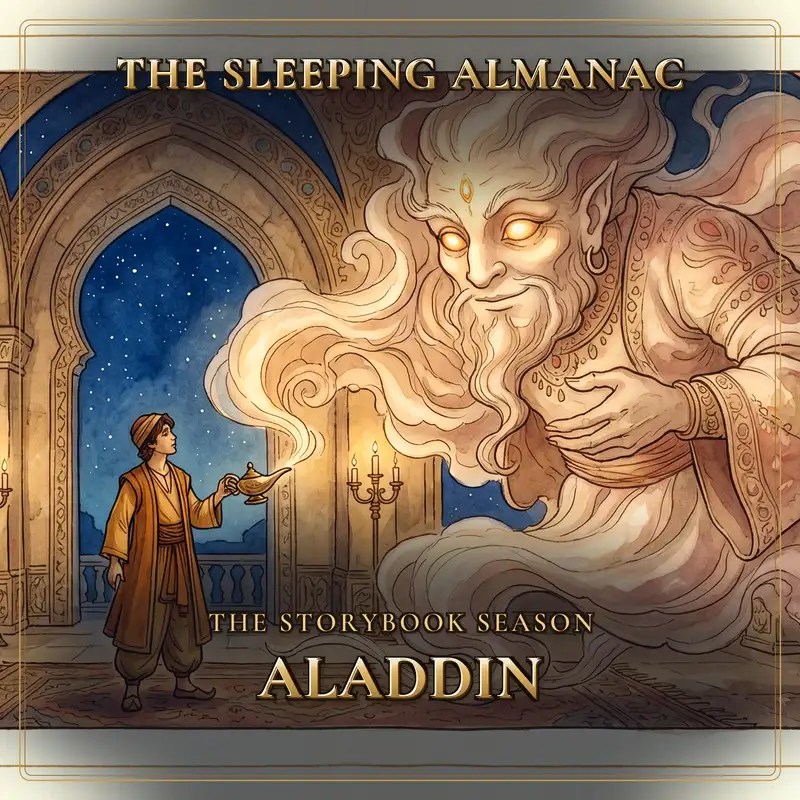
Welcome to The Sleeping Almanac.
Before the lamp is lit, one small thing. If these stories carry you to sleep, subscribe now, while your eyes are still open, and tomorrow night's tale will be waiting for you. A like helps other tired souls find this room. That is all. Let's light the lamp together now.
The lamp is lit again.
The same small flame as last night, in the same quiet room at the edge of the world.
The storyteller is already here. She was here before you arrived. She will stay until you sleep.
There is a chair for you. There is a blanket. The night outside is doing all of its slow, dark work, and none of it is yours to carry until morning.
The storyteller opens the old book, and turns past the tales already told, to a page that waits for tonight.
Tonight, she says softly, we go far to the east, to a city in China, where a boy called Aladdin carries an old brass lamp up out of the dark, with dust on his hands and the light of buried jewels still in his eyes.
And there is no hurry at all as she begins.
Settle in, now. Let the chair take your weight, all of it, even the weight you have been carrying without noticing. Let the blanket be heavy in the good way, the way snow is heavy on a roof that has nothing to do until spring. Whatever the day asked of you, it has stopped asking. You do not have to watch this story. You do not have to remember any of it in the morning.
You may believe you know this tale. You know a version of it, the way you know a photograph of a garden. Tonight you are given the garden itself, the old one, the true one, from a book older than any film, and it is stranger and slower and kinder than the one you remember. There are two genies in it, not one. There is a princess whose name means the full moon of full moons. There is a palace built between midnight and morning, and a bargain cried aloud in the street one morning so foolish that a whole city came out of its doors laughing, though only one man in that street was not joking, and every one of these things is exactly as the old book tells it.
If you drift, drift. The storyteller will not mind, and neither will Aladdin. Tales like this one were told aloud in the dark for centuries before anyone wrote them down, told to rooms full of people breathing slowly, and half of every audience this story has ever had was asleep before the palace was built. You will be in good company. We begin.
Chapter One.
The Tailor's Son.
Long ago, and very far from here, at the eastern edge of all the maps, there was a city in China.
That is what the old book says, and the storyteller reads it as it is written. A city in China. The book does not tell us the city's name. It was written down by tellers who lived a year's hard travel from China, and had never seen it, and so their China is a wonderful place, with bazaars in it, and a sultan, and sellers of dates and sweet water, a city very like their own city, only farther, and shinier at the edges, the way places are when we have only dreamed them. When those tellers wanted a story to feel as far away as a story can be, they set it in China, the way you or I might set a story on the far side of the moon.
So. A city in China, at the hour when the lamps come on.
Give it walls the color of weak tea. Give it a river gate and a mountain gate. Give it a thousand small courtyards where supper is cooking, and washing strung between the windows like flags of a very modest kingdom, and swallows turning over the rooftops in the last of the light. Give it a bazaar that is putting itself to bed, awning by awning, and a night watchman who knows every stone by the sound his sandal makes on it.
In that city there lived a poor tailor named Mustafa.
He was a good tailor and a gentle man. His shop was one room wide. He sat in the doorway of it from morning prayer to evening prayer with his legs folded and his needle rising and falling, and what he sewed held, that was his reputation, seams that outlived the garment and buttons that outlived the man. He had a wife who could make a supper out of very nearly nothing, and one son.
The son was called Aladdin.
Now the old book is stern with Aladdin, right at the start. It calls him idle. It calls him careless. It says he would not learn his father's trade or any other, that he was out the door at sunrise and back at dark, all day in the streets and the market squares with the other boys, playing at whatever the season offered, kites in the windy month, marbles in the dusty one, and no thought in his head that stayed longer than a sparrow stays on a windowsill.
The storyteller reads all that, and then she looks up from the book, and she is gentler than the book is.
Some people, she says, are born waiting for one particular hour, one door, one errand that belongs only to them. And until that hour finds them, they are no good at any other. It is a kind of patience wearing the costume of impatience. The old book calls Aladdin idle because the old book knows what is coming and is cross with him for not knowing it too. But no one knows what is coming. That is the whole arrangement.
What can be said for certain is this. Aladdin was quick, and he was friendly, and he was kind in the unplanned way of boys, which is the truest way. When he had two coins he bought two oranges and gave one away, usually to whichever child looked as though the day had been long. Every dog in the quarter knew him.
His father tried to teach him tailoring, and failed, and tried again, and grew sad about it, and then grew tired in a way that mending could not fix. And one autumn Mustafa folded his work in the evening, and slept, and did not wake. The old book says the grief of it had worn him through. We will say it that way, softly, and walk on, for this is a tale that is kind to its dead.
After that it was Aladdin and his mother in the little house. She spun cotton, and the spinning bought their bread, and their suppers were thin but they were suppers, and the roof was known by its leaks the way a friend is known by his laugh. Aladdin grew to fifteen in those narrow rooms, and still the streets held him all day, and still his one particular hour had not come to find him.
But it was coming.
For on an evening like this very evening, while the swallows turned over the rooftops and the bazaar folded its awnings and Aladdin's mother set two bowls on the table and listened for his step, not one soul in all that city knew, and Aladdin least of all, that far away to the west, across every desert the maps could hold, a man was walking toward the mountain gate with Aladdin's name in his mouth.
He had been walking, the storyteller supposes, the better part of a year, for the old book counts no miles.
He was not an uncle. Remember that, when he says otherwise.
Chapter Two.
The Stranger Who Called Him Nephew.
The man who came in at the mountain gate was a magician.
He came from Africa, from the far dry countries of the west, where the old book says the deepest magic was studied in those days, the patient kind, the kind that is mostly reading. He was not a magician of storms or of serpents. His art was quieter and stranger than that. He was a reader of sand.
He would smooth a tray of fine sand with a rod of brass, and make marks in it, and read the marks the way a merchant reads a letter, and the sand would tell him things. Where lost ships lay. Where water slept under a desert. And once, on a night he never stopped thinking about afterward, the sand had told him about a lamp.
An old lamp, of plain brass, in a hidden place under a mountain, at the eastern edge of all the maps. A lamp worth more than every treasury of every king alive, said the sand, because of what slept inside it. And then the sand had told him the part he liked least. The place would not open for him. The door in the earth would open for one person only, a boy in a certain city in China, an idle boy, a tailor's son, a boy called Aladdin.
Magic is strict that way, said the storyteller. It has rules older than the people who use them, and it does not make exceptions, even for men who have studied forty years. Especially, perhaps, for them.
So the magician had crossed the world on foot and by ship and by camel, a year of it, with the boy's name in his mouth like a stone he was afraid to swallow. And on his first evening in the city he walked the streets until he found a square where boys were playing in the last of the light, and he stood in the shadow of an awning, and he watched, and he listened, and presently he heard the other boys calling one boy Aladdin.
He looked at the boy a long time. Then he arranged his face.
This is a thing worth knowing about, the arranging of faces. The magician had practiced his the way musicians practice, alone, for years. He could put on kindness the way you or I put on a coat. And the coat was warm, and the coat was convincing, and there was nothing inside it at all.
He came out of the shadow, and he asked Aladdin his name, though he knew it, and his father's name, though he knew that too. And when Aladdin said, my father was Mustafa the tailor, but he died a long while past, the magician gave a soft cry and embraced the boy and let tears stand in his eyes, real tears, for he could do those as well.
Then I am too late, he said. Oh, my brother.
And he told Aladdin that he was his uncle. Mustafa's own brother, gone from this country forty years, trading and traveling in far places, come home at last with one wish in his heart, to see his brother's face again, and here was that face, he said, holding Aladdin at arm's length, here it was, alive again in the son. He pressed money into Aladdin's hands, real gold, and said, run to your mother, child, tell her your uncle will come tomorrow and eat supper with you, and buy meat and rice and candles.
Aladdin ran home the way boys run when they are carrying news too big for them.
His mother turned the gold over in her hand and was quiet a while. Your father had a brother once, she said at last. He died long ago, before you were born. I never in all our years heard of another.
And that, said the storyteller, was true, and the tale lets the mother say her doubt out loud on the very first evening, so that you, the listener, are never fooled for a moment, even while the little house is. You know the uncle is false. The story knows you know. It is a story about a boy walking toward his one particular hour, and the false uncle is simply the road the hour arrived by. There is no suspense gentler than watching a thing you already understand unfold exactly as it must.
The magician came to supper the next evening and wept at the empty place where Mustafa would have sat. He had studied where the empty place would be. He told long true sounding tales of his trading years, of cities of white stone and ships with cinnamon in their holds, and the little room filled up with the warmth of them, and the candles burned down, and the mother's doubt did not vanish, but it grew quiet and stood at the back.
And to Aladdin the magician said, tomorrow I will buy you a merchant's coat, and we will walk in the gardens outside the walls, and I will show you the world a little, nephew, for a boy cannot stay a boy forever.
The coat was bought. It was the finest thing Aladdin had ever worn. And for two days the magician was as good as his word, and better. They walked out by the river gate among the gardens of the rich, fountains behind lattice walls, pavilions with bells at their corners that spoke whenever the air moved. They ate melon in the shade. Everywhere the magician was generous and patient, full of plans for the shop he would open for Aladdin.
And each garden they walked to was a little farther from the walls than the last.
You will have noticed that, said the storyteller. Aladdin did not. Fifteen is not an age that measures its distance from home. Each day the fountains were finer, and the shade was deeper, and the city behind them was smaller, and on the third morning the magician woke him early, and they walked out through the mountain gate with bread and dates in a cloth, and this time they did not stop at any garden at all.
They walked all that morning, and somewhere on the path the magician stopped telling stories. Aladdin, who noticed everything and understood none of it yet, thought only that his uncle was saving his breath for the climb. Up they went, out of the gardens, into the bare brown country where the mountains begin.
Aladdin had never been so far from his own streets. It was quiet in a way he had no name for. The path went up between stones the size of houses, and the city fell away behind them until it was only a smudge of smoke and a shine of river, and the only sounds were their own feet, and the wind combing the dry grass, and once, very high up, an eagle saying the one thing eagles say.
They rested at midday in the shade of a rock, and ate the bread and the dates, and the magician told stories of the mountains of his own country. Then they went on, and in the middle of the afternoon they came to a narrow valley between two mountains, a quiet fold in the world where the wind did not reach and nothing grew but a few grey bushes.
This is the place, said the magician, and his voice had changed. The kindness was still on it, but stretched now, tight over something underneath, the way cloth stretches over a box you cannot see into.
Gather me sticks, nephew. We will make a small fire.
Aladdin gathered dry brush, glad of something to do, and the magician built the fire small and neat and lit it. And when it was burning he took from inside his robe a little box, and out of the box a pinch of grey powder, incense of a kind, and he stood over the fire, and he said two words that Aladdin did not know, in a language Aladdin did not know, and threw the powder on the flames.
The smoke went up white and sweet and sudden.
And the ground made a sound.
It was not a crack of thunder. The old book does not deal in thunder here, and neither will we. It was a low sound, far under their feet, like a door being tried in a distant part of a very large house. The dust jumped once, softly, all across the valley floor. And the earth in front of the fire opened along a straight seam, quietly, the way a book opens, and folded its dry soil back, and showed them what it had been keeping.
A stone lay in the ground. A square stone, flat, the size of a table for four, with an old shine on it as though many hands had once kept it polished, and in the center of it a ring of brass, green with a thousand years, made fast to the stone as a knocker is made fast to a door.
Aladdin stood very still. The fire snapped once. High up, the eagle turned.
Do not be afraid, said the magician, and for that one moment, oddly, he meant it, for a frightened boy was no use to him at all. Nothing here will harm you. Under that stone is a treasure that has been waiting a long time, and here is the strangeness of it, nephew. It has been waiting for you. Not for me. Not for any king. It will not open for me, I have known that for years. It opens for a boy called Aladdin, the son of Mustafa the tailor, and there is no other such boy in the world.
Take hold of the ring. It will not be heavy for you. Say your name as you lift, and your father's name, and your mother's name with them.
And Aladdin, who was afraid, and who was fifteen, and to whom no one had ever once said you are the only person in the world who can do this, stepped forward and took the brass ring in both hands.
It was warm. That surprised him. Warm as a kettle a long while off the fire.
Aladdin, he said, and his voice wobbled, and he steadied it. Aladdin, son of Mustafa the tailor and of the spinner his wife.
And the stone came up as lightly as a lid comes off a basket.
Under it, going down into the dark, there were steps. Clean stone steps, wide and shallow, without a grain of dust on them, and from somewhere far down at the bottom of them came a smell that was not the smell of a hole in the ground at all. It was green. It was the smell of a garden after rain, rising out of the earth in the middle of a bare brown valley.
The magician crouched by the opening, and his eyes had a lamplight in them that did not come from any lamp.
Listen to me now, nephew, he said. Listen as you have never listened. Go down these steps and you will come to a door, and past the door three great halls, one after another, with jars of bronze along the walls, full of gold and silver. Touch none of it. Gather your coat close about you and let not even the hem of it brush the walls or the jars, for everything in those halls belongs to the treasure, and the treasure knows its own. Walk through, touching nothing, and you will come out into a garden of trees, and past the garden, up a few steps, on a ledge in the wall, you will find a lamp. A small old lamp of brass, lit and burning. Take it down, pour out the oil, and put it inside your shirt, against your chest, and bring it to me. That is all. That is everything. On the way back, if you like, you may pick what grows on the trees, that much is allowed to you.
And here, he said, take this.
He drew from his own finger a ring, a worn silver ring with a dull stone, and he put it on Aladdin's finger, where it fitted as though it had been measured.
It was, said the storyteller, the single truthful gift the magician gave in the whole of this tale, and he gave it believing it was nothing, a trinket blessed for luck. Magicians read sand, but they cannot read what a gift will come to mean. Nobody can.
It will keep you from harm, said the magician. Now go down, nephew. Go down, and bring me the lamp.
And Aladdin went down the clean stone steps, into the smell of rain and gardens, and the daylight stayed behind him at the top like a friend who could come no farther. But the smell of rain and green leaves rose up the stair to meet him, and it was a kind smell, and he followed it down without fear.
Chapter Three.
The Garden of Jewel Fruit.
The steps went down farther than any cellar, and yet it never once grew dark.
That was the first strangeness, and Aladdin stopped on the stairs when he noticed it. There were no lamps, and there were no windows, and still the air held a soft grey shine everywhere, like the light inside a pearl, like the hour before sunrise when nothing has a shadow yet. Light with no source and no direction. The old book does not explain it. Deep places in old tales are lit that way, and the storyteller has always believed it is because the tales themselves need to see.
At the bottom of the steps stood a door of plain dark wood, unlocked, and past it the first of the three halls.
They were larger than the great mosque of his city, with ceilings lost in the pearl colored light. And all along the walls, just as the magician had said, stood jars of bronze, each one tall as a man, each one filled past its brim, and the gold in them did not glitter. It glowed. It lay there with the deep settled shine of things that have been asleep a very long time, coin over coin over coin, more in one jar than a sultan spends in a lifetime, and the silence over all of it was the thickest silence Aladdin had ever heard.
He gathered his coat close about him, both fists full of the cloth, and he walked down the exact middle of that hall like a boy walking a plank over deep water. Touch nothing. He said it to himself in his mother's voice, which is the voice most of us use for rules when we truly mean to keep them.
Through the first hall. Through the second, where the jars held silver, whiter than moonlight on snow. Through the third, where the jars held gold again, and where one coin lay alone on the floor near the wall, and Aladdin walked past it and did not so much as let his shadow linger on it. The old book pauses to say he obeyed exactly, and old books do not hand out such praise easily, so let it stand. In the deepest room of the world, with nobody watching, the idle boy did exactly as he had been told.
And then the third hall ended, and Aladdin came out through an arch of white stone, and stopped, and forgot his coat, and forgot the magician, and very nearly forgot his own name.
He was in the garden.
It lay under the earth in that same pearl grey light, wide as a field, quiet as a snowfall, and it was full of trees. Real trees, with bark and boughs and thousands upon thousands of leaves, and every leaf was silver on one side and green enamel on the other, so that when the still air moved at all, which it did, slowly, like breathing, the whole garden shimmered and whispered with a sound like far away rain.
And the trees were in fruit.
The fruit hung heavy on every bough, round and polished, in every color light can be. White fruit, with a soft deep shine to it, in clusters like enormous grapes. Clear fruit, bright as ice in the sun, that gathered up the grey light and gave it back in little rainbows. Red fruit, dark as pomegranate seeds and darker. Green fruit, deep as the deepest part of a wave. Blue fruit, the blue of evening exactly, as though each one held its own small piece of dusk.
Aladdin stood under those trees, and looked up, and laughed. One laugh, soft, astonished, and the garden took it and passed it from leaf to leaf until it came back to him as a whisper from the far wall.
He thought it was glass.
The storyteller lays the book down flat here, because this is the hinge of the whole tale, and it goes by in one line. The white fruits were pearls. The clear ones were diamonds. The red were rubies, the green were emeralds, the blue were sapphires, and any single one of them outweighed the treasury of the sultan of that country, and Aladdin, the tailor's son, who had never in his life held anything more precious than a copper coin and a good orange, looked up at the wealth of ten thousand kings and thought, glass. How pretty. My mother will like these.
He was allowed the fruit, the magician had said so. So he picked as boys pick, cheerfully, without ceremony. He filled his two purses. He filled the front of his shirt. He loaded the wide sleeves of his merchant's coat until they swung at his sides like saddlebags, choosing by color, plenty of the red and the green, the blue ones for his mother especially, because she kept one square of blue cloth from her wedding in a chest and took it out sometimes just to look at.
And when he could carry no more, he remembered the lamp.
It stood where the magician had said it would stand, past the last of the trees, up a flight of shallow steps, in a small arched hollow in the garden wall, the way a candle stands in a window. It was burning. A little tongue of flame, very calm, and by now Aladdin knew better than to ask what it burned, for there was no one to fill it, and there had been no one for a very long time.
It was small. It was brass. It was, next to the garden and the halls and all that sleeping gold, the plainest thing in that whole deep place. An old lamp such as any old woman keeps on any shelf in any lane of any city, dented at the shoulder, dark with years. Whatever in the world made it worth a year of walking, Aladdin could not see it.
But his uncle wanted the lamp, and his uncle had been kind.
So he climbed the steps and took it down, and the flame went out sweetly of itself, like a child allowed at last to stop pretending to be awake. He poured out the drop of oil that was in it. He tucked it inside his shirt, against his chest, where it sat with a small settled weight, warmer than brass ought to be, the way the ring in the stone had been warm.
Then he turned and walked back, down the steps, under the whispering trees, through the three great halls with his coat gathered tight, to the foot of the long stair, where far above him the daylight waited in a small blue square, with the shape of the magician's head and shoulders leaning into it.
Chapter Four.
The Ring Turned in the Dark.
Climbing stairs with your sleeves full of treasure is slow work, and Aladdin came up the long flight one careful step at a time, both arms cradled against himself like a man carrying firewood.
He stopped a few steps from the top. The stone doorway there was narrow, and he was wide with his cargo, and he needed a hand up.
Uncle, he said. Help me out. I am too loaded to climb.
Give me the lamp first, said the magician. Reach it up to me. It will lighten you.
And it would have. Only the lamp was inside Aladdin's shirt, packed down under a shirt front full of jewel fruit, and to dig it out he would have had to unlade every purse and sleeve on that narrow stair, and besides, in some hallway of his heart a door had quietly shut, one he did not even hear shutting. All at once he did not want to hand the lamp up into that reaching silhouette before he himself was standing in the daylight.
When I am out, uncle, he said. I cannot reach it now. Pull me up, and you shall have it that same minute.
The lamp, said the magician. First the lamp.
His voice, doing this, lost the last of its stretch, and what was under the cloth showed plain. Forty years of reading sand. A year of deserts. And one idle boy, one stair's length from his hand, saying no. Not even saying no. Saying, in a minute. The old book says his rage rose up like smoke. Greedy men, said the storyteller, trust no one, for they measure the whole world by the only heart they have ever examined closely, which is their own.
The magician stood. He threw the rest of his grey powder on the embers of the fire, and said his two words, and the earth sighed, and the stone sank back into its bed, and the seam of soil folded itself closed over the stone, and the valley lay bare and brown and quiet under the late sun, as though no door had ever been in it.
And the magician turned and began to walk west, back toward Africa, empty handed, a year of walking for nothing, leaving behind him the one thing he had crossed the world for. He believed he was leaving a boy shut in the dark. What he was in fact leaving, sealed safe underground like a seed in autumn, was a boy, and a lamp, and a ring, all three together, which was the very sum of everything he wanted in the world. There is a lesson in that about anger, said the storyteller, but the tale is wise enough not to say it out loud, and so am I.
Now.
We must speak of Aladdin in the dark, and we will do it honestly and gently, for this is the low place of the tale.
When the light at the top of the stairs went out, the dark that came was complete. He called, and no one answered. He climbed to where the stone was and pushed, and it was like pushing the mountain. He went down again, feeling each step with his foot, thinking to wait in the garden among the shining trees, but the door of dark wood at the stair's foot had shut with the stone, and would not open. So the stair itself was his lodging, a clean stone stair in a dry dark, and there he stayed.
The old book gives him three days there. The storyteller will not walk you through them hour by hour. Only know this much. He was not brave the whole time. Nobody is. He wept, and he slept, and he woke and forgot where he was, and remembered, and wept again, and slept again. He thought of his mother with the two bowls set out. And the dark, which was complete, was at least not cold, and the stair was smooth, and sleep kept coming back for him, the way it does, the way it will, sleep being the one visitor no door in the world can keep out.
And on the third day, Aladdin did the thing that people in trouble have always done. He put his hands together, and bowed his head, and prepared to pray.
And as he pressed his hands together, one hand chanced to turn the old silver ring on the finger of the other. Turned it. Rubbed it, just so.
The dark filled up with light, rose colored, soft, like dawn arriving indoors. And there was a being on the stair.
It was tall, taller than the stair should have held, and yet the stair held it comfortably, for beings of that kind bring their own room with them. It was made, as near as Aladdin could tell, of smoke and embers and courtesy. Its eyes were like lamps in the evening, and when it spoke, its voice was enormous and quiet at once, like a bell heard from underwater, and it said the words that its kind have always said.
I am the servant of the ring, it said. I serve the one who wears it. Ask what you will.
And Aladdin, three days in the dark, fifteen years old, his sleeves full of fruit he thought was glass, did not ask for gold, or for vengeance, or for a palace, or for any of the twelve clever things you or I would like to believe we would have asked for.
Take me out of this place, he said.
Ah, said the storyteller. There. That is my favorite moment in the whole of this tale. The old book gives the wish only those few plain words, take me out of this place. But watch what the boy does with his freedom. All the treasure of the deep earth on his back, and a spirit of the ring bowing before him, and he asks for no gold and no vengeance and no throne, and walks straight down the mountain in the dark, home to his mother's table with the two bowls on it. Keep that boy in your mind tonight. The tale is about to make him the richest man under the sun, and it matters, it matters more than anything, that when the ground first asked him what he truly wanted, the answer was, home.
The earth passed him upward through itself as easily as water passes a bubble up, and set him gently on the brown floor of the valley in the last light of day, and the rose colored glow paid itself out and was gone.
The evening air. The smell of dry grass. One eagle, or its granddaughter, high up, turning.
Aladdin walked down out of the mountains in the dark, following the river shine, and came to the gate at midnight, and came up his own lane past the sleeping doorways, and lifted the latch he had lifted all his life. And his mother, who had not slept in three nights either, met him at the door, and what they said belongs to them, not to us, and even the old book has the manners to close that door and let them have it.
He slept until noon of the following day, in his own corner, on his own mat, with the lamp under it wrapped in his coat, and all the jewel fruit heaped in a basket by the wall, glowing quietly in the dark of the little house like coals that give no heat, and no one in all the city knew that the poorest lane inside the river gate now held the greatest treasure on the face of the earth.
Chapter Five.
The Genie of the Lamp.
Hunger woke him, as it will, and hunger had beaten him to the cupboard, for there was nothing in the house at all.
His mother counted through her spinning, but the cotton was sold and the new was not spun. And then Aladdin remembered the lamp. We might sell it, he said, digging it out of the folded coat. Old brass fetches a little. It would buy today's supper, and tomorrow I will think of tomorrow.
His mother turned the lamp over. It was dark with years and dented at the shoulder, and no one buys a dirty lamp when a clean one stands beside it, so she sat down on the doorstep with a handful of fine sand, the way lamps were scoured in that country, and began to rub it bright.
She had rubbed exactly twice.
The air in the little room folded itself open, and there was a being in it, filling it, the way a tree fills a courtyard, made of the cousin stuff of the ring's servant but older, grander, its shoulders in the rafters, its eyes like two evening windows with lamplight behind them, and it bowed as well as the ceiling allowed and said, in a voice that came from everywhere in the room at once,
I am the servant of the lamp. I serve the one who holds it. Ask what you will.
Aladdin's mother fainted dead away, which the old book reports without unkindness, and so do we, for it is exactly what any of us would have done.
But Aladdin had seen a being of this kind before. Three days in the dark had left him, in this one narrow subject, the most experienced person in the city. He picked up the lamp from where it had rolled, and he stood as straight as he knew how, and he said the thing that was true.
We are hungry, he said. Bring us something to eat.
The being was gone and back between one breath and the next. And in the middle of the poorest room in the lane there stood a great tray of silver, and on it twelve dishes of silver with dinner in them, fresh bread that was still warm, and two cups, and two flasks of something cool. The smell of it filled the house. It was the smell of the kind of kitchen neither of them had ever so much as stood in.
And the servant of the lamp bowed and folded itself away into the air, and the room was only a room again, with a fortune in silver sitting on the floor of it, steaming gently.
Mother and son looked at the tray a long while before either of them could touch it. Then they ate, slowly and in silence and then not in silence, and the meal on those dishes lasted them two days.
His mother never touched the lamp again. She would dust the shelf below it and the shelf above it and leave the lamp its own dust, and once, the old book says, she begged Aladdin to sell it and have done with spirits forever. He smiled, and kept it, and she never asked again, though it may be noted that she moved her spinning to the far side of the room, and kept it there for years.
Now here the tale goes quiet for a stretch, said the storyteller, and it is one of the loveliest quiets in the old book, so we will keep it a while ourselves.
Because Aladdin did not race to the palace, and did not pour his jewels on a table, and did not become a great man by Friday. What happened instead is that when the food was gone, he took one of the twelve silver dishes to the market and sold it, and they lived on that. And when that was spent, he sold another. A dish at a time, a month at a time, the lamp resting quiet on its shelf, the basket of jewel fruit sitting in the corner covered with the old blue wedding cloth, because they still, mark this, they still thought the fruit was colored glass, and the true fortune of the house was, they believed, its dwindling stack of dinnerware.
The merchant who bought the dishes had quick eyes and a slow scale, and paid a fraction of their worth, and Aladdin, who knew no better, thanked him each time. Until the day an old goldsmith farther down the row called the boy over, and weighed the next dish honestly, and paid him honestly, which came to more than all the other dishes together had fetched, and told him plainly what such work was worth.
And something else happened in those quiet months, more slowly still. Aladdin began sitting among the merchants. It had begun as business and became a kind of school. He learned how cloth is judged, and how rumor is discounted, and how a man's word is weighed on scales you cannot see. He began to walk differently, not proudly, only certainly. And one afternoon, standing where the jewel sellers traded, watching stones a hundredth the size of his mother's covered basket change hands for chests of gold, Aladdin understood, all at once, in the middle of the street, with the sun on his back, what it was that grew on those silver trees in the garden under the mountain.
He walked home slowly that day, said the storyteller. You would too.
But he told no one, and he sold none of it, and the basket stayed in its corner under the blue cloth. His hour had found him, and he seemed to know now that the rest of it would come in its own season, the way he knew rain was coming by the smell of the wind.
And it came. It came on the day of the princess.
Chapter Six.
The Princess Badroulbadour.
The sultan of that country had one daughter, and her name was Badroulbadour, which in the old tongue means the full moon of full moons.
She had lived her whole life inside the palace walls, in the manner of princesses of that age and place, and the city had loved her its whole life without ever once seeing her, which is a strange kind of love but a real one. They knew her the way people know the sea who live one valley from the coast. By report. By weather. By the salt that reached them on the wind.
On certain days the princess went with her women to the great bath house, which stood apart from the palace among its own gardens, and on those days the streets along her way were cleared by proclamation, and the shutters were drawn, and the city turned its back politely while she passed, for it was the law that no man should look on her face, an old law the city was fond of, the way cities are fond of laws that make their princess feel like a secret they are all keeping together.
Aladdin had heard the proclamation cried that morning, and Aladdin, said the storyteller, closing one finger in the book, was fifteen no longer, but he had been fifteen recently enough to remember the way. He did not clear the street. He went quietly along the lanes to the bath house, and let himself into the shadow behind the great cedar door, and stood still as a hinge, and waited, curious for one look at the face the whole city had agreed not to see.
The street filled with the sound of the procession, soft drums and slippers and the rustle of a hundred veils. The princess came up the steps among her women like the moon among thin clouds. And at the threshold of the door, one step from where the world's most patient idle boy stood breathing as quietly as he had ever breathed, Badroulbadour reached up and put back her veil, because she was arriving indoors, and the day was warm, and she had no reason in the world to believe the street was anything but empty.
The old book spends its finest page here, and the storyteller will not race it. Her face was oval, says the book, and her eyes were large and dark and gentle, and her look was the look of someone thinking of something pleasant and far away, and her hair was blackness itself with lamplight in it. But what undid Aladdin was nothing a page can hold. It was that she was real. A real person, breathing, blinking against the warm air, a little tired, humming two notes of something to herself as she passed in out of the sun. The city had made her a legend, and legends do not need us. But this was a young woman with a life, and from that moment his own life bent toward hers the way a stream bends toward a valley, without argument, without noise, following the simple slope of the world.
He went home and did not eat, and did not speak, and sat with his back against the wall looking at nothing, until his mother, who had raised him and buried his father and fainted at a genie and was not to be frightened by a mood, put down her spinning and said, well. Tell me.
Mother, said Aladdin, I have seen the princess Badroulbadour, and I mean to ask the sultan for her hand.
His mother laughed, said the old book, until she had to hold the doorpost, and the storyteller loves her for it, and Aladdin only waited, because he had learned waiting from the best dark room in the world. And when the laughing was done she argued, and he waited through that as well. You, she said, the tailor's son, and what would you even carry to the palace, child, for no one comes before the sultan asking a favor with empty hands. What in this house could stand in front of a throne.
And Aladdin looked at the corner, at the basket, at the old blue cloth.
Mother, he said gently, I have not told you yet what it is you keep under your wedding veil.
He told her. He took out the fruits one by one into the lamplight, the moons of pearl, the coals of ruby, the drops of deep sea green, and he set them in a porcelain bowl, and this time nobody in that room called them glass, and the little house was as quiet as the underground garden, and the smallest stone in the bowl was worth the street they lived on.
His mother went to the palace in the morning, in her clean dress, with the bowl wrapped in a napkin, and stood at the very back of the great hall where the sultan heard petitions. And her courage failed her, and she came home with the napkin unopened, and Aladdin thanked her, and she went again. Six mornings she went, said the old book, and six mornings stood at the back holding her folded courage in a cloth, and the seventh morning the sultan himself, who had been noticing her longer than she knew, said to his grand vizier, that same quiet woman is here again. Bring her forward. Whatever she carries, she carries it patiently, and I will know what it is.
So she came forward, and knelt, and begged pardon in advance for the boldness of her son, which is what mothers do, and unfolded the napkin.
The hall changed color. The old book says the jewels filled the place with light, and flung little wandering stains of rose and green and violet up the pillars and across the ceiling, and the whole court leaned like grass in wind. The sultan looked a long time into the bowl. He had a treasury, and knew what was in it, and knew that nothing in it stood anywhere near the nearest of these.
And what does the sender of this ask, he said at last, quietly.
And Aladdin's mother, from the floor of the shining hall, in the smallest voice ever to fill it, said, the hand of the princess Badroulbadour, for my son Aladdin.
Chapter Seven.
Forty Basins of Gold.
Now the sultan was minded to say yes on the spot, jewels being a language sultans read fluently. But at his right hand stood the grand vizier, and the grand vizier had a son of his own, and had spent long months steering that son gently toward the princess the way a careful man steers a boat toward a private harbor.
Majesty, murmured the vizier, a bowl of stones, however fine, from a man no one at court has ever seen. Give it three months. If he is worthy, three months will not hurt him. If he is not, three months will show it.
Three months, said the sultan to Aladdin's mother, kindly enough. Let your son come to me in three months.
And she carried the answer home, and Aladdin heard it, and was glad with his whole heart, for three months is nothing at all to a boy who has waited in the dark. He began, quietly, to get ready.
But two months in, walking in the bazaar, his mother heard drums, and asked the oil seller's wife what feast it was. And the woman said, why, where have you been, it is the wedding. The princess Badroulbadour marries the son of the grand vizier tonight.
A promise had been broken. It happens in palaces as it happens in lanes. And Aladdin, hearing it at home with the dust of the bazaar still on his mother's shawl, sat still a long moment, and then he did not shout, and he did not despair. He went to the shelf, and took down the lamp, and rubbed it, and when the great courteous shape of its servant stood filling the room, Aladdin, it must be told, arranged a small and entirely gentle mischief.
What he asked, the old book tells with a straight face, and so shall I. That night, when the palace slept, the bridal bed itself, with the vizier's son in it, rose and floated out of the palace like a boat off its mooring, and came to rest in Aladdin's little house. The vizier's son spent his wedding night shivering in the lumber room among the spinning baskets, certain he was dreaming and hoping he was, while the princess, the old book admits, slept badly in a strange room, as anyone would, and the storyteller will not pretend otherwise. But the book also swears that no harm came near her, not once, not for a moment, and that is the part to carry. And Aladdin, says the old book, laid a drawn sword down the middle of the bed and slept on the far side of it, steel for a promise that she was as safe in that house as in her father's. And before first light, bed and sleepers sailed home again, and were found in the morning exactly where they ought to be, save that the bridegroom had somehow acquired a cold.
Two nights of this, said the old book, no more, and the vizier's son, who had never been consulted about the harbor his father steered him toward, went to the sultan of his own accord and begged to be released from the marriage, and was, to the private relief, one may guess, of everyone concerned including the bride, who had formed her own opinion of a husband who vanished into lumber rooms.
And the third morning, Aladdin's mother stood again at the back of the great hall, patient as furniture, and the sultan saw her, and remembered his promise, and had the grace to feel it.
But the vizier leaned close once more. Majesty, set a price no tailor's son can pay. Then the promise keeps itself.
So the sultan named his price, and it was this. Forty basins of beaten gold, every basin brimming with those same fruits of jewel, and the basins to be carried through the streets by eighty servants clothed in silk and gold, forty to bear and forty to attend, in procession, for all the city to see. That, said the sultan, or no wedding, and he said it in the voice of a man closing a door forever, and was sorry as he said it, for he had rather liked the look of that bowl.
Aladdin's mother came home walking like a woman who has been asked to fetch the moon in a bucket.
And Aladdin listened, and kissed her, and went in to the lamp.
What happened in the city that noon was talked of for three generations. Out of the poorest lane inside the river gate came a procession such as no capital has seen before or since. Eighty servants, tall and calm and beautiful, in silk the color of deep water stitched with gold, walking two by two, and every second one bore on his head a basin of massy gold, and the basins were heaped past their brims with pearl and ruby and emerald and sapphire, uncovered, blazing in the sun, a river of impossible wealth flowing slowly through streets lined with every soul who could stand, walk, or be carried. No guard went with the treasure. None was needed. There are sights that put even the idea of theft to sleep, and this was one. The procession crossed the whole city at a walking pace, in through the palace gates, up the length of the great hall, and the eighty set down their basins before the throne, and bowed once, all together, like a field bowing under one wind.
The sultan looked down the hall at forty basins of what no treasury on earth could match one basin of.
Send for the young man, he said, when he could.
And when Aladdin came, bathed and dressed as the lamp knew how to dress him, riding slowly so the city could look at him, scattering handfuls of gold to the children in the crossings because he remembered exactly, exactly, what it was to be a child in those crossings, the sultan came down from the throne itself to meet him, and found his hand taken, and kissed, respectfully, by a young man with a steady eye and no swagger in him at all, who had, everyone agreed, a way of seeming to have all the time in the world.
The wedding, said the sultan, may be as soon as you like.
Sire, said Aladdin, thank you. But first, if the princess is willing, I should like to build her a house.
Chapter Eight.
The Palace Built in a Night.
He asked the lamp for it that same midnight, standing in the little room where all of this had begun, and he asked not like a boy wishing but like a man who had spent months quietly deciding. This is what he asked.
A palace, facing the sultan's own across the great square, but set back, respectfully, with gardens between. Marble of every warm color, rose and cream and honey. Fountains in the courtyards, and stables, and kitchens, and a treasury, and windows placed to catch the morning. And at the heart of it one high hall with four and twenty windows, and every window's lattice to be worked not in iron but in diamonds and rubies and emeralds, so that the daylight coming in should fall through jewels and lie on the floor in colors, all day, moving with the sun, like the inside of the garden under the mountain.
All but one window, said Aladdin. The last window leave unfinished. Plain stone, empty, untouched.
And if the servant of the lamp was puzzled, it did not say so. Its kind ask what you will, not why.
The city went to sleep that night with a bare paved square outside the sultan's windows, and woke to bells and shouting and then to a most unusual silence, the silence of forty thousand people all leaning out of windows at once. Across the square, with the early mist still moving in its new gardens, stood a palace where no palace had been at bedtime. Rose marble and cream marble, courts and towers, doves already settled on its ledges as though they had lived there for years, fountains already speaking in its courtyards, and from its gates to the sultan's gates, laid across the whole square in the night, a carpet of velvet for the princess to walk on.
The sultan stood at his window a long time that morning. Then he began, hugely, helplessly, to laugh, and the laugh was heard in the square, and the city took it up, and that was the true beginning of the wedding, and the feasting ran on for days the old book does not trouble to count.
Of the wedding itself the old book gives us music and lamplight and the whole city fed at long tables in the streets, and gives us, better than any of it, one small hour. In the middle of the feasting, Badroulbadour and Aladdin, wife and husband now, walked out of the noise together onto a terrace of the new palace to breathe, and stood looking at the lit city, and had, for the very first time, a conversation. The old book does not follow them out there, and the storyteller would not dream of it. She will only tell you that they came back in an hour looking as though they had known one another a long time. She had been a legend to him at a doorway. He had been a procession to her, and a story her maids told. On the terrace, those two strangers put down the legend and the procession, and picked up something plainer and better, and it lasted them all their lives.
And the unfinished window. Ah, said the storyteller, this is a passage the old tellers polished like a stone they loved.
The sultan, touring his son in law's palace in the days after the wedding, came to the high hall and stood turning in the middle of it with his mouth open, jeweled light sliding over his robes, and then he saw the one plain window, and cried out as though he had found a wound. Aladdin, what is this. The workmen have cheated you. And Aladdin said gravely, no, sire. I left it so on purpose. I wished your majesty to have the honor of completing the palace, so that it should be our two houses' work, and not mine alone.
The sultan was so pleased he ordered it begun that same day. He sent for the royal jewelers, and they sent for the guild, and the guild sent for the whole city's stock, and for a month the finest hands in the kingdom fitted diamonds to that lattice from dawn to dusk. At the month's end they had finished less than half of one side of the frame, and used up every fine stone in the capital to do it, and the chief jeweler came before the sultan and confessed, ashen, that the window had beaten them, that all the jewels of the kingdom could not fill it.
Take out what you have set, said Aladdin gently, and give every stone back where it came from.
And when the workmen and their sacks were gone home, and the hall stood empty in the late light, he took out the lamp and touched it, and by morning the four and twentieth window matched its sisters so perfectly that no eye alive could say which one had ever stood empty. The sultan, seeing it, was quiet a long while. He was beginning to understand, without any name for it, the size of what had married into his family. If it troubled him, the sight of his daughter laughing in the jeweled light put an end to the trouble, and he chose, as wise men choose, to be glad of a mystery that was kind.
So the years came in, and they were good years. Aladdin wore his fortune the way his father had sewn seams, evenly, and made to last. And in the sunniest rooms of the new palace lived Aladdin's mother, who had a servant now for every task she had ever done alone, and who spun cotton anyway, most afternoons, by an open window, because her hands were happier working. Badroulbadour would come and sit among the spindles some evenings, more evenings than the court ever knew, and the two of them talked of Aladdin the way two people talk of a river they both live beside. He rode out among the people with his purse open, sat with merchants like a merchant and with porters like a porter, judged quarrels so fairly that men came out of the countryside to be judged by him, and was loved in that city as few kings' sons have ever managed to be loved, because the city could feel, without being told, that he was one of its own lanes come to glory. And Badroulbadour, who had married a bowl of jewels and a broken promise mended, found she had married the one man in the kingdom who knew exactly how lucky he was, and there is no better husband made than that.
The lamp rested in those years on a cornice in the hall of the four and twenty windows, plain and dark among the splendor, and was rarely touched now, for their days needed little that hands could not do. And far away, at the western edge of all the maps, in a dry country, at a table of smoothed sand, a man who was not an uncle sat down one morning to read, for idle curiosity's sake, the fortunes of a boy he was quite sure had been dead for years.
Chapter Nine.
New Lamps for Old.
The sand told him everything.
He had smoothed his tray that morning expecting the small sour satisfaction of reading a grave. Instead the marks said, alive. They said, married. They said, beloved of a princess, beloved of a city, rich past the counting of it, and living at his ease in a palace with four and twenty jeweled windows. The magician sat very still at his table for a long time. He did not ask the sand where such a palace had come from. Forty years of study can spare a man some questions.
What rose in him this time was not the smoke of rage. It was something slower and colder, and it packed his bags for him, and it kept him company all the long months of the second journey east. A year of travel is nothing at all, said the storyteller, to a man who is only carrying one thought.
In the city he took a room near the bazaar and did what he did best, which was listen. It was easy listening. The whole city talked of Prince Aladdin the way a garden talks of rain. On the third morning he learned that the prince had ridden out hunting with his men, eight days of hunting, three of them already spent. And the sand, consulted quietly that night, told him the last thing he needed. The lamp had not gone hunting. The lamp was in the palace.
The next day a coppersmith in the bazaar sold a dozen new lamps to a foreign gentleman who paid without bargaining. The foreign gentleman polished them brighter still, laid them in a basket, and traded his fine robe for the worn cloak of a peddler. He had worn kindness like a coat for years. Foolishness, it turns out, is an easier coat to sew. He put it on, took up the basket, and went out into the streets crying the most famous foolish bargain in the world.
New lamps for old. New lamps for old.
The children found him first, the way children find anything wonderful. Then the crowd. By the time he had worked his slow way to the great square, half the quarter followed him laughing, and battered old lamps came down off shelves all along his route, and bright new lamps went home in their place, and the city was delighted with its madman. He let them laugh. He walked at a peddler's pace, crying his cry, and his eyes never stopped working along the walls above him, where the four and twenty windows took the sun.
The princess Badroulbadour heard the laughter from the high hall and sent a maid to learn the joke. The maid came back laughing herself. An old peddler, she said, trading new lamps for old ones, straight across, and the street is emptying its cupboards at him. And another of the women said, why, mistress, there is that shabby old lamp on the cornice in the hall itself. The master left it behind when he rode out, for who takes a lamp hunting. Shall we see if the madman will truly trade.
Now the storyteller sets down the book a moment, and asks for gentleness.
Badroulbadour knew nothing. Aladdin had never told her what the lamp was. It was the one secret he had kept, not from mistrust, but because the right evening to tell it never quite seemed to arrive. You cannot guard a treasure that no one has told you is a treasure. She sent the old lamp down to the gate laughing, expecting a funny story to tell her husband when he rode home, and there is no more blame in her than in the doves on the ledges. The old book does not scold her. Neither will we.
At the gate, a hand came out from under a peddler's cloak and closed around the old brass lamp, and went still, the way a man goes still when a long fever leaves him.
The peddler did not even take up his basket. He left the whole shining dozen for whoever wanted them, and walked out of the laughing crowd at his same slow pace, and out of the quarter, and out of the gates, and into the empty country beyond the gardens. And at nightfall, in a lonely place, he set the lamp on a stone and rubbed it.
The servant of the lamp came, filling the dusk, and bowed. It serves the one who holds it. That is the whole of its law, and it is an old law, older than kindness, and it does not ask how the holding came about. Ask what you will, it said.
Carry the palace of Aladdin, said the magician, with all it holds, to Africa, and set it down outside my own city. And it was done that night, between midnight and morning, as quietly as the palace had first been built. The city slept, and heard nothing. Only a night watchman on his rounds felt a great shadow pass between himself and the stars, the way a cloud passes, and looked up, and the stars were back, and he walked on.
In the grey of morning the sultan came to his window as he had come every morning for years, to be glad of his daughter's house before breakfast.
The square was bare. Paved stone from edge to edge, and the early mist moving over it with nothing to move around, and above it a slow circling of doves with nowhere left to land.
We will pass quickly over the sultan's grief, because it was a father's, and it was real, and grief that is real is not for dwelling on tonight. Riders went out. Aladdin was found at his hunting and brought back, and the old book does not hide that he was brought back roughly, or that the grand vizier, at the sultan's ear, said, there stands your builder of wonders, majesty, and where is your daughter this morning. But when Aladdin was led through the streets, the city came out of its doors and filled the square, porters and merchants and children and the old goldsmith from the row, standing quietly, in their thousands. The sultan looked out at his whole city, standing there for one man. Some kings would have found anger in that sight, said the storyteller. This one, to his credit, found his senses.
Find her, he said to Aladdin. Bring her back to me. That is all I ask, and all the treasure of your wedding is nothing beside it. And Aladdin bowed, and asked for forty days to bring her home, and asked nothing else but a horse.
For three days he searched and asked, and no one could tell him anything, for what answer is there to the question, has anyone seen my palace. He rode until the horse was tired, and then he walked, and on the evening of the third day he came to a river at the edge of the wild country, and stopped on the bank, and knelt, and pressed his hands together to pray.
And as he pressed his hands together, one hand turned the old silver ring upon the other.
Rose light opened over the water, soft as dawn arriving indoors, and the servant of the ring stood on the riverbank, smaller than its cousin of the lamp, and older in its courtesy, and it bowed and said, as it had said in the dark under the mountain, I am the servant of the ring. I serve the one who wears it. Ask what you will.
Bring my palace home, said Aladdin. Bring me my wife.
That I cannot do, said the servant of the ring, and it said so gently, for the laws it lived by were not its own choosing. What the servant of the lamp has done, only the servant of the lamp may undo. But what I may do, I will. I can carry you to where your palace stands.
Then take me there, said Aladdin, and set me down beneath her window.
And the river and the reeds and the whole darkening world turned past him like a page, and he was set down on cool grass in a dry country at the western edge of all the maps, in the hour before sunrise, under high walls of rose and cream marble that he knew as well as he knew his mother's doorway. Far above him, one window showed the small warm light of a lamp kept burning by someone who could not sleep.
Badroulbadour had slept little in that stolen palace, and risen early each of its mornings, and it was one of her women, opening the shutters to the grey light, who looked down and put her hand over her mouth.
Mistress. Come and see who is standing in the grass.
The old book gives them their meeting at that window, she above and he below, in the last of the starlight, and this time the book leans close enough to hear a little of it, and what it heard was mostly each other's names, said over and over, the way you test a good thing to be sure it will hold.
Then she was weeping, telling him of the peddler and the basket and the laughing, blaming herself with every breath, and Aladdin stopped her as gently as a lamp is trimmed. The fault is mine, he said. I kept a secret where I should have kept none. We will not divide the blame, we will only mend the day. And between the two of them, in an hour, while the sky went from grey to pearl, the mending was planned. It was a quiet plan. It could not have been quieter. That is why it worked.
Aladdin went into the strange city with the morning crowds, and traded cloaks with a countryman on the road, and found among the sellers of herbs a certain powder, the kind that apothecaries in that age kept for those whose pain would not let them rest. A powder for sleep, the deepest kind there is. The old book is blunter about that sleep than we will be tonight. This tale ends, said the storyteller, as it began, with something small carried quietly against the chest.
That evening the princess sent word to the magician that she would sup with him.
He had waited weeks for such a message, and believed, because he measured every heart by his own, that she had weighed her fortunes and chosen sensibly. He dressed with care. He arranged his face. And Badroulbadour, receiving him among the lamps of the high hall, arranged hers, the one art he had carried into their lives, turned against him now, just once, at the last. She spoke of the city, and she had her women bring wine in two cups, and she pledged him according to the custom of her country, in which, she told him, host and guest exchange their cups for friendship's sake.
He took her cup, and was glad, and drank it to the bottom.
The sleep in that cup was deep, and it took him between one breath and the next, and he lay back among the cushions and was still. And here the old book, which walked beside this man across two deserts and forty years, does not wake him again, and neither will we. The tale is finished with him. He spent his life learning to read what was written in sand, said the storyteller, and never learned that nothing worth having can be taken. It can only be given. Let him lie among the cushions, out of the story. We will not be harder on him than that, tonight.
Chapter Ten.
The Quiet Restoration.
Aladdin came in from the terrace, where he had waited with his heart loud in his ears, and knelt, and drew the old lamp from where it lay against the sleeper's chest. He held it a moment in both hands, this small dented thing that had carried their whole lives inside it, up out of the earth and into the light and across the width of the world. Then he rubbed it, and the hall filled with the great courteous presence of its servant, and the words came down like the words of an old song. Ask what you will.
Carry us home, said Aladdin. Set this palace down where it stood, at the edge of its own square, and wake no one.
And of everything in this long tale, said the storyteller, here is the passage to fall asleep inside.
The palace rose through the dark with every lamp in it burning low. It rose with the maids asleep in their beds and the doves asleep on the ledges, with the fountains still speaking softly in the courtyards as they flew, with the kitchen fires banked and the bread set to rise for a morning that would arrive in another country. It sailed east over the desert with all its windows glowing gently, and the few travelers awake in that wilderness saw only a slow warm constellation crossing the sky, and made of it what travelers make of such things, a story for the next fire. Badroulbadour and Aladdin stood together at a window of the high hall and watched the dark world slide beneath them, mountains like sleeping cattle, rivers with the stars lying in them, and neither of them said very much, and by the time the palace settled onto its own square, as gently as a cup set down on a saucer, the princess was asleep on her husband's shoulder.
The doves came round once in the dark, and landed.
The sultan woke at his usual hour, and lay a moment in the grey light, and knew before he knew why that something was different. The light through his shutters had colors in it. He crossed the room in his slippers, an old man in a nightcap, no majesty about him at all, and opened the shutters on the four and twenty windows taking the sunrise, and the mist moving in the gardens, and the doves on the ledges, and his daughter's house standing where his daughter's house belonged.
What passed when he had crossed the square belongs to a father and a daughter, and the old book closes that door too. It tells us only that the drums of rejoicing were heard for ten days, and that the city fed itself at long tables in the streets all over again, gladder this time, for gladness is sweeter when you know what it costs. The grand vizier said nothing at all, and went on saying it, with great discipline, for years.
The old book has one more page before it lets the house rest, and the storyteller turns to it. The magician had a younger brother, of the same schooling and the same heart, and the news went west to him the way bad news travels, slowly, and all the way. He came east wearing a borrowed face. There was in that city a holy woman called Fatima, so loved that the streets went quiet where she walked, and the false brother took her veil and her slow way of walking for his own, and the old book is blunt about what that taking cost her, and we will say only that this tale is never kind to its villains because its villains are never kind, and walk on. Veiled and blessed at every corner, he was welcomed into the palace itself, for the princess had long wished to meet the famous Fatima. And the false holy woman looked up at the great jeweled hall and said softly, it wants only one thing. A roc's egg, the egg of the great bird itself, hung from the middle of the dome. And after that the princess could think of nothing else.
So Aladdin, who had never yet asked the lamp for anything it grieved to give, rubbed it and asked. And for the first and only time in all this tale, the great courteous servant did not bow. The hall went cold. You do not know what you ask, it said, and the enormous quiet voice was a bell rung once, hard. The roc is my own high master. That egg is the one thing in all the world I may not fetch you, and the wish was never yours at all. It was planted in this house by the brother of the man who sleeps in Africa, and he stands in your wife's rooms this hour, wearing a murdered woman's face. Guard your house. Then it was gone, and the lamp was only warm brass in his hands, and the cold was already leaving the hall, the way breath leaves a windowpane.
What Aladdin did then, the old book tells quickly and with a knife in it, and the storyteller tells it her own way. The false Fatima was sent for, to lay holy hands on a headache Aladdin did not have, and reached inside the borrowed robe for something that was no blessing, and Aladdin was young no longer, and was not slow, and that man's part of the tale was over in one line, as his brother's had been, and we will not be harder on either of them than that. The true Fatima's name was given back to her streets, and kept gently there, which is the only mending that page allows.
And that was the last shadow in the old book, and the storyteller smooths the page flat with her hand. There is no one left in the wide world, she says, who wishes this house anything but well. Every door of it can stand open now. Listen. The fountains have gone back to their night voices already.
Chapter Eleven.
The Good Years.
And the days closed over the whole matter the way water closes over a stone.
The lamp did not go back to the cornice. It was given a high shelf now, in Aladdin's own quiet room, behind a lattice of carved cedar, plain and dark among the splendor. But the lattice was not the true guard, and everyone in the house knew it. There were no secrets kept in that house anymore. Badroulbadour knew what she guarded, and the knowing sat lightly on her, as shared things do.
The ring stayed on Aladdin's finger, worn silver with a dull stone, and was never turned again except by accident, washing his hands, and if a rose colored light ever half woke in the water of the basin, it found nothing wanted, and went back to sleep.
After that the palace was left alone to do the slow work of palaces, which is mostly light and mostly weather. The seasons came through the four and twenty windows one after another. Winter light, low and long across the floor. Spring light with doves in it. Summer light strained soft through the gardens. Autumn light the exact color of the honey marble. Nobody in that hall was ever in a hurry again, and the hall, being patient, approved.
The old sultan crossed the square most evenings, with no procession at all, an old man and two lamps and a slow walk, to sit with his daughter while the palace was lit for the night. He never asked about the lamp, or the window, or the year of wonders. He had decided, once and finally, to be glad of a mystery that was kind, and gladness of that sort keeps a man young a long time, and it kept him.
In the sunniest rooms the spinning wheel still turned, most afternoons, unhurried, for reasons that had never had anything to do with cotton.
In time, when the old sultan's long life folded closed, Aladdin ruled that country after him, and ruled it the way he had always judged quarrels, evenly, and made to last, and Badroulbadour ruled beside him. The old book gives them years upon years, and says that after them came a long line of kings, each one lit from the last the way a lamp is lit from a lamp. And the city told their story to its children at bedtime while the two of them were still alive to hear it through the windows, which is the best fortune a story can have.
Chapter Twelve.
Goodnight. And the Lamp at the Edge of Morning.
The tale is told. But do not go just yet. Walk once around the palace with me, the way a night watchman walks, before we put out the light.
It is very late there now. The feast tables are folded away. The kitchen fires are banked to a red whisper. In the stables the horses stand asleep, dreaming whatever horses dream. The fountains have been lowered to their night voices. The doves are settled along the ledges, each one a small warm loaf.
In the hall of the four and twenty windows there is no lamp burning, and none needed. Starlight comes in through the jeweled lattices and lies on the floor in faint colors, moving as the sky moves, all night, with no one to watch it. The hall does not mind. Beautiful rooms are patient.
Far below, the city sleeps inside its walls the color of weak tea. Lane by lane its lamps have gone out. The bazaar is folded. The night watchman is passing the tailor's old street, where a small house is kept swept and whole, with two bowls on the shelf, because Aladdin never sold it, and never will.
And in her own quiet rooms of the new palace, Aladdin's mother is asleep, her spindle set down for the night, her door left open the width of a hand, out of old habit, for a boy who always came home late and always came home.
And far away, under a bare brown valley, the garden is shining with no one to see. The silver trees are whispering their sound of far away rain. The jewel fruit is glowing softly in the dark of the earth. It has waited a thousand years. It does not count the years. It is the most patient thing in this whole tale, and it wishes you the patience of stones and orchards tonight.
Badroulbadour is asleep, the full moon of full moons, with the actual moon standing over the square. Aladdin is nearly asleep beside her. The ring is on his finger. The lamp is on its shelf, behind its lattice, dark and dented and content. Once a year, perhaps, he takes it down and dusts it with his sleeve. He does not rub it. He only says thank you, quietly, and puts it back.
Two genies keep that house, and neither one is needed before morning. Nothing is needed before morning. Not from them. Not from you.
Let the story sit beside you now, like the lamp, small and warm and not going anywhere. If you are still awake, you have kept good company. If you are drifting, drift. The boy got home. The palace came back. Everyone in this tale is asleep now, and you are invited.
The storyteller closes the book, but slowly, the way a door is closed on a sleeping house.
The lamp is turned low.
Whatever became of them after, they are safe now, and so are you.
The lantern will be lit again. There are more tales in the old book than there are nights in a year.
Goodnight.