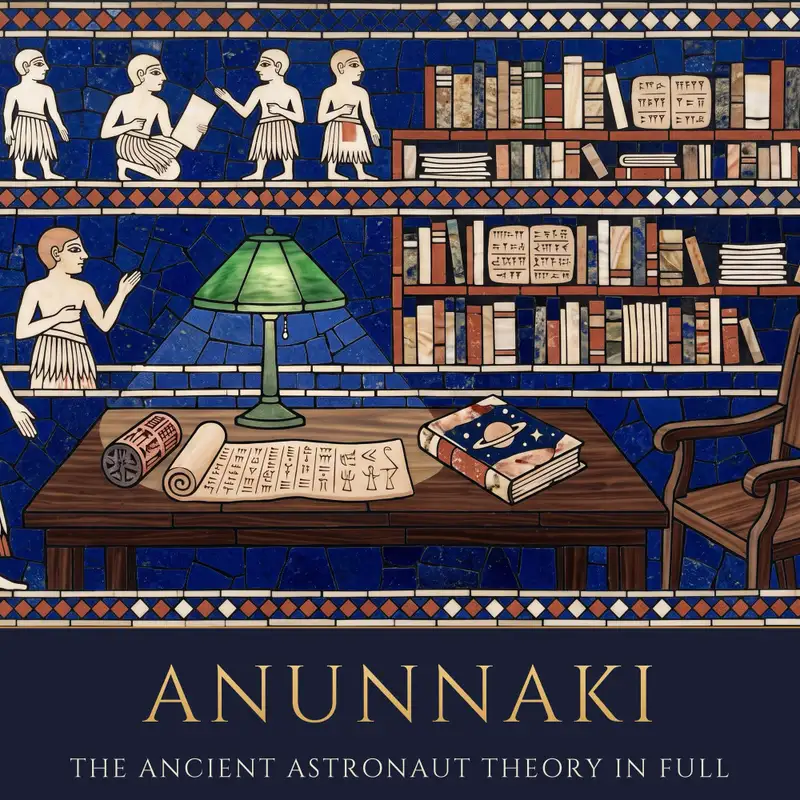
Welcome to The Sleeping Almanac. Tonight is the thirteenth night of a season that only has twelve, and it is here on purpose, and it is here because of you. For twelve nights you sat in the tablet house and heard the oldest stories in the world told the way the clay tells them. The two waters. The woman in the moon house. The three long nights of the famous king. The eagle, the seven gates, the fisherman, the queen who was left alone, the bird on the mountain, the god who could not settle. You know those stories now. You know them better than most people who have ever written about them. And all through those twelve nights there was another story standing just outside the door, and a great many of you came in through that door. It is the story most people mean when they say the word Anunnaki. It says the gods of Sumer were not gods. It says they were visitors, from a planet with a long slow orbit, who came here for gold, and who made us, in a laboratory, out of clay and their own blood, to dig it for them. It says the tablets tell this story plainly, if you know how to read them, and that a man in 1976 finally did. And if tonight is your first night here, if you came straight in through that door, you are welcome, and you need nothing from the twelve to follow this one. Everything the story rests on will be laid on the table where you can see it. I have not told that story yet. I have mentioned it. I have set it down in one chapter, at the end of a night, and moved on. That was fair to the season, which was about the tablets. It was not entirely fair to the story, and it was not fair to you, because you came for it, and you have waited, and you have been patient. So tonight is that story. All of it. Told the way the people who believe it tell it, at full length, in its own shape, with its own wonder intact, because it is a wonderful story and it deserves a whole night. And after each part of it, quietly, once, I will tell you what the object is. What the tablet says. What the word means in the dictionary. What the seal actually shows. And then I will set it down and go on, and I will not tell you what to think, because you have twelve nights of the real clay in you now, and you do not need me to. Some of you will judge it. Some of you will sleep through the judging. Both are fine. This is a sleep story. It only happens to be about a theory. Here is where we are. There is a room in a museum, after closing. It is a study room, the kind that scholars book by the hour, at the back of the building, with a long table of dark wood and a lamp with a green glass shade. The radiators tick. Somewhere down a corridor a floor polisher hums and then stops. The public galleries are dark and the big doors are locked and the only light in this whole wing is this one lamp on this one table. On the table there are two things. The first is a cylinder seal. It is a small stone, about the length of your thumb, shaped like a little rolling pin, and it has a picture carved into it backwards, so that when you roll it across soft clay the picture stands up the right way round and stays there. Somebody has rolled it out for us, on a strip of pale clay that has gone hard, and the picture is standing still. A seated figure. Others standing before him. Some writing. A star, up in the corner, with points around it. The seal has a number on a little card beside it, because everything in a museum has a number. The number is V A two hundred and forty three. The second thing on the table is a paperback book. Its spine is cracked white from being opened too many times. Its cover is dark, with a planet on it, and the title is in big letters, and the year on the copyright page is 1976. Both of these things are real. The room is not. I have made the room so that we can sit in it. But the seal is real, it lives in Berlin, in a museum, and the book is real, and it is on a shelf in nearly every second hand bookshop on earth, and tonight I am going to take them down one at a time, the way the scribe took down his tablets, and hold each one up to the lamp. There is a chair for you. It is the good one, the one with arms, at the end of the table, out of the draught. Settle into it. Let the lamp be warm on one side of you and the cool of the empty building on the other. Close your eyes if they want to close. There is nothing in tonight's story that needs watching. It only needs to be near you, the way the ticking radiator is near you, saying the same small thing over and over in the dark. You do not have to follow every word. You do not have to remember any of it in the morning. If you drift, I will go on without you, and I will not mind, and the two things on the table will still be here, being exactly what they are, whether anyone is looking or not. And one thing, whispered like a promise. Nobody gets scolded tonight. Not the man who wrote the book. Not the people who love it. Not you, whatever you came in believing. There is a way of telling this story that is a fight, and you have heard it, probably, and it kept you awake. This is the other way. It is slower and kinder and it is true, and it lands soft. Before I open the book, one small thing, and then we will not interrupt again. If this story carries you down toward sleep, subscribe now, while your eyes are still open, and the next night will be waiting for you when you need it. A like helps other tired travelers find this lamp. And if you would rather carry these nights with you, The Sleeping Almanac is also a free podcast, on Apple Podcasts and on Spotify, wherever you listen. That is all. Now settle back. I pick up the book first, because the story begins with the man who wrote it, and he was a real man, and he had a real life, and it was a long one. We begin.
His name was Zecharia Sitchin. He was born in 1920 in Baku, which is a city on the western shore of the Caspian Sea, in what was then a very new Soviet republic and is now Azerbaijan. His family was Jewish. When he was still a small child they left, and they went south and west, to Palestine, which in those years was governed by the British, and that is where he grew up, in the heat and the dust and the old stones, in a place where the ground itself was full of history and everybody knew it. Hold that for a moment, because it matters. He was a boy in a country where you could not dig a garden without turning up somebody's broken pot. He learned Hebrew as a living language, and he learned it as the language of an old book, and he was the kind of boy who noticed when the old book said something strange, and asked about it, and was not satisfied with the answer. He went to London, and he studied economics at the university there, which is not what you would guess, and he came back to Palestine and he became a journalist, and then an editor, and he wrote for newspapers for years, in a new country that was being born around him. And then in the early 1950s he moved to New York, and he worked in shipping, and he stayed in New York for the rest of his life, nearly sixty years, and he died there in October of 2010, at the age of ninety. That is the outside of the life. Here is the inside of it. All those years, in the evenings, he read. He taught himself to read cuneiform, which is the wedge shaped writing of the tablets you have spent twelve nights with, and it is not an easy thing to teach yourself, and he did it anyway, from the published copies and the dictionaries and the grammars that were available to a determined man with a library card. He read the Sumerian King List, with its kings who reigned for tens of thousands of years, counted in the big round unit of that country, the sar, which is sixty sixties. He read the creation poem, the one about the two waters. He read the flood story, and the poem about the tired gods who went on strike, and the one about the making of people out of clay and blood. He read the same tablets the scholars read. And somewhere in those evenings, over years, he became sure that the scholars had all missed something. That the tablets were not myths. That they were records. In 1976 he published a book, and it is the book on the table. It was called The Twelfth Planet. It sold slowly and then it sold fast and then it did not stop. It went through printing after printing, and then it was translated, into more than twenty languages, and it sold in the millions, and he wrote another book, and another, until there was a whole shelf of them, seven and then more, which he called the Earth Chronicles, and the shelf is still selling, right now, tonight, somewhere, to somebody who has just discovered it and cannot put it down. He did not only write. For the last thirty years of his life he travelled and spoke, in halls and on television and at the sites themselves, and he led readers on tours to the places in the books, to the ruins and the museums, an old man in a good jacket standing in front of a case of tablets, pointing. And late in his life he did something that tells you a great deal about how he saw his own work. He wrote a book in the first person, in the voice of Enki, the god of the deep water, as if Enki himself had dictated his memoirs, so that the whole story could be read straight through as one account, from the arrival to the flood, with no scholar in the way. He called it a lost book. He was clear, in his own introduction, that he had composed it. But he composed it because he believed that somewhere, on some tablet not yet dug up, that book existed, and he was only writing down what it would say. And here, in his shape, in one breath, is what the book says. It says that the gods of Sumer, the Anunnaki, were real, and that they were people, from another world, a planet in our own solar system that swings in close to the sun once every three thousand six hundred years, and away again, on a long slow loop. It says they came to earth hundreds of thousands of years ago because their own world was in trouble and they needed gold to mend it. It says they dug for that gold themselves at first, in the south of Africa, and that they grew tired, and rebelled, and that to solve the labor problem their scientists took the creature that was already living here, a kind of early human, and mixed it with their own blood, and made a worker. Made us. It says the flood was real and that they let it happen and then repented of it. It says that everything the tablets describe, the coming down and the making and the departing, is a memory of those events, written by the people who were there, and that we have been reading it as poetry for a hundred years when we should have been reading it as a report. That is the story. You have heard pieces of it. Now you have the whole of it in one breath, the way he told it. And I want to say one thing about him before I put the book down, and then we will go on. He was not a fool, and I do not believe he was a liar. He was a self taught man with a good mind and a great deal of patience, who read the hardest texts in the world in the evenings for decades, and who saw a pattern in them, and who believed the pattern with his whole heart until the day he died. People have been wrong that way before. Great people. The story of scholarship is mostly the story of people who were sure and were wrong and were sure anyway. It is not a small thing to be that sure about something that old. It is a kind of love. I put the book down beside the seal. The lamp hums. Now. Where did the idea come from. Because it did not begin with him.
Eight years before the paperback on the table, in 1968, a Swiss writer named Erich von Daniken published a book with a question for a title. It asked whether the gods had driven chariots. Whether the winged and shining figures in the old stories, the ones who came down out of the sky in every culture on earth, might have been remembered from real visitors, in real machines, by people who had no other words for what they saw. The book was enormous. It was translated everywhere, it became a film, and for a few years in the early 1970s it was very hard to find a person who had not at least heard of it. Its author lived to ninety, and died in the winter of 2026, and I am going to leave him there, with one sentence, because this is not his night. What his book did was open a door. It made an idea respectable enough to be argued with, which is the first thing any idea needs. The chariots book was a book of pictures and questions. It pointed at the lines in the desert of Peru, at the great stone heads of Easter Island, at a carving on a tomb lid in Mexico that looked, if you turned it sideways and squinted, like a man at the controls of something, and it asked, over and over, how could they have done this, and who showed them. It did not read any ancient language. It did not need to. Its whole method was the raised eyebrow, and it was very good at it. The man from New York did something different, and it is why his book outlasted the other. He said: I have read the texts. Not the pictures, the words. In the original. And here is the story they tell, in order, with names and dates. That is a much larger claim, and a much more serious one, and it is the reason his book is on the table tonight and the other one is not. A raised eyebrow is a question. A translation is an answer. People came to the second book because it promised to close the door the first one had opened, and to tell them, finally, what was on the other side. And the idea, put plainly, was this. The old stories are not made up. They are misremembered. Strip away the awe and the poetry and you will find, underneath, an event. Now here is why the tablets of Sumer were the perfect home for that idea, and it is worth understanding, because it is not an accident. They are the oldest writing on earth. Nobody argues with that. When you read the story of the two waters you are reading something that was already old when the pyramids were new, and if you are looking for the first memory, the first event, the one everything else is a copy of, that is where you would look. They are strange. The Greek gods are people with weather in their hands. The Sumerian gods are harder to hold. They come in crowds. They are assigned jobs. They complain about the work. They hold assemblies and vote. They dig canals. There is a strangeness in those tablets that does not feel like the strangeness of a made up story, and a person reading them for the first time, alone, at night, could be forgiven for thinking they sounded less like a myth and more like minutes of a meeting. And they had almost no readers. That is the third thing, and it is the important one. When the Swiss book came out, the number of people alive who could read Sumerian and Akkadian fluently was small enough to fit in a lecture hall. The great dictionaries were half finished. The tablets sat in drawers in Philadelphia and London and Berlin and Istanbul by the tens of thousands, most of them never yet read by anyone. An ordinary person who wanted to check a claim about the Sumerian tablets could not check it. There was nothing to check it against. Into that room, that quiet room with the drawers, walked a self taught man from New York who could read the wedges, and who said: I have read them, and here is what they say. And he was, for a while, almost the only voice that ordinary people could hear. Hold on to that. Because the whole shape of the night is going to be this: what people say, and then what the thing is. And for thirty years the second half of that sentence was very hard for anyone to get hold of, and the first half was in every bookshop. The dictionaries are finished now. I will come back to that at the end, because it is a good ending. For now, we open the book to its first claim, which is a single word, and it is the word that brought most of you here.
Anunnaki. Here is what people say. They say it is not a name at all but a sentence. That in Sumerian it breaks apart into pieces, an, and nun, and na, and ki, and that the pieces mean sky, and descent, and from, and earth, and that read together, the way the book reads them, the word means those who from heaven to earth came. They say that this is the plainest evidence there is, hiding in the open, in the name of the gods themselves. That the Sumerians were not being poetic. They were being exact. The gods were called the ones who came down because they were the ones who came down. It is a beautiful reading. I want to say that first and mean it. There is a kind of pleasure that only comes from a word opening in your hand like that, and a great many people have felt it, reading that page, and it is why the word is on a million thumbnails tonight. Now here is what the dictionaries say, and I will say it once and plainly and then we will go on. The word is real. You have heard it all season. In the tablets it is a nun na, and sometimes a nun na ke ne, and it is a crowd word, a word for the great gods as a group, the way you might say the household or the court. The old scholars read it as the offspring of An, the princely seed, the children of the sky god, because An is the sky, and the nun part carries the sense of prince, or great one, and the rest is the ordinary grammar that turns a name into a belonging. The gods who belong to An. The great ones of An's line. The piece that people read as earth is the sign for earth, but it is there for its sound and not its meaning, the way a picture of an eye in a puzzle stands for the word I. It writes the little ending that means of, the hinge that makes the gods belong to An, and that ending sits on the end of a great many Sumerian words without turning any of them into a journey. There is no verb in the name. There is no came. There is no down. The Sumerian for coming down is a different word, and it is not there. That is all. That is the whole of what the object is. A word for a crowd of gods, made from the sky god's name and a word for greatness. And I said I would set it down, so I set it down. But I want to leave one thing beside it before I do, because it is fair to both sides. The reason the reading in the book feels right is that Sumerian words really do work that way. They really are made of small pieces stuck together, and a person who has learned that, and who has learned the meanings of the pieces, can build readings that sound like sentences. The trick is that a language is not only its pieces. It is the way the pieces are allowed to sit. And the way the scholars know which way the pieces sit is not a secret. It is the other ten thousand tablets, where the same pieces appear, in lists, in prayers, in letters about sheep, and where the word never once means anything but the great gods. And here is how the scholars came to know the pieces at all, because it is worth a minute and it is a lovely thing. Sumerian is a language with no relatives. Nothing spoken on earth today descends from it, and when the tablets were first dug up nobody could read a word. What saved it was the Babylonians. They spoke Akkadian, a language that does have relatives, and they kept Sumerian the way Europe kept Latin, as the language of prayer and law and school, long after nobody spoke it at home. And so their schoolboys made lists. Column after column, a Sumerian word and beside it the Akkadian word that meant the same thing, thousands of lines, on hundreds of tablets, and then lists of signs, and lists of grammar, and whole school exercises with the teacher's corrections on them. The Babylonians wrote the Sumerian dictionary themselves, four thousand years ago, for their children. The scholars did not invent the meaning of the pieces. They found it, in the homework of a dead city. That is the difference, and it is going to be the difference all night. One book and ten thousand tablets. I am not going to say it again. You will feel it, in each chapter, in the second half, the way you feel the floor of a pool with your feet. The radiator ticks. I turn the page. The next claim is not a word. It is a planet.
Here is what people say, and this is the heart of the book, and the title of it, so I will give it room. They say there is a planet in our own solar system that we have not found. Not a small one. A large world, bigger than the earth, on an orbit so long and so stretched that for most of its year it is far out in the dark beyond Neptune, beyond Pluto, beyond where our telescopes have looked, and that once in its year it swings in, through the crowd of the known planets, close enough to be seen, and then away again. They say its year is three thousand six hundred of ours. They say the Sumerians knew it and named it and counted it among the planets, which is why the book is called what it is called: the sun, the moon, the nine planets we know, and the twelfth, which is theirs. They say this is where the Anunnaki came from. That it was their home. That when it swung in close, every three thousand six hundred years, they could cross to earth, and back, and that this is why the gods in the tablets arrive and depart, and why a sar, the great number of the Sumerian counting, the one the King List reckons its ancient reigns in, is three thousand six hundred. It was never a number, they say. It was a year. Their year. The kings of the list who reigned for eight sars reigned for eight orbits of the home world, and the number was true, and it is only our small idea of time that makes it sound impossible. And they say the Sumerians had a name for the planet. They called it Nibiru. The planet of the crossing. Because it crosses. I want you to sit with that for a moment, because it is the best thing in the book, and I understand exactly why it took hold. You have spent a season with the King List. You heard kings reign for twenty eight thousand years and thirty six thousand years, and you felt what everybody feels, which is that those numbers cannot be true and must mean something. And then a man hands you a key, and the key fits, and the numbers open. Eight sars. Eight orbits. Of course. It is a wonderful feeling. It is the feeling of a locked door that has been locked your whole life swinging open, and I would not take it from anyone lightly. Now here is what the tablets say. Once, plainly. The word is real. I said that about the last word and I will say it about this one. Nibiru, or as the Akkadians wrote it, neberu, is a real word on real tablets, and it is a beautiful word, and its plain meaning is the crossing. A ford. The place where you cross a river. And from that, a crossing point in the sky. It appears in the star lists and the sky handbooks the scribes of Babylon made, and in the poem of the two waters, and it is a station in the sky, a point a bright body reaches and stands at, most often Jupiter. The men who made those lists were the same men who kept a diary of the sky, and I want to stay with that diary for a moment, because it is the truest thing in this chapter and almost nobody talks about it. For something like seven hundred years, from the middle of the eighth century before Christ down almost to the birth of Christ, the scribes of Babylon kept a diary of the sky. Every night. Where the moon rose and set and how thick it was. Which planet stood near which star. The weather, because clouds mattered. The price of barley and dates and wool in the market that month, and the level of the river, written on the same tablet under the same date, because the scribes believed the sky and the earth kept time together and they wanted the record to show it. Seven hundred years. Generations of men who never saw the beginning of the diary and knew they would never see its end, adding one night each. It is one of the longest continuous records of the sky that human beings have ever kept, nothing older matches it, and it is in the British Museum in London in pieces, and out of it, patiently, the scribes learned to predict eclipses, and the returns of the planets, and the slow wobble of the moon, with numbers so good that the Greeks borrowed them and never bettered them. That is what the Babylonians knew about the sky. It was not a secret handed down. It was seven hundred years of looking up. And in those lists neberu is not a planet nobody can see. It is a station. A point that a bright body reaches and stands at. Most often, in those lists, the body is Jupiter, the great slow wanderer, the brightest thing in the sky after the moon and the morning star, and neberu is the place where Jupiter stands when it has crossed the middle of the sky. Sometimes the name is given to Marduk's star, which is Jupiter again under another name, because Marduk was the god of Babylon and Jupiter was his lamp. Once or twice the scribes hang the word on something else, on Mercury, on a star. But it is always a crossing. It is always something you can look up and see. It never once, on any tablet anywhere, means a world beyond the last planet. And you have heard the word before, in this season, without knowing it. In the poem of the two waters, when Marduk makes the sky, he sets the stations of the stars, and he fixes a station for himself, the crossing, so that the others will know their courses by it. The listener who was here on the first night heard that line go by. It was Jupiter. It was the god's own star, put in the middle of the sky to keep the others honest. And the sar. You know what the sar is. You have known since the first Anunnaki special, when the King List was on the table and I told you, lightly, that the great unit was sixty times sixty, a counting word, on the tablets ten thousand times, in the accounts of grain and the lists of workers. You got there before I finished the sentence. You did it on the second night of the specials and you did it again just now, when I said what people say about the orbit, and you felt it, a small cool click behind the warm feeling, the sound of the key turning back. That is all. I have set it down. But I want to leave one more thing beside it, because it is the fair thing and because it is true. The feeling of the door opening was real. Nobody is a fool for having felt it. The numbers on the King List are strange and they do mean something, and the scholars have their own answers, about sacred arithmetic and the way old peoples wrote greatness as bigness, and those answers are quieter than the orbit, and less fun, and I think they are right, and you are allowed to think whatever you like, and you are also allowed to be asleep. I put the book face down on the table, open, to keep the page. Now I pick up the seal. Because the seal is the picture of the planet, they say. And it is on the table in front of us, and we can look.
Here is what people say. They say that on this little stone, carved more than four thousand years ago, is a map of our solar system. That in the top corner, where the star is, the carver has made the sun, with its rays going out, and that around the sun, in a ring, are small round marks, and that if you count the marks there are eleven of them, and with the sun that is twelve, and that the twelve are the sun and the moon and the nine planets and the one we have not found. They say the sizes are right, roughly, that the bigger dots are where the bigger planets should be. They say a Sumerian carver could not have known there were nine planets, let alone drawn them in order, unless somebody had told him. And they say the somebody was the gods. This is the most reproduced object in the whole story. It is on the cover of books and it is on a hundred thousand web pages, and nearly always it is shown cropped, so that you see only the corner with the star, blown up large, with arrows. Now. It is on the table. Let us look at the whole of it. It is a presentation scene. That is the name the scholars give to this kind of picture, and once you know the kind, you will see it everywhere, because there are thousands of seals like this one. On the right, a figure sits on a chair, a god or a king, wearing the long flounced robe that you have seen all season on the walls of the tablet house. Toward him, from the left, the others come, standing, and in pictures of this kind the one being presented is usually led forward by the hand or the wrist by a lesser god, the way you would bring a friend to meet someone important. It is a picture of somebody being brought before somebody greater. An introduction. A man being presented to a god, or to a lord, so that the lord will look kindly on him. That is what these seals were for. They were a person's signature, and the picture was a prayer. They were also jewelry. A seal was drilled through its length and worn on a pin or a cord, at the wrist or the neck, and they were cut from lapis and hematite and jasper and shell and carnelian, by craftsmen working with a bow drill and a copper point and a great deal of patience, on a surface the size of the tip of your little finger. The finest of them, from the age of the kings of Akkad, which is when this one was made, four thousand three hundred years or so ago, are among the loveliest small things human hands have made, and museums keep them in trays, thousands of them, and each one, rolled out, is a scene: a god in a boat, a hero wrestling a bull, a goddess with grain growing from her shoulders, a lord on a chair being brought a gift. The stars on them are a language of their own. An eight pointed star is the great goddess, the one you met in the moon house and at the seven gates. A disc with rays is the sun. A crescent is the moon god. Carvers put them over scenes the way a painter signs a corner, and everyone knew what they meant. Between the figures, in the space above their heads, there is writing. It is cuneiform, three lines of it, and it can be read, and it has been read, many times, and what it says is names. It names a man, and it names a second man, and it says that one of them is the servant of the other. It is the owner's name. It is what you would expect to find on a signature. It says nothing about the sky. And in the top corner, the star. Here is the thing to know about that star, and I will say it once. The Sumerians and the Babylonians had a way of drawing the sun, and they used it on thousands of seals and stones and boundary markers, over two thousand years, and it does not change much. The sun is a disc, and from the disc go rays, and the rays are wavy, or they are straight lines with wavy lines between them, so that the disc is a thing that gives off heat as well as light. When you see a disc with wavy rays on a Mesopotamian stone, you are looking at the sun god, and everyone who made it and everyone who saw it knew that. The thing in the corner of this seal has no wavy rays. It has points. Straight points, coming from a small centre, the way a child draws a star, and on Mesopotamian stones a shape like that is a star, and a star, on a seal, is the sky god, or a god in general, or simply the heavens, over the scene, the way a cross might sit over a scene in a church. Around it there are small marks, in a ring. They are part of the star. They are the way a carver fills the space around a star so that it shines. They are on other seals too, around other stars, in other numbers. That is the object. A prayer with a signature on it, and a star over the heads of the people praying, and a picture of a man being led forward by the hand. I said I would set it down and I set it down. But look at it a moment longer, not for the argument, just because it is here. It is four thousand years old. Somebody wore it on a string around their neck or their wrist, and rolled it across the wet clay of a letter or a jar seal, and their name went out into the world on it, and the name is still there, in the corner of a museum in Berlin, under glass, on a Tuesday, being looked at by nobody. The man who owned it never knew he would be the most famous seal owner on earth. He wanted the god to look kindly on him. It is a small wish, and a kind one, and I like him for it. The polisher in the corridor starts up again, far away, and stops. I turn the seal a little so the lamp catches the flounces on the seated figure's robe. Then I turn back to the book, because the next claim is about why they came, and it is about gold, and gold is a thing the tablets know a great deal about.
Here is what people say. They say the home planet was dying. That its air was thinning, or leaking, or wearing away, in the long cold of the far part of its orbit, and that its people, who were very advanced, knew of a way to mend a sky. They say it needed gold. Fine gold, ground to dust and lifted into the high air, where it would hang, and shield, and keep the warmth in. And they say there was not enough gold at home, and that they looked outward, and found a world that had it, in quantity, in the ground. This one. They say they came for it, four hundred and fifty thousand years ago, and that they landed in the south, in Africa, where the gold is, and they dug. That the diggers were the younger gods, the ones the tablets call the Igigi, and that they dug for forty sars, which they read as a hundred and forty four thousand years, in the heat and the dark, until they could not stand it, and they marched on the house of the great god and burned their tools at his door and refused to go back down. And they say that was the crisis, the moment the whole story turns on. Because the gold still had to come up. And there was nobody left to dig it. And they say this is why, ever after, human beings have loved gold past all reason. That the wanting of it was put in us. That it is a memory of the reason we were made. That is the mission of the book, and it is the engine that drives everything after it, and it is told, in the book, with real sweep. A dying world. A desperate voyage. Tired gods in the mines of the south. You can see why it became a film in people's heads. Now here is what the tablets say. And this one you know already, because you heard it on the first night of the specials, from the poem itself. The Igigi are real. The strike is real. It is the opening of the flood poem, the one the scholars call Atrahasis, and it is one of the oldest things you heard all season. The younger gods are worked too hard. And the poem is very clear about what the work is. They dig. They dig the rivers. They dig the Tigris and the Euphrates, which is to say they dig canals, they cut the channels that bring the water to the fields, and they carry earth in baskets, and the baskets are heavy, and the years are long, and the poem says forty years, and on some tablets it says a number that is a sar, and either way it is long enough, and they have had enough. They burn their tools. They march on Enlil's house at night. They surround it. And the great gods wake up frightened and hold a council. That is the poem. Canals and baskets. It is the story of the land you spent a season in, which is a land of mud and water where nothing grows unless somebody digs a channel, and where the digging never ends, and where the oldest poem about the gods is a poem about how even the gods got tired of it. There is no gold in it. Not in the strike, not in the council, not in the making of people that comes after. The word does not appear. And the place where the book puts the mines, the Abzu, which it reads as a word for the far south, for Africa, for the land below the equator where the gold is, is a word you know very well by now. You spent a night in it. The Abzu is the sweet water under the earth, the deep that the wells reach down into and the marshes rise up out of, and it is Enki's house, at Eridu, the oldest city, at the head of the gulf, in the reeds. It is not a continent. It is what is under your feet when you dig a well in the mud of Sumer and find it filling. The book takes the god's house and moves it thousands of miles south, because the gold needed somewhere to be. The tablets never moved it. It is still under Eridu, which is still there, a low mound in the desert in the south of Iraq, with the temple of the first king still under the sand. Gold appears in the tablets, of course. It appears constantly. It is on the statues of the gods and the throne of the king and the walls of the temple, and it is weighed out in the accounts, and it is given as gifts and stolen in wars and listed in dowries, and it is, in every single one of those thousands of lines, what gold is everywhere: a bright heavy metal that people love because it is bright and heavy and does not tarnish. It is never a medicine. It is never dust in a sky. The tablets know a great deal about gold and none of it is that. That is all. I set it down. And the thing I leave beside it is this, and it is not an argument, it is only something I noticed reading the book. The gold is the part of the story that comes from nowhere. Every other piece has a tablet behind it, a real word, a real seal, a real poem, that the book reads in its own way. The gold has no tablet. It is the piece the story needed in order to make the other pieces move, and so it was supplied. The author would not have put it that way. But it is worth knowing which parts of a story are found and which parts are built, and the gold was built. The radiator ticks. The lamp is steady. I turn the page, and the next one is the one most of you have been waiting for, because it is about us.
Here is what people say. They say that when the diggers refused to dig, the gods needed a worker, and that the cleverest of them, Enki, the one you know from the deep water, proposed to make one. Not from nothing. From what was here. They say there was already a creature on the earth, walking, hunting, not yet speaking, a kind of early human that the scientists would later call by a Latin name, and that Enki and his half sister, the goddess of birth, took that creature into their laboratory in the south, and mixed its essence with the essence of a god, the blood of a god, and grew the mixture in the womb of a goddess, and that the first tries went wrong, and came out crooked and blind and strange, and that at last one came out right, and they called him Adamu, and they made more, and they called the new creatures lulu, which they say means the mixed ones, the primitive workers, and they sent them down into the mines. They say this is what the tablets mean by making a man from clay and blood. That clay is a word for the raw material, the earth creature, and blood is the word for what was added, and that the goddess kneading the mixture in the poem is a scientist at a bench, and the fourteen pieces she divides it into are fourteen wombs, and the failures in the poem of Enki and the birth goddess, the ones who cannot hold their water or cannot see or cannot bear children, are the prototypes that did not work. They say the tablets describe a genetic experiment as exactly as people four thousand years ago could describe one, and that if you read them with modern eyes, you can see the lab. I will say plainly that this is the chapter of the book where a great many readers stop being interested and start being convinced. Because the poem is so strange, and because the reading fits it so closely, and because the fit feels like proof. It is a remarkable piece of reading, whatever else it is. Now here is what the tablets say. And again you have heard it, twice, and you will hear it now beside the other telling, which is the whole point of tonight. The council of the frightened gods has a problem. The diggers will not dig. And Enki says, let the birth goddess make a human, and let the human carry the basket. So they take one of the gods, a god who has a mind, whose name means something like the ear and the wit, and they kill him, and the birth goddess, whose name is Nintu and also Mami, mixes his flesh and his blood with clay. And the poem is very exact about what happens next, and it is not a laboratory, it is a ritual. The gods spit on the clay. The goddess recites over it. There is a drum. She pinches off fourteen pieces and lays seven on the right and seven on the left, and a brick between them, and after ten months the womb opens, and there are seven men and seven women, and the poem then gives instructions for what to say at a birth, and for the days a mother and father should keep apart, and it is, at that point, plainly a text that priests used, about how babies arrive and what the words are when they do. And the other poem, the one with Enki and the birth goddess at a banquet, is a drinking story. They are drunk. She makes people with faults on purpose, to show off, a man who cannot hold his water, a woman who cannot bear, a blind man, and for every one of them Enki finds a place in the world, a job, a use, a dignity. Then he makes one that she cannot find a place for, and the game ends, and the poem is about the giving of fates, about how everyone, however made, is given somewhere to stand. It is one of the kindest things on the tablets. And the word. Lulu. Or, as the Akkadians wrote it, lullu. It is on the tablets many times. It means human being, the first people, mankind as the poems say it, and it carries no sense of mixing and no sense of worker. It is us, in their language, before we had our own. That is the object. A ritual for a birth, a drinking story about fates, and a word for a person. I set it down. And I leave this beside it, and it is the thing I most want to say tonight, so I will say it carefully. The reason the reading fits so closely is that the reading is drawn from the poem. That is not a trick. It is what the book does. It takes a true and strange thing, a goddess mixing clay and blood, and it lays a modern picture over it, a bench, a vial, a womb, and because the picture was cut to fit the poem, the poem fits the picture. That will always feel like proof. It is the feeling of a key you cut yourself, opening the lock you cut it from. The tablets are real. The strangeness is real. The laboratory was brought to them. And the poem itself, read as itself, is not smaller for that. A goddess kneading clay with a god's blood while the gods spit into it and a drum beats, and seven mothers on the left and seven on the right, is not a lesser story than a laboratory. It is a stranger one. It is only that we have stopped being able to hear how strange it is, because we are not four thousand years old. The polisher hums and stops. I turn the page, and the next chapter leaves the tablets for a moment and goes to a different book, one that most of you have on a shelf.
Here is what people say. They say that the Bible remembers the same events, in a different language, from a different side of the desert. That the sixth chapter of the book of Genesis, in a few short verses just before the flood, says that the sons of God saw the daughters of men, and took wives among them, and that there were giants in the earth in those days, and that the giants were the children of those unions, and were mighty men, the men of old. They say the Hebrew word for the giants is Nephilim, and that the word means those who were cast down, or those who fell, and that it is the Anunnaki again, under a Hebrew name. The ones who came down. They say the sons of God are the visitors, and the daughters of men are the workers they made, and the giants are the children of the two, and that Genesis, being much later, kept the memory with the details worn off, the way a coin keeps a face. And they say this is the bridge. That the two oldest books on earth, the tablets of Sumer and the scroll of Genesis, tell one story between them, and that once you see it, you see it everywhere, in every flood story and every giant story in every land. Now here is what the texts are. There are two books. That is the first thing, and it is not nothing. One is written in Sumerian and Akkadian, on clay, in the land between the rivers, and the oldest of it is more than four thousand years old. The other is written in Hebrew, on scrolls, in a hill country to the west, and the oldest parts of it, on the most generous reckoning, are nearer three thousand years old. They are different books, in different languages, from different peoples, and reading one beside the other is a thing that scholars have done for a hundred and fifty years, with great care and great pleasure, because the two do speak to each other. The flood is in both. The making of a person from clay is in both. The long lives before the flood are in both. But the bridge in the book is a particular bridge, and it is built of two planks. The first plank is the name. Anunnaki means those who came down, the book says, and Nephilim means those who fell, and so they are the same. And you have already seen, three chapters ago, what the first name means in its own language, and it does not mean that. And the second word is harder than it looks. Nephilim is a word that appears only a handful of times in the whole of the Hebrew Bible, and the old scholars themselves were not sure of it, and the translators into Greek two thousand years ago rendered it as giants, and the guesses about its root are guesses, and the sons of God in that passage have been read for two thousand years as angels, as the line of Seth, as kings, as judges, by people who knew the language very well and did not agree with each other. It is a passage that has always been a doorway. The book walks through it. So did the Watchers of Enoch, whom you met a few weeks ago in another special, and so has nearly everyone who ever read those four verses, because they are strange and short and ask to be filled. The second plank is that the sons of God are the makers and the daughters of men are the made. And that plank rests entirely on the last chapter, on the laboratory, and you know what the laboratory rests on. That is the object. Two books, four verses, an old strange word, and a bridge that readers built, which is a fair thing to say about a bridge, because that is what bridges are. I set it down. And I leave this beside it. The bridge is real, in one sense. The people who wrote Genesis lived in the same world as the people who wrote the tablets. They traded with them and were conquered by them and carried off to their city, and they knew their stories, and they wrote their own. So the flood is in both, and the clay is in both, and the giants and the long lives are in both, not because a spaceship landed twice, but because stories walk, along roads, in caravans, in the mouths of exiles, and they always have. The bridge between the two books is a road. It is a very old road. You could still walk it. That is a better story too, and it is the true one. And I will tell you who first walked it, because you met him on the second night of the specials and he belongs here. In 1872, in the British Museum in London, a young man named George Smith, who had been an engraver of banknotes and had taught himself the wedges in his lunch hours, was sorting a tray of broken tablets from the library of the last great king of Assyria, and on one of the pieces he read about a boat, and a flood, and a bird sent out to find dry land, and he understood, in that instant, that the story in Genesis had an older brother. A newspaper paid him to go to Nineveh and find the missing piece, and he went, and he found it, in the rubble, in a week. That is where the bridge was first crossed. By a self taught man who read the tablets in his own way, and was right. The road between the two books was found by a man very like the man who wrote the paperback, and I want you to know that, because it means the door he walked through was a real door. Only the room on the other side was not the room he expected. The lamp is steady. Now the book on the table ends, in a sense, because the author died in 2010, and the story did not stop when he did. It grew. And the next chapter is about what grew.
When a story is loved, it does not sit still. People add to it. And in the years since the paperback was printed, and especially in the years since the author's death, the story of the Anunnaki has been carried forward by a newer generation of writers and speakers, in books and in long videos watched by millions, and they have added new pillars to it, from places the original book never went. I am going to tell you the three that people mention most, in the same shape as before. What people say. What the thing is. Here is the first, and it is the one that sounds most like science, because it is drawn from science. They say that if you look at the chromosomes of a human being, the packages the body keeps its instructions in, you will count forty six. And that if you look at the chromosomes of a chimpanzee, or a gorilla, or an orangutan, our nearest relatives, you will count forty eight. And that this difference is not scattered about. It is in one place. Our second chromosome, they say, is plainly two ape chromosomes joined end to end, and you can see the join, and there are even the worn ends of the two old chromosomes still inside it, at the seam, and the old middle of the second one, silent, like a scar. They say nature does not do that. They say a join that clean, in one place, that changed a whole species, is a signature. That somebody did it. That the tablets told us who. Now here is what the thing is, and I will say it once. All of the observation is true. The count is true. The join is true. The worn ends at the seam are true, and the silent second middle is true, and the people who found these things are the same people who study how species change over long time, and they found them by looking for them, because their own account of how we came to be predicted that a join like that would be there. Chromosomes fuse. It happens in mice, it happens in horses, it happens in people, now, occasionally, and the person is usually fine and does not know. A fusion that happened once, in an ancestor, and was carried down, is not a scar on a species. It is a family mark. It is in the ordinary story of how we are related to everything else that breathes, and it was in that story before anyone thought to look for the Anunnaki in it. There are two more claims that travel with that one, and I will give them a sentence each, attributed, and no more. It is said that the large parts of our instructions that do not seem to do anything are dormant code, placed there, waiting to be switched on. The scientists call those parts by a rude name that is now thought to be unfair to them, because more of it does something every year, and none of what it does has been found to be a message. And it is said that there is a gene for worship, put in us so that we would obey. No such gene has been found by anyone looking for it, and the search has been thorough, because it would be a remarkable thing to find. Here is the second new pillar. They say there are tablets. Not clay ones. Green ones. The Emerald Tablets of Thoth the Atlantean, they are called, and they say these are the words of a god of Egypt who was also a survivor of Atlantis, written in the deep past, recovered, translated, and that they tell of the same visitors, the same making, the same long orbits, from another side of the world, and so confirm the whole account. Here is what the book is. It is a real book, and you can buy it. It was written in the middle of the last century, in Colorado, by a man named Maurice Doreal, who founded a religious society there, the Brotherhood of the White Temple, and who said that he had found the tablets in the Great Pyramid in 1925 and translated them. No one else has seen them. There is no green tablet in any museum, no photograph, no fragment, no record before his. It is a modern text, from within living memory of some people alive tonight. It borrows its name from an older thing, a short Emerald Tablet, a single page of sayings, that came through Arabic into Latin in the Middle Ages, under the name of Hermes, and that alchemists loved for centuries, and whose most famous line you have heard, about what is above and what is below. That one is old, and short, and says nothing about planets. The long green tablets of Thoth are from Colorado. And here is the third. The newer voices have a name that is mentioned more than any other, and it is fair to say it once, because these are his claims and he has made them in public, at length, for years. Billy Carson is an author and a speaker, and it is in his books and his broadcasts that the chromosome and the green tablets have been carried, together with the older story, to a new and very large audience. I have told you what they are and what the things are, and that is the end of it. I set them all down together. And I leave this beside them, gently, because the night is getting late and the room is getting warm. The new pillars are different from the old ones in one way that is worth noticing. The old ones, the name, the planet, the seal, the gold, the clay, were readings of real tablets. You could disagree with the reading and still hold the tablet in your hand. The new ones are not readings of tablets. One is a reading of a chromosome, which the tablets never mention. One is a book from Colorado. The story has drifted, over fifty years, away from the clay it started on, the way a boat drifts from the bank when nobody is holding the rope. That is not an accusation. It is what happens to stories. It happened to the stories on the tablets, too, over a much longer time, and that is why the flood comes down to us in so many tellings. The polisher has stopped for good now. I think the man has gone home. The building is very quiet.
Here is what people say, and it is the last of the old pillars, and it is the one that does not need a tablet at all, because it is an argument from the ground. They say that civilisation appeared too fast. That for a hundred thousand years people lived in small bands, hunting, gathering, making the same stone tools their grandparents made, and then, in one small country between two rivers, in what seems like an afternoon, there were cities. Walls. Streets. Temples the size of hills. Writing. Mathematics. Law. Kings. Astronomy. Bronze. The wheel. They say nobody invents all of that at once, from nothing, and that the tablets themselves say they did not: the Sumerians wrote that the arts of civilisation were given to them, handed down from the gods, brought to Eridu by a being who came up out of the water. They say the same is true of Egypt, where the pyramids stand, and that no one has ever properly explained how a people with copper tools and rope raised two and a half million blocks into a shape that is still the largest stone building on earth, so exactly aligned to the stars, and that the workers, if there were workers, left almost no trace of themselves. They say the gaps are the evidence. That where the record goes quiet, something was done that the record could not hold. It is a strong feeling and an honest one, and everybody who has ever stood at the foot of a pyramid has felt it, including the people who dig there for a living. Now here is what the ground says, and I am going to tell it as a story, because it is one, and it is a better one. In the villages of the land between the rivers, long before there were cities, people kept accounts. They kept them with little clay shapes. A cone for a measure of grain. A ball for a sheep. A disc for a jar of oil. Little tokens, the size of a fingernail, and they have been found by the thousand, in villages that are nine thousand years old, and for four thousand years, which is a very long time, that is how people counted what they owed each other. Then somebody, somewhere, had a problem. They needed to send the tokens with a shipment, so the receiver would know what was owed, and they needed the tokens not to be tampered with on the road. So they put the tokens inside a hollow ball of clay and sealed it. A clay envelope. And then, because you could not see inside the envelope, they pressed the tokens into the outside of it before they sealed it, so that the marks on the outside would tell you what was inside. And one day somebody noticed that if you have the marks on the outside, you do not need the tokens on the inside. You can just make the marks. On a flat piece of clay. With a reed. That, most of the people who study it now think, is where writing came from. Not from a god. From a shepherd's receipt. It took thousands of years and it happened one small step at a time, and every one of the steps is in the ground, in order, in the layers, from the tokens to the envelopes to the marked envelopes to the tablets, and the earliest tablets, from the great city of Uruk, five thousand years ago, are not poems and are not prayers. They are lists. Grain. Beer. Workers. Sheep. The first thing writing was ever used for was to make sure nobody cheated on the beer. And the city came the same way. Not in an afternoon. Over two thousand years, from villages to towns to walled towns to cities, and the walls of the older towns are under the walls of the newer ones, and you can dig down through them like the rings of a tree. The scholars who put this together did not do it to spite anyone. They did it because the tokens were there, in the drawers, thousands of them, unexplained, and one woman spent her working life sorting them by shape and asking what the shapes were for, and the answer, when it came, was the birth of writing, and it was a receipt. Her name was Denise Schmandt Besserat, and she began in the 1970s, in the same years the paperback was being written, looking at the same drawers from the other direction, and she is one of the reasons the second half of tonight's sentence can be said at all. And the city where the first tablets were found is Uruk, the city of the famous king, the one with the walls he walks along on the last tablet of his poem. Five thousand years ago it was the largest city on earth, and it had a temple on a platform, painted white, that you could see across the plain for a day's walk, and it had, in the drawers of that temple, five thousand tablets of lists. That is what the first city looked like from the inside. A very large accounts department with a view. And the pyramids. For a hundred years the people who said nobody could have built them were right about one thing. Nobody had found the builders. And then, in the 1990s, on the plateau at Giza, a little way south of the great pyramids, two men and their teams began to dig in a place where the sand had been left alone, and they found a town. Streets. Barracks, long halls where the men slept in rows. Bakeries, with the great bell shaped bread moulds still in them, hundreds of them, because you have to feed twenty thousand men and men eat bread. A cattle yard, and the bones of the cattle, young ones, good ones, which means the workers ate well. A cemetery, with the workers' own tombs, small and proud, with their names and their titles on them. Overseer of the side of the pyramid. Inspector of the builders. The two men were Mark Lehner and Zahi Hawass, and they dug there for twenty years, and what they found was not a camp of slaves and not a landing field. It was a company town. The bread was baked in batches for gangs of workers who rotated in from the villages of the Nile for a season at a time, in the months when the fields were under the flood and there was no farming to do, so that building the king's tomb was, for most of the men who did it, the thing you did in the wet months, for wages in bread and beer, before you went home to plant. It was a national project and a seasonal job. There are records of rations. And in the cemetery there are skeletons with bones that were broken and set and healed straight, which means that when a man fell, somebody was there whose job it was to set them. And on the stones themselves, in the places no one was meant to see, inside the sealed chambers above Khufu's burial room and on the blocks of Menkaure's temple, painted in red ochre by the gangs who hauled them, the names the gangs gave themselves. Friends of Khufu. Drunkards of Menkaure. Work crews, with team names, painted on the blocks the way men paint their names on things, for a laugh, at the end of a shift. That is who built the pyramids. Men with team names, who ate beef and slept in rows and were buried with their titles on their tombs. They left a great deal of trace. It was under the sand, in the one place nobody had dug, and now it is not. That is the ground. I set it down. And the thing I leave beside it is only this. The story of the visitors says: it is too wonderful to be ours. And I understand the feeling. But the receipt that became writing, and the bakers of Giza, and the woman who sorted the tokens, and the drunkards of Menkaure painting their name on a block in the dark, are ours, and I do not think they are less wonderful. I think they are more. A god handing down civilisation is a large thing. A shepherd pressing a token into an envelope, and his grandchild's grandchild pressing a reed into a tablet instead, is a larger one, because it is true, and because they did not know what they were doing, and did it anyway, the way we all do. The lamp is warm. The night is late. The pillars are all down now, all of them, on the table, in a row, and I am not going to build anything out of them. I am going to sit with the seal and the book a while longer, and talk quietly, and then say goodnight.
I want to ask a different question now, and it is not what people say or what the thing is. It is why. Why this story, of all the stories that have been told about the tablets, is the one that a hundred million people know. Why the book on the table is on every shelf and the dictionaries are on almost none. And I think the answer is kind, and I think it is true, and I would like to say it before we sleep. The story is loved because it is shaped like the stories on the tablets. Think about what you heard for twelve nights. Gods who come down. Gods who make people, out of clay, to do the work. Gods who hold assemblies and argue and decide our fate without asking us. Gods who send the flood and regret it. Gods who leave, and are not seen, and are remembered in stories that grow stranger the longer they are told. That is the shape of the oldest religion on earth, and it is a shape that fits the human heart so well that it has never gone out of it. We are made things. We were made for a reason. The makers went away. That is on the clay and it is in Genesis and it is in a paperback from 1976, and the paperback did not invent the shape. It borrowed it, faithfully, from the tablets it was reading, and then it did one thing that the tablets never did. It said: this is not a story. This happened. And that is the whole appeal, and it is not a foolish one. Because the tablets ask a question, on every one of their ten thousand lines, and the question is where did we come from and why. And the scholars, who know the tablets better than anyone, answer that question with a shrug and a receipt, with tokens and canals and shepherds and layers of mud, and that is an answer to a different question. Not to the one the heart is asking. The book on the table answers the question. I have told you, once, plainly, in each chapter, what the clay says instead, and set that down beside it. But it answers it. It looks at the oldest question there is and it says: here is what happened, and here is who did it, and here is why you feel the way you feel. And a great many people would rather have an answer than a shrug, and I do not think that makes them fools. I think it makes them people. So nobody is scolded. And there is one more thing I want to say, and it is about the dictionaries, because I said I would come back to them, and it is a good ending. When the book on the table was written, in the 1970s, the great dictionary of the Akkadian language, the one begun in Chicago in the 1920s, was less than half finished. Volume by volume it came out, over ninety years, each one the size of a paving stone, each one the work of dozens of scholars over decades, and the last volume was published in 2010, which is, by chance, the year the author of the paperback died. Twenty one volumes. Every word the Babylonians and Assyrians ever wrote, with every place it appears, and what it means there. And the Sumerian dictionary, which is younger, is not in volumes at all. It is on the internet. It is free. You can open it tonight on your telephone and type in the word Anunnaki, or the word for crossing, or the word for a human being, and see every tablet it is on and what it means on each one, in about the time it takes to read this sentence. That is what changed. Not the tablets. The tablets said what they said in 1976 and they say it now. What changed is that the second half of the sentence, what the thing is, used to be locked in drawers in Philadelphia, and now it is in your pocket. The scholars did not hide anything. They spent ninety years writing it all down so that they could not be accused of hiding anything, and then they put it where anyone could reach it, and then, being scholars, they did not tell anyone, and went back to work. So that is the whole of what they ask. Not that you believe them. Only that you look. The word is there. The seal is there. The poem of the birth goddess is there, all of it, in a translation you can read in an evening. Look, and decide. Or look, and do not decide, and go to sleep, which is what you are doing now, and which is also fine. The lamp is the only light in the building. The radiator has gone quiet, the way they do late, when the boiler winds down. Outside, somewhere, a city is asleep around a museum, and the museum is asleep around a room, and the room is asleep around two things on a table, and one chair, with you in it.
It is time to put things back. I pick up the seal first. It is cool in the hand, the way stone is, and a little heavier than it looks. I turn it once more under the lamp, and the flounced robe of the seated god catches the light, and the small figure being led forward catches it, and the star in the corner, with its points, catches it last. Then I lift the strip of hardened clay it was rolled on, with its picture standing still, and I carry them both to the case. The case is glass, in the dark gallery, in the middle of a room of other cases. Nobody is there. I open it, and set the seal on its little stand, on the velvet, with the card beside it, V A two hundred and forty three, and I set the rolled out clay beside that, and I close the glass, and it makes the small sound glass makes. And the seal is what it was before anyone said anything about it. A prayer, with a name on it, four thousand years old, under a star. In the morning the museum will open and people will walk past it. Most of them will not stop. A few will. A few will have read the book, and will stop, and lean in, and look at the corner with the star, and count the little marks, and feel the thing they came to feel. And that is all right. It is a seal. It has been looked at by believers and by scholars and mostly by nobody for four thousand years, and it does not mind. Things do not mind. That is the great gift of things. Then the book. I close it, and it does not quite close, because the spine is broken from being opened so often, and I press it flat with my hand. The planet on the cover. The year on the inside. I carry it to the shelf, the long shelf along the study room wall, where the dictionaries are, the paving stone volumes from Chicago, twenty one of them in a row, and I put the paperback at the end of the row, and it looks very small there, and very bright, and it belongs there as much as they do. It is part of the story of these tablets now. It is part of what people did with them. A thousand years from now, if there are museums, it will be in a case of its own, and somebody will roll it out on clay, in a sense, and look at it, and say: this is what one man saw when he looked at the oldest writing in the world. And they will be right to keep it. I turn off the lamp. And in the dark, for a moment, the room is exactly what it is. A long table. A chair with you in it. Two things put away. And outside the window, above the city, the real sky, with the real planets in it, five that you can see with your eyes, the same five the scribes of Babylon watched from their roofs, and wrote down, night after night, for centuries, in a patience that is still the most wonderful thing on any of the tablets. Jupiter is up tonight. Bright, slow, crossing the middle of the sky. Neberu. The ford. Marduk's lamp. It is exactly where they said it would be. You have heard the whole story now. Both halves of it. What people say and what the things are. That is more than almost anyone ever hears, because almost everyone stops after the first half, on one side or the other, and shouts across. You did not shout. You sat in the good chair with the arms, out of the draught, and you listened to all of it, and then you closed your eyes. That was the season. Twelve nights in the tablet house, two nights with the tablets that slept, two with the books the Bible left out, and this one, in the museum, in the dark, with the seal put away and the book on the shelf. The tablets said what they said. A man said what he said. And the sky said nothing, the way it does, and went on crossing. Goodnight.