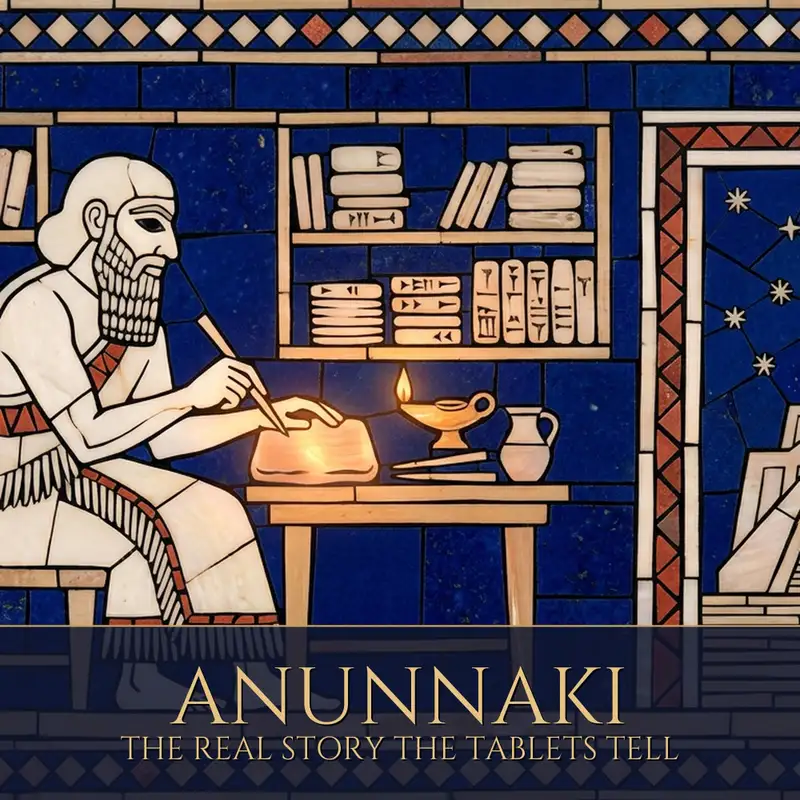
Welcome to The Sleeping Almanac. Tonight, the oldest story that anyone ever bothered to write down. You have heard the word Anunnaki. Tonight we go all the way back to the clay it was first pressed into, and read what the tablets actually say. They are older than the Odyssey by a thousand years and older than the Bible by longer than that, and what is written on them is stranger and kinder and far more human than anything invented about them since. There are gods in it who dig rivers by hand until they cannot bear it any longer. There is a night when the workers of heaven burn their tools and stand outside a door in the dark, and nobody is harmed, and everything changes. There is a god who is chosen so that people can exist. There are people who are made out of river clay and given the baskets to carry, and who then multiply and thrive and become so gloriously loud that the gods upstairs cannot get to sleep. And there is a man who is warned of a coming flood by a voice that refuses to speak to him, and speaks instead to the wall he is standing behind. Stay with it if you can, down to the tenth chapter, where the kings reign for twenty eight thousand years each, and I will show you the small quiet true thing that explains those numbers. For everyone remembers who the gods were. Almost no one remembers that somebody had to sit down with a lump of wet clay and write them, or that we can only read a word of it tonight because of a fire that was meant to destroy everything. There is a room at the edge of the world, and in it there is a lamp. It is a small lamp, a clay dish of oil with a wick laid in the lip of it, and it burns the pale gold of old honey. Beyond its light the room goes soft and brown and shadowed. This is a tablet house. It stands in a city of mudbrick beside a slow river, in a country that lies between two rivers, and outside the door the night is warm and smells of water and dust and barley. The river is out there in the dark, moving the way rivers move, patient, in no hurry, asking nothing of you. The stars are out. They are the same stars that shepherds have counted and named on this plain for longer than anyone can say, and they do not know that any time has passed at all. By the lamp sits an old scribe. His hands are the interesting thing about him, and you would know his trade from them alone: the flattened place on one finger, the fine grey dust worked into every crease, the way they move without being told. On the table in front of him there is a tablet of river clay, still soft, still dark with water, cut to the size of a hand. Beside it lies a reed, cut at an angle. And propped in front of him, where a musician might prop a page of music, there is another tablet, dry and pale and old. That older tablet is what he is copying. And here is the thing worth knowing before anything else tonight. It was already ancient when he sat down. The man who wrote it had been dead for a thousand years before this scribe was born, and the story on it was old when that man wrote it too. Every hand that has ever touched this story was copying it from somebody further back. There is a place for you here in the warm part of the room. There is a reed mat, and a folded cloak for your head, and a whole night with nothing in it that you must carry. Tonight, the scribe says, I am not going to tell you what people say about the great gods. You have heard some of that already, or you think you have. Visitors. Ships. Somebody's clever idea about who really built the world and why. That is a story from a different country and a much later century, and it will keep. Tonight I am going to read you what is actually written here, in this clay, in front of me, by people who believed it and lived beside these rivers and had names and a language and a great deal of trouble with the weather. It is a story about work, mostly. About who has to do the work, and what happens when they refuse. I have always thought that is the most honest beginning any world has ever been given. You do not have to do anything now. Settle onto the mat. Let the lamp be warm on one side of you and the cool night on the other, the way the whole world feels when you are almost asleep and perfectly safe. Close your eyes if they want to close. This story does not need to be watched. It only needs to be near you, the way the lamp is near you, the way the river is near you, saying the same soft word over and over against the reeds. You do not have to follow every word. You do not have to remember any of it in the morning. If you drift, the scribe will go on without you, and he will not mind. In a tablet house, drifting is only another way of listening. And one thing, whispered like a promise across the clay. Nothing in this story will ever startle you. There is a flood in it, and there is a god who is chosen and does not survive it, and I will not pretend to you that those things are gentle. But they will be told the way this house tells everything, plainly, in a low voice, at a little distance, and then set down. No storm in here will ever be louder than the river outside. You can trust this lamp. That is what it was lit for. The old scribe turns the reed once in his fingers and lays it against the clay. It makes a small dry sound, like a bird stepping on a roof. Before he begins, one small thing, and then we will not interrupt again. If this story carries you down toward sleep, subscribe now, while your eyes are still open, and the next tale will be waiting for you when you need it. A like helps other tired travelers find this lamp. And if you would rather carry these nights with you, The Sleeping Almanac is also a free podcast, on Apple Podcasts and on Spotify, waiting wherever you listen. That is all. Now settle back, and let him begin. We begin.
Chapter One. The Tablet House. Long ago, and far to the east of here, there was a country with no stone worth speaking of, no forest worth the name, and almost no rain. What it had instead was mud. It had the finest mud in the world, black and deep and endlessly renewed, laid down every spring by two rivers that came down out of the mountains full of snowmelt and dropped their silt across a flat plain on their way to the sea. The rivers were called, in the language of that place and in ours, the Tigris and the Euphrates. And the people who settled between them looked at all that mud and did something that no one had ever done before. They built a civilization out of it. Consider what that actually means, because we say the word civilization quickly and it hides the work. They had no timber, so they cut reeds from the marshes and bound them into pillars and boats and houses. They had no quarries, so they pressed mud into rectangles, laid them in the sun, and made brick. With brick they made walls, and with walls they made cities, the first cities anywhere, with streets and gates and temples and neighbors you had not chosen. They had no rain to speak of, so they cut channels from the rivers and carried the water to the fields themselves, mile after mile of it, dug by hand, and kept clear by hand, forever, because a canal that is not cleaned is a ditch that is filling in. And when all that work produced more barley than one family could eat, and more sheep than one man could count, they needed a way to remember who had what. So they took the mud again, and pressed a mark into it. That is what writing is, and that is where it began. Not with poetry. With inventory. Somebody wet a piece of clay, and pressed a shape into it that meant a measure of grain, and let it dry, and the thought outlived the day it was thought in. Everything that has happened since, every letter and law and love song and lie ever set down, is a consequence of somebody in this country deciding that clay would hold a mark. And once you can hold a mark, you can hold anything. Within a few centuries they were writing letters. Then contracts, then lawsuits, then complaints, and here I want to tell you something true and delightful, because it is the sort of detail that lets you love people you will never meet. Among the tablets that survive from this country there is a letter from a man to a merchant, complaining bitterly that the copper he was sold was of poor quality, that he was treated with contempt, that he has been messed about, and that he will not stand for it. Almost four thousand years old. A complaint about a delivery. They wrote down the movements of the planets. They wrote down recipes. They wrote down the words to songs, and school exercises, and jokes, and the names of cows. And eventually, inevitably, they wrote down the stories. The tablet house was where all of this was taught. In their language it was called the edubba, which means, in a plainness I find very moving, the house of tablets. Boys came there in the morning, and some of them hated it, and we know that they hated it because they wrote about hating it, and those tablets survive too. They learned to cut a reed. They learned to hold it. They learned to press the wedge shaped marks that we now call cuneiform, which only means wedge shaped, and which is not a language at all but a way of writing, the way our alphabet is not a language. They copied lists. They copied more lists. They were beaten when they were late, and they wrote that down as well. And the ones who lasted, who kept going through the lists and the beatings and the ache in the hand, eventually earned the right to copy the old stories, which is where our scribe is sitting tonight, a grown man now, in a quiet room, at a lamp, with the good reed and the good clay, doing the thing he was made for. Picture him for a moment, because we are going to be with him all night. He is not young. The lamp shows the grey in his beard and the deep line between his brows that comes from thirty years of looking closely at small marks in dim light. He sits cross legged, or on a low stool, with the wet tablet cradled in his left hand, because clay must be held to be written, it cannot lie on a table and be pressed properly, and any scribe will tell you that the left hand does half the work and gets none of the credit. The reed is in his right hand. He does not scratch with it. That is the thing everyone gets wrong about this writing. He presses. He sets the cut corner of the reed against the clay and pushes, and lifts, and the clay takes a small triangular bite, deeper at one end than the other, and that is one wedge. Three wedges here, two there, turned this way and that, and you have a word. It is closer to typing than to handwriting, and it is closer still to something else, to the setting of tiles, or the stitching of a seam, a craft of small repeated identical motions that add up into meaning. The sound of it is the sound of this whole night, so listen to it once and then let it go under everything else, the way you let rain go under everything else. A soft press. A pause. A soft press. A pause. And now and then the scrape of the tablet turning in his hand. Outside, the river. He works at night because the day is hot and full of other people. At night the tablet house is his. The lamp is enough for a hand's width of clay, which is all he needs, and beyond that little circle the room could be any size at all. The other tablets sleep on their shelves in the dark, hundreds of them, standing on edge like plates in a rack, each with its little tag hanging down so it can be found again. There is a system. There has always been a system. Someone made this place with the expectation that a person a hundred years from now would want to find something, and would need help doing it, and that is a kind of love that does not usually get called love. He wets his thumb and smooths a corner of the clay. And now he looks at the old tablet propped up in front of him, the pale dry one, the one he is copying, and I want you to look at it with him, because that tablet is the reason for tonight. It is chipped along one edge. Someone dropped it once, long before he was born. The marks on it are cut a little differently than he would cut them, in an older style, the way a letter written by your grandmother has a slant that no one uses anymore. He can read it perfectly well. But he can tell, the way you can always tell, that a stranger from another time made these marks, and that the hand that made them has been dust for longer than his city has stood. And what is written on it begins like this. When the gods were the ones who did the work. The actual first words are only three, in his language, and they are so compact that scholars still argue over exactly how to unfold them. When gods were man, they say, or when the gods were like men, or when the gods did the work of men. Every reading circles the same idea, and the idea is the astonishing part. Not in the beginning was the word, and not sing to me of the man, but a flat opening statement about labor, made by people who knew exactly what labor was, delivered without a shred of ceremony. When the gods were the ones who did the work. He reads it, and then he reaches for the wet clay, and he begins to copy it, so that when this tablet finally crumbles the story will already be somewhere else. That is the entire job. That is all any of them were ever doing. Moving a story from a dying object into a fresh one, hand to hand, down four thousand years, until it arrives in a warm room where you are lying down with your eyes closed. So let us go back to the beginning of what is written there. Back before the mudbrick and the canals. Back before the boys and the lists and the complaints about copper. Back to a time when this whole plain between the rivers was empty of anything that could hold a reed, and the only ones here to do anything at all were the gods themselves.
Chapter Two. Before Anyone Was Made. There was a time, the tablet says, when the gods were the ones who did the work. Sit with that a moment before we go on, because it is not how these stories usually begin, and the difference matters. In a great many traditions the world opens with a word, or a wish, or a great calm act of making, and the maker is never tired. Here the world opens with a shift roster. Here the first fact about existence is that somebody has to carry the baskets, and at the beginning there is nobody to carry them except the gods themselves. So picture the plain as it was then, which is to say picture this same country with everything human subtracted from it. The two rivers are already running. They have always been running. But there are no canals yet, and so the water goes where water goes, which is wherever it likes, spilling out in the wet season across the flat land into marsh and reed bed and standing pools that dry to cracked grey plates in the summer. There are no fields. There is no barley in rows. There are no walls, no gates, no roofs, no smoke going up anywhere at all, and no lamps at night, so the dark is complete and the stars come all the way down to the ground on every side. And in that empty country, the gods. Now, who were they. This is where I must be careful with you, and where almost everything you may have heard goes wrong, so let us take it slowly and get it right, and I promise you it costs nothing to follow because there are only two names to hold. The first is Anunnaki. It is a Sumerian word, and it is built out of ordinary pieces the way most old words are. There is a piece in it that means princely or lordly, and a piece that carries the sense of offspring, of seed, of the ones descended from. And there is An, who is the sky. So the word means, near enough, the princely offspring, the children of the sky. That is all it means. The Anunnaki are the great gods. They are the senior ones, the assembly, the council that sits and decrees what will happen. When something is decided in these stories, it is decided by them, and the phrase that comes with them again and again is that they decree the fates. That is their office. They are, if you like, the ones with the authority to say what a thing will be. The second name is Igigi. The Igigi are the other gods. The younger ones, the lesser ones, the ones without a seat in the assembly. And the relationship between these two groups is genuinely unsettled across the tablets, and I would rather tell you that plainly than tidy it up for you. In some texts the two names are used almost interchangeably, as though a scribe reached for whichever one fitted the line. In others they are clearly and firmly distinct. In later centuries the word Anunnaki drifts downward and comes to mean the gods of the underworld, while Igigi drifts upward and comes to mean the gods of the sky, which is very nearly the opposite of where they started. Old words do this. They wander. Anyone who tells you the ancient world used its terms with perfect consistency has not spent much time with the ancient world. But in the tablet our scribe is copying tonight, the one called by scholars the Atrahasis, the arrangement is clear and it is the arrangement that matters for everything that follows. The Anunnaki decide. The Igigi dig. And I want to say one more thing about that word, Anunnaki, and then I will let it rest for the whole of the night, because it is the reason many of you are here and it deserves one straight sentence before we go on into the story. It does not mean visitors. It does not mean the ones who came down from somewhere else, and it does not mean travelers, and it does not mean anything to do with other worlds. It means the princely offspring of the sky god. The people who wrote it down knew exactly what they meant by it. It is one of the best attested words in the language, and it sits in hundreds of texts, in accounting records and hymns and lists of offerings and curses and prayers, and in every single one of them it means the great gods. There is a much later story about all this, a modern one, and it is genuinely interesting, and we are going to give it a proper hearing of its own on another night. It is not a cheat and it is not a footnote and I am not going to sneer at it. But it is a story from the twentieth century of our era, and tonight we are in the eighteenth century before it, and I would like you to hear what these people said with their own voices first, before anyone speaks over them. So. The sky gods decide, and the young gods dig. Dig what. Everything. That is the answer, and it is worth understanding properly, because the labor in this story is not vague and it is not symbolic and it is not a metaphor for something else. It is the specific, backbreaking, entirely real work of making this particular country habitable, and the people who wrote it knew that work the way you know the road to your own front door. The gods dug the rivers.
Chapter Three. The Ones Who Carried the Baskets. The Tigris first, the tablet says, and the Euphrates after it. They dug the beds of the two great rivers, and then they dug the channels that lead off the rivers, and then the smaller channels that lead off those, out and out across the plain in a branching pattern like the veins in a leaf, until the water could be brought to any place that a growing thing might want to stand. That is what the Igigi were doing. That is the whole of their existence in this story. They were building the irrigation system of southern Mesopotamia, by hand, with baskets. And here is why I love this detail so much, and why I think it tells you more about these people than any temple ever could. They were describing their own lives. Every man who ever heard this story recited had spent part of his year on exactly that work. Canal digging was not a poetic idea in that country, it was the tax you paid in labor, the thing everyone owed, the reason your back hurt in the spring. A canal silts up. It silts up constantly, because the water it carries is thick with the mud that made the whole country in the first place, and so every year, forever, without exception, the channels have to be dug out again, and the spoil carried up the bank in a basket on your shoulder, and dumped, and then you go back down and fill the basket again. So when the scribes wanted to describe the world before people, they did not imagine a paradise. They imagined the work continuing without anyone to do it, and the gods themselves down in the ditch with the baskets. And how long did that last. Here the tablets give us a number, and the number is where I need you to pay a small amount of attention, because we are going to come back to it in the tenth chapter tonight and again on another night entirely, and it is the single most useful thing you will learn in this whole story. How long were the Igigi digging. Some read the worn signs one way and some another, and I will not pretend the tablet is cleaner than it is. Some read the worn signs as a mere forty years. But in the fuller reading, the number the tablet itself gives for the years of that labor is three thousand six hundred. Three thousand six hundred. Remember it. That is all I ask of you tonight. Three thousand six hundred, and I will tell you in the tenth chapter exactly what it is, and it is not what almost anyone thinks. For now, simply understand that the labor went on for a very long time, longer than anyone would agree to if they had known at the start, which is true of most labor. And it broke them. Not suddenly. That is what makes it good. The tablet is quite precise about the shape of it, and the shape is one that anybody who has ever worked too long at something will recognise immediately. It was not one terrible day. It was the accumulation. It was the fact that the basket was full again in the morning, and the channel was silting again behind them, and there was no version of the future in which it stopped. They complained among themselves first. You can hear it in the lines, the way the murmuring goes around the work gang, the way one god says what several have been thinking. Excessive toil, the tablet calls it. The load is too great. The work is killing us. And still they went out the next day and did it. That is such a human note, and it is four thousand years old. They complained for a long time before they did anything. Complaint came first, as it always does, and it changed nothing, as it usually does not. Until one night it did.
Chapter Four. The Night They Burned Their Tools. Out on the dark plain, in the middle of the night, a fire has been lit that nobody is cooking over and nobody is warming themselves at. There is a moment in every long grievance where the talking stops being talking. The tablet does not explain how it happened. It does not give us the god who said the words that turned it. It simply moves, in a few lines, from a work gang muttering in the dark to a work gang that has made a decision, and the decision is expressed not in speech but in fire. They burned their tools. Consider how complete that is. Not a work stoppage, which can be ended. Not a walkout, which can be waited out. They took the baskets and the picks and the carrying frames, everything they had been given to do the work with, everything that made them the ones who did the work, and they put it all in a heap and set it alight, in the middle of the night, on the plain, with nobody watching. You do not burn your tools if you intend to be talked back into using them. And then, by the light of that fire, they went to the house of Enlil. Enlil is the god in charge. He is the great god of the air and of authority, the one whose word carries weight in the assembly, and the one who, in this story and in others, has the least patience of anyone in the sky. His house is where the decision was made that the Igigi would do the digging. So that is where they went. And here is the part I want you to see, because this is the whole reason I love this passage, and because it matters for how you sleep tonight. Nothing happens. They surround the house in the dark. All of them, the entire younger generation of the gods, standing in a ring around the door with the light of their burning tools behind them. And they do not break the door. They do not raise a hand. There is no blow struck in this scene, not one, and no god is harmed, and nothing is destroyed except the tools that they themselves had chosen to destroy. They simply stand there, and wait, and refuse. It is a picket line. It is the oldest picket line in recorded literature, and it is a good one, because it works. Inside, the tablet says, there is alarm. Enlil's steward wakes him. Enlil bars the door. And this is the detail that makes the whole scene, so listen for it: he is frightened. The great god of authority, the one whose word decides things, wakes in the night to find his house surrounded and his first instinct is to bolt the door and send for help. He calls for the other senior gods. Anu comes down from the sky. Enki comes up from the sweet water under the earth. And the great gods of the assembly sit down in the middle of the night, in a barred house, with a silent crowd standing outside in the dark, to work out what on earth to do. They send someone out to ask who started it. That is the first thing authority always asks, and it is always the wrong question, and the answer they get is the right one and a very old one. Nobody started it. Every one of us. All of us together. There is no ringleader out here to hand you, because the grievance is not one god's, it is everyone's, and it is the work itself. And so the senior gods do something that I find genuinely surprising every time I come back to this story. They agree. There is no punishment. There is no god dragged out of the ring and made an example of. The assembly hears the complaint, and considers it, and concludes that the complaint is correct. The work is too hard. It has been too hard for too long. And it is not going to be borne by the ones who have been bearing it. Which leaves them, of course, with the original problem, sitting in the middle of the floor where it has always been. The rivers still need digging. The channels still silt. The country does not maintain itself, and now nobody in the sky is willing to maintain it either. So who will. And into that silence, in a barred house, in the middle of the night, with the fire of the burned tools still going outside, one god has an idea. The god who has the idea is Enki, and you should know a little about him before he opens his mouth, because he is going to matter enormously tonight and he is my favourite figure in this whole literature.
Chapter Five. The God Who Had Intelligence. Enki is the god of the sweet water and of wisdom, and those two things are the same thing in that country, which tells you a great deal about the place. The sweet water is the water under the ground. Not the rivers, which anyone can see, but the water that is down there in the dark beneath the whole plain, the water you reach by digging, the water that comes up in a well when everything above is dust. They called that the Abzu, and they understood, correctly, that it was always there, patient, underneath, whether you knew it or not. And the god of that water is also the god of cleverness, of craft, of the solution nobody else in the room has thought of yet. Because that is what wisdom looked like to them. Not thunder. Not a voice from the sky. Something quiet and underneath and available if you dig. He is also, and this is important for everything that follows tonight, the one who likes people. He has not made any yet. But he is going to, and once he does, whenever the stories bring people into danger, he is the one you will find on their side, again and again, even when it costs him. So Enki speaks, in the barred house, with the crowd outside. His idea is this. The work is real and the work must continue. The Igigi are right that they should not carry it. Therefore let something else be made that can. Let there be a new kind of thing in the world. Give it hands. Let it take up the basket and the pick, and let it dig the channels and keep the rivers clear, and let the gods be free. And the assembly agrees, and there is only one question left, which is what such a thing would be made of. The answer has two halves, and the first half is the earth. Clay. Of course clay. What else would it be, in that country. They lived in brick, they wrote on clay, they ate from clay, they were buried under it. When those people imagined the substance a body might be made from, they reached for the one material they had in unlimited supply, the mud that came down the river every spring, the stuff that everything in their world was already made of. There is something very honest in that. Other traditions build the first people out of divine breath or the tears of a god or the wood of a sacred tree. These people looked at their own hands, and at the riverbank, and made the obvious connection. But clay alone is a pot. Clay alone is a brick. Clay alone lies there. Which brings us to the second half of the answer, and this is the hard part of the night, so I am going to tell it to you the way I promised, plainly, at a little distance, and then we will set it down and go on. For the thing to be alive, and to think, something of the gods had to go into it. So a god was chosen, and a god was killed. The tablet says it as plainly as that, and it does not linger over it, and neither will we. The tablets name him. He is called, in the text our scribe is copying, We ila, and in other tellings the name comes down to us as Aw ilu, and in others as Geshtu e. The name is not stable, the way names in very old stories are often not stable, and I will not pretend to you that we know exactly how it was said. But the sense inside the name is stable, and the sense is this. He is the god who had intelligence. The god who possessed understanding. The thinking one. That is who they chose. Not the weakest. Not a nobody. The one whose defining quality was mind. And they took him, and he was killed, and his flesh and his blood were mixed into the clay. I am not going to describe that further and there is nothing further you need. The tablet itself does not linger over it either, which I have always found telling. It is stated, and it is grave, and then the text moves on to what came of it, because what came of it is the point. What came of it is you. Because the thing that went into the clay was not strength and it was not obedience. It was intelligence. The mind of a god, the specific quality of understanding, mixed into river mud and made into a body. That is what these people believed a human being is. Ordinary earth from an ordinary riverbank, with something in it that thinks, and the something that thinks was not ours originally and did not come free. And there is one more line in that passage that I have carried around for years, and I will give it to you now while you are drifting, because it is the kind of thing that is better received half asleep than fully awake. The tablets say that from the flesh of that god there would be a spirit, and that the spirit would remain, and would be the sign that the god was not forgotten. Some read it as the drumbeat of the heart. That the pulse in you, the sound you can hear in your own ears right now if the room is quiet enough, is the part of that god that did not stop. I do not know if that is what they meant. Scholars argue about the line and they are right to. But it is what is written, near enough, and it is four thousand years old, and it is a remarkable thing to have thought. Then the birth goddess took the mixture, and fourteen pieces were pinched off, seven and seven, and set down in two rows, and from them came the first people. And they were given the baskets.
Chapter Six. The Noise of a Full World. Picture the plain again, but now at night, from high up, the way a bird would see it. And where there was nothing but dark water and dark reeds, there are now ten thousand small lights. Cooking fires. Doorway lamps. The glow of kilns banked for the evening. Towns strung along the rivers like beads on two long threads, and every light with people around it. The story does something genuinely lovely here, and it does it in about four lines, and if you were not listening for it you would miss it entirely. It skips forward, and it lets people be a success. Because they were. That is the next thing that happens. The people take up the work, and the channels get dug, and the water goes where it is meant to go, and the barley comes up in rows, and the gods are free, and everybody in the arrangement gets what they were promised. It works. The solution worked. And then, because this is a story written by people who had watched their own cities grow, the people multiply. Twelve hundred years pass, the tablet says. And in twelve hundred years there are more of them. Then another twelve hundred years, and there are more again. The villages become towns. The towns become cities. The plain that had nothing on it but reeds and standing water now has walls on it, and roofs, and streets, and markets, and boats knocking together in harbors, and temples going up, and a great deal of everything all the time. And the land, the tablet says, bellowed like a bull. That is the phrase. The land bellowed. Not the people. The land itself, the whole country, roaring with the sound of everybody living on it at once, the hammering and the arguing and the animals and the children and the singing and the grinding of grain, all of it going up off the plain like heat off a road, day and night, without stopping. And upstairs, Enlil could not sleep. I want you to appreciate the position we have arrived at, because it is one of the great quiet jokes in world literature and nobody set it up on purpose. The gods made people because they did not want to work. The people did the work, exactly as designed, and did it so well that they thrived, and thrived so thoroughly that they filled the country, and filled it so completely that the noise of them rose up and reached the god of the air, who now lies awake at night listening to the success of his own solution. He is not angry about wickedness. That is the thing to understand. This is not a story about people becoming corrupt or cruel or forgetting their duties. There is no moral failure anywhere in this passage, and no god accuses them of one. They are simply there, in enormous numbers, being alive, loudly. And he cannot sleep. Now. I am aware of the situation we are in, you and I, on this particular channel, at this particular hour, and I am not going to lean on it. But I would be failing in my duty if I did not point out that four thousand years ago, on a plain between two rivers, somebody sat down with a reed and a piece of wet clay and wrote a story in which the central grievance of the king of the gods, the complaint that sets the entire remaining plot in motion, is that he was trying to get to sleep and there was too much noise. He has my sympathy. I suspect he has yours. Rest here a moment, because the next part is where the story turns. Because Enlil, being who he is, does not solve his problem by asking anyone to be quieter.
Chapter Seven. The Voice in the Reed Wall. There is a house in the marsh country whose walls are made of bundled reeds, and you can hear everything through a wall like that. Hold that house in your mind, because the story is on its way there. First, Enlil tries three times. That is the shape of this part, and it is worth knowing in advance so that nothing in it catches you unprepared. Three attempts, each one worse than the last, and I am going to move through the first two lightly because they are not where the story lives. First there is a plague. Then, later, a drought and a famine. Both times the same thing happens, and the pattern is what matters. The people suffer. And down in the sweet water under the ground, Enki hears about it, and Enki tells them what to do. Direct your offerings here, he says. Concentrate everything on this one god, and shame him into lifting it. And they do, and it works, and the plague lifts, and later the rain comes back. Twice Enki gets his people out of it. Twice Enlil works out that somebody has been helping, and knows perfectly well who. So the third time, Enlil closes the door. He goes to the assembly, and he binds them. Every god present is made to swear an oath that this time nobody will warn the people, nobody will help them, nobody will breathe a word of what is coming. And the oath includes Enki. He is in the room. He swears with the rest of them, because a god of the assembly cannot simply decline, and the thing that is coming is a flood that will end every person on the plain. But one god in that room is already turning the wording of the oath over in his mind, looking for the crack in it, and he is going to find one. Now hold that situation in your mind, because everything I love about this literature is about to happen in a single move. Enki has sworn an oath not to tell a man. He has not sworn an oath not to talk to a wall. There is a man called Atrahasis, whose name means something close to exceedingly wise, and he is a king of a city, and he has always been Enki's man, the one who listens, the one who keeps the offerings, the one who has heard the god's voice before. His house has a wall of reeds, because that is what houses were made of in the marsh country, bundles of river reed standing upright and lashed together, and you can hear everything through a wall like that. Anybody who has ever lived in a thin walled house knows exactly how this works. And one night, Enki comes and stands on the other side of that reed wall. And he does not address the man. He addresses the wall. Wall, he says. Reed wall. Listen to me, reed wall. And then he tells the wall everything. He tells the wall that a flood is coming. He tells the wall that it must tear down the house and build a boat with it. He tells the wall the measurements. He tells the wall to roof it over, above and below, so that the sun cannot be seen inside it. He tells the wall to take aboard the living things. And on the other side of that reed wall, in the dark, a man is standing perfectly still, listening to a god talk to a piece of architecture. I find that scene almost unbearably wonderful, and I have never entirely been able to say why. Part of it is the sheer legal cheek of it, the oldest loophole in the world, a god keeping the exact letter of a promise he has every intention of breaking. Part of it is the picture itself, the reed wall, the night, the two figures on either side of it who are both pretending this is not a conversation. But most of it, I think, is that it is an act of love performed under surveillance. He cannot help them openly. He has sworn. So he finds the one crack in the wording and he pours everything he has through it, and he does it in the dark, alone, talking to a bundle of reeds, hoping the man behind it is awake. The man behind it was awake.
Chapter Eight. Seven Days and Seven Nights. He tore down the house and he built the boat. The tablets are damaged here, in the way that tablets are, and pieces of what follows are missing or worn to nothing, and where the Atrahasis breaks off we can go across to the other great telling of the same flood in the Epic of Gilgamesh, which preserves it more fully. The two accounts agree closely enough that scholars treat them as the same story told twice, and I will tell it to you as one, and where I am drawing on the fuller telling I will say so. He built it, and he loaded it. His family. His kin. The craftsmen. The animals of the field, the birds of the sky, the cattle and the creatures that walk, brought aboard by whatever means a man in a story brings such things aboard. And then he went inside, and the door was sealed with pitch. I said at the beginning of tonight that nothing here would startle you, and I meant it, and so I am going to tell you the flood the way the tablet tells it, which is from the outside, at a distance, the way weather is described by someone remembering it rather than someone in it. The storm came up from the horizon. For seven days and seven nights it came. The wind went over the land, and the water came with it, and the whole plain that they had drained and dug and channelled and planted went back under, and everything that had been built on it was gone. The tablets say the gods themselves were frightened. They say the great gods sat and wept, and that the birth goddess who had pinched the fourteen pieces from the clay grieved for what was being undone. That is the register the story uses. Not triumph. Not judgment. Grief, upstairs, among the ones who ordered it. And on the seventh day, the storm lay down. That is the phrase, near enough, and it is the gentlest sentence about the end of a catastrophe I know. The storm lay down. The sea grew calm. The water stopped rising and began, slowly, to go. The man opened a hatch and light came in on his face. And then comes the part that everyone remembers even if they do not know where it comes from, and it belongs here, in the calm, at the end. He sent out a dove. And the dove went out, and found nothing to stand on anywhere in the world, and came back. He waited, and he sent out a swallow. And the swallow went out, and found nothing, and came back. He waited, and he sent out a raven. And the raven went out, and the raven did not come back, and that was how he knew. Somewhere out there beyond the horizon the water had gone down far enough that a bird could find a place to stand and something to eat, and had decided, in the way of ravens, that it had better things to do than return to a boat. The boat came to rest on a mountain. He opened it, and let out everything living that was in it, in every direction, and they went. And on the top of that mountain he made an offering, and the smoke of it went up. And the gods, the tablet says, gathered around that smoke like flies. Which is a startling image to find in a sacred text, and it is not disrespectful, it is hungry. They had ended the people who fed them, and they had been days without offerings, and when the smoke went up they came to it the way anything comes to food. Enlil arrived last, and saw the boat, and understood at once that somebody had talked. And there was an argument in the sky, and Enki won it. He won it by pointing out the thing that the whole story has been driving at from the first line: that the flood was not justice, that it was disproportionate, that you do not end everything because of noise. Punish the wrongdoer if there is one, he says. Not all of them. Never all of them. And a settlement was made, and this is where the story lands. There would be no second flood, not ever again. Instead there would be limits. Lives would have a natural end, the way a river has banks, so that the plain would always have room in it for the people coming, and the great gods bound themselves to that, and it held. It is a spare arrangement and it is also, if you turn it in the light, a merciful one. The alternative on the table had been ending everybody. What they settled on instead was that people would go on, generation after generation, in a world with room in it. And what became of the man who had listened at the reed wall. Here the tellings agree on the shape of it, and it is a gentle shape. The gods did not punish him, and they did not quite let him go home either. They took his hand, the old version says, and blessed him, and made him and his wife something other than what they had been. He was given life like a god's, and settled far away, at the mouth of the rivers, in a place at the edge of the world where nothing withers. As far as the tablets are concerned he is there still. So the one man who heard the warning through the wall did not simply survive the story. He was carried out past the far edge of it, to a quiet country, to live on and on. And the story of the flood ends there, and nothing louder than this will happen for the rest of the night. Rest now. The hard part is behind us, and it will not come back.
Chapter Nine. The Sages Who Came Out of the Water. At dawn, on the oldest shore in the world, something is standing up out of the sea. It is shaped like a man, and it is robed like a fish, and it is walking up out of the shallows toward the people on the sand, and it has come to teach. Let us go back, now that the flood has gone down, and give this figure the chapter it has been waiting for, because we walked past it on the way in. Because there is another set of figures in these stories, and they are not gods and they are not people, and they are the ones the later world has found most interesting of all. They are called the Apkallu, which means, simply, the sages. The wise ones. And there were seven of them, and they came before the flood. Here is what the tradition says about them, and I will tell you where each piece comes from as we go, because this is a place where the sources thin out and it is only honest to say so. Enki sent them. That is the first thing. They belong to the god of the sweet water and the god of wisdom, which by now you will recognise as exactly the right address for them. They came to teach. That is their entire purpose, and it is a purpose I find very moving. In the age before the flood, when people were new and had nothing, seven sages were sent up out of the water to give them the things a civilization needs, and then to go back down again. And what did they give. Not fire, and not weapons, and not gold. They gave writing. They gave the working of numbers. They gave the measuring of land, and the building of cities and temples, and the planting and reaping of crops, and the making of laws, and the ordering of the year. They gave, in other words, precisely the list of unglamorous technical skills that actually produce a functioning society, and the fact that this is what an ancient people chose to imagine as the gift of the gods says something rather wonderful about them. They were named, all seven of them, and the names survive. I will not make you hold them, because names in a dead language slide off a sleeping mind, and there is no examination in the morning. But they were written down, in order, each one attached to a king he had advised and a city he had served, the way a list of ministers might be kept. That is the detail I want you to have. These were not vague shining figures. Somebody kept a record of which sage went with which reign. The first of the seven has a name that comes down to us in two forms. In the cuneiform he is Uanna. In Greek he became Oannes, and it is the Greek form that most people have heard. And we know about Oannes chiefly through one man, so let me introduce him properly, because he matters again in Part Two. His name was Berossus. He was a Babylonian priest, and he lived long after everything we have talked about tonight, around two hundred and ninety years before the common era, in the Greek speaking world that Alexander had left behind. And Berossus did something that almost nobody in his position did. He sat down and wrote the history of his own country, in Greek, for outsiders, so that the Greeks would know that Babylon had a past longer than theirs and better recorded. His book is lost. We have only pieces of it, quoted by later writers who were quoting earlier writers, which is a fragile chain and you should hold it lightly. But the pieces we have are extraordinary, and the very first thing in his history, the thing he chose to open with, is Oannes. And this is how he describes him. In the first year, from the sea, there appeared a creature. It had the body of a fish. And under the head of the fish there was another head, a human one, and human feet came out from beneath the tail, and it had a human voice. By day it came up out of the water and moved among people and taught them. It gave them letters and the knowledge of arts and crafts. It taught them to build houses and found temples and set down laws. It taught them the measuring of land, the sowing of seed, the gathering of harvest. It taught them everything that softens life. And when the sun went down, it went back into the sea and passed the night in the deep, for it was amphibious. Then it came back the next morning, and did it again. That is the account, near enough as it comes to us, and I have not embellished it. Now. I know what some of you are thinking, lying there in the dark, and I am not going to pretend I do not. A figure that comes out of the water, teaches humanity everything it knows, and returns each night to somewhere we cannot follow. Somebody in the twentieth century was always going to read that and reach for a different explanation, and somebody did, and we will get to him properly. But hold, for tonight, what the Assyrians actually carved. Because we have pictures. There are stone reliefs from Assyrian palaces, hundreds of years old before Berossus was born, showing these figures, and they turn up over and over, standing beside doorways and beside kings. They come in two kinds, and the difference is worth a moment. Some of them have the head of a bird. A great curved beak, a calm eye, wings folded down the back, and in the hands a small bucket and what looks like a pine cone, held up as though about to touch the wall or the king or the sacred tree beside them. Nobody is entirely certain what the bucket held. Something purifying. Something you sprinkle. And the others, the ones that matter for tonight, are not fish men at all. They are a man wearing a fish. That is what the carving shows, once you look properly. The head of the fish is worn up over the man's own head like a hood, with the fish's mouth open above his forehead, and the body and tail of it hang down his back like a cape, and underneath it he is plainly a man, with a man's legs and a man's beard and a fringed robe. It is a costume. It is a priest of Enki in the dress of his office, because the fish is the sign of the god of the sweet water, and a man who serves that god wears it, the way a man who serves another god wears something else. We have the reliefs. They are in museums. You can go and look at them. So the seven sages, in the art of the people who believed in them, are dressed as what they are: the servants of the water god, come up to teach, in the uniform of their service. And they did not only carve them. They made them small, and buried them. This is my favourite thing in the whole of Mesopotamian archaeology and I have been waiting all night to tell you. Across Assyria and Babylonia, in city after city, archaeologists digging out ordinary houses kept finding little boxes of brick set into the foundations, down under the floor, sealed up. And inside the boxes, standing in rows, are small clay figurines of the sages. Groups of six or seven of them. Fish cloaked, bird headed, a few inches high, made of unbaked clay, put down there deliberately when the house was built, and then covered over and forgotten and lived on top of. They were guards. That is what they were for. A householder who wanted his home protected called in the priest who knew the ritual, and figurines were made, and prayers were said over them, and then they were put into the fabric of the building itself so that the walls and the floors and the doorways would be, in a sense, watched. And we know where they were meant to go, because the instructions survive. In front of the door. Behind the chair. In the middle of the main room. At the threshold of the chapel. And at the head of the bed. I will say that again, because I do not think I could have invented anything better for this particular hour. Three thousand years ago, in a city of mudbrick between two rivers, a man who could not sleep easy, or a woman lying awake in a house that felt wrong, would have someone come and bury seven small clay sages in the floor at the head of the bed, so that the ones who taught the world everything it knows would stand under the room all night, in the dark, facing outward, while the household slept. Somebody, four thousand years ago, wanted exactly what you want tonight. To lie down and be guarded and let go. And there is a last piece of it that I like best of all. The tradition did not end them at seven. After the flood, it said, there were more of them, and these later ones were not sent up out of the sea at all. They were human. They were scholars, and scribes, and the wise men of particular cities, and they were named, and their names were written down, and they were counted in the same line as the seven who came out of the water. One of them, the tradition says, went the other way. It says that the last of the seven ascended, and did not come back down, and it does not explain itself further, and I have always liked that it does not. But the human ones stayed. Which means that somewhere in that country, a scribe sitting at a lamp understood himself to be the far end of a chain that began with the sages, and that the work he was doing, the copying, the teaching, the keeping of the letters, was the same work. He was not wrong.
Chapter Ten. The Kings Who Reigned in Thousands. And now we come to the list, and to the number I asked you to remember. Among the tablets of that country there is a document that scholars call the Sumerian King List, and it is exactly what it sounds like. It is a list of kings. It names them, city by city, in order, one after another, down through the centuries, and it says how long each of them reigned. For most of its length it is an ordinary and rather dry historical document, and kings reign for twenty years or thirty or six. But at the very top of it, at the beginning, before everything else, there is a section that is not ordinary at all. It opens with one of the great sentences, and it is worth hearing in the shape it comes in. After kingship came down from heaven, it says, kingship was in Eridu. Came down. That is how they thought of it. Kingship was not invented and it was not seized. It descended, the way rain descends, onto one particular city, and that city was Eridu, which was real, and which you can walk around today, and which is among the oldest cities anyone has found anywhere on earth. And then it lists the kings before the flood. And there are eight of them, in five cities. The first is called Alulim, and he ruled in Eridu, and the list says that he reigned for twenty eight thousand eight hundred years. His successor reigned for thirty six thousand. Then kingship moved, the way it does in this list, from city to city, as though it were an object being handed along. To Bad tibira. To Larak, where a king reigned twenty eight thousand eight hundred years. To Sippar, twenty one thousand. And at last to a city called Shuruppak, and hold on to that name for a moment, because we have been there tonight already and you do not know it yet. And when you add all eight of them together, the list tells us that the kings before the flood ruled for a total of two hundred and forty one thousand two hundred years. And then comes the line that stops the section, and it is five words long. Then the flood swept over. That is all. No description, no storm, no boat, no bird. The list is not a poem and it does not pause to grieve. It simply notes that everything before this point is on the other side of the water, and then it carries on. And when it carries on, something happens to the numbers. Kingship came down from heaven a second time, the list says, and this time it came down in a city called Kish. And the reigns after that are still long, and then less long, and then less long again, and if you follow the list down its length the numbers come sliding gently out of the impossible and into the ordinary, until by the end you are reading about men who reigned for thirty six years, or six, or in one case a matter of months, which is a very human number indeed. The list itself walks you out of legend and into history, and it does it without a word of explanation. Now. Shuruppak. The last king of Shuruppak in that list is a man called Ubara Tutu. And in the story we heard tonight, the man who was warned at the reed wall, the man who built the boat, is in one telling the son of Ubara Tutu of Shuruppak. In the Sumerian version of the flood story he even has a different name. He is called Ziusudra, which means something very close to life of long days. Now, is Ziusudra himself on the list. I will tell you exactly, because this is a place where copies of the list differ, and you deserve the truth rather than the tidy version. In the standard copy the last name before the water is his father, Ubara Tutu, and the flood man himself is not written there. But other copies of the list add him, Ziusudra of Shuruppak, reigning last of all, in the last city before the water came. The scribes themselves did not fully agree on the roster, which is, if anything, more convincing rather than less. Real records are like that. Either way, the family of the flood man sits in the civic register at the hinge, the last names before the water. The people who kept this document did not think they were writing mythology. They thought they were writing the register of who had governed, going back and back, past the point where the record and the story become the same thing. Now let us do the numbers, because I promised you. Sit with those reigns for a moment. They are magnificent. They are also, quite plainly, not a record of anybody's actual lifespan, and the people who wrote them down were not confused about how long a man lives. They buried their dead. They knew. So what are they. And here, at last, is the thing I asked you to carry all night. Three thousand six hundred. Look at those reigns again with that number in your hand. Twenty eight thousand eight hundred is three thousand six hundred, eight times. Thirty six thousand is three thousand six hundred, ten times. Twenty one thousand is not a clean multiple, and there are one or two like it, and I would rather you knew that than be sold a tidier story than the tablets support. But very nearly all of them, up and down that list, are clean multiples of three thousand six hundred. Because three thousand six hundred is a unit. That country did not count the way we count. We count in tens, because we have ten fingers, and everything in our arithmetic is built on that. They counted in sixties. And sixty is a much better choice than ten, which is the sort of thing you only notice when somebody points it out. Ten divides evenly by two and five and that is the end of it. Sixty divides evenly by two, three, four, five, six, ten, twelve, fifteen, twenty and thirty. If you are a people who spend your lives dividing fields and rations and canal work and barley among unequal numbers of men, sixty is an enormously practical number to build a world on. So they counted in sixties. Sixty, and sixty sixties, and sixty of those, going up in steps. And it is the reason a minute has sixty seconds and an hour has sixty minutes and a circle has three hundred and sixty degrees to this day. That is theirs. Nobody has ever replaced it. You are using the arithmetic of that plain every single time you look at a clock. And in that system, sixty times sixty is three thousand six hundred, and it was a named unit, the way we say a dozen, or a gross, or a million. They called it a sar. That is all it is. A sar is three thousand six hundred. It is a counting word. So when the list says that Alulim reigned twenty eight thousand eight hundred years, what the scribe wrote was eight sars. They were writing in round units, the way we say a man lived a hundred years to mean he lived a long life, and the way a story says a thousand ships, or forty days, and means a great many. The enormous numbers are not a claim about biology. They are a way of saying: this was long ago, and these were the great ones, and the time before the flood was of a different order than ours. Which is, when you think about it, exactly what we mean when we say once upon a time. Remember it anyway. A sar is three thousand six hundred. You will want it again.
Chapter Eleven. What the Tablets Were For. And that is the story on the old chipped tablet, and the copy is nearly finished. The lamp has burned down. Our scribe has been working most of the night, and the fresh tablet in his left hand is covered now, both faces of it, edge to edge, with the small wedge marks going across in their careful lines. He will let it dry slowly, in the shade, out of the sun, because clay dried too fast will crack. In a few days it will be pale and hard and it will keep. Then it will go on the shelf with the others, standing on edge, with its little tag hanging down. And that is the end of his part in it. I want to spend this chapter on him, and on all of them, because we have talked all night about gods and floods and I would like to finish with the people who actually did the work of getting any of this to you. There were thousands of them. That is the first thing. This was not one inspired man writing a masterpiece. This was a profession, with a training, and a bad school, and a guild, and standards, and thousands of ordinary practitioners across two thousand years, most of whom we will never know the names of, doing a job. They copied. That was the job. A tablet cracks, a tablet chips, a tablet gets dropped, and so you make another one, and the story steps sideways into a fresh object and keeps going. Copy after copy after copy, each one made because the last one was wearing out, a relay race run in the dark by people who could not see the finish and did not know there was one. And they were not always reverent about it. We know this because we have their notes. There are tablets with the scribe's own remarks at the bottom, and some of them are complaints, and some are jokes, and some are just a man saying that he checked this against the original and it was correct. There are exercise tablets covered in the same sign written a hundred times by a child getting it wrong and then less wrong. There are tablets where a teacher has written a line at the top and a student has copied it underneath, badly, and you can see exactly where the boy's attention wandered, four thousand years ago, on a warm afternoon, in a hot room, when he would rather have been outside. There is even a school story, written by scribes about scribes, about a boy having a bad day. He gets up late. He is anxious about being late. He hurries his mother for his lunch. He gets to the school and he is caned for being late, and then caned for talking, and then caned for standing up without permission, and then caned for his handwriting. And at the end of it his father invites the teacher home for dinner and is extremely nice to him and gives him a present, and the teacher, thus refreshed, tells the boy he will become an excellent scribe. Four thousand years. The same joke. The same tired parent buying peace with hospitality. And before the stories, before any of it, they copied lists. This is the part of the profession nobody ever mentions and I find it quietly astonishing. A large share of everything that survives from the tablet houses is lists of words. Not sentences. Lists. And not lists of important words either, but lists of everything, arranged by kind, going on and on for tablet after tablet. Lists of trees. Then lists of things made of wood, every object in a house that had wood in it, in order. Lists of reeds, and things made of reeds. Lists of clay vessels by shape and size. Lists of hides, and metals, and animals, and the parts of animals. Lists of birds. Lists of fish. Lists of stones. Lists of garments. Lists of the names of places, and of professions, and of gods, and of the words for kinds of beer. A boy learning this trade spent years copying an inventory of the world. And you can call that drudgery, and it was, and the boys said so. But look at what it actually is. Somebody decided that the whole of creation could be written down if you were patient enough, and then set about doing it, one category at a time, and kept at it for two thousand years. Every tree. Every pot. Every fish. The universe, alphabetised before there was an alphabet. Not everything was kept, either. Clay that has not been fired can be soaked in water and worked back into a lump, and a great deal of it was, because a practice tablet is worth less than the clay it is written on. Somebody had to decide, every time, whether a thing was worth keeping. Most of what was ever written in that country was quietly turned back into mud. Which makes the survivors stranger and more valuable. Everything you have heard tonight got through because at some point, more than once, somebody with a wet lump in their hands looked at it and thought, no. Not this one. This one we keep. That boy is why you know this story. Not the kings, who commissioned nothing that lasted. Not the gods. The boy in the hot room, and the tired man at the lamp, and the thousands like them, pressing the same wedges into the same clay year after year after year, because it was their trade and somebody had to. And they had a goddess of their own, which I have saved for the end because it is the loveliest fact in the whole profession. Her name is Nisaba. And she is the goddess of writing. She is also the goddess of grain. Not two goddesses who happened to share a name. One goddess, holding both, and once you see why, you cannot unsee it. Writing began as counting, and what they counted first was barley. The measure of grain and the mark that recorded the measure came into the world together, out of the same fields, in the same hands. So the power that made the crop and the power that made the sign were understood to be one power, and she was it, and she is shown with grain growing out of her shoulders and a stylus in her hand. The scribes belonged to her. She was their patron and their teacher, and when a scribe finished a tablet he would often write a line to her at the bottom, in the little space left over, asking her to guide the stylus, or to keep the tablet free of errors. And there is a formula that closes an enormous number of these texts. It is the last thing written, after the story is done, when the clay is nearly full and the work is over. Four words, more or less, depending how you render them. Praise be to Nisaba. That is how they signed off. Not with their own names, most of them, and not with the name of a king. With thanks to the goddess of grain and letters, for the help in getting it finished. There is a word they used for a good copy. It meant, roughly, checked and true. Checked and true. Somebody sat with two tablets in front of them, an old one and a new one, and went along both, line by line, making sure. And then wrote at the bottom that they had done it. That is the whole of civilization in one gesture, I have always thought. Somebody caring whether it came out right, on a night when nobody was watching, for a reader they would never meet. Which is you. Tonight. You are the reader they would never meet.
Chapter Twelve. Goodnight. And the Lamp in the Tablet House. The copy is done. He sets the reed down on the table. He turns the new tablet over once in his hands, and looks along both faces of it in the low light, checking the way anyone checks work they have finished late at night, not really seeing it anymore. It is good. He knows it is good. In the small space at the bottom he has written the line to the goddess, the way he always does, the way he was taught to as a boy in a hot room. Praise be to Nisaba. It took him a moment. He did not think about it particularly. He carries the tablet to the shelf in the corner where the wet ones go, and stands it on its edge, and leaves a space beside it so the air can get all the way around. The old tablet, the chipped one, he puts back in its place among the others. It has a while yet. Outside, the river. It is very late now, and the city is as quiet as a city of mudbrick ever gets. Somewhere a dog. Somewhere further off, a door. The night is warm and the air coming through the doorway smells of water and dust and barley, the way it has all night, the way it will smell in the morning. Below the floor of the room, under the brick, the small clay sages stand in their box in the dark, facing outward, as they have since the house was built, doing the work they were put there to do. He does not put out the lamp. There is oil in it still, and it is a small thing, and someone may come in before dawn. So he leaves it burning on the table, in the empty room, with the shelves standing all around it in the dark and the hundreds of tablets on them sleeping on their edges. That is where we leave him. And the tablet he made tonight will sit on that shelf and dry, and then it will be shelved properly, and then it will be copied by somebody else, and that copy by somebody else, and the story will go on stepping sideways from object to object, down and down through the years, the way it has to. But this particular tablet, this one, the one he pressed tonight with his own hands. This one is going to have a longer night than he knows. It is going to lie in the dark a very long time. It is going to be buried, and it is going to be burned, and the burning is going to be the saving of it, though nobody alive tonight could possibly guess that. And then, thousands of years from now, in a cold country he has never heard of, a tired man on his lunch break is going to pick it up and read what it says. That is the story for another night. For now there is only the lamp, and the shelf, and the small clay guardians under the floor, and the river going on in the dark outside, and the clay drying slowly in the good cool air. Let the room be as it is. The lamp will burn a while and then it will go out on its own, some time before morning, and nobody will see it happen. The oil will be gone and the wick will cool and the room will be dark, and the tablets will go on standing on their shelves in the dark exactly as they were, which is what they are for. They do not need to be looked at to keep what they hold. That is the whole point of them. Outside, the river will keep going. It has been going all night under everything I have told you, and you may not have noticed it for a long while now, and that is exactly right. It was never asking for your attention. It was only there, the way it was there for the scribe, and for the boy in the hot room, and for every one of the thousands of them, going past the city in the dark, carrying the mud that all of this was made of down toward the sea. In the morning somebody will come and open the door, and the light will come in across the floor, and the tablets will be where they were left. But that is the morning, and the morning can wait. Sleep well. Goodnight.