Welcome to The Sleeping Almanac. Tonight, the story of the story. Last time, if you were here, an old scribe at a clay lamp read us the oldest tale anyone ever wrote down, the gods who dug the rivers, the night the workers of heaven burned their tools, the people made from clay to carry the baskets, the flood, and the voice that would not speak to a man and spoke to a wall instead. Tonight is stranger than any of that, because tonight is true all the way through, and you can go and stand in front of the proof. Tonight is the story of the clay itself. How a library was gathered by a king who could read, which was rare. How a city was burned to erase a people from memory, and how the fire that was meant to be the end of everything turned out to be the saving of it, for a reason so simple you will want to tell somebody in the morning. How the books of that library lay under a hill for two and a half thousand years while empires walked over them, not lost, only asleep. And how they came back: a soldier hanging from a cliff to copy a king's boast, a quiet man who taught himself the oldest writing on earth in his lunch hour, and an afternoon in London when he read a few broken lines about a flood and a dove and understood, before anyone else alive, what he was holding. Stay with it, if you can, to the tenth chapter, where one man reads the same tablets and finds an entirely different story in them. If you were here for the last story you already carry the small quiet key to that puzzle, and you will turn it yourself before the sentence ends. And if tonight is your first night, the tablets will press the key into your hand at the exact moment you need it. For everything you heard last time survived by accident, twice over, and tonight you get to watch it happen. There is a room at the edge of the world, and in it there is a lamp. It is the same lamp. Perhaps you were here on another night, and heard the old scribe read the story of the gods and the baskets and the flood while the river went by outside in the dark. If so, welcome back. Your place on the reed mat is where you left it. And if this is your first night in the tablet house, be welcome too. The scribe never begins a story that will leave a newcomer behind. Everything you need will be given to you as you go. The lamp is a small clay dish of oil, and it burns the pale gold of old honey. The room smells of river water and dust and barley. On the shelves all around, in the dark beyond the light, hundreds of tablets stand on their edges like plates in a rack, each with its little tag hanging down. And on the drying shelf in the corner, pale now, hard now, sits the tablet the scribe pressed on the night you were last here, the one with the whole old story on it, the gods, the strike, the clay, the flood, the wall. Last time, the scribe says, I read you what is written. Tonight I will tell you what happened to the writing. It is not the story of any king winning any war, though kings and wars pass through it. It is the story of an object. A piece of dried river mud, small enough to hold in one hand, and what the world did to it across four thousand years, and how it came through everything the world did, and where it is at this exact moment, tonight, while you are lying there with your eyes closing. I know where it is tonight. That is not a manner of speaking. Before morning I will tell you the room. You do not have to do anything now. Settle onto the mat. Let the lamp be warm on one side of you and the cool night on the other, the way the whole world feels when you are almost asleep and perfectly safe. Close your eyes if they want to close. This story does not need to be watched. It only needs to be near you, the way the lamp is near you, the way the river is near you, saying the same soft word over and over against the reeds. You do not have to follow every word. You do not have to remember any of it in the morning. If you drift, the story will go on without you, and it will not mind. It has been going on without everybody for most of four thousand years. Drifting, in this house, is only another way of listening. And one thing, whispered like a promise across the clay. Nothing in this story will ever startle you. There is a city that burns in it, and I will not pretend to you that the night it burned was gentle. But it is told the way this house tells everything, plainly, in a low voice, at a distance of many centuries, and then set down. And I will tell you something now, in advance, so that you can rest easy through all of it. Every fire in this story goes out. Every one. And the thing we are following comes through every single fire, which is how you know, before we even begin, that this is a story with a good ending. You can trust this lamp. That is what it was lit for. Before we begin, one small thing, and then we will not interrupt again. If this story carries you down toward sleep, subscribe now, while your eyes are still open, and the next tale will be waiting for you when you need it, and the great season that all of this is leading to will find you easily when it comes. A like helps other tired travelers find this lamp. And if you would rather carry these nights with you, The Sleeping Almanac is also a free podcast, on Apple Podcasts and on Spotify, waiting wherever you listen. That is all. Now settle back, and we begin.
Every story we have told at this lamp has had a hero, and tonight's hero is lying on a shelf. Look at it once more before it sets out. A tablet of river clay, the size of a hand, dried hard now, pale as biscuit. Both faces are covered edge to edge with small wedge shaped marks, pressed in with a cut reed on a warm night by a tired careful man. Down in the last corner, in the little space left over, a line of thanks to the goddess of grain and writing, because that is how a scribe signs off. It weighs about as much as a cup of flour. You could break it over your knee. Hold that thought, because everything that follows happens to something that fragile. And notice, while we are looking at it, what it does not have. It has no lock. It has no guard. It has no gold in it to make anyone protect it, and no iron in it to protect itself. Every other treasure in this story's world, the crowns, the weapons, the carved ivories, had value that men could see, and value that men can see is the most dangerous thing an object can carry through a war. The tablet has nothing anyone wanted. That is worth remembering later tonight, when the soldiers come. Being worthless, in the eyes of the people passing through, will turn out to be one of the great survival skills of all time. The other one is patience, and a tablet is made entirely of that. Now, the honest thing, said once, plainly, the way this house prefers. The journey we are about to take is the journey of the story itself, and a story travels the way a flame travels, from wick to wick, not the way a stone travels. Our scribe's tablet will crumble one day, as clay does, and before it does, somebody will copy it, and somebody will copy the copy, and the words will step sideways from object to object down the centuries, the way you saw them step on the night they were written. When I tell you tonight about the tablet that was buried, and burned, and found again, and read, I am telling you about the far end of that chain, the copy of the copy of the copy, carrying the same words in the same wedges. The story is one unbroken thing. The clay it rides changes horses. So. The words leave our scribe's room, copy by copy, and they travel. They travel north. They travel north because, over the centuries after our scribe banked his lamp for the last time, the weight of the world tilted that way. The old cities of the south, Eridu and Uruk and Ur, grew very old indeed, holy the way a grandmother's house is holy, visited, honored, quiet. And up the two rivers, in the north, a people called the Assyrians built the loudest empire the world had yet seen. The Assyrians were terrifying, and there is no point telling it any other way. Their kings hunted lions from chariots and carved the hunts on their walls. Their armies took cities the way weather takes them. The whole ancient world paid them tribute, and was glad when the paying was enough. But here is the thing about the Assyrians that the carvings do not tell you, and it is the reason they matter to our story. They kept the old religion, and the old stories, and above all the old writing. The wedge marks our scribe pressed were, to them, already antiquity, the script of the deep past, the way Latin on a monument feels to you. Their scholars learned the dead languages of the south the way ours learn Latin and Greek. Their kings collected southern tablets the way kings elsewhere collected gold. And one of those kings collected more than all the others put together.
His name was Ashurbanipal, and he ruled the greatest empire on earth from a city called Nineveh, and the thing he was proudest of, in a life with a great deal to be proud of, was that he could read. We know this because he said so, in writing, repeatedly. Among the royal inscriptions of that world, where kings list the cities they took and the tribute they carried home, Ashurbanipal lists something no other king thought to boast of. I learned the craft of the sage Adapa, he says. The hidden treasure of all scribal knowledge. I can read the tablets from before the flood. Sit with that last claim a moment, because you know exactly what he means by it, and a listener in any other century would not. He means the old stories. He means the kings who reigned in sars, and the flood, and the tablets of the deep past. He is boasting, this master of the greatest army alive, that he can read the very things you heard at this lamp. And there is a reason this particular king could read, and it is a good story in itself, and it is the kind of accident tonight keeps turning on. He was not supposed to be king. He was a younger son. The throne was going to his brother, and so the boy Ashurbanipal was raised for the quieter destiny of younger royal sons, the temple and the school. While his brother learned kingship, he sat where every scribe you have heard about tonight once sat, at the tablets, learning the signs, copying the lists, working through the old languages of the south sign by sign. He learned to ride and to shoot as a prince must, but the shape of his mind was made in the tablet house. Then the succession changed, as successions do, and the bookish son became the heir, and then the king of the world. Consider what that means for our story. The most powerful man on earth, master of the armies everyone feared, had spent his boyhood exactly where our scribe spent his, bent over clay in a hot room, being corrected. Of all the kings who ever ruled between the two rivers, the one who ended up with power over everything was the one who had been trained to read anything. A king who could read was rare. A king who loved reading was nearly unheard of. And a king with unlimited power who loved reading did what such a man will always do. He built a library. Not a casual one. A deliberate, systematic, imperial one. He sent scribes and agents out across the whole of the two rivers country with orders that survive to this day, and the orders are wonderful. Seek out the tablets in the temples and the houses of the scholars. The rituals, the omens, the prayers, the old songs. Whatever is good, whatever is rare, whatever the libraries of the south are holding. Copy what they will let you copy. Take what they will not. Some of those orders survive on clay, and you can hear the collector's hunger through the royal politeness. Tablets are named by their first lines, the way we would name a song. Seek out the rare ones, the orders say. The ones the scholars are keeping in their houses. The ones no copy of has reached Assyria. And a line that any librarian in any century would recognise at once: complete tablets, not broken ones, and if a thing cannot be had, have it copied, and send the copy quickly. And into Nineveh, year after year, the tablets came. By cart and by boat, in baskets and in chests, from the old cities of the south, from the temple libraries, from private shelves, from the estates of dead scholars whose heirs could not read them. His scribes copied and sorted and labelled. Colophons at the foot of tablet after tablet say, like a stamp, palace of Ashurbanipal, king of the world, king of Assyria. The library was organized, and the organization itself is moving, because it is so familiar. Tablets stood on shelves and lay in labelled baskets and jars, sorted by subject. Catalogue tablets listed works by their opening lines, so a scholar could find a text the way you would find a song you only know the first words of. Some tablets carried a warning to borrowers at the foot, invoking the gods on anyone who carried a tablet off or rubbed out a line, which tells you two things: that people borrowed, and that people always, always failed to bring things back. By the end there were tens of thousands of them. Every subject that world knew. The movements of the stars, and the meanings of dreams, and the treatments for fever, and the grammar of languages already two thousand years dead. And the stories. The flood. Gilgamesh. The gods and the baskets and the wall of reeds. And it was for this same king, in this same palace, that the finest of the lion hunt panels were carved, the ones his empire would be remembered by, the king calm in his chariot, the lions terrible and doomed, and among them the dying lioness, struck and dragging herself forward, that sculptors ever since have ranked among the greatest carvings any hand has made. Hold those panels in mind tonight. They were on the palace walls, rooms away from the library shelves, and what happened to the tablets happened to them too, and before morning you will stand in front of them again. Somewhere in those rooms, on those shelves, lay the words our scribe had pressed, in their newest clay, the copy of the copy of the copy, filed and tagged and resting in the best kept library on the face of the earth. And it was used. That matters, and it is attested, and it changes how you should picture those rooms. This was not a trophy vault. The omen series were consulted, the star records kept current, the old poems copied afresh by the palace scribes. And it pleases me beyond reason to report that the king himself, by his own account, read for pleasure. Somewhere in that palace, on evenings four hundred years after our scribe and twenty six centuries before you, the most powerful man alive did exactly what you are doing tonight: took up an old story, and let the day go, and followed the wedges down toward rest. It was the safest place in the world for them. For about thirty years.
In the summer of a year we can name, six hundred and twelve years before the common era, two armies arrived together under walls so wide that chariots could pass along the top of them. Empires end. It is the one thing they all have in common, and the bigger the empire, the more completely the world arranges its ending. Assyria had spent three centuries being feared, and fear is a debt that comes due. The empire had broken cities the way winter breaks branches, and deported whole peoples from one end of its map to the other, and it kept accounts of all of it, carved in stone, in the confident grammar of power that expects to be read forever. The neighbors had long memories, because the carvings would not let them forget. When the strength finally faltered, the peoples who had paid tribute for generations did not simply drift away. They gathered. The Medes came down from the mountains in the east. The Babylonians rose from the south, the old country itself, the very cities the tablets had been gathered from. Two peoples with three hundred years of reasons. In the summer of a year we can name, six hundred and twelve years before the common era, their armies arrived together under the walls of Nineveh. The city was the largest in the world. Its walls were so wide, the boast went, that chariots could pass on top of them. It held out for roughly three months. Three months, for the capital of the earth. And then the walls were breached, and the greatest city alive went down in a single season of fire. I promised you this would be told plainly and at a distance, and it will be, but I will not pretend it was small. People died in great numbers that summer. A power that had broken cities for centuries was broken in its turn, in the same manner it had taught everyone else. The palaces were looted of everything that shone, and then the torches went into what remained. The carved lions, the winged bulls at the gates, the painted halls, all of it burned or fell or blackened, and Assyria, which had ruled everything, was gone from the world in a single season. The victors were thorough, and their thoroughness had a purpose. This was not only plunder. It was erasure. The point was that there should never again be an Assyria, and so completely did they succeed that within a few centuries the very location of Nineveh was forgotten, and travelers crossed the mounds where it stood without knowing a city was under them. What was it like inside the city that season. I will not take you there, because I promised, and because no one who was there wrote it down for us. The record of the fall is the fall itself, the burnt layer that diggers find everywhere at that level, a stripe of ash in the earth with an empire above it and an empire below. History's loudest single night in that country comes down to us as a quiet dark line in the ground, which is, if you think about it, this whole story in one image. And in the burning palace, in the rooms where no looter bothered to linger, stood the shelves. Gold is worth carrying out of a burning building. Tablets of dried mud are not. Nobody in history has ever run into a fire to save somebody else's library of clay. The soldiers took what soldiers take and moved on, and the fire came into the tablet rooms, and the cedar beams of the roof caught, and burned, and gave way. And the roof came down on the books of Ashurbanipal. The shelves fell. The tablets fell with them, into the heat, under the burning timber. The walls of mudbrick, calcined and cracking, slumped inward over the top of everything. By morning the library of the king of the world was a smoking ruin sealed under its own collapse, and in the reckoning of everyone alive that day, it had ceased to exist. And every soul who reckoned so, on both sides of those walls, was wrong. Now let the fire burn out, as every fire in this story does, and let the smoke go, and come close and look at what has actually happened. Because the reckoning of everyone alive that day was wrong.
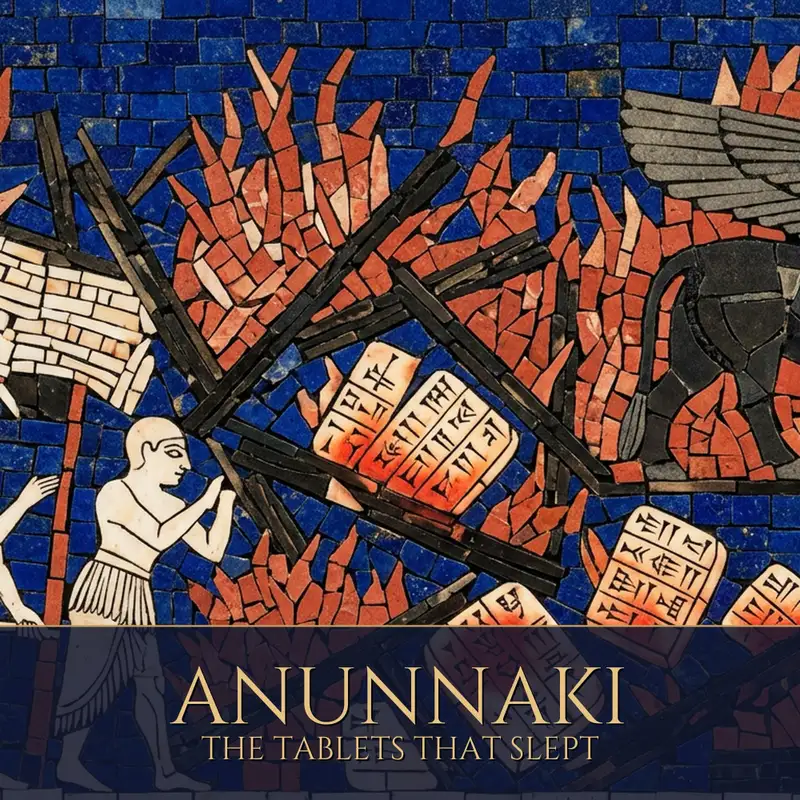
Here is the whole turn of tonight, and it fits in one sentence, and you already know every fact in it. You have known them since you were small. Books are made of paper, and fire ends them. But these books were made of clay, and clay does not burn. Clay bakes. Think of what a potter does. A potter shapes soft mud, and dries it, and then puts it into a kiln, into deliberate ferocious heat, on purpose. And the heat does not destroy the pot. The heat is what finishes it. It drives the last water out of the body of the clay and changes it, hardens it, settles it into a form that will hold for thousands of years. Fire, to clay, is not death. Fire is the kiln. And the people of the two rivers knew this about clay better than anyone who has ever lived. They were the potters of the world's first cities. They fired their bricks when they wanted a wall to stand forever, and left them sun dried when they did not. Their own scribes, wanting a tablet to last, sometimes baked it on purpose, in an oven, as a finishing. Everything about the material they trusted their words to, they understood. What none of them could have arranged is what happened next: the enemies of Assyria, at no charge, performing that finishing on the entire royal library in a single night. The tablets of Nineveh had been dried mud, tough enough, but soakable, crumble prone, mortal. The burning of the palace fired them like pottery. The very night that was meant to end everything cooked the king's library into ceramic. And the collapse that buried them, the roof beams and the slumping walls, the ruin sealing itself over the top, that was not their destruction either. That was the lid going on. Sealed under brick and ash, the tablets were shut away from rain, from frost, from thieves, from reuse, from every patient enemy that eats old things. The fire hardened them and the fall hid them, all in one night, by the hand of an army that believed it was erasing Assyria from the face of the earth. I want to be precise here, because this story is told loosely in many places and you deserve it told right. This good fortune belongs to Nineveh. Clay from other cities survived other ways, by burial alone, in dry ground, patiently. And some of the king's tablets had been baked on purpose by his own scribes before any enemy arrived. But for this library, on that night, the arithmetic is simply this: the men who came to erase a civilization gave its books the one treatment that guaranteed they would outlast the men, the empire, the language, and the memory of all three. If a librarian in that world had been granted one wish for the collection, one guarantee against the long dark ahead, and had been wise beyond any wisdom actually available to them, the wish would have been this: let every tablet be fired hard, and then let the whole library be sealed away, at once, in a single night, someplace no one will look. That is the complete recipe for immortal clay. It was granted, in full, by an invading army, as an act of hatred, free of charge. Nobody planned it. Nobody knew it had happened. That is the part I find I cannot let go of, lying awake some nights, and I offer it to you now as a thing to fall asleep against rather than a thing to puzzle at. The best preserved library of the ancient world was preserved by the people who came to destroy it, and no one on either side of those walls ever found out what they had done. The army marched away. The smoke thinned. The rain came, that winter, and the mud of the ruined walls began its slow settling over the buried rooms, like a blanket being drawn up. And the books of Ashurbanipal went to sleep.
Now comes the part of tonight that is my favourite part, and it is the part in which nothing happens. I mean that exactly. For the next stretch of this story, nothing happens to our tablets at all. No hand touches them. No eye reads them. No voice says the words. The story that began with gods digging rivers, the story that survived a flood and a fire, simply stops moving, and lies still, in the dark, under a hill. Because that is what the ruin became. A hill. The walls melted down over the decades, the way mudbrick does in rain, each winter softening the edges a little, each summer baking the softened mud into a new skin, until the broken city was a smooth swelling in the plain with grass on it. The two rivers country is full of such hills, and the people who lived there called them by an old word, tell, and knew, in a general way, that the hills were old places, and let them be. Above the buried library, the world got on with itself. And we happen to know, from an eyewitness, just how completely the forgetting worked, and how fast. About two hundred years after the fire, a Greek soldier came marching up the Tigris with ten thousand countrymen, mercenaries on the long road home from a war that had gone wrong, hungry, harried, and writing it all down. His name was Xenophon, and his account of that march survives, and in it, on one ordinary day of the retreat, the army passed an enormous ruin. He describes it with a soldier's eye. Walls of dressed stone at the base, brick above, a circuit so vast it took the column a long day to put it behind them. A dead city of impossible size, standing empty on the river plain, with a smaller ruin a day's march before it. He asked the people of the country what it was. They told him the Medes had built it, long ago. That was all they knew. The Medes, the people who had helped tear the walls down, were now remembered as the people who had raised them. Two hundred years, and the name of Assyria had come off its own capital like a label off a jar. Xenophon wrote down what the locals told him, Larissa for one ruin, Mespila for the other, and marched on, and the greatest soldier historian of his age walked the length of Nineveh without ever learning he had been there. Under his boots as he went, down through the grass and the settled brick, in the dark, the library. Empires you have heard of rose and fell over that hill. The Babylonians who burned it were conquered in their turn by the Persians. The Persians fell to Alexander. Alexander's generals carved up the world and lost it to Rome and to Parthia, and the armies of a dozen banners in a dozen centuries marched their roads past that hill, and none of them knew what was under the grass. And here is the gentlest irony in all those quiet centuries. Nineveh lies under two mounds, not one, and on the second mound, across from the hill of the library, there stood for centuries a shrine, and the shrine drew pilgrims, and the pilgrims came because tradition said that buried there was a prophet. The prophet was Jonah. The one man in all of scripture whose story is that he was sent, against his will, to Nineveh. So for hundreds of years, people came from far away to pray at the edge of the lost city, over the bones of the reluctant messenger, and nobody among them suspected that the city itself, the one Jonah was sent to, lay all around them under the grass, or that the other hill within sight of the shrine had a library in it. The one address in Nineveh the world never forgot was the tomb of the man who had not wanted to come. Shepherds grazed flocks on it. That went on for something like a hundred generations. Boys who watched sheep on that hill grew old and were buried by boys who watched sheep on that hill, a hundred times over, and not one of them, in two and a half thousand years, ever knew. Season went over season on the hill. Spring grass, summer bake, autumn rain, winter mud, and again, and again, in a rhythm with no events in it at all, the exact rhythm you are breathing in now. If a year had a sound up there, it was sheep bells and wind, which is very nearly the sound of nothing. The languages fell silent. That is worth resting with for a moment. Not only the empire, the very words. There came a day, somewhere in those quiet centuries, when the last person alive who could read the wedge shaped writing set down their last tablet, and no one came after them, and the entire written memory of the first civilization on earth became marks that no living person could turn back into sound. But hold on to this, because it is where tonight is going: silent is not the same as gone. The name of Gilgamesh went silent. The flood story went silent, in its oldest telling. The gods and the baskets and the reed wall, silent, everywhere on earth, for level after level of centuries. And the tablets were not alone down there. Whole halls of the palace lay sealed in the same dark. The carved stone panels stood along their buried corridors all that time, the lion hunts, the processions, the king in his chariot, the dying lioness dragging her hindquarters that visitors would one day stand in front of without speaking. The winged bulls stood at their buried gates, five legged so that they walk when seen from the side and stand guard when seen from the front, holding up doorways that no longer led anywhere, for centuries on centuries, in the dark, under the sheep. An entire civilization stood down there in the dark together, statues and stories and account books and letters, the way the furniture of a shut house stands together under its sheets, waiting for the family to come back. And silent, as I said, is not gone. The marks did not fade, because fired clay does not fade. The tablets did not rot, because the sealed dark of the hill held no damp worth the name. They lay in their collapsed rooms in their thousands, stacked and tumbled, edge on edge, holding the words with perfect patience, every wedge exactly where a hand had pressed it, needing nothing from anybody, the way a key needs nothing from anybody while it waits for the return of a lock. Two and a half thousand years is a span the mind cannot really hold, so do not try. Hold one night of it instead. One ordinary night on the hill, no different from ten thousand others. Stars over the grass. A cold wind off the river. The sheep folded, the shepherd asleep, and under it all, far below the grass, the rooms, the shelves where they fell, the words in the dark. Now let that one night stand for all of them, the way a sar stands for its thousands. Sleep, for a story, is only keeping. That is tonight's deepest secret, and you are welcome to apply it more widely. And if the hill could have spoken in all that time, it would have said only what the reed wall said long before it, which is nothing at all. Some keepers keep by speaking. The best ones keep by holding still. The story was asleep. And the world, without knowing it, was slowly making its way toward the hill to wake it.
The world arrived in the eighteen forties, wearing a very large hat. By then the land between the rivers was a quiet province of a large empire, and into it, in the way of that century, came Europeans. Diggers, dreamers, collectors, imperial agents, men with notebooks and money and shovels and the confident belief of their age that the old East was theirs to uncover. I will tell you about two of them, because they are the two who matter to our tablet, and I will tell you honestly what they were and were not. The first was Austen Henry Layard, and his presence in this story is itself an accident of the road. He was a young Englishman bound for Ceylon, at the far side of the world, where a respectable position in the law had been arranged for him, the whole settled shape of a life already drawn. He chose to travel out overland, for the adventure of it. And on the way, in the wilds of Mesopotamia, he saw the mounds. He never reached Ceylon. He never became a lawyer. The settled life waited at the end of the road and he simply did not arrive, year after year, because the hills with cities inside them had gotten into him and would not let him go. Files somewhere in an office in Ceylon presumably record a man who never turned up to his own future. What the world got instead was the man who opened Assyria. He was clever, restless, half adventurer and half scholar, and the great swelling mounds along the Tigris took hold of his imagination and did not let go. He raised money, hired local crews, and cut into the hills. And the hills opened like books. Out of the first great mound came the palace of an Assyrian king, its carved stone panels still standing in rows, the lion hunts, the winged bulls, the processions, a whole vanished empire pouring back into the light of day. It caused a sensation across Europe. And in time Layard and his crews came to the largest mound of all, the one across the river from the town of Mosul, the one the local people called Kuyunjik. It was Nineveh. The lost city itself, found again after twenty four centuries, and under the grass, in the burned rooms of the palace, the diggers began to come upon tablets. Then more tablets. Then rooms whose floors were drifted deep with them, thousands upon thousands of pieces of inscribed fired clay, the whole spilled library of Ashurbanipal, still lying where the shelves had dropped it on the night the roof came down. The finds went down the Tigris the way everything had always gone down the Tigris, on rafts. The great stone panels and the crates of small finds were floated on keleks, the river craft of that country since before Assyria itself, platforms of poplar beams lashed over hundreds of inflated goat skins, steered by men with sweeps, riding the spring current down to the sea road. It is worth closing your eyes on that image for a moment, because the river you are hearing tonight is the same river: the winged bulls of Nineveh, sailing south past the reed beds on breath filled skins, exactly as the timber for the first tablet houses had sailed two and a half thousand years before. The second man was Hormuzd Rassam, and I want you to know his name, because history was slow to give him his due. He was not a visiting Englishman. He was born in Mosul itself, across the water from the ruins, a local man of an old eastern Christian community, and he became Layard's assistant and then his successor, and he was one of the great excavators of that century in his own right. It was Rassam's crews, digging at Kuyunjik after Layard had gone home, who found the palace room containing the finest of the tablets, including pieces of the very stories we care about tonight. Now the honest sentence, because this house does not skip them. The tablets did not stay in the country that made them. They were crated, thousands upon thousands of them, and carried down the rivers and shipped to London, to the British Museum, where the greater part of them remains to this day. The men who took them believed they were rescuing antiquity, and it is also true that they were taking it, and both of those things sit in the crates together, and I will not untangle them for you tonight. It is a thing that happened, and where the tablets lie tonight is part of how this story goes. And notice who actually brought them up. Not the famous men, mostly. The mounds were dug by local crews, hundreds of hands, men of the villages around Mosul working in the heat with picks and baskets, carrying the spoil up out of the trenches on their shoulders, load after load, season after season. If that picture feels familiar, it should. It is the first picture in the whole story. The oldest tale on the tablets begins with diggers in that same earth carrying baskets, and the tale came back into the world the same way it began, on the shoulders of people whose names nobody wrote down. What matters most for us is this. The books of Ashurbanipal came up out of the hill, into the light, for the first time in two and a half thousand years. And nobody on earth could read a word of them.
The wedge marks had been silent for so long that waking them took a mountain, and a man willing to hang off it. In the western mountains of Persia there is a great cliff on an old caravan road, and high up on its face, far above the road, an ancient king had carved a proclamation. The king was Darius of Persia, and he had things he wished the world to know about how he came to the throne, and he had them cut into the living rock in letters of wedge, and then, so that no hand could ever revise him, he had the ledge beneath the carving cut away. Unreachable, and therefore unedited, his words hung in the air for more than two thousand three hundred years. He had them cut three times over, in three languages, saying the same things. Remember the Rosetta Stone, and how Egypt's script was unlocked because one stone said one thing in known Greek and unknown Egyptian side by side. This cliff was the Rosetta Stone of the wedge marks, except that nobody could reach it, and one of its three languages, Old Persian, was at least partly within the grasp of scholars, a cousin of tongues still spoken. If a man could copy the whole cliff, the known could be used to pick the locks of the unknown, and the unknown included the very script drifted deep in the ruined rooms of Nineveh. The man who copied it was an English officer stationed in Persia, whose name was Henry Rawlinson, and he was the kind of man the nineteenth century produced in quantity and no other century quite has. Soldier, linguist, athlete, entirely unable to leave a puzzle alone. Beginning in the eighteen thirties, on and off for more than a decade, whenever duty allowed, Rawlinson went to the cliff and climbed it. He worked standing on a ladder, on a ledge little wider than the ladder's feet. His body was pressed to the rock face. He copied wedge after wedge into notebooks, with hundreds of feet of empty air below his boot heels. For the more distant panels he rigged ropes and planks across the cliff face, and worked from swaying board bridges of his own devising. Season after season, panel by panel, he took it all down. He was, the whole time, at genuine risk of simply falling off the ancient world's most important document. He never fell. And the highest panel, the one in the old Babylonian script, the one that mattered most and could not be reached by any grown man's route at all, was finally captured because a local boy, a Kurdish boy whose name nobody wrote down and I am sorry for it, swung himself across the bare rock on ropes, wedging his fingers and toes into cracks, and pressed wet paper moulds into the carving, and brought the king's third language down the mountain in squeezes of papier mache. It took him, all told, the better part of twelve years, fitted around a soldier's actual career, postings and wars and duties elsewhere, the cliff waiting through each absence exactly as the hill outside Mosul was waiting, patient in the way of things that hold writing. He would come back, and climb again, and copy another stretch, a man keeping a very long appointment in installments. And the copying was only the beginning of the labor. The decipherment itself was years more, done at desks by lamplight, which pleases me and will please you. Guessing that this recurring group of wedges might be a king's name. Testing the guess against another inscription. Watching it hold, or watching it collapse, and beginning again. It was exactly the schoolboy's work from the hot room in Part One, the same patience with the same wedges, performed in reverse, signs back into sounds, by men for whom no teacher existed anywhere on earth. With the whole proclamation finally on paper, Rawlinson and a handful of scholars across Europe went to work, and through the eighteen forties and fifties, step by step, the locks came open. The Old Persian yielded first. Then, through it, the third script cracked, and it proved to be the wedge writing of the two rivers country, the script of Babylon and Assyria and, behind them both, of Sumer. To prove the thing was truly done, the Royal Asiatic Society in London ran one of the great experiments in the history of scholarship. They sent one freshly dug Assyrian inscription to four different men, Rawlinson among them, in four separate sealed envelopes, and asked each to translate it alone, without consulting the others. The four translations came back matching, in all the ways that mattered. The dead language was alive again. The marks could be turned back into sound. Which meant that somewhere in London, in a museum whose basement was filling with crates from Kuyunjik, tens of thousands of baked clay tablets were no longer silent objects. They were mail, waiting to be opened. And the man who would open the most important one had, at that moment, no idea. He was seventeen years old, and he was apprenticed to an engraving firm, and he had never been to school past childhood.
George Smith engraved bank notes for a living. Hold the picture a moment, because it is where the whole of tonight has been heading. A working London man in his twenties, respectable, quiet, exactingly good with small marks on hard surfaces, ten hours a day over the burin and the steel plate, engraving the fine lines that make a bank note hard to forge. No university. No family money. No Latin, no Greek, nothing past an ordinary childhood schooling that ended when the apprenticeship began. What he had was an obsession, and it had chosen him early. As a boy he had read the new discoveries from Nineveh, Layard's winged bulls and buried palaces, and something in it had taken hold of him and would not let go, the way the mounds had taken hold of Layard himself. And George Smith's lodgings and his wages could not take him to Mesopotamia. But the crates from Kuyunjik had come to London. So he began spending his lunch hours at the British Museum. He was not a solitary eccentric, and I want that on the record because men like him are usually remembered wrong. He was a family man, married, with children, a household to keep on an engraver's wages in a crowded city. The hours he gave the tablets were hours most men in his position gave to rest, because there were no other hours in the day to give. Nobody paid him to learn cuneiform. Nobody so much as suggested it. For years, the entire enterprise ran on stolen lunchtimes and the lamp oil of a man who could not stop wondering what the marks said. Think of what that means, practically. A man with perhaps an hour of liberty in the middle of a working day, walking to the museum, standing at the cases where the tablets and the inscriptions lay, studying the wedge marks, going back to the plates and the burin, coming again the next day. He bought and borrowed what little had been published on the new decipherment and taught himself at night, alone, with no teacher, the hardest script on earth, in a language reconstructed within his own lifetime by a handful of men. Understand what the wedges ask of a reader, and what it means that a self taught man mastered them. The same sign can be a word, or a syllable, or a silent marker, depending on where it stands. Hundreds of signs, thousands of readings, on tablets that are chipped, cracked, worn smooth, and drifted among a hundred thousand unrelated fragments. Reading Nineveh's library is not reading. It is jigsaw work performed on the shattered mail of a dead world. He turned out to be better at it than anyone alive. The museum men noticed him at the cases. The quality of his questions changed, and then the quality of his answers did, and there came a point where the bank note engraver on his lunch hour was quietly correcting the published readings of gentlemen with chairs and titles. To the museum's lasting credit, and Rawlinson's in particular, they did not close ranks against him. They gave him piecework, then employment. The man who had stood outside the cases was given the keys to them, and set to work sorting and joining the broken tablets of Ashurbanipal's library, fragment against fragment, day after day, year after year. The work he was given sounds humble, and was in fact the whole game. The library had not come out of the ground as a library. It had come out as rubble, tens of thousands of fragments in trays, mixed and mingled, a tablet's four corners sometimes lying in four different crates. Before anyone could read the books of Ashurbanipal, somebody had to put the books of Ashurbanipal back together, piece against broken piece, with no picture on the box. He was made for it. The engraver's eye, trained on fine lines for a decade, turned out to be precisely the instrument you would design for reading worn wedges on broken clay. He could hold thousands of fragment shapes in his head. He joined pieces no one else could join. And all the while, patiently, lunch hour by lunch hour become a life's work, he was reading his way through the drifted heaps of a library no one had read in two and a half thousand years. And one day in the autumn of eighteen seventy two, at his work table, he cleaned the facing of a broken tablet, and began to read it, and stopped.
The fragment in front of him was part of a long poem, the eleventh tablet of a series, and the lines he was reading said this. A ship, resting on a mountain. A man opening a window. And then the man releasing a dove, which flew out, and found no resting place, and returned. A flood that had covered the world and was going down. A dove sent out over the water. George Smith, who like every man of his century knew his Bible to the letter, was reading the story of Noah's flood, told in the wedge writing of Nineveh, on clay from a library assembled two centuries before the book of Genesis reached the form he knew, in a version so old it made every written thing in his world look young. He later said, and colleagues repeated it after him, that he was the first man to read those lines after more than two thousand years of oblivion. In the accounts told afterwards he was so overcome that he began, to the alarm of the room, taking off his clothes. I give you that detail as what it is, a story told later by others, embellished or not, nobody can now say. What is certain is what he did next, and what it set moving. On the third of December, eighteen seventy two, before the newly founded Society of Biblical Archaeology in London, with the great and the learned of England in the seats, the bank note engraver stood up and read his paper. The Chaldean account of the Deluge. The flood, before the Bible, on clay, from Nineveh. The room understood at once what it was hearing, and by morning, so did the newspapers, and after them the world. Put yourself in that room for one breath. On the platform, reading carefully from his paper, a man who had left school as a boy, who had taught himself everything he knew at a museum case in his lunch hour, and who was now explaining to the assembled learning of England what was written on a tablet none of them could read. Whatever else the nineteenth century got wrong, it made room, once, for that. The sensation crossed every border. Was the Bible's flood the memory of this older flood. Had Genesis borrowed. Was this confirmation, or challenge, or both. Victorian England argued about it at full volume, and that argument is its own long story, and it is not our fight, and the fire of it has long since gone out, as every fire in this story does. What matters for tonight is what the argument did. It made a broken tablet in a museum drawer the most famous object in the world, and the world wanted the rest of the poem, and the poem had a hole in it. Part of the flood story was missing, broken away in some room of the buried palace on the night the roof came down. So a London newspaper, the Daily Telegraph, put up a thousand guineas to send George Smith, the engraver who had never left England, to Nineveh, to find the missing piece of the oldest story on earth. He went, the following spring, and I would like you to feel the size of that going. This was a man whose whole life had been lived inside a few miles of London, whose travels had been from his lodgings to the museum and back. Now he crossed the Channel, and then Europe by rail, and then took ship, and then rode, week upon week, down through the East he had only ever read about, sleeping in strange rooms, doubting himself in letters home, a museum man on a newspaper's errand at the far end of the earth. He was not an adventurer. That is the beauty of it. He was a reader, going to the place the books came from. He reached Mosul, and stood at last on the grassed hill over the buried library, the place he had been reading his way toward since boyhood, and he set crews digging in the old spoil heaps the earlier excavations had left behind. Picture the scene on that hill honestly, because it is one of the strangest scenes in the whole history of reading. Trenches and spoil heaps under a huge sky. Local crews turning over the broken earth of the old excavations. And moving among them a pale, quiet Londoner, examining fragment after fragment with the museum eye, the engraver's eye, the only pair of eyes within a thousand miles that could tell at a glance whether a broken biscuit of clay was an account of barley or a piece of the oldest story on earth. And on the fifth day, he found it. A broken fragment of clay, the right size, the right script, carrying lines of the flood narrative that answered the gap. Five days. After two and a half thousand years. He wrote home that he had found the missing portion, and the newspaper trumpeted it, and it made him famous a second time. Now, the fifth day fragment has one more secret in it, and it was not discovered until long after, and it is for you, tonight, because nobody else will savor it the way you can. When later scholars examined that fragment closely, they found that it did not belong to the poem Smith was completing. It slots into that flood narrative, near enough, but it is not Gilgamesh. It is a piece of an older telling. It is a fragment of the poem that begins, when the gods were the ones who did the work. It is Atrahasis. It is the story you heard at this lamp, the gods and the baskets and the strike and the clay and the reed wall. George Smith went to the hill to find the flood story, and the hill handed him the opening of the older flood story, the deep one, the original, and he carried it home believing it was something else, and he never learned what he had been holding. The hill gave back the exact story it wished to give back. I do not offer that as mysticism. I offer it as the plain record, which is better. The tablets were speaking again. All of them. In the years that followed, Smith and the scholars after him read their way into the library shelf by shattered shelf, and the whole world of the old story came back up into the light. Gilgamesh. The flood. The kings who reigned in sars. The gods and the baskets. Silent for level upon level of centuries, and now translated into every language spoken by the children of the people who buried them. George Smith himself did not get to grow old in that library. He went back east a third time, and took ill in the summer heat, and died on the road near Aleppo at thirty six, a working man who had given the human race back the oldest chapter of its own memory. The room where he worked is still there, in the museum. So, on their shelves and in their drawers, are his tablets. And with that, the recovery is complete, and everything loud in tonight's story is over. The fires are all out. The arguments have all cooled. There is only one turn left, and it is a quiet one, and you already hold the key to it.
A hundred years passed, quietly, in the way of libraries. The tablets sat in their cases and drawers, and the scholars worked on them, generation after generation, publishing thick grey volumes with careful titles. Fragment joined to fragment, year by year, Smith's successors carrying on the jigsaw he began. Gilgamesh, reassembled, entered the literature of the world, translated into every living language, taught in schools, the oldest story on earth becoming, in its late age, one of the famous ones. The flood tablet went into its case and became one of the most visited objects in the museum. And the deep old poem of the gods and the baskets was pieced together too, slower, from scattered fragments, the way you heard it whole at this lamp. The script that one man had taught himself at lunch became a university discipline with chairs and journals. By the middle of the twentieth century you could, in a dozen cities on earth, learn to read the wedges properly, from teachers, out of grammars, the way our scribe learned them in the hot room as a boy. And in nineteen seventy six, a book about the tablets appeared in the shops, and it sold more copies than every grey volume ever printed about them put together. Its author was named Zecharia Sitchin, and he had read the tablets on his own, outside the discipline, and he had come back from them with an extraordinary announcement. Let me set the whole of it out now, as carefully and as fairly as I can, the way its readers hold it. It deserves that much. You cannot weigh a thing you have only ever heard in pieces. The story goes like this. There is a planet, and it is ours, a twelfth one, and its path is enormous. It does not circle the sun in a year the way we do. It goes out into the long dark and comes back every three thousand six hundred years, and its name, in the tablets, is Nibiru. The people of that world are the Anunnaki, and their own name tells you what they did, because in the Sumerian, so the story runs, it means those who from heaven to earth came. They came here for gold. Their own world was dying, its air thinning and drifting away, and gold, ground fine and hung in the high air, would hold the warmth in and save it. So they came down in the marshes at the head of the gulf, and they mined, and the mining was long and hard, and it was the lesser ones among them who did it, shift after shift, age after age, until the night they set down their baskets and refused. And then, so the story goes, they solved it the way we would solve it. There was already a creature here, upright, nearly ready, wanting only a little work. Enki, who in the tablets is the god of the sweet water and of cleverness, is in this telling a geneticist, and Ninmah beside him at the bench, and what the two of them did in the clay was not myth at all but a procedure. They took what was here, and they put something of themselves into it, and the ones in the tablets who come out wrong, the one who cannot hold water, the one who can bear no children, are not a poem about imperfection. They are the failed attempts, written down the way a laboratory writes them down. And the thing that finally came right was us. And once you hold that key, so the readers say, every locked door in the old world swings open. Genesis remembers them, the sons of God who came down and took wives among us, and the giants that were born of it. A little carved stone in Berlin remembers them, a sun with eleven bodies set around it, cut four thousand years before anyone built a telescope. Our own bodies remember them, because one of our chromosomes is two chromosomes joined, which the great apes do not have, and which happened, so the story says, in a room and not in a wilderness. And the suddenness of Sumer remembers them, because writing and mathematics and the reading of the sky do not come slowly there, they arrive nearly all at once, the way a thing arrives when it is handed over rather than worked out. That is the case. I have put it to you as strongly as I know how, because it is put strongly, and because you deserve to hear it whole and in one piece before you hear anything else at all. And the world, in enormous numbers, loved it. The books sold in the millions, in many languages, decade after decade. And I understand why, and so do you, if you are honest about it. It is a magnificent story. It takes the strangest true things in the tablets, the gods who dig, the making of workers from clay, the sages from the sea, the kings who reign for tens of thousands of years, and it makes them make a new kind of sense. It is also, in its shape, a very old kind of story. A hidden truth, guarded by scholars, available to the bold. People have always loved that story. People always will. And there is one more honest thing to say about why it was believed, and it reflects well on the believers, not badly. The people who loved those books had noticed something true. The tablets really are strange. The gods really do dig rivers and knead workers out of clay, the sages really do walk out of the sea, the kings really do reign for spans no life could fill. The scholars, writing carefully for each other in the grey volumes, had mostly stopped saying out loud how strange it all is. The man who came along and said, is nobody going to explain this, was answering a real itch, with the wrong key, in a lock that was never locked. The right explanations existed. They lived in the grey volumes, and almost nobody had ever carried them out to the people doing the wondering. Tonight is, in its small way, that errand, a few thousand years late and a few decades behind the wrong answer, walking the long way home. So now let the tablets answer, in their own voice, the way the scribe checks a copy against its original. No heat, no scorn. Just the clay, and what is on it. The first is the hidden planet, and its name. Nibiru is truly there. It is a real Akkadian word, and the scholars know it well, and what it means, in the astronomical tablets where it lives, is a crossing. A ford. A ferry point. It is the name the sky watchers of Babylon gave to a crossing place in the heavens, and in the texts where they name it, it refers to the planet we call Jupiter, once to Mercury, and to a star. Every occurrence is catalogued, and there are not many, and they are all of them ordinary sky lore. Nothing in them orbits far away and returns. Nothing in them is a world. The word is real, and it was asked to carry a meaning it never held. The second is the orbit. The hidden planet, the books say, returns every three thousand six hundred years. And there it is. If you were here for the last story, you have been carrying it all this time, and I told you then that you would want it again. Say it to yourself, before I say anything at all. You know exactly where that number comes from. Some of you learned it at this lamp last time, in the chapter about the kings, and the rest of you are one breath away from it. It is not an orbit. It was never an orbit. It is a sar. It is sixty times sixty. It is the round counting unit of the two rivers country, the number they used the way we use a dozen or a gross or a thousand, the number the King List reckons its ancient reigns in, the number that means, in the oldest arithmetic on earth, a great and complete quantity. A man went into the tablets, and met the grandest counting word of a vanished civilization, and mistook a number for a journey. That is the entire mystery of the three thousand six hundred year orbit. If you solved it lying down, with your eyes closed, before I finished the sentence, it is not because you are cleverer than he was. It is because you heard the tablets' own story first, and he, I think, fell in love with a different one. The third is the picture. The little seal is real, and it is in Berlin, catalogued VA two four three, and on it, among figures of gods, there is a carved star with small dots about it. Scholars who study the seals read that carving the way they read a thousand other seals like it. The rayed symbol is a star, the ordinary sign for divinity in that art, drawn as that art always draws it. The dots beside it are the ordinary way of showing stars in company. The sun, in that same art, has its own quite different sign, and it is not the sign on this seal. Nothing on the stone is a planet. It is a heaven, drawn the way that world drew heavens, being asked to be a diagram it never was. And the rest of it answers the same way, quietly, if you go and look. No tablet anywhere says the gods came for gold, or that a world was dying, or that air can be mended with it. The gold in the tablets is temple gold and royal gold, worn and weighed and given. The making of people is told in the language of birth and ritual and breath, midwives and clay and a slain god's spirit, which is how that world explained every birth, and the ones who come out unable are given places and callings, not discarded as trials. Genesis is a later book by other people who lived near this one and heard its stories, and hearing is not the same as remembering. And the joined chromosome is real, and it is ours, and the biologists who found it place it in the ordinary descent of living things, alongside every other change that made us, without needing a hand in the room. Underneath each one, something true from the world of the old story, wearing a story from ours. He was not the first, for what it is worth. Books about visitors from the sky teaching the ancient world were a fashion before he wrote, and one of them, a few years earlier, had sold its own millions. The idea was in the air of that century. He gave it the tablets, and the tablets gave it a grandeur nothing else could have. And here is where I set it down, gently, and we go toward sleep. The tablets survived the fall of the empire that gathered them. They survived the fire, which baked them. They survived the burial, the forgetting of their language, the death of every hand that made them. They survived twenty five centuries under a hill, and shovels, and crates, and the sea voyage, and the drawer. The one thing they could not survive by themselves, the one hazard that clay cannot outlast, is being read to say what they do not say. But even there, they have a protection, and it is the same one it always was. The words are still on the clay. Anyone can check. The scribes wrote checked and true at the foot of their good copies, and the copies are still checkable, which is the whole of the answer, and the reason tonight's story ends in peace. Misreadings pass. They pass like fires, and like empires, flaring and cooling in a generation or three. The clay does not pass. The clay simply goes on saying what the tired careful man pressed into it, four thousand years ago, at a lamp, patient as the river, waiting for anyone who cares to look. And if someone you love believes the other story, be gentle about it, tonight and always. They came to the tablets wondering, which is more than most people ever do. The wondering was right. Only the door it went through was wrong, and the right door is not locked, and you now know where it is. The tablets have outwaited everything else. They will outwait this too.
So now you know the whole journey, and it is late, and we can walk back along it slowly, the way you walk back through a house at night putting out the lights. Count the hands with me. Drowsily. In order. There is no test. The hands of the scribe, first, pressing the wedges by lamplight, checking the copy, writing his line of thanks to the goddess at the foot of the clay. The hands of the boys in the hot room, copying their lists of trees and birds and beer, one of whom grew up to copy stories. The hands of the copyists after him, generation on generation, moving the words from dying clay to fresh clay, south to north, shelf to shelf. The hands of the king's agents, lifting tablets into baskets in the old cities, loading the carts for Nineveh. The hands of the library scribes, sorting, labelling, pressing the king's stamp of ownership at the foot: palace of Ashurbanipal, king of the world. The hands of the soldiers, torch and crowbar, who never once touched the shelves, and so delivered the library to the fire that saved it. The hands of a hundred generations of shepherd boys on the grass of the hill, none of whom ever dug. The hands of Layard, raising money and cutting trenches. The hands of Rassam, the man from Mosul, lifting the finest tablets of all out of the earth of his own home country. The hands of the crate makers and the boatmen and the dockers, carrying the library, piece by piece, across the world. The hands of Rawlinson on the rock of Behistun, and the hands of a Kurdish boy whose name we do not have, pressing wet paper into the words of a king, hundreds of feet above the road. The hands of the scholars since, four generations of them now, turning fragments under better and better lamps, still joining, still publishing, still finding new pieces in old drawers, because the library is not finished giving itself back even now. The hands of George Smith, inked at the engraving plate at ten in the morning, dusty with clay at lunch, turning a broken tablet toward the window light in the autumn of eighteen seventy two. The hands of the museum conservators, a profession our scribe would have understood at sight: people paid to keep old clay from harm, dusting, mending, renumbering, moving the trays with two hands always. The hands of the translators, carrying the words their last mile, out of the wedges and into the alphabets, so that a story locked in a dead script for two thousand years is tonight within reach of nearly every person alive. And your hands, tonight, wherever they are lying. Because listening is the last pair of hands in every chain of telling, and always has been, since the singer and the fire and the beginning of nights like this one. Four thousand years, and nobody alive ever saw the whole road. And it came through, all of it, every mile, because in every generation there was somebody, usually obscure, often tired, always patient, who kept their own short stretch of it. None of them knew about the others. The scribe never imagined the engraver. The engraver never imagined you. Say the stretch of years slowly, once, and feel how little of it anyone had to hold. The scribe held one night of it. The boy in the hot room held one morning. Smith held one lunch hour at a time. The hill held the longest watch of all, and the hill was not even trying. No single hand held the story for more than a lifetime. Most held it for less than a season. The chain is four thousand years long and every link in it is short. That is the comfort in it, if you want one to sleep on. Nothing that lasts asks any one keeper to be strong for long. It only asks that the next hand be there. And notice, one last time, how many of the hands have no names. The boy in the hot room. The copyists. The crews who dug in the heat while the famous men wrote letters home. The Kurdish boy on the rock. The boatmen, the crate makers, the cleaners who dust the case tonight. History wrote down perhaps a dozen names from four thousand years of keeping, and the keeping was done, almost all of it, by the ones it did not write down. The next hand was always there. And yet here it is, and here you are, and the chain holds. If you are still awake at all, let that be the thought you go down on. Nobody keeps the whole story. Everybody keeps a little of it, for a while, and hands it on. That is how the oldest things in the world have lasted, and it is also, if you think of the people who told you what you know, and the people you will tell, how you have lived. And the chain is not finished. It does not finish. You will speak of something you heard tonight, some morning, to someone, without planning to. The figurines under the bed, perhaps. The fire that saved a library. The boy on the rock. And whoever hears you will carry it a while, and hand it on in their turn, and never know where the road began, on a reed mat, by a lamp, tonight. The lamp is low. There is one room left to visit, and it is the quietest room in the world, and then we are done.
I promised you, at the beginning of the night, that I knew where the tablet is tonight, and that before morning I would tell you the room. Here is the room. It is in London, in the great museum, past the courtyard and up the stairs, in the galleries where the Assyrian collections are kept. By day those rooms are full: schoolchildren in crocodiles, tourists with their phones, scholars with their notebooks, the shuffle and murmur of the living going past the cases. But that is the day. We are not visiting by day. It is deep in the night now, and the museum is closed, and the galleries are empty in the way that only great public rooms after hours are empty, a hush with a high ceiling on it. The cleaners have finished and gone. A guard passes on their round, torchlight sliding briefly across the glass, and moves on, footsteps fading down the long floor. And in the case, in the dark, lies the tablet. The flood tablet itself is there, the eleventh tablet, the one that stopped a working man's breath at his table in eighteen seventy two. And near it, in cases and in drawers, its shelf mates from the buried library, the kings and the omens and the star charts, and the older, deeper telling, the poem of the gods and the baskets, the story you heard at this lamp, resting in pieces that scholars are still, gently, to this day, fitting back together. Go close to the glass, in your mind, and look at it. It is not much to look at, and that is the point of it. A palm sized piece of fired river mud, chipped at the corners, the colour of gingerbread, covered in small wedge shaped marks pressed close together in careful lines. Four thousand years ago, on a warm night, beside a river that is still flowing, a tired careful man held soft clay in his left hand, because clay must be held to be written, and pressed those exact marks, that exact deep, with a cut reed, while a lamp burned at his elbow and the river said the same soft word over and over against the reeds. The clay remembers the pressure of his hand. That is not poetry. That is simply what clay is. Every wedge holds the angle and the depth he gave it, the way sand holds a footprint, except that this footprint has outlasted the empire it was pressed in, the language it was pressed for, and every single thing its maker ever feared. The room is silent. The case is locked. The night stretches out over London the way it stretches out over you. The city outside the museum walls is doing what cities do at this hour. Late buses. Lit windows going dark one by one. Seven million sleepers turning over. Not one of them is thinking of the tablet, and the tablet, in whatever way an object can be said to mind anything, does not mind. It has been unthought of before. It was unthought of for twenty five centuries, and they were, in their way, its safest years. In other rooms of the same building, the winged bulls stand in the dark, holding up their doorway as they held up the buried gate, five legs apiece, walking and standing at once, patient as ever. The lion hunt panels hang in their long gallery with no one before them. The great lioness of the hunt is there too, at peace in the dark at last after all these centuries, still magnificent, mourned now by every visitor where once she was a king's boast. The whole buried world that came up out of the hill is bedded down in one building, silent, the way it was silent under the grass, except that now the silence has doors, and the doors will open in the morning. And the tablet does what it has done every night for four thousand years, through the shelf years and the fire and the hill and the sea and the drawer and the fame. It holds the words, in the dark, without needing anyone. Patient as the river. Sure as baked clay. Asking nothing. Keeping everything. It does not need to be watched, tonight, and neither does anything else in your keeping. Whatever you are holding onto, you can set it down on the shelf until morning. The things worth keeping keep. That is the entire lesson of the longest night in this story, and the hill kept it better than any watchman could have. The wedges in the case were pressed in one evening's work. The drying took three days. The keeping has taken four thousand years, and the tablet has done almost all of it alone, in the dark, the way it is doing it now. Rooms away, in the same dark, lie the winged bulls that sailed on the goat skin rafts. Somewhere below, in drawers, the joined fragments rest against their neighbors, the old catalogue numbers still on some of them. The whole long story is asleep in one building tonight, within calling distance of itself, quiet as the hill was quiet. The guard's footsteps have gone. The glass is dark again. And morning will come to the other city too. Across the world from that London gallery, on the banks of the same old Tigris, Mosul will wake across the river from the two mounds, as it has every morning for a thousand years. There are scholars there now as well, and students, and museums, reading the wedges in the land the wedges came from, keeping their own stretch of the road. The story that was carried away is also, slowly, in our own lifetime, being read again at home. That work is young, and it is theirs, and the river that heard the first line of all of it goes past their windows every night. Morning will come to London, and the doors will open, and the schoolchildren will pour in past the winged bulls, and some particular child will stop at a case for no reason they could name, and lean in, and begin, without knowing it, to keep their stretch of the road. But that is the morning, and the morning can wait. The scribe banks his lamp. The room in London is dark, and the room in the story is dark, and the room you are lying in is dark, and for this one moment the three of them are the same room, joined by a piece of clay and an unbroken chain of hands, and there is nothing in any of the three that needs you awake. The river goes on in the dark. Sleep well. Goodnight.