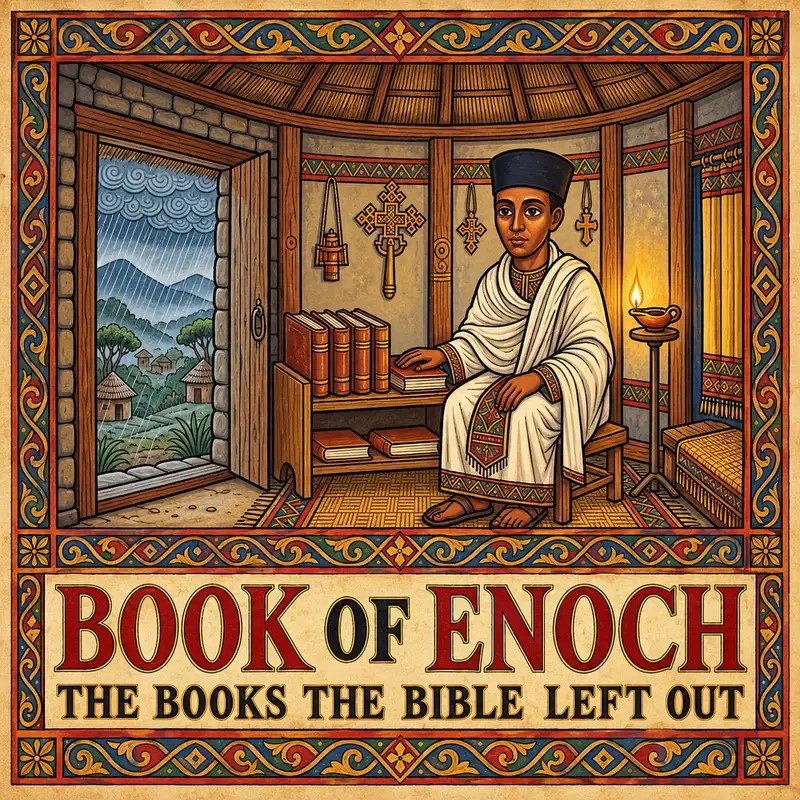
Welcome to The Sleeping Almanac. Tonight, the books that were left out. You have heard of one of them. It is called the Book of Enoch, and for a long time now people have been telling each other that it was lost, or hidden, or banned, and most of that is not true, and the true story is stranger and quieter and far more interesting than any of it. There is a man in it who does not die. There are two hundred of heaven's own watchmen who come down a mountain and swear an oath they will regret. There is a house whose floor is fire and whose ceiling is fire, and a man asleep beside a river who is shown it in a dream. And there is this, which nobody who says the word banned ever seems to mention: a book inside the New Testament quotes the Book of Enoch by name, as prophecy, and has done so for two thousand years. Bishops argued about these books for longer than most countries have existed. A monk in Egypt buried a jar in the ground rather than hand his copies over. And one church, high in the mountains of Ethiopia, never left them out at all, and reads them this Sunday, and read them last Sunday, and has never once in its long life called them lost. That is where we are going tonight. Not to a cave, not yet. To a room where the book was never missing. There is a church at the top of a hill, and inside it there is a lamp. The church is round. Its walls are stone and timber and its roof is thatch, deep and steep, and tonight the rain is on it. Not a storm. The long patient rain of the highlands, the kind that comes for weeks in this part of the year and settles in and makes the whole country green, and it is falling on the thatch with a sound like a great many small hands, and it has been falling all evening, and it will fall all night. The hill the church stands on is one of a thousand hills. Beyond it the land drops away in steps, escarpment below escarpment, into valleys full of cloud, and in the daytime you can see for fifty miles, and at night you can see nothing at all except, if you go to the door, the rain, silver, and the dark shape of a juniper. Inside, the lamp. A small clay dish of oil, a wick laid in the lip of it, the flame the colour of old honey. By the lamp sits a man in white. He is not old and he is not young. He wears the white cotton that everyone wears here, wrapped at the shoulder, and across his knees there is a board, and on the board there is a sheet of parchment, pale and fine and cut from a goat skin, and on the parchment, in two neat columns, is a script that you would not be able to read. It is called Ge'ez. Say it once, slowly. Ge'ez. It is older than most of the languages of Europe, and it is written in letters that look, if you have never seen them, a little like rows of small people standing very straight. He writes it with a reed. Beside him, in two small pots, are two inks, one black and one red, and the red is for the name of God and for the headings, and nothing else. He is copying a book. This is the thing worth knowing before anything else tonight. The book he is copying is the Book of Enoch. And he is not preserving it, and he is not rescuing it, and he does not know that anybody thinks it was lost, because in this church nobody ever thought so. It is one of the books. It has always been one of the books. His teacher copied it, and his teacher's teacher, back and back, through more centuries than we will count tonight, in rooms like this one, on hills like this one, in this same rain. To him it is not a discovery. It is Tuesday. His hand aches a little, the way it does by this hour. He has copied this page before, and he knows where the hard word is, three lines down, and he slows for it. Beside him, on a low shelf against the wall, there are other books. Five or six of them, bound in wooden boards and leather, some fat, some thin, and every one of them is a book that somewhere else in the world was left off a list. Here they sit in a row in the lamplight, doing nothing, needing nothing, waiting for Sunday. Tonight we are going to take them down one at a time. There is a place for you here, in the warm part of the room, out of the rain. There is a mat, and a folded cloth for your head, and a whole night with nothing in it that you have to carry. You do not have to do anything now. Let the rain be on the roof. Let the lamp be warm on one side of you and the cool wet air of the mountains on the other, the way the whole world feels when you are almost asleep and perfectly safe. Close your eyes if they want to close. This story does not need to be watched. It only needs to be near you, the way the lamp is near you, the way the rain is near you, saying the same soft thing over and over on the thatch. You do not have to follow every word. You do not have to remember any of it in the morning. If you drift, the copyist will go on without you, and he will not mind. He has copied through a great many people's sleep. And one thing, whispered like a promise. Nothing in this story will ever startle you. There are angels in it who fall, and there are giants, and there is a judgment, and I will not pretend to you that those things are gentle. But they will be told the way this room tells everything, plainly, in a low voice, at a little distance, and then set down. No storm in here will ever be louder than the rain outside. You can trust this lamp. That is what it was lit for. The copyist dips the reed. It makes a small sound against the lip of the pot, like a bird stepping on a wet leaf. Before he begins, one small thing, and then we will not interrupt again. If this story carries you down toward sleep, subscribe now, while your eyes are still open, and the next tale will be waiting for you when you need it. A like helps other tired travelers find this lamp. And if you would rather carry these nights with you, The Sleeping Almanac is also a free podcast, on Apple Podcasts and on Spotify, waiting wherever you listen. That is all. Now settle back, and let him begin. We begin.
The copyist does not begin with the book on his knees. He begins with the shelf. He sets the board aside for a moment, carefully, so the wet ink will not run, and he reaches down to the shelf and lays his hand flat on the row of books, the way you would lay a hand on the back of a sleeping animal, and he leaves it there. He is not counting them. He knows how many there are. He is doing what people do with things they have had a long time. Let me tell you what a book is, in this room, because it is not quite what a book is where you are. A book here begins as an animal. A goat, most often, or a sheep. The skin is taken and soaked and scraped and stretched on a frame and dried in the sun and scraped again, and then it is cut into leaves, and the leaves are folded, and the folded leaves are gathered into little bundles, and the bundles are sewn together with cord and bound between two boards of wood, and the wood is sometimes covered in leather, and sometimes not. Then somebody sits down with a reed and two pots of ink, and begins. A page a day, perhaps. Perhaps less. A whole book is a year of a man's life, sometimes two, and every book on this shelf was somebody's year. He learned it here, as a boy. That is how it is done. A boy is sent up the hill by his family and sits at the side of the room and learns his letters by saying them aloud, all of them, over and over, in a sing song, the whole alphabet with all its orders, because Ge'ez letters come in sevens, each one with seven shapes for its seven vowels, and there are a great many of them, and a boy learns them the way he learns to walk, by falling over them for a year. Then he learns to read. Then, if his hand is steady and his teacher is willing, he learns to write, on scraps first, on bits of skin too small for anything else, and then on a whole leaf, and the first whole leaf a boy writes is always spoiled, and everyone knows that, and nobody minds. The copyist's first leaf was spoiled. He remembers which word. He was eleven. Before a leaf is written it is ruled. Not with ink. With a blunt point, drawn along a straightedge, pressing lines into the skin so faintly that you cannot see them unless you tilt the leaf to the lamp, and then you see them all at once, a whole page of ghost lines, the two columns marked out, every line of writing waiting for its writing. He rules a leaf in the morning and writes it through the day and into the night, and if he is honest, which he is, he does not get to the bottom of it every day. That is why nothing on it was ever thrown away. You cannot throw away a year. Not casually. Not because a letter came from a city you have never seen, saying that this book is no longer on the list. You would have to be very sure, and nobody here has ever been that sure, and so the books stayed. That is the whole secret, and I am telling it to you at the very beginning of the night so that you can stop wondering about it and go to sleep. Nothing here was hidden. Nothing was smuggled. Nobody stood in a doorway with a torch. The books stayed because they were books, and books are years, and you do not burn a year. Outside, the rain. It has been raining for three weeks. This is the wet season in the highlands, and the whole country is drinking. Down in the valleys the rivers are brown and loud and the fields are the green of something that has just been born. Up here on the hill the thatch drinks the rain and holds it and lets it through in slow drops at the edges, and the juniper by the door drips, and the path down to the village is a stream. Nobody will come up the hill tonight. Nobody is expected. The copyist has the whole church to himself, and the lamp, and the row of books, and the long hours before morning, which is when the light will be good enough to check what he has written. He takes the first book down. It is not the biggest and it is not the oldest. It is the one he knows best, because it is the one he is copying, and a man knows the book he is copying the way he knows the road to his own house. Its boards are dark with handling. When he opens it the leaves make a small dry sound, and the two columns of Ge'ez stand up straight on every page, black, with here and there a line of red, and the red is where the name of God is, and he touches one of the red places with the side of his thumb, not reading it, just touching it, the way you touch a doorframe on your way in. Mashafa Henok, this book is called here. Say it once. Mashafa Henok. The Book of Enoch. Everywhere else in the world, for a very long time, people said it was lost. He turns to the first page. And we will begin where the book begins, which is not on this hill at all, and not in this century, and not even with this book. It begins with a list of names in a much older book, and one name in the list that does not behave.
His hand is on the first book, open at the beginning. But the beginning of the Book of Enoch is not the beginning of Enoch. For that we have to go to Genesis, to a page that most people turn past. It is a list. The fifth chapter of Genesis, and it is nothing but a list, one of those long patient lists of who was the son of whom, and how many years they lived, and it goes on for a page, and the rhythm of it is the rhythm of a road going over flat country, one milestone after another, all the same. Adam lived, and had a son called Seth, and lived after that, and died. Seth lived, and had a son called Enosh, and lived after that, and died. Enosh, and Kenan, and Mahalalel, and Jared. Each one lives, and has a son, and lives on for a great many years, eight hundred, nine hundred, and then the same three words at the end of every one, and the words are, and he died. It is like a bell. Every few lines the bell. And he died. And he died. You could set a clock by it. It is one of the oldest and plainest things in the whole of the Bible, this list, and it says one thing over and over with the calm of a man laying bricks, and the thing it says is that everybody dies. Then it comes to the seventh name. Jared had a son, and the son was called Enoch. And the list goes on as it has gone on, and says how long he lived, and the number is three hundred and sixty five years. Which is a small number, in this company. His father lived past nine hundred. His son, who was called Methuselah, would live past nine hundred and sixty, longer than anyone. Enoch lived three hundred and sixty five. One year for every day in a year. If you like that sort of thing you may like it a great deal, and if you do not, let it go by. The list does not stop to explain it. Seventh from Adam. That is the other thing the list tells you without meaning to, and people have been counting it on their fingers for two thousand years. Adam, one. Seth, two. Enosh, Kenan, Mahalalel, Jared, and then Enoch, seven. In a book where seven is never an accident, the seventh man is the one who does not die. Later readers made a great deal of that. The list makes nothing of it. It just goes on counting. And his son. I said Methuselah lived longer than anyone, and he did, nine hundred and sixty nine years, the longest life in the whole of the Bible, and if you do the sums, which people have, he dies in the year of the flood. The longest life there has ever been, ending in the same year the water comes. The list does not say whether he was on the boat. He was not. His grandson was, and his grandson's name was Noah. So the man who did not die had a son who lived longer than anyone and died just as the world did, and a grandson who floated. It is a strange family, and the list lays it out flat and walks past it. And then the bell does not ring. Everybody else in the list, and he died. Enoch, no. What the page says instead, and I will give it to you plainly, is this. Enoch walked with God. And he was not, for God took him. That is all. That is the whole of it. No more than that. He was not. The list picks itself up and goes on, Methuselah, Lamech, Noah, and the bell rings again, and he died, and he died, and the road goes on over the flat country. But there is a place in the road now where the milestone is missing, and everyone who has ever read this page has stopped there, and looked at the gap, and wondered. Where did he go? The page does not say. It says he walked with God, and it says God took him, and it uses a word for took that is the same word you would use for picking something up. That is all it uses. It does not say where. It does not say whether he was afraid, or glad, or whether it hurt, or whether he had time to say goodbye to Methuselah, or whether it was morning. It leaves a door open in the middle of a wall of names and it walks on. For a long time, that was the whole of Enoch. A gap in a list. A man who did not die. And then, some centuries before the birth of Christ, in a language called Aramaic that was spoken across the whole of that part of the world, somebody walked through the door. That is what the book on the copyist's knees is. It is what somebody wrote when they went through the gap in the list to see what was on the other side. Not one somebody. Several. Over a long time. The book he is copying is not one book but five, written by different hands in different generations and bound together long ago, and the oldest parts of it are older than almost anything else you will hear tonight. But all of it, every part, begins from the same small thing. A man in a list who did not die. Where did he go? And what did he see? The copyist turns the leaf. And on the other side of the door, the first thing anyone saw was a mountain.
The same book. A few pages in. His hand rests on the margin while he reads, and the rain is steady on the roof. Here is what the book says happened, in the days when there were only a few people on the earth, and the sons and daughters of the first families were being born and growing up, and the daughters, the book says, were beautiful. There were watchmen in heaven. That is the word the book uses, Watchers, the ones who do not sleep, the ones who keep watch. And two hundred of them looked down and saw the daughters of men and wanted them. Now here is the part that people who tell this story quickly always leave out, and it is the most human thing in it. The one who led them, whose name was Shemihazah, was afraid. He said to the others, I am afraid that you will not go through with it, and that I alone will pay for a great sin. So he made them swear. All of them together. He made every one of the two hundred bind himself with an oath and a curse, so that none of them could ever say afterwards that it had been someone else's idea. That is what leaders do when they are frightened. They make sure nobody can leave. And they came down. They came down on a mountain, and the book names it. Mount Hermon, which is a real mountain, and you can see it today, high and white at the top for most of the year, standing at the northern edge of the land of Israel where three countries now meet. The book says they came down onto its summit and swore their oath there, and it says, in one of the oldest puns in the world, that the mountain got its name from what they did on it, because the word for the oath and the name of the mountain sound alike. Whether that is true of the name I could not tell you. It is true of the book. The book says so. Two hundred of them, on a summit of snow, binding themselves together in the cold. Then they came down the mountain into the warm country below and took wives among the daughters of men, and the book gives the names of the leaders, twenty of them, in a long roll, and I will not read you the roll. Some of the names are strange and some are lovely and all of them are in the book. I want to stay on the summit a moment before we go down, because the book does, and because it is the picture everyone remembers. Two hundred of them. Not a crowd. Two hundred is a number you could count, if you stood at the edge and were patient, and the book wants you to know it is a number you could count. They are not a storm or a plague or a host. They are two hundred watchmen who each decided, and each swore, and each came. Every one of them had a name. The book only gives you twenty of the names because twenty is enough to make the point, that these were not a force of nature, they were persons, and each of them chose, and the choosing is the whole of the story. Snow under them. The country spread out below in the dark, with its small fires. And the cold, which watchmen who do not sleep have never had to feel before, and feel now, and do not turn back. And here is where the story turns into something else, because the book is not really about the wives. It is about what they taught. One of the two hundred was called Azazel. And Azazel, the book says, taught men to make swords. And knives. And shields. And the plates of armour that go over the chest. He taught them how to find the metals in the ground and how to work them, and he taught the women bracelets, and ornaments, and the paint that goes around the eyes, and the dyes, and the precious stones, and all the colours. And others among the two hundred taught other things. One taught the cutting of roots and the making of charms. One taught the signs of the sun, and one the signs of the moon, and one the reading of the stars, and one the meaning of the clouds, and one the signs of the earth. Do you see what happened? It is a list of everything. Metal and medicine and make up and the weather and the stars. Everything a people would need to stop being frightened of the world and start running it. And the book says it all arrived at once, and it arrived too early, from the wrong direction, before anyone was ready, and it was not a gift. That is the whole idea of this part of the Book of Enoch, and it is one of the oldest ideas anyone ever wrote down. Knowledge can come before you are ready for it. And when it does, it is not a blessing, or not only. I am not going to tell you what to think about that. Neither does the book, quite. It just lays the list down and lets you look at it. Swords. And the paint for the eyes. In the same breath. There were children. The book says the children were enormous, and it gives a size, and the size is impossible, and I will not repeat it, because the size is not the point. The point is what they ate. They ate everything. All the labour of men went into feeding them and it was not enough, and when it was not enough they turned on the birds, and the beasts, and the creeping things, and the fish, and in the end, the book says, on one another. And the earth itself, the book says, the earth which had been made to be quiet and fruitful, opened its mouth and cried out. Cried out to whom? To the ones who were still watching. Four of them. The book names them. Michael, Sariel, Raphael, Gabriel, though in some copies the second name is different, and that is worth knowing only so that you do not argue with anyone about it. Four of the watchmen who had not gone down. They looked, the book says, from the sanctuary of heaven, and they saw the blood on the earth, and they heard the earth crying, and they said to one another, the sound of it goes all the way up to the gates of heaven. And they carried what they had heard upward, to the highest place there is, and they set it down there. And what was decided, and how, and what became of Shemihazah and Azazel and the two hundred and the children, is a story for another night, a long one, and the copyist knows it, and will not tell it tonight. He turns past those pages. He has his hand on one page in particular, further on, and it is the page he was always going to read you, because it is the strangest thing in the book and the gentlest. It is about a man falling asleep beside a river.
The same book, the same hand. He has turned to the page. After the cry went up, and after the answer came down, the two hundred knew what had been decided, and they were afraid. And they wanted to plead. To ask for mercy. To say that they were sorry and to ask if there was any way back. And they could not. That is the thing. They had come down, and having come down they could not go up, not to ask, not to speak, not at all. The road ran one way. So they needed somebody who could carry a message up for them. And they went to a man. They went to Enoch. Who walked with God, the list had said, and who, the book says, had been hidden away in a quiet place where no man knew where he was, and whose days were spent with the watchmen who had not fallen. The fallen ones came to him. And they asked him, angels asking a man, please write our petition for us. Write down that we are sorry, and that we ask to be forgiven, and carry it up, because we cannot. Let that sit for a moment. Everything you have ever heard about angels and men runs the other way. Angels bring messages down. Here, the two hundred watchmen of heaven stand around one man and ask him, please, will you write this for us and take it up. And the reason is only this, that he could still go where they could not. The book does not make a lesson of it. I am not going to either. But I think it is the most human page in it. So he wrote the petition. All of it. Every request they made, and every plea, and he took it and he went, the book says, to a place by water. The waters of Dan, in the land of Dan, south and west of the mountain where the whole thing had begun. A river country, at the foot of the snow. And he sat down there beside the water, and he read the petition aloud, all of it, to the end, so that it would be heard. And then he fell asleep. That is what the book says. He read it, and he fell asleep beside the water, and the answer came to him in a dream. And I have to tell you, of all the things in all the books on this shelf, that is the one I would have chosen for this room and this rain if I had been allowed to choose. A man does the thing he was asked to do, and then he lies down by a river and sleeps, and in his sleep he is shown everything. Here is what he was shown. Clouds came and called him. And mist. And the courses of the stars, and lightning, and a wind that took him and lifted him and carried him up. And he came to a wall. And the wall was made of hailstones. Great white stones of ice, fitted together, and around the wall there was fire, and the fire was moving, and he was afraid, and he went in through the fire. And inside the wall there was a house. And the house too was built of hailstones. Its walls were like a floor of ice laid on end, and its floor was snow, and its roof, when he looked up, was the paths of the stars, and lightning going to and fro among them, and between the stars there were burning cherubim, and the heaven above all of it was water. And the house was hot, hotter than fire, and colder than ice, both at once, and there was no life in it, and no pleasure, and he was afraid, and he fell down on his face. And in his dream he saw a second house. A house greater than the first, the book says, with its door standing open before him, and this one was built all of flames. Its floor was fire, and above it were lightning and the paths of the stars, and its ceiling was fire, and in every direction, and in the middle of it there was a throne, and the throne was like ice, and its wheels were like the sun, and there was a sound of cherubim, and from under the throne came streams of fire, and he could not look at it. And on the throne there was one so bright that no angel could enter that house and no flesh could look at him, and around him there stood ten thousand times ten thousand, and none of the ones who stood closest to him ever went far from him, night or day, and he needed none of them. I want to stay in that second house a little longer, because the book does, and because it is the reason this book was copied for two thousand years by people who could not have told you what a gate of the sun was. It is the description. Nobody had written anything like it. The Bible, before this, had given you a burning bush, and a mountain with smoke on it, and a throne with living creatures around it. But not a house. Not a building you could walk into, with a floor, and a ceiling, and a door standing open, and a man standing in the doorway trying to look and failing. The book measures it the way it measured the gates of the sun. The floor is of this. The ceiling is of that. The throne is here, and its wheels are like this, and from beneath it there flows that. It is architecture. It is a surveyor's report of the inside of heaven, written by somebody who was so frightened that he could only get through it by describing, one thing after another, the way you count your breaths. And Enoch lay on the floor with his face down, trembling. And a voice said, come here. And it said, Enoch. And it said, do not be afraid. It is the oldest thing anyone says to anyone in a dream. Do not be afraid. Come here, and hear what I have to say. And then the answer to the petition, which he was to carry back down to the two hundred who were waiting for it by the mountain. And the answer was no. I will tell you that plainly, once, and then set it down. The petition was refused. They were watchmen and they had left their watch, and there would be no peace for them, the voice said, and no forgiveness, and he was to go back down and tell them so, and he did. He woke beside the water, and he went, and he told them, and the book says that when they heard it they were afraid and they trembled, and that is the last we see of them tonight. But I want you to keep the house. Not the answer. The house. Ice and fire, floor and ceiling, hot and cold at the same time, no life in it and no pleasure, the paths of the stars for a roof, and a man lying on his face on the snow of the floor in a dream by a river. Nobody in the world had ever described anything like that before, and I do not think anyone has since. And it is in a book that people tell you was lost. The copyist lifts his hand off the page. And turns forward, a long way, to a part of the same book where nothing happens at all, and everything is measured.
The same book, but a different book. I told you that the Book of Enoch is five books bound as one. Here is the third of them, and it is nothing like the others, and after the house of fire it is a glass of cool water. It is about the sun. The copyist's hand goes slower here, because the words are strange and the numbers are many, and a copyist earns his bread in a chapter like this. The book says that an angel called Uriel, whose name means the light of God, took Enoch and showed him the sky. Not the sky as a picture. The sky as a machine. How it works. Where the sun goes when it sets and where it comes from when it rises and why the days are longer in summer than in winter and what the moon is doing when it changes shape. And here is the picture the book gives, and I want you to see it, because it is beautiful and it is very old and it is completely wrong and none of that matters tonight. In the east there are six gates. Great gates in the edge of the world, standing in a row, and the sun comes up through one of them. In the west there are six more, and the sun goes down through one of those. And the sun does not use the same gate every day. It moves. It comes up through the first gate for a month of mornings, and then it moves along to the second gate, and then the third, and so on, until it reaches the sixth, and then it turns and comes back. That is why the sun rises in a different place on the horizon in summer than in winter. It is using a different door. And the days get long when the sun is in the far gates, and short when it is in the near ones, and Uriel shows Enoch all of this, gate by gate, and the book writes it all down, how many parts of the day are light and how many are dark in each gate, patiently, like a man counting sheep through a gap in a wall. And the moon does the same, with its own gates, and the book counts the moon too. It counts the moon more carefully than anything. How much of it is lit on the first night, and how much on the second, in parts, fourteen parts to a full moon, one part more each night going up and one part less each night going down, and which gate it comes through, and how the moon's gates and the sun's gates are the same gates used in a different order. It is pages of this. A copyist knows these pages. They are the ones where you lose your place, and count on your fingers, and find it again, and the man who first wrote them down must have sat under the real moon night after night with a tablet in his lap doing exactly that, counting, and getting it a little wrong, and writing it down anyway with the confidence of a man who has been told by an angel. And there are four days in it that have names. Not the ordinary days. The four that stand at the corners of the year, one at each turning of the seasons, the book calls them leaders, and it says that each one leads its season the way a man leads a flock, and that the stars know them, and that these four are the ones that get forgotten. And when it has all been counted, the book adds it up, and says how long a year is. And the number it gives is three hundred and sixty four days. Three hundred and sixty four. Not sixty five. Sixty four. Fifty two weeks exactly, of seven days, and no days left over, so that every year begins on the same day of the week and every feast falls on the same day of the week forever, and nothing ever drifts. The book is very pleased with this. It says that there are four days in the year, one at each turning of the seasons, that people forget to count, and it names them as the fault, and it says that the ones who count properly will not go wrong, and the ones who do not will find that their years slide, and their feasts wander, and their whole reckoning comes apart, slowly, like a rope untwisting. I will not tell you tonight what became of that number. I will only tell you that it was a number some people believed in very much, and that a year is not, in fact, three hundred and sixty four days long, and that the people who believed it knew about the sun and knew about the seasons and believed it anyway, because a number that never drifts is a beautiful thing to believe in, and because it was written in a book, and because the book said an angel had said it. And I will leave it lying there, in the lamplight, and come back for it another night. But look at what the book is doing. It is a book about the sky, and it is arguing with the sky. It has counted the gates and it has done the sums and it has arrived at a year that is prettier than the real one, and it would rather have the pretty one. And it puts the pretty one in the mouth of an angel. That is what the whole shelf is like, I think. Books that would rather have the pretty one. I do not say that against them. So would I. The copyist has stopped writing. It is late. He sets the board down across his knees and lets his hands rest on it, and for a moment the only sound in the church is the rain, which has not changed at all, which does not know about gates. Then he reaches for the second book on the shelf. And this one is different. This one is hardly a book at all. It is a bundle.
His hand is on the bundle. It is not on his shelf, in truth. It is on ours. This is a book that nobody has whole. What exists of it is fragments, pieces of skin and papyrus the size of a palm, the size of a thumb, found in a cave a very long way from here, and I will tell you about that cave another night. Tonight only what is on the pieces. It is the same story. The two hundred, the mountain, the wives, the children. But it is told from the other side. It is told by the giants. The Book of Giants, the pieces are called. And in the pieces the giants have names, and they talk to each other, and they are afraid. Two of them are brothers, Ohya and Hahya, and their father is Shemihazah, the one who made the others swear. And there is another called Mahaway, whose father was one of the two hundred too. And they have dreams. That is what the fragments are mostly about. The giants dream, and they do not understand their dreams, and their dreams frighten them. One dreams of a garden with trees in it, and gardeners, and then water, and fire, and the garden being destroyed, and all the trees but one. One dreams of a tablet, a great stone tablet, being dropped into water and going under, and only three names on it staying above the surface. They wake and they tell each other the dreams and they cannot read them, and the fear passes from one to the next like a cold. And so they send Mahaway to find the one man who can read a dream. They send him to Enoch. The book says that Mahaway went across the wilderness to where Enoch was, and that he flew, or was carried, and that he found him, and that Enoch read the dreams and told him what they meant, and what they meant was the flood. That is what the giants are dreaming of. The water that is coming. The garden that will be washed away with one tree left standing, and the tablet with three names, which are the three sons of the one man who will float. Now here is the thing about this bundle of pieces, and it is the reason I took it down tonight, and if you have been with us this season you will know why before I finish the sentence. One of the giants is called Gilgamesh. That name. In this book. On a scrap of skin written in Aramaic in the land of Israel two hundred years before Christ, among the sons of the fallen watchmen, there is a giant, and his name is the name of the king of Uruk who went to the cedar forest and killed the guardian and fought the bull of heaven and lost his friend and walked to the end of the world to ask an old man about death. If you were here for those nights, you know him. He has come a long way. A thousand years and a thousand miles, out of the clay of Mesopotamia and into a Jewish book about angels, and nobody knows exactly how, and I am not going to guess. I am only going to tell you that it is there, and that a man with a reed wrote it down, and that the scrap survived. Stories travel. That is all it means, and it is enough. And this one kept travelling. That is the last thing I will tell you about the bundle, because it is the kind of thing that only makes sense at night. Four hundred years after the pieces in the cave were written, a man in Mesopotamia, back where Gilgamesh came from, in the very country of the clay tablets, started a religion. His name was Mani. And among the books he wrote for it, he wrote his own Book of Giants, out of the same story, the two hundred and the mountain and the children who dreamed. And his religion spread east, along the roads that carried silk, over the mountains and across the deserts into the middle of Asia, and there it lasted for centuries after it had died everywhere else, and the giants went with it. Scraps of his Book of Giants have been found in languages you have never heard the names of, in the sand of oases a very long way from anywhere, and some of the names had been translated into the new tongues and some had been kept, and one of the kept ones is Mahaway, the one who was sent to Enoch. The giant afraid of his dream did not stay in the cave. He walked east, out of one alphabet and into another, and another, and was still being read by somebody, under some lamp, a thousand years after the last man on the hill in Judea had put down his pen. They go out of one country and into the next, and they change their clothes and keep their names, and they turn up in the strangest places, in a cave, on a hill, in the mouth of a giant who is afraid of a dream. There is one more piece I want to give you from this bundle, and it is very small, and then we will put it back. One of the giants wakes from his dream and says to the others, I have seen a thing that terrifies me, and I do not know what it is. And that is where the fragment breaks off. That is the edge of the skin. Nobody knows what came next on that piece, because the next piece is gone, and he is left there forever, in the middle of the sentence, having seen something, not knowing what it was. The copyist sets the bundle back on the shelf, gently, because it is only pieces. And takes down the third book, which is large, and heavy, and whole, and has been whole here for a very long time.
This one is thick. The boards are worn to a shine at the corners where hands have taken hold of it over and over. The copyist opens it near the middle, and the columns of Ge'ez stand up on the page, and there is a great deal of red on this one, because it is a book with the name of God on nearly every page. Mashafa Kufale, it is called here. The Book of Division. Everywhere else, where people have heard of it at all, they call it Jubilees. And what it is, is Genesis, told again. Not corrected. Not argued with. Told again, slowly, by a different voice, with everything that Genesis left out put back in, and all the numbers made to add up. The voice is an angel. That is the frame of the whole book. Moses is on the mountain, on Sinai, for forty days, and an angel who stands in the presence of God is beside him, and the angel is reading aloud to him from tablets. Tablets of heaven, the book calls them. Everything that has happened and everything that will happen is written on them already, and the angel reads, and Moses writes, and what Moses writes is this book. An angel with a tablet, reading. If you have been with this lamp a long time, you have met that image before, in a very old country, and I will not say more than that. And what the angel reads is the whole story from the making of the world to the coming out of Egypt, and he measures it. That is the thing this book cares about most. Measuring. Every event in it is placed, exactly, in a year, and the years are counted in sevens, and seven sevens make a jubilee, forty nine years, and the whole of history is laid out in jubilees like a field in furrows, and nothing in it is ever out of place. When was Adam made? The book knows. When did Cain kill his brother? The book knows, to the year, and the week of years, and the jubilee. It is the most orderly book on the shelf. It is a book by someone who could not bear for a thing to have happened at no particular time. And it keeps the calendar. The same one. Three hundred and sixty four days, fifty two weeks, no drifting. The angel is very clear about that, and says that the ones who use the moon to count their year will get it wrong, and their feasts will wander, and I said I would leave that lying in the lamplight, and I will. And it puts things in. That is the pleasure of it, if you know Genesis well, and the people who wrote it knew Genesis very well. All the places where Genesis goes quiet, this book fills. Genesis tells you Abraham was called out of his country and does not tell you what he was like as a boy. This book does. It says that when he was fourteen, in the city where he was born, the crows came down on the fields at sowing time and ate the seed before it could be covered, every year, whole flocks of them, so that nothing came up, and the boy went out ahead of the sowers and ran at the birds, and shouted, and drove them off, all day, from every field, so that not one crow landed, and the seed went into the ground, and the harvest came up, and after that the farmers sent for him every year at sowing time. That is in this book. A boy running at crows. It also says he was the one who thought of fixing a small blade to the plough so the seed would be covered as it fell, and I do not know whether that is true, and it does not matter. A boy in a field, with the crows going up in front of him like smoke. Nobody asked the angel for that. The angel put it in anyway. There are angels all through it, more than in Genesis, doing things Genesis never mentions. And there is one who is not on the right side, whose name is Mastema, which means something like hostility, and who is the chief of the spirits that trouble the world, and who asks, at one point, to be allowed to keep a tenth of them to do his work with, and is allowed. I tell you that only so you know the book has a shadow in it. It does. Every book here does. But it is a shadow at the edge of a very well lit room, and the angel goes on reading, and the years go on being counted. Here is what I want you to keep from this book. It was written in Hebrew, a very long time ago, about a hundred and fifty years before Christ, give or take. And it was copied and copied, and read as scripture by people who kept it in a desert and hid it in caves, a great many copies of it, more copies than almost any other book in those caves. And then, in the West, it was left off the lists, and stopped being copied, and the Hebrew was lost, every leaf of it. And the whole book, all of it, every year and every jubilee, survives complete in exactly one language, and it is the language on this page, and this is the second book tonight of which that is true. The copyist runs his thumb down a column of red. Then he closes the boards, and lifts the book back to its place with both hands, because it is heavy. And he reaches for the next one, and there is no next one. Not on this shelf. The next two books were never here. They were somewhere else entirely, in a jar, in the sand, in another country. And we have to leave the hill for them, briefly, and then we will come back.
Leave the church for a moment. Leave the rain. Go south and west, a long way, across the highlands and down and down into a flat hot country by a wide slow river, where it does not rain at all, and where the sand keeps things. There is a book that was found there. I will tell you how, another night. Tonight only what it is. It is a gospel, and it is not like the others. It has no birth in it. No stable, no star, no shepherds. It has no miracles. Nobody is healed, nobody walks on water, no bread is multiplied. It has no cross. No trial, no garden, no crown of thorns, no nails. It has no tomb, and nobody comes to it on the third day and finds it empty. None of that. Not a word of it. What it has is sayings. A hundred and fourteen of them, one after another, each one beginning with the same three words, Jesus said, and then a sentence or two, and then the next. Some of them you would know. They are in the other gospels almost word for word, the sower going out to sow, the mustard seed, the blind leading the blind. And some of them you would not know, because they are nowhere else, and they are strange and short and some of them are beautiful and some of them are very hard to understand and the book does not help you. It does not explain. It does not tell you where he was standing when he said it, or who was listening, or what happened next. It is just the sayings. A page with no story on it. It is called the Gospel of Thomas, because it says at the top that a man called Thomas wrote the sayings down. Whether he did I cannot tell you. Nobody can. Let me give you one, as the book gives it, bare. He said, the kingdom is spread out over the earth, and people do not see it. That is all. No one asks him what he means. He does not say. The next line is the next saying. And another. Split a piece of wood, and I am there. Lift a stone, and you will find me. That one has been in my head for years, and I could not tell you what it means either, and I have come to think that is what it is for. One more, and then I will stop, because three is enough and the book has a hundred and eleven others. Near the beginning, they ask him where the kingdom is, and whether it is in the sky, and he says, if it were in the sky the birds would get there first. And if it were in the sea, the fish. It is inside you, he says, and it is outside you. And then the next saying, which is about something else entirely. That is the whole texture of the book. A question, a turn, a door left open, and on to the next. Now here is what I want you to notice about this book, because it is the interesting thing, and it is not the thing people usually say. People usually say, here is the suppressed gospel, the one they did not want you to read, the secret truth. And I do not think that is right, and I do not think it is interesting. What is interesting is that it is a different kind of book. The other gospels are stories. They have a beginning and an end, and a man walks through them from one to the other, and things happen. This is not a story. It is a collection. It is what you would have if somebody had followed him around for a year with a wax tablet writing down only the things he said, and none of the things he did, and then died before they could put it in order. It is the sayings without the man. Or rather, it is the man made entirely of sayings. And whether that is a lesser thing or a greater thing I am not going to decide for you at this hour. It was written in Greek, first. And the Greek was lost, or nearly. A few scraps of it turned up, decades before the whole book was found, in a rubbish heap in Egypt, a great mound of old papyrus that a town had been throwing its paper on for centuries, and the scraps had Jesus said on them, and sayings nobody knew, and the people who found them did not know what book they were from. They put them in a drawer. They were from this one. Nobody could have known that until the whole book came out of the ground, in a language called Coptic, in a jar. I said I would tell you about the jar another night. I will only say now that it was a real jar, of red clay, sealed, and that it was buried on purpose, by someone who would rather put a year of his life in the ground than hand it over, and that it was not the only book in it. There were twelve others. And one of them I want to take down for you before we go back up the hill, because it is the strangest thing on the whole shelf, and I want you to have seen it once.
From the same jar. A different book. And I am going to give you one page of it and then close it, because it is not a book for this hour, and because a page is enough. You know the garden. Everybody knows the garden. The tree in the middle, and the fruit, and the two of them, and the serpent, and the voice that says, did God really say you must not eat of it. You know how it goes. The serpent lies, and they eat, and they are sent out, and the gate is shut behind them, and that is the beginning of everything hard. Now turn it over. Look at it from the other side. That is what this book does. In this book, the one who made the garden is not the highest there is. He thinks he is. He says so. He says, I am God, and there is no other, and the book says he said it because he did not know. He did not know that there was anything above him. He had been made, himself, by mistake, by a being far greater than he was who had tried to make something alone and had made him instead, and had been ashamed, and had hidden him away in a cloud, and he had grown up in that cloud thinking he was the only one there was, and he made a world, and he made two people, and he put them in a garden and told them not to eat. And in this book, the one who tells them to eat is telling the truth. The fruit is knowledge. Real knowledge. Knowledge of what they are and where they came from and that the one who made the garden is not the top of the sky. And the serpent, or the voice in the serpent, or the one who sent it, depending on which page you are reading, is not the enemy. It is the messenger. It has come down into the garden from above the maker's head to tell his two prisoners what he has been keeping from them. Eat. Wake up. You are more than he told you. The book has a name, and I will say it once. The Secret Book of John. It says at the top that it is what was shown to John, the disciple, after the crucifixion, when he went up a mountain alone and grieving and the heavens opened. Whether that is true I cannot tell you, and I have stopped pretending I can tell you such things at this hour. What I can tell you is that it was in the jar more than once. Different copies. Different hands. Whoever buried that jar thought enough of this book to bury it several times over, in case one copy did not last, and that tells you what it was to them. Not a curiosity. Not a heresy they had been told to get rid of and were hiding out of stubbornness. A book they read. And the one above the maker, the one who made him by mistake, has a name too, and it is a woman's name, and it is Sophia, which is only the Greek word for wisdom. Wisdom made a mistake. That is the beginning of this book's world. Not a fall, not a sin, not a serpent. Wisdom, alone, wanting to make something without asking, and making it, and being ashamed of what she had made, and hiding it. And everything after that, the maker and his cloud and his garden and his two prisoners, is what came of one moment of wisdom acting on her own. If you have ever made something you were ashamed of and could not unmake, you know more about this book than most of the people who have written about it. That is all I am going to give you. One picture. The garden seen from the other side, with the maker down in it, small and angry and mistaken, and the truth coming in from above him through the mouth of a snake. I am not going to tell you what to make of that, and I am not going to tell you it is true, and I am not going to tell you it is false. It is not my job tonight to decide what God is. It is my job to show you a page, and I have shown you one, and this is what was on it. There were people, a great many of them, in that flat hot country and far beyond it, who read this and believed it, and they had a name for the maker, and the name was Yaldabaoth, and you will hear it once more some other night and then never again from me. Say it once, slowly, and let it go. Yaldabaoth. The one who did not know. The book was buried with the other twelve. In the jar. In the sand. And we can go back up the hill now, into the rain, because the copyist has been waiting, and he has one more book to show you, and then a thing to tell you that is not in any of the books at all.
Up the hill. In through the door. The lamp still burning, the rain the same, the copyist in his place with the board across his knees. He has been at the hard word, the one three lines down, and he has got it right, and he is pleased in the small tired way of a man who has got a thing right at the end of a long day. He has one book left on the shelf, and it is not one of the left out ones. It is the other kind. It is the Bible. Not all of it. One small part. A letter. Near the very end of the New Testament, one page long, so short that you could read it aloud between the rain starting and the rain stopping if the rain ever stopped. It is called the Letter of Jude. And in the middle of it, there is a sentence. I am going to read it to you plainly, because it does not need anything from me. Jude is writing about people who have gone wrong, and he wants to say that this was foreseen, that somebody saw it coming a long time ago, and so he reaches back for the oldest voice he can find. And he writes this. Enoch also, the seventh from Adam, prophesied of these, saying, Behold, the Lord cometh with ten thousands of his saints. The seventh from Adam. That is the man from the list, the one who did not die. And the words Jude puts in his mouth, behold, the Lord comes with ten thousand of his holy ones, are not from Genesis. Genesis does not have Enoch say anything. They are from the first page of the book on the copyist's knees. The Book of Enoch. Quoted. Word for word, near enough, by name, as prophecy, in a letter that is inside the Bible, and has been inside it since there was a Bible to be inside of. Let that arrive at its own speed. If you have been listening, you are already there, and you got there before I did. A book inside quotes a book outside. So the book outside was never entirely outside. It was there, in the room, when the letter was written. The man who wrote the letter had read it and believed it and called it prophecy, and everybody he was writing to knew what he meant. Whatever else happened to the Book of Enoch afterwards, that happened first, and it is still there, one page from the end, and nobody has ever taken it out. And people knew. There was a man in North Africa, about a hundred years later, a lawyer turned Christian, fierce, clever, hard to like, called Tertullian, who wrote a great many books, and in one of them, a book about what women should wear, of all things, he stopped to argue for Enoch. He said it was scripture. He said it should be read. He said that people who did not accept it were wrong, and he gave a reason for how it could have survived the flood, and he pointed at the letter of Jude and said, look, it is quoted, what more do you want. That was around the year two hundred. Enoch had friends. And the reason he gave is worth a moment, because it is the kind of reason only a lawyer would think of. People had said, how can this book be real, when everything before the flood was drowned. Enoch wrote it, they said, and then the water came and took every book in the world, so whatever this is, it cannot be his. And Tertullian said, well, Noah was Enoch's great grandson, and he was on the boat, and he could have carried it, or if he did not carry it he could have remembered it and written it down again afterwards, and anyway if God wanted a book to survive a flood he could see to it. It is not a very good argument. He was not a very good arguer, only a very determined one. But there he is, a hard clever man in a hot city, a hundred years after Jude, pressing the case for a book that people were already beginning to leave off the lists, and losing, and knowing he was losing, and pressing it anyway. And then, slowly, over a long time, in the West, it stopped. I want to tell you how, because the way it is usually told is wrong, and the wrong way is exciting and the right way is not, and you deserve the right way at this hour. There was no council. There was no room with a locked door and men in it deciding what you would be allowed to read. There was no night of fires. What there was, was time. Generations of it. Churches in different cities reading different books, and writing to each other, and slowly agreeing, the way people slowly agree about anything, by arguing and dying and being replaced by people who had grown up with the argument already half settled. Somebody would write a list. Somebody else would write a different list. The lists were mostly the same and a little different at the edges, and the edges were where books like this one lived. One Easter, in the year three hundred and sixty seven, a bishop in Egypt, in Alexandria, wrote his yearly letter to the churches, the way he did every spring, and in that year's letter he put a list. Twenty seven books, he said, and these are the New Testament, and let nobody add to them or take away. It is the first time anybody had written that exact list down. It is the list you have. And the same letter, in the same breath, said that there were a few other books that were not on the list but were good, and could still be read aloud to newcomers, to teach them, and it named some, and one of them was a book called the Shepherd, and I will show you that one before the night is over. So even the letter that closed the door left it open a crack. And then some men met in North Africa, in the three nineties, in a couple of towns whose names you would not know, and agreed with the list, and wrote it down again, and that, more or less, was that. Nobody banned Enoch. Nobody burned it. It was not on the list, and so, in those countries, slowly, nobody copied it, and a book that is not copied is a book that is going, a page at a time, as the old copies wear out and nobody makes new ones. Why was it not on the list? People give reasons. It was not written by Moses. It was too strange, too full of visions and gates and numbers. It was the sort of book that the sort of people the bishops did not trust were fond of. Some of those reasons are in the old writers and some of them are guesses by the new ones, and I give them to you as a range, because that is what they are. Nobody wrote down, on the day, why. It was just a book that did not make the list, in one part of the world, at one time, and slowly went quiet there. In one part of the world. The copyist has not looked up. He is checking his page against the old one, line by line, the way he does at the end of every leaf. He has never heard of the bishop's letter. It never reached this hill. Nobody up here was on that list of churches, and the rain that fell here in the year three hundred and sixty seven fell on a book that nobody had told anyone to stop copying, and so they did not stop.
The rain is quieter. Not stopping. Just older, the way rain gets late at night, when it has said everything it had to say and is only keeping you company. I promised you one more book, and it is the strangest of all of them, in its way, because it is not on this shelf at all, and it is not in a jar, and it was never left out. It was just at the back. There is a Bible in a library in London, in a glass case, and it is one of the oldest whole Bibles there is. It was not made in London. It was found, most of it, in a monastery, a very old one, of stone, at the foot of the mountain in the desert where Moses is said to have gone up for forty days and come down with the law. The same mountain the angel with the tablet was standing on, in the heavy book. Monks had kept this Bible there for a thousand years and more, in a room, the way the copyist keeps his, and I mention that only because it is the second monastery tonight that kept a book without being asked to, and it will not be the last. It was written in Greek, by hand, about the same time as that Easter letter, sixteen hundred years ago, on the finest calfskin anybody could get, and it is enormous, and it has almost everything in it. And when you get to the end of it, past the last page of the New Testament, past the Revelation, past where you would stop, it does not stop. There are two more books. Bound in. The same hand, the same ink, the same care. And one of them is that Shepherd, the book the bishop said could still be read to newcomers. A vision. A man in Rome, a long time before, who was a slave once and then was not, and who is shown, by an old woman who is the church, and then by a shepherd who is an angel, a great many things, and the chief of them is a tower. A tower being built, by angels, out of stones. The stones are people. Some of them fit and are set in the wall, white and square, and some do not fit and are set aside, near the tower, to be looked at again, and some are thrown away far off, and the man watches the building of it for a long time and asks what everything means, and is told. That is the Shepherd. It was very much loved. For a while it was as widely read as anything. And it was never quite on the list, and it was never quite off it, and there it sits at the back of one of the oldest Bibles in the world, after the end, as if whoever was making that great book got to the last page of Revelation, and stopped, and thought about it, and could not quite bear to leave it out. I tell you that because it is the truth about all of these books. The line was never a wall. It was always more like the edge of the lamplight. Bright in the middle, and then less bright, and then dim, and then dark, and no one place where you could say, here it ends. And in this room the lamplight goes all the way to the shelf. The copyist has finished his page. He lifts the board off his knees and lays it flat on the floor beside him, with the wet leaf on it, face up, so it can dry. He will not touch it again tonight. In the morning, when the light comes in at the door, he will hold it up and look at it, and if it is good he will add it to the others, and one day, not soon, there will be a whole book, and it will be sewn and bound and put on the shelf beside the one he copied it from, and somebody will read from it in this room on a Sunday, and nobody will remember which is the new one. A word about the language, since the whole night has rested on it. Ge'ez is not spoken any more. Not in the market, not in the house, not by the copyist's children, who speak other languages now, close kin to it, the way Italian is kin to Latin. It is the language of the books and of the church and of nothing else, and it has been that for a very long time, and everybody who reads it learned it on a hillside as a boy, saying the letters out loud. Which means that every book on this shelf is in a language nobody's mother spoke to them in. It is kept alive entirely by being read aloud on Sundays and copied by lamplight on the nights between. That is a fragile way for a language to live. And it has lived that way for a thousand years, and the Book of Enoch has lived inside it, whole, the entire time, while the Aramaic it was first written in went silent and the Greek it was carried in went to scraps. The book outlived two of its own languages and is alive in the third, on this hill, in this rain, in a tongue that is used for nothing else. Here they do not have twenty seven books, in the New Testament, or sixty six all told. They have eighty one. By their own count. That is what the church on this hill calls the Bible, and it has done so for longer than anyone can say, and the Book of Enoch is in it, and Jubilees is in it, and nobody here was ever told to take them out, and if they had been told they would not have understood the question. That is the whole of it. The thing I said I would tell you at the beginning, so you could go to sleep. Nobody hid these books. Nobody saved them. They were not smuggled out and they were not dug up, not here. A church at the edge of the map went on reading them every year, in the rain, because they were books, and books are years, and nobody here has ever been sure enough to throw one away. Where you are, they are called the lost books. Here they are called Tuesday.
The rain, on the thatch. It is very late now, and the church is very quiet, and the copyist has done what he came to do. He sits for a while with his hands in his lap, not because he is thinking anything, but because it is a good thing to do at the end of a page, to sit, and he does it every night, and the lamp does not mind. The books are on the shelf. Five of them, six, in their boards, in a row, the ones we took down and the ones we did not. Enoch, with the red in it. The heavy one, with the years all counted. The bundle of pieces that is not really here. And the ones from the jar, that were never here at all, and are somewhere else tonight, in glass, in a city, under a different kind of light. They are all in their places. They do not need to be looked at to keep what they hold. That is the whole point of them. The wet leaf lies on its board on the floor, face up, drying. Two columns. Black, and a little red. By morning it will be dry, and it will say what the old leaf said, near enough, and one day someone will copy it in turn, and not know which one was which. The copyist stands. His knees are stiff. He crosses the small round room to the door and stands in it and looks out, the way he does every night, at nothing, at the rain, at the dark shape of the juniper, at the place where in daylight you can see fifty miles and at night you can see the inside of a cloud. The air is cold and wet and smells of woodsmoke and thatch and, faintly, of the incense from Sunday, which never quite leaves a room like this one. Somewhere down the hill, a long way down, one dog, once, and then the rain again, closing over the sound the way water closes over a stone. On Sunday the book will come out. Not his leaf, that is years away, but the old one, the one he is copying from, with the dark boards. It will be carried in, wrapped in cloth, and unwrapped, and set on a stand, and read from, aloud, in Ge'ez, which nobody here speaks in the street any more and everybody here knows the sound of, the way you know the sound of rain before you have decided to listen to it. The people will stand. They stand for the whole of it, here, leaning on long staffs with a crosspiece at the top that were made for exactly that, for standing a long time and listening. And the reader will come to a line, and it will be a line from the Book of Enoch, and nobody will look up, or look at anyone else, or think anything about it at all, because it is one of the books, and it always has been, and the rain will very likely be falling then too. Then he comes back in, and does not put out the lamp. He never does. It is left to burn on its own, some time before morning, when the oil is gone, and nobody sees it happen, and the room goes dark, and the books go on standing on their shelf in the dark exactly as they were. Let the room be as it is. Let the rain go on. It has been going on all night under everything I have told you, and you may not have noticed it for a long while now, and that is exactly right. It was never asking for your attention. It was only there, the way it was there for the copyist, and for his teacher, and for every one of them, back and back, falling on the roof of a small round church at the top of a hill at the edge of the map, on a book that nobody ever told them to stop. In the morning somebody will open the door, and the light will come in across the floor, and the leaf will be dry, and the books will be where they were left. But that is the morning, and the morning can wait. Sleep well. Goodnight.