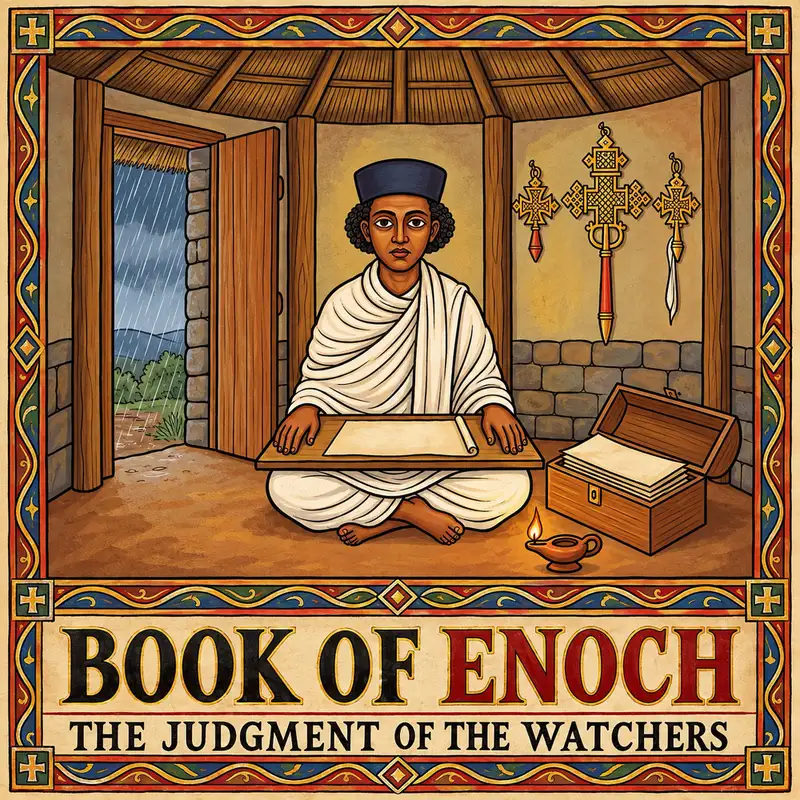
Welcome to The Sleeping Almanac. Tonight, the night we owed you. The last time you were in this room, in this rain, a copyist read you the story of two hundred watchmen who came down a mountain, and what they taught, and what their children ate, and how the earth itself opened its mouth and cried out, and four of the ones who had stayed at their posts carried the sound of it upward and set it down in the highest place there is. And then he turned past a page. He said that what was decided, and how, and what became of Shemihazah and Azazel and the two hundred and the children, was a story for another night, a long one. This is that night. It is the story of a sentence. Not a battle, not a war in heaven with swords, none of that is in the book. A sentence, passed, and carried down, and then, because this is the Book of Enoch and it cannot help itself, a journey. The man who carried the answer is taken by the hand and walked to the ends of the earth, east and west and north and south, and shown where the winds are kept, and where the rivers go into the ground, and a mountain made of stones with a summit of sapphire, and a tree whose fruit is like the dates of a palm, and, at the very end of the east, a garden that is still there, with the tree in it, the one his father and mother ate from. He is shown all of it slowly, one place at a time, and he writes it all down, and that is the book. A judgment, and then a map. There is a church at the top of a hill in Ethiopia, and inside it there is a lamp. You know the room. Round, stone and timber, the thatch deep and steep, and the rain on it, the long patient rain of the highlands of Ethiopia, the same rain, or its child, because it has been longer for him than it has for you, and I am not going to count how much longer, because he does not. The juniper by the door, dripping. The valleys full of cloud. The path to the village a stream. Inside, the small clay dish of oil, the wick in the lip of it, the flame the colour of old honey, and by the lamp the man in white, with the board across his knees. He is copying the Book of Enoch, and he is nearly done. That is what is different tonight. When you were last here there was a wooden box beside him with the finished leaves waiting in it, and it was heavy, and it was not a book yet, and a book was a long way off. The rains have come and gone since then, more than once, and the box is nearly full. What is left is a gathering. One bundle of leaves, the last one, the one that closes the book, and he ruled the first leaf of it some mornings ago, and he will rule the last leaf of it before he sleeps, and somewhere between the two, in the next few weeks, in this rain, the copy he began before you ever heard of it will be finished, and sewn, and boarded, and set on the shelf beside the old one, and nobody will write down the day. He is not thinking about that. He is thinking about the page in front of him, which is one of the pages he turned past for you, the last time, because it was not the page for that night. Tonight it is. There is a place for you here, in the warm part of the room, out of the rain. The mat, the folded cloth for your head, the whole night with nothing in it that you have to carry. You do not have to do anything now. Let the rain be on the roof. Let the lamp be warm on one side of you and the cool wet air on the other. Close your eyes if they want to close. This story does not need to be watched. It only needs to be near you, the way the lamp is near you, saying the same soft thing over and over. You do not have to follow every word. You do not have to remember any of it in the morning. If you drift, the copyist will go on without you, and he will not mind. He has copied through a great many people's sleep. And one thing, whispered, as before. Nothing in this story will ever startle you. There is a judgment in it. I said there would be. There are places in it that are dark, and I will not pretend to you that they are not, and there are places in it that the book itself calls horrible. But you will be shown each of those places the way the copyist is shown them, once, from the doorway, and then taken on, because the book does not stay in them either. It is far more interested in trees. No storm in here will ever be louder than the rain outside. You can trust this lamp. That is what it was lit for. The copyist opens the old book across his knees. The small dry sound of the leaves. Before he begins, one small thing, and then we will not interrupt again. If this story carries you down toward sleep, subscribe now, while your eyes are still open, and the next night will be waiting for you when you need it. A like helps other tired travelers find this lamp. And if you would rather carry these nights with you, The Sleeping Almanac is also a free podcast, on Apple Podcasts and on Spotify, waiting wherever you listen. That is all. Now settle back, and let him begin. We begin.
He begins, tonight, with the box. It sits on the floor at his left hand, against the wall, a plain box of dark wood with a lid that does not quite fit, because the leaves inside it have been added to for so long that they have begun, gently, to push it up. He lifts the lid and lays it against the wall. Inside, the leaves. Pale, in a stack, each one two columns of black with a little red in it, each one a day of his life, or most of a day, laid one on the next in the order he wrote them, the first ones at the bottom, a little darker now at the edges than the ones on top, because parchment goes on ripening after it is written on, slowly, the way a floor goes on darkening after it is laid. He does not count them. He lays his hand on the top of the stack, flat, and holds it there a moment, and takes it away. I told you, the first night, what a book is in this room. An animal, a skin, a year. I want to tell you tonight what a gathering is, because it is the thing he is making now, and because you will hear the word again before morning. You do not write a book on a book. You write it on leaves, and the leaves are folded once down the middle, so that each one becomes two, and four or five folded leaves are laid inside one another to make a little bundle, the way you might lay one folded cloth inside another, and that bundle is a gathering. A book is a row of gatherings, sewn through the fold, one linked to the next, and the same thread joins them to the boards. When you open a book on this shelf and look down into the gutter of it you can see them, the folds, standing in a row like the ribs of a boat. The Book of Enoch, in this copy, will be a good many gatherings. All of them but one are in the box. The one that is not in the box is on his knees. He rules it in the morning, when the light is good, with the blunt point and the straightedge, the ghost lines pressed into the skin. He has ruled the first leaf of it. When he rules the last leaf, the book has been ruled from end to end, and there is nothing left to do but fill it, which is the easy part, or the part he thinks of as easy, because he has done it for so long. He says that he will rule the last leaf tonight, before he sleeps. He has said that for three nights. His hand aches a little. It is the hour for it. He turns the reed in his fingers once, the way he does, to find the place on it where it sits best, and looks at the lamp, and looks at the leaf, and the rain goes on doing what it has done all evening, which is nothing, beautifully. And he turns, in the old book, the one he is copying from, back to the place he passed over. It is not far back. A few leaves. He finds it by the red, because there is a heading there in red ink, and the heading is where the story of the mountain stops and the story of the sentence begins, and he sets his thumb against the margin beside it, and reads. I will give you the mountain again, once, in a breath, and then not again tonight, because you have had it and it is spent. Two hundred watchmen, on the summit of Hermon in the snow, who swore an oath together because their leader was afraid to be the only one blamed, and came down, and took wives, and taught. Swords, and the paint for the eyes. Their children ate everything, and then each other. The earth cried out. Four who had kept their watch heard it, and carried it up, and set it down before the highest place there is. That is the whole of the first night's story, and every word of it is on the leaves in the box, and there it can stay. Here is what the book says happened next. And the first thing it says is not about the two hundred at all.
The rain, steady. His thumb in the margin of the old book. The book says that the Most High spoke. And it does not describe him, and neither will I, tonight or any night. The book says he spoke, and it says who he spoke to, and that is enough for a book to say. He spoke to one of the ones who had kept their watch, and the first thing he did with the whole matter of the two hundred and the wives and the giants and the earth crying out was this. He sent a message to one man. He sent Uriel to the son of Lamech. That is Noah. And the message was two words long, and the book gives them, and they are, hide thyself. Go to Noah, he said, and tell him in my name, hide thyself, and tell him what is coming. That the whole earth is going to be washed. That a flood is coming over all of it and everything on it. And tell him how to get out of the way, so that he lives, and so that his children live, and there is somebody left afterward. Do you see what the book has done? Before it says one word about the guilty, it takes care of the one who is not. Before the sentence, the exception. It is the kind of order a very old and very careful mind puts things in. The flood is the answer to the earth's cry, and the book knows it, and the book knows that a flood does not choose, and so the first thing said, before anything, is a word in the ear of the one man who is going to have to build a boat. Hide yourself. It is coming. Here is how you live. And you know that story. Everybody knows that story, the boat and the rain and the birds, and the book does not tell it, because it does not need to, and I will not either. I will only tell you that the book makes the flood a sentence, and that this is an early surviving account in which the water comes as the answer to the watchmen. The rain that fell for forty days fell on account of two hundred who came down a mountain and would not go back. That is the book's idea. It is not the only idea anyone ever had about that rain. It is this book's, and it puts it first. Then it turns to the two hundred. And it does not turn to them all at once. It takes them by name, one at a time, the two who led, and it gives each of them to one of the four. The first is Azazel. The one who taught the metals and the swords and the paint for the eyes. And the book gives him to Raphael, whose name means the healing of God, which is not an accident, as you will hear. And the sentence is this. Bind him, hand and foot. And put him into the dark. And make an opening in the desert, and put him in it. The book names the place. It gives the desert a name, a strange one, and the copies do not agree on how to spell it, so I will not say it, because if I say it one way somebody will tell you in the morning that it is the other way, and it does not matter. A hole in a desert, with a name. Put him in it, the sentence says. And lay rough and jagged stones over him. And cover him with darkness. And let him stay there. And cover his face, so that he does not see the light. And on the day of the great judgment, the sentence says, he will be put into the fire. That is one image, and I have given it to you, and now we will leave it, the way the book leaves it, because the book leaves it in the same breath. The very next thing the voice says to Raphael, the healer, is not about Azazel at all. It is, heal the earth. Heal the earth which the angels have spoiled, it says, and tell the earth that it is healing, so that the plague stops, so that the children of men do not all die of the things the watchmen taught. And then one more sentence about Azazel, and it is the strangest sentence in the chapter, and the copyist slowed for it, when he wrote it, because it is short and he did not want to get it wrong. The whole earth, the voice says, has been ruined by what Azazel taught. To him, write down all sin. To him ascribe all sin. That is how the old translation has it. Every wrong thing that was ever done, laid at the door of the one who taught the making of knives. It is a very large thing to say about one of two hundred. The book says it, and does not explain it, and moves on. People have argued about that sentence for two thousand years, and I am not going to settle it at this hour. I will only tell you that there is another book on this shelf, an older one, that has a goat sent out into the desert every year carrying everything, and that the name the goat is sent to, in that older book, is the same name, or nearly, and that scholars have noticed, and have not agreed, and that the copyist has copied both books and never once thought of it as a problem. Rough stones, darkness, a covered face. And then, heal the earth. The book puts those two things side by side, in the mouth of the same messenger, and the second is longer than the first.
His thumb has reached the second name. The rain has not changed. The second name is given to Gabriel, and the sentence that goes with it is not about the watchmen. It is about the children. Go against the giants, the voice says. The children of the watchers. And the sentence for them is not stones and darkness. It is this. Send them one against the other. Let them destroy each other. For length of days they shall not have. That is all. The book does not describe it. It says that the giants, who had been eating the world, would turn on each other and be gone, and it says the reason in the plainest way. They had hoped, the book says, to live forever. Their fathers had asked for that, on their behalf. Each of them, the book says, had hoped to live five hundred years. And the answer to that was no, and the answer was not carried to them in a dream. It was carried by their own hands. I will not stay with it. The book does not. It gives the sentence in three lines and goes on, and I have given it to you in three lines, and if you have been listening to this lamp for long you know that this is how a hard thing is told here. Once. At a little distance. And then the page turns. Now the leader. Shemihazah, who was afraid on the summit and made the others swear. And the book gives him to Michael, and it gives all the rest of the two hundred with him, everyone who had come down and taken a wife, and the sentence for them is the longest, and it has two parts, and the second part is the one that stays with you. The first part is this. They are to watch. The book says, and I will give it to you as it is, when their sons have killed one another, and when they have seen the destruction of the ones they loved, then bind them. Not before. They are to stand and see it. That is in the sentence. The book does not soften it, and I will not either, except to say that it is said once, in a single clause, and that the book is not interested in the seeing. It is interested in what comes after. What comes after is this. Bind them fast, the voice says, for seventy generations, in the valleys of the earth. Under the hills. That is where the two hundred go. Not into fire, not yet. Into the ground, into the low places, the valleys, the folds of the earth, bound, for seventy generations. And the number is worth staying on for a moment, because it is not forever. Seventy generations is a very long time, and you could count it, if you were patient and knew how long a generation was, and people have, and have come to different answers, and I will not give you any of them. But it is a number. It has an end. The two hundred are put under the hills until a day, and the day has a name in the book, the day of their judgment, the great one, the one that finishes everything, and until that day they are simply there, under the valleys, in the dark, bound, and the world goes on over them, and the rain falls on the hills they are under. And on that day, the book says, they will be led off to the fire. One line. I will say it once and set it down, as the book does. There is an abyss of fire in this book, and the two hundred go into it at the end, and so does anyone who is condemned with them, and that is the whole of what the book has to say about it in this chapter, and it is more than enough for this hour, and we will not go there tonight, or look into it, or count its columns. The book will show it to Enoch, later, from a distance, and I will show it to you the same way, and then we will both turn our backs on it and look at a tree. I want you to notice something about the sentence, now that you have all of it. Three angels, three tasks, and not one of them is the same. Azazel is buried. The children are turned on each other. The two hundred are bound under the hills until a day. The book is very careful about this. It is not a story about a thunderbolt. Nobody is struck from above. Nobody in heaven draws a sword. Four messengers are sent down with four instructions, like men sent out from a house with lists, and each of them does the thing on his list, and it takes as long as it takes, and the earth, which had cried out, is quiet. That is the judgment of the Watchers. A set of instructions, carried down. The book calls it a great judgment and it is, but it is done the way this room does everything, plainly, in order, one thing after another, and then set down. And then the voice says one more thing to Michael, and it is the last instruction on the list, and it is the one the book cares about most, because everything after it is about it, and it is this. Destroy all wrong from the face of the earth, the voice says. Let every evil work come to an end. And let the plant of righteousness and truth appear. The plant. The copyist has come to the bottom of a column of the old book. He does not stop. He moves his thumb across to the top of the next one, and reads on, because the next column is the one he has been waiting for all evening, and so have I.
The same page. But listen to what it does. A moment ago the book was talking about stones laid over a face, and an abyss, and seventy generations under the hills. And now, with no more warning than a new line, it is talking about farming. Here is what it says. And then, it says, all the righteous will escape, and they will live until they have thousands of children, and all the days of their youth and their old age they will finish in peace. And then the whole earth will be tilled in righteousness, and all of it will be planted with trees and be full of blessing. And all the good trees will be planted on it, and they will plant vines on it, and the vine that they plant will give wine in abundance, and every measure of seed that is sown will bring back a thousand, and every measure of olives will give ten presses of oil. Ten presses of oil from one measure of olives. That is the sentence that follows the abyss. I want you to hold the two of them in the same hand a moment, the way the book does, and feel the weight of each. The book gave the abyss one line. It gives the olives most of a page. And it goes on. Cleanse the earth, it says, from all oppression, and from all wrong, and from all sin, and from all godlessness, and everything unclean that has been done on it, take it off the earth. And all the children of men will become righteous, and all the nations will worship, and the earth will be clean of every stain, and every sin, and every punishment, and every torment, and I will never again send them upon it, the voice says, from one generation to the next, and for ever. Never again. That is the promise at the bottom of the judgment, and it is the same promise that is at the bottom of the other flood story, the one everybody knows, with the boat and the bow in the clouds. Never again. The book knows that story, and it lands in the same place, and it lands there by way of a vineyard. And then the last thing, and the chapter ends. In those days, the voice says, I will open the storehouses of blessing that are in heaven, and send them down over the work and the labour of the children of men. And truth and peace will keep company together through all the days of the world, and through all the generations of men. The storehouses of blessing. You will hear that word again tonight, storehouses, in a stranger place, and I mention it now so that you will know it when it comes. The book thinks of heaven as a house with rooms in it, and things kept in the rooms, and doors that are opened and shut. Blessing is kept in a room. So is the wind. So is the snow. It is a very old way to think about the sky, and a very restful one, and the copyist, who keeps his finished leaves in a box, has never found anything odd in it. That is the whole of the judgment. That is what was decided, and how. A word in Noah's ear. Four messengers with four lists. And then a vineyard, and oil, and a promise, and the storehouses opened. If you came tonight for the punishment of the watchmen you have had it, and it took a page, and the book has already moved on, because the book was never really about the punishment. It was about the plant. The plant of righteousness and truth, the thing that comes up after, in the cleaned ground, and the book cares about that the way a farmer cares about the field after the flood has gone down, which is to say, entirely. The copyist slowed here, when he copied this page, years ago now. Not for a hard word. For the red. His own leaf is in the box, near the bottom, and there is a great deal of red on it, because the page carries names for God, the Most High, the Lord, the Holy Great One, and every time the name came the copyist set down the black reed and picked up the red one, and dipped it, and wrote the one word, and wiped the reed, and picked up the black again. It takes a long time to copy a page where God is speaking. Nobody hurries it. The rain does not. Outside, the rain. It has been on the roof all evening, and it is on the thatch of every house down the hill, and on the fields, which are drinking it, and which will be green in a way you would not believe if you had not seen it, and the vines, which are not vines here but something else, a grain with a name you would not know, will come up thick. The book was written in a dry country. It dreamed of the rain the copyist lives in. He has never thought of that. He is reading the red. And now the book does a thing that only this book would do. It has told you the sentence. And now it goes back, and tells you how the sentence was given to the man who carried it, and what else was said to him in the dream by the river, because on the first night I gave you the house of fire and the refusal and stopped. It stopped because the page stopped for that night. There was more said in the house. Here is the rest of it.
Turn back, in your mind, to the river. The waters of Dan, at the foot of the snow, and a man asleep beside them with a petition in his hand, and the answer coming to him in a dream, up through clouds and mist and the paths of the stars, to a wall of hailstones, and a house inside the wall, and a greater house inside that, with a floor of fire and a ceiling of fire and a door standing open, and a man lying on his face, trembling, and a voice saying, come here, Enoch, and do not be afraid. You had that. You had the answer to the petition, too, which was no. What you did not have is what the voice said next, after the no, because the copyist turned the leaf, and it was not that night's page. It is tonight's. Here is what it said. Fear not, Enoch, you righteous man, you scribe of righteousness. Come near, and hear my voice. And go, and say to the watchers of heaven, who sent you here to speak for them. You should be speaking for men. Not men for you. Let that sit. It is the whole of the matter in a sentence, and the book knows it, and puts it first. Everything is upside down. The ones whose work was to watch over men have sent a man up to plead for them. And the voice does not so much refuse it as turn it the right way round and hand it back. You should be interceding for men. Not men for you. That is what a watchman is for. And then the voice asks a question, and it is not a question that wants an answer. Why, it says, did you leave the high and holy and eternal heaven, and lie with women, and do as the children of earth do, and beget giants for sons? You were holy. You were spirit. You lived the life that does not end. And you wanted what those want who die. And here the book says a thing that people have thought about for a very long time, and it says it quite gently. The voice says, that is why I gave them wives. Men. I gave men wives so that they would have children, so that nothing would be missing for them on the earth, because they die, and their children go on for them. But you were never going to die. You did not need it. And so I did not give it to you. For the spirits of heaven, heaven is their house. And you left the house. That is the reason the book gives. It is not a rule for the sake of a rule. It is a house with rooms, again, and each kind of thing in the room that was made for it, and the whole trouble of the world, in this book, is two hundred who walked out of their room into one that was not theirs. The copyist likes this passage. I know because on his own leaf, the one near the bottom of the box, the hand is steady all the way down, because there is no hard word in it. It is plain Ge'ez, and plain sense. Then the voice says what became of the children. Not their deaths, which you have had. What became of them after. And this is the part of the page whose story of spirits would be taken up by some early Christian writers. The giants, the voice says, who were made from spirit and from flesh, will be called evil spirits on the earth, and the earth will be their house. Because they were born of men and of the holy watchers, their beginning is in both, and so they will be spirits, and they will be called evil spirits, and they will stay. The spirits of heaven have heaven. The spirits that were born on the earth have the earth. And the spirits of the giants, the voice says, will trouble, and oppress, and break things, and fight, and cause harm on the earth, and they take no food, and are hungry, and thirsty, and they will rise up against the children of men and against the women, because it was from them that they came. That is the book's account of these spirits. From here. From the children of the two hundred, who were too big for the world and ate it, and were turned on each other, and whose bodies died, and whose other part did not, because half of it had never been the kind of thing that dies. So they stayed. Hungry, the book says, and taking no food. That is the only thing it says about what it is like to be one of them, and it is the saddest line on the page, and the book says it once. I tell you this because you will meet it again this season, in a very different room, told from the other side by people who had read this page and decided it was the wrong way up. Not tonight. Tonight it is just a line in a dream, and a man on the floor of a house of fire, and a voice. And the voice finishes. As for the watchers who sent you, it says, tell them this. You were in heaven, but not every secret had been shown to you yet, and what you knew was the worthless part, and that is what you taught, in the hardness of your hearts, to the women, and through it men and women have done a great deal of harm on the earth. And then the last thing, four words, and the book sets them by themselves, and so will I. You have no peace. And Enoch woke. He woke by the water, and he went to find them, and the book says where they were. They were all sitting together, gathered, weeping, in a place between Lebanon and the mountain, with their faces covered. The book names the place, and the name, some scholars think, is a play on the word for mourning, a meadow of weeping, and whether that is so or not it is what the picture is. Two hundred of them, in a valley, sitting on the ground with their faces covered, waiting for a man to come back from a river and tell them what he had heard. And he came. And he told them. All of it. The book says he recounted every vision he had seen in his sleep, and began to speak the words of righteousness, and to reprove the watchers of heaven. And that is the last time in this part of the book that anyone sees the two hundred. Sitting, with their faces covered, being told. The copyist turns the leaf. And the book, having done the hardest thing it will ever do, takes its own scribe by the hand, and walks him out of the story altogether, and only looks back at it twice, from the edge of the world, because it has something better to show him. It has the world.
The same book. A new red heading. The rain. They took me, the book says. That is how it begins. Not the voice now, and not a dream. Enoch, awake, in his own words, and they took him, and the book does not quite say who, only that they were the ones who had been with him in the vision, the holy ones, the ones who watch and did not fall. They took him, and they showed him things, and he wrote each one down, and the chapters that follow are the writing. This is the part of the book I have been waiting all evening to bring you to, and if you are still awake I am glad, and if you are not, that is exactly right, because from here to the end of the night nothing happens. Nobody is judged. Nobody is bound. A man is walked through the world by somebody who knows where everything is kept, and he is shown it, and he says, I saw, and then he says what, and then, I saw, and then what. It is a list of places. It is the most restful list I know. They brought him first, the book says, to a place where the ones who were there were like flaming fire, and, when they wished, appeared as men. And they brought him to the place of darkness, and to a mountain whose top touched heaven. And he saw the places of the lights, and the storehouses of the stars, and the thunder, and in the deepest depths a bow of fire, and arrows, and their quiver, and a sword of fire, and all the lightnings, put away, the way tools are put away in the back of a workshop. And they took him to the living waters, and to the fire of the west, which receives every setting of the sun. Stay there a moment. The fire of the west, which receives every setting of the sun. That is where the sun goes, in this book. Every evening, through a gate, into a fire in the west that takes it in. You saw the gates on the first night, six of them, and now you have seen what is on the other side of the gates. A fire that receives. And he came, the book says, to a river of fire, in which the fire runs like water and pours itself into the great sea toward the west. And he saw the great rivers, and came to the great darkness, and went to the place where no flesh walks. And he saw the mountains of the darkness of winter, and the place from which all the waters of the deep flow out. And he saw the mouths of all the rivers of the earth, and the mouth of the deep. The mouths of all the rivers. Not where they run into the sea. Where they come out of the ground. The book thinks every river in the world has a mouth, a beginning, a place where it comes up out of the dark, and it thinks all of those places are together, somewhere, at the edge, and that a man could be walked to them and shown them all in a row. And under them, the mouth of the deep itself, the one great water all the small ones come from. I saw the storehouses of all the winds, he says. There is the word again. The winds are kept. He saw how the whole of creation had been furnished with them, and the firm foundations of the earth, and he saw the cornerstone of the earth. And he saw the four winds that carry the earth and the vault of the heaven, and he saw how the winds stretch out the vaults of heaven and have their station between heaven and earth. These are the pillars of the heaven, the book says. Wind. The sky is held up on wind, and the wind is a pillar, and the pillars stand at the corners, and a man was shown the corners. And he saw the winds of heaven that turn the sun and all the stars to their setting, and the winds on the earth that carry the clouds, and the paths of the angels, and at the end of the earth, the vault of heaven above. Do you see what kind of a place this is? It is not heaven. He has been to heaven, in the dream, and it was a house of fire, and he could not look. This is something else. This is the back of the world. The place behind the scenery where the things that make the world go are kept, the winds in their rooms, the rivers at their mouths, the lightning in its quiver, the pillars at the corners, and the fire in the west that takes the sun in every night and, we are to understand, lets it go again every morning by the eastern gates. It is a workshop, and a storeroom, and he is being shown round it by the ones who keep it, slowly, the way you would show a guest round a mill. And then, the book says, he went on, and saw a place that burns day and night, and there were seven mountains there of magnificent stones, three toward the east and three toward the south. And those toward the east were of coloured stone, and one of pearl, and one of jacinth, and those toward the south were of red stone. And the middle one reached to heaven like a throne, and it was of alabaster, and the summit of it was sapphire. Seven mountains of stone. Coloured stone, pearl, jacinth, red stone, alabaster, and a sapphire summit. He does not say why they are there. He does not ask, yet. He says what they are made of, in order, the way the book always does, the way a man would who was so far from home that the only thing he could hold onto was the list. And beyond the mountains, the book says, is a region that is the end of the great earth. There the heavens were completed. He has come to the edge. And the next thing he sees is one of the places in the journey that the book itself calls horrible, and I will show it to you the way he was shown it, from where he stood, and then we will go on.
I saw a deep abyss, the book says. With columns of heavenly fire, and among them columns of fire falling, that were beyond measure both in height and in depth. And beyond that abyss he saw a place that had no sky above it and no founded earth beneath it. There was no water on it, and no birds. It was a waste, the book says, and a horrible place. That is one of them. You have seen it now, a place with no sky and no ground and no water and no birds, and it is the emptiest thing in the book, and I am going to let you look at it for exactly as long as Enoch did, which was long enough to ask a question. He saw there seven stars, the book says, like great burning mountains. And he asked about them. And the angel with him said, this place is the end of heaven and earth. This has become a prison for the stars and the host of heaven. And the stars that roll over the fire are the ones that broke the commandment of the Lord at the beginning of their rising, because they did not come out at their appointed times. And he was angry with them, and bound them, until the time of their guilt is finished, ten thousand years. Stars that were late. That is what is in the horrible place. Not the two hundred. Stars. Seven of them, that did not come up when they were supposed to, at the very beginning, when the times were first set, and were put here for it, for ten thousand years, which is a long time, and is a number, and ends. The book is very strict about time. You saw that on the first night, with the gates and the four days that people forget to count. Here is the other side of that strictness. Even a star that is late is a broken thing, and is put away until its time is made up, and then, the book lets you understand, let go. And then Uriel says the thing that brings the whole night round in a circle, and he says it as if it were an afterthought, standing at the edge of the empty place. Here, he says, will stand the angels who joined themselves with women. Here. Their spirits, taking many shapes, are leading men astray, and here they will stand, until the day of the great judgment, when they are judged, and made an end of. So that is where the two hundred come, in the end, on the day. The book has shown him the place. And it does not linger. The very next line is the strangest and loneliest in the whole journey, and it is this. And I, Enoch, alone saw the vision, the ends of all things, and no man shall see as I have seen. Alone. One man, at the edge of the world, shown the empty place where the late stars are kept and where the two hundred will stand, and told that nobody else will ever see it. And then walked away from it, by the hand, because there is more, and none of the rest is like this. Before we go on, the book stops, and does a thing it likes to do, which is to give a list of names. Not the two hundred. The other ones. The ones who watch and did not fall, and who have been walking with him. There are seven in the old translation I am following, and it says what each is for, and I will say them once, slowly, the way names are said in this room, and then not again. Uriel, who is over the world and over the abyss. Raphael, who is over the spirits of men. Raguel, who takes vengeance on the world of the lights. Michael, who is set over the best part of mankind. Saraqael, who is set over the spirits that sin in the spirit. Gabriel, who is over Paradise, and the serpents, and the cherubim. And Remiel, whom God set over those who rise. Seven who watch. Two hundred who did not. The book puts the seven here, after the horrible place and before the rest of the journey, as if to say, these are the ones walking beside him. He is not alone in the way that line made it sound. He is the only man. But the seven are with him, and one of them is over the spirits of men, and one of them is over those who rise, and the copyist, who knows this list the way you know the names of your own family, reads it without looking up. And the book goes back, once, for one more look at the empty place, from a little further off, and I will give it to you in a sentence, because that is all it gets. He went, the book says, to where things were chaotic, and saw the seven stars bound like burning mountains, and asked, and was told again, ten thousand years, and went from there to another place that was worse, a great fire, cleft down to the abyss, full of columns of fire going down, and he said, how fearful is this place, and how terrible to look upon, and Uriel said, why are you so afraid, and he said, because of the place, and because of the pain, and Uriel said, this is the prison of the angels, and here they will be held for ever. That is the last word the book has to say about the prison, in this journey, and it is the last word I have to say about it tonight. For ever. It is said, and it is set down, and Enoch turns from it, and so do we, and the next thing the angels show him is a mountain with a spring of water in it.
The rain is quieter, or you have stopped hearing it, which is the same thing. From there, the book says, he went to another place, and Raphael showed him, in the west, a great high mountain of hard rock. And in the mountain there were hollow places, four of them, deep and wide and very smooth. How smooth these hollow places are, Enoch said, and how deep, and dark to look at. And in one copy, three of them are dark, and one is bright, and there is a spring of water in the bright one. And he asked what they were for. And Raphael said, these hollow places were made for this, that the spirits of the souls of the dead should gather in them. All the souls of the children of men gather here. They were made to hold them until the day of their judgment, until the time that was set for them. The dead, the book says, are in a mountain in the west, in smooth deep hollows in the rock, waiting. Not in the sky, not in the ground, not anywhere you would have guessed. In a mountain, at the edge, near where the sun goes into the fire, in rooms cut out of stone as smooth as the inside of a bowl. That is where the book puts them. It is a very old picture of where the dead go, and the thing I notice about it, every time, is how quiet it is. Hollow places, and smooth, and deep, and a spring. The book has just come from the place with no sky and no birds. It knows how to describe a place that is terrible. This is not that. This is a mountain where the dead are kept, gently, in the dark, with water, until a day. And he saw the spirits of the children of men who had died, the book says, and one of them was making suit. Its voice went up to heaven and made suit, and he asked Raphael, whose voice is that, that goes up and pleads. And Raphael said, this is the spirit that went out of Abel, whom his brother Cain killed, and he makes his suit against him until his seed is gone from the face of the earth. Abel. The first one who ever died, in the other book, the older one, in the field, and the book knows him, and knows where he is, and knows what he is saying. He is in the mountain, and his voice goes up, and it has been going up since the beginning, and the book does not say that it is answered, only that it goes up. That is one image, and it is grave, and I have shown it to you, and Enoch turns from it too, because he has a question, and the question is about the four hollows, and why one is separated from the others. And Raphael tells him, and I will give you only the gentle half of it, because the other half is the kind of thing this room says once and I have said it. The bright hollow, with the spring, is for the righteous. That is what the spring is for. And the others are for the others, each kind to its own hollow, until the day, and the book says which is which and what waits for whom, and the copyist has copied it, in its place, and I am going to let him have it and not repeat it, because it is late and it is not the part of the page the book wants you to keep. The part it wants you to keep is the spring. A spring of bright water in a hollow in a mountain of hard rock in the west, with the righteous beside it, and the dark all round, and the water running. That is where the book leaves the dead. And Enoch, the book says, blessed the Lord of glory, and said, blessed be my Lord, the Lord of righteousness, who rules for ever. He does this from here on. Not in the first part of the journey, where he only looks and writes, but from the hollow places onward, after the tree, after the middle of the earth, and at the very end, the same line, or near it, and I bring it to you now because it is the rhythm of the rest of the journey and you should have it once. He is shown a thing. He describes it. He blesses. He is taken on. Shown, describe, bless, on. It is the shape of a walk with somebody who knows the country, and it is the shape of a prayer, and it is the shape of the thing the copyist does at the end of every leaf, when he sits with his hands in his lap. There is no hurry anywhere in it. From there, the book says, he went to another place in the west of the ends of the earth, and he saw a fire that ran without resting, and did not pause from its course day or night, but ran on. And he asked what it was, that never rests. And Raguel, the one who is over the lights, said, this course of fire that you have seen is the fire in the west that drives all the lights of heaven. The fire that drives the lights. The sun goes into a fire in the west, and there is another fire in the west that never rests and that keeps the sun, and the moon, and every star, moving. The book has now told you where the lights are kept, and where they go, and what makes them go. It has not told you what they are. It does not think that is the interesting question. The interesting question, for this book, is always where. Where is it kept. Where does it go. Who is over it. And the answers are all the same kind of answer. In a room. Through a gate. Somebody, by name. The copyist is at the bottom of the page in the old book. He looks at it a moment in the lamp, and turns the leaf, and sets his thumb to the top of the first column. And in the old book, open beside him, the angels take Enoch on, past the fire, to a mountain range that burns, and over it.
From there he went to another place of the earth, the book says, and was shown a range of mountains of fire that burned day and night. And he went beyond it. And he saw seven magnificent mountains, each different from the others, and their stones were magnificent and beautiful, magnificent as a whole, glorious to look at and fair on the outside. Three toward the east, one founded on the next, and three toward the south, one upon the other, and deep rough ravines between them, no one of which joined with any other. And the seventh mountain was in the midst of these, and it was higher than all of them, and it was like the seat of a throne. And fragrant trees stood round the throne. And among them was a tree such as he had never smelled. There was none like it among them, and none like it anywhere. It had a fragrance beyond all fragrance, and its leaves and its blossoms and its wood did not wither, ever, and its fruit was beautiful, and its fruit was like the dates of a palm. How beautiful is this tree, Enoch said, and fragrant, and its leaves are fair, and its blossoms are very delightful to look at. And Michael answered him. Michael, who is over the best part of mankind, and who was their leader, the book says, the leader of the ones walking with him. And Michael said, Enoch, why do you ask me about the fragrance of the tree, and why do you wish to learn the truth? And Enoch said, I wish to know about everything, but especially about this tree. I wish to know about everything. But especially about this tree. That is Enoch, the whole of him, in a sentence. He has been to the house of fire and to the horrible place and to the mountain of the dead and he has asked about all of it, but this is the one he really wants to know about, the one whose fruit is like dates, and he says so, like a child, and Michael tells him. This high mountain, Michael said, whose summit is like the throne of God, is his throne, where the Holy Great One, the Lord of glory, the eternal King, will sit, when he comes down to visit the earth with goodness. When he comes down to visit the earth with goodness. That is what the mountain is for. The book does not describe him sitting there, and neither will I, and there is nobody on the mountain now, only the trees. It is a throne waiting, in the open air, on a hill, at the edge of the world, with a garden round it, and one tree in the garden that is not like the others. And as for this fragrant tree, Michael said, no mortal is allowed to touch it until the great judgment, when everything is brought to its end. Then it will be given to the righteous and the holy. Its fruit will be food for the chosen. It will be transplanted, he said, to the holy place, to the temple of the Lord, the eternal King. And then they will rejoice with joy and be glad, and they will go into the holy place, and its fragrance will be in their bones, and they will live a long life on the earth, the kind of life your fathers lived, and in their days no sorrow, or plague, or torment, or calamity will touch them. Its fragrance will be in their bones. I do not know a better line on this shelf, and I have read all of them. Not its fruit in their mouths. Its fragrance in their bones. A tree that no one may touch, on a mountain where no one sits, kept, the way everything in this book is kept, until a day, and on the day, moved, carried in, and planted where people are, and the smell of it going into them, into the bone, so that they live a long time and nothing hurts them. This is the same book that had the stones laid over a face. The two pages are a few leaves apart. The copyist copied them both, years ago now, a few days apart, in this same rain, with the same reed. And Enoch blessed the God of glory, the book says, the eternal King, who had prepared such things for the righteous, and had made them, and had promised to give them. From there he went to the middle of the earth. And he saw a blessed place, in which there were trees with branches that stayed and bloomed. And there he saw a holy mountain, and under the mountain, to the east, there was a stream, and it ran toward the south. And to the east he saw another mountain, higher than this, and between them a deep narrow ravine, and in it too a stream ran, under the mountain. And to the west there was another mountain, lower than the first, and a ravine, deep and dry, between them, and another deep dry ravine at the ends of the three. And all the ravines were deep and narrow, of hard rock, and no trees were planted on them. And I marvelled, the book says, at the rocks, and I marvelled at the ravine. I marvelled very much. If you know the city, you know the place. Scholars have been fairly sure for a long time which mountain that is, in the middle of the earth, with the stream to the east of it running south, and which ravines those are, deep and dry, with hard rock, where nothing is planted, and I am not going to name it tonight, because the book does not, and because the copyist has never been there, though some from this hill have, and he has a hill of his own. But the book, which has been at the ends of the earth and will be again in a moment, stops at the middle, and looks at three mountains and three ravines and a stream, and says, I marvelled very much, and that is the only time in the whole journey it says that. Not at the pearl, not at the sapphire. At three hills and a dry valley in the middle of the earth. And Enoch asked what the blessed land with the trees was for, and what the accursed valley between was for. And Uriel told him, and the answer is a passage of grave things, and I will give you its shape and then we will be gone. The valley, Uriel said, is for those who are accursed for ever, who say unseemly words against the Lord and speak hard things of his glory, and here they will be gathered, and here will be the place of their judgment, and in the last days the righteous will look on it and bless the Lord of glory for the mercy he has shown them. That is the valley. And Enoch blessed the Lord of glory, and set forth his glory, and praised him. And went east. He goes east now, and for a long while the rest of the journey is trees.
From there he went toward the east, the book says, into the middle of the mountain range of the desert, and he saw a wilderness, and it was solitary, and full of trees and plants. And water came gushing from above. It rushed like a great watercourse toward the north west, and it made clouds and dew go up on every side. A wilderness full of trees, with water falling into it from above and mist rising off it. That is the first thing in the east. And from there he went to another place in the desert, and came to the east of the mountain range, and there he saw aromatic trees, giving off the fragrance of frankincense and myrrh, and the trees were like the almond tree. And beyond these he went far to the east, and saw another place, a valley full of water, and in it a tree, the colour of fragrant trees, such as the mastic. And on the sides of those valleys he saw fragrant cinnamon. And beyond these he went on to the east. Listen to how the book is walking now. Not I saw a horrible place. Not I saw seven stars bound. I saw frankincense. I saw myrrh. I saw a tree like an almond tree. I saw cinnamon on the sides of the valleys. It has stopped being a report and become a walk through a spice garden, and the pace of it has changed, and a copyist can feel that in his hand when he copies it, because the words are shorter and the columns go faster and there are no red words in it at all. Nobody is speaking. It is just a man, walking east, smelling things. And he saw other mountains, the book says, and among them were groves of trees, and there flowed out of them nectar, which is named sarara and galbanum. And beyond these mountains he saw another mountain, to the east of the ends of the earth, and on it were aloe trees, and all the trees were full of stacte, and were like almond trees, and when one burned it, it smelled sweeter than any fragrant odour. Sarara. Galbanum. Stacte. I will not tell you what they are. Some of them the scholars are not sure of either. They are the names of resins, mostly, the sweet gums that come out of the bark of certain trees when it is cut, and are gathered in tears and burned, and the book knows them by name the way the copyist knows the names of the inks, and it lists them the way it listed the stones, and for the same reason. Because they are there, and because a man who has been shown them should say what they were. And after these fragrant odours, the book says, as he looked toward the north over the mountains, he saw seven mountains full of choice nard, and fragrant trees, and cinnamon, and pepper. And from there he went over the summits of all those mountains, far toward the east of the earth, and passed above the Erythraean sea, and went far from it, and passed over the angel Zotiel. I will not tell you who Zotiel is. The book does not explain him. He is in the book once, here, as a thing to be passed over on the way east, like a headland, and the book does not stop, and neither will we. The sea it passes over is the one you would call the Red Sea, or a sea near it, in the old way of naming. And beyond the sea, and beyond the angel, the book says this. And I came to the Garden of Righteousness. And I saw, beyond those trees, many large trees growing there, of goodly fragrance, large, very beautiful and glorious, and the tree of wisdom, of which they eat and know great wisdom. The garden. Not a garden. The one. The book has walked its man across the whole of the earth, from the fire in the west where the sun goes in, past the prison and the mountain of the dead and the throne on the hill and the middle of the earth, east through the frankincense and the cinnamon and over the sea and over the angel, and at the very end of the east, at the edge of everything, the garden is still there. Nobody moved it. Nobody shut it. It is where it was, with its trees, and the tree is in it. That tree, the book says, is as tall as a fir, and its leaves are like the leaves of the carob tree, and its fruit is like the clusters of the vine, very beautiful, and the fragrance of the tree carries far. How beautiful is the tree, Enoch said, and how attractive is its look. And Raphael, the holy angel who was with him, answered him and said, this is the tree of wisdom, from which your father, old in years, and your aged mother, who were before you, ate, and learned wisdom, and their eyes were opened, and they knew that they were naked, and they were driven out of the garden. Your father, old in years, and your aged mother. That is all Raphael says. He does not say their names. He does not say the serpent. He does not say the sword at the gate, or the sweat, or the thorns. He says, your father and your mother ate from this, and learned, and saw, and were sent out. And the book, which was about a man who walked with God and was not, and about two hundred who came down and were bound, and about a plant that would come up after the water went down, brings the seventh from Adam to stand under the tree that Adam ate from, looking at it, saying how beautiful it is. He does not eat from it. The book does not say he wanted to. He looks, and he says it is beautiful, and it is, and the leaves are like a carob and the fruit is like grapes and it smells of something that carries a long way, and his father and his mother had it once and lost the garden for it, and he is in the garden, and he is not sent out, and nobody says a word about that, and the book goes on. I have thought about that page for a long time, and I am not going to tell you what it means. I am going to tell you that the copyist has it open beside him now, in the old book, and that the hand that wrote it long ago was steady, and that there is no red in it, and that outside the rain has not changed, and that in this church, on this hill, this page belongs among the scriptures, and the copyist does not think it is strange, that a man in their book stood in that garden and was not sent out of it, because it is one of the books, and it always has been.
The rain is old now. It has said everything it had to say and is only keeping you company. From the garden, the book says, he went to the ends of the earth, and saw great beasts there, each different from the other, and birds, differing in appearance and beauty and voice, one from another. And to the east of those beasts he saw the ends of the earth, where the heaven rests on it, and the gates of the heaven standing open. And he saw how the stars of heaven come out, and he counted the gates they come out of, and he wrote down all their outlets, each star by itself, by their number and their names, their courses and their places and their times and their months, as Uriel showed him. Uriel showed him all of it, and wrote it down for him, their names, and their laws, and their companies. You have heard this before. The first night, the sky book, the gates of the sun, the moon in fourteen parts, Uriel counting. This is where that book comes from. Here, at the eastern edge, the stars come up through gates in a row, and a man stands there with an angel and counts them, and writes each one, and the angel writes too, so that there are two copies. The whole of the book that argued with the sky is the notebook from this one night at the edge of the world, or that is what the book wants you to believe, and the copyist believes it, and so, at this hour, do I. And then the winds. He went north, to the ends of the earth, and saw there a great and glorious thing at the ends of the whole earth, and three gates of heaven standing open in the heaven, and through each of them the north winds come out, and when they blow there is cold, and hail, and frost, and snow, and dew, and rain. And out of one gate they blow for good. But when they blow through the other two, it is with violence and affliction on the earth. Three gates in the north. One blows kindly. Two do not. And he went west, to the ends of the earth, and saw three gates of heaven open there too, the same number as in the east, with the same number of outlets. And he went south, to the ends of the earth, and saw three open gates of the heaven, and from there come dew, and rain, and wind. And from there he went east, to the ends of the heaven, and saw the three eastern gates standing open, and small gates above them, and through each of the small gates pass the stars of heaven, and run their course to the west, on the path that is shown to them. Twelve gates. Three at each corner, with the winds in their rooms behind them, and the little gates above the eastern three for the stars. That is the last thing he is shown. Not a throne, not a judgment, not the two hundred. Weather. Where the frost is kept, and which door the kind wind uses, and the small doors the stars pass through on their course. The book has walked its man all the way round the world and brought him to the eastern edge, and what it leaves him looking at is the sky doing what it does every night, coming up through the small gates, on the path that is shown to it. And as often as I saw, the book says, I blessed. I blessed the Lord of glory, always, who has made great and glorious wonders, to show the greatness of his work to the angels and to spirits and to men, that they might praise his work and all his creation, and see the work of his might, and praise the great work of his hands, and bless him for ever. That is the end of the journey. That is the end of the first of the five books that are bound together as the Book of Enoch, one of the oldest of them, the Book of the Watchers, as the scholars call it. It begins with a list of names in Genesis and a man who was not, and it ends with a man at the eastern edge of the world watching the stars come out through small doors, blessing, and then the page turns, and the next book begins, and that is a book for another night, and the copyist knows which night, and so do I, and it is his. I want to give you three things before the lamp, quickly, because they are the third layer, the one this shelf always keeps for last. What the book is, what the book says, and then, how it was used. The first is when. This part of the book, the sentence and the journey, is among its oldest parts, and it is very old. Scholars put it in the third century before Christ, or a little earlier, in Aramaic, and the reason they can say so with some confidence is that pieces of it were found in a cave in the Judean desert, in that language, on skin, some copied around the second century before the birth of Christ, from a story older still. I told you about that cave on the second night and I will tell you more this season. Tonight only this. The pages the copyist has been reading you all evening are among the oldest pages in his whole book, and among the oldest of their kind in the world, and they exist in his language, whole, and in the cave's language, in pieces, and the pieces and the whole preserve the same ancient story, with differences that scholars still compare. The second is what became of the journey. Because the journey belongs to a much larger family of stories. A man walks to the ends of the earth and is shown the place where the late stars are kept and the mountain where the dead wait and the tree on the hill and the garden. In later Jewish and Christian books, other travelers are led through places beyond ordinary sight and shown who is where and why. This page is an early member of that family, and an important one. The family has older roots too, and its branches do not all lead through one book. But you can hear the likeness. A traveler. A guide. A question at the doorway. An answer, and then another place. The guided tour of the unseen world. Here the book gives the grave places their look, and still has room for the question about the tree. That is what I want to keep from it tonight. Not only what waits in the dark. What grows beyond it. And the third is the spirits. The line from the dream, that the giants' other part stayed on the earth, hungry and taking no food, and troubles people. The story traveled. In the second century, the Christian writer Justin told of angels who were drawn to women, and of their children as demons, and of the harm they did among people. It is a recognizable branch of this same account. It was never the only way Jewish or Christian readers understood evil spirits, and it did not have to remain inside this book to be heard. That is the strange afterlife of a page. A book can stand outside one church's list while a story related to it remains in that church's memory. Here the book itself stayed too. The copyist has the page. That is the third layer, and it is set down. The book is a real book. The journey is a real journey in the sense that a man really wrote it and other men really copied it and it is really on the copyist's knees. Whether Enoch stood under the tree is not a thing a book can tell you, and I have stopped pretending, on this shelf, that it can. An authentic book is not the same as a true event. It is enough, at this hour, that it is authentic. That the leaf is real, and the reed, and the rain. The copyist has reached the end of the column in the old book. He lets his thumb rest there a moment, and lifts it, and closes the boards, gently, because it is late. And then he does the thing he said he would do three nights running, and did not. He takes the last leaf of the gathering, blank, and lays it on the board, and reaches for the straightedge, and the blunt point.
The rain, on the thatch. He rules it slowly. It is not a thing to hurry, and it is the last one, and he knows that, though he would not say so. The straightedge along the skin. The point drawn down it, once, pressing, so that a line goes into the parchment that you cannot see unless you tilt it to the light. Then the straightedge moved, a finger's width, and the point drawn down again. Line after line, the whole leaf, the two columns marked out, every line of writing that will ever be on this page waiting for its writing. It takes him the best part of an hour. The lamp does not mind. The rain does not. And when it is done he tilts the leaf to the flame, and all the lines come up at once, a whole page of ghost lines, and he looks at it the way you look at a field that has been ploughed and not yet sown, and then he lays it in the gathering with the others, and the gathering is ruled, all of it, and the book is ruled from end to end, and there is nothing left to do but write it, which is the easy part, or the part he thinks of as easy. He does not say anything. There is nobody to say it to. He sits with his hands in his lap. The books are on the shelf. The old Enoch with the dark boards and the red in it, the one he is copying from, open at the eastern gates. The heavy one with the years counted. The bundle that is not really here. The ones that were never here. The box on the floor with its lid against the wall and the finished leaves in it, more of them tonight than last night. And on his knees, the last gathering, ruled and empty, waiting. I told you the judgment of the Watchers tonight, because I owed it to you, and you have had it, and it took a page, and it was a word in Noah's ear and four messengers with four lists and a vineyard. And then I walked you round the world, because the book does, and you have seen the fire in the west that receives every setting of the sun, and the mouths of the rivers, and the winds in their rooms, and the seven mountains of stone, and the empty place, once, and the mountain where the dead wait beside a spring, and the tree like no other on the hill where the throne will be, and the middle of the earth, and the frankincense and the cinnamon, and the garden, still there, with the tree in it, and a man standing under it who was not sent out. And then the gates, at the four corners, with the weather behind them, and the little doors above the eastern three where the stars come out. It is all in the box. Or it will be, by the end of the month, when the last gathering is filled, and he does not know which day, and will not write it down. And it is all kept here, among the church's scriptures, in Ge'ez, because it is one of the books, and here nobody has ever once thought of it as lost. The Book of Enoch is scripture in the Ethiopian Orthodox Tewahedo Church today, and was last Sunday, and will be next Sunday, and the copyist who has been ruling a leaf beside you all night has never in his life heard the question. The copyist stands. His knees are stiff. He crosses the small round room to the door and stands in it and looks out, the way he does every night, at nothing, at the rain, at the dark shape of the juniper, at the place where in daylight you can see fifty miles and at night you can see the inside of a cloud. The air is cold and wet and smells of woodsmoke and thatch and, faintly, of the incense from Sunday. Somewhere down the hill one dog, once, and then the rain again, closing over it. He thinks, standing there, or something in him thinks, that the man in the book stood at the edge of the world and watched the stars come up through small gates, and blessed, and that he himself is standing in a doorway at the edge of the map watching rain come off a roof, and that these are not so different, and then he does not think it any more, because it is late, and he has ruled the last leaf. Then he comes back in, and does not put out the lamp. He never does. It will burn a while, and go out on its own some time before morning, and nobody will see it happen, and the room will be dark, and the books will go on standing on their shelf in the dark exactly as they were, and the empty gathering will lie on the board, ruled, with nothing on it yet, and will be there in the morning. Let the room be as it is. Let the rain go on. It has been going on under everything I have told you tonight, the sentence and the journey and the tree, and you may not have noticed it for a long while now, and that is exactly right. It was never asking for your attention. It was only there. The way it was there for the copyist, and for his teacher, and for every one of them, back and back, falling on the roof of a small round church at the top of a hill at the edge of the map, on a book that nobody ever told them to stop. In the morning somebody will open the door, and the light will come in across the floor, and the leaf will be where he left it, ruled and empty, and the box no heavier than it was, and the last gathering will be waiting for the first word. But that is the morning, and the morning can wait. Sleep well. Goodnight.