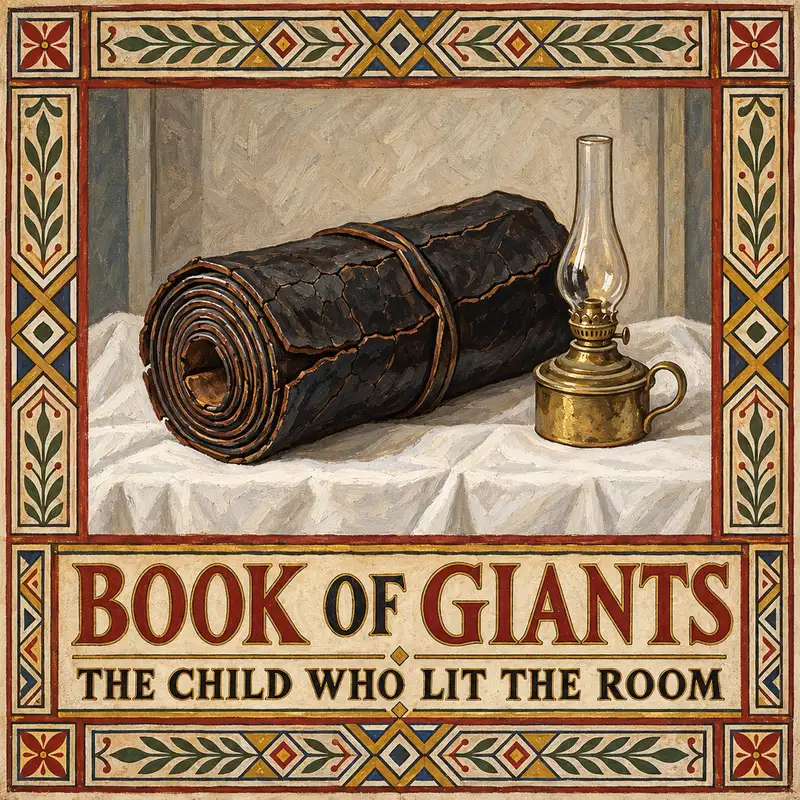
Welcome to The Sleeping Almanac. Tonight, a baby. Born in a house before the flood, to a man who did not believe he was the father, and who was right to wonder, because in the world of the book he was born into, the two hundred had come down from the mountain and taken wives, and a child who was too beautiful was a child who might be one of theirs. This one was too beautiful. The book says that when he opened his eyes he lit the whole house like the sun, and that he stood up in the midwife's hands and spoke. And his father was afraid of him, and ran to his own father, and his father went to the ends of the earth to ask the one man who would know. You know that man. He is the one who was walked round the world and shown the gates of the winds, and he was still out there, at the edge, when his son came to him with the question, and the question was, is this child ours, or theirs. And the answer was a name. The child's name was Noah. That story is on the copyist's shelf, in the old Enoch, at the very end of the book, in Ge'ez. And it is also in the cliff, in the first cave, in a roll that was so badly damaged that it was the last of the seven to be opened, and could hardly be read at all, and turned out, in the columns that could be read, to be the same story, told longer, in the first person, in a work kept among the scrolls, with the mother given a speech that the copyist's book does not give her. That roll is the book for tonight. It is called, for want of a better name, the Genesis Apocryphon, and I will explain the name, and it retells the oldest book in the Bible in the voices of the people in it. Lamech, afraid. Noah, in his own words, planting a vineyard on a mountain. And Abram, in Egypt, dreaming of a cedar and a palm tree, and waking, and telling his wife what to say at the border. We begin in the museum. The room with the roof like a lid, the hum, the low light. It is the second night we have opened here, and there is one more, and then the season goes back up the hill for a while. Let us picture the roll in its case, dark and difficult to read, and look at it anyway. It is dark. Darker than the others. Where the Isaiah in the drum is the colour of pale honey, this one is the colour of a burnt crust, brown going to black, and it is in pieces, and the pieces are laid flat under glass in the order somebody worked out for them over a long time, and between the pieces there are gaps, and the gaps are most of it. Of a roll that was once long, longer than what lies under this glass, we have a handful of columns you can read from top to bottom, and a great many more that give you a word here and a phrase there and then go dark. It is the worst kept of the seven rolls from the first cave, and it is one of the strangest, and the two things are connected, as you will hear. There is a place for you here, on the bench against the wall, in the cool. The hum. The cases. Nothing in the room has moved for two thousand years, and nothing will move tonight. You do not have to do anything now. Let the hum be the rain again. Let the cool be on one side of you and the dark on the other. Close your eyes if they want to close. This story does not need to be watched. It only needs to be near you, the way the rolls are near you, keeping what they keep. You do not have to follow every word. You do not have to remember any of it in the morning. If you drift, the roll will go on being dark in its case without you, and that is what it is used to. And one thing, whispered. Nothing in this story will ever startle you. There is a flood in it, told in Noah's voice, though much of that part is lost, and we will come through it to his vineyard. There is a woman taken into a king's house, and she comes out of it. There is illness in that house, and healing before she leaves. There is a baby who glows. Nothing louder than that. You can trust this room. Before we begin, one small thing, and then we will not interrupt again. If this story carries you down toward sleep, subscribe now, while your eyes are still open, and the next night will be waiting for you when you need it. A like helps other tired travelers find this lamp. And if you would rather carry these nights with you, The Sleeping Almanac is also a free podcast, on Apple Podcasts and on Spotify, waiting wherever you listen. That is all. Now settle back, in the cool, and let us begin. We begin.
Seven rolls came to light from the first cave in forty seven. Six of them could be unrolled. Some easily, some with great care, on tables, in a school and a university and a museum, sheet by sheet, and read. The seventh could not. It had been kept worse than the others. Nobody knows the exact conditions in which it was kept, but damp had got at it, and the leather had darkened and stiffened and the sheets had glued themselves to each other, so that it was not a roll any more so much as a single dark lump in the shape of a roll, and when anyone touched the edge of it, it came away in flakes. Nobody knew what it was. It was Aramaic, they could see that from the few letters showing on the outside, and it was long, and it was ruined, and it remained unopened. It waited for years. At last, after it had reached the scholars who would publish it, an expert undertook the opening. The dry leather had to be spread without crumbling. The layers that had stuck together had to be separated. Some parts were already beyond recovery. Others could still give back words. Columns of Lamech. Columns of Noah. Near the end, three columns largely spared the damage that had eaten into the rest. The writing was there, waiting to be read. I want to stay with the opening, because it is the kind of work this room honours. The first publication describes brittle leather and layers held together by the sticky products of decay. It praises the patience and skill of the man who separated them. It does not give us every movement of his hands, and I will not pretend to have watched him. What matters is the difference between the dark thing that arrived and the columns that could at last be studied. Even then, ordinary sight was not enough everywhere. Photography using light beyond the red end of what our eyes can see made some of the writing clearer. A page that looked almost empty could still have words in it. The darkness was damage, but it was not always the end of reading. And when they read what was there, it was Genesis. But it was not Genesis. It was the stories of Genesis, in the right order, with the right people in them, told in Aramaic, which was the language people spoke on that terrace and in the streets of that country, and told in the first person. I. Lamech says I. Noah says I. Abram says I. Where the Bible says, and Abram went down into Egypt, this roll says, and I went down into Egypt, and then tells you what he dreamed on the night of entering Egypt, which the Bible does not tell you, because the Bible does not stop for dreams at borders. The scholars did not know what to call it. It was not a translation of Genesis and it was not a commentary on Genesis. It was Genesis retold, expanded, with the gaps filled and the feelings put in, by somebody who knew the book by heart and thought it could be told better, or longer, or closer. So they called it the Genesis Apocryphon, which means, roughly, the hidden Genesis, or the Genesis that was set aside, and the name is not a good one and it has stuck, and I will use it, and you may forget it, because what matters is not the name. What matters is that somebody, two thousand years ago, on that terrace or before it, sat down and told these ancient stories in the voices of the people they happened to, and put in what they must have felt, and it went into a cave and was damaged and was opened with patience and here it is. I want to say one thing about the first person before we go into it, because it is the thing that makes this roll what it is. Genesis is told from above. And God said, and Noah did, and Abram went. This roll is told from inside. I was afraid. I went down. I dreamed. It is the difference between a map and a walk. The rule from the caves asks for study through part of the night. Beside that rule, this roll feels to me like the walk, and it begins, as the walk of the whole book begins, with a birth. The copyist has the same birth. On his shelf, at the very end of the old Enoch, in Ge'ez, in a hand older than his, and not yet in his own. I want you to know that before we start, because tonight the two rooms have the same page open, and they have not had that before, and it will not happen often.
Here is how the copyist's book tells it, at the end of Enoch, in the appendix that was bound in long ago, where Enoch himself is speaking. After some days, he says, my son Methuselah took a wife for his son Lamech, and she became pregnant, and bore a son. And his body was white as snow and red as the blooming of a rose. And the hair of his head was white as wool, and his eyes were beautiful. And when he opened his eyes, he lit up the whole house like the sun, and the whole house was very bright. And thereupon he arose in the hands of the midwife, and opened his mouth, and spoke with the Lord of righteousness. A word about where this sits in his book, because it is odd, and the oddness is true. The birth of Noah comes near the end of Enoch, after the journeys and the parables and the sky book and the dreams and the letter. These two chapters have often been connected with older Noah traditions, though the shape of any separate source remains disputed. So the copyist's Enoch all but ends not with Enoch but with a baby. A final chapter follows, a last word from Enoch to his son, and then the boards. And that birth story traveled. A Greek papyrus from Egypt preserves it among the closing chapters. A Latin form of part of the birth story survives too, in a medieval manuscript now in London. It is a small witness, and it is not all that Latin writers kept of Enoch. But it is this story. The child who lit the room. Across languages, through damaged books and scattered leaves, somebody kept the light. I am giving you the old translation there, nearly word for word, because it is very old and belongs to everyone and because I do not think it can be improved. A newborn, in a house before the flood, white as snow and red as a rose, with hair like white wool, who opens his eyes and the room goes bright, and who stands up in the midwife's hands, a newborn, standing, and speaks. Now, if you have been with this lamp for these last nights, you know what is wrong with that picture, and so did Lamech. A child who is not like other children, in the generation after the two hundred came down, is a child with a question over him. And Lamech, the book says, was afraid of him, and fled, and came to his father Methuselah, and said this. I have begotten a strange son. Different from men, and unlike them, and resembling the sons of the God of heaven. His nature is different. He is not like us. His eyes are as the rays of the sun and his face is glorious. And it seems to me that he is not sprung from me, but from the angels, and I fear that in his days a wonder may be worked on the earth. He is not sprung from me but from the angels. That is the whole of Lamech's fear, and the book puts it in his mouth plainly. He looks at his own son and does not believe he is his own son, because of the light, and because of what everyone knew about the watchmen and the daughters of men, and because a father who is afraid will believe the worst thing available, and the worst thing available, in that house, in that generation, was that one of the two hundred had been there before him. And so he asks his father to go and ask. To go to Enoch, our father, and learn from him the truth, for his dwelling place is among the angels. Stay with the house a moment before we follow Methuselah out of it. Because the book does not, and I think it should have. A house, before the flood, at night, with a child in it who lights the room. The midwife with her hands still out. The mother, who has not yet been given a word to say, in the copyist's book. And the father gone, out of the door, running to his own father, because he was afraid of the light in his own house. It is an ancient story about a father not being sure, and it is told in the Bible's own family, three generations from the man who did not die, and the book that tells it is on the shelf in a church in Ethiopia and was kept in a cave above the Dead Sea, and the child is Noah. And the mother. I said the copyist's book gives her no word, and it does not, and I want to stay one moment on the silence, because it is the shape of the thing. In his book she bears the child, and the child lights the room, and the father runs, and the next we hear of anyone it is Methuselah at the ends of the earth. She is in one clause. She became pregnant and bore a son. Everything after that happens to the men, and about the child, and she is in the house with the light and the midwife and nobody asks her anything in this version. That is the account in Enoch. The roll from the cliff gives the mother a different place in the story. Hold that, because you are about to hear her. The copyist has not copied this page yet. It belongs to the last gathering, the one on the board, ruled and empty, and he will come to it in a few weeks, near the end, when a copyist is tired and glad, and his hand will be a little looser there than it was at the beginning, the way handwriting gets at the bottom of a long letter, and there will be a red word in it, because the child, when he stood, spoke with the Lord, and that is a name, and the red is for the name. Tonight it is in the old book, in an older hand, with the same red. Now the other room. Because the roll in the cliff has the same house, and the same fear, and one more voice in it.
One of the early columns we can read is the one where Lamech is afraid. It is broken at the top and broken at the bottom and what is in between is the middle of a scene, and the scene is this. Lamech is speaking. I. He says that his heart was changed within him at the sight of the child, and that he thought the conception was from the watchers, or from the holy ones, or from the giants, and he says, and I am giving it to you as nearly as I can without the old words, that his mind wavered because of the child. And then he goes to his wife. Her name is not in the Bible. It is in this roll. It is Bitenosh, and I will say it slowly, because she is the only woman in tonight's story who is given a whole speech, and she earns it. Bitenosh. Lamech goes to her, and says, swear to me by the Most High, by the Great Lord, by the King of all the ages, that you will tell me the truth and not lie. Is the child mine. Was it one of the sons of heaven. And she answers him. I will not give you her words as if they were scripture, because there is no old translation of this roll that belongs to everyone and I will not put another man's English in your ear as if it were hers. I will tell you what she says. She is angry. That comes through even in the pieces. She swears, by the Great Holy One, by the King of the heavens, and she says, remember. She tells him to remember the night. To remember that the child is his and no one else's, that the seed was his, that the conception was from him, and she reminds him, in words plainer than Genesis ever gives a woman, of the night itself, and of her own pleasure in it, her word, not his, and asks him why his face has changed and his spirit is downcast, and tells him again, I swear it, this child is yours. That speech is not in the copyist's book. His Enoch goes straight from Lamech's fear to Lamech's running. The roll in the cliff stops, and lets the mother speak, and what she says is the most human page in the whole of the caves after the list of punishments, and it lay in the dark of a cave for centuries, and it lets us hear what Genesis and this account in Enoch do not give us. The mother's answer. And I want to give you the shape of her oath, because the roll gives it and it is worth having. She does not swear by one name. She swears by the Great Holy One, and by the King of the heavens, and the leather is broken where a third may have stood, and he, when he asked her, had sworn her by three, the Most High, the Great Lord, the King of all the ages. Names stacked on names, as if one were not enough to carry the weight of what she is being asked. And when she has sworn she does not stop. She says, the roll says, that she will tell him the truth about everything, and she does, and then she says it again, and then she reminds him, and then she swears again. It is not the speech of a woman who is being believed. It is the speech of a woman who can see that she is not being believed, and says it anyway, all of it, because it is true and there is nothing else to say. And there is something in the way the column is broken that I have come to think of as part of the story, though it is only damage. Words fail at the edges. We come into fear, and the mother's answer stands out amid the gaps. Enough remains to carry Lamech onward to his father, so this is not a scene without an after. But we do not hear a full reply from him to her oath. That is the silence I notice. The frightened man, the angry woman, and the answer she gives him, still there in the broken column. It is a good piece to have. And Lamech, having heard her, still goes to his father. The roll says so. He hears her oath and he goes anyway, because a frightened man does not stop being frightened when he is told the truth, he stops when someone he trusts more than the truth tells him again. The roll knows that. It is a very old roll and it knows a great deal. The roll gives Lamech's own words to his father, in the same broken column. He runs to Methuselah, and he tells him everything, and asks him to go and find out from Enoch, because Enoch, he says, is the one who knows all things, because he is a friend of God, and the roll uses that word, a friend, a beloved of God, and says that it was made known to him, and that he had his lot with the holy ones. So Methuselah goes. And the roll gives the place. It says he went to the place at the ends of the earth where Enoch was, and it gives that place a name, a strange one, whose meaning is not certain, and I told you I would not say it, and I will not, but I wanted you to know that the roll gave the edge of the world a name. So Lamech goes to Methuselah. And Methuselah goes to the ends of the earth.
Now Enoch is speaking again, in the copyist's book, and he is where we left him last time, at the edge of the world, and he hears a voice. When Methuselah heard the words of his son, the book says, he came to me, to the ends of the earth, for he had heard that I was there. And he cried aloud, and I heard his voice, and I came to him. And I said to him, behold, here am I, my son. Why have you come to me? Think what that journey was. Enoch had been walked to the edge of everything by the ones who watch, and shown the gates, and was still there, and his son, who was not shown anything, who was only a man, and old, who would live nine hundred and sixty nine years and die in the year the water came, walked out after him, on his own feet, to the ends of the earth, because his own son was frightened of a baby. And found him. And cried out. And the father came. And Methuselah tells him. All of it. A son has been born to Lamech, the like of whom there is none, and his nature is not like a man's nature, and his body is whiter than snow and redder than the bloom of a rose, and his hair is whiter than white wool, and his eyes are like the rays of the sun, and he opened his eyes and lit the whole house, and stood up in the hands of the midwife, and blessed the Lord of heaven. And Lamech is afraid, and does not believe the child is his, and thinks he is in the likeness of the angels of heaven. And I have come to you, father, so that you will tell me the truth. The whole description again. The book gives it twice, once in the house and once at the edge of the world, word for word, nearly, and I have given it to you twice for the same reason the book does. Because that is how frightened people tell a thing. They say all of it, every detail, the snow and the rose and the wool, as if the details were the proof, and the person they are telling has to hear all of it before he is allowed to answer. Enoch hears all of it. And then he answers, and the answer is the calmest thing in the book. The Lord will do a new thing on the earth, he says, and I have already seen this in a vision. In the generation of my father Jared, some of the angels of heaven transgressed the word of the Lord, and united themselves with women, and had children by them, and there will be giants on the earth, and a great punishment, and the earth will be cleansed. There will be a flood, and a great destruction, for one year. And this son who has been born to you will be left on the earth, and his three children will be saved with him, when all mankind that are on the earth die. And now make known to your son Lamech that he who has been born is in truth his son. And call his name Noah. For he will be left to you, and he and his sons will be saved from the destruction that will come on the earth because of all the sin that will be finished on the earth in his days. In truth his son. That is the answer, and everything else is around it. Yes, the angels came down. Yes, there are giants. Yes, there will be water. And no, this child is not theirs. He is yours. He is not the sign of what is wrong with the world. He is the one who will be left when the wrong is washed off it. The light in the house was never the light of the two hundred. It was the light of the one who would float. And call him Noah. The book gives the name here, at the edge of the world, in Enoch's mouth, and the copyist's book adds, at the very end of it, the reason for the name, that he will comfort the earth after the destruction, because the name and the word for comfort sound alike, and that is the last thing in the whole Book of Enoch, or nearly. A name, and a pun, and a man walking back from the ends of the earth with both. And Enoch says one more thing, before his son goes, and it is the thing the whole shelf turns on. He says that he knows the mysteries of the holy ones, because the Lord showed him, and because he read them in the heavenly tablets. The tablets. You met them on the first night, in the heavy book, in the mouth of an angel reading to Moses. Here they are again, at the end of Enoch, and I will not open them tonight, because they are another night's, and it is soon. And Methuselah walked home. From the ends of the earth to the house with the child in it, an old man carrying a name. The book tells us that he returned and reported what he had learned. It does not give the road, and I imagine it as the walk of a man who has good news and a long way to carry it, which is the best kind of walk there is. Genesis gives him nine hundred and sixty nine years. In the reckoning of the familiar Hebrew text, his death falls in the year of the flood. I can picture him seeing the boy grow, and the boat taking shape. But those pictures are mine. The book gives the errand, and the answer, and the name brought home. Methuselah went home. The book says he had been shown everything in secret, and that he returned, and showed it to Lamech, and called the name of that son Noah. And the roll in the cliff says the same, in its own broken columns, and adds a place, the name of a place at the ends of the earth where Enoch was, and I will not say it, because nobody agrees what it means, and because a place at the ends of the earth does not need a name. It needs a man standing in it, and a son coming toward him, and it has both. The lamp, and the hum. Two rooms, one page. Let it close.
Before Noah speaks, one chapter, and I owe it to you because of what the roll in the cliff is, and I will keep it short, because you have had it. The people who kept the dark roll had the Book of Giants on their shelf. You know it. The bundle of pieces. The two brothers, Ohya and Hahya, sons of the one who made the others swear. Mahaway, who was sent across the wilderness to find Enoch, the way Methuselah was, and flew, or was carried. The dream of the garden with every tree destroyed but one, and the dream of a writing tablet sinking in water, its words washed away. The giant who woke and said, I have seen a thing that terrifies me, and the fragment breaking off. And the one among them who was called Gilgamesh, the king of Uruk, out of the clay of a country a thousand miles away, in a Jewish book about angels, by a route we cannot trace with confidence. I gave you all of that on the first night, and I will not give it to you again, because it is spent, and a thing this room has told you once it does not tell you twice. I only want you to set it beside tonight's story, because they are the same story, and the same fear, told from two sides. The giants dream of the water and send to Enoch to ask what it means. Much of his answer is lost, but the surviving pieces speak of judgment and ruin. Lamech looks at his son and sends to Enoch to ask what he is, and he is the one who will be saved from the flood. Two errands, across the same wilderness, to the same man, in the same generation, one from the children of the watchmen and one from the children of men, and the answer to both is the same water. The people on the terrace had both books in the same caves, in the same language, and I think they read them together, and I think that is why the roll gives Lamech his fear at such length. They knew what he was afraid of. They had the other book. And I will give Mani one paragraph, because I gave him more than that on the first night and he has had his due. Centuries later, a related story of the giants entered his writings and traveled through his religion into Iran and Central Asia. Names and episodes connect those later fragments with the ancient Jewish tradition, though we cannot follow a particular roll out of these caves and into his hands. Stories travel. That is all it means, and I said so before. Here one witness stopped in the dark. Elsewhere, the story went on. There is one small thing in the two books that I noticed only when I laid them side by side for tonight, and I give it to you because it is the kind of thing this room likes. When Enoch answers his son at the ends of the earth, in the copyist's book, he begins by saying, in the generation of my father Jared some of the angels of heaven transgressed. Jared. And at the front of the same book, where the two hundred come down onto the mountain, it says they came down in the days of Jared. And the heavy book with the years counted, which counts everything, and gives the descent its year like everything else, still stops to say that Jared was given his name because in his days the angels came down. Even the book that had a year for it wanted the name as well. That is how a family dates a thing, in the year grandmother was ill, in the summer the barn burned. The people who wrote these books had a name for when the two hundred came, and the name was the father of the man who did not die, and it is in the old book on the floor beside the copyist tonight, twice, and will be in his own hand before the month is out. The copyist has the giants too, in pieces, in truth, on our shelf and not his. He does not have the dark roll at all. What he has, tonight, is the last page but one of his Enoch, with the child in it, and the name, and the pun. And that is enough for a night. What survives from the caves is in pieces. In the church we imagine tonight, the related story is kept in a book, with red in it, sewn. Now the man himself. Because the dark roll does a thing next that Genesis does not do this way. It lets Noah tell his own life.
The next columns that can be read are Noah's. He says I, and tells the story in his own voice. In Genesis, Noah does not say a single word until after the flood, and then it is a curse on one grandson and a blessing on two sons, and then he dies. He builds, and he loads, and he floats, and he sends the birds, and he comes out, and he sacrifices, and he plants a vineyard, and he drinks, and in all of that he is silent. The dark roll gives him a voice, and the voice is the voice of a man telling his life at the end of it, in order, the way an old man does. He says that from the day he was born he walked in truth. That he held to the paths of everlasting truth, and that the Holy Great One was with him. That he took a wife, and names her, and had sons and daughters, and took wives for his sons from the daughters of his brothers, and gave his daughters to the sons of his brothers, according to the law, the eternal law. It is the most orderly beginning a life ever had. A man saying, I did it right, from the beginning, and here is how. And there is a thing in his beginning that Genesis does not have and that I think you should hear, because it is the reason the roll gives him a voice at all. He says that he was born for righteousness, and the damaged lines have been read as saying that the Holy One taught him to keep from the ways of falsehood, and he says, in his own words, that he girded his loins with the vision of truth and wisdom, and walked in the paths of everlasting truth. A man saying, I was taught, and I kept it. It is what the light in the house came to. Not a wonder. A man who did it right, and knew he had, and said so, without pride, the way an old farmer says the fields were kept. And then the flood, and here the damage is heavy. The surviving words speak of visions and heavenly messengers. Noah says that he kept a mystery in his heart. Whole stretches of what he once said are gone. I cannot tell you that the writer hurried through the water, or that he gave it only a few lines, because the gaps may have held much more. Tonight we will pass across those gaps, and come to the place where the ark rests, and the earth can be walked on again. After, the ark rests on a mountain, in the country the Bible calls Ararat and the roll calls by an older form of the same name, and Noah comes out, and the first thing he does, in his own words, is thank. He builds an altar, and offers, and atones for the whole earth, and burns incense on the altar, and the smoke goes up, and he says that it was pleasing. And then God speaks to him, and the roll gives it as the Bible gives it, a promise, words about the earth, permission for food, and the command not to eat blood. The bow appears in the next damaged column. Familiar words, even where the leather has lost the sentences around them. The surviving offering has an order of its own. A goat comes first, and the burning of its parts is described. The birds come later in the sequence, and the grain is mixed with oil. Incense and salt have their place too. These are not details I have borrowed from the later priestly rolls and laid over Noah. They belong to this damaged account of his offering. That is why I want you to hear them before the sons and the vineyard. The man has stepped out onto land, but the telling does not hurry straight to planting. It pauses over what he brings, and what is set upon the altar, and how the offering is completed. In this roll, surviving the water is followed by an act with things that can be held in the hands. An animal. Birds. Grain and oil. The renewed earth is met with thanks in a sequence, before it is met with the work of a vineyard. And then, and this is the part I brought you here for, he plants a vineyard. On the mountain. The roll names the mountain, and the heavy book on the copyist's shelf places the ark there too. Its exact place is not securely known. I will leave the name on the page, because a mountain does not need a name to have a vineyard on it. He plants it, and the vines come up, and he waits, and keeps the wine until the fifth year. In the fifth year, in the first month, on the first day, he opens the wine. And he gathers his sons and his grandsons, and their wives, and they sit down together, on the mountain, and drink it, and bless the Lord of heaven, and he says, in his own words, that he blessed the Most High for the vine and the fruit and for having been saved, and that it was a feast. That is Noah in the dark roll. Not a drunk man in a tent, which is what Genesis gives you next and all it gives you. An old man on a mountain, with his whole family round him, on the first day of the fifth year, opening the first wine of the new world and saying thank you for it. The roll knew the tent story. Everyone did. It chose to stay on the mountain for the feast, and give the old man his day, and I think whoever wrote it loved him, and I think you can hear it, even in the pieces. And then he dreams. Noah lies down, and the broken columns give us trees and branches, and an interpretation. A great cedar stands for Noah. Its growing shoots are read in terms of his sons, and their descendants, and the lands where they will live. Elsewhere in the vision there is an olive tree too, struck by winds. Much of what joined these pictures is lost. We are not hearing a complete dream. But through the breaks, a family takes the shape of a tree, and the branches reach toward the world his children will inherit. And then, in the roll, he divides the earth. This is the last of Noah's columns, and it is a map in words. He calls his sons, and gives each one his share, by the rivers. To one, the lands beyond this river as far as that sea. To another, the mountains and the lands to the north as far as the great river. To the third, the south, and the lands along the far shore. And then each son does the same for his own sons, and the roll goes through them, grandson by grandson, river by river, mountain by mountain, and the world is parcelled out, in Aramaic, in a roll kept near a dead sea, by an old man who had just opened his first wine. The names of the rivers are old and some of them are lost. The shape of the thing is not. It is a grandfather at a table with a map, and the map is the whole world, and he is giving it away. And I will give you one more thing of Noah's, a small heading worth keeping. Before this part begins, the roll writes the book of the words of Noah. A book of Noah. Scholars debate what separate work may stand behind that title. The heading presents what follows as his words; it does not by itself tell us exactly what each reader believed about a real book written on the boat. It is close kin to a question you heard earlier, about a book surviving the water. Here, at least, the title survives. And after the title, the man is allowed to speak. The roll goes dark after that, for a long stretch. Whole columns gone, black, eaten. Noah's words disappear into that gap. We cannot say what the missing columns told. And when the leather can be read again, it is a different man speaking, and he is walking down into Egypt. But before Abram, one more roll from the cliff, a small one, in pieces, because the people who kept the dark roll kept it beside another that gives a voice to somebody else Genesis keeps silent, and it is the priest.
Levi. The third son of Jacob, whose name went onto a whole tribe, and whose tribe was associated with service at the sanctuary, and who, in Genesis, does one thing, and it is a terrible thing, at a town called Shechem, with his brother, and is cursed for it by his father on his deathbed, and that is all Genesis gives him. The priests of Israel, for a thousand years, descended from a man Genesis only shows you with a sword. The caves had another book about him. In Aramaic, in pieces, in more than one cave, and some of it had turned up before, in that storeroom in Cairo, the room with no door, in a copy a thousand years younger, so that this is another book found twice, though I will not make as much of that as I did of the other. It is called, by the scholars, the Aramaic Levi Document, and in it Levi speaks. I. And we will hear him speak about prayer and learning. He says that he washed. That he went down to the water, and washed his whole body, and washed his garments, and came up, and prayed. And the prayer is there, in the pieces, a long one, asking to be kept from every evil spirit and from unrighteousness, and to be shown the holy spirit, and counsel, and wisdom, and knowledge, and strength. A young man, at a river, clean, asking to be made fit for something he does not yet have a name for. And then a vision. He sees the heavens open, and he is given, in the vision, the priesthood. He is told that he will be a priest, and his sons after him, forever. The details of the vision are mostly gone, in the dark of the leather, and I will not invent them. What is left is enough. A man washed at a river and prayed and was told, in a vision, that he would be the one who stands at the altar. And then his grandfather teaches him how. That is the heart of this small roll and it is the reason I brought it to you. Isaac, old, calls Levi to him and teaches him the priesthood, and the roll gives the lesson. Wash your hands and feet before you go up to the altar, and again during the preparation of the offering. Keep far from every uncleanness. Take care about the blood. And then the wood. Isaac tells him which woods are fit to burn on the altar and which are not, and he lists them, twelve kinds, by name, cedar and juniper and almond and fir and pine and ash and cypress and the rest, and says to look them over for worms, and to split them, and to lay them in order, and how much salt to use with each offering, and how much fine flour, and how much oil, and how much frankincense, by weight, for a bull, for a ram, for a lamb. It is a recipe. A grandfather giving a grandson the recipe for the altar, wood by wood, measure by measure, the way a grandfather in a kitchen gives a recipe, and the roll writes it all down. And then, at the end, when Levi is old, he tells his own sons to teach their children to read and to write. That is in it too. Because the priest is not only the one at the altar. He is the one who keeps the book. And Levi says that he did it himself, that he taught his sons letters and wisdom, and that wisdom is a thing that cannot be taken away from a man, that a king may lose his kingdom and a rich man his goods but a wise man keeps his wisdom in every land he is carried to, and that his sons should hold to it. I said the caves were the night watch of a people reading. Here is the book that told them why. A grandfather, teaching a boy the woods for the altar, and the boy, grown old, telling his own sons to learn their letters, so that the recipe would not be lost. The copyist on the hill learned his letters from an old man in a room, saying them aloud in sevens. He has never heard of this roll. He is doing what it says. And Levi's son has a roll too, in the caves, in pieces, and it is the shortest and I think the best. His name is Qahat, and in it he is old, and he is speaking to his sons, and what he tells them is this. That they are to hold on to what they were given. To the truth, and the uprightness, and the priesthood, and the books. He says, and it is the plainest thing in the caves, that they are to keep the writings that he is passing to them, which his fathers passed to him, and not to give their inheritance to strangers, or their heritage to outsiders, so that they will not be made small in the eyes of others. And he tells them to pass the writings on, in turn, to their sons, and he says that this is the way it is to be done, from father to son, and that if they do it they will be a joy to their fathers and their fathers will be a joy to them. A dying priest, telling his sons to keep the books and hand them down. You have heard that speech before. You heard it on the first night, on the hill, when I told you that a boy learns his letters from an old man and copies the book once or twice in his life and teaches a boy and dies. It is the same speech. The people of the caves had it in Aramaic, from Qahat, and lost it in a cave, and in the church imagined tonight, handing on books belongs to another tradition. And there is one more voice in this family of rolls, in a few pieces, and I will give it to you in a sentence. Levi's grandson, Amram, the father of Moses, has a vision in which two figures stand over him and argue about him, and ask which of them he seeks. One is dreadful and dark; the other has a smiling face. The pieces do not give us every part of the encounter. Two spirits, arguing over a man, in an old story about the family of the priests. You heard the two spirits last time, in the rule. Here they are with faces. I set it down. The hum, the case, the dark roll. When the leather can be read again, a man is walking down into Egypt, and he has had a dream.
Abram is speaking now, and the hand is clear, and the columns are whole, and this is the best kept part of the dark roll and the best told. The roll gives his road. It is the kind of thing the roll cannot help. He went, he says, from the place where he had built an altar, south, through the hill country, and down, to the dry country in the south of the land, and on, until he came to the river that is the border, and it names the river, and the copies of Genesis do not, and I will not, because the old river name does not need a modern identification tonight. He came to it, he says, and it was one of the branches of the great river of that country, and he crossed them, seven of them, and was in Egypt. On the night of entering Egypt. That is where the roll gives him the dream. He has come down out of the land because of a famine, the way Genesis says, and he has come to the river that is the border of Egypt, and on that night of entering Egypt, he sleeps. And he dreams. I dreamed, he says, and I will give it to you as he gives it, in the pieces. There was a cedar, and there was a palm tree, a date palm, and the palm grew from one root with the cedar, close beside it. And men came, and they wanted to cut down the cedar and root it up, and leave the palm standing alone. And the palm cried out. It said, do not cut down the cedar, for we two grow from one root. And they left the cedar, for the sake of the palm, and did not cut it down. And he wakes. And he understands the dream, and he is afraid, and he tells his wife. Her name in this roll is Sarai, the way it is in Genesis at that point in her life, and he says to her, I have dreamed, and I am afraid because of the dream, and she says, tell me. And he tells her the cedar and the palm, and then he tells her what it means, and it is this. They will try to kill me, when they see you, and let you live. So say that I am your brother. Say it for my sake, so that I live because of you, and my life is spared for your sake. And she weeps. The roll says so. Sarai wept that night, because of what he had told her. And then the roll says a thing that I think only a very careful reader would have put in. It says that when they went into Egypt she was careful. That before the visitors came in the fifth year, she had not been seen by the men of Egypt, and for years it worked. Years of a woman keeping to a house because of a dream her husband had at a river. The roll counts them. And then, in the fifth year, three men came to dinner. That is not in Genesis either. In Genesis he says, say you are my sister, and the next verse they are in Egypt. In the roll, there is a night in between, at the border, with a dream in it and a woman crying, and then the years before the fifth, in which she is not seen, kept in, before the thing he was afraid of happens anyway. I want to stay with the tree a moment, because it is the loveliest thing in the caves and I have not said so yet. A cedar and a palm from one root. He is the cedar. She is the palm. And in the dream it is the palm that speaks, and the palm that saves him, by saying they are one thing, and the men listen to her. He dreamed his wife saving his life by saying they were of one root, and then woke and asked her to say they were brother and sister, which is the same thing said the wrong way round, and she wept, and did it. The roll knew what it was doing. It gave him the true dream and the false plan in the same night, and let you see the difference, and let him not. And the roll does one thing more with the tree that Genesis could not have done, because Genesis did not have the dream. When Abram tells Sarai the dream, he explains it. He says, the cedar is me, and the palm is you, and the men who want to cut the cedar are the ones who will want to kill me for you. He reads his own dream, aloud, to her, before it comes true, and the reading is right. That is not a small thing in this season. Enoch read the giants' dreams for them. Enoch read his own. Here is a man reading his own dream to his wife in the dark on a riverbank, correctly, and then, having read it correctly, doing the wrong thing with it, because reading a dream and knowing what to do about it are two different gifts and the roll knows they are. There is a thing in this roll that every reader has noticed and I will tell you plainly so that you can stop noticing it. It gives the Bible's people more room than the Bible does. Noah plants and feasts and thanks instead of drinking in a tent. Abram dreams and is afraid and tells the truth to his wife about why he is asking her to lie. The roll is on their side. It reads Genesis the way you read a story about your own family, filling in the reasons, and giving them the benefit. I do not say that is history. I say it is love, and it is two thousand years old, and it was kept in a cave.
They go into Egypt. Time passes, and in the fifth year, three of the king's princes come out, on the king's business, to see Abram, and they bring gifts, and they eat and drink with him, and Abram reads to them, the roll says, from the words of Enoch, which is a thing to remember in this season, and while they are there they see Sarai. And here the roll gives us a passage to hear beside the account in Genesis, and I am going to give it to you carefully, because it is a description of a woman by men who are about to wrong her, and the roll knows that, and so do I. One of the princes goes back to the king and tells him about her, and the roll gives what he said, and it is a poem. Not a leer. A poem, in order, the way the book of Enoch gave you the house of fire, one thing after another. How splendid her face is. How fine the hair of her head. How lovely her eyes. How beautiful her nose, and all the radiance of her face. How fair her breast, how fair her skin. Her arms, how beautiful. Her hands, how perfect, and every look of her hands. How lovely her palms, and how long and slender the fingers of her hands. Her feet, how beautiful. Her legs, how perfect. And above all, he says, no bride who enters a bridal chamber is more beautiful than she, and beyond all this beauty she has great wisdom, and whatever she does with her hands is right. I have given you that as it is, near enough, and then I am going to set it down, because it is a sustained description of a woman in a roll from the caves, and it was written by a man and spoken by a courtier to a king, and I do not want you to hear it as anything but what it is. A list. Made by somebody who had never seen her before and would not see her again, and who noticed, at the end, that she was wise, and that her hands did things right, and put that last, the way you put the true thing last when you have been talking too long. And the king sends for her. And takes her into his house. And Abram, because of what he had said at the border, is not killed, and is given gifts, because he is her brother. And she is in the king's house. The roll says, for two years. And Abram weeps. In his own words. He says that he wept, that night, and Lot with him, and that he prayed, and the roll gives the prayer. That she had been taken from him by force. That God should judge the king for it. That his hand should be against the king and his house, and that the king should not be able to touch her that night, nor any night, so that it would be known that God was the Lord of all the kings of the earth. And it was so. The roll says that a spirit was sent, a plague, on the king and on every man of his house, and that it afflicted them, and that the king could not come near her, and did not, in all the time she was in his house, and that after two years of it the king sent for every wise man and physician in Egypt and none of them could heal him, because the spirit afflicted them too, and they fled. Two years. The roll counts them the way it counted the five. Two years of a king who cannot come near the woman he took, and does not know why, and sends for every physician in Egypt, and every physician is struck the moment he comes into the house, and runs. The roll says they fled. All the wise men of Egypt, running out of the palace, one after another, because of a spirit that was sent for the sake of a woman who was keeping a promise she had wept over at a river. I think that is the roll's idea of justice, and it is a very old and very exact one. Nobody is said to be killed here. But the house is afflicted. A king is made unable, and his doctors are made to run, until he asks the right question. And at last a man of the court, one who had been at that first dinner, comes to Abram to ask him to pray for the king, and Lot tells him why Abram cannot, and he goes back to the king and says it. It is because of the woman. She is the wife of the man you thought was her brother. Send her back. And the king calls Abram, and asks him why, and Abram tells him, and the king gives her back, and asks Abram to pray for him, and lay his hands on him, so that the spirit will leave, and Abram does, and it does, and the king sends them out of Egypt with gifts, and a great deal of silver and gold, and a servant for Sarai, and men to see them safely to the border. And among the gifts the king gives, the roll says, when he sends them out of Egypt, is a woman. A servant, given to Sarai, to be hers. The roll gives her name, and you know it, because it is the name of the woman who, some years later, in Genesis, will bear Abram his first son, and whose own story in Genesis will lead into the desert. The roll does not say any of that. It says only that she was given, in Egypt, by the king, on the day the king gave Sarai back, and it lets you know, if you know Genesis, what it has just done, and then it says nothing, the way the best books say nothing. That is the story. You know its shape from Genesis, where it is eleven verses and nobody weeps. In the roll it is two years, and a poem, and a plague that keeps her untouched, and a man crying at night with his nephew, and a laying on of hands. And the last thing I want you to see in it is that laying on of hands. Abram, who lied at the border, stands over the king who took his wife, and puts his hands on his head, and heals him. That is where I want to leave this scene. The roll goes on to the gifts and the departure, but I want to keep the healing. His hands on the head of the man who had wronged him, and the man made well.
They come back up out of Egypt, rich, and they part from Lot, the way Genesis says, and Abram settles, and then God tells him to go up on a high place and look. He goes up. The roll names the hill, and it is a real hill, and he goes up it, the morning after a vision in the night, and stands at the top, and the roll says what he saw, and it is the land. All of it. From the river of Egypt to the mountain in the north, and from the great sea to the wilderness, and he is told, in his own words, that all this land will be his and his seed's after him forever. There is another walk in the dark roll, earlier, and I want to set it beside this one now. Noah has come through the water. In the broken words after his offering, he goes out and walks through the land, along its length and breadth. He sees growth there again. Leaves and fruit, grass and herbs and grain. And he blesses the Lord of heaven for having mercy on the earth. The little that survives is enough to make a different picture of the man who came out of the boat. He does not only look for a place to settle. He walks through what has been given back. Then a voice from heaven tells him not to be afraid and speaks of his sons, and the land they will fill. The column is damaged, and I will not join every broken phrase as though the page were whole. But the walk is there, and the blessing, and the growing earth. Remember how the roll later gives Noah a vineyard and a feast. This is the ground before them, being found again, step by step. And now Abram stands in another part of the same work, hearing another promise about land. One walk follows a destruction. The other follows a promise. They are not the same event, and the roll does not tell us that Abram is thinking of Noah. We can still hear the words beside each other. The length and the breadth. A man going out onto the earth, with more to receive than he can take in from one place. That is something this damaged book does for us. It gives the old names feet. Noah can leave the doorway of the ark, and Abram can leave the place where he stood looking, and a promise can become a road. So hold the earlier walk near this one, and listen to how much more of Abram's road the leather has kept. And then God says, get up. Walk. Go the length of it and the breadth of it, and see how much it is, because I am giving it to you. And he does. This is the thing I brought you to the hill for. Genesis says, in one verse, that he was told to walk through the land, and does not say he did. The roll says he did. It gives the walk. He set out, it says, from the river on the border of Egypt, and went along the great sea, to the north, to the mountain the roll names, the great mountain that stands at the top of that country, and then he turned east, and went along the great river, the one that comes down from that mountain, all the way to the sea it runs into, in the south and east, and then along that sea, and back along the shore, until he came again to the river where he had started. All the way round. The whole land, in a circuit, on foot, by its edges, the sea and the mountain and the river and the sea, and back to the beginning. It took him, the roll does not say, but it took him the time it takes a man to walk round a country. And then he went home, and sat down under the oaks he had left, and built an altar, and offered on it, and ate and drank with his household and with three friends of his, whom the roll names as the Bible names them a little later, three brothers from that hill country who stood with him, and were glad. A man walking round the edges of a country to see how big it was, because he had been told it was his. The roll does not give him a companion. Lot has gone his own way by then, and the household stays under the oaks, and it is one man, on foot, with a staff perhaps, along a shore, for as long as it takes, sleeping where the dark finds him, and getting up, and going on, with the sea on one hand and the land on the other, until the land runs out and he turns. I do not think he hurried. There is no reason in the roll to think he hurried. He had been told the land was his forever, and a man who has forever does not need to walk fast. I think that is the most restful thing in the dark roll, and I have saved it for late. Not the dream, not the poem, not the plague. A walk. Along the sea, and up to the mountain, and down the river, and along the other sea, and home, with the land on his right hand as he circles it, and then a meal under the oaks. The roll does not say what he thought about while he walked. It did not need to. It said where he walked, and that is what a walk is. And then, because the roll is Genesis, there is a war. The four kings and the five, and Lot taken, and Abram going after them with his men by night, and I will give you what the roll adds to it in a breath, which is the number of his men, and the route, and the names of the places, and then the one thing that matters, which is that on the way back a king came out to meet him with bread and wine, and blessed him, and it was the priest from the three verses, and Abram gave him a tenth of everything, and the roll keeps the bread and the wine and the blessing, as Genesis does, and you had him last time, raised into a judge, and here he is again, at the beginning, with bread. I said I would give you the war in a breath, and I have, but there is one thing in the roll's telling that I want you to have, because it is the roll being itself. When Abram hears that Lot has been taken, the roll says he wept, again, for his nephew, and then armed his men, and it gives the number, and the number is the Bible's number, three hundred and eighteen, and then it gives the road, north, by night, to the place where the river of that country rises, and on past the city the roll names and Genesis names, and beyond it, and it says that he divided his men and fell on the kings from more than one side in the dark, and took everything back, and everyone, and Lot, and came home by the same road, and on that road, near the city that would one day be called by the name it is called now, the priest came out with the bread. The roll cannot tell a road without naming its towns. It named them all. I have named none of them, and you have the road anyway. The roll goes on a little after that. God comes to Abram in a vision, and Abram speaks of having no son. The surviving text breaks off in the exchange about his heir. The last sheet is missing, and the old seam that once joined it to the rest is still there. So this is not an ending written by the author, and not simply a black page that could once have told us Isaac, or the binding, or the ladder. We do not know how far the work continued. We have the break, and the place where another sheet belonged. A man speaking of a son, and the rest beyond what we have.
The hum. The cases. It is the third layer now, the one this shelf keeps for last, and it is short tonight, because the roll has said most of it. What is the dark roll? It is Genesis told again, in the language people spoke, in the first person, with the gaps filled and the feelings put in. Scholars call that kind of book rewritten Bible, which is a plain name for a strange thing, and there was a great deal of it in the caves. The collection does not contain only copies of biblical books. It keeps retellings too. That does not locate every writer on the terrace, or tell us precisely how each book was used. But it lets us place the stories beside one another, and hear how an ancient retelling can make room within a familiar account. You will meet the greatest of those retellings on another night soon, the heavy book from the copyist's shelf, the one with the years all counted, because it is the same kind of book as this one, and it was in the caves in more copies than almost anything, and this is the last time I will say so. And here is a small thing that ties the two rooms together, and I found it late. The mother's name. Bitenosh, whom I said was not in the Bible. She is not. But she is in the heavy book on the copyist's shelf, the one with the years counted, the one whose night is coming. That book, in the place where it counts the years of Lamech, names his wife, and the name it gives her is the same name, near enough, that the dark roll gives her, in another language, in another country. Two books, one kept in Ge'ez on a hill and one found in Aramaic in a cliff, agreeing on the name of a woman Genesis does not name. Their relationship is debated. One may have known the other, or both may have drawn on related traditions. The agreement does not give us the road between them. It gives us her name, and here, her speech. And when was it written? The copy in the cliff, the scholars say from the hand and from the burning, is from around the time of the birth of Christ, give or take, and the book it copies is older than that, perhaps a good deal older, and nobody knows by how much, and I will not guess. It is old enough to show that this fear could be made into an ancient story. The story alone cannot tell us which fears its readers carried home. And what does the dark roll prove? It proves that an ancient writer could bring these traditions together in Aramaic. Bitenosh has her speech. Noah has his feast. Sarai has her tears. Abram has his walk. The fear of the watchmen belongs to the story, and the words of Enoch stand beside the stories of Genesis within it. That is a connection we can read. It does not show us exactly who heard the roll, or in which room, or at what hour. It does not prove that a baby lit a house. It proves that an ancient account of his birth was copied and kept. And the church on the hill keeps related books among its scriptures. Genesis. Enoch. The heavy book with the years counted, whose night is coming, and in it the mother's name. A living church, with its own long history of reading. We do not need to say it has never heard of this roll, or that every detail here existed only in one cave. Tonight we can set the witnesses beside each other and hear what each one lets us hear. The child in one. The mother's answer in another. A story can be kept in more than one room, and still have something to give when the rooms are brought together. An authentic book is not the same as a true event. This is the most authentic book on the shelf tonight and the least readable, and both of those are true at once. And here is the last thing, and then the hill. The birth of Noah, the child who lit the room, is in Ethiopia. It is on the copyist's shelf, in his Enoch, at the end, in Ge'ez, whole, with the red in it. Bitenosh's speech is not. That is what this roll preserves for us, through damage, and through the patient work that opened it. So tonight, for once, the two rooms have one page between them, and each has half. The hill has the child and the light and the errand and the name. The cliff has the mother. And I think the story needs both, and I think that is why this season keeps going back and forth between a church and a case.
Leave the museum. Leave the cool and the hum. Go south, a long way, and up, into the rain. The round church at the top of the hill. The thatch, the long patient rain on it, the juniper by the door. The lamp, the small clay dish with the wick in the lip of it, the flame the colour of old honey. The man in white with the board across his knees, and on the board the last gathering, ruled and empty, waiting, and on the floor beside him the old book, open, near the end. He has it open at the child. I told you that. The Book of Enoch is scripture in the Ethiopian Orthodox Tewahedo Church today, as it was last Sunday, and this page is part of the book as it is kept there. The last page but one of his Enoch, the one with the light in it, and the errand, and the name. He is not copying it. It is not its turn. It belongs to the empty gathering on the board, and it will be the last thing he writes, or nearly, and the box will be full when he does. Tonight he is reading it. He does that, some nights, at the end of a page, when his hand aches. He reads the old book, near the end, where the child is, and the house goes bright, and the father runs, and the grandfather walks to the ends of the earth, and the name comes back. And the lamp beside him is only a lamp. I want to give you that, because it is the whole of tonight. There was a child, the book says, who lit a whole house when he opened his eyes, and his father was afraid of the light. And there is a man on a hill, with a lamp that lights a small round room the colour of old honey, and nobody is afraid of it, and it has done the same work every night for longer than anyone can say, and nobody stood up in a midwife's hands to make it. It was lit. It is a lamp. It lights a book that has a child in it who lit a house. And that is enough light, for a room, for a night. It is the same hour in the two rooms. Or near enough. The rain on the thatch here, the hum in the building there. Here, a page open at a child. There, a black roll in a case with the child's mother in it, in the broken column that keeps her answer, saying, remember. Two rooms, one story, half each, and neither room knows the other has the rest, and both are keeping what they have, in the dark, with the lights low, the way you keep a thing you were given and do not fully understand. The copyist lifts the board off his knees and sets it flat on the floor, with the empty leaf on it, and sits, with his hands in his lap. The books are on the shelf. The old Enoch, open at the end. The heavy one with the years counted, whose night is coming. The bundle that is not really here. The box, nearly full. The dark roll, that is not here at all, in its case, a long way north, under a lid, keeping the mother's speech in the dark. The copyist stands. His knees are stiff. He crosses the small round room to the door and stands in it and looks out, the way he does every night, at nothing, at the rain, at the dark shape of the juniper, at the place where in daylight you can see fifty miles. The air is cold and wet and smells of woodsmoke and thatch and, faintly, of the incense from Sunday. Somewhere down the hill one dog, once, and then the rain again, closing over it. He thinks, standing there, or something in him thinks, of the old man walking home from the ends of the earth with a name, and of the boy he was, eleven, spoiling his first leaf, and of the old man who taught him his letters and is under the stones on the slope below, and of the box, nearly full, and that one day, not soon, a boy will copy from the book that is in it, and not know which was which. And then he does not think it any more, because it is late. Then he comes back in, and does not put out the lamp. He never does. It will burn a while, and go out on its own some time before morning, and nobody will see it happen, and the room will be dark, and the books will go on standing on their shelf in the dark exactly as they were, which is what they are for. Let the room be as it is. Let the rain go on. It has been going on under everything I have told you tonight, the child and the light and the mother's oath and the feast on the mountain and the cedar and the palm and the walk round the land, and you may not have noticed it for a long while now, and that is exactly right. It was never asking for your attention. It was only there, the way it was there for the copyist, and for his teacher, and for every one of them, back and back, and the way the dark was there for the roll, in the cave, in the cliff, keeping what it could and losing the rest, without meaning either. In the morning somebody will open the door, and the light will come in across the floor, and the leaf will be where he left it, and the books will be where they were left. But that is the morning, and the morning can wait. Sleep well. Goodnight.