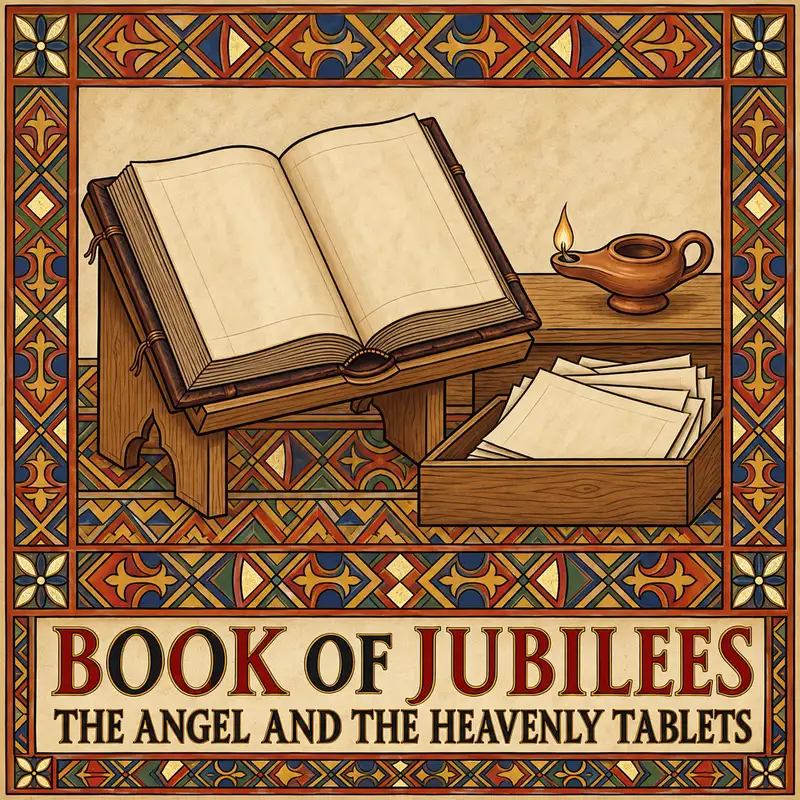
Welcome to The Sleeping Almanac. Tonight, a book I have been opening at one page and closing again for four nights, and tonight I am going to leave it open. It is the heavy one on the copyist's shelf, the one with the years counted, and you know its shape already, because I gave you its shape in the first of the two nights before this season began. An angel reading aloud to Moses from tablets kept in heaven, and a man on a mountain writing down what he hears. A year of three hundred and sixty four days. Everything measured in sevens, and forty nine years to a jubilee, so that the whole history of the world from the first day to the day the people cross into the land comes out, in this book, at exactly fifty jubilees, and not a year over. A boy called Abram driving crows off the fields and putting a blade on the plough. A prince of hostile spirits with a name that means what he does, allowed to keep a tenth of his demons and made to give up the rest. A book written in Hebrew about a hundred and fifty years before Christ, give or take, and found in the caves in many copies, and whole, from the first word to the last, only in Ge'ez, on the hill. That is what you have. I am not going to tell any of it again, except to touch it as we pass. What you do not have is the book itself. What it is for. And it is for something so strange and so tender that I have kept it back on purpose. It is a book by somebody who read Genesis, the whole of it, and half of Exodus, and could not bear that so much of it happened with no law behind it. Adam leaves the garden, and the book asks, what did he do at the gate. Cain kills his brother and is not killed, and the book cannot leave that alone. Abraham keeps a feast that has not been commanded yet. Jacob gives a tenth of everything to a son who is not a priest yet. The book takes every one of those and puts under it the thing it was missing. A law. Written, it says, on the heavenly tablets, before any of it happened, so that nothing that happened ever happened by accident, and nothing anybody did was ever the first time. I want to tell you at the door what kind of night this is. It is not a night of events. It is a night of reasons. A book in which the world is a temple, and the garden was its innermost room, and the year is a ledger, and every feast you keep is a day somebody remembered. And in the middle of it, twice, a figure standing at the edge of a scene that you already know, at the altar on the mountain where the boy is bound, and at the door in Egypt on the night of the lamb, a figure the old story never mentioned, watching, and named, and sent away. Those two are the only loud things in the book, and I will bring you to them one at a time, and then we will go back down to the quiet, where this book lives. We begin, and end, on the hill. The round church, the rain, the lamp, the copyist with his board across his knees and his last gathering half filled, and the heavy book on the shelf behind him with the name in red on its first leaf, where the angel begins to read. He has read it. He has read it more often than his own name. And tonight, when his hand aches, he is going to take it down. There is a place for you here. On the bench by the wall, in the dry, in the warm. If this story carries you down toward sleep, subscribe now, while your eyes are still open, and the next night will be waiting for you when you need it. Nothing else is expected of you. Nothing will be. You do not have to do anything now.
Let me begin with the book as a thing, because that is how we always begin, and because the thing is stranger than the story. The copyist's copy is called Mashafa Kufale. The Book of Division. He would tell you that is its name, and it is, and it is nearly the oldest name it has, because the book calls itself that on its own first line. This is the history of the division of the days, it begins, of the law and of the testimony, of the events of the years, of their weeks, of their jubilees, throughout all the years of the world. Division. Not because it divides people, though it did, but because it divides time. It cuts the years into weeks of years and the weeks into jubilees and lays every event of Genesis into its cut, so that you can say of anything, the birth of Cain, the building of the tower, the day the ram was caught by its horns, in which jubilee, in which week, in which year. That is what the book thinks history is. Not what happened. When. Outside Ethiopia it had other names, and you can tell where it went by what it was called. The Greek writers of the early church called it the Little Genesis. Not a small story, but a retelling that stood beside Genesis, dwelling on details the older book passes quickly. The reason for the name has been understood in more than one way. They quoted it. Epiphanius quoted it, in the fourth century, and a chronicler in Constantinople called Syncellus quoted it, centuries later, when he wanted a date for something that Genesis had not dated, because this book dates everything. So the Greek world had it, once, whole, and then the Greek copies stopped being copied, and what was left of them was those quotations, sentences held in other people's books like insects in amber. The Latin world had it too, and lost it the same way, and then found a surviving portion in the most Latin way possible. In the middle of the nineteenth century a librarian in Milan, working through the library's palimpsests, the parchments that had been scraped and written over because parchment was dear, identified under the later writing a surviving Latin portion of about a third of this book, copied in the fifth century. Somebody had needed the skin more than the book. That is how it survived in Latin. Under something else. And meanwhile the whole of it, first line to last, sat on the hill, in Ge'ez, in the church, where it had never been lost at all, and where it was kept among the church scriptures. A missionary sent a copy of it to Europe in the middle of that same century, and a German scholar called Dillmann made a translation from it, and then an edition, and readers in Paris or London could now open the Little Genesis and find that it was not little, and that the quotations in the fathers had been true. Then, at the very end of the century, an Englishman called Charles, who spent his life on exactly these books, went through every Ge'ez copy he could find, in Paris and in London and wherever else they had come to rest, and made the text and the translation that I will be reading from tonight, because it is old enough now to belong to everyone. And then the caves. I will not give you a number, because the book's own first night in this series gave you the words instead of the number and the words are what I have. Many copies among the books from those caves. In Hebrew, the language it was written in, which the surviving medieval copies had not preserved, in pieces, from more than one cave. And in a book you met on the second night of this season, the one whose copy turned up in a Cairo storeroom half a century before the caves were opened, the Damascus Document, there is a line that sends the reader, for the exact reckoning of the times, to the Book of the Divisions of the Seasons according to their Jubilees and their Weeks. That is this book, cited by its own name, by people who used it. So we know, without guessing, what the people of the caves thought it was. It was the book you went to when you wanted to know when. And one more small thing about the object, because it tells you what kind of mind made it. In a library in London there is a Syriac page, a single leaf, with a title on it. Names of the Wives of the Patriarchs according to the Hebrew Book called Jubilees. That is all it is. A list. Because this book, which cannot leave anything without a date, cannot leave anyone without a name either. Genesis marries off the first men to nobody. Cain has a wife and she is not named. Noah has a wife and she is not named. Enoch's wife, Methuselah's, Shem's, none of them. This book names every one. Cain's wife is Awan, his sister. Noah's wife is Emzara, the daughter of his father's brother. Enoch's wife is Edni. And a Syriac writer kept a list of those wives, linked to Jubilees by its title. We do not know whether he worked from the complete book or copied an older list, and it is one small witness to the book in that language. Other Syriac writings preserve material from it too, though a complete Syriac translation has not been found. A book that gives everybody a name and everything a date. I picture its writer as somebody who loved a record, and loved the people in it. That is the object. Whole in one language on a hill in Africa, about a third of it under another book in Milan, sentences of it in Greek in other men's books, and pieces of it in its own tongue in the dry. And the reason it survived where it survived is the reason the whole season is what it is, and I will say it now and again at the end. The Latin church stopped reading it. The Greek church stopped reading it. The rabbis did not keep it either. It is a Jewish book, written by a Jew for Jews, and the synagogue did not carry it, and neither did Rome. Ethiopia did. The whole book survived in Ge'ez. It was kept in Ethiopia, while its other ancient versions survived only in parts.
Now the frame, because you cannot read this book without the frame, and the frame is the strangest thing in it. Moses goes up the mountain. You know that. In the first year after they came out of Egypt, in the third month, on the sixteenth day, because the book dates it, the book dates everything, he is called up, and the glory settles on the mountain like a fire on the top, and a cloud covers it six days, and on the seventh day he is called into the cloud, and he stays forty days and forty nights. So far, Exodus. And then this book does the thing it does. It asks what he was told, for forty days, and it answers. God speaks first, in the first chapter, a long speech, and it is a speech that already knows how everything will go. They will forget. They will go after other gods. They will be scattered. They will come back. It is the whole of the Bible after Moses, told to Moses before any of it, as a warning he is to write down so that later, when it all happens, they will know it was said. And then God turns to somebody else. And He said to the angel of the presence, the book says, Write for Moses from the beginning of creation till My sanctuary has been built among them for all eternity. And the angel of the presence, who went before the camp of Israel, took the tables of the divisions of the years, from the time of the creation, of the law and of the testimony of the weeks, of the jubilees. That is the frame. God does not dictate the book. An angel does, reading from tablets that already exist, on which time has already been written out, and Moses writes what the angel reads. And from the second chapter to the last, the voice of the book is the angel's. It says we. We brought Adam into the garden. We taught Noah the medicines. We bound the prince of the spirits. I stood before Abraham. The angel of the presence is not a messenger in this book. He is a witness, who was there for everything, and is reading you his notes. I told you on the calendar night that the angel stops, at the year, to say that the three hundred and sixty four was not his own idea, that the book lay written before him. Tonight I want you to see that he says that about all of it. Everything in the book is in the tablets first. The Sabbath is in the tablets. The feasts are in the tablets. The law about the woman after childbirth is in the tablets, and the law about covering yourself, and the law about the man who kills his neighbour with a stone. The tablets are older than the world. The book is a reading of them. And the reading is dated. Everything that happens in it happens in a jubilee, in a week of years, in a year, from the creation, which is year one, to the day the people will cross the river into the land, which is the end of the fiftieth jubilee, two thousand four hundred and fifty years exactly, a jubilee of jubilees, so that the entering of the land is itself a jubilee, the year when what was sold is given back and what was bound goes free. You will notice what that does to the story. It makes the whole of Genesis a countdown. Nothing in it is merely a thing that happened. Everything is a step in a sum that comes out. I said on the first of the special nights that this is a book by someone who could not bear for a thing to have happened at no particular time, and that is still the truest thing I know about it, and tonight you will see the other half. He could not bear for a thing to have happened for no particular reason either. When is the ledger. Why is the law. The book supplies both, to every line of Genesis, page after page, and never once seems to tire. And then, at the end of the frame, a distinction that matters, because it tells you what the book thought it was. The angel, in the sixth chapter, speaks of the book of the first law, the one, he says, that I have written for thee. That is the Torah. The five books. The angel wrote those too, in this book's telling. And this book, the one he is now dictating, is not that. It is the second thing. The testimony. The history with the reasons put back. The book does not claim to replace Genesis. It claims to be what Moses was told about Genesis, on the mountain, in the cloud, when he asked, as anyone would have asked, why. One more thing the frame does, and then hold it. Because the angel is reading from tablets on which the whole world was laid out, he can tell Moses how the other nations are governed, and he does. There are many nations and many peoples, he says, and all are His, and over all hath He placed spirits in authority. Every nation has a spirit set over it, in this book, and the spirits lead them astray, and that is why the nations worship what they worship. But over Israel He did not appoint any angel or spirit, for He alone is their ruler. One people with no spirit between them and God. Everyone else with a governor. It is the book's map of the world, and it is the reason the book is so afraid of mixing, of the marriages and the calendar and the games, because in this map to go over to the nations is to go under their spirits, and there is no coming back from that by argument. So hold the frame. A man writing. An angel reading. Tablets that were there before the first day. And a sum that comes out. Everything I tell you tonight is inside that, and the copyist on the hill, who touched the red name on the first leaf last time we were here, has never read it any other way.
The angel begins where you would begin. Write the complete history of the creation, he says, how in six days the Lord God finished all His works and all that He created, and kept Sabbath on the seventh day and hallowed it for all ages. And then he tells it. And it is Genesis, almost, and the almost is where the book lives. On the first day, the book says, the heavens and the earth and the waters, and the spirits who serve, and it names them, the angels of the presence and the angels of sanctification and the angels of the winds and the clouds and the frost and the hail and the thunder and the spirits of cold and heat and winter and spring, every weather with its angel, made on the first day so that there would be somebody to keep the weather when the weather was made. Seven works on the first day. On the second, the firmament, one work. On the third, the dry land and the seas and the plants, and a fourth thing that Genesis does not have on the third day at all. The Garden of Eden. Made on the third day, with the herbs, as a place, before anyone was there to be put in it. Four works. On the fourth day the sun and the moon and the stars, and here the book does what I told you it does on the calendar night, and I will only touch it. It says the sun was set as a great sign upon the earth for days and for sabbaths and for months and for feasts and for years, and it does not say the moon. The moon is made. The moon is not given the year. Three works. On the fifth the creatures of the water and the birds, three. On the sixth the beasts and the cattle and the creeping things, and then man, a man and a woman, four. And then the book stops and adds them up. And there were altogether two and twenty kinds. Twenty two works of creation in six days, and God finished, and the seventh day was given. But listen to who it is given to first. And He gave us a great sign, the angel says, the Sabbath day, that we should work six days but keep Sabbath on the seventh day from all work. Us. The angels. And all the angels of the presence and all the angels of sanctification, these two great classes, He hath bidden us to keep the Sabbath with Him in heaven and on earth. The Sabbath, in this book, is kept in heaven before it is kept anywhere else. The two highest orders of angels keep it with God. And then God says, and the angel reports it, that He will separate for Himself one people from all the peoples, and that they will keep the Sabbath too, with the angels, so that there will be, on the seventh day, one rest, in heaven and on the earth, kept by the two orders above and one people below. That is what the book thinks the Sabbath is. Not a rule. A company. And because it is a company and not a rule, the book is very strict about it, and I will give you the list, because the list is quiet and you can let it go by. Declare and say to the children of Israel the law of this day, the angel says. That they should not do any work thereon which is unseemly, nor do their own pleasure, and that they should not prepare thereon anything to be eaten or drunk, nor draw water, nor bring in or take out through their gates any burden which they had not prepared for themselves on the sixth day in their dwellings. No cooking. No water drawn. Nothing carried through a gate. Everything ready the day before. And then, this. For that day is more holy and blessed than any jubilee day of the jubilees. On this we kept Sabbath in the heavens before it was made known to any flesh to keep Sabbath thereon on the earth. More holy than a jubilee, in the book of jubilees. Kept above before it was kept below. And every one who observeth it, the angel says, and keepeth Sabbath thereon from all his work, will be holy and blessed throughout all days like unto us. Like unto us. That is the promise under the whole list. Keep the day and you are, for that day, what we are. And then the sum comes back, because in this book the sums always come back. There were, the angel says, two and twenty heads of mankind from Adam to Jacob, and two and twenty kinds of work were made until the seventh day. Twenty two generations from the first man to the man whose name became the people. Twenty two works from the first day to the rest. The book sets them side by side and does not explain, and does not need to. The world was made in twenty two, and the people were made in twenty two, and the seventh day is where both of them were going. I want to stay a moment on the Garden being made on the third day, because it is a small thing that becomes the whole of the next chapter. In Genesis the garden is planted after the man, for the man. In this book it is made with the plants, on the third day, as a place, before there is anybody. It is not a home that was built for someone. It is a room that was there first, and later someone was brought into it. And when you hear how they were brought in, you will understand why the book moved it.
Here is the thing this book knows about Eden that Genesis does not say, and it is, to me, the loveliest thing in it. Adam is made, and for five days, the book says, the animals are brought to him and he names them, and he is alone. On the sixth day the woman is made from his side. And then the book says something about time that Genesis does not. In the first week was Adam created, and the rib, his wife. In the second week He showed her unto him. And then, this. And after Adam had completed forty days in the land where he had been created, we brought him into the Garden of Eden to till and keep it, but his wife they brought in on the eightieth day, and after this she entered into the Garden of Eden. Forty days for the man. Eighty for the woman. And if you know the old law, you will have heard those numbers already, because they are the numbers in Leviticus for a woman after she has given birth, forty days before she may come to the sanctuary if the child is a boy, eighty if it is a girl. The book knows you have heard them. It says so. And for this reason, it says, the commandment is written on the heavenly tablets in regard to her that giveth birth. The law of the forty and the eighty days, the law of the temple, is in this book the law of the garden, and Adam and Eve were the first to keep it, without knowing there was a law, by being brought in late. Which means the garden was a temple. The book says it in so many words. When she had completed these eighty days we brought her into the Garden of Eden, for it is holier than all the earth besides, and every tree that is planted in it is holy. Holier than all the earth. Every tree holy. Eden is not a park with a fence and a snake. It is a sanctuary. It has an inside you may not enter until you are clean, and the first two people waited outside it, in the land where they had been made, the way a mother waits before she comes up to the temple, and then were brought in. And when they leave, the book gives Adam something to do at the gate. On that day on which Adam went forth from the garden, it says, he offered as a sweet savour an offering, frankincense, galbanum, and stacte, and spices, in the morning with the rising of the sun. You may not know those words. A priest would. Those names echo the incense of the tabernacle in Exodus, sweet spices beaten small and burned before the veil. Adam, leaving the garden, burns the temple incense at its door. He is the first priest, and the garden is the first temple, and the day he is put out of it he does what a priest does when he goes out from the holy place. He makes the smoke. There is one more thing that happens at the gate that day, and it is the strangest, and I give it to you because it is the kind of thing you should be told just before sleep. On that day, the book says, was closed the mouth of all beasts, and of cattle, and of birds, and of whatever walketh, and of whatever moveth, so that they could no longer speak, for they had all spoken one with another with one lip and with one tongue. The animals could talk. In the garden, everything could. On the day the man went out, they went quiet, and they have been quiet since. The book does not make anything of it. It says it and moves on. And all flesh was scattered, it says, according to its kinds, unto the places which had been created for them. The garden stays holy after they leave. That is the point of it being a temple and not a home. Much later in the book, when Noah's sons divide the earth between them and the middle of it falls to Shem, the book stops to say why Shem's portion is the best, and its reason is that his land holds the holy places. Noah knew, it says, that the Garden of Eden is the holy of holies and the dwelling of the Lord, and Mount Sinai the centre of the desert, and Mount Zion the centre of the navel of the earth. Three holy places made facing one another. The garden, the mountain where the book is being dictated, and the hill where the temple stands. And earlier still, in the chapter about Enoch, the one this book cannot leave alone any more than the caves could, the book says the Lord has four places on the earth, the Garden of Eden, and the Mount of the East, and Mount Sinai, and Mount Zion. And it puts Enoch in the first of them. You know where Enoch went, in the book that carries his name. This book agrees, and adds the room. He was taken from among the children of men, it says, and we conducted him into the Garden of Eden in majesty and honour, and behold, there he writeth down the condemnation and judgment of the world. And he burnt the incense of the sanctuary, sweet spices, acceptable before the Lord on the Mount. Enoch is in the garden, alive, writing, and burning the incense of the sanctuary, as Adam had burned incense at the gate. The garden has a priest again. He has been there, in this book's reckoning, since before the flood, and he is there now, writing, which is a thing the copyist on the hill, with his board across his knees, has read many times without any sense of strangeness at all, because a man in a holy place writing down what he has been shown is not strange to him. It is Tuesday.
I said this was a night of reasons, and I want to show you now how the book makes them, because once you have seen it done three times you will see it everywhere, and it will begin to sound, in the dark, like a voice you know. Cain kills Abel. In Genesis he is marked and sent away and lives a long life and builds a city, and that is the end of him, and the book cannot bear it. So it tells you how he died. At the end of the fourth chapter, long after, in a year it gives, Cain's house fell upon him, the book says, and he died in the midst of his house, and he was killed by its stones, for with a stone he had killed Abel, and by a stone was he killed in righteous judgment. The house he built was of stone, and it came down on him, and the book has waited more than eight hundred years of its own reckoning to tell you that, and then it does the thing. For this reason, it says, it was ordained on the heavenly tablets, with the instrument with which a man kills his neighbour, with the same shall he be killed, after the manner that he wounded him, in like manner shall they deal with him. Do you see the shape. A story that Genesis tells and leaves. Then the missing end. Then the law that the end was obeying, which was written on the tablets before Cain was born. Nothing happened. Everything was kept. And it is not only the great things. Adam, going out of the garden, is given skins to cover himself, and the book says, on this account it is prescribed on the heavenly tablets, that they should cover their shame, and should not uncover themselves as the Gentiles uncover themselves. Many readers hear a law about the games here. About the gymnasium, and the Greek habit, new in the writer's city, of exercising unclothed, which was one of the things that told a priest around a hundred and fifty years before Christ that the world was ending. The book puts the answer to it at the gate of Eden. Adam covered himself. It was on the tablets. Whatever the young men down at the gymnasium are doing, it was decided against before there was a gymnasium, or a young man. And circumcision. Abraham is given it in the fifteenth chapter, as in Genesis, and then the book adds a line that no one else has. For all the angels of the presence and all the angels of sanctification have been so created from the day of their creation. The two highest orders of angels are, in this book, circumcised. Made so. The sign that marks the people is the sign the angels already bear, and keeping it is not an obligation so much as a resemblance. The same two orders keep the Sabbath. Israel is being asked, all through this book, to live like the angels of the presence, and the reason the book gives for every law is finally the same reason. That is how it is done above. I want you to notice the phrase, because it is the book's heartbeat and you will hear it again and again tonight without my pointing. Written on the heavenly tablets. Ordained on the heavenly tablets. Engraven on the heavenly tablets. The tablets are where the book's authority comes from, and they are also, I think, its deepest wish. Because a thing written on a tablet in heaven before the world was made cannot be argued with by a Greek, or a priest in the city who keeps the year by the moon, or a king. It cannot be changed. It was never new. And a man writing, in those years, in a city full of new things, wanting one thing that was not new, wrote a book in which nothing was. And there is one reason the book gives that is not about a law at all, and I will give it to you here because it is about a book, and about a language, and about copying. When Abram is an old man in Haran, before he sets out, the book says the Lord told the angel, Open his mouth and his ears, that he may hear and speak with his mouth, with the language which hath been revealed, for it had ceased from the mouths of all the children of men from the day of the overthrow of Babel. And I opened his mouth, the angel says, and his ears and his lips, and I began to speak with him in Hebrew, in the tongue of the creation. Hebrew, in this book, is the language the world was made in, the one the animals spoke in the garden before their mouths were closed, and it was lost at the tower, and given back to one man. And what does he do with it. And he took the books of his fathers, the book says, and these were written in Hebrew, and he transcribed them, and he began from henceforth to study them, and I made known to him that which he could not understand, and he studied them during the six rainy months. The six rainy months. An old man, given back a lost language, spends a whole rainy season copying his fathers' books, with an angel beside him explaining the hard parts. That is what Abram does in this book before he goes anywhere. He copies. And the books he copies are Enoch's, and Noah's, come down through Shem, so that the chain of hands I keep telling you about is inside the book as well as around it, and the first thing the father of the people did with the tongue of creation was make a fair copy. That is the method, and now that you have it I can give you the rest of the night more gently, because everything from here is the method applied. The mountain, the night in Egypt, the flood, the feasts, the priests. A story you know, and under it the reason, and under the reason the tablets, and the angel reading, and Moses writing, and the copyist on the hill copying what Moses wrote, in Ge'ez, in a church, in the rain, which is a chain of hands longer than any I know, and every link of it believed it was not adding anything. Only keeping.
Now the first of the two loud things, and I will tell it quietly, and once, and then we will set it down together and it will not be picked up again. You know the story. The old man is told to take his son up a mountain and offer him. He goes. The boy carries the wood. The boy asks where the lamb is. The old man says God will provide one. He builds the altar and binds the boy and lifts the knife, and a voice stops him, and there is a ram in a thicket. That is Genesis, and it has been read for many centuries without one explanation settling every reader's question, because Genesis gives one line for the why. God tested Abraham. That is all. And this book, which cannot leave a why alone, gives it another. It begins the chapter by counting. There were voices in heaven, it says, that Abraham was faithful in everything that was told him, and that he loved the Lord, and that in every affliction he was faithful. And then a figure I have kept back all night steps forward. The prince of hostile spirits, the one who was allowed to keep the tenth. His name, which you already know means what he does, is used by the book as a title and as a name, and the name is Mastema. I will not say it again tonight. He came, the book says, and said before God, Behold, Abraham loveth Isaac his son, and he delighteth in him above all things else. Bid him offer him as a burnt offering on the altar, and Thou wilt see if he will do this command, and Thou wilt know if he is faithful in everything wherein Thou dost try him. So in this book the test is not God's idea. It is the accuser's. It is the same shape as the opening of Job, a figure standing in the court saying, of course he is faithful, look what he has, take it away and see. And God, the book says, already knew. The Lord knew that Abraham was faithful in all his afflictions, for He had tried him through his country, and with famine, and had tried him with the wealth of kings, and had tried him again through his wife when she was torn from him, and with circumcision, and had tried him through Ishmael and Hagar when he sent them away. Six trials, or seven, depending how you count them, before this one. The book is saying that the accuser's challenge was answered before it was made, and was allowed anyway, so that the answer would be seen. And then the story, in the book's words, which are nearly the Bible's, and I will give you only the turn. Abraham built an altar, and placed the wood on the altar, and bound Isaac his son, and placed him on the wood which was upon the altar, and stretched forth his hand to take the knife to slay Isaac his son. And I stood before him, the angel says, and before the prince of the hostile spirits. Two figures at the altar that Genesis does not see. The angel of the presence, who is telling you this, and the accuser, who proposed it. Standing there, on the mountain, on either side of the old man and the knife. And the Lord said, Bid him not to lay his hand on the lad, nor to do anything to him, for I have shown that he feareth the Lord. And I called to him from heaven, and said unto him, Abraham, Abraham. And he was terrified, and said, Behold, here am I. And then the line the whole chapter was written for, and it is not about Abraham at all. And the prince of the hostile spirits was put to shame. Four words in the old translation. Put to shame. And then, as if the shame had made room for it, Abraham lifted up his eyes and looked, and behold, a single ram caught by his horns, and Abraham went and took the ram and offered it for a burnt offering in the stead of his son. That is what this book did to the hardest story in Genesis. It put a watcher at the edge of it who wanted it to go the other way, and it let the old man's hand stop, and it turned to the watcher and said, you were wrong, and he was ashamed. And then the book does the thing it always does, and dates it, and places it. Abraham called that place The Lord hath seen, and the book says, that is Mount Zion, so that the altar where the knife stopped is the hill where the temple will stand, and the temple is the place where the knife is always stopped and the ram is always given instead. And the book has him set out on the twelfth of the first month and reach the place on the third day, so that the week on the mountain is, in this book's year, the week of Passover, and the ram caught on the mountain is the first lamb. Which is why, in the next chapter, when we come to the door in Egypt, the same figure will be standing there. But not yet. Set it down. The knife stopped. The boy came down the mountain with his father. The accuser was ashamed and went away. And the old man went home to Beersheba, the book says, and kept a feast there, and Beersheba is where I will bring you soon, after the door in Egypt, for the gentlest chapter in the book, and by then you will have earned it.
Now the second loud thing, and the last, and then the night goes quiet all the way down. I said the figure from the mountain would be at the door in Egypt, and he is, and I will not say his name again, because I said it once, on the mountain, and once is the rule. I will call him what the book mostly calls him. The prince of the hostile spirits. The accuser. The book comes to Egypt in its last chapters, because the book ends where Exodus is only beginning, on the mountain, with Moses writing, and the story of how Moses came to be on the mountain is the last story the angel tells him. And the angel tells it as a story about the accuser. Everywhere in Exodus that something goes wrong, this book puts him. When Moses is on the road back to Egypt, and Exodus has that strange night at the lodging place where God meets him and seeks to kill him, and the reason has long troubled readers, this book says who. The prince of the hostile spirits sought to slay thee, the angel tells Moses, and I delivered thee out of his hand. When the magicians of Pharaoh match Moses sign for sign, the book says who was helping them. The prince of the hostile spirits stood up against thee, and sought to cast thee into the hands of Pharaoh, and helped the magicians. And we permitted them to work evils, the angel says, but the remedies we did not allow to be wrought by their hands. They could make the plagues. They could not take them away. That was the difference, and it was allowed on purpose. And then the night. The fourteenth of the first month. The night of the lamb. And here the book does the thing I have been walking you toward all night, and it does it in one sentence, and the sentence is not about the lamb. On the fourteenth day and on the fifteenth and on the sixteenth and on the seventeenth and on the eighteenth, the angel says, the prince of the hostile spirits was bound and imprisoned behind the children of Israel, that he might not accuse them. Five days. Bound. Behind the people. That is what Passover is, in this book. Not only a night when death passed over the doors. A night, and four days after it, when the accuser was held, so that as the people went out he could not follow them and could not speak against them. The angels who serve in this book are the ones who bound him, and the angel who is dictating was one of them, and says so. And on the nineteenth, the book says, we let them loose, that they might help the Egyptians and pursue the children of Israel. And he hardened their hearts and made them stubborn, and the device was devised by the Lord our God that He might smite the Egyptians and cast them into the sea. So the hardening of Pharaoh's heart, which is God's in Exodus, is the accuser's in this book, let loose for the purpose, and the sea is the end of it. And the book gives you the night itself, quietly, as the law of the feast, and it is the last thing the angel tells Moses before the Sabbath, and I am going to give it to you as the book gives it, because it is a night, and we are in one. Remember the commandment, the angel says, which the Lord commanded thee concerning the passover, that thou shouldst celebrate it in its season on the fourteenth of the first month, that thou shouldst kill it before it is evening, and that they should eat it by night on the evening of the fifteenth from the time of the setting of the sun. For on this night, the beginning of the festival and the beginning of the joy, ye were eating the passover in Egypt, when all the powers of the hostile spirits had been let loose to slay all the firstborn in the land of Egypt. I will not tell the firstborn. You know it. The book says it in a line and passes, and says instead that in the houses where the blood was on the lintel nothing entered, and the plague came not upon them, and then it says what the people were doing inside, which is the part I want you to have. And all Israel was eating the flesh of the paschal lamb, the book says, and drinking the wine, and was lauding and blessing and giving thanks to the Lord God of their fathers, and was ready to go forth from under the yoke of Egypt. Drinking the wine. This is one early witness to wine at the Passover table. Not in Exodus. Here. In a book on the hill. Two thousand years before tonight, somebody wrote that on the night the accuser was bound behind them, the people ate the lamb and drank wine and sang, inside, with the doors shut, and that is the scene this book asks its readers to remember. And the book gives the hours. Between the evenings, the angel says, from the third part of the day to the third part of the night, for two portions of the day are given to the light, and a third part to the evening. Kill it as the light goes. Eat it, the book says, at the time of the evening until the third part of the night, and whatever is left over from the third part of the night and onwards, let them burn it with fire. Roast it, not boiled, not raw. Eat it with diligence. And not break any bone of it. And then, for the last time in the book, the reason. For it is a festival day, and a day commanded, and there may be no passing over from day to day, and month to month, but on the day of its festival let it be observed. And it will come for a memorial well pleasing before the Lord, and no plague will come upon them to slay or to smite in that year in which they celebrate the passover in its season. So that is the night, in this book. A lamb killed as the light goes. Blood on the door. Wine inside, and singing, through the first third of the night, and then the fire for what is left, and no bone broken. And outside, behind the people, in the dark, bound for five days so that he cannot speak, the one who proposed the mountain, and was put to shame there, and was allowed his tenth, and helped the magicians, and stood in the road. Held. Not destroyed. The book does not destroy him in these scenes. It tells of those five days, and of his release on the nineteenth, and then commands the people to keep Passover each year. That is the book's whole theology of evil, and it is a calendar. There are days when the accuser is held. Keep them. Set him down now, with the mountain. He does not come back tonight. The book's last chapter is the Sabbath, the day of rest, laid out as law, no work, no journey, no fire, no buying and selling, and the book ends on it, the way its story began on it, on the seventh day, with the angels resting, and Moses writing, and the colophon at the very end, in the copyist's Ge'ez, that says herewith is completed the account of the division of the days. Completed. The sum came out.
The flood comes and goes in this book as it does in Enoch, and I told the flood on the first night of the season, and I will not tell it again. What this book tells us next is what happened after, in Noah's house, when his grandchildren began to be sick. Before they were sick, he taught them. The book gives Noah a speech, an old man's speech to his sons' sons, and it has the shape of a sermon, and it is short, and I want you to hear its shape because it is the shape of every sermon since. He exhorted his sons, the book says, to observe righteousness, and to cover the shame of their flesh, and to bless their Creator, and honour father and mother, and love their neighbour, and guard their souls from fornication and uncleanness and all iniquity. For owing to these three things came the flood upon the earth. And then he tells them the three, and the first of the three is the Watchers, whom he calls by that name, going after the daughters of men against the law of their ordinances, and the giants they made, and the blood. Noah does not tell his grandchildren the flood as a story. He tells it as a warning, from a man who was in it, and the warning is a list of what not to do, and then the sickness comes anyway, from the same source, from what the Watchers left behind, and the old man has to go from teaching to praying. In the third week of that jubilee, the book says, the unclean demons began to lead astray the sons of Noah's sons, and to make them err and to destroy them. You know who those demons are. I told you on the first night. They are what was left of the giants after their bodies were destroyed, spirits with nowhere to go, and this book, which read the Enoch book as closely as the caves did, agrees. And the sons of Noah came to Noah their father, and told him concerning the demons which were leading astray and blinding and slaying his sons' sons. So Noah prays. And it is one of the few prayers in the book, and it is the prayer of a grandfather. God of the spirits of all flesh, he says, who hast shown mercy unto me, and hast saved me and my sons from the waters of the flood. Let Thy grace be lifted up upon my sons, and let not wicked spirits rule over them, lest they should destroy them from the earth. And then, because he was there and knows exactly what these things are, Thou knowest how Thy Watchers, the fathers of these spirits, acted in my day. As for these spirits which are living, imprison them, and hold them fast in the place of condemnation, and let them not bring destruction on the sons of Thy servant. And the answer is the one thing about this book you already know, and I promised I would only touch it. The Lord bids the angels bind them all, and the chief of the spirits asks to keep some, and is given his tenth, which you know. You heard his name and what it means in the first special, and I said it once tonight, at the altar, and I will not say it again. Here, I only want you to see that the tenth is not the end of the chapter. It is the middle. And the end of the chapter is a book. And one of us, the angel says, He commanded that we should teach Noah all their medicines, for He knew that they would not walk in uprightness. And we did according to all His words. All the malignant evil ones we bound in the place of condemnation, and a tenth part of them we left. And we explained to Noah all the medicines of their diseases, together with their seductions, how he might heal them with herbs of the earth. And Noah wrote down all things in a book, as we instructed him, concerning every kind of medicine. Thus the evil spirits were precluded from hurting the sons of Noah. And he gave all that he had written to Shem, his eldest son, for he loved him exceedingly above all his sons. I want you to sit with that, because it is the tenderest answer to the giants that anybody ever wrote. The Enoch book ends the giants with a sentence of judgment, and the spirits go on afflicting until the end. This book does not undo that. The tenth are still loose. But it sends an angel down with a remedy. Herbs of the earth. For every sickness the spirits cause, a plant that answers it, taught by the one who bound them, and written down, in a book, by an old man who had already lost one world and did not intend to lose his grandchildren. And the book is given to Shem. Kept. Passed down. It is a book of medicine beside the older writings of Enoch, another thing passed into human hands. People remembered that. Long after, in the Hebrew of the middle ages, there was a book of medicine that opened by saying where medicine came from, and it said an angel gave it to Noah, for the healing of what the spirits do, and that Noah wrote it in a book and it came down through his sons. Whether that later writer used this book directly, or received the story another way, remains uncertain. But the story kept its shape for a thousand years. The remedies were older than the doctors. They came down from the ark. And Noah dies, in this book, as he dies in the other, on the mountain, in the land of Ararat, and the book gives him his years, nine hundred and fifty, nineteen jubilees and two weeks and five years, because it must, and then it gives him a rare compliment. In his life on earth, it says, he excelled the children of men, save Enoch, because of the righteousness wherein he was perfect. Save Enoch. Enoch is in the garden, writing. Noah is second, and his book is in Shem's hands, and the tenth are loose, and there is a plant for each of them, and the book goes on to the tower.
I told you on the calendar night that this book gives Noah the four corners of the year, as the four days he remembered from the flood, and that the feast in the third month, the feast of weeks, is in this book the anniversary of Noah's covenant, the bow in the cloud, kept by Noah and forgotten by his sons and kept again by Abraham. That is spent, and I only touch it, to tell you that it is not the only feast this book gives a memory to. It does it to all of them. Every feast the people keep is, in this book, a day when somebody, long before there was a people, did something, and could not stop doing it every year, and the tablets had said they would. The feast of booths. In the autumn, in the seventh month, when the people build shelters of branches and live in them a week. Leviticus says it is so the generations will know that Israel lived in booths when they came out of Egypt. This book puts it more than four hundred years earlier, by its own count, and gives it to Abraham. He is at Beersheba, in the sixteenth chapter, in the seventh month, and the angels have just come back to him with the promise of the son and of the sons after him, and Abraham, the book says, built booths for himself and for his servants on this festival, and he was the first to celebrate the feast of tabernacles on the earth. The first. Nobody told him. He built an altar, and offered, and burned on it incense, and the book names the incense, seven spices, frankincense and galbanum and stacte and nard and myrrh and spice and costum, all these seven he offered, crushed, mixed together in equal parts, and pure. And he celebrated this feast during seven days, rejoicing with all his heart and with all his soul, he and all those who were in his house. And then the distinctive detail that I love more than I can tell you. Abraham took branches of palm trees, and the fruit of goodly trees, and every day going round the altar with the branches seven times, in the morning, he praised and gave thanks to his God for all things in joy. And the book says the people are to do the same, forever, and dwell in booths, and set wreaths upon their heads, and take leafy boughs, and willows from the brook. Wreaths upon their heads. There is no wreath in Leviticus. Somebody who wrote this book had seen the feast kept with wreaths, or wanted it kept so, and put the wreaths on Abraham's head at Beersheba, and made them law. Picture it, because it is a picture for sleep. An old man, a very old man, at the edge of the desert, in the autumn, in a shelter of branches he built with his own hands, with a wreath on his head, walking round a stone altar seven times in the morning with a palm branch in his hand, singing, because a son was promised him and the promise is being kept. That is where the feast comes from, in this book. Not from Egypt. From joy. And we blessed him for ever, the angel says, and all his seed after him, because he celebrated this festival in its season, according to the testimony of the heavenly tablets. And now the other one. The Day of Atonement. The one day in the year with no joy in it, the tenth of the seventh month, when the people fast and afflict themselves, and the book gives that a memory too, and the memory is Jacob's. You know what Jacob's sons did with Joseph. They sold him, and killed a kid, and dipped his coat in the blood. And this book says when. They sent it to Jacob their father on the tenth of the seventh month. And he mourned all that night, for they had brought it to him in the evening, and he became feverish with mourning for his death, and he said, an evil beast hath devoured Joseph. And the book gives him a whole year of mourning, and then it says the thing. For this reason it is ordained for the children of Israel that they should afflict themselves on the tenth of the seventh month, on the day that the news which made him weep for Joseph came to Jacob his father, that they should make atonement for themselves thereon with a young goat. A young goat. The kid whose blood was on the coat. The animal of the lie is the animal of the atonement, on the day the lie was told, forever. That is the book's whole habit in one sentence. The holiest day of the year is an old man's worst evening, kept. So that is what this book means by the festivals given their origins. Not commanded. Remembered. The feast of weeks is Noah's bow. The booths are Abraham's joy. The fast is Jacob's grief. And Passover, which is the last feast in the book and the last thing the angel tells Moses before the Sabbath laws that close it, is the night when the figure from the mountain came back, and was bound. You have already stood at that door tonight. What is left is the quiet. And the copyist, reading these feasts on the hill, in his own year of thirteen months, can follow the memories the book has placed beneath them. It is on the page. He has copied it.
There is a family in this book that the book loves above every other, and it is not the family you would guess. It is not Abraham's line as a whole, and not Judah's, from whom the kings came. It is Levi's. The priests. And the way the book gives Levi the priesthood is the plainest example in it of a reason being put under a thing that had none, and it begins with one of the harshest stories in Genesis, and I am going to tell that part plainly and quickly, because it is hard, and it is history, and it deserves neither dressing up nor dwelling on. Jacob's daughter is Dinah. In Genesis she goes out to see the daughters of the land, and the son of the ruler of the city of Shechem takes her, and then asks for her, and her brothers answer with a trick and then with swords, and two of them, Simeon and Levi, kill the men of the city, and Jacob is afraid of what will follow, and curses their anger on his deathbed. That is Genesis. It does not approve. This book does. It tells the same story and then it stops, as it always does, and says, and for this reason it is written on the heavenly tablets, and the law it gives is the law against giving a daughter to a foreigner, and then it says of Levi, and the seed of Levi was chosen for the priesthood, because he was zealous, and it makes his zeal the reason for everything that follows. I will say what I think, once. I hear a priestly writer here, resisting marriages and a calendar he thought were wrong, and he wanted the line he belonged to to have been chosen for a reason, and the reason he chose is not one I would choose. It is on the page. I have read it to you. Set it down. What follows is gentler, and it is the part I brought you for. Jacob goes home to his old father, to Isaac, who is blind, and he brings two of his sons with him. Levi and Judah. And the darkness left the eyes of Isaac, the book says, and he saw the two sons of Jacob, and he said, are these thy sons, my son, for they are like thee. And the spirit of prophecy came down into his mouth, and he took Levi by his right hand and Judah by his left. The right hand for Levi. The book says he turned to Levi first, and began to bless him first. May the Lord give to thee and to thy seed greatness and great glory, he says, and cause thee and thy seed, from among all flesh, to approach Him to serve in His sanctuary as the angels of the presence and as the holy ones. And they will be princes and judges and chiefs of all the seed of the sons of Jacob. Thy mother hath called thy name Levi, and justly hath she called thy name. Thou wilt be joined to the Lord and be the companion of all the sons of Jacob. Let His table be thine, and do thou and thy sons eat thereof, and may thy table be full unto all generations. Then Judah, with the left hand. A prince shalt thou be, thou and one of thy sons, over the sons of Jacob. Kings from Judah. Priests from Levi. But the priest first, and by the right hand, and told that he will serve as the angels of the presence serve, which is the highest thing the book knows how to say about anyone. And the priests, in this blessing, are not only priests. They are judges and chiefs. They rule. That is a claim, and one way to read it is as a priestly hope that service at the sanctuary should carry authority among the people. And then the book gives Levi the priesthood a second time, in a dream and a sum, and the sum is the one I want you to fall asleep on. Jacob is at Bethel, where he once saw the ladder, and he has vowed, long ago, to give God a tenth of everything, and now he has come back to pay it. And he abode that night at Bethel, the book says, and Levi dreamed that they had ordained and made him the priest of the Most High God, him and his sons for ever, and he awoke from his sleep and blessed the Lord. That is the dream. And in the morning Jacob rises to pay his vow, and gives a tenth of all that came with him, of men and cattle, of gold and every vessel and garment, yea, he gave tithes of all. And then he has a problem. He has eleven sons and a twelfth on the way, the book says Rachel had just conceived Benjamin, and a tenth of twelve sons is a son, and which one. And the book says he counted. Jacob counted his sons from Benjamin upwards, from the child not yet born, backwards, and Levi fell to the portion of the Lord. The tenth son, counting from the end. Levi. And his father clothed him in the garments of the priesthood, and filled his hands. So Levi is a tithe. He is the tenth of Jacob's children, given to God the way the tenth sheep is given, and dressed in the garments, and from then on, at Bethel, the book says, he discharged the priestly office before Jacob his father in preference to his ten brothers. A son handed over as a tenth. It is the tenderest and strangest reason in a book made of reasons, and it is why, in this book, the tithe is given twice, the second tithe, the one you eat before the Lord in the place He chooses, because Jacob tithed again the tithe, that night, and it is ordained on the heavenly tablets, and to this law there is no limit of days. Two nights ago you met Levi's voice, in the Aramaic, from the caves, a priest speaking in the first person about what he was taught. This is the same Levi, from the other side. The book that tells you how he came to be a priest, so that the book in which he speaks as one has something to stand on. And there is one more thing this book gives him, near its end, when Jacob is dying in Egypt, and it is the thing that ties him to the hill. Jacob gave all his books, the book says, and the books of his fathers, to Levi his son, that he might preserve them and renew them for his children until this day. The books. Enoch's book, which came down through Methuselah and Noah and Shem, and Noah's book of remedies, and Abraham's, all of them, given to the priest, to keep and to copy. To renew them. That is the word. A priest whose office is to make new copies of old books so that the old books do not die. Which is a thing the copyist on the hill, who is not a Levite and would never think to call himself one, has been doing since he was eleven years old, on a board across his knees, without being told that it was the whole point of Levi.
I want to give you one more page of the book, and then the third layer, the readers, and then we go home. The page is in the twenty third chapter, after Abraham dies, and it is the clearest place where the book looks up from its ledger and out at the world it was written in, and it does it as a prophecy, and the prophecy is the saddest and then the kindest thing in it. Abraham dies old, and the book stops at his death to say that since the flood the lives of men have been growing shorter, and then it says why, and it says what will follow. The lives will shorten. Generation by generation, the years of men will go down, until, the book says, the children's heads will be white with grey hair, and a child of three weeks will look as old as a man of a hundred years, and their strength will fail through affliction. Children grown grey. That is the book's picture of the writer's own time, the days of the Greek kings, when, it says, they will forsake the covenant, and some will make war on others, and a great affliction will come, and the young will reproach the old for not keeping the law, and the old will reproach the young. It is a time of children who look old. And then, in the middle of the sorrow, the turn. And in those days, the book says, the children will begin to study the laws, and to seek the commandments, and to return to the path of righteousness. And the days will begin to grow many and increase amongst those children of men, till their days draw nigh to one thousand years, and to a greater number of years than before was the number of the days. And there will be no old man nor one who is not satisfied with his days, for all will be children and youths. And all their days they will complete and live in peace and in joy, and there will be no Satan nor any evil destroyer. Read that again in the dark. No Satan nor any evil destroyer. The accuser gone, not bound. Children who do not grow grey. A thousand years each, in peace, and it comes, in this book, not by a king or a war but by the children beginning to study. The book thinks the world is healed by reading. By the law being read again by the young. Which, whatever you make of the rest of it, is a thing you can understand being written by a man with a reed in his hand, at a table, in a bad time. He thought the cure was the book. And he thought it was already beginning. And I should tell you, before the readers, what a jubilee is, because I have said the word all night and only counted with it. It is from Leviticus. Seven weeks of years, forty nine, and the fiftieth year is proclaimed with a trumpet, and in that year the land that was sold goes back to the family that sold it, and the people who sold themselves into service go home, and the fields lie fallow, and everybody begins again from where they began. It is a year of release. A year when what was lost is given back. And the book that counts the whole history of the world in those years, and brings the people into the land in the jubilee of jubilees, is saying, under all its sums, that the whole of history is a lease, and that the land was always going to come back, and the people were always going to go home, at the time that was written. That is why it counts. Not to be exact. To be sure. Now the readers, briefly, because the season's last night is theirs and I will not take it from them. Who read this book, after. The people of the caves read it, and cited it by name, and kept it close, because it gave them their year and their priests and their tablets. The Greek churches read it for a few centuries and quoted it and let it go. The Latin church had it and lost it, apart from the portion under the palimpsest. The rabbis did not keep it, and we do not have their own account of why. The differences that follow may help explain the distance, but they are an inference, not a verdict the rabbis left us. Its year was not their year. Its priests ruling as princes was not their hope. Its tablets, with every law fixed before the world, left no room for the argument that became the Talmud, which is a book made entirely of argument, and a book with no room for argument could not live in that house. The book did not become part of the rabbinic canon, and I will not turn the difference between those traditions into a verdict about which people kept the right books. Books are kept by the people they fit. And that is the last thing, before the hill. An authentic book is not the same as a true event. This book is authentic. It was written in Hebrew about a hundred and fifty years before Christ, give or take, by a priest, or by someone who thought like one, and it says what it says, and we have it, whole, and in pieces, and under other books. What it tells us is true about him. What he wanted. What he feared. What year he kept. What he thought the garden was. Whether Adam burned incense at the gate, whether the accuser stood at the altar, whether Levi was counted backwards from Benjamin, those are not things a book can settle, and this book does not try to settle them. It says they were written on the tablets, and that the angel read them out, and that Moses wrote them down, and it leaves you there, with the chain of hands, which brings us back to the surviving manuscripts. Those books are real. We can examine what the hands preserved.
The hill. The rain. It has been raining under everything tonight, under the garden and the incense and the stones of Cain's house and the wreath on Abraham's head, and you may not have noticed for a long time, and that is as it should be. The copyist is where he always is. By the lamp, with the board across his knees, and the last gathering on it, more than half filled now, a column and a bit tonight, in a hand that is smaller than it was when he began the book because his eyes have changed and he has not admitted it. He sets the reed down. He sits, with his hands in his lap, the way he does, at the end of a page, when his hand aches. And then he does something he does not do every night. He turns, on his stool, and takes the heavy book down from the shelf behind him. Kufale. The Book of Division. His own copy, or his teacher's, or his teacher's teacher's, it does not matter, the hands are the same hands. The Book of Jubilees is scripture in the Ethiopian Orthodox Tewahedo Church today. It was last Sunday. It stands in the list of the books, the long list, the one with eighty one in it, beside the book he is copying and beside the Gospels and the Psalms, and in this room it belongs among the scriptures, supported by the church's own lists and by the copies that survive. That is what it means for a book to be scripture in a living church. Not a decision. A habit, kept so long it became the floor. The Jews of this country kept it too, in the same language, on their own shelves, the Beta Israel, so that it is not only the church that never let it go. It is the hill. He has it open at the first leaf. The angel beginning to read to Moses, with the name in it, in red. He does not read the words. He knows them. He reads, if he reads anything, the way the ink sits in the vellum, the way the old hand made its letters, a little rounder than his, a little more sure. And then he turns, slowly, past the creation and the garden and the flood, past Noah's book and the tower and the boy in the field with the crows, past the booths, past the mountain and the ram, past Levi with his right hand in his grandfather's, past the night in Egypt, to the end, where the Sabbath is, and the last line, which says that the account is completed, and he lets the book lie open there a moment, on his knees, in the lamplight, the way you let a thing lie that you have finished and do not want to close yet. And I want to tell you what he has, because it is the thing this whole night was about. He has a book in which nothing ever happened at no particular time and nothing was ever done for no particular reason. Every feast he reads about in this book, on his hill, in his year of thirteen months, has an old man under it. Every law has a tablet under it. Every story in the first book of his Bible has a second book beside it saying why. And he does not think of it as a book that argues, or a book that dates things, or a book that a priest wrote in a bad time to make his own line older than it was. He thinks of it, if he thinks of it, as the book where the angel tells you the rest. That is all. The rest. And it fits him, this book, better than it fitted anyone else who ever held it, and I think I can tell you why, and then I will stop. It is a book about a man writing what an angel reads. About a book that was there first, and a hand that copies it, and adds nothing, and keeps it. About Levi being given the old books to preserve and renew. About the world being healed by children reading. Whoever wrote it, in Hebrew, in the bad years, wanted more than anything for the thing he was writing to be a copy of something older, so that it could not be argued with, and could not be lost. And it was argued with, and it was lost, in Greek and in Latin and in the synagogue, and it was not lost here, and here I picture one of the readers who kept it. A man who copies. Who does not add. Who renews the old books for the children, on a board across his knees, in a church, in the rain, and has never once thought that strange. He closes it. He turns it back to the first leaf first, the way he does, so that it lies right on the shelf, and touches the red with the side of his thumb, and closes it, and sets it back where it stands, beside the one he is copying, and the shelf takes its weight without a sound, because it has taken it before. He stands. He puts the board with the last gathering on it flat on the floor, where he will find it in the morning. He looks at the lamp, and lets it burn. Let the room be as it is. Let the rain go on. It was never asking anything of you. It was only there, the way it was there for the copyist, and for his teacher, and for every one of them, back and back, and the way the tablets were there, in the book, before the first day, for a man who needed something to have been there first. In the morning somebody will open the door, and the light will come in across the floor, and the heavy book will be where he left it, closed, on the shelf, beside the one that is nearly finished, and the last gathering will be on the floor with a column and a bit more on it than there was, and the box will be a little heavier than it was. But that is the morning, and the morning can wait. Sleep well. Goodnight.