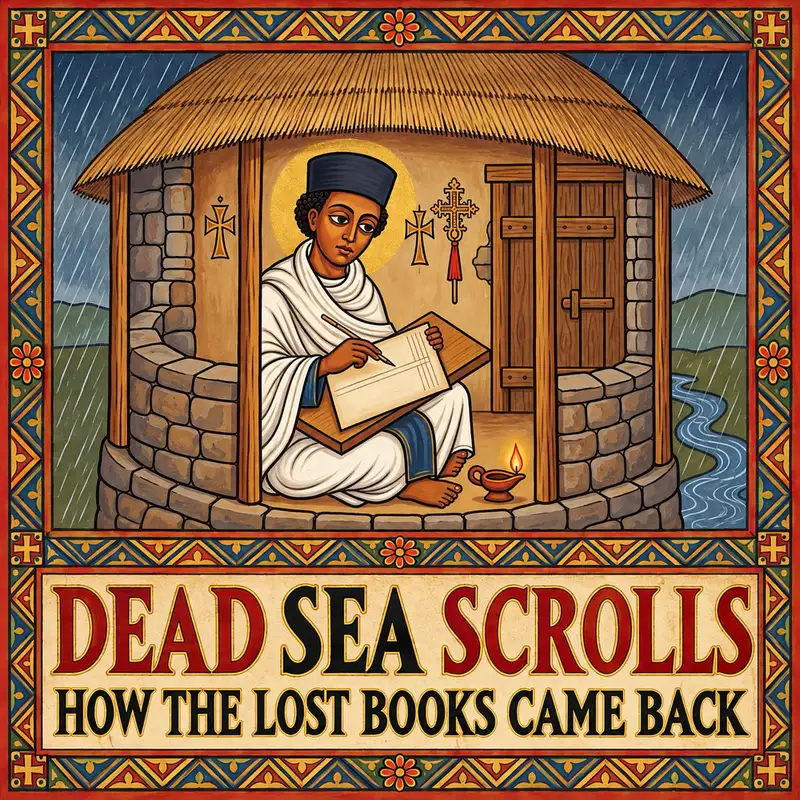
Welcome to The Sleeping Almanac. Tonight, how they came back. Last time we sat in a round church in the rain and took the books down off a shelf one at a time, the Book of Enoch and the angel with the tablet and the giants who dreamed and the gospel with no story in it, and I told you that in one country they were never lost at all. Tonight I want to tell you about the other countries. About a Scotsman who walked out of the mountains with three books in his luggage and was laughed at in London for everything else he said. About a shepherd, and a cliff, and a jar, and a smell of old leather in the dark. About a farmer in Egypt digging for something to put on his fields, and what his spade hit. About a room full of fragments the size of postage stamps, and a man with a magnifying glass who had the fastest hands in the world. And about a cave where, when the scraps were finally laid out and read, the oldest copy of the book on the copyist's knees turned out to say what he had been saying all along. Stay with me down to the fifth chapter for that. It is the thing the whole night is for. And then, when everything has been dug up and unrolled and read, I am going to tell you why the word we have been using for two nights is the wrong word, and I think you will already know by then. There is a church at the top of a hill, and inside it there is a lamp. If you were here last time, you know it. If you were not, you are welcome, and you have missed nothing you cannot be told in a breath. The church is round and its roof is thatch and it is raining on it, the long soft rain of the highlands, the same rain, and by the lamp there is a man in white with a board across his knees and a sheet of parchment on the board, and on the parchment, in two columns, in black ink and a little red, there is a book that he is copying. The book is the Book of Enoch. And the whole of last night was this: that the world says that book was lost, and this man has never heard that, because on this hill it never was. His teacher copied it, and his teacher's teacher, and the rain fell on all of them, and nobody was ever told to stop. That is where we left him. He has a new leaf on the board tonight. The old one dried, and it was good, and it is with the others now. He rules the new one with a blunt point, pressing the ghost lines into the skin, two columns, every line waiting, and he dips the reed. There is a place for you here, the same place, in the warm part of the room. The mat, the folded cloth, the whole night with nothing in it that you must carry. You do not have to do anything now. But tonight, before he begins, I want to ask him a question, and it is the question of the whole night. Last time I told you the book was never lost here. And that is true. But here is a small hill in a large world. What about everywhere else? The book he is copying is a translation. It was made, long ago, from a Greek book, which was made from a book in a language older still, called Aramaic, that was spoken all over the East before Christ was born. Where did those go? The Greek. The Aramaic. Every leaf of every copy, in every country that was not this one. Where were they, all those centuries, while this man's teachers were copying in the rain? They were somewhere. That is the thing. A book is not a thought. It is skin, or reed, or paper, and it is somewhere, or it is nowhere. And tonight I am going to tell you where. Let the rain be on the roof. Let the lamp be warm. Close your eyes if they want to close. If you drift, the copyist will go on without you, the way he did last night, and you will not have missed him. He will be here, on this hill, in this rain, for as long as any of this takes. And one thing, whispered like a promise. Nothing tonight will startle you. There are no angels falling in it. There is no house of fire. There is a cliff, and there is a hole in a cliff, and there is a great deal of dust, and men bending over tables. It is the quietest story this room has ever told, and I mean that as the highest thing I can say about it. You can trust this lamp. That is what it was lit for. The copyist lays the reed against the skin. Before he begins, one small thing, and then we will not interrupt again. If this story carries you down toward sleep, subscribe now, while your eyes are still open, and the next tale will be waiting for you when you need it. A like helps other tired travelers find this lamp. And if you would rather carry these nights with you, The Sleeping Almanac is also a free podcast, on Apple Podcasts and on Spotify, waiting wherever you listen. That is all. Now settle back, and let him begin. We begin.
The same lamp. The same honey coloured flame in the same clay dish. It has been filled again, because it burned out last night some time before morning, the way it always does, and nobody saw it happen, and in the morning the leaf was dry. He is three lines into the new page. His hand is steady tonight. The rain has been lighter today and heavier tonight, and he thinks, without thinking about it, that it will be heavier still by the time the lamp goes out, and he is right, and it does not matter. The shelf is where it was. The books are on it. I am not going to take them down tonight. We know what is on them. What I want you to look at instead, for a moment, is the one on his knees, and I want you to look at it the way you would look at a coin, turning it over. On the front is the book. Enoch, on the mountain, and the house of fire, and the gates of the sun. That was last night. On the back is a question. How did it get here? Because it was not written here. Nobody on this hill wrote the Book of Enoch. Nobody in this country did, in this language. It came from somewhere else, a very long way off, and it came in stages, the way water comes down a hill, from pool to pool. It was written first in Aramaic, in the land of Israel, two or three hundred years before Christ. Then somebody put it into Greek, because Greek was the language that everything travelled in then. And then somebody, here, or somewhere near here, a long time ago, took the Greek and put it into this, into Ge'ez, so that it could be read in this church. A translation of a translation. That is what is on his knees. The Aramaic is two steps behind it, and the Greek is one, and the man copying it has never seen a word of either, and neither had his teacher. When was the Ge'ez made? Nobody can tell you the year. What can be said is that it was made in the centuries when the kingdom in these mountains first became Christian, which is a very long time ago, fifteen or sixteen hundred years, when the whole of the Bible was being put into Ge'ez so that the new churches could read it, and the Book of Enoch was put into Ge'ez along with everything else, because to the people doing the translating it was part of everything else. Nobody made a separate decision about it. It came in with the rest, the way a guest's coat comes in with the guest. And once it was in, it was in. It was read, and copied, and read, in this language, in these mountains, from that century to this one, and the Greek it had been made from went on its own way, and the Aramaic behind that on its own, and the three of them never saw each other again until our own lifetime. Think of it as three brothers. One stayed home. Two went abroad and were not heard from. And tonight is about the two. So the question on the back of the coin is this. Those two older books, the Greek and the Aramaic, the ones behind the one he is copying. Where did they go? And the answer, for a very long time, was that nobody knew. In the West, in the countries that had left the book off their list, people knew that it had existed. They had Jude, quoting it. They had the old writers, arguing about it. They had, here and there, a few lines of the Greek, copied out by somebody as a curiosity, the way you might copy out a line of a song you half remember. And that was all. A book they had heard of and could not read. The most famous book that nobody had. For fourteen hundred years. I am going to walk you through those years tonight, and then out the other side of them, into a century in which, one after another, in a trunk, and a cliff, and a jar, the books came back. But the walk begins here, at this lamp, with the man who never noticed they were gone. He turns the leaf.
Let me tell you what it is like to have heard of a book and never seen it. You know the feeling, a little. There is a book you have heard about all your life, and you have never read it, and you have a picture of it in your head anyway, put together out of what people say about it, and one day you actually read it and it is nothing like the picture. Now make that fourteen hundred years long, and make it a whole civilisation, and make the book one that a letter in the Bible calls prophecy. That was Enoch, in the West. People knew it had existed. That was never in doubt. Jude had quoted it, and Jude was in every Bible in every church, and so every priest who could read had read, once a year at least, that Enoch the seventh from Adam had prophesied, and the words of the prophecy, and had known that those words came from somewhere. From a book. Which he did not have. The old writers had had it. The ones from the first few centuries, when the lists were still open. They quoted it, argued about it, defended it, doubted it. And their books survived, and were copied, and so the argument survived even after the book it was about had gone quiet. Imagine reading a long, careful review of a book that no longer exists. That is what a scholar in the year one thousand had. The greatest of the Western writers had it too, and said the thing that most of the West went on saying for a thousand years. Augustine, in North Africa, in the years when the lists were closing, wrote in his great book about the city of God that yes, Enoch had written things, and yes, the letter of Jude said so, and yes, there were writings going about under Enoch's name. And then he said that they had been left out, and not without reason, because they were so old that nobody could be sure any more which parts were his and which had been added, and that a book you cannot be sure of is a book you cannot build on. That is not a ban. It is a shrug. A very learned, very careful shrug, from the most careful man of his age, and it did more to close the door on Enoch in the West than any list, because after Augustine had shrugged, nobody else needed to think about it. It had been thought about. By him. And he had put it down. I tell you that so you will hear how the West lost the book, which was not by burning it. It was by deciding, reasonably, once, and then never picking it up again. Imagine, too, what that shrug sounds like from this hill, where the book was being read aloud that same century, in the rain, to people who had never heard of Augustine and would not have understood the problem. Tertullian saying it should be read. Somebody else saying it should not. The argument, complete, and the thing argued about, missing. And there were scraps. This is the strange part. Here and there, a monk or a chronicler had copied a few pages of the Greek into some other book, as a quotation, or a curiosity, or because it bore on something he was writing about. In the East, in the Greek speaking part of the old empire, a chronicler who was making a history of the world from the creation onward reached the part about the Watchers and the giants and copied in several pages of Enoch, in Greek, to tell it, the way a man building a wall will use whatever stones are lying about. And so those pages survived, inside his history, and people who read his history read them, and knew they were from Enoch, and could not read the rest. A few pages. Out of a book that was five books long. It was like having a handful of tiles from a floor. And I will tell you now, out of its place, because it belongs with the Greek and nowhere else tonight, that a little more of the Greek did come back, once, long after the years I am describing, and that it came back out of a grave. In Egypt, in the eighteen eighties, in a cemetery by a town on the river, somebody opened an old grave and found a small book in it, bound, in Greek, that had been buried with the dead man, and in it, along with a gospel nobody had seen and a vision of the end of the world, were the first thirty six chapters of Enoch. The mountain, the two hundred, the house of fire. In Greek. The middle brother, come back from abroad, with the grave dirt still on him. People say it was a monk's grave. Nobody knows that. What is known is that someone, sixteen hundred years ago, cared enough about that little book to be buried with it, and that the ground kept it, and that is the second time tonight I have said that about the ground and it will not be the last. That is the whole of what the West had of the Greek. A chronicler's borrowed pages and a book from a grave. It is more than nothing. It is very much less than a shelf. And the strangest thing of all is that the whole of it was here the entire time. Not hidden. Not lost. On a shelf. Being read aloud on Sundays, in the rain, in a language nobody in Europe could read, in a country almost nobody in Europe had been to. There were people in Europe who knew that. Travellers came back and said, the Christians in the mountains beyond Egypt have books we do not have, and Enoch is one of them. And that was received the way such things are received, which is to say, politely, and filed, and not believed very much, because travellers say a great many things. Fourteen hundred years. Not of a book being lost. Of a book being somewhere else. The copyist has stopped at the hard word again. There is one on every page. He looks at it in the old book, and then at the space for it on the new one, and then he writes it, slowly, and it is right.
There was a man called James Bruce, and he was very tall, and very red haired, and very sure of himself, and he went to Ethiopia. This was in the seventeen sixties and seventies. He was a Scot, a gentleman with an estate and an education and a restlessness that his estate could not use, and he went to Africa the way some men of that age went to Africa, to see what nobody he knew had seen. He went up the Nile. He got to the highlands. He lived there for some years, at the court of the king, in a city of round churches and stone castles on a plateau above a great lake, and he learned the languages, and this is the part that matters, because he learned Ge'ez. Not well, perhaps. Well enough. Well enough to know what a book was when he saw one, and to know which book it was, and to know that the one everyone in Europe talked about and nobody in Europe had was sitting on shelves in every church he walked into, in two columns, with the red in it, being read aloud on Sundays by people who had no idea it was famous. He was liked there, and not liked, and nearly killed more than once, and he was there for the better part of three years, and then he came home. And in his luggage, when he came home, there were three copies of the Book of Enoch. Three. In Ge'ez. On parchment, in two columns, with the red where the name of God is. Books like the one on the copyist's knees. He had had them made, or had been given them, or had bought them, the accounts differ, and I will not pick one. What is not in doubt is that he had them, and that he brought them out, over the mountains and down the river and across the sea, and that when he arrived in Europe in the year seventeen seventy three, three complete copies of the most famous book nobody had, arrived with him. One he gave to the king of France, for the great library in Paris. One he gave to the university at Oxford, to the library there. One he kept, at his own house in Scotland, and it found its way to a library too, in the end, after he was gone. And that was that. After fourteen hundred years, the book was in Europe, whole, three times over, on library shelves, where anyone could go and look at it. Almost nobody did. That is the part of the story I like best, and it is the part nobody tells. The books sat there. For decades. Because they were in Ge'ez, and there were perhaps a dozen men in the whole of Europe who could read Ge'ez, and they were busy with other things, and because, to be honest, nobody was quite sure the books were real. You see, nobody believed James Bruce. He came home and wrote five enormous volumes about his travels, and they were full of things that were true and sounded false. He said he had found the source of the Nile, which he had not, quite, but he had got close. He said the people of the highlands cut steaks from living cattle and ate the meat raw, which they did, and which London found so disgusting and so unlikely that it became a joke, and the joke stuck to him for the rest of his life. He said a great many things, and most of them were true, and London decided that a man who said that many surprising things must be making some of them up, and then decided that if he was making some up he was probably making most up, and that was the end of James Bruce as a witness to anything. He was a liar. Everybody knew it. And he had brought home three copies of a lost book, which was exactly the sort of thing a liar would do. So the books sat. I want you to see that. Three copies of the Book of Enoch, in two of the greatest libraries in the world, catalogued and shelved and available, and unread, for nearly fifty years, because the man who brought them had told the truth about too many other things. He died in seventeen ninety four. He fell down the stairs in his own house, a big heavy man by then, and that was the end of him, and the books were still on the shelves. And then, in the year eighteen twenty one, a man at Oxford whose name was Richard Laurence, who was a professor of Hebrew and could read Ge'ez, which almost nobody could, took one of the three books down, the one in the Oxford library, and sat with it, and read it, and put it into English. The first time. In over a thousand years, the first time anyone who read English could read the Book of Enoch. I want to be careful about that sentence, because it is easy to say wrongly. It was not the first time anyone in Europe had read it. There were the Greek scraps, and there were the dozen men who could read Ge'ez. It was the first time in English. But English was, by then, a language a great many people read, on two sides of an ocean, and so this was the moment the book stopped being a rumour, for most of the world, and became a thing you could hold. And what they found, when they held it, was stranger than the rumour. They had expected a prophecy, because Jude had called it that. What they got was the mountain, and the two hundred, and Azazel's list, and the house of fire and ice, and the gates of the sun, and a man asleep beside a river. Nothing in fourteen hundred years of hearing about it had prepared anyone for what it actually was, and I think that is always true of books that come back, and it is one of the reasons to want them to. Laurence was cautious. He did not claim more than he had. He said, here is the book, in English, from the manuscript at Oxford, and here is what I think it is and when I think it was written, and he was wrong about some of that and right about more, and it did not matter, because the thing was done. The book was out. And from that day it has never gone back in. Every English Enoch since, every one, every cheap paperback and every scholarly edition and every strange website, descends from a tall red haired Scotsman nobody believed, and a professor who read Ge'ez, and three books on a shelf in Oxford that sat unread for fifty years. The copyist, who has never heard of any of them, finishes his line.
Now leave the hill. Leave the rain. Go north, and a long way, out of the highlands and down through Egypt and across the top of the Red Sea and into a country of stone and salt. There is a sea there, if you can call it that, which is the lowest water on the surface of the earth, so far below the level of the ocean that the air itself is thick and heavy and warm, and nothing lives in the water, nothing at all, because it is so salt that a body floats in it like a cork, and the shore is white with what the water leaves behind when it dries. On the western side of that sea there are cliffs. Pale limestone, dry, cracked, full of caves, rising up from a narrow strip of flat ground along the shore, and above the cliffs there is desert, and nothing else, for miles. It was there, in the winter of nineteen forty seven, that a shepherd found the jars. I am going to tell you this very simply, because the story has been told a great many ways, by a great many people, some of whom were there and some of whom were not, and the versions do not agree with each other, and I am not going to choose one and tell it to you as if it were what happened. What is agreed is this. There were shepherds, of the people who have kept flocks in that country for as long as there have been flocks. One of them, a young man, was on the cliffs above the shore. There was a cave, high up, with a small opening. He went in, or threw a stone in, or went in after a stone, the accounts differ. And inside there were jars. Stop at the jars a moment, because the jars are the reason. Somebody, two thousand years ago, made a decision about those jars, and it is the only decision anybody on that terrace made that reached us. They did not simply leave the rolls in the cave. They put them in jars. Tall ones, made for the purpose, of the local clay, with lids that fitted, and they wrapped the rolls in linen first, and then put them in, and put the lids on, and stood the jars along the wall of the cave in the dark. A jar keeps out damp. A jar keeps out animals. A jar keeps out the small crawling things that eat leather, and the dust, and the light. It is the oldest way there is of keeping a thing, and it is the same thing a farmer in Egypt would find two years before this, a thousand miles away, with a spade, and I do not think the two sets of people ever heard of each other, and they did the same thing, because it is what you do with a book when you cannot take it with you and cannot bear to leave it in the open. You put it in a jar. Tall clay jars, taller than a man's knee, standing on the floor of the cave in the dark, with lids on them. Some were broken. Some were whole. And inside the whole ones, wrapped in linen, gone dark and stiff with age, were rolls. Rolls of leather, written on. He did not know what they were. Why would he? He took some, and left some, and went back to his people, and the rolls went from hand to hand, the way things do, to a dealer in a town, to another dealer, to a man who knew a man at a school, and slowly, over the next months, it began to be understood what they were. Let me tell you what the first of them looked like, because it is worth knowing. There were seven rolls, in the beginning, from that first cave. They were leather, sheets of it sewn end to end, and rolled tight, and wrapped in linen that had gone the colour of tea, and some of them were so brittle that they could not be unrolled without breaking, and some were in wonderful condition, and one of them, when it was finally opened, flat, on a table, went on for twenty four feet. Twenty four feet of Hebrew, in columns, in a good clear hand, without a break. It was the book of Isaiah. All of it. From the first word to the last. I will come back to that one before the night is over, because it is the quiet thing, and it is more important than anything I am going to tell you about Enoch, and almost nobody who tells this story stops to say so. The rolls went to a school in Jerusalem, and to a university, and to a museum, and scholars bent over them, and the word went out, and the word was, these are two thousand years old. And the word was not believed, at first, by everyone, because that is not how things are found. Things that old are found in pieces, in the ground, by men with trowels, over years. They are not found whole, in jars, by a shepherd. And yet. So they tested the linen. This was the very beginning of a new way of telling how old a thing is, by what is left in it of a certain kind of carbon that every living thing takes in while it lives and stops taking in when it dies, and which then fades, slowly, at a rate that does not change, so that a piece of cloth is a clock that started the year the flax was cut. The man who had worked out how to read that clock was given a scrap of the linen the rolls had been wrapped in, and he burned it, carefully, in a laboratory in Chicago, and measured what was left, and said, this cloth is about two thousand years old, give or take a couple of centuries. It was the first time the method had been used on anything that mattered so much, and it said what the scholars had said, and after that the doubting mostly stopped. A piece of cloth from a cave, turned to ash in a city on a lake half the world away, to prove that a shepherd had found what he had found. I want to say one more thing about the shepherd, and then let him go. His name is recorded. I am not going to say it, because it is not mine to make famous, and because he was a young man doing what young men who keep flocks in that country do, which is climb into holes in cliffs to see what is in them, and he was not looking for a library and did not know he had found one, and I think that is the right way for the oldest books in the world to be found, by someone who is not looking, and who goes home afterwards to his flock. They were books. Very old books. Books in Hebrew and in Aramaic, written by hand on leather, and rolled, and put in jars, and left in a cave in a cliff above the lowest sea on earth, two thousand years before, by people who had then gone away and never come back for them. That is the first jar. There were more caves. Many more. Over the next few years the cliffs were searched, cave by cave, by shepherds and by scholars and by everyone in between, and more caves had jars, and more jars had books, and some caves had no jars at all but had books anyway, in pieces, thousands of pieces, lying in the dust on the floor where the jars had rotted away from around them centuries before. And in one of those caves, the fourth one that was found, in the dust, there were pieces of the book on the copyist's knees. I will come to that. It is the next chapter, and it is the one I promised you. But I want to stop here for a moment, at the mouth of the first cave, in the winter of forty seven, with the jars still standing in the dark inside, and the young man outside on the ledge with the whole sea below him, white at the edges, and nobody in the world yet knowing what he had found. It is a good place to stop. It is very quiet there. The salt, and the heat coming up off the flat ground, and the small dark mouths of the caves along the cliff, one above another, and no sound at all but the wind, which has been blowing through those cliffs, in and out of those holes, for two thousand years without once disturbing a jar. It is one of the quietest places there is.
Cave Four was found a few years after the first one. Not by scholars. By the shepherds again, who by then knew what a cave with books in it was worth, and who had got very good at finding them. It was in the marl. Not the hard pale limestone of the first cave, but the soft crumbling stuff of the terrace below it, close to the ruins of a settlement, a huddle of stone walls and cisterns and a tower where, two thousand years before, somebody had lived, and worked, and copied, and eaten, and washed, and prayed, and kept books. The cave was just across a gully from the settlement, dug into the soft rock of the ridge on the far side, so close that the men digging the ruins could have looked up from their work and seen the mouth of it, and for a long time did, without knowing. And there were no jars. The jars had gone, or there had never been any. What there was, was the floor. And on the floor, in the dust, in the dark, were pieces. Many thousands of them. Fragments of leather and papyrus, some the size of a hand, most the size of a fingernail, dry, curled, brown, some with two words on them and some with two letters, from hundreds of different books, all mixed together on the floor of one cave, where they had lain since the year the settlement was abandoned and the people went away. It took decades to sort them. I want you to think about that. Not the finding. The sorting. Men at long tables, in a room with the windows shut against the wind, with a great many small brown pieces laid out on glass, moving them a quarter of an inch at a time, looking for the edge of a letter on one piece that might meet the edge of a letter on another. One of those men could do it faster than anyone alive, and people said so, and they said he had the fastest hands in the world, and I believe them. The man with the fast hands was a priest, and a scholar, from Poland, and he was given the pieces of Enoch to put together, and he did, over years, in that room with the windows shut, and when he had done it he published them, all of them, with photographs, in a big book from the press at Oxford, the same university that had had Bruce's Ge'ez copy sitting unread on a shelf a hundred and fifty years before. That was in nineteen seventy six. And I will tell you one small thing about that year and then let it go, because it belongs to another night. In the same year, nineteen seventy six, a very different book about very old tablets was published in America, and sold a great many copies, and told a very different story about where the gods came from, and you may have heard of it, and it is not our business tonight. Two books about the oldest stories in the world, in the same year. One of them was the Aramaic Enoch. That is all. And as the pieces came together, slowly, book by book, it became clear what the people in the settlement had had on their shelves. And among the things they had had, in the language it was first written in, in Aramaic, two thousand years old, older than any other copy of it anywhere on earth by a distance so great that you could put the whole of the Roman Empire inside it, was the Book of Enoch. Not all of it. Four of its five parts. The Watchers, and the mountain, and the two hundred. The sky book, with the gates of the sun. The dreams. The letter at the end. The one part that was not there was the part in the middle, the one about the Son of Man, and people have thought about that absence a great deal, and I will not, because an absence is only an absence. But four of five. In Aramaic. In pieces the size of a fingernail. On the floor of a cave under a ruin above a dead sea. And here is the thing I promised you, and it is the thing the whole of tonight has been walking toward. They laid the Aramaic beside the Ge'ez. The pieces from the cave, two thousand years old, in the first language, beside the book from the hill, the translation of a translation, copied by hand for a thousand years by men who had never seen a word of the original and did not know it still existed. The oldest and the newest. The first step and the last. And they read them against each other, line by line, where the pieces allowed it. And it was the same book. Not word for word. Nobody should ever tell you word for word about a copy of a copy of a copy. There were differences, the kind there always are, a phrase longer here, a name spelled otherwise there, a line dropped and a line added, the small drift of a thousand years of hands. But it was the same book. The mountain was the mountain. The house of fire was the house of fire. The gates were six, and the year was three hundred and sixty four days. Everything the man on the hill had been copying, in the rain, from his teacher, who had copied it from his, was there in the dust two thousand years before any of them, saying the same thing. Let me show you what faithful means, with one thing, so it is not a word. The roll of names. Last night I told you the book gives twenty names for the leaders of the two hundred, and that I would not read you the roll. The Ge'ez has the roll. Twenty names, in order, strange ones, in letters that look like small people standing straight. The Aramaic pieces from the cave have the roll too. The same twenty, in the same order, two thousand years older, in a different alphabet, on a scrap of leather you could cover with your hand. Some of the names had shifted a little in the mouth, the way names do when they cross three languages, a sound softened here, a letter dropped there. But twenty. In order. The same men. A list of angels' names, copied through two alphabets and a thousand years and fifteen hundred miles, and arriving intact. If you want to know what a copyist is for, that is what a copyist is for. And there were places, a few, where the Ge'ez had kept a line that the Greek had dropped along the way, and the Aramaic pieces showed that the Ge'ez was right and the Greek was wrong. The last brother, the one who stayed home, had in some places kept the family memory better than the one who went abroad. Nobody expected that. It is the kind of thing you only find out when the pieces are finally on the table. He was right. That is what the cave proved, in the end, more than anything else. Not that the book was real. Everybody knew it was real. That the copy was faithful. That a chain of men in a country nobody thought to look in, in a language used for nothing else, working by lamplight, one page a day, had carried this book across a thousand years and put it down at the far end almost exactly as they had picked it up. Nobody checked their work for a thousand years. Nobody could. There was nothing to check it against. And when at last there was, they had got it right. The copyist does not know any of this. He is on the fifth line of the new leaf. He has got the hard word right again. He does not look up. And there, I think, we can leave the tension of the night, such as it was. Everything from here on is downhill, and quiet, and dusk. The books are back. What is left is to look at them.
Stay at the cave a while. Not inside it. Outside, on the terrace, in the last of the light, with the settlement's walls behind you and the sea below. I told you last night that the sky book gave the year as three hundred and sixty four days, and that I would leave that number lying in the lamplight, and I am going to pick it up now for one paragraph and put it down again, because the people who lived on this terrace and kept these books believed it. They kept a year of three hundred and sixty four days. Fifty two weeks exactly, nothing left over, every feast on the same day of the week forever. And the great temple in Jerusalem, a day's walk to the west, did not. Jerusalem counted by the moon, and added a month when the moon fell behind, the way most of the world did. And so the people on this terrace and the people in the temple were, a great deal of the time, keeping the same feasts on different days. When it was the day of atonement here, it was an ordinary day there, and the other way about. Rarely, if ever, on the same day. I will not tell you tonight what that meant to them, or how much of why they were out here it explains, because I do not know and neither does anyone, and because it is a longer story than one paragraph, and it will keep. But look at the place. The terrace is marl, soft and pale, and it is dry, dry the way only a place beside a dead sea can be dry, and the walls of the settlement are low, and the cisterns are empty, and the tower is a stump. There is a long room where people sat at benches and wrote. You can stand in it. It is roofless now and the sky is very large above it and very empty, and if you stand there in the last of the light you can see, without turning your head, the whole of the sea, and the mountains on the far side going pink, and the cliffs behind you going gold, and the mouths of the caves in the cliffs, small and dark, one above another, like the holes in a flute. Who were they? I will tell you what is said, and how sure people are, because you deserve both. Most scholars think they were a community that a Jewish writer of the time, a soldier and historian called Josephus, described in his books, a people who lived apart, held their goods in common, bathed a great deal, ate together in silence, and kept their own calendar and their own rules with a seriousness that the rest of the country found strange. Most scholars think that. Not all. It is the best guess, and it fits the ruins, the baths cut into the rock, the long room, the rows of graves, the books, and the calendar. But nobody who lived here left a note saying who they were, and so I give it to you as what most people think, and no more. Look at the graves, before the light goes. There are hundreds of them, on the flat ground east of the walls, toward the sea, laid out in rows, each one marked with a low heap of stones, and every one of them runs the same way, the length of the body pointing north and south, row after row, like furrows. Nobody has ever been sure why they all face the same way. It was clearly a rule. It was clearly kept. And whoever kept it is under one of those heaps, and has been for two thousand years, in the dry, with the sea going pink and grey and dark beside them every evening, exactly as it is doing now. And look at the water. There is none, now, and there was very little then, and that is the thing about this place that you would not guess from the books. It rains here perhaps a few days in a year, and when it rains it comes all at once, down the gullies from the desert above in a brown flood that lasts an hour. So they caught it. They cut a channel in the rock, from the mouth of the gully above the settlement, along the cliff, down into the walls, and every drop that came down that gully in those few hours went along the channel and into the cisterns, and the cisterns were deep, and stepped, and plastered, and they held it, all year, in the dark, for the drinking and the cooking and the baths, which they took often, more often than anyone around them, for reasons that had to do with the books and the calendar and being sure. A whole community, in the driest place on earth, living on an hour of rain a year, caught in a ditch. It is the opposite of the hill. And the books came through both. And look at the long room. They found ink there. Inkwells, clay and bronze, in the rubble of the floor, and long low benches, or what was left of them, and most people think this is where the copying was done, that men sat here, at these benches, with reeds, and made the very rolls that went into the jars. A room for copying, two thousand years ago, a day's walk from Jerusalem. A room like the one on the hill. That is the third one tonight. They were here for a long time. A couple of centuries. They came out here on purpose, away from the city, to be with each other and their books and their calendar, and they wrote, and copied, and read aloud, and kept their feasts on the days they were sure were the right days, and buried their dead in rows, facing north, and then something happened, a war, and they put the books in jars and put the jars in the caves, some of them, and left the rest where they lay, and went, and did not come back. And the caves kept them. That is the second time tonight I have said that a place kept a book without meaning to, and it will not be the last. The hill kept it by copying. The cliff kept it by being dry. Neither was a plan. There is no plan in any of this, anywhere, and if you take one thing from tonight I would like it to be that. The books came back because a cliff was dry and a hill was wet and a Scotsman was stubborn. That is all. That is enough. The light goes off the far mountains. The sea goes grey, then the colour of pewter, then nothing.
Two years before the shepherd found the first cave, in another country, another man found another jar. I am going out of order to tell you this, and I want you to know that I know. The jar in the cliff was nineteen forty seven. This was December, nineteen forty five. It came first. I have told you the cliff first because it is the cave that had the copyist's book in it, and because that was the thing I promised you, and now that it is told, we can go back two years and a thousand miles and open the other one. Egypt. The upper part of it, far up the river, where the valley is narrow and the cliffs come close on either side and the fields between the river and the cliffs are thin and green and worked very hard. There was a farmer. He and his brothers had gone out to the foot of the cliff, where the ground is soft and full of old things, to dig for the kind of earth that farmers there dig for and spread on their fields, and one of them put his spade into the ground, and it hit something that was not earth. A jar. Red clay, sealed, about as high as a man's waist. He broke it. The accounts differ about how, and about whether he was afraid to, and about what he thought might be in it, and I am not going to give you any of them as fact. He broke it, and inside, not rolls this time, but books. Bound books, with covers of leather, thirteen of them, or twelve and the pieces of a thirteenth, written on papyrus in a language called Coptic, which is the old language of Egypt written in Greek letters, and which the church there still uses, the way the church on the hill still uses Ge'ez. He took them home. And some of them, it is said, went into the oven, as kindling, before anyone understood what they were. I tell you that because it is recorded, and because it is the closest anything comes tonight to a book being lost in the way people mean when they say lost, and it happened in a kitchen, by accident, to a few leaves. The rest survived. They went from hand to hand, the way the rolls from the cliff would two years later, and were understood, slowly. Slowly is the word. They were sold, and bought, and sold again, and one went abroad and had to be brought back, and for years they sat in a museum in Cairo, the museum of the old church of Egypt, where they still are, while a very few men were allowed to see them and everybody else waited. It was decades before the whole of what was in that jar was in print where anyone could read it. Decades. A book that had waited sixteen hundred years in the ground waited another thirty in a drawer, for reasons that had nothing to do with the book and everything to do with the people who had it, which is, I am afraid, the most ordinary thing in this story. They were the books from the jar. The one I showed you a page of last night. The gospel with no story in it. The garden seen from the other side. Twelve books like that, and many more inside them, because each bound book held several, fifty or so in all, most of them known before only as names in the lists of what the old writers had disapproved of. And here is the thing about this jar, and it is a different thing from the cliff. The cliff was abandoned. The people went away and the books were left. This jar was buried on purpose. Somebody dug a hole at the foot of a cliff in Upper Egypt, sixteen hundred years ago, and put thirteen books in a jar and sealed it and put it in the ground and covered it over and went away and did not tell anyone where it was. And the reason, as far as anyone can tell, and I say as far as anyone can tell because nobody wrote it down, was that letter. There were monasteries there. That is the thing to know about that stretch of the river. Some of the oldest in the world. The man who is usually called the father of the whole idea of monks living together in a house under a rule, rather than alone in caves, founded his first houses on that very stretch of the Nile, a little way from that cliff, a hundred years or so before the jar went into the ground. By the time of the jar there were several such houses within a walk of the place, with hundreds of monks in them, and a library in each, and a rule that said what they should read and when. The Easter letter. The one I told you about last night, from the bishop in Alexandria, with the list of twenty seven books in it, and the instruction that nobody was to read anything else. That letter went out to every church and every monastery in Egypt in the spring of the year three hundred and sixty seven. And there were monasteries near this cliff. Old ones. And they had books that were not on the list. And a monk, or several monks, in one of those houses, somewhere in the years after that letter arrived, looked at the shelf, and looked at the letter, and did not burn the books, which is what the letter meant, and did not hand them over, and instead took thirteen of them out to the foot of the cliff one night, in a jar, and put them in the ground. Not to save them for us. Nobody buries a jar for people sixteen hundred years off. To keep them. To not be the man who burned them. For the same reason, I think, that nobody on the hill ever threw a book away, which is that a book is a year of a man's life, and you do not put a year in a fire because a letter told you to. So there are two jars now. The one in the cliff, that was left. The one in the sand, that was hidden. And on the hill, the shelf, that was neither.
Come back up the hill. Into the rain. He is halfway down the first column. I want to put the three of them side by side now, because we have all three, and because it is the last thing I have to show you before the dusk. Three ways a book can come through sixteen hundred years. And none of them is what you would have guessed, and none of them is what the people who tell this story usually say, and I have come to think that the three of them together are the truest thing I know about how anything survives. The first way is to be left. That was the cliff. The people went away, and the books stayed where they were, in the jars and on the floor, and the reason they lasted was that the cliff was dry. That is all. No one guarded them. No one copied them. No one so much as remembered they were there. For two thousand years they were exactly as safe as the weather, and the weather in that place happens to be the driest on earth, and so they lasted. If it had rained there the way it rains here, there would be nothing. Not a fragment. The Book of Enoch in Aramaic would be a rumour forever, and the man on the hill would never have been proved right. It is a way of surviving that depends on nothing but luck, and it worked. The second way is to be hidden. That was the sand. Somebody chose. Somebody looked at a shelf and a letter and made a decision one night and carried a jar out to a cliff. That is the opposite of luck. It is the one place in the whole of tonight where a person did a thing on purpose to keep a book from being destroyed, and I have to tell you that it very nearly did not work either, because the jar was found by a man digging for fertiliser and some of it went into an oven. Hiding a thing is a bet that someone will find it and know what it is. It is a good bet, over sixteen hundred years. It is not a safe one. And the third way is the hill. The third way is not to hide the book and not to leave it, but to use it. To read it aloud every year and copy it every generation and wear the boards smooth with handling, so that it is never in a jar and never in a cave and never, for one day in a thousand years, out of somebody's hands. That is the way the book on the copyist's knees survived, and it is the only one of the three that involves nobody being lucky and nobody being brave. Just a great many people, one after another, in the rain, doing Tuesday. Think about what each of them looks like now, tonight, at this hour. The pieces from the cliff are in a building made for them, in the cool, in the dark, under glass, at a temperature that never changes and a dampness in the air that is measured every day and kept exactly where it must be, because if it rises the leather softens and if it falls the leather cracks, and people whose whole working lives are this are responsible for it, and nobody touches them without gloves, and nobody touches them at all if it can be avoided. That is what it costs to keep a thing that was kept by luck. Once the luck runs out, once the cave is opened and the dry is let out, it is care, forever, every day, or it is gone. The book on the hill has thumb marks on it. Wax on the boards, from candles. A page near the front that has been mended with a strip of skin and stitched, by somebody, a long time ago, because it tore. A smell. It has been in the rain. It has been carried in and out of this room a thousand Sundays. It has been dropped, probably. And it is fine. It will be fine for another thousand years, or as long as somebody keeps reading it, whichever is longer, and those are the same thing. Sand, and a lectern. A jar, and a shelf. A thing that is kept by being put away, and a thing that is kept by being taken out every Sunday. I know which one I would rather be. I know which one lasts longer, too, if you are asking, and it is the second, though it does not look it. The sand kept the Aramaic for two thousand years and gave it back as fragments the size of a fingernail. The lectern kept the Ge'ez for a thousand and gave it back whole, with the red still in it, being read aloud this coming Sunday to people standing on their staffs. One of those is a miracle of preservation. The other is just a book. He finishes the first column, and begins the second.
There is one more thing I have to tell you about the cliff, and I have saved it for here, in the dusk, because it is not exciting and it is the most important thing in the cave. Most of what came out of those caves was not lost books. I have been talking all night about Enoch and Jubilees and the giants, because those are the ones that were left off the list and those are the ones we are following, and it would be easy to leave you thinking that the caves above the dead sea were a library of forbidden books, a secret shelf, the things the bishops did not want you to read. They were not. About a quarter of the manuscripts were copies of books now in the Hebrew Bible. Among many kinds of writing. Genesis and Isaiah and the Psalms and Deuteronomy. Copies of familiar books in their ancient language, about a thousand years older than the medieval Hebrew copies scholars had relied on. Let me say that again, slowly, because it is the quiet thing and it goes past people. Before the caves, the oldest copies anyone had of the books of the Hebrew Bible were about a thousand years old. Good copies, careful copies, made by men who counted every letter, but a thousand years old. And here, in a cave, was a roll of the book of Isaiah, complete, from end to end, two thousand years old. A thousand years older than anything. And when they read it against the copies they had, it was the same book. Again. The same thing the cave said about Enoch, it said about Isaiah, and about all the rest. A thousand years of copying, and the men who did the copying had got it right. I told you about the roll of Isaiah, the one that went on for twenty four feet. Let me tell you what it was like to open it. It was in the first cave, in a jar, one of the seven, and it was in such good condition that it could be unrolled, which most of them could not, and so, on a table, in a room, sheet by sheet, somebody unrolled it, the whole prophet, two thousand years old, seventeen sheets of leather sewn end to end, fifty four columns of Hebrew, and read it. And the men who had the careful thousand year old copies, the ones where every letter had been counted, laid theirs beside it, and went through, line by line, the way they would later go through Enoch, and found what they found. The same book. A word here. A spelling there. The small drift. And underneath the drift, the same book, a thousand years further back than anyone had ever been able to see, saying what it had always said. And there was more than the books everybody had. There were books that people call the Apocrypha, the ones that sit between the two Testaments in some Bibles and are missing from others, Tobit, and the wisdom of Sirach, in the languages they were first written in, which nobody had had for a very long time. They were in the caves too. On the same floor. Not lost either, it turns out. And there was a roll of Psalms with the Psalms in a different order from the one you know, and with a few in it that are not in your book at all, which tells you that two thousand years ago the book of Psalms was still, a little, a collection, and not yet quite a book, and that somebody on that terrace had a slightly different one from the one that went to Jerusalem. One of the extra ones is about David as a boy. The youngest of his brothers, the one nobody thought of, out with the sheep, making himself a harp, and being sent for, and chosen. It is short and it is plain and it has been sung, somewhere, in some church, ever since, in Greek and in other tongues, as the hundred and fifty first psalm, and it was on that floor in Hebrew, two thousand years old, and it is not in most of the Bibles in the world, and it was never lost either. It was just in a jar. I find that lovelier than anything about Enoch, if I am honest. The Psalms, not finished. Still being gathered. So the lost books were a shelf. Inside a library. The library was the Bible, and the shelf was the books beside it, and the people on the terrace had kept both, together, in the same jars, without, as far as anyone can tell, making very much of a distinction. Enoch next to Isaiah. The giants next to the Psalms. On the same floor, in the same dust, for the same two thousand years. I think that is the truest picture of the whole thing that I can give you. Not a wall with the Bible on one side and the lost books on the other. A floor, with everything on it, in pieces, mixed, waiting to be sorted by a man with fast hands. The copyist is at the bottom of the second column. It is very late.
We have called them the lost books for two nights. I have used the word myself, more times than I meant to, because it is the word everyone uses and because it is a good word for a title. And now, at the end, with everything dug up and unrolled and laid on the glass and read, I am going to say the thing I have been walking toward since the first lamp was lit. They were never lost. Not one of them. Not for a day. The Book of Enoch was on a shelf in Ethiopia the whole time, being read aloud every year, in a church, in the rain. It was never lost. It was in a language most of the world could not read, in a country most of the world had not been to, and that is not the same thing as lost. That is the same thing as somewhere else. The Aramaic was on the floor of a cave the whole time. Two thousand years. It never went anywhere. Nobody carried it off, nobody burned it, nobody hid it. The people who owned it walked away and it stayed exactly where it was, in the dark, in the dry, until a shepherd went in. That is not lost either. That is left. And the books in the sand were put there by a man who knew exactly where they were, and who chose to put them there rather than see them destroyed, and who kept them by hiding them, which is a strange kind of keeping but it is keeping. He did not lose them. He knew where they were until the day he died, and after that the ground knew, and the ground does not forget. Nothing was lost. Things were somewhere else, or left, or hidden. And every one of those is a way of being kept. I want to be fair to the word, though, before I set it down, because there are lost books. Real ones. Books of which not one copy exists anywhere on earth, in any language, in any jar, and never will. We know they existed because somebody quoted a line of them, or listed them, or argued with them, and that is all we have. The argument, and not the book. There are gospels like that. There are histories like that. There are whole libraries that burned, in cities you have heard of, and what was in them we will never know. Those are the lost books. And nobody makes videos about them, because there is nothing to show, and nobody says they were hidden, because they were not, and nobody says they were suppressed, because they were simply, plainly, gone, the way most things are gone. The ones we have been talking about for two nights are not those. That is the whole point. The ones we have been talking about are the ones that are here. On a shelf. Under glass. In a case in Cairo. You can read them tonight, all of them, in your own language, and that is the opposite of lost, and the word we should have been using all along is found. Or, better, kept. I will say the other thing now, once, and then set it down, because it belongs to this chapter and nowhere else. There are readings of these books, now, in our own time, that make the two hundred on the mountain into visitors from somewhere far off, and the giants into what came of it, and that read the whole of last night as a record of something that arrived from the sky. I name that so you know I know it is there. It is a story of our own century, built on the names in these books, and the books are not that story, and the people who wrote them were not telling it, and the man on the hill has never heard of it. That is all I will say. Turn the volume down on it, and let the parchment speak. Here is what the parchment says, if you listen to the whole of it, both nights, all the way through. A man in a list did not die. Somebody went through the gap to see what was on the other side, and wrote it down. Somebody translated it. Somebody translated it again. Somebody carried it up into the mountains and somebody there copied it, and copied it, and copied it, in the rain, for a thousand years, while somewhere else a letter went out and a list was closed and a monk put a jar in the ground and a cliff stayed dry. And then a shepherd, and a farmer, and a tall man with red hair, and a professor, and a man with fast hands, and at the end of it, on a table under glass, the pieces from the dust laid next to the leaf from the hill, and they said the same thing. That is not a story about loss. It is a story about how much survives, and how strangely, and by how many hands. The copyist has finished the leaf. He lifts the board and looks at it in the lamplight, both columns, black and a little red, and it is good, and he sets it down on the floor beside him, face up, to dry.
Count them with me. Slowly. It is the kind of counting you can fall asleep in the middle of, and that is what it is for. A man, somewhere in the land of Israel, two or three hundred years before Christ, who read the list in Genesis and stopped at the seventh name, and wondered, and wrote. We do not know his name. We will never know it. He is the first hand. The men who wrote the other four parts, in other years, and the one who bound them all together as one book. We do not know their names either. The one who put it into Greek. So that it could travel. The ones who carried it. On roads, in bags, in the holds of ships, up rivers, a book going from one country to another the way a seed goes, on the wind, in the fur of animals, without anyone meaning it to. The one who put it into Ge'ez. On a hill, or in a valley, or in a city that is a ruin now, a long time ago, so that it could be read in the church. The copyist's own teacher. He does know that name. He says it, in fact, every night before he begins, under his breath, the way you might touch a doorframe, and he has never once in his life thought of it as anything but a habit. The old man is dead these many years. He is under a heap of stones on the slope below the church, facing the way they face here, and the rain is on him too tonight. He copied this book twice in his life. His hands shook toward the end and the last leaf he did is a little uneven, and it is in the book on the shelf, and nobody has ever taken it out. And then the copyists. Not one. Hundreds. Every generation for a thousand years, in the rain, a boy who learned his letters in sevens and spoiled his first leaf and got better, and copied the book once, or twice, in his life, and taught a boy, and died. Hundreds of them. Back and back. The man on the hill tonight is only the newest. The people on the terrace, who put a jar in a cave and walked away. The monk in Egypt, who would not burn a year. Jude, who quoted it. Tertullian, who argued for it. The chronicler in the East who copied a few pages into his history and saved them without knowing. The travellers who came back and said, they have books there that we do not have, and were not believed. The Scotsman. The professor at Oxford with his Ge'ez grammar. The shepherd on the cliff. The farmer with the spade. The dealers, the scholars, the man with the fastest hands in the world, bending over the glass. And the ones I have not named because there are too many. The people who made the parchment, on the hill, from the goat, and stretched it, and scraped it, for every one of those thousand years, without ever reading a word of what went onto it. The people who made the ink. The boys who ruled the leaves. The women who wove the linen the rolls were wrapped in, on the terrace, before they went into the jars. The potter who made the jars. The potter who made the other jar, in Egypt, the red one. The men who cut the marl to make the fourth cave. The photographers, in the fifties, who put every fragment under a lamp and made a picture of it so that it could be studied without being touched, and whose pictures are, in some cases, clearer now than the fragments themselves, because the fragments have faded and the pictures have not. The people who built the museum with the roof like a lid. The people who sweep it. Every one of them a hand. Every one of them holding it for a moment and passing it on. Most of them not knowing what it was. Most of them not caring. All of them, together, without a plan and without a meeting and without ever once agreeing to anything, the reason you can hear this tonight. And you. Tonight. Listening. Or not listening, because you have gone to sleep, which is allowed, and is in fact the point. You are the last hand, for now. Somebody will come after. That is the whole of it. A chain of people who mostly never met and mostly did not know what they were carrying and mostly wanted something else, passing a book along, hand to hand, for two thousand years, until it reached a lamp in a round church on a hill in the rain, and a man who has never once thought of it as anything but Tuesday. He is not thinking about any of that. He is looking at the wet leaf on the floor, to see that it is drying flat.
The rain, on the thatch. It is the end of the second night, and the copyist has done what he came to do, and he sits for a while with his hands in his lap, the way he did last night, the way he does every night, because it is a good thing to do at the end of a page. I want to show you three rooms before I go. Three rooms, tonight, at this hour, in three countries, and in each of them a book, and then I will let you sleep. The first room is this one. The round church, the thatch, the rain. The book is on the shelf, in its boards, dark with handling, the red inside it. On Sunday it will come down and be unwrapped and set on the stand and read from, aloud, in Ge'ez, to people standing on their staffs, and nobody will think anything of it. It is alive. That is the only word for it. It is a book that is still being used for what it was made for, by the people it was made for, and it is the only one of the three of which that is true. The second room is in Jerusalem. A museum, built for exactly this, with a roof shaped like the lid of one of the jars. Inside it, in the cool, in the dark, under glass, lit very low, are the rolls from the cliff. And somewhere in the building, in a drawer or a case, are the pieces. The Aramaic Enoch. Four of five parts, the size of fingernails, laid on glass in the order a man with fast hands put them in, decades ago. They are safe. They are looked after by people who know exactly what they are. Nobody reads them aloud. They are kept. The third room is in Cairo. A museum of the old church of Egypt, and in it, in a case, the books from the jar. Leather covers, papyrus, Coptic in Greek letters, the gospel with no story in it and the garden seen from the other side and the rest. Also safe. Also kept. Also, in a case, in the quiet, read by scholars and photographed and studied and not, any more, by anyone, read the way a book is read, for what it says. It is the same hour in all three. Or near enough. The rain on the thatch here. The hum of the cooling in the building in Jerusalem, which never stops, and which nobody hears any more. The traffic outside the museum in Cairo, far off, on the other side of thick walls. Three rooms in the dark with the lights low, three books in them, sixteen hundred years and more of being carried from one place to another, and all of it, tonight, still. Three rooms. One book alive, and two books kept. And I am not going to tell you that one is better than the others, because I think the world needs all three, and because it is late. I am only going to tell you that the one on the hill was never in a jar, and never in a cave, and never in a case, and never, for one Sunday in a thousand years, out of somebody's hands, and that of all the ways there are to come through sixteen hundred years, that is the one that does not look like a miracle, and is the one I would choose. The copyist stands. His knees are stiff. He goes to the door and stands in it and looks out at the rain, and the dark, and the shape of the juniper, and the cloud where the valleys are, and the air is cold and smells of wet thatch and old incense, and somewhere a long way down the hill one dog, once, and then the rain closes over it. Then he comes back in, and does not put out the lamp. He never does. It will burn a while, and go out on its own some time before morning, and nobody will see it happen, and the room will be dark, and the books will go on standing on their shelf in the dark exactly as they were, which is what they are for. Let the room be as it is. Let the rain go on. It has been going on under everything I have told you, both nights, and you may not have noticed it for a long while, and that is exactly right. It was never asking for your attention. It was only there. The way it was there for the copyist, and for his teacher, and for every one of them, back and back, and the way the dry was there for the cliff, and the ground was there for the jar. Nobody asked any of them to keep anything. They kept it anyway. In the morning somebody will open the door, and the light will come in across the floor, and the leaf will be dry. He will pick it up and hold it to the door, and look down the columns, and if it is good, and it will be, he will lay it with the others in the wooden box where the finished leaves wait. There are a great many of them in there now. Not a book yet. A book is a long way off. But the box is heavier than it was, and one day it will be heavy enough, and somebody will sew the leaves and bind them between boards and put the boards on the shelf, and there will be one more copy in the world of a book that was never lost, and nobody will write down the day it happened, because on this hill it is not the kind of thing you write down. And the books will be where they were left. But that is the morning, and the morning can wait. Sleep well. Goodnight.