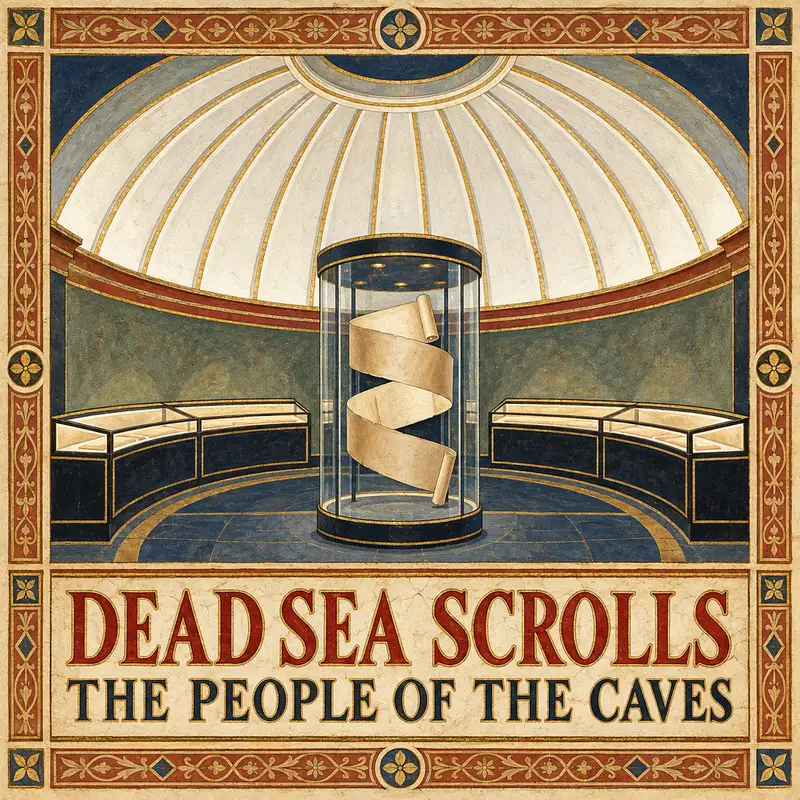
Welcome to The Sleeping Almanac. Tonight, the people. Not the caves. You have had the caves, the shepherd on the ledge, the jars along the wall in the dark, the floor of the fourth cave covered in pieces the size of a fingernail, the man with the fastest hands in the world bending over the glass. All of that is behind us and I am not going to tell it again. Tonight is about the ones who put the jars there. Who they were, or who most people think they were. What they ate, and when they washed, and what they did when one of them laughed at the wrong moment, and what they read aloud at night while the others kept awake to listen. Because the thing the shepherd found in the cliff was not only a library. It was a rule book. Several. Linked by many scholars with the people who lived on the terrace below the cliff, and it is an unusually detailed account of how a small group of people two thousand years ago decided to live, down to the hour of the day and the number of days you would be punished for falling asleep in a meeting. There is a scroll made of copper on which somebody engraved a list of buried treasure whose hoards have not been securely identified. There is a scroll longer than any other, that a dealer kept hidden under a floor for years. There is a book that was found twice, half a century apart, in two countries, in two very different keeping places, and turned out to be the same book. There is a war that was never fought, written down as a set of instructions for the trumpets. And there is a machine, built only a year or so before I tell you this, that was taught to read their handwriting, and the people who built it named it Enoch. Tonight we are not in the round church. Not yet. We will be there before morning, and the copyist will be where he always is, and the rain will be on the thatch. But we begin somewhere else, in a room I showed you once, briefly, at the end of a night, and left too soon. There is a museum in Jerusalem, and its roof is shaped like the lid of a jar. It was built for the rolls from the cliff, under a white roof shaped like a jar lid. Let us make a quiet room beneath that shape tonight. Low light. Cool air. A hum under everything. I picture a round display at the centre, recalling the long roll of Isaiah, and cases nearby where other pieces can be looked after. This is our imagined walk among the witnesses, rather than an inventory of what happens to be displayed on one particular evening. What matters here is the care. A building made to hold writing that once waited in the dark, and a place where we can sit near it for a while. It is night. The museum is closed. There is a guard somewhere, and the hum, and that is all. There is a place for you here, on a bench against the wall, in the cool. It is not a room anyone sleeps in. But it is very quiet, and very dark, and nothing in it has moved for two thousand years, and if you sit still for a while you will find that it is the kind of quiet you can rest in, the quiet of things that are being looked after. You do not have to do anything now. Let the hum be the rain, tonight. It does the same work. Let the cool of the room be on one side of you and the dark on the other. Close your eyes if they want to close. This story does not need to be watched. It only needs to be near you, the way the cases are near you, holding what they hold without asking anything of you. You do not have to follow every word. You do not have to remember any of it in the morning. If you drift, the rolls will go on being kept without you, which is what they are for. And one thing, whispered, as always. Nothing in this story will ever startle you. There is a war in it, and tonight we will hear its banners and its prayers. There is punishment in it, and it is measured in days, and the penalties include being set apart from the community's purity for a while. There is nothing in the caves that is louder than the hum. You can trust this room. That is what it was built for. Before we begin, one small thing, and then we will not interrupt again. If this story carries you down toward sleep, subscribe now, while your eyes are still open, and the next night will be waiting for you when you need it. A like helps other tired travelers find this lamp. And if you would rather carry these nights with you, The Sleeping Almanac is also a free podcast, on Apple Podcasts and on Spotify, waiting wherever you listen. That is all. Now settle back, in the cool, and let us begin. We begin.
Start with what a scroll is, in this room, because it is not quite what a book is on the hill, and the difference matters tonight. A book on the hill is leaves, folded, gathered, sewn, boarded. A scroll is a road. Sheets of leather, each about as tall as your forearm is long, scraped thin and pale, and sewn to one another edge to edge with thread made of sinew or of flax, so that they make one long strip, and the strip is rolled on itself from one end, and you read it by unrolling from one side and rolling up on the other, so that the place you are reading is always the one flat stretch between two rolls, and the rest of the book is behind you and ahead of you, curled. A road, with the place where you stand. They ruled it, before they wrote on it. I want you to know that. With a dry point, along a straightedge, faint lines pressed into the skin that you cannot see unless you tilt it to the light, and then you see the whole column laid out in ghost lines, exactly as the copyist did on his hill, in his rain, with his blunt point, the last time you sat with him. Two thousand years and fifteen hundred miles between them and it is the same movement of the same wrist. Much of the black ink was carbon based, and its writing can still be read. The columns are narrow and tall and the hand, in the good scrolls, is very even, the letters hung from the ruled line like washing from a rope, the way that alphabet is written, from the top down rather than from the bottom up. And there is one thing about the writing that I want you to have, because it is the cousin of a thing you know. In some of the rolls, when the scribe came to the name of God, the four letters of it, he did not write them in the hand he was using. He changed. He wrote those four letters in an older form of the script, the letters used in the time of the first temple, so that the name stood on the page in a different alphabet from everything around it, older, set apart, the way a red word stands in a black column on the hill. Some scrolls do this and some do not, and nobody agrees about why, and I do not need to know why. Two rooms, two thousand years apart, and in both of them a man with a reed slowed down at the same word and did something different with his hand. Some of the rolls were wrapped in linen. Plain cloth, folded round the leather, and tied, and put in the jars. Some of the linen survived. It is in a case in this room, gone the colour of tea, and you would walk past it, and it is the reason anyone believed any of this, because it was a piece of that cloth that was burned in Chicago to prove the date. The cloth is the witness. The rolls are the thing it witnesses to. There were eleven caves, in the end. Eleven caves in the cliffs and in the soft marl of the terrace, found over about ten years, some by shepherds and some by scholars, some with jars and some with only a floor. And between them they held, in whole rolls and in pieces, more than nine hundred manuscripts. About two hundred and thirty were copies of books that are now in the Hebrew Bible. Roughly a quarter of the collection. Genesis and Isaiah and the Psalms, beside many other kinds of writing. Rules for a community. Hymns. Visions. Books that had been lost. Other books had remained in use outside the caves. The writings came from more than one group, and we cannot put every hand that copied them on that one terrace. But the pieces stayed in the caves and waited, and at last they were laid on glass, and the words could be read again. Those are the books for tonight. The voices this collection kept for us. Here is what I want you to keep in mind about them, before we take the first one down, and it is the thing that is hardest to hold onto in a room like this one, where everything is in a case. These were not treasures. They were not made to be kept. They were made to be used. A rule book is a thing you take down every day and open to the page you need. A hymn is a thing you sing. A list of buried treasure is a thing you dig with. The cases in this room, with their low light and their hum, are keeping things that were never meant to be still, and I think the rolls know it, in whatever way a roll can know anything, and I think that is why the room feels the way it does at night. Like a house where everyone has gone quiet because a guest is asleep. The first one I want to show you is not leather at all.
It is not in this room. Of all the great rolls from the cliff it is the one that is kept in another country, across the river, in Amman, in a museum of its own, because the cave was under Jordanian control when it was found, and the scroll later entered the collections in Amman. I am going to bring it into this room for you anyway, for one chapter, because it belongs with the others tonight and because in the dark a case is a case. Picture it by itself, and it does not look like the others, and the first time you see it you do not know what you are looking at. It looks like two long strips of something dark green and brittle, broken into segments, with a texture like the bark of a tree. It is metal. It is copper, thin sheet copper, and it was found in one of the caves, not in a jar, lying against the wall, rolled up tight the way a scroll is rolled, in two pieces, and when the people who found it tried to unroll it, it would not unroll. Two thousand years in the cave had turned it to something between metal and rust, and it broke if you touched it, and it stayed rolled. So they could not read it. Not for years. They could see that there was writing on it, because whoever made it had punched the letters into the copper with a chisel, so that they went in on the writing side and stood out on the back, and the sheet had been rolled with the writing inside, so the backs of the letters showed on the outside of the roll as raised shapes, and a few words were read that way, from the outside, before anyone found a way in. But you could not open it. And a scroll you cannot open is the most exasperating thing in the world to the kind of person who spends his life opening things. In the end, in England, in the fifties, somebody worked out how to cut it. Not unroll it. Cut it. They coated the outside of the roll in something to hold it together, and mounted it on a spindle, and with a very fine saw they cut it into strips, one strip at a time, each strip curved like a piece of pipe, and lifted each one away, and laid it down, and read the letters on the inside of the curve. Twenty three strips, or thereabouts, for the two rolls. It took the best part of a year. And when it was done, they had the whole text, and they read it, and it was a list. Not a psalm. Not a rule. Not a story. A list. Sixty four items, and every one of them the same shape. In such and such a place, so many steps from such and such a thing, at such and such a depth, there is buried this much silver, or this much gold, or so many vessels. Sixty four hiding places, spread through a landscape of old landmarks, described in the plainest terms by somebody who plainly expected the reader to know where the landmarks were, because the landmarks are given the way you would give them to a neighbour. The cistern under the steps. The cave by the spring. Under the tomb of so and so. Dig down three cubits. And the sums, if you add them up, come to more gold and silver than anyone can easily believe was ever in one place at one time in that country, by a distance. I want to be very careful here, because this is the kind of thing that people get excited about, and the caves have had enough excitement. No hoard has been securely identified as the treasure on this list. People have looked, and not only the kind of people you are imagining, serious people too, with the strips in one hand and a map in the other, and nothing has ever come up. Some scholars think it was real, a record of a real treasure hidden from a real army as a real war came down the road, and that it is all still there, or was all dug up long ago by someone who never told. Some think the sums are too large for that, and that it is something else, a kind of story, a treasure list of the sort that turns up in other old writings, a thing to be read rather than followed. And some think the truth is in between, and that nobody will ever know, because the one thing a treasure list cannot tell you is whether the treasure was ever there. There is one more thing about it that I like, and it is small. The letters do not look like the easy work of a hand accustomed to writing on leather. The letters are clumsy. They may be the work of somebody unused to this material, which fought the hand at every stroke, and there are mistakes in it, letters left out, letters put in twice, the kind of mistakes you make when every letter costs you a blow of the hammer and you cannot go back. And at the end of the list, the last item, it says that there is a copy of this very document, with the explanation, and the measurements, and the details of every item, hidden in a certain place. A second list, that explains the first. Nobody has found that either. So the copper scroll ends by telling you that the key to it is buried, and says where in exactly the way it says everything else, so many steps from a thing nobody can find, and that is either the oldest joke in the room or the saddest sentence in it, and I have never decided which. Here is what I think you should keep. Not the gold. The copper. Somebody, two thousand years ago, chose a material very different from the leather of the other rolls, and hammered a list into it, letter by letter, with a chisel, which is slow and hard and hurts the hands, and rolled it up, and put it in a cave. Whatever the list was, they wanted it to last. And it did. It lasted so well that it could not be opened. That is the whole story of the copper scroll. It is an inventory that nobody has cashed, kept in a case in the dark in another city, in twenty three curved strips, with the letters still standing up on it like the raised pattern on an old coin, and I would rather have that than the gold. The next one is leather again. And it is the longest thing in the room.
You would not know it was the longest. It lies in its case unrolled to one stretch, like all the others, and the rest of it is off to either side, curled, in the dark. But if you took it out and laid it flat on the floor of this room, it would go from one wall to the other and back again, and then some. It is longer than the roll of Isaiah. It is the longest scroll that came out of the cliff, by a good way, and it is the only one of the great ones that was not found by a scholar or handed over by a shepherd. It was kept. A dealer had it. For years. Somebody had brought it out of one of the caves, and it had gone the way the rolls went, from hand to hand, to a man in a town who bought and sold such things, and he knew what he had, or knew enough, and he did not sell it. He hid it. Under a floor, the story goes, wrapped up, in a box, in his house, and he kept it there through a great deal of trouble in that country, and it suffered for it. Leather does not like floors. When it finally came into the hands of people who could open it, after a war, the outer turns of it had gone to nothing, and the first sheets are lost, and what is left is still longer than anything else. And what is on it is a voice. The voice is God's. That is the first thing to know about it. Other books in the caves carry divine speech too, but this scroll does something especially sustained with it. It rewrites much of the law as God's own address. In the first person. I, to you. As if the reader were Moses, on the mountain, and the whole of the law were being given again, straight, with no one in between. And the law it gives is the law of a temple. Not the temple in Jerusalem. That temple was standing, a day's walk to the west, when this was written, and the people on the terrace, most scholars think, did not go to it, for reasons that had to do with the calendar and the priests and being sure. This scroll describes another temple. A larger one. Square, with courts inside courts, three of them, one inside the next, with gates named for the twelve tribes and the whole city laid out around it in rings of holiness, so that the further you walked toward the middle the cleaner you had to be, and the middle was the one place on earth where God had said he would put his name. It gives the measurements. Of course it does. Every court, every gate, every chamber, in cubits, patiently, the way the sky book gave you the gates of the sun. And it gives the feasts. Not only the ones you know from the Bible. Others, that are not in your book at all, a feast of new wine, and a feast of new oil in a sequence of seven week counts, with a wood offering festival too, in a year of three hundred and sixty four days, which I have told you about and will tell you about again, another night, and not tonight. There is a king in it too, near the end, and I will give you him because he is the most human thing in the roll. The scroll lays down a law for the king, when there is one. He is to have a guard of twelve thousand men, a thousand from each tribe, chosen, who never leave him day or night, so that he is never taken by a foreign people. He is not to multiply horses. He is not to multiply wives. He is to have one wife, from his father's house, and no other while she lives. He is not to go to war on his own judgment but must ask the priest, who asks the oracle, and only then. And he is to have a council of thirty six, twelve princes and twelve priests and twelve Levites, who sit with him always, and he is to do nothing without them. Somebody in the world behind this scroll wrote down exactly how a king should be held to the law, and the scroll is quite calm about it, and so, tonight, am I. It is a temple that was never built. There is no stone of it anywhere. It exists only in cubits, on leather, in a voice that says I, and the people who kept it on the terrace knew that it had not been built and, some scholars think, believed that it would be, one day, when the ones who ran the real temple had been put out of it. That is a great deal to believe, and they believed it in a dry place, a long way from anything, with very little rain. I will tell you the thing I find most moving about it, and then we will go to the people. It is written as Torah. As the law. Where the Bible says, and the Lord said to Moses, this scroll drops the and the Lord said, and just says the thing, in the first person, so that it reads as though it were older than the Bible and the Bible were the report of it. Somebody, on that terrace or on the road to it, two thousand years ago, sat down with a reed and wrote a book of the law in God's own voice, longer than Isaiah, about a building that did not exist, and rolled it up, and I do not know whether to call that faith or nerve, and I am not going to decide tonight. That is the room. The lid over it, the drum in the middle with Isaiah going round, the copper that I borrowed for you from across the river, the longest roll off to the side in the dark. Now I want to take you out of the cases altogether, and down onto the terrace, and into a day. Because the rule book is in this room too, and it is not a temple that was never built. It is a day we can reconstruct from the rules and an ancient account.
The rule book is a roll of leather about as long as a man is tall, in a small even hand, in Hebrew, and it was in the first cave, in a jar, with Isaiah. It is called, by the people who study it, the Community Rule, or the Rule of the Community, and the word the people on the terrace used for themselves, in it, is a word that means, more or less, the Together. The Union. The Yahad. Say it once, slowly. Yahad. It is the word they chose, and it is the whole of what they were trying to be. I am going to give you one day. Not the theory. The day. Put together from the rule itself and from the one outsider who wrote about them, whom you will meet before the night is over. They rise before the sun. Before it is up they do not speak of ordinary things at all. They say the prayers that were handed down to them, facing the light that is coming, and the ancient account describes their prayers as if they were asking for the sun to rise, and perhaps he was wrong about that, and perhaps not. Then they go out to work. Each to his own. The terrace had fields, a little way off where there was water, and date palms, and a pottery, and the room sometimes interpreted as a place where scrolls were copied, and each man went to what he was set to and worked at it, in the heat, until the middle of the morning. Then the bath. They washed, in cold water, in the stepped cisterns cut into the marl and plastered, that I showed you at dusk on the second night. All of them, before eating. And then, in white, they went in together to eat. The meal is the centre of the day, and the rule is very exact about it. They sit in order. There is an order to everything here, and the order at the table is the order of the whole community, the priests first, and then the rest by rank, and each man knows his place and takes it. When the bread and the new wine are set out, no one touches them. The priest stretches out his hand first and blesses the first of the bread and the first of the wine, and only then do the others eat. In silence, mostly. The ancient writer says the silence at their meals seemed to people outside like some tremendous mystery. I have always liked that line. I picture someone standing at a door hearing nothing and not knowing what to make of it. Then work again, until evening. Then supper, the same way. And then the night. Here is the thing in the rule that I brought you here for. The rule says that where there are ten of them together, there must never be lacking among them a man who studies the law, day and night, continually, each taking his turn. And it says that the Many, which is what they called the whole gathering of the full members, shall keep watch together for a third of all the nights of the year, to read the book, and to study the judgment, and to bless together. A third of every night, as the line is often read. Awake, together, in the long room or somewhere like it, by lamps, with one man reading aloud from a scroll and the others listening. Not for a feast. Not for an emergency. As the rule. That is the duty the rule sets for their nights. And I tell you that in this room, with the hum, at this hour, because you are doing something like it now, and because it means that the rule preserves a picture of lamps and reading and men keeping awake together. We cannot watch every night on that terrace, or say which scroll was opened on each one. But we can hear the duty the rule set them. They were not a library. They were the night watch. And in the day, in the assembly, when a question was put, they spoke in turn. By rank. And nobody spoke before his turn, and nobody interrupted, and the rule says so, and then the rule says what happened if you did, and this is the part I promised you at the door. There is a list of punishments, and it is the most human page in the whole of the caves, because it is a list of the things people actually do. If a man interrupts another while he is speaking, ten days. If he speaks foolishly, three months. If he laughs foolishly, so that his voice is heard, thirty days. If he falls asleep in the assembly of the Many, thirty days. If he spits in the assembly, thirty days. If he goes out three times in one sitting without leave, ten days. If he gestures with his left hand, ten days. If he walks naked before his fellow when he need not, six months. And the punishment, for most of these, is not a beating and it is not the door. It is that for those days he is set apart from the purity of the Many. The rule does not explain every penalty in the same detail. In one place exclusion from the pure food goes with losing a quarter of a man's bread, and the shorter penalties may have meant a ration cut. Thirty days of penalty, for falling asleep in the meeting. I would have drawn a great many days of penalty, on that terrace. So would you. I think that is the point of telling you. These were not saints. They were men who fell asleep in the assembly and laughed at the wrong moment and spat, and wrote it all down, and measured it in days, and went back to the table when the days were over. And admission came by stages. If a man wanted to join, he was examined and taught the rule, and then waited a year. At the end of that year the Many considered him again. Admission to the pure food came after the first year, and admission to the drink of the Many after the second. His property was kept apart while he waited, before it was joined to theirs. Food, drink, counsel, possessions. Each had its place in the rule. It is on the leather, and the leather was in the first cave with Isaiah, and now it is in a case in this room in the dark, and it says, still, thirty days for falling asleep, to nobody, forever.
Turn the rule further in. Past the punishments and the table and the two years. There is a page near the beginning that is not about how to live at all. It is about why. And it is the page that makes the people of the caves who they are, more than any other, and I am going to give it to you gently, because it is not a gentle idea, but it is a very quiet one. The rule says that God made man to rule the world, and that he set within him two spirits, to walk in them until the time of his visitation. Two. The spirit of truth and the spirit of falsehood. Light and darkness. And it says that the one is under the hand of the Prince of Lights, and that all the children of righteousness walk in his ways, and the other is under the hand of the Angel of Darkness, and all the children of falsehood walk in his. And then it says the thing that keeps it from being simple. It says that the Angel of Darkness leads the children of righteousness astray too, and that all their sin and their guilt and their trouble are under his hand, and that this goes on, according to the mysteries of God, until the end. And that the two spirits are in every man. Both of them. In portions. And that a man's place in the world, his rank, his lot, is the measure of how much of each he has in him. Two spirits in one heart. Not a good man and a bad man, sorted into rooms. One man, with both in him, walking, until the time. And the whole of the rule, the washing and the ranks and the thirty days, is what it looks like when people who believe that try to live in a way that gives the one spirit more room than the other, day by day, in a dry place, with each other. The rule says who is to teach this. There is a man it calls the Instructor, the wise one, and it is his task to teach the sons of light about the nature of all the children of men, according to the spirits in them, and their deeds in their generations, and their visitation, and it gives him what to say. It gives the ways of the spirit of truth, and they are a list, and it is a gentle list: humility, and patience, and abundant mercy, and eternal goodness, and understanding, and a spirit of knowledge in every plan, and zeal for right judgment, and a holy intent with a steady mind, and abundant love for all the sons of truth, and a purity that turns away from every unclean thing, and walking humbly, and a discreet tongue. That is the one spirit. Then it gives the other, and I will not give you that list, because you know what is on it, and it is late, and the rule itself does not dwell there. It says what comes of each, in the end, and moves on. And every year, the rule says, they were examined. Every man. His spirit and his deeds, once a year, by the whole community, and moved up in rank according to his understanding and the perfection of his way, or moved down for his failings. Every man's place at the table, every man's turn to speak, decided each year by the others looking at him and saying how much of the light they saw. Nobody kept his place by having had it. That is a hard way to live, and it is the life this rule asks for, and I think it is why the rule bothered to measure the punishments in days. If your place could rise and fall, the days had to be counted. And there is a word the rule uses for a man's share of the two spirits, and it is the word for a lot, the kind you draw. The lot of light. The lot of darkness. As if the portion had been drawn for you before you were born, and your life was the finding out. The rule believes that, and it also believes that you must wash before you eat, and it does not think those two things are in any tension, and I am not going to put them in one for you at this hour. I am not going to tell you what to think about it. This is what the text says. It is not a thing anyone can check. It is a page in a rule book that some men in the desert wrote for themselves, and they believed it, and it explains nearly everything else they did, and I give it to you as a page and nothing more. But I will tell you what it does to the room, at night, if you sit with it. It makes the cases feel less like a museum and more like the inside of somebody's head. Because that is what they are. The rule is a mind, written down. Two spirits, and the ranks, and the third of the night, and the bread. And when the people went away, the mind stayed in the jar, and now it is here, in the low light, still thinking, in a way, still saying the same things about light and darkness to an empty room, and I do not find that frightening. I find it rather lonely, and I am glad we came. There is one more thing in the rule that I want you to have before we leave it, because it will come back at the end of the night. The rule says that the ones who keep it will be, in the last days, a house of holiness for Israel, and it uses the picture of a building. A wall, tried and true, a precious cornerstone, whose foundations will not shake. People as stones. A house made of the ones who kept the rule. You have heard that picture before, on an earlier night, from another country and another century, told by a man in Rome who saw a tower. I only want you to notice that it was here first, on the terrace, and that we have no evidence that the people who imagined the tower and the people who imagined the wall ever met, yet they drew a similar picture.
Leave the terrace for a moment. Go south and west again, into Egypt, but not to the sand this time. To a city. To the old part of Cairo, and a synagogue, an old one, with a room in it that has no door. It is a storeroom. High up in the wall, reached by a ladder, a chamber where for centuries the people of that synagogue had put the writings they could not throw away. Not the books they used. The worn out ones. The torn ones. Letters, contracts, prayers, children's exercises, a page from this and a page from that, anything with the name of God on it, because you do not throw the name of God on a rubbish heap, and so you put it in the room, and the room fills up, over centuries, with paper and parchment, in layers, in the dark, in the dry Egyptian air, and nobody reads any of it, because it was never meant to be read again. It was meant to be kept until it fell apart, respectfully, on its own. You know that idea. You met it once before, in Egypt, at the other jar. You do not burn a year. This is the same idea in another city, and it kept a great deal. A scholar from Cambridge got into that room in the last years of the eighteen hundreds, with permission, and came out with a great many sacks of it, and spent years going through it, and among the thousands of pieces he found two copies of a book nobody had ever seen. Two copies, of the tenth and twelfth centuries or thereabouts, both incomplete, in Hebrew, of a book that described a group of people who had left the land, gone out, the book said, to a place it called Damascus, made a new covenant there, and lived under a rule, with a teacher over them, whom it called the Teacher of Righteousness, and an enemy, whom it called by other names, and I will come to that. He published it. And people read it, and did not know what to make of it. A rule for a group nobody had heard of, in a place that might or might not be Damascus, from a time nobody could fix, found in a storeroom in Cairo in a copy a thousand years younger than whatever it copied. It was a puzzle. It sat in the scholarship, as puzzles do, for forty years. And then the shepherd went into the cliff. And among the pieces on the floor of the caves, in more than one cave, in hands two thousand years old, was the same book. The book from the storeroom. An older witness to it. The same work, preserved in ancient fragments and in medieval copies. Between them lie centuries of copying whose full path we do not know. At some point the medieval leaves reached the storeroom in Egypt, and there they stayed. The same book, found twice. Once in a room that was built to hold what could not be thrown away, and once in a cave that was never built at all. Half a century apart. And when they were laid side by side, they were the same book. You have heard me say that before, about Enoch, about Isaiah. I will say it as many times as it is true. It is the truest thing about the caves. The book is called, now, the Damascus Document, after the place it names, and whether Damascus means Damascus or means the desert or means something else again is a question I will leave lying in the case, because the scholars have. What it says is this. That in a time of wrath, when the city had been given into the hand of the king of Babylon, God remembered the covenant and left a remnant, a root, from Israel and from Aaron, to possess the land. And that for a long time, the book gives the number, they groped like blind men for the way, twenty years, knowing that they were guilty and not knowing what to do about it. And that then a remnant went out. That God raised up for them a Teacher of Righteousness, to lead them in the way of his heart. That there was one who opposed the Teacher, described with names such as the Scoffer and the Man of the Lie. Another scroll names an enemy as the Wicked Priest, and these need not all be the same man, and I am not going to tell you who that was, because the book does not, and because the people who have spent their lives on it do not agree, and because I think the book did not want you to know. It wanted you to know that there was a Teacher, and that there was a Liar, and that you had to choose. That was enough for them. It is enough for tonight. And then the laws. Most of the book is laws. The Sabbath, in great detail, with close rules about work and movement. Who may marry whom. What may be eaten. How the camps were to be ordered, because this book, unlike the rule on the terrace, allows for men who married and had children and lived in towns, and calls their settlements camps, as if they were still in the wilderness with Moses, which is what they thought they were. I said the Teacher was unnamed and the enemy was unnamed. I will say one more thing about the Teacher and then close the book. The Hymns from the caves, which you will hear in a moment, are written in the first person, and some scholars think, not all, that the voice in some of them is his. A man who was driven out, who founded something in the desert, who was hated by the powerful and loved by a few, and whose voice some readers hear in poems about being dust. Whether that is the Teacher or not I cannot tell you. But somebody wrote them, and it was somebody who had been through something, and that is enough to go on with.
Now the hymns. And I want the room to change a little for them, so let it. Let the hum drop a note. Let the cases go darker. Because these let us hear the voice of prayer. A single speaker addresses God, but a single voice on the page does not tell us whether it was spoken alone or with others. Listen to it tonight as one voice, near the lamp. They were in the first cave, in a jar, a roll of them, badly damaged, and more pieces in the fourth cave, and they are called the Thanksgiving Hymns, because a great many of them begin with the same words, I thank you, Lord. And then they say why. And the why is always the same why, turned a different way each time, the way a man turns a stone over in his hand. I will not read them to you, because there is no old translation I may read from and I will not put another man's English in your ear as if it were scripture. I will tell you what they say, and you will hear it. Voices in these hymns speak of being dust. That he is a creature of clay, kneaded with water. A thing of dust and ashes. A building of sin. A foundation of shame. He says it plainly, more than once, in the way a man says a thing he has decided is simply true and has stopped being ashamed of. And then he says what was done for him. That he was lifted. That God took him from the pit, and set him on a high place, and gave him understanding, and put him among the ones who stand in the presence, the holy ones, the sons of heaven, so that he, dust, stands where the angels stand, and knows things that he was never fit to know, and was given a mouth to praise with, and a tongue. Dust, and then a high place. Clay, and then the presence. That is one of its recurring movements, hymn after hymn, and the wonder in it never wears out, because he never gets used to it. Every time he says I am dust he says it as if he had only just found out, and every time he says and yet, he says it as if it had only just happened. There is one in which the voice speaks of a great many waters, and the gates of death, and the foundations of the mountains shaking, and a ship in a storm, and then quiet. And one that speaks of being like a child, with its father, or like a nursing child at its mother's breast, kept. And one that speaks of a tree, planted by water, in a garden, with its roots going down to the deep, and its leaves in the light, and the well of life beside it, and the other trees around it that do not drink from the well and do not know it is there. In the hymn with the child, there is a sharper turn than the picture alone can tell you. Human care has failed the speaker. Father and mother are brought into that failure, and God becomes the one who receives and sustains him. I do not take that as proof that we have found a particular man abandoned by his parents. A first person prayer can give a condition to many mouths. But the change of care belongs to the poem. The need does not disappear when the voice looks upward. It finds someone to speak to. That is why I want the nursing child beside the creature of clay. One image says how little the speaker can claim for himself. The other says that littleness can be held. The hymn does not require a strong voice before it can begin. It gives the dependent one words too. And whether those words were first spoken alone or in company, they can still make that movement for a listener, from being left without help to being received. There is one in which the voice says that he has been set as a banner, a standard, for the chosen, and as an interpreter of knowledge in wonderful mysteries, and that he has been made a fortress, a high wall, for the ones who came to him, and that the enemy has laid siege to him and he has stood. And one that says that God has placed him like a strong tower, a high wall, and set his feet on rock, and that the eternal foundations are beneath him. You will notice that the man who called himself dust also calls himself a wall. Both are in the same roll, sometimes in the same hymn, and I think that is the truest thing in it. A creature of clay, and a tower. That is what it felt like to him, and he did not choose between them. And there is the gate. More than once the voice speaks of a gate, and of being brought in through it, or of the gates of death, and of the doors of the pit, and of coming up out of them, and I hear a recurring movement in those doorways, seen from below and then from above. He was down. He was lifted. He does not say how. He says who. You will hear the tree again, before morning, in another book, in the other room. I mention it so that you will know it. I asked you to hear one voice in these hymns. The words also belong to a world of gatherings and praise. A third of the night, as the rule is often read, keeping watch, reading. I picture a lamp near these words too, though we cannot know the room or the hour when they were written. Not the rule, not the war, not the temple. These. I thank you, Lord, because I am dust and you have lifted me. Whoever he was. In a small even hand. And then he rolled them up, and they went into a jar, and the jar went into the cliff, and here they are in the low light, and I have told you what they say, and now I am going to let them be quiet. There is a last thing in the hymns, and it is not an image, it is a habit. Again and again the voice turns toward praise. In one passage it speaks of thanksgiving put into its mouth, and of blessing continually, and of recounting glory among people. There is time inside that promise. The day goes on, and the voice means to go on with it. Tonight I hear that as a rhythm to rest beside. Dust, and yet a mouth. Need, and yet thanksgiving. We will meet the counted year again on another night. Here, let us keep the song. The hum. The cases. The cool. The next roll is the one with the trumpets in it, and we will hear its banners and its prayers, as I promised.
It was in the first cave too, in a jar, a long roll, and it is called the War Scroll, and the name is honest. It is about a war. The last one. The war of the sons of light against the sons of darkness, at the end of days, and it lasts forty years, and it is laid out in the roll in order, year by year, with who fights whom and in what year, and the rests between, because there is a rest every seventh year, even in the last war, because the Sabbath does not stop for the end of the world. And here is what it is really about, and it is the reason I can give it to you at this hour. It gives the fighting a place, and gives instructions for it. Tonight I will stay with the trumpets. And the banners. And the priests, whose signals direct the formations. Let me show you the trumpets. There are trumpets for everything. Trumpets for calling the assembly, and trumpets for the officers, and trumpets for the march, and trumpets for the battle line, and trumpets for pursuit, and trumpets for the return, and each kind has words written on it, and the roll gives the words. On the trumpets of assembly it is written, the called of God. On the trumpets of the march it is written, the mighty deeds of God to scatter the enemy. On the trumpets for retreat to the formation it is written, God has gathered again. There is another return beyond that one. The return from battle to the congregation in Jerusalem has its own words about joy and a peaceful homecoming. The roll distinguishes a movement back into the line from the longer road back to the gathered people. A horn can mean, come to your place again. Another can mean, the journey home. Those are different moments, and the writing gives each one room. It is a small distinction, but it changes the picture. The ordered sounds do not all point forward. Some of them gather the men back, first into formation, and then toward the place from which they came. And so on, trumpet after trumpet, each with its sentence, so that the whole war, if you were standing far off and could not see it, would come to you as a sequence of horns, each one saying a sentence about God, in order. And the banners. There is a great banner for the whole people, and on it, the People of God, and the name of Israel, and of Aaron, and the names of the twelve tribes, in order. And a banner for every division, of a thousand, and on it the name of the division and its chief. And a banner for every hundred, and for every fifty, and for every ten, and every one with its own words, the roll gives them all, the Congregation of God, the Camps of God, the Tribes of God, the Families of God, down to the company of ten men, whose standard carries words of praise and the names of its chief and the nine under him. And when they go out to battle the words on the banners change, and when they return the words change again, and the roll gives all of those too. Do you see what it is? It is a liturgy. It is ritual worship written into a battle plan. Everything is who stands where and what is said when, and the enemy is barely there, a name and a direction, and the whole of the light is on the sentences on the cloth and the sentences on the horns and the priests, who do not fight, who take their appointed places in their linen, and blow, and say the prayers, and blow again. The roll is very particular that the priests must not go down among the fallen, because of the blood. They sound from a distance when the slain fall. And the priests. Seven of them, in the roll, in white linen. One goes out to encourage the men, and six carry trumpets, and it is their blowing that moves the whole thing. They blow, and the line advances. They blow, and the line stands still. They blow the note the roll calls the alarm, and everyone knows what to do, and they blow the sounds for retreat, soft and sustained and shrill, and everyone comes back, and the roll gives every note and every moment, the way a conductor's score gives every entrance. The priests never touch the enemy. They are not allowed to. The roll is strict about it. They take their appointed places, in their linen, and blow, and the war is a thing that happens in front of them to the sound they make. And there is a sequence in it for returning after battle. They come back to camp and sing, and it is a prayer of thanks, and then, the next morning, they wash their clothes and go back to the place where the line stood, and bless. That is in the roll. The morning after. The washing. The field and what follows the fighting have their place in its order too. Whoever wrote the war down had thought about the morning after it, and put it in, in order, as a thing that is done. I promised you the banners and the prayers. The roll includes fighting, and we have stayed with its ritual order. A signal, a formation, a return. After battle, the words of thanks. I do not want to mistake that ordered telling for a harmless war, or pretend that the scroll has no enemy. I want to keep the moment after the noise, when the voices turn again toward blessing. That moment is in it too. I imagine the roll being read. A man near a lamp, giving the words on the trumpets one after another, while others listen. I cannot know that this happened on a particular night, or that no one expected the war to come. But the thought of that reading belongs beside the metal list and the temple in cubits. Plans can live in writing long before anyone carries them out. A war kept in a roll. Words that can still be heard, when the men who first heard them are gone. And then, in time, there was a real war, with real soldiers coming down the real road, and no trumpets with sentences on them, and the rolls were hidden in the caves, perhaps as that danger approached, and that war is not in any of the rolls, because they were not there to write it. The hum. Let the banners be quiet. There is one more roll from the caves that is about the end of things, and it is very short, and it is about a priest who is barely in the Bible at all, and it is the strangest small thing in the room.
There is a man in the book of Genesis who appears for three verses and is never seen again. He comes out of a city to meet Abraham, after a battle, with bread and wine, and blesses him, and Abraham gives him a tenth of everything, and then the account leaves him, and that is all. He is a king, and he is a priest, and his name is Melchizedek, and he has no father and no mother in the story and no death, and people have been wondering about him for as long as there have been people to wonder. The people of the caves wondered. In the eleventh cave, the last one, in pieces, there was a roll about him, short, and what it says is this. That there is a jubilee coming, the tenth one, the last, and that in it there will be release, read through laws about the jubilee and the remission of debts. And that the one who will proclaim that release, and forgive those debts, and judge, is Melchizedek. Not a king in a city. A figure in heaven. Standing among the holy ones, taking the judgment, freeing the captives, with words of the Psalms read about him, the ones that say, God stands in the assembly of God, and judges among the gods. The roll reads those words about him. The roll brings several biblical passages together, including these. From the law, the jubilee return to property and the separate command to remit debts. From the prophet, the good news to the poor, the binding up of the broken hearted, the proclaiming of liberty to the captives, the year of the Lord's favour. And from the Psalm, the one that has God standing in the assembly of the gods to judge. It takes those three, and lays them on top of one another, and where they overlap it puts the priest from the three verses, and says, this is the one who does all this, at the end, in the tenth jubilee, on the day of atonement, when atonement is made for those described as the sons of light and the lot of Melchizedek. It is a way of reading that the people of the caves used all the time. The Bible is a code, and the key is us, and the time is now. They read the prophets that way, verse by verse, with a commentary that said, this means the Teacher, and this means the Liar, and this means the ones who went out to the desert. It is a strange way to read, from where you are lying. It was one powerful way these writers read. A priest from three verses in Genesis, presented in this roll as a heavenly judge, in the tenth jubilee, freeing the captives. I tell you that for two reasons. The first is that there is a letter in the New Testament, a long one, that makes a great deal of the same three verses, and turns the same priest into a figure above the priests of the temple, forever, and the letter and the roll were written within a century or so of each other, and there is no sign that either had read the other, and they reached for the same man. Two hands, in two rooms, taking the same small thing off the shelf. I am not going to tell you what that means. I am only going to tell you that it happened, because it is the kind of thing this season is about. And the second reason is that the surviving pieces give us release, spoken of as freedom from the debt of iniquities. It is the gentlest end in the caves, and it is in the last cave, in pieces, and I wanted you to have it. And there is one more small roll, of the same kind, that I will give you in a breath, because it is a table. There is a rule for the last days, a companion to the rule you have heard, and in it there is a meal. The meal at the end, when the anointed ones have come. And the rule for it is the rule for every meal on the terrace. They sit in order. The priest goes in first, and sits first, and stretches out his hand first over the bread and the new wine and blesses it, and only then the other, the anointed of Israel, and only then all the rest, each by his rank, and this, the rule says, is how they shall do it at every meal where at least ten are gathered. A table, set, with bread and new wine on it, in a rule for the end of the world, laid the same way as the table on the terrace on any Tuesday. That is where the people of the caves put the end of days. At their own table, in order, with the priest reaching out his hand first. And I would like to leave you there for a while, at that table, with the bread on it, before we go and meet an ancient writer who described them.
Much of what I have told you tonight came out of the cliff. Out of jars, off the floor, in pieces. But another account comes from a man of their own time, who described the Essenes in Greek, in a book that was never lost, and that is why the people of the caves have had a name for two thousand years, whether it was theirs or not. His name was Josephus. He was a soldier, and then a prisoner, and then a historian, and he wrote the history of the war that ended the terrace, because he was in it, on one side and then, after he was captured, near the other, and he wrote it for Romans, in Rome, to explain his own people to them. And in the middle of his account, he stops, and says that there are three ways of thinking among the Jews, and he describes them, and to one of the three he gives more room than the other two put together, and it is the one he plainly loved. He says they were called Essenes. And here is what he says about them, and I can give you his own words, because his book is very old and the English of it is very old and belongs to everyone. He says they are despisers of riches. He says that there is no one among them who has more than another, because it is a law among them that those who come to them must let what they have be common to the whole order. He says they think oil is a defilement, and that they think it a good thing to be clothed in white garments. He says that before the sun rises they speak not a word about ordinary matters, but say certain prayers which they have received from their forefathers, as if they made a supplication for its rising. He says that they work until the fifth hour, and then bathe in cold water, and then go in to eat, and that the priest says grace before meat, and it is unlawful for any one to taste of the food before grace be said, and that the silence they keep at the table appears to foreigners like some tremendous mystery. Do you hear it? It is the rule. The rule you had in Chapter Four, from the leather, from the jar. The white, the common purse, the prayers before the sun, the bath, the priest's hand first, the silence. An ancient writer described Essene life, and two thousand years later manuscripts from the caves preserved a related world of rules and meals, and the two accounts were laid side by side, and they fit. Not perfectly. He gets some things wrong, or gets them from a branch of them that did things a little differently, and the scholars have their lists. But they fit. And he tells you how you joined. He says a man is not admitted at once but must live their way for a year, outside, and is given a small hatchet, and a girdle, and the white garment, and is then tried two more years, and only then, before he is allowed to touch their common food, must swear tremendous oaths. And he gives the oaths. That he will practise piety toward God. That he will do no harm to anyone. That he will always hate the wicked and stand with the righteous. That he will keep his hands clear from theft. That he will hide nothing from his own sect and tell nothing of it to others, not even under threat of death. And then the last one, and I want you to hear it exactly as he wrote it, because of everything you have heard this season. He swears, Josephus says, that he will equally preserve the books belonging to their sect, and the names of the angels. The books, and the names of the angels. An oath, in his account of the Essenes, to keep the books, and to keep the names. You have heard angelic names on the mountain, and at the edge of the world. Josephus does not tell us which names he meant. But the likeness belongs beside the scrolls, and it is worth hearing. He says one more thing that I will give you, and then let him go. He says they take great pains in studying the writings of the ancients, and that they inquire after such roots and medicinal stones as may cure their distempers. Roots and stones. The healing of the earth, out of a book that had Raphael in it. I do not say that is what he meant. I say it is there, in the same account as the books and the names of the angels, and you may make of it what you like at this hour. That is Josephus. Most scholars think he was describing the people on the terrace. Not all. The ruins fit him, the rule fits him, the baths and the white and the silence fit him, and there is another old writer, a Roman, who says that on the western shore of that dead sea there lived a solitary people, remarkable beyond all others, without women, without money, with only the palm trees for company, and places them on that western shore, above the town of En Gedi. The Roman was writing a book about the whole world, its rivers and its mountains and its peoples, and when he came to that sea he stopped, as everyone does, to say how salt it is, and then he put this people on its shore, and said that they had lived there for thousands of ages, though nobody is born among them, because so many tired of life come to join them, and he called them, in his own tongue, a people alone. And there was a third, a philosopher in Alexandria, a Jew, who wrote of the same people, and said they numbered about four thousand, and lived in villages, and worked with their hands, and had no slaves, and kept the seventh day in their meeting houses, sitting in order by age, the young below the old, listening, while one man read and another explained. Sitting in order. Listening. Three ancient accounts, with points of likeness, though they are not three records of a visit to this table. Three outside accounts, describing a related world. It is the best guess there is, and it is a good one, and it is a guess, and I give it to you as what most people think, and no more, because the people themselves never once, in all those rolls, used the name.
The hum. The cases. It is late in the room, and I have one more thing to tell you from the third layer, the one this shelf always keeps for last, and it is the newest thing in the room by two thousand years. How old are they? I told you the cloth was burned in Chicago and said two thousand years, give or take. That was the beginning. For decades, handwriting remained central to the dating of the scrolls, alongside radiocarbon tests and other evidence. That sounds less than it is. A trained eye can tell, from the shapes of the letters, the way a hand hangs them from the line, how the strokes turn, which generation of scribes was taught that way, and the scholars built up a ladder of hands, older at the bottom and younger at the top, and placed each roll on its rung, and the ladder was good, and it was also, in the end, a set of educated opinions about ink. Then, only a year or so ago as I tell you this, some people in the Netherlands did something new. They took a few dozen of the rolls, thirty or so, and cut tiny pieces from the edges, and cleaned them of the oils and the glue that decades of handling had left, and burned those, the way the cloth had been burned, but with the far finer instruments of now, and got dates for them. Date ranges, from the leather itself. And then they did the other thing. They took photographs of the handwriting, very close, and taught a computer to look at the shapes of the letters, the way a scholar's eye does, but with numbers, and they showed it the rolls whose date ranges they had estimated from the burning, so that it could learn what a hand from one century looks like against a hand from another. And when it had learned, they showed it the rolls without those new radiocarbon measurements, and asked. They named the machine Enoch. I am not going to pretend that is not a good story, because it is, and because they clearly thought so too. The man who did not die, who was walked to the ends of the earth and wrote down the gates of the stars, and whose book was on the floor of the fourth cave in pieces, lent his name to a machine built to read the handwriting on the pieces. I only say that it is a name, and a machine, and that what it says is new. What it says is that a good many of the rolls are older than the ladder had them. Not all. Many. Some by decades, some by more. The great roll of Isaiah in the drum in the middle of this room, which the ladder had already placed in the second century before Christ, the machine dates both halves to the same broad period, between about one hundred and eighty and one hundred years before Christ, with no sign that one scribe worked much later than the other, and one or two of the smaller rolls, of books from the Bible, a Daniel and an Ecclesiastes, they place earlier than the standard handwriting estimates, which means that a copy of a book from the Bible may have been made within a lifetime of the time when scholars think that book was written, and that is a very large thing to say about a piece of leather the size of a hand. And I say it to you the way the people who did it said it, which is carefully. It is a new method. It is a promising one. It is not the last word. Other scholars are looking at it, and some think it is right and some think it reaches too far, and the argument is going on now, in journals, in rooms with the windows shut, exactly as the argument about the ladder went on for seventy years before it. I give you the machine as what it is. A new witness, called into a very old case, with an old name, and its evidence still being weighed. In this room, tonight, the rolls do not know that they have been redated. They lie where they lay. That is the third layer, and it is set down. Here is what I want you to take out of this room, and then we will go. The people of the caves did not write everything in the caves. About a quarter of the surviving manuscripts are copies of books now in the Hebrew Bible. The rest preserve many other kinds of Jewish religious writing, and the collection carries the voices of more than one community. We cannot say that every book was written by the people who lived on that terrace. What you heard tonight was a little of the world the manuscripts preserve. The rule, and the two spirits. The war that was all banners. The temple that was all cubits. The list in copper. The hymns of a man who was dust. The priest raised into a judge. Real words, in real rolls, carried down to us in pieces. And among them, the voices of people trying to put their lives in order, and a rule asking them to keep watch for a third of every night to read. And what the caves do not prove is anything else. They do not prove that angels walked on the earth or that a man was carried to the edge of the world. They prove that people copied and kept a book saying so. The rule gives us reading at night, and Josephus gives us white garments. Bringing every part of that picture into one room is a reconstruction. They do not prove a secret. They prove a shelf. An authentic book is not the same as a true event, and the caves are the most authentic books there are, and that is exactly the difference the whole of this season is for. The Teacher of Righteousness has no name tonight, and the Wicked Priest has no name, and the shepherd has no name, and the people themselves never once wrote down the name we call them by. That is a great deal of not knowing, for one room. I think it is the right amount. The guard has gone past, once, and not come back. The hum. The Isaiah in the drum, going round. It is time to leave the lid, and go up the hill.
Leave the museum. Leave the cool. Go south, a long way, across the top of the Red Sea and down through Egypt and up into the highlands, into the rain. It is the same hour there. Or near enough. The round church at the top of the hill, the thatch, the long patient rain on it, the juniper by the door. The lamp. The man in white with the board across his knees. He has not been waiting for you. He does not know you were away. He has been where he always is, filling a ruled leaf, or reading one, or sitting with his hands in his lap at the end of a page, and the rain has been doing what the rain does, and the books have been on their shelf. I took you to the other room tonight because it keeps a different collection from the shelf we imagine here. The rule, the war, the copper across the river, the hymns, the temple in cubits. Those works survive among the writings from the caves. Enoch belongs to that ancient world too, but its full book also comes to us through another history, through the church on the hill and its manuscripts. I cannot tell you that no reader in that church ever heard of the other works, or that every work from the caves was written by one community for itself. What I can give you is the contrast between the witnesses that survived. A collection in fragments, and a book still kept as scripture. Tonight our two rooms hold those different kinds of keeping. But I want you to see the two rooms together, once, before you sleep, because they are the two ways there are, and this season is about both of them. In the room with the roof like a lid, the books are kept. In cases, in the cool, in the dark, with a hum, by people who know exactly what they are and handle them with gloves, and the ordinary visitor meets them here as objects kept for study and display. They were the night watch of a people who are gone, and now they are watched, in turn, by the machines that keep the air, and they will last a very long time that way, and I am glad of it. In the room on the hill, the books are used. This is Ethiopia, and the church is the Ethiopian Orthodox Tewahedo Church, and the Book of Enoch on its shelf is scripture there today, and was last Sunday, and will be next Sunday. Kept as scripture, among the church's books in Ge'ez, the language of its worship. In our imagined room it is copied by lamplight on the nights between, by a man who has never once thought of it as anything but Tuesday. A shelf in a case, and a shelf in a church. Both are keeping. I am not going to tell you which is better, because it is late and because I think the world needs both, and because the people of the caves would have understood the man on the hill better than anyone alive. Their rule asks for a third of every night in watch and reading. In our imagined room he keeps a long watch too, some nights, without a rule that says he must. The copyist lifts the board off his knees and sets it flat on the floor beside him, and sits, with his hands in his lap, the way he does. On the shelf, the old Enoch with the red in it, lying open where he left it, and on the open page, though you could not read it from the door, the tree at the end of the east, the one his father and mother ate from, with the garden still around it. That is the other tree. The man who called himself dust, and planted himself by water, would have known it at once. The heavy one with the years counted. The bundle that is not really here. The box, with its lid against the wall. The last gathering, ruled, on the board, waiting. The copyist stands. His knees are stiff. He crosses the small round room to the door and stands in it and looks out, the way he does every night, at nothing, at the rain, at the dark shape of the juniper, at the place where in daylight you can see fifty miles. The air is cold and wet and smells of woodsmoke and thatch and, faintly, of the incense from Sunday. Somewhere down the hill one dog, once, and then the rain again, closing over it. Then he comes back in, and does not put out the lamp. He never does. It will burn a while, and go out on its own some time before morning, and nobody will see it happen, and the room will be dark, and the books will go on standing on their shelf in the dark exactly as they were, which is what they are for. Let the room be as it is. Let the rain go on. It has been going on under everything I have told you tonight, the copper and the cubits and the trumpets and the two spirits and the man who was dust, and the table with the bread on it, and the priest reaching out his hand first, and the twenty years of groping, and the thirty days of penalty, and the oath to keep the books and the names of the angels, and you may not have noticed it for a long while now, and that is exactly right. It was never asking for your attention. It was only there, the way it was there for the copyist, and for his teacher, and for every one of them, back and back, and the way the dry was there for the cliff, and the hum is there tonight for the rolls, in the room with the roof like a lid, a long way north of here, where nothing has moved for two thousand years and nothing will move tonight. In the morning somebody will open the door, and the light will come in across the floor, and the leaf will be where he left it, and the books will be where they were left. But that is the morning, and the morning can wait. Sleep well. Goodnight.