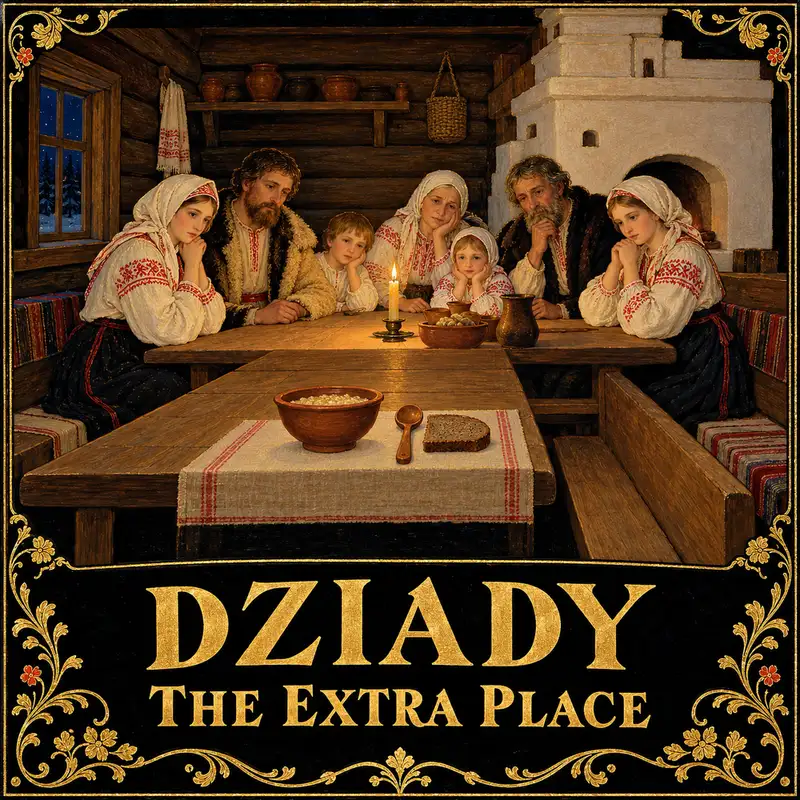
Welcome to The Sleeping Almanac. Tonight there is a place set at the table for somebody who is not coming. Not in the way you are thinking. Nobody is late. Nobody is ill. The chair has been left empty on purpose, and the plate in front of it is a real plate, and somebody has put food on it, and in a moment somebody is going to say a name out loud in a quiet room and mean it. This happened in farmhouses across a great stretch of Europe for longer than anyone can measure, every autumn, when the work in the fields was finished and the nights got long, and it happened in living memory, and in a few places it is happening tonight while you fall asleep. The people who did it called the dead the grandfathers. Not the ancestors, which is a word from a book. The grandfathers, which is a word from a kitchen. And the evening itself took its name from them, and the name is Dziady, which is that same word, grandfathers, said as though it were the name of a night. If you would rather listen with the screen off, this whole season is on the podcast, free, same night. And if this carries you down toward sleep, subscribe now, while your eyes are still open, and the next night will be waiting for you when you need it. This is the first of two nights that open a season, and the season is Slavic. That word covers an enormous number of people who are not the same as each other, and I am going to be careful about that all season, because the usual way of telling this is to pour them all into one pot and call it a mythology, and it is not one and never was. Tonight is one plain custom recorded in many of these lands, and it is not a god. It is a meal. Here is what I can promise you about tonight, and it is a short list, and everything on it is true. There was a custom of feeding the dead. It was very old. It was very widespread. Its detailed later forms were written down by witnesses and collectors, and recording continued until it became something you could photograph. And underneath the written down version there is a short account from the sixth century, in Greek, by a man writing from inside an empire, among the earliest descriptions of these people, and it mentions rivers, and I am going to spend a chapter on it because it is the floor of everything. And here is what I cannot promise you, said now so you do not have to wonder later. I cannot recover a complete sixth century account of what these communities believed about the dead from the witnesses we have. I cannot tell you the words they said over the food, because the words we have were collected in the eighteen hundreds and the nineteen hundreds, and they had been passing from mouth to mouth for a very long time before anyone put them on paper. What I can tell you is what people did, in particular houses, in particular villages, in accounts preserved by particular witnesses and collectors. That is a lot. It is more than most of this season will have. But it is not the same as knowing what anybody thought a thousand years ago, and anyone who tells you otherwise is selling you the comfortable version. An authentic custom is not the same as an ancient meaning. So tonight is a house I have pictured from the customs, not a reconstruction of one recorded visit. The table, the candle and the woman will carry the story, while the accounts around them belong to different places. It is late October, or early November, depending where you are standing, and the ground is cold and the last of the outdoor work is done. There is a fire. There is a table with a cloth on it. There is bread, and there is a dish of boiled wheat with honey in it, and there is a jug, and there is a spoon laid at a place where nobody is sitting. Somewhere in the room a candle is burning in a window where a candle is not normally put. The door is not locked. That is deliberate too. Settle in. The hill in Ethiopia where last season's lamp burned has gone dark for the winter, and tonight we are in a colder country, in a house made of wood, where the floor is swept and then not swept again until morning, and where a woman is about to say her father's name to an empty chair.
Start with the room, because the room is the whole argument. It is a single large room in most of the houses this custom lived in, and the biggest thing in it is the stove. Not a fireplace, which is an open mouth in a wall. A stove, which is a body of brick or clay in the middle of the house, big enough to sleep on top of, holding its heat for a day and a night. Everything in the house is arranged around it. In the deep cold, calves and lambs come inside and lie near it. Children sleep on it. Grain dries on it. Bread comes out of it, and the bread of this evening came out of it this morning. Against one wall there is a long table, and along the table a bench, and the bench matters, because the dead in this custom sit down. They are not addressed as a presence in the air. They are given a seat. At the head of the table, or at the end nearest the door, or in the corner, depending which village you are standing in, there is one place laid that nobody will use. A plate or a bowl. A spoon. Sometimes a cup with something in it. In many accounts the spoon is laid with the bowl of it turned downward, which is not how you lay a spoon for the living, and that small wrongness is the point. Anyone coming into the room would see it in the first second and know what kind of night it was. The food is ordinary. That is the thing that surprises people who expect a rite to look like a rite. It is the food of the house, made better than usual and in a larger quantity than usual, and then given away. Boiled wheat or barley, sweetened with honey, sometimes with poppy seed in it, which is the dish that turns up again and again across a huge geography and under several names. Bread, often a loaf baked for the occasion and not cut with a knife at the start but broken. Pancakes in some regions. Fish where there was fish. A jug of something to drink, and a cup for the ones who are coming. Before anyone eats, the head of the house takes the first spoonful and does not eat it. In some places it goes into a dish set aside. In some it goes onto the windowsill. In some it goes under the table, on the floor, which sounds like waste and is not, because the floor of that house is where the oldest of the household ghosts is understood to live. In some places the first spoonful goes into the fire. The direction changes from valley to valley. The gesture does not. The first of the food is not yours. Then the names. I will give the naming its own chapter, because it is the heart of the night and it deserves the time. For now, know only this: somebody at that table says out loud the names of the people who used to sit there, and invites them, in words, to come and eat. Not silently. Not in their heads. Out loud, in a room where everybody can hear it, including the children, who are usually told to be quiet and are usually not told very much else. And then the family eats, with an empty chair at the table and food going cold on a plate in front of it, and they talk, and it is not frightening. This is the part that does not travel well into our century. We expect the dead at the table to be a horror image, because that is what our films have taught us to expect, and it was not that. The accounts are almost boring in their calm. People ate. People talked about the harvest. Somebody mentioned that the old man would have had something to say about the price of a horse. Somebody cried a little, if the loss was fresh. The candle burned in the window. Nobody screamed. Afterward, the food on that plate stays where it is until morning, and the floor stays as it is until morning, crumbs and all, and I will tell you why when we come to the morning. There is a detail in some of the accounts that I have not been able to stop thinking about, and I am going to give it to you plainly and then leave it alone. In several places the family will wipe the bench with a cloth before the meal, so that the dead have somewhere clean to sit, and it is easy to imagine the woman doing it saying, while she does it, that it is cold outside and they have come a long way. That is the whole of the custom in one sentence, and it took a thousand words to earn it. A family sets a place for the people it has lost, tells them out loud that they are welcome, and then behaves for one evening as though the door between the two of them were merely difficult rather than shut.
Now the floor under all of it, and it is not much, and it is very old. In the middle of the sixth century a man named Procopius was writing a history of the wars of the eastern Roman empire, which is the empire people now call Byzantine, though nobody living in it would have said that word. He was a secretary who travelled with a famous general. He wrote several books. One of them is a history of a long war in Italy, and it is a serious piece of work by a man who had seen the places he was writing about. In the middle of the Gothic war he stops to describe some of the people fighting in it, because a large number of them came from north of the Danube, and they were new to his readers. He calls them the Sclavenes and the Antes, and the first of those words is where our word Slav comes from, and this is one of their earliest substantial descriptions in a surviving written account. And in the middle of that description there are three sentences about what they believed. I am going to give them to you carefully, because they are an exceptionally early written account of belief, and because there is an argument inside them that matters. He says that they believe that one god, the maker of lightning, is the lord of all things, and that they sacrifice cattle to him and every kind of sacrificial animal. He says they do not know about fate and do not believe it has any power over people, but that when death is close, in illness or in war, they promise a sacrifice if they live, and if they live they make it, and they think they have bought their safety with it. And then he says that they also honour rivers, and nymphs, and certain other spirits, and that they sacrifice to all of these as well, and that they make their divinations at those sacrifices. That is it. That is an exceptionally early account of their beliefs. Other early descriptions survive too, though the village customs we will come to were recorded much later. Around those three sentences he gives a few more, and they are worth having, because they are an early picture of daily life, given by an outsider. He says they are not ruled by one man, but have lived from ancient times under what he calls a democracy, which in his mouth means that decisions were taken by the whole body of the people together and not by a king, and he says it with the faint distaste of a man who has served an emperor. He says they live in wretched huts, scattered far apart, and that they move house often. He says they go into battle on foot, carrying small shields and javelins, and wear no armour, and that some of them do not even wear a shirt. He says they are tall and strong, and that their hair is neither very fair nor very dark but somewhere between, and that their way of life is rough and uncared for, and that they are always covered in dirt. And then, in the same breath, he says they are not at all wicked, and not given to malice, and that in their simplicity they keep something of the old ways of the Huns. Take that for what it is. A man in a warm room describing people who had come out of the forest to fight him, and getting some things right and some things wrong and not being able to tell which. But notice what he does not say. He does not say they have temples. He does not say they have priests. He does not say they have images. That silence does not establish whether buildings or ritual specialists existed. It tells us what this Greek author chose to record. He describes rivers, sacrifices and promises made when death was close. Those are the places and acts in his account, not a complete map of anybody's religion. Now, the argument. The phrase I gave you, the maker of lightning, is the usual translation. There is an argument over it, but it is important to say what kind. One scholarly proposal would change the Greek text itself to make this god the creator of all things. That is different from simply reading the words we have another way. I am not going to pretend the argument is closed. Nor does the sentence settle how closely Procopius understood the people he was describing. He may be passing on what he was told about a thunderer in charge, a god you will meet on the second night of this season. Or he may be arranging a foreign religion into the shape of one high god over everything, a shape that Greek and Roman writers knew how to recognise. I lean to the thunder reading, and I hold it loosely, and I want you to notice why I am hedging. Procopius was not a neutral camera. He was an educated man from inside an empire describing people that empire was fighting, and he wrote them into categories his readers already had. When he says one god lord of all, he may be describing what he was told, or he may be doing the thing every ancient writer did, which is to arrange somebody else's religion into a shape that could be understood at home. But here is what I think is the most valuable thing in the whole passage, and it is the part people quote least. The rivers. The nymphs. The other spirits. The sacrifices made to all of them. Because notice what that does to the sentence before it. He has just told you there is one god on top, and then immediately he tells you that the actual religious life he can see is happening at water, and at particular places, and to a crowd of beings who are not the one god at all. The thunderer, if that is what he is, is in the sentence. He is not in the yard. What is in the yard is a river with something in it that people bring things to. And that is the shape of everything that comes after. Some thirteen hundred years later, when nineteenth century collectors go into villages with notebooks, the gods with names are mostly gone or reduced to a curse word, and what is still there, in enormous and stubborn quantity, is exactly this: the water with somebody in it, the forest with somebody in it, the house with somebody in it, and the dead who come back once a year and are fed. The high god of the chroniclers vanishes. The rivers do not. Procopius never mentions a feast for the dead. I want to be honest about that, because I could easily leave it out and let you assume it. He does not say these people set a place for their grandfathers. His account does not establish when that particular custom began. What he gives you is the floor: a world where the sacred is local and physical and gets fed, and where you promise something to somebody and then hand it over, and where a river is not scenery. Tonight's table stands on that floor. I cannot prove the table was already there in his century. I can set the two pictures beside each other, without pretending that resemblance proves an unbroken custom.
Here is the difficulty at the centre of this whole season, and I would rather hand it to you tonight than have it sit under the rest like a stone. There is no Slavic book. There is no Iliad, no Edda, no collection of poems written down by somebody who still believed them. For the Greeks we have Homer and Hesiod. For the Norse we have two books made in Iceland by people two centuries after the conversion, which is late, and which scholars argue about constantly, and which is still infinitely more than what we have here. For the Slavs, in the centuries before Christianity, there is nothing. Not a lost book we know the name of. Nothing. What there is instead is this. A short list of idols in a chronicle written by monks, which you will get on the second night. A handful of descriptions of temples on the Baltic coast written by Germans and Danes who were there to destroy them. One medieval war poem that still uses some old names in a way that suggests the poet expected his audience to recognise them. Some sermons complaining about what people were still doing. And then, much later, an ocean of folk custom, written down by educated people who went out into villages in the eighteen and nineteen hundreds and asked. That is a brief view of the written evidence, alongside the archaeology. A few pages of hostile witnesses, and a library of stories and customs collected from farmers. So how did a people this large leave nothing? Start with how large. By the time Procopius is writing, groups speaking these languages are spreading across an enormous area, and within two or three centuries they are settled from the Elbe in the west to the Volga in the east, and from the Baltic down into Greece. That is not one nation moving. It is a language and a way of farming and a set of customs spreading through a landscape that had been emptied and rearranged by two centuries of upheaval, absorbing people as it went. The archaeology of this period is genuinely hard and specialists argue about nearly all of it, including how much of the spread was people moving and how much was people already there beginning to speak differently. What the archaeology does show, and this is the part that matters tonight, is that the early settlements are small, wooden, and almost aggressively modest. Small houses partly dug into the ground with a stove or a hearth in one corner. Simple undecorated pottery. Very little metal. No stone temples in most of the territory, no palaces, no monuments, no writing. Compared to what the Romans left in the same landscape, it is close to invisible. A people can be enormous and leave almost nothing, if what they build is wooden and what they say stays in the mouth. There is one more early witness, and it belongs in tonight's episode and not in the second night's, because it is about funerals and not about gods, and I want to give it to you before we go on. Around the year eleven hundred, in Kiev, a monk compiled a chronicle of the Rus from the beginning of the world to his own day, and near the start of it, before any of the princes, he describes the tribes who lived in the land before the state existed. He is describing them from the point of view of his own tribe, which he thinks is gentle and civilised, and he is not kind about the others. He says that certain of them, the ones in the forests to the north and east, lived like animals, and ate everything unclean, and did not marry properly, and then he says this. When one of them died, they held a feast over him, and then they built a great pyre, and laid the dead man on it, and burned him. And when they had gathered up the bones, they put them in a small vessel, and set the vessel on a post beside the road. And then the monk adds, in five words that carry the whole weight of the passage: which the Vyatichi do even now. Even now. Meaning in his own lifetime, in the eleven hundreds, a century after the prince in Kiev was baptised, there were people several hundred miles away, in the forests toward the Oka, putting the burnt bones of their dead in pots on posts along the roads, and a monk in a monastery knew it and wrote it down in disgust. The word he uses for the feast is one I am going to give you because it is old and because it is the ancestor of tonight. The trizna. A funeral feast, held over the dead, before the burning. Nobody knows exactly what it involved. The word turns up in the chronicle more than once, and in one famous and terrible place it is a feast held on a burial mound at which a widow avenges her husband on the men who killed him, and I am not going to tell that story tonight because this is a night for sleeping and it is not a sleeping story. What matters is the shape. A meal, over the dead, at the grave, as the oldest thing anyone can point to. The monk was hostile, and that is reason to read him carefully. A pot on a post by the road is a specific detail worth preserving, but specificity does not prove that a writer saw it. What we have here is his account of the feast, the pyre and the bones by the road, and all of it is, from the point of view of tonight, the far end of a thread whose near end is a plate on a table. Because that is the second half of the answer. They had no writing of their own. The alphabets that exist now for these languages were made by missionaries in the ninth century, and the first thing written in them was scripture. What survives gives us no native book setting out the old religion as a whole. By the time the tools existed, the hands holding them belonged to the church, and the church was not going to spend expensive parchment on the words a village said over a bowl of wheat. And there is a third thing, and it is the one that makes this season what it is. The conversion here was not a single event you can point at. In the east there is a famous moment in the year 988, when a ruler in Kiev was baptised, and you will hear the rest of that on the second night. But that is one city and one prince. What actually happened, across this whole enormous landscape, took centuries, and it was uneven, and in the countryside it produced something the church spent the next eight hundred years complaining about in writing: people who were baptised, who went to church, who considered themselves Christian, and who also fed their dead in the autumn and left milk out for the thing that lived behind the stove. Historians have a word for that arrangement, and I am going to use it once and then drop it, because it makes a natural thing sound like a condition. Double faith. It suggests two religions stacked on top of each other, one official and one hidden, which is not what the evidence looks like. What the evidence looks like is people doing what their grandmother did and also what the priest said, and not experiencing any particular difficulty about it, because the two were answering different questions. The priest answered what happens to a soul. The grandmother answered what you do with the first spoonful. So the customs you will hear all season are not a coin hidden under a carpet. They are things people did, some with the priest's blessing and some without, all of them with the same hands in the same week. Which brings the problem back around to tonight, and I want to name it before we go further. The detailed household forms we are following come largely through later collections. The earlier chronicles and sermons are different kinds of evidence. My house brings details together as a picture, rather than claiming that one collector saw every one of them on a single night. That is not a weakness, as long as nobody pretends otherwise. Those collectors were often very good. They wrote down what they saw and heard, in the village, in the language it was said in, with the name of the person who said it. Some of them were the grandchildren of the people they were writing about. What they could not do, and did not claim to do, was tell you how old any of it was. A custom can be five hundred years old or two thousand and look exactly the same from a doorway. So I will tell you what people did, and where, and who watched them do it, and when a thing is old I will say how we know, and when it is only probably old I will say that instead. That is the whole deal for tonight. In exchange you get something better than a reconstruction. You get the house we have pictured, drawn from recorded customs, with one chair empty. When I return to that woman and that candle, I am returning to a scene, not claiming a particular dated visit.
Go back into the room, because before tonight's meal can make sense you need to know that this house feeds things all year round, and the dead are only the largest guests. Start with the stove again, because everything starts there. It is lit in the autumn and, in the coldest months, it is never fully allowed to go out. Somebody rises before dawn and rakes the ash and finds the coals still red under it and builds the fire back up. That continuity is not a convenience. In a great many of the accounts, it is understood as a kind of guardianship. A house whose fire has gone cold is a house something has left. And something lives behind that stove. I am going to give it to you once tonight, and lightly, because it has a name and a shape and a whole lore of its own, and this is not its night. Call it the grandfather of the house, and know only that it is old, and that it is fed. A crust left in the corner. A little milk in a saucer. A spoonful of the porridge put down on the floor by the stove before the family eats. When people moved house, in some regions, they carried a shovel of coals from the old stove to the new one and asked it, out loud, to come with them. Notice the grammar of that. Not worshipped. Fed. Nobody builds it a shrine. Somebody puts a crust down where it can find it and says a few words the way you would say them to an old relative in the next room. That grammar is the grammar of tonight, and it runs through the whole year. The year, in a house like this, is punctuated by small givings. When the bread is baked, a piece may be set aside before anyone eats. When the cow calves, the first milk is not for the table. When the harvest is cut, the last sheaf is treated as something more than a sheaf, dressed or carried or kept through the winter in the corner of the room. Beginnings are marked by not taking the first of a thing for yourself. That is a rule you can find in a hundred cultures, and here it is domestic to the point of invisibility. Endings are marked too, and the largest ending of the year is the harvest, and I want to give you one thing from it because it belongs to the grandfathers. When the last field was cut, across a very wide stretch of this territory, a few stalks were left standing. Not forgotten. Left. A handful of grain at the edge of the field, uncut, and then bent over and twisted together and tied at the top, so that it stood like a small figure or a small hut, and under it, on the bare earth, somebody put a piece of bread and a pinch of salt, and in some places poured a little of something to drink. The collectors found this everywhere and found it called different things in different districts, and in more than one district it was called the beard. Whose beard depended on who you asked, and some of the answers name a god you will meet on another night, and some of them say the grandfather, plainly, the way you would say it of the old man in the corner. The last sheaf that was actually cut was treated with the same care. It was not threshed with the others. It was carried home on the last cart, sometimes dressed in a cloth like a person, sometimes carried by the girl who had cut it, and it was stood in the corner of the room, the corner where the best things in the house were kept, and it stayed there through the autumn and into the winter. At the winter feast its grain was fed to the animals, or kept and mixed into the seed for the spring, so that the last of the old year went into the first of the new. I give you this because it is the same gesture as tonight's plate, moved out of doors. Something is not taken. Something is left, in a particular place, with bread and salt, for somebody who is understood to be there and is not seen. The field has a grandfather in it, the house has one behind the stove, and the burial ground on the rise has all the rest, and once a year they are all called by the same name and fed at the same table. So when, in the autumn, the family sets the table for the grandfathers, they are not doing something strange. They are doing the ordinary thing on a larger scale and for a larger audience. The first spoonful that goes to the floor every morning goes, tonight, to the people who used to eat here. Now the food itself, because the food is where the custom is most consistent across the enormous distance it covers. The centre of the meal, nearly everywhere, is grain cooked whole. Wheat where there is wheat, barley where there is barley, in some places rice much later when rice could be had. It is boiled until soft and sweetened with honey, and often poppy seed is stirred through it, and sometimes nuts or dried fruit. The dish has a name that changes from region to region and a shape that does not. It is soft, it is sweet, it is pale, and it is old. The same dish is served at funerals, and at the winter feast, and at a birth in some places, which tells you it belongs to thresholds rather than to any one of them. Then bread. Not sliced. Broken, at the start, by the eldest at the table, and often a loaf baked for this evening and marked in some way, a cross or a pattern pressed into the top before it went into the oven. In many households the bread is set out with salt beside it, because bread and salt together are the oldest form of welcome these people have, offered to a guest at the door, offered to a bride, offered to an honoured visitor, and offered tonight to the dead. Then whatever the house has. Pancakes in some regions, because a pancake is round and pale and warm and goes quickly from the pan to the plate. Boiled eggs. Fish, where the river gives fish. A jug of something to drink, honey drink or beer or, in later centuries, something stronger. And in nearly every account a cup or a glass poured for the ones who are coming, and not drunk. There is one more thing on the table in many descriptions, and it is a candle, and it will get its own chapter, but I want you to see it now. In the house I am picturing it is lit before the meal and stays lit through it, a light visible from outside. That is our scene, not a rule shared by every account. Before anyone sits down, the woman of the house, in most accounts, does three small things. She wipes the bench with a clean cloth. She sets a bowl of water near the door, or on the windowsill, with a towel beside it, so that the guests can wash when they come in, because they have been travelling. And she opens something, a window a crack, or the door onto the latch, so that they can get in without having to knock. None of those three things is a rite. They are what you do for a guest who will want to wash his hands, and I will come back to what that means once the candle is lit.
Not every version of this night stays in the house. In a great part of the eastern territory, and in the spring especially, the family goes to the dead instead of waiting for the dead to come to them. The picture is this. On the appointed day the family dresses in its better clothes and packs food. The same food, the sweet grain, bread, eggs, something to drink, wrapped in a cloth. They walk to the burial ground, which in a village is never far, usually on a rise, usually with a few old trees in it, usually surrounded by a low wooden fence to keep the animals out. They find their own graves, which they know without looking for them. And they lay the cloth on the ground beside the grave, or on the grave itself, and they set out the food, and they sit down, and they eat. I want to slow this down because it is the part that people from outside the custom find hardest to hold in their heads without either laughing or shuddering, and it deserves neither. They eat a meal on the grave. They talk to the person in it. Out loud. They tell him what has happened in the year. Who married. Who was born. What the harvest was like. Whether the roof held. They pour a little of the drink onto the earth, and they crumble a little of the bread onto it, and they leave an egg, or a piece of the sweet grain, in a dish or on a cloth, on the mound. And then they sit there for a while longer, and they talk among themselves, and it is, by every account, a social occasion. Neighbours move from grave to grave. Old people are greeted. Children run about between the fences. In some places there is singing. And then they go home, and the food stays on the graves. Now the thing that ties the graveside meal back to the house, and it is a thing about language that I find beautiful and that I cannot fully explain. The word for the grandfathers, the dead who are being fed, is the same word that came to be used for the poor. For beggars. For the wandering old men who stood at the gates of the burial ground and sang, and who were given food. That is not a coincidence, and the collectors who wrote it down did not think it was one. On the day of the dead, the poor came to the cemetery, because the poor always know where food is going to be, and the families gave them what they had brought, or what they had left over, and in return the beggars sang, and prayed, and in a real and understood sense stood in for the dead. A man you had never seen before, in a ragged coat, ate the food you had brought for your father, and everybody present understood that this was correct, and that in some way your father had eaten it. There are accounts of the beggars being invited into houses on this night and seated at the table in the empty place. There are accounts of the food from the empty plate being carried out to them at the door. The grandfathers and the beggars share a name because, for the length of one meal, they share a role. I said I would tell you when a thing is old and when it is only probably old, and here is one that is at least older than any collector. There are sermons, from the medieval centuries, in several of these languages, in which priests complain that people are taking food to the graves and eating there and leaving things behind, and that they are doing it on days the church has not given them. The priests wanted it stopped. That is the only reason we have the sermons. Disapproval is one reason these practices entered the written record. So the graveside meal is in the record, hostile and incidental, several hundred years before anybody went out with a notebook to describe it kindly. The sermons are worth a moment more, because they are where the church tells you, without meaning to, exactly what it was fighting. They were written in the eastern territory from the twelfth century onward and copied for hundreds of years afterward, which preserves the complaint but does not by itself prove that every practice continued unchanged. One of them complains that people set a second table beside the lawful one for the old powers of birth and kin, and a list of questions that a Novgorod monk put to his bishop in the same century says what went on that table, bread and cheese and honey, and some scholars read those powers as the ancestors under another name and some do not, and neither text says. Another complains of something plainer. On the Thursday before Easter, the later copies of it say, people heat the bathhouse for the dead, and strew ash on the floor, and hang up a cloth and a towel, and set out meat and milk and eggs, and then find footprints in the ash, which the preacher says the demons leave there to deceive them. The word that sermon uses for the dead is an old one, navi, and you will hear it again tonight in a colder place. And a church council of the fifteen hundreds complains that on the days for the dead in spring and early summer people go out to the graves and wail over them, and then, when the minstrels strike up, stop wailing and dance and clap and sing on the graves themselves. Every one of those preachers says it is a demon's feast, and that the people who do it are still, in their hearts, worshipping what their ancestors worshipped. And the first of them adds, with real irritation, that the people doing this consider themselves Christians. That last complaint is the one to hold onto. Not that pagans were doing it. That Christians were. Baptised people, who went to church, who would have been offended to be called anything else, were also, in the twelfth century and the sixteenth and the eighteenth, putting bread and honey out for the dead, and the church knew it, and wrote it down, and could not stop it, while the church also kept its own days of prayer for the dead, which we will follow on the next night of this season. There is one more detail from the graveyards and then we go back inside, because tonight's night is the indoor one. In the spring version, in a wide belt of the eastern territory, the eggs that are brought are dyed, and they are rolled. Rolled across the grave, or rolled down from the top of the mound and left where they stop. Children do it. It is understood as a game and also as something more than a game, and the collectors could not get anyone to say what the something more was, which is exactly what you would expect from a thing that has been done for so long that its reason has worn smooth. An egg rolled on a grave in spring. A plate set at a table in autumn. The same people. The same dead. Two doors in the year, and we will come to the second door later tonight.
Now the centre of it. Everything else in this custom is preparation. The food, the bench, the bowl of water, the candle, the walk to the graves. All of it is a setting for one act, and the act is a person saying names. The head of the house stands. In some accounts it is the eldest man, in some the eldest woman, in some whoever remembers the most. In the fullest descriptions the person stands at the head of the table with the candle lit and the food uncovered and the rest of the family silent, and speaks. I am going to give you the shape of what is said, in English, in my own words, because the collectors wrote it down in the languages it was said in, and because the exact words changed from village to village and I would rather give you the bones than pretend to a single text. It begins with a calling. Holy grandfathers, we call you. Come to us. Come and eat what the house has, and drink what the house has. Something like that, and the word holy is in many of the versions, which tells you something about how the dead were regarded that no chronicle does. Then the names. The person names the dead of the house. Father and mother, if they are dead. Grandfather and grandmother. Great grandfather and great grandmother, if the names are known. Brothers and sisters who died. Children who died, which in these villages in these centuries was most families. Each name said plainly, sometimes with a place or a thing attached to it, the way you would identify someone in conversation. The one who fell from the cart. The one who died the winter of the bad ice. The little one. Three generations is the common depth. Some go deeper. Nobody, in any account I know of, recites a line back to a founder the way the chroniclers did for princes. This is not lineage. It is memory, and memory in a house like this reaches back about as far as the oldest person in it can reach, and then stops. And that is where the custom does its most humane thing. At the end of the names, in some of the versions, there is a line for the ones who have no names, the named and the unnamed, as one of the prayers puts it. The ones nobody in the room remembers. The ones whose families have died out, or moved away, or forgotten. The ones with nobody left to call them. And they are called too. Come, all of you who have nobody to remember you. Come and eat with us. Think about what that line is doing. It is the family extending its table past its own dead to the dead in general, to the unremembered, to the ones who have fallen off the edge of everybody's memory. It is an act of hospitality toward people who cannot reciprocate, who cannot even be identified, and it is done every year, by people who have never read a word about hospitality in their lives. In several accounts a second plate is set for exactly these guests. One plate for the family's own dead, with the spoon turned down. And one plate for the strangers. Then the family sits and eats, and the names have been said, and the room is understood to be full. And the children watched. I keep coming back to this, because it is how the custom lasted a thousand years without a book. A child of five, sitting on the bench, watching her grandmother stand up in the candlelight and say the name of a great grandmother the child never met, and say it to the empty chair, and then sit down and pass the bread. That child will do the same thing at seventy, in a different house, with a different candle, and she will say her grandmother's name, and a different child will watch. That is the whole transmission. No text. No priest. No school. A meal, a chair, and a name said out loud by someone who has done it every year of her life.
Now the part of the night that is not warm, and I am going to give it to you plainly and briefly and without decoration, because the people who lived inside this custom did not decorate it either. Not all the dead were the same. Everybody who has ever lived near a graveyard knows that. There were the dead who had died in their beds, in their houses, at their proper time, with their families round them, and had been washed and dressed and carried out through the door feet first and buried in the ground where their parents were. Those were the grandfathers. Those were the ones you called by name and set a place for and were glad to see. And then there were the others. The ones the river kept. Every village on a river knows this kind. A child who went under in the spring flood. A man who went through the ice with a horse. A girl who went into the water on purpose. In the older understanding, which survives into the collectors' notebooks very clearly, a person who drowned did not simply die. They went somewhere else, and stayed there, and were not at rest, and were not entirely safe to be near. The ones who died away from home, on a road, in a war, in a foreign country, and were buried by strangers or not buried at all. Nobody had washed them. Nobody had said the words. They were dead and they were not home, and a dead person who is not home is, in this way of seeing, a person still travelling. The ones who died before their time, especially the young. The ones who died by their own hand. The ones who died with something unfinished, a quarrel, a debt, a wrong done to them that was never put right. And the ones who had been, in life, the kind of person that a village is quietly relieved to bury. For this part of the story I will use one English description, rather than claim that every region used one name. Unquiet. The unquiet dead. Not evil. Not monstrous. Unsettled. Unable to rest because the thing that lets a person rest, which is to have died at home and been properly seen off, did not happen to them. Here is the thing I most want you to understand about tonight's meal, and it is the thing that the warm chapters have been walking toward. The meal was partly for them. The empty plate for the strangers, the ones nobody remembers, in many accounts also covers these. The line in the calling that invites everyone who has nobody to call them was understood to reach the drowned and the lost and the unquiet, and to offer them, once a year, what they did not get when they died. A seat at a table. Food. Their name, if anybody knew it, said kindly. A door left open, and then, when the visit is ended, a door politely closed. Because the alternative was that they came anyway. The chronicle I told you about, the one compiled in Kiev around eleven hundred, has an entry that shows you what that looked like in the mind of the time, and I am going to give it to you because it is an early account of dead riders feared in this part of the world, and it is short, and it is strange. Under the year ten ninety two, the monk writes that a great wonder appeared in the city of Polotsk, far to the north. At night, in the streets, there was a stamping and a sound of running, and of something groaning, as though men were going through the town, and nothing could be seen. And if anyone came out of his house to look, he was struck, invisibly, by whatever was there, and he sickened and died. So the people of Polotsk stopped going out at night. And then it began to happen by day as well. Riders in the streets in daylight that nobody could see, though the hooves of their horses could be seen, and people dying of it. And the chronicler writes down what the people of Polotsk said about it, which is the reason the entry exists. They said: the dead are beating the people of Polotsk. The dead. He records the people using the old word for the departed, the one the sermons also use. In this entry those departed are feared. The word alone does not make every dead person unquiet. The monk explains it as demons, because that is what a monk in the eleventh century would say. But he records what the people said, and what the people said was that the dead were riding through the town and striking the living down. Whether a sickness lay behind it, the chronicler records dead riders feared in the streets. He does not say that an unfed ghost caused it. Set that fear beside our meal without turning the resemblance into his explanation. That is the fear under tonight's plate on the threshold. Not a ghost story. A city with riders in it that nobody could see. This is the darker side of a custom that is otherwise almost entirely about love, and I would be lying to you if I left it out. A dead person who is not fed, in this way of seeing the world, does not simply stay away. They come hungry. They stand at windows. They make the cattle sicken. They pull the living into the river to keep them company. The night when the dead are fed is also the night when the dead are managed, and the same plate does both jobs at once. The collectors wrote down, in several regions, that the food set out for the unquiet dead was put not on the table but on the windowsill, or on the threshold, or outside the door. Inside the house for the family. At the edge of the house for the others. The geography is the theology. The grandfathers sit at the table. The drowned eat on the step. I will give you one image from this and then we will leave the cold part of the night, because we have been in it long enough. In parts of the eastern territory what was left from the plate on the threshold was carried out of the house after the family had eaten, to the crossroads, or to the water. Picture the woman of the house walking it down to the river in the dark, and putting it on a flat stone at the edge of the water, and saying something, and coming back, and not looking behind her. What she says, nobody wrote down, and I suspect that if a collector had asked she would not have told him.
Back inside, because the fire is still lit and the meal is over and the family is still awake, and the next part of the night is about light. The candle in the window is the light I have chosen for this house, and it is also the one whose meaning is easiest to feel and hardest to state. In our pictured house it is placed in the window. Other accounts put a candle elsewhere, and their details are not interchangeable. A house at night in a wooden village is a dark thing; you can walk past it and not know anyone lives there. A candle in the window turns it into a signal. It says that this house is awake, and that it is expecting somebody. In our scene it is lit before dark and burns until morning. That is not a universal rule. One recorded form extinguishes a candle before supper. In the house we are following, keeping a light through the dark is a choice, and it is a real cost in a household where a candle is not a small thing. Tallow or beeswax, made in the house or bought, burning all night, once a year, so that somebody who is not alive can find the way. And it is for them. That is the meaning the light carries in the house I am picturing. The candle is so that the dead can see the house. So that they can find it. So that they do not lose their way in the dark and go past it, or wander, or end up in the wrong house, or in the river. I said the meaning is easy to feel and hard to state, and here is why. The accounts do not give us one shared explanation of what the dead saw or how they travelled. Folk beliefs and Christian ideas could live in the same house. I will not give every family a single doctrine. There was a candle, and a certainty that it helped, and a great deal of care taken about it, and if you asked why, the answer was that it was for the grandfathers, and that was the end of the answer. Around the candle, in the fullest accounts, there is a whole grammar of small permissions. The door is left on the latch, or a window is left open a hand's width, even in the cold, because the guests should not have to knock. Water is not thrown out of the house after dark, because you might throw it over somebody. The floor is not swept, because you would sweep them out with the dust. The bench is not sat on in the place where the spoon is turned down. A towel is hung by the bowl of water so that they can dry their hands. In some houses a bed is made up and not slept in. And in some houses, a mirror, if the house has one, is turned to the wall or covered with a cloth. This one is worth pausing on, because it is very widespread, and it belongs more properly to the night of a death than to the night of the dead, and the two nights share it. When somebody has just died, the mirror is covered. The reason given, when a reason is given, is that the newly dead might see themselves in it and be confused, or that the living might see the dead in it and be frightened, or that a soul might be caught in it and unable to leave. On the night of the grandfathers some households cover the mirror for the same reasons, extended. It is a house full of guests who should not be startled. Now the thing that ties all this together, and it is the reason I have spent a chapter on a candle. Every single one of these small acts is an act of hospitality, and every single one of them assumes that the guest is fragile. Not dangerous. Fragile. Easily lost. Easily startled. Easily swept out with the dust. The dead in this custom are not powerful visitors from another realm. They are old people who have travelled a long way in the cold and might not find the door, and might be frightened by their own reflection, and would like somewhere to wash and something warm to eat and a bench that has been wiped for them. That is the emotional truth of the whole night, and it is the reason it lasted. It is not a rite of fear. It is not a rite of power. It is the way you would treat your grandmother if she came back, which is to say it is the way you treated her when she was alive, extended past the point where most people stop. The candle burns down through the night. In the scene we are following, the woman stays up later than the others to watch it. In the morning it is a stub, and the plate on the table has not been touched, and the house is very quiet, and the door is still on the latch, and the first thing anyone does is close it.
I have been saying autumn all night, and I have been slightly lying to you, and now is the time to correct it. The dead were not fed once a year. They were fed twice in most places, and in some regions three or four times, at fixed points in the turning of the year, and the autumn feeding, which is tonight's, was only the largest and most elaborate of them. The other great one was in spring. Picture the year from inside a farming village, because that is where the shape of it comes from. In autumn the fields are cut, the animals are brought in, the ground goes hard, and the household turns inward. Everything is stored. Everything is closed. It is the natural time to count what you have and who you have, and the dead are part of who you have. So the autumn feeding is indoors, at the table, with the door on the latch and the candle in the window, and it has the mood of a house settling in for the dark. In spring it is the opposite. The ground opens. The animals go out. The graves, which have been under snow for four months, can be walked to again. And so the spring feeding is outdoors, at the burial ground, with the cloth on the grave and the eggs and the singing, and it has the mood of a house opening its doors. Same dead. Same food, largely. Same names. Two moods. The spring day has a name of its own in the eastern territory, and it is worth giving you, because it is one of the few names in this custom that has survived into printed calendars. In its most common form it is something like Radunitsa, and people have argued for a long time about what the word means, because it looks like the word for joy and also like the word for kin, and some have heard in it the old word for the lament sung over a grave, and more than one of those readings has had serious defenders. I am not going to settle it. What I can tell you is that the day is still marked, in the countries where it is kept, that in at least one of them it is a public holiday, and that the thing done on it is exactly what I described in the fifth chapter: the walk to the burial ground, the cloth, the eggs, the meal, the talk. A day whose name might mean joy, spent at the graves. If you want the whole custom in a single word, it is that one. And between and around those two there were, in many places, smaller ones. A feeding before the winter feast. A feeding at the end of the winter. A feeding at midsummer in some regions. The collectors found villages that counted four days in the year for the grandfathers and villages that counted two and villages that had only kept one. The number does not matter. The shape matters. The dead were fed at the joints of the year, at the points where one season became another and the household had to turn. Now I have to say something about timing that I am going to say carefully, because there is another night of this season that owns most of it. If you ask when in the autumn this happened, the honest answer is that it happened, by the time anyone wrote it down, on dates that had been fixed by the church. The spring feeding sat inside the church's spring. The autumn feeding sat, in most places, within a few days of the church's own days for the dead, which arrive at the start of November. Whether the church put its days where the feeding already was, or the feeding moved to where the church put its days, is a question that has been argued for two hundred years, and I am not going to settle it tonight, because the whole of the next night is about exactly that, about what happened when the church gave this evening a new name. What I will say is this. The church has days for the dead. So does almost every religion that has ever existed. The idea of setting aside part of the year to remember the dead is not Slavic and not Christian and not anybody's; it is close to universal. What is particular here, what makes this custom itself and not a general human habit, is the table. The plate. The spoon turned down. The bench wiped. The candle in the window. The food carried to the grave and eaten there. These household details are not one prescribed church service. Recorded customs preserve them in differing combinations, rather than as one rule for every house. So when you hear that this night falls at the beginning of November, do not hear that as a claim about origins. Hear it as a claim about a calendar that two different things ended up sharing. One last thing about the spring door, because it is where the custom is most alive and I want you to have it before we go back to the autumn table for the end of the night. In the eastern territory the spring feeding survived the twentieth century better than almost anything else in this season. Better than the gods, who are gone. Better than most of the tales, which live in books now. It survived wars and collectivisation and official disapproval and the emptying of villages, and in a great many places it is still done, on a day in spring, by families who drive out from cities to the burial grounds of villages that no longer exist, and lay a cloth on the grave, and eat. I cannot tell you what those families believe. Most of them, if you asked, would say they were visiting their parents. And that is, in the end, what the custom was always saying, in autumn and in spring, at the table and at the grave. You do not stop being family when you die. You just have to be fed differently.
Every invitation has an end, and this is the part of the custom that the warm versions leave out, and it is the part that tells you the people who did it were not sentimental. The dead are sent away. Sent away, on purpose, in words. The timing differs between accounts: a recorded supper ends with a dismissal, rather than a required wait for dawn. In the house we have pictured, the woman waits until the grey comes into the window. That is the order of this scene, not a timetable for every village. The shape of the dismissal, again in my words rather than any one village's, is something like this. Holy grandfathers, you have eaten, you have drunk. Now go home. Go back where you came from. Take nothing from the house with you. Do not come back before your time. And come again next year, when we call you. Every clause of that is doing work, and I want to walk through it, because the whole psychology of the custom is in it. You have eaten, you have drunk. The obligation has been met. The living did what they owed, and they say so, out loud, so that there can be no later claim that the dead went hungry. Now go home. The dead have a home, and it is not here. This is said with affection and it is said firmly. A guest who will not leave is not a guest. Take nothing from the house. This one is not in every version, and where it turns up it is the sentence that gives the game away. The fear is not that the dead will harm the living. It is that they will take something. A child. An animal. The luck of the house. A person's health. The visit has been generous and it has been bounded, and the boundary is stated at the door. Do not come back before your time. Meaning, do not come back until you are called. The dead are welcome on the night of the dead and not on the night after, and the house is saying so. And come again next year. Which is the promise on the other side of the boundary. You will be called. You will be fed. This is not a farewell. It is an appointment. Then the practical acts, which are the reverse of the evening's small permissions, one by one. The door, which was on the latch, is opened wide, so that they can go out, and then it is closed properly for the first time since dusk. The window is shut. The water that was set out for washing is carried outside and poured away from the house, on the ground, not at the door. The towel is taken in. The candle stub is put out and, in some houses, kept, and in others buried. And then the floor is swept. That is the moment the house is a house again. All night nobody swept, because you do not sweep with guests on the floor. In the morning the woman takes the broom and sweeps toward the door, and out over the step, and the collectors describe this in more than one place as being done with a particular briskness, as though something were being gently but definitely shown out. The food from the empty plate is not, in most of the accounts, eaten by the family, though in some districts it was, and in some the crumbs were dried and kept. Mostly it goes to the animals, or to the poor, or to the beggars at the gate if there are beggars, or it is carried out and left at a crossroads or under a tree. It has been given, and a given thing is not taken back. There is a line that belongs at the end of the dismissal, and whether any one village said it in these words I cannot tell you, but the calling that invites the ones with nobody to call them has to be answered by something like it, and I have thought about it more than any other line in this custom, so I will give it to you and then we can go to the collectors. After the grandfathers have been told to go, and to take nothing, and to come again, the speaker adds a last sentence for the ones who did not have names. Something like: and you who came without being called, go too, and forgive us, and do not be angry, we have given you what we could. Forgive us. Said to the unquiet dead, the drowned and the lost and the unremembered, by a farmer at dawn in a room that smells of tallow and cold wheat. Not a prayer. A courtesy, extended past the point where anyone was watching, to people who could not possibly answer.
The later collections carry much of what I have told you tonight, and you should know some of the people behind them. In the first decades of the eighteen hundreds, the educated classes of this part of Europe began to do something they had not done before, which was to go into villages and write down what peasants said. It was part of a much larger change happening everywhere, the discovery, by people who lived in cities and read books, that the countryside they had been ignoring was full of songs and stories and customs older than any of their books. The Germans did it. The Scots did it. The Finns did it. And in the lands where these languages were spoken, where a whole layer of the population had been treated for centuries as a resource rather than a people, it happened with a particular intensity, because the people doing the collecting were often also trying to prove that the peasants were a nation. The first name I will give you belongs to a man who died a little past forty, in the eighteen twenties, having spent his short life walking through the countryside with a notebook, convinced that the old religion was still there under everything if you knew how to look. His name was Zorian Dolega Chodakowski, and he was not right about most of what he thought he had found, and he was among the pioneers of that work, and later collectors followed him. Then, over the next hundred years, the serious collectors. Oskar Kolberg, who spent half a century going from village to village across the Polish lands and filled dozens of volumes with what he heard, songs and tales and customs and the music written out in notes. Michal Federowski, who did the same for the Belarusian countryside from the eighteen seventies onward, and whose volumes are full of exactly the kind of detail you have heard tonight, the tables, the food, the words said over it, each with the name of the person who said it. Pavel Shein, whose collections from the same territory in the same decades run to thousands of pages. Adam Bogdanovich, who in the eighteen nineties wrote a study of what he called the survivals of the ancient way of seeing among the Belarusians, and put the feeding of the dead at the centre of it. I am naming them because they are the sources and because they can disappear behind a modern retelling. When you read a modern book about this custom, or hear it described, or see it in a film, you may be getting records like theirs, filtered and rewritten, with the collector's name left behind. They walked. They asked. They sat in the houses. They wrote down the names of the people who told them things, and the names of the villages, and sometimes the date. And they wrote it in the language it was said in, which is why the exact words survive at all. Because their methods were good, the detail survives, and I want to give you a sense of what the methods were, since it is the difference between a custom and a rumour. Kolberg travelled with a notebook and a good ear, and when he wrote down a song he wrote down the tune as well as the words, in musical notation, so that a song collected in eighteen sixty can be sung today exactly as he heard it. Federowski wrote in the dialect of the person speaking, not in the literary language, and recorded who had told him what and in which village, so that a single detail about a spoon can be traced to a named woman in a named place in a named year. Shein, who could not walk every road himself, built a network of village schoolteachers and priests and literate farmers across the whole territory and had them send him what they heard, with instructions on how to write it, and the result is a collection with a breadth no single traveller could have managed. Bogdanovich grew up in the countryside he wrote about and had watched the feeding of the dead as a child, in his own family, and wrote about it as a man who was describing his grandmother and not a specimen. That is why the distinction matters. The collections preserve practices; my house joins details into a scene. A spoon, a wiped bench and a bowl of water can belong to different records, and the morning I have pictured should not be mistaken for one collector's dated visit. They also, and this matters, disagreed with each other, and with themselves, about what any of it meant. Some of them were sure they were looking at the last remnants of a pagan religion, and read every spoon and candle as a fossil. Some of them thought that was romantic nonsense and that the customs were mostly Christian folk practice with older bits mixed in. Some changed their minds between one volume and the next. What they did not do, to their great credit, was let the argument about meaning stop them from recording the practice, and it is the practice that survived, in their pages, and not their theories. Now the twentieth century, briefly, because it is where the custom comes closest to us. The custom lasted. That is the plain fact. It lasted through the first war, and the revolution, and the second war, which emptied whole districts of this territory of their people, and the decades of official atheism that followed in most of it, and the movement of the countryside into cities. Ethnographers in the nineteen fifties and sixties and seventies were still finding houses that set the extra place. In some areas it went underground and became something done quietly, at home, by grandmothers. In others it was simply too ordinary to stop. And then, in the late nineteen eighties, in Belarus, the autumn night of the grandfathers was taken up again in public, as a day of remembrance for the dead of that country's terrible century, and that is where I will leave it, because from there it becomes a story about the present and the present is not what this channel is for. What I want you to take from this chapter is only this. The feeding of the dead is recorded custom, not my guess about what ancient people might have done. The house I have used to carry it is a picture assembled from differing records. The custom persisted through changes in institutions, but that does not make every gesture in my scene one unchanged rite. Whatever it was in Procopius's century, and I have been honest that we do not know, its recorded forms give us the customs from which this house has been pictured. A table. A plate. A name.
Back to the house, because we started there and it is nearly morning. The candle in the window is a stub now, guttering in the last of the tallow, and the grey light coming through the glass is beginning to be stronger than it. The fire in the stove has settled to a red glow under the ash, and somebody will rake it up soon, but not yet. The family is asleep, on the stove and on the benches and in the loft, all except one. The woman who called the names is sitting at the end of the table, near the empty place, with a shawl round her shoulders, awake. She has been awake most of the night. Last night, when she stood at the head of the table, the first name she said was her father's, to the chair at the end, and it was the first year she had said it, and her voice held. In this house she sits up with them. That is how I have pictured her keeping the night, the way you would sit up with a visitor who could not sleep. On the plate in front of the empty chair the sweet grain has gone cold and a skin has formed on it. The spoon is still turned down. The cup has not been touched. The bread, broken at the start of the evening, has dried a little at the broken edge. None of that is a disappointment. I want to be clear about that, because a modern mind arrives at this scene looking for the moment when the plate was found empty, and in the scene we have followed there is no such moment. Other traditions could treat food disappearing as a good sign. Here the food was put out to be offered. The offering was the act. The plate being full in the morning is the offering having been made. She looks at the plate for a while. Then she gets up, and goes to the window, and looks out. The village is grey and still. There is frost on the fence. Down the road, in three other houses, three other candles are guttering in three other windows, and in each of them somebody is awake. She does not say the dismissal yet. The light is not strong enough. In the scene we have followed, she chooses to wait for clear daylight, and she watches for it the way she watches bread. Other households did not need to wait for that hour. So she waits, and while she waits I will tell you the thing I have been saving, which is what this night is really about, underneath the wheat and the candle and the words. It is about the size of a family. Everything else in these people's lives told them a family was the people in the house. The ones you could see. The ones who ate at the table and slept on the stove and would carry you out feet first when your time came. That is a family the size of a room. And once a year, on this night, they told each other, out loud, in a form of words they had learned from their grandmothers, that it was not true. That the family was bigger than the room. That it included the ones who had gone out through the door and been buried on the rise with the old trees, and their parents, and their parents' parents, back as far as anyone could remember and one step further, into the dark where the names ran out. That all of those people were still at the table. That they could be called, and would come, and would eat, and would go home when asked. I do not know if any of it is true. I do not think the people who did it would have found that an interesting question. What I know is that a child who grows up in a house where that is said, every autumn, by candlelight, with the door on the latch, grows up with a different sense of how many people she belongs to than a child who does not. She belongs to the room, and to the rise with the trees on it, and to the dark past the trees. She is never going to be alone in the way that a person with a family the size of a room can be alone. That is what the extra place is. It is not a superstition about ghosts. It is a claim about the size of a family, made once a year in the plainest possible way, with a plate. The light is strong enough now. She stands. She is not in a hurry. She goes to the head of the table and puts her hands flat on the cloth, the way she did last night, and she says, quietly, so as not to wake the children, the words that send them home. You have eaten. You have drunk. Go home now. Take nothing. Come again next year. Then she goes to the door and lifts the latch and opens it wide, and the cold comes in, and she stands there for a moment, and then she closes it, properly, for the first time since yesterday. She takes the bowl of water from the windowsill and carries it out and pours it on the ground away from the house. She brings the towel in. She pinches the candle. She takes the broom from behind the stove and sweeps the floor toward the door and over the step, briskly, and puts the broom back. Then she picks up the plate from the empty place, and looks at it, and takes it to the door, and sets it down outside on the step, for whoever comes. The house is a house again. The stove needs raking. The children will be awake soon. The year is turning toward the dark, and the table has been set, and the names have been said, and the door is shut. Goodnight.