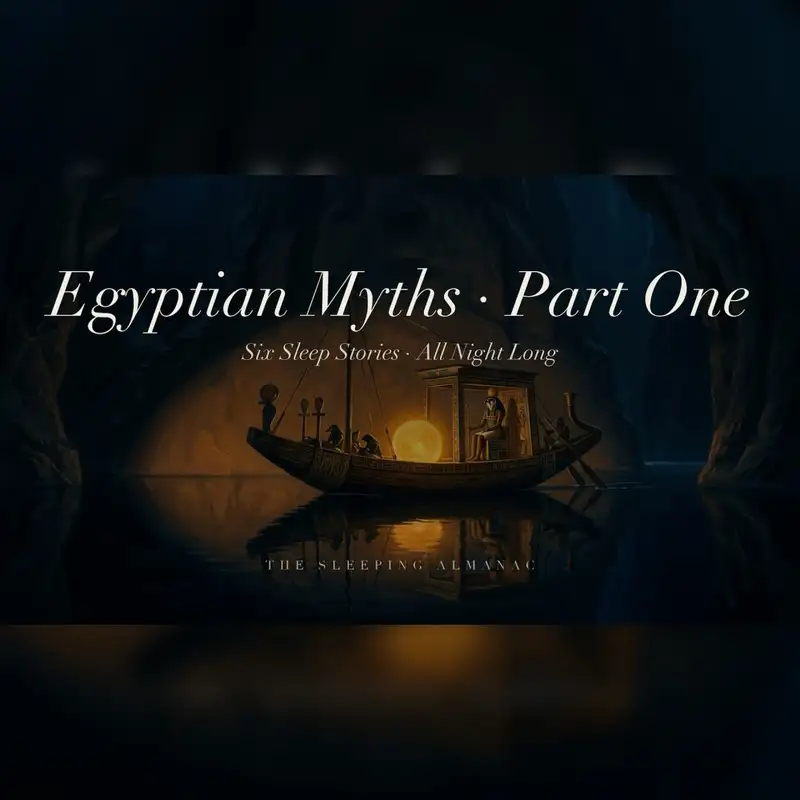
Welcome to The Sleeping Almanac.
Tonight, we are going to go back further than the pyramids.
Further than the pharaohs, further than the first stone ever set upon another stone along the Nile.
We are going back to a night so old that it came before the very first morning.
A night with no stars in it yet, and no sky to hold them.
There was only water.
Dark, still, endless water, with nothing above it and nothing below.
And somewhere in that water, not yet awake, was the sun.
So let your shoulders come down from wherever they have been holding all day.
Let the bed take your weight.
You do not have to follow every word.
You do not have to remember any of it in the morning.
The old Egyptians believed that the world began not with a shout but with a slow stirring in the dark, and that is the pace we are going to keep tonight.
Slow.
Unhurried.
Patient as deep water.
The Egyptians had a name for that beginning, for the very oldest of times, the moment before any other moment.
They called it zep tepi, which means something close to the first time, or the first occasion.
It was the morning before all mornings, the one from which every other day would learn its shape.
And the thing about the first time, the thing that made it holy to them, is that it was not over and done with.
It came round again.
Every dawn was a small return to zep tepi, the world made new exactly as it was made at the start.
So as we go back tonight to that first occasion, you are not going somewhere far away and strange.
You are going to the place that the morning still comes from, every single day, the deep source of every sunrise you have ever seen.
This is the story of the first sunrise.
We will draw it from the oldest religious writing humanity has left behind, the Pyramid Texts, carved into the walls of royal tombs
which set down the teaching of the priests of a place the Greeks would later call Heliopolis, the city of the sun.
The Egyptians called it Iunu.
It was there that the priests told how the sun made itself, and made the world, and learned to rise.
Those texts are very old, older than almost anything we can hold in the mind.
They were cut into stone more than four thousand years ago, in the burial chambers of kings, in narrow rooms meant never to be seen by the living.
The carvers filled the walls with columns of small careful signs, painted in green and blue
so that the words would help the dead king climb out of the dark and join the sun in the sky.
We are about to listen, very quietly, to some of the oldest words that human beings ever thought worth keeping.
They have outlasted every kingdom that came after them.
They were waiting in the dark of those sealed rooms for thousands of years, patient as the deep water they describe, and they are still here
and tonight a little of what they say will carry you down into sleep.
There is a line from one of their old teachers, a man named Ptahhotep, that we will carry with us through this whole season like a small lamp.
He said that good speech, true and ordered speech, is more hidden than the green stone, and yet it may be found among the maidservants at the grindstones.
He meant that what is true is quiet, and easy to miss, and waiting in plain places.
The Egyptians had a word for that kind of order, the rightness that holds the world together.
They called it ma'at.
Keep it nearby.
We will come back to it.
For now, there is only the water.
Close your eyes if they are not closed already, and let us go down to where it begins.
Chapter One.
The Waters That Had No Shore.
Before anything, there was Nun.
That was the name the Egyptians gave to the water that was there before the world.
Not a sea, because a sea has a surface and a floor and a far edge that the eye can reach for.
Nun had none of those things.
It was water in every direction, above and below and within, dark and without movement, neither warm nor cold, going on without limit and without end.
There was no up.
There was no down.
There was no time, because there was no sun to divide the day from the night, and so there were no days at all.
There was only the deep, lying in itself, waiting without knowing that it waited.
The Egyptians did not imagine this as a frightening place, and we will not either.
They imagined it as a kind of sleep.
The water was not angry.
It was not a flood that had drowned some earlier world.
It was simply the way things were before they were anything, the great calm that all things came out of and that all things, in the end, would return to.
When their priests wanted to describe what was most ancient and most restful, they spoke of the waters of Nun.
To go back to Nun was to go back to before the beginning.
In the old texts, Nun is given gentle titles.
He is called the father of the gods, the oldest of them all, the one who was there when no other had yet come to be.
And he was thought to be vast beyond imagining, not a thing inside the world but the thing the world was set down into
the boundless deep that surrounds everything still.
The Egyptians believed that even after the world was made, the waters of Nun never went away.
They lay beneath the earth, the source of the river and the springs.
They lay beyond the farthest desert, at the edges of everything.
And they lay above the sky as well, held back by the body of the heavens, a dark ocean overhead that the stars float in.
The world, to them, was a single bubble of light and air and dry ground, floating in an endless gentle sea that has no shore.
We live, even now, in a clearing made in the middle of the deep.
There is something steadying in that thought, rather than something fearful.
The deep is not waiting to rush in.
It is simply there, all around, the way the dark is there around a lit room, holding it, never crowding it.
The Egyptians did not lie awake worrying that the waters would return.
They knew the deep as the place they came from and the place they would rest in, the great quiet that holds the small bright world the way a cupped hand holds a coal.
To remember that the deep is out there, calm and patient, is not to be afraid.
It is to feel held.
And in those waters, folded into themselves, was everything that had not happened yet.
Every river that would later run.
Every reed that would later bend in the wind.
Every god, every animal, every grain of sand in a desert that did not yet exist.
All of it was there, dissolved into the dark water like salt into a cup, present and yet not present, real and yet not awake.
Somewhere in that endlessness, though we cannot say where, because there was no where, something was beginning to gather.
Not quickly.
Nothing here happened quickly.
But slowly, the way silt settles in still water, the way warmth gathers in a sleeping body, something was drawing itself together out of the deep.
A single point of difference in all that sameness.
A first thought, you might say, in a mind that did not yet have a name.
The Egyptians called what was gathering by many names across their long history, but the oldest and the simplest was Atum.
The name means something close to "the all," and also something close to "the complete one," and also, strangely
something close to "the one who is not yet." Atum was the part of the water that was about to become awake.
He had not opened his eyes.
He had not taken a breath.
He floated in Nun the way you float just below the surface of sleep, when the morning is still far off, and the dream has not yet decided what it will be.
It is worth resting on that name a moment, because the Egyptians clearly loved how much it held.
To be the all and the complete one and the not yet, all at the same time, is a strange and beautiful thing to be.
It means that nothing was missing from him, and yet nothing had happened.
He was whole, and he was waiting.
He contained everything, and he had not yet let any of it out.
The priests who first spoke this name understood, in their quiet way, that fullness and stillness can live together.
A thing can be complete and still be at rest.
You do not have to be doing anything to be whole.
Lying here in the dark, breathing slowly, with the whole long day finished and nothing more required of you, you are a little like Atum in the deep.
Complete.
Unhurried.
Holding everything, and letting it all be still.
The old texts say that he was alone with himself in the water, and that he had no place to stand, and no other to speak to
and that he made the first thought in the dark.
Before there was light there was a thought.
Before there was a word there was the long quiet before the word, the gathering, the readiness.
Everything that the world would ever be was first a slow stirring in the mind of one who floated half asleep in the deep.
There is no rush in the beginning of things.
There is only the patient drawing together of what is about to be.
We are there with him now, in the warm dark, before the first morning.
The Egyptians who first told this story lived in a narrow green country pressed between two great deserts
and they knew water the way only people who depend on a single river can know it.
They knew the river that gave them everything.
They knew the dark of the deep pools where the current slowed.
And they knew how still water can become at night, when not a breath of wind moves across it, and the surface lies as smooth and as black as polished stone.
When they tried to imagine the time before the world, that was the water they reached for.
Not a storm.
Not a drowning.
A vast and gentle stillness, warm as the air on a summer night, holding its breath.
And they understood something about that stillness that is worth resting on.
They understood that it was full.
The waters of Nun were not empty.
They were not nothing.
They held everything that was ever going to be, the way a single seed holds a whole tree, folded so small and so quiet that you would never guess what was waiting inside.
The river that would one day carry their boats was there in the water.
The wheat that would one day feed their children was there in the water.
You were there in the water, and so was this night, and so was the bed you are lying in now, all of it dissolved and dreaming in the deep before the first morning.
There is no hurry in a place like that, because hurry needs a future, and the future had not been made yet.
There is no worry, because worry needs a tomorrow, and there were no tomorrows.
There was only the long, full, patient now of the deep water, going on and on, asking nothing of anyone, complete in itself.
Everything that weighs on you tonight came later than this.
All of it is downstream.
Underneath all of it, holding all of it up, is this old calm water, where nothing yet needs to happen, and nothing is late, and nothing is owed.
There is nothing to do here.
There is nowhere to be.
There is only the water, holding everything, asking nothing.
Let it hold you too.
Chapter Two.
The First Mound.
In the deep water, a single mound of earth rose.
The Egyptians thought about this image their whole lives, because every year they watched it happen.
Each summer the Nile would flood and cover the land, and the whole valley would become a sheet of brown water from desert edge to desert edge.
And then, slowly, as the flood drew back, the first dark hills of soil would lift their backs above the water, glistening and new, ready to be planted.
The Egyptians watched the land be born out of the water every single year.
So when they told the story of how the world began, this is the shape it took.
First the endless water.
Then, rising out of it, the first patch of solid ground.
They called it the Benben.
The first mound.
The first place where there was a here instead of an everywhere.
In the temple at Heliopolis the priests kept a sacred stone of that name, a tapering pillar with a pointed top, and they said it stood for that first hill
the oldest ground in the world.
Long afterward, the capstones of the great pyramids, and the points of the tall stone needles we now call obelisks, were all shaped in memory of the Benben
the small high place that caught the first light.
But all of that was still unimaginably far away.
For now there was only the mound, dark and wet and silent, lifting itself out of Nun.
Think about that for a moment, because it tells you something tender about these people.
When they raised the greatest stone monuments the world had ever seen, the pyramids that still stand on the edge of the desert, they shaped the very top
the highest and last stone, the one that would catch the morning sun before anything else, to be a small copy of the first hill at the beginning of the world.
And the tall thin pillars they set up before their temples, the ones we call obelisks, were tipped with the same pointed shape
and often sheathed in shining metal so that at dawn the very tip would blaze gold while the rest of the world was still in shadow.
Everywhere they built, they were remembering this.
The first high place.
The first ground to break the surface of the deep.
The first thing the light ever touched.
Their whole civilization kept reaching up toward that one small mound, the way a plant reaches up toward the sun.
And the word itself was a small wonder to them.
Benben sounds like other Egyptian words for rising, for shining, for welling up, the way water wells up from a spring or light wells up over the horizon.
To say the name was to say, all at once, the hill that rose and the light that rose and the sun that rises.
They heard the whole morning folded into that single soft word.
We will not always be able to follow the play of their language, but it is worth knowing that for them the names of things were never only labels.
A name carried the nature of the thing inside it, the way a seed carries the tree.
The first mound and the first rising and the first light were all one word, because to them they were all one act, the world lifting itself gently into being.
And on the mound was Atum.
He had come to rest there the way a tired traveler comes to rest, though there had been no journey, and there was nowhere he had come from except the water itself.
He was the first thing to be somewhere.
The first thing with an edge, with an outline, with a place where he stopped and the rest of the world began.
Around him the waters of Nun still stretched away without end.
But he was no longer only water.
He was a shape upon the water.
He was the beginning of the difference between something and nothing.
In some of the old tellings, a bird came to the mound.
A grey heron, tall and still, standing at the water's edge as herons do, watching.
The Egyptians called it the bennu, and later the Greeks would hear of it and call it the phoenix, the bird that is reborn from its own ashes and never truly dies.
The bennu was said to have flown across the face of the waters and come to rest on the Benben, and when it gave its first cry
that cry was the first sound that had ever been made.
It broke the long silence.
It told the dark that something had changed.
It is a quiet, true image, if you have ever watched a heron.
They are patient birds, the most patient of all the birds of the river.
They stand in the shallows without moving for a long time, so still that you can forget they are alive, and then in their own moment they lift
slow and unhurried, on great soft wings.
The Egyptians knew the heron well, for it haunted the marshes along the Nile
and they chose it to be the first living thing to come to the new world precisely because of that stillness.
The bennu did not rush to the mound.
It came the way a heron comes, gliding low across the dark water, folding its long legs, settling without a sound.
And only then, in its own time, did it open its throat and cry, and the cry went out across the deep where no sound had ever been
and the long silence of forever was over.
The Egyptians thought of the bennu as the soul of the sun, the spirit of the light taking the shape of a bird so that it could be seen and welcomed.
They said it lived on the Benben stone, and that it returned across vast stretches of time, age after age, always the same bird, never truly dying, only renewing itself.
That is the seed the Greeks later grew into the story of the phoenix, the bird that burns and is born again from its own ashes.
But the older Egyptian bird is gentler than that.
It is not about fire.
It is about return.
The heron that came to the first hill is the same light that comes back over the horizon every morning, faithful, unhurried
crossing the dark to settle once more on the high ground and to cry the day awake.
The Egyptians built this whole picture of the beginning on something they watched with their own eyes every year.
Each summer the great river rose.
It spread out beyond its banks and covered the fields and turned the long valley into a single sheet of still brown water, from one desert wall to the other.
For weeks the land simply vanished beneath the flood.
And then, slowly, as the water began to fall, the first high places would appear again.
Dark, wet mounds of earth lifting their backs above the surface, glistening in the early light, the richest soil in the world laid fresh upon them.
Within days the farmers would be out walking those first islands of mud, pressing in the seed, and the green would return, and life would begin again.
So when they imagined the very first beginning, the beginning of all beginnings, they reached for that exact picture, because they trusted it.
First the endless water, the way the flood is endless while it lasts.
Then the first mound, lifting its dark back into the light, the first dry place, the first here in all the everywhere.
The Egyptians were not guessing wildly when they told this.
They were describing the thing they saw every single year, raised up to the size of the whole world.
Creation, to them, was not a violence.
It was a flood drawing back.
It was the good earth rising, patient and certain, ready to be planted once again.
There is a comfort in that worth carrying down into sleep.
The people who told this story did not believe the world had to be torn into being.
They believed it rose, quietly, the way their own fields rose every year out of the falling water, and that it would go on rising, season after season
long after they were gone.
We should let ourselves rest here a moment, on the first ground, in the first quiet after the first sound.
Notice how much has already happened, and how gently.
There has been no battle.
Nothing has been broken.
The world is not being torn from anything.
It is simply lifting itself, patiently, out of the deep, the way a thought lifts itself out of sleep.
A mound of earth.
A standing bird.
A single cry, fading now back into stillness.
And on the high ground, the one who was about to make everything, sitting alone, beginning at last to wake.
Chapter Three.
The One Who Made Himself.
Atum opened his eyes, and there was no one to see.
This is the strangest and the loveliest part of the Egyptian beginning, and their priests turned it over and over for thousands of years.
Atum was alone.
Truly alone, in a way that nothing has ever been alone since.
There was no sky for him to look up into, because he had not made it yet.
There was no land beyond his small mound, because he had not made that either.
There were no other gods, no animals, no people, no voices.
There was only the one figure on the one hill in the middle of the endless water, and the water did not speak.
So if there was going to be a world, Atum would have to bring it out of himself.
He had nothing else to make it from.
The Egyptians said that he was the one who came into being on his own, the one who made himself, and they did not find this idea troubling.
They found it comforting.
It meant that creation did not depend on anything outside itself.
The world was not made from the body of a defeated enemy, the way some peoples told it.
It was not stolen or won in a war.
It came, quietly, from the inside of the first god, who simply decided to be more than one.
How he did it, the old texts tell in more than one way, and we will be honest about that
because the Egyptians were comfortable holding several pictures of the same truth at once.
In one telling, Atum spoke, and the speaking made things real.
In another, he simply willed it, and what he held in his heart became what was.
And in the oldest and most physical telling, the one carved into the pyramid walls, he brought the next gods out of his own body
from his own breath and his own moisture, the way a spring brings water out of dry rock.
The Egyptians were not embarrassed by the body.
To them, making life from the body of a god was the most natural image there could be.
The point, in every version, is the same.
The one became the first of many.
The lonely figure on the mound was about to have company.
There was a power the Egyptians believed in that runs underneath all of these tellings, and it is worth a gentle word, because we will meet it again and again.
They called it heka.
We do not have a clean word for it.
We sometimes translate it as magic, but that makes it sound like a trick, and it was nothing of the kind.
Heka was the force that makes things happen, the power that turns a thought into a thing, a word into a deed, a wish into the world.
It was the energy of creation itself, present from the very first, older than the gods who used it.
When Atum thought of the world and the world began to be, that was heka working.
When he spoke a name and the named thing came into being, that was heka.
The Egyptians believed that to know the true name of a thing, and to say it rightly, was to hold a little of the power that made it.
And so for them, words were never small.
A word said with knowledge and care could shape what was real.
This is why their hymns and their healing spells and their prayers mattered so much to them.
They were not asking.
They were taking part, in their small human way, in the heka that made the world.
There is a kindness in that idea that you can carry into the dark.
It means that the gentle words you say to yourself at the end of a hard day are not nothing.
The Egyptians would have told you that words have a weight, that to name the day finished and to say that it is enough and to tell yourself, quietly
that you are allowed to rest, is to set a little order in your own small world.
So let the last words of your day be soft ones.
Let them be true.
The same power that the first god used to make the morning is, in the smallest and most ordinary way, the power you use when you tell yourself it is time, now, to let go.
And notice what he made first.
Not stone.
Not gold.
Not a throne or a crown or a weapon.
The first two things that Atum brought into being were air and moisture.
The breath you are breathing now, slow and even in the dark, and the faint dampness of it on your lips.
These were the first children of the first god.
The Egyptians named them Shu and Tefnut.
Shu was the air, the dry bright space that holds everything apart so that there is room to move.
Tefnut was the moisture, the wet and the dew and the rain that has not fallen yet.
Between them they were the very substance of weather, of breathing, of the difference between the inside of a thing and the air around it.
So now there were three on the mound where there had been one.
The father, and the air, and the water that falls.
And for the first time since the beginning, Atum was not alone.
He gathered the two of them close, the old texts say, and he was glad, and the gladness itself was a new thing in the world
because there had been no one to be glad with before.
The Egyptians chose those two, air and moisture, as the first to be made, and we should not pass over the choice too quickly, because there is wisdom in it.
They might have begun the world with anything.
They could have made the sun first, or the gods of war or the gods of gold, or the great kings.
But they began with breath and with water, the two things a body cannot live without for even a little while.
Shu and Tefnut are not grand.
They are not throne and crown.
They are the air in your lungs and the moisture on your lips, the very plainest gifts, the ones so constant that we forget them entirely.
The Egyptians, who lived close to the line between thirst and life, never forgot them.
To begin the world with breath and water was their way of saying that the first holy things are the ones that keep you alive without your ever noticing
the slow breath you are taking right now, the soft dampness of it, the simple machinery of being a living thing in the dark.
And there is one more thing to notice about how Atum made the first two gods, because the Egyptians noticed it, and it mattered to them.
He did not make servants.
He did not make tools or soldiers or stones to build with.
He made family.
The very first act of creation, once the lonely god decided to be more than one, was to bring into being someone to be with.
Company.
Kin.
Two children gathered close on the small high ground above the water.
The Egyptians were a people who loved their families deeply, who filled their tombs with images of husbands and wives sitting side by side
of children gathered at their parents' feet, of households meant to stay together not only through this life but through whatever came after.
And so it told them something true and tender that the world itself began as a family coming together.
Not power reaching for more power, but a parent who had been alone, reaching out, and no longer being alone.
The loneliness of the first god is one of the oldest feelings in any story humans have told.
And the cure for it, in this telling, is the simplest and oldest cure there is.
Someone to sit beside.
Someone to be glad with.
So picture them now, the three of them, on the first ground in all the world.
The father, weary and content.
The bright dry air, newly breathing.
The soft moisture, settling like dew.
Around them the endless water still lies dark and calm, but they are no longer lost in it.
They have each other, and they have somewhere to be, and the long aloneness of the beginning is over at last.
Rest there with the three of them, in the first company, on the first ground.
The hardest part is over.
The world has decided to exist.
From here, everything will unfold more gently, like a long slow exhale that has only just begun.
Chapter Four.
The First Breath and the First Rain.
Shu was the air, and so the first thing he did was to make a space.
Before Shu there had been no room between things, because there had been only the water, packed against itself with no gap anywhere.
But air is the gift of distance.
Air is what lets two things be near each other without being the same thing.
When Shu came into being and breathed out, he pushed a little of the endless water back, and in the space he cleared there was, for the first time
somewhere to stand that was not underwater.
A pocket of dryness in the deep.
A held breath in the middle of the flood.
The Egyptians thought of Shu as the one who holds things up and holds things apart.
In their pictures they drew him kneeling with his arms raised, lifting the weight of the sky away from the earth
keeping the two from collapsing back together into one crushed mass.
He was patience made into a god.
He was the steady effort that keeps a space open so that life can happen inside it.
Without him the sky would lie down on the land and there would be no room for anything to grow, or move, or breathe.
Every breath you take tonight is a small repetition of what Shu did at the beginning, making room, again and again
so that you can keep living in the space he holds open.
His name, too, the Egyptians felt to be full of meaning.
Shu sounds like their words for emptiness and for dryness and for the act of raising up, and so to say his name was to feel, all at once
the dry clear space he made and the lifting that made it.
He was the god you cannot see but feel on your skin, the breeze in the doorway on a hot evening, the cool of the air at the top of a high place
the invisible something that fills the gap between one thing and another.
The Egyptians had a lovely sense that the wind itself was Shu breathing
that when the air stirred across the river at dusk it was the first god of the air moving quietly through the world he held open.
When the night air touches your face tonight, you might think of it that way.
The oldest breath there is, still moving, still making room.
Tefnut was the moisture, and she was harder to draw, because moisture has no edges.
She was the dew that gathers on cool stone before dawn.
She was the dampness in the breath of a sleeping animal.
She was the rain that the Egyptians almost never saw, because in Egypt rain is rare and the land drinks instead from the river.
But she was also the river's own wetness, the life in the water that makes seeds swell and roots reach.
Where Shu was space, Tefnut was the softness that fills it.
The two of them belonged together the way breathing in belongs with breathing out.
The old priests of Heliopolis arranged all of this into a family, and they counted the generations carefully, because to the Egyptian mind, order was holy.
First there was Atum, the source.
Then Shu and Tefnut, air and moisture, the first pair.
And from that first pair, in time, would come the next, and from those the next, until there were nine great gods altogether
the family that held the whole shape of the world.
They called this family the Ennead, which simply means "the nine." We will meet all nine before the season is through
because their story is the story of everything that follows, the love and the loss and the long struggle that the Egyptians told for three thousand years.
But tonight we are still near the beginning, with only the first three, and then, very soon, the first four.
It is a gentle thing to know, lying here at the start of a long season, that the whole family is already implied in these first few.
The Egyptians liked to count it out, almost like a lullaby of names.
From Atum came Shu and Tefnut, the air and the wet.
From Shu and Tefnut would come Geb and Nut, the earth and the sky, whom we will meet in a little while.
And from Geb and Nut would come the last and most storied of the nine
four children whose loves and griefs and long patience fill nearly all the nights of this season to come.
There is a green king among them, and a wise and faithful queen, and a brother who brings the long sorrow, and a quiet sister who keeps the watch.
But we do not need their names yet, nor their story, not tonight.
Tonight it is enough to know that they are coming, folded up small in the beginning the way the whole tree is folded into the seed, waiting
as everything waits in these old quiet tales, for their own time to unfold.
And there is comfort in a thing being a family rather than a machine.
The Egyptians did not imagine the world as a set of forces grinding against each other.
They imagined it as kin, generation after generation, each one bringing the next into being and then making room for them.
The order they so loved was not the cold order of a clock.
It was the warm order of a household, where the elders make a place for the young, and the young carry the line forward, and everyone has their station and their part.
When you hear, across this season, of the struggles and the sorrows of these gods, remember that underneath all of it they are one family
sprung from a single lonely figure on a hill who simply did not want to be alone.
The whole of Egyptian myth is, in the end, the long story of a family, and you are about to spend many quiet nights inside it.
The Egyptians gave Shu and Tefnut another role as well, one that runs quietly under everything else in this season.
They said that the two of them were the parents of the sky and the earth, which we will come to in a little while.
But more than that, they were the gap and the gift that made a world possible at all.
Shu, the air, was the reason there could be an inside and an outside, a here and a there, a breath drawn in and a breath let go.
Tefnut, the moisture, was the reason the dry world could still be soft
that there could be dew on the morning grass and water in the living body and tears in the eye of a god.
Between the two of them, air and water, they were the whole climate of the world, the weather that makes a place livable.
And the priests of Heliopolis, who loved to set things in careful order, taught that this was the true shape of creation.
Not a single great explosion, but a patient unfolding, one generation bringing forth the next, each gift making the next gift possible.
The source brings forth the air and the water.
The air and the water will bring forth the earth and the sky.
The earth and the sky will bring forth the gods whose loves and griefs fill the rest of these long nights.
Step by gentle step, the way one quiet thing leads to another, the way one slow breath leads to the next, until without any hurry at all there is a whole world
and a whole family, and a whole story waiting to be told.
There is something worth resting on here, before we go on.
The Egyptians did not begin the world with kings or armies or gold.
They began it with the most ordinary and most necessary things there are.
Air.
Water.
The space to breathe and the moisture to live.
The things you cannot see and never think about and could not survive an hour without.
Their creation story is, at its root, a quiet act of gratitude for breath itself.
And so, as Shu holds the space open one more time, take a slow breath in, and let it fall, and let yourself sink a little deeper into the warm dark
where the family of the first morning is still gathering on the first hill above the endless calm of Nun.
Chapter Five.
The Lost Children and the Weeping Eye.
Now we come to a story the Egyptians loved, because it explained, in a single tender image, where people come from.
When Shu and Tefnut were still young, the old texts say, they wandered away from their father into the dark waters of Nun.
Perhaps they went exploring, the way the first of anything explores.
Perhaps the endless water simply drew them out and closed over them, and they were lost in it, two small new gods swallowed by the deep that had no edges.
And Atum, on his mound, found that he was alone again.
The children he had made from his own breath were gone, somewhere out in the limitless dark, and he could not see them, and he did not know if they would come back.
So he did something that any parent would understand.
He took out his own eye, and he sent it to look for them.
This is one of the oldest and strangest ideas in Egyptian religion, and it runs through the whole of this season, so let us sit with it gently.
The Egyptians believed that the sun itself was, in a sense, the eye of the great god.
The thing that sees, the thing that gives light, the thing that searches the world from above and misses nothing.
When Atum sent out his eye to find his lost children, he was sending out the light to search the dark.
And the eye went out across the face of the waters, shining, looking, and at last it found Shu and Tefnut far out in the deep, and it brought them home.
Stay with that image a little, because it is a beautiful one and it repays a slow look.
The light, for the Egyptians, was not a thing apart from the god.
It was his very eye, sent out from him to do his looking
the way you might send your gaze across a dark room to find a sleeping child and make sure the breathing is steady.
The sun did not merely shine on the world.
It watched over it.
It searched it.
It cared.
Every ray that crosses the world is, in this old way of seeing, a look from someone who is paying attention, someone who does not want anything to be lost.
There is a tenderness in being seen like that, in being looked for.
Whatever else you feel tonight, the oldest story these people told says that the light is out there searching
and that what it is searching for is the ones who have wandered off, so that it can bring them home.
When they came back to the mound, Atum wept.
He wept with relief, the way you weep when something you thought was lost is suddenly returned to you.
And the Egyptians, who loved a play on words even in their most sacred texts, noticed that their word for the tears of a god, remyt
sounded almost exactly like their word for human beings, remetj.
And so they told it that when the first god wept for joy at the return of his children, his tears fell upon the new earth, and where each tear struck
a human being rose up.
That is where people came from, the priests of Heliopolis said.
We are the tears of the creator, wept in gladness at the moment a lost thing was found.
We should be honest and say that this was one telling among several, because the Egyptians had more than one account of where people began
and they were content to hold them side by side.
But this is the one to carry into sleep, because of what it says about us.
It says that human beings were not made as servants, or as an afterthought, or as a punishment.
We were made of a god's relief and a god's joy.
We came into the world at the exact moment that grief turned back into gladness.
There is a great tenderness in that, and the Egyptians felt it.
To be a person, in this old story, is to be a small piece of the creator's happiness, set walking upon the earth.
That play on words, the tears and the people, the remyt and the remetj, was not idle to them, and it is worth understanding why.
The Egyptians believed, as we touched on earlier, that the names of things told the truth of things.
So when their word for the weeping of a god and their word for human beings sounded almost the same, they did not think this was an accident of language.
They thought it was a clue, a hint left in the very sound of the words, pointing to where people had really come from.
The likeness in the sound was, to them, a kind of proof.
We are named, in their hearing, after the tears of the first morning.
The word for what you are still carries, very faintly, the sound of a god weeping for gladness.
It is a strange and lovely thing to think that buried inside the oldest name for our kind there is the memory of a joy.
There is a second tenderness folded into this story, and the Egyptians felt it keenly.
When the lost children came home, the old texts say, they did not come back to the same father they had left.
While they were gone, Atum had grieved, and grief changes a person, even a god.
And so when Shu and Tefnut returned, he set his eye back into his face, but he set it in a new place, high on his brow, where it could always see
where it could keep watch over the children he had so nearly lost.
The Egyptians said that this is why the sun rides high in the sky and looks down upon the whole world.
It is the watchful eye of a parent who once knew what it was to lose what he loved, and who never wants to feel that again, and so keeps looking, always
to be sure that everything is where it should be.
And think again of what it means that our own beginning, in this telling, is bound up with that moment.
We are the tears of that homecoming.
We rose from the ground where joy fell.
Every human being who has ever lived began, in the story the priests of Heliopolis told
at the precise instant when a father stopped grieving and started weeping for happiness instead.
Whatever else is true of us, this old story says that we are made of relief.
We are made of the moment the lost thing is found and the long fear lets go.
So if there is anything tonight that feels lost to you, anything you have been holding onto or holding off, let this old image hold it for a while.
The eye is out there searching the dark, and the eye is gentle, and the eye brings the wanderers home.
And the eye that went searching has its own long road ahead of it.
Across this season we will see it again and again, sometimes as the gentle light that returns the lost, sometimes as a goddess in her own right, sometimes
when it is angered, as a thing of fire that the gods must learn to calm.
But tonight it is only the kind light that searches the dark and brings the wanderers home.
Let it search gently over you as you drift.
It is not looking to wake you.
It is only making sure that you, too, are safe, and gathered in, and held.
Chapter Six.
Earth and Sky.
From Shu and Tefnut, air and moisture, came the next two great gods.
And these two you can see with your own eyes, every day and every night, for as long as you live.
Their names were Geb and Nut.
Geb was the earth, and Nut was the sky.
Geb was the land itself, the dark rich soil of the river valley, the rock beneath it, the whole solid body of the world.
The Egyptians drew him lying down, because the earth lies down, stretched out and patient, holding everything that grows.
They said that the low hills were his shoulders and his knees, and that when he laughed it was the trembling of the ground
and that all the plants of the world grew up out of his green back.
He was steady and he was generous.
Everything that lives stands upon him, and in the end everything that lives lies down again upon him to rest.
There is no gentler thought to hold at the edge of sleep than that the earth itself is a god who lies down, and that you are lying down upon him now, held
and carried, and at rest.
Nut was the sky, and she was one of the most beautiful figures the Egyptians ever imagined.
They drew her as a woman arched high overhead, her fingertips touching the eastern horizon and her toes touching the western one
her whole long body curved across the top of the world like a great vault.
Her skin was deep and dark, and across it were scattered all the stars.
When you look up on a clear night and see the band of the Milky Way stretched from one edge of the sky to the other, the Egyptians saw the body of Nut
bending over the world, keeping the dark waters of Nun from crashing back down upon it.
She was the ceiling of everything.
She was the dark that holds the stars.
The Egyptians painted her on the insides of their coffin lids, which tells you better than anything how they felt about her.
When they laid a beloved one to rest, they wanted the very last thing above the body, looking down, to be Nut, the great mother of the sky
arched protectively overhead just as she arches over the whole living world.
So the one who had died would lie within her, the way the stars lie within her, the way the sun lies within her each night.
To be dead, in that picture, was to be gathered up into the body of the sky, held in the dark among the stars, carried through the night toward a new dawn.
There are few gentler things in all of human imagining than that.
They could not bear for their dead to lie under nothing.
And so they gave them the whole star scattered body of the heavens to lie beneath, a mother bending close in the dark.
She was thought to be a tender and watchful figure, this goddess of the sky, and very ancient.
The old texts call her the one who bears the stars, the one in whom the gods are born and reborn
the great protectress whose body shelters the world from the deep that lies above it.
For remember, the waters of Nun did not vanish when the world was made.
They still pressed down from above, the dark ocean overhead, and it was Nut, arched and steady, who held them off
who kept the deep from crashing back down and unmaking everything.
Every night you have ever slept safely beneath the open sky, you slept under her.
The dark you see overhead is not emptiness.
In the oldest seeing of these people, it is someone, bending close, holding back the deep, scattered all over with the lamps of the stars
watching the small warm world go round to morning.
Now, the priests of Heliopolis told a tender and slightly sorrowful tale about Geb and Nut, the earth and the sky.
They said that in the very beginning the two of them lay close together, the sky resting upon the earth
holding each other so tightly that there was no room between them.
And while they held each other, nothing could grow, because there was no space, no air, no light getting in.
So Shu, their father, the god of air, came between them.
He set his hands beneath Nut and lifted her up, high above Geb, and held her there.
He raised the sky away from the earth and made the great open space of the world, the space we all live inside
with the land below and the stars above and the bright air in between.
The Egyptians felt the sweetness and the sadness of that.
The earth and the sky had been lifted apart so that life could exist, and they would spend all of time reaching for each other across the distance
the rain falling from sky to earth, the smoke and the prayers rising from earth to sky, never quite able to touch again.
But because they were parted, there was room.
Room for the sun to sail.
Room for birds to fly and rivers to run and people to walk and lie down and dream.
The space you are resting in tonight, the quiet dark between the floor and the ceiling of your room
is a small echo of that first great space that Shu made when he lifted the sky away from the earth.
The Egyptians lived with these two gods more closely than with almost any others, because they could not help it.
They saw Geb every time they knelt to work the dark soil, every time they lay down at night on the warm ground
every time they buried someone they loved and gave the body back to the earth that had given it.
And they saw Nut every clear night of their lives, the great dark woman arched overhead, scattered all over with stars.
They even told that Nut swallowed the sun each evening at the western horizon, and carried it through the long darkness inside her body
and gave birth to it again each morning in the east, red and new, between the hills of the dawn.
The sky was a mother who took the light into herself at night and returned it, faithfully, at first light.
There is no more reassuring picture in all of their wisdom than that.
And between the earth that holds and the sky that shelters, there is the space where we live.
The Egyptians never stopped being grateful for that space.
They knew, because their priests taught it, that the room they breathed in had been made on purpose, lifted open and held open so that there could be life.
Every house with a roof and a floor was a small image of it.
Every still night under the stars was a reminder of it.
The world is a room with the good earth for its floor and the star scattered body of the sky for its ceiling, and you are lying down inside it now
exactly where you are meant to be, held below and sheltered above.
And here, in the middle of the story, it is worth remembering the small lamp we set out at the very beginning, the words of the old teacher Ptahhotep
and the word ma'at that they pointed toward.
He taught that the deepest order of things is quiet, that good and ordered speech is more hidden than the green stone
and yet it may be found in the humblest of places, among the maidservants at the grindstones.
Look at what has been made so far in this story, and notice how quietly it was made.
The earth lay down.
The air lifted the sky.
A space opened where life could be.
There was no thunder in any of it.
The order that holds the world apart so that we can live inside it was set in place without a single shout.
That is ma'at.
Not a loud command but a steady arrangement
a rightness so quiet and so reliable that we live inside it without ever once noticing the work it does to hold the ceiling off the floor.
And before Shu lifted her up, while the sky and the earth still lay close in the dark, Nut had brought forth children of her own.
Five of them, the most important gods in all the long story of Egypt.
But the telling of how they came to be born is a story all its own, full of moonlight and clever wagers and a game played for the oldest of stakes.
That story waits for us a little further on.
For now, let the sky lift gently overhead, and let the earth hold you from below, and rest in the wide calm space between them
where the whole world has just been given room to breathe.
Chapter Seven.
The Sun Takes Its Throne.
We have spoken of the first god as Atum, the one who made himself on the mound.
But there was another name, and it is the name this whole season belongs to.
Ra.
The Egyptians used the two names together so often that they wrote them as one, Atum and Ra spoken in a single breath, and it is worth understanding why, slowly
because it is the heart of tonight's story.
Atum was the god of the source, the one who began in the deep and gathered the world out of himself.
He was the completeness of things, and also their old age, the sun as it sinks at evening, full and red and finished with the day.
But Ra was that same power seen at its height.
Ra was the sun blazing at noon.
Ra was the light when it is strongest, the warmth at the top of the sky, the great golden disc that the whole earth turns its face toward.
The Egyptians did not think of these as two different gods quarreling for one throne.
They thought of them as one being in different lights, the way you are the same person when you first wake and when you are most awake
and the same person again when you are finally, gratefully, lying down to sleep.
This is worth lingering over, because it is a kind and a wise way of seeing, and the Egyptians lived by it.
They did not feel that a thing had to be only one thing to be real.
The very god at the centre of their world was the source and the height and the setting all at once
the hidden one in the deep and the blazing one at noon and the tired red one going down in the west, and not one of these names was a lie
and not one of them was the whole truth.
They held the great being lightly, in all its faces, and were content.
There is a rest in learning to do the same with yourself.
You are the one who rose this morning and the one who carried the long bright middle of the day and the one who is sinking now toward sleep
and all of them are you, and none of them is the whole of you, and you do not have to choose.
You are allowed to be many things, the way the sun is, and to let the evening face be as true and as good as the morning one.
And notice, gently, that the season is named for the height, for Ra, the blazing noon, and yet tonight we have met him most as the source and as the setting
as the quiet one in the deep and the red one going down.
That is no accident.
The Egyptians knew that the brightest power is best understood from its calm edges, from where it begins and where it comes to rest.
The whole long season ahead is the story of the sun in its strength, the great struggles and loves of the family it began.
But it opens here, in the quiet, with the light at its gentlest, rising and setting, because that is the face of the sun that belongs to sleep.
The blazing noon is for the waking world.
The soft gold of the beginning and the end is for the dark, and for the bed, and for you, here, now, at the edge of rest.
And when the world had been made, when there was earth below and sky above and the wide air between, the god rose up over it as the sun, and the first true day began.
Try to imagine that first sunrise, because no one had ever seen one.
There had been the long dark of Nun, and then the dim grey light of the bennu's cry, and the slow making of air and water and earth and sky.
But there had never yet been a morning.
And then, over the eastern edge of the new world, the disc lifted.
Gold poured across the water.
The dark that had been there since before the beginning drew back for the first time, not destroyed, only set aside for a while
and the whole new earth was washed in warm light.
The river caught fire with it.
The first mound, the Benben, blazed like a lit lamp.
And every living thing that had just been made lifted its face, the way living things have lifted their faces to the morning ever since.
Try to feel it, slowly, the way the Egyptians must have felt it when they sang it.
First the long dark, which was all there had ever been, so that no one and nothing had any idea that the dark could end.
Then the faintest change at one edge of the world, a thinning, a greying, a softness coming into the black where the eastern hills would be.
Then the first true colour the world had ever held, a deep red bleeding up out of the horizon, and the water far off beginning to glow.
Then the rim of the disc, just the curved top edge of it, breaking the line of the world, and the first ray going out flat and golden across the new earth
touching the high places first, the Benben, the tops of things, and running down into the low places after.
And then warmth.
Warmth, which the world had never known, spreading across the cool new ground, soaking into the wet mound, lying gently on the upturned faces of everything that lived.
The Egyptians never tired of that sequence.
It was the most ordinary miracle there is, and they treated it, every single dawn, as though it were the first one.
And imagine the silence breaking into sound.
The bennu had cried once, long before, and then the world had gone quiet again through all the slow making of things.
But now, with the light, the whole new earth seemed to find its voice at once.
This is why, ever after, the birds of Egypt sang the loudest at dawn, and the people understood it perfectly.
They were greeting the light.
They were doing what every living thing wants to do when the dark lets go, which is to make a glad noise and lift the face and feel the first warmth come.
You have done it yourself, on some early morning, stepping out into the first sun after a cold or a sleepless night
feeling it touch your skin and something in your chest ease.
That is very old, that feeling.
It is as old as the first morning.
It is the world remembering, every dawn, that the light came back.
And here is something gentle to understand about the way the Egyptians thought, because it is easy to be confused by it otherwise.
They did not mind that the sun had many names, and many forms, and more than one story of how it came to be.
They were not troubled the way we sometimes are when two accounts do not line up perfectly.
To them, the sun was simply too great a thing to be caught in a single picture.
It was the source on the mound and it was the disc in the sky.
It was Atum and it was Ra.
It was the old one and the bright one and, as we will see, the new one being born at every dawn.
The Egyptians held all of these at once, easily, the way you might hold in your mind that a person is a parent and a child and a friend all at the same time
no one of these untrue, no one of these the whole truth.
This is a restful way to hold the world, if you can manage it.
Not everything has to be resolved into a single tidy answer.
Some things are simply large, and many sided, and you can let them be large without needing to pin them down.
So when the sun rose over the world for the first time, it was the same one who had stirred in the deep, now wearing the face of the blazing day.
The completeness of the dark water had become the warmth of the morning.
Nothing had been lost in the change.
Everything had only come into its light.
The Egyptians never lost their wonder at this.
For three thousand years, in temple after temple, the priests rose before dawn and waited in the dark and sang the sun up over the horizon, every single morning
as though it might be the first one, as though it still needed their welcome.
They were not anxious people, on the whole.
But they understood that the rising of the sun was the oldest victory there was, light coming back into the dark, and that it was worth being grateful for
every day, without ever growing used to it.
So the sun took its place over the world, and the god who had begun as a stirring in the deep water now sailed at the top of the sky
looking down upon everything he had made.
And it was good, and it was warm, and it was, at last, no longer dark.
Rest in that first warmth a while.
You do not have to do anything with it.
Just let it be morning, somewhere very old, for the very first time.
Chapter Eight.
The Boat of Millions of Years.
The sun does not stand still in the sky.
It moves.
And the Egyptians, who lived their whole lives beside a river, knew exactly how a thing crosses a wide space slowly and steadily from one side to the other.
It goes by boat.
So they said that the sun crossed the sky in a boat, and they gave the boat a name.
They called it the Mandjet, the boat of the daytime, though they also called it by a grander title that I love, the Boat of Millions of Years.
Because the sun had been making this crossing since the first morning, and would go on making it for millions of years more, the same patient voyage
dawn to dusk, day after day after day, longer than any kingdom, longer than any memory, longer than the stones themselves.
In the boat, the Egyptians said, Ra did not sail alone.
He had a crew.
There were other gods who rode with him and worked the great vessel across the heights of the sky.
There was one who stood at the prow and watched the way ahead.
There was one who held the steering oar.
There was wisdom aboard, and magic aboard, and strength aboard, all the powers that the morning needs to carry the light safely from one horizon to the other.
The Egyptians imagined the sky as a kind of celestial Nile, a river of air arching over the world, and along it the bright boat sailed
with the sun shining at its center, and the gods at their stations, calm and unhurried, doing the oldest work there is.
It comforted them to think that the light was not left to fend for itself, that it had companions, that the great work of carrying the day was shared.
The very heka we spoke of, the creative power that made the world, was said to ride in the boat as a god in its own right, standing near the sun
ready to speak the words that keep the way clear.
The all seeing eye sailed there too.
And there were others whose task was simply to watch, to steer, to keep the steady rhythm of the crossing.
None of them hurried.
None of them were afraid.
They had made this voyage more times than there are grains of sand, and they would make it more times still
and they went about it with the calm of people who know their work and trust each other to do theirs.
There is a deep peace in that picture, in a thing being well crewed and unhurried and sure of its way.
The light is not alone up there.
It never has been.
Good and faithful hands are at the oar and the steering and the lookout, and they have never yet let the morning fail to come.
The Egyptians also loved the title they gave that boat, the Boat of Millions of Years, and it is worth saying slowly
for it is one of the most restful phrases they ever made.
Millions of years.
Not a day, not a season, not a single human life with all its hurry, but millions of years, a span so long that no worry can survive inside it.
Whatever presses on you tonight is happening inside one small day, one turn of the boat.
But the boat itself has been sailing since before the first kings, and it will sail long after the last of us, the same patient crossing, dawn to dusk and round again.
To set your small day down beside the millions of years of that voyage is to feel it grow light.
The boat does not strain.
It does not race the clock.
It has all the time there is, and so, just for tonight, so do you.
The Egyptians were the greatest boat people of the ancient world, and so this was the most natural image they had.
Their whole country was strung along a single river.
They traveled by boat, they traded by boat, they carried their dead to the tombs by boat, and they buried their kings with real boats
full sized vessels laid in pits beside the pyramids, so that the dead might join the sun on its eternal sailing.
When they looked at the sky and tried to understand how the sun moved, they did not reach for anything strange.
They reached for the thing they knew best in all the world.
The sky was a river, and the sun went down it the way everything went down their own river, slowly, steadily, carried by the current, with a crew aboard to keep it true.
And they imagined that long voyage in loving detail.
They knew that a great river journey has a rhythm to it, the dip and lift of the oars, the small sounds of the water against the hull, the slow sliding by of the banks.
They pictured the sun's boat exactly so, gliding without haste along the high blue river of the sky, the light pouring off it onto the world below
the gods at their quiet stations doing the oldest work there is, hour after unhurried hour.
Nothing about it was frantic.
Nothing about it was forced.
It was the calmest crossing imaginable, repeated faithfully every day since the first day, and meant to be repeated for millions of years to come.
Think of how steady that is.
Not a chariot racing, not a fire flung across the heavens, but a boat, moving at the pace of deep water, carried along by a current you cannot see.
The Egyptians did not picture the day as a sprint.
They pictured it as a long, smooth sail.
The sun rises in the east, where the boat puts out from shore.
It climbs to the top of the sky by noon, when the boat reaches the middle of the great river.
And then, all afternoon, it descends gently toward the west, where the boat will come at last to the far shore as the light turns gold and then red and then dim.
There is a reason the Egyptians found this image so deeply restful, and so do we.
A boat carries you.
You do not have to swim.
You do not have to row.
You lie back in the hull and the river does the work, and the far shore comes to you in its own time
whether you watch for it or whether you close your eyes and let the motion rock you.
Tonight, you are a passenger on the oldest boat there is.
The light is sailing west.
The current is slow and sure.
You have nowhere to be but here, carried, while the great vessel makes its quiet way across the top of the world.
Chapter Nine.
The Three Faces of the Sun.
The Egyptians watched the sun very closely, more closely than almost any people who have ever lived, and they noticed that it does not look the same all day.
And so they said that the sun god wore three faces, one for each part of his journey, and that he changed from one to the next as the day turned.
In the morning, when the disc first lifts over the edge of the world, fresh and new and climbing, they called him Khepri.
And here the Egyptians did one of the things they did best, which was to find a great truth hidden in a small and ordinary creature.
Khepri was pictured as a scarab, a humble dung beetle, the kind that rolls a little ball of earth across the ground in front of it.
The Egyptians had watched that beetle roll its round burden along, and it reminded them of the sun rolling across the sky, and they had noticed something else as well.
They saw young beetles emerge, seemingly, from the ball itself, life coming out of what looked like dead earth.
And so the scarab became their sign for a thing that brings itself into being, that comes up new out of nothing, that is reborn each morning by its own power.
Khepri was the rising sun, the sun being born again, the sun that makes itself anew every single dawn just as Atum had made himself at the very first.
And the name fits the thought exactly, which the Egyptians delighted in.
Khepri comes from their word for coming into being, for becoming, for taking shape where there was nothing before.
To say the name was to say the very act of beginning.
So the morning sun was not only called the one who shines, but the one who becomes, the one who comes into being
the same word they used for the first god making himself in the deep.
Every dawn, then, was a small repetition of the very first morning.
The sun did not merely return.
It was reborn.
It came into being all over again, fresh as it was at the start of the world, as though the long night had wiped the slate clean and the light got to begin once more.
There is a generosity in that idea, a kind of mercy folded into the turning of the day.
Whatever the day before was like, the morning comes new.
The sun does not carry yesterday on its back.
It is born again, clean and golden, over the eastern hills.
At noon, when the sun stands at the top of the sky in its full strength, golden and high and blazing over everything, they called him Ra, simply Ra
the sun at the height of its power, the great disc ruling the middle of the day.
This was the face of the sun that the whole season is named for.
The sun as king.
The sun at its brightest and most awake.
And in the evening, when the disc sinks toward the western desert, swollen and slow and deep red, its heat fading, its long light reaching across the sand
they called him Atum once more.
The old one.
The complete one.
The sun that has done its work and is ready, now, to go down.
The same god who had begun the world was the same god who closed the day, gone full circle from morning to evening
from the child rolling up out of the dark to the elder sinking gratefully toward rest.
There is a whole human life held inside that single day, and the Egyptians saw it clearly, and they did not find it sad.
The morning sun is the child, new and climbing, full of the beginning.
The noon sun is the one in full strength, at the height, ruling the bright top of the day.
And the evening sun is the elder, the one who has done the long work and grown gentle with it, sinking now, deep and red and unhurried, toward a well earned rest.
To watch the sun cross the sky was, for them, to watch a life go by, from the first eager rising to the slow grateful setting
and to be reminded that each part of it is good, that the evening is not a failure of the morning but its fulfillment
the same light come round at last to its rest.
You are nearer the evening end of your own day now, sinking gently like the western sun, your work behind you, your heat softening
the long light of you reaching out low and golden across the dark before it lets go.
That is not a loss.
That is the day completing itself, exactly as it should.
And of the three faces, it is worth lingering on the first, the scarab, Khepri, the rising sun, because the Egyptians built one of their deepest hopes upon it.
They had watched the beetle roll its little ball of earth, and they had seen, or believed they had seen, new life come out of that ball
as though the creature made itself out of plain ground.
And they thought, what a thing that is.
To come up new out of what looked like nothing.
To be reborn by your own quiet power, without anyone needing to make you.
That, they decided, was exactly what the sun did at every dawn.
It went down old and red in the west, worn out with the day, and somewhere in the dark it gathered itself
and it rolled itself back up over the eastern edge of the world, young again, as though the evening had never happened.
The Egyptians took enormous comfort from this, and they wove it through everything, even into how they thought about death.
If the sun could go down into the dark and come up again new, then perhaps a person could too.
Perhaps an ending was not truly an ending but only a setting, a going down, with a rising still to come.
They carved scarabs out of stone and precious things and laid them over the hearts of their dead
so that those they loved might roll up new out of the dark the way the morning sun does.
It was their sign for hope, the smallest and humblest of creatures, carrying the largest of promises.
I find a great kindness in this, and the Egyptians did too.
They looked at the sun and they saw the whole shape of a life inside a single day.
Born new in the morning, full and strong at the height, and at evening growing old and red and quiet and ready to lie down.
And then, in the dark, somehow, made young again, so that the morning could come once more.
The sun showed them that ending and beginning are not so far apart, that the old one and the new one are the same one
that what goes down in the west will rise again in the east, every time, without fail, no matter how dark the night between.
Hold that quietly as you drift.
The face of the sun is turning, now, from gold to red.
It is growing older and gentler.
It is beginning, like you, to come down toward rest.
Chapter Ten.
The Measuring of the Day.
Before the sun, there had been no time.
We said that at the very beginning, in the waters of Nun, where there were no days because there was nothing to divide them.
But once the sun began its crossing, once there was a morning and a noon and an evening, time itself was born
and the Egyptians thought of this as one of the greatest gifts the sun ever gave.
Because the sun did not only give light and warmth.
It gave order.
It gave the day its shape, the steady reliable shape of rising and climbing and setting that you can count on, that comes again and again in the same way
that never tricks you and never fails.
From the sun came the dividing of light from dark, and from that came the very first measure of time, the day, and from the days came the months
and from the months the year, and from the patient repeating of the years came the whole Egyptian calendar
one of the most accurate that the ancient world ever made.
All of it rested, in the end, on the simple fact that the sun could be trusted to rise.
And the Egyptians read time in the great rhythm of their river as well, in a yearly round as faithful as the daily one.
Each year the Nile rose and spread across the land and laid down its rich black soil, and then drew back, and the seed went in, and the green came up
and the harvest was gathered, and the land grew dry again and waited for the flood to return.
They marked their year in three long seasons by this rhythm, the time of the flood, the time of the growing, the time of the harvest
and they timed the whole of it by the sky, for the flood came each year just as a certain bright star returned to the dawn horizon after its season away.
The day was measured by the sun, and the year was measured by the river and the stars, and both came round, and came round, and came round
so faithfully that a people could build a calendar on them and trust it.
Under all their counting of time lay this one deep certainty, that the great cycles keep their promises, that what goes away comes back
that the light returns and the flood returns and the green returns, in their seasons, without fail.
There is a particular peace in living among rhythms you can trust, and the Egyptians felt it in their bones.
They did not have to wonder whether the morning would come, or whether the river would rise.
These things had their times, and kept them.
A life lived inside such faithful cycles is a calmer life than one that fears each tomorrow is a stranger.
So tonight, lay your own small worries down inside the great reliable wheel of things.
The day will end and the day will come again.
The light is going round even now.
You are held inside a rhythm older than every fear you have, a turning so faithful that it has never once, in all the millions of years, failed to bring the morning back.
And this, the Egyptians felt, was the deepest thing about the sun, deeper even than its warmth.
The sun was the great keeper of ma'at.
We met that word in the very first minutes of tonight, and now it comes back to us, the way the sun comes back.
Ma'at was the Egyptian name for rightness, for order, for truth, for the way things are supposed to be.
It was the balance that holds the world steady, the law beneath all laws, the difference between a world that makes sense and a world that has come apart.
And the sun, rising faithfully every morning, crossing the sky in its appointed boat, setting in its appointed place
was the great daily proof that ma'at was real, that the world was held in order, that there was something you could count on at the bottom of everything.
That old teacher Ptahhotep, whose words we are carrying through this season, understood that the truest things are often the quietest.
Good speech, he said, true and ordered speech, is more hidden than the green stone, and yet it may be found among the maidservants at the grindstones.
He meant that ma'at, the deep rightness of things, does not announce itself with thunder.
It is humble.
It is steady.
It is in the ordinary turning of the day, the sun coming up over the same horizon it came up over yesterday, the river rising when it should
the seasons keeping their promises.
The order that holds the world is not loud.
It is patient and faithful and easy to overlook, exactly because it never lets you down.
The Egyptians wove ma'at into everything, not only the turning of the sky but the running of a life.
To live well, they believed, was to live in ma'at, in balance and truth and fair dealing, in keeping with the deep order of things.
To do wrong was to break ma'at, to pull a little against the grain of the world.
And at the very end of a life, they believed, the heart of a person would be weighed against the feather of ma'at itself
to see whether that life had kept the balance or lost it.
We will come to that weighing in its own time, in one of the gentlest and most thoughtful nights of this whole season.
But it begins here, at the first sunrise, with the simple fact that the sun rose in order, and crossed in order, and set in order, and so taught the world what order was.
And that old teacher Ptahhotep, whose quiet maxim we are carrying like a lamp, would have understood the sun perfectly.
He spent his long life setting down advice on how to live in ma'at, how to listen well, how to speak truly
how to be patient with the foolish and gracious in success and calm in the face of trouble.
His wisdom was not loud.
It was the wisdom of a man who had watched the world for a very long time and noticed that the things that truly hold a life together are humble and steady and easy to overlook
like the rising of the sun, like the keeping of one's word, like the small daily honesty that never makes a sound.
Good speech is more hidden than the green stone, he said, and yet it is found among the maidservants at the grindstones.
The deepest order is the quietest.
It does its faithful work whether or not anyone is watching.
There is a great peace in trusting something that has never once failed.
The sun has risen every morning since the first morning.
It rose over the pharaohs and it set over them, and it rose over their grandchildren, and over the long centuries after the last temple closed
and it rose this morning over you, and it will rise again tomorrow whether or not you are awake to see it.
You do not have to hold the world together tonight.
The sun is keeping ma'at.
The order is keeping itself.
You can let go of the day, knowing the day will come again, measured and faithful, exactly as it always has.
Chapter Eleven.
The Descent.
And now the boat comes to the western shore, and the sun goes down, and we come to the part of the story that makes this a tale for sleep.
All day the great vessel had sailed across the bright top of the sky.
But every voyage has an end, and as the afternoon deepened, the boat drew down toward the western edge of the world, where the desert meets the sky
where the Egyptians believed the land of the living gave way to something older and darker.
The disc touched the horizon.
The gold became red, and the red became deep, and the light reached out long and low across the sand, and then, slowly
the sun slipped below the edge and was gone, and the dark that had waited since the beginning came quietly back across the world.
But the Egyptians did not believe the sun was destroyed when it set.
They believed it went on a journey.
At the western horizon, they said, Ra left the daytime boat, the bright Mandjet, and stepped into another vessel, the boat of the night, which they called the Mesektet.
And in that second boat he began the other half of his endless voyage, the hidden half, down into the world beneath the world
the great dark country that the Egyptians called the Duat.
All night long, while the living slept, the sun sailed on through that underworld, through hour after hour of darkness
carrying his light through a place that had never seen the day.
We will follow that night voyage in full before the season is through, because it is one of the most beautiful and most calming journeys in all of mythology.
But tonight it is enough to know that when the sun sets, it does not die.
It goes down into the dark to make its slow way back toward the morning.
The Egyptians thought of that hidden country in careful detail, and they divided the long night into twelve hours
and they imagined that the boat passed through a different region in each one, behind gate after gate
deeper and deeper into the dark and then up and out again toward the light.
They wrote whole books about it, the secret guides to the night, and they painted them on the walls of the royal tombs
so that the dead king might travel the same road with the sun.
Each hour had its own quiet character, its own waiting figures, its own task.
We will go through those hours slowly, one by one, on a night later in this season, and it is one of the most deeply restful journeys there is
the light moving patiently through the dark, hour by measured hour, with no need to hurry, sure of its way to the morning.
But tonight we only stand at the doorway and watch the boat go down into the first of those hours
and it is enough to know that the road through the dark is known, and mapped, and travelled safely every single night.
And the most comforting thing about that long dark passage is who travels it.
The sun does not go down into the night alone, and neither, the Egyptians believed, do the dead.
To go into the Duat was to go in the company of the light, to travel with the great boat through the hours of the night and to rise with it in the east.
The dark was not a place you were left in.
It was a road you went down with company, the best company there is, the very light of the world itself, sailing patiently beside you toward the dawn.
There is no loneliness in the Egyptian night.
Whatever goes into the dark goes with the sun, and what goes with the sun comes up again in the morning.
And we should say, gently, that the night was not entirely without danger, for that is part of why the morning mattered so much to them.
The Egyptians told of a great serpent that lived in the dark waters at the edge of the world, an enemy as old as creation itself
the very spirit of the chaos that Atum had risen out of and pushed back.
They called it Apophis.
Each night, as the sun sailed through the Duat, the serpent rose against the boat and tried to swallow the light and stop the morning from ever coming.
And each night the crew of the boat stood against it, and held the serpent back, and carried the sun safely through to the eastern horizon
so that dawn could break once more.
Think of what the serpent stood for, because it makes the whole thing gentler rather than more frightening.
Apophis was not a new enemy who had appeared to spoil the world.
He was the old chaos itself, the formless deep that everything had come out of, reaching up to pull the light back down into the dark from which it rose.
He was the everything before the beginning, the undivided water, the no time and no order, given a shape so that the story could speak of it.
And the sun, sailing past him every night, was order making its patient way through chaos
the made world carrying its light through the unmade dark and coming out the other side.
The struggle at the edge of the night was simply the oldest fact of the world, told as a story.
Things hold together.
The light keeps its road.
Order is renewed, quietly, every single night, against the old pull of the deep, and the morning is the proof that it held again.
We will tell the serpent's own story in full near the end of this season, on a night given over to that nightly battle at the world's edge
and even that night will be a calm one, because the ending of the story is never in doubt.
But it is good to meet the serpent here, gently, at the very beginning, so that we are not troubled by it later.
He is real, in the story.
He rises.
He is old and he is hungry and he wants the light to stop.
And he never, in all the millions of years, succeeds.
The crew is ready for him.
The light goes past.
The morning comes.
That is the whole shape of it, the same every night, and once you know the shape, the serpent loses all its power to keep you awake.
It is worth saying clearly, because it is the very heart of why the Egyptians slept easily, that they did not fear the night the way some peoples have.
The dark was not evil to them.
The Duat, the great night country beneath the world, was not a place of punishment.
It was the place the sun went to be renewed, the secret half of the journey, the long quiet passage between the setting and the rising.
To go into the dark, in their way of seeing, was to go toward the morning.
Even the dead made that voyage.
They went down into the Duat to travel with the sun, to pass through the hours of the night in the company of the light
and to come up renewed at dawn in the fields of the blessed.
The night was not the end of the road.
It was the middle of it.
And so the serpent at the edge of the dark, for all its ancient hunger, was never truly the master of the story.
It was the old chaos that the world had risen out of, reaching up to pull the light back down.
But the world had already chosen order over chaos at the very first morning, and that choice was renewed every single night
when the crew of the boat stood firm and the serpent was driven back and the sun sailed on toward the east.
The Egyptians did not lie awake fearing that this might be the night the snake won.
They knew the shape of the story.
The light goes down, the dark does its worst, and the morning comes anyway.
It always has.
It always will.
It is the oldest contest there is, the light against the dark, the order of ma'at against the hunger of chaos.
But here is the thing to carry into sleep.
The serpent never wins.
Night after night, age after age, the great snake rises at the edge of the dark, and night after night the light is carried safely past it
and the morning always, always comes.
You do not need to keep watch tonight.
The boat is sailing on through the dark without you.
The crew is at its stations.
The morning is already on its way.
Chapter Twelve.
Goodnight.
And the Serpent at the Edge of Dawn.
So this is where we leave the first day, and the first night, and the sun that learned to make its endless round.
The world began in the deep still water of Nun, where everything waited, dissolved and dreaming.
A mound rose.
A god gathered himself out of the dark and made himself, and then made the air and the moisture, and then the earth and the sky
and lifted the one away from the other so that there was room at last for living.
The sun rose over it all for the first time, and there was morning.
And the great boat began its voyage, gold across the sky by day, and down through the hidden country by night
carrying the light around and around the world in a circle with no end.
And running quietly under all of it, from the first stirring in the deep to the last gate of the night, was the order the Egyptians loved above everything
the rightness they called ma'at.
That old teacher Ptahhotep, whose small lamp we have carried through the whole of this night, knew where that order really lives.
It is not in the loud places.
Good and true speech, he said, is more hidden than the green stone, and yet it is found in the humblest places of all, among the maidservants at the grindstones.
The deep order of the world is like that.
It does not shout.
It is in the faithful turning of the day, the sun keeping its road, the river keeping its season, the morning keeping its promise.
You do not have to guard it.
It guards itself, quietly, the way it has since the first time.
The Egyptians took that whole great picture, the deep, the mound, the family of gods, the sailing light, and they folded it down small enough to carry into sleep.
They were not anxious people.
They had looked the dark in the face and found a road through it.
They had looked at death and seen a setting, with a rising still to come.
They had looked at chaos and found that order was stronger, every night, without fail.
And so they could lie down at the end of their days the way you are lying down now, and let the light go on without them
sure that it would come round again to morning, because it always had, and because that is simply what the light does.
And every night, at the far dark edge of things, the old serpent rises.
Apophis, the chaos that was there before the beginning, the hunger that wants the light to stop.
He coils in the deep water where the night meets the coming day, and he waits for the boat, and he rises against it
just as he has risen every night since the first night.
But the sun has a crew, and the crew is faithful, and the order of ma'at is stronger than the hunger of the dark.
The serpent is held back.
The boat sails on.
And on the eastern edge of the world, the sky goes grey, and then pale, and then gold, and the scarab rolls the new sun up over the horizon
and it is morning again, exactly as it was promised to be.
You do not have to wait up for it.
That is the gift the Egyptians left us in this oldest of their stories.
The morning is not your task tonight.
The light is already being carried, safely, through the dark, by hands far older and far stronger than yours.
All you have to do is rest, here in the warm space between the earth that holds you and the sky that arches over you, while the boat sails on without you
toward a dawn that has never once failed to come.
Sleep now.
The waters are calm.
The boat is sure.
And somewhere out past the edge of the dark, the serpent rises, and is turned away, and the sun comes round again toward morning.
Goodnight.
And the serpent at the edge of dawn.
Welcome to The Sleeping Almanac.
Tonight, the oldest and most powerful being in the world is going to be undone by a single word.
Not by a sword.
Not by an army.
By a word.
A name, a secret name, that he had kept hidden inside himself since before the first morning
and that one patient goddess wanted more than anything else in all of creation.
So settle in, and let the day fall away from you.
You do not need to keep hold of anything now.
The Egyptians believed that to know the true name of a thing was to hold its very heart in your hand
and that the greatest power in the world was not strength but knowledge, quietly gathered, patiently kept.
That is the kind of story this is.
A slow one.
A clever one.
A story that moves at the pace of someone waiting, without hurry, for exactly the right moment.
We will draw it tonight from a very old papyrus kept now in the city of Turin, written down more than three thousand years ago.
The Egyptians treasured this story so deeply that they used its words as a healing charm, a spell murmured over the sick to draw out poison and pain.
So even in its own time, this was a tale told softly at bedsides, in low voices, to bring relief and rest.
We will tell it the same way.
Sit with that for a breath, because it is a strange and lovely thing.
The very tale we are about to tell was not only meant to be enjoyed.
It was meant to work.
When someone was stung by a scorpion in the warm dark, or bitten by a serpent in the reeds at the edge of a field
the Egyptians would call for one who knew the old words, and that person would speak this very story over the sufferer
the story of how Isis drew the fire out of the greatest of the gods.
They believed that to tell of a healing, in the right way, with the right words, was to call that same healing down again into the room.
Sometimes they would write the words upon a strip of papyrus, and steep that strip in water, and give the water to the sick one to drink
so that the story itself went down into the body and did its quiet work from the inside.
So this story has been used to comfort the frightened and to ease the suffering for thousands of years.
It is one of the oldest medicines there is.
And tonight it is being used, gently, for you.
We should say a little, too, about why a story of a god being bitten could ever be thought to heal a bite, because the Egyptians had a reason, and it is a tender one.
They believed that what happened to the gods in the beginning was the pattern for everything that happened afterward.
If the greatest of all beings had once felt that same burning fire in his veins, and had been brought low by it
and had been healed in the end by the wise hands of Isis, then the small sufferer lying in the dark was not alone.
The same trouble had come even to the sun, and the same relief had followed it.
To tell the story was to lay the sufferer's small pain alongside the oldest pain there was, and to promise, in the telling
that this pain too would pass the way that one had passed.
There is a deep kindness in that, in being reminded that your trouble is an old one, and a known one, and one that has been eased before.
It is the story of how the goddess Isis became the greatest magician in the world.
And it begins long after the world was made, in the age when the gods still ruled upon the earth and the sun had grown old, long after the first morning
in a time when the river had already risen and fallen a thousand thousand times.
There is a line we carry with us through this whole season, from an old Egyptian teacher named Ptahhotep, and it belongs to this night more than to almost any other.
He said that good speech is more hidden than the green stone, and yet it may be found among the maidservants at the grindstones.
He meant that the truest and most powerful things are quiet, and easy to overlook, and waiting in plain and humble places for whoever is patient enough to look.
The Egyptians had a word for that deep rightness, that hidden order beneath the world.
They called it ma'at, and they believed it rewarded patience above all things.
Tonight is a story about exactly that, a story in which the greatest power in all of creation is reached not by force, but by a quiet watching
and a long waiting, by one who knew where to look.
Keep that thought nearby as you drift.
It is worth holding the green stone in your mind for a moment, because the image meant a great deal to them.
The Egyptians prized it, that deep stone the colour of new leaves and river weed, and they did not find it lying loose upon the ground.
It was hidden, dug from far places, carried a long way, set into the collars of kings.
To say that good speech was more hidden than the green stone was to say that wisdom is rarer and more precious than even that.
And then, in the same breath, the old teacher said the strangest and gentlest thing.
He said it might be found among the maidservants at the grindstones, among the humblest workers doing the plainest task there was
grinding the grain into flour in the cool of the morning.
The most precious thing in the world, he said, hidden in the lowliest of places.
That is the shape of tonight's story exactly.
The greatest power that ever was, hidden, and then found, not in a palace or a treasury, but in the dust of an empty road
by one who knew that the deepest things lie low.
You do not have to hurry toward sleep, any more than Isis hurried toward her hour.
You can simply let it come, the way she let her moment come, in its own time, unforced, sure to arrive.
Let your eyes close.
Let the breath slow.
And let us go back to that ancient age.
Chapter One.
The Age When the Gods Walked the Earth.
There was a time, the Egyptians said, before there were any pharaohs of flesh and blood, when the gods themselves ruled upon the earth.
In that first age, the world was younger and closer to its making.
The gods did not dwell only in the high sky or the hidden underworld.
They walked the green banks of the river.
They sat in halls of stone and gold.
They governed the land as kings govern it, and the first and greatest king of all was Ra himself, the sun
the one who had made the world and now ruled the thing he had made.
The Egyptians held that age in their imaginations the way we sometimes hold the idea of a long ago golden time, when things were simpler and closer to their source.
It was the time before the line of mortal kings, before the long roll of dynasties carved on the temple walls
before any pharaoh of flesh and blood had ever worn the double crown.
In that older time, the rulers were the gods, and the histories the priests kept reached back through them, name after divine name
to the very first king of all, who was the sun.
So when an Egyptian thought of how far back the world went, he did not stop at the pyramids, or at the first stones, or even at the first human kings.
He went on back, past all of that, into the bright morning of the world, when the gods still walked the earth and the sun himself sat upon the throne.
That is where we are tonight.
As far back as their imagining could reach.
It was a good age, in its way.
The river rose and fell in its seasons.
The grain grew.
The people, who had come from the tears of the creator, lived their small lives beneath the rule of the shining king.
And Ra crossed the sky each day in his boat, as he had since the first morning, and came down each evening, and rose again each dawn
and the great round of the days turned on, faithful and unbroken.
That daily crossing was the steady heartbeat under everything, and it is worth resting on, because it is the thing the whole story leans against.
Each morning the sun god put out from the eastern edge of the world in his bright boat, and climbed the long blue river of the sky
and stood at the height of it at noon, and then came down all the slow afternoon toward the west
where the light turned gold and then red and the great vessel slipped below the rim of the world.
And then, in the dark, by the hidden road beneath the earth, he made his way back to the east to begin again.
He had done this since the first day.
He would do it, the Egyptians believed, for millions of years more.
It was the most regular thing in all of creation, the most faithful, the one motion you could set your whole life beside and trust.
So when we say that even this began, very slowly, to falter, you will feel how large a thing that was.
The thing that never changed was beginning, just slightly, to change.
The Egyptians measured their days by that crossing, and their years by the rising and falling of the river
and they built a whole calm way of living upon the certainty of both.
They were not, on the whole, an anxious people, and this was a great part of why.
They lived inside rhythms they could trust.
The sun would cross.
The river would rise.
The grain would come.
A people who live among such faithful cycles do not lie awake fearing that tomorrow will be a stranger, and the Egyptians did not.
They slept easily beneath the turning of a sky that had never once failed them.
And it is that same trust we are reaching for tonight, the deep ease of knowing that the great wheel turns whether or not you keep watch over it
that the morning is coming on its own, carried by something older and surer than your own effort.
Try to picture that world for a moment, because it is a gentle one to rest inside.
The same long green valley the Egyptians knew, pressed thin between two deserts, but younger then, and closer to the time of its making.
The river ran broad and slow and warm.
Palms leaned over the water.
The reeds bent in the evening wind, and the herons stood in the shallows as still as carved stone.
And through that country, in the old tellings, the gods themselves moved as kings move, in cool halls of stone and gold, their voices low
their footsteps unhurried, the bright air following the sun wherever he walked.
It was not a frightening age.
It was a slow, sunlit, settled one, the way a long afternoon is settled, when the heat has softened and there is nowhere in particular you have to be.
And under everything, holding everything up, was the simple fact of the sun.
The Egyptians did not have to be told to trust him.
They had watched him rise over the eastern hills every morning of their lives, and set behind the western desert every evening, and come round again without fail.
To them the rule of Ra was not a story about a distant throne.
It was the warmth on the back of the neck at noon.
It was the gold light lying long across the fields at the close of day.
It was the most dependable thing there was, so dependable that no one thought to wonder, in those years, whether it might ever change.
But change comes to all things, even to the brightest of them, and it was coming, very slowly, even to the sun.
But here is the thing the Egyptians understood, and built this whole story upon.
Even the sun grows old.
Not quickly.
The gods do not age the way we age, in a handful of brief years.
But across the long ages of that first world, something in Ra was changing.
The fierce young fire of the first sunrise had softened.
The king who had once blazed at the top of the noon sky now sat more often upon his throne, and rose more slowly from it, and felt
for the first time since the beginning, the weight of all the years he had carried.
He had made everything.
He had ruled everything.
And he was, very gently, beginning to tire.
The Egyptians were not frightened by this idea, and we should not be either.
They watched the sun grow old every single day.
They watched it climb strong in the morning and stand fierce at noon and then sink, in the afternoon, red and swollen and weary, toward the western hills.
They had a word for that evening sun.
They called it Atum, the old one, the complete one.
And they understood that age was simply part of the great round, part of the turning
no more to be feared than the coming of evening at the end of a long and well spent day.
And there was another picture of the aging god that the old texts gave, and it is a strange and beautiful one
and it tells you how the Egyptians imagined the body of the sun.
They said that the flesh of Ra was made of pure gold, and his bones of silver, and his hair of true lapis lazuli
that deep blue stone shot through with flecks of gold like a night sky full of stars.
He was not flesh as we are flesh.
He was a being made of the most precious things there were, gold and silver and the blue stone that the Egyptians loved above almost any other.
Picture that for a moment, in the long gold light of the afternoon.
A king whose very body shone with gold and silver and deep starry blue, seated upon his throne, grown old now
the precious frame of him heavy with all the years it had carried.
But gold can grow soft, and silver can grow dull, and even a body made of the rarest things on earth can come, in the end, to feel the weight of its own long life.
That image of the precious body matters, and it is worth holding gently, because it is part of what the whole story turns upon.
A god made of gold and silver and lapis is a god who is very nearly beyond all reach, beyond all harm, the most guarded and most perfect thing imaginable.
Nothing in the world could mark such a body.
No blade could cut the gold.
No fire could touch the silver.
And yet, the Egyptians knew, the most guarded thing of all has its one quiet weakness
and it is not in the gold or the silver but in something hidden far deeper, in a name folded away inside, at the very centre
where no precious metal can protect it.
The body could not be reached.
But the name, perhaps, could.
Keep that thought somewhere soft as you drift, the picture of the golden king and the one unguarded thing inside him.
So picture that ancient king now, in the late afternoon of his long reign.
The most powerful being that had ever existed.
The maker of the sky and the earth.
The one whose light gives life to everything that lives.
And yet, an old one too, seated on his golden throne as the day grows long, his great eyes growing heavy, the world he made turning quietly on around him.
There is a deep calm in that picture, the calm of something vast and old at rest.
Let it settle over you as the story begins.
Chapter Two.
The God Who Had Grown Old.
The Egyptians told, very plainly and without any cruelty, how age had come upon the sun.
They said that Ra, in his great old age, had begun to nod upon his throne.
That his head would sink, and his eyes would close, and he would drift, the way the very old drift, into a shallow doze in the warmth of the afternoon.
And they said, with that strange tender honesty the Egyptians had about the body, that the old king's mouth would fall open as he dozed, and that he would drool
that a thread of his spittle would slip from his lips and fall, unnoticed, down to the earth below.
We should not laugh at the old god for this, and the Egyptians did not.
There is something gentle and human in it, even though he was the greatest of all beings.
The mightiest power in the world, grown so old that he dozed in the sun and did not notice the world slipping a little out of his grip.
It is the most ordinary kind of frailty, and the Egyptians, who saw their own grandparents nod in the doorways in the warm evenings, knew it well and told it kindly.
It tells you something good about these people, that they could imagine the greatest of their gods this way and feel no need to look away.
Other peoples have wanted their highest gods to be untouchable, perfect, beyond the reach of any weakness, ageless and unchanging on their high thrones.
The Egyptians wanted that too, in a way, but they were too honest, and too tender about the body, to pretend that age and tiredness were shameful things.
They had watched their own beloved elders grow slow and forgetful in the warm years at the ends of their lives
nodding in the doorways while the children played, and they had not loved them any less for it.
They had loved them more, perhaps, for the softness that age brings
for the way the fierce and busy years finally loosen their grip and let a person simply sit in the sun.
And so they could let even the sun god grow old like that, and doze like that, and they told it not as a fall but as a truth, the kind of truth you tell gently
at a bedside, in a low voice.
You may know that kind of doze yourself, the one that is creeping over you now.
It is the doze of the warm afternoon, when the light is heavy and the body is heavy and the eyes ask only to be allowed to close.
The head sinks a little.
The breath grows slow and even.
The day, which felt so urgent an hour ago, loosens its hold and drifts away, and you are not quite asleep and not quite awake, only resting, only letting go.
That was the state the old king had come to, the Egyptians said, in the late years of his long reign.
Not asleep.
Only resting, in the warmth, with the world turning quietly on around him and nothing in it, he thought, that needed his attention any longer.
And there is no harshness in the way the story tells it.
The Egyptians did not mock the body, not even the body of a god, because they loved the body and meant to carry it with them even into the afterlife.
They spoke of the old king's drowsing the way you might speak of a beloved elder asleep in his chair by the window, the light on his face, his hands at rest.
There is a tenderness in being watched over while you sleep, in having someone notice the small things you let fall without knowing you let them fall.
The old king was watched over, that afternoon.
He simply did not yet understand by whom, or why.
But here is what mattered about that falling spittle.
It was the spittle of a god.
And not just any god, but the god who had made the world out of his own body at the very beginning.
We remember that, from the first night of this season.
Ra, who was Atum, had brought forth the first gods from his own breath and his own moisture.
His body was not like other bodies.
Whatever came from it carried something of his making power, some spark of the force that had shaped the world.
So when a drop of the old sun's spittle fell to the earth and mingled with the dust, it was not a worthless thing.
It was a piece of the creator, fallen and lying in the dirt, full of a power that even the old king had half forgotten he possessed.
This is one of the deep ideas the Egyptians built their whole world upon, and it is worth saying slowly, because the rest of the story rests on it.
They believed that a thing which came from a god carried the god's own power inside it.
A word the creator spoke, a tear he wept, a breath he breathed, a drop of moisture that fell from him, each of these was not empty.
Each carried a living spark of the force that had made everything.
We saw this on the first night of the season, when Atum wept for joy at the return of his lost children, and where each tear struck the new earth a human being rose up.
People themselves came from the moisture of a god.
So a falling drop of the old sun's spittle was no small thing at all.
It was the same kind of stuff that the world had been made from, the same creative moisture, fallen now and lying unguarded in the dust of the road
still warm with the power that had shaped the sky.
And here is the quiet weakness in the old king's greatness, the thing his age had blinded him to.
He had made the world out of his own body, and so his own body was the one thing in all creation that held a power equal to his own.
No enemy could be stronger than the maker of all things.
But the maker's own fallen strength, gathered up and turned with knowledge and patience, that could reach him, because it was made of the very same stuff he was.
The Egyptians understood this with a kind of awe.
The only thing that could ever touch the greatest of the gods was a piece of himself.
And he had let a piece of himself fall, unnoticed, into the dust, because he had grown old, and careless, and certain that nothing in the world could ever reach him.
He was right about the world.
He had simply forgotten about himself.
And there was one in that ancient court who noticed.
There was one who watched the old god closely, who missed nothing, who understood exactly what that falling drop might be worth.
She was patient, and she was wise, and she had a hunger in her that none of the other gods quite shared.
Her name was Isis.
For now, though, let the old king doze.
Let the warm afternoon hold him.
The world is quiet, and the sun is at rest upon his throne, and nothing has happened yet.
Rest there with him a while, in the long gold light of that ancient age, before anything begins to turn.
Chapter Three.
Isis, the Great of Magic.
Of all the gods who walked the earth in that first age, the Egyptians loved none more deeply than Isis.
Her name in their own tongue was Aset, and the Greeks who came long after called her Isis, and it is by that name that the world has known her ever since.
She was a granddaughter of the sun, one of the great family that we will follow all through this season, and she would become, in time
the most beloved goddess in all of Egypt, and then in all of the ancient world, worshipped far beyond the banks of the Nile
in lands that had never seen the river at all.
But that is a later story.
Tonight she is younger, and watchful, and reaching for something she does not yet have.
What Isis loved, more than anything, was knowledge.
The deep kind.
The hidden kind.
The Egyptians had a word for the power that flows through words and names and the true understanding of things.
They called it heka, and we might call it magic, though it was not trickery to them.
It was something closer to the deep craft of the world, the force that the gods themselves had used to shape and order all things.
And Isis was its greatest student.
They gave her a title for it.
They called her Weret Hekau, the Great of Magic, the one whose knowledge ran deeper than any other's.
We should rest a little on that word, heka, because it is the secret engine of this whole story
and the Egyptians thought about it more deeply than almost any other thing.
It was not magic the way we sometimes mean magic, all wands and tricks and pretending.
To them, heka was a real force in the world, as real as wind or water, perhaps the oldest force of all.
It was the power that turns a thought into a thing and a word into a deed.
It was what had been at work when the first god spoke and the spoken thing came into being.
It was older than the gods themselves, present from the very first morning, the energy of creation, the force that makes things happen.
And because words and names were the channels through which it flowed, the Egyptians believed that one who truly understood words
and knew the real names of things, could take hold of a little of that creative power and turn it.
To know was to be able to do.
Knowledge was not a quiet thing you kept in your head.
Knowledge was power that could reach out and change the world.
So when they called Isis the Great of Magic, the Great of Heka, they were not calling her a clever trickster.
They were saying that she, among all the younger gods, had drawn nearest to the deep creative force that had made everything.
She understood words more truly than anyone.
She knew the names of things, and the right way to speak them, and the way the spoken word reaches down into the heart of what it names.
That was her greatness.
Not strength of arm, but depth of understanding, and the quiet power that comes with it.
And the Egyptians loved her for it, because it was the gentlest kind of greatness, the kind that, more than any other, was used in the end to heal.
Think for a moment about what kind of greatness that is, because it is not the kind we usually picture.
It is not the greatness of the strong arm or the loud voice or the high throne.
It is the quiet greatness of the one who pays attention.
Isis was not the mightiest of the gods.
She could not have stood against Ra in his strength, and she knew it, and she never tried.
What she had instead was a patience that never tired, and a watchfulness that missed nothing
and a long slow gathering of understanding that she had been building, year upon year, the way a careful hand builds a wall, one stone at a time.
She was the kind of presence who sat at the edge of every gathering and listened more than she spoke, who remembered what others forgot
who noticed the thing in the corner of the room that no one else had thought worth noticing.
That is a restful kind of power to think about, here in the dark.
There is no violence in it.
There is no grasping.
There is only attention, given slowly and given fully, until at last the patient one understands a thing more deeply than anyone else alive.
The Egyptians admired that in Isis, and they loved her for it
and they trusted her with their own hopes and their own griefs more than they trusted almost any other god, precisely because her power was the gentle kind.
The kind that watches.
The kind that waits.
The kind that, in the end, is used to heal.
And it was a healing power above all, which is the thing to hold onto when the story grows tense later on.
When an Egyptian child burned with fever in the night, or a scorpion stung in the dark, or a serpent struck in the long grass at the edge of a field
it was Isis they called upon.
It was her name they spoke over the sufferer.
The very spells the healers murmured to draw out poison were addressed to her, the Great of Magic
the one whose knowledge could reach the trouble that strength could not.
Mothers wore her image at their throats to guard their children.
The sick reached for her in their worst hours.
Of all the great gods, she was the one who felt nearest to ordinary people, because the power she carried was the power that mended things
and there is no power a frightened person loves more than that.
The same patient watcher who, in tonight's story, sets a quiet trap for the king of the gods is the same gentle one who
in a thousand sickrooms across three thousand years, was begged for and trusted and thanked.
The watching and the healing were never two different things.
They were the same deep knowing, turned now one way and now another.
It is worth knowing, too, that the world came to love her as the Egyptians did, far beyond the banks of her own river.
In the long ages after, when Egypt itself had passed into the keeping of others, the worship of Isis spread out across the whole of the ancient world
carried by sailors and merchants and soldiers, until there were temples to her in lands that had never seen the Nile
from the islands of the Greeks to the cold edges of the northern empire.
People who had never heard her older name, Aset, knelt to her as Isis and asked her for the same things the Egyptians had asked, for healing, for protection
for the safe keeping of their children and their dead.
She became, for a long stretch of the world's history, one of the most beloved and most far travelled goddesses there ever was.
But all of that grew, in the end, from the quiet thing we are watching tonight, from a patient goddess who knew the worth of a fallen drop of moisture
and who understood, better than anyone alive, the power that sleeps inside a name.
But there was one thing she did not yet know, and it was the greatest thing of all.
She did not know the secret name of Ra.
And she had come to understand that whoever knew that name would share in the very power that held up the world.
We should be honest, the way the Egyptians were honest, about what Isis wanted.
She wanted power.
The old texts do not pretend otherwise.
She looked at the aging king upon his throne and she thought that the rule of the world should not pass into the hands of the forgetful and the weary
and she wished to secure a place for herself, and for the children who would one day come from her line.
Her motives were not simple.
They rarely are, in the oldest and truest stories.
But there was no cruelty in her.
She did not wish to destroy the old king.
She wished only to know what he knew, to hold what he held, to carry forward the power of the sun into a new and younger age.
And so she watched, and she waited, and she made her quiet plans, the way the patient and the wise always do.
She did not strike.
She did not demand.
She simply paid attention, more closely than anyone else, to an old god dozing in the afternoon sun, and to a thread of spittle falling, unnoticed, to the dust below.
Let her watch a while longer.
There is no hurry in her at all.
And there is no hurry in us either, lying here in the quiet, as the long patient plan begins, very slowly, to take its shape.
Chapter Four.
The Secret Name.
To understand what Isis was reaching for, we have to understand what the Egyptians believed about names
because it was one of the deepest things they believed about anything.
To the Egyptian mind, a name was not just a label.
A name was part of the thing it named.
To know a thing's true name was to know its real nature, to hold a piece of its very being, to have, in some quiet way, power over it.
This is why the Egyptians were so careful with names.
They wrote the names of those they loved upon the walls of tombs so that those names would endure and the dead would go on living.
And they sometimes struck the names of the hated from the stone, scratching them out, because to erase a name was to erase the thing itself.
A name was a handle on the soul.
It went deeper even than that, and it is worth understanding how deep, because it is one of the most beautiful things the Egyptians believed about what a person is.
They thought that a being was not a single simple thing but was made of several parts woven together.
There was the body, of course, the flesh you could see and touch.
But there was also the ka, the life force, the vital double that was born with you and lived on after you.
There was the ba, something close to what we might call the soul or the personality, often pictured as a bird with a human face, free to come and go.
And there was the ren, the name, the true name, which they counted as a real part of a person's being, as real as the body or the soul.
Your name was not a label stuck on the outside of you.
It was a piece of you, one of the things you were made of, and it carried your existence inside it.
As long as your name endured, the Egyptians believed, you endured.
To lose your name was to lose a part of your very self.
That is why a tomb, to the Egyptians, was so deeply concerned with names.
Walk in your imagination into one of those quiet painted rooms, far back in the rock, and you will see the same name written again and again, on the walls
on the coffin, on the offering stones, carved deep so that it would last.
It was not vanity.
It was survival.
As long as the name remained, cut into the stone where someone might one day read it, the dead person had a thread back into being
a place to which the soul could return, a part of the self that had not been allowed to vanish.
To say a dead person's name aloud was to give them a small breath of life, to call a little of them back into the world.
The Egyptians had a saying close to this, that to speak the name of the dead is to make them live again.
So the keeping of names was an act of love, the most patient and the most lasting love there was
reaching across the years to hold a person in being long after their body was gone.
And the other side of that belief was a terrible one, and the Egyptians used it deliberately.
If keeping a name kept a person alive, then destroying a name could destroy them.
To take a chisel to the stone and scratch out an enemy's name, to leave a rough blank where the careful signs had been, was not mere defacement.
It was an attack upon the person's very being, a way of unmaking them, of cutting away one of the things they were made of so that they might be lost forever
even in the world beyond.
Pharaohs did this to the memory of those they wished erased from history.
They struck the names from the monuments and left the blanks behind.
So a name could be a shelter that held a soul in being, or a name could be taken away as the deepest of all woundings.
Now you understand, a little, what it truly meant that the greatest of the gods kept one name hidden inside himself
and what it would mean for that name to pass into another's keeping.
Sit with that belief a moment, because it is a beautiful one, and it has a kind of weight to it that is easy to feel even now.
Imagine a craftsman in a quiet tomb, far back in the dark, the lamp burning low beside him, carving the name of a dead man into the wall with slow and careful strokes.
He is not only marking who lies there.
In his mind he is keeping that man alive.
As long as the name stands cut in the stone, and as long as someone, someday, might read it aloud, the man is not truly gone.
To say a name, the Egyptians believed, was to call a little of the thing back into being.
To know a name was to reach the very center of it.
There was nothing more intimate, and nothing more powerful, than the true name of a thing.
So when we say that Isis wanted the secret name of the sun, understand that she did not want a word the way you might want to learn a fact.
She wanted the deepest possible nearness to the deepest possible power.
She wanted to hold the very heart of the one who had made the world.
To the Egyptians, that was the highest thing anyone could reach for, and the most hidden, and the most carefully guarded.
It was no small hunger.
But it was a quiet one, and a patient one
and that was exactly what made it so dangerous to a king who had grown old and careless and certain that nothing in the world could ever reach him.
And every being, the Egyptians believed, had more than one name.
There were the names you went by, the names everyone knew, the names called out across the courtyard and carved upon the door.
But beneath those, hidden deep, there might be another name.
A true name.
A secret name, known to no one, holding the real and inmost nature of a thing.
And the secret name of the greatest of the gods would hold the greatest power there was.
Ra had such a name.
The Egyptians said it had been hidden inside his body at the very moment of his birth, placed deep within him where no one could reach it
so that no other god could ever gain mastery over him.
He had many names that the world knew.
He was Khepri in the morning, the scarab rolling up the new sun.
He was Ra at the height of the day.
He was Atum in the evening, the old one going down.
He was called the maker of heaven, the maker of the earth, the maker of the waters, the bull of his mother, the lord of years, and a hundred titles more.
He wore his names like a great robe of many folds.
But beneath all of them, hidden at the very center, was the one name he had told to no one.
The name that was his power.
The name that was, in a sense, himself.
Think of what it meant that he had hidden it inside his own body at his birth.
He had taken the most powerful thing about himself, the truest part of his being, the name that was the seat of all his rule
and he had folded it away in the one place he believed nothing could ever reach, deep within his own flesh, in the very centre of himself.
It was the safest hiding place imaginable.
No other god knew where it lay.
No word of it had ever been spoken.
It had never once been in danger, in all the long ages since the beginning, because no one had ever even come near it.
And so the old king had stopped thinking about it at all.
You do not stand guard over a thing that has never been threatened.
You forget, after a while, that you are even holding it.
That was the state the king had come to.
The deepest secret in all the world lay hidden inside him, and he no longer gave it a single thought, because in all of time, nothing had ever come close.
And the Egyptians understood that the way to reach such a hidden centre was never force.
You cannot break your way into the true centre of a thing.
You can only be patient enough, and trusted enough, and gentle enough, that it is given to you.
That is the whole secret of the story, and it is a restful one.
The deepest things are not taken.
They are, in the end, surrendered.
That was what Isis wanted.
Not the robe of public names that everyone could see.
The hidden thing at the center.
And she understood something that made the whole patient plan possible.
She understood that even the greatest power can be reached, if you are willing to wait, and to watch, and to be cleverer and more patient than anyone expects.
The old king guarded his name without thinking, the way you guard something you have never once been in danger of losing.
He had no reason to fear.
No one had ever come close.
And that, precisely that, was the opening that Isis had seen.
Let the thought rest gently.
There is something almost soothing in it, the idea that even the mightiest things have a quiet center, a true name folded away inside
and that the way to it is not force but patience.
Breathe slowly.
The plan is taking shape, unhurried as a shadow lengthening across a courtyard floor.
Chapter Five.
The Drop That Fell.
And so we come to the moment Isis had been waiting for, and it was a small and quiet moment, as the great turning points so often are.
One afternoon, as the old king made his slow procession through the world, as he did each day, he grew weary, as he now so often did.
His steps slowed.
His head drooped.
And as he dozed there in the warm gold light, a drop of his spittle slipped from his lips and fell, glistening, down to the earth
and landed in the dust of the road, and lay there, shining faintly, full of the old god's half forgotten making power.
No one else saw it.
No one else would have thought it worth seeing.
But Isis was watching, as she was always watching now, and the moment the drop fell she understood that her long patience had come, at last, to its hour.
She went, quietly, to the place where it had fallen.
She knelt in the dust of the road.
And she gathered up the earth where the spittle lay, the moist clay of it, the dust and the divine moisture mingled together, and she held it in her hands.
In her hands she held a piece of the creator.
A fragment of the very stuff the world had been made from, fallen now and lying in the road, waiting for someone wise enough to know what it was.
There is a quiet rhyme in this that the Egyptians would have heard, and it is worth pausing on.
The world itself, in the oldest tellings, had been shaped this way, from the moisture of a god mingling with the first earth.
Atum had brought forth life from his own breath and his own dampness.
Human beings had risen where the creator's tears fell upon the ground.
And now, here, in the dust of an ordinary road, the same thing was happening again, on a smaller and stranger scale.
Divine moisture, fallen earth, the two mingling, and out of the mingling, in a wise hand, something new about to be made.
Isis was not inventing some unheard of magic.
She was doing again, deliberately and with full understanding, the very thing the creator had done at the beginning without quite knowing his own power.
She had watched, and she had understood, and now she would use the oldest making power there was, turned gently back upon its own source.
And notice that what she gathered was so small, and so humble, and so easy to miss.
It was a handful of damp earth from a road.
Anyone might have walked past it a thousand times.
There was nothing to see, nothing to mark the spot, no glow, no sign, only a patch of dust a little darker than the rest.
The greatest power in the world lay there looking like nothing at all, like the plainest thing there is, mud in a road.
That was exactly the point the Egyptians loved.
The truest and the mightiest things wear humble clothes.
They lie in low and overlooked places.
They are found not by the proud and the hurried, who would never think to look down at the dust beneath their feet, but by the patient and the watchful
by the one who knows that greatness is often disguised as something small.
Isis knew.
She had always known.
And so she knelt where no one else would have thought to kneel, and gathered up what no one else would have thought to gather
and rose with the seed of the whole story warm in her cupped hands.
Let yourself be there with her for a breath, in the warm hush of that afternoon.
The road is empty.
The light lies thick and gold across the dust.
There is no sound but the small sounds of a country at rest, a bird somewhere in the reeds, the far whisper of the river
the wind moving once through the dry grass and then falling still again.
And a goddess kneeling alone in the road, her robe pooled in the dust around her, her head bent low
her hands closing gently around a small patch of damp earth as though it were the most precious thing in the world.
Which, just then, it was.
No one passing would have seen anything but a woman stooped in the road, doing something humble and slow.
No one would have guessed that the rule of the world had begun, very quietly, to change hands.
And notice the smallness of it, because the Egyptians did, and they loved the story for it.
The greatest power in all of creation did not change hands in a great hall, before a crowd, with trumpets and thrones and the gathering of armies.
It began in the dust, in an empty road, in the warmth of an ordinary afternoon, with a single drop of moisture and a single pair of patient hands.
The largest things, the Egyptians knew, often begin in the smallest and most overlooked of places.
The ones no one is watching.
The ones that look like nothing at all.
The Egyptians, telling this, would have felt the quiet thrill of it.
The greatest power in the world, lying unguarded in the dust, because its owner had grown old and careless and did not notice what he let fall.
And the one person clever enough to see it, kneeling in the road, gathering it up in her two hands.
There was no theft in it, not exactly.
She took only what had been let go.
She took only what had fallen and been left behind.
But in that fallen drop was the thread that would lead, in the end, all the way to the secret name.
I want you to notice how gentle this is, as a turning point.
There is no violence here.
No breaking in.
No battle at the gates.
There is only an old god dozing, and a drop of spittle falling, and a wise woman kneeling in the road to gather up the dust.
The greatest things, the Egyptians knew, often turn on the smallest and quietest of moments, the ones that no one else even notices.
Ptahhotep, the old teacher whose wisdom we carry through this season, understood that.
The truest things, he said, are more hidden than the green stone, found in plain and humble places, by those patient enough to look.
Isis was looking.
And in the dust of the road, she had found her beginning.
Let her kneel there in the long light, the clay warm in her hands, the old king dozing far above.
Nothing is rushed.
Nothing is forced.
The plan moves at the pace of patience itself.
And you, too, can let go now, and sink, and rest, while the wise goddess gathers up the dust and rises, slowly, to begin her work.
Chapter Six.
The Shaping of the Serpent.
Isis carried the handful of clay to a quiet place, and there, alone, she began to work.
She was the Great of Magic, and her hands knew the old craft.
She took the moist earth, the dust of the road mingled with the fallen moisture of the god, and she began to shape it, slowly, patiently
the way a potter shapes the clay upon the wheel.
And the thing she shaped was a serpent.
A small, slender, sacred serpent, formed out of the very stuff of the creator
given its long curving body and its fine narrow head by the careful hands of the wisest of the goddesses.
There is something quieting in the picture of those working hands, and you might let it slow your own breathing as you watch.
The clay is cool and soft between her fingers.
She presses it, and smooths it, and draws it long, the way the river potters drew their cups and their jars along the banks of the Nile, working without haste
working by feel.
The light shifts.
The hours pass and she does not hurry them.
A maker at her work is a peaceful thing to be near, even when the thing being made will one day matter a great deal.
There is only the soft clay, and the steady hands, and the slow taking shape of something where before there was nothing at all.
And remember, as she works, that she is not building a weapon in the way you might think of a weapon.
The serpent she shapes is small, no longer than a hand, no fiercer to look at than the little snakes that slipped through the warm grass of every Egyptian field.
It is not a monster.
It is a quiet thing, a made thing, holding inside it only a sleeping piece of the old king's own power, waiting to be woken.
The Egyptians did not picture this moment as terrible.
They pictured it as careful, and patient, and strangely gentle, the deep craft of the world being turned, in the soft afternoon light
toward an end that no one but the maker could yet see.
And it is fitting, in a way that the Egyptians felt deeply, that the made thing should be a serpent, because no creature held so doubled a place in their hearts.
They both feared the serpent and revered it.
They knew its danger well, for Egypt was a land of snakes, and a bite in the field or the doorway could kill a strong man before morning.
The venom of a serpent was one of the most real terrors of their ordinary lives, a sudden fire in the blood that came out of the grass without warning.
And yet they also set the serpent at the very brow of their kings and their gods, the rearing cobra they called the uraeus
poised upon the forehead of the crown, ready to spit fire at any enemy.
The same creature whose bite they dreaded was the guardian they placed closest of all to the sacred head, the protector of the sun god himself.
To them the serpent was both the deadliest danger and the fiercest defender, poison and guardian woven into one coiled shape.
So when Isis shaped a serpent out of the fallen power of the sun, she was reaching for the one creature that already carried, in the Egyptian mind
that whole strange marriage of harm and holiness.
Hold, too, the picture of those hands at their slow and patient work, because it is one of the restful images of the whole night.
The light is low and gold.
The clay is cool.
There is no hurry anywhere in her.
She draws the soft earth out long, and gives it the fine taper of a head, and smooths the curve of its slender body
working by feel the way the potters along the river worked their cups and jars, without haste, content to let the thing take shape in its own time.
A maker absorbed in careful work is one of the most peaceful things there is to be near, and you may let the steadiness of it slow your own breathing.
There is only the soft clay, and the patient hands
and the gradual coming into being of something where a moment ago there was nothing at all but a handful of dust from the road.
And when it was shaped, she spoke over it.
She breathed into it the words of power, the deep words, the heka that she alone among the younger gods truly commanded.
And the clay serpent, made from the spittle of Ra, woke.
It stirred in her hands.
It was alive, in the strange way that the made things of magic are alive, and it carried within it a piece of the old god's own power, so that even Ra himself
who had made all things, would not be able to simply command it away.
He could not undo it, because it was made partly of him.
This was the cleverness at the very root of her plan, and it is worth resting on, because it is so quiet and so complete.
The old king ruled all things by his word.
He could command any creature in the world to be still, and it would be still, because he had made it and held power over it.
But he could hold no power over his own fallen strength.
A thing made out of himself answered to no one but the one who had shaped it, and that was Isis, not he.
So the serpent she made was the one creature in all of creation that the king of the gods could not command away.
He could order the whole world to obey, and the world would obey, and still the small made thing would not, because it was, in a deep sense
a piece of his own being, turned against the rest of him by a wiser hand.
There was no force anywhere that could undo it.
Only knowledge.
Only the one who held the secret of its making.
And here, the Egyptians knew, was the true shape of heka, the deep craft, working at its highest.
Isis did not overpower the king.
She could not have.
She had no strength to match his, and she never pretended to.
What she did instead was far stranger and far quieter.
She took his own power, the very thing that made him unreachable, and she turned a small portion of it, gently, into the one key that could open him.
The wise do not meet strength with strength.
They find the place where the strong are strong against everyone but themselves, and they wait there.
It is not a frightening thought, told softly in the dark.
It is almost a comforting one.
The mightiest walls in the world have always had one quiet door, and it is patience, not force, that finds it.
Then Isis took the living serpent to the crossing of the roads.
She knew the path the old king walked each day upon his slow procession through the world.
She knew the place where his road met another, the quiet junction he passed every afternoon.
And there, in the dust, she laid the serpent down, coiled and waiting and hidden, in the very place where the sun would pass.
And then, the Egyptians say, she simply withdrew, and waited.
That was all.
She did not lie in ambush with any weapon.
She did not raise her hand against the king.
She set one small made thing in his path, and she stepped back into the shadows, and she let patience do the rest.
The whole of her great design rested now on a single quiet certainty.
The old king would walk his road, as he walked it every day, faithful as the sun itself.
And the thing she had made would be waiting.
We should sit for a moment with the strangeness and the cleverness of it, the way the Egyptians did.
Isis did not match the king's power with greater power.
She had none.
What she had was understanding.
She understood that the old god's own strength, his own fallen spittle, could be turned into the very thing that would reach him
and that nothing in all the world is so well guarded that patience and knowledge cannot find a way.
It is not a frightening thought, told gently like this.
It is almost a restful one.
The wise do not need to be strong.
They need only to understand, and to wait.
So the serpent lies coiled and quiet at the crossing of the roads.
The goddess waits in the shadows.
And the old king, far away, rises from his throne to begin his daily round, knowing nothing of any of it, walking, as he always walks
toward the turning of his long story.
Let the scene rest there, hushed and waiting, and let yourself rest with it, here in the gathering quiet of the night.
Chapter Seven.
The Turning of the Road.
The old king came at his appointed hour, as he always did.
He walked his daily round through the world he had made, his court of gods about him, the warm light moving with him across the land.
He came, in time, to the crossing of the roads, the quiet junction he had passed a thousand times and ten thousand times before, never once thinking of it
because nothing had ever waited for him there.
And as he passed, the small made thing that Isis had laid in the dust stirred, and rose, and touched him
and was gone again into the grass before anyone could see what it had been.
Picture that daily procession, because the Egyptians did, and it is a stately and a soothing thing to hold in the mind.
The sun god did not move alone or in haste.
He went in a great slow company, his court of gods walking with him, the bright air moving where he moved, the light pouring off him onto the land.
It was the most regular journey in all the world, the same path at the same hour, day after day after day, so familiar that no one in the company gave it a thought.
They had walked it ten thousand times.
Nothing had ever happened on it.
The crossing was just a place you passed through, a quiet junction in the warm afternoon, on the way to nowhere in particular.
The very ordinariness of it was the thing.
The greatest turning point in the story came not at some fated hour in some marked place, but on an ordinary walk, at an ordinary crossing, on an ordinary afternoon.
We will pass over the moment of the touch quickly and lightly, the way the Egyptians did, because it is not the heart of the story and there is no need to dwell in it.
The small thing rose, and touched him, and was gone.
That is all.
It happened in an instant, and then it was over, and the serpent was nowhere to be seen, slipped back into the grass like any small snake of the fields.
What matters is not the touch itself but everything that came after it, the slow turning of the whole story toward healing and peace.
So let the moment pass behind us as gently as it passed in the telling, and let us go on, calmly, to the long and tender work of setting things right.
The Egyptians told this moment quickly and quietly, and we will too, because the point of the story is not the touch but everything that comes after it.
What matters is this.
Something of the old king's own power had been turned, gently, back upon himself, and now it moved within him
a strange fire he had never felt before in all the long ages of his life.
He, who had made all things, had never once been hurt by anything, because there had never been anything in the world stronger than he was.
And now there was.
Now there was a small thing made of his own fallen strength, and it had reached him, and for the first time since before the beginning
the maker of the world felt the world turn against him.
He cried out.
The great voice that had sung the morning into being rang out across the land, and the gods of his court came running
and they found their king swaying upon his feet, his light gone strange and pale, a fire he could not name moving through him like cold water through reeds.
He did not understand it.
That was the worst of it, for him.
He had made everything, and known everything, and now here was a thing he did not know, working within his own body
and he could not see where it had come from or what it was.
We will not dwell on his pain, because this is a story for sleep, and because the Egyptians themselves told it as a healing tale, meant to soothe rather than to frighten.
So let us say only that the old king was brought low, gently, the way a great tree is brought to lean by a slow wind, and that he sat down upon the earth
and called for help, and waited, as even the greatest must sometimes wait, for someone wise enough to know what had happened to him.
The light of the world sat down in the dust and grew quiet and afraid.
And far off, in the shadows, the one who had made it all happen watched, and knew that her hour had nearly come.
The old papyrus describes the strange new feeling the way an Egyptian who had been bitten would have known it, a fire that ran cold and hot at once, a trembling
a sweat, a shaking in the limbs, the body turning against itself.
It was the very sensation that a real snakebite brought, the burning that ran through the blood and the chill that came after, and that is no accident
for this story was written to be spoken over exactly such sufferers.
When the healer murmured these words above someone lying ill from a bite, the sick one would hear that even the great sun god had felt this same fire
this same shaking, this same fear, and had been eased of it in the end.
There is comfort in that, more comfort than you might think, to be told that your trouble is an old and a known one, that it has come even to the highest
and that it has always, always passed.
We feel it gently here too.
The fire is in the story, but so is the healing, and the healing is already on its way.
And we feel for him, told this way, rather than fearing for him, which is just as the Egyptians meant us to.
There is no horror in it.
There is only the oldest of softnesses, the great one brought low, the strong one made suddenly weak and uncertain and afraid
sitting down in the dust like anyone and calling for help.
We have all seen it, in those we love, in the failing years.
The strong arm that grows unsteady.
The certain voice that grows small.
It is not a thing to recoil from.
It is a thing to be tender about, and to draw close to, and to meet with gentle hands.
The Egyptians drew close to it.
And the gentlest hands in all the world were already coming toward the old king through the gathering crowd, though he did not yet know whose they were.
It is worth pausing on something tender here, because the Egyptians who first told this would have felt it.
There is a particular kind of frailty in a great one brought low, and it is not a thing to be glad of.
The old king had never once been helpless.
He had made the world, and ruled it, and stood at the center of everything, certain and unshaken, since before there were days to count.
And now he sat in the dust like anyone, frightened of a thing he could not name, calling out for help into the warm afternoon.
The Egyptians, who watched their own elders grow frail and uncertain at the ends of their long lives, knew that softness, and they did not turn from it.
They held it gently.
And so do we, here in the quiet, knowing already that this is a healing story, and that the gentlest of hands is on her way to him.
So let the scene rest soft and far off, the way you might watch something from across a wide field at dusk, too distant to trouble you.
The old king sits down upon the warm earth.
The light around him dims and steadies.
His court draws near, murmuring.
And the long story turns, without any violence in it now, toward the slow relief that is coming.
There is nothing here to keep you awake.
The hard moment has already passed.
What is left is only the waiting, and the healing, and the quiet.
Chapter Eight.
None Could Heal Him.
The gods gathered around their fallen king, and not one of them could help him.
They came from every quarter, the whole great company of the gods, those who knew the craft of healing and those who knew the words of power
and they bent over the old king where he sat, and they tried everything they knew.
But the fire within him had been made by Isis, out of his own fallen strength, and it answered to no one but her.
The other gods spoke their spells, and nothing happened.
They laid their hands upon him, and the strange fire did not cool.
They were the mightiest beings in the world, and they stood there helpless around the mightiest of them all, and could do nothing but watch him suffer and grow afraid.
The Egyptians pictured that gathering with great sympathy, the whole bright company of the gods bending over their stricken king.
There were healers among them, those who knew the binding of wounds and the cooling of fevers.
There were speakers of spells, those who knew the old words that could turn aside a sickness or send a poison back into the ground.
There was strength enough among them to lift mountains, and wisdom enough to have ordered the turning of the stars.
And all of it, gathered there together in one place, could not help him.
One by one they tried, and one by one they stepped back, their faces grave, their hands empty, until at last they only stood about him in a silent ring
the mightiest beings in the world, looking down at their king and not knowing what to do.
There is something in this that the Egyptians understood very well, and that anyone who has ever sat at a sickbed understands.
There are troubles that power cannot touch.
There are hurts that all the strength in the world cannot reach.
The old king had ruled everything, commanded everything, made everything, and none of it was any use to him now.
What he needed was not power.
What he needed was knowledge, the one particular knowledge of what had happened to him and how it might be undone, and that knowledge was held, just then
by only one person in all the world.
This is one of the quiet wisdoms folded into the old story, and the Egyptians left it there on purpose.
They knew, as every people has known, that there is a kind of helplessness that comes even to the mighty, a place past which all their might is simply of no use.
The strong arm cannot lift the fever from a sleeping child.
The loud voice cannot argue away a grief.
The high throne gives no comfort in the long dark hours of an illness.
The old king had all the strength there had ever been, and there he sat, in the dust, surrounded by the most powerful beings in the world
and none of it could ease him by even a little.
Only understanding could.
Only the patient, gathered knowledge of the one who had been watching all along.
That is why the Egyptians honored heka, the deep craft of knowing, above so many showier powers.
It was the power that could actually help.
When their own children burned with fever, when a scorpion stung in the night, when the body failed and the loud world could do nothing
it was the quiet ones they called for, the ones who knew the words and the true names of things, the healers and the keepers of the old knowledge.
Strength could not save you.
Knowledge sometimes could.
And here, in this oldest of stories, even the maker of the world had come to the place where only knowledge would do, and he had to wait
as the smallest and most ordinary of us must sometimes wait, for the wise one to arrive.
For the Egyptians did not draw the line we draw between medicine and magic.
To them the two were one cloth, woven together, and their healers were both physicians and speakers of spells at once.
A true healer in Egypt knew the herbs and the salves and the binding of wounds, the practical craft of the body, gathered and tested across many lifetimes
some of it so sound that it would be recognized as good medicine even now.
But the same healer also knew the words, the incantations, the true names, the heka that reached the part of an illness that no salve could touch.
When a child was stung by a scorpion in the night, the healer might lay a poultice upon the wound, and in the same breath speak a spell over it
and the Egyptians saw no contradiction in this at all.
The hands did one kind of work and the words did another, and both were needed, and both were healing.
This very story was part of that craft, a spell against venom, kept alongside the recipes and the remedies
because to them a story rightly told was as real a medicine as any herb.
And they knew, as anyone who has sat beside a sickbed knows, that there are troubles the strong hand cannot reach.
This is the quiet truth folded into the heart of the chapter, and the Egyptians left it there on purpose, because they had felt it themselves.
All the strength in the world cannot lift a fever from a sleeping child.
The loudest voice cannot argue a poison out of the blood.
Power, the kind that builds and commands and conquers, simply has no purchase on certain kinds of suffering.
What those troubles ask for is not strength but knowledge, the particular quiet knowledge of what has gone wrong and how it may be set right
and that knowledge lives only in the patient ones, the watchers, the keepers of the old craft.
The old king had all the strength there had ever been, and there he sat in the dust, and none of it could ease him by even a little.
He needed the one thing his strength could not buy.
He needed to wait for the wise one, the way the rest of us must.
And at last that person came.
Isis came through the crowd of helpless gods, and she knelt beside the old king, and she looked at him with what seemed to be nothing but tenderness and concern.
She was the Great of Magic.
If anyone could help him, surely it was she.
The other gods drew back to let her near, grateful, hopeful, certain now that the wise one would set things right.
And the old king turned his pale and frightened face toward her, and saw in her, as he thought, his rescue.
He did not know that she had made the serpent.
He did not know that the fire in his veins was her doing.
He saw only the wisest of the healers, come at last to save him, and he reached for her help the way the suffering always reach for the hand that promises relief.
The Egyptians, telling this, would have felt the quiet weight of the moment.
The whole of the old king's fate now rested in the hands of the one who had arranged his fall.
And she knelt beside him, calm and kind, and made ready to name her price.
We should be honest about the strangeness of her position, the way the Egyptians were honest
because it is part of why they found her so true to life rather than simply good or simply wicked.
Isis had caused the very suffering she now came to heal.
The fire she would draw out was the fire she had kindled.
And yet there was no cruelty in her, and the old texts read no cruelty into her.
Her aim had never been to harm the king.
It was only ever to reach the one thing he would not give by any gentler means, the secret name, the deepest knowledge in the world.
She had no wish to see him suffer a moment longer than her purpose required, and the moment she had what she sought, she meant to make him whole.
Her motives were tangled, as the truest motives always are, neither pure mercy nor pure ambition but something woven of both.
The Egyptians did not flinch from that.
They knew that real beings, even divine ones, are seldom simple, and they loved Isis as a real being, complicated and patient and, in the end, kind.
Let it rest there, gently.
There is no horror in it, only the oldest of patterns, the strong brought low and the wise come to their side.
Breathe slow.
The night is deep, and the story is turning, softly, toward its quiet resolution.
Chapter Nine.
The Healer's Price.
Isis looked at the suffering king, and she spoke to him gently, and she told him the truth, or near enough to the truth to serve.
She said that she could drive out the fire that troubled him.
She said that her words of power were strong enough to cool it and send it away, and that he need not suffer any longer than he chose to.
The old king, hearing this, was filled with hope.
But then Isis said the other thing, the thing her whole long patience had been bending toward.
She said that her magic could only work if she spoke it with his true name.
For a spell to reach so deep into a god, she told him, it must be spoken with the god's own real name, the secret one, the name hidden in his body since his birth.
Without it, she said, she could do nothing.
With it, she could make him well.
And here the old king hesitated, even in his suffering, because he understood exactly what was being asked.
His secret name was his power.
To give it away was to give away the very thing that made him master of the world.
He had kept it hidden since the beginning for precisely this reason, so that no one could ever hold it over him.
And now he was being asked to hand it, freely, to one of the younger gods, in exchange for relief from a pain he did not understand.
And notice the deep cleverness of how the price was framed, for it was not framed as a price at all.
Isis did not say, give me your name and I will help you.
She said something far gentler and far harder to refuse.
She said that the spell could only work if it were spoken with his true name, that the healing itself required it
that without the name her words would have nothing to take hold of.
She made the surrender of the secret sound not like a payment but like a simple condition of the cure, a necessary part of the medicine.
That was the heart of her craft.
She did not demand.
She did not threaten.
She only described, calmly and kindly, what the healing would require, and let the requirement do its slow work upon a frightened and suffering king.
There is no way to argue with a condition.
You can refuse a demand.
But how do you refuse the one thing the cure cannot be made without?
She had built the trap so gently that it did not look like a trap at all.
It looked like help.
And there was a truth folded inside the cleverness, which is what made it so hard to resist.
To reach so deeply into a god, to cool a fire that lived in the very centre of his being, a healing word truly would need to reach the centre too
and the name was the centre.
In a sense she was not even lying.
The deepest healing does need the truest name.
She was simply telling him, with perfect calm, a thing that was both her own desire and an honest fact at once, and offering him the choice that it forced.
Hold his power, and keep the fire.
Give up his power, and be made whole.
Laid out so plainly, by the gentlest of voices, it was a choice that could only end one way
though it would take the long patience of the chapters still to come for the old king to arrive there.
Feel, for a moment, how finely balanced that hesitation was, because it is the hinge of the whole long story.
On the one side, the name.
The thing he had guarded since before there was time, the seat of his rule, the last and deepest secret of the most secret being there was.
To give it up was unthinkable.
He had never once even considered it.
On the other side, only the longing to be well again, the simple, bodily longing for the fire to leave him and for the cool quiet of relief to come flooding in behind it.
It does not sound, set that way, like a hard choice for a king.
The name should have weighed far more than the pain.
And for a long while, it did.
But Isis was patient, and patience has a way of shifting the scales.
She did not press him.
She did not threaten.
She only knelt beside him, calm and certain, holding out the one thing he wanted and naming, without urgency, the one price that would buy it.
The Egyptians understood that the patient one rarely needs to force anything.
She only needs to wait, while the longing grows, and the resistance tires, and the balance that seemed so certain begins, by the smallest degrees, to tip.
That is how heka often worked, in their telling.
Not as a sudden blow, but as a slow and quiet pressure, soft as water, that in the end wears down even the hardest of stones.
There is an image the Egyptians would have known in their bones, of how water shapes stone, and it belongs here.
They lived beside a river and among great cliffs of soft pale rock, and they had seen how water, which seems the gentlest and weakest of things
will in the end carve the hardest stone, not by striking it, but by touching it, again and again, patiently, for longer than any blow could last.
The flood did not break the valley open.
It shaped it, slowly, over ages, by being soft and steady and never stopping.
That was the nature of Isis here, and the nature of the deep patience the Egyptians admired above almost all things.
She was the water against the stone.
She did not need to be harder than the old king.
She only needed to be more patient than his resistance, to be there, calm and unhurried
while his longing for relief slowly wore away the certainty that had stood unshaken since before the beginning of the world.
So he tried, first, to give her something else.
He began to tell her his names, all the great names that the world already knew, hoping that one of them would be enough
hoping he could buy his healing without paying the true price.
And this is one of the most beautiful passages in the whole old papyrus, the moment when the maker of the world recites the roll of his own names
and we will give it its own quiet chapter, because it is worth dwelling in.
But know, as we go into it, that Isis was not fooled, and would not be.
She had not waited all this time, and gathered the dust, and shaped the serpent, and set it in the road, to be put off now with the names that everyone already knew.
She listened to the old king's long recital with patience and with kindness, and she waited, as she had waited through everything
for him to understand that there was only one name that would do, and that he would have to give it, in the end, if he wished to be whole again.
There is no cruelty in her here, and the Egyptians did not read it as cruelty.
There is only a great and quiet inevitability, the kind that you cannot fight, the kind it is finally easier to surrender to.
The old king will give up his secret.
He does not know it yet.
But the night is turning toward it, slow and sure, and so are we.
Rest now, while the king begins to speak his names, one after another, into the gathering dark.
Chapter Ten.
The Naming of Names.
The old king began to recite his names, and the recital itself is like a slow and drowsy song, and you may let it carry you down toward sleep.
I am the maker of heaven and earth, he said.
I am the one who knotted together the mountains.
I am the one who made the waters, so that the great flood might come.
I am the one who made the bull for the cow, so that there might be life.
I am the one who made the sky, and hid the two horizons, and set the gods like stars within it.
I am the one who, when he opens his eyes, there is light, and when he closes his eyes, there is darkness.
I am Khepri in the morning, he said, and Ra at the noon of the day, and Atum in the evening.
I am the one whose names the hours of the day are called by.
I am the maker of time, and the lord of years, and the bringer of the flood, and the one from whose body the great river flows.
On and on the old king named himself, the long roll of his titles unspooling into the quiet, each one true, each one mighty
each one a real name that the world knew and honored.
And as he named them, the listeners might have thought that surely this was enough, that surely so many great names must hold all the power there was.
But the fire within him did not cool.
With each name he spoke, the strange heat went on burning, because none of these was the name.
These were the robe, the many bright folds of it, the names that everyone could see.
The thing hidden underneath, the true name, the secret one, he had not yet spoken, and until he spoke it, Isis could not heal him, and would not.
And there is something deeply human in what the old king was doing, the way the Egyptians told it, even though he was the greatest of all beings.
He was trying to give everything except the one thing that was asked.
He poured out name after name, title after title, the whole vast wealth of who he was known to be, hoping that the sheer abundance of it would be enough
that if he only gave generously enough of the names the world already knew, he might keep back the one name that the world did not.
It is the oldest evasion there is, and we all know it.
To offer a great deal of what is easy in order to avoid giving the little that is hard.
The old king offered the maker of heaven and the maker of earth and the lord of years and a hundred mighty titles besides
and not one of them cost him anything he truly minded losing, and that was exactly why not one of them worked.
The fire knew the difference.
The healing knew the difference.
Only the true price would do.
Let the sound of that recital wash over you, because it was made to be heard this way, low and slow and rolling on.
Remember that this was a tale the Egyptians murmured at the bedsides of the sick, in the dim light, in the quiet of the night
and that the long naming of the names was part of the medicine.
There is a comfort in a list of large and steady things, spoken without hurry, one after another after another.
The maker of heaven.
The maker of earth.
The one who knotted the mountains.
The one who made the waters.
The lord of years.
The bringer of the flood.
Each name a great calm stone laid down in the dark, each one true and ancient and sure
the words themselves a kind of slow tide carrying you out and away from the shore of the waking day.
You do not need to hold on to any of them.
That is the gift of a litany like this.
The names roll past and you let them roll, the way you let the slow banks of a river slide by from the deck of a boat, not reaching for any of them
not needing to keep any of them, only drifting, only carried.
The old king names himself a hundred ways into the gathering dark, and the saying of it is heavy and soft and endless
and somewhere in the listening the day lets go of you a little more, and the bed takes a little more of your weight
and the long warm current of the story carries you on toward sleep.
She knelt beside him through the whole long recital, listening, patient, kind.
And when at last the old king fell silent, having named himself a hundred ways and found no relief in any of them, she spoke to him again, very gently.
She said that none of those names had been his true name, and that the fire would not leave him until he gave her the one that would.
She said it without anger and without triumph, the way you might tell a tired child a simple truth they have been resisting.
The name, she said.
The real one.
The hidden one.
Give it to me, and you will be well.
And the old king, weary now, and aching, and longing more than anything for the fire to be gone and for rest to come, came at last to the edge of his long resistance.
He had spent the whole of creation guarding the one name.
And now, in his old age, brought low and tired and frightened, he found that he wanted peace more than he wanted power.
The Egyptians understood that too.
There comes a time, even for the greatest, when rest is worth more than mastery, when you would give almost anything simply to lay the burden down.
The old king had come to that time.
Let him rest there at the edge of it, and rest there with him, as the night deepens and the last resistance softens and begins, quietly, to let go.
Chapter Eleven.
The Name Passes.
And so, at the last, the old king gave up his secret name.
The Egyptians told it with great care and great mystery.
They said that Ra allowed the name to pass out of his body and into the body of Isis.
The hidden thing that had lain at his center since his birth, the true name, the seat of all his power, moved from him into her
the way a flame is passed from one lamp to another, the way a long held breath is finally, gratefully, let go.
He did not speak the name aloud for all to hear, the papyrus is careful about that.
It passed from his heart into hers in secret, so that she alone would hold it, and the two of them would share the deepest knowledge in the world.
It is worth resting on the great care the old text takes here, because it tells you how sacred the moment was to them.
The name is never written down.
It is never spoken aloud in the story for any listener to catch.
The papyrus, which set down so much, would not set down this.
It says only that the name passed from the body of the god into the body of the goddess, hidden, unspoken, in secret, from his heart into hers.
The Egyptians, who believed that to write or say a true name was to hold its power, would not commit this one to the page even in their telling.
They left it as a sealed thing, a mystery kept whole.
And there is a strange beauty in that, in a story that leads you all this way toward a secret and then, at the very threshold, gently closes the door and keeps it.
Some things are too deep to be said.
The story honors that by not saying it.
And the image they chose for the passing of it is the gentlest one imaginable, and you might let it settle over you.
It was not torn from him.
It was not seized.
It passed the way a flame passes from one lamp to the next, where the first lamp is not diminished by the lighting of the second, where the light simply becomes shared.
It passed the way a breath long held is finally let go, with relief, with a kind of release, as though the keeping of the secret had itself been a weight
and the giving of it a setting down.
The old king did not lose his name so much as he ceased, at last, to carry it alone.
From that moment, two beings held the deepest knowledge in the world between them, the old sun and the wise goddess, keepers together of the one true name.
There was no violence anywhere in it.
Only a flame, shared.
Only a breath, released into the quiet.
And the moment the name was hers, Isis spoke her healing.
She was the Great of Magic, and now she held the true name of the sun, and so her words had no limit to their power.
She commanded the fire to leave him, and it left.
She drew the strange heat out of his body and sent it away, and the old king felt it go, felt the cool relief flood in behind it
felt himself made whole again and eased and quiet.
The suffering was over.
The danger had passed.
The light of the world, which had sat down frightened in the dust, rose up again, healed, into the calm of the evening.
Let that relief settle over you too, because it is the kind of relief you can almost feel in your own body.
You know the moment it describes.
The fever that finally breaks in the small hours.
The pain that loosens, all at once, and lets go.
The long held breath you did not know you were holding, released at last into the quiet.
That cool flood of ease, coming in behind the trouble as it leaves, washing through and leaving stillness behind it.
That was what the old king felt as the strange fire went out of him
and it is a feeling the Egyptians knew well and wished upon all the sick they ever sang this story over, and it is a feeling we can wish upon ourselves now
in the dark, as the body softens and the trouble of the day drains slowly away.
And there is a deep peace in how the Egyptians ended it, because nothing was broken and nothing was lost.
The old king was whole again.
The fire was gone.
The name had simply passed from one keeper to another, the way the light itself passes from the day into the gentle hands of the night.
The world had not been overthrown.
The throne had not been seized.
The evening came on as it always came on, gold deepening to red and red to dusk, and the sun, healed and quiet
went down toward his rest as he had gone down every evening since the first one.
Everything turned, in the end, toward calm.
But everything had changed, and the Egyptians knew it, and this is the real heart of the story.
The secret name was no longer his alone.
Isis held it now.
She had become, in that moment, the equal of the sun in the one thing that mattered most, the keeper of the deepest knowledge there was.
She had become truly and forever the Great of Magic, mightiest of all enchanters, the goddess whose power even the other gods would fear and honor ever after.
And here is the thing to carry into sleep, the thing that makes Isis beloved rather than feared.
She did not use the name to destroy the old king.
She did not overthrow him, or unmake the world, or seize the throne by force.
She had wanted the knowledge, and now she had it, and what she did with it, in the long ages after, was to protect.
The Egyptians told that Isis used her great magic above all to shield those she loved, and especially, in a story still ahead of us this season
to guard her own child through terrible danger and to set him safely on his father's throne.
Her power, in the end, was a sheltering power.
The deepest knowledge in the world, gathered by patience and cleverness, was used not to rule but to keep safe.
This is the turn that the whole long patience was bending toward, and it is the gentlest possible ending to so much careful scheming.
Everything Isis had done, the watching, the gathering of the dust, the shaping of the serpent, the long quiet pressure upon the king
all of it had been for this, for the knowledge, and the knowledge, once hers, became a shelter.
She had reached for the greatest power there was, and when she held it, she spent it on guarding rather than ruling.
The Egyptians knew the rest of her story, which they would tell on other nights
of how she would one day hide her small son in the marshes from those who hunted him, and heal him when the scorpions stung him in the dark
and use this very depth of magic to keep him safe until he was grown and could take his place.
The same power that had brought the old sun low became, in her hands, the power that bent low over a sickbed and a cradle.
That was the kind of greatness the Egyptians trusted.
Not the greatness that takes, but the greatness that keeps.
There is a quiet lesson in that, the kind the Egyptians liked to leave at the end of a story.
Knowledge is the truest strength.
Patience reaches what force never can.
And the greatest power of all, in the right hands, becomes not a weapon but a shelter, a thing that guards and heals and keeps.
Let that settle over you now, soft as a blanket drawn up in the dark.
The fire is gone.
The king is at peace.
The wise one holds the secret, and means only to protect.
Chapter Twelve.
Goodnight.
And the Serpent at the Edge of Dawn.
So that is how the goddess Isis became the greatest magician in the world, not by strength, but by patience, and watchfulness, and the deep understanding of names.
It began with an old god dozing in the afternoon sun, and a single drop of spittle falling, unnoticed, to the dust of the road.
It moved through the kneeling of a wise goddess in that dust, and the shaping of a small serpent out of fallen power
and a quiet thing waiting at the crossing of the roads.
It passed through the bringing low of the mightiest king in the world, and the long roll of his hundred names
and the slow surrender of the one name he had guarded since before the beginning.
And it ended in healing, and in peace, and in the deepest knowledge in the world passing into the hands of one who would use it, ever after, to shelter and to guard.
The Egyptians loved this story so much that they made its very words into medicine.
They would speak this tale, or write it out and steep it in water and give the water to the sick to drink
so that the healing Isis worked upon the sun might work, in some small way, upon them too.
So this was always a tale told at the bedside, in the low light, to draw out pain and bring on rest.
We have told it the same way, and now we let it go.
Think, as we let it go, of all the hands this story has passed through to reach you, and the long line of quiet rooms it has been spoken in.
For thousands of years it has been murmured in the dark over the frightened and the suffering, by healers bending close, by mothers over their stung children
by the keepers of the old words at countless bedsides up and down the river.
It was written on papyrus and folded away in temple libraries.
It was steeped in water and drunk down as medicine.
It outlasted the kingdom that first told it, and the language it was first told in, and it came down through all the long centuries since, hand to hand
voice to voice, until tonight it reached this room, and you, lying here in the dark at the end of your own long day.
You are the newest bedside this old healing tale has come to.
It has been bringing rest to the weary for longer than almost anything human beings have made, and now it is bringing rest to you.
And it is fitting that a story whose secret was a name should itself have kept its name so faithfully across the ages, the name of Isis the Great of Magic
the patient one, the wise one, the one who knew that the deepest things are reached not by force but by waiting.
The Egyptians carved her name to keep her in being, and they need not have worried, for the world has spoken it without ceasing ever since.
She is still here, in the telling, the gentlest of all the great powers, the watcher, the healer
the one who bends low over the sick and the small and the frightened and keeps them safe.
Let her keep watch over you a little while now, as the story comes to its rest, the way she kept watch over an old king dozing in the sun, missing nothing
meaning no harm, holding the deep order of things steady in her patient hands.
And think, as you let it go, how gently it has answered the old teacher's words.
Ptahhotep said that good speech is more hidden than the green stone, and yet it may be found among the maidservants at the grindstones.
The truest things are quiet, and humble, and waiting in plain places for the patient to find.
So it was in this story.
The greatest power in all the world was not taken by force or by storm.
It was found in the dust of an empty road, by one who knew how to wait, and how to watch
and how to look in the small and overlooked places where no one else thought to look at all.
That is ma'at, the deep order the Egyptians trusted, the rightness that rewards patience above haste and knowledge above strength.
It does its quiet work whether or not anyone is watching, and in the end it brings, as it brought here, not ruin but healing.
There is no better thought to carry down into sleep than that.
You do not have to be strong tonight.
You do not have to seize anything or master anything or hold the world together by your own effort.
The deep order is keeping itself, patiently, the way it always has, the way it always will.
The wise are watching.
The healing is done.
And all that is asked of you now is to rest, and to let the long calm of the story carry you the rest of the way down.
And out beyond the edge of the dark, as on every night, the old serpent of chaos rises against the boat of the sun
just as he has risen every night since the first night.
But the sun has been healed, and the wise ones keep their watch, and the order of ma'at is stronger than the hunger of the dark.
The serpent is turned away.
The boat sails on.
And on the eastern edge of the world the sky goes pale, and then gold, and the sun comes round again toward morning, whole and shining, exactly as it was promised to be.
You do not have to keep watch for it.
The healing is done.
The fire is gone.
The night is keeping its own slow order, and the morning is already on its way, carried toward you by hands far older and far wiser than yours.
Sleep now.
The king is at peace.
The name is kept safe.
And somewhere out past the edge of the dark, the serpent rises, and is turned away, and the sun comes round again toward morning.
Goodnight.
And the serpent at the edge of dawn.
Welcome to The Sleeping Almanac.
Tonight, the most dangerous power ever loosed upon the world is going to be calmed.
Not by a stronger force.
Not by a chain or a wall or a weapon.
It is going to be calmed by a field flooded the color of dawn, and by a great and gentle sleep that washes the fury away and leaves only kindness behind.
So let the day go.
Let your hands rest, and your shoulders, and the small tight places behind your eyes.
This is a story about rage, but it is told for the sake of the calm that comes after rage, the deep quiet on the far side of a storm
when the anger has burned all the way down and the heart, emptied of it at last, grows soft and drowsy and forgiving.
That is where we are going tonight.
Toward the calm on the far side.
We will draw the tale from one of the great Egyptian temple texts, a writing the Egyptians carved on the walls of the tombs of their kings
which scholars now call the Book of the Heavenly Cow.
It tells of the time when the sun god ruled upon the earth, and grew old, and how the fierce eye of the sun went out into the world, and how the gods
in their wisdom, found a way to bring it home again gentle.
The Egyptians remembered this story every year, in a festival of music and rest, when they honored the goddess who had once been terrible and had become kind.
It is the story of the Eye of Ra.
And it begins, like so many of the oldest stories, in the late afternoon of the world, when the sun had grown old upon his throne.
We are not at the beginning tonight, in the deep still water before the first morning.
We are far downstream of that, in the age when the gods still ruled upon the earth and the sun had grown old, long after the world was made
when the maker of everything had reigned so many ages that his people had begun to forget how to be amazed by him.
Set yourself there, in that old and golden evening, when the gods walked the earth and the king of them all was tired.
There is a thread of old wisdom we carry through this whole season, drawn from a teacher named Ptahhotep, who set down the oldest advice that humanity has kept.
And his words sit gently over a story like this one, a story about anger and the calming of anger.
The wise, he understood, are not ruled by their fury.
The calm heart outlasts the hot one.
Balance, the deep rightness the Egyptians called ma'at, is not restored by a greater force flung against a lesser.
It is restored by patience, and by gentleness, and by the long quiet work of soothing what cannot be beaten.
Good speech, Ptahhotep said, true and ordered speech, is more hidden than the green stone, and yet it may be found among the maidservants at the grindstones.
He meant that the truest things are the quiet ones, easy to overlook, waiting in plain and humble places.
Keep that near you tonight.
The story we are about to tell is exactly that.
A fury that no command could stop, undone in the end by something humble and patient and kind.
Let your eyes close.
Let the breath lengthen.
And let us go back to that ancient evening of the gods.
Chapter One.
The Aging of the Sun.
We return tonight to the same ancient age we visited before, the age when the gods still ruled upon the earth, and the sun himself was king.
It had been a long reign.
Ra had made the world and then governed it, season upon season, age upon age, the river rising and falling
the grain greening and gilding and being cut and greening again, the people living out their short lives beneath the rule of the shining king.
And as we have seen, across all those long ages, the sun had grown old.
The fierce young fire of the first morning had mellowed into the deep gold of a long afternoon.
The king who had once leapt up the eastern sky now rose more slowly from his throne, and the bones of him, if a god may be said to have bones
had grown heavy with the weight of all his years.
The Egyptians pictured the old king tenderly.
They said that in his great age his very body had changed, that his bones had become silver, and his flesh gold
and his hair the deep blue of the precious stone lapis, so that he was beautiful still, but in the way that very old and precious things are beautiful
worn and shining and quiet.
He sat upon his throne in the long light, the maker of everything, grown old in the world he had made, and he watched it turn on around him.
The Egyptians did not choose those three substances idly, for they were the very materials they believed the gods were made of
the imperishable things that did not rot or rust or fade.
Gold was the flesh of the gods because gold alone among metals never tarnished, never dulled, but held its warm light forever
and so it stood for the sun and for all that could not die.
Silver was rarer to them even than gold, a moon colored metal they thought of as the bones beneath that golden flesh, the pale frame on which the brightness hung.
And lapis, that deep night blue flecked with little glints of gold, carried from unthinkably far away in the mountains of the east
was to them the color of the heavens themselves, and so they gave it to the old king for his hair
as though the night sky itself lay folded across his ancient head.
Picture him made of these things, then, in the long evening light.
Flesh of unfading gold.
Bones of pale silver.
Hair the deep blue of a star strewn sky.
He is not decaying, for all his age.
He is becoming something closer to the eternal, the way the oldest and most precious things do, settling into a worn and shining stillness that time can no longer touch.
There is a rest to be found simply in that image, if you let it hold you.
Most of what we love in the daylight world is fragile and passing, the green leaf that will brown, the warm loaf that will go stale, our own quick and fleeting lives.
But the Egyptians liked to rest their minds, now and then, against the things that did not pass
the gold that did not tarnish and the stone that did not crumble and the deep blue heaven that wheeled the same above their grandparents and would wheel the same above their grandchildren.
The old king sitting in his evening light is one of those unpassing things.
He has watched everything fragile come and go a thousand times over, and he is still there, gold and silver and blue, watching the river.
Lean back against that ancientness for a moment.
There is nothing you need to hold up tonight.
The oldest things are holding themselves, and have been since long before you, and will go on long after, and they ask nothing of you at all.
Think of the kind of light that comes at the end of a long day.
Not the hard white light of noon, when the sun stands at the top of the sky and everything is sharp and bright and awake
but the low gold light of late afternoon, when the shadows lengthen across the land and the heat goes soft and the whole world seems to lean toward its rest.
That was the light the old king sat in.
The fierce hour of his strength was far behind him, and the evening of his reign had come, and over the long valley of the river the light lay thick and gold and slow.
The Egyptians, who watched that light fall across their fields every single day, knew exactly what it felt like, the warmth gone gentle, the day winding down
the cool of the coming night still far off but on its way.
That is the hour we begin in.
The unhurried gold of a very old afternoon.
And consider how many such evenings the old king had already seen.
Not a few, not a thousand, but more than there were grains of sand along the whole length of the river.
He had watched the light go long and gold over the valley on the first day there ever was, and on every day since
an unbroken procession of evenings reaching back further than any counting
each one settling gold and quiet over the fields exactly as this one was settling now.
To have seen so many endings of so many days, and to know that each one gave way, without fail, to the cool blue dark and then to a new morning
is to hold a kind of calm that nothing can shake.
The old king was tired, yes.
But he was not afraid of the evening, because he had watched ten thousand thousand evenings come and go and had learned, in his very bones
that evening is not an ending but only a turning, the day folding gently down toward its rest so that it may rise once more.
Borrow that calm tonight.
The evening you are lying in has come ten thousand thousand times before, and has always, always given way to morning
and it asks nothing of you now but to let it fold you down.
And the river kept on as it always had.
Below the throne of the aging sun the great Nile slid by the way it had slid by for all the ages of his reign, swelling in its season and falling again
laying down its dark rich silt and drawing back, while the farmers walked out onto the wet new ground and pressed in the seed, and the green came up
and the grain ripened to the same deep gold as the evening light, and was cut, and came up green once more.
The old king had watched that turning more times than there were stars.
He had seen the people who depended on it live out their short bright lives beneath him, generation after generation
each one no longer than a single one of his afternoons.
He was very old, and very tired, and he had seen a great deal.
There is a particular kind of stillness in something that has watched the world for that long, and we can rest in it now
the way you rest beside a deep slow river that has been flowing since long before you came and will go on flowing long after you have gone.
And listen, if you will, to the sound of that river under the throne, because it is a sound made for sleep.
The Egyptians lived their whole lives within the sound of it, the great slow body of water sliding endlessly past, never hurrying, never stopping
a low and constant murmur that was the background of every day and every night they ever knew.
It is the kind of sound that asks nothing and promises everything, the sound of something vast and patient simply continuing, the way your own breath continues
the way your own heart continues, without your needing to attend to it at all.
The old king had that sound beneath him through every age of his long reign, the river going on and on below the throne
and so did every Egyptian who ever lay down to sleep along its banks, lulled by the same endless quiet sliding of the water.
Let it be beneath you too tonight, that deep slow river sound, going on in the dark, carrying everything gently downstream toward the sea, asking nothing of you
promising only that the world will keep on flowing whether you keep watch over it or not.
And the world had grown used to him.
That was part of what was happening, though the old king did not yet see it.
When a ruler has reigned so long that no one alive remembers any other, the awe begins, very slowly, to wear thin.
The people who had been made from the creator's own tears, who owed him their very lives
had lived so long beneath his rule that they had begun to take it for granted, the way you take for granted the ground beneath your feet
the way you forget to be amazed that the sun comes up at all.
And out of that forgetting, the Egyptians said, a kind of trouble was beginning to grow.
But that is for the next chapter.
For now, simply rest in the picture of the old king in the evening of his reign.
The silver bones.
The golden flesh.
The deep blue hair like lapis.
The maker of the world, grown old and beautiful and tired, seated on his throne in the long gold light, watching the thing he made turn quietly on without him.
There is no danger in this moment yet.
There is only the deep calm of something ancient at rest.
Let it hold you, as the light grows long, and the story gathers itself in the quiet.
Chapter Two.
The Whispering of Mankind.
The trouble, when it came, came not as an army but as a whisper.
The people of the world, grown used to the old king, began to murmur against him.
The Egyptians do not say it was a great rebellion of swords and fire.
They say it was something smaller and more human than that, and in a way sadder.
The people had begun to doubt him.
They had begun to mock him, quietly, among themselves, the way people will mock anything they have stopped fearing.
They looked at the old king with his silver bones and his weary eyes, and instead of awe they felt a kind of contempt, and they whispered that he was old now
and slow now, and perhaps not so mighty as he once had been, and perhaps no longer worth the obeying.
And the whispers, small as they were, reached the old king on his throne.
For he was still the sun, and the sun sees everything that happens in the light of day.
He heard what his people said of him.
He heard the mockery and the doubt, and it grieved him, the way it grieves anyone to learn that those they have cared for have turned, in secret, to scorn.
He had given these people their very lives.
They had risen from his own tears at the beginning of the world.
And now they whispered against him in the shadows and thought him too old to matter.
The Egyptians, telling this, understood the old king's grief, and we can understand it too.
There is an old and quiet sorrow in being taken for granted, in giving everything to someone and finding, in the end, that they have forgotten to be grateful
that they have begun to look at you with tired eyes and ask what you have done for them lately.
The old king felt that sorrow.
And mixed in with it, the way it so often is, was the beginning of anger.
It is a strange and moving thing, when you sit with it, that the Egyptians let their greatest god be wounded at all.
They could have told a story in which the creator stood far above such things, too vast and too bright to be touched by the opinions of the small creatures below him.
But they did not.
They told a story in which the maker of the world could be hurt by being doubted, could feel the sting of ingratitude
could grow sorrowful and tired and uncertain, exactly as a person does.
There was a deep tenderness in that, and a deep wisdom too.
They were saying that even the highest and oldest power in all of creation knew what it was to be taken for granted, and to grieve over it
and to wrestle with the slow rise of anger that grief can bring.
If the sun himself could feel it, then there was no shame in feeling it.
It was simply part of the great pattern, woven in at the very top.
And there is something easing in that thought, here at the end of your own day, if any small slight or ingratitude has lodged itself in you and will not quite let go.
The oldest god there was carried the same weight, and was not lessened by it, and in time set it gently down.
Whatever was not said to you today, or was said too carelessly, or was taken from you without thanks, you can let it rest now beside the old king's grief
up there in the gold evening light.
You do not have to settle it tonight.
You do not have to decide what it means or what should be done about it.
You can simply let it be held, for now, in the great old quiet, and turn your face, as the king will soon turn his, toward the slow work of letting it go.
It is worth resting for a moment on how small the trouble was, at the start, and how human.
There was no clash of weapons.
There was no enemy at the gates.
There was only a low murmur, a thing said behind a hand, a doubt passed quietly from one person to the next in the cool of the evening
the way doubts always travel, soft and unremarkable, until somehow everyone is carrying them.
The people did not rise up.
They simply stopped being amazed.
They had woken to the same sun every morning of their lives, and their parents before them, and their parents before them
until the rising of it no longer seemed a wonder but only a fact, a thing that happened, a thing owed to them, nothing to marvel at.
That is how awe wears away.
Not in a single great blow but in a thousand ordinary mornings, each one a little less astonished than the last
until the marvel has quietly become the expected, and the giver has quietly become the overlooked.
The Egyptians understood this as the first real trouble that ever came between the people and the powers that had made them
and it is worth noticing how they chose to tell it.
They did not make the people into monsters.
They did not say that mankind had become wicked, or cruel, or bent on evil.
They said only that the people had forgotten to be amazed, that they had let their wonder wear thin
that they had begun to grumble in the ordinary way that the comfortable and the unthankful have always grumbled.
It is a very gentle account of a very old failing, and there is a kind of mercy in its gentleness.
The people were not villains.
They were only human, only tired, only used to their blessings, only guilty of the small daily forgetting that every one of us is guilty of
the forgetting to marvel at the sun, at the bread, at the water, at the breath, at the great unearned gift of simply being alive another day.
The Egyptians knew that forgetting from the inside, and so they told it without much blame, the way you would tell of a fault you knew very well in yourself.
We can hear it the same way, with sympathy rather than judgment, here at the close of a day in which we too, very likely
forgot to be amazed by most of what we were given.
And notice the strange loneliness of the king in this.
He could hear them.
That was the hardest part.
He was the sun, and the sun sees and hears everything that passes under the light of day
and so the murmuring came up to him from every corner of the world at once, soft and constant, the doubt of the very people he had wept into being.
There was nowhere he could turn that the whispering did not reach.
He sat alone at the top of the world with the sound of his own children's scorn drifting up to him on the warm evening air, and he could not unhear it
and he could not pretend it away.
The Egyptians felt the ache of that, the particular ache of hearing yourself doubted by those you love and being unable to close your ears to it.
It is a tender, sorrowful place to begin a story, and we begin there gently, with the old king listening, and grieving, in the long gold evening of his reign.
He did not act in haste, though.
That is worth noticing, because it tells us something about how the Egyptians understood good rule.
The old king did not simply lash out.
Wounded as he was, he called instead for counsel.
He summoned the eldest and wisest of the gods, the ones who had been there even before him, and he asked them what should be done.
We will go to that council in the next chapter, in the deep quiet of the night, where the great gods gathered to take the measure of the trouble.
For now, let the whisper fade.
Let the mockery die away into the evening.
And rest, while the old king sits with his grief and his slow anger, and sends out his call for the wise to come.
Chapter Three.
The Council in the Night.
The gods came to the old king under the cover of darkness, so that the people would not know that they had been summoned.
This is one of the quiet, careful touches the Egyptians put into the story, and it is worth resting on.
The council was held in secret, at night, in the great hall, with the doors closed and the people sleeping and unaware.
The eldest gods came, the ones from the very beginning.
Nun came, the god of the primeval waters, the oldest of all, the deep from which everything had risen, whom we met on the first night of this season.
And the other great ancient gods came, gathering in the darkened hall around the throne of the aging sun, to take counsel together about what should be done.
The Egyptians named the ones who came, and the names are like a quiet roll call of the foundations of the world.
Shu came, the god of the air and of the empty space between things, and Tefnut, his sister, the goddess of moisture, the two eldest children of the creator
whom the old stories say were the first breath and the first rain.
Geb came, the broad green earth itself, and Nut, the arching star filled sky, their children, the ground below and the heavens above come in person to sit in council.
And oldest of them all came Nun, the dark primeval water, the deep out of which the whole of creation had first risen
summoned up from the depths to lend his ancient counsel to a troubled king.
Imagine the weight of such a gathering.
Not ministers and generals, but the air and the water and the earth and the sky themselves, the very pieces of the world
leaning in around a single throne in the dark to weigh what should be done.
And there is a fitting strangeness, which the Egyptians surely felt, in the fact that it was Nun, the calm deep water
the stillest and most ancient thing there is, who gave the fierce counsel that set the fire loose.
The eldest and most peaceful of all the gods spoke the words that would send the burning out.
Perhaps that is the way of these things, that even the wisest and the calmest can give, in a hard moment, a harder counsel than they mean to.
We will watch the gods spend the whole rest of the night undoing what that one quiet sentence began.
For now, let the great old powers murmur together in the dark, the water and the air and the earth and the sky
and rest in the knowledge that whatever they set in motion, the wisest of them will labor until dawn to make it gentle again.
The Egyptians imagined this as a solemn and quiet gathering, the way the most serious decisions are always made in low voices behind closed doors.
The old king laid the trouble before them.
He told them of the whispering of mankind, the mockery, the doubt, the scorn of the people he had made.
And he asked them what he should do.
The old story even keeps the shape of the words.
The aged king looked round at the great gods gathered in the dark and he spoke to them gravely, telling them that mankind
the very people who had come into being from his own eye, were now plotting against him in their hearts, and he asked them, plainly, what they would have him do
for he would not destroy his children until he had heard their counsel.
And the gathered gods, the oldest powers there were, bowed themselves down low before him in the lamplight, and bid him hear the wisdom of the eldest, of Nun
the deep water out of which they had all first come.
There is a deep orderliness in that picture, the orderliness the Egyptians loved, even in a moment of crisis.
No one shouts.
No one acts alone.
The king asks, and the gods bow, and the eldest is given the first word, and the matter is weighed in its proper order, by age and by rank
the way they believed all serious things ought to be weighed.
Even with the world about to tip toward fire, the form is kept, the courtesy is kept, the slow grave ceremony of wise beings taking counsel together is kept.
Rest in the orderliness of it, the unhurried dignity, the sense of ancient powers doing things properly in the dark while you lie safe and far away.
Picture the hall as they would have pictured it.
A great room of stone, far from the sleeping houses of the people, its high columns lost in the dark above.
A few lamps burning low, their small flames steady in the still air, throwing long soft shadows across the floor.
The oldest gods in the world gathered close around the throne, their faces half in gold light and half in shadow, leaning in so that their words would not carry.
Outside, the country lay asleep under the stars, the river moving quietly past the dark fields
the people unaware that anything at all was being decided in the night above them.
There is a deep hush to a place like that, the hush of a great matter being weighed slowly and seriously by those who have weighed many great matters before.
Let that hush settle around you too.
The hush of a closed room, late at night, where the wise are speaking softly, and there is nothing you are needed for, and nothing you must decide.
And there is something almost comforting in the care of it, the slowness of it.
The Egyptians, who prized order above nearly everything, did not imagine the gods rushing to judgment.
They imagined them gathering, and listening, and taking counsel together in the dark, the eldest powers of creation come to lend their wisdom to a king in trouble.
Whatever was about to be set in motion, it was not set in motion lightly.
It came out of a long quiet conversation among the oldest beings in the world, each one given their say, each one heard.
There is a kind of peace in watching serious people take their time, even when you sense that the path they are choosing may not be the wisest one.
The weight of it is being honored.
The matter is being held with care.
And old Nun, the eldest, the deep water itself, gave his counsel.
Send forth your Eye, he said.
Send the Eye of Ra out against them.
Here we come to one of the deepest and strangest ideas in all of Egyptian thought, and we must take it slowly, because the whole story turns upon it.
We have met the Eye of the sun before, on the first night of this season
when the lonely creator sent out his eye to search the dark waters for his lost children, and it brought them safely home.
The Eye of Ra was the part of the sun that went out into the world to act, to see, to seek, to do the will of the god at a distance from him.
It was light made into a power that could move on its own.
And it was not only gentle.
The Eye that could search and find and rescue could also, when the god was angered, go forth as something fierce, a burning power
the very heat of the sun loosed and walking.
That was what Nun counseled.
Let the Eye go out, no longer as the gentle searcher, but as the fierce one, to answer the scorn of mankind.
And the old king, grieved and angered and weary, agreed.
He would send his Eye into the world.
We will see, in time, that this counsel led further than any of them intended
and that the wisest of the gods would spend the rest of the story trying to undo what was about to be set loose.
But that is the way of anger, the Egyptians knew.
It is easy to send out.
It is hard to call home.
For now, let the dark council settle.
Let the old gods murmur in the closed hall.
The decision is made, but nothing has yet happened.
Rest in the hush before it, in the deep night of the gods, while the choice hangs quiet in the air.
Chapter Four.
The Eye Becomes the Lioness.
When the Eye of Ra went forth against mankind, it took a shape, and the shape it took was a goddess.
In her gentle form, the Egyptians knew this goddess as Hathor, one of the most beloved of all their deities, the goddess of love and music and joy
of dancing and beauty and the sweetness of life.
She was often pictured as a gentle cow, soft eyed and nurturing, or as a beautiful woman crowned with horns and the sun's disc.
She was, in her kindness, everything warm about the world.
But the Eye of Ra had another form, a fierce form, and when the gentle goddess took up the burning anger of the sun, she changed.
She became a lioness.
And in that form the Egyptians called her by another name.
They called her Sekhmet, which means the Powerful One.
This was one of the great truths the Egyptians held about the world, and they were not afraid of it.
The same power that nurtures can destroy.
The same sun that ripens the grain can scorch the field to dust.
The goddess of love and the lioness of fury were not two different beings.
They were one being in two faces, the gentlest and the most terrible of all the gods, and which face she wore depended on what she had been called forth to do.
Tonight, she had been called forth in anger.
And so the gentle one put on the shape of the lioness, and the warm goddess of love became the burning Powerful One
and she went down out of the presence of the old king and into the world of mankind.
It is worth pausing on her gentle cow form, because it gave the whole ancient writing its name.
The Egyptians did not call this text the Book of the Burning Lioness.
They called it the Book of the Heavenly Cow, after the great sky cow whose body, they said, became the heavens themselves.
For at the very end of all these events, when the old king at last grew too weary of the world to rule it from the earth any longer
he climbed up onto the back of the gentle goddess in her cow form, and she rose, and lifted him high
and her four legs became the four pillars that hold up the sky and her star strewn belly became the great vault of heaven arching over everything
so that ever after the sun could sail across her body and be carried safely round.
That is the image the Egyptians chose to name the whole story by.
Not the fury, but the gentle one who became the sky.
It tells you where their hearts truly were in all of this.
The lioness is the storm in the middle of the tale, but the cow who became the heavens is the deep frame around it
the vast and tender mother shape that holds the whole of it, and holds us too, arched over the sleeping world like a sky full of stars.
Let her hold you tonight, the great calm cow of heaven, her dark belly strewn with stars, curved gently over everything you love.
The Egyptians, who lived at the very edge of a great desert, knew this truth in their bones, because the sun taught it to them every day.
The same sun that warmed their backs in the cool of the morning, that ripened their barley and gilded their river
was the sun that could stand at noon over the red lands beyond the green and bake the stone until it burned to the touch.
Out there past the last reach of the river's water lay a vast and shimmering emptiness where nothing grew and nothing lived
scorched by the very same light that, a few steps away, made all their fields green.
They did not think of these as two suns.
They were one sun, kind on one side of a line and merciless on the other.
And so when they imagined the goddess of the sun's own eye, it made perfect sense to them that she would carry both the warmth and the burning
the love and the fury, the gentle cow and the lion, all in the one body.
They had seen it written across their whole world.
The thing that gives life and the thing that takes it can be the very same thing, turned a different way.
And because they knew this, the Egyptians held the lioness goddess in a kind of awe that was not only fear.
Sekhmet, the Powerful One, was to them the bringer of burning sickness, the scorching breath that comes off the desert
the fever that rises in the worst heat of the year.
Her arrows, they said, were illness, and her messengers were the plagues that could walk the land.
And yet, for that very reason, she was also the great healer, the one who could turn back what she had sent
and her own priests were counted among the physicians of Egypt
the ones who knew the medicines and the words of power against the very sicknesses she commanded.
The Egyptians did not find this strange at all.
The power that could send the fever was the power best able to lift it.
The one you feared in the heat of summer was the one you prayed to when at last the fever broke.
She held the sickness and the cure in the same two hands, and which she gave depended, like everything about her
on whether she had been roused to fury or soothed to gentleness.
So even the lioness, even at her most terrible, was never only a thing of destruction to them.
She was bound up with healing, with protection, with the fierce love that stands between you and whatever would harm you.
A lioness is the most dangerous thing on the plain precisely because of how fiercely she loves what she guards.
Hold the goddess that way as the night deepens, not as a monster but as a fierce protector whose protection has, for one moment, blazed too hot.
Everything that follows is the cooling of that blaze back into the warm steady watchfulness it was always meant to be.
The fierceness was never the enemy.
It was only love and strength burning too bright, and it can be brought back down, gentled, to keep its long warm watch over the sleeping world.
Let it stand guard over yours, as you drift, cooled now and calm.
So hold the lioness gently in your mind, even now, as she goes down into the world.
She is fearsome, yes.
But she is also, and always, the goddess of music, the one who loves dancing, the one who pours out the sweetness of being alive.
The fierceness is not a different creature that has replaced her.
It is her own warmth turned to fire, her own strength turned to burning, and it can be turned back.
Everything that happens after this is the slow, patient turning of her back.
The fire cooling to warmth again.
The lion softening again into the gentle one.
Keep that ahead of you like a light you are walking toward.
The kindness is not gone.
It is only wearing, for a little while, a burning mask.
We should be honest that this is the frightening part of the story, and then we should pass through it gently
the way you pass quickly and quietly through the frightening part of a tale you are telling a child at bedtime, not lingering, not dwelling
keeping your voice low and calm so that the fear cannot take hold.
The Egyptians did not tell this part to terrify.
They told it to set up the mercy that was coming, to make the calm at the end feel as deep and as welcome as it truly was.
So we will see the lioness go forth.
And then we will turn, with great relief, toward the bringing of her home.
For now, rest in this.
Whatever fierce shape she has taken, she is, underneath, the goddess of love and music and joy.
The gentleness is not gone.
It is only hidden, for a while, beneath the burning.
And the whole of the rest of the story is the long, clever, tender work of the gods to call the gentleness back out, to soothe the fury
to return the lioness to the warm goddess she truly is.
Hold that, as the night deepens.
The kindness is still in there.
It is only waiting to be called home.
Chapter Five.
The Going Forth.
The lioness went out across the land, and we will watch it the way the gods watched it, from far above, at a great and quiet distance.
The Egyptians said that Sekhmet went forth among mankind, and that her fury was terrible, and that she did exactly what she had been sent to do, and more.
We will not walk among the fields with her tonight.
We will stay up high, with the old king on his throne, and watch the storm of her pass across the world below like a shadow crossing the land
like weather moving over distant hills.
That is mercy enough for a story told at the edge of sleep.
The point is not the storm.
The point is that it was too much.
So let us keep the high and quiet distance
the way you might stand at the top of a long valley in the evening and watch a far rainstorm move along the floor of it, miles away
the grey curtain of it sweeping across the distant land while the air around you stays calm and still.
From up here there is no sound.
There is only the slow passage of the darkness below, moving where it will, a thing happening far off and long ago
held at the safe remove of a story told gently in the dark.
We are not down among it.
We are up high, with the old king, looking down.
And what matters from up here is not the storm itself but the look on the old king's face as he watches it, the dawning of something he had not expected to feel.
There is an old mercy in telling a fearful thing from far away, and the Egyptians understood it, and we can lean on it tonight.
Up here at the height of the throne, the storm below has no teeth.
It is a shadow on distant ground, a weather you are watching, not a weather you are caught in.
This is how the mind likes to hold the things that frighten it once at last it is safe and warm and ready for sleep, at a great soft distance
the way a remembered fear loosens its grip the moment you are home with the door shut and the lamp low.
We are home, in this telling.
The door is shut.
Whatever moves across the far country below moves there and not here, long ago and far off, and it cannot reach the quiet room where you are lying.
Watch it the way the old king watches it, from above and at a distance, with nothing required of you at all but to see, and to breathe
and to wait for the turn toward mercy that is already, even now, beginning.
Because something turned in him, up there on his throne.
He had wanted to be answered.
He had wanted his scorners humbled, his old dignity restored, the murmuring stilled.
He had not wanted this.
As the shadow of her fury spread further and further across the world below, the old king saw, with a slow and terrible clarity, where it was heading.
If she went on, there would be no people left.
Not the guilty only, but all of them.
The whole of mankind, every soul wept into being from his own tears at the dawn of the world, would simply be gone
and the green earth would lie empty under the sun, and he would be the lonely king of an emptied world.
And the Egyptians, who knew the human heart well, understood exactly the feeling that came over him then.
It is the feeling of having pushed open a door you cannot now close, of watching your own anger become a thing far larger and far colder than you ever meant it to be.
Because here is what happened, and it is the turning of the whole tale.
The lioness, once loosed, could not be easily stopped.
The fury of the sun, once it began to burn, did not know where to end.
She had been sent to answer the scorn of those who had mocked the king, but anger does not stay neatly within its bounds, and the burning spread
and the old king, looking down from his throne, began to see that if she went on, there would soon be no people left at all.
The whole of mankind, the people made from the creator's own tears at the beginning of the world, would be gone.
Wiped from the earth entirely.
And the old king, even in his grief, even in his anger, found that this was not what he wanted.
This is the heart of the story, and it is a very human heart.
The old king had lashed out in his hurt, and now he saw the size of what his hurt had set in motion, and he was sorry.
He had wanted to be respected again.
He had not wanted to destroy everything.
He looked down at the burning world and he felt the thing that anyone feels when their anger has gone further than they meant it to go
that cold drop in the stomach, that wish to take it back, that sudden longing to undo what cannot easily be undone.
And here is the gentle truth the Egyptians wanted you to carry away from this, the thing that makes it a story worth telling at the close of a day.
The most powerful being in all the world, the maker of everything, looked upon his own anger and decided he did not want what it was doing.
He chose mercy over the satisfaction of his fury.
He chose to spare rather than to punish, even though it was his right to punish, even though he had been wronged.
That choice, made high on the throne in the long gold light, is where the whole rest of the story comes from, and it is a kind and hopeful place for a story to come from.
The wronged one chose to forgive.
The angry one chose to relent.
And everything that follows, all the long patient labor of the night, is simply the working out of that one quiet
merciful decision made by a tired old king who found, in the end, that he loved his foolish children more than he wanted to be avenged upon them.
There is something worth holding in that, especially at the end of a long day, and especially if the day asked you to be harder than you wanted to be.
The mightiest being in the whole story is also, it turns out, the most merciful, and the Egyptians did not think those two things were opposites at all.
To them, true greatness and true gentleness were nearly the same thing, two names for one quality
and the proof of real power was not how much it could destroy but how much it could choose to spare.
The old king was never more a king than in the moment he decided to save the very people who had scorned him.
Let that quietly reframe whatever strength your own day required of you.
The strongest thing a person can do is almost never the hardest or the loudest.
More often it is the gentlest, the most forgiving, the most willing to let a wrong go unanswered and to choose peace instead.
The old king knew it, up there on his throne in the failing light.
The most powerful choice in all the world was mercy, and he made it, and everything that follows is simply that mercy working itself out.
The Egyptians understood that wish completely, and they built the rest of the story around it, around the work of repair
the clever and patient labor of calling back a fury that has been let loose.
So even here, in the fiercest part of the tale, the turn toward mercy has already begun.
The old king has seen too far.
He wants it stopped.
And in the next breath, he will set about stopping it.
Rest in that, even now.
The mercy is already rising.
The one who loosed the storm already wants it home.
Let the distant shadow pass across the far hills, and stay up here in the high quiet, where the turning toward kindness has already begun.
Chapter Six.
The Sun Repents.
The old king resolved to save mankind, and the trouble was that the lioness would not listen.
He called to her to stop.
He, who had sent her forth, now wished to call her home, and he found, as so many have found, that the thing is far harder to call back than it was to send out.
The fury of the sun, once burning, was deaf to reason.
She had been loosed in anger, and anger does not stop simply because it is told to.
The Egyptians said that Sekhmet had become caught up in her own fierceness, carried along by it, and that the gentle voice of the old king could not reach her through it.
He had made the storm.
He could not simply unmake it with a word.
So the old king had to become clever.
And this, too, the Egyptians built into the deep meaning of the story.
You cannot always stop a fury by force, or by command, or by meeting it head on.
Sometimes the only way is to be gentler and wiser than the anger, to find the quiet path around it, to soothe what you cannot overpower.
The old king could not order the lioness to stop.
So he would have to find a way to ease her into stopping, to lure the fury down into rest, to trick the burning, you might almost say, into cooling itself.
There is a deep calm in that turn, if you let yourself feel it.
The whole shape of the story changes here, from a thing of fire to a thing of patience.
The old king stops trying to overpower and begins, instead, to think.
And the thinking is slow and quiet and unworried, the kind of thinking a wise old person does by lamplight
turning a problem over and over until the gentle answer rises to the surface of its own accord.
He is not panicking, even though the world is burning.
He is being still, and being clever, and being kind, all at once.
That is the wisdom of Ptahhotep made into a story, the calm heart outlasting the hot one
the quiet patient answer proving stronger in the end than all the fierce loud force in the world.
And notice that it is the oldest one in the story who finds the gentle answer.
The king's body had grown weak.
His strength was long behind him.
The fierce young fire that might once have met force with force had gone out of him ages ago.
But his mind was not weak, and his heart was not weak
and in the place where his old strength had been there had grown something better suited to this trouble than strength had ever been, a deep slow cleverness
a patience, a knowing of how things and creatures truly work.
The Egyptians honored that.
They did not believe that the only power worth having was the power of the strong arm.
They believed in the power of the wise word, the clever plan, the patient hand
the kind of strength that tends to grow in a person precisely as the other kind fades, ripening late, like fruit, when the green years are over.
The old king could no longer overpower anything.
But he could outthink the fury, and outwait it, and gentle it down, and that turned out to be the only power in the world that could have saved it.
There is a quiet encouragement in that for anyone who feels their own younger strength behind them.
The best kind of strength does not leave when the body tires.
It deepens.
It was deepening in the old king even now, in the worst hour of his long reign, and it was about to save everything.
His plan, the Egyptians said, turned upon a color.
He sent his swift messengers out across the land, all the way to the far southern edge of the world, to bring back a great quantity of a certain red stone.
The Egyptians called it by a name we might translate as red ochre, a deep earth red, the color of blood
the color also of the rich red silt that the great river carried down in its season of flood.
There was a fitting tenderness in the choice, for that red silt was the very stuff of life in Egypt
the dark red mud the flood laid down each year to make the fields green again.
The thing that would save the world was to be colored like the soil that fed it.
The old king had a plan that turned upon that deep blood red of the earth, and upon something else as well
something that the Egyptians knew brought even the fiercest spirits down into softness and sleep.
He sent also for the brewers, and for grain, and for the makings of a vast and gentle work that would be done through the whole of the coming night.
The Egyptians even remembered where the red was to be fetched from.
The swift messengers were sent all the way south, up the long river to the very edge of the land, to the island of Elephantine at the foot of the great rapids
the place they thought of as the doorway of the flood, where the river came down out of the unknown country beyond.
There, in that far red land, was found the deep earth pigment they wanted, the ground red stone the color of dried blood.
There is a quiet rightness in sending all the way to the river's source for the thing that would save the river's people
as though the cure had to be carried down the whole length of the land, from the wild beginning of the water to the gentle fields it fed.
Picture the long journey of it through the night, the messengers hurrying south into the dark and then turning home again with their heavy red cargo
racing it down the river toward the waiting brewers, while every mile of the way the great work waited on their return.
And there is something soothing, too, in how homely the rescue was.
Not a weapon forged in fire, not a terror raised to meet terror with.
Only red earth, and grain, and water, and the patient craft of brewing, the plainest and most familiar things in all of Egypt, gathered up and turned
by cleverness and by care, into the very thing that would calm a goddess and save the world.
The Egyptians liked their mercy to be made of ordinary stuff.
It made the mercy feel near, and possible, and real.
The same earth underfoot, the same grain from the same fields, the same quiet kitchen work, holding within it, when the need came, the power to undo a catastrophe.
Rest in that as the messengers ride.
The thing that will save everything is being gathered out of the most ordinary corners of the world.
We will go down into that night work in the next chapter, into the warm brewing houses
into the lamplight and the low voices and the patient labor of mixing and steeping and pouring, the kind of slow, soothing
repetitive work that is itself half a lullaby.
The plan to save the world was not a battle.
It was a brewing.
It was the gentlest and most patient kind of work there is, carried out quietly in the dark while the world held its breath.
So let the day's last worry go, as the messengers race south for the red earth, and the brewers light their lamps, and the long calm labor of mercy begins.
Chapter Seven.
The Brewing in the Night.
All through the night, in the brewing houses, the gods and their helpers worked, and the work was slow and warm and quiet
and you may sink down into it as you would sink into a warm bath.
The Egyptians knew brewing as well as any people who have ever lived.
Beer was the everyday drink of Egypt, made in nearly every household, gentle and nourishing, shared at every table.
So they pictured this great work in loving and familiar detail.
The grain was gathered and crushed.
The mash was made.
The vats were filled.
And the brewers tended it through the dark hours, stirring and watching, in the warm dimness of the brewing houses, by the soft light of the oil lamps
their shadows moving slowly on the walls.
And think who did the very first part of that work, down at the bottom of it, before ever the vats were filled.
The grain had to be ground, and grinding the grain was the work of the maidservants, the humblest workers there were, kneeling at their stones in the half dark
pushing the heavy upper stone back and forth across the lower one, hour upon hour, turning the hard barley into soft pale flour.
It is the very image old Ptahhotep reached for when he wanted to name the most overlooked people in the world, the maidservants at the grindstones
and here they are at the foundation of the whole rescue, their patient kneeling labor the first quiet step in the saving of all mankind.
There is a deep fitness in that, the kind the Egyptians loved.
The world was not saved from the top down, by a command shouted from the throne.
It was saved from the bottom up, beginning in the aching arms of the lowliest workers grinding grain in the dark
exactly where the old teacher had said the most precious things are always found.
Rest among them a while, in the soft grit and rhythm of that ancient work, the back and forth of the stone, the slow warm heap of flour growing
the humblest hands in all of Egypt beginning, without even knowing it, to save the world.
Let yourself go down into that warmth, into the smell and the sound of it, because there is no part of this story more made for sleep.
The brewing houses were close and warm, the air heavy with the soft yeasty smell of the grain and the mash, a smell like bread, like something nourishing being made.
There would have been the low murmur of voices, the brewers speaking quietly to one another as they worked, no one raising a voice
because it was deep in the night and there was no need to hurry.
There was the steady sound of the stirring, the slow turning of the paddles through the thick mash, round and round, a sound as even and unbroken as breathing.
There was the small soft hiss and flicker of the oil lamps, the only light in all that warm dark
and the great shadows of the workers leaning and rising on the walls as they bent to their task and straightened again.
Warmth, and a good smell, and low voices, and the slow even motion of the stirring, on and on, hour after hour.
If you have ever fallen asleep in a warm kitchen while someone you love moved quietly about it, cooking, you know exactly the feeling of this place.
It is the feeling of being safe and warm while gentle work is done all around you, asking nothing of you but to rest.
Add to the warmth one more thing, the cool just beyond it.
Step in your mind to the open doorway of the brewing house, where the heat of the work meets the cool night air coming up off the river
and feel how good that meeting is, the warmth at your back and the coolness on your face, the best of both held in a single breath.
Out there the dark country lies still, the water moving by unseen, the stars turning slow overhead, a faint smell of wet earth and reeds drifting up from the bank.
In here the lamps glow gold and the air is thick and sweet with the smell of the mash, and the paddles turn, and the low voices murmur
and the great work goes patiently on.
You are standing on the threshold between the wide cool night and the warm close room, and both of them are peaceful, and neither of them needs a single thing from you.
Let your breath find the rhythm of the stirring, slow in and slow out, round and round, as even and unhurried as the paddles turning through the mash.
There is nowhere to be but here.
There is nothing to do but breathe, and warm, and slowly, slowly, begin to sink.
And the work had its own slow rhythm, the rhythm of all the oldest crafts, the kind your hands can fall into without your mind needing to follow.
Gather, and crush, and pour.
Stir, and watch, and wait.
Pour again.
There was no rushing it, because brewing cannot be rushed, any more than a flood can be rushed or a morning can be rushed.
It takes the time it takes.
So the gods and their helpers settled into that patient rhythm and let the night carry them along, and the vats filled slowly, and the warm dark held them
and out beyond the lamplight the world lay quiet and waiting, not knowing that its rescue was being stirred together, vat by vat, in the close warm dark.
And the smell of it deepened as the night wore on, the way the smell of anything brewing or baking deepens, growing richer and rounder and sweeter
filling the whole warm space until you could almost taste it on the air, that soft full smell of grain and yeast and something good slowly becoming.
It is one of the oldest comforting smells there is, older than almost any other, the smell of sustenance being made, of plenty being quietly prepared
and the body answers to it without being asked, the shoulders loosening, the breath slowing
some deep old part of you reassured at the most basic level that there is food, and warmth, and care, and therefore nothing at all to fear.
Breathe it in now, that warm full grainy sweetness, and let your body believe what it is telling you.
You are safe.
You are warm.
There is plenty.
The good work is being done all around you.
And there is nothing left for you to do but rest in the warmth and let the long night carry you gently down.
And into the brewing they mixed the red.
The messengers had returned from the far south with the deep red ochre, the blood colored earth
and the gods ground it fine and stirred it through the beer until the whole of it ran a deep and gleaming red, the exact color of blood
the exact color of the rich flood silt of the river.
Vat after vat of it, all through the night, until the red beer filled them, thousands of measures of it, more than anyone had ever brewed before.
There is something deeply soothing in this part of the story, and the Egyptians felt it.
The saving of the whole world was not being done with weapons or with shouting.
It was being done with the quiet, patient, homely work of brewing, the kind of work that has lulled people for thousands of years
the stirring and the tending and the watching through the night.
The fate of all mankind rested on a long, calm, careful labor carried out in lamplight while the world slept, and there is no more restful image of rescue than that.
Not a battle won by fury, but a danger soothed by patience, vat by vat, through the slow hours of the dark.
Let yourself be there, in the warm brewing house, in the low gold lamplight, among the slow stirring and the quiet voices and the deep red gleam of the vats.
The work goes on, unhurried, all through the night.
There is nothing to fear here.
There is only the patient labor of mercy, warm and slow, carrying the world gently toward its rescue.
Let the warmth and the quiet and the slow stirring carry you down.
Chapter Eight.
Seven Thousand Jars.
When the brewing was done, the Egyptians said, there were seven thousand jars of the red beer, and the gods took them to the place where the lioness would come at dawn.
Seven thousand jars.
The number itself is meant to stagger you a little, to show the sheer size of the gentle labor that had been done in the night.
Enough red beer to fill a valley.
Enough to flood the fields.
The gods carried it all to the place where they knew the fury would pass when the light returned, to the flat low plains, and there
in the last dark hour before dawn, they poured it all out upon the ground.
Picture the carrying of it, the long patient labor of bringing seven thousand jars down to the plains in the dark.
Not all at once, not by any quick magic, but the slow way, jar after jar after jar
a great unhurried procession of bearers moving down through the night with the heavy vessels balanced and cradled, their feet finding the path by starlight
their breath even, no one rushing, because a thing carried in a hurry is a thing spilled.
Down they came, and down, and down, in a line that seemed to have no end
setting the jars in their ranks along the edges of the low fields and turning back for more, all through the deep middle of the night
until the whole plain was ringed and crowded with vessels gleaming faintly in the starlight.
There is a deep calm in imagining that, the long slow patient carrying, the quiet bearers in the dark, the steady gathering of the means of mercy
jar by jar by jar, with all the unhurried sureness of something that cannot fail because it simply refuses to rush.
Let your breath fall into the rhythm of their walking, slow step after slow step, down through the soft dark toward the waiting fields.
The gods carried it all down to the low fields where they knew the fury would pass when the light returned.
And there, on the plains, the gods poured out the seven thousand jars, and the red beer spread across the low fields until it lay three palms deep
a whole shining flood of it, deep red in the last starlight, filling the fields from edge to edge.
In the long after years the Egyptians would honor the gentle goddess of this story above all at Dendera
where her great temple rose and where her homecoming was remembered with music every year.
But on this first night the field was only a field, an ordinary low stretch of ground chosen for the one reason that the lioness would cross it at dawn.
There is a quiet wonder in the size of it, and the Egyptians meant you to feel it.
All through the dark the gods had carried the jars down to the plains, one after another after another, a long patient procession of them in the starlight
until the whole low country was ringed with vessels and there were more of them than anyone could count.
And then the pouring, jar after jar tipped out onto the thirsty ground, the red beer running and spreading and joining and rising
slow as the flood itself rises, until the separate streams of it became one great still sheet lying across the land.
It was the very image the Egyptians knew best of all, the flooding of the fields, but worked in red, and worked in the dark, and worked for mercy.
The river floods to feed the world.
This flood was poured to save it.
Both of them came in the night and lay still across the low ground and waited for the morning.
It is worth resting on how deeply this image would have spoken to an Egyptian, because the flooding of the fields was the great yearly mercy their whole life turned upon.
Once every year, in the heat of high summer, the river rose.
It came up out of the south, swelling and browning and spreading, until it brimmed its banks and ran out across the flat dark fields and covered them
and lay there, still and wide and shining, for weeks on end.
And the Egyptians did not fear it.
They waited for it.
They longed for it.
That still sheet of water lying across the drowned fields was not a disaster to them but the very promise of life
the silt and the wetness that would make the grain grow, the difference between a year of plenty and a year of hunger.
So when they pictured the gods flooding the plains with a great still red sheet in the dark, they were picturing the most hopeful thing they knew
the flood that saves, the water that comes in the night and lies quiet across the land and means that everyone will live.
The rescue wore the shape of the thing they trusted most in all the world.
And that is a good thing to carry down with you toward sleep, the deep dependable mercy of a thing that comes every year without fail
whether or not anyone frets over it, whether or not anyone lies awake.
The flood came on its own.
The grain grew on its own.
The great wheel turned, faithful and unhurried, carrying the people through year after year, asking only that they trust it.
You can trust it too, tonight.
The morning will flood up over the edge of the world the way the river floods the fields, on its own, in its own time, with no help needed from you.
You can let go of the watching.
The flood of light is already gathering somewhere past the dark, sure to arrive, and all you have to do is rest until it comes.
And then there was nothing left to do but wait, and the waiting itself was deep and calm.
The gods drew back to the edges of the plain and grew quiet, and the great red field lay there gleaming faintly under the fading stars, perfectly still
not a ripple on it, holding the last of the night sky on its surface like a dark mirror.
All the long labor was finished.
The grain was crushed and the beer was brewed and the red was poured
and now the only thing that remained was to be patient and let the morning come and bring the fury down to drink.
The hardest and busiest part of the night was behind them.
What was left was the stillness, the held breath, the quiet of everything ready and in its place.
There is a particular hour that this was, and anyone who has been awake in it knows its deep strange peace.
It is the hour furthest from both the evening and the morning, the still center of the night, when the dark is at its softest and most complete
when even the night creatures have gone quiet and the world seems to hold entirely still.
The stars stand at their fullest then, wheeled all the way over, and the air is at its coolest, and there is a silence so deep that it seems to have a sound of its own.
The Egyptians, who watched the night sky as closely as any people ever have, knew that hour well, the long pause before the east begins to pale.
And that is the hour the red fields lay waiting in, the deepest trough of the night, everything finished, everything still
the gods withdrawn and silent at the edges, the great red mirror holding the stars
and nothing left to happen until the slow turning of the sky should bring the first grey light up out of the east.
Lie in that hour now.
The deepest, softest, stillest part of the whole night, where everything is ready and nothing is required
and the only thing left in all the world to do is to wait, and to breathe, and to rest.
And then they waited.
The trap, if we can call so gentle a thing a trap, was set.
It was not a snare of nets or chains.
It was a field flooded with a deep red drink, lying still and gleaming in the dark, waiting for the fury to arrive at first light and to mistake it
in her burning, for the very thing she sought.
Picture it now, in the hush before dawn.
The wide low fields, flooded ankle deep and then knee deep with the still red beer, gleaming faintly under the last of the stars.
No sound.
No movement.
Only the great red mirror lying across the land, and the gods withdrawn and waiting, and the sky in the east just beginning, very faintly, to think about the morning.
Everything is ready.
Everything is calm.
The whole long night of patient work has come down to this one still red field, waiting in the dark.
The hardest part is over.
Breathe out slowly, and let yourself grow as still as the field.
What comes next is the beginning of the calm.
Chapter Nine.
The Lioness at Dawn.
When the first light came, the lioness came with it, and she found the fields flooded red.
She had burned through the night, the fury of the sun, and now at dawn she came down into the plains to continue what she had begun
and she found the whole world before her gleaming the deep red she had been seeking.
The Egyptians said that she saw the flooded fields, red from edge to edge, and that in her fierceness she believed it to be what her burning desired
and that she was pleased by the sight of so much red lying ready before her, and she bent down to it.
And she drank.
She drank, the old story says, because the whole field gleamed the deep red she had craved, and in her burning she took it for the blood she sought
and was drawn down to it.
She drank deeply, the way the parched drink, the way the long furious drink when at last they find what they crave.
She drank and drank, the red beer that the gods had brewed all through the night, and she did not know, in her burning, that it was not what she thought it was.
She drank until the fields began to empty, until the deep flood grew shallow, until she had taken into herself nearly the whole of the seven thousand jars.
And all the while, from the edges of the plain, the gods were watching, and we may imagine how they held their breath.
Everything they had labored through the whole night to make had come down to this, to whether the fury would stoop to the red field and drink
or whether she would see through it, or scorn it, and burn on.
They had ground the grain and brewed the beer and carried the seven thousand jars and poured them out and withdrawn into the dark
and now there was nothing left in their power to do.
It was out of their hands entirely.
They could only watch, and wait, and hope that the gentlest trick in all the world would be enough to turn the fiercest power in all the world.
And when she bent, and drank, and drank again, and did not stop, a slow relief must have moved through them like a cool breath
the relief of seeing a great danger begin, at last, to pass.
Hold that feeling for yourself as you lie here, the feeling of a long held worry beginning finally to ease
the moment when you first sense that the hard thing is going to be all right after all, and the breath you did not know you were holding begins, slowly
to let itself go.
And slowly, as she drank, something began to change.
The Egyptians knew exactly what beer does, in quantity, to even the fiercest of spirits.
It softens them.
It slows them.
It loosens the grip of whatever they were holding so tightly, and lets it fall, and brings them down, at last, toward rest.
And so it was with the lioness.
As she drank the red beer, the fire in her began, very gently, to cool.
The burning that had carried her across the world began to loosen its hold.
Her fierce eyes grew heavy.
Her terrible strength grew soft and slow.
The fury that no command could stop began, all on its own, to drain quietly away, drowned in the warm red flood, easing down toward sleep.
You may know in your own body the change that came over her, because it is the same change that comes over all of us at the close of a hard day.
The way a clenched hand, held tight for hours without your even noticing, slowly opens once you remember to let it.
The way the shoulders come down.
The way the jaw unsets itself.
The way a tightness you have been carrying for so long that it had begun to feel like part of you finally, quietly, lets go.
That is what was happening to the lioness, there in the reddening light of dawn.
The fierceness that had held her rigid was loosening, muscle by muscle, breath by breath.
The burning was going out of her not all at once but the way a fire goes out, sinking lower and lower
the flames becoming embers and the embers becoming a deep warm glow and the glow becoming, at last, only warmth, and then only the gentle gray ash of rest.
There was no struggle in it.
There was only the slow, sweet, irresistible letting go.
It matters, too, what the drink itself was, because to the Egyptians beer was never a harsh thing.
It was gentle, and nourishing, and good.
It was the everyday drink of every household, thick and mild and faintly sweet, given to children and to workers and to the old, shared at every table
set out as an offering to the gods and laid in the tombs of the dead for their long rest.
It was, to them, one of the kind gifts of the gods, bound up with bread as the very stuff of life.
So there was a deep fitness in the fact that the fury was undone not by poison, not by any cruel thing, but by this, the mildest and most homely comfort they knew.
The lioness was not tricked into harm.
She was offered the gentlest gift in all of Egypt, and she took it, and it did to her what it had done to tired people at the end of long days for thousands of years.
It eased her.
It softened her.
It loosed the grip of the long hard day and let her sink, at last, toward rest.
There was a mercy even in the means of it.
And you may feel, if you turn your attention gently inward, the same warmth beginning its slow spread through you.
It starts, the way it started in her, somewhere deep in the center, and then it moves outward, unhurried, into the chest, down the long muscles of the arms
into the hands, down through the legs to the very feet, a heaviness that is not unpleasant at all but warm and welcome
the body growing dense and slow and content.
The eyes are the last to go, and they go the way hers went, slipping closed and then half opening and then closing again
each time a little less willing to reopen, until the lifting of them comes to seem far too much trouble, and they simply stay shut
and the warmth closes gently over the top of you like water.
There is nowhere you have to be.
There is nothing you have to hold.
Let the warmth take the hands first, and then the arms, and then everything, the way it took her, there in the reddening light.
And as the fire cooled, a heaviness came over her in its place, the good heaviness that follows any great exertion
the heaviness of limbs that have done their work and now want only to be still.
Her great head grew too heavy to hold so high.
Her wide eyes, that had blazed all night, began to close, and to open, and to close again, more slowly each time, the way your own eyes may be closing now.
The drinking slowed.
The fury was forgotten somewhere behind her, dropped and left in the emptying red field, no longer worth the holding.
And in its place rose only the deep and gathering pull of sleep, drawing her down, gently, the way the river draws everything down toward the sea.
There is a deep wisdom hidden in this, the kind the Egyptians loved to fold into a story.
The fury could not be fought.
It could not be commanded or overpowered.
But it could be soothed.
It could be eased, and softened, and brought gently down, until it simply could not hold itself up any longer and began to sink toward rest.
Hold that quietly as you lie here.
Even the fiercest fire burns itself down in the end.
Even the greatest anger, given time and gentleness, grows heavy and slow and longs, at last, only to lie down.
Let the lioness drink.
Let the burning cool.
Let the long fury soften, here in the first light, toward sleep.
Chapter Ten.
The Calming.
The lioness grew drowsy, and the fury left her, and she forgot, in her warm heaviness, what she had ever been so angry about.
This is the gentlest turning in the whole story, and the Egyptians lingered over it, and so will we.
The red flood had done its quiet work.
The burning was gone now, washed away, drained down into a deep and growing heaviness.
The lioness, who had been the most terrible power ever loosed upon the world
stood in the emptying red fields in the morning light and felt her own fierceness slipping away from her, and could not hold onto it, and did not, in the end
want to.
The anger had been a fire, and the fire was out, and what was left where it had burned was only a great and gentle tiredness, the kind that follows a storm
the kind that follows weeping, the kind that comes when something that gripped you for so long finally lets go.
She grew calm.
Her breathing slowed.
The hardness went out of her.
And the Egyptians said that the deep red drink had so softened and quieted her that the fury was simply forgotten, drowned, gone, as though it had never been.
She no longer knew why she had been so angry.
She no longer wished to harm anyone at all.
The whole burning purpose that had carried her across the world had dissolved away into a warm and drowsy peace, and she stood in the morning light gentled
emptied of her rage, soft again, and kind.
There is a particular quality to the calm that comes after great anger, and the Egyptians knew it, and folded it into the story with great tenderness.
It is not the same as the calm of someone who was never angry at all.
It is deeper than that, and softer, and more forgiving, the way the air is washed and clean after a storm has finally passed and spent itself.
When a fury that has gripped you for a long time at last burns itself out, what is left behind is not emptiness but a kind of sweetness
a great gentle tiredness that has no fight left in it and wants none.
The thing you were so sure of, the wrong you could not stop turning over, the heat you could not put down
all of it has somehow loosened its hold while you were not watching, and you find you can no longer quite remember why it mattered so much.
You are simply tired, and quiet, and oddly at peace.
That is where the lioness had come to.
The far gentle shore on the other side of the fire.
The Egyptians had a word for the deep settled peace the goddess came to rest in, and it was one of their most beloved words.
They called it hotep.
It meant peace, and contentment, and being satisfied, the quiet a person feels when there is nothing more that is needed
when the meal is eaten and the work is done and the heart is at ease.
It was the word they carved on the tables where the offerings were laid, and the word they wished upon their dead for their long rest
and the word they folded into their own names, so that a person might be called something like he is content, he is at peace.
That was the state the lioness had been brought home to.
Not defeat, and not weariness only, but hotep, the deep good peace on the far side of all striving.
Let that old word settle over you too, here in the quiet.
Hotep.
There is nothing more needed.
There is nothing left to do.
The day is eaten, the work is done, and the heart may rest, satisfied, and at ease.
Think of how the world feels in the first hour after a great storm has finally blown itself out.
The air is washed and clean and unnaturally still.
The light comes through soft and new.
Everything drips and settles and steams a little in the returning warmth, and there is a hush over all of it
a sense that something large has passed and will not come again tonight, that the worst is over and the long quiet has begun.
The birds come back first, a tentative note or two, and then the ordinary sounds return one by one, gentle and unhurried
and the whole drenched world seems to let out a long held breath.
That was the feeling in the fields at that dawn, and it can be the feeling in you now.
Whatever weather moved through your day, it has blown out.
The air is clearing.
The light is coming soft.
And over everything settles that deep washed stillness that only ever comes on the far side of a storm.
And the morning light was on her now, soft and gold and new, the very light of the sun she was a part of, fallen across her gentled shape in the emptying fields.
The terror was over and the day had come, an ordinary day, with an ordinary dawn
the kind of dawn that comes after every storm to show that the world is still here and still turning.
The red flood had soaked away into the dark ground.
The fury had soaked away into the deep of her.
And she stood in the new light no longer a thing to be feared, only a tired and gentle creature in a quiet field at sunrise, ready at last to lay her great head down.
And the old king, watching from above, saw that it was done.
The world was saved.
Not destroyed, and not by force, but soothed, calmed, eased back from the edge by patience and cleverness and a field flooded the color of dawn.
The people who remained were spared.
The fury was ended.
And the terrible lioness, the Powerful One, stood quiet in the empty red fields, no longer terrible at all, only tired, and gentle, and ready to come home.
Let yourself rest fully in this now, because it is the deep calm the whole story has been carrying you toward.
The storm is over.
The anger has burned all the way down and gone out.
What is left is only the soft, heavy, forgiving quiet that comes after, the peace on the far side of the fury
where nothing is owed and nothing is feared and the only thing left to do is rest.
The lioness has found it.
Let yourself find it too, here in the first gentle light of the morning, where all the burning has finally, finally cooled.
Chapter Eleven.
Hathor Returns.
When the fury had gone out of her entirely, the lioness was a lioness no longer.
She was Hathor again, the gentle one, the goddess of love and music and joy.
This was the homecoming the whole story had been working toward, and it was the thing the Egyptians most wanted to remember.
The terrible Sekhmet and the gentle Hathor were one being, and when the fury was soothed away
the gentleness that had always been underneath came back up to the surface, like the warm goddess rising out of the cooled fire.
She who had gone forth as a lioness came home as the goddess of dancing and beauty and sweetness, crowned again with the soft horns and the sun's disc
her terrible strength turned back into tenderness, her burning turned back into warmth.
The kindness had never truly been lost.
It had only been hidden beneath the anger, waiting, all along, to be called home.
Try to see the moment of the change itself, for the Egyptians surely did.
The great tawny shape lying heavy in the emptying field, the lioness gone drowsy and still, and then, so gently that there is no clear instant to it
the fierceness simply continuing to drain away until what lies there is no longer a lioness at all but the goddess in her own true form, the gentle one
soft eyed and calm, crowned with the curved horns and the golden disc of the sun.
It is not a violent change, not a tearing or a breaking.
It is more like watching a face that has been clenched in anger slowly, slowly relax, until you realize you are looking at the same beloved face you always knew
returned to itself, the hardness all gone out of it.
That was the homecoming.
Not the arrival of someone new, but the return of someone deeply familiar, the kind one, who had been there underneath the whole time.
The Egyptians found that unspeakably reassuring, and so may we.
The gentleness is not something that has to be built from nothing.
It is already there, underneath, your own true face, only waiting for the hardness of the day to relax and let it through.
The Egyptians honored this homecoming every single year.
They held a festival for the returning goddess, a festival of release and rest and gladness, with music and quiet and the setting down of burdens
when they remembered how the terrible one had been made gentle, how the fury had been soothed into peace
how mercy had won out over destruction through patience and cleverness rather than force.
It was, in its deepest meaning, a festival about coming home from anger, about laying down the fierce thing you have been carrying and becoming soft again
and the Egyptians treasured it.
It was, above all, a festival of letting go.
That is the heart of why they kept it, year after year, for thousands of years.
Once in the season they gave themselves permission to set everything down
the day's labor and the year's worry and whatever fierceness they had been carrying in their own hearts, and to rest, and to be glad
and to let the gentleness come back up to the surface the way it had come back up in the goddess.
They would gather in the warmth of the temple, and there would be music, soft and sweet, and a deep unwinding of all the tightness that ordinary life winds into a person.
It was not a festival about excess.
It was a festival about release, about the great relief of finally laying a burden down, about remembering that underneath the hardness the day demands of us
the kindness is still there, and can be let out again, and welcomed home.
They were celebrating, in the end, the very thing this story is about.
The fury soothed.
The gentleness returned.
The heart, emptied of its anger at last, grown soft and drowsy and forgiving.
They kept that festival with music above all, and with one instrument in particular, the sistrum, the gentle handheld rattle that was sacred to the goddess
whose soft metallic shimmer was thought to soothe her and to draw out her kind face rather than her fierce one.
All through the festival they would shake the sistrum and sing and set out the beer in her honor, and burn lamps through the night
and then wake in the morning to greet the goddess come home gentle, exactly as she had come home gentle in the story.
It was their way of living the tale themselves, once a year, of laying down the year's fierceness as the goddess had laid down hers
and waking soft and glad in the new light.
There is something tender in a whole people doing that together, year upon year, for thousands of years
gathering in the warm dark to play soft music to the fiercest power they knew
coaxing her gentleness back up to the surface the way you might soothe a frightened animal, or a frightened child, or your own tired and overburdened heart.
And in that homecoming, the Egyptians understood, the order of the world had been set right again.
This was ma'at restored, the deep balance that holds everything steady, knit back together not by a greater force flung against the fury but by patience
by cleverness, by gentleness, by the calm heart outlasting the hot one.
The world had tilted toward ruin and had been brought gently level again.
The old teacher Ptahhotep would have nodded at it, for it was exactly what his quiet wisdom taught.
The truest strength is not the loud kind.
The thing that saves the world in the end is humble and patient and easy to overlook, more hidden than the green stone
found not in thunder but among ordinary people doing ordinary work, brewing in the dark, waiting for the dawn, choosing gentleness over force.
That is the order the Egyptians believed held the whole world together.
And it had held, here too.
It always, in their telling, held in the end.
And the goddess herself, ever after, held both her faces, and the Egyptians were not troubled by it.
They prayed to Sekhmet the Powerful for strength, for the fierce protection that drives off what threatens, for the burning away of sickness and evil.
And they loved Hathor the gentle for joy, for music, for love, for the sweetness of being alive.
They understood that the two were one, that the power to destroy and the power to nurture flow from the same deep source, and that the great work, the wise work
the work the gods themselves had to do in this very story, is the work of soothing the fierce into the gentle
of calling the kindness home from out of the fire.
There is a quiet gift in that for any of us who have ever been angry, and the Egyptians meant it as a gift.
The fury is not your truest self.
Underneath the burning, the gentleness is still there, waiting.
And it can be called home.
Not by force, not by fighting the anger head on, but by patience, by gentleness, by giving the fire what it needs to burn down and cool and finally rest.
Let that settle over you now like a blessing in the dark.
Whatever has burned in you today, it will burn down.
The gentleness underneath is still there.
And the night is wide and soft enough to call it home.
Chapter Twelve.
Goodnight.
And the Serpent at the Edge of Dawn.
So that is the story of the Eye of Ra, of the fury that went out and the gentleness that came home
of the world that was saved not by a greater force but by a field flooded the color of dawn.
It began in the late afternoon of the world, with an old king grown tired upon his throne, and a people who had forgotten to be grateful
and a whisper of scorn that grew into a slow and sorrowful anger.
It rose through the secret council in the dark, and the loosing of the fierce Eye, and the lioness who went forth and could not be called back.
And then it turned, the way the Egyptians always loved a story to turn, toward mercy.
The long patient brewing through the night.
The seven thousand jars.
The red fields gleaming in the last starlight.
The fury drinking deep and growing drowsy and soft and finally still.
And the gentle goddess rising at last out of the cooled fire, come home, kind again, to the world she had so nearly unmade.
The Egyptians kept this story close because it told them something they wanted never to forget.
That anger, even the anger of a god, burns itself down in the end.
That the fiercest fury can be soothed by patience and gentleness when it can never be beaten by force.
And that underneath even the most terrible face, the kindness is still there, waiting to be called home.
And notice that nothing in the whole tale was fixed by force.
Not one blow was struck to mend it.
The world was saved by red earth and grain and water, by patience and cleverness and a long night's gentle work, by a tired old king who chose, in the end, to forgive.
That is the kind of victory the Egyptians believed in most deeply, the quiet kind, the kind that leaves no wound behind it, the kind that ends not in triumph but in rest.
There is no enemy to mourn at the close of this tale, no ruin to clear away in the morning.
There is only a goddess come home gentle, and a world still turning, and the soft good tiredness of everyone who labored through the dark to make it so.
So let the last of the day's weight go, now, the way the lioness let go of hers.
You do not have to carry it into the dark with you.
It has done whatever it came to do, and it can be set down at the edge of sleep like a heavy thing laid finally on the ground.
Tomorrow will ask for it again soon enough, if it must.
But not now.
Now there is only the soft dark, and the slow breath, and the gentle settling of a long day finally and fully ending.
The fire is burning down.
The gentleness is rising.
And there is nothing left for you to do but let it.
So let it be a comfort to you now, at the close of your own day, whatever it asked of you and whatever you carried through it.
If there was any heat in your day, any fury, any tightness you could not quite set down, let this old story hold it for a while.
The lioness carried a fire far greater than yours, and even she came home gentle in the end.
The fire went out of her, and it will go out of you, the way a fire always does, slowly, on its own
given a little warmth and a little time and a little quiet in which to cool.
You do not have to fight the day's last anger.
You only have to lie still, and let it burn down, the way the lioness lay down in the red field at dawn and let the long heat drain out of her into the patient ground.
The gentleness underneath is yours, and it is still there, and it is already coming home.
And out beyond the edge of the dark, as on every night, the old serpent of chaos rises against the boat of the sun.
But the sun has its crew, and the order of ma'at is stronger than the hunger of the dark, and the serpent is turned away, as it is turned away every night
and the morning comes on as it always comes, pale and then gold over the eastern hills.
You do not have to keep watch for it.
The fury is soothed.
The goddess is home.
The night is keeping its own gentle order, and the dawn is already on its way.
Sleep now.
The fire is out.
The gentle one has come home.
And somewhere out past the edge of the dark, the serpent rises, and is turned away, and the sun comes round again toward morning.
Goodnight.
And the serpent at the edge of dawn.
Welcome to The Sleeping Almanac.
Tonight, the wisest of all the gods is going to sit down to a quiet game played by moonlight, and he is going to win, one careful move at a time
five whole days that did not exist before.
Five new days, stolen so gently from the light of the moon that the year itself had to grow longer to hold them.
And on those five new days, five great gods will be born, the very gods whose loves and griefs and long story will carry us through the rest of this season.
So let the day set you down.
Let the bed take you.
This is a story about patience and cleverness and the slow winning of small things, move by move, in the soft light of the moon.
There is no battle in it, no chase, no fury.
There is only a wise god at a game board, thinking carefully, taking his time, and a year quietly growing wide enough to hold what was coming.
We will draw it from the Egyptians themselves, and also from a Greek writer named Plutarch
who lived long after the time of the pharaohs and gathered up the old Egyptian stories and set them down in his own way.
And we will draw it, too, from something solid and real, from the Egyptian calendar itself, which truly did have five strange extra days each year
days the Egyptians called the days upon the year, set apart from all the rest, and kept as the birthdays of the great gods.
It is the story of how those five days came to be.
And it begins with two who loved each other so closely that there was no room in all the year for what they wished to bring into the world.
This is a tale set in the first age of the world, when the gods themselves still walked it, and the shape of time had not yet been settled.
There is a line we carry with us through this whole season, from an old Egyptian teacher named Ptahhotep, and tonight it fits the story exactly.
He wrote that patience and careful measure find the quiet door that force can never break, and that the wisest course is often the gentlest one.
Tonight's god, Thoth, is the very keeper of ma'at, the deep order and balance of things, the rightness that holds the world steady.
And Ptahhotep said something else, in words the Egyptians treasured.
Good speech, he said, is more hidden than the green stone, and yet it may be found among the maidservants at the grindstones.
He meant that what is wisest and truest is quiet, and humble, and easy to overlook, waiting in plain places for a patient mind to find it.
Keep that nearby tonight.
It is the whole secret of the story.
Let your eyes close.
Let the breath go slow.
And let us go up, tonight, into the moonlit sky.
Chapter One.
The Sky and the Earth in Love.
We return tonight to two we met on the very first night of this season.
Geb, the earth, and Nut, the sky.
You may remember them.
Geb was the land itself, the dark rich soil and the rock beneath it, the whole patient body of the world lying down.
And Nut was the sky, the great dark woman arched overhead, her body scattered all over with stars.
They were brother and sister, children of Shu the air and Tefnut the moisture, and they were, the Egyptians said, deeply and tenderly in love.
In the very beginning, before the world had been fully opened up, they had lain close together, the sky resting upon the earth
holding each other so tightly that not even air could pass between them.
There is a deep sweetness the Egyptians felt in that first closeness, before any parting, and it is worth resting in for its own sake.
The sky and the earth, in the very beginning, lay folded together with no gap between them at all
holding each other so completely that there was no inside and no outside, no up and no down, only the two of them pressed close in the warm dark.
It is the way the whole world begins, in many of the oldest stories, not with a blow but with an embrace
a closeness so total that nothing has yet been separated out from anything else.
Before there was light there was this, two who loved each other holding on in the dark.
You came from a closeness like that yourself once, held warm and folded and undivided before ever you were set out into the bright cold air of the world.
Some quiet part of the body remembers it, and reaches for it again every night
when you curl down under the blankets into the warm dark and let the edges of yourself soften and the day's separations close gently back over.
Rest there now, in the first closeness, before the parting, where the earth and the sky still hold each other and nothing has yet been pulled away.
And we remember what happened then.
Their father Shu, the air, came between them.
He lifted Nut high up above Geb and held her there, raising the sky away from the earth, so that there would be a space in the middle for the world to live in.
It was a necessary thing.
Without that space there could be no light, no breath, no room for anything to grow.
But it was a sorrowful thing too, and the Egyptians felt the sorrow of it.
The earth and the sky, who loved each other, were parted forever, set apart so that the world could exist
able only to gaze at each other across the great distance, the rain falling from her to him, the prayers and the smoke rising from him to her
never again able to truly touch.
If you have ever lain out under a clear night sky, far from any lamp
and let your eyes follow the long pale river of stars that runs from one edge of the dark to the other, then you have seen, in a way
the body of Nut arched over you.
That is how the Egyptians saw it.
The whole sweep of the night sky was a goddess bending over the world, her fingertips at the eastern horizon and her toes at the western one
her dark skin scattered all over with the lights we call stars.
And beneath her lay Geb, the patient earth, the same ground that holds your bed tonight, the same soil that has held every sleeper who ever lay down upon it.
Picture them now, the dark woman of stars above and the still green land below, parted by the gentle air, gazing at each other across a distance they would never close.
There is a quiet ache in it, but there is a great calm in it too
the two oldest lovers in the world holding their long and faithful watch over everything that lives between them.
The Egyptians drew this picture on their coffin lids and temple ceilings more often than almost any other, and if you have seen it you do not forget it.
The long body of the goddess Nut, stretched in a great arc from one horizon to the other, her hands set down at the western edge and her feet at the eastern
her body the deep blue of the night and powdered all over with stars.
Below her, the green god Geb reclining along the ground, one knee raised like a low hill, the rises and hollows of his body the rises and hollows of the land.
And between them, holding them apart with his upraised arms, their father Shu, the air, the empty luminous space in which everything lives.
They painted it above their dead so that the goddess of the sky would arch over the sleeper through all the long night of the tomb
and swallow the sun each evening, and give birth to it again each dawn out of her own body.
It is a strange and beautiful thought, that the whole night sky is the body of a watching mother
and that the sun travels the length of her each night only to be born again.
Let it be above you now, that great arched body of stars, bending over your bed the way it bent over theirs, faithful and unhurried
holding the dark gently in place until morning.
But before they were parted, in the closeness of the beginning, something had begun.
Nut, the sky, was carrying children.
Five of them, the most important gods in all the long story of Egypt, were waiting within her to be born.
And that should have been a simple joy.
A mother carrying her children, waiting for their day to come.
But it was not simple, because of a fear that had taken hold of the old king Ra, a jealous and anxious fear
that turned the bringing of these children into the world into the hardest of riddles.
There is something to rest on in that image of children carried and waiting, before any trouble comes near them.
Every living thing begins this way, held in a warm dark, unhurried, before its day arrives.
The five great gods of Egypt, who would one day fill three thousand years of story with their loves and their losses
were at this moment only a quiet weight inside the night sky, dreaming the long dream of the not yet born.
They did not know the riddle that had closed around them.
They did not need to.
They were held, and they were safe, and their time was coming, even if the way to it had not yet been found.
You can let yourself be held the same way tonight, carried in the dark, your own day far off and asking nothing of you yet.
We will come to that fear in the next chapter.
For now, simply hold the tenderness of it.
The sky and the earth, parted by the needs of the world but loving each other still across the distance.
And within the body of the sky, five children waiting, gods who would one day fill the whole world with their story, not yet born, not yet able to be born
held quietly in the dark of the night sky, waiting for someone wise enough to make a place for them.
Let yourself settle into that quiet waiting, up in the soft dark among the stars, as the story gathers itself around the riddle of the five.
Chapter Two.
The Jealous Decree.
The old king Ra had heard a thing that frightened him, and out of his fear he spoke a decree.
The Egyptians and the Greek Plutarch told it in slightly different ways, but the heart of it is the same.
Ra, the aging sun, the ruler of the world, had come to fear the children that Nut was carrying.
Perhaps it was a prophecy he had heard, that one of these children, or their line, would one day rule in his place.
Perhaps it was simply the old fear of the old and powerful, that the young coming up behind them will one day take what they hold.
Whatever its root, the fear took hold of him, and out of it he spoke a decree meant to keep those children from ever being born at all.
The fear itself is one of the oldest in all of storytelling, and the Egyptians were not the only ones to feel it.
The ruler who hears that a child not yet born will one day take his place, and who tries to shut that child out of the world
appears in the tales of many peoples, and it almost never works, because there is something in the order of things that wants the new life to come
and bends the world quietly toward it.
Plutarch, telling this Egyptian story to his Greek readers, would have heard echoes of his own myths in it
of old gods who tried to swallow their children to keep their thrones and were undone in the end all the same.
The Egyptians felt the same deep truth.
You cannot, in the end, decree the future out of existence.
You cannot wall off what is coming.
The old and powerful may try, out of their fear, to keep the world exactly as it is, frozen and closed and theirs forever, but time does not work that way
and the new thing finds its day.
There is even a kind of comfort in that, if you are not a frightened king.
The world is always quietly making room for what comes next, whether or not anyone gives it leave.
He decreed that Nut should not give birth on any day of the year.
Now, to understand the weight of that, you have to understand how the Egyptians counted the year.
In that ancient time, they said, the year had three hundred and sixty days.
Twelve months of thirty days each, three hundred and sixty in all, and that was the whole of the year, the complete round of time
with no day left over and no day outside it.
So when Ra decreed that Nut could not give birth on any day of the year, he was, in effect, forbidding her ever to give birth at all.
There was no day that was not part of the year.
There was nowhere in all of time for the children to be born.
The decree was a door with no opening in it, a wall around the whole of the calendar, and the five children were shut on the wrong side of it
unable to come into the world.
It helps to picture how the Egyptians actually lived inside that round of three hundred and sixty days
because the calendar was not an abstract thing to them but the very rhythm of their lives.
They divided their year into three great seasons, each of four months, and each named for what the river was doing.
First came the season of the flood, when the Nile rose and spread brown and wide across the fields and the people waited for it to draw back.
Then came the season of the coming forth, when the wet dark land lay open and the seed went in and the green came up.
And last the season of the harvest, when the grain was cut and gathered in the heat before the river rose once more.
Round and round it went, flood and growth and harvest, flood and growth and harvest, as faithful as breathing.
That was the closed perfect circle Ra had sealed, the deep familiar rhythm of the whole land.
And it is a restful thing in itself to think on, that endless dependable turning, the river always returning, the grain always greening
the world going round its sure old wheel whether or not anyone lies awake to watch it.
Let that turning carry you, the way it carried them, sure and slow and asking nothing of you at all.
Think for a moment about what a year of three hundred and sixty days would feel like, laid out before you.
Twelve clean months, each one thirty days exactly, the same width as the last, turning over and over without remainder, a perfect and closed circle of time.
It is a tidy thing, almost too tidy, the kind of order that leaves no gaps and no surprises.
And that perfect closure was exactly the trap.
A circle has no door.
A wall with no seam in it cannot be climbed through.
Ra had not needed to chase the children or fight them or hold them down.
He had only to wrap the calendar shut around them, and the very neatness of time itself became the cage.
It was, you might say, a prison made of order, and only someone who understood order more deeply than Ra himself could ever hope to find the flaw in it.
There is no need to feel the fear of that, though, even as we name it, because we are listening from the far side of the story, where we already know it ends well.
The decree was hard and the wall was real, but walls of that kind have a particular weakness, and the story is already moving, quietly
toward the one mind clever enough to see it.
The Egyptians felt the cruelty and the cleverness of the decree, and so should we, but only gently, because the story is on its way to undoing it.
It was a clever cruelty, the kind that traps you not with force but with the very shape of things, with the rules themselves.
There seemed to be no way around it.
The year was the year.
It had three hundred and sixty days, and not one of them could be used, and there were no others.
And yet, as the Egyptians knew, there is almost always a way around, if you are wise enough and patient enough to find it.
The decree had a flaw in it, a small overlooked thing, and there was one god clever enough to see it.
The decree forbade birth on any day of the year.
But what if there were days that were not part of the year?
Days that did not yet exist, that could be made, that would belong to no month and fall under no decree?
No one had thought of that, because there had never been such days.
But one god was about to make some.
It is worth noticing, gently, that the flaw in the decree was not in its strength but in its words.
Ra had made the rule as wide and as tight as he could.
He had closed every day of the year against the children.
But a rule can only forbid the things its maker has imagined, and Ra had imagined only the days that already existed.
He had not imagined that new days could be made, because no one ever had.
And so the very completeness of his decree, the way it shut every door he could see, left wide open the one door he could not see, the door that was not yet built.
The wise god did not have to break Ra's word.
He only had to find the place the word had never reached.
Let that hang quietly in the moonlit air, the small forgotten opening in a wall that seemed to have none, while the wisest of the gods begins, calmly
to think his way toward it.
Chapter Three.
The Year That Had No Room.
Nut grieved, for she could not bring her children into the world, and there seemed to be no help for it.
The Egyptians let us feel her sorrow, the particular sorrow of a mother who cannot do the one thing she most longs to do.
The children were ready.
Their time was near.
But the decree of the old king lay over the whole of the year like a sealed lid, and there was no day on which they could be born, and so they waited
and could not come, and Nut, the great sky, arched over the world with her children held within her and no way to release them into life.
She turned, in her grief, to the one she trusted most, the wisest of all the gods, a friend to her and to all who were in trouble.
And to understand the rest of the story, we need to meet him properly
because he is one of the most important and most beloved figures in all of Egyptian thought, and he will be with us, quietly, all through this season.
His name was Thoth.
But before we go to Thoth, let us simply rest a moment in the shape of the problem, because there is something restful, strangely
even in a riddle this old and this hard.
The whole of time was closed.
Every day was spoken for.
There was no room in all the year for what most needed to come.
And yet the story we are telling exists, which means the riddle was solved, which means that even a wall around the whole of the calendar had a way through it.
The Egyptians liked to set their listeners a problem that seemed to have no answer, and then to show, slowly, patiently
that the answer had been there all along, waiting for a wise enough mind to find it.
There is even a kind of beauty in a problem that waits patiently for its answer, and the Egyptians felt it.
They did not rush their stories toward the solution.
They let the difficulty stand for a while, let it be fully felt, the sealed year, the grieving sky, the children with nowhere to be born
because they knew that the relief of an answer is only as deep as the difficulty it answers.
A riddle held gently, without panic, is not a torment.
It is almost a kind of rest, a thing set down in front of you to be turned over slowly, with no demand that you crack it this very instant.
That is how to hold the unsolved things tonight.
Not gripped, not forced, but simply set down in the moonlight where the patient mind can look at them, the way Thoth is about to look at this one, unhurried
unworried, sure that the seam is there somewhere and that it will show itself in time.
Let the riddle rest.
Let yourself rest.
The answer is already on its way, and it does not need your worry to arrive.
You may have known that feeling yourself, the feeling of a problem turned over and over in the dark with no way out in sight.
It is one of the things that keeps people awake, the mind going round and round the closed walls of some trouble, looking for the gap and not finding it.
But notice how often, when you finally stop pressing against the problem and simply set it down, the answer comes of its own accord, quietly, the next morning
or the one after, when you had stopped grasping for it.
That is the kind of wisdom this story is about.
Not the wisdom that batters at a locked door, but the wisdom that waits, and looks, and lets the answer rise.
Nut, in her grief, has stopped battering.
She has gone instead to the one who knows how to wait, and how to look, and how to find the opening that frantic effort always misses.
So you can lay your own troubles down beside hers tonight.
You do not have to solve them now.
You only have to rest, and trust that the patient mind finds the way.
And there is a quiet wisdom, too, simply in where Nut took her trouble.
She did not rage against the decree.
She did not hurl herself uselessly against the sealed year.
She went, instead, to the one who might actually be able to help, and she laid the whole trouble in his hands.
That is its own kind of wisdom, and not a small one.
Knowing when a thing is beyond your own strength, and knowing who to carry it to, and being willing to set it down in front of them and ask
is sometimes the most clear eyed thing a person can do.
The grieving sky did not have to be clever enough to solve the riddle herself.
She only had to be wise enough to bring it to the one who could.
There may be some trouble you have been carrying alone tonight, turning it over by yourself in the dark.
You might let Nut remind you, gently, that you do not always have to be the one who finds the answer.
Sometimes the answer is only to bring the trouble to the right pair of hands, and then to rest, as she is about to rest, while a mind wiser than worry takes it up.
So do not carry the grief too heavily.
Nut grieves now, up in the night sky, her children held within her and nowhere to set them down.
But help is already on its way.
The wisest of the gods has heard her trouble, and he is already turning it over in his careful mind
and he is the sort of god who does not push against a closed door but quietly finds the hidden hinge.
Rest in the trust of that.
The riddle has an answer.
The wise one is already at work.
Let the sorrow soften, and the hope rise, as we turn now to meet the cleverest of all the gods.
Chapter Four.
The Wisest of the Gods.
Thoth was the god of wisdom, and of writing, and of the moon, and of the measuring of time, and the Egyptians loved him as the calm mind at the center of the world.
They pictured him most often as a man with the head of an ibis, the long legged wading bird of the riverbanks
with its slender curved beak that dips so precisely into the water, as a careful mind dips into a problem.
Sometimes they pictured him instead as a baboon, sitting still and watchful in the moonlight
for the baboons of Egypt cried out at dawn and seemed to greet the moon at night, and the Egyptians thought them wise.
But whatever shape he wore, Thoth was the same.
He was the keeper of knowledge.
He was the one who had invented writing, who had given the gift of words set down, so that things could be remembered, so that time itself could be measured and kept.
The Egyptians gave Thoth more offices than almost any other god, because wisdom touches everything.
He was the scribe of the gods
the one who stood at the great court of the afterlife and wrote down the verdict when a human heart was weighed against the feather of truth
recording each soul's fate in his careful hand.
He was the inventor of writing itself, of the sacred signs the Egyptians believed could hold a thing forever
and so he was the patron of every scribe who ever sat cross legged with a reed pen and a sheet of papyrus
doing the quiet work of setting the world down in words.
He was the lord of the moon and the reckoner of its months, the keeper of the calendar, the divider of time into its seasons and its days.
He healed, he judged, he counted, he recorded.
Wherever there was knowledge to be kept or order to be measured, the Egyptians placed Thoth there, the cool clear mind behind all of it.
His great city was a place the Greeks would later call Hermopolis, the city of Hermes
because when those Greeks came to Egypt and met Thoth they felt they had met their own god Hermes wearing an Egyptian face
the swift clever messenger of words and crossings and clever turns.
They thought him so deep and so old that they called him Thrice Great, and built whole traditions of hidden wisdom around his name.
But long before any Greek set foot on the Nile, the people of Egypt had already loved him for thousands of years as their own, the ibis headed one
the patient recorder, the friend of anyone in trouble who needed a clear mind on their side.
It is that Thoth, the old and homely and deeply trusted one, who is sitting down now to help the grieving sky.
Rest in the thought of him, the calm bright mind at the center of the world, taking up your own night's worries the way he is about to take up hers.
He was the god of the moon, and that mattered greatly to this story.
The Egyptians watched two great lights cross their sky.
The sun, blazing and unchanging, ruling the day.
And the moon, gentler, cooler, ruling the night, and always changing, growing from a thin curve to a full bright disc and then thinning away again to nothing
month after month, in a slow and faithful round.
The sun belonged to Ra.
The moon, that softer and more changeable light, belonged to Thoth, and from it he measured out the months, and kept the count of time.
There is something fitting in that, that the god of wisdom should be the god of the gentler light.
The sun is glorious, but you cannot look at it.
It rules by sheer force, blazing down, demanding that everything turn its face away.
The moon is the opposite kind of ruler.
You can gaze at the moon as long as you like.
It does not burn you.
It only shines, softly, changing its face from night to night, and the more closely you watch it the more it has to show you.
The Egyptians felt that the wisdom of Thoth was like that, a light you could look into, patient and cool and ever changing
a light made for the quiet hours when the loud sun has gone down and the careful mind comes awake.
If you have ever found that your clearest thoughts come late, in the soft dark, long after the busy day has set
then you already know something of why the wise god rules the moon.
And he was, above all, the god of ma'at in its calmest form, the keeper of order, of balance, of true measure and right reckoning.
When disputes arose among the gods, it was Thoth who judged them fairly.
When records had to be kept, it was Thoth who kept them.
He did not rule by force, and he did not act in anger.
He acted by wisdom, by patience, by the careful weighing of things, by finding the just and clever answer that no one else had seen.
He was, in a sense, the very mind of the world, cool and bright and steady as the moon he governed.
The Egyptians had a tender idea about the moon and Thoth that is worth knowing.
They sometimes said the moon was a kind of healed wound, an eye that had been hurt and then made whole again, and that Thoth was the one who healed it
the great restorer of what was damaged, the one who set broken things right and made them whole.
So the soft light of the moon was, to them, the very emblem of healing, of restoration, of the patient mending of what had been torn.
That is the god who is helping the sky tonight, not a god of force or fire but a god of mending, of setting right, of making whole again what grief had broken.
There is comfort in being in the care of a healer rather than a warrior.
The trouble Nut brought him was a kind of brokenness, a thing that would not come right, and Thoth is exactly the sort of power that mends such things, quietly
with patience, without ever raising his voice.
Whatever in your own life feels a little broken tonight, a little out of true, you might place it too, for these few hours, in the keeping of the mender
the one who heals the wounded light and makes it whole, and rest while he works.
The Egyptians imagined him standing a little apart from the quarrels of the other gods, watching, listening, his reed pen ready and his clear eye missing nothing.
When the others raged or wept or schemed, Thoth was the one who stayed calm.
He was the one you went to when there seemed to be no answer, because he could be trusted to look at the trouble plainly, without fear and without temper
and to find the fair and quiet path through it.
There is a deep restfulness in a figure like that, the steady one in the middle of every storm, the one who never panics
the one who can always be relied upon to think clearly when everyone else has lost their way.
The whole of Egyptian thought leaned on Thoth the way a tired traveler leans on a sure and patient guide.
And tonight, in this story, the grieving sky leans on him too.
There is one more thing the Egyptians believed about Thoth that belongs to a story like this, that his words had power.
Not the power of command or of force, but the deeper power of the true word rightly spoken, the word that names a thing correctly and so sets it in its proper place.
They thought that the world itself had partly been spoken into being, called into order by the right words said in the right way, and that Thoth
the lord of words, knew those words better than anyone.
So when he set himself to the riddle of the sky, he was not only thinking cleverly.
He was working with the very stuff that holds the world together, with words and measure and true reckoning, the quiet forces that order everything.
The Egyptians found that immensely reassuring, that the deepest power in their world was not a fist but a wisely spoken word
and that it belonged to the gentlest and most patient of their gods.
Rest in the care of that power tonight, the calm ordering word, the true measure
the quiet wisdom that sets things right not by breaking them but by naming them gently back into their places.
So when Nut, the grieving sky, brought her trouble to Thoth, she had come to exactly the right god.
If anyone in all the world could find a way through a riddle that seemed to have no answer, it was the wise one, the moon god, the keeper of time and measure.
He listened to her sorrow, and he turned the problem over in his careful mind, and he saw, where no one else had seen, the small flaw in the old king's decree
and the quiet path that led around it.
And the path led to a game.
Rest now, in the calm presence of the wisest of the gods, while he makes his careful plan, and turns his thoughts toward the moon
and the long quiet game he is about to play.
Chapter Five.
The Moon and the Game.
Thoth's plan was this.
He would make new days.
Days that were not part of the year, that fell under no decree, on which the children could be born.
But to make new days, he needed light, for a day is a measure of light, and he could not simply conjure it out of nothing.
So he went to win it, patiently, at a game, from the one other great light in the sky.
He went to play against the moon.
In the old tellings, the moon was itself a god, a quiet shining god of the night, holding within its disc a great store of light.
And Thoth, who governed the moon and knew it well, came to it with a game board, and proposed to play.
The game was one the Egyptians knew and loved, and played in their own homes for thousands of years.
They called it senet.
It was a game of moving pieces along a board of thirty squares, a game of skill and a little of chance
a quiet game played across a small board between two seated players, the kind of game that fills a long calm evening.
The Egyptians loved it so much that they painted it on the walls of their tombs and buried game boards with their dead
so that they might go on playing in the long evening of the afterlife.
And it was this gentle game, this quiet pastime of long evenings, that Thoth proposed to play against the moon, for the highest of stakes
a little of the moon's own light.
The Egyptians played senet for the better part of three thousand years, longer than almost any game in all of human history has been played
and we know it well because they left it everywhere.
They painted players bent over the board on their tomb walls.
They buried beautiful boards with their dead, inlaid with ivory and dark wood, the little drawers still holding the pieces.
The boy king Tutankhamun was sent into eternity with several of them.
The board was thirty squares, laid in three rows of ten, and the players moved their pieces along it by the cast of marked sticks
for they had no cubic dice in the early days, so that the game mixed skill with a breath of chance, the planning of the moves with the luck of the throw.
It was a game for two, seated close, played slowly through an evening
and it was woven so deeply into Egyptian life that they could imagine no better way to spend the long quiet hours, in this world or the next.
So when they pictured the wise god sitting down to play for the fate of the world, they were not imagining anything strange or grand.
They were imagining the most familiar and companionable thing they knew, two players at a senet board, in the lamplight, taking their unhurried turns.
If you have ever sat across a board from someone you love, on a long quiet evening with nowhere else to be, you know the particular peace of it.
The small click of a piece set down.
The pause while the other one thinks.
The low light, and the unhurried turns
and the way the whole rest of the world seems to fall away until there is only the board and the two of you and the slow back and forth of the game.
That is the feeling the Egyptians were reaching for when they imagined this scene.
Not the noise of a battle, but the hush of a board game played deep into the night.
The squares of senet laid out, thirty of them, in three neat rows.
The pieces moving along them, one by one.
And between the two players, the thing they were playing for, a soft and gathering glow of moonlight
growing by small portions on the wise god's side of the board as the long night wore on.
There is a gentleness even in who the two players are.
This is not a wise god sitting down against an enemy.
The moon was his own, in a way, the very light he governed and loved and knew better than anyone.
So the game is less a contest than a quiet conversation between old companions, the keeper of the moon and the moon itself, sitting together through the dark
moving the pieces, neither one wishing the other any harm.
The moon would lose a little light, yes, but to a friend, and for a good purpose, and not by any trick or cruelty.
The Egyptians liked that the great matter was settled so gently, between two who belonged together, over a board, in the soft shared light of the lamp and the moon.
There is no edge of fear anywhere in it.
It is the most peaceable contest imaginable, two old friends at a game on a long night, and the fate of the world resting easy in their unhurried hands.
Let that peaceableness be yours as you lie here.
Nothing is being fought over tonight.
There is only the soft back and forth of the game, between friends, in the gentle light, going quietly on.
The Egyptians sometimes thought of senet itself as more than a game.
To them the board, with its thirty squares, was a little image of a journey, the journey of a soul moving square by square toward its rest
and they painted it in their tombs for exactly that reason, a quiet passage to be made carefully, in order, one step at a time.
So there was a deep rightness, to their minds, in the fact that the fate of the world should be decided over such a board.
The making of new days, the giving of room for new life, was itself a kind of journey across squares, a patient moving forward, move by move
toward a place of rest that had not existed before.
There is something wonderful in that, and the Egyptians felt it.
The fate of five great gods, and the whole shape of the year, and the answer to a riddle that had trapped the sky herself, all of it came down not to a war but to a game.
To two players seated at a small board in the soft light of the night, moving their pieces, taking their turns, the wise one thinking carefully over each move
the moon playing on, the light of the stakes gleaming between them.
No fury.
No force.
Just the oldest and quietest kind of contest there is, a game played slowly through the night.
So picture it now, that quiet scene.
The wise god with the long curved beak of the ibis, seated calm and patient at the game board.
The moon, soft and full and shining, seated across from him.
The board between them with its thirty squares.
And the long night ahead, in which the game will be played out, move by careful move, for a little of the moon's own light.
Rest in the calm of it, in the soft glow, in the unhurried taking of turns.
There is nothing frightening here at all.
There is only a wise god at a quiet game, playing patiently through the night for the sake of children not yet born.
Let the scene fill in slowly around you, the way a remembered room fills in when you close your eyes.
The low table between the two players.
The board upon it, its thirty squares worn smooth with handling.
A single lamp somewhere near, throwing its small steady gold across the squares and leaving the corners of the room in soft shadow.
The wise god seated on one side, unhurried, his long beak dipping now and then toward the board as he considers.
The moon seated on the other, round and pale and patient, its soft light filling the room more gently than the lamp.
No sound but the small click of a piece set down, and then a long quiet while the next move is weighed, and then another click, and another long quiet.
That is the whole texture of this scene, click and quiet, click and quiet, all through the night, as steady and as soothing as a slow clock in another room.
Let that rhythm be the rhythm of your breathing now.
A piece set down as you breathe out.
The long quiet as you breathe in.
There is nowhere this game needs to get to in a hurry.
It has all night.
So do you.
Chapter Six.
Playing for Light.
They played through the night, and Thoth, being the wisest of all the gods, slowly began to win.
The Egyptians did not tell this as a fierce contest.
They told it as a long, patient, careful game, the kind that is decided not by any single bold stroke but by steady wisdom, move upon move, hour upon hour.
Thoth was the cleverest player there had ever been, the god of reckoning itself, and he played the moon with patience and skill, and little by little
square by square, he gained the upper hand.
And the stakes of the game were light, the moon's own light, and as Thoth won, he won small portions of it, gathering them to himself
a little and a little and a little more, all through the long night.
Notice the pace of it, because the pace is the whole lesson, and it is a good pace to fall asleep to.
Nothing here is won all at once.
There is no single triumphant blow, no sudden turning, no moment that quickens the heart.
There is only the slow accumulation of small gains, the patient piling up of little things, the way a riverbank is built grain by grain
the way a night passes minute by minute until somehow it is morning.
Thoth did not need to win the moon's whole light.
He needed only to win, patiently, the small amount that the task required, and to keep at it, calmly, for as long as it took.
That is how the great quiet victories are usually won, not in a rush but in a long unhurried gathering, a little and a little and a little more
until what seemed impossible has quietly come to pass.
You can feel that truth in your own body, lying here.
Sleep itself comes exactly this way, not seized but gathered, not won in a single stroke but accumulated, breath by breath, one small loosening after another.
You do not fall asleep by trying harder.
No one ever has.
You fall asleep the way Thoth won his light, by patience, by letting each small measure of ease add itself quietly to the last, the jaw softening
then the shoulders, then the hands, then the long muscles of the legs, each one giving up a little of its holding, a little and a little and a little more
until without any single moment you could point to, the whole of you has crossed over into rest.
So do not try to win sleep tonight.
Only play the long quiet game of it, move by move, breath by breath, and let the small gains gather of their own accord.
They will.
They always do, in the end, for anyone patient enough to stop forcing it and simply let the night do its slow work.
And as the hours wore on, the soft glow on the wise god's side of the board grew, and grew, while across from him the moon shone on, patient and unbothered
playing the game out to its end.
There was no anger in this losing.
The moon did not rage or grasp.
It simply gave up, by small measures, what the wise one had fairly won, the way the night sky gives up its darkness by small measures to the coming dawn.
Everything in this story moves gently, even the loss.
There is a small grace worth taking from the moon here, the grace of losing without bitterness.
The moon played, and lost, and gave up what it had lost without a struggle, and was not diminished in any way that truly mattered.
It is still there, every night, shining.
We do not always lose so gently.
We tend to grip what we are losing, to rage a little against it, to feel that something is being taken from us unfairly.
But the moon, in this old story, shows another way, the way of the open hand, giving up its small portion of light easily, almost gladly
because that light was going toward something good, toward room in the world for new life.
There may be something you are slowly losing too, as all of us always are, some brightness of an earlier season quietly thinning away.
You might let the moon show you how to hold it, loosely, without grasping, trusting that what is given up gently is not truly lost but only passed along
poured out into the next thing that needs it.
The moon thins, and is not afraid, and fills again.
So, in their own time, do we.
The Egyptians said that he won, in the end, a seventieth part of the moon's light.
A small fraction, gathered patiently over the whole long game.
Not so much that the moon was darkened forever, but enough, just enough, gathered carefully together, to make something new.
And here the Egyptians, who loved to find a great truth folded into a small everyday thing
used this story to explain something they watched in the sky every single month.
The Egyptians liked to see in this why the moon is not as bright as the sun, and why it wanes.
Thoth won a portion of its light away at the beginning of things, and so the moon must give up its light a little each month
thinning away to nothing and then slowly gathering itself back, forever, in memory of the night it played the wise god and lost.
There is a deep gentleness in that, the idea that the soft changing light of the moon
the waxing and the waning that has soothed sleepless people for as long as there have been people, is the mark of an old debt
a little light given up long ago so that something new could be born.
The very thing that makes the moon gentle, its dimness, its changefulness, is in this story a kind of generosity
light surrendered for the sake of the children who needed days to be born into.
It is a lovely way to think of the moon, the next time you see it riding low and pale over the rooftops, or hanging full and bright in the deep of the night.
That softness, that quality that makes it a friend to the sleepless where the sun is too fierce to look at, is in this old story the mark of a gift it gave.
The moon shines gently because long ago it parted, willingly enough, with a little of its brightness, so that there would be room in the world for new life.
And the Egyptians, watching it thin and fill and thin again, month after faithful month
saw in that endless patient rhythm not a loss but a kind of giving that never runs out.
The moon gives up its light and gathers it back, gives it up and gathers it back, forever, the gentlest and most constant of the lights in heaven.
There are worse things to fall asleep beneath than a light like that.
And so, when the long game was over, Thoth held in his keeping a small store of light won from the moon.
Enough light to make new days.
He had found the way around the old king's decree, not by breaking it, not by fighting it
but by quietly making something that the decree had never imagined and so had never forbidden.
Days that were not part of the year.
Rest now, as the long game ends, and the wise god rises from the board with his small winnings of moonlight gathered in his hands
and turns to the work of making, out of that soft won light, five new days for the world.
Chapter Seven.
The Making of Five Days.
With the light he had won, Thoth made five new days, and he set them gently outside the year.
This is the quiet heart of the whole story, and it is worth understanding slowly, because it is one of the cleverest answers to a riddle in all of mythology.
The old king had decreed that Nut could not give birth on any day of the year.
The year had three hundred and sixty days, and every one of them fell under the decree.
So Thoth did not try to use any of those days.
Instead, out of the moonlight he had won, he made five new days, and he placed them outside the year entirely
in the small gap between the end of one year and the beginning of the next.
Five days that belonged to no month.
Five days that were part of no year.
Five days that the old king's decree had never mentioned, because no such days had existed when he spoke it.
Try to picture where those five days sit, because the picture is a restful one.
Imagine the year as a great ring, the three hundred and sixty days curving round and round, month after month, back to where they started.
And then imagine, at the very place where the end of the ring meets its beginning, a small soft gap, a little uncounted space tucked into the seam
neither the old year nor the new.
That is where the five days live, in the quiet join of the circle, the threshold where one turning of time hands off to the next.
It is the stillest place in all the calendar, outside the busy round of the ordinary days
a kind of held breath between the breathing out of one year and the breathing in of the next.
The Egyptians felt that hush, and kept it carefully, and set the births of their greatest gods inside it.
There is a place like that in every night, too, the deep still seam in the middle of the dark, furthest from both the evening and the morning
where time seems to pause and hold.
You are drifting toward it now.
Let it hold you, that quiet gap between the days
where nothing is counted and nothing is required and the only thing to do is rest in the seam until the new year of the morning begins.
The Egyptians called these days the days upon the year, and this, they said, is how the calendar came to be the way it truly was in their own time.
For the Egyptian year did have exactly this shape.
Three hundred and sixty days, in twelve months of thirty, and then five extra days added on at the end, set apart from all the rest
days that belonged to no month and stood outside the ordinary count of time.
The Egyptians lived by that calendar for thousands of years.
And every year, when those five strange extra days came around, they remembered that these were the days Thoth had made, the days won from the moon
the days on which the great gods had been born.
And when the five days were over, the Egyptians kept a festival they called the opening of the year, the first day of the new year proper
when the count began again at one.
It came, in the deep past, near the time the river started to rise and the bright star returned to the dawn sky
so that the turning of the calendar and the turning of the living world fell close together
the new year and the new flood and the new green all arriving in the same season.
There was a great gladness in it, the gladness of beginning again, of a fresh clean round of time opening up ahead with all its days still unspent.
We feel a little of that ourselves at the turn of our own year, the sense of a page turned, a slate wiped clean, a new start offered.
The Egyptians felt it tied to the river and the star and the soft uncounted days that Thoth had made, the old year laid to rest, the five gods' birthdays kept
and then the world beginning fresh.
You have a smaller version of that gift every single night.
Sleep is the opening of your own year, in miniature, the old day laid down and a new one gathering, clean and unspent, on the far side of the dark.
Cross into it gently.
Tomorrow is still unspent.
Let it wait for you there.
So the year grew from three hundred and sixty days to three hundred and sixty five, which is very nearly the true length of the year
the time it takes the earth to make one full circle of the sun.
There is something quietly marvelous in that, that an old story about a wise god and a game of moonlight should land so close to the real shape of the year
the five extra days that any calendar must somehow find room for.
The Egyptians had wrapped a true and careful piece of timekeeping inside a gentle tale, the way they so often did.
And it is worth pausing on those five extra days, because we still live with them, in our own way, even now.
Every year the turning of the seasons does not divide neatly into the count of the days.
There is always a little remainder, a little time left over that does not fit the simple pattern
and every people who has ever kept a calendar has had to find some quiet way to hold it.
The Egyptians held it by making five days that stood outside the months altogether.
We hold it by other means, but the problem is the same one Thoth faced, the same small overflow of time that the world refuses to round off cleanly.
There is a gentle wonder in knowing that the careful people of the Nile noticed this thousands of years ago
watched the river and the stars and counted the days, and found that the year would not quite close, and made, out of that not quite closing
a story about a wise god and a game of light.
The numbers were real.
The watching was patient and exact.
And around the truth they wrapped a tale soft enough to tell a child at bedtime.
Think, too, of what it means that the gods themselves were born in that little overflow of time, in the days that did not belong to any ordinary month.
Their birthdays fell in the seam of the year, the quiet uncounted space at its edge
the place where the neat round of the calendar opens just slightly to let something new through.
It is as though the most important things came into the world not in the broad daylight of the ordinary days, but in the soft margin, the threshold
the small held breath between one year and the next.
The Egyptians felt that those days were charged with a special quality, set apart, a little outside time, and so the things born in them were set apart too.
The Egyptians treated those five days with real care, as a time held a little apart from ordinary life.
Because the days stood outside the safe round of the calendar, beyond the ordinary order of things, they felt charged and delicate, a threshold time
and the people marked each of the five as the birthday of one of the great gods and kept them with watchfulness and with quiet ritual.
They were not frightened of them, exactly, but they were mindful, the way you are mindful at any threshold, any doorway between one state and the next.
And then, on the far side of the five, the new year began, the river beginning to rise, the whole great round of time starting over clean.
There is something fitting in placing the births of the gods right there, in that hushed and watchful seam, the held breath at the very turn of the year.
The most important arrivals came in the most set apart time, in the quiet uncounted days at the threshold, and then the world began again.
You are in a kind of threshold yourself tonight, the daily one, the soft uncounted seam between the day that is ending and the one not yet begun.
Keep it gently, the way they kept theirs.
Good things come in at the threshold.
Rest in it, and let the new day gather itself on the far side while you sleep.
And now, at last, there was room.
Five whole days, outside the year, beyond the reach of the decree, on which the children of the sky could be born.
Nut's long grief was over.
The riddle was solved, not by force, not by defiance, but by the quiet cleverness of the wisest of the gods, who had made, out of a little won light
exactly the room that was needed.
Rest in the relief of that.
The way has been found.
The days have been made.
And one by one, on each of those five new days, the great gods are about to come into the world.
Chapter Eight.
The First Day.
Osiris.
On the first of the five new days, the eldest of the children was born, and his name was Osiris.
The Egyptians remembered his birth as a great and shining thing, and they wrapped it in signs and wonders, because of all that he would become.
For Osiris was to be the best and most beloved of kings, the green god of growing things
the one who would teach mankind to farm and to live well and to honor the gods, and then, in the great sorrow that lies ahead of us in this season
the one who would die and rise to rule the kingdom of the dead.
All of that was still to come.
But even at his birth, the Egyptians said, there were signs of it.
They told that at the moment Osiris came into the world, a voice was heard to proclaim that the lord of all the earth had been born.
It was a birth that the whole world seemed to lean toward, as the fields lean toward the sun.
The Egyptians pictured him, when he was grown, with skin the green of new growing things, the green of the wheat coming up
the green of the reeds along the river, the green of life itself returning to the land after the flood.
He was the god of everything that grows and ripens and feeds, the patient green power that turns seed into grain and bare soil into harvest.
And so his birth, the Egyptians felt, was the coming of all of that into the world, the first arrival of the kind and growing thing that would make the land good.
Even on the first of the five days, before he had done anything at all, he carried that promise within him, the way a single seed carries a whole field
folded small and quiet and waiting for its season.
The Egyptians loved Osiris so deeply that they wove him into the very ground they walked on.
He was the grain that was buried in the dark earth and seemed to die there and then rose green into the light
and so he became their great sign of life returning out of death.
They made little figures of him out of soil and seed and watered them until the seed sprouted
so that the shape of the god would grow a soft green coat of new grain, the dead king coming back to life in their own hands.
They raised a tall pillar in his honor that stood for his backbone and for steadiness itself, and the raising of it meant the setting right of a fallen world.
All of this lay ahead of the small newborn god on the first of the five days, folded inside him the way the whole harvest is folded inside the seed.
But it is worth knowing, even now, at his gentle beginning, how much the Egyptians would come to love him, and why.
He was their promise that what goes down into the dark comes up again green.
There is no better thought to hold at the edge of sleep, when you yourself are going down gently into the dark, than that one.
What sleeps is not lost.
It is only keeping its season, like the grain, like the green god, and it will rise again with the morning.
We will not tell his great story tonight, because it deserves its own nights, and it will have them, several of them, as this season goes on.
Tonight it is enough simply to welcome him into the world, on the first of the five new days, the eldest of the five, the one around whom so much of the rest will turn.
The green king.
The good king.
The one whose name, before the season is done, will be spoken with more love and more sorrow than almost any other.
There is something worth resting on in the simple fact of a first birth, a first arrival, the first of the five long awaited children come at last into the light.
Think of how a household feels in the quiet after a child is safely born, the long waiting over, the worry set down
a new and small and precious life now in the world where before there had only been hope of one.
The Egyptians, who loved their families so deeply, felt all of that in the birth of Osiris, multiplied to the scale of the whole world.
Here was the first of the great gods, the eldest, the one the others would gather around, come safely through the long impossible riddle and into the world at last.
The sky that had grieved so long could rest now.
The first of her children was here.
And consider what it meant to these people in particular, who lived at the mercy of a river, that their most beloved god should be the green of returning life.
Every year they watched the land die.
The river shrank, the fields cracked, the green burned away to dust and bare earth under the terrible sun
until it seemed the whole world had gone brown and lifeless and would never be green again.
And every year, faithfully, the flood came back, and the water spread, and drew off, and left the dark wet soil
and out of that soil the green rose again as if from nothing, the whole land coming back to life.
Osiris was that returning.
He was the green that always came back, the life that could not finally be kept down
the proof written across their whole valley every single year that death is not the end of the story.
No wonder they loved him.
No wonder they wept for him in the sorrow ahead and rejoiced when he rose.
He was their deepest hope made into a god, the hope that what has gone brown and bare and seemingly dead will green again in its own season.
Carry that hope down into sleep with you.
You are only going brown and bare for a single night.
The green is coming back with the morning.
It always does.
So let the first day be a day of welcome and of quiet joy.
The grieving sky has brought her first child into the world at last, on a day made just for him out of won moonlight, and the world has a king coming who will be loved.
There is no shadow on this night yet.
The shadow lies further on, in episodes still ahead.
For now there is only the gladness of a long awaited birth, the first of the five, the beginning of the family whose story will fill the rest of this season.
Plutarch remembered Osiris above all as the king who made his people gentle.
He found them, the old telling says, living roughly, and he taught them, patiently, the better ways.
He showed them how to plant the grain and tend it and gather it in.
He gave them laws to live by, fair and quiet ones, and taught them to honor the gods, and the love of music
and all the soft civilizing arts that turn a hard life into a good one.
And he did it, they said, not by conquest, not by force, but by persuasion and by gentleness, going among the people and winning them over with kindness
so that they followed him out of love rather than fear.
The Egyptians cherished that picture of him, the king whose only weapon was kindness, who made the world better simply by teaching it, patiently, to be gentler.
It is the same quiet wisdom this whole night has been about, the strength that works by patience rather than by force
now carried forward into the one who was born first of the five.
Hold that gentle king in your mind as the first day closes, the one who would teach the world to be kind, newly come into it
small and new and full of all that goodness folded up inside him, waiting for its season like the seed.
Rest in that gladness.
The eldest is born.
The best of them, the most beloved.
And four more are still to come, one on each of the days that the wise god won from the moon.
Let the first day close in peace, with the green king newly come into the world, and the sky no longer grieving, and the long riddle answered at last.
Chapter Nine.
The Second Day and the Third.
On the second of the new days, another child was born, and the Egyptians called him Horus the Elder.
We must be careful here, because there is a younger and far more famous Horus still to come in this season, the son of Osiris and Isis
the falcon prince who will fight to win back his father's throne.
This is not yet that Horus.
This is an older one, born among the first five, Horus the Elder, a god of the sky and of the far seeing falcon, sometimes counted among the children of Nut.
The Egyptians had many gods named Horus, woven together over their long history, and they did not trouble themselves to keep them all perfectly separate
and we will not trouble ourselves either.
Tonight he is simply the second child, born on the second of the new days, a falcon god come into the world.
It is worth dwelling for a moment on what a falcon meant to these people, because it was one of their most cherished images of the divine.
The falcon was the bird that flew higher than any other, that hung steady on the wind where the eye could barely find it
that looked down on the whole green ribbon of Egypt from a height no person could reach.
To see like that, from so far up, taking in the whole land at a single calm glance, was to the Egyptians very close to what it meant to be a god
to be lifted clear above the small troubles of the ground and to behold everything whole and ordered and at peace.
So a falcon god was a god of high serene oversight, of the long view, of the calm that comes from being far enough above a thing to see all of it at once.
There is a rest in borrowing that view tonight, in rising in your mind to the falcon's height and looking down on your own day from up there
where the things that loomed so large at ground level shrink to their true small size, and the whole of it lies quiet and far below, and you are above it all
riding the still air, watching it grow smaller as you climb toward sleep.
The falcon was a bird the Egyptians watched with wonder, the way it rode the high air over the river valley, hanging almost still on the warm rising winds
its sharp eye sweeping the land far below.
To them a god with the head of a falcon was a god who saw everything, who watched over the whole world from a great calm height, the way the bird itself seemed to watch.
There is a quiet reassurance in that image, a watchful falcon high in the bright air, keeping its patient eye on all the small things moving below.
You do not have to be one of the things watched over to feel the calm of it.
Far up in the day sky there is something that sees, and is steady, and means the world no harm.
The Egyptians had a beautiful idea about the falcon's two eyes, and it touches this very story.
They said the right eye of the great falcon was the sun, and the left eye was the moon, the two lights of heaven set in the one watching face.
So the bird who rode the high air over Egypt carried both of the sky's great lamps in his gaze, the blazing one and the gentle one
the day and the night held together in a single steady look.
There is something deeply calming in that, the thought of a watcher whose two eyes are the sun and the moon, who never closes both at once
who keeps one bright eye on the world by day and one soft eye on it by night, so that the world is never, in all the turning of time, entirely unwatched.
You can let yourself rest under that gaze tonight.
The day eye has closed now, sinking in the west.
But the night eye is open, the soft moon eye, the gentle one, keeping its patient watch over the sleeping world while the bright one rests.
You are held in that quiet half lidded gaze, watched over softly, asked for nothing.
Close your own eyes under it, and let the night eye keep the watch.
And on the third of the new days, a fourth figure was born, and his name was Set.
Set we must speak of carefully, because he becomes, in the great story ahead, the bringer of the season's deepest sorrow.
He was the god of the desert, of the red wild lands beyond the green river valley, of storms and of disorder, the restless and turbulent one among the children.
The Egyptians said that he did not come into the world gently, in his own due time, the way his brothers had, but that he came early and roughly
in his own restless and impatient way, as though even his birth could not be contained within the ordinary order of things.
It was a fitting beginning, they thought, for the one who would always stand a little outside the harmony of the others, the wild brother
the red god of the desert and the storm.
Plutarch kept a vivid memory of how Set came into the world, and it suits him.
He did not wait for his proper day and his proper hour.
He tore his way out, the old telling says, breaking roughly from his mother's side before his time, impatient, refusing to be carried gently like the others.
From his very first breath he was the one who would not be contained, who broke the order rather than keeping it.
The Egyptians did not flinch from that.
They knew the world had a Set in it, a force that comes early and roughly, that will not wait, that breaks through.
They saw it in the sudden desert storms that boiled up out of a clear sky, in the red wind that scoured the land, in everything wild and abrupt and untamed.
And rather than pretend such things away, they gave them a god, and a place, and even, in time, a use.
There is a strange wisdom in that, in making room in your picture of the world for the wild and the disruptive, rather than insisting that everything be gentle.
Tonight we only note his arrival, the third child, the restless one, and we let him be, without fear.
The order of things is wide enough to hold him.
It was made wide enough on purpose.
There is a place in the world for the wild brother, and the Egyptians knew it, which is why they did not simply cast him out of their imagination.
The red lands of the desert that Set ruled were harsh, but they were also the great wall that kept Egypt safe
the vast dry barrier that held back invaders and bounded the green valley on either side.
The storms he governed were frightening, but the desert and its winds were part of the world too, part of the whole that ma'at held in balance.
The Egyptians did not pretend that everything in the world was soft and kind.
They knew there was wildness in it, and disorder, and a restless red power that could not be tamed.
And in their wisdom they gave that power a god and a place rather than denying it
and they trusted that the deep order of things was wide enough to hold even Set within it.
We will not judge him tonight, and we will not fear him.
That is for the episodes ahead, and even then the Egyptians held a complicated view of Set, for he was not only a bringer of sorrow but also, in other stories
a defender, one who stood at the prow of the sun's own boat each night and fought back the serpent of chaos.
The Egyptians could hold both of those at once.
Tonight he is only the third of the children to be born, the restless one, come into the world on the third of the new days.
Let him be welcomed too, the wild brother, without fear, on this quiet night.
There are two more still to come, and they are the gentlest of all.
As the third day closes, let the family of the sky grow toward its full five, and let your breath grow slower still.
Chapter Ten.
The Fourth Day and the Fifth.
On the fourth of the new days, a daughter was born, and her name was Isis.
We have met her already this season, in the story of the secret name, where she became the greatest magician in all the world.
Here we see her at the very beginning, newly born, the fourth child of the sky, on the fourth of the days that Thoth had made.
The Egyptians loved her above almost all the gods, and they felt that love reaching all the way back to her birth.
She was born, they said, in the marshes, among the reeds and the water, and she would be the wisest and the most devoted of the children
the one whose love and whose cleverness would hold the whole family together through the sorrow that was coming.
She and Osiris, the eldest, were said to have loved each other even within their mother's body, before they were born
and they would in time become husband and wife, the green king and the wise queen, the most beloved pair in all of Egyptian story.
It is a soft and fitting place to be born, the marshes of the river, and the Egyptians knew it well.
Picture the green reeds standing tall and close along the water's edge, the still pools between them catching the light
the birds calling softly in the early hush, the world half water and half land and gentle in every direction.
It was a place of hiding and of safety, of new green growth and quiet beginnings
and Egyptian story returns to it again and again as the place where precious things are kept safe and brought up out of danger.
That the wisest and most loving of the goddesses should first open her eyes there, among the reeds and the water, in the soft green shelter of the marsh
tells you something tender about how the Egyptians felt toward her.
She belonged, from her very first moment, to the gentle living places of the world.
The Egyptians felt that Isis, more than any of them, was the one who loved, and who held on, and who would not let go.
In the long story ahead she becomes the great searcher, the one who travels the whole length of the land and beyond it looking for the one she loves
who gathers up what is scattered and breathes life back into it by the sheer force of her devotion.
All of that begins here, in the marsh, in this small new goddess opening her eyes among the reeds.
The love that will not give up, the cleverness bent always toward healing and restoring rather than toward power for its own sake
the faithfulness that outlasts every sorrow.
She is the warm steady heart the whole family will turn to when the dark comes.
But tonight there is no dark, only her gentle beginning in the green and the water, the fourth child safely born.
It is worth knowing, as you drift, that the one the Egyptians trusted most to hold a family together through grief is here now, newly come into the world
and that her whole long story is proof of how much love can mend.
Rest in the company of the great searcher and mender, newly born among the reeds, and let her steadiness settle over you.
And on the fifth and last of the new days, the final child was born, and her name was Nephthys.
Nephthys is the quietest of the five, and the Egyptians gave her less of the spotlight, but they held her dear.
She was the sister of Isis, the gentle and shadowy one, often paired with her sister as the two great mourners
the two who would weep for the dead and watch over them and never leave them comfortless.
Where Isis was bright and clever and bold, Nephthys was soft and faithful and quiet, a goddess of the edges and the thresholds, of the dusk and the dawn
of the moment between.
In the sorrow that is coming, the two sisters will stand together over the one they love
and their weeping will be one of the most tender things in all of this season's story.
But that is ahead of us.
Tonight Nephthys is simply the fifth and last child, the quiet one, come into the world on the last of the five new days.
The Egyptians almost always pictured these two together, Isis and Nephthys, the two sisters, standing one at each end of whatever was to be guarded
one at the head and one at the foot, like two birds settled at the edges of a nest.
They imagined them often as kites, the slender hawks of the riverlands whose high thin crying sounds so like a woman keening
and in the sorrow that lies ahead in this season the two sisters will take that very shape and search and mourn and keep watch through the night over the one they love.
But there is nothing to mourn yet.
Tonight the two of them are only newly born, the bright sister and the quiet one, the fourth and the fifth, the last of the children to come into the world.
Hold them together in your mind the way the Egyptians always did, the two faithful sisters side by side at the gentle edge of the family
and let their steadiness be part of what settles you.
Whatever is coming, in the nights ahead, those two will be there, one at the head and one at the foot, keeping the watch.
That is a good thing to know as you drift.
There are watchers at the edges.
You are not left alone in the dark.
There is a particular tenderness in the goddess of the thresholds, the one who keeps watch at the dusk and the dawn
at the soft margins where one thing turns gently into another.
She is the goddess of exactly the hour you are in now, the long slow edge between waking and sleeping, the quiet threshold you are crossing as you listen.
The Egyptians felt that the in between places were holy and worth keeping, the moment when the light is neither full day nor full night
the breath between one year and the next, the gentle border where the watchful and faithful goddess stands.
Nephthys never left anyone comfortless at those edges.
She was the one who stayed beside the sleeper and the mourner alike, quiet and constant, asking nothing, simply there.
Let her keep watch over your own threshold tonight, the soft border you are even now drifting across, toward the deep good country of sleep.
And so the family was complete.
Five children, born on five days that had not existed before, days won from the moon by the wisest of the gods and set gently outside the year.
Osiris the eldest and best.
Horus the Elder, the falcon.
Set, the restless red god of the desert.
Isis, the wise and loving.
And Nephthys, the quiet and faithful.
Five gods whose loves and griefs and long struggle will carry us through the whole of the rest of this season.
They are all born now.
They are all in the world.
Rest in the quiet completeness of that, the whole family gathered at last, on the far side of a riddle that once seemed to have no answer.
Chapter Eleven.
The Year Made Whole.
So the year was made whole, and the children were born, and the wisest of the gods had answered a riddle that had trapped the sky herself
all without a single blow struck or a single voice raised in anger.
This is the thing the Egyptians most wanted to remember from the story, and it is worth holding as we come toward the end.
Thoth did not defeat the old king's decree by force.
He could not have.
Ra was the mightiest of the gods, and his word was law.
What Thoth did instead was wiser than force.
He looked at the decree with his careful mind, and he found the small space it had not closed, the one possibility it had never imagined
and he made his answer there, quietly, by making something new.
The decree forbade birth on any day of the year.
So Thoth made days that were not part of the year.
He did not break the rule.
He went gently around it, and so he won where strength could never have won.
And what he won was not only the births of five gods.
He won the very shape of the year itself, the calendar the Egyptians would live by for thousands of years, the three hundred and sixty five days
the twelve months and the five days upon the year.
Every time an Egyptian counted out the days
every time they marked the turning of the seasons or reckoned the rising of the river or kept the appointed festivals
they were living inside the answer that Thoth had found.
He was the keeper of time, and in this story he made time itself a little wider, wide enough to hold what the world needed.
The Egyptians honored those five extra days every year, sometimes with caution, for days outside the ordinary order felt strange and charged to them
but always with the memory that these were the birthdays of the great gods, the gift of the wise one's patient game.
There is one more true thing tucked inside this, and it is a quiet marvel.
The Egyptians had measured the year at three hundred and sixty five days, which is very nearly right, but not quite.
The true year is about a quarter of a day longer still, that small stubborn remainder that even five extra days do not catch.
And because they did not add a leap day to chase it, their calendar drifted, very slowly, against the real turning of the seasons, a single day every four years
slipping further and further until, after many centuries, it had wandered all the way around and come back to where it began.
The Egyptians knew this.
They watched a certain bright star, the one we call Sirius, rise just before the dawn at the season the river began to flood
and they kept that rising as a truer mark of the year, and so they held two kinds of time at once
the neat calendar of the months and the slow true rhythm of the star and the river.
There is something wonderful in that patience, a people content to watch the sky for thousands of years and hold two counts of time gently side by side
never forcing them to agree.
The world does not round off cleanly, they knew, and they did not need it to.
They simply kept watching, and counting, and trusting the river to come.
Let that be a comfort as you lie here.
The exact reckoning can wait.
The river comes when it comes.
The star rises when it rises.
And the morning will arrive on its own true time, whether or not the count is ever perfect, and carry you up gently into it.
There is a calm wisdom in all of this that is worth carrying down into sleep.
The hardest problems are not always solved by pushing harder.
Sometimes they are solved by stepping quietly to the side, by patience, by looking long enough to find the small forgotten opening that no one else has seen.
Thoth, the cool bright mind of the world, the keeper of measure and of ma'at, teaches that in this gentle story.
Not every wall must be broken down.
Some are simply walked around, by those wise enough and patient enough to find the way.
This is where the old teacher Ptahhotep comes back to us, the one whose words we carry like a small lamp through this season.
He spent his long life setting down quiet advice on how to live well, how to listen, how to keep one's measure
how to meet the world with patience rather than with force.
And the whole of tonight's story is, in a way, his teaching told as a tale.
Good speech, he said, the true and ordered kind, is more hidden than the green stone, and yet it may be found among the maidservants at the grindstones.
He meant that the deepest wisdom does not shout.
It does not stand at the front and demand to be seen.
It is quiet, and humble, and waiting in plain places, in the ordinary turning of things, for the patient mind to come and find it.
Thoth found his answer exactly there, not in some great display of power, but in the small overlooked seam of the calendar, the quiet place no one had thought to look.
The order that holds the world, the ma'at that Thoth keeps, is like that.
It is patient and unshowy, and it always, in the end, finds the way through.
There is a particular comfort in remembering that the calm mind tends to outlast the loud one.
The old king Ra had all the power, and the fear, and the booming decree, and none of it held.
The wise god had only patience, and a game board, and a little won light, and with those quiet things he made room in the world for everything that mattered.
Force, for all its noise, ran out.
Patience did not.
The Egyptians built their whole vision of the world on that quiet confidence, that the deep order of things, the ma'at that Thoth keeps
is patient and unshakable and always, in the end, restores itself.
Kings would rage and die.
The river would flood too high one year and too low the next.
Trouble would come, as it always comes.
But underneath all of it, they trusted, ran a deep steady rightness that could not finally be overthrown
that bent always back toward balance the way water finds its level, the way the moon, however thin it wears, always fills again.
That trust was the floor beneath their feet, and it let them meet the world calmly
without the frantic fear of people who believe that everything depends on their own grip.
It does not all depend on your grip either.
There is an order under things older and surer than your watching, and it held long before you and will hold long after, and it is holding now, quietly
while you let go of the day.
You can rest the whole weight of yourself down on that floor tonight.
It will not give way.
And the year itself, when it was made whole, was a gentler thing than the year that came before.
The old year of three hundred and sixty days had been perfect and closed and a little cruel, a circle with no room in it for anything new.
The new year, with its five soft days set apart at the edge, was a year with a little give in it, a little room, a little grace.
It could hold the births of gods.
It could hold what the world needed it to hold.
There is a lesson folded quietly in that too, that a life with a little room left in it, a little grace at the edges, a little space that is not spoken for
is a kinder thing to live inside than a life packed perfectly full.
The wisest of the gods did not only answer a riddle.
He made the very shape of time a little more generous.
And we have lived inside that generosity ever since, every year, in the five days that the calendar still keeps room for.
And so the family of the sky is born, and the year is whole, and the stage is quietly set for everything that is to come.
Five gods are in the world now, and their long story, the love of Osiris and Isis, the trouble that will come through Set
the falcon child who will one day set things right, all of it waits ahead of us, in the nights still to come.
But none of that tonight.
Tonight there is only the quiet completeness of a riddle answered and a family born and a year made whole.
Rest in it.
Let it be enough.
It is more than enough.
Chapter Twelve.
Goodnight.
And the Serpent at the Edge of Dawn.
So that is how the five days came to be, and how the great gods were born, and how the wisest of all the gods answered a riddle that seemed to have no answer at all.
It began with two who loved each other, the earth and the sky, parted so that the world could live, and with five children held within the sky and unable to be born.
It moved through the jealous decree of the old king, the wall around the whole of the year
and the long grief of a mother who could not bring her children into the world.
And then it turned, the way the Egyptians loved a story to turn, on wisdom rather than on force.
A quiet game played through the night.
A little light won from the moon, move by careful move.
Five new days made out of that won light and set gently outside the year.
And on those five days, one after another, the birth of the gods whose story will fill the rest of this season.
The Egyptians wrapped a true thing inside that gentle tale, the real shape of their year
the five strange days upon the year that they kept and honored for thousands of years.
And they wrapped a piece of wisdom inside it too.
That patience outlasts power.
That cleverness finds the door that force could never break.
That the wise one, working quietly in the moonlight, can make room in the world for what most needs to come.
So if your own day pressed on you, if it felt too full, too tightly packed, with no room in it to breathe, let this old story leave you with its gentlest gift.
The wise god's answer to a world shut tight was to make a little more room in it, five soft uncounted days where there had been none, a margin, a grace
a place for new life to come through.
You can make that same small room now, at the close of the day, simply by letting the night be uncounted.
These hours ahead are not part of the tally.
Nothing is owed in them.
They are your own five stolen days, set gently outside the reckoning, a threshold to rest in.
Lay the full hard day down on the far side of them, and step across into the quiet, where time loosens its grip and the only thing asked of you is to sleep.
And under all of it, holding it up, was the moon.
The soft changing light that the wise god won his small portion from, the light that has watched over sleeping people for as long as there have been people to sleep.
Every month, when the moon thins away and then slowly fills again, the Egyptians remembered this old night and this old game
the little light given up so that something new could be born.
Perhaps the moon is shining somewhere over you now, behind the clouds or beyond the window, keeping its patient round.
If it is, you might think of it gently as you drift, the same moon that played the wise god in the first age of the world, still turning, still faithful
still measuring out the quiet months one after another, asking nothing of you but that you rest beneath it.
And notice, at the very last, how the whole of this story chose gentleness at every turn.
A riddle answered by a game and not a war.
A wall walked around and not battered down.
A little light won softly from a moon that gave it up without anger.
Five new days made out of patience, and five gods welcomed gently into the world, even the wild one among them given a place rather than cast out.
There is not a single act of force in the whole of it, from the first move to the last.
That is the kind of story the Egyptians chose to tell about the making of their own calendar, the shape of their own time
and it is the kind of story worth carrying down into the dark with you.
The world can be met gently.
The hard things can be answered with patience instead of force.
And the night, like the wise god, asks nothing of you at all but that you stop pushing, and rest, and let the quiet do what the quiet does.
And out beyond the edge of the dark, as on every night, the old serpent of chaos rises against the boat of the sun.
But the wise gods keep their watch, and the order of ma'at is stronger than the hunger of the dark, and the serpent is turned away
as it is turned away every night, and the morning comes on as it always comes, pale and then gold over the eastern hills.
You do not have to keep watch for it.
The riddle is answered.
The children are born.
The night is keeping its own gentle order, and the dawn is already on its way.
Sleep now.
The year is whole.
The wise one has made his room in the world.
And somewhere out past the edge of the dark, the serpent rises, and is turned away, and the sun comes round again toward morning.
Goodnight.
And the serpent at the edge of dawn.
Welcome to The Sleeping Almanac.
Tonight, there is no battle.
There is no chase, no fury, no shadow falling across the land.
Tonight is the story of the best king the world has ever known, the green king Osiris, under whose gentle rule the whole earth grew quiet and kind and good.
It is the long golden calm before any sorrow comes, and we are going to stay inside that calm for the whole of the night
the way you stay in a warm house while the weather keeps its distance outside.
So let the day set you down.
Let the bed take your weight, and your shoulders, and the last of the day's holding.
This is a story about a world being made gentle, about a rough land taught to grow grain and keep laws and love music
by a king who ruled not with force but with kindness.
There is nothing in it to fear and nothing you must follow.
You can simply let it spread over you like the green coming back over the fields after the flood.
We will draw it from the old Egyptian kingship texts and from the Greek writer Plutarch
who gathered the scattered Egyptian stories of Osiris and set them down in one long telling.
It is the tale of the king the Egyptians loved above all others, the one whose name they spoke with more tenderness than any other in all their long history.
There is a line we carry through this whole season, from an old Egyptian teacher named Ptahhotep, and tonight it sits at the very center of the story.
He taught that the truest strength is the gentle kind, that good is done not by force but by patience and fair dealing and the quiet ordering of things.
Osiris is the keeper of exactly that.
He is the king who conquered the whole world, the Egyptians said, and never once raised a weapon to do it.
He won it with grain, and with music, and with kindness.
Keep that near you as you drift.
It is the soul of the night.
Let your eyes close.
Let the breath go long and slow.
And let us go back to the bright morning of the world, when the gods still ruled the earth, and the best of all kings came to his throne.
Chapter One.
The King Who Was Born to Be Loved.
We return tonight to one we met among the five children of the sky, born on the first of the days that Thoth won from the moon.
The eldest of them.
The best of them.
His name was Osiris.
You may remember his birth, on that first of the five new days
when a voice was said to have gone out across the world to say that the lord of all the earth had come into it.
The Egyptians wrapped his beginning in signs and wonders because of all that he would become, and now we come to the becoming
to the long good reign that earned him the love of a whole people for thousands of years.
For Osiris did not stay a child.
He grew, and he came in time to the throne of the living world, and when he sat upon it the earth itself seemed to lean toward him the way a field leans toward the sun.
The Egyptians pictured him tenderly, as they pictured everything they loved.
They gave him skin the green of growing things, the green of the young wheat standing in the field, the green of the reeds along the river
the green of life itself coming back to the land.
Sometimes they painted him the deep black of the rich wet soil the flood leaves behind, the dark earth that everything grows from
and they meant the same thing by it, for to them green and black were both the colors of life returning.
He wore the tall white crown of the south, and he carried two things crossed upon his breast, a shepherd's crook and a gentle flail
the tools not of a warrior but of a herdsman and a farmer, the keeper and the feeder of his people.
That was the king he was.
Not a conqueror with a sword.
A shepherd with a crook, a sower with a flail, the green god of the growing land come to sit upon the throne of the world.
Think for a moment about what it means to be loved by a whole people for thousands of years, because that is no small thing, and it did not happen by accident.
The Egyptians did not love Osiris because he was mighty or terrible.
They loved him because he was good to them, because under him the grain grew and the laws were fair and the music played
because he made their hard world soft and their rough lives gentle.
He was the king you would actually want to live beneath, the one who asked little and gave much, the one whose reign you would remember, ever after
as the time when everything was right.
There is a deep rest in simply imagining such a ruler, a power above you that is wholly kind, that wishes you nothing but good
under whom you could lie down at night with no fear at all.
Let yourself rest under that kind of rule tonight.
You are not being watched over by anything that means you harm.
You are being kept, the way the green king kept his people, gently, and well.
The Egyptians carried this further than mere affection, into the very center of how they understood the world.
To them the king was not a thing apart from the land he ruled.
He was bound to it, woven into it, so that the health of the king and the health of the country were one single thing.
When the king was good and strong, the river rose on time and the grain came thick and the herds grew fat
and the goodness of the ruler seemed to flow out into the very soil.
And no king embodied that bond more completely than the green one, whose skin was the color of the crops, whose body was the growing land made into a person.
To crown Osiris was to crown the fertile earth itself, to set the living green of the world upon the throne.
So when the Egyptians pictured his reign, they did not picture only a good man governing well.
They pictured the land itself made glad, the country and its king greening together
the whole of Egypt flourishing because the very spirit of flourishing sat upon its throne.
Let that wholeness settle over you, the deep rightness of a world where the one who rules and the land itself are bound together in goodness
where nothing is divided against itself.
There is a profound rest in a world that whole, that knit together, that well.
Nothing in it is at war with anything else.
The king blesses the land, and the land feeds the people, and the people bless the king, around and around, a closed circle of goodness with no break in it anywhere.
You are inside that circle tonight.
Lie down within it and feel how seamless it is, how nothing in it is jagged or torn, how the whole green world holds together in a single quiet harmony
and let that harmony become the slow and even rhythm of your own breathing.
The Egyptians had a special name they gave Osiris, and it tells you in a single word how they felt about him.
They called him Wennefer, which means something like the one who is continually good, the perfect being, the eternally gracious one.
It was not a title earned by conquest or by fear.
It was a name that simply meant goodness itself, made into a person and set upon a throne.
To say it was to say that here, at last, was a ruler who was good all the way through, good without a shadow in him
good the way the sun is warm or the river is wet, by his very nature.
There are not many rulers in all the long history of the world of whom their own people would say such a thing, that their very name meant goodness.
The Egyptians said it of the green king, and went on saying it, with love, for thousands of years.
And the land he came to was waiting for him, the Egyptians felt, the way dry ground waits for water.
We will see in the next chapter what the world was like before him, the roughness he found and the gentleness he brought
but for now simply hold the picture of the good king newly come to his throne, green as the spring fields, crook and flail crossed quietly upon his breast
looking out over a world that was about to become, under his patient hands, the best version of itself it had ever been.
There is no shadow on him yet.
There is only the long gold morning of a good reign beginning.
Rest there, in that bright unhurried hour, while the green king takes his throne and the world turns its face toward him like a field toward the light.
Chapter Two.
A Land Without Settled Ways.
Before Osiris, the Egyptians said, the people of the world lived roughly, without settled ways, and did not yet know how to live well.
It is worth resting on this gently, because it tells us what kind of king Osiris was by showing us what he changed.
The old tellings say that before the green king came, mankind lived a hard and scattered life.
They did not yet know how to farm.
They did not gather the grain or store it against the lean season.
They wandered, and they took what they could find, and their lives were short and uncertain and often unkind.
They had no settled laws to live by, no agreed way of dealing fairly with one another, and so the strong did as they liked and the weak suffered it.
They did not yet know the gods, or how to honor them, and they did not yet have the soft arts that make a life good, the music and the order and the quiet pleasures.
It was not a wicked world, exactly.
It was only an unfinished one, a rough world that had not yet been taught how to be gentle.
Think about what the settled life truly gives, because it is more than full bellies, and the Egyptians knew it.
The deepest gift of a settled world is the end of fear.
When you do not know where your next meal will come from, fear lives with you always, a low constant hum beneath everything, and it makes people hard
and grasping, and quick to harm, not because they are cruel but because they are afraid.
Take that fear away, give people a full granary and a fair law and a roof that will be theirs tomorrow as it was today, and something in them softens.
They can afford to be kind, because they are no longer cornered.
They can be generous, because they are no longer starving.
The green king understood that the way to make people good was first to make them safe
to lift the old animal fear off their backs so that the gentleness underneath could come out.
That is what a settled world is for.
Not just to feed the body, but to quiet the fear enough that the heart can open.
And he did it, the Egyptians were always careful to say, by teaching and not by force, and there is a great dignity in that worth resting on.
To be forced into goodness is to be treated as a beast to be broken.
To be taught it is to be treated as a person worth raising.
The green king chose the second way every time.
He did not drive his people toward the better life with whips and fear; he led them toward it with patience and example and gifts
trusting that once they saw the kinder way they would want it for themselves.
And they did.
That is the slow, respectful, dignifying way that good is truly and lastingly done, and it is the way the whole of this gentle reign was built.
Rest in the patience of it as the chapter closes, in a world about to be made better not by breaking anyone but by teaching everyone, kindly
the way a good teacher brings along a child they believe in.
The Egyptians, who lived in one of the most ordered and settled lands there has ever been
looked back on that imagined rough time the way you might look back on a hard winter from the warmth of spring.
They knew how much had been given to them, how much careful work had gone into making their world the calm and dependable place it was
and they wrapped all of that gratitude into the figure of Osiris, the king who had taught them.
Everything good and settled in their lives, they felt, had come from him.
The bread on the table.
The law in the court.
The song at the festival.
The very shape of a life lived well.
All of it traced back, in their imagining, to the green king who had found them living roughly and had patiently shown them a better way.
The Egyptians never quite got over their gratitude for this, and it is worth feeling why.
They lived, they knew, in one of the most ordered and gentle lands in all the world, a place of law and plenty and peace
and they did not imagine it had always been so or had to be so.
They remembered, in this story, that it had been made, patiently, out of a rough beginning, by a king who cared enough to teach.
And so they never took their settled world entirely for granted.
Every full granary, every fair judgment, every quiet evening was, to them, a thing that had been given, not a thing that simply was.
There is a kind of happiness available only to people who remember that their good things are gifts, and the Egyptians had it
and they traced it all back to the green king.
Let it touch you too, tonight, the quiet gladness of remembering that the safety you are lying in was built by patient hands, and given
and is not to be taken for granted but received, gratefully, like a kindness.
There is something tender in that, in a people crediting the whole goodness of their world to one gentle hand, and it is worth holding without any sadness
because the story we are telling is the story of that gift being given.
We are not lingering in the rough time.
We are only standing at its edge for a moment, to feel the difference the king would make
the way you feel the warmth of a room more keenly for having just come in from the cold.
The cold is nearly behind us.
The door is about to open.
The green king is about to begin his long, patient work of making the world kind.
And notice that the Egyptians did not imagine him fixing the rough world by force.
He did not come with armies to beat the people into order, or with punishments to frighten them into goodness.
That is not how the green king worked, and it is not how the Egyptians believed the deepest and most lasting kind of good is ever done.
He came instead with gifts, and with teaching, and with patience, the way a good parent or a good teacher brings a child along
not by breaking them but by showing them, gently, again and again, until the better way becomes their own.
That is the wisdom of old Ptahhotep made into a reign.
The truest strength is the gentle kind.
The most lasting order is the kind that is taught and chosen, not the kind that is forced.
Rest in the patience of that as the chapter closes, in the knowledge that the world is about to be made better slowly, kindly
by a king who knew that the gentlest way is also the strongest.
The rough time is ending.
The teaching is about to begin.
Chapter Three.
The Teaching of the Grain.
The first and greatest gift Osiris gave his people was the grain, and it changed everything.
This was the heart of what the Egyptians remembered about him, and we should take it slowly, because it is the most important thing the green king ever did.
He taught mankind to farm.
He showed them the grain, the wild grasses with their heavy heads of seed, and he taught them what no one had known before, that the seed could be saved
and planted, and tended, and that out of a handful of it pressed into the wet ground a whole field would rise.
He taught them to watch the river, to wait for the flood and the dark rich soil it left behind, to press the seed into that soil and let it grow
and to gather the grain when it ripened gold, and to store it against the time of want.
He gave them, in other words, the thing that turns a wandering people into a settled one, the thing that fills the storehouse and quiets the fear of hunger
the steady miracle of bread.
It is hard, from where we sit, to feel how enormous a gift that was, so let us try to feel it for a moment.
Imagine a life lived always at the edge of hunger, never sure where the next meal will come from, always moving, always searching
the cold fear of the empty season never far away.
And then imagine being shown, for the first time, that you could make food grow, that you could plant in the spring and eat all year
that you could fill a granary and sleep through the winter knowing it was full.
That is what Osiris gave.
He gave the end of that old gnawing fear.
He gave the settled life, the full storehouse, the deep security of knowing the grain was in.
And from the grain came the two things that sat at the center of every Egyptian table, every single day, for thousands of years, bread and beer.
We tend to think of beer as something for celebration, but to the Egyptians it was daily food, thick and mild and nourishing, brewed in nearly every home
shared by everyone from the child to the elder.
Bread and beer were so much the foundation of life that workers were often paid in them, a day's labor counted out in loaves and jars.
They were the staff a whole civilization leaned on.
And all of it, every loaf and every jar, grew out of the gift the green king gave, the knowledge of the grain.
When an Egyptian broke bread, they held in their hands the direct descendant of Osiris's first teaching
the simple miracle of the planted seed carried down through all the generations to their own table.
No wonder they loved him.
He was, quite literally, their daily bread.
The Egyptians never forgot it.
Every loaf of bread they ever ate, every bowl of grain, every full granary along the river, was in their hearts a gift from the green king
the one who had taught them how to make the land feed them.
And there was something deeper still folded into it, the Egyptians felt, something that made Osiris not just the giver of bread but the very soul of the grain itself.
For the grain dies, in a way, to give its gift.
The seed goes down into the dark earth and seems to vanish, to rot, to be gone, and then out of that buried death the green shoot rises into the light.
The Egyptians watched that small daily miracle in every field, the seed buried and seeming dead, the green life rising from it
and they came to feel that Osiris was in it, that the green king was the grain, going down into the dark and rising again, dying and living, forever.
That is why they painted him green, the color of the rising shoot.
That is why they loved him the way they did.
He was not only the king who taught them to farm.
He was the living promise, written across every field they owned, that what goes down into the dark comes up again into the light.
Hold that promise close as you lie here tonight, because it is the gentlest thought there is to fall asleep on.
You are going down now, gently, into the dark of sleep, the way the seed goes down into the dark of the earth.
And like the seed, you are not being lost.
You are only keeping your season.
The morning will lift you up again into the light the way the spring lifts the grain, on its own, in its own time
asking nothing of you but that you rest in the dark a while and trust the rising.
The green king knew it.
The grain knows it.
Let your body know it too, and sink, like the planted seed, into the good dark, sure of the morning.
Chapter Four.
The Gift of the Vine.
After the grain, the Egyptians said, Osiris gave his people the vine, and taught them the sweetness that grows on the long slow patience of the year.
If the grain was the gift that fed them, the vine was the gift that gladdened them, and the Egyptians loved the green king for both
for he cared not only that his people should live but that they should find joy in living.
They told that he showed them the grape, the trailing vine with its hanging fruit, and taught them to tend it
to train it along the warm walls and the trellises, to wait through the long ripening of the year
and to gather the fruit at last and press from it the sweet dark juice.
And from the orchard, too, he taught them
the fig and the date and all the patient trees that take their slow years to come to fruit and then give their sweetness freely.
He taught them, in short, that the land could give not only bread but pleasure, not only what they needed but what they delighted in, and that both were good
and both were gifts worth the tending.
There is a gentle wisdom in that pairing, the grain and the vine together, and the Egyptians felt it.
A king who gave only bread would have been a king who cared that his people survived.
But a king who gave the vine as well was a king who cared that they were glad, that their hard days were softened by sweetness
that there was something at the end of the long labor to lift the heart.
Osiris was that kind of king.
He did not think his people should only toil and eat and sleep.
He thought they should also taste the sweetness of the world
should gather in the cool of the evening with the fruit of the vine and the sound of music and the company of those they loved, and be happy.
He gave them, along with the means to live, the reasons to be glad of living.
That is a rare and tender thing in a ruler, and the Egyptians knew how rare it was, and loved him for it.
And notice the patience the vine asks, because it is the same patience that runs all through this story like a quiet thread.
The grape does not come quickly.
The vine must be planted and tended for years before it gives its first true fruit, and then each year it must be watched through the long slow seasons
the bare cold months, the budding, the leafing, the green hard fruit, the slow ripening in the heat, before at last the sweetness comes.
It cannot be hurried.
It cannot be forced.
It gives its gift only to those willing to wait for it through the turning of the whole year.
The Egyptians, who waited every year for the river and the grain, understood that kind of patience in their bones, and they saw it honored in the green king
who taught them that the sweetest things are the ones that ripen slowly, in their own time, and are worth the long wait.
Picture the orchard in the season of gathering, because it is one of the gentlest scenes the old world had to offer.
The trees heavy with fruit in the warm gold light, the fig and the date and the pomegranate, the vines hanging thick along the walls.
The people moving slowly among them in the cool of the morning, reaching up, filling their baskets, the sweet ripe smell of it all around, the easy talk
the children eating as much as they gather.
There is no hurry in a harvest like that, and no fear, only the glad slow work of bringing in more sweetness than you can use
the deep satisfaction of a year's patience come at last to fruit.
The Egyptians knew that feeling well, the contentment of the full basket and the laden tree, and they gave the green king the credit for all of it
for teaching them how to coax the very trees into giving up their sweetness to patient hands.
And from the gathered fruit came the glad evenings
the gatherings where the sweet dark wine was shared and the harp played and the long day's work dissolved into ease and laughter and song.
The Egyptians did not think gladness a small thing or a guilty one.
They thought it part of a life well lived, that a people who labored honestly deserved also to rejoice
and that the king who gave them the means to rejoice was as good as the king who gave them bread.
So they remembered Osiris not as a stern ruler who frowned on pleasure, but as the gracious one who gave them their joy along with their living
who wanted them not only fed but happy.
There is a warmth in being ruled by a power that wishes your gladness, that delights in your delight.
Rest in that warmth tonight, and let the ease of the harvest evening settle over you like the soft last light.
Let that patience be yours tonight, the unhurried patience of the vine.
You do not have to rush toward sleep any more than the grape rushes toward its sweetness.
You can simply lie still in the dark and let it ripen in you, slowly, on its own, the way the fruit ripens through the long warm season
gathering its sweetness in the quiet, asking nothing but time.
The green king is tending his orchard in the cool of the evening.
The vine is heavy on the warm wall.
The whole patient land is ripening toward its rest.
And so are you.
Let it come slowly, and let it come sweet.
Chapter Five.
The Laws and the Gods.
When his people had bread to eat and sweetness to gladden them, Osiris gave them the next gift, the one that lets people live well together.
He gave them laws.
The Egyptians thought of law not as a heavy thing, a list of punishments and prohibitions, but as a kind of gift, the gift of fairness
the agreed and gentle order that lets people trust one another and live side by side without fear.
Before the green king, they said, there had been no settled law, and so the strong had simply done as they pleased and the weak had borne it.
What Osiris gave was the end of that.
He gave just measures and fair dealing, the rule that a thing agreed is a thing kept
the quiet framework that lets a person plant a field and know the harvest will be theirs, lend a kindness and know it will be returned
lie down at night and know the morning will be much like the evening.
He gave, in a word, the deep dependable order the Egyptians prized above almost everything, the rightness they called ma'at
the sense that the world is steady and fair and can be trusted.
And he taught them, too, to honor the gods, to lift their hearts to the powers that made and kept the world
to mark the turning of the year with festivals and offerings and gratitude.
This mattered to the Egyptians more than we might easily feel, for to them the honoring of the gods was not a duty but a kind of belonging
a way of knowing your small life was woven into a great and gracious order, that you were not alone in an empty world but held within a living one.
Osiris gave them that belonging.
He showed them how to give thanks, how to keep the holy days, how to live in a friendship with the powers above them rather than in fear of them.
He made the whole of existence feel, to his people, like a thing they were welcomed into rather than merely subjected to.
And with the laws and the worship came the gentler arts, and chief among them was music.
The Egyptians remembered Osiris as a giver of music, of song and the harp and the soft rhythms that gladden a gathering and soothe a troubled heart.
It is a lovely detail to hold, that the same king who gave them law and grain also gave them song
as though he understood that a people need not only order and bread but also beauty
the sound that lifts the spirit and binds a company together and turns a bare evening into a glad one.
We will see, in a little while, that when he went out to teach the wider world, it was with music as much as with anything that he won it.
The green king ruled, you might say, in a register of music.
Not the blare of war horns, but the soft sweetness of the harp.
The Egyptians had a beautiful way of picturing the fairness Osiris gave them.
They imagined justice itself as a feather, the single soft plume of the goddess of truth, and they believed that a life, in the end, was weighed against it.
To live rightly was to live as light as that feather, true and fair and unburdened, in balance with the deep order of the world.
That order, that rightness, was ma'at, and it was the very thing the green king's laws were made to serve.
His laws were not a cage built to trap people but a balance held to keep them even
a way of making sure that no one was crushed and no one went hungry while another hoarded, that the strong dealt fairly with the weak
that a promise meant something and a wrong could be set right.
To live under such law was to live without the constant low dread of being cheated or harmed
and that freedom from dread is one of the quietest and deepest comforts a person can have.
And the Egyptians remembered the green king's justice as a thing of mercy more than of punishment, which is rarer than it sounds.
It is easy for law to become only a list of cruelties, a way of frightening people into line.
But the law Osiris gave was remembered as gentle, its purpose to protect rather than to terrify, to lift up the wronged rather than to crush the wrongdoer
to mend rather than to break.
The Egyptians believed that the truest justice was not the harshest but the fairest, the one that set things right with the lightest hand it could
and they saw that justice in their green king.
He was a judge, yes, but a kind one, the sort who would rather restore a thing than destroy it.
There is a deep ease in living under a justice like that, a justice you need not fear if you mean well, a fairness that is quietly on your side.
Let yourself rest under that gentle law tonight, judged by nothing harsher than kindness.
And picture the festivals he gave them, the holy days that broke the working year with gladness.
The Egyptians loved a festival, and they pictured the ones of the golden age as the gentlest gatherings imaginable.
The work set down for a day.
The people come together in the cool of the evening, garlands and lamplight, the offerings laid out, the soft music playing
children fallen asleep against their parents, the old stories told in low voices, a whole community at rest together in the warm dark.
There was no wildness in it, only a deep communal ease, the feeling of belonging to something larger and kinder than yourself
of being one small glad part of a whole peaceful people giving thanks together.
Let that gathering hold you tonight, the lamplight and the low music and the company of a contented people in the evening, and let yourself be one of them
resting easy among friends, with the work all done and nothing left to do but be glad and grow drowsy in the warm and friendly dark.
There is a deep restfulness in imagining a world ordered like that, and the Egyptians felt it keenly.
A world where the law is fair, so you need not fear being wronged.
A world where the gods are honored and near, so you need not feel alone.
A world with music in it, so the heart is gladdened.
That is the world the green king made, and it is a world worth resting inside tonight, even if only in the imagination
a world where everything is fair and held and kind
where there is order without harshness and belonging without fear and beauty woven through the ordinary days.
Let that ordered, gentle world settle around you like a warm room.
Nothing in it is out of place.
Nothing in it means you harm.
The law is fair, the gods are near, the music is playing softly somewhere in the evening, and you may lie down inside it all and rest.
Chapter Six.
The Queen at His Side.
Osiris did not rule alone.
At his side, through all of it, was the wisest and most beloved of the goddesses, his sister and his queen, Isis.
We have met her before this season, the great of magic, the one who would one day win even the secret name of the sun.
Tonight we see her in an earlier and a happier light, as the young queen beside the young king, in the long golden morning of their reign together.
The Egyptians said that Osiris and Isis had loved each other from the very beginning, that they had loved each other even within their mother's body
before they were ever born, and that they came into the world already belonging to one another.
And when Osiris took the throne, Isis took it with him, not as a shadow behind him but as a power beside him
his equal in wisdom and his partner in every good thing he did.
The Egyptians held this partnership very dear, and it is worth resting on, because it tells you something gentle about how they saw the world.
They did not imagine the great king ruling by himself, a lone figure on a high throne.
They imagined a pair, a king and a queen who loved and trusted and completed one another, who shared the work and the wisdom between them.
Where Osiris taught the people to farm, Isis, the Egyptians said, taught the women the quiet household arts, the grinding of the grain, the weaving of cloth
the keeping of a home.
Where he gave the laws, she gave the deep cleverness and the healing magic that knit a people together.
They were two halves of one good reign, and the love between them was, to the Egyptians, the warm center of the whole golden age
the thing that made it not just orderly but tender.
The Egyptians gave Isis a name that itself meant the throne, the very seat of kingship, as though to say that the queen was the foundation the king sat upon
the steady base that held the whole reign up.
And they remembered her gifts with the same gratitude they gave her husband's.
They said she taught the people the quiet arts of the settled life, the grinding of the grain into flour, the spinning of thread and the weaving of cloth
the keeping of a household warm and ordered and fed.
Where Osiris gave the great public gifts, the law and the grain and the music, Isis gave the close domestic ones, the warm small skills that make a house a home
and between them they covered the whole of a life, the field and the hearth, the court and the kitchen, the great world outside and the small dear world within.
There is a particular peace in the thought of a world held by two who love each other, and the Egyptians felt it deeply.
A single ruler, however good, is one person who can grow tired, who can be wrong, who can stand alone against the weight of everything.
But two who trust each other completely are stronger than twice one, because each holds the other up, each catches what the other misses
each rests in the certainty of the other's care.
That was the green reign.
Not one figure straining alone on a high throne, but two turned toward each other in love, sharing the weight between them
so that neither was ever truly burdened and the kingdom was always held by someone wide awake.
Rest in the safety of that tonight.
You are kept by a love that does not tire, a watch that is never left empty, a care that is shared and sure.
Let yourself lean the whole of your weight upon it, the way the king leaned on the queen and the queen on the king, and sink, held on every side, toward sleep.
And there is a particular comfort in the wisdom Isis brought, because hers was the wisdom of holding things together.
Osiris was the giver, the teacher, the one who went out and made things new.
Isis was the keeper, the steady center, the one who held what he made and made it last.
The Egyptians trusted her completely.
She was the one you went to when something was broken, the one whose patience and cleverness could mend what seemed past mending
the one who never gave up on the people or things she loved.
In this happy chapter of her story there is nothing yet for her to mend, only a good reign to share and a beloved husband to stand beside
but the Egyptians who told it knew what she was capable of, the depth of the faithfulness in her, and it gave the golden age a kind of safety
the safety of knowing that the wisest and most devoted power in the world was watching over it with love.
There is one more reason the Egyptians held this pair so dear, and it is a tender one.
Osiris and Isis were, to them, the very model of what love between two people could be.
Ordinary husbands and wives, living their ordinary lives along the river, looked up to the green king and his queen as the pattern of devotion
the thing they reached for in their own homes, two who belonged wholly to each other, who shared the work and the worry and the joy
who stood together through everything.
The Egyptians wrote of married love with real warmth, and much of that warmth gathered around this divine pair, the loving king and the faithful queen
whose bond was so strong that it would, in time, prove stronger even than death.
Tonight that bond is young and happy and whole.
Rest in the thought of it, the gentlest love story their world knew, only beginning, with all its long faithfulness still ahead.
Hold that partnership in your mind as you drift
because there are few more restful things than the thought of two who love each other keeping watch together over a peaceful land.
The king and the queen, side by side in the long gold evening of their reign, the one who gives and the one who keeps, the teacher and the mender
ruling a quiet world in a register of love.
You are watched over tonight by something like that, a steady and devoted care that wishes you only well and will not leave its post.
Rest under it.
The king and the queen are keeping the land.
Nothing is asked of you but to lie still in their peace and sleep.
Chapter Seven.
The Green Crown.
It is worth pausing now on how the Egyptians pictured their green king, because every part of the picture meant something, and the meanings are gentle ones.
Bring him before your closed eyes.
He stands wrapped in white, still and calm, his skin the deep green of the growing shoot or the black of the rich river soil, the colors of life rising from the earth.
Upon his head is a tall pale crown, and crossed upon his breast he holds two things, a crook and a flail.
We should rest on those two a moment, because they are the truest sign of what kind of king he was.
The crook is a shepherd's tool, the long curved staff for gently guiding the flock, for drawing a wandering sheep back to safety, for keeping and tending and caring.
The flail is a farmer's tool, used in the threshing of the grain.
Neither is a weapon.
Neither is a sword or a spear or anything made to harm.
The king of all the world carried, as the emblems of his rule, the tools of a herdsman and a farmer, the keeper of animals and the grower of food.
That was how the Egyptians understood power at its best.
Not the power to destroy, but the power to tend and to feed.
And there was one more sign of him, quieter than the crook and the flail but just as dear to the Egyptians, and that was a tall pillar they raised in his honor
a column with broad ridges near its top.
They called it the djed, and they said it was the backbone of Osiris, the strong spine of the green king holding the world upright.
It stood, to them, for steadiness itself, for endurance, for the strength that holds firm through every season
and the raising of it was one of their most beloved rituals, a setting upright of the world, a renewal of the deep order that keeps everything standing.
There is something wonderful in that image, the good king understood not as a fist but as a backbone
not as the power that strikes but as the quiet strength that holds, the steadiness running down the center of the world like a spine, keeping it from falling.
Think of how different a thing that is from the way power is so often pictured.
Not the conqueror on his war horse, not the warrior with his sword raised, but the green shepherd with his crook, the patient farmer with his flail
the steady backbone holding the world upright.
The Egyptians chose those images on purpose, because they told the truth about the king they loved.
He kept his people the way a shepherd keeps a flock.
He fed them the way a farmer feeds the land.
He held the world steady the way a spine holds a body.
His was the strength of keeping and tending and holding, the strength that does not need to harm anything to be the greatest strength there is.
Dwell a moment longer on that green, and on the black the Egyptians sometimes gave him instead, because the two colors together hold the whole of what he meant.
Green was the living shoot, the crop in the field, the visible life of the growing world.
Black was the soil that life rises from, the dark rich mud the flood lays down, the fertile ground that looks like nothing and holds everything.
The Egyptians did not find black a fearful color the way we sometimes do.
To them it was the color of the most fruitful thing they knew, the precious silt that made their whole land live
and so to paint the king black was to call him the very source of fertility, the dark ground out of which all green things come.
Green and black, the shoot and the soil, the life and the source of life.
That was the green king's body, painted in the two colors of everything that grows.
He was not merely alive.
He was the living principle itself, the deep power of growing, made into a calm figure in a white crown.
And hold the whole picture still in your mind now, the way you would hold a single beloved image on the edge of sleep, and let its stillness become your stillness.
The tall calm figure, wrapped in white.
The skin the green of spring or the black of the good earth.
The shepherd's crook and the gentle flail crossed quietly on the breast.
The strong straight pillar of the back, holding the world upright.
There is no movement in the picture, no urgency, nothing happening at all.
It is an image of pure steady being, of a power so settled and so sure that it has no need to do anything but stand, and keep, and hold.
Let that deep stillness reach you.
Let your body grow as quiet and as settled as the figure of the green king, holding nothing, straining at nothing, simply being, calm and whole and upright
while the peaceful world rests in your keeping the way it rested in his.
Let that gentle strength stand over you as you lie here.
You are kept tonight by a crook, not a sword, by a power whose whole nature is to tend and to hold and to keep, never to harm.
Picture the tall calm figure in white, green as the spring, the shepherd's crook in his quiet hands
the strong pillar of his back holding the whole peaceful world upright around you.
Nothing can fall while that backbone holds.
Nothing can harm you under that crook.
Rest in the keeping of the green king, and let the steadiness of him become the steadiness of your own slowing breath.
Chapter Eight.
The Journey Out.
When his own land was settled and green and glad, Osiris did a thing that tells you everything about him.
He left his throne, and went out to give the same gifts to all the rest of the world.
He could have kept his teaching for his own people.
He could have sat on his throne in his good green land and let the rest of the world stay rough and hungry.
But that was not the green king.
The Egyptians said that when Egypt was at peace, Osiris set out to travel the whole of the earth
to carry the grain and the vine and the law and the music to every people he could reach, to make the whole world as gentle as he had made his own corner of it.
And here is the thing the Egyptians remembered most about that long journey, the thing they said with the most wonder and the most love.
He conquered the whole world, and he did it without a war.
He took no armies.
He raised no weapons.
He overcame the roughness of the nations not by force but by gentleness, drawing people to the better way by patience and reason and kindness, and most of all
they said, by music and by song.
He went among the rough peoples with the harp playing, with the sweet sound going before him, and he won them not by frightening them but by charming them
by showing them a way of living so much kinder than their own that they simply chose it, gladly, and followed.
Sit with that a moment, because it is one of the most beautiful ideas in all of Egyptian thought.
A conqueror who conquered with music.
A king who won the world by making it want to be good, rather than by forcing it.
The Egyptians, who knew as well as anyone how the world usually works, how power usually spreads by the sword and the spear
chose to tell a story of a different kind of power entirely, a power that spread by gift and by song
that left every land it touched better and gladder than it found it, that took nothing and gave everything.
That was their dream of what a great king could be, and they placed it at the very heart of the story of the one they loved best.
Osiris did not need to harm the world to win it.
He only needed to be good to it, patiently, everywhere he went, until the whole earth was as green and glad as home.
There is a question hidden in that long bloodless journey, and the Egyptians answered it the way few peoples ever have.
What makes a conqueror great?
The usual answer, then and now, is the size of what he takes, the number of his victories, the fear he commands.
But the green king answers differently.
He won more of the world than any conqueror ever has, and he did it by giving rather than taking, by leaving every land richer and gladder and freer than he found it.
His greatness was measured not by what he seized but by what he gave away, not by the fear he caused but by the love he earned.
The Egyptians, telling it, were quietly insisting that this is the truer greatness
that the king worth remembering is not the one who broke the world but the one who blessed it.
It is the wisdom of old Ptahhotep raised to the scale of the whole earth.
The gentlest way is the strongest.
The one who gives is greater than the one who takes.
Rest in the rightness of that as the chapter closes, in a world being won, for once, entirely by kindness.
And while he was away on his long gentle journey, the Egyptians said, the land did not fall into disorder, because Isis remained, and Isis ruled it wisely.
This is a quiet detail but a telling one.
The king could leave his throne for a long season and travel to the ends of the earth, and his kingdom stayed at peace
because the queen he trusted held it steady in his absence with the same wisdom and the same care he would have given it himself.
There was no scramble for power while he was gone, no falling apart, only the steady continuance of the good order
kept safe in the hands of the wise queen until the king came home.
There is something in that long gentle journey the Egyptians clearly loved to dwell on, the sheer reach of it
the picture of goodness spreading across the whole face of the earth like light spreading across the morning sky.
It did not come all at once, in a single blaze.
It came the way dawn comes, gradually, gently, one land growing brighter and then the next, the kindness moving outward from its source mile by mile
never forcing, never burning, only quietly lighting up whatever it touched.
Every people it reached was left with the grain in their fields and the law in their courts and the music in their evenings, and then the green king moved on
leaving the brightness behind him to stay.
Imagine being one of those far peoples, living roughly at the edge of the world
and seeing that gentle figure come over the horizon with the music playing before him, bringing not soldiers but seeds, not conquest but kindness.
Imagine the relief of it, the wonder, the door opening at last on a whole better way of living.
And imagine, too, the homecoming at the end of it, the green king returning to his own green land, the journey done
the whole wide world left kinder than he found it, the wise queen waiting, the kingdom still at peace and ready to receive him.
There is deep rest in a journey that ends well, in the traveler come safely home to a house in order and a love that kept faith through the long absence.
The work is finished.
The world is good.
The king is home.
And the whole earth, from his own river valley to its farthest edge, lies quiet now under the same gentle order, breathing slow in the same deep peace.
Let that completed peace be yours tonight.
There is nowhere left to travel, nothing left to mend, no distant land still waiting.
It is all done, and all well, and you may come home now too, into the deep house of sleep, where the love that keeps you has kept faith, and the bed is waiting
and the long day's journey is finally, gently over.
It is a picture of a trust so complete, a partnership so sound, that the kingdom did not even feel the king's absence
because the love and the wisdom that ran it never left.
So let the journey be a gentle one in your mind, the green king going out across the wide world with the music playing before him
leaving every land kinder than he found it, while at home the wise queen keeps the peace and waits for his return.
There is no danger in it, no battle, only the slow glad spread of goodness across the whole earth, like the green spreading over the fields
like dawn spreading over the sky.
The world is becoming, mile by mile, song by song, the best version of itself.
And you can rest inside that becoming, carried along by the gentle music, as the green king makes the whole wide world as peaceful as the room you are lying in now.
Chapter Nine.
The Land at Peace.
And so there came a time, in the long reign of the green king, when the whole world was at peace
and it is in that deep peace that we are going to rest for a while tonight.
The Egyptians loved to imagine that golden age, the time when everything was right, and we should let ourselves sink fully into it
because it is the most restful place this story has to offer.
Picture the land of the river in those good years.
The flood came each summer, faithful and gentle, rising and spreading and drawing back, leaving the dark rich soil behind it.
The seed went into the soft ground, and the green came up, and the grain ripened gold, and the harvest was gathered in, full and sure, year upon year
with no famine and no fear.
The vine hung heavy on the warm walls.
The orchards gave their fruit.
The herds grazed quiet along the green banks.
And the people lived their lives in the deep safety of it, knowing the storehouse was full, knowing the law was fair
knowing the king was good and the queen was wise and the gods were honored and near.
Come down from the wide view for a moment, into a single ordinary day in that good age
because the peace of a golden time is really made of countless small ordinary days, each one quietly whole.
Imagine waking in a mudbrick house by the river as the light comes gray and then gold.
The cool of the early morning.
The smell of bread already baking.
The sound of the water and the birds in the reeds.
A day of unhurried work in the green fields, the sun warm but not yet fierce, neighbors calling easily to one another across the rows.
The rest in the shade at midday.
The slow gold afternoon.
And then the evening, the work laid down, the meal shared, the family gathered, the lamp lit, the soft talk fading toward sleep.
Nothing dramatic.
Nothing to fear.
Just one good ordinary day in a long string of good ordinary days, a life that asks little and gives much, lived out in safety under a kind king.
That was the golden age, not as a grand idea but as it was actually lived, one peaceful day at a time.
There is a wisdom in seeing it that way, as a heap of quiet ordinary days, because it is the same shape your own good days take
and it makes the peace feel near rather than far.
We sometimes imagine that a wonderful life must be full of great events, but the Egyptians knew better.
The best of all ages, to them, was simply an unbroken run of ordinary mornings with nothing wrong in them
the granary full and the law fair and the loved ones near, day after gentle day.
That is a peace you can actually rest inside, because it asks for nothing extraordinary, only the quiet continuance of small good things.
Let tonight be one of those days drawing to its close.
The work is done.
The meal is eaten.
The lamp is low.
Nothing is wrong.
And you may lie down in the long soft string of ordinary good days and let this one end the gentle way they all ended, sliding without a ripple into sleep.
There is a particular quality to a world with nothing wrong in it, and the Egyptians reached for it here, and we can reach for it too.
Imagine waking in that land, in those years, with no fear anywhere in you.
No worry about food, for the granary is full.
No worry about wrong, for the law is fair and kept.
No worry about the powers above you, for they are kind.
No enemy at the border, no trouble in the house, nothing out of place in all the wide green world.
Just the long warm days of a good season, the river sliding by, the grain standing gold in the field, the music drifting up in the cool of the evening
and over it all the gentle rule of a king who wished his people nothing but good.
That is the world we are lying in tonight.
A world with nothing wrong in it.
Let yourself believe in it, just for these few hours.
Let every guard come down.
There is nothing here that needs your watching.
And under all of it, holding the whole golden age steady, was the river, rising and falling in its faithful round.
The Egyptians built their deepest sense of safety on that rhythm.
Every year, in the heat of summer, the flood came up out of the south, brown and wide and certain, and spread across the fields, and drew back
and left the dark rich soil that made everything grow.
It had done so for longer than memory, and it would do so, they trusted, forever.
A people who live inside a rhythm that dependable do not lie awake fearing the future, because the future has a shape they know and can trust.
The river will rise.
The grain will come.
The year will turn.
And the green king's golden age rested on that turning the way a sleeping child rests on the slow sure breathing of the one who holds it.
Let that same dependable rhythm hold you now, the great faithful wheel of the year turning quietly on whether or not you watch it
as sure to bring the morning as it is to bring the flood.
The Egyptians knew, of course, that no age stays golden forever, that this was the high noon of a story that would in time turn toward evening.
But they also knew the value of dwelling in the good hour while it lasts, of letting the heart rest fully in the peace before any trouble comes
and that is exactly what we are going to do.
We are not going to hurry on toward what comes next.
We are going to stay here, in the land at peace, in the best years of the best king, and let the deep calm of it soak all the way down into us.
There will be time enough, on other nights, for the turning of the tale.
Tonight we rest in the green years, in the long gold afternoon of a world made gentle, with nothing to fear and nothing to do and nowhere to be but here
in the peace the green king made.
Breathe it in slowly, the air of that good age.
The warm smell of the ripening grain.
The sweetness of the orchard.
The faint sound of the harp somewhere in the evening.
The deep, settled, fearless calm of a land where everything, for now, is wholly right.
Let it hold you the way it held them.
Let it be enough.
It is more than enough.
Rest in the land at peace.
Chapter Ten.
The Brother in the Shadows.
There was, far off at the edge of all that brightness, one shadow.
We will speak of it only softly tonight, and then we will turn away from it, because its hour is not yet, and it will not trouble the peace of this night.
The green king had a brother.
You may remember him from among the five children of the sky, the restless one, the red god of the desert and the storm, born early and roughly into the world.
His name was Set.
And while the whole earth came to love Osiris, while the green king filled the world with grain and music and gentleness, something in the brother did not soften with it.
The Egyptians told, very quietly, that Set looked upon all the love his brother won, all the goodness and the gladness and the bright reign
and felt instead of joy a slow cold envy, the kind that grows in the dark corners of a heart that cannot share in the light.
It is an old and human thing, that shadow, and the Egyptians did not pretend it away.
Even in the best of all worlds, under the best of all kings, there can be one heart that turns away from the warmth and broods in the cool of its own resentment.
But we are going to leave that shadow where it is tonight, far off at the edge of the bright land, and we are going to do it on purpose, gently
the way you would steer a bedtime story away from the frightening part when the child is nearly asleep.
The trouble that the brother's envy will one day bring is not for tonight.
It belongs to another night, and it will be told in its time, with care.
Tonight the shadow is only a distant thing at the far edge of a sunlit world, a small coldness in one corner of a vast warmth
and it has no power yet to reach the peace we are resting in.
The green king still reigns.
The land is still at peace.
The love is still everywhere.
We are only naming the shadow, softly, the way you might note a far cloud on the horizon before turning back to the warm afternoon
knowing it is hours away and may not come at all tonight.
And there is something worth holding even in this, even in the naming of the one shadow, because it makes the brightness truer.
The golden age was not golden because nothing dark existed anywhere in the world.
It was golden because the good was so much greater than the shadow, because the warmth so far outweighed the one cold corner
because love filled the whole land and envy hid in a single heart at its edge.
That is nearer to the real shape of a good life than a world with no shadow in it at all.
There can be one cold thing at the edge and still the whole of the rest be warm.
There can be one trouble far off and still tonight be wholly at peace.
The shadow does not cancel the light.
It only sits, small and far, at the edge of it, while the light goes on filling everything else.
Let that be a quiet comfort as you lie here, larger than the old story it comes from.
Most lives have one far cold thing somewhere at their edge, one worry or sorrow or trouble waiting at the rim of the warmth.
And the lesson of the green age is that the one shadow need not spoil the whole bright field.
You can know the cold thing is out there, somewhere, and still turn your back to it for the night and rest in the warmth that is so much larger than it.
The shadow keeps its distance.
Its hour, whatever it may be, is not this hour.
This hour is warm, and safe, and golden, and yours.
Turn toward it the way the whole happy land turned toward its good king, and let the far cold thing stay far, while you rest in the near and certain warmth.
And the green king himself did not yet know of the cold thing at his edge, and we will let him not know it tonight, the way you let a sleeper sleep.
He sat in the warm center of his good reign, among the people who loved him and the queen who held the land beside him
and the long gold peace went on around him, whole and unbroken.
There will come a night, further along, when the shadow steps closer, and we will meet it then, gently, with all the care it needs.
But not now.
Now the king is at peace, and the land is at peace, and so may you be.
Let the far thing stay far.
Let the warm thing stay near.
And let the green king have, for tonight, his unbroken golden evening, and let yourself have it with him.
So let the brother brood in his distant desert, far away at the rim of the world, and let your attention turn back, as ours does now
to the warm green center where the good king reigns and the people are glad and nothing, tonight, is wrong.
The shadow is far off.
Its hour is not now.
You are safe in the warm middle of the bright land, and you can let the far cold thing stay far, and rest, untroubled, in the peace that still holds
whole and golden, all around you.
Chapter Eleven.
What the Green King Meant.
Before we say goodnight, it is worth resting on what Osiris truly meant to the Egyptians, because it is the gentlest meaning a god has ever carried
and it is a good one to fall asleep holding.
We have called him the king who taught the grain, the giver of the vine and the law and the music, the gentle conqueror who won the world with song.
All of that is true, and all of it the Egyptians loved him for.
But beneath all of it lay a deeper thing, the thing that made them love him not just as a good king but as the dearest of all their gods
the one whose name they breathed with the most hope.
Osiris was, to them, the promise that life comes back.
He was the grain that goes down into the dark earth and seems to die and rises again green into the light.
He was the proof, written across every field they planted, that what is buried is not lost, that what goes down comes up
that death is not the end of the story but a turning in it, a going under before a rising.
This was the heart of why they loved him, and it is worth feeling the full tenderness of it.
The Egyptians thought deeply about death, more deeply perhaps than any people before or since, and what they longed for, above everything
was the assurance that it was not the end.
And in the green king they found it.
For Osiris, in the fullness of his story, would himself go down into the dark and rise again
and become the lord and the keeper of all who make that same passage, the gentle king of the land beyond
who welcomes the dead not as a terror but as a shepherd, and promises them the same rising he himself was given.
That is still ahead of us in this season, the going down and the rising.
But it was already there in him from the beginning, folded into his green skin and his buried grain, the deep promise that the Egyptians built their whole hope upon.
What goes into the dark comes back into the light.
Always.
Faithfully.
The way the seed comes back.
The way the morning comes back.
The Egyptians even had a name for the country the green king would keep for those who had gone down into the dark
and it is the most peaceful place their imagination ever made.
They called it the Field of Reeds.
It was their own beloved land made perfect and unending, a place of green fields and still waters under a gentle sun
where the grain grew tall and the river ran clear and there was no hunger and no fear and no sorrow ever again
only the calm good life of the golden age going on and on.
And Osiris was its king, the same gentle shepherd, keeping the same kind of peace he had kept upon the earth
welcoming each one who came the way a king welcomes a traveler home.
There is no softer picture of what waits beyond the dark than that, a green field by still water, a kind king, an endless quiet evening.
Let it lie at the far edge of your sleep tonight like a lamp left burning in a distant window.
Whatever the dark holds, it is held by him, and he is gentle, and the field beyond it is green.
And the Egyptians did the most touching thing with him, in the end.
When one of their own died and was made ready for the journey beyond, they gave that person his name.
Each beloved soul became, in the words of their prayers, an Osiris, joined to the green king, sharing in his rising
folded into his story so completely that his rebirth became their own.
A humble farmer, a beloved grandmother, a small child gone too soon, each one was called by his name and promised his passage, the going down and the coming up
the green return.
There is an unspeakable tenderness in that, a whole people reaching for the dearest of their gods at the hardest moment there is, and being told
you too are Osiris, what happened to him happens to you, the dark is not the end for you either.
Carry that with you to the very edge of sleep.
Whatever you are, you are folded into the green king's promise.
What rises in him rises in you.
And here the old teacher Ptahhotep returns to us one last time, the quiet voice we have carried through this whole season
because the green king is his wisdom made into a god.
Ptahhotep taught that the truest strength is the gentle kind, that the world is best ordered not by force but by patience and fair dealing and kindness
that the deep rightness the Egyptians called ma'at is kept not by the strong arm but by the steady, patient, tending hand.
And there is the green king entire.
He conquered the world without a weapon.
He fed it and gladdened it and ordered it and held it upright, all by gentleness, all by giving.
He is the proof that the patient, kindly way is not the weak way but the strongest way there is
the only kind of strength that builds a golden age instead of merely ruling a frightened one.
Carry that down into sleep with you, the deep reassurance of it.
The gentle way is the strong way.
The buried seed will rise.
The good king keeps the world, not with a fist, but with a shepherd's quiet crook.
So let the meaning of him settle over you now like a blessing in the dark.
Whatever in your own life feels buried tonight, feels gone under, feels lost in the dark of some hard season
let the green king remind you of what he taught a whole people for thousands of years.
What goes down comes up.
What is buried rises.
The dark is not the end.
It is only the season before the green returns.
You are going down into the good dark of sleep now, like the planted seed, and like the seed you will rise with the morning, lifted into the light on your own quiet time.
Rest in that promise.
It is the truest and kindest thing the green king has to give.
Chapter Twelve.
Goodnight.
And the Serpent at the Edge of Dawn.
So that is the story of Osiris, the green king, the best ruler the world has ever known, and of the long golden age he made.
It began with a king born to be loved, and a rough unfinished world waiting for him.
It moved through the great gifts he gave, the grain that fed his people and ended their fear of hunger, the vine that gladdened them
the laws that made them fair to one another, the worship that made them feel held, the music that lifted their hearts.
It moved through the wise queen at his side, and the gentle emblems of his rule, the shepherd's crook and the steady backbone of the world.
It followed him out across the whole earth, conquering the nations with nothing but kindness and song, and home again to a land kept at peace by the love that ran it.
And it rested, for a long while, in the deep calm of the golden age, the world at peace, the one far shadow left untroubling at its distant edge.
The Egyptians kept this story close because it told them what goodness looks like when it sits on a throne.
Not might.
Not fear.
But grain, and music, and fair law, and a shepherd's crook, and the patient gentle strength that tends and feeds and holds.
And beneath it, the deepest promise they knew, written in the green of his skin and the rising of his grain
that what goes down into the dark comes up again into the light.
So let it be a comfort to you now, at the close of your own day.
You have lived this day, whatever it asked of you, and now you may lay it down and go down gently into the dark of sleep
sure as the seed is sure of the spring that you will rise again with the morning.
The green king keeps the land.
The wise queen holds it steady.
The granary is full, the law is fair, the music is fading soft in the evening, and there is nothing left in all the peaceful world for you to do but rest.
Let the green king's whole gift come to rest on you now, at the close of your own day.
He taught a rough world to be gentle, and you have come through a day that may have asked you to be harder than you wished.
Let his gentleness be the note you end on.
He filled the granaries against the lean times, and whatever this day took from you, there is enough now, you are provided for, you can stop the gathering.
He gave his people their gladness along with their bread, and you are allowed, tonight, to set the labor down and simply be glad you are here
warm and safe and breathing in the dark.
The work of the day is done.
The good king keeps the land.
And you may lay the whole of it down, and rest.
And out beyond the edge of the dark, as on every night, the old serpent of chaos rises against the boat of the sun.
But the sun has its crew, and the order of ma'at is stronger than the hunger of the dark, and the serpent is turned away, as it is turned away every night
and the morning comes on as it always comes, pale and then gold over the eastern hills.
You do not have to keep watch for it.
The green king reigns.
The land is at peace.
The night is keeping its own gentle order, and the dawn is already on its way.
Sleep now.
The world is good.
The king is kind.
And somewhere out past the edge of the dark, the serpent rises, and is turned away, and the sun comes round again toward morning.
Goodnight.
And the serpent at the edge of dawn.
Welcome to The Sleeping Almanac.
Tonight the story turns.
For the last while we have stayed inside the long golden calm of the green king's reign, the best and gentlest rule the world had ever known
and tonight that calm meets its shadow.
But hear this first, before anything else, and hold it close through the whole of the night.
This is told gently.
There is nothing in it to fear, and nothing that will jar you or pull you back from the edge of sleep.
Even the sorrow in it is told softly, the way you might tell a sad and beautiful old story to someone you were trying to settle into rest.
You are safe here.
You will stay safe the whole way through.
So let the day set you down.
Let the bed take your weight, and your shoulders, and the last of the day's holding.
Tonight is the story the Egyptians told of how the green king passed out of the seen world, how a brother in shadow made a beautiful box
and how the river carried the good king away.
And it is the story, too, of why that passing was never, to the Egyptians, an ending.
For they did not believe the green king died the way we fear death.
They believed he went down the way the grain goes down, into the dark, to rise.
Keep that near you.
We are not telling a story of loss tonight.
We are telling a story of a seed going into the ground.
We will draw it from the old Egyptian kingship texts and from the Greek writer Plutarch
who gathered the scattered Egyptian tellings of Osiris and set them down in one long account, the fullest that has come to us.
Where the old sources fall quiet or differ, we will fill the small gaps gently, in their own spirit, always choosing the telling that serves a calm night.
There is a line we have carried through this whole season, from an old Egyptian teacher named Ptahhotep, who taught that the truest strength is the gentle kind
that good is done not by force but by patience and fair dealing.
Tonight that teaching meets its hardest test, for the gentle king is met by force, and seems, for a while, to lose.
But hold the deeper thing Ptahhotep knew.
What is built gently is not so easily unbuilt.
The grain the green king planted goes on growing in the dark long after the sower has lain down.
Goodness, once given, is very hard to kill.
Keep that near you as you drift.
It is the quiet heart of the night.
Let your eyes close.
Let the breath go long and slow.
And let us go back to the bright world of the green king's reign, in its last golden evening, when one who loved him not at all was watching from the edge of the light.
Chapter One.
The Shadow at the Edge of the Feast.
In every telling of the green king, there stands a second figure, just at the edge of the light, watching.
His brother.
His name was Set.
We must meet him tonight, gently, and we must meet him without too much fear, because fear is not what we are after here.
Set was the brother of Osiris, born among the same five children of the sky, and where Osiris was green and growing and kind, Set was the other thing
the dry and the hard and the restless.
The Egyptians gave him the red of the desert, the barren land beyond the green, the place where nothing grows.
They made him the lord of the storm and the parched sand and the wild places
and they felt about him the way a farmer feels about the killing wind that comes off the desert and withers the young crop.
He was not, to them, a simple villain to be hissed at.
He was a force, the way drought is a force, the way the hard edge of the world is a force.
But he was a force that did not love, and tonight he stands at the edge of his brother's bright reign, and he is watching, and what is in him is not love.
Let us not rush to hate him, even so, because there is something worth understanding in him, something quiet and a little sad.
Set looked at his brother and saw everything he himself was not.
He saw a king the whole world loved, a king whose very name meant goodness, a king under whom the land greened and the people sang.
And he saw, in himself, the dry one, the hard one, the brother of the desert whom no one loved in that warm way.
The Egyptians understood that envy is a kind of pain, that it grows in the place where love should be and was not, and they let Set be that
the one who stood outside the warm circle of his brother's reign and felt the cold of being outside it, and could not bear it.
We are not asked to forgive him tonight.
We are only asked to see him clearly, the lonely figure at the edge of the feast, eaten from within by the goodness he cannot share.
Sit a moment longer with the picture the Egyptians drew of him, because it is a picture of the dry places of the world
and there is a strange calm in looking at them from somewhere warm and safe.
They gave Set the color of the red desert, the great waste of sand and stone that lay on either side of their narrow green river
the country where the rain does not fall and the grain does not grow and a person alone does not last long.
They heard him in the hot wind that comes off that waste in the dead of the year
the wind that dries the lips and withers the young shoots and carries the fine sand into everything.
He was, to them, the hard edge of their world, the barrenness pressing in against the green.
And they knew, living where they lived, that the barren is not wicked exactly.
It simply does not give.
It cannot.
It is the place where giving stops.
And the brother who stood at the edge of the feast was that, a person in whom the giving had stopped, a dry place where a green one should have been.
There is no need to fear the desert tonight from where you lie, warm and held and far from its wind.
There is only the quiet of looking out at it from safety, the way you might look out a dark window at a cold field and feel, by contrast, how warm your own room is.
Let the dry brother stand out there in his dry country at the edge of the story.
You are not out there with him.
You are here, in the green and the warmth, and here is where you will stay.
Rest for a moment in how the green king himself treated this brother, because it tells you again the kind of king Osiris was.
He did not shut Set out.
He did not strike first, or guard against him, or meet the coldness with coldness.
The green king, who met everything with gentleness, met his brother with gentleness too, gave him a place at the table, a seat at the feast
the trust a good man gives his own blood.
There is a great tenderness in that, and tonight there is a great sorrow folded inside the tenderness, because we know, as we lie here
what the green king did not let himself believe.
But do not carry that forward as dread.
Carry it forward only as the simple knowledge that Osiris was good to the very end, that he trusted where a harder man would have guarded
and that his goodness was real all the way through, even toward the one who meant him harm.
For now, simply hold the two brothers in your mind as the night begins, the way the Egyptians held them, the two halves of the world.
The green and the red.
The growing and the barren.
The one who gave and the one who could not.
They are not yet in conflict tonight.
There is only the long warm reign going on as it always had, the grain in the fields and the music in the halls, and, at the edge of all that brightness
one quiet figure watching it and turning something slowly over in the dark of his own heart.
Let him stand there at the edge for now.
We will not follow him into the dark yet.
Tonight we are only learning that he is there, and then we are letting the warm reign close back over the picture like water, and resting, a little while longer
inside the green king's long good evening.
Chapter Two.
The Quiet Gathering.
What Set turned over in his heart, the old tellings say, slowly took a shape, and the shape was a plan.
We will follow it gently, because the plan itself was a quiet thing, made in low voices, and we can tell it in low voices too
the way you tell the turning of a story you already know will come right in the end.
Set did not rise up against his brother in open war.
That was not his way, and besides, the green king was loved by all the world, and no open hand would have been raised against him.
So Set worked the other way, the hidden way, the way of the quiet word and the closed door.
Plutarch tells us that he gathered to himself a company of others who, for reasons of their own, were willing to stand with him against the king.
There were seventy two of them, the old account says, seventy two who would keep the secret, and with them a queen who had come up from a far southern land
a queen named Aso, who lent her power to the plot.
Let us rest, oddly enough, on the number, because there is something almost soothing in how carefully the old story counts.
Seventy two.
The Egyptians loved to fix a thing with a number, to give it edges, and the number has come down to us across all the long centuries
seventy two conspirators gathered in the quiet around the one cold brother.
It is a small enough company against a king the whole world loved, and that is worth holding too.
The dark, in this story, is not vast.
It is a small huddle of the discontented in a corner of a bright and happy world.
The green king's reign was wide as the sky.
The plot against it was seventy two people in a closed room.
Hold that proportion as you drift, the great warm brightness everywhere, and the little knot of shadow in one corner of it
and feel how small the shadow really is against all that light.
And rest, too, on how quietly it all moved, because there is a strange softness even in the gathering of a plot, when you watch it from far enough away.
There were no horns, no marching, no fire in the night.
There was only a closed door, and low voices behind it, and a handful of the discontented leaning together in the dark
speaking of a king the rest of the world was, at that very hour, singing about in the lighted halls.
The Egyptians did not give the conspiracy a great army or a great hour.
They gave it a whisper in a corner.
And a whisper, however cold, is a small sound in a wide and singing world.
Picture the whole of the green land that night, the river running broad and quiet under the stars, the villages along it warm with lamplight
the people at their evening meal, the music drifting out of the great halls, all of it good and unafraid, and somewhere in the midst of all that warmth
one closed room where a few cold voices murmured.
The murmur could not be heard over the singing.
It never can be.
Let that be the proportion you carry down into sleep, the vast warm singing world and the small cold whisper lost inside it, and let the singing
not the whisper, be the sound you drift away on.
Notice, too, and let it comfort you, how the old tellings refuse to make the plot grand or glorious.
There is no great cause in it, no noble grievance, nothing that asks for our sympathy.
It is simply envy, gathered into a room, given a number and a plan.
The Egyptians, who understood the human heart as well as any people ever have, knew that real harm rarely wears a grand face.
It wears a small and petty one.
It is the cold brother and his seventy two, meeting in the quiet, nursing a resentment against a goodness they could not match.
There is a strange peace in seeing the dark so plainly, so stripped of all its borrowed grandeur.
It is not a great enemy.
It is a small and sad one.
And the thing it moves against, the green king's goodness, is far larger than it, and will, in the end, outlast it utterly.
So let the quiet gathering meet in its closed room, and let us not sit with them, because their company is cold and we are after warmth tonight.
Let us know only what we need to know, that a plan was being made, that it was patient and hidden and small, and that it turned, as such plans do
on knowing the one they moved against better than he knew them.
For the plan Set made needed one thing above all before it could go forward.
It needed to know the green king exactly, his very measure, the precise length and breadth of him.
And how the cold brother came to take that measure is the strange and quiet heart of the next part of the story.
For now, let the closed door close.
Let the low voices fade.
And come back out into the warm reign where the green king walks, untroubled, loved, and let the warmth of that close back over you as you rest.
Chapter Three.
The Taking of the Measure.
The plan turned on a strange and quiet thing.
Before anything else could happen, Set had to know the exact measure of his brother's body.
It is one of the oddest details in all the old story, and one of the most quietly clever, and we can turn it over slowly tonight like a smooth stone in the hand.
Set did not mean to move against his brother with force.
He meant to move with cunning, and the cunning he had devised needed, at its very center, a thing made to fit Osiris and Osiris alone.
So before the craftsmen could begin, the cold brother had to learn his brother's length, the precise reach of him from crown to heel
the exact breadth of his shoulders, the whole shape and span of the green king's body, taken down in secret and carried back to the makers.
Plutarch does not tell us exactly how it was done, by what quiet watching or careful guess, and so we may simply picture it as the old story leaves it
the measure of the good king taken in secret, by one who smiled at him by day.
Rest, strangely, on the intimacy of it, because there is something in it worth feeling, even here.
To take the measure of a person is a close and knowing thing.
It is the work of the one who makes your bed, or your coat, or, in the end, the long box you are laid in.
Set took his brother's measure the way only someone near to him could, someone trusted, someone let close.
And that nearness is the quiet ache at the center of this part of the story, that the harm came not from a stranger far off but from a brother near at hand
one who had been given every closeness, and who used the closeness to measure the one who trusted him.
We do not dwell on the ache to be wounded by it.
We dwell on it only because it is true, and because the truest stories do not look away from such things, but tell them gently, and hold them, and go on.
And yet, even here, let the green king's own peace be your peace.
For Osiris, through all of this, knew nothing of it, and lived in his goodness undisturbed.
While the measure was being taken in secret, he went on as he always had, ruling kindly, walking among his people, trusting his brother as he trusted everyone
carrying no suspicion and no fear.
There is a way of reading that as sorrow, the good king blind to the harm beside him, and there is another way, a gentler way, the way I would have you take tonight.
The green king lived his whole bright life without the cold weight of suspicion, without ever once looking at his brother and measuring him back
without the constant low fear that eats at those who are always on their guard.
He was free of all that, free in his trust, light in it.
He paid a price for that freedom, in the end.
But the freedom itself was real, and it was a kind of grace, and there are worse things to be than the one who trusted too well in a world that did not deserve it.
Let yourself feel, for a moment, what that kind of trust is actually like to live inside, because most of us know it only in glimpses
and it is one of the most restful states a person can be in.
To trust completely is to set down a weight you may not even know you are carrying.
The watchful person, the guarded one, is always working, always scanning, always holding some small part of themselves back and ready.
It is tiring in a way that never quite stops, a low labor that goes on even in sleep.
The green king never carried that weight.
He walked through his days with his hands open and his face open, expecting good because he meant good, and so he was light in a way the guarded can never be.
There is a lesson the Egyptians might not have meant to teach but that lies in the story all the same, that the trusting heart, whatever it risks
at least gets to live unburdened, gets to move through the world without the constant quiet ache of suspicion.
Tonight, let yourself borrow a little of the green king's lightness.
You do not have to keep watch over anything just now.
You do not have to hold any part of yourself back and ready.
The day is over, the doors are shut, and nothing is asked of you but to let go.
Set the watchfulness down the way the green king never had to pick it up, and feel how much lighter you are without it, here, in the safe dark
where you can trust the night to hold you.
So let the measure be taken, quietly, off at the edge of the story, and let it not trouble your rest.
The green king walks on in the sun, untroubled, and we walk with him there, in the light, not back in the shadow where the makers are bending over their secret plans.
We know what is coming, the way you know the turns of an old tale, but knowing it does not mean we must dread it.
We can hold the whole shape of the night at once, the shadow and the coming sorrow and, beyond it, sure as the dawn, the rising.
Rest in that wholeness.
The measure is only a measure.
What it leads to is not the end of the green king, however it may look.
It is only the beginning of his longest journey.
Lie still, and let the next part of the story come as gently as the rest.
Chapter Four.
The Beautiful Chest.
With the measure taken, the craftsmen set to work, and what they made was the most beautiful thing anyone had ever seen.
Let us linger here, in the workshop, because there is a strange and quiet wonder in it, and because the thing they made was, before it was anything else, beautiful.
Set commanded that a chest be built, a great box, fitted exactly to the measure of the green king's body.
But he did not have it made plain, or dark, or fearful.
He had it made gorgeous.
The old tellings say it was wrought of the finest woods, of cedar and ebony brought from far away, and inlaid with ivory and with gold
and painted and carved and adorned until it shone like a treasure, until it was the single loveliest object in all the land.
It was a chest a king might covet.
It was meant to be.
For the whole of the cold brother's plan turned on the green king, and everyone at the feast, wanting that beautiful box for their own.
Rest on the strangeness of that, gently, because it is one of the deep strange truths the old story knows, that harm so often comes wrapped in beauty.
The trap was not ugly.
It was the most beautiful thing in the room.
And the Egyptians, telling this, understood something true about the world, that the things which undo us are rarely the things that look like danger.
The danger that looks like danger we guard against.
It is the danger that looks like a gift, that shines, that we want, that slips past us.
We need not turn that into fear tonight.
We can simply hold it as one of the old quiet wisdoms folded into the story, and let it make us, not anxious, but a little softer
a little more tender toward how easily the bright thing can be the snare.
The green king will want the beautiful chest.
So would anyone.
So, perhaps, would we.
Linger in the workshop a little longer, because there is a quiet pleasure in watching anything made well, even this
and the watching is the kind of slow and absorbing thing that loosens the mind toward sleep.
Picture the hands at the work.
The cedar brought in long and fragrant from the far northern hills, the dark ebony heavy as stone, the ivory pale and smooth, the gold beaten thin and bright.
Picture the careful fitting of the joints, the slow rubbing of the wood until it glowed, the laying in of the gold along the carved edges
the whole patient labor of making a thing as lovely as hands can make it.
Whatever dark purpose lay behind it, the work itself was real work, the same work that makes a beautiful door or a beautiful boat or a beautiful bed
and there is something in the watching of it that quiets a person, the way watching any sure and skilled and unhurried making quiets a person.
Let the workshop be that for you tonight, a place of warm wood smell and slow sure hands and the soft shine of gold in lamplight.
Do not think yet of what the box is for.
Only watch it being made, watch the beautiful thing take shape under the patient hands
and let the watching slow your breathing and soften your thoughts the way the slow making softens everything around it
until the workshop and its warm light blur gently at the edges, and you are already half away.
But hold, too, the other face of it, the face the Egyptians would have us see by the story's end, because they were a people who turned even their grief toward hope.
The beautiful chest was meant to be a trap and a tomb.
And yet the very thing it became, in the long telling, was something else entirely.
The box made to hold the green king's death became the vessel of his journey
the boat that carried him down the river and out across the sea to the far shore where his next life would begin.
What was built for an ending became the means of a passage.
The Egyptians, who buried their own dead in beautiful painted coffins, in cases made lovely with gold and color, knew exactly what they were doing when they told it so.
They had turned the chest of Osiris into the first and greatest of all coffins, and a coffin, to them, was never only a box for the dead.
It was a vessel for the voyage, a beautiful ship for the soul, fitted and adorned with love to carry the one inside it safely through the dark and into the light beyond.
Rest in that turning as the chapter closes.
The beautiful box is not, in the end, what it seems.
It looks like the instrument of an ending.
It will prove to be the vessel of a journey.
And the green king, when at last he lies down inside it, will not be lying down into nothing.
He will be setting sail.
So let the craftsmen finish their work.
Let the gold be laid into the wood and the lid be fitted true.
Let the most beautiful chest in all the world stand finished and gleaming, waiting, in the cold brother's hall, for the night of the feast.
We are not afraid of it.
We know what it truly is, even if those at the feast will not.
It is a boat, made to look like a box.
It is the beginning of a voyage, dressed as the end of a life.
And the one it was made for walks toward it now, in the warm evening, loved and unsuspecting and good, as the night of the banquet comes on.
Rest, and let it come gently.
Chapter Five.
The Banquet.
When all was ready, the cold brother gave a feast, and he made it a beautiful one.
Let us go into the warm hall, because for all that we know is coming, the feast itself was a lovely thing, and the Egyptians did not stint in picturing it.
Osiris had been away, you may remember, on his long gentle journey across the world, carrying the gift of grain and law and music to every far people
and he had come home again to his own land in peace.
And to mark his homecoming, his brother Set made a banquet in his honor, and bid all the great ones of the land to come.
The hall was filled with light.
The lamps burned warm against the evening.
There was food in plenty, and drink, and the easy talk of people gathered in gladness, and at the head of it all sat the green king, home from his travels
among his own, loved and honored, with no shadow on his face at all.
Wennefer, his people called him, the one continually good
and the shepherd's crook and the gentle flail lay crossed and quiet upon his breast as he sat among them
the same kind tools he had carried all through his reign, the marks not of a conqueror but of a keeper and a feeder of his people.
Rest in the warmth of that hall for a moment, and do not let what you know spoil it, because the green king did not know it
and lived this evening in pure gladness, and we can sit beside him in that gladness a while.
There is a particular sweetness in a homecoming feast, in being gathered back among your own after a long time away
in the lamplight and the warm voices and the sense of having come, at last, to rest.
The green king felt all of that tonight, in full measure, and it was real, every bit of it, the love in the room and the gladness and the ease.
Hold that, and let it be your own ease as you lie there.
Whatever comes after, this hour was good, and the goodness of it was not a lie.
The king came home.
The lamps were lit.
The people he loved were all around him.
Let that warmth be the warmth you rest in now.
Let the feast fill out around you with all its small good sounds and warmth, because a feast is a deeply soothing thing to lie inside of in the mind
and the Egyptians loved a feast as much as any people ever have.
Let there be the soft gold of many lamps, the kind of light that has no edge to it, that pools and glows and leaves the corners of the great hall in gentle shadow.
Let there be the low steady murmur of many voices, none of them raised, the sound a happy gathering makes, like water moving somewhere near.
Let there be the scent of good food, of bread and roasted things and sweet fruit, and the cool of poured drink
and somewhere at the edge of hearing the soft notes of a harp, played slow.
The green king sat at the heart of all of it, home and at rest, and the warmth of the room was on his face, and he was glad.
You are at the heart of it too tonight, in the warm pooled light, among the low kind voices, with the slow harp somewhere near.
Nothing is required of you here but to recline and let the warmth hold you, the way it held the green king on the last good evening, in the lamplight, among his own.
And in the midst of the feast, when the gladness was at its height, the cold brother had the beautiful chest brought in.
You can imagine the hush as it came, the way a room goes quiet when something truly lovely is carried into it.
The cedar and the ebony, the ivory and the gold, all of it shining in the lamplight, the single most beautiful thing any of them had ever seen.
The guests would have leaned toward it, murmured over it, wanted it, the way people want a beautiful thing the moment they see it.
And the cold brother let them want it.
He let the longing build in the room.
And then, smiling, he made his offer, the offer that was the whole hidden hinge of his plan.
We will hear the offer in the next breath of the story, for it was made as a game, a light and playful thing
the kind of game a host proposes at the height of a feast to delight his guests.
And that is how we will take it as we cross into it, gently, as a game, because that is how it looked to everyone in that warm and lamplit hall.
No one there felt any fear.
No one there saw anything but a host offering a marvelous prize in a bit of evening fun.
The only one who knew what it truly was sat smiling among them, and we will not borrow his cold knowledge tonight.
We will stay where the green king stayed, in the warmth, in the gladness, in the lamplight, and let the game begin as it began for him
as nothing more than a pleasant turn at the end of a happy night.
Rest there, in the warm hall, and let the story breathe a moment before it goes on.
Chapter Six.
The Game.
The offer the cold brother made was this.
He would give the beautiful chest, he said, to whichever of his guests could lie down inside it and fit it exactly.
Let us take the game gently, the way the hall took it, as a piece of evening delight, because that is truly how it would have seemed.
It was the kind of playful contest a generous host might propose, a marvelous prize and a bit of fun to win it, and the whole bright room would have warmed to it at once.
One by one, the old tellings say, the guests came up to try.
One by one they climbed in and lay down in the beautiful chest, laughing, while the others called out and watched.
And one by one, it did not fit them.
This one was too short, and lay swimming in the space with room to spare.
That one was too tall, and could not stretch out, and had to fold himself and climb back out again.
Another was too broad in the shoulder, or too long in the leg, and the lid would not have closed over any of them.
The chest had been made to one measure and one measure only, and none of the laughing guests was made to match it.
Rest, oddly, in the lightness of it, because the Egyptians told this part almost playfully, and we can hold it that way too.
Picture the warm hall, the lamplight, the laughter as one after another the great ones of the land climbed in and out of the beautiful box, none of them fitting
all of them merry, the whole thing a game at the end of a feast.
There is nothing dark in the room yet, nothing anyone can see.
There is only the play of it, the trying and the laughing and the calling out, the beautiful prize waiting for the one it would fit.
The cold brother watched it all with his quiet smile, knowing what the others did not, that the box would fit one man alone
and that the game was only the patient road toward the moment that man would lie down.
But the room did not know.
The room was only playing.
Let yourself rest in the lightness the room felt, even now, even knowing.
And here, if you like, is a gentle place to let the knowing soften into something almost tender
because the green king sat and watched the game with all the others, and there was, in his watching, no fear at all.
He saw a happy room.
He saw his guests laughing, climbing in and out of a marvelous box his brother had made.
He saw nothing to be afraid of, because there was nothing, to his eyes, to fear.
That openness, that trust, that willingness to take a happy evening at its happy face, was the very heart of who the green king was.
It is the same goodness that had made him a king the whole world loved.
He met the world as a kind place because he himself was kind, and a kind person sees kindness everywhere, even, sometimes, where it is not.
We will not call that foolishness tonight.
We will call it what it was.
It was grace.
And it carried him, all unknowing, toward the chest, in the warm and laughing room, as the game came round, at last, to him.
Rest in the simple human warmth of a roomful of people at play, because that warmth was real, and it is a good thing to fall asleep inside of.
There is something that happens to a gathering when a game begins, a loosening, a shared gladness, the way grown people become for a while almost like children
laughing at the small drama of who will fit and who will not.
One after another the great ones of the land took their turn, and the room called out and laughed, and helped this one in and that one out
and the whole hall was bound together for a while in the easy fellowship of a game well played.
There was no thought in any of them of harm.
There was only the warm common pleasure of an evening among friends, the kind of evening we all carry a few of in our memory and reach for when we want to feel safe.
Let one of those evenings rise up around you now, warm and laughing and kind, everyone you have ever felt easy among gathered into one lamplit room
the game going round, the laughter soft.
That is the room the green king sat in.
Let it be the room you drift off in too, held in the warmth of good company at play, where nothing has gone wrong and no one means you any harm at all.
So let the game go on in the lamplight, light and merry, the guests climbing in and out, none of them fitting, the beautiful prize still unwon.
We are not afraid of a game.
The green king was not afraid.
The whole bright hall was at its ease.
Hold that ease a moment longer, that last warm lightness, before the green king rises, smiling, to take his turn.
The story is about to come to its quiet center.
But it comes there gently, through laughter, in a warm and lighted room, and we will go there the same way, gently, unafraid
holding the green king's own trust as our own, as we cross into the next part of the night.
Chapter Seven.
The King Lies Down.
At last, the green king rose, and smiling, came to take his turn, and lay down in the beautiful chest.
Let us hold this moment with great tenderness, because it is the quiet center of the whole night, and the Egyptians held it tenderly too.
The green king came up, as all the others had, in good humor, in the warm lamplight, among the people he loved.
He looked at the beautiful box his brother had made, the cedar and the gold, and perhaps he admired it, as anyone would.
And then, easily, trustingly, the way he had done everything in his good life, he lay himself down inside it.
And the chest, which had fit no one else, received him exactly.
It had been made to his measure, after all, made for him alone, and so it took him as a thing takes the one it was shaped for, closely, perfectly
the way a bed takes the body that has lain in it a thousand nights.
Rest here, in the strange gentleness of that fit, because there is something almost peaceful in it, something the Egyptians surely felt.
The green king lay down, and the place he lay down in was made for him, fitted to him, his and his alone in all the world.
There is an old comfort in being held that exactly, in lying down in the one place shaped to your own shape.
We feel it ourselves, in the bed that knows us, in the pillow worn to the curve of our own head.
The green king felt it too, in that first moment, before anything else, the simple ease of lying down in a place that fit him perfectly.
Let yourself feel it with him, the body settling, the weight let go, the deep rightness of being held exactly.
You are lying in your own such place tonight.
Let it take you the way the chest took the green king, closely, kindly, made for you.
Stay in that first gentle moment a while, the moment of lying down into a place that fits, because the Egyptians
who thought so long and so lovingly about the lying down of the body, would have wanted us to.
Think of how the whole body answers when it is finally allowed to lie down in the right place, after a long day, after a long journey home.
The back lengthens and eases.
The shoulders, which have been held up without our knowing it, come down at last.
The legs grow heavy and still.
The breath, which was shallow and quick with the day, begins to go deep and slow.
There is a settling that moves through the whole body when it is held exactly, a letting go that begins at the crown and travels down
loosening everything it passes, until even the hands lie open and at rest.
That is the settling the green king felt in his first moment in the place made for him, and it is the settling you can feel now, in the place made for you.
Let it travel through you slowly, that loosening, from the crown of your head down through your face and your throat and your shoulders
down through the chest and the long muscles of the back, down through the legs to the very soles of the feet
until the whole length of you lies easy and heavy and held, made for the place you are lying in, as the place was made for you.
And here the old story turns, and we will turn with it gently, holding the green king all the way.
For the moment he was down, the moment he lay there fitted and at ease, the lid was brought over, and closed.
We do not need to make it terrible.
The Egyptians, telling it, did not linger on terror, and neither will we.
The lid came down over the green king like the dark coming down over a field at the end of the day, like the lid of sleep coming down over tired eyes.
One moment there was the warm and lighted hall, and the next there was the close dark of the beautiful chest, and the green king inside it
going out of the seen world as gently, in the end, as a light is carried out of a room.
He did not thrash, in the way the Egyptians told it down the long years.
He passed.
The good king passed out of the bright world the way the sun passes out of the sky at evening, not destroyed, not ended, only gone, for a while
into the dark on the far side of things, where, as we will see, he did not cease to be.
So let the lid be closed, gently, and do not be afraid for him, because the Egyptians never were, not finally.
They knew where this was going.
They knew that the green king, the lord of the grain, was only doing now what the grain itself does, going down into the dark, seeming to end, in order to rise.
The seed is in the ground tonight.
That is all that has happened, however it looked in the lamplit hall.
The seed is in the ground.
Hold that, and let the close dark of the chest be, for you, only the close dark of your own room, and the green king's deep stillness be only your own stillness
as you lie there, held exactly, and let the night carry you on.
Chapter Eight.
The River Takes Him.
What the cold brother did then was to give the chest to the river.
Let us follow it out of the hall gently, into the cool of the night, because the worst of the story is behind us now, and what remains is almost quiet.
The plot was done.
The lid was closed and sealed fast, fastened, the old tellings say, so that it could not be opened
and then the cold brother and his seventy two carried the beautiful chest out of the lamplit hall and down through the dark to the edge of the great river.
And there they set it upon the water, and let it go.
The Nile took it.
The slow strong river that the green king had taught his people to love, the river whose flood brought the black soil and the rising grain
gathered up the chest that held him and bore it away into the dark, down toward the sea.
Rest, strangely, in the gentleness of the river, because the Egyptians surely meant us to.
Of all the hands the green king might have fallen into, he fell into the river's, and the river was the kindest power in all their world.
It was the river that fed them, the river that made the desert bloom, the mother water from which all their life came.
And it was the river that now took up the green king and carried him, not roughly, not cruelly
but the way moving water carries a fallen leaf or a drifting boat, steadily, smoothly, onward through the night.
The Egyptians who told this had watched the Nile carry a thousand things downstream in the dark.
They knew its slow sure motion, its broad calm, the way it bears a thing along without hurry and without harm.
And they gave the green king into exactly that motion.
Whatever had been done to him in the hall, the river did not add to it.
The river only carried him, gently, the way it carried everything, down through the dark land toward the waiting sea.
Let the motion of the river become the whole of your attention now
because moving water is among the oldest and surest of all the things that carry a tired mind down into sleep.
Feel the slow broad current under the beautiful chest, the deep unhurried pull of a great river moving toward the sea
the kind of motion that never jolts and never stops, only flows, and flows, and flows.
The banks slide by in the dark, the reeds the green king loved standing black against the stars, the sleeping villages with their last lamps going out
and the river bears its quiet burden past all of it, smooth and steady, rocking it ever so gently the way deep water rocks anything it carries.
There is nothing to do on a river but be carried.
The river does all the work.
It knows the way down to the sea, it has always known, and it asks nothing of the thing it bears but that it rest upon the water and be taken.
Lie now upon the deep slow river of the night and let it bear you the same way, without effort, without struggle, rocked so gently you can barely feel it
carried smooth and sure through the soft dark, down and down toward the wide and quiet sea of sleep.
And here let the deep Egyptian hope come up through the story like the dawn, because this is the place it begins to turn.
The river was carrying the green king, yes, away from his throne and his people and the bright world he had ruled.
But a river always carries a thing toward something as well as away from something.
It was carrying him toward the sea, toward a far shore, toward the strange new country where the next part of his story would unfold.
The Egyptians did not see the chest upon the river as an ending drifting away into the dark.
They saw it as a journey beginning, a voyage downstream, the green king set sail at last in the beautiful boat made to his measure
bound for a shore none of them had seen.
The boat the cold brother had built to be a coffin had become, just as we said it would, a vessel, and the green king was upon his voyage now
carried by the kindest water in the world toward whatever waited at the river's end.
So let the chest go down the river, smoothly, into the dark, and do not watch it go with grief, but with the strange calm the Egyptians kept even here.
The green king is not lost.
He is traveling.
The river has him, and the river is gentle, and the river always arrives somewhere.
Lie still tonight and let that same broad motion carry you, the slow sure drift of deep water moving on through the dark, bearing you, like the green king
gently onward, asking nothing of you, taking you smoothly toward the far quiet shore of sleep.
The river knows the way.
Let it carry you.
We will see, when we go on, what waited for the green king at the end of his long water road, in a far country, by the sea.
Chapter Nine.
The Far Shore.
The river carried the chest at last out of the land of Egypt altogether, out through the mouths of the Nile and into the great green sea.
Let us go with it gently onto the wider water, because the sea, in this part of the story, is not a fearful place but a vast and patient one.
The Nile bore the beautiful chest down through the whole long dark length of Egypt and at last delivered it to the sea
the great green water the Egyptians knew lay at the northern edge of their world.
And the sea took up the chest where the river left it, and carried it on, out across the open water, away from the land the green king had ruled
toward a far coast in another country.
The old tellings say it was borne all the way to the shore of Byblos, a city of the Phoenician coast, a place of cedar and trade far to the north and east
a foreign land that had never known the green king in life and did not know what gift the sea was bringing to its shore.
Rest on the long patience of that sea voyage, because there is deep calm in it if we let there be.
Picture the beautiful chest upon the wide water under the stars, rising and falling with the slow breath of the swell, carried on and on across the dark sea
in no hurry, bound for a shore it could not see.
There is no struggle in the picture, no storm, no fear.
There is only the vast gentle motion of deep water under a deep sky, bearing one small beautiful thing steadily toward a far coast.
The Egyptians, who feared the open sea more than they loved it, still gave the green king into its keeping for this long passage, and the sea kept him gently
and bore him true.
Let that vast slow motion be your motion now.
You are far out on the wide calm water of the night, rising and falling, carried, going gently toward a shore you cannot yet see but that is surely there
as all shores are, waiting at the end of the water.
Let the great sky come down over the water as you drift, because there are few things more quieting than the picture of an open sea under stars
and the Egyptians, who steered by those stars, knew their deep calm well.
Above the wide dark water the whole sky stands open, crowded with the soft and steady lights the Egyptians knew by name
wheeling so slowly you cannot see them move, keeping their long patient order through the whole of the night.
There is no land in sight, no edge, no hurry
only the great circle of the sea and the great dome of the stars and the small beautiful chest riding the swell between them, lifted and lowered
lifted and lowered, by the long slow breathing of the deep.
It is the loneliest picture in the story and somehow the most peaceful
the one small thing carried so gently across the vast calm by powers far larger and far kinder than the cold hall it came from.
Let yourself be that small carried thing now, under the wheeling stars, on the breathing sea, far from anything that could trouble you
held by the vast slow night itself, rising and falling, rising and falling, borne on toward the morning and asking nothing, nothing at all, but to be carried.
And here, again, let the Egyptian hope keep rising quietly through the story, because even this far passage was, to them
a part of the green king's becoming and not merely his being carried away.
He was going somewhere.
He was crossing over, the way the dead cross over, out of the known country and across the wide water into a far and hidden land.
The Egyptians, who imagined the journey of every soul as a crossing, a voyage by boat across difficult water to a shore beyond
would have felt the deep rightness of the green king making exactly such a crossing now, first by river and then by sea
carried in his beautiful boat over the wide dark water toward the far country where the next part of his life waited.
He was not drifting nowhere.
He was crossing over.
And on the far shore, though no one in Egypt knew it yet, something was waiting to receive him, and to keep him, and to wrap him round, all unknowing
in one of the strangest and most beautiful keepings in all the old stories.
Rest, and let the sea carry you toward it, as it carried him.
Chapter Ten.
The Tree by the Sea.
When the chest came at last to the shore of Byblos, a strange and beautiful thing happened.
A tree grew up and took it in.
Let us go very gently into this, because it is one of the loveliest images in all the old story, and one of the most restful.
The beautiful chest came to rest on the shore of the far country, in the shallows by the sand, and where it lodged, the old tellings say
a young tree sprang up beside it, a tamarisk, one of those sweet and sturdy trees that grow along the warm shores of that sea.
And the tree grew with a strange and wonderful swiftness, and as it grew it took the chest into itself, folding the beautiful box into its trunk
closing around it, drawing it up into the living wood, until the chest was hidden away entirely inside the heart of the tree
and no eye could see it there at all.
The green king, lord of all growing things, was taken up into a growing thing and hidden in it, enfolded in living wood by the sea, in a far country
where no one knew to look for him.
Rest in the deep strange peace of that picture, because there is so much quiet in it.
The green king, who was the grain, who was the green life of the world, did not lie in the cold dark of the chest alone upon a foreign beach.
A living tree rose up and gathered him in, wrapped him round in growing wood, hid him in the warm heart of itself by the sounding sea.
There is a tenderness in it almost beyond telling, that the lord of green things should be taken, at the end of his long water road
into the green keeping of a tree, held in living wood, cradled in the very stuff of growth he had given to the world.
He was not abandoned on that far shore.
He was gathered in, and hidden, and kept, in the heart of a living thing, safe, as a seed is safe deep in the earth, waiting.
Let that safekeeping be your own as you lie there.
Something living has gathered you in too, and holds you warm, and hides you safe in the heart of the night.
Stay with the tree a while, because it is a good thing to fall asleep imagining, a great living growing thing by the sea
and the slow picture of its rising is itself a kind of lullaby.
Imagine the young shoot coming up out of the sand beside the chest, tender at first, and then imagine it growing as the old stories let it grow
swiftly and strongly, the trunk thickening, the roots going down, the branches lifting and spreading, year folded into a moment
the whole great tree rising up out of the shore.
And imagine the chest being taken up into it, drawn slowly into the heart of the wood as the trunk closed round it
until it was no longer a box on a beach but a secret held in living timber, wrapped in growth, hidden in the very middle of a tall and fragrant tree.
The old tellings say the tree was wonderfully sweet of scent, and you can let that scent be in the air as you drift
the warm resinous sweetness of fragrant wood, drifting on the sea air, rising from the great tree that held the green king in its heart.
He was kept the way the kindest things are kept, not in cold stone but in warm living wood, cradled at the center of something growing.
Let that be your keeping too.
The night is a great living tree, and you are gathered into the warm heart of it, wrapped round and held safe and sweetly hidden
while the long hours pass and the slow growth goes on around you in the dark.
And the old story gives it one more turn, gentle and strange and somehow fitting.
The tree that held the green king grew so tall and so beautiful and so wonderfully fragrant that word of it reached the king of that far country
and he came and marveled at it, and had it cut down to make a great pillar for his hall, a column to hold up the roof of his own house.
And so the tree, with the green king still hidden in its heart, was raised up as a mighty pillar in the palace of the king of Byblos, and stood there
holding up the roof, sweet smelling and strong
while the people of that house came and went beneath it and never knew that the best king the world had ever held was sleeping in the wood above their heads.
The green king had become the very pillar of a far king's house, the strong center that held the whole roof up, hidden, unknown, holding everything up
the way goodness so often holds everything up unseen.
Rest in that image as the chapter closes, the king asleep in the fragrant pillar, the quiet center holding up the house, hidden and safe and waiting
while far away in Egypt, the one who loved him most was rising, even now, to come and find him.
Chapter Eleven.
What the Death of Osiris Meant.
So the green king passed out of the seen world.
And now, before we say goodnight, let us hold what the Egyptians believed his passing truly meant, because it is the gentlest part of the whole night.
For here is the wonder at the center of it all.
The Egyptians took this story, which might have been only a story of loss, and they made it into the very ground of their hope.
They did not believe, in the end, that the green king had died as we fear dying, into nothing, into the dark, gone.
They believed he had gone down the way the seed goes down, into the earth, into the hidden country, in order to rise.
And rising, he became something he had never been in life, something even greater than the good king of the living.
He became the king of the blessed dead, the gentle lord of the hidden land, the one who waits on the far shore to welcome every soul that makes the crossing.
The green king who had ruled the living world became, through his passing, the kind king of the world beyond, and that, to the Egyptians
was the best news there could ever be.
Rest in how much comfort they drew from this, because they drew an ocean of it, and it can be your comfort too tonight.
Every Egyptian who ever died, for thousands of years, hoped to follow the green king through the dark and into the light beyond.
They believed that the one who had gone first had made the way safe, had gone down into death and come through it and turned it, by going
into a country with a kind king in it.
When an Egyptian died, they hoped to become, in a sense, an Osiris themselves, to share in his passage and his rising
to be received on the far shore by the gentle green lord who had crossed before them and knew the way.
The green king's passing was not, to them, the saddest of stories.
It was the most hopeful.
It meant that the dark had a door in it, and a kind one waiting on the other side, and a green country beyond.
Hold that as you lie here.
Whatever dark any of us must pass through, this old people believed past all doubting that there is a kind one already on the far side of it, who went first
and waits, and will receive us gently.
Rest in the picture they made of that far green country, because they made it lovely on purpose, to comfort themselves and one another, and it can comfort you too.
They imagined the land beyond as a field, of all things, a great green field of reeds laced with quiet water
a country that looked like the best of their own beloved valley, only kinder, with no want in it and no fear.
They believed that the one who made the crossing well would come at last into that field
and would find the grain growing tall and the water running clear and the green king himself there, the gentle lord of the place, to welcome them home.
To die, they hoped, was simply to follow Osiris into that field, to become one of his own
to lay down the long labor of living and come into a country as green and as safe as a remembered childhood home.
There is no fear anywhere in that picture, only rest, only homecoming, only a green field at evening with a kind king in it.
Let it be the country you drift toward now, just over the edge of sleep, the green field and the still water and the gentle welcome waiting
the place the green king went ahead to keep, and keeps, for everyone who follows.
And there was grief, too, real grief, and we will not pretend there was not, but even the grief was a kind of love, and we can hold it tenderly.
For far away in Egypt, the green king's queen, Isis, who loved him beyond all telling, learned that he was gone, and her sorrow was deep as the river.
But she did not lie down in her sorrow.
She rose up out of it.
She cut her hair, and put on the clothes of mourning, and set out, alone, to search the whole world over for the one she loved
to find him wherever he had been carried and bring him home.
That search is a story for another night, the long faithful journey of a love that would not let go even of the dead.
But hold its beginning tonight as the gentlest possible close to the green king's passing.
He was not left lost and forgotten on a far shore.
He was loved, and the love came after him, across the whole wide world, and would not rest until it found him.
There is no warmer thing in all the old stories than that, a love that follows you even into death, even across the sea
even into the heart of a tree in a far country, and will not stop until it has found you and brought you home.
So let the meaning of it settle over you now like a blanket, soft and warm and whole.
The green king went down like the seed, into the dark, to rise.
His passing made him the kind lord of the country beyond, who waits to receive us all.
And the love that bore him company did not end at the edge of death but went on after him, faithful, unstopping, sure.
This is not a story of loss, the Egyptians would tell you.
It only looked like one for a while, in a lamplit hall, on a dark river.
It is, underneath, a story of a seed, and a door in the dark, and a love that does not let go.
Rest in all three of those tonight, the seed and the door and the faithful love, and let them be the last warm thoughts you carry down into sleep.
Chapter Twelve.
Goodnight.
And the Serpent at the Edge of Dawn.
And so we come to the quiet end of the night, with the green king gone down into the dark, and the whole of Egypt's hope going down with him, sure as the dawn, to rise.
Let the last of the story be only peace now.
The green king sleeps in the fragrant heart of the tree, in a far country, by the sounding sea, held safe in living wood, waiting.
The love that follows him is already on its long road.
And out beyond the edge of the world, the old turning of things goes on as it always has and always will.
For the Egyptians believed that every single night the sun itself made just such a passage as the green king made
going down at evening into the dark country under the world, sailing all night through the hidden land
meeting at the deepest hour the great serpent of the dark that coils at the edge of everything, and passing it, always passing it, to rise again, without fail
green and gold, at the edge of dawn.
The green king has only gone down into that same great turning.
He is in the night country now, with the sun, sailing toward the morning.
And the morning always comes.
So do not hold any fear tonight, not for him and not for yourself, because there is none left in the story, and there never truly was.
What looked like an ending was a seed going into the ground.
What looked like a loss was a king becoming the gentle lord of the country beyond.
What looked like the dark having the last word was only the long night sail toward a sure dawn, with the serpent passed, as it is always passed
and the light returning, as it always returns.
The green king goes down, and the green king will rise, because that is what green things do, and that is what he is.
Hold that sure and quiet promise as you let the very last of the day go.
Let the old picture of the night sun carry you the rest of the way down, because the Egyptians found it deeply comforting and so may you.
They watched the sun go down each evening into the west, into the country of the dead, and they did not believe it was extinguished there.
They believed it climbed into its night boat and sailed on through the hidden world below, through all the dark hours
lighting the country of the sleeping dead as it passed
until it came in the last and deepest hour to the place where the great serpent of the dark lay coiled across the river of the night.
And every night the sun passed it.
Every night, without fail, the boat went by the serpent and sailed on, and rose, green and gold and new, at the edge of the morning.
The green king has only gone into that same night country now, sailing with the sun through the dark toward a certain dawn.
He is not lost in it.
He is passing through it, the way the sun passes through it, the way you are passing through it now, carried on the same sure boat toward the same sure morning.
There is nothing to fear in the whole long dark, because the dark is only a country to be sailed through, and the boat knows the way
and the dawn is already there at the far end of it, waiting, certain, green.
Sleep now.
Let the river of the night carry you the way it carried the green king, gently, smoothly, toward a far and quiet shore.
Let the living dark gather you in and hold you safe the way the tree gathered and held him.
And know, as you go down into your own night's sleep, that the dawn is already coming, sure as it ever was, past the serpent, past the dark
at the edge of the world, where the light comes back, always, and the green rises again.
Goodnight.
Sleep deeply.
And we will meet again, by the river, when the love that would not let go sets out at last to find him, and the long search for the green king begins.