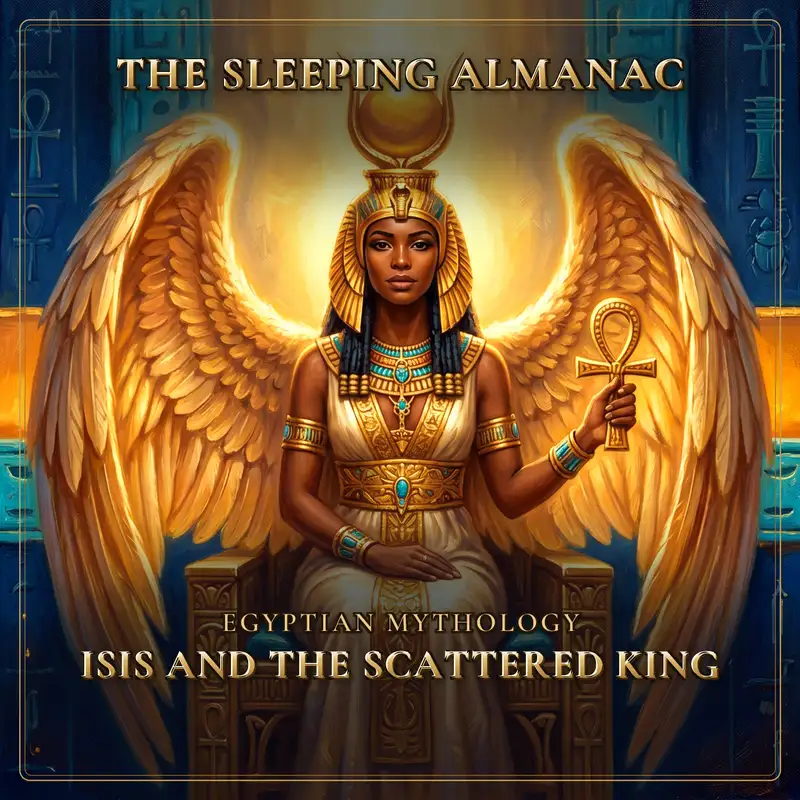
Welcome to The Sleeping Almanac.
Last time, the good green king Osiris passed gently out of the seen world, carried down the river in a beautiful chest and hidden, far away
in the heart of a fragrant tree.
Tonight is the story of what love did about it.
For the king had a queen, and her name was Isis, and she loved him past all telling, and she would not let the dark keep him.
Tonight is the story of her long search, of how she crossed the whole world to find him, of how she gathered him when he was scattered, and of how
by the strength of her love, she made the broken whole again.
It is, in the end, the most hopeful story the Egyptians ever told, and we will tell it gently, the whole way through.
So let the day set you down.
Let the bed take your weight, and your shoulders, and the last of the day's holding.
Hear this before we begin, and keep it close.
There is grief in tonight's story, and there is a brother in shadow, and there is even a scattering.
But none of it is told to trouble you.
It is all told softly, the way you would tell a tender old story to someone you were settling into sleep, and every dark turn in it is answered
before the night is done, by love.
You are safe here.
The story bends, always, toward the gathering up of what was lost, toward the making whole of what was broken.
Let that be the direction you drift in too.
We will draw it from the ancient Egyptians themselves, from the old temple texts and the laments they sang for Isis and her sister
and from the Greek writer Plutarch, who gathered the scattered pieces of the story, fittingly enough, and set them down in one long telling.
Where the old sources fall quiet or differ, we will fill the small gaps gently, in their own spirit, always choosing the telling that serves a calm night.
There is a line we have carried through this whole season, from an old Egyptian teacher named Ptahhotep, who taught that the truest strength is the gentle kind
that good is done not by force but by patience and fair dealing.
Tonight that teaching wears the face of a woman who will not give up.
Isis does not win back her king with armies or with rage.
She wins him back with patience, with devotion, with a love that simply refuses to stop looking.
Hers is the gentle strength made perfect, the quiet power that outlasts every loud one.
Keep that near you as you drift.
It is the soul of the night.
Let your eyes close.
Let the breath go long and slow.
And let us go back to the green land in its hour of loss, to a queen who has just learned that her king is gone, and is rising, even now, to go and find him.
Chapter One.
The Search Begins.
When Isis learned that the green king was gone, her grief was deep as the river in flood.
But she did not lie down in it.
She rose, and she went to look for him.
Let us begin with that rising, because it is the heart of who Isis was, and there is a strange strength in it that is good to rest beside.
The news of the king's passing came to her, and she felt it the way only one who loves completely can feel such a thing, all the way down, a sorrow with no bottom to it.
The old Egyptians did not hide her grief.
They sang of it for thousands of years, the lament of Isis for her lost lord, one of the oldest songs of mourning in all the world.
She cut her hair, as the mourners did.
She put on the plain clothes of grief.
She let the sorrow be exactly as large as it was.
And then, having felt it fully, she did the thing that makes her story not a story of despair but a story of hope.
She stood up, and she set out, alone, to find him and bring him home.
Rest for a moment on the difference between those two things, because it is one of the gentle wisdoms folded into this story.
There is the grief that lies down, that pulls the blanket over its head, that lets the loss become the end of everything.
And there is the grief that rises, that turns its sorrow into a road and begins to walk it.
Isis felt the first kind fully, the Egyptians were careful to say, for she was no stranger to sorrow.
But she chose the second.
She let her love be stronger than her loss, let it lift her up off the floor of her grief and set her feet moving, out the door, into the wide world
toward the one she would not give up.
We are not asked to do anything tonight but lie still and rest.
But there is comfort, even in rest, in knowing that love can do that, can turn even the deepest sorrow into a journey, a purpose, a reason to rise.
Let that comfort be near you as you settle.
And so she began to walk.
The old tellings give us the picture of her wandering the length of the land, asking everywhere she went, of everyone she met
whether they had seen any sign of the beautiful chest the river had taken.
She asked the great and she asked the humble.
She asked the people working in the fields and the people fishing along the banks.
She left no one out, and she left nowhere unsearched, because that is what love does when it is looking for the one it loves.
It looks everywhere.
It asks everyone.
It does not decide that any place is too small or any person too lowly to hold the answer.
Let yourself rest in the steady rhythm of that asking, because there is something almost like a lullaby in it
the same gentle question repeated over and over down the length of the land.
Picture her moving along the green river, day after day, stopping at each village, each landing, each cluster of reed houses by the water, and asking
always the same soft question, whether anyone had seen the chest the river took.
The fishermen mending their nets in the morning light.
The women carrying water up from the bank.
The old men sitting in the shade of the palms.
To each she came, and of each she asked, and from each she took whatever small word they had and carried it on to the next.
There is no hurry in it and no despair in it, only the long patient repetition of a love doing the one thing it can do, which is to keep asking, keep looking
keep moving toward the answer one quiet question at a time.
The Egyptians sang her search as a kind of slow refrain, and you can let it be a refrain for you tonight, the gentle question and the gentle moving on
over and over, down the long green river, until the asking itself becomes as soft and as steady as breathing, and carries you down toward sleep.
There is a tenderness in imagining the great queen of the green land going quietly from person to person, humble in her grief
asking the simple folk along the river if they had seen which way her king had gone.
Let the patience of that search settle over you like a slow blanket, because it is the patience that will run through the whole night.
Isis did not expect to find him in a day.
She set out knowing the road might be long, knowing she might have to ask a thousand times before one answer came, and she made her peace with that, and she walked.
There is a deep calm available in that kind of patience, the patience that does not need the end to come quickly
that is willing to take the long road one quiet step at a time.
The whole of this story moves at that pace, the unhurried pace of a love with all the time in the world, and we will move at that pace too, tonight, slowly
patiently, in no hurry to arrive, content simply to be on the road.
Lie still, and let the long gentle search begin, and let its patience become the slow and even rhythm of your own breath.
Chapter Two.
The Word of the Children.
For a long while, the old tellings say, the only ones who could help her were the children.
This is one of the tenderest details in the whole story, and it is worth resting on gently.
As Isis wandered, searching for some word of the chest the river had carried, it was the children, the story says, who had seen which way it went, and who told her.
There is something deeply Egyptian in that, and deeply touching.
The little ones, who play along the riverbanks, who watch the water for hours the way children do
who notice the small drifting things that the busy grown people miss, they had seen the beautiful chest float by, and they could point the way.
And so the great queen, in her search, came again and again to the children, and knelt to them, and listened to them, and followed where they pointed.
Rest in the gentleness of that picture, the powerful one humbling herself to listen to the smallest
because there is a sweetness in it that is good to fall asleep beside.
The Egyptians remembered this so fondly that they came to believe children carried a touch of unlooked for wisdom
that out of the mouths of the little ones came true words that the wise might miss.
And whether or not that is so, there is something lovely in the image of Isis, who could command the powers of heaven
going down on her knees in the riverside dust to hear what a child had seen.
Love makes us humble like that.
It will kneel anywhere, ask anyone, follow the smallest clue, if it leads toward the one we are looking for.
Rest a while in the world of the riverbank children, because it is one of the most peaceful small worlds in all the old stories.
Think of how a child watches a river, with all the long unhurried attention that grown people lose, sitting for hours at the water's edge, noticing every ripple
every drifting reed, every bird that lands and lifts again, every small thing that floats by on the slow brown current.
The busy adults walked past the river with their minds on a hundred cares and saw nothing.
But the children, with their slow and patient watching, had seen the beautiful chest go by, and had remembered, and could point the way.
There is a gentle wisdom in that the Egyptians treasured, the idea that the truest seeing belongs to the unhurried
to the ones still patient enough to simply watch the water go by.
Tonight you can borrow a little of that child's slow attention, not to search for anything, but only to rest in it, the long calm watching of a river at evening
the drifting reeds, the lifting birds, the slow brown water carrying everything gently downstream.
Let your mind go as quiet and as patient as a child by the water, watching nothing in particular, in no hurry at all
and let that deep unhurried calm carry you toward sleep.
Let that humble tenderness be part of your rest tonight, the great queen and the small children, the powerful made gentle by love.
And the word the children gave her led her, at last, toward the sea.
For the chest, you will remember, had gone down the river and out across the wide green water, all the way to a far foreign shore.
And as Isis followed the trail of it, asking and listening and following
she came at last to understand that her king had been carried out of the land of Egypt altogether, across the sea, to a distant country in the north.
It was a hard thing to learn, that he had gone so far, beyond the edge of her own known world.
But it did not stop her.
It only turned her steps toward the coast, toward the wide water, toward the long crossing she would have to make to follow him.
Love does not stop at the border of the known.
It crosses over, into the strange country, after the one it loves.
Let the long reach of that search settle over you now, the way it widens from the riverbanks of home all the way out to the edge of the sea and beyond.
There is something steadying in a search that simply will not be turned back, that meets each new distance and each new difficulty and answers it only by going on.
Isis learned that her king was across the sea, in a land she had never seen, and she did not despair, and she did not turn home.
She simply set her face toward the water and prepared to follow.
We can rest in the sureness of that, the deep calm of a love that has decided, once and for all, that no distance is too great.
Wherever the king has gone, the queen will follow.
The sea is no barrier.
The strange land is no barrier.
Nothing is a barrier to a love like this.
Lie still, and let that sure unhurried devotion carry you onward, toward the far shore, the way it carried her.
Chapter Three.
The Tree in the Far King's Hall.
At last her search brought her across the sea to the foreign city of Byblos, where her king lay hidden in the heart of a tree.
We return now to the strange and beautiful thing that had happened on that far shore, and we can take it slowly, because it is a restful wonder.
You will remember that the chest had come to rest on the coast of Byblos, and that a young tamarisk tree had grown up and taken it into itself
folding the king away inside its trunk
and that the tree had grown so tall and so wonderfully fragrant that the king of that country had it cut down and raised up as a great pillar to hold the roof of his hall.
So the green king was there, in the foreign city, hidden in the heart of a pillar in a palace
holding up the roof of a house that did not know what treasure it contained.
And Isis, following the long trail of her love, came at last to that city, and somehow, by the deep knowing that love gives, she felt that he was near.
Rest in the quiet of her arrival, because the old tellings give her a still and patient entrance, not a grand one.
She did not come storming into the palace demanding her king.
She came quietly, a stranger in a foreign town, and she sat down, the story says, by a well, in the simple way of a traveler resting from the road.
And there she waited, and watched, and let herself be still, gathering herself for whatever would come next.
There is a deep lesson in that stillness, the way the one who had crossed the whole world to get there did not rush the final step
but sat down by the water and waited for the way to open.
Sometimes love's greatest work is the waiting, the patient sitting by the well, trusting that the door will open if you are only still enough
and present enough, and willing to wait.
Let the picture of the well at evening settle over you, because it is a deeply restful place to be.
Picture the foreign city going quiet as the day ends, the light turning gold and then blue, the heat lifting off the stones
and the traveler sitting still beside the well in the cool of the evening.
The well was the gathering place of every old town, the place where the water was drawn and the news was shared, the calm center where everyone came in the cool hours.
And there Isis sat, a stranger at rest, her long journey behind her, letting the city move around her while she stayed perfectly still, gathering her quiet
waiting for the way to open.
There is such peace in being the still point in a moving world, in sitting quietly while the evening comes on and the others go about their tasks
asking nothing, needing nothing, simply being present and at rest.
You can be that still point tonight, the calm one beside the cool water as the day fades, the whole world softening into evening around you while you sit
and breathe, and wait for nothing at all, and let the deep stillness of the well at dusk carry you down toward sleep.
Let that stillness be your stillness tonight, the traveler at rest by the quiet well, her long journey nearly done, waiting, calm, for the way in.
And the way in came, as it so often does, through simple kindness.
By the well, the old story says, Isis met the serving women of the queen of that country, and she was gentle with them, and kind
and she did for them a small kindness
braiding their hair and breathing upon them a sweetness so lovely that when they returned to the palace a wonderful fragrance hung about them.
The queen, noticing it, asked where such sweetness had come from, and so word of the gracious stranger by the well made its way into the palace
and the queen sent for her.
And just like that, the door Isis had been waiting for opened, not because she had forced it
but because she had been kind by a well to people the world would have overlooked.
There is a gentle truth in that worth holding as you drift.
The way in is so often kindness.
The door so often opens to the one who was simply good, and patient, and gentle, while she waited.
Let all of that settle over you now, the long search ending not with a battle at the gate but with a quiet woman by a well
winning her way into the palace through sweetness and patience and grace.
The king is so near now, just inside those walls, hidden in the great fragrant pillar that holds up the roof.
And the queen who loves him has found her way to the very threshold, gently, kindly, the way water finds its way through stone, not by force but by patience.
Rest in how near they are now, after so long and so far, the lost king and the love that crossed the world to find him, with only a doorway left between them.
Lie still in that nearness, that almost, that sweet and patient closing of the long distance, and let it carry you down toward sleep.
Chapter Four.
The Quiet Nurse.
Inside the palace, Isis was given a place in the household, and there she stayed a while, quiet and patient, close to her hidden king.
Let us rest inside the palace now, in the warm domestic quiet of it, because this part of the story is gentle and slow and full of a strange tenderness.
The queen of Byblos, taken with the gracious stranger, gave Isis a place in her house, and made her, the old tellings say, the nurse of her own small child.
And so the great queen of Egypt, in her long search for her king, became for a while a nurse in a foreign palace, caring for another woman's baby
biding her time, staying near to the pillar that held her lord.
There is something deeply moving in that, the most powerful woman in the world content to live quietly as a servant, to rock a stranger's child
because it kept her close to the one she loved.
Love will do humble work gladly, if the humble work keeps it near.
Rest in the warm small world of those palace nights, because there is great peace in the simple work of tending a child in the quiet hours.
Picture the lamplit nursery in the foreign palace, the household gone to sleep, the great halls dark and still
and the gentle nurse moving softly through the hush, tending the little one.
There is a deep and ancient calm in that scene, the calm of the one who keeps watch while everyone else sleeps, the soft rocking, the low humming
the patient soothing of a child back down into rest.
It is among the oldest and most tender of all human pictures, the watcher in the night and the small one in her arms
and it carries a peace that settles anyone who rests beside it.
Isis, the great queen, found in that humble nightly work a kind of solace, the comfort of small gentle tasks done with love in the quiet dark.
Let that same comfort hold you tonight, as if you too were being gently tended in the small hours, rocked softly, watched over by patient hands
kept safe through the night by a love that does not sleep.
Let the lamplit hush of the nursery be your hush, and the soft rocking be your own slow breath, and let it carry you down, like a tended child, into sleep.
Rest in the tenderness of those quiet days, because the Egyptians wrapped this part of the story in real sweetness.
Isis grew to love the little child she nursed, the way you cannot help but love a baby you care for, and she wished to give the child a gift
the greatest gift she could, and so the old stories tell of her trying, by her deep magic, to make the child something more than mortal
to burn away in gentle fire all that was small and passing in him and leave only what would last.
It is a strange old detail, and we need not follow it into its every turn tonight.
We need only feel the love behind it, the nurse bending over the child in the night, wishing with all her power to give the little one something precious and lasting.
Even in the midst of her own long grief, Isis was making gifts, caring, loving, pouring out tenderness on a child not her own.
That is the kind of heart she had.
It could not stop loving, even when it was breaking.
And all the while, through those quiet days and nights of caring for the child, she stayed near the great pillar
the fragrant column that held up the roof of the hall, knowing, with the deep certainty of love, that her king was inside it.
Imagine the long patience of that, to be so near to him at last, only a few steps away, hidden in the wood, and to wait, and tend the child
and bide her time until the moment was right to ask for what she had crossed the world to claim.
The Egyptians understood that the deepest love is often the most patient, that it can wait a long time, quietly, near the thing it longs for, without grasping
until the right moment comes.
Let that patience be your own as you rest, the long quiet biding of a love that is finally near its goal and is willing, even now, to wait a little longer
and do it gently, and do it right.
So let the palace grow quiet around you, the lamps burning low, the foreign household settling into sleep
the great fragrant pillar standing silent in the dark hall, and the gentle nurse moving softly through it all, near her hidden king, patient, loving
biding her time.
There is so much peace in this part of the story, the peace of a long journey nearly ended, of a love come at last to rest near the one it sought
waiting only for the dawn of the right moment.
Lie still in that warm and patient quiet.
The hardest part of the search is behind her now.
She has crossed the world and found him.
All that remains is to ask, gently, for him back, and to carry him home, and we will follow her there, softly, when the night goes on.
Chapter Five.
The Pillar Given.
When at last the moment was right, Isis revealed who she was, and asked the king of Byblos for the pillar that held up his hall.
Let us come gently to the moment the long patience finally opens into, because it is a quiet triumph, not a loud one.
The day came when Isis set aside her disguise as a humble nurse and let the household see her for what she truly was, a great queen and a power of heaven
come from a far land in search of her lost lord.
And she went to the king and queen of Byblos and told them, plainly and with grace
that the great fragrant pillar holding up the roof of their hall held something precious to her beyond all measure, and she asked them to give it to her.
And they, awed by her and moved by her story, did not refuse.
They had the great column taken down, and they cut it open, and they gave to Isis what lay hidden inside, the beautiful chest, and her king within it
found at last after all the long miles of her searching.
Rest in the deep relief of that finding, because after so much patience it lands like the first deep breath after holding your breath too long.
She had crossed the whole world.
She had humbled herself, and waited, and served, and bided her time, and now at last the pillar was opened and the chest was hers, and the search was over.
The Egyptians tell that she fell upon the chest with a cry of such grief and such love that it frightened the people of the house
the long held sorrow and the long held hope breaking out of her all at once.
We need not dwell in the sharpness of that cry.
We need only feel the release in it, the enormous letting go of a soul that has finally, finally reached the thing it crossed the world for.
There is a rest on the far side of long striving that is deeper than any other, the rest of arrival, of the search being over
of the long road finally ending at the door it was always pointed toward.
Let that rest of arrival be yours tonight.
And then, the old tellings say, she wrapped the pillar that had held him, the fragrant wood that had cradled her king through all his time in that far country
in fine linen, and anointed it with sweet oil, and gave it back to the people of Byblos as a thing now holy, a gift in return for the gift they had given her.
There is such grace in that, even in her hour of grief, to bless the ones who had unknowingly kept her king safe, to leave them something sacred in thanks.
The Egyptians said that pillar was honored in Byblos long after, wrapped and revered, because the body of the green king had rested within it.
Isis, even with her lord at last in her arms, took the time to give thanks, and to make holy the wood that had sheltered him.
Love remembers its debts.
It blesses what kept the beloved safe.
Rest in the deep relief that fills this whole chapter, because relief is one of the gentlest feelings there is to fall asleep inside of.
Think of the particular peace that comes the moment a long anxious effort is finally over
when the thing you have strained toward for so long is at last in your hands, and the straining can stop.
The whole body lets go in that moment.
The held breath is finally let out.
The shoulders come down.
Isis had carried the tension of the search for so long, across the whole world, through all the patient waiting, and now, with the chest in her arms at last
all of that long holding could finally release.
There is no relief deeper than the relief of a long search ended, a hard thing finished, a beloved found.
You can let your own held things release tonight in just that way, every effort of the day finally over, every strained reaching finally done
the long holding let go all at once, the deep sweet slackening of a labor complete.
Let your whole body unclench the way hers did when the search was over, and let that deep release carry you down into rest.
Let that gracious gratitude be part of your rest, the queen pausing in her own great moment to bless the strangers who had helped her without knowing it.
So let the long search close here, gently, with the chest at last in the arms of the one who loved him, and the people of the far city blessed and wondering
and the fragrant pillar standing wrapped and holy in the hall.
The first half of Isis's great labor is done.
She set out from a green land in grief, and she crossed the sea, and she found her king in the heart of a tree in a foreign palace, and now she has him back.
There is so much peace in a thing sought and found, a circle closed, a journey completed.
Rest in that completion tonight, the deep sweet rest of the long search ended, before we turn, gently, to the carrying of him home.
Chapter Six.
The Voyage Home.
With her king found at last, Isis took ship and carried him home across the sea, back toward the green land that loved him.
Let the sea voyage home be a long calm passage in your mind, because it is one of the most peaceful stretches of the whole story.
Isis placed the precious chest aboard a ship, and set out across the wide green water, back the way her king had come
retracing his long sea road in the other direction, carrying him home.
Picture the boat upon the broad calm sea, the queen beside the chest she had crossed the world to find
the water stretching out on every side under a wide and quiet sky, and the green land of home waiting somewhere beyond the horizon.
The journey out had been a search, anxious and uncertain.
The journey home was something gentler, the slow sure return of a thing accomplished, a homecoming under way.
There is a particular peace in a homeward voyage, the peace of the hard part being done and only the going home remaining.
Let that homeward peace be your peace tonight.
Rest in the steady motion of the ship across the sea, because there is deep sleep in it, the same slow rocking that carried the king out now carrying him home.
The Egyptians knew the sea as a vast and patient power, and here it served the homecoming, bearing the queen and her king smoothly back toward the land of the river.
There was no storm in the telling, no trial upon the water.
There was only the long quiet crossing, the boat riding the gentle swell, the queen keeping her patient watch beside the one she had found
the home shore drawing slowly nearer with every hour.
Lie still and let that crossing carry you the way it carried them, the slow rise and fall of deep calm water, the wide sky, the sure and steady progress toward home.
You are on the homeward sea tonight, the hard searching behind you, nothing left to do but rest and be carried home.
And when at last she came again to the green land, the old tellings say, Isis did a careful and a loving thing.
She did not set the chest down in the open, in the palace or the temple, where it might be found.
She carried it away in secret to a hidden place, deep in the quiet marshes of the Delta, among the tall reeds and the still water and the drifting birds
and there she hid her king away to keep him safe while she rested from her long journey.
The marshes of the Delta were the most secret place in all the land, a vast green maze of reeds and water where a thing could be hidden and never found
and there, in that green and watery quiet, she laid her king to rest a while, and watched over him, and let herself, at last, be still.
Picture that hidden place, the tall reeds whispering, the still water bright under the moon, the drifting waterbirds
the queen keeping her quiet watch over the hidden chest in the deep green secret of the marsh.
There is so much peace in it.
Let the marsh take you all the way down, because the reed marshes of the old Delta are about the most peaceful place a mind can rest.
Let there be the tall green reeds standing close on every side, swaying just slightly, whispering softly when the night air moves through them.
Let there be the still dark water between them, bright with the reflection of the moon and the scattered stars, so calm it barely stirs.
Let there be the soft small sounds of the night marsh, the gentle plash of a fish, the murmur of a sleeping bird settling deeper into its feathers
the faint stir of a heron somewhere far off, and under all of it the deep green silence of a vast and secret place where no trouble can reach.
This was the most hidden country in all of Egypt, a green maze where a thing could be kept safe and never found, and Isis chose it for exactly that
a place of perfect shelter and perfect quiet.
Let it shelter you too tonight.
Lie down in the deep green hush of the marsh, among the whispering reeds, beside the still bright water, hidden away from everything
safe in the most secret and peaceful place there is, and let its deep green silence close softly over you and carry you down into sleep.
Let the marsh close softly around you now, the way it closed around the hidden king, all tall reeds and still water and the soft sounds of the night birds
a green and secret cradle far from every trouble.
Isis had done what she set out to do.
She had found her king and brought him home and hidden him safe in the most secret quiet of the land, and for a little while there was peace
the deep peace of a great labor accomplished and a beloved kept safe.
We will not trouble that peace too soon.
We will let it be, tonight, as long as we can, the hidden chest in the moonlit marsh and the faithful queen at rest beside it at last.
Lie still in the green and watery quiet, among the reeds, under the moon, and let the peace of the hidden place be your peace
and let it carry you gently down toward sleep.
Chapter Seven.
The Scattering.
Now there came the hardest turn of the story, and we will tell it very gently.
The brother in shadow found the hidden king, and he scattered him across the whole of the land.
Let us go into this softly, and hold it lightly, because the Egyptians themselves turned even this, the darkest moment, into something that became a blessing.
Set, the red brother, was abroad in the night, hunting by the light of the moon in the marshes, and by chance, the old tellings say
he came upon the hidden chest where Isis had laid her king.
And knowing it, and not willing that his brother should be kept and honored even in death, he did a strange and sorrowful and, in the end, strangely fruitful thing.
He took the body of the green king and he divided it, into many parts, the old story says fourteen, and he scattered those parts the length and breadth of Egypt
casting one into this far province and one into that, so that the king was spread across the whole of the land, and could never, Set thought
be gathered up again.
Now hold this gently, because here is where the Egyptians did something extraordinary with their grief, something worth resting in.
They could have told this as the final ruin, the king not only dead but scattered, undone past all mending.
But that is not how they told it.
They told it, instead, as the king being given to the whole land.
For every place where a part of Osiris came to rest became, in their telling, holy ground, a sacred place, a shrine.
The scattering spread the green king across the entire country, and so the entire country became, in a sense, his body
every province blessed with a piece of him, every region made sacred by his presence.
What Set meant as the final scattering, the Egyptians received as a strange kind of gift, the good king given not to one tomb but to all of Egypt
sown across the whole land like seed across a field.
The very word for the harm became the word for a blessing.
The king was everywhere now.
The whole land had become holy.
Rest in the largeness of that gentle idea, because it turns the whole dark moment soft, and it is a beautiful thing to drift away on.
Think of the green king, who was the grain, who was the very life of the growing land, now spread across the whole of that land, present in every province
sleeping in every quiet corner of the country he had loved.
The Egyptians came to feel that he was simply everywhere now, woven into the soil of the whole earth they walked
so that a person standing anywhere in all of Egypt was standing on holy ground, near some part of the good king.
There is something almost tender in being given to the whole of a place you love, in becoming part of all of it rather than shut away in one spot.
The scattering, held this way, is not a breaking but a spreading, the king poured out across the land like water across a thirsty field, blessing all of it
present in all of it, near to everyone.
Let that large and gentle thought dissolve the last of any unease, the good king everywhere at once, the whole green land made holy by him
and let the quiet enormity of it settle you, and carry you down toward sleep.
Rest in that turning, because it is one of the deepest and most consoling things this old people ever believed, that even a scattering can become a sowing
that even being broken into many pieces can become a way of being given to everyone.
We need not picture anything fearful tonight.
We need only hold the gentle Egyptian meaning, the green king spread across the green land, each quiet province now holding something sacred
the whole country made holy by the king who had been given to all of it.
There is no horror in it, told that way.
There is only a kind of sad and beautiful largeness, the good king made part of the very land his people lived upon, present in every corner of it
sown into the whole of the earth they walked.
Let that large and gentle meaning settle the moment for you, and carry no fear from it into your rest.
And know, as you lie there, that this scattering was not the end, not for one moment
because the love that had already crossed the world was not about to be stopped by a little distance.
The very next turn of the story is the gathering, the patient loving collecting of every scattered piece, the making whole of what was broken.
So even as we hold the scattering, we can hold its answer with it, already on its way.
Nothing in this story stays broken.
Everything scattered will be gathered.
Everything divided will be made one again.
That is the promise the whole night is built on, and it is never more sure than right here, at the darkest turn
with the love that will undo all of it already rising to begin.
Lie still, and let go of any worry, and let the gentle certainty carry you, that what was scattered is about to be, lovingly, gathered home.
Chapter Eight.
The Gathering.
So Isis set out a second time, and this time her sister went with her, and together they gathered the scattered king.
Let us rest in the companionship of that, because there is a deep sweetness in it that was not there before.
The first search, Isis made alone.
But for the second, the great gathering, she was joined by her sister, Nephthys, who loved the green king too, and who would not let Isis bear the labor by herself.
And so the two sisters went out together, the length and breadth of Egypt, to gather up every scattered part of the king and bring him home.
There is something profoundly comforting in that image, the two sisters walking the land side by side on their long sorrowful loving errand, neither one alone
each holding the other up.
The Egyptians sang of the two sisters together for thousands of years, the two who mourned and the two who gathered, and the picture of them
side by side in their labor of love, is one of the tenderest things in all their long memory.
Grief shared is grief halved.
The road is so much easier with a sister on it.
Rest in the quiet companionship of the two of them on the long road
because there are few things more comforting to fall asleep beside than the thought of not being alone.
Picture the two sisters walking together through the green land, day after day, under the wide sky, neither one ahead and neither behind, simply together
sharing the road and the work and the weight of it.
When one grew tired, the other carried on.
When one faltered, the other steadied her.
They walked through the long warm days and rested through the soft nights, side by side, and the great labor that would have crushed one alone was bearable
even gentle, because it was shared.
There is a deep old comfort in that picture, the comfort of company on a hard road, of a hand always there to hold
of never having to bear the whole of anything by yourself.
Let that comfort be near you tonight, the sense of a faithful presence beside you in the dark, the road shared, the weight halved, no part of the night to be faced alone.
Let the two sisters walk on together through your drifting thoughts, patient and unhurried and side by side
and let their quiet companionship carry you gently down into sleep.
Let the comfort of that companionship be near you as you drift, the two faithful ones walking the land together, no one bearing the sorrow alone.
And so they gathered him.
Patiently, place by place, province by province, the two sisters traveled the whole of the land, and wherever a part of the king had come to rest, they came
and they found it, and they honored it, and they took it up to be made whole again.
Picture the long patience of it, the same patience that had carried Isis across the sea, now spread across the whole map of Egypt
the two sisters going from sacred place to sacred place, gathering up what had been scattered, missing nothing, leaving nothing behind.
It was the search all over again, but wider now, and shared, and lit by the sure knowledge that every piece could be found if only they kept looking.
There is such steadiness in that gathering, such patient, methodical, unstoppable love.
It simply went on, place after place, until the king was whole.
Let that steady gathering rhythm become your own as you rest, the patient collecting of what was scattered, the long sure work of making broken things one again.
The Egyptians told that at each place where the sisters found a part of the king and took it up, Isis left behind a shrine
so that the place would be honored forever as holy ground.
And so the gathering, which undid Set's scattering, did not erase it but transformed it, leaving the whole land dotted with sacred places
each one marking where the good king had rested and been found.
It is a beautiful way to think of it, the love that goes back over the scattered pieces of a sorrow and, in gathering them up
makes each place where the sorrow fell into something holy.
Nothing was wasted.
Even the scattering, once love had passed back over it, became a string of sacred places across the land, a map of devotion
every point on it marking where love had found what was lost.
Let that gentle thought rest you, that love, going back over even the scattered pieces of grief, can make each one holy, can leave even the hardest places blessed.
So let the two sisters go on with their patient gathering as the chapter closes, walking the green land together under the wide sky
finding the king piece by piece, leaving holiness behind them everywhere they went
drawing slowly nearer to the moment when all of him would be gathered in one place again and the great making whole could begin.
There is so much quiet hope in this part of the story, the steady undoing of the scattering, the patient reversal of the loss, the broken thing being gathered
lovingly, toward wholeness.
Rest in that hope tonight.
What was scattered is being gathered.
What was lost is being found.
The two who love him are bringing him home, piece by patient piece, and nothing, now, will be left behind.
Chapter Nine.
The Making Whole.
When all the scattered parts of the king had been gathered, Isis began the most loving work of all.
She made him whole again.
Let us come gently to this, because it is the tender heart of the whole story, and the Egyptians held it as something close to sacred.
With every part of the green king gathered in one place at last, Isis set about the patient, loving labor of joining him together again
of making the scattered one whole.
The old tellings say she was helped in this by Anubis, the gentle guardian of the dead
the jackal headed one whose care watches over every soul that crosses over, and that together they wound the king's body in fine linen
wrapping him with sweet oils and resins and long bandages of the finest cloth, binding the gathered parts tenderly back into one.
They were making, the Egyptians believed, the very first mummy, the first body ever prepared with such loving care for the long journey beyond
and every burial that every Egyptian would ever receive, for thousands of years after, was a remembering of this first one
this first act of love over a gathered king.
Rest in the deep tenderness of that wrapping, because it is meant to be felt as care, not as anything fearful.
Picture the patient hands, the soft clean linen, the sweet scent of the oils, the slow gentle binding of the king back into wholeness
the way you might wrap something infinitely precious, infinitely fragile, with infinite care.
This was not a grim work.
It was the most loving thing one being can do for another, the careful tending of the beloved's body, the making of it ready and whole and at peace.
The Egyptians wrapped their dead so carefully because they had learned it, they believed, from this
from Isis bending over her gathered king with her linen and her oils and her boundless love, making the broken whole, making the scattered one again.
There is such peace in being tended like that, wrapped and kept and made whole by loving hands.
Let yourself feel it tonight, as if loving hands were settling the blanket gently around you too, tucking you in, making you safe and whole for the night.
Stay with the gentleness of that tending a while longer, because the slow careful wrapping is itself a kind of lullaby for the body.
Think of the long soft lengths of clean linen, light as breath, laid gently over and around, smooth and cool and endlessly patient.
Think of the sweet warm scent of the oils and resins, cedar and myrrh, the smell of care itself, rising soft in the still air.
Think of the unhurried rhythm of the work, the slow winding round and round, gentle and steady and sure, every motion an act of love
every layer a small kindness, until the one being tended is wrapped warm and whole and utterly safe, held on every side, nothing left exposed
nothing left untended.
There is a peace in being so completely cared for that goes all the way back to the very beginning of us, the peace of being swaddled, of being wrapped and held and kept.
Let that be your peace tonight.
Let the soft layers settle gently over you one by one, warm and light and sweet, the day's last tensions wound away beneath them
until you too are wrapped whole and safe and still, tended by patient loving hands, and let that deep cared for peace carry you all the way down into sleep.
And here is the wonder the Egyptians never got over, the thing that made this the most hopeful story they knew.
The wrapping was not only an ending.
It was the making of something new.
For when Isis had bound the king whole again, the green king did not simply lie there, finished.
He passed instead into a new life, a deeper one, becoming through this very wrapping the lord of the world beyond, the king of the blessed dead
the gentle ruler of the hidden country where every soul would one day go.
The making whole was a making new.
The careful binding that looked like the close of his story was in truth the door to the greatest part of it
his rising as the kind king of the land beyond death, the one who would wait on the far shore to welcome every soul that followed.
Isis, with her linen and her love, had not only mended her king.
She had helped him become what he would be forever, the lord of the quiet country, the comforter of all the dead.
So let the making whole settle over you as the deep comfort it was meant to be, the gathered king bound gently back into one by loving hands
and through that very binding raised into his new and greater life.
There is no grief left in this part of the story, only a kind of awed tenderness, the broken made whole, the lost made new
love completing its long labor and finding, at the end of it, not an ending at all but a beginning.
Lie still and let those loving hands tend you too, wrapping you gently in the quiet of the night, making you whole and safe and ready for rest
and let the deep peace of being so cared for carry you down toward sleep.
Chapter Ten.
The Wings of Isis.
And out of all that love and all that grief, the old tellings say, something new was born.
Isis brought forth a son.
Let us rest in the quiet miracle of this, because it is the place where the whole long sorrow turns, at last, fully toward hope.
By her great magic and her greater love, the Egyptians believed, Isis drew from her gathered king a single spark of new life, and from it, in time
she brought forth a son, an heir, a child of the green king who would carry his line on into the world.
They told that she took the form of a bird, a bright winged falcon, and hovered over her lord with her wings beating the breath of life
and that from that union of love and magic and longing came the child who would set all things right.
His name was Horus, and he was the hope of the story, the proof that not even death and scattering could end what the green king had begun.
Love had not only gathered the lost king and made him whole.
Love had brought new life out of the very heart of the loss.
Rest in the image of the wings, because it is one of the most protective and comforting images in all of Egyptian thought.
The Egyptians loved to picture Isis with great sheltering wings, wings she spread over the ones she loved, wings of protection and healing and care.
They carved her again and again with her arms outstretched into feathered wings, folding them around the king, around the child, around all who needed keeping.
To be under the wings of Isis was to be utterly safe, sheltered by the strongest and most faithful love there was.
Rest a long moment under those wings, because the image is one of the most sheltering in all the world, and it was made to be rested under.
Think of great soft feathered wings spreading slowly open and then folding gently down around you, warm and close and dark
shutting out the cold and the wind and every trouble of the night.
Under wings like that, nothing can reach you.
Under wings like that, the whole vast frightening dark becomes small and far away, held off beyond the soft feathered curve
while you lie warm and safe in the sheltered hollow within.
The Egyptians reached for this image whenever they were afraid, the great protecting wings of the faithful one folded over them
and it steadied them through everything, even death, because they trusted those wings to be there.
Let them be there for you tonight.
Let the great soft wings come down around you where you lie, warm and dark and sheltering, folding you in, holding the whole night gently off
leaving you nothing to do but rest in the safe warm dark beneath them.
You are under the wings tonight.
Nothing can reach you here.
Let that perfect shelter carry you down, deep and safe, into sleep.
And tonight her wings are spread wide, over the gathered king, over the coming child, over the whole green land, over, if you like, you yourself as you lie there.
Let yourself rest under the wings of Isis tonight, the great soft sheltering wings of the most faithful love in all the old world, folded gently around you
keeping you safe through the whole of the dark.
And the child, when he was born, she hid away in the green marshes to keep him safe, the same secret marshes where she had once hidden his father
the tall reeds and the still water closing protectively around the falcon child as he grew.
There is a lovely rhyme in that, the marsh that had sheltered the king now sheltering his son, the secret green place keeping safe the hope of the world.
Isis raised the child in hiding, in the quiet of the reeds, tending him, guarding him
growing him toward the day when he would be ready to take up his father's name and set the world to rights.
But that is a story for other nights.
Tonight we need only hold the gentle beginning of it, the child safe in the marsh, the mother's wings spread over him
the long sorrow of the story finally bearing, out of all its grief, a bright new living hope.
Let that hope rest you.
Out of the deepest loss came new life.
Out of the long grief came a child.
Love had the last word after all.
So let the marsh grow quiet and green around the hidden child as the chapter closes, the mother keeping her faithful watch, her wings folded over the little one
the reeds whispering, the still water shining under the moon.
The story has turned all the way from grief to hope now, from a lost king to a living son, from a scattering to a gathering to a new beginning.
There is so much peace in that turning, the long night of the story giving way, at last, to a quiet green dawn of new life.
Rest in it tonight, under the wings, beside the still water, with the worst behind and the hope ahead
and let the deep peace of love victorious carry you gently down into sleep.
Chapter Eleven.
What Isis Meant.
So before we say goodnight, let us hold what Isis meant to the Egyptians, because she meant almost everything, and all of it is gentle.
For here is the truth at the center of this whole long night.
The Egyptians took the worst things they could imagine, loss and grief and a loved one scattered past all mending
and they answered every one of them with a single figure, a woman whose love would not stop.
Isis was, to them, the proof that love is stronger than death.
She had faced the very worst, the loss of the one she loved most, and then the scattering of him across the whole earth, and she had not been broken by it.
She had risen, and searched, and crossed the world, and gathered him, and made him whole, and brought new life out of the heart of the loss.
There was no sorrow so deep that her love could not go down into it and bring something back.
That is who she was to them, the great faithful one, the love that does not quit, and they trusted her, and prayed to her
and leaned on her for thousands of years, because everyone, sooner or later, needs to believe that love can be that strong.
Rest in how much comfort they drew from her, because it can be your comfort too.
To the Egyptians, Isis was the great protector, the healer, the one who watched over mothers and children and the sick and the lost and the dead
the one whose wings sheltered everyone who needed shelter.
When they were afraid, they thought of her.
When they grieved, they remembered that she had grieved too, and had come through it.
When they faced their own death, they trusted that the same loving hands that had gathered and wrapped the green king would gather and keep them too.
She made the whole frightening business of loss and death feel survivable, even gentle, because she had walked through all of it and turned it, every step, into love.
There are few warmer things to rest beside than a love like that, a love proven against the very worst and still standing.
Let the steadiness of her settle deep into you, because a love that has been tested against the very worst and held is the safest thing in the world to lean on.
Some comforts are fragile, untried, easily shaken.
But Isis was not that.
Hers was a love that had been taken down into the deepest grief there is and had come back up again carrying the beloved with it
a love that had met loss and scattering and despair and had simply outlasted all of them.
When the Egyptians leaned on her, they were leaning on something that had already been proven, already been broken upon and not broken
already walked through the fire and come out whole.
There is a particular peace in resting on something that strong, something you know will hold because it has already held against the worst that could come.
Let yourself lean your whole weight on a love like that tonight, the tested and faithful and unbreakable kind, and feel how completely it holds
how it does not shift or fail or fall away, how it simply stays, steady and sure beneath you, the way it stayed for a whole people for thousands of years.
Lean on it fully, let it take all your weight, and let its deep proven steadiness carry you down into sleep.
Let it stand over you tonight, the way it stood over all of Egypt, faithful, sheltering, sure.
And think, as you lie there, of the gift her love left to everyone.
Because she gathered and wrapped the green king with such care, every Egyptian after her believed that they too would be gathered and wrapped and kept
that the same rites of love performed over the first king would be performed over them, that they too would be made whole and sent safely on.
Her single act of devotion became the hope of a whole civilization, the promise that no one need face the dark alone or unloved
that there were loving hands and sheltering wings for everyone, at the end.
That is what one love did, spreading out from one grieving queen to cover a whole people for thousands of years.
It is among the most beautiful things any people ever believed, and it was all built on the simple refusal of one heart to give up on the one it loved.
Let that beauty rest you, the immense gentle hope that grew from a single faithful love.
So let it all settle over you now, soft and whole and warm, everything the great queen meant.
Love stronger than death.
The lost gathered home.
The broken made whole.
New life out of the deepest grief.
And sheltering wings spread wide over everyone who ever needed them.
This is not a story of loss, the Egyptians would tell you, however it looked along the way.
It is the story of love winning, patiently, completely, against the very worst the world could do.
Rest in that victory tonight, the gentlest and surest victory there is, and let it be the last warm thought you carry down into sleep.
Chapter Twelve.
Goodnight.
And the Serpent at the Edge of Dawn.
And so we come to the quiet end of the night, with the king gathered and whole, the child safe in the green marsh
and the wings of the faithful queen spread wide over all of it.
Let the last of the story be only peace now.
Everything that was scattered has been gathered.
Everything that was broken has been made whole.
The green king has passed into his new life as the gentle lord of the country beyond, where he waits to welcome every soul that crosses over.
The bright child grows in the safe green quiet of the reeds, the hope of all the days to come.
And over the whole of it, over the king and the child and the green land and the wide night itself, the great soft wings of Isis are spread, keeping everything safe.
And far out beyond the edge of the world, the old turning of things goes on as it always has, the sun sailing down each night into the dark country
passing at the deepest hour the great serpent coiled at the edge of everything, and rising again, sure as ever, green and gold, at the edge of dawn.
Let that great sure turning carry the last of your waking thoughts away, because it is the most dependable rhythm there is, and the Egyptians found endless comfort in it.
Every night the sun went down into the dark, and every night it sailed the hidden country, and every night it passed the serpent at the deepest hour
and every single morning, without one exception in all the ages of the world, it rose again.
Nothing has ever stopped that turning.
No dark has ever been deep enough to keep the light from coming back.
The green king learned it, going down to rise.
Isis lived it, going into the grief and coming back up with love.
And the sun shows it to us again every single day, the certain return of the light after even the longest night.
You are inside that sure turning now, only at the gentle downward part of it, the going into the dark that is always, always followed by the coming back to the light.
There is nothing to fear in the downward part when the rising is this certain.
Let yourself go down into the night the way the sun goes down, unafraid, trusting the turn, knowing the dawn is already on its way
and let that deepest and surest of all rhythms carry you all the way down into sleep.
So carry no trouble into your sleep tonight, not for any of them, because the story has answered every sorrow it raised.
What looked like a loss became a search.
What looked like a scattering became a sowing, and then a gathering.
What looked like an ending became, through love, a beginning, a new king of the blessed and a new child of hope.
There is nothing left unhealed in it, nothing left broken, nothing left lost.
Love went down into the very worst of it and brought all of it home.
Hold that sure and gentle promise as you let the very last of the day go, that there is a love that gathers what is scattered, that mends what is broken
that does not stop until everything lost is found.
Sleep now, under the wings.
Let the faithful love that sheltered a whole world shelter you tonight too, folded soft and warm around you in the dark.
Let the long story of searching and gathering and making whole become, in you, the simple settling of everything into its place, every part of you gathered home
every holding of the day let gently go.
And know, as you drift down into your own night's rest, that the dawn is already coming, sure as it ever was, past the serpent, past the dark
at the edge of the world, where the light returns, always, and the green rises again, and the lost are always, always gathered home.
Goodnight.
Sleep deeply.
And we will meet again, by the river, when the bright child of the marshes grows at last into his strength, and rises to set the whole world right.