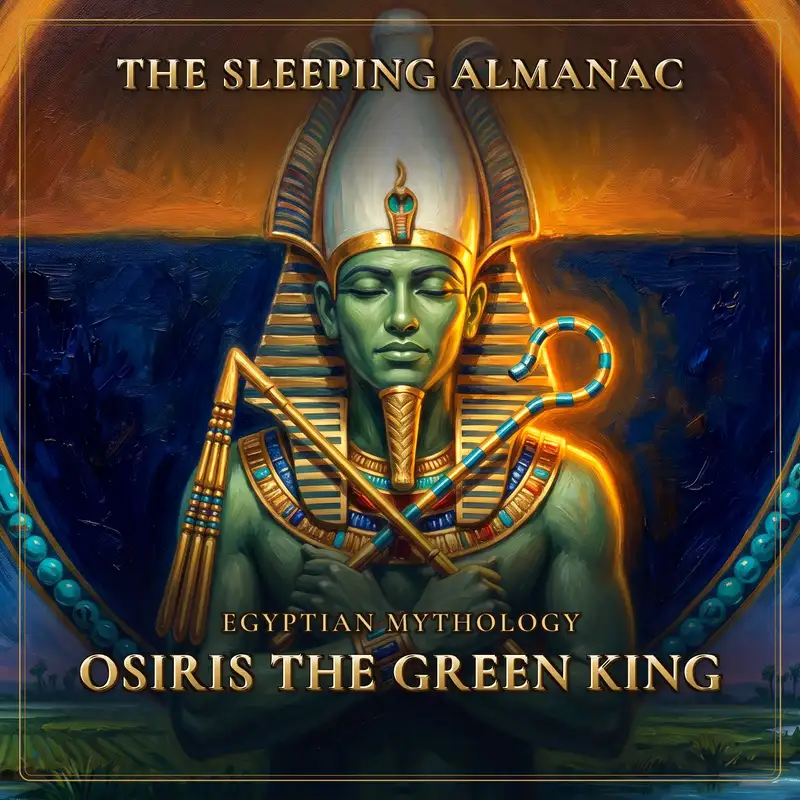
Welcome to The Sleeping Almanac.
Tonight, there is no battle.
There is no chase, no fury, no shadow falling across the land.
Tonight is the story of the best king the world has ever known, the green king Osiris, under whose gentle rule the whole earth grew quiet and kind and good.
It is the long golden calm before any sorrow comes, and we are going to stay inside that calm for the whole of the night
the way you stay in a warm house while the weather keeps its distance outside.
So let the day set you down.
Let the bed take your weight, and your shoulders, and the last of the day's holding.
This is a story about a world being made gentle, about a rough land taught to grow grain and keep laws and love music
by a king who ruled not with force but with kindness.
There is nothing in it to fear and nothing you must follow.
You can simply let it spread over you like the green coming back over the fields after the flood.
We will draw it from the old Egyptian kingship texts and from the Greek writer Plutarch
who gathered the scattered Egyptian stories of Osiris and set them down in one long telling.
It is the tale of the king the Egyptians loved above all others, the one whose name they spoke with more tenderness than any other in all their long history.
There is a line we carry through this whole season, from an old Egyptian teacher named Ptahhotep, and tonight it sits at the very center of the story.
He taught that the truest strength is the gentle kind, that good is done not by force but by patience and fair dealing and the quiet ordering of things.
Osiris is the keeper of exactly that.
He is the king who conquered the whole world, the Egyptians said, and never once raised a weapon to do it.
He won it with grain, and with music, and with kindness.
Keep that near you as you drift.
It is the soul of the night.
Let your eyes close.
Let the breath go long and slow.
And let us go back to the bright morning of the world, when the gods still ruled the earth, and the best of all kings came to his throne.
Chapter One.
The King Who Was Born to Be Loved.
We return tonight to one we met among the five children of the sky, born on the first of the days that Thoth won from the moon.
The eldest of them.
The best of them.
His name was Osiris.
You may remember his birth, on that first of the five new days
when a voice was said to have gone out across the world to say that the lord of all the earth had come into it.
The Egyptians wrapped his beginning in signs and wonders because of all that he would become, and now we come to the becoming
to the long good reign that earned him the love of a whole people for thousands of years.
For Osiris did not stay a child.
He grew, and he came in time to the throne of the living world, and when he sat upon it the earth itself seemed to lean toward him the way a field leans toward the sun.
The Egyptians pictured him tenderly, as they pictured everything they loved.
They gave him skin the green of growing things, the green of the young wheat standing in the field, the green of the reeds along the river
the green of life itself coming back to the land.
Sometimes they painted him the deep black of the rich wet soil the flood leaves behind, the dark earth that everything grows from
and they meant the same thing by it, for to them green and black were both the colors of life returning.
He wore the tall white crown of the south, and he carried two things crossed upon his breast, a shepherd's crook and a gentle flail
the tools not of a warrior but of a herdsman and a farmer, the keeper and the feeder of his people.
That was the king he was.
Not a conqueror with a sword.
A shepherd with a crook, a sower with a flail, the green god of the growing land come to sit upon the throne of the world.
Think for a moment about what it means to be loved by a whole people for thousands of years, because that is no small thing, and it did not happen by accident.
The Egyptians did not love Osiris because he was mighty or terrible.
They loved him because he was good to them, because under him the grain grew and the laws were fair and the music played
because he made their hard world soft and their rough lives gentle.
He was the king you would actually want to live beneath, the one who asked little and gave much, the one whose reign you would remember, ever after
as the time when everything was right.
There is a deep rest in simply imagining such a ruler, a power above you that is wholly kind, that wishes you nothing but good
under whom you could lie down at night with no fear at all.
Let yourself rest under that kind of rule tonight.
You are not being watched over by anything that means you harm.
You are being kept, the way the green king kept his people, gently, and well.
The Egyptians carried this further than mere affection, into the very center of how they understood the world.
To them the king was not a thing apart from the land he ruled.
He was bound to it, woven into it, so that the health of the king and the health of the country were one single thing.
When the king was good and strong, the river rose on time and the grain came thick and the herds grew fat
and the goodness of the ruler seemed to flow out into the very soil.
And no king embodied that bond more completely than the green one, whose skin was the color of the crops, whose body was the growing land made into a person.
To crown Osiris was to crown the fertile earth itself, to set the living green of the world upon the throne.
So when the Egyptians pictured his reign, they did not picture only a good man governing well.
They pictured the land itself made glad, the country and its king greening together
the whole of Egypt flourishing because the very spirit of flourishing sat upon its throne.
Let that wholeness settle over you, the deep rightness of a world where the one who rules and the land itself are bound together in goodness
where nothing is divided against itself.
There is a profound rest in a world that whole, that knit together, that well.
Nothing in it is at war with anything else.
The king blesses the land, and the land feeds the people, and the people bless the king, around and around, a closed circle of goodness with no break in it anywhere.
You are inside that circle tonight.
Lie down within it and feel how seamless it is, how nothing in it is jagged or torn, how the whole green world holds together in a single quiet harmony
and let that harmony become the slow and even rhythm of your own breathing.
The Egyptians had a special name they gave Osiris, and it tells you in a single word how they felt about him.
They called him Wennefer, which means something like the one who is continually good, the perfect being, the eternally gracious one.
It was not a title earned by conquest or by fear.
It was a name that simply meant goodness itself, made into a person and set upon a throne.
To say it was to say that here, at last, was a ruler who was good all the way through, good without a shadow in him
good the way the sun is warm or the river is wet, by his very nature.
There are not many rulers in all the long history of the world of whom their own people would say such a thing, that their very name meant goodness.
The Egyptians said it of the green king, and went on saying it, with love, for thousands of years.
And the land he came to was waiting for him, the Egyptians felt, the way dry ground waits for water.
We will see in the next chapter what the world was like before him, the roughness he found and the gentleness he brought
but for now simply hold the picture of the good king newly come to his throne, green as the spring fields, crook and flail crossed quietly upon his breast
looking out over a world that was about to become, under his patient hands, the best version of itself it had ever been.
There is no shadow on him yet.
There is only the long gold morning of a good reign beginning.
Rest there, in that bright unhurried hour, while the green king takes his throne and the world turns its face toward him like a field toward the light.
Chapter Two.
A Land Without Settled Ways.
Before Osiris, the Egyptians said, the people of the world lived roughly, without settled ways, and did not yet know how to live well.
It is worth resting on this gently, because it tells us what kind of king Osiris was by showing us what he changed.
The old tellings say that before the green king came, mankind lived a hard and scattered life.
They did not yet know how to farm.
They did not gather the grain or store it against the lean season.
They wandered, and they took what they could find, and their lives were short and uncertain and often unkind.
They had no settled laws to live by, no agreed way of dealing fairly with one another, and so the strong did as they liked and the weak suffered it.
They did not yet know the gods, or how to honor them, and they did not yet have the soft arts that make a life good, the music and the order and the quiet pleasures.
It was not a wicked world, exactly.
It was only an unfinished one, a rough world that had not yet been taught how to be gentle.
Think about what the settled life truly gives, because it is more than full bellies, and the Egyptians knew it.
The deepest gift of a settled world is the end of fear.
When you do not know where your next meal will come from, fear lives with you always, a low constant hum beneath everything, and it makes people hard
and grasping, and quick to harm, not because they are cruel but because they are afraid.
Take that fear away, give people a full granary and a fair law and a roof that will be theirs tomorrow as it was today, and something in them softens.
They can afford to be kind, because they are no longer cornered.
They can be generous, because they are no longer starving.
The green king understood that the way to make people good was first to make them safe
to lift the old animal fear off their backs so that the gentleness underneath could come out.
That is what a settled world is for.
Not just to feed the body, but to quiet the fear enough that the heart can open.
And he did it, the Egyptians were always careful to say, by teaching and not by force, and there is a great dignity in that worth resting on.
To be forced into goodness is to be treated as a beast to be broken.
To be taught it is to be treated as a person worth raising.
The green king chose the second way every time.
He did not drive his people toward the better life with whips and fear; he led them toward it with patience and example and gifts
trusting that once they saw the kinder way they would want it for themselves.
And they did.
That is the slow, respectful, dignifying way that good is truly and lastingly done, and it is the way the whole of this gentle reign was built.
Rest in the patience of it as the chapter closes, in a world about to be made better not by breaking anyone but by teaching everyone, kindly
the way a good teacher brings along a child they believe in.
The Egyptians, who lived in one of the most ordered and settled lands there has ever been
looked back on that imagined rough time the way you might look back on a hard winter from the warmth of spring.
They knew how much had been given to them, how much careful work had gone into making their world the calm and dependable place it was
and they wrapped all of that gratitude into the figure of Osiris, the king who had taught them.
Everything good and settled in their lives, they felt, had come from him.
The bread on the table.
The law in the court.
The song at the festival.
The very shape of a life lived well.
All of it traced back, in their imagining, to the green king who had found them living roughly and had patiently shown them a better way.
The Egyptians never quite got over their gratitude for this, and it is worth feeling why.
They lived, they knew, in one of the most ordered and gentle lands in all the world, a place of law and plenty and peace
and they did not imagine it had always been so or had to be so.
They remembered, in this story, that it had been made, patiently, out of a rough beginning, by a king who cared enough to teach.
And so they never took their settled world entirely for granted.
Every full granary, every fair judgment, every quiet evening was, to them, a thing that had been given, not a thing that simply was.
There is a kind of happiness available only to people who remember that their good things are gifts, and the Egyptians had it
and they traced it all back to the green king.
Let it touch you too, tonight, the quiet gladness of remembering that the safety you are lying in was built by patient hands, and given
and is not to be taken for granted but received, gratefully, like a kindness.
There is something tender in that, in a people crediting the whole goodness of their world to one gentle hand, and it is worth holding without any sadness
because the story we are telling is the story of that gift being given.
We are not lingering in the rough time.
We are only standing at its edge for a moment, to feel the difference the king would make
the way you feel the warmth of a room more keenly for having just come in from the cold.
The cold is nearly behind us.
The door is about to open.
The green king is about to begin his long, patient work of making the world kind.
And notice that the Egyptians did not imagine him fixing the rough world by force.
He did not come with armies to beat the people into order, or with punishments to frighten them into goodness.
That is not how the green king worked, and it is not how the Egyptians believed the deepest and most lasting kind of good is ever done.
He came instead with gifts, and with teaching, and with patience, the way a good parent or a good teacher brings a child along
not by breaking them but by showing them, gently, again and again, until the better way becomes their own.
That is the wisdom of old Ptahhotep made into a reign.
The truest strength is the gentle kind.
The most lasting order is the kind that is taught and chosen, not the kind that is forced.
Rest in the patience of that as the chapter closes, in the knowledge that the world is about to be made better slowly, kindly
by a king who knew that the gentlest way is also the strongest.
The rough time is ending.
The teaching is about to begin.
Chapter Three.
The Teaching of the Grain.
The first and greatest gift Osiris gave his people was the grain, and it changed everything.
This was the heart of what the Egyptians remembered about him, and we should take it slowly, because it is the most important thing the green king ever did.
He taught mankind to farm.
He showed them the grain, the wild grasses with their heavy heads of seed, and he taught them what no one had known before, that the seed could be saved
and planted, and tended, and that out of a handful of it pressed into the wet ground a whole field would rise.
He taught them to watch the river, to wait for the flood and the dark rich soil it left behind, to press the seed into that soil and let it grow
and to gather the grain when it ripened gold, and to store it against the time of want.
He gave them, in other words, the thing that turns a wandering people into a settled one, the thing that fills the storehouse and quiets the fear of hunger
the steady miracle of bread.
It is hard, from where we sit, to feel how enormous a gift that was, so let us try to feel it for a moment.
Imagine a life lived always at the edge of hunger, never sure where the next meal will come from, always moving, always searching
the cold fear of the empty season never far away.
And then imagine being shown, for the first time, that you could make food grow, that you could plant in the spring and eat all year
that you could fill a granary and sleep through the winter knowing it was full.
That is what Osiris gave.
He gave the end of that old gnawing fear.
He gave the settled life, the full storehouse, the deep security of knowing the grain was in.
And from the grain came the two things that sat at the center of every Egyptian table, every single day, for thousands of years, bread and beer.
We tend to think of beer as something for celebration, but to the Egyptians it was daily food, thick and mild and nourishing, brewed in nearly every home
shared by everyone from the child to the elder.
Bread and beer were so much the foundation of life that workers were often paid in them, a day's labor counted out in loaves and jars.
They were the staff a whole civilization leaned on.
And all of it, every loaf and every jar, grew out of the gift the green king gave, the knowledge of the grain.
When an Egyptian broke bread, they held in their hands the direct descendant of Osiris's first teaching
the simple miracle of the planted seed carried down through all the generations to their own table.
No wonder they loved him.
He was, quite literally, their daily bread.
The Egyptians never forgot it.
Every loaf of bread they ever ate, every bowl of grain, every full granary along the river, was in their hearts a gift from the green king
the one who had taught them how to make the land feed them.
And there was something deeper still folded into it, the Egyptians felt, something that made Osiris not just the giver of bread but the very soul of the grain itself.
For the grain dies, in a way, to give its gift.
The seed goes down into the dark earth and seems to vanish, to rot, to be gone, and then out of that buried death the green shoot rises into the light.
The Egyptians watched that small daily miracle in every field, the seed buried and seeming dead, the green life rising from it
and they came to feel that Osiris was in it, that the green king was the grain, going down into the dark and rising again, dying and living, forever.
That is why they painted him green, the color of the rising shoot.
That is why they loved him the way they did.
He was not only the king who taught them to farm.
He was the living promise, written across every field they owned, that what goes down into the dark comes up again into the light.
Hold that promise close as you lie here tonight, because it is the gentlest thought there is to fall asleep on.
You are going down now, gently, into the dark of sleep, the way the seed goes down into the dark of the earth.
And like the seed, you are not being lost.
You are only keeping your season.
The morning will lift you up again into the light the way the spring lifts the grain, on its own, in its own time
asking nothing of you but that you rest in the dark a while and trust the rising.
The green king knew it.
The grain knows it.
Let your body know it too, and sink, like the planted seed, into the good dark, sure of the morning.
Chapter Four.
The Gift of the Vine.
After the grain, the Egyptians said, Osiris gave his people the vine, and taught them the sweetness that grows on the long slow patience of the year.
If the grain was the gift that fed them, the vine was the gift that gladdened them, and the Egyptians loved the green king for both
for he cared not only that his people should live but that they should find joy in living.
They told that he showed them the grape, the trailing vine with its hanging fruit, and taught them to tend it
to train it along the warm walls and the trellises, to wait through the long ripening of the year
and to gather the fruit at last and press from it the sweet dark juice.
And from the orchard, too, he taught them
the fig and the date and all the patient trees that take their slow years to come to fruit and then give their sweetness freely.
He taught them, in short, that the land could give not only bread but pleasure, not only what they needed but what they delighted in, and that both were good
and both were gifts worth the tending.
There is a gentle wisdom in that pairing, the grain and the vine together, and the Egyptians felt it.
A king who gave only bread would have been a king who cared that his people survived.
But a king who gave the vine as well was a king who cared that they were glad, that their hard days were softened by sweetness
that there was something at the end of the long labor to lift the heart.
Osiris was that kind of king.
He did not think his people should only toil and eat and sleep.
He thought they should also taste the sweetness of the world
should gather in the cool of the evening with the fruit of the vine and the sound of music and the company of those they loved, and be happy.
He gave them, along with the means to live, the reasons to be glad of living.
That is a rare and tender thing in a ruler, and the Egyptians knew how rare it was, and loved him for it.
And notice the patience the vine asks, because it is the same patience that runs all through this story like a quiet thread.
The grape does not come quickly.
The vine must be planted and tended for years before it gives its first true fruit, and then each year it must be watched through the long slow seasons
the bare cold months, the budding, the leafing, the green hard fruit, the slow ripening in the heat, before at last the sweetness comes.
It cannot be hurried.
It cannot be forced.
It gives its gift only to those willing to wait for it through the turning of the whole year.
The Egyptians, who waited every year for the river and the grain, understood that kind of patience in their bones, and they saw it honored in the green king
who taught them that the sweetest things are the ones that ripen slowly, in their own time, and are worth the long wait.
Picture the orchard in the season of gathering, because it is one of the gentlest scenes the old world had to offer.
The trees heavy with fruit in the warm gold light, the fig and the date and the pomegranate, the vines hanging thick along the walls.
The people moving slowly among them in the cool of the morning, reaching up, filling their baskets, the sweet ripe smell of it all around, the easy talk
the children eating as much as they gather.
There is no hurry in a harvest like that, and no fear, only the glad slow work of bringing in more sweetness than you can use
the deep satisfaction of a year's patience come at last to fruit.
The Egyptians knew that feeling well, the contentment of the full basket and the laden tree, and they gave the green king the credit for all of it
for teaching them how to coax the very trees into giving up their sweetness to patient hands.
And from the gathered fruit came the glad evenings
the gatherings where the sweet dark wine was shared and the harp played and the long day's work dissolved into ease and laughter and song.
The Egyptians did not think gladness a small thing or a guilty one.
They thought it part of a life well lived, that a people who labored honestly deserved also to rejoice
and that the king who gave them the means to rejoice was as good as the king who gave them bread.
So they remembered Osiris not as a stern ruler who frowned on pleasure, but as the gracious one who gave them their joy along with their living
who wanted them not only fed but happy.
There is a warmth in being ruled by a power that wishes your gladness, that delights in your delight.
Rest in that warmth tonight, and let the ease of the harvest evening settle over you like the soft last light.
Let that patience be yours tonight, the unhurried patience of the vine.
You do not have to rush toward sleep any more than the grape rushes toward its sweetness.
You can simply lie still in the dark and let it ripen in you, slowly, on its own, the way the fruit ripens through the long warm season
gathering its sweetness in the quiet, asking nothing but time.
The green king is tending his orchard in the cool of the evening.
The vine is heavy on the warm wall.
The whole patient land is ripening toward its rest.
And so are you.
Let it come slowly, and let it come sweet.
Chapter Five.
The Laws and the Gods.
When his people had bread to eat and sweetness to gladden them, Osiris gave them the next gift, the one that lets people live well together.
He gave them laws.
The Egyptians thought of law not as a heavy thing, a list of punishments and prohibitions, but as a kind of gift, the gift of fairness
the agreed and gentle order that lets people trust one another and live side by side without fear.
Before the green king, they said, there had been no settled law, and so the strong had simply done as they pleased and the weak had borne it.
What Osiris gave was the end of that.
He gave just measures and fair dealing, the rule that a thing agreed is a thing kept
the quiet framework that lets a person plant a field and know the harvest will be theirs, lend a kindness and know it will be returned
lie down at night and know the morning will be much like the evening.
He gave, in a word, the deep dependable order the Egyptians prized above almost everything, the rightness they called ma'at
the sense that the world is steady and fair and can be trusted.
And he taught them, too, to honor the gods, to lift their hearts to the powers that made and kept the world
to mark the turning of the year with festivals and offerings and gratitude.
This mattered to the Egyptians more than we might easily feel, for to them the honoring of the gods was not a duty but a kind of belonging
a way of knowing your small life was woven into a great and gracious order, that you were not alone in an empty world but held within a living one.
Osiris gave them that belonging.
He showed them how to give thanks, how to keep the holy days, how to live in a friendship with the powers above them rather than in fear of them.
He made the whole of existence feel, to his people, like a thing they were welcomed into rather than merely subjected to.
And with the laws and the worship came the gentler arts, and chief among them was music.
The Egyptians remembered Osiris as a giver of music, of song and the harp and the soft rhythms that gladden a gathering and soothe a troubled heart.
It is a lovely detail to hold, that the same king who gave them law and grain also gave them song
as though he understood that a people need not only order and bread but also beauty
the sound that lifts the spirit and binds a company together and turns a bare evening into a glad one.
We will see, in a little while, that when he went out to teach the wider world, it was with music as much as with anything that he won it.
The green king ruled, you might say, in a register of music.
Not the blare of war horns, but the soft sweetness of the harp.
The Egyptians had a beautiful way of picturing the fairness Osiris gave them.
They imagined justice itself as a feather, the single soft plume of the goddess of truth, and they believed that a life, in the end, was weighed against it.
To live rightly was to live as light as that feather, true and fair and unburdened, in balance with the deep order of the world.
That order, that rightness, was ma'at, and it was the very thing the green king's laws were made to serve.
His laws were not a cage built to trap people but a balance held to keep them even
a way of making sure that no one was crushed and no one went hungry while another hoarded, that the strong dealt fairly with the weak
that a promise meant something and a wrong could be set right.
To live under such law was to live without the constant low dread of being cheated or harmed
and that freedom from dread is one of the quietest and deepest comforts a person can have.
And the Egyptians remembered the green king's justice as a thing of mercy more than of punishment, which is rarer than it sounds.
It is easy for law to become only a list of cruelties, a way of frightening people into line.
But the law Osiris gave was remembered as gentle, its purpose to protect rather than to terrify, to lift up the wronged rather than to crush the wrongdoer
to mend rather than to break.
The Egyptians believed that the truest justice was not the harshest but the fairest, the one that set things right with the lightest hand it could
and they saw that justice in their green king.
He was a judge, yes, but a kind one, the sort who would rather restore a thing than destroy it.
There is a deep ease in living under a justice like that, a justice you need not fear if you mean well, a fairness that is quietly on your side.
Let yourself rest under that gentle law tonight, judged by nothing harsher than kindness.
And picture the festivals he gave them, the holy days that broke the working year with gladness.
The Egyptians loved a festival, and they pictured the ones of the golden age as the gentlest gatherings imaginable.
The work set down for a day.
The people come together in the cool of the evening, garlands and lamplight, the offerings laid out, the soft music playing
children fallen asleep against their parents, the old stories told in low voices, a whole community at rest together in the warm dark.
There was no wildness in it, only a deep communal ease, the feeling of belonging to something larger and kinder than yourself
of being one small glad part of a whole peaceful people giving thanks together.
Let that gathering hold you tonight, the lamplight and the low music and the company of a contented people in the evening, and let yourself be one of them
resting easy among friends, with the work all done and nothing left to do but be glad and grow drowsy in the warm and friendly dark.
There is a deep restfulness in imagining a world ordered like that, and the Egyptians felt it keenly.
A world where the law is fair, so you need not fear being wronged.
A world where the gods are honored and near, so you need not feel alone.
A world with music in it, so the heart is gladdened.
That is the world the green king made, and it is a world worth resting inside tonight, even if only in the imagination
a world where everything is fair and held and kind
where there is order without harshness and belonging without fear and beauty woven through the ordinary days.
Let that ordered, gentle world settle around you like a warm room.
Nothing in it is out of place.
Nothing in it means you harm.
The law is fair, the gods are near, the music is playing softly somewhere in the evening, and you may lie down inside it all and rest.
Chapter Six.
The Queen at His Side.
Osiris did not rule alone.
At his side, through all of it, was the wisest and most beloved of the goddesses, his sister and his queen, Isis.
We have met her before this season, the great of magic, the one who would one day win even the secret name of the sun.
Tonight we see her in an earlier and a happier light, as the young queen beside the young king, in the long golden morning of their reign together.
The Egyptians said that Osiris and Isis had loved each other from the very beginning, that they had loved each other even within their mother's body
before they were ever born, and that they came into the world already belonging to one another.
And when Osiris took the throne, Isis took it with him, not as a shadow behind him but as a power beside him
his equal in wisdom and his partner in every good thing he did.
The Egyptians held this partnership very dear, and it is worth resting on, because it tells you something gentle about how they saw the world.
They did not imagine the great king ruling by himself, a lone figure on a high throne.
They imagined a pair, a king and a queen who loved and trusted and completed one another, who shared the work and the wisdom between them.
Where Osiris taught the people to farm, Isis, the Egyptians said, taught the women the quiet household arts, the grinding of the grain, the weaving of cloth
the keeping of a home.
Where he gave the laws, she gave the deep cleverness and the healing magic that knit a people together.
They were two halves of one good reign, and the love between them was, to the Egyptians, the warm center of the whole golden age
the thing that made it not just orderly but tender.
The Egyptians gave Isis a name that itself meant the throne, the very seat of kingship, as though to say that the queen was the foundation the king sat upon
the steady base that held the whole reign up.
And they remembered her gifts with the same gratitude they gave her husband's.
They said she taught the people the quiet arts of the settled life, the grinding of the grain into flour, the spinning of thread and the weaving of cloth
the keeping of a household warm and ordered and fed.
Where Osiris gave the great public gifts, the law and the grain and the music, Isis gave the close domestic ones, the warm small skills that make a house a home
and between them they covered the whole of a life, the field and the hearth, the court and the kitchen, the great world outside and the small dear world within.
There is a particular peace in the thought of a world held by two who love each other, and the Egyptians felt it deeply.
A single ruler, however good, is one person who can grow tired, who can be wrong, who can stand alone against the weight of everything.
But two who trust each other completely are stronger than twice one, because each holds the other up, each catches what the other misses
each rests in the certainty of the other's care.
That was the green reign.
Not one figure straining alone on a high throne, but two turned toward each other in love, sharing the weight between them
so that neither was ever truly burdened and the kingdom was always held by someone wide awake.
Rest in the safety of that tonight.
You are kept by a love that does not tire, a watch that is never left empty, a care that is shared and sure.
Let yourself lean the whole of your weight upon it, the way the king leaned on the queen and the queen on the king, and sink, held on every side, toward sleep.
And there is a particular comfort in the wisdom Isis brought, because hers was the wisdom of holding things together.
Osiris was the giver, the teacher, the one who went out and made things new.
Isis was the keeper, the steady center, the one who held what he made and made it last.
The Egyptians trusted her completely.
She was the one you went to when something was broken, the one whose patience and cleverness could mend what seemed past mending
the one who never gave up on the people or things she loved.
In this happy chapter of her story there is nothing yet for her to mend, only a good reign to share and a beloved husband to stand beside
but the Egyptians who told it knew what she was capable of, the depth of the faithfulness in her, and it gave the golden age a kind of safety
the safety of knowing that the wisest and most devoted power in the world was watching over it with love.
There is one more reason the Egyptians held this pair so dear, and it is a tender one.
Osiris and Isis were, to them, the very model of what love between two people could be.
Ordinary husbands and wives, living their ordinary lives along the river, looked up to the green king and his queen as the pattern of devotion
the thing they reached for in their own homes, two who belonged wholly to each other, who shared the work and the worry and the joy
who stood together through everything.
The Egyptians wrote of married love with real warmth, and much of that warmth gathered around this divine pair, the loving king and the faithful queen
whose bond was so strong that it would, in time, prove stronger even than death.
Tonight that bond is young and happy and whole.
Rest in the thought of it, the gentlest love story their world knew, only beginning, with all its long faithfulness still ahead.
Hold that partnership in your mind as you drift
because there are few more restful things than the thought of two who love each other keeping watch together over a peaceful land.
The king and the queen, side by side in the long gold evening of their reign, the one who gives and the one who keeps, the teacher and the mender
ruling a quiet world in a register of love.
You are watched over tonight by something like that, a steady and devoted care that wishes you only well and will not leave its post.
Rest under it.
The king and the queen are keeping the land.
Nothing is asked of you but to lie still in their peace and sleep.
Chapter Seven.
The Green Crown.
It is worth pausing now on how the Egyptians pictured their green king, because every part of the picture meant something, and the meanings are gentle ones.
Bring him before your closed eyes.
He stands wrapped in white, still and calm, his skin the deep green of the growing shoot or the black of the rich river soil, the colors of life rising from the earth.
Upon his head is a tall pale crown, and crossed upon his breast he holds two things, a crook and a flail.
We should rest on those two a moment, because they are the truest sign of what kind of king he was.
The crook is a shepherd's tool, the long curved staff for gently guiding the flock, for drawing a wandering sheep back to safety, for keeping and tending and caring.
The flail is a farmer's tool, used in the threshing of the grain.
Neither is a weapon.
Neither is a sword or a spear or anything made to harm.
The king of all the world carried, as the emblems of his rule, the tools of a herdsman and a farmer, the keeper of animals and the grower of food.
That was how the Egyptians understood power at its best.
Not the power to destroy, but the power to tend and to feed.
And there was one more sign of him, quieter than the crook and the flail but just as dear to the Egyptians, and that was a tall pillar they raised in his honor
a column with broad ridges near its top.
They called it the djed, and they said it was the backbone of Osiris, the strong spine of the green king holding the world upright.
It stood, to them, for steadiness itself, for endurance, for the strength that holds firm through every season
and the raising of it was one of their most beloved rituals, a setting upright of the world, a renewal of the deep order that keeps everything standing.
There is something wonderful in that image, the good king understood not as a fist but as a backbone
not as the power that strikes but as the quiet strength that holds, the steadiness running down the center of the world like a spine, keeping it from falling.
Think of how different a thing that is from the way power is so often pictured.
Not the conqueror on his war horse, not the warrior with his sword raised, but the green shepherd with his crook, the patient farmer with his flail
the steady backbone holding the world upright.
The Egyptians chose those images on purpose, because they told the truth about the king they loved.
He kept his people the way a shepherd keeps a flock.
He fed them the way a farmer feeds the land.
He held the world steady the way a spine holds a body.
His was the strength of keeping and tending and holding, the strength that does not need to harm anything to be the greatest strength there is.
Dwell a moment longer on that green, and on the black the Egyptians sometimes gave him instead, because the two colors together hold the whole of what he meant.
Green was the living shoot, the crop in the field, the visible life of the growing world.
Black was the soil that life rises from, the dark rich mud the flood lays down, the fertile ground that looks like nothing and holds everything.
The Egyptians did not find black a fearful color the way we sometimes do.
To them it was the color of the most fruitful thing they knew, the precious silt that made their whole land live
and so to paint the king black was to call him the very source of fertility, the dark ground out of which all green things come.
Green and black, the shoot and the soil, the life and the source of life.
That was the green king's body, painted in the two colors of everything that grows.
He was not merely alive.
He was the living principle itself, the deep power of growing, made into a calm figure in a white crown.
And hold the whole picture still in your mind now, the way you would hold a single beloved image on the edge of sleep, and let its stillness become your stillness.
The tall calm figure, wrapped in white.
The skin the green of spring or the black of the good earth.
The shepherd's crook and the gentle flail crossed quietly on the breast.
The strong straight pillar of the back, holding the world upright.
There is no movement in the picture, no urgency, nothing happening at all.
It is an image of pure steady being, of a power so settled and so sure that it has no need to do anything but stand, and keep, and hold.
Let that deep stillness reach you.
Let your body grow as quiet and as settled as the figure of the green king, holding nothing, straining at nothing, simply being, calm and whole and upright
while the peaceful world rests in your keeping the way it rested in his.
Let that gentle strength stand over you as you lie here.
You are kept tonight by a crook, not a sword, by a power whose whole nature is to tend and to hold and to keep, never to harm.
Picture the tall calm figure in white, green as the spring, the shepherd's crook in his quiet hands
the strong pillar of his back holding the whole peaceful world upright around you.
Nothing can fall while that backbone holds.
Nothing can harm you under that crook.
Rest in the keeping of the green king, and let the steadiness of him become the steadiness of your own slowing breath.
Chapter Eight.
The Journey Out.
When his own land was settled and green and glad, Osiris did a thing that tells you everything about him.
He left his throne, and went out to give the same gifts to all the rest of the world.
He could have kept his teaching for his own people.
He could have sat on his throne in his good green land and let the rest of the world stay rough and hungry.
But that was not the green king.
The Egyptians said that when Egypt was at peace, Osiris set out to travel the whole of the earth
to carry the grain and the vine and the law and the music to every people he could reach, to make the whole world as gentle as he had made his own corner of it.
And here is the thing the Egyptians remembered most about that long journey, the thing they said with the most wonder and the most love.
He conquered the whole world, and he did it without a war.
He took no armies.
He raised no weapons.
He overcame the roughness of the nations not by force but by gentleness, drawing people to the better way by patience and reason and kindness, and most of all
they said, by music and by song.
He went among the rough peoples with the harp playing, with the sweet sound going before him, and he won them not by frightening them but by charming them
by showing them a way of living so much kinder than their own that they simply chose it, gladly, and followed.
Sit with that a moment, because it is one of the most beautiful ideas in all of Egyptian thought.
A conqueror who conquered with music.
A king who won the world by making it want to be good, rather than by forcing it.
The Egyptians, who knew as well as anyone how the world usually works, how power usually spreads by the sword and the spear
chose to tell a story of a different kind of power entirely, a power that spread by gift and by song
that left every land it touched better and gladder than it found it, that took nothing and gave everything.
That was their dream of what a great king could be, and they placed it at the very heart of the story of the one they loved best.
Osiris did not need to harm the world to win it.
He only needed to be good to it, patiently, everywhere he went, until the whole earth was as green and glad as home.
There is a question hidden in that long bloodless journey, and the Egyptians answered it the way few peoples ever have.
What makes a conqueror great?
The usual answer, then and now, is the size of what he takes, the number of his victories, the fear he commands.
But the green king answers differently.
He won more of the world than any conqueror ever has, and he did it by giving rather than taking, by leaving every land richer and gladder and freer than he found it.
His greatness was measured not by what he seized but by what he gave away, not by the fear he caused but by the love he earned.
The Egyptians, telling it, were quietly insisting that this is the truer greatness
that the king worth remembering is not the one who broke the world but the one who blessed it.
It is the wisdom of old Ptahhotep raised to the scale of the whole earth.
The gentlest way is the strongest.
The one who gives is greater than the one who takes.
Rest in the rightness of that as the chapter closes, in a world being won, for once, entirely by kindness.
And while he was away on his long gentle journey, the Egyptians said, the land did not fall into disorder, because Isis remained, and Isis ruled it wisely.
This is a quiet detail but a telling one.
The king could leave his throne for a long season and travel to the ends of the earth, and his kingdom stayed at peace
because the queen he trusted held it steady in his absence with the same wisdom and the same care he would have given it himself.
There was no scramble for power while he was gone, no falling apart, only the steady continuance of the good order
kept safe in the hands of the wise queen until the king came home.
There is something in that long gentle journey the Egyptians clearly loved to dwell on, the sheer reach of it
the picture of goodness spreading across the whole face of the earth like light spreading across the morning sky.
It did not come all at once, in a single blaze.
It came the way dawn comes, gradually, gently, one land growing brighter and then the next, the kindness moving outward from its source mile by mile
never forcing, never burning, only quietly lighting up whatever it touched.
Every people it reached was left with the grain in their fields and the law in their courts and the music in their evenings, and then the green king moved on
leaving the brightness behind him to stay.
Imagine being one of those far peoples, living roughly at the edge of the world
and seeing that gentle figure come over the horizon with the music playing before him, bringing not soldiers but seeds, not conquest but kindness.
Imagine the relief of it, the wonder, the door opening at last on a whole better way of living.
And imagine, too, the homecoming at the end of it, the green king returning to his own green land, the journey done
the whole wide world left kinder than he found it, the wise queen waiting, the kingdom still at peace and ready to receive him.
There is deep rest in a journey that ends well, in the traveler come safely home to a house in order and a love that kept faith through the long absence.
The work is finished.
The world is good.
The king is home.
And the whole earth, from his own river valley to its farthest edge, lies quiet now under the same gentle order, breathing slow in the same deep peace.
Let that completed peace be yours tonight.
There is nowhere left to travel, nothing left to mend, no distant land still waiting.
It is all done, and all well, and you may come home now too, into the deep house of sleep, where the love that keeps you has kept faith, and the bed is waiting
and the long day's journey is finally, gently over.
It is a picture of a trust so complete, a partnership so sound, that the kingdom did not even feel the king's absence
because the love and the wisdom that ran it never left.
So let the journey be a gentle one in your mind, the green king going out across the wide world with the music playing before him
leaving every land kinder than he found it, while at home the wise queen keeps the peace and waits for his return.
There is no danger in it, no battle, only the slow glad spread of goodness across the whole earth, like the green spreading over the fields
like dawn spreading over the sky.
The world is becoming, mile by mile, song by song, the best version of itself.
And you can rest inside that becoming, carried along by the gentle music, as the green king makes the whole wide world as peaceful as the room you are lying in now.
Chapter Nine.
The Land at Peace.
And so there came a time, in the long reign of the green king, when the whole world was at peace
and it is in that deep peace that we are going to rest for a while tonight.
The Egyptians loved to imagine that golden age, the time when everything was right, and we should let ourselves sink fully into it
because it is the most restful place this story has to offer.
Picture the land of the river in those good years.
The flood came each summer, faithful and gentle, rising and spreading and drawing back, leaving the dark rich soil behind it.
The seed went into the soft ground, and the green came up, and the grain ripened gold, and the harvest was gathered in, full and sure, year upon year
with no famine and no fear.
The vine hung heavy on the warm walls.
The orchards gave their fruit.
The herds grazed quiet along the green banks.
And the people lived their lives in the deep safety of it, knowing the storehouse was full, knowing the law was fair
knowing the king was good and the queen was wise and the gods were honored and near.
Come down from the wide view for a moment, into a single ordinary day in that good age
because the peace of a golden time is really made of countless small ordinary days, each one quietly whole.
Imagine waking in a mudbrick house by the river as the light comes gray and then gold.
The cool of the early morning.
The smell of bread already baking.
The sound of the water and the birds in the reeds.
A day of unhurried work in the green fields, the sun warm but not yet fierce, neighbors calling easily to one another across the rows.
The rest in the shade at midday.
The slow gold afternoon.
And then the evening, the work laid down, the meal shared, the family gathered, the lamp lit, the soft talk fading toward sleep.
Nothing dramatic.
Nothing to fear.
Just one good ordinary day in a long string of good ordinary days, a life that asks little and gives much, lived out in safety under a kind king.
That was the golden age, not as a grand idea but as it was actually lived, one peaceful day at a time.
There is a wisdom in seeing it that way, as a heap of quiet ordinary days, because it is the same shape your own good days take
and it makes the peace feel near rather than far.
We sometimes imagine that a wonderful life must be full of great events, but the Egyptians knew better.
The best of all ages, to them, was simply an unbroken run of ordinary mornings with nothing wrong in them
the granary full and the law fair and the loved ones near, day after gentle day.
That is a peace you can actually rest inside, because it asks for nothing extraordinary, only the quiet continuance of small good things.
Let tonight be one of those days drawing to its close.
The work is done.
The meal is eaten.
The lamp is low.
Nothing is wrong.
And you may lie down in the long soft string of ordinary good days and let this one end the gentle way they all ended, sliding without a ripple into sleep.
There is a particular quality to a world with nothing wrong in it, and the Egyptians reached for it here, and we can reach for it too.
Imagine waking in that land, in those years, with no fear anywhere in you.
No worry about food, for the granary is full.
No worry about wrong, for the law is fair and kept.
No worry about the powers above you, for they are kind.
No enemy at the border, no trouble in the house, nothing out of place in all the wide green world.
Just the long warm days of a good season, the river sliding by, the grain standing gold in the field, the music drifting up in the cool of the evening
and over it all the gentle rule of a king who wished his people nothing but good.
That is the world we are lying in tonight.
A world with nothing wrong in it.
Let yourself believe in it, just for these few hours.
Let every guard come down.
There is nothing here that needs your watching.
And under all of it, holding the whole golden age steady, was the river, rising and falling in its faithful round.
The Egyptians built their deepest sense of safety on that rhythm.
Every year, in the heat of summer, the flood came up out of the south, brown and wide and certain, and spread across the fields, and drew back
and left the dark rich soil that made everything grow.
It had done so for longer than memory, and it would do so, they trusted, forever.
A people who live inside a rhythm that dependable do not lie awake fearing the future, because the future has a shape they know and can trust.
The river will rise.
The grain will come.
The year will turn.
And the green king's golden age rested on that turning the way a sleeping child rests on the slow sure breathing of the one who holds it.
Let that same dependable rhythm hold you now, the great faithful wheel of the year turning quietly on whether or not you watch it
as sure to bring the morning as it is to bring the flood.
The Egyptians knew, of course, that no age stays golden forever, that this was the high noon of a story that would in time turn toward evening.
But they also knew the value of dwelling in the good hour while it lasts, of letting the heart rest fully in the peace before any trouble comes
and that is exactly what we are going to do.
We are not going to hurry on toward what comes next.
We are going to stay here, in the land at peace, in the best years of the best king, and let the deep calm of it soak all the way down into us.
There will be time enough, on other nights, for the turning of the tale.
Tonight we rest in the green years, in the long gold afternoon of a world made gentle, with nothing to fear and nothing to do and nowhere to be but here
in the peace the green king made.
Breathe it in slowly, the air of that good age.
The warm smell of the ripening grain.
The sweetness of the orchard.
The faint sound of the harp somewhere in the evening.
The deep, settled, fearless calm of a land where everything, for now, is wholly right.
Let it hold you the way it held them.
Let it be enough.
It is more than enough.
Rest in the land at peace.
Chapter Ten.
The Brother in the Shadows.
There was, far off at the edge of all that brightness, one shadow.
We will speak of it only softly tonight, and then we will turn away from it, because its hour is not yet, and it will not trouble the peace of this night.
The green king had a brother.
You may remember him from among the five children of the sky, the restless one, the red god of the desert and the storm, born early and roughly into the world.
His name was Set.
And while the whole earth came to love Osiris, while the green king filled the world with grain and music and gentleness, something in the brother did not soften with it.
The Egyptians told, very quietly, that Set looked upon all the love his brother won, all the goodness and the gladness and the bright reign
and felt instead of joy a slow cold envy, the kind that grows in the dark corners of a heart that cannot share in the light.
It is an old and human thing, that shadow, and the Egyptians did not pretend it away.
Even in the best of all worlds, under the best of all kings, there can be one heart that turns away from the warmth and broods in the cool of its own resentment.
But we are going to leave that shadow where it is tonight, far off at the edge of the bright land, and we are going to do it on purpose, gently
the way you would steer a bedtime story away from the frightening part when the child is nearly asleep.
The trouble that the brother's envy will one day bring is not for tonight.
It belongs to another night, and it will be told in its time, with care.
Tonight the shadow is only a distant thing at the far edge of a sunlit world, a small coldness in one corner of a vast warmth
and it has no power yet to reach the peace we are resting in.
The green king still reigns.
The land is still at peace.
The love is still everywhere.
We are only naming the shadow, softly, the way you might note a far cloud on the horizon before turning back to the warm afternoon
knowing it is hours away and may not come at all tonight.
And there is something worth holding even in this, even in the naming of the one shadow, because it makes the brightness truer.
The golden age was not golden because nothing dark existed anywhere in the world.
It was golden because the good was so much greater than the shadow, because the warmth so far outweighed the one cold corner
because love filled the whole land and envy hid in a single heart at its edge.
That is nearer to the real shape of a good life than a world with no shadow in it at all.
There can be one cold thing at the edge and still the whole of the rest be warm.
There can be one trouble far off and still tonight be wholly at peace.
The shadow does not cancel the light.
It only sits, small and far, at the edge of it, while the light goes on filling everything else.
Let that be a quiet comfort as you lie here, larger than the old story it comes from.
Most lives have one far cold thing somewhere at their edge, one worry or sorrow or trouble waiting at the rim of the warmth.
And the lesson of the green age is that the one shadow need not spoil the whole bright field.
You can know the cold thing is out there, somewhere, and still turn your back to it for the night and rest in the warmth that is so much larger than it.
The shadow keeps its distance.
Its hour, whatever it may be, is not this hour.
This hour is warm, and safe, and golden, and yours.
Turn toward it the way the whole happy land turned toward its good king, and let the far cold thing stay far, while you rest in the near and certain warmth.
And the green king himself did not yet know of the cold thing at his edge, and we will let him not know it tonight, the way you let a sleeper sleep.
He sat in the warm center of his good reign, among the people who loved him and the queen who held the land beside him
and the long gold peace went on around him, whole and unbroken.
There will come a night, further along, when the shadow steps closer, and we will meet it then, gently, with all the care it needs.
But not now.
Now the king is at peace, and the land is at peace, and so may you be.
Let the far thing stay far.
Let the warm thing stay near.
And let the green king have, for tonight, his unbroken golden evening, and let yourself have it with him.
So let the brother brood in his distant desert, far away at the rim of the world, and let your attention turn back, as ours does now
to the warm green center where the good king reigns and the people are glad and nothing, tonight, is wrong.
The shadow is far off.
Its hour is not now.
You are safe in the warm middle of the bright land, and you can let the far cold thing stay far, and rest, untroubled, in the peace that still holds
whole and golden, all around you.
Chapter Eleven.
What the Green King Meant.
Before we say goodnight, it is worth resting on what Osiris truly meant to the Egyptians, because it is the gentlest meaning a god has ever carried
and it is a good one to fall asleep holding.
We have called him the king who taught the grain, the giver of the vine and the law and the music, the gentle conqueror who won the world with song.
All of that is true, and all of it the Egyptians loved him for.
But beneath all of it lay a deeper thing, the thing that made them love him not just as a good king but as the dearest of all their gods
the one whose name they breathed with the most hope.
Osiris was, to them, the promise that life comes back.
He was the grain that goes down into the dark earth and seems to die and rises again green into the light.
He was the proof, written across every field they planted, that what is buried is not lost, that what goes down comes up
that death is not the end of the story but a turning in it, a going under before a rising.
This was the heart of why they loved him, and it is worth feeling the full tenderness of it.
The Egyptians thought deeply about death, more deeply perhaps than any people before or since, and what they longed for, above everything
was the assurance that it was not the end.
And in the green king they found it.
For Osiris, in the fullness of his story, would himself go down into the dark and rise again
and become the lord and the keeper of all who make that same passage, the gentle king of the land beyond
who welcomes the dead not as a terror but as a shepherd, and promises them the same rising he himself was given.
That is still ahead of us in this season, the going down and the rising.
But it was already there in him from the beginning, folded into his green skin and his buried grain, the deep promise that the Egyptians built their whole hope upon.
What goes into the dark comes back into the light.
Always.
Faithfully.
The way the seed comes back.
The way the morning comes back.
The Egyptians even had a name for the country the green king would keep for those who had gone down into the dark
and it is the most peaceful place their imagination ever made.
They called it the Field of Reeds.
It was their own beloved land made perfect and unending, a place of green fields and still waters under a gentle sun
where the grain grew tall and the river ran clear and there was no hunger and no fear and no sorrow ever again
only the calm good life of the golden age going on and on.
And Osiris was its king, the same gentle shepherd, keeping the same kind of peace he had kept upon the earth
welcoming each one who came the way a king welcomes a traveler home.
There is no softer picture of what waits beyond the dark than that, a green field by still water, a kind king, an endless quiet evening.
Let it lie at the far edge of your sleep tonight like a lamp left burning in a distant window.
Whatever the dark holds, it is held by him, and he is gentle, and the field beyond it is green.
And the Egyptians did the most touching thing with him, in the end.
When one of their own died and was made ready for the journey beyond, they gave that person his name.
Each beloved soul became, in the words of their prayers, an Osiris, joined to the green king, sharing in his rising
folded into his story so completely that his rebirth became their own.
A humble farmer, a beloved grandmother, a small child gone too soon, each one was called by his name and promised his passage, the going down and the coming up
the green return.
There is an unspeakable tenderness in that, a whole people reaching for the dearest of their gods at the hardest moment there is, and being told
you too are Osiris, what happened to him happens to you, the dark is not the end for you either.
Carry that with you to the very edge of sleep.
Whatever you are, you are folded into the green king's promise.
What rises in him rises in you.
And here the old teacher Ptahhotep returns to us one last time, the quiet voice we have carried through this whole season
because the green king is his wisdom made into a god.
Ptahhotep taught that the truest strength is the gentle kind, that the world is best ordered not by force but by patience and fair dealing and kindness
that the deep rightness the Egyptians called ma'at is kept not by the strong arm but by the steady, patient, tending hand.
And there is the green king entire.
He conquered the world without a weapon.
He fed it and gladdened it and ordered it and held it upright, all by gentleness, all by giving.
He is the proof that the patient, kindly way is not the weak way but the strongest way there is
the only kind of strength that builds a golden age instead of merely ruling a frightened one.
Carry that down into sleep with you, the deep reassurance of it.
The gentle way is the strong way.
The buried seed will rise.
The good king keeps the world, not with a fist, but with a shepherd's quiet crook.
So let the meaning of him settle over you now like a blessing in the dark.
Whatever in your own life feels buried tonight, feels gone under, feels lost in the dark of some hard season
let the green king remind you of what he taught a whole people for thousands of years.
What goes down comes up.
What is buried rises.
The dark is not the end.
It is only the season before the green returns.
You are going down into the good dark of sleep now, like the planted seed, and like the seed you will rise with the morning, lifted into the light on your own quiet time.
Rest in that promise.
It is the truest and kindest thing the green king has to give.
Chapter Twelve.
Goodnight.
And the Serpent at the Edge of Dawn.
So that is the story of Osiris, the green king, the best ruler the world has ever known, and of the long golden age he made.
It began with a king born to be loved, and a rough unfinished world waiting for him.
It moved through the great gifts he gave, the grain that fed his people and ended their fear of hunger, the vine that gladdened them
the laws that made them fair to one another, the worship that made them feel held, the music that lifted their hearts.
It moved through the wise queen at his side, and the gentle emblems of his rule, the shepherd's crook and the steady backbone of the world.
It followed him out across the whole earth, conquering the nations with nothing but kindness and song, and home again to a land kept at peace by the love that ran it.
And it rested, for a long while, in the deep calm of the golden age, the world at peace, the one far shadow left untroubling at its distant edge.
The Egyptians kept this story close because it told them what goodness looks like when it sits on a throne.
Not might.
Not fear.
But grain, and music, and fair law, and a shepherd's crook, and the patient gentle strength that tends and feeds and holds.
And beneath it, the deepest promise they knew, written in the green of his skin and the rising of his grain
that what goes down into the dark comes up again into the light.
So let it be a comfort to you now, at the close of your own day.
You have lived this day, whatever it asked of you, and now you may lay it down and go down gently into the dark of sleep
sure as the seed is sure of the spring that you will rise again with the morning.
The green king keeps the land.
The wise queen holds it steady.
The granary is full, the law is fair, the music is fading soft in the evening, and there is nothing left in all the peaceful world for you to do but rest.
Let the green king's whole gift come to rest on you now, at the close of your own day.
He taught a rough world to be gentle, and you have come through a day that may have asked you to be harder than you wished.
Let his gentleness be the note you end on.
He filled the granaries against the lean times, and whatever this day took from you, there is enough now, you are provided for, you can stop the gathering.
He gave his people their gladness along with their bread, and you are allowed, tonight, to set the labor down and simply be glad you are here
warm and safe and breathing in the dark.
The work of the day is done.
The good king keeps the land.
And you may lay the whole of it down, and rest.
And out beyond the edge of the dark, as on every night, the old serpent of chaos rises against the boat of the sun.
But the sun has its crew, and the order of ma'at is stronger than the hunger of the dark, and the serpent is turned away, as it is turned away every night
and the morning comes on as it always comes, pale and then gold over the eastern hills.
You do not have to keep watch for it.
The green king reigns.
The land is at peace.
The night is keeping its own gentle order, and the dawn is already on its way.
Sleep now.
The world is good.
The king is kind.
And somewhere out past the edge of the dark, the serpent rises, and is turned away, and the sun comes round again toward morning.
Goodnight.
And the serpent at the edge of dawn.