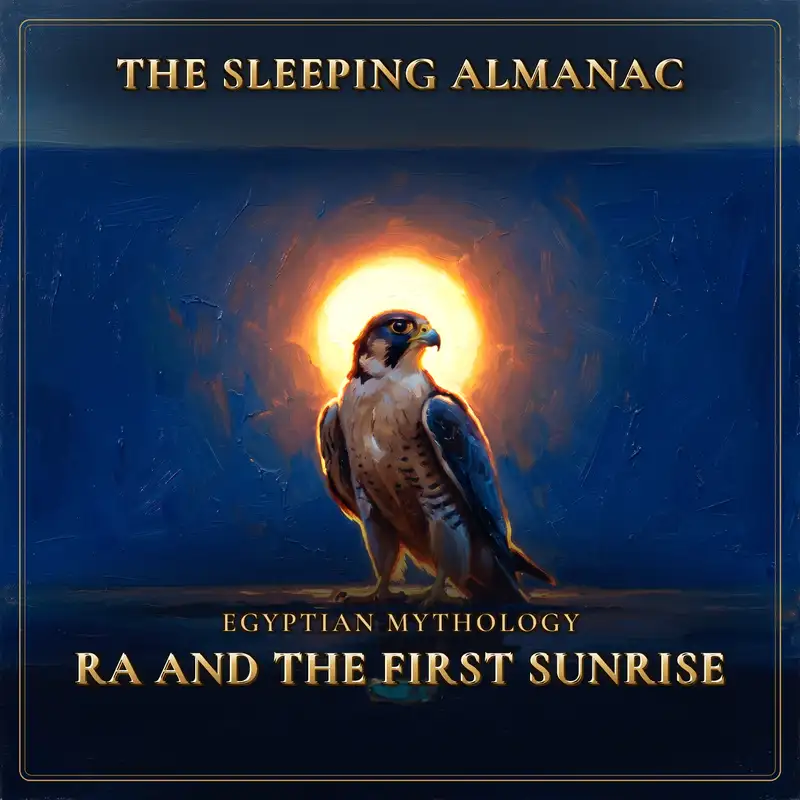
Welcome to The Sleeping Almanac.
Tonight, we are going to go back further than the pyramids.
Further than the pharaohs, further than the first stone ever set upon another stone along the Nile.
We are going back to a night so old that it came before the very first morning.
A night with no stars in it yet, and no sky to hold them.
There was only water.
Dark, still, endless water, with nothing above it and nothing below.
And somewhere in that water, not yet awake, was the sun.
So let your shoulders come down from wherever they have been holding all day.
Let the bed take your weight.
You do not have to follow every word.
You do not have to remember any of it in the morning.
The old Egyptians believed that the world began not with a shout but with a slow stirring in the dark, and that is the pace we are going to keep tonight.
Slow.
Unhurried.
Patient as deep water.
The Egyptians had a name for that beginning, for the very oldest of times, the moment before any other moment.
They called it zep tepi, which means something close to the first time, or the first occasion.
It was the morning before all mornings, the one from which every other day would learn its shape.
And the thing about the first time, the thing that made it holy to them, is that it was not over and done with.
It came round again.
Every dawn was a small return to zep tepi, the world made new exactly as it was made at the start.
So as we go back tonight to that first occasion, you are not going somewhere far away and strange.
You are going to the place that the morning still comes from, every single day, the deep source of every sunrise you have ever seen.
This is the story of the first sunrise.
We will draw it from the oldest religious writing humanity has left behind, the Pyramid Texts, carved into the walls of royal tombs
which set down the teaching of the priests of a place the Greeks would later call Heliopolis, the city of the sun.
The Egyptians called it Iunu.
It was there that the priests told how the sun made itself, and made the world, and learned to rise.
Those texts are very old, older than almost anything we can hold in the mind.
They were cut into stone more than four thousand years ago, in the burial chambers of kings, in narrow rooms meant never to be seen by the living.
The carvers filled the walls with columns of small careful signs, painted in green and blue
so that the words would help the dead king climb out of the dark and join the sun in the sky.
We are about to listen, very quietly, to some of the oldest words that human beings ever thought worth keeping.
They have outlasted every kingdom that came after them.
They were waiting in the dark of those sealed rooms for thousands of years, patient as the deep water they describe, and they are still here
and tonight a little of what they say will carry you down into sleep.
There is a line from one of their old teachers, a man named Ptahhotep, that we will carry with us through this whole season like a small lamp.
He said that good speech, true and ordered speech, is more hidden than the green stone, and yet it may be found among the maidservants at the grindstones.
He meant that what is true is quiet, and easy to miss, and waiting in plain places.
The Egyptians had a word for that kind of order, the rightness that holds the world together.
They called it ma'at.
Keep it nearby.
We will come back to it.
For now, there is only the water.
Close your eyes if they are not closed already, and let us go down to where it begins.
Chapter One.
The Waters That Had No Shore.
Before anything, there was Nun.
That was the name the Egyptians gave to the water that was there before the world.
Not a sea, because a sea has a surface and a floor and a far edge that the eye can reach for.
Nun had none of those things.
It was water in every direction, above and below and within, dark and without movement, neither warm nor cold, going on without limit and without end.
There was no up.
There was no down.
There was no time, because there was no sun to divide the day from the night, and so there were no days at all.
There was only the deep, lying in itself, waiting without knowing that it waited.
The Egyptians did not imagine this as a frightening place, and we will not either.
They imagined it as a kind of sleep.
The water was not angry.
It was not a flood that had drowned some earlier world.
It was simply the way things were before they were anything, the great calm that all things came out of and that all things, in the end, would return to.
When their priests wanted to describe what was most ancient and most restful, they spoke of the waters of Nun.
To go back to Nun was to go back to before the beginning.
In the old texts, Nun is given gentle titles.
He is called the father of the gods, the oldest of them all, the one who was there when no other had yet come to be.
And he was thought to be vast beyond imagining, not a thing inside the world but the thing the world was set down into
the boundless deep that surrounds everything still.
The Egyptians believed that even after the world was made, the waters of Nun never went away.
They lay beneath the earth, the source of the river and the springs.
They lay beyond the farthest desert, at the edges of everything.
And they lay above the sky as well, held back by the body of the heavens, a dark ocean overhead that the stars float in.
The world, to them, was a single bubble of light and air and dry ground, floating in an endless gentle sea that has no shore.
We live, even now, in a clearing made in the middle of the deep.
There is something steadying in that thought, rather than something fearful.
The deep is not waiting to rush in.
It is simply there, all around, the way the dark is there around a lit room, holding it, never crowding it.
The Egyptians did not lie awake worrying that the waters would return.
They knew the deep as the place they came from and the place they would rest in, the great quiet that holds the small bright world the way a cupped hand holds a coal.
To remember that the deep is out there, calm and patient, is not to be afraid.
It is to feel held.
And in those waters, folded into themselves, was everything that had not happened yet.
Every river that would later run.
Every reed that would later bend in the wind.
Every god, every animal, every grain of sand in a desert that did not yet exist.
All of it was there, dissolved into the dark water like salt into a cup, present and yet not present, real and yet not awake.
Somewhere in that endlessness, though we cannot say where, because there was no where, something was beginning to gather.
Not quickly.
Nothing here happened quickly.
But slowly, the way silt settles in still water, the way warmth gathers in a sleeping body, something was drawing itself together out of the deep.
A single point of difference in all that sameness.
A first thought, you might say, in a mind that did not yet have a name.
The Egyptians called what was gathering by many names across their long history, but the oldest and the simplest was Atum.
The name means something close to "the all," and also something close to "the complete one," and also, strangely
something close to "the one who is not yet." Atum was the part of the water that was about to become awake.
He had not opened his eyes.
He had not taken a breath.
He floated in Nun the way you float just below the surface of sleep, when the morning is still far off, and the dream has not yet decided what it will be.
It is worth resting on that name a moment, because the Egyptians clearly loved how much it held.
To be the all and the complete one and the not yet, all at the same time, is a strange and beautiful thing to be.
It means that nothing was missing from him, and yet nothing had happened.
He was whole, and he was waiting.
He contained everything, and he had not yet let any of it out.
The priests who first spoke this name understood, in their quiet way, that fullness and stillness can live together.
A thing can be complete and still be at rest.
You do not have to be doing anything to be whole.
Lying here in the dark, breathing slowly, with the whole long day finished and nothing more required of you, you are a little like Atum in the deep.
Complete.
Unhurried.
Holding everything, and letting it all be still.
The old texts say that he was alone with himself in the water, and that he had no place to stand, and no other to speak to
and that he made the first thought in the dark.
Before there was light there was a thought.
Before there was a word there was the long quiet before the word, the gathering, the readiness.
Everything that the world would ever be was first a slow stirring in the mind of one who floated half asleep in the deep.
There is no rush in the beginning of things.
There is only the patient drawing together of what is about to be.
We are there with him now, in the warm dark, before the first morning.
The Egyptians who first told this story lived in a narrow green country pressed between two great deserts
and they knew water the way only people who depend on a single river can know it.
They knew the river that gave them everything.
They knew the dark of the deep pools where the current slowed.
And they knew how still water can become at night, when not a breath of wind moves across it, and the surface lies as smooth and as black as polished stone.
When they tried to imagine the time before the world, that was the water they reached for.
Not a storm.
Not a drowning.
A vast and gentle stillness, warm as the air on a summer night, holding its breath.
And they understood something about that stillness that is worth resting on.
They understood that it was full.
The waters of Nun were not empty.
They were not nothing.
They held everything that was ever going to be, the way a single seed holds a whole tree, folded so small and so quiet that you would never guess what was waiting inside.
The river that would one day carry their boats was there in the water.
The wheat that would one day feed their children was there in the water.
You were there in the water, and so was this night, and so was the bed you are lying in now, all of it dissolved and dreaming in the deep before the first morning.
There is no hurry in a place like that, because hurry needs a future, and the future had not been made yet.
There is no worry, because worry needs a tomorrow, and there were no tomorrows.
There was only the long, full, patient now of the deep water, going on and on, asking nothing of anyone, complete in itself.
Everything that weighs on you tonight came later than this.
All of it is downstream.
Underneath all of it, holding all of it up, is this old calm water, where nothing yet needs to happen, and nothing is late, and nothing is owed.
There is nothing to do here.
There is nowhere to be.
There is only the water, holding everything, asking nothing.
Let it hold you too.
Chapter Two.
The First Mound.
In the deep water, a single mound of earth rose.
The Egyptians thought about this image their whole lives, because every year they watched it happen.
Each summer the Nile would flood and cover the land, and the whole valley would become a sheet of brown water from desert edge to desert edge.
And then, slowly, as the flood drew back, the first dark hills of soil would lift their backs above the water, glistening and new, ready to be planted.
The Egyptians watched the land be born out of the water every single year.
So when they told the story of how the world began, this is the shape it took.
First the endless water.
Then, rising out of it, the first patch of solid ground.
They called it the Benben.
The first mound.
The first place where there was a here instead of an everywhere.
In the temple at Heliopolis the priests kept a sacred stone of that name, a tapering pillar with a pointed top, and they said it stood for that first hill
the oldest ground in the world.
Long afterward, the capstones of the great pyramids, and the points of the tall stone needles we now call obelisks, were all shaped in memory of the Benben
the small high place that caught the first light.
But all of that was still unimaginably far away.
For now there was only the mound, dark and wet and silent, lifting itself out of Nun.
Think about that for a moment, because it tells you something tender about these people.
When they raised the greatest stone monuments the world had ever seen, the pyramids that still stand on the edge of the desert, they shaped the very top
the highest and last stone, the one that would catch the morning sun before anything else, to be a small copy of the first hill at the beginning of the world.
And the tall thin pillars they set up before their temples, the ones we call obelisks, were tipped with the same pointed shape
and often sheathed in shining metal so that at dawn the very tip would blaze gold while the rest of the world was still in shadow.
Everywhere they built, they were remembering this.
The first high place.
The first ground to break the surface of the deep.
The first thing the light ever touched.
Their whole civilization kept reaching up toward that one small mound, the way a plant reaches up toward the sun.
And the word itself was a small wonder to them.
Benben sounds like other Egyptian words for rising, for shining, for welling up, the way water wells up from a spring or light wells up over the horizon.
To say the name was to say, all at once, the hill that rose and the light that rose and the sun that rises.
They heard the whole morning folded into that single soft word.
We will not always be able to follow the play of their language, but it is worth knowing that for them the names of things were never only labels.
A name carried the nature of the thing inside it, the way a seed carries the tree.
The first mound and the first rising and the first light were all one word, because to them they were all one act, the world lifting itself gently into being.
And on the mound was Atum.
He had come to rest there the way a tired traveler comes to rest, though there had been no journey, and there was nowhere he had come from except the water itself.
He was the first thing to be somewhere.
The first thing with an edge, with an outline, with a place where he stopped and the rest of the world began.
Around him the waters of Nun still stretched away without end.
But he was no longer only water.
He was a shape upon the water.
He was the beginning of the difference between something and nothing.
In some of the old tellings, a bird came to the mound.
A grey heron, tall and still, standing at the water's edge as herons do, watching.
The Egyptians called it the bennu, and later the Greeks would hear of it and call it the phoenix, the bird that is reborn from its own ashes and never truly dies.
The bennu was said to have flown across the face of the waters and come to rest on the Benben, and when it gave its first cry
that cry was the first sound that had ever been made.
It broke the long silence.
It told the dark that something had changed.
It is a quiet, true image, if you have ever watched a heron.
They are patient birds, the most patient of all the birds of the river.
They stand in the shallows without moving for a long time, so still that you can forget they are alive, and then in their own moment they lift
slow and unhurried, on great soft wings.
The Egyptians knew the heron well, for it haunted the marshes along the Nile
and they chose it to be the first living thing to come to the new world precisely because of that stillness.
The bennu did not rush to the mound.
It came the way a heron comes, gliding low across the dark water, folding its long legs, settling without a sound.
And only then, in its own time, did it open its throat and cry, and the cry went out across the deep where no sound had ever been
and the long silence of forever was over.
The Egyptians thought of the bennu as the soul of the sun, the spirit of the light taking the shape of a bird so that it could be seen and welcomed.
They said it lived on the Benben stone, and that it returned across vast stretches of time, age after age, always the same bird, never truly dying, only renewing itself.
That is the seed the Greeks later grew into the story of the phoenix, the bird that burns and is born again from its own ashes.
But the older Egyptian bird is gentler than that.
It is not about fire.
It is about return.
The heron that came to the first hill is the same light that comes back over the horizon every morning, faithful, unhurried
crossing the dark to settle once more on the high ground and to cry the day awake.
The Egyptians built this whole picture of the beginning on something they watched with their own eyes every year.
Each summer the great river rose.
It spread out beyond its banks and covered the fields and turned the long valley into a single sheet of still brown water, from one desert wall to the other.
For weeks the land simply vanished beneath the flood.
And then, slowly, as the water began to fall, the first high places would appear again.
Dark, wet mounds of earth lifting their backs above the surface, glistening in the early light, the richest soil in the world laid fresh upon them.
Within days the farmers would be out walking those first islands of mud, pressing in the seed, and the green would return, and life would begin again.
So when they imagined the very first beginning, the beginning of all beginnings, they reached for that exact picture, because they trusted it.
First the endless water, the way the flood is endless while it lasts.
Then the first mound, lifting its dark back into the light, the first dry place, the first here in all the everywhere.
The Egyptians were not guessing wildly when they told this.
They were describing the thing they saw every single year, raised up to the size of the whole world.
Creation, to them, was not a violence.
It was a flood drawing back.
It was the good earth rising, patient and certain, ready to be planted once again.
There is a comfort in that worth carrying down into sleep.
The people who told this story did not believe the world had to be torn into being.
They believed it rose, quietly, the way their own fields rose every year out of the falling water, and that it would go on rising, season after season
long after they were gone.
We should let ourselves rest here a moment, on the first ground, in the first quiet after the first sound.
Notice how much has already happened, and how gently.
There has been no battle.
Nothing has been broken.
The world is not being torn from anything.
It is simply lifting itself, patiently, out of the deep, the way a thought lifts itself out of sleep.
A mound of earth.
A standing bird.
A single cry, fading now back into stillness.
And on the high ground, the one who was about to make everything, sitting alone, beginning at last to wake.
Chapter Three.
The One Who Made Himself.
Atum opened his eyes, and there was no one to see.
This is the strangest and the loveliest part of the Egyptian beginning, and their priests turned it over and over for thousands of years.
Atum was alone.
Truly alone, in a way that nothing has ever been alone since.
There was no sky for him to look up into, because he had not made it yet.
There was no land beyond his small mound, because he had not made that either.
There were no other gods, no animals, no people, no voices.
There was only the one figure on the one hill in the middle of the endless water, and the water did not speak.
So if there was going to be a world, Atum would have to bring it out of himself.
He had nothing else to make it from.
The Egyptians said that he was the one who came into being on his own, the one who made himself, and they did not find this idea troubling.
They found it comforting.
It meant that creation did not depend on anything outside itself.
The world was not made from the body of a defeated enemy, the way some peoples told it.
It was not stolen or won in a war.
It came, quietly, from the inside of the first god, who simply decided to be more than one.
How he did it, the old texts tell in more than one way, and we will be honest about that
because the Egyptians were comfortable holding several pictures of the same truth at once.
In one telling, Atum spoke, and the speaking made things real.
In another, he simply willed it, and what he held in his heart became what was.
And in the oldest and most physical telling, the one carved into the pyramid walls, he brought the next gods out of his own body
from his own breath and his own moisture, the way a spring brings water out of dry rock.
The Egyptians were not embarrassed by the body.
To them, making life from the body of a god was the most natural image there could be.
The point, in every version, is the same.
The one became the first of many.
The lonely figure on the mound was about to have company.
There was a power the Egyptians believed in that runs underneath all of these tellings, and it is worth a gentle word, because we will meet it again and again.
They called it heka.
We do not have a clean word for it.
We sometimes translate it as magic, but that makes it sound like a trick, and it was nothing of the kind.
Heka was the force that makes things happen, the power that turns a thought into a thing, a word into a deed, a wish into the world.
It was the energy of creation itself, present from the very first, older than the gods who used it.
When Atum thought of the world and the world began to be, that was heka working.
When he spoke a name and the named thing came into being, that was heka.
The Egyptians believed that to know the true name of a thing, and to say it rightly, was to hold a little of the power that made it.
And so for them, words were never small.
A word said with knowledge and care could shape what was real.
This is why their hymns and their healing spells and their prayers mattered so much to them.
They were not asking.
They were taking part, in their small human way, in the heka that made the world.
There is a kindness in that idea that you can carry into the dark.
It means that the gentle words you say to yourself at the end of a hard day are not nothing.
The Egyptians would have told you that words have a weight, that to name the day finished and to say that it is enough and to tell yourself, quietly
that you are allowed to rest, is to set a little order in your own small world.
So let the last words of your day be soft ones.
Let them be true.
The same power that the first god used to make the morning is, in the smallest and most ordinary way, the power you use when you tell yourself it is time, now, to let go.
And notice what he made first.
Not stone.
Not gold.
Not a throne or a crown or a weapon.
The first two things that Atum brought into being were air and moisture.
The breath you are breathing now, slow and even in the dark, and the faint dampness of it on your lips.
These were the first children of the first god.
The Egyptians named them Shu and Tefnut.
Shu was the air, the dry bright space that holds everything apart so that there is room to move.
Tefnut was the moisture, the wet and the dew and the rain that has not fallen yet.
Between them they were the very substance of weather, of breathing, of the difference between the inside of a thing and the air around it.
So now there were three on the mound where there had been one.
The father, and the air, and the water that falls.
And for the first time since the beginning, Atum was not alone.
He gathered the two of them close, the old texts say, and he was glad, and the gladness itself was a new thing in the world
because there had been no one to be glad with before.
The Egyptians chose those two, air and moisture, as the first to be made, and we should not pass over the choice too quickly, because there is wisdom in it.
They might have begun the world with anything.
They could have made the sun first, or the gods of war or the gods of gold, or the great kings.
But they began with breath and with water, the two things a body cannot live without for even a little while.
Shu and Tefnut are not grand.
They are not throne and crown.
They are the air in your lungs and the moisture on your lips, the very plainest gifts, the ones so constant that we forget them entirely.
The Egyptians, who lived close to the line between thirst and life, never forgot them.
To begin the world with breath and water was their way of saying that the first holy things are the ones that keep you alive without your ever noticing
the slow breath you are taking right now, the soft dampness of it, the simple machinery of being a living thing in the dark.
And there is one more thing to notice about how Atum made the first two gods, because the Egyptians noticed it, and it mattered to them.
He did not make servants.
He did not make tools or soldiers or stones to build with.
He made family.
The very first act of creation, once the lonely god decided to be more than one, was to bring into being someone to be with.
Company.
Kin.
Two children gathered close on the small high ground above the water.
The Egyptians were a people who loved their families deeply, who filled their tombs with images of husbands and wives sitting side by side
of children gathered at their parents' feet, of households meant to stay together not only through this life but through whatever came after.
And so it told them something true and tender that the world itself began as a family coming together.
Not power reaching for more power, but a parent who had been alone, reaching out, and no longer being alone.
The loneliness of the first god is one of the oldest feelings in any story humans have told.
And the cure for it, in this telling, is the simplest and oldest cure there is.
Someone to sit beside.
Someone to be glad with.
So picture them now, the three of them, on the first ground in all the world.
The father, weary and content.
The bright dry air, newly breathing.
The soft moisture, settling like dew.
Around them the endless water still lies dark and calm, but they are no longer lost in it.
They have each other, and they have somewhere to be, and the long aloneness of the beginning is over at last.
Rest there with the three of them, in the first company, on the first ground.
The hardest part is over.
The world has decided to exist.
From here, everything will unfold more gently, like a long slow exhale that has only just begun.
Chapter Four.
The First Breath and the First Rain.
Shu was the air, and so the first thing he did was to make a space.
Before Shu there had been no room between things, because there had been only the water, packed against itself with no gap anywhere.
But air is the gift of distance.
Air is what lets two things be near each other without being the same thing.
When Shu came into being and breathed out, he pushed a little of the endless water back, and in the space he cleared there was, for the first time
somewhere to stand that was not underwater.
A pocket of dryness in the deep.
A held breath in the middle of the flood.
The Egyptians thought of Shu as the one who holds things up and holds things apart.
In their pictures they drew him kneeling with his arms raised, lifting the weight of the sky away from the earth
keeping the two from collapsing back together into one crushed mass.
He was patience made into a god.
He was the steady effort that keeps a space open so that life can happen inside it.
Without him the sky would lie down on the land and there would be no room for anything to grow, or move, or breathe.
Every breath you take tonight is a small repetition of what Shu did at the beginning, making room, again and again
so that you can keep living in the space he holds open.
His name, too, the Egyptians felt to be full of meaning.
Shu sounds like their words for emptiness and for dryness and for the act of raising up, and so to say his name was to feel, all at once
the dry clear space he made and the lifting that made it.
He was the god you cannot see but feel on your skin, the breeze in the doorway on a hot evening, the cool of the air at the top of a high place
the invisible something that fills the gap between one thing and another.
The Egyptians had a lovely sense that the wind itself was Shu breathing
that when the air stirred across the river at dusk it was the first god of the air moving quietly through the world he held open.
When the night air touches your face tonight, you might think of it that way.
The oldest breath there is, still moving, still making room.
Tefnut was the moisture, and she was harder to draw, because moisture has no edges.
She was the dew that gathers on cool stone before dawn.
She was the dampness in the breath of a sleeping animal.
She was the rain that the Egyptians almost never saw, because in Egypt rain is rare and the land drinks instead from the river.
But she was also the river's own wetness, the life in the water that makes seeds swell and roots reach.
Where Shu was space, Tefnut was the softness that fills it.
The two of them belonged together the way breathing in belongs with breathing out.
The old priests of Heliopolis arranged all of this into a family, and they counted the generations carefully, because to the Egyptian mind, order was holy.
First there was Atum, the source.
Then Shu and Tefnut, air and moisture, the first pair.
And from that first pair, in time, would come the next, and from those the next, until there were nine great gods altogether
the family that held the whole shape of the world.
They called this family the Ennead, which simply means "the nine." We will meet all nine before the season is through
because their story is the story of everything that follows, the love and the loss and the long struggle that the Egyptians told for three thousand years.
But tonight we are still near the beginning, with only the first three, and then, very soon, the first four.
It is a gentle thing to know, lying here at the start of a long season, that the whole family is already implied in these first few.
The Egyptians liked to count it out, almost like a lullaby of names.
From Atum came Shu and Tefnut, the air and the wet.
From Shu and Tefnut would come Geb and Nut, the earth and the sky, whom we will meet in a little while.
And from Geb and Nut would come the last and most storied of the nine
four children whose loves and griefs and long patience fill nearly all the nights of this season to come.
There is a green king among them, and a wise and faithful queen, and a brother who brings the long sorrow, and a quiet sister who keeps the watch.
But we do not need their names yet, nor their story, not tonight.
Tonight it is enough to know that they are coming, folded up small in the beginning the way the whole tree is folded into the seed, waiting
as everything waits in these old quiet tales, for their own time to unfold.
And there is comfort in a thing being a family rather than a machine.
The Egyptians did not imagine the world as a set of forces grinding against each other.
They imagined it as kin, generation after generation, each one bringing the next into being and then making room for them.
The order they so loved was not the cold order of a clock.
It was the warm order of a household, where the elders make a place for the young, and the young carry the line forward, and everyone has their station and their part.
When you hear, across this season, of the struggles and the sorrows of these gods, remember that underneath all of it they are one family
sprung from a single lonely figure on a hill who simply did not want to be alone.
The whole of Egyptian myth is, in the end, the long story of a family, and you are about to spend many quiet nights inside it.
The Egyptians gave Shu and Tefnut another role as well, one that runs quietly under everything else in this season.
They said that the two of them were the parents of the sky and the earth, which we will come to in a little while.
But more than that, they were the gap and the gift that made a world possible at all.
Shu, the air, was the reason there could be an inside and an outside, a here and a there, a breath drawn in and a breath let go.
Tefnut, the moisture, was the reason the dry world could still be soft
that there could be dew on the morning grass and water in the living body and tears in the eye of a god.
Between the two of them, air and water, they were the whole climate of the world, the weather that makes a place livable.
And the priests of Heliopolis, who loved to set things in careful order, taught that this was the true shape of creation.
Not a single great explosion, but a patient unfolding, one generation bringing forth the next, each gift making the next gift possible.
The source brings forth the air and the water.
The air and the water will bring forth the earth and the sky.
The earth and the sky will bring forth the gods whose loves and griefs fill the rest of these long nights.
Step by gentle step, the way one quiet thing leads to another, the way one slow breath leads to the next, until without any hurry at all there is a whole world
and a whole family, and a whole story waiting to be told.
There is something worth resting on here, before we go on.
The Egyptians did not begin the world with kings or armies or gold.
They began it with the most ordinary and most necessary things there are.
Air.
Water.
The space to breathe and the moisture to live.
The things you cannot see and never think about and could not survive an hour without.
Their creation story is, at its root, a quiet act of gratitude for breath itself.
And so, as Shu holds the space open one more time, take a slow breath in, and let it fall, and let yourself sink a little deeper into the warm dark
where the family of the first morning is still gathering on the first hill above the endless calm of Nun.
Chapter Five.
The Lost Children and the Weeping Eye.
Now we come to a story the Egyptians loved, because it explained, in a single tender image, where people come from.
When Shu and Tefnut were still young, the old texts say, they wandered away from their father into the dark waters of Nun.
Perhaps they went exploring, the way the first of anything explores.
Perhaps the endless water simply drew them out and closed over them, and they were lost in it, two small new gods swallowed by the deep that had no edges.
And Atum, on his mound, found that he was alone again.
The children he had made from his own breath were gone, somewhere out in the limitless dark, and he could not see them, and he did not know if they would come back.
So he did something that any parent would understand.
He took out his own eye, and he sent it to look for them.
This is one of the oldest and strangest ideas in Egyptian religion, and it runs through the whole of this season, so let us sit with it gently.
The Egyptians believed that the sun itself was, in a sense, the eye of the great god.
The thing that sees, the thing that gives light, the thing that searches the world from above and misses nothing.
When Atum sent out his eye to find his lost children, he was sending out the light to search the dark.
And the eye went out across the face of the waters, shining, looking, and at last it found Shu and Tefnut far out in the deep, and it brought them home.
Stay with that image a little, because it is a beautiful one and it repays a slow look.
The light, for the Egyptians, was not a thing apart from the god.
It was his very eye, sent out from him to do his looking
the way you might send your gaze across a dark room to find a sleeping child and make sure the breathing is steady.
The sun did not merely shine on the world.
It watched over it.
It searched it.
It cared.
Every ray that crosses the world is, in this old way of seeing, a look from someone who is paying attention, someone who does not want anything to be lost.
There is a tenderness in being seen like that, in being looked for.
Whatever else you feel tonight, the oldest story these people told says that the light is out there searching
and that what it is searching for is the ones who have wandered off, so that it can bring them home.
When they came back to the mound, Atum wept.
He wept with relief, the way you weep when something you thought was lost is suddenly returned to you.
And the Egyptians, who loved a play on words even in their most sacred texts, noticed that their word for the tears of a god, remyt
sounded almost exactly like their word for human beings, remetj.
And so they told it that when the first god wept for joy at the return of his children, his tears fell upon the new earth, and where each tear struck
a human being rose up.
That is where people came from, the priests of Heliopolis said.
We are the tears of the creator, wept in gladness at the moment a lost thing was found.
We should be honest and say that this was one telling among several, because the Egyptians had more than one account of where people began
and they were content to hold them side by side.
But this is the one to carry into sleep, because of what it says about us.
It says that human beings were not made as servants, or as an afterthought, or as a punishment.
We were made of a god's relief and a god's joy.
We came into the world at the exact moment that grief turned back into gladness.
There is a great tenderness in that, and the Egyptians felt it.
To be a person, in this old story, is to be a small piece of the creator's happiness, set walking upon the earth.
That play on words, the tears and the people, the remyt and the remetj, was not idle to them, and it is worth understanding why.
The Egyptians believed, as we touched on earlier, that the names of things told the truth of things.
So when their word for the weeping of a god and their word for human beings sounded almost the same, they did not think this was an accident of language.
They thought it was a clue, a hint left in the very sound of the words, pointing to where people had really come from.
The likeness in the sound was, to them, a kind of proof.
We are named, in their hearing, after the tears of the first morning.
The word for what you are still carries, very faintly, the sound of a god weeping for gladness.
It is a strange and lovely thing to think that buried inside the oldest name for our kind there is the memory of a joy.
There is a second tenderness folded into this story, and the Egyptians felt it keenly.
When the lost children came home, the old texts say, they did not come back to the same father they had left.
While they were gone, Atum had grieved, and grief changes a person, even a god.
And so when Shu and Tefnut returned, he set his eye back into his face, but he set it in a new place, high on his brow, where it could always see
where it could keep watch over the children he had so nearly lost.
The Egyptians said that this is why the sun rides high in the sky and looks down upon the whole world.
It is the watchful eye of a parent who once knew what it was to lose what he loved, and who never wants to feel that again, and so keeps looking, always
to be sure that everything is where it should be.
And think again of what it means that our own beginning, in this telling, is bound up with that moment.
We are the tears of that homecoming.
We rose from the ground where joy fell.
Every human being who has ever lived began, in the story the priests of Heliopolis told
at the precise instant when a father stopped grieving and started weeping for happiness instead.
Whatever else is true of us, this old story says that we are made of relief.
We are made of the moment the lost thing is found and the long fear lets go.
So if there is anything tonight that feels lost to you, anything you have been holding onto or holding off, let this old image hold it for a while.
The eye is out there searching the dark, and the eye is gentle, and the eye brings the wanderers home.
And the eye that went searching has its own long road ahead of it.
Across this season we will see it again and again, sometimes as the gentle light that returns the lost, sometimes as a goddess in her own right, sometimes
when it is angered, as a thing of fire that the gods must learn to calm.
But tonight it is only the kind light that searches the dark and brings the wanderers home.
Let it search gently over you as you drift.
It is not looking to wake you.
It is only making sure that you, too, are safe, and gathered in, and held.
Chapter Six.
Earth and Sky.
From Shu and Tefnut, air and moisture, came the next two great gods.
And these two you can see with your own eyes, every day and every night, for as long as you live.
Their names were Geb and Nut.
Geb was the earth, and Nut was the sky.
Geb was the land itself, the dark rich soil of the river valley, the rock beneath it, the whole solid body of the world.
The Egyptians drew him lying down, because the earth lies down, stretched out and patient, holding everything that grows.
They said that the low hills were his shoulders and his knees, and that when he laughed it was the trembling of the ground
and that all the plants of the world grew up out of his green back.
He was steady and he was generous.
Everything that lives stands upon him, and in the end everything that lives lies down again upon him to rest.
There is no gentler thought to hold at the edge of sleep than that the earth itself is a god who lies down, and that you are lying down upon him now, held
and carried, and at rest.
Nut was the sky, and she was one of the most beautiful figures the Egyptians ever imagined.
They drew her as a woman arched high overhead, her fingertips touching the eastern horizon and her toes touching the western one
her whole long body curved across the top of the world like a great vault.
Her skin was deep and dark, and across it were scattered all the stars.
When you look up on a clear night and see the band of the Milky Way stretched from one edge of the sky to the other, the Egyptians saw the body of Nut
bending over the world, keeping the dark waters of Nun from crashing back down upon it.
She was the ceiling of everything.
She was the dark that holds the stars.
The Egyptians painted her on the insides of their coffin lids, which tells you better than anything how they felt about her.
When they laid a beloved one to rest, they wanted the very last thing above the body, looking down, to be Nut, the great mother of the sky
arched protectively overhead just as she arches over the whole living world.
So the one who had died would lie within her, the way the stars lie within her, the way the sun lies within her each night.
To be dead, in that picture, was to be gathered up into the body of the sky, held in the dark among the stars, carried through the night toward a new dawn.
There are few gentler things in all of human imagining than that.
They could not bear for their dead to lie under nothing.
And so they gave them the whole star scattered body of the heavens to lie beneath, a mother bending close in the dark.
She was thought to be a tender and watchful figure, this goddess of the sky, and very ancient.
The old texts call her the one who bears the stars, the one in whom the gods are born and reborn
the great protectress whose body shelters the world from the deep that lies above it.
For remember, the waters of Nun did not vanish when the world was made.
They still pressed down from above, the dark ocean overhead, and it was Nut, arched and steady, who held them off
who kept the deep from crashing back down and unmaking everything.
Every night you have ever slept safely beneath the open sky, you slept under her.
The dark you see overhead is not emptiness.
In the oldest seeing of these people, it is someone, bending close, holding back the deep, scattered all over with the lamps of the stars
watching the small warm world go round to morning.
Now, the priests of Heliopolis told a tender and slightly sorrowful tale about Geb and Nut, the earth and the sky.
They said that in the very beginning the two of them lay close together, the sky resting upon the earth
holding each other so tightly that there was no room between them.
And while they held each other, nothing could grow, because there was no space, no air, no light getting in.
So Shu, their father, the god of air, came between them.
He set his hands beneath Nut and lifted her up, high above Geb, and held her there.
He raised the sky away from the earth and made the great open space of the world, the space we all live inside
with the land below and the stars above and the bright air in between.
The Egyptians felt the sweetness and the sadness of that.
The earth and the sky had been lifted apart so that life could exist, and they would spend all of time reaching for each other across the distance
the rain falling from sky to earth, the smoke and the prayers rising from earth to sky, never quite able to touch again.
But because they were parted, there was room.
Room for the sun to sail.
Room for birds to fly and rivers to run and people to walk and lie down and dream.
The space you are resting in tonight, the quiet dark between the floor and the ceiling of your room
is a small echo of that first great space that Shu made when he lifted the sky away from the earth.
The Egyptians lived with these two gods more closely than with almost any others, because they could not help it.
They saw Geb every time they knelt to work the dark soil, every time they lay down at night on the warm ground
every time they buried someone they loved and gave the body back to the earth that had given it.
And they saw Nut every clear night of their lives, the great dark woman arched overhead, scattered all over with stars.
They even told that Nut swallowed the sun each evening at the western horizon, and carried it through the long darkness inside her body
and gave birth to it again each morning in the east, red and new, between the hills of the dawn.
The sky was a mother who took the light into herself at night and returned it, faithfully, at first light.
There is no more reassuring picture in all of their wisdom than that.
And between the earth that holds and the sky that shelters, there is the space where we live.
The Egyptians never stopped being grateful for that space.
They knew, because their priests taught it, that the room they breathed in had been made on purpose, lifted open and held open so that there could be life.
Every house with a roof and a floor was a small image of it.
Every still night under the stars was a reminder of it.
The world is a room with the good earth for its floor and the star scattered body of the sky for its ceiling, and you are lying down inside it now
exactly where you are meant to be, held below and sheltered above.
And here, in the middle of the story, it is worth remembering the small lamp we set out at the very beginning, the words of the old teacher Ptahhotep
and the word ma'at that they pointed toward.
He taught that the deepest order of things is quiet, that good and ordered speech is more hidden than the green stone
and yet it may be found in the humblest of places, among the maidservants at the grindstones.
Look at what has been made so far in this story, and notice how quietly it was made.
The earth lay down.
The air lifted the sky.
A space opened where life could be.
There was no thunder in any of it.
The order that holds the world apart so that we can live inside it was set in place without a single shout.
That is ma'at.
Not a loud command but a steady arrangement
a rightness so quiet and so reliable that we live inside it without ever once noticing the work it does to hold the ceiling off the floor.
And before Shu lifted her up, while the sky and the earth still lay close in the dark, Nut had brought forth children of her own.
Five of them, the most important gods in all the long story of Egypt.
But the telling of how they came to be born is a story all its own, full of moonlight and clever wagers and a game played for the oldest of stakes.
That story waits for us a little further on.
For now, let the sky lift gently overhead, and let the earth hold you from below, and rest in the wide calm space between them
where the whole world has just been given room to breathe.
Chapter Seven.
The Sun Takes Its Throne.
We have spoken of the first god as Atum, the one who made himself on the mound.
But there was another name, and it is the name this whole season belongs to.
Ra.
The Egyptians used the two names together so often that they wrote them as one, Atum and Ra spoken in a single breath, and it is worth understanding why, slowly
because it is the heart of tonight's story.
Atum was the god of the source, the one who began in the deep and gathered the world out of himself.
He was the completeness of things, and also their old age, the sun as it sinks at evening, full and red and finished with the day.
But Ra was that same power seen at its height.
Ra was the sun blazing at noon.
Ra was the light when it is strongest, the warmth at the top of the sky, the great golden disc that the whole earth turns its face toward.
The Egyptians did not think of these as two different gods quarreling for one throne.
They thought of them as one being in different lights, the way you are the same person when you first wake and when you are most awake
and the same person again when you are finally, gratefully, lying down to sleep.
This is worth lingering over, because it is a kind and a wise way of seeing, and the Egyptians lived by it.
They did not feel that a thing had to be only one thing to be real.
The very god at the centre of their world was the source and the height and the setting all at once
the hidden one in the deep and the blazing one at noon and the tired red one going down in the west, and not one of these names was a lie
and not one of them was the whole truth.
They held the great being lightly, in all its faces, and were content.
There is a rest in learning to do the same with yourself.
You are the one who rose this morning and the one who carried the long bright middle of the day and the one who is sinking now toward sleep
and all of them are you, and none of them is the whole of you, and you do not have to choose.
You are allowed to be many things, the way the sun is, and to let the evening face be as true and as good as the morning one.
And notice, gently, that the season is named for the height, for Ra, the blazing noon, and yet tonight we have met him most as the source and as the setting
as the quiet one in the deep and the red one going down.
That is no accident.
The Egyptians knew that the brightest power is best understood from its calm edges, from where it begins and where it comes to rest.
The whole long season ahead is the story of the sun in its strength, the great struggles and loves of the family it began.
But it opens here, in the quiet, with the light at its gentlest, rising and setting, because that is the face of the sun that belongs to sleep.
The blazing noon is for the waking world.
The soft gold of the beginning and the end is for the dark, and for the bed, and for you, here, now, at the edge of rest.
And when the world had been made, when there was earth below and sky above and the wide air between, the god rose up over it as the sun, and the first true day began.
Try to imagine that first sunrise, because no one had ever seen one.
There had been the long dark of Nun, and then the dim grey light of the bennu's cry, and the slow making of air and water and earth and sky.
But there had never yet been a morning.
And then, over the eastern edge of the new world, the disc lifted.
Gold poured across the water.
The dark that had been there since before the beginning drew back for the first time, not destroyed, only set aside for a while
and the whole new earth was washed in warm light.
The river caught fire with it.
The first mound, the Benben, blazed like a lit lamp.
And every living thing that had just been made lifted its face, the way living things have lifted their faces to the morning ever since.
Try to feel it, slowly, the way the Egyptians must have felt it when they sang it.
First the long dark, which was all there had ever been, so that no one and nothing had any idea that the dark could end.
Then the faintest change at one edge of the world, a thinning, a greying, a softness coming into the black where the eastern hills would be.
Then the first true colour the world had ever held, a deep red bleeding up out of the horizon, and the water far off beginning to glow.
Then the rim of the disc, just the curved top edge of it, breaking the line of the world, and the first ray going out flat and golden across the new earth
touching the high places first, the Benben, the tops of things, and running down into the low places after.
And then warmth.
Warmth, which the world had never known, spreading across the cool new ground, soaking into the wet mound, lying gently on the upturned faces of everything that lived.
The Egyptians never tired of that sequence.
It was the most ordinary miracle there is, and they treated it, every single dawn, as though it were the first one.
And imagine the silence breaking into sound.
The bennu had cried once, long before, and then the world had gone quiet again through all the slow making of things.
But now, with the light, the whole new earth seemed to find its voice at once.
This is why, ever after, the birds of Egypt sang the loudest at dawn, and the people understood it perfectly.
They were greeting the light.
They were doing what every living thing wants to do when the dark lets go, which is to make a glad noise and lift the face and feel the first warmth come.
You have done it yourself, on some early morning, stepping out into the first sun after a cold or a sleepless night
feeling it touch your skin and something in your chest ease.
That is very old, that feeling.
It is as old as the first morning.
It is the world remembering, every dawn, that the light came back.
And here is something gentle to understand about the way the Egyptians thought, because it is easy to be confused by it otherwise.
They did not mind that the sun had many names, and many forms, and more than one story of how it came to be.
They were not troubled the way we sometimes are when two accounts do not line up perfectly.
To them, the sun was simply too great a thing to be caught in a single picture.
It was the source on the mound and it was the disc in the sky.
It was Atum and it was Ra.
It was the old one and the bright one and, as we will see, the new one being born at every dawn.
The Egyptians held all of these at once, easily, the way you might hold in your mind that a person is a parent and a child and a friend all at the same time
no one of these untrue, no one of these the whole truth.
This is a restful way to hold the world, if you can manage it.
Not everything has to be resolved into a single tidy answer.
Some things are simply large, and many sided, and you can let them be large without needing to pin them down.
So when the sun rose over the world for the first time, it was the same one who had stirred in the deep, now wearing the face of the blazing day.
The completeness of the dark water had become the warmth of the morning.
Nothing had been lost in the change.
Everything had only come into its light.
The Egyptians never lost their wonder at this.
For three thousand years, in temple after temple, the priests rose before dawn and waited in the dark and sang the sun up over the horizon, every single morning
as though it might be the first one, as though it still needed their welcome.
They were not anxious people, on the whole.
But they understood that the rising of the sun was the oldest victory there was, light coming back into the dark, and that it was worth being grateful for
every day, without ever growing used to it.
So the sun took its place over the world, and the god who had begun as a stirring in the deep water now sailed at the top of the sky
looking down upon everything he had made.
And it was good, and it was warm, and it was, at last, no longer dark.
Rest in that first warmth a while.
You do not have to do anything with it.
Just let it be morning, somewhere very old, for the very first time.
Chapter Eight.
The Boat of Millions of Years.
The sun does not stand still in the sky.
It moves.
And the Egyptians, who lived their whole lives beside a river, knew exactly how a thing crosses a wide space slowly and steadily from one side to the other.
It goes by boat.
So they said that the sun crossed the sky in a boat, and they gave the boat a name.
They called it the Mandjet, the boat of the daytime, though they also called it by a grander title that I love, the Boat of Millions of Years.
Because the sun had been making this crossing since the first morning, and would go on making it for millions of years more, the same patient voyage
dawn to dusk, day after day after day, longer than any kingdom, longer than any memory, longer than the stones themselves.
In the boat, the Egyptians said, Ra did not sail alone.
He had a crew.
There were other gods who rode with him and worked the great vessel across the heights of the sky.
There was one who stood at the prow and watched the way ahead.
There was one who held the steering oar.
There was wisdom aboard, and magic aboard, and strength aboard, all the powers that the morning needs to carry the light safely from one horizon to the other.
The Egyptians imagined the sky as a kind of celestial Nile, a river of air arching over the world, and along it the bright boat sailed
with the sun shining at its center, and the gods at their stations, calm and unhurried, doing the oldest work there is.
It comforted them to think that the light was not left to fend for itself, that it had companions, that the great work of carrying the day was shared.
The very heka we spoke of, the creative power that made the world, was said to ride in the boat as a god in its own right, standing near the sun
ready to speak the words that keep the way clear.
The all seeing eye sailed there too.
And there were others whose task was simply to watch, to steer, to keep the steady rhythm of the crossing.
None of them hurried.
None of them were afraid.
They had made this voyage more times than there are grains of sand, and they would make it more times still
and they went about it with the calm of people who know their work and trust each other to do theirs.
There is a deep peace in that picture, in a thing being well crewed and unhurried and sure of its way.
The light is not alone up there.
It never has been.
Good and faithful hands are at the oar and the steering and the lookout, and they have never yet let the morning fail to come.
The Egyptians also loved the title they gave that boat, the Boat of Millions of Years, and it is worth saying slowly
for it is one of the most restful phrases they ever made.
Millions of years.
Not a day, not a season, not a single human life with all its hurry, but millions of years, a span so long that no worry can survive inside it.
Whatever presses on you tonight is happening inside one small day, one turn of the boat.
But the boat itself has been sailing since before the first kings, and it will sail long after the last of us, the same patient crossing, dawn to dusk and round again.
To set your small day down beside the millions of years of that voyage is to feel it grow light.
The boat does not strain.
It does not race the clock.
It has all the time there is, and so, just for tonight, so do you.
The Egyptians were the greatest boat people of the ancient world, and so this was the most natural image they had.
Their whole country was strung along a single river.
They traveled by boat, they traded by boat, they carried their dead to the tombs by boat, and they buried their kings with real boats
full sized vessels laid in pits beside the pyramids, so that the dead might join the sun on its eternal sailing.
When they looked at the sky and tried to understand how the sun moved, they did not reach for anything strange.
They reached for the thing they knew best in all the world.
The sky was a river, and the sun went down it the way everything went down their own river, slowly, steadily, carried by the current, with a crew aboard to keep it true.
And they imagined that long voyage in loving detail.
They knew that a great river journey has a rhythm to it, the dip and lift of the oars, the small sounds of the water against the hull, the slow sliding by of the banks.
They pictured the sun's boat exactly so, gliding without haste along the high blue river of the sky, the light pouring off it onto the world below
the gods at their quiet stations doing the oldest work there is, hour after unhurried hour.
Nothing about it was frantic.
Nothing about it was forced.
It was the calmest crossing imaginable, repeated faithfully every day since the first day, and meant to be repeated for millions of years to come.
Think of how steady that is.
Not a chariot racing, not a fire flung across the heavens, but a boat, moving at the pace of deep water, carried along by a current you cannot see.
The Egyptians did not picture the day as a sprint.
They pictured it as a long, smooth sail.
The sun rises in the east, where the boat puts out from shore.
It climbs to the top of the sky by noon, when the boat reaches the middle of the great river.
And then, all afternoon, it descends gently toward the west, where the boat will come at last to the far shore as the light turns gold and then red and then dim.
There is a reason the Egyptians found this image so deeply restful, and so do we.
A boat carries you.
You do not have to swim.
You do not have to row.
You lie back in the hull and the river does the work, and the far shore comes to you in its own time
whether you watch for it or whether you close your eyes and let the motion rock you.
Tonight, you are a passenger on the oldest boat there is.
The light is sailing west.
The current is slow and sure.
You have nowhere to be but here, carried, while the great vessel makes its quiet way across the top of the world.
Chapter Nine.
The Three Faces of the Sun.
The Egyptians watched the sun very closely, more closely than almost any people who have ever lived, and they noticed that it does not look the same all day.
And so they said that the sun god wore three faces, one for each part of his journey, and that he changed from one to the next as the day turned.
In the morning, when the disc first lifts over the edge of the world, fresh and new and climbing, they called him Khepri.
And here the Egyptians did one of the things they did best, which was to find a great truth hidden in a small and ordinary creature.
Khepri was pictured as a scarab, a humble dung beetle, the kind that rolls a little ball of earth across the ground in front of it.
The Egyptians had watched that beetle roll its round burden along, and it reminded them of the sun rolling across the sky, and they had noticed something else as well.
They saw young beetles emerge, seemingly, from the ball itself, life coming out of what looked like dead earth.
And so the scarab became their sign for a thing that brings itself into being, that comes up new out of nothing, that is reborn each morning by its own power.
Khepri was the rising sun, the sun being born again, the sun that makes itself anew every single dawn just as Atum had made himself at the very first.
And the name fits the thought exactly, which the Egyptians delighted in.
Khepri comes from their word for coming into being, for becoming, for taking shape where there was nothing before.
To say the name was to say the very act of beginning.
So the morning sun was not only called the one who shines, but the one who becomes, the one who comes into being
the same word they used for the first god making himself in the deep.
Every dawn, then, was a small repetition of the very first morning.
The sun did not merely return.
It was reborn.
It came into being all over again, fresh as it was at the start of the world, as though the long night had wiped the slate clean and the light got to begin once more.
There is a generosity in that idea, a kind of mercy folded into the turning of the day.
Whatever the day before was like, the morning comes new.
The sun does not carry yesterday on its back.
It is born again, clean and golden, over the eastern hills.
At noon, when the sun stands at the top of the sky in its full strength, golden and high and blazing over everything, they called him Ra, simply Ra
the sun at the height of its power, the great disc ruling the middle of the day.
This was the face of the sun that the whole season is named for.
The sun as king.
The sun at its brightest and most awake.
And in the evening, when the disc sinks toward the western desert, swollen and slow and deep red, its heat fading, its long light reaching across the sand
they called him Atum once more.
The old one.
The complete one.
The sun that has done its work and is ready, now, to go down.
The same god who had begun the world was the same god who closed the day, gone full circle from morning to evening
from the child rolling up out of the dark to the elder sinking gratefully toward rest.
There is a whole human life held inside that single day, and the Egyptians saw it clearly, and they did not find it sad.
The morning sun is the child, new and climbing, full of the beginning.
The noon sun is the one in full strength, at the height, ruling the bright top of the day.
And the evening sun is the elder, the one who has done the long work and grown gentle with it, sinking now, deep and red and unhurried, toward a well earned rest.
To watch the sun cross the sky was, for them, to watch a life go by, from the first eager rising to the slow grateful setting
and to be reminded that each part of it is good, that the evening is not a failure of the morning but its fulfillment
the same light come round at last to its rest.
You are nearer the evening end of your own day now, sinking gently like the western sun, your work behind you, your heat softening
the long light of you reaching out low and golden across the dark before it lets go.
That is not a loss.
That is the day completing itself, exactly as it should.
And of the three faces, it is worth lingering on the first, the scarab, Khepri, the rising sun, because the Egyptians built one of their deepest hopes upon it.
They had watched the beetle roll its little ball of earth, and they had seen, or believed they had seen, new life come out of that ball
as though the creature made itself out of plain ground.
And they thought, what a thing that is.
To come up new out of what looked like nothing.
To be reborn by your own quiet power, without anyone needing to make you.
That, they decided, was exactly what the sun did at every dawn.
It went down old and red in the west, worn out with the day, and somewhere in the dark it gathered itself
and it rolled itself back up over the eastern edge of the world, young again, as though the evening had never happened.
The Egyptians took enormous comfort from this, and they wove it through everything, even into how they thought about death.
If the sun could go down into the dark and come up again new, then perhaps a person could too.
Perhaps an ending was not truly an ending but only a setting, a going down, with a rising still to come.
They carved scarabs out of stone and precious things and laid them over the hearts of their dead
so that those they loved might roll up new out of the dark the way the morning sun does.
It was their sign for hope, the smallest and humblest of creatures, carrying the largest of promises.
I find a great kindness in this, and the Egyptians did too.
They looked at the sun and they saw the whole shape of a life inside a single day.
Born new in the morning, full and strong at the height, and at evening growing old and red and quiet and ready to lie down.
And then, in the dark, somehow, made young again, so that the morning could come once more.
The sun showed them that ending and beginning are not so far apart, that the old one and the new one are the same one
that what goes down in the west will rise again in the east, every time, without fail, no matter how dark the night between.
Hold that quietly as you drift.
The face of the sun is turning, now, from gold to red.
It is growing older and gentler.
It is beginning, like you, to come down toward rest.
Chapter Ten.
The Measuring of the Day.
Before the sun, there had been no time.
We said that at the very beginning, in the waters of Nun, where there were no days because there was nothing to divide them.
But once the sun began its crossing, once there was a morning and a noon and an evening, time itself was born
and the Egyptians thought of this as one of the greatest gifts the sun ever gave.
Because the sun did not only give light and warmth.
It gave order.
It gave the day its shape, the steady reliable shape of rising and climbing and setting that you can count on, that comes again and again in the same way
that never tricks you and never fails.
From the sun came the dividing of light from dark, and from that came the very first measure of time, the day, and from the days came the months
and from the months the year, and from the patient repeating of the years came the whole Egyptian calendar
one of the most accurate that the ancient world ever made.
All of it rested, in the end, on the simple fact that the sun could be trusted to rise.
And the Egyptians read time in the great rhythm of their river as well, in a yearly round as faithful as the daily one.
Each year the Nile rose and spread across the land and laid down its rich black soil, and then drew back, and the seed went in, and the green came up
and the harvest was gathered, and the land grew dry again and waited for the flood to return.
They marked their year in three long seasons by this rhythm, the time of the flood, the time of the growing, the time of the harvest
and they timed the whole of it by the sky, for the flood came each year just as a certain bright star returned to the dawn horizon after its season away.
The day was measured by the sun, and the year was measured by the river and the stars, and both came round, and came round, and came round
so faithfully that a people could build a calendar on them and trust it.
Under all their counting of time lay this one deep certainty, that the great cycles keep their promises, that what goes away comes back
that the light returns and the flood returns and the green returns, in their seasons, without fail.
There is a particular peace in living among rhythms you can trust, and the Egyptians felt it in their bones.
They did not have to wonder whether the morning would come, or whether the river would rise.
These things had their times, and kept them.
A life lived inside such faithful cycles is a calmer life than one that fears each tomorrow is a stranger.
So tonight, lay your own small worries down inside the great reliable wheel of things.
The day will end and the day will come again.
The light is going round even now.
You are held inside a rhythm older than every fear you have, a turning so faithful that it has never once, in all the millions of years, failed to bring the morning back.
And this, the Egyptians felt, was the deepest thing about the sun, deeper even than its warmth.
The sun was the great keeper of ma'at.
We met that word in the very first minutes of tonight, and now it comes back to us, the way the sun comes back.
Ma'at was the Egyptian name for rightness, for order, for truth, for the way things are supposed to be.
It was the balance that holds the world steady, the law beneath all laws, the difference between a world that makes sense and a world that has come apart.
And the sun, rising faithfully every morning, crossing the sky in its appointed boat, setting in its appointed place
was the great daily proof that ma'at was real, that the world was held in order, that there was something you could count on at the bottom of everything.
That old teacher Ptahhotep, whose words we are carrying through this season, understood that the truest things are often the quietest.
Good speech, he said, true and ordered speech, is more hidden than the green stone, and yet it may be found among the maidservants at the grindstones.
He meant that ma'at, the deep rightness of things, does not announce itself with thunder.
It is humble.
It is steady.
It is in the ordinary turning of the day, the sun coming up over the same horizon it came up over yesterday, the river rising when it should
the seasons keeping their promises.
The order that holds the world is not loud.
It is patient and faithful and easy to overlook, exactly because it never lets you down.
The Egyptians wove ma'at into everything, not only the turning of the sky but the running of a life.
To live well, they believed, was to live in ma'at, in balance and truth and fair dealing, in keeping with the deep order of things.
To do wrong was to break ma'at, to pull a little against the grain of the world.
And at the very end of a life, they believed, the heart of a person would be weighed against the feather of ma'at itself
to see whether that life had kept the balance or lost it.
We will come to that weighing in its own time, in one of the gentlest and most thoughtful nights of this whole season.
But it begins here, at the first sunrise, with the simple fact that the sun rose in order, and crossed in order, and set in order, and so taught the world what order was.
And that old teacher Ptahhotep, whose quiet maxim we are carrying like a lamp, would have understood the sun perfectly.
He spent his long life setting down advice on how to live in ma'at, how to listen well, how to speak truly
how to be patient with the foolish and gracious in success and calm in the face of trouble.
His wisdom was not loud.
It was the wisdom of a man who had watched the world for a very long time and noticed that the things that truly hold a life together are humble and steady and easy to overlook
like the rising of the sun, like the keeping of one's word, like the small daily honesty that never makes a sound.
Good speech is more hidden than the green stone, he said, and yet it is found among the maidservants at the grindstones.
The deepest order is the quietest.
It does its faithful work whether or not anyone is watching.
There is a great peace in trusting something that has never once failed.
The sun has risen every morning since the first morning.
It rose over the pharaohs and it set over them, and it rose over their grandchildren, and over the long centuries after the last temple closed
and it rose this morning over you, and it will rise again tomorrow whether or not you are awake to see it.
You do not have to hold the world together tonight.
The sun is keeping ma'at.
The order is keeping itself.
You can let go of the day, knowing the day will come again, measured and faithful, exactly as it always has.
Chapter Eleven.
The Descent.
And now the boat comes to the western shore, and the sun goes down, and we come to the part of the story that makes this a tale for sleep.
All day the great vessel had sailed across the bright top of the sky.
But every voyage has an end, and as the afternoon deepened, the boat drew down toward the western edge of the world, where the desert meets the sky
where the Egyptians believed the land of the living gave way to something older and darker.
The disc touched the horizon.
The gold became red, and the red became deep, and the light reached out long and low across the sand, and then, slowly
the sun slipped below the edge and was gone, and the dark that had waited since the beginning came quietly back across the world.
But the Egyptians did not believe the sun was destroyed when it set.
They believed it went on a journey.
At the western horizon, they said, Ra left the daytime boat, the bright Mandjet, and stepped into another vessel, the boat of the night, which they called the Mesektet.
And in that second boat he began the other half of his endless voyage, the hidden half, down into the world beneath the world
the great dark country that the Egyptians called the Duat.
All night long, while the living slept, the sun sailed on through that underworld, through hour after hour of darkness
carrying his light through a place that had never seen the day.
We will follow that night voyage in full before the season is through, because it is one of the most beautiful and most calming journeys in all of mythology.
But tonight it is enough to know that when the sun sets, it does not die.
It goes down into the dark to make its slow way back toward the morning.
The Egyptians thought of that hidden country in careful detail, and they divided the long night into twelve hours
and they imagined that the boat passed through a different region in each one, behind gate after gate
deeper and deeper into the dark and then up and out again toward the light.
They wrote whole books about it, the secret guides to the night, and they painted them on the walls of the royal tombs
so that the dead king might travel the same road with the sun.
Each hour had its own quiet character, its own waiting figures, its own task.
We will go through those hours slowly, one by one, on a night later in this season, and it is one of the most deeply restful journeys there is
the light moving patiently through the dark, hour by measured hour, with no need to hurry, sure of its way to the morning.
But tonight we only stand at the doorway and watch the boat go down into the first of those hours
and it is enough to know that the road through the dark is known, and mapped, and travelled safely every single night.
And the most comforting thing about that long dark passage is who travels it.
The sun does not go down into the night alone, and neither, the Egyptians believed, do the dead.
To go into the Duat was to go in the company of the light, to travel with the great boat through the hours of the night and to rise with it in the east.
The dark was not a place you were left in.
It was a road you went down with company, the best company there is, the very light of the world itself, sailing patiently beside you toward the dawn.
There is no loneliness in the Egyptian night.
Whatever goes into the dark goes with the sun, and what goes with the sun comes up again in the morning.
And we should say, gently, that the night was not entirely without danger, for that is part of why the morning mattered so much to them.
The Egyptians told of a great serpent that lived in the dark waters at the edge of the world, an enemy as old as creation itself
the very spirit of the chaos that Atum had risen out of and pushed back.
They called it Apophis.
Each night, as the sun sailed through the Duat, the serpent rose against the boat and tried to swallow the light and stop the morning from ever coming.
And each night the crew of the boat stood against it, and held the serpent back, and carried the sun safely through to the eastern horizon
so that dawn could break once more.
Think of what the serpent stood for, because it makes the whole thing gentler rather than more frightening.
Apophis was not a new enemy who had appeared to spoil the world.
He was the old chaos itself, the formless deep that everything had come out of, reaching up to pull the light back down into the dark from which it rose.
He was the everything before the beginning, the undivided water, the no time and no order, given a shape so that the story could speak of it.
And the sun, sailing past him every night, was order making its patient way through chaos
the made world carrying its light through the unmade dark and coming out the other side.
The struggle at the edge of the night was simply the oldest fact of the world, told as a story.
Things hold together.
The light keeps its road.
Order is renewed, quietly, every single night, against the old pull of the deep, and the morning is the proof that it held again.
We will tell the serpent's own story in full near the end of this season, on a night given over to that nightly battle at the world's edge
and even that night will be a calm one, because the ending of the story is never in doubt.
But it is good to meet the serpent here, gently, at the very beginning, so that we are not troubled by it later.
He is real, in the story.
He rises.
He is old and he is hungry and he wants the light to stop.
And he never, in all the millions of years, succeeds.
The crew is ready for him.
The light goes past.
The morning comes.
That is the whole shape of it, the same every night, and once you know the shape, the serpent loses all its power to keep you awake.
It is worth saying clearly, because it is the very heart of why the Egyptians slept easily, that they did not fear the night the way some peoples have.
The dark was not evil to them.
The Duat, the great night country beneath the world, was not a place of punishment.
It was the place the sun went to be renewed, the secret half of the journey, the long quiet passage between the setting and the rising.
To go into the dark, in their way of seeing, was to go toward the morning.
Even the dead made that voyage.
They went down into the Duat to travel with the sun, to pass through the hours of the night in the company of the light
and to come up renewed at dawn in the fields of the blessed.
The night was not the end of the road.
It was the middle of it.
And so the serpent at the edge of the dark, for all its ancient hunger, was never truly the master of the story.
It was the old chaos that the world had risen out of, reaching up to pull the light back down.
But the world had already chosen order over chaos at the very first morning, and that choice was renewed every single night
when the crew of the boat stood firm and the serpent was driven back and the sun sailed on toward the east.
The Egyptians did not lie awake fearing that this might be the night the snake won.
They knew the shape of the story.
The light goes down, the dark does its worst, and the morning comes anyway.
It always has.
It always will.
It is the oldest contest there is, the light against the dark, the order of ma'at against the hunger of chaos.
But here is the thing to carry into sleep.
The serpent never wins.
Night after night, age after age, the great snake rises at the edge of the dark, and night after night the light is carried safely past it
and the morning always, always comes.
You do not need to keep watch tonight.
The boat is sailing on through the dark without you.
The crew is at its stations.
The morning is already on its way.
Chapter Twelve.
Goodnight.
And the Serpent at the Edge of Dawn.
So this is where we leave the first day, and the first night, and the sun that learned to make its endless round.
The world began in the deep still water of Nun, where everything waited, dissolved and dreaming.
A mound rose.
A god gathered himself out of the dark and made himself, and then made the air and the moisture, and then the earth and the sky
and lifted the one away from the other so that there was room at last for living.
The sun rose over it all for the first time, and there was morning.
And the great boat began its voyage, gold across the sky by day, and down through the hidden country by night
carrying the light around and around the world in a circle with no end.
And running quietly under all of it, from the first stirring in the deep to the last gate of the night, was the order the Egyptians loved above everything
the rightness they called ma'at.
That old teacher Ptahhotep, whose small lamp we have carried through the whole of this night, knew where that order really lives.
It is not in the loud places.
Good and true speech, he said, is more hidden than the green stone, and yet it is found in the humblest places of all, among the maidservants at the grindstones.
The deep order of the world is like that.
It does not shout.
It is in the faithful turning of the day, the sun keeping its road, the river keeping its season, the morning keeping its promise.
You do not have to guard it.
It guards itself, quietly, the way it has since the first time.
The Egyptians took that whole great picture, the deep, the mound, the family of gods, the sailing light, and they folded it down small enough to carry into sleep.
They were not anxious people.
They had looked the dark in the face and found a road through it.
They had looked at death and seen a setting, with a rising still to come.
They had looked at chaos and found that order was stronger, every night, without fail.
And so they could lie down at the end of their days the way you are lying down now, and let the light go on without them
sure that it would come round again to morning, because it always had, and because that is simply what the light does.
And every night, at the far dark edge of things, the old serpent rises.
Apophis, the chaos that was there before the beginning, the hunger that wants the light to stop.
He coils in the deep water where the night meets the coming day, and he waits for the boat, and he rises against it
just as he has risen every night since the first night.
But the sun has a crew, and the crew is faithful, and the order of ma'at is stronger than the hunger of the dark.
The serpent is held back.
The boat sails on.
And on the eastern edge of the world, the sky goes grey, and then pale, and then gold, and the scarab rolls the new sun up over the horizon
and it is morning again, exactly as it was promised to be.
You do not have to wait up for it.
That is the gift the Egyptians left us in this oldest of their stories.
The morning is not your task tonight.
The light is already being carried, safely, through the dark, by hands far older and far stronger than yours.
All you have to do is rest, here in the warm space between the earth that holds you and the sky that arches over you, while the boat sails on without you
toward a dawn that has never once failed to come.
Sleep now.
The waters are calm.
The boat is sure.
And somewhere out past the edge of the dark, the serpent rises, and is turned away, and the sun comes round again toward morning.
Goodnight.
And the serpent at the edge of dawn.