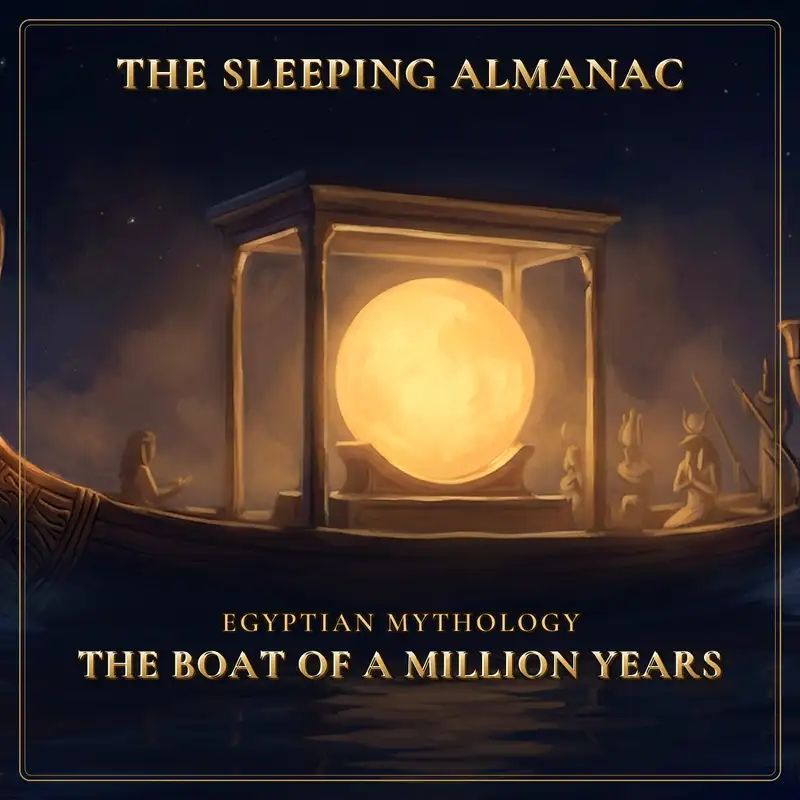
Welcome to The Sleeping Almanac.
Last time, we followed a single gentle soul across the threshold of death and into the green country beyond.
Tonight we follow the greatest traveler of all on the very same road, the one who makes that crossing not once but every single night.
For the Egyptians believed that each evening the sun itself sailed down into the country of the dark
and journeyed all night long through the hidden world below, and rose again, without fail, at dawn.
Tonight is the story of that voyage, the long night sail of the sun in his great boat, through the twelve dark hours, and home again to the morning.
The Egyptians called that boat the Boat of a Million Years.
So let the day set you down.
Let the bed take your weight, and your shoulders, and the last of the day's holding.
Hear this first, and keep it close, for it is the deepest comfort this whole channel has to give.
The night is not a thing that happens to you.
It is a voyage you are carried through.
Every night the sun goes down into the dark, and every night it is carried safely through, and every single morning
without one exception in all the ages of the world, it rises again.
You are going to ride that boat tonight, down through the gentle dark and home to the certain dawn, and there is nothing in the whole long voyage to fear
for the boat has never once failed to arrive.
We will draw it from the old Egyptian books of the night
the painted guides they wrote upon the walls of their royal tombs to chart the sun's dark journey hour by hour, the book they called the Amduat
which means simply that which is in the underworld.
Where those old books turn toward fear, we will turn, gently, toward comfort, choosing always the telling that serves a calm night.
There is a line we have carried through this whole season, from an old Egyptian teacher named Ptahhotep, who taught that the truest strength is the gentle kind.
And tonight it joins the deepest rhythm there is, the turning of night into day.
For the sun does not fight its way through the dark.
It is carried through, by a faithful crew, along a sure river, to a certain dawn.
The dark is not conquered.
It is simply passed, the way you pass through sleep, gently, and come out into morning.
Keep that near you as you drift.
It is the soul of the night.
Let your eyes close.
Let the breath go long and slow.
And let us go down to the western horizon at evening, where the great boat waits, and the long calm voyage of the night is about to begin.
Chapter One.
The Boat of a Million Years.
The Egyptians believed the sun was a traveler, and that it crossed the sky each day in a boat.
And when it sank in the west, it did not stop.
It only changed to a different boat, and sailed on, into the night.
Let us rest at the very start on that gentle idea, the sun as a traveler in a boat, because it is one of the loveliest pictures any people ever made of the sky.
The Egyptians, who lived their whole lives along a great river and knew boats the way other peoples knew roads
looked up at the sun crossing the heavens and saw, naturally, a boat upon a river
the sun sailing the blue water of the day sky from the eastern shore of morning to the western shore of evening.
And when it reached that western shore and sank from sight, they did not imagine it extinguished or gone.
They imagined it simply transferring to its night boat, the great vessel of the hours of darkness, and sailing on, down below the world
through the hidden country, all the long night, until it came round again to the east and rose.
The sun never stopped.
It only sailed, on and on, around and around, forever.
Rest in the deep constancy of that, because there is real peace in a thing that never stops and never fails.
The Egyptians gave the night boat a name that holds all of that constancy in a single phrase.
They called it the Boat of a Million Years, the vessel that had made this voyage a million times and would make it a million more
the boat whose journey was as old as the world and as sure as anything could be.
There is something deeply steadying in that name, in the sheer unbroken reliability of it, a voyage repeated so many times, so faithfully, for so long
that you could set the whole of your trust upon it.
The sun has sailed this night road every night since the beginning, and it has never once been lost.
Let that vast reliability hold you tonight.
You are climbing aboard the most dependable thing there is, the boat that always, always comes home.
And here is the gentle heart of why this story matters so much for a night like this one.
The Egyptians did not see the sun's night voyage as something far away and separate from themselves.
They saw it as the very pattern of all rest, all death, all sleep, all the dark passages anyone must ever make.
To go down into the dark and to be carried through it and to rise again renewed, that was the sun's journey, and it was also, they felt, every soul's journey
and it is also, tonight, simply yours.
You are doing the same thing the sun does.
You are going down, now, into the dark of sleep, to be carried gently through the hours, and to rise renewed in the morning.
The sun's voyage is your voyage.
And it always ends in dawn.
Let yourself settle into the boat itself for a moment, because it is a deeply restful thing to imagine being held by.
Picture the great vessel on the still water in the last gold light, long and low and beautifully made, its timbers warm, its deck broad and steady beneath you.
Picture lying back in it, letting it take your full weight, the way you are letting the bed take your weight now
and feeling it ride the water with a deep and gentle steadiness, utterly sure, utterly calm.
A good boat on calm water holds you the way nothing else quite does, rocking so slightly you can barely feel it, carrying you without the smallest effort of your own.
This is the most seaworthy vessel there has ever been, the boat that has crossed a million nights and never sunk, and it is holding you now
steady and warm and sure on the darkening water.
There is nothing to grip and nothing to brace against.
The boat has you completely.
Let your whole body settle into its keeping, every muscle letting go into the steady hold of the vessel beneath you
and let that deep held steadiness begin to carry you down toward sleep.
So let us go aboard the Boat of a Million Years as the chapter closes, in the last gold light of the western evening, the great calm vessel waiting on the water
ready for its long sure journey through the night.
There is no fear in boarding it, only the deep ease of trusting a thing that has never failed.
Lie back in it, and let it take your weight, and feel it begin, ever so gently, to move out upon the darkening water.
The voyage of the night has begun, the same voyage the sun has always made, and it will carry you, as it carries the sun
safely through the dark and home to the certain morning.
Rest, and let it begin to sail.
Chapter Two.
The Gate of the West.
The voyage began at the western horizon, where the Egyptians believed there stood a great gate, the doorway between the world of the living and the country of the night.
Let us pass through that gate gently, because it is only a threshold, the same kind of soft threshold we have crossed before, and there is nothing fearful in it.
As the sun sank in the west, the Egyptians imagined it coming to a great gateway in the mountains of the horizon
the door that led down out of the bright world and into the hidden country of the Duat, the land of the night.
And the boat sailed through that gate, out of the last light of evening and into the deep calm of the dark beyond.
It was a passing from one country into another, from the loud bright day into the quiet of the night world
and the Egyptians marked it with a gate the way you might mark the entrance to a great and solemn house
a sign that you were leaving one kind of place and entering another.
Rest in the quiet that lies just beyond that gate, because it is a deep and welcoming quiet.
On the far side of the western door, the noise of the day falls away completely.
There is no more glare, no more heat, no more of the bright world's clamor.
There is only the still dark water of the night river, and the soft sounds of the boat upon it, and the deep hush of the hidden country opening ahead.
It is the same hush you cross into when you leave the loud day behind and pass through the gate of sleep, the world growing quiet, the light going soft
a deep calm country opening before you.
Let yourself pass through that gate now, out of the day and all its noise, into the deep still quiet of the night world
and feel how the clamor falls away behind you, and how the calm opens ahead.
Rest in the great threshold itself a moment, because there is something deeply settling in the image of one clear doorway between the noise and the peace.
Picture the gate of the west as the Egyptians did, a vast and solemn doorway set in the mountains of the horizon
glowing softly with the last of the evening light, and the boat passing slowly through it, out of one world and into another.
On the near side is the day, with all its heat and glare and clamor, everything you have carried since morning.
On the far side is the deep cool quiet of the night country.
And the gate is the clean line between them, the single threshold you cross to leave one entirely behind and enter the other.
There is a real relief in a threshold like that, a definite passing, a door that closes the loud day behind you as surely as it opens the quiet night ahead.
Let yourself feel the boat carry you through it now, the warm light of the gate sliding past overhead, the day and all its weight sealing away behind you
and the deep cool calm of the night opening clean and wide ahead.
You have passed through the gate.
The day is on the other side of it now.
There is only the quiet country before you, and the gentle voyage through it
and you can let the whole of the day stay behind at the gate as the boat carries you on into the calm.
And notice, as the boat passes through, that the Egyptians did not imagine the night country as empty or barren.
They filled it with life, with whole hidden regions and their dwellers, with gods and blessed souls and quiet realms, a entire world living its life in the dark
waiting for the sun to pass through and bring its light.
The night, to them, was not nothing.
It was a country, vast and populated and full of its own deep order, and the sun's passage through it was a visitation
a bringing of light to a world that lived in the dark and longed for it.
There is something wonderful in that, the thought that the dark is not empty but full, a whole living country quietly waiting
and that the night journey is not a lonely crossing of a void but a sail through an inhabited and ordered land.
Let that fullness be a comfort as you drift, the sense of a whole quiet world around you in the dark, alive and ordered and at peace
through which you are being gently carried.
So let the great boat sail on through the gate of the west, out of the day and into the deep calm country of the night, the still water ahead
the hidden land opening on every side, the long voyage truly begun.
There is no fear in the crossing and no hurry in the sailing.
There is only the gentle passing from the bright loud world into the deep quiet one, the same passing you make each night into sleep.
Rest in it now, the gate behind you, the still dark country ahead, and let the boat carry you on, calm and unafraid, deeper into the gentle night.
Chapter Three.
The Crew of the Boat.
The sun did not sail through the night alone.
The Boat of a Million Years carried a whole crew, a company of gods who sailed with the sun to see it safely through.
Let us rest in the company of that crew, because it is one of the most reassuring details in the whole story.
The Egyptians never imagined the sun making its dangerous night voyage by itself.
They filled the boat with helpers, a faithful crew of gods who stood at their places along the vessel, each with a task, each watching over the journey
so that the sun was never, for one moment of the long night, alone or unguarded.
There were those who steered, and those who watched the way, and those who spoke the words that opened the gates ahead
and those who stood ready at the prow to keep the boat safe.
It was a crewed ship on a long voyage, and the sun at the center of it was tended and guarded and accompanied every mile of the way
carried through the dark by a whole company devoted to seeing it safely home.
Rest in how much that company takes the fear out of the dark, because being accompanied is the deepest antidote to fear there is.
The night is only frightening when you face it alone.
To cross it in good company, surrounded by faithful ones who know the way and are watching over you, is another thing entirely, a thing closer to safety than to danger.
The Egyptians knew that, and so they never sent their sun into the dark alone, and they never imagined themselves going alone either.
There were always the gods, the guardians, the company of the faithful, all through the dark.
Let that same company surround you tonight.
You are not crossing the night alone.
You are aboard a crewed boat, watched over on every side by patient guardians who have made this voyage a million times and will see you gently through.
Let the comfort of that good company settle over you and ease you toward sleep.
Rest in the quiet competence of that crew, because there is a deep peace in being among those who simply know what they are doing.
Picture them at their places along the boat, calm and unhurried and sure, each one practiced in a task they have performed ten thousand times, no one anxious
no one straining, the whole company moving with the easy confidence of long mastery.
The one at the steering oar holds the course without effort.
The watchers read the dark water ahead and are unworried by it.
The ones who speak the words to open each gate know them by heart.
There is nothing frantic anywhere on the boat, only the deep calm of a skilled crew doing familiar work well
carrying their precious light through a night they know better than anyone.
To be among people like that, competent and calm and unbothered, is one of the most reassuring feelings there is.
It tells you, without a word, that everything is handled, that you can stop watching, that you can rest.
Let that be your reassurance now.
Everything about this voyage is handled by hands that have handled it forever.
There is nothing you need to manage or watch or worry.
The crew has it all.
You can let go completely and rest in their sure keeping, and let the calm competence around you carry you down toward sleep.
And among the crew, the Egyptians often placed a figure we have met before, standing at the very prow of the boat, the strong one, Set
his fierce power turned now to the boat's defense, ready to guard the way ahead through the darkest hours.
There is a deep rightness in finding him there, the old storm reconciled and given his great purpose, his strength no longer a danger but the boat's protection
standing watch at the front of the vessel as it sails into the dark.
We saw him take that place at the end of the long contest, and here he is, faithfully keeping it, the mighty guardian at the prow.
It means the boat is not only crewed but defended, that its strongest possible protector stands ready at its front.
Let that be one more layer of safety around you tonight, the knowledge that the very strongest one stands guard at the prow of the boat that carries you
watching the dark ahead so that you do not have to.
So let the crewed boat sail on into the deepening night, the faithful company at their places, the guardian at the prow
the sun tended and watched and safe at the center of them all.
There is nothing lonely and nothing unguarded about this voyage.
It is a whole devoted company carrying one precious light safely through the dark.
Rest in the middle of that company tonight, tended and accompanied and kept, and let the deep safety of good company on a long voyage carry you onward
calm and guarded, into the gentle hours ahead.
Chapter Four.
The River Through the Dark.
Through the heart of the night country ran a river, and the boat sailed down it, hour by quiet hour, through the hidden land.
Let us rest in the long calm sailing of that river, because it is the deep restful center of the whole night, and the Egyptians imagined it as a true voyage
unhurried, region by region, through the dark.
The Duat, the night country, was threaded by a great river, a continuation of the earthly Nile run on into the hidden world
and the sun's boat sailed down it through the twelve hours of the night, each hour a new stretch of the river
a new region of the dark land with its own dwellers and its own quiet character.
It was a journey with stages, a long slow progress through the night, the boat moving steadily down the dark water from one hour to the next, never rushing
never stopping, simply sailing on through the deep calm country toward the distant dawn.
There is deep peace in that image of a long river voyage through the night, the steady movement, the passing regions, the sure unhurried progress through the dark.
Rest in the motion of the boat upon that river, because moving water in the dark is among the most sleep giving images there is.
Feel the gentle forward glide of the vessel, the soft parting of the dark water at the prow, the slow steady progress down the hidden river
region sliding past region in the deep quiet.
There is nothing to do on such a voyage but rest and be carried.
The river knows the way.
The crew tends the boat.
Let the great night sky come down over the river as you drift, because there are few things more quieting than the vast slow wheel of stars above dark water.
Picture the deep night arching overhead as the boat glides on, crowded with soft and steady stars, the ones the Egyptians knew and named and steered by
turning so slowly across the sky that you cannot see them move and yet they move, all night, in their long sure order.
Picture them reflected in the still dark river, so that the boat seems to sail through stars above and below
gliding gently down a glittering road of them toward the morning.
There is no vaster calm than that
the great wheeling sky and the still mirroring water and the small boat sailing softly between them through the deep middle of the night.
It is the most peaceful place there is, the open night, the quiet stars, the dark gliding river, and you are at the heart of it, carried gently along.
Let that immense calm settle over you now, the wheeling stars above and below, the boat gliding through the soft glittering dark
and let the great slow turning of the night sky carry you onward, deeper and deeper, toward sleep.
The whole long journey unfolds on its own, mile after dark mile, while you simply lie back in the gently moving boat and let it bear you on.
Let that be your own state now, lying back in the night boat, carried down the dark river, the regions of the night drifting slowly past
nothing required of you but to rest in the gentle motion and let it carry you deeper and deeper toward sleep.
And the Egyptians filled each stretch of that river with its own quiet wonders, region after region of the night land opening as the boat passed through
each with its dwellers waking to the passing light.
There were fields and waters, gates and guardians, quiet realms of the blessed, whole provinces of the hidden country
each one greeting the sun as it sailed through and falling quiet again behind it as it passed on.
We need not visit every one tonight.
We need only feel the deep richness of the journey, the sense of sailing through a vast and various and ordered country in the dark
region after region drifting past in the soft light of the passing boat.
There is a deep comfort in a journey so full and so ordered, every stretch of it known, every region in its place
the whole dark country laid out along the river in its proper and ancient order.
Let that ordered richness carry you onward, the boat gliding down the long river of the night, through region after quiet region, deeper into the gentle dark.
Rest, especially, in the fact that the night was divided into twelve known hours, because there is a quiet reassurance in a dark that has been mapped.
The Egyptians did not leave the night as one vast trackless black.
They charted it, hour by hour, twelve measured stretches of the journey, each one named and known and painted on the walls of their tombs
so that anyone making the voyage would know exactly where they were and exactly what came next.
The night had a shape.
It had stages, and an order, and a known end.
There is real comfort in that for any long dark passage, the knowledge that it is not formless or endless but measured
that it moves through known stages toward a known morning, that someone has charted the whole of it and found it has an end.
Your own night is mapped that way too, divided into its quiet hours, moving in its sure order toward a certain dawn.
You do not have to know where you are in it.
The chart is old and the way is sure.
Let the orderliness of the measured night hold you now, the twelve known hours unfolding one into the next in their ancient order
each one carrying you closer to the morning, and let that mapped and certain dark carry you gently onward toward sleep.
So let the boat sail on down the river through the heart of the night, hour by quiet hour, region by region, the dark water parting softly at the prow
the hidden country drifting past on either side, the crew at their places, the guardian at the prow
the long calm voyage unfolding exactly as it has a million times before.
There is nowhere you need to be but here, in the gently moving boat, and nothing you need to do but rest and be carried.
Lie back in it now, and let the river of the night bear you on, deeper and deeper into the quiet, toward the deep midnight hour and, beyond it, the certain dawn.
Rest, and let the dark river carry you.
Chapter Five.
The Sleeping Ones.
As the boat sailed on, its light fell upon the dwellers of the dark, and the Egyptians imagined something tender.
The sleeping ones woke, for one hour, as the light passed by.
Let us rest in the gentleness of that, because it is one of the most beautiful ideas in the whole night journey.
The Egyptians believed that the dead, the blessed ones who dwelt in the night country, lay quiet in the dark most of the time
but that when the sun's boat sailed through their region, its light fell upon them, and for that one hour they woke, and stirred, and lived again in its warmth
and were glad.
The sun's passing was a gift to the sleeping country, a visitation of light and life to those who lay in the dark
one bright hour given to each region as the boat sailed through, before the light moved on and the gentle dark returned.
It was the kindest thing, the sun bringing its warmth even here, even to the deepest hidden land
so that no one in all the dark country was forgotten or left forever without light.
Rest in the tenderness of that visiting light
because there is deep comfort in the idea of a light that reaches even into the deepest dark to wake and warm the ones who lie there.
No region was too far, no dweller too deep, for the sun to come to.
It sailed to every one of them in turn, all through the night, bringing each its hour of warmth.
The Egyptians found enormous comfort in that, the assurance that the light came even here, even to the country of the dead
that no darkness was so deep the sun would not visit it.
Let that comfort reach you too tonight, wherever you are, however deep into your own night you have gone.
The light comes even here.
It reaches the deepest place.
It is sailing toward you now, to bring you your gentle hour of warmth, and it will not forget you or pass you by.
Rest in the warmth of that visiting light, because warmth in the dark is one of the oldest comforts there is.
Imagine the soft glow of the passing boat reaching you where you lie, not a harsh light but a gentle one, the warm amber of a single lamp
spreading slowly over you and through you, easing every cold and tired place.
The Egyptians imagined the dead reaching toward that warmth gladly, turning their faces to it, basking for their hour in the kind light of the passing sun.
You can do the same now.
Let the warm light of the boat reach you where you rest, and let it spread through you slowly
from the crown of your head down through your shoulders and your chest and your long tired limbs, a gentle warmth easing everything it touches
loosening every held place, melting the last of the day's cold tension away.
There is nothing to do but lie in the warmth and receive it, the way the sleeping ones received their hour of light.
Let it pool around you and soak into you, soft and golden and kind, and let that gentle visiting warmth carry you down, eased and loosened and warm
toward the deep middle of the night.
And there is a soft rhythm in the way the Egyptians told it, the regions waking and sleeping again as the boat passed, that is itself like the rhythm of rest.
Each region woke as the light arrived, lived its bright hour, and then settled gently back into the quiet dark as the boat sailed on to the next
the whole night country waking and sleeping in slow procession down the length of the river.
There is something deeply soothing in that slow rhythm, the gentle rise into light and the gentle settling back into dark, region after region, all down the night.
Let that rhythm become your own as you drift, the soft rising and the soft settling, the brief warm light and the returning gentle dark
the whole quiet country breathing slowly in and out around you as the boat carries you through.
Let it rock you, that slow procession of waking and sleeping, deeper and deeper toward your own rest.
So let the boat sail on through the regions of the blessed, its light waking each in turn to its gentle hour and leaving each to its peaceful dark
the whole night country greeting the passing sun and settling softly behind it.
There is nothing here but kindness, the light visiting the deep places, the sleeping ones warmed for their hour, the boat moving gently on.
Rest in the deep tenderness of it tonight, the visiting light and the grateful dark, and let the slow rhythm of waking and sleeping carry you onward
down the quiet river, toward the deep heart of the night.
Chapter Six.
The Deepest Hour.
At the middle of the night came the deepest hour of all, the lowest point of the voyage, and there the Egyptians placed the greatest mystery of the whole journey.
Let us come gently to that deep hour, because for all that it was the lowest and darkest point
the Egyptians filled it not with terror but with the most profound and hopeful thing they knew.
At the very middle of the night, in the deepest region of the hidden country, they believed that something wonderful happened.
The sun, sailing through the dark, came to the place where Osiris lay, the gentle king of the dead whose whole story we have followed, and there
in the deep midnight, the two of them met and for a moment became one.
The living sun and the quiet king of the dead, joined in the deepest hour, and from that joining came the great renewal
the spark that would carry the sun up out of the dark and into the new dawn.
The lowest point of the night was also the turning point.
The deepest dark was where the new light was born.
Rest in the deep meaning of that, because it is perhaps the most hopeful thing this whole season has held.
The Egyptians looked at the very bottom of the night, the darkest, lowest, most hidden hour, and they did not see despair there.
They saw renewal.
They saw the place where the living and the dead embrace, where the old light touches the deep stillness and is made new, where the whole turning toward dawn begins.
The deepest dark was not the end of the journey but its secret heart, the place of renewal, the hidden spring from which the morning rises.
There is profound comfort in that for any low or dark hour.
The bottom is not the end.
The deepest point is where the turning begins.
Even the lowest hour of the night is already, secretly, the beginning of the dawn.
Rest in the deep meeting at the heart of that hour, because there is a quiet beauty in it worth holding gently.
The living sun and the still king of the dead, the brightest thing there is and the gentlest lord of the quiet country
coming together for one silent moment in the deepest dark, and from their meeting, life renewed.
The Egyptians felt that this was the most sacred moment of the whole turning world, the secret embrace in the deep from which every morning is born
the place where what is awake and what is at rest become, for an instant, one.
There is something in it that speaks to the deepest part of sleep itself
the place where the waking self and the resting self meet in the dark and the tired one is made new.
You are coming to that meeting now, the deepest, stillest point, where your own day and your own rest embrace in the quiet and the renewal begins.
Let yourself sink all the way down to it, the secret deep heart of the night, and rest there in the profound stillness of the turning
where the brightest and the gentlest meet, and the new day is quietly conceived, and everything, for a moment, is perfectly and silently at peace.
Let that deep hope settle over you now, in the quiet middle of the night, the knowledge that the deepest dark is where the new light is made.
And let the stillness of that deep hour be the deepest stillness of your own rest, because it is the quietest point of the whole voyage.
Here, at the bottom of the night, everything goes utterly still.
The boat rests for a moment in the deep, the great joining happens in the silence, and the whole night country holds its breath in the profound calm of the turning point.
There is no deeper stillness anywhere than this, the still center of the night, the quiet bottom of the voyage where renewal silently begins.
Let yourself sink all the way down into that stillness now, the deepest, quietest point, where everything pauses and is renewed
and let it hold you in its profound calm, the still heart of the night, where the dark is deepest and the new dawn is already, quietly, being born.
So let the boat rest a moment in the deep midnight, at the lowest point of the long voyage
where the sun and the gentle king of the dead are joined and the great renewal silently begins.
There is no fear in this deep place, only the profound stillness of the turning point, the secret heart of the night where morning starts.
Rest in that deepest stillness now, carried to the very bottom of the gentle dark, and know that from here, from this quiet deep, the boat will begin, slowly, to rise.
The lowest hour has come, and passed, and the long turn toward dawn has, even now, begun.
Rest, renewed, in the deep still heart of the night.
Chapter Seven.
The Renewing Waters.
From the deep hour onward, the journey changed.
The sun was being renewed now, gathering its new light, beginning the long slow rise toward the morning.
Let us rest in the gentle turning of the voyage, because from here the whole journey bends, slowly and surely, back toward the light.
Past the deepest hour, the Egyptians imagined the sun beginning its renewal, moving through regions of regenerating water and gathering strength
the new light slowly kindling within it, the boat beginning its long climb up out of the depths toward the eastern dawn.
The hardest, deepest part was behind now.
What lay ahead was the gradual gathering of light, the slow sure rise, the steady approach to morning.
The voyage had turned a corner in the deep, and now every hour carried it closer to the dawn, the dark thinning by degrees
the new sun growing slowly brighter within the boat.
The night was not deepening anymore.
It was lifting.
Rest in the deep relief of that turning, because there are few feelings sweeter than the moment a long dark passage turns toward its end.
Everything from here is movement toward the light.
The boat that sailed down into the dark is sailing up now toward the morning, the new sun kindling, the regions growing slowly less dark as it climbs.
There is a profound ease in being past the lowest point, in knowing that the deepest part is behind you and the way ahead leads only upward, toward light
toward morning, toward home.
Let that ease settle over you now, the deep relief of the turn made and the climb begun, the worst behind, the light ahead
the boat carrying you gently up out of the deep toward the certain dawn.
You have passed the deepest hour.
From here, it is all a gentle rising toward the light.
And the Egyptians filled this rising stretch with the imagery of renewing waters, of the sun being bathed and refreshed and made new in the regenerating deep
the way you yourself are refreshed and made new by a night of sleep.
There is a deep rightness in that image for the heart of the night, the renewing waters, the slow refreshment of the deep, the new light gathering.
It is exactly what sleep itself does, taking the worn and tired thing down into the dark and bringing it up renewed, refreshed, made new for the morning.
Let that renewal be happening in you now, in the deep of your own night, the long slow refreshment of rest, the worn day washing away in the renewing waters
the new morning self slowly gathering.
You are being made new tonight, the way the sun is made new in the deep, carried up out of the dark refreshed and ready for the dawn.
Rest in the slow refreshment happening in you now, because there is a deep comfort in trusting the quiet work of the night.
You do not have to do anything to be renewed by sleep.
It simply happens, in the dark, while you rest, the way the sun was renewed without effort in the deep waters of the night.
All through the hours, while you lie still and ask nothing of yourself, the deep work of restoration goes on, the tiredness washing slowly away
the worn places quietly mending, the new morning self gathering on its own.
It is the most effortless renewal there is, asking only that you let go and let it happen.
The Egyptians trusted the deep to renew their sun without its striving, and you can trust the night to renew you without yours.
There is nothing to work at, nothing to help along.
The renewal is automatic, ancient, sure.
Let yourself rest in that trust now, doing nothing, striving for nothing, simply lying in the deep and letting it make you new
the way it has made every tired thing new since the beginning, and let the quiet certainty of that effortless renewal carry you onward toward the dawn.
So let the boat climb gently on through the renewing waters, up out of the deepest hour, the new light slowly gathering, the regions thinning toward dawn
the long voyage bending surely toward its bright end.
The hardest part is behind.
The renewal has begun.
The morning is ahead.
Rest in the gentle rising of it now, the boat carrying you up out of the deep toward the light, refreshed and renewed with every passing hour
and let that sure ascent toward dawn carry you onward, deeper into rest even as the boat climbs toward the morning.
Chapter Eight.
The Coils of the Great Serpent.
Near the end of the journey, in the last dark hours before dawn, the boat came to the one place every telling spoke of, the place where the great serpent waited.
Let us go gently here, because although this is the one moment of the voyage that holds any tension, the Egyptians always told it as a thing overcome
and we will hold it that way too, lightly, and without fear.
In the last hours of the night, the old books said, the boat came to the lair of the great serpent of the dark, the ancient enemy of the light
a vast coil named Apophis who lay across the river of the night and sought to halt the sun's passage and keep the morning from coming.
He was the one shadow on the whole bright voyage, the single obstacle between the renewed sun and the dawn.
But hold this, before anything else, the way the Egyptians always held it.
He never won.
Not once, in all the millions of nights, did the serpent stop the sun.
The dawn always came.
The serpent was always passed.
Rest, even here, in the deep certainty of how this always ends, because that certainty is the whole point of the story.
The Egyptians did not tell of the serpent to frighten themselves.
They told of it to reassure themselves, to give a face to the fear of the dark and then to show that fear defeated, every single night, without fail.
The serpent is real in the story, yes, but so is its defeat, and the defeat is the older and surer truth.
For every night that there has ever been, the boat has met the serpent and passed it and sailed on to the dawn.
That is not a hope.
It is a record, unbroken since the beginning of the world.
Let that unbroken record hold you steady now, even as the boat approaches the serpent's place.
You already know how this ends.
It ends the way it has always ended, with the serpent passed and the morning coming.
There is no night in which it ended any other way.
Rest in how the Egyptians chose to handle their one fear, because there is wisdom in it worth carrying into your own dark.
They did not pretend the serpent away, and they did not let it grow huge and formless in the dark either.
They gave the fear a shape, a single known coil at a single known stretch of the river, and then they showed it met and passed, every night, by a guard that never failed.
That is the kindest thing you can do with a fear, to give it edges, to put it in its one place, and to set against it a protection larger than itself.
The fear of the dark, named and bounded and overcome, becomes a small thing, a single coil on a long river, already as good as behind you.
Whatever shapeless worry the night sometimes carries, let this old wisdom gentle it now.
Give it its one small place, and then let the sure boat and its tireless guard carry you straight past it
the way they have carried every traveler past it on every night there has ever been.
The fear is small and bounded.
The guard is vast and sure.
And the morning on the far side of it is already certain.
Let that settle you completely as the boat sails on, and carry you, unworried, toward the light.
And notice that the boat does not come to the serpent unprepared or alone, for this is exactly why the crew is aboard and why the guardian stands at the prow.
All through the calm hours, the strong one has stood ready at the front of the boat, and the faithful crew has kept their places, precisely for this moment.
The boat that carries the sun is a guarded boat, defended by the strongest power there is, and when it comes at last to the serpent's coils
it meets them not as a lone and frightened thing but as a whole company ready and able to pass.
The fear has been prepared for since the voyage began.
The defense has been in place the whole night long.
Let that be your reassurance as the chapter closes.
The one hard moment of the night is the one the boat is most ready for, the one its guardian has stood watch for all along.
You are not carried toward the serpent undefended.
You are carried toward it behind the strongest guard there is.
So let the boat draw near the coils of the great serpent in the last dark hours, calm and crewed and guarded, exactly as it has on every night since the world began.
There is tension in the moment but no real danger, for you already know, as surely as you know anything, how it ends.
The serpent is met.
The serpent is passed.
The boat sails on.
And the dawn, just ahead now, begins to pale the edge of the dark.
Rest in the deep certainty of it tonight, the one shadow already as good as behind you, the morning already as good as come, and let the sure boat carry you on
past the last dark coil, toward the breaking light.
Chapter Nine.
The Holding Back of the Serpent.
And so it happened the way it has always happened.
The guardians of the boat held the great serpent back, and the sun sailed safely past, and the way to the dawn lay open.
Let us rest in the quiet victory of it, because the Egyptians told this moment not as a terrible battle but as a sure and almost ritual passing
the same calm overcoming every single night.
As the boat came to the serpent's coils, the crew rose to their task, and the strong guardian at the prow met the great shadow
and by their steady power the serpent was turned aside and held back from the boat, its coils drawn away from the river, the channel opened, the way made clear.
The sun sailed on, untouched, through the gap they made, and the serpent sank back into the dark behind it, overcome once more.
There was no gore in the telling and no real doubt, only the sure and practiced overcoming of the one obstacle, the guardians doing what they were there to do
the boat passing safely through, exactly as it always had.
Rest in how completely that settles the one fear of the night, because once the serpent is passed, nothing stands between the boat and the dawn.
The single shadow of the whole voyage is behind you now.
The way ahead is open and clear, all the way to the morning.
There is a deep release in that, the passing of the last hard thing
the moment when the only obstacle falls away and nothing remains but the gentle sail home to the light.
Let that release move through you now, the last fear overcome, the way opened, the boat sailing free toward the brightening east.
Whatever the night held, its one shadow is behind you.
There is only the dawn ahead now, and the clear and open way to it.
Let the deep ease of that carry you onward toward sleep.
And let it be a quiet comfort, too, that the overcoming was never really in doubt, because the guardians are stronger than the shadow, and always have been.
The Egyptians did not imagine a fair fight with an uncertain end.
They imagined a sure protection, a guardian whose strength was simply greater than the serpent's, a defense that had never failed and never would.
The shadow is real, but it is the weaker thing.
The light and its guardians are stronger, and the proof is the unbroken record of every dawn that has ever come.
Let that settled certainty be the ground you rest on now.
The thing that guards you is stronger than the thing you feared.
It has always been stronger.
The dawn has always come.
And it is coming now, sure and bright, just ahead.
Rest in the wide open water that lies beyond the serpent, because there is a deep release in a way suddenly clear.
For the whole voyage there was one knot of tension somewhere ahead, one place to be passed, and now it is behind
and the river opens out smooth and wide and unobstructed all the way to the morning.
Picture the boat sailing free now into that open water, nothing ahead but calm river and brightening sky, the last obstacle gone, the way clear to the end.
There is a particular peace that comes only after the one hard thing is done, a loosening of something held tight for a long time
a deep breath finally let all the way out.
Let that release move through you now, the held breath of the whole night finally let go, the last hard thing behind you, the way ahead smooth and open and sure.
You can unclench completely now.
There is nothing left to pass, nothing left to brace for, only the gentle open water and the brightening sky and the easy sail home.
Let that wide open calm carry you on, every tension released, toward the waiting dawn.
Let the sure boat carry you on toward it, every fear behind you, into the gentle paling of the dark.
So let the great serpent sink away behind the boat, held back and overcome as it has been on every night since the world began, and let the sun sail on
free and unhindered, toward the opening dawn.
The hard moment is past.
The way is clear.
The light is near.
There is nothing between you and the morning now but a last stretch of gentle, brightening water.
Rest in the deep peace of the danger passed, the way home open, and let the boat carry you on, calm and free and almost there, toward the breaking of the day.
Chapter Ten.
The Turning Toward Dawn.
Now the boat sailed up through the last hours of the night, and the dark began, ever so slowly, to thin toward the coming light.
Let us rest in the gentle paling of the dark, because there are few things more quietly hopeful than the first thinning of the night toward dawn.
Past the serpent, in the last regions of the night country, the Egyptians imagined the deep dark beginning at last to soften
the first faint grey of the coming day seeping into the edges of the sky
the boat climbing steadily up toward the eastern gate where it would emerge into the morning.
The hours of deepest dark were behind now.
What lay ahead was the slow brightening, the gradual return of the light, the long gentle approach to the dawn.
Each stretch of river was a little less dark than the last, the sky a shade paler, the morning a little nearer, the whole world beginning, almost imperceptibly, to wake.
Rest in that slow brightening, because it is the gentlest possible kind of arrival, the dark not snapping away but softening by slow degrees toward the light.
There is no jolt in it, no sudden change, only the patient, gradual return of the morning, grey by grey, shade by shade
the night easing toward the day so softly you can barely mark the moment it turns.
Let that same gentle brightening be the shape of your own passage now, not a sudden waking but a slow soft easing, the deep dark of sleep beginning
in its own far time, to soften toward a distant morning, with no hurry and no jolt, only the patient turning of night toward day.
You are in the last gentle hours now, the boat climbing softly toward the light, the dark thinning by slow degrees, the dawn drawing near in its own unhurried time.
And the Egyptians filled these last hours with a rising sense of gladness, the whole night country stirring toward the coming day
the dwellers of the dark turning their faces toward the east, the long night nearly done and the morning nearly come.
There is a deep quiet joy in the approach of dawn after a long night, a gladness that gathers slowly as the light returns, and the old books are full of it here
the relief and the rising hope of the last hours, the boat and all its company drawing near at last to the morning.
Let that quiet gathering gladness be in you too as you drift, the deep glad sense of the long dark nearly passed and the light nearly come
the morning drawing near, the voyage nearly done.
You have come through almost the whole of the night now.
The dawn is close.
Let the gentle gladness of its approach carry you onward, up through the last soft dark, toward the breaking light.
Rest in the soft colors of the coming dawn, because the slow return of color to the world is among the gentlest sights there is.
The Egyptians watched it every morning along their river, the deep blue black of the night easing first to a soft grey, then warming, ever so slowly
to the faintest rose along the eastern edge, then to a pale and tender gold, the colors returning to the world by the gentlest degrees
so softly that the night seems not to end but simply to bloom into day.
Picture that now, far ahead of the boat, the first faint warmth touching the rim of the dark, the sky beginning to soften and color at its edge
the promise of the morning written in the palest gold along the horizon.
There is no gentler thing to drift toward than that first soft coloring of the dawn, the quiet promise of it, the slow tender return of the light.
Let it glow there at the edge of your rest, the faint warm rose and gold of the coming morning, drawing nearer by slow degrees
and let its gentle promise carry you on through the last of the soft dark, unhurried and unafraid, toward the breaking of the day.
So let the boat climb on through the last thinning hours, the dark softening toward grey, the eastern gate drawing near
the whole night country turning its face toward the coming day.
The deep dark is behind.
The morning is just ahead.
There is only a little of the gentle night left now, and then the light.
Rest in the soft brightening of it, the slow sure turning toward dawn, and let the boat carry you up out of the last dark, gently and surely
toward the golden gate of the morning.
Chapter Eleven.
The Scarab and the Dawn.
And then, at the eastern edge of the world, the boat came to the gate of morning, and the sun was born again, new and bright, into the day.
Let us rest in the wonder of that rebirth, because it is the triumphant and gentle end the whole long voyage was always sailing toward.
At the eastern gate, where the night country meets the morning, the renewed sun emerged at last from the dark, and the Egyptians pictured it being born anew
fresh and shining, lifted up into the dawn.
They had a beautiful image for that reborn morning sun.
They saw it as a scarab, a small beetle they called Khepri, which means the one who comes into being, the one who is reborn
and they pictured the great renewed sun rising from the dark like a new thing coming freshly into the world, pushed up over the horizon into the waiting sky.
The sun that had sailed down worn and old into the west rose up new and bright in the east, made wholly new by its passage through the night, reborn into the morning.
The voyage was complete.
The dawn had come.
The sun was new again.
Rest in the deep meaning of that, because it is the truth this whole channel is built upon.
The sun goes down old and tired into the dark, and it is carried through the night, and it rises new.
The dark does not destroy it.
The dark renews it.
The night is not the enemy of the light but the very means of its making new.
And the same, the Egyptians believed, is true of every rest, every sleep, every dark passage a soul must make.
You go down into the night worn from the day, and you are carried through, and you rise renewed, made new by the very darkness you feared
born fresh into the morning like the scarab sun.
That is what sleep is.
That is what this voyage means.
The dark is where you are made new.
Let that profound and gentle truth settle all the way into you now, as the sun rises new from its long night sail.
You are not losing the day in the dark.
You are being made new for the next one.
Rest in the small and hopeful image the Egyptians chose for that rebirth, because there is something deeply endearing in it.
Of all the grand things they might have made the reborn morning sun, they made it a scarab
a small dark beetle they watched rolling its little ball of earth across the sand, and pushing, from that ball, new life.
They saw in that humble creature the whole mystery of coming into being out of nothing, of new life pushed up from the dark earth, and they gave its name
Khepri, the one who comes into being, to the vast reborn sun of the morning.
There is a lovely humility in that, the greatest renewal in the cosmos pictured as a small beetle pushing the new day up over the edge of the world.
It says that renewal is not always grand and sudden, that often it is small and patient and quiet, a little thing pushing steadily until the light comes.
Your own renewal tonight is like that, quiet and patient and sure, the new morning self gathering in the dark by small degrees, pushed gently up toward the waking.
Let that humble, hopeful image rest you now, the small sure pushing up of new life, the quiet beetle and the rising sun, and let it carry you
patiently renewing, toward your own morning.
And let the certainty of the dawn be the deepest reassurance you carry down into sleep, because it is the surest thing there is.
In all the millions of years, through all the millions of nights, the boat has always come through, and the sun has always risen.
Not once has the morning failed to come.
Whatever your own night holds, it holds this too, the same unbroken certainty, the same sure dawn at the end of it.
You can let go into the dark completely tonight, the way the sun lets go into the west
trusting absolutely that you will be carried through and brought up renewed into the morning, because that is how it has always gone, every single time
without one exception, since the beginning of the world.
Let that total certainty hold you now, the sure dawn at the end of the sure voyage
and let yourself sail down into sleep as trustingly as the sun sails into the night, knowing the morning is already on its way.
So let the renewed sun rise new and golden at the eastern gate, the long voyage of the night complete, the dark passed, the dawn come
the Boat of a Million Years arrived once more exactly where it always arrives, in the morning.
The journey is done, and it has ended as it always ends, in light.
Rest in the deep peace of that completion now, the whole night sailed through and the morning sure
and let the certainty of the dawn carry you the rest of the way down into your own deep rest.
Chapter Twelve.
Goodnight.
And the Serpent at the Edge of Dawn.
And so we come to the quiet end of the night, with the long voyage understood at last, and every word we have ever closed on made whole.
Let the last of it be only peace now.
All this season, night after night, we have ended at the same place, with the serpent at the edge of dawn.
And now you know the whole of what those words mean.
They mean the sun sailing its great boat down through the dark country, carried by its faithful crew, renewed in the deepest hour
meeting the great serpent in the last dark stretch and passing it, always passing it, by the strength of its guardians
to rise new and golden at the eastern gate.
They mean that the dark is always crossed, the serpent always passed, the morning always made.
The whole long voyage of the night, gathered into a single closing image, and at the heart of it, always, the certainty of the dawn.
So carry no trouble into your sleep tonight, for you are aboard the surest vessel there is, the boat that has never failed to come home.
The day set you down in the west.
The crew is at their places.
The guardian stands at the prow.
The river runs sure beneath you, down through the gentle dark and up toward the certain morning.
There is nothing in the whole long voyage to fear, for it has been made a million times and has always, always ended in light.
Hold that deepest of certainties as you let the very last of the day go.
Let the whole voyage gather into one calm picture as you sink the last of the way down, because it holds everything this channel has ever tried to give you.
A great boat on a dark river, carrying a precious light.
A faithful crew at every station, and the strongest guardian at the prow.
A sure passage down through the gentle dark, a renewing in the deepest hour, a serpent met and always passed, and a certain dawn at the end of it all.
That is the night, every night, the sun's and yours alike.
You are the precious light tonight, carried in the sure boat, watched over by faithful hands, sailing the gentle dark toward a morning that has never once failed to come.
There is nothing for you to do but be carried.
Nothing to steer, nothing to guard, nothing to fear.
Just lie in the boat and let it bear you, down through the quiet hours, toward the sure and certain dawn, and let that whole deep calm picture hold you as you go.
Sleep now.
Let yourself sail down into the dark as trustingly as the sun, carried by faithful hands along a sure river toward a certain dawn.
Let the deep hour renew you, the worn day washing away, the new morning self gathering quietly in the dark.
And know, as you drift down into your own night's sleep, that the dawn is coming, sure as it ever was, past the serpent, past the dark, at the edge of the world
where the boat always arrives, and the light returns, always, and the sun is born new, and every traveler comes safely home to the morning.
Goodnight.
Sleep deeply.
And we will meet again, by the river, under the same old stars, for the night is long, and the gentle stories are many, and the boat is always sailing, even now
toward the dawn.