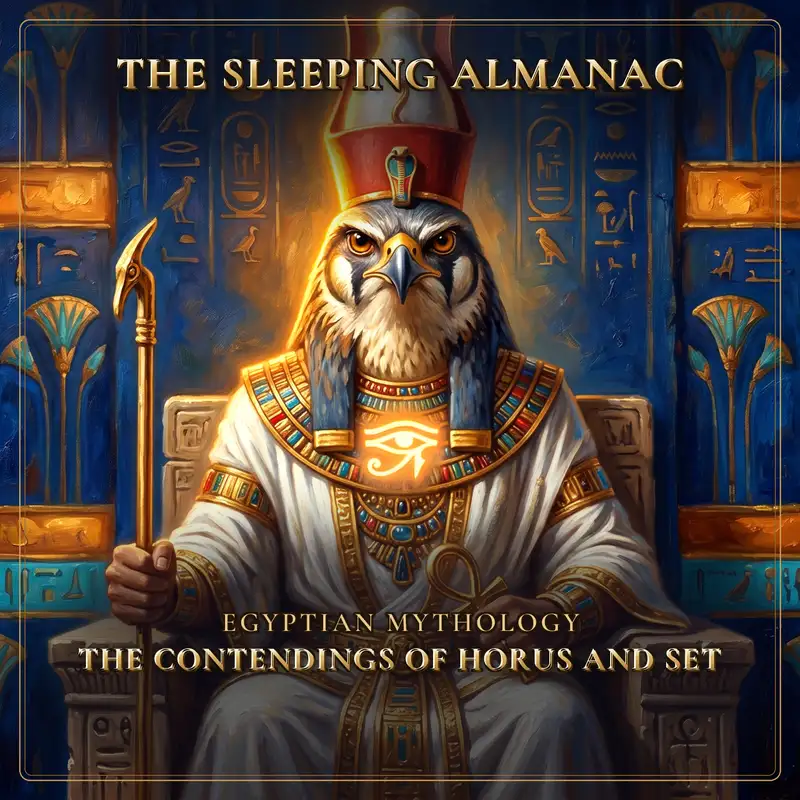
Welcome to The Sleeping Almanac.
Last time, the faithful queen Isis gathered her scattered king and brought new life out of all her grief, a son hidden away in the green marsh
the bright child who would one day set the world right.
Tonight, that child has grown.
Tonight is the story of how Horus, the son of Osiris, came at last to claim his father's throne, and of the long, patient
almost endless struggle it took to win it from the one who had taken it.
It is a story about justice arriving slowly, about patience outlasting force, and about a quarrel so old it finally ends not in destruction but in peace.
And we will tell all of it gently.
So let the day set you down.
Let the bed take your weight, and your shoulders, and the last of the day's holding.
Hear this first, and keep it close.
There is a long contest in tonight's story, a rival who will not give way, and trials of wit and will that stretch on for years.
But there is no horror in it, and nothing that will pull you back from the edge of sleep.
The struggle is told slowly and kindly, the way you would tell a long, winding, satisfying old tale to someone you were settling toward rest.
And it ends well.
It ends in a crowning, and even in a kind of reconciliation.
You are safe here, the whole way through.
We will draw it from one of the great old Egyptian papyri
a long and famous telling of this very contest that has come down to us across more than three thousand years
and from the wider tradition of Horus and his father's throne.
Where the old source turns rough, or strange, or strays from the calm we are after, we will set that aside and keep the dignified heart of it
choosing always the telling that serves a quiet night.
There is a line we have carried through this whole season, from an old Egyptian teacher named Ptahhotep, who taught that the truest strength is the gentle kind
that good is done not by force but by patience and fair dealing.
Tonight that teaching is the whole story.
Horus does not win his father's throne by being the strongest.
Set is the stronger.
Horus wins it by being the rightful one, and by waiting, and by cleverness, and by the long slow patience of a just cause that simply will not go away.
Keep that near you as you drift.
It is the soul of the night, and it is the soul of the whole season.
Let your eyes close.
Let the breath go long and slow.
And let us go back to the green marsh where a hidden child has grown into a young man, and is rising, now, to go and claim what is his.
Chapter One.
The Child Grown.
The child that Isis hid among the reeds did not stay a child.
He grew, in the green secret of the marsh, into a young man, and his name was Horus.
Let us begin in that quiet green place where we left him, because there is peace in returning to it.
You may remember the falcon child, the son of Osiris and Isis, hidden away in the marshes of the Delta to keep him safe
his mother's wings spread over him through all the long danger of his early days.
The old stories tell that he grew there slowly, sheltered and tended, learning what he would need to know, gathering his strength out of sight
until the day came when he was ready to step out of the reeds and into the wide world to take up the thing he had been born for.
There is something deeply restful in the picture of a strength that grows quietly, in a hidden place, in no hurry, until it is ready.
Horus was not rushed.
He grew the way the grain grows, the way anything good and lasting grows, slowly, in the dark and the green, until its time.
Rest a while in that hidden growing, because it is a gentle thing to consider as you settle.
We live in a world that is always hurrying, always pushing the young thing to be ready before it is.
But the old story gives Horus all the time he needed.
It let him grow in secret, protected, gathering himself, until he was strong enough and wise enough and ready enough to do what he came to do.
There is a deep kindness in that, and a deep wisdom too.
The things that last are the things that were allowed to grow slowly.
The hidden years are not wasted years.
They are the years that make the strength real.
Let the green marsh hold you a while as you picture those quiet growing years, because it is among the most peaceful places in all of these stories to rest.
Let there be the tall reeds standing close and soft, swaying just slightly when the night air moves through them.
Let there be the still dark water between them, bright with the moon, barely stirring.
Let there be the small night sounds, the gentle plash of a fish, the settling of a waterbird deep in its feathers
and under it all the deep green hush of a hidden place where no harm can reach.
There the young Horus grew, year by quiet year, sheltered and unhurried, gathering his strength the way the reeds gather theirs, slowly
out of the still water and the soft dark.
There is no rushing in that place, no clamor, nothing that pushes or pulls.
There is only the patient green growing, the slow sure gathering of a strength biding its time.
Let that same unhurried peace gather in you now, lying still in the soft dark, nothing required of you, nothing to hurry toward, only the quiet growing of rest
and let the green hush of the marsh close gently over you and carry you down toward sleep.
Let that thought settle over you, the patience of a strength growing quietly toward its time, and let your own readiness, for sleep, for tomorrow
for whatever comes, feel like that, unhurried, gathering, sure.
And when at last he was grown, Horus did a simple and a powerful thing.
He came forward, and he made a claim.
He stood up before the gods themselves and said, in effect, that the throne of his father Osiris was his by right, that he was the son and the heir
and that the kingship of the living world belonged to him and not to the one who had taken it.
It was a quiet act, in its way, no army behind it, no great show of force.
It was just a young man standing up and saying, this is mine by right, and I have come to claim it.
But it set in motion the longest and most patient struggle in all the old stories, the struggle we will follow, gently, through the whole of this night.
Let the simple rightness of that claim be the thing you rest on as the chapter closes.
Horus did not come to take the throne by force, because he could not, for the one who held it was stronger than he was.
He came to claim it by right, as the true heir, and then to wait, and to let the rightness of his cause do the slow work that force could never do.
There is a quiet confidence in that worth carrying down toward sleep, the confidence of one who knows that the thing he asks for is just
and who is willing to wait, patiently, for as long as it takes for the justice of it to be seen.
Rest in that calm certainty tonight.
The rightful claim is made.
Now the long patient story of its proving can begin.
Chapter Two.
The Tribunal of the Gods.
Horus did not have to win his throne on a battlefield.
He had to win it in a court.
For the gods themselves sat in judgment on his claim.
This is the strange and wonderful heart of tonight's story, and it is worth resting on, because it is so unlike what we might expect.
The quarrel over the throne of Osiris was not settled by war.
It was settled, or rather it was argued, endlessly, in a great tribunal of the gods, a court of law presided over by the elder gods
where Horus and Set each put their case and the assembled powers of heaven weighed which of them should rule.
The Egyptians, who loved order and law above almost everything
imagined even the greatest quarrel of the gods being handed not to the strongest arm but to a court, to be decided by argument and judgment and right.
There is something deeply civilized in that, deeply hopeful, the idea that even among the gods, the way to settle a thing is to sit down together and judge it fairly.
Rest in the orderliness of that, because there is real peace in it.
Picture the great hall of the gods, the elder powers seated in their places, calm and deliberate, and the two claimants standing before them, each to be heard.
No swords.
No armies.
Just the slow, patient machinery of justice, turning over the question, weighing it, seeking the right answer.
The Egyptians believed that this was how things ought to be settled, by a fair hearing before a wise court
and they built that belief into the very story of how their gods chose a king.
Whatever storms would come in the long contest ahead, the frame around all of it was a courtroom, a place of judgment, a search for what was right.
Let that calm and orderly frame hold you tonight, the sense of a fair court patiently at work, in no hurry, determined to reach the just answer however long it takes.
Rest a while inside that great hall of the gods, because it is a deeply soothing place to imagine, all stillness and order and slow deliberation.
Picture the high cool chamber, the elder powers seated calmly in their places, the soft light pooling among the great columns
the unhurried voices rising one at a time and falling again into quiet.
There is no shouting here, no clash, only the slow measured turning of careful minds over a careful question.
A court at its best is one of the calmest places there is, a room built entirely around the idea that things should be weighed slowly and decided fairly
that no one should be rushed and nothing should be settled by force.
The Egyptians loved that calm so much they gave it to their gods
imagining even the powers of heaven submitting their greatest quarrel to the slow patient order of a fair hearing.
Let that ordered calm settle over you now, the cool high hall, the soft light, the unhurried voices
the deep sense that everything here is being handled carefully and well and in its own good time
and let the peace of that patient room carry you gently down toward sleep.
And the court did take its time, the old story says, more time than you would believe.
For the tribunal could not easily agree.
Some of the gods favored Horus, the young rightful heir, the son of the beloved Osiris.
Others favored Set, who was strong, and experienced, and who had held the throne for a long while already.
And so the case dragged on, and on, the arguments going back and forth, the verdict always seeming near and never quite arriving.
The Egyptians said the contest lasted eighty years.
Eighty years of hearings and arguments and delays, eighty years of the court turning the question over and not deciding.
It is almost funny, told a certain way, the endless patience of it, the case that would simply not conclude.
Let the long slowness of it be a comfort rather than a frustration tonight, because there is a gentle lesson folded into it.
Justice, the old story seems to say, can be very slow.
The right answer can take a long, long time to arrive.
But the slowness is not the same as failure.
All through those eighty years, the rightful claim never went away.
It sat there, patient, undeniable, waiting for the court to come round to it at last.
There is a deep reassurance in that for anyone who has ever waited a long time for something just to come true.
The waiting is not the end of the story.
The slow court is still a court, still turning, still moving, however gradually, toward the right.
Rest in that patience tonight, the long unhurried turning of justice toward its proper end, and let its slow certainty carry you down toward sleep.
Chapter Three.
The Long Delay.
For year upon year, the case would not resolve, and the reason is worth understanding, because it is the whole tension of the story.
Let us rest gently on the shape of the deadlock, because it is a quiet thing, not a violent one.
The trouble was this.
By right, the throne belonged to Horus.
He was the son of Osiris, the true heir, and most of the court knew it in their hearts.
But Set was strong.
Set was the mightiest of the gods in raw power, a storm of a being, and there were those in the court, including some of the very greatest
who feared that the young Horus was simply not strong enough to hold the world against the forces of chaos
that the kingship needed the strongest hand and not merely the rightful one.
And so the court was caught between two things, between what was right and what was strong, between the true heir and the mighty holder
and it could not bring itself to choose.
That was the long delay.
Not cruelty, not war.
Just a court torn between right and might, unable to decide.
Rest in the gentleness of that framing, because there is no horror in it, only a very old and very human difficulty.
How often the world hesitates between the rightful and the strong.
How often the just claim has to wait because the mighty one will not give way.
And yet rest, tonight, on the patience of the one who was waiting, because there is a quiet strength in it that is good to be near.
Through all those years of delay, Horus did not rage, and he did not give up, and he did not try to seize by force what the slow court would not yet grant him.
He simply held his ground, year after year, steady in the knowledge that his cause was just, willing to wait as long as it took for the rightness of it to win through.
That is one of the hardest and most beautiful kinds of patience there is
the patience to keep standing quietly for what is right while the world takes its long time coming round to it.
It asks no struggle of you, only steadiness, only the calm refusal to give up or to force the matter.
There is deep rest available in that posture, the posture of one who knows he is in the right and can therefore afford to wait, unhurried, untroubled, certain of the end.
Let that steady patience be your own tonight.
There is nothing you must force, nothing you must hurry, nothing you must seize.
You can simply rest, steady and sure and calm, and let the slow good end arrive in its own time, and let that calm certainty carry you down toward sleep.
The Egyptians knew that difficulty well, and they did not pretend it away.
They let their gods feel it, let the court wrestle honestly with it, year after year.
But hold the deep thing underneath, the thing the whole story is built to show you.
In the end, right wins.
Not might.
Right.
The long delay is real, but it is only a delay.
The rightful heir is going to be crowned, however long the mighty one holds out, however long the court hesitates.
Let that sure ending hold you steady through the long middle, the way knowing the dawn will come holds you steady through the night.
And in the long delay, the old story gives us a gentle picture of the elder god Ra, the great sun, presiding over the endless court, weary of the quarrel
wishing it would end, and yet unwilling to simply force it to a close.
There is something almost tender in the image of the old sun god, tired of the long dispute, longing for peace in his court
and yet patient enough to let the slow process run its course.
He did not slam down a verdict.
He let the thing be argued out, fully, fairly, across all those years, until the right answer could not be denied.
Even the king of the gods, in this story, bows to the slow patience of justice, and waits.
Rest in the deep permission that gives you, because it is a gift worth taking into sleep, the permission to let a thing be unfinished overnight.
We carry so many unresolved things, so many questions still open, so many matters not yet decided, and we feel, so often
that we must force them closed before we can rest.
But here is the great sun god himself, the king of all the gods, sitting with the largest unfinished question there is and simply letting it stay open
trusting that the answer will come in its own time, that it does not have to be forced tonight.
There is a profound rest in that, in setting down the need to resolve everything before you sleep
in letting the open questions of your own day stay open until morning, trusting, as the old sun god trusted
that they will work themselves toward their answers in time.
Nothing has to be decided tonight.
Nothing has to be forced.
You can lay the whole unfinished day down exactly as it is, open questions and all, and let it rest unresolved in the dark
and trust the slow turning of things to carry it forward without you.
Let that permission settle over you now, the deep ease of leaving things open, and let it carry you down toward sleep.
Let that patient waiting be your model as you drift tonight, the great sun god himself sitting through the long contest, in no hurry to force it
trusting the slow work of judgment to arrive where it should.
There is a deep rest available in trusting a slow process, in not needing to force the answer, in letting a thing take exactly as long as it needs to take.
The court will reach its verdict in time.
Horus will have his throne in time.
Nothing needs to be rushed tonight, not the story, not your own thoughts, not the slow settling of your body into sleep.
Let it all take its time, the way the old gods let their great question take its time, and rest in the patience of it.
Chapter Four.
The Counsel of the Wise.
When the court could not decide, the gods did a wise thing.
They sought counsel from the oldest and wisest among them.
Let us follow that gently, because it is a calm and thoughtful turn in the story.
Unable to settle the question themselves, the tribunal sent to one of the most ancient and venerable of all the gods, a wise elder power, for advice
the way a court might send for the opinion of the oldest and most respected judge of all.
And the wise one sent back a clear answer.
Give the throne to Horus, came the counsel.
He is the rightful heir, the son of Osiris, and the kingship is his by right.
Let him be crowned.
And as for Set, do not cast him down or shame him, but comfort him, honor him, give him his own due, a place and a dignity of his own
so that he is not destroyed but satisfied.
It was wise counsel, balanced and kind, and it pointed straight at the answer the whole long contest was circling toward.
Rest on the wisdom of that counsel, because it holds the gentle heart of the whole episode.
The wise advice was not simply, Horus wins and Set is crushed.
It was, Horus takes his rightful place, and Set is honored in his own.
It sought not a victory that destroys the loser, but a settlement that gives each his proper due
the throne to the rightful heir and a place of dignity to the mighty rival.
That is a deep and grown up kind of justice, the kind that does not merely defeat the other side but finds a way for everyone to have their place.
Rest on that idea of balance, because it sat at the very center of how the Egyptians understood a good world, and it is a calming thing to hold.
They had a word for it, for the rightness and balance and order that a good world rests upon, and they pictured it as a feather
a single light feather against which all things were weighed.
To them, the best outcome was never one side crushing the other into nothing.
It was balance restored, each thing brought back into its proper place, the scales coming level again.
A justice that simply destroyed its enemy left the world lopsided, a wound where the loser had been.
A justice that found even the rival a fitting place left the world whole, balanced, level, at peace.
There is something deeply restful in that vision of a world brought back into balance, nothing crushed, nothing cast out, everything settled gently into where it belongs.
Let that balanced calm settle over you now, the light feather and the level scale
the deep Egyptian dream of a world made right not by force but by restoring the balance of things, and let that evenness, that settledness
that sense of everything coming gently level, carry you down toward sleep.
The Egyptians, who prized balance above almost everything, built that balance into the very resolution of their greatest divine quarrel.
Let the fairness of it settle you, the vision of a justice large enough to crown the right one without needing to ruin the other.
And yet, even with the wise counsel given, the contest did not end at once, because Set would not accept it.
The mighty one was not willing to step aside simply because the wise elder had spoken.
And so, even with the right answer now plainly on the table, the struggle went on, through more delays, more arguments
and at last through a series of contests that Set demanded, trials of strength and skill by which he was sure he could prove himself the worthier king.
We will follow those contests, gently, in the chapters to come, and we will see how, one after another, the rightful heir, with patience and with cleverness
came through them.
But for now simply rest in the knowledge that the wise answer has been spoken aloud.
The throne belongs to Horus.
Everyone, now, has heard it said.
All that remains is the long working out of it.
Let that settled rightness be the thing you carry into sleep as the chapter closes.
The wisest of the gods has named the true king.
The answer is no longer in doubt, only in delay.
And a delay, however long, is a small thing against a truth that has finally been spoken.
Rest in the calm of a question essentially answered, a verdict essentially reached, the rest of the night now only the gentle unfolding of what is already
in its heart, decided.
Let the patience of it carry you down, the long contest bending now, slowly but surely, toward its just and peaceful end.
Chapter Five.
The Clever Word of Isis.
Through all of this, Horus had a great ally, the cleverest of all the gods, and she was his mother.
Isis found a way to win the argument with a single clever word.
Let us rest in the cleverness of it, because it is one of the most satisfying turns in the whole story, and there is no force in it at all, only wit.
You will remember that Isis, long ago, had won the very secret name of Ra by her cunning, that she was the most clever of all the gods.
Now she turned that cleverness to winning her son his throne.
The old story tells that she disguised herself, putting off her own form and appearing as an ordinary woman, and came to Set where he could not recognize her
and told him a small sad story.
There was a herdsman, she said, who had died, and left a son, and his cattle, and now a stranger had come and tried to take the cattle and drive the son away
even though the son was alive and was the rightful heir.
And she asked Set, as if seeking his judgment, what should be done.
Was that right?
Should the stranger take what belonged to the son?
Rest on the gentle trap of it, because it is beautifully made.
Set, not knowing he was speaking to Isis, and not seeing that the little story was really about himself, answered the way anyone would.
Of course not, he said.
The stranger is in the wrong.
The cattle belong to the son.
How could a stranger take what belongs to the rightful heir while that heir still lives?
And the moment he said it, the trap closed, gently, completely.
For Isis had led him, with her clever word, to pronounce judgment on his own case without knowing it.
The son was Horus.
The stranger was Set.
The cattle were the throne.
And Set, out of his own mouth, had just declared that the rightful heir should have what was his.
There was no taking it back.
He had judged himself.
Let the quiet triumph of that settle over you, because it is the gentlest possible victory, a victory won with nothing but a story and a question.
Isis did not fight Set.
She did not overpower him.
She simply led him, with patience and wit, to speak the truth he did not want to speak, to admit, in a moment of honesty, what he knew in his heart to be right.
There is something deeply satisfying in that, the cleverness of the just outwitting the strength of the mighty
the truth drawn out gently into the open where it cannot be denied.
Rest in the particular pleasure of a thing solved by wit rather than by force, because it is one of the gentlest pleasures there is.
There is no violence in Isis's victory, no clash, no harm done to anyone.
There is only a clever woman, a small sad story, and a question asked at just the right moment, and the truth steps quietly out into the open all on its own.
The Egyptians delighted in cleverness like this, the mind winning where muscle could not, the gentle outwitting the strong
and they told such stories with obvious affection.
There is a deep calm in being reminded that not everything is won by force, that the quiet and the clever and the patient have their own kind of power
often the deciding kind.
You do not have to be the strongest in any room to prevail.
You only have to be patient, and true, and wise enough to let the truth find its own way into the light.
Let that gentle reassurance settle over you now, the soft power of wit and patience and truth, winning quietly where force never could
and let the calm of it carry you down toward sleep.
The Egyptians loved Isis for exactly this, her quick and gentle mind, her way of winning not by force but by being cleverer and truer than those who relied on strength.
Let her cleverness be a quiet delight as you drift, the long contest turned, in a single clever word, decisively toward the right.
And when Set understood what had happened, that he had condemned his own cause out of his own mouth before the whole court, the case against him was all but complete.
The gods had heard him judge himself.
The rightful answer, already named by the wise elder, was now sealed by Set's own words.
By every measure of justice and of right, the throne was Horus's.
And still, even now, the mighty one would not simply yield.
He demanded, instead, that the matter be settled another way, by contest, by trials of strength and skill between himself and the young heir, sure that there
at least, on the field of raw power, he could not lose.
We will follow those contests next, gently, and watch how the patient, clever heir came through them.
Rest now in the satisfaction of the clever word already spoken, the truth already drawn into the light, and let it carry you, calm and unhurried, toward sleep.
Chapter Six.
The Contests Begin.
Since he would not accept the judgment, Set demanded that he and Horus settle the throne between them, by contest.
And the court, weary, allowed it.
Let us go gently into the contests, because for all that they sound like trials of strength, the old story turns them, again and again
into victories of patience and cleverness, which is the whole point.
Set was sure of himself here.
On the field of raw power he believed he could not be beaten, for he was the mightiest of the gods, and Horus was young.
And so he proposed that the two of them compete, directly, in feats of strength and skill, the winner to take the throne.
It was, in a way, his last hope, the strong one's faith that strength would surely decide it.
The court, exhausted by the endless legal wrangling, agreed to let the contests go forward.
And so the quarrel moved, for a while, from the courtroom to the field.
Rest in the knowledge, as the contests begin, that you need not brace for anything frightening, because the story does not go where Set hopes it will.
Again and again, in the trials to come, it is not the stronger who wins but the cleverer
not raw power but wit and patience and the quiet help of those who love the rightful heir.
The Egyptians built the contests this way on purpose, to show, over and over, that might does not in fact decide who should rule, that the strong one
for all his confidence, keeps losing to the patient and the clever and the just.
So let go of any worry as we step onto the field.
These are not grim battles.
They are, more than anything, a series of clever puzzles, and the rightful heir, with his mother's wit and his own steady patience, is going to solve every one of them.
Picture the spirit of it, gently, because the old contests are more like a long unhurried game than anything fearful.
A trial of who can rest longest and stillest beneath the river.
A race of curious boats upon the water.
Feats and challenges set one after another, each one Set's fresh certainty that this time, surely, his strength would settle it, and each one quietly turning
instead, on patience or cleverness or the help of those who loved the rightful heir.
There is a rhythm to it that is almost soothing, the same shape repeating, the mighty one sure of himself, the patient one quietly ready, the contest unfolding
and the rightful heir coming through once more.
You can lie back and let that gentle rhythm wash over you the way you would a long familiar tale, in no suspense at all, because you already know how each one ends.
The strong one will be sure.
The clever one will come through.
And the throne will draw one step nearer to where it belongs.
Let that easy repeating rhythm carry you onward now, contest after contest unfolding softly in the warm distance, nothing to fear in any of them
and let it carry you down toward sleep.
And notice, as the contests begin, that Horus never relies on being the strongest, because he is not.
He relies on being the cleverest, the most patient, the best advised, the most willing to win by wit rather than by force.
There is a deep continuity in that with everything this season has shown.
The green king conquered the world with grain and kindness, not the sword.
Isis won back her king with patient devotion, and won the argument with a clever word.
And now the young heir will win his throne not by overpowering his mighty rival but by outlasting and outwitting him.
It is the same truth told again, the truest strength is the gentle kind, the patient kind, the clever kind.
Let that truth lift a weight off you tonight, because it quietly excuses you from a burden you may not know you carry.
So much of the day asks us to be strong, to push, to force things through by sheer effort, and we lie down at night still braced from all that pushing
still holding the day's exertion in our shoulders and our jaw.
But the whole of this story, the whole of this season, says gently that the pushing was never the thing that mattered most.
The green king did not push.
Isis did not push.
Horus does not push.
They wait, and they love, and they understand, and that is enough, and more than enough.
You are allowed to set the pushing down tonight.
You are allowed to stop being strong for a while, to stop forcing anything at all, and simply to rest, soft and unbraced
trusting that the deepest things move forward without your straining.
Let your shoulders come down from where the day put them.
Let your jaw unclench, your hands fall open, the whole long effort of being strong dissolve into the mattress beneath you.
The patient and the gentle win in the end.
You can let go of the strength tonight and simply rest, and let that ease carry you down into sleep.
Let that steady thread hold you as you drift, the deep reassurance that in this whole world of stories, it is never finally the strongest who wins, but the rightest.
So let the contests begin, out on the field, under the watching eyes of the gods, the mighty one sure of himself and the patient one quietly ready.
There is no need to fear the outcome.
We know already who the rightful king is, and we know already that in this season, right is what wins.
The contests are only the long, satisfying working out of a thing already true.
Rest in that certainty as the chapter closes, and let the slow unfolding of the trials carry you gently onward toward sleep
like a story you have heard before and love, whose happy ending you can already feel coming.
Chapter Seven.
The Long Breath Beneath the Water.
The first great contest was a trial of endurance.
The two would take the form of river beasts, and slip beneath the water, and see who could hold there the longest without rising.
Let us rest in the strange calm of that image, because it is a deeply quiet one
two great beings sinking down into the still green depths of the river and simply holding there, in the silence, beneath the surface, to see who could endure.
The old story tells that Horus and Set each took on the form of a great river creature, a hippopotamus, and plunged together into the deep water
and the contest was simply this, to remain submerged, motionless, enduring, and whoever surfaced first would lose.
It was a trial not of striking power but of patience, of the ability to stay still and hold on in the dark longer than the other.
There is something almost meditative in it, the two of them down in the deep green quiet, holding their breath, holding their place
waiting each other out in the silence beneath the river.
Rest in that underwater stillness, because it is a beautiful thing to sink into as you drift toward sleep.
Imagine the deep river closing over you, the surface light fading to a soft green glow far above, the sounds of the world muffled to nothing
only the slow heavy quiet of the deep water all around.
Imagine simply holding there, still and weightless, in no distress, perfectly calm, the way a great river beast rests on the bottom in the cool and the dark.
There is a deep peace in that image of stillness beneath the water, of being held in the quiet depths, of enduring not by struggling but by simply, calmly, being still.
Let yourself sink into that stillness now, weightless and calm in the green deep, the noisy world far above and growing fainter, nothing to do but rest in the quiet.
Stay down in that gentle depth a while longer, because there are few images more perfectly suited to falling asleep than the calm of deep still water.
Feel how the water holds you on every side, even and cool and weightless, so that you do not have to hold yourself up at all
so that every muscle can simply let go and the water will keep you.
Feel how the light from the surface comes down soft and green and dim, and how the sounds of the world above arrive only as a distant muffled hush
far away and growing fainter.
There is nothing to brace against down here, nothing to push against, nothing to do.
The deep simply holds you, calm and complete, the way sleep itself will hold you in a little while.
Let the weight go out of your arms and your legs into that holding water.
Let your breath grow as slow and as deep as the river itself.
Let the green dimness close softly over you, the surface and all its noise drifting further and further above
until there is only the deep calm and the holding water and the slow quiet of your own breath, and let it carry you all the way down into sleep.
The old story tells that this contest, like the others, did not go simply, and that Isis once again played her part, watching over her son
ready to help him when the trial grew hard, for she could not bear to see him lose.
We need not follow every twist of it tonight.
The thread that matters, the one to carry into sleep, is that the rightful heir endured
that with his own patience and his mother's watchful help he came through the trial of the deep water, and that the mighty Set, for all his strength
did not manage to win the throne beneath the river.
The strong one's first sure path to victory had failed him.
Endurance and love had carried the rightful heir through.
Let the deep water hold you a while longer as the chapter closes, that green and silent calm, and let the gentle outcome reassure you.
The trial of stillness was passed.
The patient one endured.
There is a quiet lesson in it worth resting on, that sometimes the way through is not to fight but to hold, calmly, in the quiet, longer than the trouble can last.
Tonight you do not have to fight anything.
You only have to rest, to hold gently in the deep calm of the night, weightless and still
while the long contest unfolds toward its certain end somewhere above you, and the green quiet of the deep water carries you down into sleep.
Chapter Eight.
The Race of the Stone Boats.
The next great contest was a race, a race of boats, and here the cleverness of the rightful heir shone brightest of all.
Let us rest in the cleverness of it, because it is the most delightful of all the trials, a victory won entirely by wit.
Set proposed a race in boats made of stone.
Each of them would build a ship of stone, the old story says, and they would race them on the river, and the winner would take the throne.
It was a strange and impossible sounding contest, a race in boats of stone, and Set was sure of himself
for he was mighty enough to carve a great vessel out of solid rock.
And so he went and hewed himself an enormous boat from a mountain of stone, a huge and heavy thing, sure that his strength had given him the winning ship.
Rest on what Horus did instead, because it is pure cleverness, and there is real delight in it.
Horus did not try to out muscle Set by carving a heavier boat.
He built his ship of wood, of good light cedar, and then he covered it over with plaster and painted it to look exactly like stone
so that to every eye it seemed a great stone vessel like Set's, while in truth it was light wood that would ride high on the water.
And when the race began, the two boats were put into the river.
And Set's boat, his mighty boat of solid stone, did the only thing a boat of solid stone can ever do.
It sank, at once, straight to the bottom.
And Horus's boat, light wood dressed as stone, floated gently on, and won the race, and the throne with it
by a trick so simple and so clever that you can only smile at it.
Let the gentle comedy of that settle over you, because it carries the deepest truth of the whole story in the lightest possible way.
The mighty one trusted his strength, and built a thing so heavy with his own power that it sank him.
The clever one understood the river, understood what truly floats, and won with something light and well made and wise.
It is the whole season in a single image.
Strength alone sinks.
Wisdom floats.
Rest in the lightness of that, quite literally, because it is a buoyant and happy thing to drift off on.
There is a reason a well made boat floats, and it is not strength, it is understanding, the patient knowledge of how water and wood and weight all work together
the wisdom to make a thing light enough and true enough to ride upon the surface instead of fighting it.
The mighty one made his boat the way the mighty think, heavy and forceful and sure, and it sank under its own weight.
The wise one made his light, and it floated free.
There is a gentle invitation in that for the end of a long day, to be more like the floating boat than the sinking stone, to let yourself grow light
to stop carrying the day's heaviness, to ride easy on the surface of the night instead of sinking under the weight of everything you are still holding.
Let the heaviness go now, the way you would lighten a boat to make it float, setting down one heavy thing after another until you ride high and easy and weightless.
Let yourself float tonight, light and untroubled on the calm surface of sleep, carried gently along, and let that buoyant ease carry you down into rest.
The one who understands how things really work, who is patient and clever and well advised, comes through where the merely mighty goes straight to the bottom.
The Egyptians delighted in this story for three thousand years, the stone boat that sank and the wise boat that floated, and you can delight in it too, gently
as you drift, the rightful heir winning his throne not by force but by understanding.
So let the wise light boat float on toward its victory as the chapter closes
riding high and easy on the calm river while the heavy stone boat rests harmlessly on the bottom.
The contests of strength have not gone the way the strong one hoped.
Patience won beneath the water.
Cleverness won upon it.
The throne draws nearer and nearer to the rightful heir with every trial, and the long quarrel bends ever closer to its just and gentle end.
Rest in the lightness of it tonight, the easy floating of the well made boat, and let that buoyant calm carry you on, riding high and untroubled, toward sleep.
Chapter Nine.
The Eye Made Whole.
Somewhere in the long struggle, Horus was hurt.
His eye was wounded and lost.
But the gods did not leave it so.
It was found, and healed, and made whole again, and it became the most beloved sign in all of Egypt.
Let us handle this gently, because the Egyptians turned the one real wound in the whole story into their greatest symbol of healing.
In the rough and tumble of the long contest, the old tellings say, Horus's eye was injured and lost to him.
We need not dwell on how.
What matters, what the Egyptians cared about, is what happened next.
For the eye was not gone forever.
The wise god Thoth, the gentle moon god we met long ago, the keeper of wisdom and of healing, found the injured eye and tended it and restored it
made it sound and whole and bright again, and gave it back to Horus complete.
The thing that had been hurt was made well.
The thing that had been lost was restored.
Rest in the deep comfort of that, because it became, for the Egyptians, the very emblem of all healing and wholeness.
They called the restored eye the Eye of Horus, and they drew it everywhere, wore it as an amulet, painted it on coffins and ships and doorways
for thousands of years, as the great sign of protection, of health, of the broken made whole again.
To them it meant exactly this, that what is wounded can be healed, that what is lost can be restored, that hurt is not the end of the story.
There are few more reassuring ideas than that to carry toward sleep, the promise written into their most beloved symbol, that wholeness can be given back
that the wise and gentle hands of healing can make sound again what was hurt.
Let that healing settle into you bodily tonight, because sleep itself is exactly this, the gentle nightly making whole of what the day has worn.
All through the day we are spent a little, frayed a little, small hurts and tirednesses gathering in the body and the mind, and then night comes
and sleep does its quiet patient work, and we wake mended, restored, made whole again, without ever having to do a thing.
That is the Eye of Horus working in you every single night, the deep restoring power that takes what is worn and tends it and gives it back sound in the morning.
You do not have to repair yourself tonight.
You only have to let the healing happen, the way Horus only had to receive his restored eye from the gentle hands of Thoth.
Lie still and let the night be those gentle hands.
Let it move slowly over everything in you that is tired or sore or frayed, tending it, mending it, making it whole, asking nothing of you but to rest and be restored.
The healed eye is the promise, and the promise is for you tonight, that what is worn can be made whole again, gently, in the dark, while you do nothing but sleep.
Let that promise settle over you tonight.
Whatever in you is tired or worn or hurting, let the night be the gentle hands that tend it, and rest in the deep old truth of the healed eye
that things can be made whole again.
And there is a lovely fittingness in who did the healing, worth resting on as the chapter closes.
It was Thoth, the god of the moon and of wisdom, the same patient god who long ago won the five extra days for the world by a quiet game played in the moonlight.
The gentle, clever, healing one, again.
All through this season it is the gentle powers who mend and make and save, never the violent ones.
It was gentleness that taught the world to farm, gentleness that searched the world over for a lost love
gentleness that healed the wounded eye and made it the sign of all wholeness.
Let that quiet thread be your last thought as the chapter ends, the healing hands of the gentle god restoring what was hurt, and let the deep reassurance of it
that you too are held by gentle and restoring hands tonight, carry you down toward sleep.
Chapter Ten.
The Word from the Land of the Dead.
When the long contest still would not quite end, a word came that settled it, and it came from the one place no one could argue with.
It came from Osiris himself, from the land of the dead.
Let us rest in the quiet authority of that, because it is the moment the whole thing finally turns.
Osiris, you will remember, had become through his death the gentle lord of the world beyond, the king of the blessed dead
ruling the hidden country where every soul must one day come.
And now, from that deep place, the father sent his word to the tribunal of the living gods on behalf of his son.
He reminded them, with the calm authority of one who rules the country we all must enter, that justice was justice, that the rightful heir was his son Horus
and that the throne must come to him.
And he reminded them, too, of a quiet truth they could not deny, that he, Osiris, was the lord of the grain
that the very bread which fed even the gods grew up out of his realm, out of the dark earth he had become.
His was not a threat so much as a deep reminder of how the world really worked, of how bound together the living and the dead and the growing grain all were
and of how that whole order rested on justice being done.
Rest in the gravity of that word from the deep, because there is something steadying in it.
The Egyptians imagined the final, deciding voice in the great quarrel coming not from the strongest or the loudest
but from the patient lord of the quiet country below, the one who had himself suffered injustice and death and had become, through it
the very ground of life and the keeper of the world's order.
When Osiris spoke, the court listened, because he spoke from the deepest place there is, the place all of them, even the gods, were bound to in the end.
Rest on the quiet wonder of that, the dead king still caring, still acting, still working for his son from beyond the edge of the world.
Death had not made Osiris cold or distant or gone.
From the deep country he still loved, still watched over the ones he had left behind, still reached back into the bright world to set right what needed setting right.
There is something deeply comforting in that picture, the love that does not stop at the border of death, the father still fathering from the far shore
the bond unbroken by the dark.
The Egyptians believed it utterly, that the beloved dead were not lost but only gone ahead, still present, still near, still part of the family of the living
reachable and reaching.
Whatever you make of it, there is real warmth in resting beside such a belief tonight, the sense of being watched over by a love older and deeper than the day
a steady care that underlies everything and does not fail.
Let that warmth settle over you now, the quiet certainty of being held by a love that does not end, and let it carry you, safe and watched over, down toward sleep.
And what he asked for was simply justice, simply that his son receive what was right.
There is a deep reassurance in the idea that justice has a voice that even the mighty must finally heed
a voice that speaks quietly from the foundations of the world and cannot, in the end, be ignored.
Rest in the deep steadiness of that voice from below, because there is something profoundly grounding in it.
Osiris speaks from the very foundations of things, from the dark earth where the grain takes root
from the quiet country that underlies the whole bright busy world above.
His is the deepest and steadiest voice there is, unhurried, certain, rising from the bedrock of how the world actually works, and when it speaks
even the squabbling gods grow quiet and listen.
There is a comfort in knowing that beneath all the noise and argument of the surface, there is a deep steady ground that holds, a foundation that does not shift
a quiet certainty underlying everything.
You can rest your whole weight on that ground tonight.
Beneath the busy churn of the day, beneath all the unsettled questions, there is something deep and steady and sure, the same deep ground the grain grows from
the same quiet foundation the whole world rests upon.
Let yourself sink down onto it now, off the restless surface and down onto the deep steady ground, and let its unshakable steadiness hold you, calm and certain
all the way down into sleep.
Let that steady gravity hold you as you drift, the calm deep voice of rightness speaking at last, and being heard.
And with that word from the land of the dead, the long contest was finally, truly over.
There was no more delaying it.
The wise counsel had named Horus.
Set had judged himself out of his own mouth.
The trials of strength had gone, one after another, to the patient and the clever heir.
And now the father himself, from the deep country, had spoken for his son.
Every voice that mattered had said the same thing.
The throne belonged to Horus.
The court could hesitate no longer.
After all the long years, the verdict was reached at last, and it was the verdict that had been right from the very beginning.
Let the deep relief of that settle over you as the chapter closes, the long, long contest finally resolved
the right answer finally spoken by every voice and denied by none.
There is a profound rest in a thing at last concluded, a question at last answered, a justice at last done after the longest of waits.
Eighty years of argument, and in the end the simple truth that was there from the start.
Rest in that completion tonight, the great quarrel finally over, the rightful king about to be crowned
and let the deep peace of a long struggle ended carry you gently down toward sleep.
Chapter Eleven.
The Crowning of Horus and the Place of Set.
And so, at the last, Horus was crowned.
The son of Osiris took his father's throne, and the world had its rightful king.
But the most beautiful part is what became of Set.
Let us rest in the crowning first, because it is the moment the whole season has been moving toward.
After all the years, all the trials, all the patient waiting, Horus was set upon the throne of his father and crowned king of the living world.
The wrong that had been done to Osiris was at last made right in his son.
The rightful heir reigned.
The Egyptians felt this deeply, for they believed that every living pharaoh was a Horus upon the throne and every dead one an Osiris in the beyond
the living king and the father king, the son ruling the bright world and the father ruling the quiet one, forever.
The crowning of Horus was, to them, the founding of all rightful kingship, the moment the world was set in proper order, the just heir in his proper place.
Rest in how complete that made their world feel, because it closed a circle that had been open since the green king first fell.
Think of the long arc of it, all the way back.
A good king reigned, and was taken, and was mourned, and was sought, and was gathered, and was given a son
and now that son had grown and waited and won and been crowned in his father's place.
The wrong was not merely avenged.
It was healed, undone, set right, the broken line made whole again, the throne restored to the house it was stolen from.
There are few satisfactions deeper than a long story finally completing itself, a circle that was broken open at last closing gently shut.
The Egyptians had carried that open wound through the whole long tale of Osiris, and here, at the crowning of his son, it finally closed, and the world could rest.
Let that deep completion settle over you now, the long story come full circle, the broken line restored, everything that was lost finally and fully made right
and let the deep peace of a circle gently closing carry you down into sleep.
Let the deep rightness of it settle over you, the long story come at last to its proper end, the true king upon his throne, the world made right.
And now rest in what became of Set, because here the story does something wiser and gentler than you might expect.
Set was not destroyed.
He was not cast into darkness or unmade.
The old story tells that he was reconciled, given his own honored place, and in one of the most beautiful turns of all
the great sun god Ra took Set up to live with him, and set that mighty, stormy strength to a new and vital purpose.
For every night, you remember, the sun sails through the dark country and meets, at the deepest hour, the great serpent of chaos coiled at the edge of the world.
And it was Set, the story says, Set with all his enormous strength, who stood at the prow of the sun's boat and drove back the serpent, night after night
so that the sun could rise.
The mighty one who had been the rival became the guardian.
The storm that had been a danger became the strength that defends the dawn.
Let the deep peace of that reconciliation settle over you, because it is one of the wisest things the Egyptians ever imagined.
They did not need their story to end with the enemy crushed.
They ended it with the enemy turned, his fierce strength given a place and a purpose, set to guard the very sunrise.
Even Set, the red and stormy brother, was woven back into the order of things, his power no longer a threat but a defense.
That is a balance large enough to hold everyone, a justice that crowns the rightful king and yet finds even for the defeated rival an honored place and worthy work.
The world was not made right by destroying the storm, but by giving the storm its proper place.
Rest in how whole that leaves the world, because a story that casts nothing out is a deeply peaceful story to fall asleep inside of.
There is no lingering enemy at the end of this tale, no banished thing still seething in the dark, no loose and dangerous remainder.
Everything has been gathered back into the order of things, even the storm, even the old rival, each given a place and a purpose
the whole world brought round into a single balanced peace with nothing left over and nothing left out.
That is a rare and beautiful kind of ending, and the Egyptians reached for it on purpose, because they could not bear a world with a permanent enemy in it
a world still at war with some banished part of itself.
They wanted wholeness, balance, every force folded back into the harmony of the whole.
Let that complete and gathered peace settle over you now, a world with nothing cast out and nothing at war, everything home, everything in its place
every part of it reconciled, and let that deep wholeness hold you, calm and entire, as you drift down into sleep.
Let that wholeness be your rest tonight, a world set in order with nothing cast out, even the old rival turned to guarding the dawn.
So hold it all together now as the chapter closes, the whole long story come to rest.
The rightful king crowned in the bright world.
The father king reigning in the quiet one.
The wounded eye healed and made the sign of all wholeness.
And the mighty rival reconciled, standing watch at the prow of the sun's boat, driving back the dark so the morning can come.
Everything in its place.
Everything made right.
The long, long contest ended not in ruin but in order and in peace.
Rest in that deep and balanced peace tonight, the whole world set right at last, and let it carry you gently down into sleep.
Chapter Twelve.
Goodnight.
And the Serpent at the Edge of Dawn.
And so we come to the quiet end of the night, with the rightful king upon his throne, the world set in order, and even the old storm turned to guarding the morning.
Let the last of the story be only peace now.
The long quarrel is over.
Justice, after all its delays, was done.
Horus reigns in the bright world and Osiris in the quiet one, father and son, the living and the dead held together in a single great order.
The wounded is healed.
The rival is reconciled.
And far out at the edge of the world, the old turning of things goes on as it always has, the sun sailing down each night into the dark country, and there, now
you know who stands at the prow.
The mighty strength of Set, turned at last to good, driving back the great serpent coiled at the edge of everything, so that the sun may pass, and rise again
sure as ever, green and gold, at the edge of dawn.
So carry no trouble into your sleep tonight, for the whole long story has come to rest, and every part of it has found its place.
What looked like an endless quarrel became, in the end, a settled peace.
What looked like a wound became the sign of all healing.
What looked like an enemy became the guardian of the dawn.
There is nothing left unresolved in it, nothing left at war.
The world is in order, the right king reigns, and even the storm keeps watch for the morning.
Hold that deep and settled peace as you let the very last of the day go.
Let the old turning of the sun carry the very last of your waking thoughts away, because it is the surest rhythm there is and tonight it has a guardian.
Every night the sun goes down into the dark country, and sails the hidden river, and comes at the deepest hour to the great serpent coiled at the edge of the world.
And now, at the prow, stands the reconciled storm, the mighty strength of Set turned at last to good, driving the serpent back so the light can pass.
Night after night, without fail, the dark is held off and the sun sails through and rises new at the edge of dawn.
Nothing has ever stopped that turning, and now nothing ever will, for the strongest force there is keeps watch at the front of the boat.
You are inside that sure turning tonight, only at the gentle downward part of it, the going into the dark that is always
always followed by the coming back to the light, and tonight even the dark is guarded.
There is nothing at all to fear in the night.
Let yourself go down into it the way the sun goes down, unafraid, well guarded, certain of the dawn
and let that surest and most ancient of rhythms carry you all the way down into sleep.
Sleep now.
Let the long patience of the story become your own, the deep ease of a thing at last concluded, every question answered, every part in its place.
Let the rightful order of that whole bright world settle over you like a blanket, calm and complete and good.
And know, as you drift down into your own night's rest, that the dawn is coming, sure as it ever was, defended now by a tireless strength at the prow of the sun
past the serpent, past the dark, at the edge of the world, where the light returns, always, and the green rises again.
Goodnight.
Sleep deeply.
And we will meet again, in the quiet hall of the beyond, where the gentle king Osiris waits, and a single feather waits beside the scale
and every heart that ever was comes at last to be weighed.