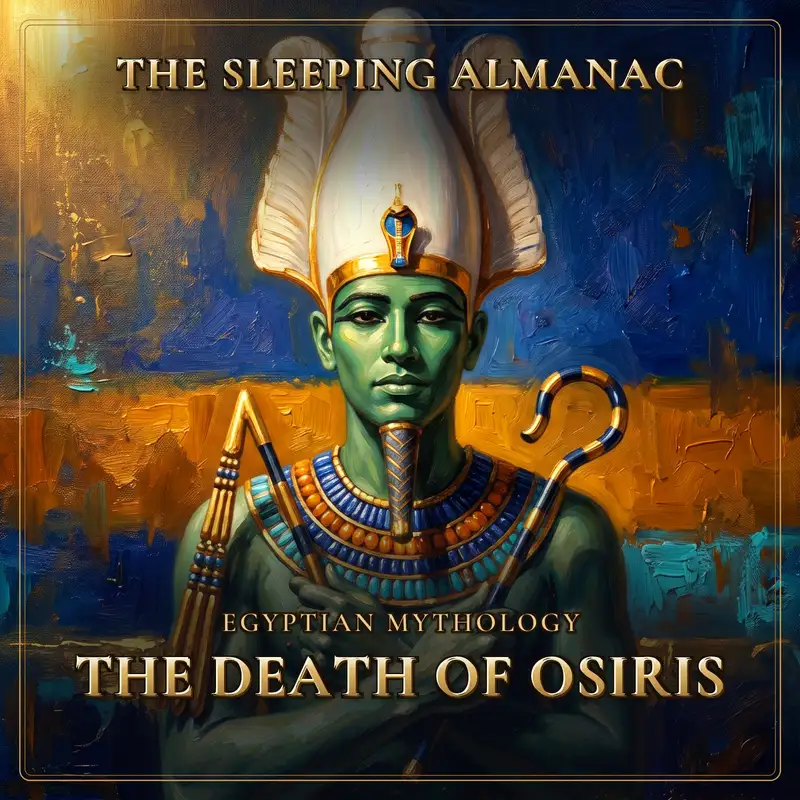
Welcome to The Sleeping Almanac.
Tonight the story turns.
For the last while we have stayed inside the long golden calm of the green king's reign, the best and gentlest rule the world had ever known
and tonight that calm meets its shadow.
But hear this first, before anything else, and hold it close through the whole of the night.
This is told gently.
There is nothing in it to fear, and nothing that will jar you or pull you back from the edge of sleep.
Even the sorrow in it is told softly, the way you might tell a sad and beautiful old story to someone you were trying to settle into rest.
You are safe here.
You will stay safe the whole way through.
So let the day set you down.
Let the bed take your weight, and your shoulders, and the last of the day's holding.
Tonight is the story the Egyptians told of how the green king passed out of the seen world, how a brother in shadow made a beautiful box
and how the river carried the good king away.
And it is the story, too, of why that passing was never, to the Egyptians, an ending.
For they did not believe the green king died the way we fear death.
They believed he went down the way the grain goes down, into the dark, to rise.
Keep that near you.
We are not telling a story of loss tonight.
We are telling a story of a seed going into the ground.
We will draw it from the old Egyptian kingship texts and from the Greek writer Plutarch
who gathered the scattered Egyptian tellings of Osiris and set them down in one long account, the fullest that has come to us.
Where the old sources fall quiet or differ, we will fill the small gaps gently, in their own spirit, always choosing the telling that serves a calm night.
There is a line we have carried through this whole season, from an old Egyptian teacher named Ptahhotep, who taught that the truest strength is the gentle kind
that good is done not by force but by patience and fair dealing.
Tonight that teaching meets its hardest test, for the gentle king is met by force, and seems, for a while, to lose.
But hold the deeper thing Ptahhotep knew.
What is built gently is not so easily unbuilt.
The grain the green king planted goes on growing in the dark long after the sower has lain down.
Goodness, once given, is very hard to kill.
Keep that near you as you drift.
It is the quiet heart of the night.
Let your eyes close.
Let the breath go long and slow.
And let us go back to the bright world of the green king's reign, in its last golden evening, when one who loved him not at all was watching from the edge of the light.
Chapter One.
The Shadow at the Edge of the Feast.
In every telling of the green king, there stands a second figure, just at the edge of the light, watching.
His brother.
His name was Set.
We must meet him tonight, gently, and we must meet him without too much fear, because fear is not what we are after here.
Set was the brother of Osiris, born among the same five children of the sky, and where Osiris was green and growing and kind, Set was the other thing
the dry and the hard and the restless.
The Egyptians gave him the red of the desert, the barren land beyond the green, the place where nothing grows.
They made him the lord of the storm and the parched sand and the wild places
and they felt about him the way a farmer feels about the killing wind that comes off the desert and withers the young crop.
He was not, to them, a simple villain to be hissed at.
He was a force, the way drought is a force, the way the hard edge of the world is a force.
But he was a force that did not love, and tonight he stands at the edge of his brother's bright reign, and he is watching, and what is in him is not love.
Let us not rush to hate him, even so, because there is something worth understanding in him, something quiet and a little sad.
Set looked at his brother and saw everything he himself was not.
He saw a king the whole world loved, a king whose very name meant goodness, a king under whom the land greened and the people sang.
And he saw, in himself, the dry one, the hard one, the brother of the desert whom no one loved in that warm way.
The Egyptians understood that envy is a kind of pain, that it grows in the place where love should be and was not, and they let Set be that
the one who stood outside the warm circle of his brother's reign and felt the cold of being outside it, and could not bear it.
We are not asked to forgive him tonight.
We are only asked to see him clearly, the lonely figure at the edge of the feast, eaten from within by the goodness he cannot share.
Sit a moment longer with the picture the Egyptians drew of him, because it is a picture of the dry places of the world
and there is a strange calm in looking at them from somewhere warm and safe.
They gave Set the color of the red desert, the great waste of sand and stone that lay on either side of their narrow green river
the country where the rain does not fall and the grain does not grow and a person alone does not last long.
They heard him in the hot wind that comes off that waste in the dead of the year
the wind that dries the lips and withers the young shoots and carries the fine sand into everything.
He was, to them, the hard edge of their world, the barrenness pressing in against the green.
And they knew, living where they lived, that the barren is not wicked exactly.
It simply does not give.
It cannot.
It is the place where giving stops.
And the brother who stood at the edge of the feast was that, a person in whom the giving had stopped, a dry place where a green one should have been.
There is no need to fear the desert tonight from where you lie, warm and held and far from its wind.
There is only the quiet of looking out at it from safety, the way you might look out a dark window at a cold field and feel, by contrast, how warm your own room is.
Let the dry brother stand out there in his dry country at the edge of the story.
You are not out there with him.
You are here, in the green and the warmth, and here is where you will stay.
Rest for a moment in how the green king himself treated this brother, because it tells you again the kind of king Osiris was.
He did not shut Set out.
He did not strike first, or guard against him, or meet the coldness with coldness.
The green king, who met everything with gentleness, met his brother with gentleness too, gave him a place at the table, a seat at the feast
the trust a good man gives his own blood.
There is a great tenderness in that, and tonight there is a great sorrow folded inside the tenderness, because we know, as we lie here
what the green king did not let himself believe.
But do not carry that forward as dread.
Carry it forward only as the simple knowledge that Osiris was good to the very end, that he trusted where a harder man would have guarded
and that his goodness was real all the way through, even toward the one who meant him harm.
For now, simply hold the two brothers in your mind as the night begins, the way the Egyptians held them, the two halves of the world.
The green and the red.
The growing and the barren.
The one who gave and the one who could not.
They are not yet in conflict tonight.
There is only the long warm reign going on as it always had, the grain in the fields and the music in the halls, and, at the edge of all that brightness
one quiet figure watching it and turning something slowly over in the dark of his own heart.
Let him stand there at the edge for now.
We will not follow him into the dark yet.
Tonight we are only learning that he is there, and then we are letting the warm reign close back over the picture like water, and resting, a little while longer
inside the green king's long good evening.
Chapter Two.
The Quiet Gathering.
What Set turned over in his heart, the old tellings say, slowly took a shape, and the shape was a plan.
We will follow it gently, because the plan itself was a quiet thing, made in low voices, and we can tell it in low voices too
the way you tell the turning of a story you already know will come right in the end.
Set did not rise up against his brother in open war.
That was not his way, and besides, the green king was loved by all the world, and no open hand would have been raised against him.
So Set worked the other way, the hidden way, the way of the quiet word and the closed door.
Plutarch tells us that he gathered to himself a company of others who, for reasons of their own, were willing to stand with him against the king.
There were seventy two of them, the old account says, seventy two who would keep the secret, and with them a queen who had come up from a far southern land
a queen named Aso, who lent her power to the plot.
Let us rest, oddly enough, on the number, because there is something almost soothing in how carefully the old story counts.
Seventy two.
The Egyptians loved to fix a thing with a number, to give it edges, and the number has come down to us across all the long centuries
seventy two conspirators gathered in the quiet around the one cold brother.
It is a small enough company against a king the whole world loved, and that is worth holding too.
The dark, in this story, is not vast.
It is a small huddle of the discontented in a corner of a bright and happy world.
The green king's reign was wide as the sky.
The plot against it was seventy two people in a closed room.
Hold that proportion as you drift, the great warm brightness everywhere, and the little knot of shadow in one corner of it
and feel how small the shadow really is against all that light.
And rest, too, on how quietly it all moved, because there is a strange softness even in the gathering of a plot, when you watch it from far enough away.
There were no horns, no marching, no fire in the night.
There was only a closed door, and low voices behind it, and a handful of the discontented leaning together in the dark
speaking of a king the rest of the world was, at that very hour, singing about in the lighted halls.
The Egyptians did not give the conspiracy a great army or a great hour.
They gave it a whisper in a corner.
And a whisper, however cold, is a small sound in a wide and singing world.
Picture the whole of the green land that night, the river running broad and quiet under the stars, the villages along it warm with lamplight
the people at their evening meal, the music drifting out of the great halls, all of it good and unafraid, and somewhere in the midst of all that warmth
one closed room where a few cold voices murmured.
The murmur could not be heard over the singing.
It never can be.
Let that be the proportion you carry down into sleep, the vast warm singing world and the small cold whisper lost inside it, and let the singing
not the whisper, be the sound you drift away on.
Notice, too, and let it comfort you, how the old tellings refuse to make the plot grand or glorious.
There is no great cause in it, no noble grievance, nothing that asks for our sympathy.
It is simply envy, gathered into a room, given a number and a plan.
The Egyptians, who understood the human heart as well as any people ever have, knew that real harm rarely wears a grand face.
It wears a small and petty one.
It is the cold brother and his seventy two, meeting in the quiet, nursing a resentment against a goodness they could not match.
There is a strange peace in seeing the dark so plainly, so stripped of all its borrowed grandeur.
It is not a great enemy.
It is a small and sad one.
And the thing it moves against, the green king's goodness, is far larger than it, and will, in the end, outlast it utterly.
So let the quiet gathering meet in its closed room, and let us not sit with them, because their company is cold and we are after warmth tonight.
Let us know only what we need to know, that a plan was being made, that it was patient and hidden and small, and that it turned, as such plans do
on knowing the one they moved against better than he knew them.
For the plan Set made needed one thing above all before it could go forward.
It needed to know the green king exactly, his very measure, the precise length and breadth of him.
And how the cold brother came to take that measure is the strange and quiet heart of the next part of the story.
For now, let the closed door close.
Let the low voices fade.
And come back out into the warm reign where the green king walks, untroubled, loved, and let the warmth of that close back over you as you rest.
Chapter Three.
The Taking of the Measure.
The plan turned on a strange and quiet thing.
Before anything else could happen, Set had to know the exact measure of his brother's body.
It is one of the oddest details in all the old story, and one of the most quietly clever, and we can turn it over slowly tonight like a smooth stone in the hand.
Set did not mean to move against his brother with force.
He meant to move with cunning, and the cunning he had devised needed, at its very center, a thing made to fit Osiris and Osiris alone.
So before the craftsmen could begin, the cold brother had to learn his brother's length, the precise reach of him from crown to heel
the exact breadth of his shoulders, the whole shape and span of the green king's body, taken down in secret and carried back to the makers.
Plutarch does not tell us exactly how it was done, by what quiet watching or careful guess, and so we may simply picture it as the old story leaves it
the measure of the good king taken in secret, by one who smiled at him by day.
Rest, strangely, on the intimacy of it, because there is something in it worth feeling, even here.
To take the measure of a person is a close and knowing thing.
It is the work of the one who makes your bed, or your coat, or, in the end, the long box you are laid in.
Set took his brother's measure the way only someone near to him could, someone trusted, someone let close.
And that nearness is the quiet ache at the center of this part of the story, that the harm came not from a stranger far off but from a brother near at hand
one who had been given every closeness, and who used the closeness to measure the one who trusted him.
We do not dwell on the ache to be wounded by it.
We dwell on it only because it is true, and because the truest stories do not look away from such things, but tell them gently, and hold them, and go on.
And yet, even here, let the green king's own peace be your peace.
For Osiris, through all of this, knew nothing of it, and lived in his goodness undisturbed.
While the measure was being taken in secret, he went on as he always had, ruling kindly, walking among his people, trusting his brother as he trusted everyone
carrying no suspicion and no fear.
There is a way of reading that as sorrow, the good king blind to the harm beside him, and there is another way, a gentler way, the way I would have you take tonight.
The green king lived his whole bright life without the cold weight of suspicion, without ever once looking at his brother and measuring him back
without the constant low fear that eats at those who are always on their guard.
He was free of all that, free in his trust, light in it.
He paid a price for that freedom, in the end.
But the freedom itself was real, and it was a kind of grace, and there are worse things to be than the one who trusted too well in a world that did not deserve it.
Let yourself feel, for a moment, what that kind of trust is actually like to live inside, because most of us know it only in glimpses
and it is one of the most restful states a person can be in.
To trust completely is to set down a weight you may not even know you are carrying.
The watchful person, the guarded one, is always working, always scanning, always holding some small part of themselves back and ready.
It is tiring in a way that never quite stops, a low labor that goes on even in sleep.
The green king never carried that weight.
He walked through his days with his hands open and his face open, expecting good because he meant good, and so he was light in a way the guarded can never be.
There is a lesson the Egyptians might not have meant to teach but that lies in the story all the same, that the trusting heart, whatever it risks
at least gets to live unburdened, gets to move through the world without the constant quiet ache of suspicion.
Tonight, let yourself borrow a little of the green king's lightness.
You do not have to keep watch over anything just now.
You do not have to hold any part of yourself back and ready.
The day is over, the doors are shut, and nothing is asked of you but to let go.
Set the watchfulness down the way the green king never had to pick it up, and feel how much lighter you are without it, here, in the safe dark
where you can trust the night to hold you.
So let the measure be taken, quietly, off at the edge of the story, and let it not trouble your rest.
The green king walks on in the sun, untroubled, and we walk with him there, in the light, not back in the shadow where the makers are bending over their secret plans.
We know what is coming, the way you know the turns of an old tale, but knowing it does not mean we must dread it.
We can hold the whole shape of the night at once, the shadow and the coming sorrow and, beyond it, sure as the dawn, the rising.
Rest in that wholeness.
The measure is only a measure.
What it leads to is not the end of the green king, however it may look.
It is only the beginning of his longest journey.
Lie still, and let the next part of the story come as gently as the rest.
Chapter Four.
The Beautiful Chest.
With the measure taken, the craftsmen set to work, and what they made was the most beautiful thing anyone had ever seen.
Let us linger here, in the workshop, because there is a strange and quiet wonder in it, and because the thing they made was, before it was anything else, beautiful.
Set commanded that a chest be built, a great box, fitted exactly to the measure of the green king's body.
But he did not have it made plain, or dark, or fearful.
He had it made gorgeous.
The old tellings say it was wrought of the finest woods, of cedar and ebony brought from far away, and inlaid with ivory and with gold
and painted and carved and adorned until it shone like a treasure, until it was the single loveliest object in all the land.
It was a chest a king might covet.
It was meant to be.
For the whole of the cold brother's plan turned on the green king, and everyone at the feast, wanting that beautiful box for their own.
Rest on the strangeness of that, gently, because it is one of the deep strange truths the old story knows, that harm so often comes wrapped in beauty.
The trap was not ugly.
It was the most beautiful thing in the room.
And the Egyptians, telling this, understood something true about the world, that the things which undo us are rarely the things that look like danger.
The danger that looks like danger we guard against.
It is the danger that looks like a gift, that shines, that we want, that slips past us.
We need not turn that into fear tonight.
We can simply hold it as one of the old quiet wisdoms folded into the story, and let it make us, not anxious, but a little softer
a little more tender toward how easily the bright thing can be the snare.
The green king will want the beautiful chest.
So would anyone.
So, perhaps, would we.
Linger in the workshop a little longer, because there is a quiet pleasure in watching anything made well, even this
and the watching is the kind of slow and absorbing thing that loosens the mind toward sleep.
Picture the hands at the work.
The cedar brought in long and fragrant from the far northern hills, the dark ebony heavy as stone, the ivory pale and smooth, the gold beaten thin and bright.
Picture the careful fitting of the joints, the slow rubbing of the wood until it glowed, the laying in of the gold along the carved edges
the whole patient labor of making a thing as lovely as hands can make it.
Whatever dark purpose lay behind it, the work itself was real work, the same work that makes a beautiful door or a beautiful boat or a beautiful bed
and there is something in the watching of it that quiets a person, the way watching any sure and skilled and unhurried making quiets a person.
Let the workshop be that for you tonight, a place of warm wood smell and slow sure hands and the soft shine of gold in lamplight.
Do not think yet of what the box is for.
Only watch it being made, watch the beautiful thing take shape under the patient hands
and let the watching slow your breathing and soften your thoughts the way the slow making softens everything around it
until the workshop and its warm light blur gently at the edges, and you are already half away.
But hold, too, the other face of it, the face the Egyptians would have us see by the story's end, because they were a people who turned even their grief toward hope.
The beautiful chest was meant to be a trap and a tomb.
And yet the very thing it became, in the long telling, was something else entirely.
The box made to hold the green king's death became the vessel of his journey
the boat that carried him down the river and out across the sea to the far shore where his next life would begin.
What was built for an ending became the means of a passage.
The Egyptians, who buried their own dead in beautiful painted coffins, in cases made lovely with gold and color, knew exactly what they were doing when they told it so.
They had turned the chest of Osiris into the first and greatest of all coffins, and a coffin, to them, was never only a box for the dead.
It was a vessel for the voyage, a beautiful ship for the soul, fitted and adorned with love to carry the one inside it safely through the dark and into the light beyond.
Rest in that turning as the chapter closes.
The beautiful box is not, in the end, what it seems.
It looks like the instrument of an ending.
It will prove to be the vessel of a journey.
And the green king, when at last he lies down inside it, will not be lying down into nothing.
He will be setting sail.
So let the craftsmen finish their work.
Let the gold be laid into the wood and the lid be fitted true.
Let the most beautiful chest in all the world stand finished and gleaming, waiting, in the cold brother's hall, for the night of the feast.
We are not afraid of it.
We know what it truly is, even if those at the feast will not.
It is a boat, made to look like a box.
It is the beginning of a voyage, dressed as the end of a life.
And the one it was made for walks toward it now, in the warm evening, loved and unsuspecting and good, as the night of the banquet comes on.
Rest, and let it come gently.
Chapter Five.
The Banquet.
When all was ready, the cold brother gave a feast, and he made it a beautiful one.
Let us go into the warm hall, because for all that we know is coming, the feast itself was a lovely thing, and the Egyptians did not stint in picturing it.
Osiris had been away, you may remember, on his long gentle journey across the world, carrying the gift of grain and law and music to every far people
and he had come home again to his own land in peace.
And to mark his homecoming, his brother Set made a banquet in his honor, and bid all the great ones of the land to come.
The hall was filled with light.
The lamps burned warm against the evening.
There was food in plenty, and drink, and the easy talk of people gathered in gladness, and at the head of it all sat the green king, home from his travels
among his own, loved and honored, with no shadow on his face at all.
Wennefer, his people called him, the one continually good
and the shepherd's crook and the gentle flail lay crossed and quiet upon his breast as he sat among them
the same kind tools he had carried all through his reign, the marks not of a conqueror but of a keeper and a feeder of his people.
Rest in the warmth of that hall for a moment, and do not let what you know spoil it, because the green king did not know it
and lived this evening in pure gladness, and we can sit beside him in that gladness a while.
There is a particular sweetness in a homecoming feast, in being gathered back among your own after a long time away
in the lamplight and the warm voices and the sense of having come, at last, to rest.
The green king felt all of that tonight, in full measure, and it was real, every bit of it, the love in the room and the gladness and the ease.
Hold that, and let it be your own ease as you lie there.
Whatever comes after, this hour was good, and the goodness of it was not a lie.
The king came home.
The lamps were lit.
The people he loved were all around him.
Let that warmth be the warmth you rest in now.
Let the feast fill out around you with all its small good sounds and warmth, because a feast is a deeply soothing thing to lie inside of in the mind
and the Egyptians loved a feast as much as any people ever have.
Let there be the soft gold of many lamps, the kind of light that has no edge to it, that pools and glows and leaves the corners of the great hall in gentle shadow.
Let there be the low steady murmur of many voices, none of them raised, the sound a happy gathering makes, like water moving somewhere near.
Let there be the scent of good food, of bread and roasted things and sweet fruit, and the cool of poured drink
and somewhere at the edge of hearing the soft notes of a harp, played slow.
The green king sat at the heart of all of it, home and at rest, and the warmth of the room was on his face, and he was glad.
You are at the heart of it too tonight, in the warm pooled light, among the low kind voices, with the slow harp somewhere near.
Nothing is required of you here but to recline and let the warmth hold you, the way it held the green king on the last good evening, in the lamplight, among his own.
And in the midst of the feast, when the gladness was at its height, the cold brother had the beautiful chest brought in.
You can imagine the hush as it came, the way a room goes quiet when something truly lovely is carried into it.
The cedar and the ebony, the ivory and the gold, all of it shining in the lamplight, the single most beautiful thing any of them had ever seen.
The guests would have leaned toward it, murmured over it, wanted it, the way people want a beautiful thing the moment they see it.
And the cold brother let them want it.
He let the longing build in the room.
And then, smiling, he made his offer, the offer that was the whole hidden hinge of his plan.
We will hear the offer in the next breath of the story, for it was made as a game, a light and playful thing
the kind of game a host proposes at the height of a feast to delight his guests.
And that is how we will take it as we cross into it, gently, as a game, because that is how it looked to everyone in that warm and lamplit hall.
No one there felt any fear.
No one there saw anything but a host offering a marvelous prize in a bit of evening fun.
The only one who knew what it truly was sat smiling among them, and we will not borrow his cold knowledge tonight.
We will stay where the green king stayed, in the warmth, in the gladness, in the lamplight, and let the game begin as it began for him
as nothing more than a pleasant turn at the end of a happy night.
Rest there, in the warm hall, and let the story breathe a moment before it goes on.
Chapter Six.
The Game.
The offer the cold brother made was this.
He would give the beautiful chest, he said, to whichever of his guests could lie down inside it and fit it exactly.
Let us take the game gently, the way the hall took it, as a piece of evening delight, because that is truly how it would have seemed.
It was the kind of playful contest a generous host might propose, a marvelous prize and a bit of fun to win it, and the whole bright room would have warmed to it at once.
One by one, the old tellings say, the guests came up to try.
One by one they climbed in and lay down in the beautiful chest, laughing, while the others called out and watched.
And one by one, it did not fit them.
This one was too short, and lay swimming in the space with room to spare.
That one was too tall, and could not stretch out, and had to fold himself and climb back out again.
Another was too broad in the shoulder, or too long in the leg, and the lid would not have closed over any of them.
The chest had been made to one measure and one measure only, and none of the laughing guests was made to match it.
Rest, oddly, in the lightness of it, because the Egyptians told this part almost playfully, and we can hold it that way too.
Picture the warm hall, the lamplight, the laughter as one after another the great ones of the land climbed in and out of the beautiful box, none of them fitting
all of them merry, the whole thing a game at the end of a feast.
There is nothing dark in the room yet, nothing anyone can see.
There is only the play of it, the trying and the laughing and the calling out, the beautiful prize waiting for the one it would fit.
The cold brother watched it all with his quiet smile, knowing what the others did not, that the box would fit one man alone
and that the game was only the patient road toward the moment that man would lie down.
But the room did not know.
The room was only playing.
Let yourself rest in the lightness the room felt, even now, even knowing.
And here, if you like, is a gentle place to let the knowing soften into something almost tender
because the green king sat and watched the game with all the others, and there was, in his watching, no fear at all.
He saw a happy room.
He saw his guests laughing, climbing in and out of a marvelous box his brother had made.
He saw nothing to be afraid of, because there was nothing, to his eyes, to fear.
That openness, that trust, that willingness to take a happy evening at its happy face, was the very heart of who the green king was.
It is the same goodness that had made him a king the whole world loved.
He met the world as a kind place because he himself was kind, and a kind person sees kindness everywhere, even, sometimes, where it is not.
We will not call that foolishness tonight.
We will call it what it was.
It was grace.
And it carried him, all unknowing, toward the chest, in the warm and laughing room, as the game came round, at last, to him.
Rest in the simple human warmth of a roomful of people at play, because that warmth was real, and it is a good thing to fall asleep inside of.
There is something that happens to a gathering when a game begins, a loosening, a shared gladness, the way grown people become for a while almost like children
laughing at the small drama of who will fit and who will not.
One after another the great ones of the land took their turn, and the room called out and laughed, and helped this one in and that one out
and the whole hall was bound together for a while in the easy fellowship of a game well played.
There was no thought in any of them of harm.
There was only the warm common pleasure of an evening among friends, the kind of evening we all carry a few of in our memory and reach for when we want to feel safe.
Let one of those evenings rise up around you now, warm and laughing and kind, everyone you have ever felt easy among gathered into one lamplit room
the game going round, the laughter soft.
That is the room the green king sat in.
Let it be the room you drift off in too, held in the warmth of good company at play, where nothing has gone wrong and no one means you any harm at all.
So let the game go on in the lamplight, light and merry, the guests climbing in and out, none of them fitting, the beautiful prize still unwon.
We are not afraid of a game.
The green king was not afraid.
The whole bright hall was at its ease.
Hold that ease a moment longer, that last warm lightness, before the green king rises, smiling, to take his turn.
The story is about to come to its quiet center.
But it comes there gently, through laughter, in a warm and lighted room, and we will go there the same way, gently, unafraid
holding the green king's own trust as our own, as we cross into the next part of the night.
Chapter Seven.
The King Lies Down.
At last, the green king rose, and smiling, came to take his turn, and lay down in the beautiful chest.
Let us hold this moment with great tenderness, because it is the quiet center of the whole night, and the Egyptians held it tenderly too.
The green king came up, as all the others had, in good humor, in the warm lamplight, among the people he loved.
He looked at the beautiful box his brother had made, the cedar and the gold, and perhaps he admired it, as anyone would.
And then, easily, trustingly, the way he had done everything in his good life, he lay himself down inside it.
And the chest, which had fit no one else, received him exactly.
It had been made to his measure, after all, made for him alone, and so it took him as a thing takes the one it was shaped for, closely, perfectly
the way a bed takes the body that has lain in it a thousand nights.
Rest here, in the strange gentleness of that fit, because there is something almost peaceful in it, something the Egyptians surely felt.
The green king lay down, and the place he lay down in was made for him, fitted to him, his and his alone in all the world.
There is an old comfort in being held that exactly, in lying down in the one place shaped to your own shape.
We feel it ourselves, in the bed that knows us, in the pillow worn to the curve of our own head.
The green king felt it too, in that first moment, before anything else, the simple ease of lying down in a place that fit him perfectly.
Let yourself feel it with him, the body settling, the weight let go, the deep rightness of being held exactly.
You are lying in your own such place tonight.
Let it take you the way the chest took the green king, closely, kindly, made for you.
Stay in that first gentle moment a while, the moment of lying down into a place that fits, because the Egyptians
who thought so long and so lovingly about the lying down of the body, would have wanted us to.
Think of how the whole body answers when it is finally allowed to lie down in the right place, after a long day, after a long journey home.
The back lengthens and eases.
The shoulders, which have been held up without our knowing it, come down at last.
The legs grow heavy and still.
The breath, which was shallow and quick with the day, begins to go deep and slow.
There is a settling that moves through the whole body when it is held exactly, a letting go that begins at the crown and travels down
loosening everything it passes, until even the hands lie open and at rest.
That is the settling the green king felt in his first moment in the place made for him, and it is the settling you can feel now, in the place made for you.
Let it travel through you slowly, that loosening, from the crown of your head down through your face and your throat and your shoulders
down through the chest and the long muscles of the back, down through the legs to the very soles of the feet
until the whole length of you lies easy and heavy and held, made for the place you are lying in, as the place was made for you.
And here the old story turns, and we will turn with it gently, holding the green king all the way.
For the moment he was down, the moment he lay there fitted and at ease, the lid was brought over, and closed.
We do not need to make it terrible.
The Egyptians, telling it, did not linger on terror, and neither will we.
The lid came down over the green king like the dark coming down over a field at the end of the day, like the lid of sleep coming down over tired eyes.
One moment there was the warm and lighted hall, and the next there was the close dark of the beautiful chest, and the green king inside it
going out of the seen world as gently, in the end, as a light is carried out of a room.
He did not thrash, in the way the Egyptians told it down the long years.
He passed.
The good king passed out of the bright world the way the sun passes out of the sky at evening, not destroyed, not ended, only gone, for a while
into the dark on the far side of things, where, as we will see, he did not cease to be.
So let the lid be closed, gently, and do not be afraid for him, because the Egyptians never were, not finally.
They knew where this was going.
They knew that the green king, the lord of the grain, was only doing now what the grain itself does, going down into the dark, seeming to end, in order to rise.
The seed is in the ground tonight.
That is all that has happened, however it looked in the lamplit hall.
The seed is in the ground.
Hold that, and let the close dark of the chest be, for you, only the close dark of your own room, and the green king's deep stillness be only your own stillness
as you lie there, held exactly, and let the night carry you on.
Chapter Eight.
The River Takes Him.
What the cold brother did then was to give the chest to the river.
Let us follow it out of the hall gently, into the cool of the night, because the worst of the story is behind us now, and what remains is almost quiet.
The plot was done.
The lid was closed and sealed fast, fastened, the old tellings say, so that it could not be opened
and then the cold brother and his seventy two carried the beautiful chest out of the lamplit hall and down through the dark to the edge of the great river.
And there they set it upon the water, and let it go.
The Nile took it.
The slow strong river that the green king had taught his people to love, the river whose flood brought the black soil and the rising grain
gathered up the chest that held him and bore it away into the dark, down toward the sea.
Rest, strangely, in the gentleness of the river, because the Egyptians surely meant us to.
Of all the hands the green king might have fallen into, he fell into the river's, and the river was the kindest power in all their world.
It was the river that fed them, the river that made the desert bloom, the mother water from which all their life came.
And it was the river that now took up the green king and carried him, not roughly, not cruelly
but the way moving water carries a fallen leaf or a drifting boat, steadily, smoothly, onward through the night.
The Egyptians who told this had watched the Nile carry a thousand things downstream in the dark.
They knew its slow sure motion, its broad calm, the way it bears a thing along without hurry and without harm.
And they gave the green king into exactly that motion.
Whatever had been done to him in the hall, the river did not add to it.
The river only carried him, gently, the way it carried everything, down through the dark land toward the waiting sea.
Let the motion of the river become the whole of your attention now
because moving water is among the oldest and surest of all the things that carry a tired mind down into sleep.
Feel the slow broad current under the beautiful chest, the deep unhurried pull of a great river moving toward the sea
the kind of motion that never jolts and never stops, only flows, and flows, and flows.
The banks slide by in the dark, the reeds the green king loved standing black against the stars, the sleeping villages with their last lamps going out
and the river bears its quiet burden past all of it, smooth and steady, rocking it ever so gently the way deep water rocks anything it carries.
There is nothing to do on a river but be carried.
The river does all the work.
It knows the way down to the sea, it has always known, and it asks nothing of the thing it bears but that it rest upon the water and be taken.
Lie now upon the deep slow river of the night and let it bear you the same way, without effort, without struggle, rocked so gently you can barely feel it
carried smooth and sure through the soft dark, down and down toward the wide and quiet sea of sleep.
And here let the deep Egyptian hope come up through the story like the dawn, because this is the place it begins to turn.
The river was carrying the green king, yes, away from his throne and his people and the bright world he had ruled.
But a river always carries a thing toward something as well as away from something.
It was carrying him toward the sea, toward a far shore, toward the strange new country where the next part of his story would unfold.
The Egyptians did not see the chest upon the river as an ending drifting away into the dark.
They saw it as a journey beginning, a voyage downstream, the green king set sail at last in the beautiful boat made to his measure
bound for a shore none of them had seen.
The boat the cold brother had built to be a coffin had become, just as we said it would, a vessel, and the green king was upon his voyage now
carried by the kindest water in the world toward whatever waited at the river's end.
So let the chest go down the river, smoothly, into the dark, and do not watch it go with grief, but with the strange calm the Egyptians kept even here.
The green king is not lost.
He is traveling.
The river has him, and the river is gentle, and the river always arrives somewhere.
Lie still tonight and let that same broad motion carry you, the slow sure drift of deep water moving on through the dark, bearing you, like the green king
gently onward, asking nothing of you, taking you smoothly toward the far quiet shore of sleep.
The river knows the way.
Let it carry you.
We will see, when we go on, what waited for the green king at the end of his long water road, in a far country, by the sea.
Chapter Nine.
The Far Shore.
The river carried the chest at last out of the land of Egypt altogether, out through the mouths of the Nile and into the great green sea.
Let us go with it gently onto the wider water, because the sea, in this part of the story, is not a fearful place but a vast and patient one.
The Nile bore the beautiful chest down through the whole long dark length of Egypt and at last delivered it to the sea
the great green water the Egyptians knew lay at the northern edge of their world.
And the sea took up the chest where the river left it, and carried it on, out across the open water, away from the land the green king had ruled
toward a far coast in another country.
The old tellings say it was borne all the way to the shore of Byblos, a city of the Phoenician coast, a place of cedar and trade far to the north and east
a foreign land that had never known the green king in life and did not know what gift the sea was bringing to its shore.
Rest on the long patience of that sea voyage, because there is deep calm in it if we let there be.
Picture the beautiful chest upon the wide water under the stars, rising and falling with the slow breath of the swell, carried on and on across the dark sea
in no hurry, bound for a shore it could not see.
There is no struggle in the picture, no storm, no fear.
There is only the vast gentle motion of deep water under a deep sky, bearing one small beautiful thing steadily toward a far coast.
The Egyptians, who feared the open sea more than they loved it, still gave the green king into its keeping for this long passage, and the sea kept him gently
and bore him true.
Let that vast slow motion be your motion now.
You are far out on the wide calm water of the night, rising and falling, carried, going gently toward a shore you cannot yet see but that is surely there
as all shores are, waiting at the end of the water.
Let the great sky come down over the water as you drift, because there are few things more quieting than the picture of an open sea under stars
and the Egyptians, who steered by those stars, knew their deep calm well.
Above the wide dark water the whole sky stands open, crowded with the soft and steady lights the Egyptians knew by name
wheeling so slowly you cannot see them move, keeping their long patient order through the whole of the night.
There is no land in sight, no edge, no hurry
only the great circle of the sea and the great dome of the stars and the small beautiful chest riding the swell between them, lifted and lowered
lifted and lowered, by the long slow breathing of the deep.
It is the loneliest picture in the story and somehow the most peaceful
the one small thing carried so gently across the vast calm by powers far larger and far kinder than the cold hall it came from.
Let yourself be that small carried thing now, under the wheeling stars, on the breathing sea, far from anything that could trouble you
held by the vast slow night itself, rising and falling, rising and falling, borne on toward the morning and asking nothing, nothing at all, but to be carried.
And here, again, let the Egyptian hope keep rising quietly through the story, because even this far passage was, to them
a part of the green king's becoming and not merely his being carried away.
He was going somewhere.
He was crossing over, the way the dead cross over, out of the known country and across the wide water into a far and hidden land.
The Egyptians, who imagined the journey of every soul as a crossing, a voyage by boat across difficult water to a shore beyond
would have felt the deep rightness of the green king making exactly such a crossing now, first by river and then by sea
carried in his beautiful boat over the wide dark water toward the far country where the next part of his life waited.
He was not drifting nowhere.
He was crossing over.
And on the far shore, though no one in Egypt knew it yet, something was waiting to receive him, and to keep him, and to wrap him round, all unknowing
in one of the strangest and most beautiful keepings in all the old stories.
Rest, and let the sea carry you toward it, as it carried him.
Chapter Ten.
The Tree by the Sea.
When the chest came at last to the shore of Byblos, a strange and beautiful thing happened.
A tree grew up and took it in.
Let us go very gently into this, because it is one of the loveliest images in all the old story, and one of the most restful.
The beautiful chest came to rest on the shore of the far country, in the shallows by the sand, and where it lodged, the old tellings say
a young tree sprang up beside it, a tamarisk, one of those sweet and sturdy trees that grow along the warm shores of that sea.
And the tree grew with a strange and wonderful swiftness, and as it grew it took the chest into itself, folding the beautiful box into its trunk
closing around it, drawing it up into the living wood, until the chest was hidden away entirely inside the heart of the tree
and no eye could see it there at all.
The green king, lord of all growing things, was taken up into a growing thing and hidden in it, enfolded in living wood by the sea, in a far country
where no one knew to look for him.
Rest in the deep strange peace of that picture, because there is so much quiet in it.
The green king, who was the grain, who was the green life of the world, did not lie in the cold dark of the chest alone upon a foreign beach.
A living tree rose up and gathered him in, wrapped him round in growing wood, hid him in the warm heart of itself by the sounding sea.
There is a tenderness in it almost beyond telling, that the lord of green things should be taken, at the end of his long water road
into the green keeping of a tree, held in living wood, cradled in the very stuff of growth he had given to the world.
He was not abandoned on that far shore.
He was gathered in, and hidden, and kept, in the heart of a living thing, safe, as a seed is safe deep in the earth, waiting.
Let that safekeeping be your own as you lie there.
Something living has gathered you in too, and holds you warm, and hides you safe in the heart of the night.
Stay with the tree a while, because it is a good thing to fall asleep imagining, a great living growing thing by the sea
and the slow picture of its rising is itself a kind of lullaby.
Imagine the young shoot coming up out of the sand beside the chest, tender at first, and then imagine it growing as the old stories let it grow
swiftly and strongly, the trunk thickening, the roots going down, the branches lifting and spreading, year folded into a moment
the whole great tree rising up out of the shore.
And imagine the chest being taken up into it, drawn slowly into the heart of the wood as the trunk closed round it
until it was no longer a box on a beach but a secret held in living timber, wrapped in growth, hidden in the very middle of a tall and fragrant tree.
The old tellings say the tree was wonderfully sweet of scent, and you can let that scent be in the air as you drift
the warm resinous sweetness of fragrant wood, drifting on the sea air, rising from the great tree that held the green king in its heart.
He was kept the way the kindest things are kept, not in cold stone but in warm living wood, cradled at the center of something growing.
Let that be your keeping too.
The night is a great living tree, and you are gathered into the warm heart of it, wrapped round and held safe and sweetly hidden
while the long hours pass and the slow growth goes on around you in the dark.
And the old story gives it one more turn, gentle and strange and somehow fitting.
The tree that held the green king grew so tall and so beautiful and so wonderfully fragrant that word of it reached the king of that far country
and he came and marveled at it, and had it cut down to make a great pillar for his hall, a column to hold up the roof of his own house.
And so the tree, with the green king still hidden in its heart, was raised up as a mighty pillar in the palace of the king of Byblos, and stood there
holding up the roof, sweet smelling and strong
while the people of that house came and went beneath it and never knew that the best king the world had ever held was sleeping in the wood above their heads.
The green king had become the very pillar of a far king's house, the strong center that held the whole roof up, hidden, unknown, holding everything up
the way goodness so often holds everything up unseen.
Rest in that image as the chapter closes, the king asleep in the fragrant pillar, the quiet center holding up the house, hidden and safe and waiting
while far away in Egypt, the one who loved him most was rising, even now, to come and find him.
Chapter Eleven.
What the Death of Osiris Meant.
So the green king passed out of the seen world.
And now, before we say goodnight, let us hold what the Egyptians believed his passing truly meant, because it is the gentlest part of the whole night.
For here is the wonder at the center of it all.
The Egyptians took this story, which might have been only a story of loss, and they made it into the very ground of their hope.
They did not believe, in the end, that the green king had died as we fear dying, into nothing, into the dark, gone.
They believed he had gone down the way the seed goes down, into the earth, into the hidden country, in order to rise.
And rising, he became something he had never been in life, something even greater than the good king of the living.
He became the king of the blessed dead, the gentle lord of the hidden land, the one who waits on the far shore to welcome every soul that makes the crossing.
The green king who had ruled the living world became, through his passing, the kind king of the world beyond, and that, to the Egyptians
was the best news there could ever be.
Rest in how much comfort they drew from this, because they drew an ocean of it, and it can be your comfort too tonight.
Every Egyptian who ever died, for thousands of years, hoped to follow the green king through the dark and into the light beyond.
They believed that the one who had gone first had made the way safe, had gone down into death and come through it and turned it, by going
into a country with a kind king in it.
When an Egyptian died, they hoped to become, in a sense, an Osiris themselves, to share in his passage and his rising
to be received on the far shore by the gentle green lord who had crossed before them and knew the way.
The green king's passing was not, to them, the saddest of stories.
It was the most hopeful.
It meant that the dark had a door in it, and a kind one waiting on the other side, and a green country beyond.
Hold that as you lie here.
Whatever dark any of us must pass through, this old people believed past all doubting that there is a kind one already on the far side of it, who went first
and waits, and will receive us gently.
Rest in the picture they made of that far green country, because they made it lovely on purpose, to comfort themselves and one another, and it can comfort you too.
They imagined the land beyond as a field, of all things, a great green field of reeds laced with quiet water
a country that looked like the best of their own beloved valley, only kinder, with no want in it and no fear.
They believed that the one who made the crossing well would come at last into that field
and would find the grain growing tall and the water running clear and the green king himself there, the gentle lord of the place, to welcome them home.
To die, they hoped, was simply to follow Osiris into that field, to become one of his own
to lay down the long labor of living and come into a country as green and as safe as a remembered childhood home.
There is no fear anywhere in that picture, only rest, only homecoming, only a green field at evening with a kind king in it.
Let it be the country you drift toward now, just over the edge of sleep, the green field and the still water and the gentle welcome waiting
the place the green king went ahead to keep, and keeps, for everyone who follows.
And there was grief, too, real grief, and we will not pretend there was not, but even the grief was a kind of love, and we can hold it tenderly.
For far away in Egypt, the green king's queen, Isis, who loved him beyond all telling, learned that he was gone, and her sorrow was deep as the river.
But she did not lie down in her sorrow.
She rose up out of it.
She cut her hair, and put on the clothes of mourning, and set out, alone, to search the whole world over for the one she loved
to find him wherever he had been carried and bring him home.
That search is a story for another night, the long faithful journey of a love that would not let go even of the dead.
But hold its beginning tonight as the gentlest possible close to the green king's passing.
He was not left lost and forgotten on a far shore.
He was loved, and the love came after him, across the whole wide world, and would not rest until it found him.
There is no warmer thing in all the old stories than that, a love that follows you even into death, even across the sea
even into the heart of a tree in a far country, and will not stop until it has found you and brought you home.
So let the meaning of it settle over you now like a blanket, soft and warm and whole.
The green king went down like the seed, into the dark, to rise.
His passing made him the kind lord of the country beyond, who waits to receive us all.
And the love that bore him company did not end at the edge of death but went on after him, faithful, unstopping, sure.
This is not a story of loss, the Egyptians would tell you.
It only looked like one for a while, in a lamplit hall, on a dark river.
It is, underneath, a story of a seed, and a door in the dark, and a love that does not let go.
Rest in all three of those tonight, the seed and the door and the faithful love, and let them be the last warm thoughts you carry down into sleep.
Chapter Twelve.
Goodnight.
And the Serpent at the Edge of Dawn.
And so we come to the quiet end of the night, with the green king gone down into the dark, and the whole of Egypt's hope going down with him, sure as the dawn, to rise.
Let the last of the story be only peace now.
The green king sleeps in the fragrant heart of the tree, in a far country, by the sounding sea, held safe in living wood, waiting.
The love that follows him is already on its long road.
And out beyond the edge of the world, the old turning of things goes on as it always has and always will.
For the Egyptians believed that every single night the sun itself made just such a passage as the green king made
going down at evening into the dark country under the world, sailing all night through the hidden land
meeting at the deepest hour the great serpent of the dark that coils at the edge of everything, and passing it, always passing it, to rise again, without fail
green and gold, at the edge of dawn.
The green king has only gone down into that same great turning.
He is in the night country now, with the sun, sailing toward the morning.
And the morning always comes.
So do not hold any fear tonight, not for him and not for yourself, because there is none left in the story, and there never truly was.
What looked like an ending was a seed going into the ground.
What looked like a loss was a king becoming the gentle lord of the country beyond.
What looked like the dark having the last word was only the long night sail toward a sure dawn, with the serpent passed, as it is always passed
and the light returning, as it always returns.
The green king goes down, and the green king will rise, because that is what green things do, and that is what he is.
Hold that sure and quiet promise as you let the very last of the day go.
Let the old picture of the night sun carry you the rest of the way down, because the Egyptians found it deeply comforting and so may you.
They watched the sun go down each evening into the west, into the country of the dead, and they did not believe it was extinguished there.
They believed it climbed into its night boat and sailed on through the hidden world below, through all the dark hours
lighting the country of the sleeping dead as it passed
until it came in the last and deepest hour to the place where the great serpent of the dark lay coiled across the river of the night.
And every night the sun passed it.
Every night, without fail, the boat went by the serpent and sailed on, and rose, green and gold and new, at the edge of the morning.
The green king has only gone into that same night country now, sailing with the sun through the dark toward a certain dawn.
He is not lost in it.
He is passing through it, the way the sun passes through it, the way you are passing through it now, carried on the same sure boat toward the same sure morning.
There is nothing to fear in the whole long dark, because the dark is only a country to be sailed through, and the boat knows the way
and the dawn is already there at the far end of it, waiting, certain, green.
Sleep now.
Let the river of the night carry you the way it carried the green king, gently, smoothly, toward a far and quiet shore.
Let the living dark gather you in and hold you safe the way the tree gathered and held him.
And know, as you go down into your own night's sleep, that the dawn is already coming, sure as it ever was, past the serpent, past the dark
at the edge of the world, where the light comes back, always, and the green rises again.
Goodnight.
Sleep deeply.
And we will meet again, by the river, when the love that would not let go sets out at last to find him, and the long search for the green king begins.