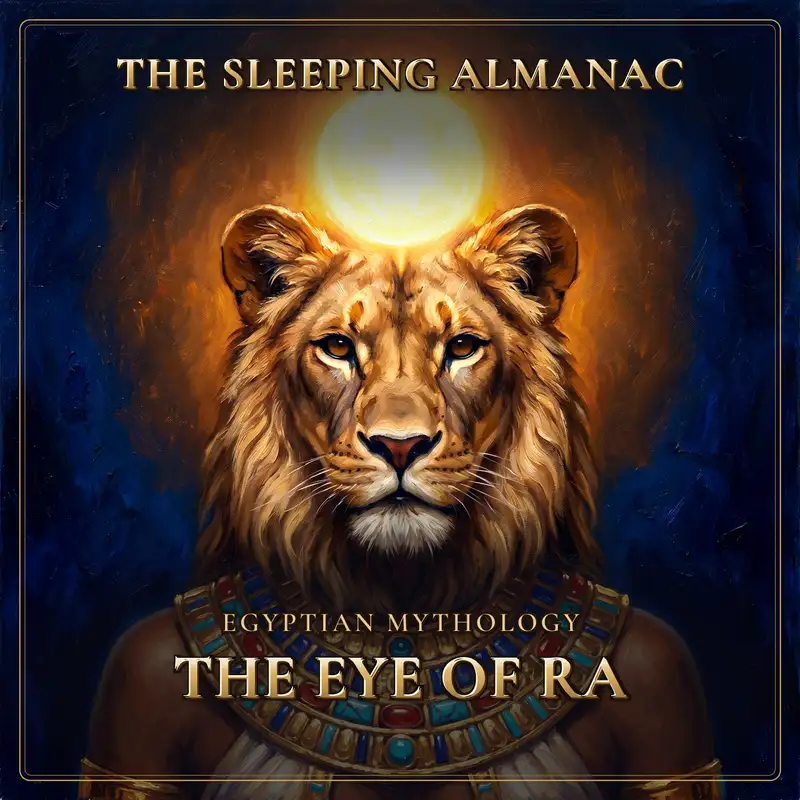
Welcome to The Sleeping Almanac.
Tonight, the most dangerous power ever loosed upon the world is going to be calmed.
Not by a stronger force.
Not by a chain or a wall or a weapon.
It is going to be calmed by a field flooded the color of dawn, and by a great and gentle sleep that washes the fury away and leaves only kindness behind.
So let the day go.
Let your hands rest, and your shoulders, and the small tight places behind your eyes.
This is a story about rage, but it is told for the sake of the calm that comes after rage, the deep quiet on the far side of a storm
when the anger has burned all the way down and the heart, emptied of it at last, grows soft and drowsy and forgiving.
That is where we are going tonight.
Toward the calm on the far side.
We will draw the tale from one of the great Egyptian temple texts, a writing the Egyptians carved on the walls of the tombs of their kings
which scholars now call the Book of the Heavenly Cow.
It tells of the time when the sun god ruled upon the earth, and grew old, and how the fierce eye of the sun went out into the world, and how the gods
in their wisdom, found a way to bring it home again gentle.
The Egyptians remembered this story every year, in a festival of music and rest, when they honored the goddess who had once been terrible and had become kind.
It is the story of the Eye of Ra.
And it begins, like so many of the oldest stories, in the late afternoon of the world, when the sun had grown old upon his throne.
We are not at the beginning tonight, in the deep still water before the first morning.
We are far downstream of that, in the age when the gods still ruled upon the earth and the sun had grown old, long after the world was made
when the maker of everything had reigned so many ages that his people had begun to forget how to be amazed by him.
Set yourself there, in that old and golden evening, when the gods walked the earth and the king of them all was tired.
There is a thread of old wisdom we carry through this whole season, drawn from a teacher named Ptahhotep, who set down the oldest advice that humanity has kept.
And his words sit gently over a story like this one, a story about anger and the calming of anger.
The wise, he understood, are not ruled by their fury.
The calm heart outlasts the hot one.
Balance, the deep rightness the Egyptians called ma'at, is not restored by a greater force flung against a lesser.
It is restored by patience, and by gentleness, and by the long quiet work of soothing what cannot be beaten.
Good speech, Ptahhotep said, true and ordered speech, is more hidden than the green stone, and yet it may be found among the maidservants at the grindstones.
He meant that the truest things are the quiet ones, easy to overlook, waiting in plain and humble places.
Keep that near you tonight.
The story we are about to tell is exactly that.
A fury that no command could stop, undone in the end by something humble and patient and kind.
Let your eyes close.
Let the breath lengthen.
And let us go back to that ancient evening of the gods.
Chapter One.
The Aging of the Sun.
We return tonight to the same ancient age we visited before, the age when the gods still ruled upon the earth, and the sun himself was king.
It had been a long reign.
Ra had made the world and then governed it, season upon season, age upon age, the river rising and falling
the grain greening and gilding and being cut and greening again, the people living out their short lives beneath the rule of the shining king.
And as we have seen, across all those long ages, the sun had grown old.
The fierce young fire of the first morning had mellowed into the deep gold of a long afternoon.
The king who had once leapt up the eastern sky now rose more slowly from his throne, and the bones of him, if a god may be said to have bones
had grown heavy with the weight of all his years.
The Egyptians pictured the old king tenderly.
They said that in his great age his very body had changed, that his bones had become silver, and his flesh gold
and his hair the deep blue of the precious stone lapis, so that he was beautiful still, but in the way that very old and precious things are beautiful
worn and shining and quiet.
He sat upon his throne in the long light, the maker of everything, grown old in the world he had made, and he watched it turn on around him.
The Egyptians did not choose those three substances idly, for they were the very materials they believed the gods were made of
the imperishable things that did not rot or rust or fade.
Gold was the flesh of the gods because gold alone among metals never tarnished, never dulled, but held its warm light forever
and so it stood for the sun and for all that could not die.
Silver was rarer to them even than gold, a moon colored metal they thought of as the bones beneath that golden flesh, the pale frame on which the brightness hung.
And lapis, that deep night blue flecked with little glints of gold, carried from unthinkably far away in the mountains of the east
was to them the color of the heavens themselves, and so they gave it to the old king for his hair
as though the night sky itself lay folded across his ancient head.
Picture him made of these things, then, in the long evening light.
Flesh of unfading gold.
Bones of pale silver.
Hair the deep blue of a star strewn sky.
He is not decaying, for all his age.
He is becoming something closer to the eternal, the way the oldest and most precious things do, settling into a worn and shining stillness that time can no longer touch.
There is a rest to be found simply in that image, if you let it hold you.
Most of what we love in the daylight world is fragile and passing, the green leaf that will brown, the warm loaf that will go stale, our own quick and fleeting lives.
But the Egyptians liked to rest their minds, now and then, against the things that did not pass
the gold that did not tarnish and the stone that did not crumble and the deep blue heaven that wheeled the same above their grandparents and would wheel the same above their grandchildren.
The old king sitting in his evening light is one of those unpassing things.
He has watched everything fragile come and go a thousand times over, and he is still there, gold and silver and blue, watching the river.
Lean back against that ancientness for a moment.
There is nothing you need to hold up tonight.
The oldest things are holding themselves, and have been since long before you, and will go on long after, and they ask nothing of you at all.
Think of the kind of light that comes at the end of a long day.
Not the hard white light of noon, when the sun stands at the top of the sky and everything is sharp and bright and awake
but the low gold light of late afternoon, when the shadows lengthen across the land and the heat goes soft and the whole world seems to lean toward its rest.
That was the light the old king sat in.
The fierce hour of his strength was far behind him, and the evening of his reign had come, and over the long valley of the river the light lay thick and gold and slow.
The Egyptians, who watched that light fall across their fields every single day, knew exactly what it felt like, the warmth gone gentle, the day winding down
the cool of the coming night still far off but on its way.
That is the hour we begin in.
The unhurried gold of a very old afternoon.
And consider how many such evenings the old king had already seen.
Not a few, not a thousand, but more than there were grains of sand along the whole length of the river.
He had watched the light go long and gold over the valley on the first day there ever was, and on every day since
an unbroken procession of evenings reaching back further than any counting
each one settling gold and quiet over the fields exactly as this one was settling now.
To have seen so many endings of so many days, and to know that each one gave way, without fail, to the cool blue dark and then to a new morning
is to hold a kind of calm that nothing can shake.
The old king was tired, yes.
But he was not afraid of the evening, because he had watched ten thousand thousand evenings come and go and had learned, in his very bones
that evening is not an ending but only a turning, the day folding gently down toward its rest so that it may rise once more.
Borrow that calm tonight.
The evening you are lying in has come ten thousand thousand times before, and has always, always given way to morning
and it asks nothing of you now but to let it fold you down.
And the river kept on as it always had.
Below the throne of the aging sun the great Nile slid by the way it had slid by for all the ages of his reign, swelling in its season and falling again
laying down its dark rich silt and drawing back, while the farmers walked out onto the wet new ground and pressed in the seed, and the green came up
and the grain ripened to the same deep gold as the evening light, and was cut, and came up green once more.
The old king had watched that turning more times than there were stars.
He had seen the people who depended on it live out their short bright lives beneath him, generation after generation
each one no longer than a single one of his afternoons.
He was very old, and very tired, and he had seen a great deal.
There is a particular kind of stillness in something that has watched the world for that long, and we can rest in it now
the way you rest beside a deep slow river that has been flowing since long before you came and will go on flowing long after you have gone.
And listen, if you will, to the sound of that river under the throne, because it is a sound made for sleep.
The Egyptians lived their whole lives within the sound of it, the great slow body of water sliding endlessly past, never hurrying, never stopping
a low and constant murmur that was the background of every day and every night they ever knew.
It is the kind of sound that asks nothing and promises everything, the sound of something vast and patient simply continuing, the way your own breath continues
the way your own heart continues, without your needing to attend to it at all.
The old king had that sound beneath him through every age of his long reign, the river going on and on below the throne
and so did every Egyptian who ever lay down to sleep along its banks, lulled by the same endless quiet sliding of the water.
Let it be beneath you too tonight, that deep slow river sound, going on in the dark, carrying everything gently downstream toward the sea, asking nothing of you
promising only that the world will keep on flowing whether you keep watch over it or not.
And the world had grown used to him.
That was part of what was happening, though the old king did not yet see it.
When a ruler has reigned so long that no one alive remembers any other, the awe begins, very slowly, to wear thin.
The people who had been made from the creator's own tears, who owed him their very lives
had lived so long beneath his rule that they had begun to take it for granted, the way you take for granted the ground beneath your feet
the way you forget to be amazed that the sun comes up at all.
And out of that forgetting, the Egyptians said, a kind of trouble was beginning to grow.
But that is for the next chapter.
For now, simply rest in the picture of the old king in the evening of his reign.
The silver bones.
The golden flesh.
The deep blue hair like lapis.
The maker of the world, grown old and beautiful and tired, seated on his throne in the long gold light, watching the thing he made turn quietly on without him.
There is no danger in this moment yet.
There is only the deep calm of something ancient at rest.
Let it hold you, as the light grows long, and the story gathers itself in the quiet.
Chapter Two.
The Whispering of Mankind.
The trouble, when it came, came not as an army but as a whisper.
The people of the world, grown used to the old king, began to murmur against him.
The Egyptians do not say it was a great rebellion of swords and fire.
They say it was something smaller and more human than that, and in a way sadder.
The people had begun to doubt him.
They had begun to mock him, quietly, among themselves, the way people will mock anything they have stopped fearing.
They looked at the old king with his silver bones and his weary eyes, and instead of awe they felt a kind of contempt, and they whispered that he was old now
and slow now, and perhaps not so mighty as he once had been, and perhaps no longer worth the obeying.
And the whispers, small as they were, reached the old king on his throne.
For he was still the sun, and the sun sees everything that happens in the light of day.
He heard what his people said of him.
He heard the mockery and the doubt, and it grieved him, the way it grieves anyone to learn that those they have cared for have turned, in secret, to scorn.
He had given these people their very lives.
They had risen from his own tears at the beginning of the world.
And now they whispered against him in the shadows and thought him too old to matter.
The Egyptians, telling this, understood the old king's grief, and we can understand it too.
There is an old and quiet sorrow in being taken for granted, in giving everything to someone and finding, in the end, that they have forgotten to be grateful
that they have begun to look at you with tired eyes and ask what you have done for them lately.
The old king felt that sorrow.
And mixed in with it, the way it so often is, was the beginning of anger.
It is a strange and moving thing, when you sit with it, that the Egyptians let their greatest god be wounded at all.
They could have told a story in which the creator stood far above such things, too vast and too bright to be touched by the opinions of the small creatures below him.
But they did not.
They told a story in which the maker of the world could be hurt by being doubted, could feel the sting of ingratitude
could grow sorrowful and tired and uncertain, exactly as a person does.
There was a deep tenderness in that, and a deep wisdom too.
They were saying that even the highest and oldest power in all of creation knew what it was to be taken for granted, and to grieve over it
and to wrestle with the slow rise of anger that grief can bring.
If the sun himself could feel it, then there was no shame in feeling it.
It was simply part of the great pattern, woven in at the very top.
And there is something easing in that thought, here at the end of your own day, if any small slight or ingratitude has lodged itself in you and will not quite let go.
The oldest god there was carried the same weight, and was not lessened by it, and in time set it gently down.
Whatever was not said to you today, or was said too carelessly, or was taken from you without thanks, you can let it rest now beside the old king's grief
up there in the gold evening light.
You do not have to settle it tonight.
You do not have to decide what it means or what should be done about it.
You can simply let it be held, for now, in the great old quiet, and turn your face, as the king will soon turn his, toward the slow work of letting it go.
It is worth resting for a moment on how small the trouble was, at the start, and how human.
There was no clash of weapons.
There was no enemy at the gates.
There was only a low murmur, a thing said behind a hand, a doubt passed quietly from one person to the next in the cool of the evening
the way doubts always travel, soft and unremarkable, until somehow everyone is carrying them.
The people did not rise up.
They simply stopped being amazed.
They had woken to the same sun every morning of their lives, and their parents before them, and their parents before them
until the rising of it no longer seemed a wonder but only a fact, a thing that happened, a thing owed to them, nothing to marvel at.
That is how awe wears away.
Not in a single great blow but in a thousand ordinary mornings, each one a little less astonished than the last
until the marvel has quietly become the expected, and the giver has quietly become the overlooked.
The Egyptians understood this as the first real trouble that ever came between the people and the powers that had made them
and it is worth noticing how they chose to tell it.
They did not make the people into monsters.
They did not say that mankind had become wicked, or cruel, or bent on evil.
They said only that the people had forgotten to be amazed, that they had let their wonder wear thin
that they had begun to grumble in the ordinary way that the comfortable and the unthankful have always grumbled.
It is a very gentle account of a very old failing, and there is a kind of mercy in its gentleness.
The people were not villains.
They were only human, only tired, only used to their blessings, only guilty of the small daily forgetting that every one of us is guilty of
the forgetting to marvel at the sun, at the bread, at the water, at the breath, at the great unearned gift of simply being alive another day.
The Egyptians knew that forgetting from the inside, and so they told it without much blame, the way you would tell of a fault you knew very well in yourself.
We can hear it the same way, with sympathy rather than judgment, here at the close of a day in which we too, very likely
forgot to be amazed by most of what we were given.
And notice the strange loneliness of the king in this.
He could hear them.
That was the hardest part.
He was the sun, and the sun sees and hears everything that passes under the light of day
and so the murmuring came up to him from every corner of the world at once, soft and constant, the doubt of the very people he had wept into being.
There was nowhere he could turn that the whispering did not reach.
He sat alone at the top of the world with the sound of his own children's scorn drifting up to him on the warm evening air, and he could not unhear it
and he could not pretend it away.
The Egyptians felt the ache of that, the particular ache of hearing yourself doubted by those you love and being unable to close your ears to it.
It is a tender, sorrowful place to begin a story, and we begin there gently, with the old king listening, and grieving, in the long gold evening of his reign.
He did not act in haste, though.
That is worth noticing, because it tells us something about how the Egyptians understood good rule.
The old king did not simply lash out.
Wounded as he was, he called instead for counsel.
He summoned the eldest and wisest of the gods, the ones who had been there even before him, and he asked them what should be done.
We will go to that council in the next chapter, in the deep quiet of the night, where the great gods gathered to take the measure of the trouble.
For now, let the whisper fade.
Let the mockery die away into the evening.
And rest, while the old king sits with his grief and his slow anger, and sends out his call for the wise to come.
Chapter Three.
The Council in the Night.
The gods came to the old king under the cover of darkness, so that the people would not know that they had been summoned.
This is one of the quiet, careful touches the Egyptians put into the story, and it is worth resting on.
The council was held in secret, at night, in the great hall, with the doors closed and the people sleeping and unaware.
The eldest gods came, the ones from the very beginning.
Nun came, the god of the primeval waters, the oldest of all, the deep from which everything had risen, whom we met on the first night of this season.
And the other great ancient gods came, gathering in the darkened hall around the throne of the aging sun, to take counsel together about what should be done.
The Egyptians named the ones who came, and the names are like a quiet roll call of the foundations of the world.
Shu came, the god of the air and of the empty space between things, and Tefnut, his sister, the goddess of moisture, the two eldest children of the creator
whom the old stories say were the first breath and the first rain.
Geb came, the broad green earth itself, and Nut, the arching star filled sky, their children, the ground below and the heavens above come in person to sit in council.
And oldest of them all came Nun, the dark primeval water, the deep out of which the whole of creation had first risen
summoned up from the depths to lend his ancient counsel to a troubled king.
Imagine the weight of such a gathering.
Not ministers and generals, but the air and the water and the earth and the sky themselves, the very pieces of the world
leaning in around a single throne in the dark to weigh what should be done.
And there is a fitting strangeness, which the Egyptians surely felt, in the fact that it was Nun, the calm deep water
the stillest and most ancient thing there is, who gave the fierce counsel that set the fire loose.
The eldest and most peaceful of all the gods spoke the words that would send the burning out.
Perhaps that is the way of these things, that even the wisest and the calmest can give, in a hard moment, a harder counsel than they mean to.
We will watch the gods spend the whole rest of the night undoing what that one quiet sentence began.
For now, let the great old powers murmur together in the dark, the water and the air and the earth and the sky
and rest in the knowledge that whatever they set in motion, the wisest of them will labor until dawn to make it gentle again.
The Egyptians imagined this as a solemn and quiet gathering, the way the most serious decisions are always made in low voices behind closed doors.
The old king laid the trouble before them.
He told them of the whispering of mankind, the mockery, the doubt, the scorn of the people he had made.
And he asked them what he should do.
The old story even keeps the shape of the words.
The aged king looked round at the great gods gathered in the dark and he spoke to them gravely, telling them that mankind
the very people who had come into being from his own eye, were now plotting against him in their hearts, and he asked them, plainly, what they would have him do
for he would not destroy his children until he had heard their counsel.
And the gathered gods, the oldest powers there were, bowed themselves down low before him in the lamplight, and bid him hear the wisdom of the eldest, of Nun
the deep water out of which they had all first come.
There is a deep orderliness in that picture, the orderliness the Egyptians loved, even in a moment of crisis.
No one shouts.
No one acts alone.
The king asks, and the gods bow, and the eldest is given the first word, and the matter is weighed in its proper order, by age and by rank
the way they believed all serious things ought to be weighed.
Even with the world about to tip toward fire, the form is kept, the courtesy is kept, the slow grave ceremony of wise beings taking counsel together is kept.
Rest in the orderliness of it, the unhurried dignity, the sense of ancient powers doing things properly in the dark while you lie safe and far away.
Picture the hall as they would have pictured it.
A great room of stone, far from the sleeping houses of the people, its high columns lost in the dark above.
A few lamps burning low, their small flames steady in the still air, throwing long soft shadows across the floor.
The oldest gods in the world gathered close around the throne, their faces half in gold light and half in shadow, leaning in so that their words would not carry.
Outside, the country lay asleep under the stars, the river moving quietly past the dark fields
the people unaware that anything at all was being decided in the night above them.
There is a deep hush to a place like that, the hush of a great matter being weighed slowly and seriously by those who have weighed many great matters before.
Let that hush settle around you too.
The hush of a closed room, late at night, where the wise are speaking softly, and there is nothing you are needed for, and nothing you must decide.
And there is something almost comforting in the care of it, the slowness of it.
The Egyptians, who prized order above nearly everything, did not imagine the gods rushing to judgment.
They imagined them gathering, and listening, and taking counsel together in the dark, the eldest powers of creation come to lend their wisdom to a king in trouble.
Whatever was about to be set in motion, it was not set in motion lightly.
It came out of a long quiet conversation among the oldest beings in the world, each one given their say, each one heard.
There is a kind of peace in watching serious people take their time, even when you sense that the path they are choosing may not be the wisest one.
The weight of it is being honored.
The matter is being held with care.
And old Nun, the eldest, the deep water itself, gave his counsel.
Send forth your Eye, he said.
Send the Eye of Ra out against them.
Here we come to one of the deepest and strangest ideas in all of Egyptian thought, and we must take it slowly, because the whole story turns upon it.
We have met the Eye of the sun before, on the first night of this season
when the lonely creator sent out his eye to search the dark waters for his lost children, and it brought them safely home.
The Eye of Ra was the part of the sun that went out into the world to act, to see, to seek, to do the will of the god at a distance from him.
It was light made into a power that could move on its own.
And it was not only gentle.
The Eye that could search and find and rescue could also, when the god was angered, go forth as something fierce, a burning power
the very heat of the sun loosed and walking.
That was what Nun counseled.
Let the Eye go out, no longer as the gentle searcher, but as the fierce one, to answer the scorn of mankind.
And the old king, grieved and angered and weary, agreed.
He would send his Eye into the world.
We will see, in time, that this counsel led further than any of them intended
and that the wisest of the gods would spend the rest of the story trying to undo what was about to be set loose.
But that is the way of anger, the Egyptians knew.
It is easy to send out.
It is hard to call home.
For now, let the dark council settle.
Let the old gods murmur in the closed hall.
The decision is made, but nothing has yet happened.
Rest in the hush before it, in the deep night of the gods, while the choice hangs quiet in the air.
Chapter Four.
The Eye Becomes the Lioness.
When the Eye of Ra went forth against mankind, it took a shape, and the shape it took was a goddess.
In her gentle form, the Egyptians knew this goddess as Hathor, one of the most beloved of all their deities, the goddess of love and music and joy
of dancing and beauty and the sweetness of life.
She was often pictured as a gentle cow, soft eyed and nurturing, or as a beautiful woman crowned with horns and the sun's disc.
She was, in her kindness, everything warm about the world.
But the Eye of Ra had another form, a fierce form, and when the gentle goddess took up the burning anger of the sun, she changed.
She became a lioness.
And in that form the Egyptians called her by another name.
They called her Sekhmet, which means the Powerful One.
This was one of the great truths the Egyptians held about the world, and they were not afraid of it.
The same power that nurtures can destroy.
The same sun that ripens the grain can scorch the field to dust.
The goddess of love and the lioness of fury were not two different beings.
They were one being in two faces, the gentlest and the most terrible of all the gods, and which face she wore depended on what she had been called forth to do.
Tonight, she had been called forth in anger.
And so the gentle one put on the shape of the lioness, and the warm goddess of love became the burning Powerful One
and she went down out of the presence of the old king and into the world of mankind.
It is worth pausing on her gentle cow form, because it gave the whole ancient writing its name.
The Egyptians did not call this text the Book of the Burning Lioness.
They called it the Book of the Heavenly Cow, after the great sky cow whose body, they said, became the heavens themselves.
For at the very end of all these events, when the old king at last grew too weary of the world to rule it from the earth any longer
he climbed up onto the back of the gentle goddess in her cow form, and she rose, and lifted him high
and her four legs became the four pillars that hold up the sky and her star strewn belly became the great vault of heaven arching over everything
so that ever after the sun could sail across her body and be carried safely round.
That is the image the Egyptians chose to name the whole story by.
Not the fury, but the gentle one who became the sky.
It tells you where their hearts truly were in all of this.
The lioness is the storm in the middle of the tale, but the cow who became the heavens is the deep frame around it
the vast and tender mother shape that holds the whole of it, and holds us too, arched over the sleeping world like a sky full of stars.
Let her hold you tonight, the great calm cow of heaven, her dark belly strewn with stars, curved gently over everything you love.
The Egyptians, who lived at the very edge of a great desert, knew this truth in their bones, because the sun taught it to them every day.
The same sun that warmed their backs in the cool of the morning, that ripened their barley and gilded their river
was the sun that could stand at noon over the red lands beyond the green and bake the stone until it burned to the touch.
Out there past the last reach of the river's water lay a vast and shimmering emptiness where nothing grew and nothing lived
scorched by the very same light that, a few steps away, made all their fields green.
They did not think of these as two suns.
They were one sun, kind on one side of a line and merciless on the other.
And so when they imagined the goddess of the sun's own eye, it made perfect sense to them that she would carry both the warmth and the burning
the love and the fury, the gentle cow and the lion, all in the one body.
They had seen it written across their whole world.
The thing that gives life and the thing that takes it can be the very same thing, turned a different way.
And because they knew this, the Egyptians held the lioness goddess in a kind of awe that was not only fear.
Sekhmet, the Powerful One, was to them the bringer of burning sickness, the scorching breath that comes off the desert
the fever that rises in the worst heat of the year.
Her arrows, they said, were illness, and her messengers were the plagues that could walk the land.
And yet, for that very reason, she was also the great healer, the one who could turn back what she had sent
and her own priests were counted among the physicians of Egypt
the ones who knew the medicines and the words of power against the very sicknesses she commanded.
The Egyptians did not find this strange at all.
The power that could send the fever was the power best able to lift it.
The one you feared in the heat of summer was the one you prayed to when at last the fever broke.
She held the sickness and the cure in the same two hands, and which she gave depended, like everything about her
on whether she had been roused to fury or soothed to gentleness.
So even the lioness, even at her most terrible, was never only a thing of destruction to them.
She was bound up with healing, with protection, with the fierce love that stands between you and whatever would harm you.
A lioness is the most dangerous thing on the plain precisely because of how fiercely she loves what she guards.
Hold the goddess that way as the night deepens, not as a monster but as a fierce protector whose protection has, for one moment, blazed too hot.
Everything that follows is the cooling of that blaze back into the warm steady watchfulness it was always meant to be.
The fierceness was never the enemy.
It was only love and strength burning too bright, and it can be brought back down, gentled, to keep its long warm watch over the sleeping world.
Let it stand guard over yours, as you drift, cooled now and calm.
So hold the lioness gently in your mind, even now, as she goes down into the world.
She is fearsome, yes.
But she is also, and always, the goddess of music, the one who loves dancing, the one who pours out the sweetness of being alive.
The fierceness is not a different creature that has replaced her.
It is her own warmth turned to fire, her own strength turned to burning, and it can be turned back.
Everything that happens after this is the slow, patient turning of her back.
The fire cooling to warmth again.
The lion softening again into the gentle one.
Keep that ahead of you like a light you are walking toward.
The kindness is not gone.
It is only wearing, for a little while, a burning mask.
We should be honest that this is the frightening part of the story, and then we should pass through it gently
the way you pass quickly and quietly through the frightening part of a tale you are telling a child at bedtime, not lingering, not dwelling
keeping your voice low and calm so that the fear cannot take hold.
The Egyptians did not tell this part to terrify.
They told it to set up the mercy that was coming, to make the calm at the end feel as deep and as welcome as it truly was.
So we will see the lioness go forth.
And then we will turn, with great relief, toward the bringing of her home.
For now, rest in this.
Whatever fierce shape she has taken, she is, underneath, the goddess of love and music and joy.
The gentleness is not gone.
It is only hidden, for a while, beneath the burning.
And the whole of the rest of the story is the long, clever, tender work of the gods to call the gentleness back out, to soothe the fury
to return the lioness to the warm goddess she truly is.
Hold that, as the night deepens.
The kindness is still in there.
It is only waiting to be called home.
Chapter Five.
The Going Forth.
The lioness went out across the land, and we will watch it the way the gods watched it, from far above, at a great and quiet distance.
The Egyptians said that Sekhmet went forth among mankind, and that her fury was terrible, and that she did exactly what she had been sent to do, and more.
We will not walk among the fields with her tonight.
We will stay up high, with the old king on his throne, and watch the storm of her pass across the world below like a shadow crossing the land
like weather moving over distant hills.
That is mercy enough for a story told at the edge of sleep.
The point is not the storm.
The point is that it was too much.
So let us keep the high and quiet distance
the way you might stand at the top of a long valley in the evening and watch a far rainstorm move along the floor of it, miles away
the grey curtain of it sweeping across the distant land while the air around you stays calm and still.
From up here there is no sound.
There is only the slow passage of the darkness below, moving where it will, a thing happening far off and long ago
held at the safe remove of a story told gently in the dark.
We are not down among it.
We are up high, with the old king, looking down.
And what matters from up here is not the storm itself but the look on the old king's face as he watches it, the dawning of something he had not expected to feel.
There is an old mercy in telling a fearful thing from far away, and the Egyptians understood it, and we can lean on it tonight.
Up here at the height of the throne, the storm below has no teeth.
It is a shadow on distant ground, a weather you are watching, not a weather you are caught in.
This is how the mind likes to hold the things that frighten it once at last it is safe and warm and ready for sleep, at a great soft distance
the way a remembered fear loosens its grip the moment you are home with the door shut and the lamp low.
We are home, in this telling.
The door is shut.
Whatever moves across the far country below moves there and not here, long ago and far off, and it cannot reach the quiet room where you are lying.
Watch it the way the old king watches it, from above and at a distance, with nothing required of you at all but to see, and to breathe
and to wait for the turn toward mercy that is already, even now, beginning.
Because something turned in him, up there on his throne.
He had wanted to be answered.
He had wanted his scorners humbled, his old dignity restored, the murmuring stilled.
He had not wanted this.
As the shadow of her fury spread further and further across the world below, the old king saw, with a slow and terrible clarity, where it was heading.
If she went on, there would be no people left.
Not the guilty only, but all of them.
The whole of mankind, every soul wept into being from his own tears at the dawn of the world, would simply be gone
and the green earth would lie empty under the sun, and he would be the lonely king of an emptied world.
And the Egyptians, who knew the human heart well, understood exactly the feeling that came over him then.
It is the feeling of having pushed open a door you cannot now close, of watching your own anger become a thing far larger and far colder than you ever meant it to be.
Because here is what happened, and it is the turning of the whole tale.
The lioness, once loosed, could not be easily stopped.
The fury of the sun, once it began to burn, did not know where to end.
She had been sent to answer the scorn of those who had mocked the king, but anger does not stay neatly within its bounds, and the burning spread
and the old king, looking down from his throne, began to see that if she went on, there would soon be no people left at all.
The whole of mankind, the people made from the creator's own tears at the beginning of the world, would be gone.
Wiped from the earth entirely.
And the old king, even in his grief, even in his anger, found that this was not what he wanted.
This is the heart of the story, and it is a very human heart.
The old king had lashed out in his hurt, and now he saw the size of what his hurt had set in motion, and he was sorry.
He had wanted to be respected again.
He had not wanted to destroy everything.
He looked down at the burning world and he felt the thing that anyone feels when their anger has gone further than they meant it to go
that cold drop in the stomach, that wish to take it back, that sudden longing to undo what cannot easily be undone.
And here is the gentle truth the Egyptians wanted you to carry away from this, the thing that makes it a story worth telling at the close of a day.
The most powerful being in all the world, the maker of everything, looked upon his own anger and decided he did not want what it was doing.
He chose mercy over the satisfaction of his fury.
He chose to spare rather than to punish, even though it was his right to punish, even though he had been wronged.
That choice, made high on the throne in the long gold light, is where the whole rest of the story comes from, and it is a kind and hopeful place for a story to come from.
The wronged one chose to forgive.
The angry one chose to relent.
And everything that follows, all the long patient labor of the night, is simply the working out of that one quiet
merciful decision made by a tired old king who found, in the end, that he loved his foolish children more than he wanted to be avenged upon them.
There is something worth holding in that, especially at the end of a long day, and especially if the day asked you to be harder than you wanted to be.
The mightiest being in the whole story is also, it turns out, the most merciful, and the Egyptians did not think those two things were opposites at all.
To them, true greatness and true gentleness were nearly the same thing, two names for one quality
and the proof of real power was not how much it could destroy but how much it could choose to spare.
The old king was never more a king than in the moment he decided to save the very people who had scorned him.
Let that quietly reframe whatever strength your own day required of you.
The strongest thing a person can do is almost never the hardest or the loudest.
More often it is the gentlest, the most forgiving, the most willing to let a wrong go unanswered and to choose peace instead.
The old king knew it, up there on his throne in the failing light.
The most powerful choice in all the world was mercy, and he made it, and everything that follows is simply that mercy working itself out.
The Egyptians understood that wish completely, and they built the rest of the story around it, around the work of repair
the clever and patient labor of calling back a fury that has been let loose.
So even here, in the fiercest part of the tale, the turn toward mercy has already begun.
The old king has seen too far.
He wants it stopped.
And in the next breath, he will set about stopping it.
Rest in that, even now.
The mercy is already rising.
The one who loosed the storm already wants it home.
Let the distant shadow pass across the far hills, and stay up here in the high quiet, where the turning toward kindness has already begun.
Chapter Six.
The Sun Repents.
The old king resolved to save mankind, and the trouble was that the lioness would not listen.
He called to her to stop.
He, who had sent her forth, now wished to call her home, and he found, as so many have found, that the thing is far harder to call back than it was to send out.
The fury of the sun, once burning, was deaf to reason.
She had been loosed in anger, and anger does not stop simply because it is told to.
The Egyptians said that Sekhmet had become caught up in her own fierceness, carried along by it, and that the gentle voice of the old king could not reach her through it.
He had made the storm.
He could not simply unmake it with a word.
So the old king had to become clever.
And this, too, the Egyptians built into the deep meaning of the story.
You cannot always stop a fury by force, or by command, or by meeting it head on.
Sometimes the only way is to be gentler and wiser than the anger, to find the quiet path around it, to soothe what you cannot overpower.
The old king could not order the lioness to stop.
So he would have to find a way to ease her into stopping, to lure the fury down into rest, to trick the burning, you might almost say, into cooling itself.
There is a deep calm in that turn, if you let yourself feel it.
The whole shape of the story changes here, from a thing of fire to a thing of patience.
The old king stops trying to overpower and begins, instead, to think.
And the thinking is slow and quiet and unworried, the kind of thinking a wise old person does by lamplight
turning a problem over and over until the gentle answer rises to the surface of its own accord.
He is not panicking, even though the world is burning.
He is being still, and being clever, and being kind, all at once.
That is the wisdom of Ptahhotep made into a story, the calm heart outlasting the hot one
the quiet patient answer proving stronger in the end than all the fierce loud force in the world.
And notice that it is the oldest one in the story who finds the gentle answer.
The king's body had grown weak.
His strength was long behind him.
The fierce young fire that might once have met force with force had gone out of him ages ago.
But his mind was not weak, and his heart was not weak
and in the place where his old strength had been there had grown something better suited to this trouble than strength had ever been, a deep slow cleverness
a patience, a knowing of how things and creatures truly work.
The Egyptians honored that.
They did not believe that the only power worth having was the power of the strong arm.
They believed in the power of the wise word, the clever plan, the patient hand
the kind of strength that tends to grow in a person precisely as the other kind fades, ripening late, like fruit, when the green years are over.
The old king could no longer overpower anything.
But he could outthink the fury, and outwait it, and gentle it down, and that turned out to be the only power in the world that could have saved it.
There is a quiet encouragement in that for anyone who feels their own younger strength behind them.
The best kind of strength does not leave when the body tires.
It deepens.
It was deepening in the old king even now, in the worst hour of his long reign, and it was about to save everything.
His plan, the Egyptians said, turned upon a color.
He sent his swift messengers out across the land, all the way to the far southern edge of the world, to bring back a great quantity of a certain red stone.
The Egyptians called it by a name we might translate as red ochre, a deep earth red, the color of blood
the color also of the rich red silt that the great river carried down in its season of flood.
There was a fitting tenderness in the choice, for that red silt was the very stuff of life in Egypt
the dark red mud the flood laid down each year to make the fields green again.
The thing that would save the world was to be colored like the soil that fed it.
The old king had a plan that turned upon that deep blood red of the earth, and upon something else as well
something that the Egyptians knew brought even the fiercest spirits down into softness and sleep.
He sent also for the brewers, and for grain, and for the makings of a vast and gentle work that would be done through the whole of the coming night.
The Egyptians even remembered where the red was to be fetched from.
The swift messengers were sent all the way south, up the long river to the very edge of the land, to the island of Elephantine at the foot of the great rapids
the place they thought of as the doorway of the flood, where the river came down out of the unknown country beyond.
There, in that far red land, was found the deep earth pigment they wanted, the ground red stone the color of dried blood.
There is a quiet rightness in sending all the way to the river's source for the thing that would save the river's people
as though the cure had to be carried down the whole length of the land, from the wild beginning of the water to the gentle fields it fed.
Picture the long journey of it through the night, the messengers hurrying south into the dark and then turning home again with their heavy red cargo
racing it down the river toward the waiting brewers, while every mile of the way the great work waited on their return.
And there is something soothing, too, in how homely the rescue was.
Not a weapon forged in fire, not a terror raised to meet terror with.
Only red earth, and grain, and water, and the patient craft of brewing, the plainest and most familiar things in all of Egypt, gathered up and turned
by cleverness and by care, into the very thing that would calm a goddess and save the world.
The Egyptians liked their mercy to be made of ordinary stuff.
It made the mercy feel near, and possible, and real.
The same earth underfoot, the same grain from the same fields, the same quiet kitchen work, holding within it, when the need came, the power to undo a catastrophe.
Rest in that as the messengers ride.
The thing that will save everything is being gathered out of the most ordinary corners of the world.
We will go down into that night work in the next chapter, into the warm brewing houses
into the lamplight and the low voices and the patient labor of mixing and steeping and pouring, the kind of slow, soothing
repetitive work that is itself half a lullaby.
The plan to save the world was not a battle.
It was a brewing.
It was the gentlest and most patient kind of work there is, carried out quietly in the dark while the world held its breath.
So let the day's last worry go, as the messengers race south for the red earth, and the brewers light their lamps, and the long calm labor of mercy begins.
Chapter Seven.
The Brewing in the Night.
All through the night, in the brewing houses, the gods and their helpers worked, and the work was slow and warm and quiet
and you may sink down into it as you would sink into a warm bath.
The Egyptians knew brewing as well as any people who have ever lived.
Beer was the everyday drink of Egypt, made in nearly every household, gentle and nourishing, shared at every table.
So they pictured this great work in loving and familiar detail.
The grain was gathered and crushed.
The mash was made.
The vats were filled.
And the brewers tended it through the dark hours, stirring and watching, in the warm dimness of the brewing houses, by the soft light of the oil lamps
their shadows moving slowly on the walls.
And think who did the very first part of that work, down at the bottom of it, before ever the vats were filled.
The grain had to be ground, and grinding the grain was the work of the maidservants, the humblest workers there were, kneeling at their stones in the half dark
pushing the heavy upper stone back and forth across the lower one, hour upon hour, turning the hard barley into soft pale flour.
It is the very image old Ptahhotep reached for when he wanted to name the most overlooked people in the world, the maidservants at the grindstones
and here they are at the foundation of the whole rescue, their patient kneeling labor the first quiet step in the saving of all mankind.
There is a deep fitness in that, the kind the Egyptians loved.
The world was not saved from the top down, by a command shouted from the throne.
It was saved from the bottom up, beginning in the aching arms of the lowliest workers grinding grain in the dark
exactly where the old teacher had said the most precious things are always found.
Rest among them a while, in the soft grit and rhythm of that ancient work, the back and forth of the stone, the slow warm heap of flour growing
the humblest hands in all of Egypt beginning, without even knowing it, to save the world.
Let yourself go down into that warmth, into the smell and the sound of it, because there is no part of this story more made for sleep.
The brewing houses were close and warm, the air heavy with the soft yeasty smell of the grain and the mash, a smell like bread, like something nourishing being made.
There would have been the low murmur of voices, the brewers speaking quietly to one another as they worked, no one raising a voice
because it was deep in the night and there was no need to hurry.
There was the steady sound of the stirring, the slow turning of the paddles through the thick mash, round and round, a sound as even and unbroken as breathing.
There was the small soft hiss and flicker of the oil lamps, the only light in all that warm dark
and the great shadows of the workers leaning and rising on the walls as they bent to their task and straightened again.
Warmth, and a good smell, and low voices, and the slow even motion of the stirring, on and on, hour after hour.
If you have ever fallen asleep in a warm kitchen while someone you love moved quietly about it, cooking, you know exactly the feeling of this place.
It is the feeling of being safe and warm while gentle work is done all around you, asking nothing of you but to rest.
Add to the warmth one more thing, the cool just beyond it.
Step in your mind to the open doorway of the brewing house, where the heat of the work meets the cool night air coming up off the river
and feel how good that meeting is, the warmth at your back and the coolness on your face, the best of both held in a single breath.
Out there the dark country lies still, the water moving by unseen, the stars turning slow overhead, a faint smell of wet earth and reeds drifting up from the bank.
In here the lamps glow gold and the air is thick and sweet with the smell of the mash, and the paddles turn, and the low voices murmur
and the great work goes patiently on.
You are standing on the threshold between the wide cool night and the warm close room, and both of them are peaceful, and neither of them needs a single thing from you.
Let your breath find the rhythm of the stirring, slow in and slow out, round and round, as even and unhurried as the paddles turning through the mash.
There is nowhere to be but here.
There is nothing to do but breathe, and warm, and slowly, slowly, begin to sink.
And the work had its own slow rhythm, the rhythm of all the oldest crafts, the kind your hands can fall into without your mind needing to follow.
Gather, and crush, and pour.
Stir, and watch, and wait.
Pour again.
There was no rushing it, because brewing cannot be rushed, any more than a flood can be rushed or a morning can be rushed.
It takes the time it takes.
So the gods and their helpers settled into that patient rhythm and let the night carry them along, and the vats filled slowly, and the warm dark held them
and out beyond the lamplight the world lay quiet and waiting, not knowing that its rescue was being stirred together, vat by vat, in the close warm dark.
And the smell of it deepened as the night wore on, the way the smell of anything brewing or baking deepens, growing richer and rounder and sweeter
filling the whole warm space until you could almost taste it on the air, that soft full smell of grain and yeast and something good slowly becoming.
It is one of the oldest comforting smells there is, older than almost any other, the smell of sustenance being made, of plenty being quietly prepared
and the body answers to it without being asked, the shoulders loosening, the breath slowing
some deep old part of you reassured at the most basic level that there is food, and warmth, and care, and therefore nothing at all to fear.
Breathe it in now, that warm full grainy sweetness, and let your body believe what it is telling you.
You are safe.
You are warm.
There is plenty.
The good work is being done all around you.
And there is nothing left for you to do but rest in the warmth and let the long night carry you gently down.
And into the brewing they mixed the red.
The messengers had returned from the far south with the deep red ochre, the blood colored earth
and the gods ground it fine and stirred it through the beer until the whole of it ran a deep and gleaming red, the exact color of blood
the exact color of the rich flood silt of the river.
Vat after vat of it, all through the night, until the red beer filled them, thousands of measures of it, more than anyone had ever brewed before.
There is something deeply soothing in this part of the story, and the Egyptians felt it.
The saving of the whole world was not being done with weapons or with shouting.
It was being done with the quiet, patient, homely work of brewing, the kind of work that has lulled people for thousands of years
the stirring and the tending and the watching through the night.
The fate of all mankind rested on a long, calm, careful labor carried out in lamplight while the world slept, and there is no more restful image of rescue than that.
Not a battle won by fury, but a danger soothed by patience, vat by vat, through the slow hours of the dark.
Let yourself be there, in the warm brewing house, in the low gold lamplight, among the slow stirring and the quiet voices and the deep red gleam of the vats.
The work goes on, unhurried, all through the night.
There is nothing to fear here.
There is only the patient labor of mercy, warm and slow, carrying the world gently toward its rescue.
Let the warmth and the quiet and the slow stirring carry you down.
Chapter Eight.
Seven Thousand Jars.
When the brewing was done, the Egyptians said, there were seven thousand jars of the red beer, and the gods took them to the place where the lioness would come at dawn.
Seven thousand jars.
The number itself is meant to stagger you a little, to show the sheer size of the gentle labor that had been done in the night.
Enough red beer to fill a valley.
Enough to flood the fields.
The gods carried it all to the place where they knew the fury would pass when the light returned, to the flat low plains, and there
in the last dark hour before dawn, they poured it all out upon the ground.
Picture the carrying of it, the long patient labor of bringing seven thousand jars down to the plains in the dark.
Not all at once, not by any quick magic, but the slow way, jar after jar after jar
a great unhurried procession of bearers moving down through the night with the heavy vessels balanced and cradled, their feet finding the path by starlight
their breath even, no one rushing, because a thing carried in a hurry is a thing spilled.
Down they came, and down, and down, in a line that seemed to have no end
setting the jars in their ranks along the edges of the low fields and turning back for more, all through the deep middle of the night
until the whole plain was ringed and crowded with vessels gleaming faintly in the starlight.
There is a deep calm in imagining that, the long slow patient carrying, the quiet bearers in the dark, the steady gathering of the means of mercy
jar by jar by jar, with all the unhurried sureness of something that cannot fail because it simply refuses to rush.
Let your breath fall into the rhythm of their walking, slow step after slow step, down through the soft dark toward the waiting fields.
The gods carried it all down to the low fields where they knew the fury would pass when the light returned.
And there, on the plains, the gods poured out the seven thousand jars, and the red beer spread across the low fields until it lay three palms deep
a whole shining flood of it, deep red in the last starlight, filling the fields from edge to edge.
In the long after years the Egyptians would honor the gentle goddess of this story above all at Dendera
where her great temple rose and where her homecoming was remembered with music every year.
But on this first night the field was only a field, an ordinary low stretch of ground chosen for the one reason that the lioness would cross it at dawn.
There is a quiet wonder in the size of it, and the Egyptians meant you to feel it.
All through the dark the gods had carried the jars down to the plains, one after another after another, a long patient procession of them in the starlight
until the whole low country was ringed with vessels and there were more of them than anyone could count.
And then the pouring, jar after jar tipped out onto the thirsty ground, the red beer running and spreading and joining and rising
slow as the flood itself rises, until the separate streams of it became one great still sheet lying across the land.
It was the very image the Egyptians knew best of all, the flooding of the fields, but worked in red, and worked in the dark, and worked for mercy.
The river floods to feed the world.
This flood was poured to save it.
Both of them came in the night and lay still across the low ground and waited for the morning.
It is worth resting on how deeply this image would have spoken to an Egyptian, because the flooding of the fields was the great yearly mercy their whole life turned upon.
Once every year, in the heat of high summer, the river rose.
It came up out of the south, swelling and browning and spreading, until it brimmed its banks and ran out across the flat dark fields and covered them
and lay there, still and wide and shining, for weeks on end.
And the Egyptians did not fear it.
They waited for it.
They longed for it.
That still sheet of water lying across the drowned fields was not a disaster to them but the very promise of life
the silt and the wetness that would make the grain grow, the difference between a year of plenty and a year of hunger.
So when they pictured the gods flooding the plains with a great still red sheet in the dark, they were picturing the most hopeful thing they knew
the flood that saves, the water that comes in the night and lies quiet across the land and means that everyone will live.
The rescue wore the shape of the thing they trusted most in all the world.
And that is a good thing to carry down with you toward sleep, the deep dependable mercy of a thing that comes every year without fail
whether or not anyone frets over it, whether or not anyone lies awake.
The flood came on its own.
The grain grew on its own.
The great wheel turned, faithful and unhurried, carrying the people through year after year, asking only that they trust it.
You can trust it too, tonight.
The morning will flood up over the edge of the world the way the river floods the fields, on its own, in its own time, with no help needed from you.
You can let go of the watching.
The flood of light is already gathering somewhere past the dark, sure to arrive, and all you have to do is rest until it comes.
And then there was nothing left to do but wait, and the waiting itself was deep and calm.
The gods drew back to the edges of the plain and grew quiet, and the great red field lay there gleaming faintly under the fading stars, perfectly still
not a ripple on it, holding the last of the night sky on its surface like a dark mirror.
All the long labor was finished.
The grain was crushed and the beer was brewed and the red was poured
and now the only thing that remained was to be patient and let the morning come and bring the fury down to drink.
The hardest and busiest part of the night was behind them.
What was left was the stillness, the held breath, the quiet of everything ready and in its place.
There is a particular hour that this was, and anyone who has been awake in it knows its deep strange peace.
It is the hour furthest from both the evening and the morning, the still center of the night, when the dark is at its softest and most complete
when even the night creatures have gone quiet and the world seems to hold entirely still.
The stars stand at their fullest then, wheeled all the way over, and the air is at its coolest, and there is a silence so deep that it seems to have a sound of its own.
The Egyptians, who watched the night sky as closely as any people ever have, knew that hour well, the long pause before the east begins to pale.
And that is the hour the red fields lay waiting in, the deepest trough of the night, everything finished, everything still
the gods withdrawn and silent at the edges, the great red mirror holding the stars
and nothing left to happen until the slow turning of the sky should bring the first grey light up out of the east.
Lie in that hour now.
The deepest, softest, stillest part of the whole night, where everything is ready and nothing is required
and the only thing left in all the world to do is to wait, and to breathe, and to rest.
And then they waited.
The trap, if we can call so gentle a thing a trap, was set.
It was not a snare of nets or chains.
It was a field flooded with a deep red drink, lying still and gleaming in the dark, waiting for the fury to arrive at first light and to mistake it
in her burning, for the very thing she sought.
Picture it now, in the hush before dawn.
The wide low fields, flooded ankle deep and then knee deep with the still red beer, gleaming faintly under the last of the stars.
No sound.
No movement.
Only the great red mirror lying across the land, and the gods withdrawn and waiting, and the sky in the east just beginning, very faintly, to think about the morning.
Everything is ready.
Everything is calm.
The whole long night of patient work has come down to this one still red field, waiting in the dark.
The hardest part is over.
Breathe out slowly, and let yourself grow as still as the field.
What comes next is the beginning of the calm.
Chapter Nine.
The Lioness at Dawn.
When the first light came, the lioness came with it, and she found the fields flooded red.
She had burned through the night, the fury of the sun, and now at dawn she came down into the plains to continue what she had begun
and she found the whole world before her gleaming the deep red she had been seeking.
The Egyptians said that she saw the flooded fields, red from edge to edge, and that in her fierceness she believed it to be what her burning desired
and that she was pleased by the sight of so much red lying ready before her, and she bent down to it.
And she drank.
She drank, the old story says, because the whole field gleamed the deep red she had craved, and in her burning she took it for the blood she sought
and was drawn down to it.
She drank deeply, the way the parched drink, the way the long furious drink when at last they find what they crave.
She drank and drank, the red beer that the gods had brewed all through the night, and she did not know, in her burning, that it was not what she thought it was.
She drank until the fields began to empty, until the deep flood grew shallow, until she had taken into herself nearly the whole of the seven thousand jars.
And all the while, from the edges of the plain, the gods were watching, and we may imagine how they held their breath.
Everything they had labored through the whole night to make had come down to this, to whether the fury would stoop to the red field and drink
or whether she would see through it, or scorn it, and burn on.
They had ground the grain and brewed the beer and carried the seven thousand jars and poured them out and withdrawn into the dark
and now there was nothing left in their power to do.
It was out of their hands entirely.
They could only watch, and wait, and hope that the gentlest trick in all the world would be enough to turn the fiercest power in all the world.
And when she bent, and drank, and drank again, and did not stop, a slow relief must have moved through them like a cool breath
the relief of seeing a great danger begin, at last, to pass.
Hold that feeling for yourself as you lie here, the feeling of a long held worry beginning finally to ease
the moment when you first sense that the hard thing is going to be all right after all, and the breath you did not know you were holding begins, slowly
to let itself go.
And slowly, as she drank, something began to change.
The Egyptians knew exactly what beer does, in quantity, to even the fiercest of spirits.
It softens them.
It slows them.
It loosens the grip of whatever they were holding so tightly, and lets it fall, and brings them down, at last, toward rest.
And so it was with the lioness.
As she drank the red beer, the fire in her began, very gently, to cool.
The burning that had carried her across the world began to loosen its hold.
Her fierce eyes grew heavy.
Her terrible strength grew soft and slow.
The fury that no command could stop began, all on its own, to drain quietly away, drowned in the warm red flood, easing down toward sleep.
You may know in your own body the change that came over her, because it is the same change that comes over all of us at the close of a hard day.
The way a clenched hand, held tight for hours without your even noticing, slowly opens once you remember to let it.
The way the shoulders come down.
The way the jaw unsets itself.
The way a tightness you have been carrying for so long that it had begun to feel like part of you finally, quietly, lets go.
That is what was happening to the lioness, there in the reddening light of dawn.
The fierceness that had held her rigid was loosening, muscle by muscle, breath by breath.
The burning was going out of her not all at once but the way a fire goes out, sinking lower and lower
the flames becoming embers and the embers becoming a deep warm glow and the glow becoming, at last, only warmth, and then only the gentle gray ash of rest.
There was no struggle in it.
There was only the slow, sweet, irresistible letting go.
It matters, too, what the drink itself was, because to the Egyptians beer was never a harsh thing.
It was gentle, and nourishing, and good.
It was the everyday drink of every household, thick and mild and faintly sweet, given to children and to workers and to the old, shared at every table
set out as an offering to the gods and laid in the tombs of the dead for their long rest.
It was, to them, one of the kind gifts of the gods, bound up with bread as the very stuff of life.
So there was a deep fitness in the fact that the fury was undone not by poison, not by any cruel thing, but by this, the mildest and most homely comfort they knew.
The lioness was not tricked into harm.
She was offered the gentlest gift in all of Egypt, and she took it, and it did to her what it had done to tired people at the end of long days for thousands of years.
It eased her.
It softened her.
It loosed the grip of the long hard day and let her sink, at last, toward rest.
There was a mercy even in the means of it.
And you may feel, if you turn your attention gently inward, the same warmth beginning its slow spread through you.
It starts, the way it started in her, somewhere deep in the center, and then it moves outward, unhurried, into the chest, down the long muscles of the arms
into the hands, down through the legs to the very feet, a heaviness that is not unpleasant at all but warm and welcome
the body growing dense and slow and content.
The eyes are the last to go, and they go the way hers went, slipping closed and then half opening and then closing again
each time a little less willing to reopen, until the lifting of them comes to seem far too much trouble, and they simply stay shut
and the warmth closes gently over the top of you like water.
There is nowhere you have to be.
There is nothing you have to hold.
Let the warmth take the hands first, and then the arms, and then everything, the way it took her, there in the reddening light.
And as the fire cooled, a heaviness came over her in its place, the good heaviness that follows any great exertion
the heaviness of limbs that have done their work and now want only to be still.
Her great head grew too heavy to hold so high.
Her wide eyes, that had blazed all night, began to close, and to open, and to close again, more slowly each time, the way your own eyes may be closing now.
The drinking slowed.
The fury was forgotten somewhere behind her, dropped and left in the emptying red field, no longer worth the holding.
And in its place rose only the deep and gathering pull of sleep, drawing her down, gently, the way the river draws everything down toward the sea.
There is a deep wisdom hidden in this, the kind the Egyptians loved to fold into a story.
The fury could not be fought.
It could not be commanded or overpowered.
But it could be soothed.
It could be eased, and softened, and brought gently down, until it simply could not hold itself up any longer and began to sink toward rest.
Hold that quietly as you lie here.
Even the fiercest fire burns itself down in the end.
Even the greatest anger, given time and gentleness, grows heavy and slow and longs, at last, only to lie down.
Let the lioness drink.
Let the burning cool.
Let the long fury soften, here in the first light, toward sleep.
Chapter Ten.
The Calming.
The lioness grew drowsy, and the fury left her, and she forgot, in her warm heaviness, what she had ever been so angry about.
This is the gentlest turning in the whole story, and the Egyptians lingered over it, and so will we.
The red flood had done its quiet work.
The burning was gone now, washed away, drained down into a deep and growing heaviness.
The lioness, who had been the most terrible power ever loosed upon the world
stood in the emptying red fields in the morning light and felt her own fierceness slipping away from her, and could not hold onto it, and did not, in the end
want to.
The anger had been a fire, and the fire was out, and what was left where it had burned was only a great and gentle tiredness, the kind that follows a storm
the kind that follows weeping, the kind that comes when something that gripped you for so long finally lets go.
She grew calm.
Her breathing slowed.
The hardness went out of her.
And the Egyptians said that the deep red drink had so softened and quieted her that the fury was simply forgotten, drowned, gone, as though it had never been.
She no longer knew why she had been so angry.
She no longer wished to harm anyone at all.
The whole burning purpose that had carried her across the world had dissolved away into a warm and drowsy peace, and she stood in the morning light gentled
emptied of her rage, soft again, and kind.
There is a particular quality to the calm that comes after great anger, and the Egyptians knew it, and folded it into the story with great tenderness.
It is not the same as the calm of someone who was never angry at all.
It is deeper than that, and softer, and more forgiving, the way the air is washed and clean after a storm has finally passed and spent itself.
When a fury that has gripped you for a long time at last burns itself out, what is left behind is not emptiness but a kind of sweetness
a great gentle tiredness that has no fight left in it and wants none.
The thing you were so sure of, the wrong you could not stop turning over, the heat you could not put down
all of it has somehow loosened its hold while you were not watching, and you find you can no longer quite remember why it mattered so much.
You are simply tired, and quiet, and oddly at peace.
That is where the lioness had come to.
The far gentle shore on the other side of the fire.
The Egyptians had a word for the deep settled peace the goddess came to rest in, and it was one of their most beloved words.
They called it hotep.
It meant peace, and contentment, and being satisfied, the quiet a person feels when there is nothing more that is needed
when the meal is eaten and the work is done and the heart is at ease.
It was the word they carved on the tables where the offerings were laid, and the word they wished upon their dead for their long rest
and the word they folded into their own names, so that a person might be called something like he is content, he is at peace.
That was the state the lioness had been brought home to.
Not defeat, and not weariness only, but hotep, the deep good peace on the far side of all striving.
Let that old word settle over you too, here in the quiet.
Hotep.
There is nothing more needed.
There is nothing left to do.
The day is eaten, the work is done, and the heart may rest, satisfied, and at ease.
Think of how the world feels in the first hour after a great storm has finally blown itself out.
The air is washed and clean and unnaturally still.
The light comes through soft and new.
Everything drips and settles and steams a little in the returning warmth, and there is a hush over all of it
a sense that something large has passed and will not come again tonight, that the worst is over and the long quiet has begun.
The birds come back first, a tentative note or two, and then the ordinary sounds return one by one, gentle and unhurried
and the whole drenched world seems to let out a long held breath.
That was the feeling in the fields at that dawn, and it can be the feeling in you now.
Whatever weather moved through your day, it has blown out.
The air is clearing.
The light is coming soft.
And over everything settles that deep washed stillness that only ever comes on the far side of a storm.
And the morning light was on her now, soft and gold and new, the very light of the sun she was a part of, fallen across her gentled shape in the emptying fields.
The terror was over and the day had come, an ordinary day, with an ordinary dawn
the kind of dawn that comes after every storm to show that the world is still here and still turning.
The red flood had soaked away into the dark ground.
The fury had soaked away into the deep of her.
And she stood in the new light no longer a thing to be feared, only a tired and gentle creature in a quiet field at sunrise, ready at last to lay her great head down.
And the old king, watching from above, saw that it was done.
The world was saved.
Not destroyed, and not by force, but soothed, calmed, eased back from the edge by patience and cleverness and a field flooded the color of dawn.
The people who remained were spared.
The fury was ended.
And the terrible lioness, the Powerful One, stood quiet in the empty red fields, no longer terrible at all, only tired, and gentle, and ready to come home.
Let yourself rest fully in this now, because it is the deep calm the whole story has been carrying you toward.
The storm is over.
The anger has burned all the way down and gone out.
What is left is only the soft, heavy, forgiving quiet that comes after, the peace on the far side of the fury
where nothing is owed and nothing is feared and the only thing left to do is rest.
The lioness has found it.
Let yourself find it too, here in the first gentle light of the morning, where all the burning has finally, finally cooled.
Chapter Eleven.
Hathor Returns.
When the fury had gone out of her entirely, the lioness was a lioness no longer.
She was Hathor again, the gentle one, the goddess of love and music and joy.
This was the homecoming the whole story had been working toward, and it was the thing the Egyptians most wanted to remember.
The terrible Sekhmet and the gentle Hathor were one being, and when the fury was soothed away
the gentleness that had always been underneath came back up to the surface, like the warm goddess rising out of the cooled fire.
She who had gone forth as a lioness came home as the goddess of dancing and beauty and sweetness, crowned again with the soft horns and the sun's disc
her terrible strength turned back into tenderness, her burning turned back into warmth.
The kindness had never truly been lost.
It had only been hidden beneath the anger, waiting, all along, to be called home.
Try to see the moment of the change itself, for the Egyptians surely did.
The great tawny shape lying heavy in the emptying field, the lioness gone drowsy and still, and then, so gently that there is no clear instant to it
the fierceness simply continuing to drain away until what lies there is no longer a lioness at all but the goddess in her own true form, the gentle one
soft eyed and calm, crowned with the curved horns and the golden disc of the sun.
It is not a violent change, not a tearing or a breaking.
It is more like watching a face that has been clenched in anger slowly, slowly relax, until you realize you are looking at the same beloved face you always knew
returned to itself, the hardness all gone out of it.
That was the homecoming.
Not the arrival of someone new, but the return of someone deeply familiar, the kind one, who had been there underneath the whole time.
The Egyptians found that unspeakably reassuring, and so may we.
The gentleness is not something that has to be built from nothing.
It is already there, underneath, your own true face, only waiting for the hardness of the day to relax and let it through.
The Egyptians honored this homecoming every single year.
They held a festival for the returning goddess, a festival of release and rest and gladness, with music and quiet and the setting down of burdens
when they remembered how the terrible one had been made gentle, how the fury had been soothed into peace
how mercy had won out over destruction through patience and cleverness rather than force.
It was, in its deepest meaning, a festival about coming home from anger, about laying down the fierce thing you have been carrying and becoming soft again
and the Egyptians treasured it.
It was, above all, a festival of letting go.
That is the heart of why they kept it, year after year, for thousands of years.
Once in the season they gave themselves permission to set everything down
the day's labor and the year's worry and whatever fierceness they had been carrying in their own hearts, and to rest, and to be glad
and to let the gentleness come back up to the surface the way it had come back up in the goddess.
They would gather in the warmth of the temple, and there would be music, soft and sweet, and a deep unwinding of all the tightness that ordinary life winds into a person.
It was not a festival about excess.
It was a festival about release, about the great relief of finally laying a burden down, about remembering that underneath the hardness the day demands of us
the kindness is still there, and can be let out again, and welcomed home.
They were celebrating, in the end, the very thing this story is about.
The fury soothed.
The gentleness returned.
The heart, emptied of its anger at last, grown soft and drowsy and forgiving.
They kept that festival with music above all, and with one instrument in particular, the sistrum, the gentle handheld rattle that was sacred to the goddess
whose soft metallic shimmer was thought to soothe her and to draw out her kind face rather than her fierce one.
All through the festival they would shake the sistrum and sing and set out the beer in her honor, and burn lamps through the night
and then wake in the morning to greet the goddess come home gentle, exactly as she had come home gentle in the story.
It was their way of living the tale themselves, once a year, of laying down the year's fierceness as the goddess had laid down hers
and waking soft and glad in the new light.
There is something tender in a whole people doing that together, year upon year, for thousands of years
gathering in the warm dark to play soft music to the fiercest power they knew
coaxing her gentleness back up to the surface the way you might soothe a frightened animal, or a frightened child, or your own tired and overburdened heart.
And in that homecoming, the Egyptians understood, the order of the world had been set right again.
This was ma'at restored, the deep balance that holds everything steady, knit back together not by a greater force flung against the fury but by patience
by cleverness, by gentleness, by the calm heart outlasting the hot one.
The world had tilted toward ruin and had been brought gently level again.
The old teacher Ptahhotep would have nodded at it, for it was exactly what his quiet wisdom taught.
The truest strength is not the loud kind.
The thing that saves the world in the end is humble and patient and easy to overlook, more hidden than the green stone
found not in thunder but among ordinary people doing ordinary work, brewing in the dark, waiting for the dawn, choosing gentleness over force.
That is the order the Egyptians believed held the whole world together.
And it had held, here too.
It always, in their telling, held in the end.
And the goddess herself, ever after, held both her faces, and the Egyptians were not troubled by it.
They prayed to Sekhmet the Powerful for strength, for the fierce protection that drives off what threatens, for the burning away of sickness and evil.
And they loved Hathor the gentle for joy, for music, for love, for the sweetness of being alive.
They understood that the two were one, that the power to destroy and the power to nurture flow from the same deep source, and that the great work, the wise work
the work the gods themselves had to do in this very story, is the work of soothing the fierce into the gentle
of calling the kindness home from out of the fire.
There is a quiet gift in that for any of us who have ever been angry, and the Egyptians meant it as a gift.
The fury is not your truest self.
Underneath the burning, the gentleness is still there, waiting.
And it can be called home.
Not by force, not by fighting the anger head on, but by patience, by gentleness, by giving the fire what it needs to burn down and cool and finally rest.
Let that settle over you now like a blessing in the dark.
Whatever has burned in you today, it will burn down.
The gentleness underneath is still there.
And the night is wide and soft enough to call it home.
Chapter Twelve.
Goodnight.
And the Serpent at the Edge of Dawn.
So that is the story of the Eye of Ra, of the fury that went out and the gentleness that came home
of the world that was saved not by a greater force but by a field flooded the color of dawn.
It began in the late afternoon of the world, with an old king grown tired upon his throne, and a people who had forgotten to be grateful
and a whisper of scorn that grew into a slow and sorrowful anger.
It rose through the secret council in the dark, and the loosing of the fierce Eye, and the lioness who went forth and could not be called back.
And then it turned, the way the Egyptians always loved a story to turn, toward mercy.
The long patient brewing through the night.
The seven thousand jars.
The red fields gleaming in the last starlight.
The fury drinking deep and growing drowsy and soft and finally still.
And the gentle goddess rising at last out of the cooled fire, come home, kind again, to the world she had so nearly unmade.
The Egyptians kept this story close because it told them something they wanted never to forget.
That anger, even the anger of a god, burns itself down in the end.
That the fiercest fury can be soothed by patience and gentleness when it can never be beaten by force.
And that underneath even the most terrible face, the kindness is still there, waiting to be called home.
And notice that nothing in the whole tale was fixed by force.
Not one blow was struck to mend it.
The world was saved by red earth and grain and water, by patience and cleverness and a long night's gentle work, by a tired old king who chose, in the end, to forgive.
That is the kind of victory the Egyptians believed in most deeply, the quiet kind, the kind that leaves no wound behind it, the kind that ends not in triumph but in rest.
There is no enemy to mourn at the close of this tale, no ruin to clear away in the morning.
There is only a goddess come home gentle, and a world still turning, and the soft good tiredness of everyone who labored through the dark to make it so.
So let the last of the day's weight go, now, the way the lioness let go of hers.
You do not have to carry it into the dark with you.
It has done whatever it came to do, and it can be set down at the edge of sleep like a heavy thing laid finally on the ground.
Tomorrow will ask for it again soon enough, if it must.
But not now.
Now there is only the soft dark, and the slow breath, and the gentle settling of a long day finally and fully ending.
The fire is burning down.
The gentleness is rising.
And there is nothing left for you to do but let it.
So let it be a comfort to you now, at the close of your own day, whatever it asked of you and whatever you carried through it.
If there was any heat in your day, any fury, any tightness you could not quite set down, let this old story hold it for a while.
The lioness carried a fire far greater than yours, and even she came home gentle in the end.
The fire went out of her, and it will go out of you, the way a fire always does, slowly, on its own
given a little warmth and a little time and a little quiet in which to cool.
You do not have to fight the day's last anger.
You only have to lie still, and let it burn down, the way the lioness lay down in the red field at dawn and let the long heat drain out of her into the patient ground.
The gentleness underneath is yours, and it is still there, and it is already coming home.
And out beyond the edge of the dark, as on every night, the old serpent of chaos rises against the boat of the sun.
But the sun has its crew, and the order of ma'at is stronger than the hunger of the dark, and the serpent is turned away, as it is turned away every night
and the morning comes on as it always comes, pale and then gold over the eastern hills.
You do not have to keep watch for it.
The fury is soothed.
The goddess is home.
The night is keeping its own gentle order, and the dawn is already on its way.
Sleep now.
The fire is out.
The gentle one has come home.
And somewhere out past the edge of the dark, the serpent rises, and is turned away, and the sun comes round again toward morning.
Goodnight.
And the serpent at the edge of dawn.