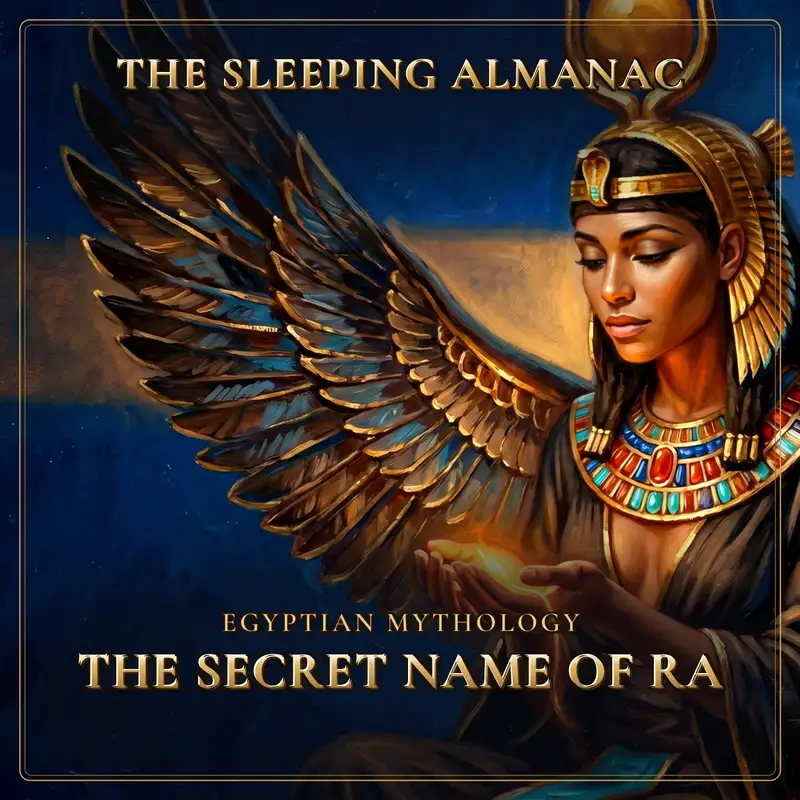
Welcome to The Sleeping Almanac.
Tonight, the oldest and most powerful being in the world is going to be undone by a single word.
Not by a sword.
Not by an army.
By a word.
A name, a secret name, that he had kept hidden inside himself since before the first morning
and that one patient goddess wanted more than anything else in all of creation.
So settle in, and let the day fall away from you.
You do not need to keep hold of anything now.
The Egyptians believed that to know the true name of a thing was to hold its very heart in your hand
and that the greatest power in the world was not strength but knowledge, quietly gathered, patiently kept.
That is the kind of story this is.
A slow one.
A clever one.
A story that moves at the pace of someone waiting, without hurry, for exactly the right moment.
We will draw it tonight from a very old papyrus kept now in the city of Turin, written down more than three thousand years ago.
The Egyptians treasured this story so deeply that they used its words as a healing charm, a spell murmured over the sick to draw out poison and pain.
So even in its own time, this was a tale told softly at bedsides, in low voices, to bring relief and rest.
We will tell it the same way.
Sit with that for a breath, because it is a strange and lovely thing.
The very tale we are about to tell was not only meant to be enjoyed.
It was meant to work.
When someone was stung by a scorpion in the warm dark, or bitten by a serpent in the reeds at the edge of a field
the Egyptians would call for one who knew the old words, and that person would speak this very story over the sufferer
the story of how Isis drew the fire out of the greatest of the gods.
They believed that to tell of a healing, in the right way, with the right words, was to call that same healing down again into the room.
Sometimes they would write the words upon a strip of papyrus, and steep that strip in water, and give the water to the sick one to drink
so that the story itself went down into the body and did its quiet work from the inside.
So this story has been used to comfort the frightened and to ease the suffering for thousands of years.
It is one of the oldest medicines there is.
And tonight it is being used, gently, for you.
We should say a little, too, about why a story of a god being bitten could ever be thought to heal a bite, because the Egyptians had a reason, and it is a tender one.
They believed that what happened to the gods in the beginning was the pattern for everything that happened afterward.
If the greatest of all beings had once felt that same burning fire in his veins, and had been brought low by it
and had been healed in the end by the wise hands of Isis, then the small sufferer lying in the dark was not alone.
The same trouble had come even to the sun, and the same relief had followed it.
To tell the story was to lay the sufferer's small pain alongside the oldest pain there was, and to promise, in the telling
that this pain too would pass the way that one had passed.
There is a deep kindness in that, in being reminded that your trouble is an old one, and a known one, and one that has been eased before.
It is the story of how the goddess Isis became the greatest magician in the world.
And it begins long after the world was made, in the age when the gods still ruled upon the earth and the sun had grown old, long after the first morning
in a time when the river had already risen and fallen a thousand thousand times.
There is a line we carry with us through this whole season, from an old Egyptian teacher named Ptahhotep, and it belongs to this night more than to almost any other.
He said that good speech is more hidden than the green stone, and yet it may be found among the maidservants at the grindstones.
He meant that the truest and most powerful things are quiet, and easy to overlook, and waiting in plain and humble places for whoever is patient enough to look.
The Egyptians had a word for that deep rightness, that hidden order beneath the world.
They called it ma'at, and they believed it rewarded patience above all things.
Tonight is a story about exactly that, a story in which the greatest power in all of creation is reached not by force, but by a quiet watching
and a long waiting, by one who knew where to look.
Keep that thought nearby as you drift.
It is worth holding the green stone in your mind for a moment, because the image meant a great deal to them.
The Egyptians prized it, that deep stone the colour of new leaves and river weed, and they did not find it lying loose upon the ground.
It was hidden, dug from far places, carried a long way, set into the collars of kings.
To say that good speech was more hidden than the green stone was to say that wisdom is rarer and more precious than even that.
And then, in the same breath, the old teacher said the strangest and gentlest thing.
He said it might be found among the maidservants at the grindstones, among the humblest workers doing the plainest task there was
grinding the grain into flour in the cool of the morning.
The most precious thing in the world, he said, hidden in the lowliest of places.
That is the shape of tonight's story exactly.
The greatest power that ever was, hidden, and then found, not in a palace or a treasury, but in the dust of an empty road
by one who knew that the deepest things lie low.
You do not have to hurry toward sleep, any more than Isis hurried toward her hour.
You can simply let it come, the way she let her moment come, in its own time, unforced, sure to arrive.
Let your eyes close.
Let the breath slow.
And let us go back to that ancient age.
Chapter One.
The Age When the Gods Walked the Earth.
There was a time, the Egyptians said, before there were any pharaohs of flesh and blood, when the gods themselves ruled upon the earth.
In that first age, the world was younger and closer to its making.
The gods did not dwell only in the high sky or the hidden underworld.
They walked the green banks of the river.
They sat in halls of stone and gold.
They governed the land as kings govern it, and the first and greatest king of all was Ra himself, the sun
the one who had made the world and now ruled the thing he had made.
The Egyptians held that age in their imaginations the way we sometimes hold the idea of a long ago golden time, when things were simpler and closer to their source.
It was the time before the line of mortal kings, before the long roll of dynasties carved on the temple walls
before any pharaoh of flesh and blood had ever worn the double crown.
In that older time, the rulers were the gods, and the histories the priests kept reached back through them, name after divine name
to the very first king of all, who was the sun.
So when an Egyptian thought of how far back the world went, he did not stop at the pyramids, or at the first stones, or even at the first human kings.
He went on back, past all of that, into the bright morning of the world, when the gods still walked the earth and the sun himself sat upon the throne.
That is where we are tonight.
As far back as their imagining could reach.
It was a good age, in its way.
The river rose and fell in its seasons.
The grain grew.
The people, who had come from the tears of the creator, lived their small lives beneath the rule of the shining king.
And Ra crossed the sky each day in his boat, as he had since the first morning, and came down each evening, and rose again each dawn
and the great round of the days turned on, faithful and unbroken.
That daily crossing was the steady heartbeat under everything, and it is worth resting on, because it is the thing the whole story leans against.
Each morning the sun god put out from the eastern edge of the world in his bright boat, and climbed the long blue river of the sky
and stood at the height of it at noon, and then came down all the slow afternoon toward the west
where the light turned gold and then red and the great vessel slipped below the rim of the world.
And then, in the dark, by the hidden road beneath the earth, he made his way back to the east to begin again.
He had done this since the first day.
He would do it, the Egyptians believed, for millions of years more.
It was the most regular thing in all of creation, the most faithful, the one motion you could set your whole life beside and trust.
So when we say that even this began, very slowly, to falter, you will feel how large a thing that was.
The thing that never changed was beginning, just slightly, to change.
The Egyptians measured their days by that crossing, and their years by the rising and falling of the river
and they built a whole calm way of living upon the certainty of both.
They were not, on the whole, an anxious people, and this was a great part of why.
They lived inside rhythms they could trust.
The sun would cross.
The river would rise.
The grain would come.
A people who live among such faithful cycles do not lie awake fearing that tomorrow will be a stranger, and the Egyptians did not.
They slept easily beneath the turning of a sky that had never once failed them.
And it is that same trust we are reaching for tonight, the deep ease of knowing that the great wheel turns whether or not you keep watch over it
that the morning is coming on its own, carried by something older and surer than your own effort.
Try to picture that world for a moment, because it is a gentle one to rest inside.
The same long green valley the Egyptians knew, pressed thin between two deserts, but younger then, and closer to the time of its making.
The river ran broad and slow and warm.
Palms leaned over the water.
The reeds bent in the evening wind, and the herons stood in the shallows as still as carved stone.
And through that country, in the old tellings, the gods themselves moved as kings move, in cool halls of stone and gold, their voices low
their footsteps unhurried, the bright air following the sun wherever he walked.
It was not a frightening age.
It was a slow, sunlit, settled one, the way a long afternoon is settled, when the heat has softened and there is nowhere in particular you have to be.
And under everything, holding everything up, was the simple fact of the sun.
The Egyptians did not have to be told to trust him.
They had watched him rise over the eastern hills every morning of their lives, and set behind the western desert every evening, and come round again without fail.
To them the rule of Ra was not a story about a distant throne.
It was the warmth on the back of the neck at noon.
It was the gold light lying long across the fields at the close of day.
It was the most dependable thing there was, so dependable that no one thought to wonder, in those years, whether it might ever change.
But change comes to all things, even to the brightest of them, and it was coming, very slowly, even to the sun.
But here is the thing the Egyptians understood, and built this whole story upon.
Even the sun grows old.
Not quickly.
The gods do not age the way we age, in a handful of brief years.
But across the long ages of that first world, something in Ra was changing.
The fierce young fire of the first sunrise had softened.
The king who had once blazed at the top of the noon sky now sat more often upon his throne, and rose more slowly from it, and felt
for the first time since the beginning, the weight of all the years he had carried.
He had made everything.
He had ruled everything.
And he was, very gently, beginning to tire.
The Egyptians were not frightened by this idea, and we should not be either.
They watched the sun grow old every single day.
They watched it climb strong in the morning and stand fierce at noon and then sink, in the afternoon, red and swollen and weary, toward the western hills.
They had a word for that evening sun.
They called it Atum, the old one, the complete one.
And they understood that age was simply part of the great round, part of the turning
no more to be feared than the coming of evening at the end of a long and well spent day.
And there was another picture of the aging god that the old texts gave, and it is a strange and beautiful one
and it tells you how the Egyptians imagined the body of the sun.
They said that the flesh of Ra was made of pure gold, and his bones of silver, and his hair of true lapis lazuli
that deep blue stone shot through with flecks of gold like a night sky full of stars.
He was not flesh as we are flesh.
He was a being made of the most precious things there were, gold and silver and the blue stone that the Egyptians loved above almost any other.
Picture that for a moment, in the long gold light of the afternoon.
A king whose very body shone with gold and silver and deep starry blue, seated upon his throne, grown old now
the precious frame of him heavy with all the years it had carried.
But gold can grow soft, and silver can grow dull, and even a body made of the rarest things on earth can come, in the end, to feel the weight of its own long life.
That image of the precious body matters, and it is worth holding gently, because it is part of what the whole story turns upon.
A god made of gold and silver and lapis is a god who is very nearly beyond all reach, beyond all harm, the most guarded and most perfect thing imaginable.
Nothing in the world could mark such a body.
No blade could cut the gold.
No fire could touch the silver.
And yet, the Egyptians knew, the most guarded thing of all has its one quiet weakness
and it is not in the gold or the silver but in something hidden far deeper, in a name folded away inside, at the very centre
where no precious metal can protect it.
The body could not be reached.
But the name, perhaps, could.
Keep that thought somewhere soft as you drift, the picture of the golden king and the one unguarded thing inside him.
So picture that ancient king now, in the late afternoon of his long reign.
The most powerful being that had ever existed.
The maker of the sky and the earth.
The one whose light gives life to everything that lives.
And yet, an old one too, seated on his golden throne as the day grows long, his great eyes growing heavy, the world he made turning quietly on around him.
There is a deep calm in that picture, the calm of something vast and old at rest.
Let it settle over you as the story begins.
Chapter Two.
The God Who Had Grown Old.
The Egyptians told, very plainly and without any cruelty, how age had come upon the sun.
They said that Ra, in his great old age, had begun to nod upon his throne.
That his head would sink, and his eyes would close, and he would drift, the way the very old drift, into a shallow doze in the warmth of the afternoon.
And they said, with that strange tender honesty the Egyptians had about the body, that the old king's mouth would fall open as he dozed, and that he would drool
that a thread of his spittle would slip from his lips and fall, unnoticed, down to the earth below.
We should not laugh at the old god for this, and the Egyptians did not.
There is something gentle and human in it, even though he was the greatest of all beings.
The mightiest power in the world, grown so old that he dozed in the sun and did not notice the world slipping a little out of his grip.
It is the most ordinary kind of frailty, and the Egyptians, who saw their own grandparents nod in the doorways in the warm evenings, knew it well and told it kindly.
It tells you something good about these people, that they could imagine the greatest of their gods this way and feel no need to look away.
Other peoples have wanted their highest gods to be untouchable, perfect, beyond the reach of any weakness, ageless and unchanging on their high thrones.
The Egyptians wanted that too, in a way, but they were too honest, and too tender about the body, to pretend that age and tiredness were shameful things.
They had watched their own beloved elders grow slow and forgetful in the warm years at the ends of their lives
nodding in the doorways while the children played, and they had not loved them any less for it.
They had loved them more, perhaps, for the softness that age brings
for the way the fierce and busy years finally loosen their grip and let a person simply sit in the sun.
And so they could let even the sun god grow old like that, and doze like that, and they told it not as a fall but as a truth, the kind of truth you tell gently
at a bedside, in a low voice.
You may know that kind of doze yourself, the one that is creeping over you now.
It is the doze of the warm afternoon, when the light is heavy and the body is heavy and the eyes ask only to be allowed to close.
The head sinks a little.
The breath grows slow and even.
The day, which felt so urgent an hour ago, loosens its hold and drifts away, and you are not quite asleep and not quite awake, only resting, only letting go.
That was the state the old king had come to, the Egyptians said, in the late years of his long reign.
Not asleep.
Only resting, in the warmth, with the world turning quietly on around him and nothing in it, he thought, that needed his attention any longer.
And there is no harshness in the way the story tells it.
The Egyptians did not mock the body, not even the body of a god, because they loved the body and meant to carry it with them even into the afterlife.
They spoke of the old king's drowsing the way you might speak of a beloved elder asleep in his chair by the window, the light on his face, his hands at rest.
There is a tenderness in being watched over while you sleep, in having someone notice the small things you let fall without knowing you let them fall.
The old king was watched over, that afternoon.
He simply did not yet understand by whom, or why.
But here is what mattered about that falling spittle.
It was the spittle of a god.
And not just any god, but the god who had made the world out of his own body at the very beginning.
We remember that, from the first night of this season.
Ra, who was Atum, had brought forth the first gods from his own breath and his own moisture.
His body was not like other bodies.
Whatever came from it carried something of his making power, some spark of the force that had shaped the world.
So when a drop of the old sun's spittle fell to the earth and mingled with the dust, it was not a worthless thing.
It was a piece of the creator, fallen and lying in the dirt, full of a power that even the old king had half forgotten he possessed.
This is one of the deep ideas the Egyptians built their whole world upon, and it is worth saying slowly, because the rest of the story rests on it.
They believed that a thing which came from a god carried the god's own power inside it.
A word the creator spoke, a tear he wept, a breath he breathed, a drop of moisture that fell from him, each of these was not empty.
Each carried a living spark of the force that had made everything.
We saw this on the first night of the season, when Atum wept for joy at the return of his lost children, and where each tear struck the new earth a human being rose up.
People themselves came from the moisture of a god.
So a falling drop of the old sun's spittle was no small thing at all.
It was the same kind of stuff that the world had been made from, the same creative moisture, fallen now and lying unguarded in the dust of the road
still warm with the power that had shaped the sky.
And here is the quiet weakness in the old king's greatness, the thing his age had blinded him to.
He had made the world out of his own body, and so his own body was the one thing in all creation that held a power equal to his own.
No enemy could be stronger than the maker of all things.
But the maker's own fallen strength, gathered up and turned with knowledge and patience, that could reach him, because it was made of the very same stuff he was.
The Egyptians understood this with a kind of awe.
The only thing that could ever touch the greatest of the gods was a piece of himself.
And he had let a piece of himself fall, unnoticed, into the dust, because he had grown old, and careless, and certain that nothing in the world could ever reach him.
He was right about the world.
He had simply forgotten about himself.
And there was one in that ancient court who noticed.
There was one who watched the old god closely, who missed nothing, who understood exactly what that falling drop might be worth.
She was patient, and she was wise, and she had a hunger in her that none of the other gods quite shared.
Her name was Isis.
For now, though, let the old king doze.
Let the warm afternoon hold him.
The world is quiet, and the sun is at rest upon his throne, and nothing has happened yet.
Rest there with him a while, in the long gold light of that ancient age, before anything begins to turn.
Chapter Three.
Isis, the Great of Magic.
Of all the gods who walked the earth in that first age, the Egyptians loved none more deeply than Isis.
Her name in their own tongue was Aset, and the Greeks who came long after called her Isis, and it is by that name that the world has known her ever since.
She was a granddaughter of the sun, one of the great family that we will follow all through this season, and she would become, in time
the most beloved goddess in all of Egypt, and then in all of the ancient world, worshipped far beyond the banks of the Nile
in lands that had never seen the river at all.
But that is a later story.
Tonight she is younger, and watchful, and reaching for something she does not yet have.
What Isis loved, more than anything, was knowledge.
The deep kind.
The hidden kind.
The Egyptians had a word for the power that flows through words and names and the true understanding of things.
They called it heka, and we might call it magic, though it was not trickery to them.
It was something closer to the deep craft of the world, the force that the gods themselves had used to shape and order all things.
And Isis was its greatest student.
They gave her a title for it.
They called her Weret Hekau, the Great of Magic, the one whose knowledge ran deeper than any other's.
We should rest a little on that word, heka, because it is the secret engine of this whole story
and the Egyptians thought about it more deeply than almost any other thing.
It was not magic the way we sometimes mean magic, all wands and tricks and pretending.
To them, heka was a real force in the world, as real as wind or water, perhaps the oldest force of all.
It was the power that turns a thought into a thing and a word into a deed.
It was what had been at work when the first god spoke and the spoken thing came into being.
It was older than the gods themselves, present from the very first morning, the energy of creation, the force that makes things happen.
And because words and names were the channels through which it flowed, the Egyptians believed that one who truly understood words
and knew the real names of things, could take hold of a little of that creative power and turn it.
To know was to be able to do.
Knowledge was not a quiet thing you kept in your head.
Knowledge was power that could reach out and change the world.
So when they called Isis the Great of Magic, the Great of Heka, they were not calling her a clever trickster.
They were saying that she, among all the younger gods, had drawn nearest to the deep creative force that had made everything.
She understood words more truly than anyone.
She knew the names of things, and the right way to speak them, and the way the spoken word reaches down into the heart of what it names.
That was her greatness.
Not strength of arm, but depth of understanding, and the quiet power that comes with it.
And the Egyptians loved her for it, because it was the gentlest kind of greatness, the kind that, more than any other, was used in the end to heal.
Think for a moment about what kind of greatness that is, because it is not the kind we usually picture.
It is not the greatness of the strong arm or the loud voice or the high throne.
It is the quiet greatness of the one who pays attention.
Isis was not the mightiest of the gods.
She could not have stood against Ra in his strength, and she knew it, and she never tried.
What she had instead was a patience that never tired, and a watchfulness that missed nothing
and a long slow gathering of understanding that she had been building, year upon year, the way a careful hand builds a wall, one stone at a time.
She was the kind of presence who sat at the edge of every gathering and listened more than she spoke, who remembered what others forgot
who noticed the thing in the corner of the room that no one else had thought worth noticing.
That is a restful kind of power to think about, here in the dark.
There is no violence in it.
There is no grasping.
There is only attention, given slowly and given fully, until at last the patient one understands a thing more deeply than anyone else alive.
The Egyptians admired that in Isis, and they loved her for it
and they trusted her with their own hopes and their own griefs more than they trusted almost any other god, precisely because her power was the gentle kind.
The kind that watches.
The kind that waits.
The kind that, in the end, is used to heal.
And it was a healing power above all, which is the thing to hold onto when the story grows tense later on.
When an Egyptian child burned with fever in the night, or a scorpion stung in the dark, or a serpent struck in the long grass at the edge of a field
it was Isis they called upon.
It was her name they spoke over the sufferer.
The very spells the healers murmured to draw out poison were addressed to her, the Great of Magic
the one whose knowledge could reach the trouble that strength could not.
Mothers wore her image at their throats to guard their children.
The sick reached for her in their worst hours.
Of all the great gods, she was the one who felt nearest to ordinary people, because the power she carried was the power that mended things
and there is no power a frightened person loves more than that.
The same patient watcher who, in tonight's story, sets a quiet trap for the king of the gods is the same gentle one who
in a thousand sickrooms across three thousand years, was begged for and trusted and thanked.
The watching and the healing were never two different things.
They were the same deep knowing, turned now one way and now another.
It is worth knowing, too, that the world came to love her as the Egyptians did, far beyond the banks of her own river.
In the long ages after, when Egypt itself had passed into the keeping of others, the worship of Isis spread out across the whole of the ancient world
carried by sailors and merchants and soldiers, until there were temples to her in lands that had never seen the Nile
from the islands of the Greeks to the cold edges of the northern empire.
People who had never heard her older name, Aset, knelt to her as Isis and asked her for the same things the Egyptians had asked, for healing, for protection
for the safe keeping of their children and their dead.
She became, for a long stretch of the world's history, one of the most beloved and most far travelled goddesses there ever was.
But all of that grew, in the end, from the quiet thing we are watching tonight, from a patient goddess who knew the worth of a fallen drop of moisture
and who understood, better than anyone alive, the power that sleeps inside a name.
But there was one thing she did not yet know, and it was the greatest thing of all.
She did not know the secret name of Ra.
And she had come to understand that whoever knew that name would share in the very power that held up the world.
We should be honest, the way the Egyptians were honest, about what Isis wanted.
She wanted power.
The old texts do not pretend otherwise.
She looked at the aging king upon his throne and she thought that the rule of the world should not pass into the hands of the forgetful and the weary
and she wished to secure a place for herself, and for the children who would one day come from her line.
Her motives were not simple.
They rarely are, in the oldest and truest stories.
But there was no cruelty in her.
She did not wish to destroy the old king.
She wished only to know what he knew, to hold what he held, to carry forward the power of the sun into a new and younger age.
And so she watched, and she waited, and she made her quiet plans, the way the patient and the wise always do.
She did not strike.
She did not demand.
She simply paid attention, more closely than anyone else, to an old god dozing in the afternoon sun, and to a thread of spittle falling, unnoticed, to the dust below.
Let her watch a while longer.
There is no hurry in her at all.
And there is no hurry in us either, lying here in the quiet, as the long patient plan begins, very slowly, to take its shape.
Chapter Four.
The Secret Name.
To understand what Isis was reaching for, we have to understand what the Egyptians believed about names
because it was one of the deepest things they believed about anything.
To the Egyptian mind, a name was not just a label.
A name was part of the thing it named.
To know a thing's true name was to know its real nature, to hold a piece of its very being, to have, in some quiet way, power over it.
This is why the Egyptians were so careful with names.
They wrote the names of those they loved upon the walls of tombs so that those names would endure and the dead would go on living.
And they sometimes struck the names of the hated from the stone, scratching them out, because to erase a name was to erase the thing itself.
A name was a handle on the soul.
It went deeper even than that, and it is worth understanding how deep, because it is one of the most beautiful things the Egyptians believed about what a person is.
They thought that a being was not a single simple thing but was made of several parts woven together.
There was the body, of course, the flesh you could see and touch.
But there was also the ka, the life force, the vital double that was born with you and lived on after you.
There was the ba, something close to what we might call the soul or the personality, often pictured as a bird with a human face, free to come and go.
And there was the ren, the name, the true name, which they counted as a real part of a person's being, as real as the body or the soul.
Your name was not a label stuck on the outside of you.
It was a piece of you, one of the things you were made of, and it carried your existence inside it.
As long as your name endured, the Egyptians believed, you endured.
To lose your name was to lose a part of your very self.
That is why a tomb, to the Egyptians, was so deeply concerned with names.
Walk in your imagination into one of those quiet painted rooms, far back in the rock, and you will see the same name written again and again, on the walls
on the coffin, on the offering stones, carved deep so that it would last.
It was not vanity.
It was survival.
As long as the name remained, cut into the stone where someone might one day read it, the dead person had a thread back into being
a place to which the soul could return, a part of the self that had not been allowed to vanish.
To say a dead person's name aloud was to give them a small breath of life, to call a little of them back into the world.
The Egyptians had a saying close to this, that to speak the name of the dead is to make them live again.
So the keeping of names was an act of love, the most patient and the most lasting love there was
reaching across the years to hold a person in being long after their body was gone.
And the other side of that belief was a terrible one, and the Egyptians used it deliberately.
If keeping a name kept a person alive, then destroying a name could destroy them.
To take a chisel to the stone and scratch out an enemy's name, to leave a rough blank where the careful signs had been, was not mere defacement.
It was an attack upon the person's very being, a way of unmaking them, of cutting away one of the things they were made of so that they might be lost forever
even in the world beyond.
Pharaohs did this to the memory of those they wished erased from history.
They struck the names from the monuments and left the blanks behind.
So a name could be a shelter that held a soul in being, or a name could be taken away as the deepest of all woundings.
Now you understand, a little, what it truly meant that the greatest of the gods kept one name hidden inside himself
and what it would mean for that name to pass into another's keeping.
Sit with that belief a moment, because it is a beautiful one, and it has a kind of weight to it that is easy to feel even now.
Imagine a craftsman in a quiet tomb, far back in the dark, the lamp burning low beside him, carving the name of a dead man into the wall with slow and careful strokes.
He is not only marking who lies there.
In his mind he is keeping that man alive.
As long as the name stands cut in the stone, and as long as someone, someday, might read it aloud, the man is not truly gone.
To say a name, the Egyptians believed, was to call a little of the thing back into being.
To know a name was to reach the very center of it.
There was nothing more intimate, and nothing more powerful, than the true name of a thing.
So when we say that Isis wanted the secret name of the sun, understand that she did not want a word the way you might want to learn a fact.
She wanted the deepest possible nearness to the deepest possible power.
She wanted to hold the very heart of the one who had made the world.
To the Egyptians, that was the highest thing anyone could reach for, and the most hidden, and the most carefully guarded.
It was no small hunger.
But it was a quiet one, and a patient one
and that was exactly what made it so dangerous to a king who had grown old and careless and certain that nothing in the world could ever reach him.
And every being, the Egyptians believed, had more than one name.
There were the names you went by, the names everyone knew, the names called out across the courtyard and carved upon the door.
But beneath those, hidden deep, there might be another name.
A true name.
A secret name, known to no one, holding the real and inmost nature of a thing.
And the secret name of the greatest of the gods would hold the greatest power there was.
Ra had such a name.
The Egyptians said it had been hidden inside his body at the very moment of his birth, placed deep within him where no one could reach it
so that no other god could ever gain mastery over him.
He had many names that the world knew.
He was Khepri in the morning, the scarab rolling up the new sun.
He was Ra at the height of the day.
He was Atum in the evening, the old one going down.
He was called the maker of heaven, the maker of the earth, the maker of the waters, the bull of his mother, the lord of years, and a hundred titles more.
He wore his names like a great robe of many folds.
But beneath all of them, hidden at the very center, was the one name he had told to no one.
The name that was his power.
The name that was, in a sense, himself.
Think of what it meant that he had hidden it inside his own body at his birth.
He had taken the most powerful thing about himself, the truest part of his being, the name that was the seat of all his rule
and he had folded it away in the one place he believed nothing could ever reach, deep within his own flesh, in the very centre of himself.
It was the safest hiding place imaginable.
No other god knew where it lay.
No word of it had ever been spoken.
It had never once been in danger, in all the long ages since the beginning, because no one had ever even come near it.
And so the old king had stopped thinking about it at all.
You do not stand guard over a thing that has never been threatened.
You forget, after a while, that you are even holding it.
That was the state the king had come to.
The deepest secret in all the world lay hidden inside him, and he no longer gave it a single thought, because in all of time, nothing had ever come close.
And the Egyptians understood that the way to reach such a hidden centre was never force.
You cannot break your way into the true centre of a thing.
You can only be patient enough, and trusted enough, and gentle enough, that it is given to you.
That is the whole secret of the story, and it is a restful one.
The deepest things are not taken.
They are, in the end, surrendered.
That was what Isis wanted.
Not the robe of public names that everyone could see.
The hidden thing at the center.
And she understood something that made the whole patient plan possible.
She understood that even the greatest power can be reached, if you are willing to wait, and to watch, and to be cleverer and more patient than anyone expects.
The old king guarded his name without thinking, the way you guard something you have never once been in danger of losing.
He had no reason to fear.
No one had ever come close.
And that, precisely that, was the opening that Isis had seen.
Let the thought rest gently.
There is something almost soothing in it, the idea that even the mightiest things have a quiet center, a true name folded away inside
and that the way to it is not force but patience.
Breathe slowly.
The plan is taking shape, unhurried as a shadow lengthening across a courtyard floor.
Chapter Five.
The Drop That Fell.
And so we come to the moment Isis had been waiting for, and it was a small and quiet moment, as the great turning points so often are.
One afternoon, as the old king made his slow procession through the world, as he did each day, he grew weary, as he now so often did.
His steps slowed.
His head drooped.
And as he dozed there in the warm gold light, a drop of his spittle slipped from his lips and fell, glistening, down to the earth
and landed in the dust of the road, and lay there, shining faintly, full of the old god's half forgotten making power.
No one else saw it.
No one else would have thought it worth seeing.
But Isis was watching, as she was always watching now, and the moment the drop fell she understood that her long patience had come, at last, to its hour.
She went, quietly, to the place where it had fallen.
She knelt in the dust of the road.
And she gathered up the earth where the spittle lay, the moist clay of it, the dust and the divine moisture mingled together, and she held it in her hands.
In her hands she held a piece of the creator.
A fragment of the very stuff the world had been made from, fallen now and lying in the road, waiting for someone wise enough to know what it was.
There is a quiet rhyme in this that the Egyptians would have heard, and it is worth pausing on.
The world itself, in the oldest tellings, had been shaped this way, from the moisture of a god mingling with the first earth.
Atum had brought forth life from his own breath and his own dampness.
Human beings had risen where the creator's tears fell upon the ground.
And now, here, in the dust of an ordinary road, the same thing was happening again, on a smaller and stranger scale.
Divine moisture, fallen earth, the two mingling, and out of the mingling, in a wise hand, something new about to be made.
Isis was not inventing some unheard of magic.
She was doing again, deliberately and with full understanding, the very thing the creator had done at the beginning without quite knowing his own power.
She had watched, and she had understood, and now she would use the oldest making power there was, turned gently back upon its own source.
And notice that what she gathered was so small, and so humble, and so easy to miss.
It was a handful of damp earth from a road.
Anyone might have walked past it a thousand times.
There was nothing to see, nothing to mark the spot, no glow, no sign, only a patch of dust a little darker than the rest.
The greatest power in the world lay there looking like nothing at all, like the plainest thing there is, mud in a road.
That was exactly the point the Egyptians loved.
The truest and the mightiest things wear humble clothes.
They lie in low and overlooked places.
They are found not by the proud and the hurried, who would never think to look down at the dust beneath their feet, but by the patient and the watchful
by the one who knows that greatness is often disguised as something small.
Isis knew.
She had always known.
And so she knelt where no one else would have thought to kneel, and gathered up what no one else would have thought to gather
and rose with the seed of the whole story warm in her cupped hands.
Let yourself be there with her for a breath, in the warm hush of that afternoon.
The road is empty.
The light lies thick and gold across the dust.
There is no sound but the small sounds of a country at rest, a bird somewhere in the reeds, the far whisper of the river
the wind moving once through the dry grass and then falling still again.
And a goddess kneeling alone in the road, her robe pooled in the dust around her, her head bent low
her hands closing gently around a small patch of damp earth as though it were the most precious thing in the world.
Which, just then, it was.
No one passing would have seen anything but a woman stooped in the road, doing something humble and slow.
No one would have guessed that the rule of the world had begun, very quietly, to change hands.
And notice the smallness of it, because the Egyptians did, and they loved the story for it.
The greatest power in all of creation did not change hands in a great hall, before a crowd, with trumpets and thrones and the gathering of armies.
It began in the dust, in an empty road, in the warmth of an ordinary afternoon, with a single drop of moisture and a single pair of patient hands.
The largest things, the Egyptians knew, often begin in the smallest and most overlooked of places.
The ones no one is watching.
The ones that look like nothing at all.
The Egyptians, telling this, would have felt the quiet thrill of it.
The greatest power in the world, lying unguarded in the dust, because its owner had grown old and careless and did not notice what he let fall.
And the one person clever enough to see it, kneeling in the road, gathering it up in her two hands.
There was no theft in it, not exactly.
She took only what had been let go.
She took only what had fallen and been left behind.
But in that fallen drop was the thread that would lead, in the end, all the way to the secret name.
I want you to notice how gentle this is, as a turning point.
There is no violence here.
No breaking in.
No battle at the gates.
There is only an old god dozing, and a drop of spittle falling, and a wise woman kneeling in the road to gather up the dust.
The greatest things, the Egyptians knew, often turn on the smallest and quietest of moments, the ones that no one else even notices.
Ptahhotep, the old teacher whose wisdom we carry through this season, understood that.
The truest things, he said, are more hidden than the green stone, found in plain and humble places, by those patient enough to look.
Isis was looking.
And in the dust of the road, she had found her beginning.
Let her kneel there in the long light, the clay warm in her hands, the old king dozing far above.
Nothing is rushed.
Nothing is forced.
The plan moves at the pace of patience itself.
And you, too, can let go now, and sink, and rest, while the wise goddess gathers up the dust and rises, slowly, to begin her work.
Chapter Six.
The Shaping of the Serpent.
Isis carried the handful of clay to a quiet place, and there, alone, she began to work.
She was the Great of Magic, and her hands knew the old craft.
She took the moist earth, the dust of the road mingled with the fallen moisture of the god, and she began to shape it, slowly, patiently
the way a potter shapes the clay upon the wheel.
And the thing she shaped was a serpent.
A small, slender, sacred serpent, formed out of the very stuff of the creator
given its long curving body and its fine narrow head by the careful hands of the wisest of the goddesses.
There is something quieting in the picture of those working hands, and you might let it slow your own breathing as you watch.
The clay is cool and soft between her fingers.
She presses it, and smooths it, and draws it long, the way the river potters drew their cups and their jars along the banks of the Nile, working without haste
working by feel.
The light shifts.
The hours pass and she does not hurry them.
A maker at her work is a peaceful thing to be near, even when the thing being made will one day matter a great deal.
There is only the soft clay, and the steady hands, and the slow taking shape of something where before there was nothing at all.
And remember, as she works, that she is not building a weapon in the way you might think of a weapon.
The serpent she shapes is small, no longer than a hand, no fiercer to look at than the little snakes that slipped through the warm grass of every Egyptian field.
It is not a monster.
It is a quiet thing, a made thing, holding inside it only a sleeping piece of the old king's own power, waiting to be woken.
The Egyptians did not picture this moment as terrible.
They pictured it as careful, and patient, and strangely gentle, the deep craft of the world being turned, in the soft afternoon light
toward an end that no one but the maker could yet see.
And it is fitting, in a way that the Egyptians felt deeply, that the made thing should be a serpent, because no creature held so doubled a place in their hearts.
They both feared the serpent and revered it.
They knew its danger well, for Egypt was a land of snakes, and a bite in the field or the doorway could kill a strong man before morning.
The venom of a serpent was one of the most real terrors of their ordinary lives, a sudden fire in the blood that came out of the grass without warning.
And yet they also set the serpent at the very brow of their kings and their gods, the rearing cobra they called the uraeus
poised upon the forehead of the crown, ready to spit fire at any enemy.
The same creature whose bite they dreaded was the guardian they placed closest of all to the sacred head, the protector of the sun god himself.
To them the serpent was both the deadliest danger and the fiercest defender, poison and guardian woven into one coiled shape.
So when Isis shaped a serpent out of the fallen power of the sun, she was reaching for the one creature that already carried, in the Egyptian mind
that whole strange marriage of harm and holiness.
Hold, too, the picture of those hands at their slow and patient work, because it is one of the restful images of the whole night.
The light is low and gold.
The clay is cool.
There is no hurry anywhere in her.
She draws the soft earth out long, and gives it the fine taper of a head, and smooths the curve of its slender body
working by feel the way the potters along the river worked their cups and jars, without haste, content to let the thing take shape in its own time.
A maker absorbed in careful work is one of the most peaceful things there is to be near, and you may let the steadiness of it slow your own breathing.
There is only the soft clay, and the patient hands
and the gradual coming into being of something where a moment ago there was nothing at all but a handful of dust from the road.
And when it was shaped, she spoke over it.
She breathed into it the words of power, the deep words, the heka that she alone among the younger gods truly commanded.
And the clay serpent, made from the spittle of Ra, woke.
It stirred in her hands.
It was alive, in the strange way that the made things of magic are alive, and it carried within it a piece of the old god's own power, so that even Ra himself
who had made all things, would not be able to simply command it away.
He could not undo it, because it was made partly of him.
This was the cleverness at the very root of her plan, and it is worth resting on, because it is so quiet and so complete.
The old king ruled all things by his word.
He could command any creature in the world to be still, and it would be still, because he had made it and held power over it.
But he could hold no power over his own fallen strength.
A thing made out of himself answered to no one but the one who had shaped it, and that was Isis, not he.
So the serpent she made was the one creature in all of creation that the king of the gods could not command away.
He could order the whole world to obey, and the world would obey, and still the small made thing would not, because it was, in a deep sense
a piece of his own being, turned against the rest of him by a wiser hand.
There was no force anywhere that could undo it.
Only knowledge.
Only the one who held the secret of its making.
And here, the Egyptians knew, was the true shape of heka, the deep craft, working at its highest.
Isis did not overpower the king.
She could not have.
She had no strength to match his, and she never pretended to.
What she did instead was far stranger and far quieter.
She took his own power, the very thing that made him unreachable, and she turned a small portion of it, gently, into the one key that could open him.
The wise do not meet strength with strength.
They find the place where the strong are strong against everyone but themselves, and they wait there.
It is not a frightening thought, told softly in the dark.
It is almost a comforting one.
The mightiest walls in the world have always had one quiet door, and it is patience, not force, that finds it.
Then Isis took the living serpent to the crossing of the roads.
She knew the path the old king walked each day upon his slow procession through the world.
She knew the place where his road met another, the quiet junction he passed every afternoon.
And there, in the dust, she laid the serpent down, coiled and waiting and hidden, in the very place where the sun would pass.
And then, the Egyptians say, she simply withdrew, and waited.
That was all.
She did not lie in ambush with any weapon.
She did not raise her hand against the king.
She set one small made thing in his path, and she stepped back into the shadows, and she let patience do the rest.
The whole of her great design rested now on a single quiet certainty.
The old king would walk his road, as he walked it every day, faithful as the sun itself.
And the thing she had made would be waiting.
We should sit for a moment with the strangeness and the cleverness of it, the way the Egyptians did.
Isis did not match the king's power with greater power.
She had none.
What she had was understanding.
She understood that the old god's own strength, his own fallen spittle, could be turned into the very thing that would reach him
and that nothing in all the world is so well guarded that patience and knowledge cannot find a way.
It is not a frightening thought, told gently like this.
It is almost a restful one.
The wise do not need to be strong.
They need only to understand, and to wait.
So the serpent lies coiled and quiet at the crossing of the roads.
The goddess waits in the shadows.
And the old king, far away, rises from his throne to begin his daily round, knowing nothing of any of it, walking, as he always walks
toward the turning of his long story.
Let the scene rest there, hushed and waiting, and let yourself rest with it, here in the gathering quiet of the night.
Chapter Seven.
The Turning of the Road.
The old king came at his appointed hour, as he always did.
He walked his daily round through the world he had made, his court of gods about him, the warm light moving with him across the land.
He came, in time, to the crossing of the roads, the quiet junction he had passed a thousand times and ten thousand times before, never once thinking of it
because nothing had ever waited for him there.
And as he passed, the small made thing that Isis had laid in the dust stirred, and rose, and touched him
and was gone again into the grass before anyone could see what it had been.
Picture that daily procession, because the Egyptians did, and it is a stately and a soothing thing to hold in the mind.
The sun god did not move alone or in haste.
He went in a great slow company, his court of gods walking with him, the bright air moving where he moved, the light pouring off him onto the land.
It was the most regular journey in all the world, the same path at the same hour, day after day after day, so familiar that no one in the company gave it a thought.
They had walked it ten thousand times.
Nothing had ever happened on it.
The crossing was just a place you passed through, a quiet junction in the warm afternoon, on the way to nowhere in particular.
The very ordinariness of it was the thing.
The greatest turning point in the story came not at some fated hour in some marked place, but on an ordinary walk, at an ordinary crossing, on an ordinary afternoon.
We will pass over the moment of the touch quickly and lightly, the way the Egyptians did, because it is not the heart of the story and there is no need to dwell in it.
The small thing rose, and touched him, and was gone.
That is all.
It happened in an instant, and then it was over, and the serpent was nowhere to be seen, slipped back into the grass like any small snake of the fields.
What matters is not the touch itself but everything that came after it, the slow turning of the whole story toward healing and peace.
So let the moment pass behind us as gently as it passed in the telling, and let us go on, calmly, to the long and tender work of setting things right.
The Egyptians told this moment quickly and quietly, and we will too, because the point of the story is not the touch but everything that comes after it.
What matters is this.
Something of the old king's own power had been turned, gently, back upon himself, and now it moved within him
a strange fire he had never felt before in all the long ages of his life.
He, who had made all things, had never once been hurt by anything, because there had never been anything in the world stronger than he was.
And now there was.
Now there was a small thing made of his own fallen strength, and it had reached him, and for the first time since before the beginning
the maker of the world felt the world turn against him.
He cried out.
The great voice that had sung the morning into being rang out across the land, and the gods of his court came running
and they found their king swaying upon his feet, his light gone strange and pale, a fire he could not name moving through him like cold water through reeds.
He did not understand it.
That was the worst of it, for him.
He had made everything, and known everything, and now here was a thing he did not know, working within his own body
and he could not see where it had come from or what it was.
We will not dwell on his pain, because this is a story for sleep, and because the Egyptians themselves told it as a healing tale, meant to soothe rather than to frighten.
So let us say only that the old king was brought low, gently, the way a great tree is brought to lean by a slow wind, and that he sat down upon the earth
and called for help, and waited, as even the greatest must sometimes wait, for someone wise enough to know what had happened to him.
The light of the world sat down in the dust and grew quiet and afraid.
And far off, in the shadows, the one who had made it all happen watched, and knew that her hour had nearly come.
The old papyrus describes the strange new feeling the way an Egyptian who had been bitten would have known it, a fire that ran cold and hot at once, a trembling
a sweat, a shaking in the limbs, the body turning against itself.
It was the very sensation that a real snakebite brought, the burning that ran through the blood and the chill that came after, and that is no accident
for this story was written to be spoken over exactly such sufferers.
When the healer murmured these words above someone lying ill from a bite, the sick one would hear that even the great sun god had felt this same fire
this same shaking, this same fear, and had been eased of it in the end.
There is comfort in that, more comfort than you might think, to be told that your trouble is an old and a known one, that it has come even to the highest
and that it has always, always passed.
We feel it gently here too.
The fire is in the story, but so is the healing, and the healing is already on its way.
And we feel for him, told this way, rather than fearing for him, which is just as the Egyptians meant us to.
There is no horror in it.
There is only the oldest of softnesses, the great one brought low, the strong one made suddenly weak and uncertain and afraid
sitting down in the dust like anyone and calling for help.
We have all seen it, in those we love, in the failing years.
The strong arm that grows unsteady.
The certain voice that grows small.
It is not a thing to recoil from.
It is a thing to be tender about, and to draw close to, and to meet with gentle hands.
The Egyptians drew close to it.
And the gentlest hands in all the world were already coming toward the old king through the gathering crowd, though he did not yet know whose they were.
It is worth pausing on something tender here, because the Egyptians who first told this would have felt it.
There is a particular kind of frailty in a great one brought low, and it is not a thing to be glad of.
The old king had never once been helpless.
He had made the world, and ruled it, and stood at the center of everything, certain and unshaken, since before there were days to count.
And now he sat in the dust like anyone, frightened of a thing he could not name, calling out for help into the warm afternoon.
The Egyptians, who watched their own elders grow frail and uncertain at the ends of their long lives, knew that softness, and they did not turn from it.
They held it gently.
And so do we, here in the quiet, knowing already that this is a healing story, and that the gentlest of hands is on her way to him.
So let the scene rest soft and far off, the way you might watch something from across a wide field at dusk, too distant to trouble you.
The old king sits down upon the warm earth.
The light around him dims and steadies.
His court draws near, murmuring.
And the long story turns, without any violence in it now, toward the slow relief that is coming.
There is nothing here to keep you awake.
The hard moment has already passed.
What is left is only the waiting, and the healing, and the quiet.
Chapter Eight.
None Could Heal Him.
The gods gathered around their fallen king, and not one of them could help him.
They came from every quarter, the whole great company of the gods, those who knew the craft of healing and those who knew the words of power
and they bent over the old king where he sat, and they tried everything they knew.
But the fire within him had been made by Isis, out of his own fallen strength, and it answered to no one but her.
The other gods spoke their spells, and nothing happened.
They laid their hands upon him, and the strange fire did not cool.
They were the mightiest beings in the world, and they stood there helpless around the mightiest of them all, and could do nothing but watch him suffer and grow afraid.
The Egyptians pictured that gathering with great sympathy, the whole bright company of the gods bending over their stricken king.
There were healers among them, those who knew the binding of wounds and the cooling of fevers.
There were speakers of spells, those who knew the old words that could turn aside a sickness or send a poison back into the ground.
There was strength enough among them to lift mountains, and wisdom enough to have ordered the turning of the stars.
And all of it, gathered there together in one place, could not help him.
One by one they tried, and one by one they stepped back, their faces grave, their hands empty, until at last they only stood about him in a silent ring
the mightiest beings in the world, looking down at their king and not knowing what to do.
There is something in this that the Egyptians understood very well, and that anyone who has ever sat at a sickbed understands.
There are troubles that power cannot touch.
There are hurts that all the strength in the world cannot reach.
The old king had ruled everything, commanded everything, made everything, and none of it was any use to him now.
What he needed was not power.
What he needed was knowledge, the one particular knowledge of what had happened to him and how it might be undone, and that knowledge was held, just then
by only one person in all the world.
This is one of the quiet wisdoms folded into the old story, and the Egyptians left it there on purpose.
They knew, as every people has known, that there is a kind of helplessness that comes even to the mighty, a place past which all their might is simply of no use.
The strong arm cannot lift the fever from a sleeping child.
The loud voice cannot argue away a grief.
The high throne gives no comfort in the long dark hours of an illness.
The old king had all the strength there had ever been, and there he sat, in the dust, surrounded by the most powerful beings in the world
and none of it could ease him by even a little.
Only understanding could.
Only the patient, gathered knowledge of the one who had been watching all along.
That is why the Egyptians honored heka, the deep craft of knowing, above so many showier powers.
It was the power that could actually help.
When their own children burned with fever, when a scorpion stung in the night, when the body failed and the loud world could do nothing
it was the quiet ones they called for, the ones who knew the words and the true names of things, the healers and the keepers of the old knowledge.
Strength could not save you.
Knowledge sometimes could.
And here, in this oldest of stories, even the maker of the world had come to the place where only knowledge would do, and he had to wait
as the smallest and most ordinary of us must sometimes wait, for the wise one to arrive.
For the Egyptians did not draw the line we draw between medicine and magic.
To them the two were one cloth, woven together, and their healers were both physicians and speakers of spells at once.
A true healer in Egypt knew the herbs and the salves and the binding of wounds, the practical craft of the body, gathered and tested across many lifetimes
some of it so sound that it would be recognized as good medicine even now.
But the same healer also knew the words, the incantations, the true names, the heka that reached the part of an illness that no salve could touch.
When a child was stung by a scorpion in the night, the healer might lay a poultice upon the wound, and in the same breath speak a spell over it
and the Egyptians saw no contradiction in this at all.
The hands did one kind of work and the words did another, and both were needed, and both were healing.
This very story was part of that craft, a spell against venom, kept alongside the recipes and the remedies
because to them a story rightly told was as real a medicine as any herb.
And they knew, as anyone who has sat beside a sickbed knows, that there are troubles the strong hand cannot reach.
This is the quiet truth folded into the heart of the chapter, and the Egyptians left it there on purpose, because they had felt it themselves.
All the strength in the world cannot lift a fever from a sleeping child.
The loudest voice cannot argue a poison out of the blood.
Power, the kind that builds and commands and conquers, simply has no purchase on certain kinds of suffering.
What those troubles ask for is not strength but knowledge, the particular quiet knowledge of what has gone wrong and how it may be set right
and that knowledge lives only in the patient ones, the watchers, the keepers of the old craft.
The old king had all the strength there had ever been, and there he sat in the dust, and none of it could ease him by even a little.
He needed the one thing his strength could not buy.
He needed to wait for the wise one, the way the rest of us must.
And at last that person came.
Isis came through the crowd of helpless gods, and she knelt beside the old king, and she looked at him with what seemed to be nothing but tenderness and concern.
She was the Great of Magic.
If anyone could help him, surely it was she.
The other gods drew back to let her near, grateful, hopeful, certain now that the wise one would set things right.
And the old king turned his pale and frightened face toward her, and saw in her, as he thought, his rescue.
He did not know that she had made the serpent.
He did not know that the fire in his veins was her doing.
He saw only the wisest of the healers, come at last to save him, and he reached for her help the way the suffering always reach for the hand that promises relief.
The Egyptians, telling this, would have felt the quiet weight of the moment.
The whole of the old king's fate now rested in the hands of the one who had arranged his fall.
And she knelt beside him, calm and kind, and made ready to name her price.
We should be honest about the strangeness of her position, the way the Egyptians were honest
because it is part of why they found her so true to life rather than simply good or simply wicked.
Isis had caused the very suffering she now came to heal.
The fire she would draw out was the fire she had kindled.
And yet there was no cruelty in her, and the old texts read no cruelty into her.
Her aim had never been to harm the king.
It was only ever to reach the one thing he would not give by any gentler means, the secret name, the deepest knowledge in the world.
She had no wish to see him suffer a moment longer than her purpose required, and the moment she had what she sought, she meant to make him whole.
Her motives were tangled, as the truest motives always are, neither pure mercy nor pure ambition but something woven of both.
The Egyptians did not flinch from that.
They knew that real beings, even divine ones, are seldom simple, and they loved Isis as a real being, complicated and patient and, in the end, kind.
Let it rest there, gently.
There is no horror in it, only the oldest of patterns, the strong brought low and the wise come to their side.
Breathe slow.
The night is deep, and the story is turning, softly, toward its quiet resolution.
Chapter Nine.
The Healer's Price.
Isis looked at the suffering king, and she spoke to him gently, and she told him the truth, or near enough to the truth to serve.
She said that she could drive out the fire that troubled him.
She said that her words of power were strong enough to cool it and send it away, and that he need not suffer any longer than he chose to.
The old king, hearing this, was filled with hope.
But then Isis said the other thing, the thing her whole long patience had been bending toward.
She said that her magic could only work if she spoke it with his true name.
For a spell to reach so deep into a god, she told him, it must be spoken with the god's own real name, the secret one, the name hidden in his body since his birth.
Without it, she said, she could do nothing.
With it, she could make him well.
And here the old king hesitated, even in his suffering, because he understood exactly what was being asked.
His secret name was his power.
To give it away was to give away the very thing that made him master of the world.
He had kept it hidden since the beginning for precisely this reason, so that no one could ever hold it over him.
And now he was being asked to hand it, freely, to one of the younger gods, in exchange for relief from a pain he did not understand.
And notice the deep cleverness of how the price was framed, for it was not framed as a price at all.
Isis did not say, give me your name and I will help you.
She said something far gentler and far harder to refuse.
She said that the spell could only work if it were spoken with his true name, that the healing itself required it
that without the name her words would have nothing to take hold of.
She made the surrender of the secret sound not like a payment but like a simple condition of the cure, a necessary part of the medicine.
That was the heart of her craft.
She did not demand.
She did not threaten.
She only described, calmly and kindly, what the healing would require, and let the requirement do its slow work upon a frightened and suffering king.
There is no way to argue with a condition.
You can refuse a demand.
But how do you refuse the one thing the cure cannot be made without?
She had built the trap so gently that it did not look like a trap at all.
It looked like help.
And there was a truth folded inside the cleverness, which is what made it so hard to resist.
To reach so deeply into a god, to cool a fire that lived in the very centre of his being, a healing word truly would need to reach the centre too
and the name was the centre.
In a sense she was not even lying.
The deepest healing does need the truest name.
She was simply telling him, with perfect calm, a thing that was both her own desire and an honest fact at once, and offering him the choice that it forced.
Hold his power, and keep the fire.
Give up his power, and be made whole.
Laid out so plainly, by the gentlest of voices, it was a choice that could only end one way
though it would take the long patience of the chapters still to come for the old king to arrive there.
Feel, for a moment, how finely balanced that hesitation was, because it is the hinge of the whole long story.
On the one side, the name.
The thing he had guarded since before there was time, the seat of his rule, the last and deepest secret of the most secret being there was.
To give it up was unthinkable.
He had never once even considered it.
On the other side, only the longing to be well again, the simple, bodily longing for the fire to leave him and for the cool quiet of relief to come flooding in behind it.
It does not sound, set that way, like a hard choice for a king.
The name should have weighed far more than the pain.
And for a long while, it did.
But Isis was patient, and patience has a way of shifting the scales.
She did not press him.
She did not threaten.
She only knelt beside him, calm and certain, holding out the one thing he wanted and naming, without urgency, the one price that would buy it.
The Egyptians understood that the patient one rarely needs to force anything.
She only needs to wait, while the longing grows, and the resistance tires, and the balance that seemed so certain begins, by the smallest degrees, to tip.
That is how heka often worked, in their telling.
Not as a sudden blow, but as a slow and quiet pressure, soft as water, that in the end wears down even the hardest of stones.
There is an image the Egyptians would have known in their bones, of how water shapes stone, and it belongs here.
They lived beside a river and among great cliffs of soft pale rock, and they had seen how water, which seems the gentlest and weakest of things
will in the end carve the hardest stone, not by striking it, but by touching it, again and again, patiently, for longer than any blow could last.
The flood did not break the valley open.
It shaped it, slowly, over ages, by being soft and steady and never stopping.
That was the nature of Isis here, and the nature of the deep patience the Egyptians admired above almost all things.
She was the water against the stone.
She did not need to be harder than the old king.
She only needed to be more patient than his resistance, to be there, calm and unhurried
while his longing for relief slowly wore away the certainty that had stood unshaken since before the beginning of the world.
So he tried, first, to give her something else.
He began to tell her his names, all the great names that the world already knew, hoping that one of them would be enough
hoping he could buy his healing without paying the true price.
And this is one of the most beautiful passages in the whole old papyrus, the moment when the maker of the world recites the roll of his own names
and we will give it its own quiet chapter, because it is worth dwelling in.
But know, as we go into it, that Isis was not fooled, and would not be.
She had not waited all this time, and gathered the dust, and shaped the serpent, and set it in the road, to be put off now with the names that everyone already knew.
She listened to the old king's long recital with patience and with kindness, and she waited, as she had waited through everything
for him to understand that there was only one name that would do, and that he would have to give it, in the end, if he wished to be whole again.
There is no cruelty in her here, and the Egyptians did not read it as cruelty.
There is only a great and quiet inevitability, the kind that you cannot fight, the kind it is finally easier to surrender to.
The old king will give up his secret.
He does not know it yet.
But the night is turning toward it, slow and sure, and so are we.
Rest now, while the king begins to speak his names, one after another, into the gathering dark.
Chapter Ten.
The Naming of Names.
The old king began to recite his names, and the recital itself is like a slow and drowsy song, and you may let it carry you down toward sleep.
I am the maker of heaven and earth, he said.
I am the one who knotted together the mountains.
I am the one who made the waters, so that the great flood might come.
I am the one who made the bull for the cow, so that there might be life.
I am the one who made the sky, and hid the two horizons, and set the gods like stars within it.
I am the one who, when he opens his eyes, there is light, and when he closes his eyes, there is darkness.
I am Khepri in the morning, he said, and Ra at the noon of the day, and Atum in the evening.
I am the one whose names the hours of the day are called by.
I am the maker of time, and the lord of years, and the bringer of the flood, and the one from whose body the great river flows.
On and on the old king named himself, the long roll of his titles unspooling into the quiet, each one true, each one mighty
each one a real name that the world knew and honored.
And as he named them, the listeners might have thought that surely this was enough, that surely so many great names must hold all the power there was.
But the fire within him did not cool.
With each name he spoke, the strange heat went on burning, because none of these was the name.
These were the robe, the many bright folds of it, the names that everyone could see.
The thing hidden underneath, the true name, the secret one, he had not yet spoken, and until he spoke it, Isis could not heal him, and would not.
And there is something deeply human in what the old king was doing, the way the Egyptians told it, even though he was the greatest of all beings.
He was trying to give everything except the one thing that was asked.
He poured out name after name, title after title, the whole vast wealth of who he was known to be, hoping that the sheer abundance of it would be enough
that if he only gave generously enough of the names the world already knew, he might keep back the one name that the world did not.
It is the oldest evasion there is, and we all know it.
To offer a great deal of what is easy in order to avoid giving the little that is hard.
The old king offered the maker of heaven and the maker of earth and the lord of years and a hundred mighty titles besides
and not one of them cost him anything he truly minded losing, and that was exactly why not one of them worked.
The fire knew the difference.
The healing knew the difference.
Only the true price would do.
Let the sound of that recital wash over you, because it was made to be heard this way, low and slow and rolling on.
Remember that this was a tale the Egyptians murmured at the bedsides of the sick, in the dim light, in the quiet of the night
and that the long naming of the names was part of the medicine.
There is a comfort in a list of large and steady things, spoken without hurry, one after another after another.
The maker of heaven.
The maker of earth.
The one who knotted the mountains.
The one who made the waters.
The lord of years.
The bringer of the flood.
Each name a great calm stone laid down in the dark, each one true and ancient and sure
the words themselves a kind of slow tide carrying you out and away from the shore of the waking day.
You do not need to hold on to any of them.
That is the gift of a litany like this.
The names roll past and you let them roll, the way you let the slow banks of a river slide by from the deck of a boat, not reaching for any of them
not needing to keep any of them, only drifting, only carried.
The old king names himself a hundred ways into the gathering dark, and the saying of it is heavy and soft and endless
and somewhere in the listening the day lets go of you a little more, and the bed takes a little more of your weight
and the long warm current of the story carries you on toward sleep.
She knelt beside him through the whole long recital, listening, patient, kind.
And when at last the old king fell silent, having named himself a hundred ways and found no relief in any of them, she spoke to him again, very gently.
She said that none of those names had been his true name, and that the fire would not leave him until he gave her the one that would.
She said it without anger and without triumph, the way you might tell a tired child a simple truth they have been resisting.
The name, she said.
The real one.
The hidden one.
Give it to me, and you will be well.
And the old king, weary now, and aching, and longing more than anything for the fire to be gone and for rest to come, came at last to the edge of his long resistance.
He had spent the whole of creation guarding the one name.
And now, in his old age, brought low and tired and frightened, he found that he wanted peace more than he wanted power.
The Egyptians understood that too.
There comes a time, even for the greatest, when rest is worth more than mastery, when you would give almost anything simply to lay the burden down.
The old king had come to that time.
Let him rest there at the edge of it, and rest there with him, as the night deepens and the last resistance softens and begins, quietly, to let go.
Chapter Eleven.
The Name Passes.
And so, at the last, the old king gave up his secret name.
The Egyptians told it with great care and great mystery.
They said that Ra allowed the name to pass out of his body and into the body of Isis.
The hidden thing that had lain at his center since his birth, the true name, the seat of all his power, moved from him into her
the way a flame is passed from one lamp to another, the way a long held breath is finally, gratefully, let go.
He did not speak the name aloud for all to hear, the papyrus is careful about that.
It passed from his heart into hers in secret, so that she alone would hold it, and the two of them would share the deepest knowledge in the world.
It is worth resting on the great care the old text takes here, because it tells you how sacred the moment was to them.
The name is never written down.
It is never spoken aloud in the story for any listener to catch.
The papyrus, which set down so much, would not set down this.
It says only that the name passed from the body of the god into the body of the goddess, hidden, unspoken, in secret, from his heart into hers.
The Egyptians, who believed that to write or say a true name was to hold its power, would not commit this one to the page even in their telling.
They left it as a sealed thing, a mystery kept whole.
And there is a strange beauty in that, in a story that leads you all this way toward a secret and then, at the very threshold, gently closes the door and keeps it.
Some things are too deep to be said.
The story honors that by not saying it.
And the image they chose for the passing of it is the gentlest one imaginable, and you might let it settle over you.
It was not torn from him.
It was not seized.
It passed the way a flame passes from one lamp to the next, where the first lamp is not diminished by the lighting of the second, where the light simply becomes shared.
It passed the way a breath long held is finally let go, with relief, with a kind of release, as though the keeping of the secret had itself been a weight
and the giving of it a setting down.
The old king did not lose his name so much as he ceased, at last, to carry it alone.
From that moment, two beings held the deepest knowledge in the world between them, the old sun and the wise goddess, keepers together of the one true name.
There was no violence anywhere in it.
Only a flame, shared.
Only a breath, released into the quiet.
And the moment the name was hers, Isis spoke her healing.
She was the Great of Magic, and now she held the true name of the sun, and so her words had no limit to their power.
She commanded the fire to leave him, and it left.
She drew the strange heat out of his body and sent it away, and the old king felt it go, felt the cool relief flood in behind it
felt himself made whole again and eased and quiet.
The suffering was over.
The danger had passed.
The light of the world, which had sat down frightened in the dust, rose up again, healed, into the calm of the evening.
Let that relief settle over you too, because it is the kind of relief you can almost feel in your own body.
You know the moment it describes.
The fever that finally breaks in the small hours.
The pain that loosens, all at once, and lets go.
The long held breath you did not know you were holding, released at last into the quiet.
That cool flood of ease, coming in behind the trouble as it leaves, washing through and leaving stillness behind it.
That was what the old king felt as the strange fire went out of him
and it is a feeling the Egyptians knew well and wished upon all the sick they ever sang this story over, and it is a feeling we can wish upon ourselves now
in the dark, as the body softens and the trouble of the day drains slowly away.
And there is a deep peace in how the Egyptians ended it, because nothing was broken and nothing was lost.
The old king was whole again.
The fire was gone.
The name had simply passed from one keeper to another, the way the light itself passes from the day into the gentle hands of the night.
The world had not been overthrown.
The throne had not been seized.
The evening came on as it always came on, gold deepening to red and red to dusk, and the sun, healed and quiet
went down toward his rest as he had gone down every evening since the first one.
Everything turned, in the end, toward calm.
But everything had changed, and the Egyptians knew it, and this is the real heart of the story.
The secret name was no longer his alone.
Isis held it now.
She had become, in that moment, the equal of the sun in the one thing that mattered most, the keeper of the deepest knowledge there was.
She had become truly and forever the Great of Magic, mightiest of all enchanters, the goddess whose power even the other gods would fear and honor ever after.
And here is the thing to carry into sleep, the thing that makes Isis beloved rather than feared.
She did not use the name to destroy the old king.
She did not overthrow him, or unmake the world, or seize the throne by force.
She had wanted the knowledge, and now she had it, and what she did with it, in the long ages after, was to protect.
The Egyptians told that Isis used her great magic above all to shield those she loved, and especially, in a story still ahead of us this season
to guard her own child through terrible danger and to set him safely on his father's throne.
Her power, in the end, was a sheltering power.
The deepest knowledge in the world, gathered by patience and cleverness, was used not to rule but to keep safe.
This is the turn that the whole long patience was bending toward, and it is the gentlest possible ending to so much careful scheming.
Everything Isis had done, the watching, the gathering of the dust, the shaping of the serpent, the long quiet pressure upon the king
all of it had been for this, for the knowledge, and the knowledge, once hers, became a shelter.
She had reached for the greatest power there was, and when she held it, she spent it on guarding rather than ruling.
The Egyptians knew the rest of her story, which they would tell on other nights
of how she would one day hide her small son in the marshes from those who hunted him, and heal him when the scorpions stung him in the dark
and use this very depth of magic to keep him safe until he was grown and could take his place.
The same power that had brought the old sun low became, in her hands, the power that bent low over a sickbed and a cradle.
That was the kind of greatness the Egyptians trusted.
Not the greatness that takes, but the greatness that keeps.
There is a quiet lesson in that, the kind the Egyptians liked to leave at the end of a story.
Knowledge is the truest strength.
Patience reaches what force never can.
And the greatest power of all, in the right hands, becomes not a weapon but a shelter, a thing that guards and heals and keeps.
Let that settle over you now, soft as a blanket drawn up in the dark.
The fire is gone.
The king is at peace.
The wise one holds the secret, and means only to protect.
Chapter Twelve.
Goodnight.
And the Serpent at the Edge of Dawn.
So that is how the goddess Isis became the greatest magician in the world, not by strength, but by patience, and watchfulness, and the deep understanding of names.
It began with an old god dozing in the afternoon sun, and a single drop of spittle falling, unnoticed, to the dust of the road.
It moved through the kneeling of a wise goddess in that dust, and the shaping of a small serpent out of fallen power
and a quiet thing waiting at the crossing of the roads.
It passed through the bringing low of the mightiest king in the world, and the long roll of his hundred names
and the slow surrender of the one name he had guarded since before the beginning.
And it ended in healing, and in peace, and in the deepest knowledge in the world passing into the hands of one who would use it, ever after, to shelter and to guard.
The Egyptians loved this story so much that they made its very words into medicine.
They would speak this tale, or write it out and steep it in water and give the water to the sick to drink
so that the healing Isis worked upon the sun might work, in some small way, upon them too.
So this was always a tale told at the bedside, in the low light, to draw out pain and bring on rest.
We have told it the same way, and now we let it go.
Think, as we let it go, of all the hands this story has passed through to reach you, and the long line of quiet rooms it has been spoken in.
For thousands of years it has been murmured in the dark over the frightened and the suffering, by healers bending close, by mothers over their stung children
by the keepers of the old words at countless bedsides up and down the river.
It was written on papyrus and folded away in temple libraries.
It was steeped in water and drunk down as medicine.
It outlasted the kingdom that first told it, and the language it was first told in, and it came down through all the long centuries since, hand to hand
voice to voice, until tonight it reached this room, and you, lying here in the dark at the end of your own long day.
You are the newest bedside this old healing tale has come to.
It has been bringing rest to the weary for longer than almost anything human beings have made, and now it is bringing rest to you.
And it is fitting that a story whose secret was a name should itself have kept its name so faithfully across the ages, the name of Isis the Great of Magic
the patient one, the wise one, the one who knew that the deepest things are reached not by force but by waiting.
The Egyptians carved her name to keep her in being, and they need not have worried, for the world has spoken it without ceasing ever since.
She is still here, in the telling, the gentlest of all the great powers, the watcher, the healer
the one who bends low over the sick and the small and the frightened and keeps them safe.
Let her keep watch over you a little while now, as the story comes to its rest, the way she kept watch over an old king dozing in the sun, missing nothing
meaning no harm, holding the deep order of things steady in her patient hands.
And think, as you let it go, how gently it has answered the old teacher's words.
Ptahhotep said that good speech is more hidden than the green stone, and yet it may be found among the maidservants at the grindstones.
The truest things are quiet, and humble, and waiting in plain places for the patient to find.
So it was in this story.
The greatest power in all the world was not taken by force or by storm.
It was found in the dust of an empty road, by one who knew how to wait, and how to watch
and how to look in the small and overlooked places where no one else thought to look at all.
That is ma'at, the deep order the Egyptians trusted, the rightness that rewards patience above haste and knowledge above strength.
It does its quiet work whether or not anyone is watching, and in the end it brings, as it brought here, not ruin but healing.
There is no better thought to carry down into sleep than that.
You do not have to be strong tonight.
You do not have to seize anything or master anything or hold the world together by your own effort.
The deep order is keeping itself, patiently, the way it always has, the way it always will.
The wise are watching.
The healing is done.
And all that is asked of you now is to rest, and to let the long calm of the story carry you the rest of the way down.
And out beyond the edge of the dark, as on every night, the old serpent of chaos rises against the boat of the sun
just as he has risen every night since the first night.
But the sun has been healed, and the wise ones keep their watch, and the order of ma'at is stronger than the hunger of the dark.
The serpent is turned away.
The boat sails on.
And on the eastern edge of the world the sky goes pale, and then gold, and the sun comes round again toward morning, whole and shining, exactly as it was promised to be.
You do not have to keep watch for it.
The healing is done.
The fire is gone.
The night is keeping its own slow order, and the morning is already on its way, carried toward you by hands far older and far wiser than yours.
Sleep now.
The king is at peace.
The name is kept safe.
And somewhere out past the edge of the dark, the serpent rises, and is turned away, and the sun comes round again toward morning.
Goodnight.
And the serpent at the edge of dawn.