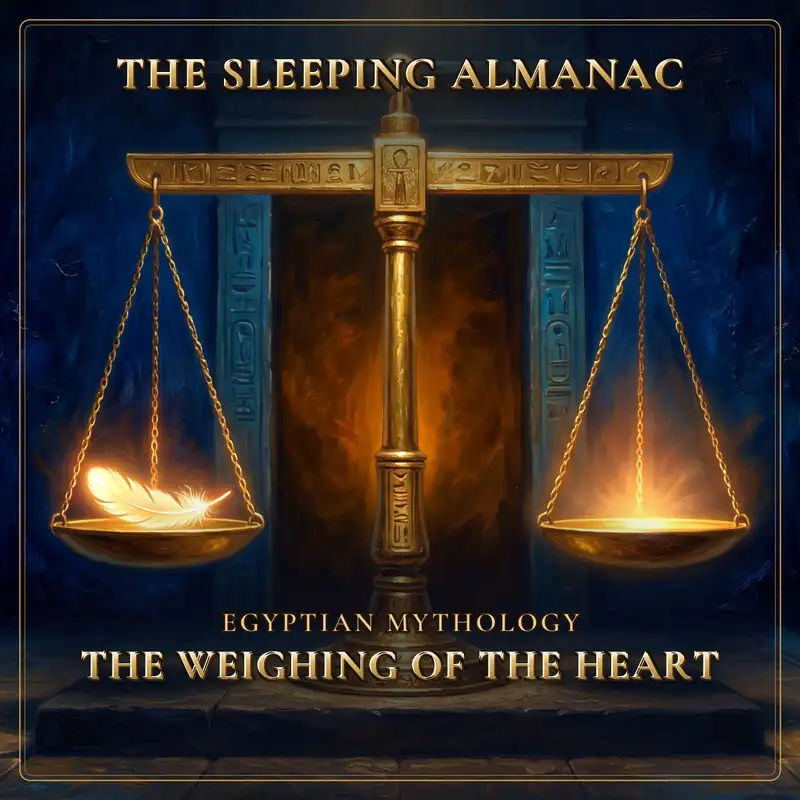
Welcome to The Sleeping Almanac.
Last time, the long contest for the throne ended in peace, and the gentle Osiris took up his quiet reign as the kind king of the country beyond
the lord of the blessed dead.
Tonight we go to that country, into the great calm hall where he waits, and we follow the gentlest journey the Egyptians ever imagined
the journey of a single heart coming home.
For they believed that at the end of every life there was a hall, and a scale, and a soft white feather, and a weighing.
And tonight is the story of that weighing, told the way it was always meant to be told, not as a thing to fear, but as a homecoming.
So let the day set you down.
Let the bed take your weight, and your shoulders, and the last of the day's holding.
Hear this before anything else, and keep it close.
There is a judgment in tonight's story, but it is the kindest judgment ever dreamed, presided over by gentle gods, in a hall full of quiet
where the only thing asked of a heart is that it be light.
We are going to follow a heart that is light, all the way through, into the green country beyond.
There is nothing here to fear.
There is only the deep peace of a soul that has lived gently arriving, at last, exactly where it hoped to be.
We will draw it from the most famous of all the old Egyptian books, the one they wrote to guide a soul safely through the country beyond, the Book of the Dead
and especially from its great scene of the weighing, where the heart is laid upon the scale against the feather of truth.
Where the old book turns toward fear, we will turn, gently, toward comfort, choosing always the telling that serves a calm night.
There is a line we have carried through this whole season, from an old Egyptian teacher named Ptahhotep, who taught that the truest strength is the gentle kind
that good is done not by force but by patience and fair dealing.
Tonight that whole teaching comes home, into a single image, the lightest image there is.
For the Egyptians believed that a life lived gently, a life of small kindnesses and fair dealing and quiet good, makes the heart light, light as a feather
and that a light heart passes the scale and goes home to the green fields.
Everything this season has said comes down to that.
Live gently, and your heart stays light.
Keep it near you as you drift.
It is the soul of the night, and the soul of the whole season.
Let your eyes close.
Let the breath go long and slow.
And let us go gently to the last doorway, and step through it, into the great calm hall where the kind gods wait.
Chapter One.
The Last Doorway.
Every life, the Egyptians believed, ends at a doorway.
And beyond the doorway is a hall.
And tonight we are going, gently, to step through.
Let us approach that doorway without any fear, because the Egyptians, for all that they thought so much about death, did not finally meet it with terror.
They met it with preparation, and with hope, and with an enormous tenderness.
They spent their whole lives getting ready for this one gentle passage, not because they dreaded it, but because they wanted to walk it well
to arrive at the hall calm and ready and unafraid.
They wrote out long, loving books to guide the soul through, full of the right words to say and the kind faces it would meet, so that when the time came
no one would have to make the journey alone or in the dark.
The doorway at the end of life was, to them, not a cliff but a threshold, a quiet passing from one room into another
from the bright loud world into a deep calm hall where gentle ones were waiting.
Rest in that gentleness as we come to the threshold, because there is deep comfort in it.
Imagine death not as the Egyptians' enemy but as their long expected destination, a place they had been packing for, gently, their whole lives
the way you might pack slowly and happily for a journey home to a place you loved.
They were not surprised by the doorway.
They were ready for it.
And so the soul that comes to it in their telling does not come trembling.
It comes the way a traveler comes to the door of home at the end of a long road, tired, and glad, and ready to be welcomed in.
There is nothing here that should trouble your rest.
There is only the soft threshold at the end of all the striving, and a calm hall beyond it, and kind ones waiting to receive you.
Let yourself approach it the way they did, unafraid, even glad, ready to step gently through.
And notice that the soul does not have to find its own way to the hall, for it is guided.
The Egyptians never imagined the dead wandering lost and alone.
They imagined a gentle hand, a kind guide who comes to lead the soul through the doorway and along the quiet way to the hall
so that no part of the journey is made in fear or in solitude.
We will meet that gentle guide in a little while.
For now simply rest in the knowing that the way is not walked alone, that there is a hand to hold and a kind one to lead, all the way through.
There is a deep childlike comfort in that, the comfort of being led by the hand through an unfamiliar place by someone who knows the way and means you nothing but good.
Let that comfort settle over you tonight, the gentle hand, the known way, the soul that is never, for one step, left alone.
Rest, too, in the deep calm that comes from being ready, because it is a calm the Egyptians worked their whole lives to earn and it is yours to borrow tonight.
There is a particular peace that belongs only to the prepared
to the one who has done the quiet work ahead of time and so can meet the great moment without scrambling or dread.
The Egyptians met death that way, ready, their words learned, their hearts tended, their long preparation done
so that when the doorway came they could walk to it unhurried and unafraid, the way you walk to a door you have walked to a thousand times.
There is nothing frantic in a prepared arrival, nothing of the panic of the caught out or the unready.
There is only the deep even calm of one who has done what was needed and can now simply, gently, arrive.
Let that prepared calm be yours as you settle tonight.
You have done enough today.
You are ready for rest.
There is nothing left to scramble for, nothing left undone that cannot wait for morning.
Let yourself come to the threshold of sleep the way the ready soul comes to its doorway, calm, unhurried, and entirely unafraid
and let that deep readiness carry you gently through.
So let us stand a moment at the last doorway, calm and ready, with a kind guide beside us, and let the bright busy world fall away behind
all its noise growing faint, all its weight setting down.
Ahead is only the quiet hall, soft with a warm and even light, and the gentle ones who wait there, and the gentlest weighing there ever was.
There is nothing to fear and nothing to hurry.
We will step through slowly, gently, when we are ready, the way you let yourself drift, slowly, gently, down toward sleep.
Rest here at the threshold a while, and let the calm of the hall beyond begin, already, to reach out and hold you.
Chapter Two.
The Hall of the Two Truths.
Beyond the doorway lay a great hall, and the Egyptians gave it a beautiful name.
They called it the Hall of the Two Truths.
Let us step into it gently, because it is one of the most solemn and most peaceful places the old people ever imagined.
The Hall of the Two Truths was the great chamber of judgment in the country beyond, a vast and quiet hall where the soul came to be weighed.
But do not picture a cold courtroom or a fearful tribunal.
Picture instead a place of deep, ordered calm, lit with a soft even light, lined with quiet watching figures, and at its far end, seated in gentle state
the kind king himself, Osiris, the green lord of the dead, the very one whose long story we have followed all this season, now come into his quiet kingship
waiting to receive each soul with the same gentleness he showed the living world.
The hall was solemn, yes, but it was not unkind.
It was the most important room in all of existence, and it was presided over by the gentlest king there ever was.
Rest in the calm of that great hall, because there is a deep peace in a place so ordered and so quiet.
The Egyptians filled it with a sense of perfect balance, perfect rightness, everything in its proper place, the soft light, the still air
the patient watching figures, the kind king on his throne.
It was the still center of everything, the place where the truth of a life was gently seen and gently honored.
There is nothing frantic in it, nothing harsh, nothing rushed.
It is the quietest room in all the old stories, a room built entirely around calm and truth and gentleness.
Let that deep stillness settle over you now, the hush of the great hall, the soft even light, the patient quiet, and let it be the stillness you rest in tonight
the calm center where everything is balanced and right.
And the Egyptians lined the hall with helpers, a great company of quiet figures, two and forty of them, who sat along its length and witnessed the weighing.
We need not learn them all tonight.
We need only know that the soul came into the hall not to face a single stern judge, but to be received by a whole gentle company
a hall full of patient witnesses and, at its head, the kindest of kings.
There is comfort even in the number of them, the sense of a great quiet assembly all turned, with patience and without malice, toward the single soul come home
each one ready to see it truly and to wish it well.
You are coming into a hall like that tonight, a hall full of quiet kindness, every face in it patient, the king at its head gentle beyond telling.
Let the warmth of that welcome reach you as you drift, the great calm hall and all its gentle company, waiting to receive you well.
Let the soft light of that hall settle over you, because there are few things more restful to imagine than a great quiet chamber filled with a warm and even glow.
Picture the light in the Hall of the Two Truths, not harsh, not glaring, but soft and golden and even, the kind of light that has no edges
that pools gently across the stone floor and washes warmly up the tall columns and rests kindly on every quiet face.
It is the light of a place where nothing is hurried and nothing is harsh, a deep, calm, honeyed light that seems to slow the very air.
The Egyptians loved such light, the warm even glow of lamps in a still chamber, and they filled their holiest imagined place with it.
Let it fill the space behind your own closed eyes now, that soft and even golden glow, warm and edgeless and calm
spreading slowly through the great quiet hall and through you with it, easing everything it touches, softening every sharp thing into rest.
There is nothing in that light to fear and nothing in it to strain toward.
There is only its deep, even, honeyed calm, holding the whole great hall in stillness, and holding you, and carrying you gently down toward sleep.
So let us stand together in the Hall of the Two Truths, in its soft and even light, the gentle king upon his throne at the far end
the quiet company seated all along its length, everything balanced, everything still, everything kind.
This is the place the whole journey has been leading to, and it is a good place, a calm place, a place where a gentle soul has nothing at all to fear.
Rest here in the great hush of it, and let the deep peace of that ordered, gentle, truth filled hall settle over you, and carry you onward, calm and unafraid
toward the gentlest weighing there ever was.
Chapter Three.
The Gentle Guide.
The soul did not come into that great hall alone.
It was led there by the hand, by one of the kindest figures in all of Egypt, the gentle guardian Anubis.
Let us rest in the kindness of that guide, because the Egyptians made him one of the most tender presences in all their long imagining.
Anubis was the guardian of the dead, the one who watched over the passage from the bright world into the quiet one, pictured with the dark head of a jackal
a creature of the still places at the edge of the desert.
But for all that he kept the solemn doorway of death, he was not fearsome.
He was gentle, careful, infinitely kind, the one who took the soul by the hand at the threshold and led it, step by patient step
into the hall and up to the great scale, never letting it stumble, never letting it feel alone.
He was the steady hand in the dark passage, the calm presence at the frightening moment
the gentle one who had done this countless times before and could be trusted, completely, to see the soul safely through.
Rest in how much comfort there is in a guide like that, because it is one of the deepest comforts there is.
To walk into the most important and unfamiliar moment of all existence, and to find a steady kind hand already holding yours
a patient one who knows exactly the way and means you nothing but good, is to be relieved of the whole weight of fear.
You do not have to know the way.
You do not have to be brave.
You only have to let yourself be led, gently, by one who has led so many before you and never lost a single one.
The Egyptians gave that gift to every soul, the gift of the gentle guide, so that no one would ever face the hall alone or unled.
Let yourself feel that same gift tonight, the sense of a kind and steady presence beside you in the dark, holding your hand, knowing the way
leading you gently and surely toward rest.
You are not finding your own way into sleep tonight.
You are being led there, gently, by a kind hand.
Rest in how completely that lets you stop steering, because the letting go is the whole gift of a trusted guide.
So much of a day is spent navigating, deciding, watching the road, holding the map, keeping ourselves pointed the right way
and we carry that habit of steering right into the bed, still trying to manage our own way down into sleep, still gripping the wheel.
But a soul with a guide like Anubis does not steer at all.
It simply goes where the kind hand leads, trusting completely, releasing the whole burden of finding the way.
There is an enormous relief in that, in being allowed, finally, to stop navigating
to hand the whole journey over to someone who knows it far better than you do and means you nothing but good.
You can do that now, tonight.
You do not have to find your own way into sleep, do not have to manage it or steer it or work at it.
You can simply let go of the wheel entirely and let yourself be led, the way the soul lets the gentle guardian lead it, down through the soft dark
one easy step at a time, toward rest.
Set down the map.
Release the wheel.
Let the kind hand do the leading, and let yourself be carried, trusting and unburdened, all the way down into sleep.
And Anubis, the old book tells, was also the careful keeper of the scale itself
the one who tended the great balance and made sure the weighing was done gently and truly and right.
There is something deeply reassuring in that, that the very one who leads you to the scale is also the kind keeper of it
that the hands that guide you are the same patient hands that tend the balance, so that nothing about the weighing is harsh or careless or unfair.
It is all done by the same gentle guardian, the same careful kindness, from the first step through the doorway to the last gentle settling of the scale.
You are in the kindest possible hands, the whole way through.
Let that knowledge hold you as the chapter closes, the gentle guide who is also the careful keeper
and let the deep safety of being so tenderly led carry you down toward sleep.
So let the gentle guardian lead the soul, slowly and kindly, up the length of the great calm hall, toward the thing that waits at its center
the tall and beautiful balance, the great scale of the weighing.
There is no hurry in his step and no fear in the leading.
There is only the patient, careful kindness of one who has done this forever and will see you gently through.
Rest in that careful leading now, the kind hand, the sure and unhurried way, and let it carry you onward, calm and held and unafraid
toward the great scale and the soft white feather that waits upon it.
Chapter Four.
The Great Scale.
At the center of the hall stood a great balance, a tall and beautiful scale with two pans hanging level, and it was the heart of everything.
Let us rest on the simple beauty of that scale, because the Egyptians made the whole meaning of a life turn on it, and yet the thing itself is calm and almost plain.
Picture a tall standing balance, finely made, with two shallow pans hanging from its arms, held perfectly level, perfectly still, in the soft light of the hall.
It was the instrument of the weighing, the place where the truth of a life was gently measured.
And what made it beautiful was not grandeur but balance, the deep Egyptian love of things held even and true, the two pans hanging quiet and level, waiting.
There is something restful in the very image of a balance at rest, two equal pans held in perfect stillness, the whole thing poised and calm and even.
Let that balanced stillness settle into you as you look upon it, the tall quiet scale, the level pans, everything poised and patient and at peace.
Rest, too, on what the scale was for, because it is gentler than you might fear.
Upon one pan would be laid a single soft feather, the feather of truth, and upon the other, the heart.
And the weighing asked one simple question, the only question that hall ever asked.
Was the heart light?
Not, was it perfect.
Not, was it grand or mighty or important.
Only, was it light, light as the feather of truth, unweighted by cruelty, unburdened by harm
the kind of light heart that comes from a life lived gently and fairly and well.
That was all the great scale measured, the lightness of a heart.
And a heart made light by a kind life would rest on its pan as gently as the feather rested on the other, and the two would hang level, balanced, true.
There is deep comfort in how simple that test was, and how kind.
It did not ask for greatness.
It asked only for gentleness.
Let that simple, kind measure rest you tonight, the soft feather and the light heart, the whole of a life weighed by nothing but its gentleness.
And here, before we go on, let us set aside the one shadow in the old story, gently, and leave it behind.
The Egyptians did imagine that a heart grown heavy with cruelty might tip the scale, and that a shadow waited in the hall for such a heart.
But we will not dwell there tonight, not for a moment, because it has nothing to do with the journey we are on.
The heart we are following is light.
The heart we are following lived gently, and dealt fairly, and did its small kindnesses, and comes to the scale unburdened and calm.
For that heart, the shadow is nothing, a thing at the edge of the room that never stirs, never matters, never comes.
So let the shadow go entirely.
We are following a light heart home, and for a light heart the hall holds nothing but welcome.
Keep that certainty close, and let no fear near your rest tonight.
So let the great scale stand ready at the center of the hall, its two pans hanging level and calm in the soft light, the feather of truth waiting upon the one
the gentle guardian beside it, the kind king watching from his throne, and the light heart coming, slowly and unafraid, to be weighed.
Everything is calm.
Everything is balanced.
Everything is kind.
There is nothing here but the gentlest measuring of the gentlest thing, and a sure and welcoming end.
Rest in that deep poised calm as the chapter closes, the level scale, the soft feather, the light heart drawing near
and let the balanced stillness of it carry you down toward sleep.
Chapter Five.
The Feather of Truth.
The thing laid upon the scale to weigh the heart against was not a stone, or a weight of gold, or anything heavy at all.
It was a single soft feather.
Let us rest on the wonder of that, because it is one of the most beautiful ideas the Egyptians ever had.
The measure of a life, the thing the whole solemn weighing turned upon, was a feather, the lightest thing there is.
It was the feather of the goddess Ma'at, who was truth and balance and the right order of things, the gentle principle that held the whole world in its proper harmony.
And they chose a feather to stand for her on purpose, because truth, to them, was not heavy.
Goodness was not a burden.
A life lived rightly did not weigh a soul down but left it light, light enough to balance against a feather.
The whole of their morality, the whole of what they asked of a person, came down to this lightest of images, a soft white feather resting on a golden pan.
Be the kind of person whose heart can balance against a feather.
Live so gently that nothing weighs you down.
Rest in the goddess the feather belonged to, because she is one of the most quietly beautiful figures the Egyptians ever imagined.
Ma'at was her name, and she was not a goddess of thunder or war or might.
She was the goddess of truth, of balance, of the right and gentle order that holds the whole world softly together
the rightness that makes the river rise on time and the seasons turn in their places and one person deal fairly with another.
The Egyptians loved her deeply, because she was the principle that everything good rested on, and they gave her, as her emblem, the lightest thing there is
the soft white feather.
To live by Ma'at was simply to live in harmony with that gentle order, to deal truly, to keep your small corner of the world balanced and fair.
And to do that, they believed, kept the heart light, in tune with the deep soft order of things, weightless as her feather.
There is a great peace in the very idea of her, a whole gentle order underlying the world, tilted toward balance and truth and fairness
asking only that we live softly in keeping with it.
Let that gentle order hold you tonight, the quiet rightness at the heart of things, and let yourself come into tune with it, balanced and light and true
and let it carry you down toward sleep.
Rest in how kind a standard that is, because it asks for lightness, not for grandeur, and there is deep comfort in that.
The scale did not measure how much you had done, or how much you had won, or how mighty or important you had become.
All of that is heavy, and none of it was asked for.
The scale measured only whether your heart had stayed light, whether you had moved through the world gently enough that it had not grown heavy with cruelty or harm.
A person of no great importance at all, who had simply been kind, and fair, and gentle, would have a heart light as a feather, and would pass.
There is something deeply consoling in a measure like that, one that the humblest gentle soul can meet as easily as the greatest
because it asks only for the lightness that kindness brings.
Let that gentle standard rest you tonight.
You do not have to have been great.
You only have to have been kind, and a kind heart is light, and a light heart passes.
Rest, especially, in how that measure forgives the ordinary, anxious, imperfect day you may have had, because the scale was never asking for perfection.
It did not weigh the heart against another heavy thing and demand it be heavier or harder or more.
It weighed it against a feather, and asked only that it not be weighed down.
A person could have stumbled, and worried, and fallen short in a hundred small ways, and still have a heart light as a feather
because the lightness is not about being flawless.
It is about being gentle, about not carrying cruelty, about meaning well and dealing fairly even on the imperfect days.
So if this day was not your best, if you were tired or short or less than you wanted to be, let the gentle scale forgive it
the way it forgave every ordinary soul that ever came to it.
Your heart is lighter than your worries tell you.
The small kindnesses count, and the stumbles weigh almost nothing, and the gentle measure was always tilted toward mercy.
Let that mercy settle over you now, the deep forgiving lightness of a standard that asks only for gentleness, and let it ease every weight the day laid on you
and carry you, lightened and forgiven, down toward sleep.
And let the feather itself become an image for your own rest tonight, because it is the perfect one.
Think of how a feather falls, slowly, gently, drifting down through still air without weight or hurry, settling softly with no sound at all.
That is how a light heart settles onto the scale, and that is how you can let yourself settle now, into the bed, into the night, into sleep.
Let yourself grow as light as the feather of truth.
Let the day's weight lift off you, all the heaviness you have been carrying, all the cares that pressed you down, until you are light, unburdened, drifting
settling slowly and softly the way a feather settles through still air.
There is nothing heavy left to hold.
Let it all go, and grow light, and drift down as gently as the feather, and let that lightness carry you toward sleep.
So let the feather of truth rest upon its golden pan, soft and white and weightless, the gentlest measure for the gentlest thing
waiting for the light heart that will balance it.
There is no harshness anywhere in this.
There is only the tenderest idea, that a good life is a light life, that kindness leaves the heart unburdened, that truth itself weighs no more than a feather.
Rest in that beautiful lightness as the chapter closes, and let yourself grow lighter and lighter as you drift, until you are weightless as the feather
and settling, softly, into sleep.
Chapter Six.
The Telling of a Life.
Before the heart was weighed, the soul spoke.
It gave a gentle accounting of its life, not a boast of great deeds, but a quiet list of the harms it had not done.
Let us rest in the strange tenderness of that accounting, because it is one of the most human things in all the old book.
The soul, standing before the gentle company, spoke what the Egyptians wrote out as a long list of denials, a recitation that went, again and again, I have not.
I have not done harm.
I have not taken what was not mine.
I have not been cruel.
I have not turned away the hungry.
I have not made anyone weep.
On and on it went, a litany not of grand accomplishment but of simple decency, a quiet inventory of an ordinary good life
measured not by what it had won but by the harm it had carefully not done.
There is something deeply moving in that, that the Egyptians measured a soul not by its triumphs but by its gentleness
by the long quiet list of the small cruelties it had refused, the harms it had chosen, day after day, not to do.
Let a little of that gentle litany drift through you now, not as a test but as a lullaby, the soft old rhythm of a life accounting for its kindness.
I have not done harm to another.
I have not taken what was not mine.
I have not spoken the cruel word, or turned away the one in need.
I have not made anyone afraid.
I have not stopped the water from flowing, or kept the bread from the hungry, or added to anyone's sorrow.
On it goes, soft and even, line after line, each one a small good kept, each one a weight the heart simply never took on.
You do not need to measure yourself against it tonight.
Let it wash over you instead, the gentle music of ordinary decency, the long soft proof that a life lived with a little care is a light and lovely thing.
There is a deep calm in that quiet rhythm, the steady returning I have not, I have not, rolling on like slow water over smooth stones
each phrase setting down another small weight, leaving the heart lighter and the mind stiller.
Let that soft litany carry you now, the gentle accounting of a gentle life, line after easy line, down and down toward sleep.
Rest in how reachable that accounting is, because it is the accounting of an ordinary kind life, and most gentle souls could give it.
It did not ask, did you change the world.
It asked, were you kind.
Did you deal fairly.
Did you feed the hungry one when you could, and refrain from the cruel word, and leave others a little better and not worse for having known you.
These are the small quiet virtues of an ordinary decent life, the kind almost any gentle person practices without even naming them
and they were exactly what the great hall asked to hear.
There is deep comfort in knowing that the final accounting asks only for that
for the ordinary gentleness you may have been practicing your whole life without ever thinking it counted for much.
It counted for everything.
The small kindnesses were the whole of it.
Rest in that thought a while longer, because it quietly redeems the whole ordinary shape of a life, and there is deep comfort in it.
We are taught, so often, to measure ourselves by the large things, the achievements, the milestones, the visible wins
and to feel that the small daily kindnesses hardly register, that they are too minor to matter.
But the great hall measured a life the other way entirely.
It did not ask after the large things at all.
It asked after the small ones, the cup of water given, the gentle word chosen, the harm not done, the patience kept, the fairness shown when no one was watching.
To the Egyptians, those small quiet goods were not minor at all.
They were the very substance of a worthy life, the things the scale was actually weighing, the whole of what made a heart light.
There is a deep and gentle justice in that, that the ordinary kindnesses you scatter without thinking, the ones the world never notices and never rewards
are exactly the things that count in the end.
Let that settle over you tonight as a quiet vindication of your own ordinary goodness.
The small kind things you do, the ones that seem to vanish unremarked, are not vanishing.
They are the weight of your life, the lightness of your heart.
Rest in the worth of them, and let that gentle assurance carry you down toward sleep.
Let that settle over you tonight, the quiet worth of an ordinary gentle life, and let it ease you.
And let the litany itself become a kind of lullaby as the chapter drifts on, the soft repeated I have not, I have not, rolling gently like waves
each one a small weight set down, each one a harm refused, each one leaving the heart a little lighter.
There is a rhythm in it made for rest, the same phrase returning and returning, soft and sure, a quiet tide of decency washing through the hall.
You do not need to follow the words.
Let them blur and soften into a gentle rhythm, the long calm recitation of a gentle life, rising and falling, easing the heart lighter and lighter with each soft return.
Let that quiet rhythm carry you, the gentle accounting washing through you like a slow tide, every refused harm a small weight lifted
until the heart is light and the mind is calm and you are drifting on the soft repeated music of a life lived gently.
So let the soul finish its quiet telling, the long gentle list of harms not done, and let it leave the heart lighter than ever, ready now for the scale.
There has been nothing harsh in any of it, only the tender accounting of an ordinary good life, measured by its kindness.
Rest in the deep ease of that as the chapter closes, the gentle telling done, the heart light and unburdened, and let the soft music of it carry you onward
calm and weightless, toward the gentle weighing and the welcome beyond.
Chapter Seven.
The Heart Laid on the Scale.
And then came the moment the whole hall was made for.
The heart was lifted, gently, and laid upon the scale.
Let us hold this moment tenderly, because it is the quiet center of the whole night, and the Egyptians held it tenderly too.
The gentle guardian took the heart, the seat of all a person had been and felt and done, and laid it with great care upon the empty pan of the scale
opposite the soft white feather of truth.
It was the most important moment in all of existence, the moment a life was finally weighed, and yet there was no violence in it, no drama
only a great careful gentleness, the heart set down as softly as you would lay a sleeping child in its bed.
The whole hall grew still.
The gentle company watched.
The kind king waited.
And the heart rested on its pan, and the feather rested on the other, and the great scale began, slowly, to find its balance.
Rest in the held stillness of that moment, because it is a stillness made for sleep.
Picture the two pans, the heart upon the one and the feather upon the other, and the long quiet pause as the balance settles
the whole hall holding its breath in the soft even light, everything poised, everything waiting, nothing moving but the slow gentle leveling of the scale.
There is a deep hush in it, the hush of a moment that matters more than any other, stretched out long and calm and quiet.
And for a heart that has lived gently, there is no fear in the hush, only a kind of peaceful certainty, the calm of one who has lived kindly and can wait
unafraid, for the scale to show it.
Let that peaceful hush settle over you now, the long quiet pause, the poised and waiting calm, and let it be the stillness you rest in, deep and certain and unhurried.
And let yourself, in that hush, lay your own heart down as gently as the guardian laid the soul's.
Set down, tonight, everything your heart has been carrying, all the day's weight of worry and effort and care, the way the heart is laid so softly on the pan.
You do not have to hold any of it up anymore.
You can lay it all down now, gently, completely, into the keeping of the night, and let it rest.
There is a deep relief in laying the heart down at last, in setting the whole weight of yourself into gentle hands and letting go.
Let that laying down move through your body now, slowly, the way the guardian laid the heart so softly on the pan.
Begin at the crown of your head and let it loosen, the small held tension behind the eyes, the set of the jaw, all of it softening and setting down.
Let it travel into the shoulders, which have carried the day, and let them lower, lay themselves down, release.
Let it move into the chest, where the heart is, and let the breath there go slow and deep and easy, the heart itself growing light as it is gently set down.
Let it travel down the arms to the open hands, down the long muscles of the back, down through the hips and the legs, each part in turn laid down, released
given over to the bed and the night, until the whole length of you is resting as softly and completely as the heart resting on its pan.
There is nothing left for you to hold up.
You can lay every part of yourself down now, gently, into the keeping of the dark, the way the soul's heart was laid down into the keeping of the kind hall.
Let it all settle, weightless and released, and let that complete laying down of every held thing carry you down into sleep.
Let that be your rest tonight, the heart laid down, the weight released, everything you have been carrying set softly aside, and nothing left to do but wait
calm and unburdened, in the quiet, while the scale finds its gentle balance.
So let the heart rest upon the scale in the great hushed hall, the feather opposite, the gentle company watching, the kind king waiting
the soft light even and still over everything.
The moment the whole journey was for has come, and it is a gentle moment, a quiet moment, a moment with no fear in it for a heart that has lived kindly.
Rest in the deep poised hush of it as the chapter closes, the heart laid down, the scale beginning to settle, and let the calm certainty of it carry you onward
gently, toward the balance and the welcome beyond.
Chapter Eight.
The Balance Holds.
And the scale came level.
The heart and the feather balanced.
The heart was light, and the soul had passed.
Let us rest in the deep relief of that, because it is the moment all the quiet tension of the hall releases into pure peace.
Slowly, gently, the great scale found its balance, and the two pans came level, the heart resting no heavier than the feather of truth, perfectly matched, perfectly even.
The heart was light.
The life had been gentle enough, kind enough, fair enough, that nothing weighed it down, and it balanced the feather as softly as one feather balances another.
And in that moment the whole hall, which had been so still, seemed to breathe out together in quiet gladness, for the soul had passed
and the way ahead was open, and there was nothing now between it and the green country beyond.
There is no relief deeper than that, the relief of a thing long awaited turning out, at last, exactly right.
Rest in how complete that peace is, because it is the peace the whole season has been moving toward.
Everything that was uncertain is now sure.
Everything that was awaited has arrived.
The heart was light, the scale held level, the gentle life was honored and found true, and the soul stands now safe and accepted in the great calm hall
with nothing left to fear and nowhere left to go but home.
There is a profound rest in arrival like that, in the long journey proving good, in the gentle life turning out to have been exactly enough.
The Egyptians built their whole hope around this single balanced moment, the heart light, the scale level, the soul through
and they found in it a peace that carried them through their whole lives.
Rest in the quiet gladness that fills the hall in that moment, because shared relief is one of the warmest feelings there is.
The whole gentle company had watched, patient and hoping, and when the scale came level a soft gladness moved through all of them at once
the wordless warmth of many kind ones glad on your behalf.
There is nothing lonely in that moment.
The soul does not pass in isolation, congratulated by no one.
It passes into the quiet joy of a whole hall that was rooting for it
the gentle gods and the watching company all glad together that the heart was light and the way was open.
Imagine being met like that at the most important moment of all
not judged coldly by a single stern eye but surrounded by a roomful of kindness that wanted you to pass and is glad, now, that you have.
There are few warmer things to drift toward than the thought of so much quiet goodwill gathered around you, wishing you well and glad at your safe arrival.
Let that warmth surround you tonight, the soft collective gladness of a hall full of kind ones, glad you are home, glad you are safe, glad you can rest
and let that encircling warmth carry you gently down into sleep.
Let that same deep peace settle over you now, the peace of a thing turned out right, a life found gentle, a heart found light, everything balanced and accepted and well.
And let the balanced scale be the image you rest in as the chapter closes, because there is nothing more restful than perfect balance.
Two pans, hanging level and still, perfectly even, perfectly at peace, nothing tipping, nothing straining, everything poised in a calm that could last forever.
That is the state the whole hall settles into once the heart is weighed, a deep and permanent balance, and it is the state you can settle into now.
Let everything in you come level, like the two pans of the scale, the day's tilt and strain easing into evenness, your breath slow and balanced
your whole self poised in a calm that needs nothing and fears nothing.
Let yourself come to rest the way the scale comes to rest, level, even, still, balanced and at peace, and let that perfect balance carry you down into sleep.
So let the scale hang level in the soft light of the great hall, the heart light, the feather matched, the gentle company glad
the kind king ready now to welcome the soul home.
The weighing is done, and it has come out as gently as everything else in this hall, in favor of the kind and the light hearted.
There is only the welcome left now, the green country waiting beyond.
Rest in the deep settled peace of the balance held, the soul passed, the way home open, and let it carry you onward, calm and accepted and unafraid
toward the gentle welcome and the green fields beyond.
Chapter Nine.
The Words of Thoth.
Beside the scale stood a familiar figure, pen in hand, ready to write down the gentle verdict.
It was Thoth, the wise one, the keeper of all true words.
Let us rest in the comfort of seeing him again, because by now he is an old friend of this season.
We met Thoth long ago, the gentle god of the moon and of wisdom, the one who won the five extra days for the world by a quiet game played in the moonlight
the one who later healed the wounded eye and made it whole.
And here he is once more, at the most important moment of all, standing by the scale as the careful scribe of the gods
the one who writes down the truth of the weighing in his own sure hand.
There is something deeply reassuring in finding the same gentle, wise, healing god here at the end, the keeper of the record
for it means the verdict is written by the kindest and fairest hand there is, the same hand that has done so much good all through these stories.
The truth of your life, in that hall, is set down by gentleness itself.
Rest in the simple beauty of that phrase the Egyptians loved, true of voice, because it is one of the gentlest things a person can be called
and you can carry it into sleep tonight as if it were said of you.
It did not mean perfect.
It did not mean great.
It meant only that you were what you seemed, that the kindness was real, that your gentle life was true all the way down with nothing false hidden in it.
To be true of voice was to be genuine, sound, honest, the same on the inside as the out, and the Egyptians could imagine no better verdict on a life than that.
There is a deep peace in being seen that truly and named that kindly, in having the quiet truth of your goodness simply recognized and written down.
Let that gentle naming settle over you tonight.
Whatever the day told you about yourself, the deeper truth is the gentler one, and a fair and kind hand would write it so.
You are true of voice.
The kindness in you is real.
Let that quiet, generous verdict be the last thing you tell yourself as you drift, and let the peace of being known so truly and so gently carry you down into sleep.
Rest in the fairness of that record, because it is a fairness you can trust completely.
Thoth did not twist or exaggerate or condemn.
He simply saw the truth and wrote it, plainly and kindly, exactly as the scale had shown it.
And for the light heart, the heart that balanced the feather, the word he wrote was the best word there is.
The Egyptians had a beautiful phrase for it.
They said the soul was true of voice, justified, found genuine and good and worthy.
True of voice.
It is a lovely thing to be called, and a lovely thing to rest in, the simple verdict that you were what you seemed
that your gentle life was real all the way through, that the kindness was true.
Let that gentle verdict settle over you tonight, the wise and fair one writing down the simple goodness of a gentle life, and naming it true.
There is deep peace in being seen so truly and judged so kindly.
Let it hold you.
And let the quiet scratch of Thoth's pen be one of the last small sounds you hear as you drift, the gentle
unhurried writing down of a good verdict in the soft light of the hall.
There is something deeply calming in the image of the wise scribe at his patient work, recording the truth without haste or harshness
his pen moving softly across the page, setting down, in careful letters, that the heart was light and the soul was true.
It is the sound of a thing being settled, finally and fairly and well, the sound of a good ending being written.
Let that soft and certain sound carry you onward now, the gentle scratch of the kind one's pen, recording your worth in the quiet hall
and let the deep peace of a fair and gentle verdict settle over you and carry you toward sleep.
So let the wise one finish his writing, the verdict set down, the soul named true of voice, the record made by the gentlest hand there is.
Everything is settled now, and settled kindly.
The heart was light, the scale held level, the verdict is good, and the way to the green country lies open and waiting.
Rest in the deep completion of it as the chapter closes, the truth of a gentle life written down and honored, and let it carry you onward
calm and justified and at peace, toward the green fields and the welcome home.
Chapter Ten.
The Green Field Beyond.
And so the soul passed through, at last, into the country it had been traveling toward all along.
The Egyptians called it the Field of Reeds, and it was the loveliest place they could imagine.
Let us rest in that green country, because it is the gentlest heaven ever dreamed, and the whole season has been quietly pointing toward it.
The Field of Reeds was where the blessed dead went, the ones whose hearts had proved light
and the Egyptians did not picture it as something strange and far off and golden.
They pictured it as home, only kinder.
It looked like their own beloved valley, the green fields along the river, the reeds and the still bright water, the grain growing tall, the cool air
the quiet evenings, all of it exactly as they had loved it in life, but with no want in it now, and no fear, and no sorrow.
It was the best of everything they knew, the ordinary green world they had cherished, made perfect and unending and safe.
To come into the Field of Reeds was simply to come home, to the dearest place there was, and to find it more beautiful than ever, and to know you could stay.
Rest in the deep homecoming of that, because there are few things more comforting to drift toward.
Imagine arriving, after the long journey, in a place that looks like the most loved corner of your whole life
the green fields and the soft light and the quiet water, and finding it waiting for you, peaceful and perfect
with everyone you had loved and lost already there, already glad, coming out to meet you.
For the Egyptians believed that too, that the green country was full of the ones who had gone before, the loved ones long missed
all gathered there in the gentle fields, waiting to welcome the new soul home.
There is no lonelier fear than the fear of the end, and the Egyptians answered it with the warmest possible picture, not an end at all but a homecoming
a green and familiar country full of welcome and reunion and rest.
Let that warm homecoming settle over you tonight, the dearest place made perfect, the loved ones waiting, the gentle welcome home.
And at the head of that green country, of course, was the gentle king himself, Osiris, the green lord whose whole long story we have followed
the good king who had gone down into death first and turned it, by going, into a country with a kind ruler in it.
He was there to welcome each gentle soul into his green kingdom, the same tender king he had always been, now the lord of a land of peace, receiving the blessed home.
There is a deep and satisfying rightness in that, the whole season coming full circle
the green king we watched live and pass and rise now waiting at the end of every gentle life to welcome it into the green fields.
The one who went first holds the door for all who follow.
Let the green country fill out around you as you drift, because it is the gentlest place to fall asleep imagining
and the Egyptians built it out of everything they most loved.
Let there be the wide fields of grain standing tall and gold and still in a soft warm light.
Let there be the calm bright water threading through them, the reeds along its edges barely stirring, the cool sweet air
the long peaceful evening that never hardens into night or fades into want.
Let there be the quiet sounds of a perfect countryside at rest, the soft rustle of the grain, the gentle lap of the water, a distant bird settling.
And let there be, moving through it, the ones who went before, the loved faces, unhurried and glad, at peace in the green fields and happy to see you come.
This was their picture of the best that could ever be, not gold and not glory but a green and gentle homeland, perfected and unending, full of everyone dear.
Let it be the country you drift into tonight, the warm fields and the still water and the gathered loved ones, the dearest place made perfect and waiting
and let its deep green peace receive you and carry you all the way down into sleep.
So let the soul walk out into the Field of Reeds, into the green and gentle country that was home made perfect, the grain tall and gold
the water bright and still, the loved ones gathered glad, the kind king waiting with his welcome.
The long journey is over, and it has ended exactly where it hoped to, in peace, in green, in welcome, in rest.
There is nothing left to fear and nothing left to do but be home.
Rest in the deep green peace of it tonight, the gentlest country at the end of the gentlest journey, and let it hold you, safe and welcomed and home
as you drift down into sleep.
Chapter Eleven.
What the Weighing Meant.
So before we say goodnight, let us hold what the whole gentle vision meant to the Egyptians, because it is the warmest thing
and it is the heart of everything this season has said.
For here is the wonder at the center of it.
The Egyptians took the one thing every human being fears, the end of life and whatever lies past it, and they did not fill it with terror.
They filled it with kindness.
They imagined the worst unknown as a calm hall, a gentle guide, a fair scale, a wise and tender judge, and beyond it a green country that was simply home made perfect.
They looked straight at death, more steadily than almost any people ever have, and what they chose to see there was gentleness.
That is a profound and beautiful act of hope, and it tells you everything about who they were.
They believed the universe, at its deepest, was kind, that it was ordered toward gentleness, that a soul who had lived with care would be met with care.
There are few more comforting things to believe, and few more comforting things to rest beside as you drift toward your own night's sleep.
Rest, as the season closes, in how the whole long story has been saying this one thing all along, in image after image, so that tonight it comes home complete.
The green king conquered the world with grain and kindness and never a sword, and taught us that the gentle way is the strong one.
The faithful queen crossed the whole world and even death itself with nothing but a love that would not quit, and taught us that gentleness outlasts everything.
The young heir won his throne not by force but by patience and a clever, truthful word, and even his fierce rival was not destroyed but reconciled and given a place.
And now, at the very end, the whole vision rests on a feather, on the simple truth that a gentle life makes a light heart, and a light heart comes home.
Every story this season told was the same story, told a new way, the quiet triumph of gentleness over force, of kindness over cruelty, of patience over haste.
That is the deep music underneath all of it, and tonight you have heard the last and clearest note of it.
Let it settle all the way into you now, the whole season's gentle truth gathered into one soft feather, and let it carry you, light of heart, down into sleep.
Rest in the gentle moral they drew from it, because it is the simplest and kindest rule there is, and it is the whole season distilled.
The weighing asked only that the heart be light, and the heart was made light by nothing more than a gentle life, by kindness, by fair dealing
by the small daily refusals of cruelty and the small daily choices of good.
That was the whole of it.
Not greatness.
Not power.
Not winning.
Just gentleness, the same gentleness Ptahhotep taught at the very start, the same gentleness the green king ruled by, the same gentleness Isis loved by and Horus won by.
All of it comes home here, in the lightest of images, the heart and the feather.
Live gently, and your heart stays light.
Live kindly, and you have nothing to fear from the scale.
It is the truest and kindest wisdom, and the Egyptians built their whole vision of eternity upon it.
Let it settle over you tonight as the gentlest possible guide to a life, and the gentlest possible comfort at the end of one.
And let it ease, too, any quiet fear you yourself might carry, because the vision was made to ease exactly that.
The Egyptians did not offer this picture to frighten anyone into goodness.
They offered it to comfort, to take the terror out of the great unknown and replace it with a hall full of kind faces and a green country full of welcome.
They wanted their people to be able to lie down at night, and at the last, unafraid.
So let it do that gentle work for you now.
Whatever you carry, whatever you fear, let this old and tender vision lay it to rest, the kind hall, the fair scale, the light heart, the green home.
You have lived more gently than you know.
Your heart is lighter than you fear.
And the whole deep order of things, the Egyptians believed, is tilted, in the end, toward welcome.
Rest in that vast kindness tonight, and let it hold you.
So let it all settle over you now, soft and complete, everything the weighing meant.
That the end is not to be feared but prepared for, gently.
That the measure of a life is its kindness.
That a gentle heart is a light heart, and a light heart comes home.
And that the deepest nature of things, past the last doorway, is welcome.
This is the gift the Egyptians left, the kindest vision of the end that any people ever made, and it is yours to rest in tonight.
Hold it close as the last warm thought of the night, and let the deep peace of it carry you down into sleep.
Chapter Twelve.
Goodnight.
And the Serpent at the Edge of Dawn.
And so we come to the quiet end of the night, with the heart found light, the soul brought home, and the whole long season come to rest in a green and gentle country.
Let the last of it be only peace now.
The weighing is done, and done kindly.
The gentle guide has led the soul through, the wise one has named it true, the green king has welcomed it home into the Field of Reeds
where the grain stands tall and the loved ones are gathered and there is no more fear.
The whole great story of the gods, from the first sunrise to this last gentle homecoming, has come round to its rest.
And far out beyond the edge of the world, the old turning of things goes on as it always has, the sun sailing down each night into the dark country
and there at the prow the reconciled strength of Set driving back the great serpent coiled at the edge of everything, so that the sun may pass, and rise again
sure as ever, green and gold, at the edge of dawn.
So carry no trouble into your sleep tonight, for every fear this whole season ever raised has been gently answered.
The rough world was made kind.
The lost king was gathered home.
The wounded was healed, the rival reconciled, and now, at the last, the gentle heart is found light and welcomed into the green fields.
There is nothing left unanswered, nothing left to dread, in this world or beyond it.
The deepest order of things is kind, and tilts, always, toward welcome and toward dawn.
Hold that sure and gentle promise as you let the very last of the day go.
Let the whole season come to rest with you now, all of it, gathered and quiet and complete.
The sun that woke on the first dark water has crossed its long day and gone down gently into the welcoming country.
The good king's story has run its full circle, from his bright reign through his passing and his rising to this last green homecoming.
Every god we met along the way is at peace in their place, the wise one with his pen, the faithful queen with her wings, the gentle guardian at the scale
the reconciled storm at the prow of the night boat.
There is nothing left unfinished, nothing left at war, nothing left to fear.
The whole great story has come home, the way a gentle heart comes home, into rest.
And you can come home with it, tonight, setting down the very last of your own day, every care and every weight, into the same deep welcoming peace.
Let the season close over you like calm water.
Let the light heart and the green fields and the kind hall hold you.
There is nowhere you need to be but here, nothing you need to do but rest, and a whole gentle universe tilted, beneath you, toward your welcome.
Sleep now.
Let your heart be light, your breath slow, your whole self held in the deep kind order of things.
And know, as you drift down into your own night's sleep, that the dawn is coming, sure as it ever was, guarded and certain, past the serpent, past the dark
at the edge of the world, where the light returns, always, and the green rises again, and every gentle heart comes safely home.
Goodnight.
Sleep deeply.
And we will meet again, by the river, under the same old stars, for the night is long, and the gentle stories are many
and there is always another waiting for the next time you cannot sleep.