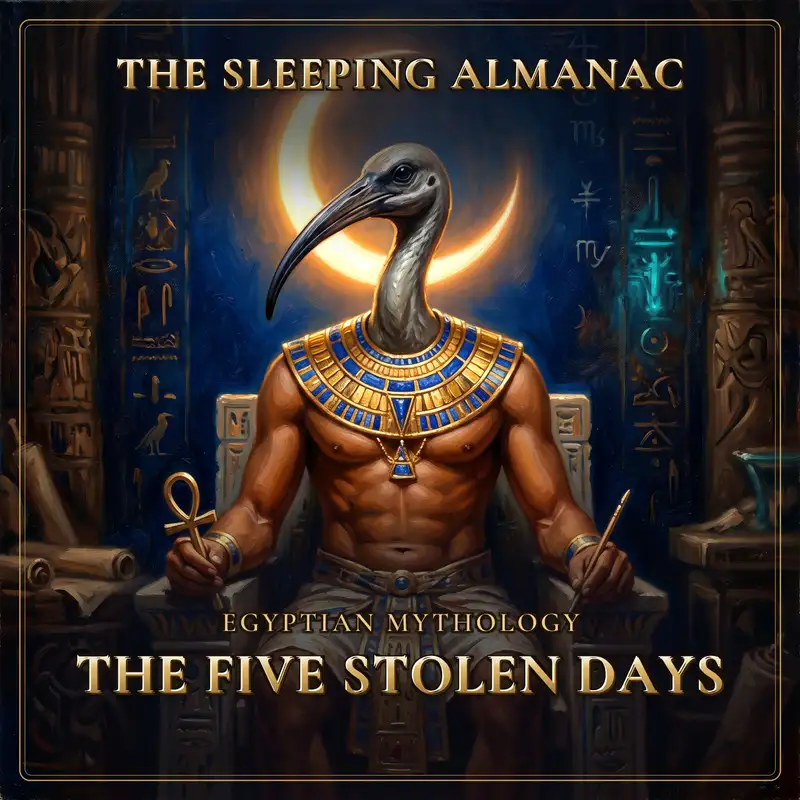
Welcome to The Sleeping Almanac.
Tonight, the wisest of all the gods is going to sit down to a quiet game played by moonlight, and he is going to win, one careful move at a time
five whole days that did not exist before.
Five new days, stolen so gently from the light of the moon that the year itself had to grow longer to hold them.
And on those five new days, five great gods will be born, the very gods whose loves and griefs and long story will carry us through the rest of this season.
So let the day set you down.
Let the bed take you.
This is a story about patience and cleverness and the slow winning of small things, move by move, in the soft light of the moon.
There is no battle in it, no chase, no fury.
There is only a wise god at a game board, thinking carefully, taking his time, and a year quietly growing wide enough to hold what was coming.
We will draw it from the Egyptians themselves, and also from a Greek writer named Plutarch
who lived long after the time of the pharaohs and gathered up the old Egyptian stories and set them down in his own way.
And we will draw it, too, from something solid and real, from the Egyptian calendar itself, which truly did have five strange extra days each year
days the Egyptians called the days upon the year, set apart from all the rest, and kept as the birthdays of the great gods.
It is the story of how those five days came to be.
And it begins with two who loved each other so closely that there was no room in all the year for what they wished to bring into the world.
This is a tale set in the first age of the world, when the gods themselves still walked it, and the shape of time had not yet been settled.
There is a line we carry with us through this whole season, from an old Egyptian teacher named Ptahhotep, and tonight it fits the story exactly.
He wrote that patience and careful measure find the quiet door that force can never break, and that the wisest course is often the gentlest one.
Tonight's god, Thoth, is the very keeper of ma'at, the deep order and balance of things, the rightness that holds the world steady.
And Ptahhotep said something else, in words the Egyptians treasured.
Good speech, he said, is more hidden than the green stone, and yet it may be found among the maidservants at the grindstones.
He meant that what is wisest and truest is quiet, and humble, and easy to overlook, waiting in plain places for a patient mind to find it.
Keep that nearby tonight.
It is the whole secret of the story.
Let your eyes close.
Let the breath go slow.
And let us go up, tonight, into the moonlit sky.
Chapter One.
The Sky and the Earth in Love.
We return tonight to two we met on the very first night of this season.
Geb, the earth, and Nut, the sky.
You may remember them.
Geb was the land itself, the dark rich soil and the rock beneath it, the whole patient body of the world lying down.
And Nut was the sky, the great dark woman arched overhead, her body scattered all over with stars.
They were brother and sister, children of Shu the air and Tefnut the moisture, and they were, the Egyptians said, deeply and tenderly in love.
In the very beginning, before the world had been fully opened up, they had lain close together, the sky resting upon the earth
holding each other so tightly that not even air could pass between them.
There is a deep sweetness the Egyptians felt in that first closeness, before any parting, and it is worth resting in for its own sake.
The sky and the earth, in the very beginning, lay folded together with no gap between them at all
holding each other so completely that there was no inside and no outside, no up and no down, only the two of them pressed close in the warm dark.
It is the way the whole world begins, in many of the oldest stories, not with a blow but with an embrace
a closeness so total that nothing has yet been separated out from anything else.
Before there was light there was this, two who loved each other holding on in the dark.
You came from a closeness like that yourself once, held warm and folded and undivided before ever you were set out into the bright cold air of the world.
Some quiet part of the body remembers it, and reaches for it again every night
when you curl down under the blankets into the warm dark and let the edges of yourself soften and the day's separations close gently back over.
Rest there now, in the first closeness, before the parting, where the earth and the sky still hold each other and nothing has yet been pulled away.
And we remember what happened then.
Their father Shu, the air, came between them.
He lifted Nut high up above Geb and held her there, raising the sky away from the earth, so that there would be a space in the middle for the world to live in.
It was a necessary thing.
Without that space there could be no light, no breath, no room for anything to grow.
But it was a sorrowful thing too, and the Egyptians felt the sorrow of it.
The earth and the sky, who loved each other, were parted forever, set apart so that the world could exist
able only to gaze at each other across the great distance, the rain falling from her to him, the prayers and the smoke rising from him to her
never again able to truly touch.
If you have ever lain out under a clear night sky, far from any lamp
and let your eyes follow the long pale river of stars that runs from one edge of the dark to the other, then you have seen, in a way
the body of Nut arched over you.
That is how the Egyptians saw it.
The whole sweep of the night sky was a goddess bending over the world, her fingertips at the eastern horizon and her toes at the western one
her dark skin scattered all over with the lights we call stars.
And beneath her lay Geb, the patient earth, the same ground that holds your bed tonight, the same soil that has held every sleeper who ever lay down upon it.
Picture them now, the dark woman of stars above and the still green land below, parted by the gentle air, gazing at each other across a distance they would never close.
There is a quiet ache in it, but there is a great calm in it too
the two oldest lovers in the world holding their long and faithful watch over everything that lives between them.
The Egyptians drew this picture on their coffin lids and temple ceilings more often than almost any other, and if you have seen it you do not forget it.
The long body of the goddess Nut, stretched in a great arc from one horizon to the other, her hands set down at the western edge and her feet at the eastern
her body the deep blue of the night and powdered all over with stars.
Below her, the green god Geb reclining along the ground, one knee raised like a low hill, the rises and hollows of his body the rises and hollows of the land.
And between them, holding them apart with his upraised arms, their father Shu, the air, the empty luminous space in which everything lives.
They painted it above their dead so that the goddess of the sky would arch over the sleeper through all the long night of the tomb
and swallow the sun each evening, and give birth to it again each dawn out of her own body.
It is a strange and beautiful thought, that the whole night sky is the body of a watching mother
and that the sun travels the length of her each night only to be born again.
Let it be above you now, that great arched body of stars, bending over your bed the way it bent over theirs, faithful and unhurried
holding the dark gently in place until morning.
But before they were parted, in the closeness of the beginning, something had begun.
Nut, the sky, was carrying children.
Five of them, the most important gods in all the long story of Egypt, were waiting within her to be born.
And that should have been a simple joy.
A mother carrying her children, waiting for their day to come.
But it was not simple, because of a fear that had taken hold of the old king Ra, a jealous and anxious fear
that turned the bringing of these children into the world into the hardest of riddles.
There is something to rest on in that image of children carried and waiting, before any trouble comes near them.
Every living thing begins this way, held in a warm dark, unhurried, before its day arrives.
The five great gods of Egypt, who would one day fill three thousand years of story with their loves and their losses
were at this moment only a quiet weight inside the night sky, dreaming the long dream of the not yet born.
They did not know the riddle that had closed around them.
They did not need to.
They were held, and they were safe, and their time was coming, even if the way to it had not yet been found.
You can let yourself be held the same way tonight, carried in the dark, your own day far off and asking nothing of you yet.
We will come to that fear in the next chapter.
For now, simply hold the tenderness of it.
The sky and the earth, parted by the needs of the world but loving each other still across the distance.
And within the body of the sky, five children waiting, gods who would one day fill the whole world with their story, not yet born, not yet able to be born
held quietly in the dark of the night sky, waiting for someone wise enough to make a place for them.
Let yourself settle into that quiet waiting, up in the soft dark among the stars, as the story gathers itself around the riddle of the five.
Chapter Two.
The Jealous Decree.
The old king Ra had heard a thing that frightened him, and out of his fear he spoke a decree.
The Egyptians and the Greek Plutarch told it in slightly different ways, but the heart of it is the same.
Ra, the aging sun, the ruler of the world, had come to fear the children that Nut was carrying.
Perhaps it was a prophecy he had heard, that one of these children, or their line, would one day rule in his place.
Perhaps it was simply the old fear of the old and powerful, that the young coming up behind them will one day take what they hold.
Whatever its root, the fear took hold of him, and out of it he spoke a decree meant to keep those children from ever being born at all.
The fear itself is one of the oldest in all of storytelling, and the Egyptians were not the only ones to feel it.
The ruler who hears that a child not yet born will one day take his place, and who tries to shut that child out of the world
appears in the tales of many peoples, and it almost never works, because there is something in the order of things that wants the new life to come
and bends the world quietly toward it.
Plutarch, telling this Egyptian story to his Greek readers, would have heard echoes of his own myths in it
of old gods who tried to swallow their children to keep their thrones and were undone in the end all the same.
The Egyptians felt the same deep truth.
You cannot, in the end, decree the future out of existence.
You cannot wall off what is coming.
The old and powerful may try, out of their fear, to keep the world exactly as it is, frozen and closed and theirs forever, but time does not work that way
and the new thing finds its day.
There is even a kind of comfort in that, if you are not a frightened king.
The world is always quietly making room for what comes next, whether or not anyone gives it leave.
He decreed that Nut should not give birth on any day of the year.
Now, to understand the weight of that, you have to understand how the Egyptians counted the year.
In that ancient time, they said, the year had three hundred and sixty days.
Twelve months of thirty days each, three hundred and sixty in all, and that was the whole of the year, the complete round of time
with no day left over and no day outside it.
So when Ra decreed that Nut could not give birth on any day of the year, he was, in effect, forbidding her ever to give birth at all.
There was no day that was not part of the year.
There was nowhere in all of time for the children to be born.
The decree was a door with no opening in it, a wall around the whole of the calendar, and the five children were shut on the wrong side of it
unable to come into the world.
It helps to picture how the Egyptians actually lived inside that round of three hundred and sixty days
because the calendar was not an abstract thing to them but the very rhythm of their lives.
They divided their year into three great seasons, each of four months, and each named for what the river was doing.
First came the season of the flood, when the Nile rose and spread brown and wide across the fields and the people waited for it to draw back.
Then came the season of the coming forth, when the wet dark land lay open and the seed went in and the green came up.
And last the season of the harvest, when the grain was cut and gathered in the heat before the river rose once more.
Round and round it went, flood and growth and harvest, flood and growth and harvest, as faithful as breathing.
That was the closed perfect circle Ra had sealed, the deep familiar rhythm of the whole land.
And it is a restful thing in itself to think on, that endless dependable turning, the river always returning, the grain always greening
the world going round its sure old wheel whether or not anyone lies awake to watch it.
Let that turning carry you, the way it carried them, sure and slow and asking nothing of you at all.
Think for a moment about what a year of three hundred and sixty days would feel like, laid out before you.
Twelve clean months, each one thirty days exactly, the same width as the last, turning over and over without remainder, a perfect and closed circle of time.
It is a tidy thing, almost too tidy, the kind of order that leaves no gaps and no surprises.
And that perfect closure was exactly the trap.
A circle has no door.
A wall with no seam in it cannot be climbed through.
Ra had not needed to chase the children or fight them or hold them down.
He had only to wrap the calendar shut around them, and the very neatness of time itself became the cage.
It was, you might say, a prison made of order, and only someone who understood order more deeply than Ra himself could ever hope to find the flaw in it.
There is no need to feel the fear of that, though, even as we name it, because we are listening from the far side of the story, where we already know it ends well.
The decree was hard and the wall was real, but walls of that kind have a particular weakness, and the story is already moving, quietly
toward the one mind clever enough to see it.
The Egyptians felt the cruelty and the cleverness of the decree, and so should we, but only gently, because the story is on its way to undoing it.
It was a clever cruelty, the kind that traps you not with force but with the very shape of things, with the rules themselves.
There seemed to be no way around it.
The year was the year.
It had three hundred and sixty days, and not one of them could be used, and there were no others.
And yet, as the Egyptians knew, there is almost always a way around, if you are wise enough and patient enough to find it.
The decree had a flaw in it, a small overlooked thing, and there was one god clever enough to see it.
The decree forbade birth on any day of the year.
But what if there were days that were not part of the year?
Days that did not yet exist, that could be made, that would belong to no month and fall under no decree?
No one had thought of that, because there had never been such days.
But one god was about to make some.
It is worth noticing, gently, that the flaw in the decree was not in its strength but in its words.
Ra had made the rule as wide and as tight as he could.
He had closed every day of the year against the children.
But a rule can only forbid the things its maker has imagined, and Ra had imagined only the days that already existed.
He had not imagined that new days could be made, because no one ever had.
And so the very completeness of his decree, the way it shut every door he could see, left wide open the one door he could not see, the door that was not yet built.
The wise god did not have to break Ra's word.
He only had to find the place the word had never reached.
Let that hang quietly in the moonlit air, the small forgotten opening in a wall that seemed to have none, while the wisest of the gods begins, calmly
to think his way toward it.
Chapter Three.
The Year That Had No Room.
Nut grieved, for she could not bring her children into the world, and there seemed to be no help for it.
The Egyptians let us feel her sorrow, the particular sorrow of a mother who cannot do the one thing she most longs to do.
The children were ready.
Their time was near.
But the decree of the old king lay over the whole of the year like a sealed lid, and there was no day on which they could be born, and so they waited
and could not come, and Nut, the great sky, arched over the world with her children held within her and no way to release them into life.
She turned, in her grief, to the one she trusted most, the wisest of all the gods, a friend to her and to all who were in trouble.
And to understand the rest of the story, we need to meet him properly
because he is one of the most important and most beloved figures in all of Egyptian thought, and he will be with us, quietly, all through this season.
His name was Thoth.
But before we go to Thoth, let us simply rest a moment in the shape of the problem, because there is something restful, strangely
even in a riddle this old and this hard.
The whole of time was closed.
Every day was spoken for.
There was no room in all the year for what most needed to come.
And yet the story we are telling exists, which means the riddle was solved, which means that even a wall around the whole of the calendar had a way through it.
The Egyptians liked to set their listeners a problem that seemed to have no answer, and then to show, slowly, patiently
that the answer had been there all along, waiting for a wise enough mind to find it.
There is even a kind of beauty in a problem that waits patiently for its answer, and the Egyptians felt it.
They did not rush their stories toward the solution.
They let the difficulty stand for a while, let it be fully felt, the sealed year, the grieving sky, the children with nowhere to be born
because they knew that the relief of an answer is only as deep as the difficulty it answers.
A riddle held gently, without panic, is not a torment.
It is almost a kind of rest, a thing set down in front of you to be turned over slowly, with no demand that you crack it this very instant.
That is how to hold the unsolved things tonight.
Not gripped, not forced, but simply set down in the moonlight where the patient mind can look at them, the way Thoth is about to look at this one, unhurried
unworried, sure that the seam is there somewhere and that it will show itself in time.
Let the riddle rest.
Let yourself rest.
The answer is already on its way, and it does not need your worry to arrive.
You may have known that feeling yourself, the feeling of a problem turned over and over in the dark with no way out in sight.
It is one of the things that keeps people awake, the mind going round and round the closed walls of some trouble, looking for the gap and not finding it.
But notice how often, when you finally stop pressing against the problem and simply set it down, the answer comes of its own accord, quietly, the next morning
or the one after, when you had stopped grasping for it.
That is the kind of wisdom this story is about.
Not the wisdom that batters at a locked door, but the wisdom that waits, and looks, and lets the answer rise.
Nut, in her grief, has stopped battering.
She has gone instead to the one who knows how to wait, and how to look, and how to find the opening that frantic effort always misses.
So you can lay your own troubles down beside hers tonight.
You do not have to solve them now.
You only have to rest, and trust that the patient mind finds the way.
And there is a quiet wisdom, too, simply in where Nut took her trouble.
She did not rage against the decree.
She did not hurl herself uselessly against the sealed year.
She went, instead, to the one who might actually be able to help, and she laid the whole trouble in his hands.
That is its own kind of wisdom, and not a small one.
Knowing when a thing is beyond your own strength, and knowing who to carry it to, and being willing to set it down in front of them and ask
is sometimes the most clear eyed thing a person can do.
The grieving sky did not have to be clever enough to solve the riddle herself.
She only had to be wise enough to bring it to the one who could.
There may be some trouble you have been carrying alone tonight, turning it over by yourself in the dark.
You might let Nut remind you, gently, that you do not always have to be the one who finds the answer.
Sometimes the answer is only to bring the trouble to the right pair of hands, and then to rest, as she is about to rest, while a mind wiser than worry takes it up.
So do not carry the grief too heavily.
Nut grieves now, up in the night sky, her children held within her and nowhere to set them down.
But help is already on its way.
The wisest of the gods has heard her trouble, and he is already turning it over in his careful mind
and he is the sort of god who does not push against a closed door but quietly finds the hidden hinge.
Rest in the trust of that.
The riddle has an answer.
The wise one is already at work.
Let the sorrow soften, and the hope rise, as we turn now to meet the cleverest of all the gods.
Chapter Four.
The Wisest of the Gods.
Thoth was the god of wisdom, and of writing, and of the moon, and of the measuring of time, and the Egyptians loved him as the calm mind at the center of the world.
They pictured him most often as a man with the head of an ibis, the long legged wading bird of the riverbanks
with its slender curved beak that dips so precisely into the water, as a careful mind dips into a problem.
Sometimes they pictured him instead as a baboon, sitting still and watchful in the moonlight
for the baboons of Egypt cried out at dawn and seemed to greet the moon at night, and the Egyptians thought them wise.
But whatever shape he wore, Thoth was the same.
He was the keeper of knowledge.
He was the one who had invented writing, who had given the gift of words set down, so that things could be remembered, so that time itself could be measured and kept.
The Egyptians gave Thoth more offices than almost any other god, because wisdom touches everything.
He was the scribe of the gods
the one who stood at the great court of the afterlife and wrote down the verdict when a human heart was weighed against the feather of truth
recording each soul's fate in his careful hand.
He was the inventor of writing itself, of the sacred signs the Egyptians believed could hold a thing forever
and so he was the patron of every scribe who ever sat cross legged with a reed pen and a sheet of papyrus
doing the quiet work of setting the world down in words.
He was the lord of the moon and the reckoner of its months, the keeper of the calendar, the divider of time into its seasons and its days.
He healed, he judged, he counted, he recorded.
Wherever there was knowledge to be kept or order to be measured, the Egyptians placed Thoth there, the cool clear mind behind all of it.
His great city was a place the Greeks would later call Hermopolis, the city of Hermes
because when those Greeks came to Egypt and met Thoth they felt they had met their own god Hermes wearing an Egyptian face
the swift clever messenger of words and crossings and clever turns.
They thought him so deep and so old that they called him Thrice Great, and built whole traditions of hidden wisdom around his name.
But long before any Greek set foot on the Nile, the people of Egypt had already loved him for thousands of years as their own, the ibis headed one
the patient recorder, the friend of anyone in trouble who needed a clear mind on their side.
It is that Thoth, the old and homely and deeply trusted one, who is sitting down now to help the grieving sky.
Rest in the thought of him, the calm bright mind at the center of the world, taking up your own night's worries the way he is about to take up hers.
He was the god of the moon, and that mattered greatly to this story.
The Egyptians watched two great lights cross their sky.
The sun, blazing and unchanging, ruling the day.
And the moon, gentler, cooler, ruling the night, and always changing, growing from a thin curve to a full bright disc and then thinning away again to nothing
month after month, in a slow and faithful round.
The sun belonged to Ra.
The moon, that softer and more changeable light, belonged to Thoth, and from it he measured out the months, and kept the count of time.
There is something fitting in that, that the god of wisdom should be the god of the gentler light.
The sun is glorious, but you cannot look at it.
It rules by sheer force, blazing down, demanding that everything turn its face away.
The moon is the opposite kind of ruler.
You can gaze at the moon as long as you like.
It does not burn you.
It only shines, softly, changing its face from night to night, and the more closely you watch it the more it has to show you.
The Egyptians felt that the wisdom of Thoth was like that, a light you could look into, patient and cool and ever changing
a light made for the quiet hours when the loud sun has gone down and the careful mind comes awake.
If you have ever found that your clearest thoughts come late, in the soft dark, long after the busy day has set
then you already know something of why the wise god rules the moon.
And he was, above all, the god of ma'at in its calmest form, the keeper of order, of balance, of true measure and right reckoning.
When disputes arose among the gods, it was Thoth who judged them fairly.
When records had to be kept, it was Thoth who kept them.
He did not rule by force, and he did not act in anger.
He acted by wisdom, by patience, by the careful weighing of things, by finding the just and clever answer that no one else had seen.
He was, in a sense, the very mind of the world, cool and bright and steady as the moon he governed.
The Egyptians had a tender idea about the moon and Thoth that is worth knowing.
They sometimes said the moon was a kind of healed wound, an eye that had been hurt and then made whole again, and that Thoth was the one who healed it
the great restorer of what was damaged, the one who set broken things right and made them whole.
So the soft light of the moon was, to them, the very emblem of healing, of restoration, of the patient mending of what had been torn.
That is the god who is helping the sky tonight, not a god of force or fire but a god of mending, of setting right, of making whole again what grief had broken.
There is comfort in being in the care of a healer rather than a warrior.
The trouble Nut brought him was a kind of brokenness, a thing that would not come right, and Thoth is exactly the sort of power that mends such things, quietly
with patience, without ever raising his voice.
Whatever in your own life feels a little broken tonight, a little out of true, you might place it too, for these few hours, in the keeping of the mender
the one who heals the wounded light and makes it whole, and rest while he works.
The Egyptians imagined him standing a little apart from the quarrels of the other gods, watching, listening, his reed pen ready and his clear eye missing nothing.
When the others raged or wept or schemed, Thoth was the one who stayed calm.
He was the one you went to when there seemed to be no answer, because he could be trusted to look at the trouble plainly, without fear and without temper
and to find the fair and quiet path through it.
There is a deep restfulness in a figure like that, the steady one in the middle of every storm, the one who never panics
the one who can always be relied upon to think clearly when everyone else has lost their way.
The whole of Egyptian thought leaned on Thoth the way a tired traveler leans on a sure and patient guide.
And tonight, in this story, the grieving sky leans on him too.
There is one more thing the Egyptians believed about Thoth that belongs to a story like this, that his words had power.
Not the power of command or of force, but the deeper power of the true word rightly spoken, the word that names a thing correctly and so sets it in its proper place.
They thought that the world itself had partly been spoken into being, called into order by the right words said in the right way, and that Thoth
the lord of words, knew those words better than anyone.
So when he set himself to the riddle of the sky, he was not only thinking cleverly.
He was working with the very stuff that holds the world together, with words and measure and true reckoning, the quiet forces that order everything.
The Egyptians found that immensely reassuring, that the deepest power in their world was not a fist but a wisely spoken word
and that it belonged to the gentlest and most patient of their gods.
Rest in the care of that power tonight, the calm ordering word, the true measure
the quiet wisdom that sets things right not by breaking them but by naming them gently back into their places.
So when Nut, the grieving sky, brought her trouble to Thoth, she had come to exactly the right god.
If anyone in all the world could find a way through a riddle that seemed to have no answer, it was the wise one, the moon god, the keeper of time and measure.
He listened to her sorrow, and he turned the problem over in his careful mind, and he saw, where no one else had seen, the small flaw in the old king's decree
and the quiet path that led around it.
And the path led to a game.
Rest now, in the calm presence of the wisest of the gods, while he makes his careful plan, and turns his thoughts toward the moon
and the long quiet game he is about to play.
Chapter Five.
The Moon and the Game.
Thoth's plan was this.
He would make new days.
Days that were not part of the year, that fell under no decree, on which the children could be born.
But to make new days, he needed light, for a day is a measure of light, and he could not simply conjure it out of nothing.
So he went to win it, patiently, at a game, from the one other great light in the sky.
He went to play against the moon.
In the old tellings, the moon was itself a god, a quiet shining god of the night, holding within its disc a great store of light.
And Thoth, who governed the moon and knew it well, came to it with a game board, and proposed to play.
The game was one the Egyptians knew and loved, and played in their own homes for thousands of years.
They called it senet.
It was a game of moving pieces along a board of thirty squares, a game of skill and a little of chance
a quiet game played across a small board between two seated players, the kind of game that fills a long calm evening.
The Egyptians loved it so much that they painted it on the walls of their tombs and buried game boards with their dead
so that they might go on playing in the long evening of the afterlife.
And it was this gentle game, this quiet pastime of long evenings, that Thoth proposed to play against the moon, for the highest of stakes
a little of the moon's own light.
The Egyptians played senet for the better part of three thousand years, longer than almost any game in all of human history has been played
and we know it well because they left it everywhere.
They painted players bent over the board on their tomb walls.
They buried beautiful boards with their dead, inlaid with ivory and dark wood, the little drawers still holding the pieces.
The boy king Tutankhamun was sent into eternity with several of them.
The board was thirty squares, laid in three rows of ten, and the players moved their pieces along it by the cast of marked sticks
for they had no cubic dice in the early days, so that the game mixed skill with a breath of chance, the planning of the moves with the luck of the throw.
It was a game for two, seated close, played slowly through an evening
and it was woven so deeply into Egyptian life that they could imagine no better way to spend the long quiet hours, in this world or the next.
So when they pictured the wise god sitting down to play for the fate of the world, they were not imagining anything strange or grand.
They were imagining the most familiar and companionable thing they knew, two players at a senet board, in the lamplight, taking their unhurried turns.
If you have ever sat across a board from someone you love, on a long quiet evening with nowhere else to be, you know the particular peace of it.
The small click of a piece set down.
The pause while the other one thinks.
The low light, and the unhurried turns
and the way the whole rest of the world seems to fall away until there is only the board and the two of you and the slow back and forth of the game.
That is the feeling the Egyptians were reaching for when they imagined this scene.
Not the noise of a battle, but the hush of a board game played deep into the night.
The squares of senet laid out, thirty of them, in three neat rows.
The pieces moving along them, one by one.
And between the two players, the thing they were playing for, a soft and gathering glow of moonlight
growing by small portions on the wise god's side of the board as the long night wore on.
There is a gentleness even in who the two players are.
This is not a wise god sitting down against an enemy.
The moon was his own, in a way, the very light he governed and loved and knew better than anyone.
So the game is less a contest than a quiet conversation between old companions, the keeper of the moon and the moon itself, sitting together through the dark
moving the pieces, neither one wishing the other any harm.
The moon would lose a little light, yes, but to a friend, and for a good purpose, and not by any trick or cruelty.
The Egyptians liked that the great matter was settled so gently, between two who belonged together, over a board, in the soft shared light of the lamp and the moon.
There is no edge of fear anywhere in it.
It is the most peaceable contest imaginable, two old friends at a game on a long night, and the fate of the world resting easy in their unhurried hands.
Let that peaceableness be yours as you lie here.
Nothing is being fought over tonight.
There is only the soft back and forth of the game, between friends, in the gentle light, going quietly on.
The Egyptians sometimes thought of senet itself as more than a game.
To them the board, with its thirty squares, was a little image of a journey, the journey of a soul moving square by square toward its rest
and they painted it in their tombs for exactly that reason, a quiet passage to be made carefully, in order, one step at a time.
So there was a deep rightness, to their minds, in the fact that the fate of the world should be decided over such a board.
The making of new days, the giving of room for new life, was itself a kind of journey across squares, a patient moving forward, move by move
toward a place of rest that had not existed before.
There is something wonderful in that, and the Egyptians felt it.
The fate of five great gods, and the whole shape of the year, and the answer to a riddle that had trapped the sky herself, all of it came down not to a war but to a game.
To two players seated at a small board in the soft light of the night, moving their pieces, taking their turns, the wise one thinking carefully over each move
the moon playing on, the light of the stakes gleaming between them.
No fury.
No force.
Just the oldest and quietest kind of contest there is, a game played slowly through the night.
So picture it now, that quiet scene.
The wise god with the long curved beak of the ibis, seated calm and patient at the game board.
The moon, soft and full and shining, seated across from him.
The board between them with its thirty squares.
And the long night ahead, in which the game will be played out, move by careful move, for a little of the moon's own light.
Rest in the calm of it, in the soft glow, in the unhurried taking of turns.
There is nothing frightening here at all.
There is only a wise god at a quiet game, playing patiently through the night for the sake of children not yet born.
Let the scene fill in slowly around you, the way a remembered room fills in when you close your eyes.
The low table between the two players.
The board upon it, its thirty squares worn smooth with handling.
A single lamp somewhere near, throwing its small steady gold across the squares and leaving the corners of the room in soft shadow.
The wise god seated on one side, unhurried, his long beak dipping now and then toward the board as he considers.
The moon seated on the other, round and pale and patient, its soft light filling the room more gently than the lamp.
No sound but the small click of a piece set down, and then a long quiet while the next move is weighed, and then another click, and another long quiet.
That is the whole texture of this scene, click and quiet, click and quiet, all through the night, as steady and as soothing as a slow clock in another room.
Let that rhythm be the rhythm of your breathing now.
A piece set down as you breathe out.
The long quiet as you breathe in.
There is nowhere this game needs to get to in a hurry.
It has all night.
So do you.
Chapter Six.
Playing for Light.
They played through the night, and Thoth, being the wisest of all the gods, slowly began to win.
The Egyptians did not tell this as a fierce contest.
They told it as a long, patient, careful game, the kind that is decided not by any single bold stroke but by steady wisdom, move upon move, hour upon hour.
Thoth was the cleverest player there had ever been, the god of reckoning itself, and he played the moon with patience and skill, and little by little
square by square, he gained the upper hand.
And the stakes of the game were light, the moon's own light, and as Thoth won, he won small portions of it, gathering them to himself
a little and a little and a little more, all through the long night.
Notice the pace of it, because the pace is the whole lesson, and it is a good pace to fall asleep to.
Nothing here is won all at once.
There is no single triumphant blow, no sudden turning, no moment that quickens the heart.
There is only the slow accumulation of small gains, the patient piling up of little things, the way a riverbank is built grain by grain
the way a night passes minute by minute until somehow it is morning.
Thoth did not need to win the moon's whole light.
He needed only to win, patiently, the small amount that the task required, and to keep at it, calmly, for as long as it took.
That is how the great quiet victories are usually won, not in a rush but in a long unhurried gathering, a little and a little and a little more
until what seemed impossible has quietly come to pass.
You can feel that truth in your own body, lying here.
Sleep itself comes exactly this way, not seized but gathered, not won in a single stroke but accumulated, breath by breath, one small loosening after another.
You do not fall asleep by trying harder.
No one ever has.
You fall asleep the way Thoth won his light, by patience, by letting each small measure of ease add itself quietly to the last, the jaw softening
then the shoulders, then the hands, then the long muscles of the legs, each one giving up a little of its holding, a little and a little and a little more
until without any single moment you could point to, the whole of you has crossed over into rest.
So do not try to win sleep tonight.
Only play the long quiet game of it, move by move, breath by breath, and let the small gains gather of their own accord.
They will.
They always do, in the end, for anyone patient enough to stop forcing it and simply let the night do its slow work.
And as the hours wore on, the soft glow on the wise god's side of the board grew, and grew, while across from him the moon shone on, patient and unbothered
playing the game out to its end.
There was no anger in this losing.
The moon did not rage or grasp.
It simply gave up, by small measures, what the wise one had fairly won, the way the night sky gives up its darkness by small measures to the coming dawn.
Everything in this story moves gently, even the loss.
There is a small grace worth taking from the moon here, the grace of losing without bitterness.
The moon played, and lost, and gave up what it had lost without a struggle, and was not diminished in any way that truly mattered.
It is still there, every night, shining.
We do not always lose so gently.
We tend to grip what we are losing, to rage a little against it, to feel that something is being taken from us unfairly.
But the moon, in this old story, shows another way, the way of the open hand, giving up its small portion of light easily, almost gladly
because that light was going toward something good, toward room in the world for new life.
There may be something you are slowly losing too, as all of us always are, some brightness of an earlier season quietly thinning away.
You might let the moon show you how to hold it, loosely, without grasping, trusting that what is given up gently is not truly lost but only passed along
poured out into the next thing that needs it.
The moon thins, and is not afraid, and fills again.
So, in their own time, do we.
The Egyptians said that he won, in the end, a seventieth part of the moon's light.
A small fraction, gathered patiently over the whole long game.
Not so much that the moon was darkened forever, but enough, just enough, gathered carefully together, to make something new.
And here the Egyptians, who loved to find a great truth folded into a small everyday thing
used this story to explain something they watched in the sky every single month.
The Egyptians liked to see in this why the moon is not as bright as the sun, and why it wanes.
Thoth won a portion of its light away at the beginning of things, and so the moon must give up its light a little each month
thinning away to nothing and then slowly gathering itself back, forever, in memory of the night it played the wise god and lost.
There is a deep gentleness in that, the idea that the soft changing light of the moon
the waxing and the waning that has soothed sleepless people for as long as there have been people, is the mark of an old debt
a little light given up long ago so that something new could be born.
The very thing that makes the moon gentle, its dimness, its changefulness, is in this story a kind of generosity
light surrendered for the sake of the children who needed days to be born into.
It is a lovely way to think of the moon, the next time you see it riding low and pale over the rooftops, or hanging full and bright in the deep of the night.
That softness, that quality that makes it a friend to the sleepless where the sun is too fierce to look at, is in this old story the mark of a gift it gave.
The moon shines gently because long ago it parted, willingly enough, with a little of its brightness, so that there would be room in the world for new life.
And the Egyptians, watching it thin and fill and thin again, month after faithful month
saw in that endless patient rhythm not a loss but a kind of giving that never runs out.
The moon gives up its light and gathers it back, gives it up and gathers it back, forever, the gentlest and most constant of the lights in heaven.
There are worse things to fall asleep beneath than a light like that.
And so, when the long game was over, Thoth held in his keeping a small store of light won from the moon.
Enough light to make new days.
He had found the way around the old king's decree, not by breaking it, not by fighting it
but by quietly making something that the decree had never imagined and so had never forbidden.
Days that were not part of the year.
Rest now, as the long game ends, and the wise god rises from the board with his small winnings of moonlight gathered in his hands
and turns to the work of making, out of that soft won light, five new days for the world.
Chapter Seven.
The Making of Five Days.
With the light he had won, Thoth made five new days, and he set them gently outside the year.
This is the quiet heart of the whole story, and it is worth understanding slowly, because it is one of the cleverest answers to a riddle in all of mythology.
The old king had decreed that Nut could not give birth on any day of the year.
The year had three hundred and sixty days, and every one of them fell under the decree.
So Thoth did not try to use any of those days.
Instead, out of the moonlight he had won, he made five new days, and he placed them outside the year entirely
in the small gap between the end of one year and the beginning of the next.
Five days that belonged to no month.
Five days that were part of no year.
Five days that the old king's decree had never mentioned, because no such days had existed when he spoke it.
Try to picture where those five days sit, because the picture is a restful one.
Imagine the year as a great ring, the three hundred and sixty days curving round and round, month after month, back to where they started.
And then imagine, at the very place where the end of the ring meets its beginning, a small soft gap, a little uncounted space tucked into the seam
neither the old year nor the new.
That is where the five days live, in the quiet join of the circle, the threshold where one turning of time hands off to the next.
It is the stillest place in all the calendar, outside the busy round of the ordinary days
a kind of held breath between the breathing out of one year and the breathing in of the next.
The Egyptians felt that hush, and kept it carefully, and set the births of their greatest gods inside it.
There is a place like that in every night, too, the deep still seam in the middle of the dark, furthest from both the evening and the morning
where time seems to pause and hold.
You are drifting toward it now.
Let it hold you, that quiet gap between the days
where nothing is counted and nothing is required and the only thing to do is rest in the seam until the new year of the morning begins.
The Egyptians called these days the days upon the year, and this, they said, is how the calendar came to be the way it truly was in their own time.
For the Egyptian year did have exactly this shape.
Three hundred and sixty days, in twelve months of thirty, and then five extra days added on at the end, set apart from all the rest
days that belonged to no month and stood outside the ordinary count of time.
The Egyptians lived by that calendar for thousands of years.
And every year, when those five strange extra days came around, they remembered that these were the days Thoth had made, the days won from the moon
the days on which the great gods had been born.
And when the five days were over, the Egyptians kept a festival they called the opening of the year, the first day of the new year proper
when the count began again at one.
It came, in the deep past, near the time the river started to rise and the bright star returned to the dawn sky
so that the turning of the calendar and the turning of the living world fell close together
the new year and the new flood and the new green all arriving in the same season.
There was a great gladness in it, the gladness of beginning again, of a fresh clean round of time opening up ahead with all its days still unspent.
We feel a little of that ourselves at the turn of our own year, the sense of a page turned, a slate wiped clean, a new start offered.
The Egyptians felt it tied to the river and the star and the soft uncounted days that Thoth had made, the old year laid to rest, the five gods' birthdays kept
and then the world beginning fresh.
You have a smaller version of that gift every single night.
Sleep is the opening of your own year, in miniature, the old day laid down and a new one gathering, clean and unspent, on the far side of the dark.
Cross into it gently.
Tomorrow is still unspent.
Let it wait for you there.
So the year grew from three hundred and sixty days to three hundred and sixty five, which is very nearly the true length of the year
the time it takes the earth to make one full circle of the sun.
There is something quietly marvelous in that, that an old story about a wise god and a game of moonlight should land so close to the real shape of the year
the five extra days that any calendar must somehow find room for.
The Egyptians had wrapped a true and careful piece of timekeeping inside a gentle tale, the way they so often did.
And it is worth pausing on those five extra days, because we still live with them, in our own way, even now.
Every year the turning of the seasons does not divide neatly into the count of the days.
There is always a little remainder, a little time left over that does not fit the simple pattern
and every people who has ever kept a calendar has had to find some quiet way to hold it.
The Egyptians held it by making five days that stood outside the months altogether.
We hold it by other means, but the problem is the same one Thoth faced, the same small overflow of time that the world refuses to round off cleanly.
There is a gentle wonder in knowing that the careful people of the Nile noticed this thousands of years ago
watched the river and the stars and counted the days, and found that the year would not quite close, and made, out of that not quite closing
a story about a wise god and a game of light.
The numbers were real.
The watching was patient and exact.
And around the truth they wrapped a tale soft enough to tell a child at bedtime.
Think, too, of what it means that the gods themselves were born in that little overflow of time, in the days that did not belong to any ordinary month.
Their birthdays fell in the seam of the year, the quiet uncounted space at its edge
the place where the neat round of the calendar opens just slightly to let something new through.
It is as though the most important things came into the world not in the broad daylight of the ordinary days, but in the soft margin, the threshold
the small held breath between one year and the next.
The Egyptians felt that those days were charged with a special quality, set apart, a little outside time, and so the things born in them were set apart too.
The Egyptians treated those five days with real care, as a time held a little apart from ordinary life.
Because the days stood outside the safe round of the calendar, beyond the ordinary order of things, they felt charged and delicate, a threshold time
and the people marked each of the five as the birthday of one of the great gods and kept them with watchfulness and with quiet ritual.
They were not frightened of them, exactly, but they were mindful, the way you are mindful at any threshold, any doorway between one state and the next.
And then, on the far side of the five, the new year began, the river beginning to rise, the whole great round of time starting over clean.
There is something fitting in placing the births of the gods right there, in that hushed and watchful seam, the held breath at the very turn of the year.
The most important arrivals came in the most set apart time, in the quiet uncounted days at the threshold, and then the world began again.
You are in a kind of threshold yourself tonight, the daily one, the soft uncounted seam between the day that is ending and the one not yet begun.
Keep it gently, the way they kept theirs.
Good things come in at the threshold.
Rest in it, and let the new day gather itself on the far side while you sleep.
And now, at last, there was room.
Five whole days, outside the year, beyond the reach of the decree, on which the children of the sky could be born.
Nut's long grief was over.
The riddle was solved, not by force, not by defiance, but by the quiet cleverness of the wisest of the gods, who had made, out of a little won light
exactly the room that was needed.
Rest in the relief of that.
The way has been found.
The days have been made.
And one by one, on each of those five new days, the great gods are about to come into the world.
Chapter Eight.
The First Day.
Osiris.
On the first of the five new days, the eldest of the children was born, and his name was Osiris.
The Egyptians remembered his birth as a great and shining thing, and they wrapped it in signs and wonders, because of all that he would become.
For Osiris was to be the best and most beloved of kings, the green god of growing things
the one who would teach mankind to farm and to live well and to honor the gods, and then, in the great sorrow that lies ahead of us in this season
the one who would die and rise to rule the kingdom of the dead.
All of that was still to come.
But even at his birth, the Egyptians said, there were signs of it.
They told that at the moment Osiris came into the world, a voice was heard to proclaim that the lord of all the earth had been born.
It was a birth that the whole world seemed to lean toward, as the fields lean toward the sun.
The Egyptians pictured him, when he was grown, with skin the green of new growing things, the green of the wheat coming up
the green of the reeds along the river, the green of life itself returning to the land after the flood.
He was the god of everything that grows and ripens and feeds, the patient green power that turns seed into grain and bare soil into harvest.
And so his birth, the Egyptians felt, was the coming of all of that into the world, the first arrival of the kind and growing thing that would make the land good.
Even on the first of the five days, before he had done anything at all, he carried that promise within him, the way a single seed carries a whole field
folded small and quiet and waiting for its season.
The Egyptians loved Osiris so deeply that they wove him into the very ground they walked on.
He was the grain that was buried in the dark earth and seemed to die there and then rose green into the light
and so he became their great sign of life returning out of death.
They made little figures of him out of soil and seed and watered them until the seed sprouted
so that the shape of the god would grow a soft green coat of new grain, the dead king coming back to life in their own hands.
They raised a tall pillar in his honor that stood for his backbone and for steadiness itself, and the raising of it meant the setting right of a fallen world.
All of this lay ahead of the small newborn god on the first of the five days, folded inside him the way the whole harvest is folded inside the seed.
But it is worth knowing, even now, at his gentle beginning, how much the Egyptians would come to love him, and why.
He was their promise that what goes down into the dark comes up again green.
There is no better thought to hold at the edge of sleep, when you yourself are going down gently into the dark, than that one.
What sleeps is not lost.
It is only keeping its season, like the grain, like the green god, and it will rise again with the morning.
We will not tell his great story tonight, because it deserves its own nights, and it will have them, several of them, as this season goes on.
Tonight it is enough simply to welcome him into the world, on the first of the five new days, the eldest of the five, the one around whom so much of the rest will turn.
The green king.
The good king.
The one whose name, before the season is done, will be spoken with more love and more sorrow than almost any other.
There is something worth resting on in the simple fact of a first birth, a first arrival, the first of the five long awaited children come at last into the light.
Think of how a household feels in the quiet after a child is safely born, the long waiting over, the worry set down
a new and small and precious life now in the world where before there had only been hope of one.
The Egyptians, who loved their families so deeply, felt all of that in the birth of Osiris, multiplied to the scale of the whole world.
Here was the first of the great gods, the eldest, the one the others would gather around, come safely through the long impossible riddle and into the world at last.
The sky that had grieved so long could rest now.
The first of her children was here.
And consider what it meant to these people in particular, who lived at the mercy of a river, that their most beloved god should be the green of returning life.
Every year they watched the land die.
The river shrank, the fields cracked, the green burned away to dust and bare earth under the terrible sun
until it seemed the whole world had gone brown and lifeless and would never be green again.
And every year, faithfully, the flood came back, and the water spread, and drew off, and left the dark wet soil
and out of that soil the green rose again as if from nothing, the whole land coming back to life.
Osiris was that returning.
He was the green that always came back, the life that could not finally be kept down
the proof written across their whole valley every single year that death is not the end of the story.
No wonder they loved him.
No wonder they wept for him in the sorrow ahead and rejoiced when he rose.
He was their deepest hope made into a god, the hope that what has gone brown and bare and seemingly dead will green again in its own season.
Carry that hope down into sleep with you.
You are only going brown and bare for a single night.
The green is coming back with the morning.
It always does.
So let the first day be a day of welcome and of quiet joy.
The grieving sky has brought her first child into the world at last, on a day made just for him out of won moonlight, and the world has a king coming who will be loved.
There is no shadow on this night yet.
The shadow lies further on, in episodes still ahead.
For now there is only the gladness of a long awaited birth, the first of the five, the beginning of the family whose story will fill the rest of this season.
Plutarch remembered Osiris above all as the king who made his people gentle.
He found them, the old telling says, living roughly, and he taught them, patiently, the better ways.
He showed them how to plant the grain and tend it and gather it in.
He gave them laws to live by, fair and quiet ones, and taught them to honor the gods, and the love of music
and all the soft civilizing arts that turn a hard life into a good one.
And he did it, they said, not by conquest, not by force, but by persuasion and by gentleness, going among the people and winning them over with kindness
so that they followed him out of love rather than fear.
The Egyptians cherished that picture of him, the king whose only weapon was kindness, who made the world better simply by teaching it, patiently, to be gentler.
It is the same quiet wisdom this whole night has been about, the strength that works by patience rather than by force
now carried forward into the one who was born first of the five.
Hold that gentle king in your mind as the first day closes, the one who would teach the world to be kind, newly come into it
small and new and full of all that goodness folded up inside him, waiting for its season like the seed.
Rest in that gladness.
The eldest is born.
The best of them, the most beloved.
And four more are still to come, one on each of the days that the wise god won from the moon.
Let the first day close in peace, with the green king newly come into the world, and the sky no longer grieving, and the long riddle answered at last.
Chapter Nine.
The Second Day and the Third.
On the second of the new days, another child was born, and the Egyptians called him Horus the Elder.
We must be careful here, because there is a younger and far more famous Horus still to come in this season, the son of Osiris and Isis
the falcon prince who will fight to win back his father's throne.
This is not yet that Horus.
This is an older one, born among the first five, Horus the Elder, a god of the sky and of the far seeing falcon, sometimes counted among the children of Nut.
The Egyptians had many gods named Horus, woven together over their long history, and they did not trouble themselves to keep them all perfectly separate
and we will not trouble ourselves either.
Tonight he is simply the second child, born on the second of the new days, a falcon god come into the world.
It is worth dwelling for a moment on what a falcon meant to these people, because it was one of their most cherished images of the divine.
The falcon was the bird that flew higher than any other, that hung steady on the wind where the eye could barely find it
that looked down on the whole green ribbon of Egypt from a height no person could reach.
To see like that, from so far up, taking in the whole land at a single calm glance, was to the Egyptians very close to what it meant to be a god
to be lifted clear above the small troubles of the ground and to behold everything whole and ordered and at peace.
So a falcon god was a god of high serene oversight, of the long view, of the calm that comes from being far enough above a thing to see all of it at once.
There is a rest in borrowing that view tonight, in rising in your mind to the falcon's height and looking down on your own day from up there
where the things that loomed so large at ground level shrink to their true small size, and the whole of it lies quiet and far below, and you are above it all
riding the still air, watching it grow smaller as you climb toward sleep.
The falcon was a bird the Egyptians watched with wonder, the way it rode the high air over the river valley, hanging almost still on the warm rising winds
its sharp eye sweeping the land far below.
To them a god with the head of a falcon was a god who saw everything, who watched over the whole world from a great calm height, the way the bird itself seemed to watch.
There is a quiet reassurance in that image, a watchful falcon high in the bright air, keeping its patient eye on all the small things moving below.
You do not have to be one of the things watched over to feel the calm of it.
Far up in the day sky there is something that sees, and is steady, and means the world no harm.
The Egyptians had a beautiful idea about the falcon's two eyes, and it touches this very story.
They said the right eye of the great falcon was the sun, and the left eye was the moon, the two lights of heaven set in the one watching face.
So the bird who rode the high air over Egypt carried both of the sky's great lamps in his gaze, the blazing one and the gentle one
the day and the night held together in a single steady look.
There is something deeply calming in that, the thought of a watcher whose two eyes are the sun and the moon, who never closes both at once
who keeps one bright eye on the world by day and one soft eye on it by night, so that the world is never, in all the turning of time, entirely unwatched.
You can let yourself rest under that gaze tonight.
The day eye has closed now, sinking in the west.
But the night eye is open, the soft moon eye, the gentle one, keeping its patient watch over the sleeping world while the bright one rests.
You are held in that quiet half lidded gaze, watched over softly, asked for nothing.
Close your own eyes under it, and let the night eye keep the watch.
And on the third of the new days, a fourth figure was born, and his name was Set.
Set we must speak of carefully, because he becomes, in the great story ahead, the bringer of the season's deepest sorrow.
He was the god of the desert, of the red wild lands beyond the green river valley, of storms and of disorder, the restless and turbulent one among the children.
The Egyptians said that he did not come into the world gently, in his own due time, the way his brothers had, but that he came early and roughly
in his own restless and impatient way, as though even his birth could not be contained within the ordinary order of things.
It was a fitting beginning, they thought, for the one who would always stand a little outside the harmony of the others, the wild brother
the red god of the desert and the storm.
Plutarch kept a vivid memory of how Set came into the world, and it suits him.
He did not wait for his proper day and his proper hour.
He tore his way out, the old telling says, breaking roughly from his mother's side before his time, impatient, refusing to be carried gently like the others.
From his very first breath he was the one who would not be contained, who broke the order rather than keeping it.
The Egyptians did not flinch from that.
They knew the world had a Set in it, a force that comes early and roughly, that will not wait, that breaks through.
They saw it in the sudden desert storms that boiled up out of a clear sky, in the red wind that scoured the land, in everything wild and abrupt and untamed.
And rather than pretend such things away, they gave them a god, and a place, and even, in time, a use.
There is a strange wisdom in that, in making room in your picture of the world for the wild and the disruptive, rather than insisting that everything be gentle.
Tonight we only note his arrival, the third child, the restless one, and we let him be, without fear.
The order of things is wide enough to hold him.
It was made wide enough on purpose.
There is a place in the world for the wild brother, and the Egyptians knew it, which is why they did not simply cast him out of their imagination.
The red lands of the desert that Set ruled were harsh, but they were also the great wall that kept Egypt safe
the vast dry barrier that held back invaders and bounded the green valley on either side.
The storms he governed were frightening, but the desert and its winds were part of the world too, part of the whole that ma'at held in balance.
The Egyptians did not pretend that everything in the world was soft and kind.
They knew there was wildness in it, and disorder, and a restless red power that could not be tamed.
And in their wisdom they gave that power a god and a place rather than denying it
and they trusted that the deep order of things was wide enough to hold even Set within it.
We will not judge him tonight, and we will not fear him.
That is for the episodes ahead, and even then the Egyptians held a complicated view of Set, for he was not only a bringer of sorrow but also, in other stories
a defender, one who stood at the prow of the sun's own boat each night and fought back the serpent of chaos.
The Egyptians could hold both of those at once.
Tonight he is only the third of the children to be born, the restless one, come into the world on the third of the new days.
Let him be welcomed too, the wild brother, without fear, on this quiet night.
There are two more still to come, and they are the gentlest of all.
As the third day closes, let the family of the sky grow toward its full five, and let your breath grow slower still.
Chapter Ten.
The Fourth Day and the Fifth.
On the fourth of the new days, a daughter was born, and her name was Isis.
We have met her already this season, in the story of the secret name, where she became the greatest magician in all the world.
Here we see her at the very beginning, newly born, the fourth child of the sky, on the fourth of the days that Thoth had made.
The Egyptians loved her above almost all the gods, and they felt that love reaching all the way back to her birth.
She was born, they said, in the marshes, among the reeds and the water, and she would be the wisest and the most devoted of the children
the one whose love and whose cleverness would hold the whole family together through the sorrow that was coming.
She and Osiris, the eldest, were said to have loved each other even within their mother's body, before they were born
and they would in time become husband and wife, the green king and the wise queen, the most beloved pair in all of Egyptian story.
It is a soft and fitting place to be born, the marshes of the river, and the Egyptians knew it well.
Picture the green reeds standing tall and close along the water's edge, the still pools between them catching the light
the birds calling softly in the early hush, the world half water and half land and gentle in every direction.
It was a place of hiding and of safety, of new green growth and quiet beginnings
and Egyptian story returns to it again and again as the place where precious things are kept safe and brought up out of danger.
That the wisest and most loving of the goddesses should first open her eyes there, among the reeds and the water, in the soft green shelter of the marsh
tells you something tender about how the Egyptians felt toward her.
She belonged, from her very first moment, to the gentle living places of the world.
The Egyptians felt that Isis, more than any of them, was the one who loved, and who held on, and who would not let go.
In the long story ahead she becomes the great searcher, the one who travels the whole length of the land and beyond it looking for the one she loves
who gathers up what is scattered and breathes life back into it by the sheer force of her devotion.
All of that begins here, in the marsh, in this small new goddess opening her eyes among the reeds.
The love that will not give up, the cleverness bent always toward healing and restoring rather than toward power for its own sake
the faithfulness that outlasts every sorrow.
She is the warm steady heart the whole family will turn to when the dark comes.
But tonight there is no dark, only her gentle beginning in the green and the water, the fourth child safely born.
It is worth knowing, as you drift, that the one the Egyptians trusted most to hold a family together through grief is here now, newly come into the world
and that her whole long story is proof of how much love can mend.
Rest in the company of the great searcher and mender, newly born among the reeds, and let her steadiness settle over you.
And on the fifth and last of the new days, the final child was born, and her name was Nephthys.
Nephthys is the quietest of the five, and the Egyptians gave her less of the spotlight, but they held her dear.
She was the sister of Isis, the gentle and shadowy one, often paired with her sister as the two great mourners
the two who would weep for the dead and watch over them and never leave them comfortless.
Where Isis was bright and clever and bold, Nephthys was soft and faithful and quiet, a goddess of the edges and the thresholds, of the dusk and the dawn
of the moment between.
In the sorrow that is coming, the two sisters will stand together over the one they love
and their weeping will be one of the most tender things in all of this season's story.
But that is ahead of us.
Tonight Nephthys is simply the fifth and last child, the quiet one, come into the world on the last of the five new days.
The Egyptians almost always pictured these two together, Isis and Nephthys, the two sisters, standing one at each end of whatever was to be guarded
one at the head and one at the foot, like two birds settled at the edges of a nest.
They imagined them often as kites, the slender hawks of the riverlands whose high thin crying sounds so like a woman keening
and in the sorrow that lies ahead in this season the two sisters will take that very shape and search and mourn and keep watch through the night over the one they love.
But there is nothing to mourn yet.
Tonight the two of them are only newly born, the bright sister and the quiet one, the fourth and the fifth, the last of the children to come into the world.
Hold them together in your mind the way the Egyptians always did, the two faithful sisters side by side at the gentle edge of the family
and let their steadiness be part of what settles you.
Whatever is coming, in the nights ahead, those two will be there, one at the head and one at the foot, keeping the watch.
That is a good thing to know as you drift.
There are watchers at the edges.
You are not left alone in the dark.
There is a particular tenderness in the goddess of the thresholds, the one who keeps watch at the dusk and the dawn
at the soft margins where one thing turns gently into another.
She is the goddess of exactly the hour you are in now, the long slow edge between waking and sleeping, the quiet threshold you are crossing as you listen.
The Egyptians felt that the in between places were holy and worth keeping, the moment when the light is neither full day nor full night
the breath between one year and the next, the gentle border where the watchful and faithful goddess stands.
Nephthys never left anyone comfortless at those edges.
She was the one who stayed beside the sleeper and the mourner alike, quiet and constant, asking nothing, simply there.
Let her keep watch over your own threshold tonight, the soft border you are even now drifting across, toward the deep good country of sleep.
And so the family was complete.
Five children, born on five days that had not existed before, days won from the moon by the wisest of the gods and set gently outside the year.
Osiris the eldest and best.
Horus the Elder, the falcon.
Set, the restless red god of the desert.
Isis, the wise and loving.
And Nephthys, the quiet and faithful.
Five gods whose loves and griefs and long struggle will carry us through the whole of the rest of this season.
They are all born now.
They are all in the world.
Rest in the quiet completeness of that, the whole family gathered at last, on the far side of a riddle that once seemed to have no answer.
Chapter Eleven.
The Year Made Whole.
So the year was made whole, and the children were born, and the wisest of the gods had answered a riddle that had trapped the sky herself
all without a single blow struck or a single voice raised in anger.
This is the thing the Egyptians most wanted to remember from the story, and it is worth holding as we come toward the end.
Thoth did not defeat the old king's decree by force.
He could not have.
Ra was the mightiest of the gods, and his word was law.
What Thoth did instead was wiser than force.
He looked at the decree with his careful mind, and he found the small space it had not closed, the one possibility it had never imagined
and he made his answer there, quietly, by making something new.
The decree forbade birth on any day of the year.
So Thoth made days that were not part of the year.
He did not break the rule.
He went gently around it, and so he won where strength could never have won.
And what he won was not only the births of five gods.
He won the very shape of the year itself, the calendar the Egyptians would live by for thousands of years, the three hundred and sixty five days
the twelve months and the five days upon the year.
Every time an Egyptian counted out the days
every time they marked the turning of the seasons or reckoned the rising of the river or kept the appointed festivals
they were living inside the answer that Thoth had found.
He was the keeper of time, and in this story he made time itself a little wider, wide enough to hold what the world needed.
The Egyptians honored those five extra days every year, sometimes with caution, for days outside the ordinary order felt strange and charged to them
but always with the memory that these were the birthdays of the great gods, the gift of the wise one's patient game.
There is one more true thing tucked inside this, and it is a quiet marvel.
The Egyptians had measured the year at three hundred and sixty five days, which is very nearly right, but not quite.
The true year is about a quarter of a day longer still, that small stubborn remainder that even five extra days do not catch.
And because they did not add a leap day to chase it, their calendar drifted, very slowly, against the real turning of the seasons, a single day every four years
slipping further and further until, after many centuries, it had wandered all the way around and come back to where it began.
The Egyptians knew this.
They watched a certain bright star, the one we call Sirius, rise just before the dawn at the season the river began to flood
and they kept that rising as a truer mark of the year, and so they held two kinds of time at once
the neat calendar of the months and the slow true rhythm of the star and the river.
There is something wonderful in that patience, a people content to watch the sky for thousands of years and hold two counts of time gently side by side
never forcing them to agree.
The world does not round off cleanly, they knew, and they did not need it to.
They simply kept watching, and counting, and trusting the river to come.
Let that be a comfort as you lie here.
The exact reckoning can wait.
The river comes when it comes.
The star rises when it rises.
And the morning will arrive on its own true time, whether or not the count is ever perfect, and carry you up gently into it.
There is a calm wisdom in all of this that is worth carrying down into sleep.
The hardest problems are not always solved by pushing harder.
Sometimes they are solved by stepping quietly to the side, by patience, by looking long enough to find the small forgotten opening that no one else has seen.
Thoth, the cool bright mind of the world, the keeper of measure and of ma'at, teaches that in this gentle story.
Not every wall must be broken down.
Some are simply walked around, by those wise enough and patient enough to find the way.
This is where the old teacher Ptahhotep comes back to us, the one whose words we carry like a small lamp through this season.
He spent his long life setting down quiet advice on how to live well, how to listen, how to keep one's measure
how to meet the world with patience rather than with force.
And the whole of tonight's story is, in a way, his teaching told as a tale.
Good speech, he said, the true and ordered kind, is more hidden than the green stone, and yet it may be found among the maidservants at the grindstones.
He meant that the deepest wisdom does not shout.
It does not stand at the front and demand to be seen.
It is quiet, and humble, and waiting in plain places, in the ordinary turning of things, for the patient mind to come and find it.
Thoth found his answer exactly there, not in some great display of power, but in the small overlooked seam of the calendar, the quiet place no one had thought to look.
The order that holds the world, the ma'at that Thoth keeps, is like that.
It is patient and unshowy, and it always, in the end, finds the way through.
There is a particular comfort in remembering that the calm mind tends to outlast the loud one.
The old king Ra had all the power, and the fear, and the booming decree, and none of it held.
The wise god had only patience, and a game board, and a little won light, and with those quiet things he made room in the world for everything that mattered.
Force, for all its noise, ran out.
Patience did not.
The Egyptians built their whole vision of the world on that quiet confidence, that the deep order of things, the ma'at that Thoth keeps
is patient and unshakable and always, in the end, restores itself.
Kings would rage and die.
The river would flood too high one year and too low the next.
Trouble would come, as it always comes.
But underneath all of it, they trusted, ran a deep steady rightness that could not finally be overthrown
that bent always back toward balance the way water finds its level, the way the moon, however thin it wears, always fills again.
That trust was the floor beneath their feet, and it let them meet the world calmly
without the frantic fear of people who believe that everything depends on their own grip.
It does not all depend on your grip either.
There is an order under things older and surer than your watching, and it held long before you and will hold long after, and it is holding now, quietly
while you let go of the day.
You can rest the whole weight of yourself down on that floor tonight.
It will not give way.
And the year itself, when it was made whole, was a gentler thing than the year that came before.
The old year of three hundred and sixty days had been perfect and closed and a little cruel, a circle with no room in it for anything new.
The new year, with its five soft days set apart at the edge, was a year with a little give in it, a little room, a little grace.
It could hold the births of gods.
It could hold what the world needed it to hold.
There is a lesson folded quietly in that too, that a life with a little room left in it, a little grace at the edges, a little space that is not spoken for
is a kinder thing to live inside than a life packed perfectly full.
The wisest of the gods did not only answer a riddle.
He made the very shape of time a little more generous.
And we have lived inside that generosity ever since, every year, in the five days that the calendar still keeps room for.
And so the family of the sky is born, and the year is whole, and the stage is quietly set for everything that is to come.
Five gods are in the world now, and their long story, the love of Osiris and Isis, the trouble that will come through Set
the falcon child who will one day set things right, all of it waits ahead of us, in the nights still to come.
But none of that tonight.
Tonight there is only the quiet completeness of a riddle answered and a family born and a year made whole.
Rest in it.
Let it be enough.
It is more than enough.
Chapter Twelve.
Goodnight.
And the Serpent at the Edge of Dawn.
So that is how the five days came to be, and how the great gods were born, and how the wisest of all the gods answered a riddle that seemed to have no answer at all.
It began with two who loved each other, the earth and the sky, parted so that the world could live, and with five children held within the sky and unable to be born.
It moved through the jealous decree of the old king, the wall around the whole of the year
and the long grief of a mother who could not bring her children into the world.
And then it turned, the way the Egyptians loved a story to turn, on wisdom rather than on force.
A quiet game played through the night.
A little light won from the moon, move by careful move.
Five new days made out of that won light and set gently outside the year.
And on those five days, one after another, the birth of the gods whose story will fill the rest of this season.
The Egyptians wrapped a true thing inside that gentle tale, the real shape of their year
the five strange days upon the year that they kept and honored for thousands of years.
And they wrapped a piece of wisdom inside it too.
That patience outlasts power.
That cleverness finds the door that force could never break.
That the wise one, working quietly in the moonlight, can make room in the world for what most needs to come.
So if your own day pressed on you, if it felt too full, too tightly packed, with no room in it to breathe, let this old story leave you with its gentlest gift.
The wise god's answer to a world shut tight was to make a little more room in it, five soft uncounted days where there had been none, a margin, a grace
a place for new life to come through.
You can make that same small room now, at the close of the day, simply by letting the night be uncounted.
These hours ahead are not part of the tally.
Nothing is owed in them.
They are your own five stolen days, set gently outside the reckoning, a threshold to rest in.
Lay the full hard day down on the far side of them, and step across into the quiet, where time loosens its grip and the only thing asked of you is to sleep.
And under all of it, holding it up, was the moon.
The soft changing light that the wise god won his small portion from, the light that has watched over sleeping people for as long as there have been people to sleep.
Every month, when the moon thins away and then slowly fills again, the Egyptians remembered this old night and this old game
the little light given up so that something new could be born.
Perhaps the moon is shining somewhere over you now, behind the clouds or beyond the window, keeping its patient round.
If it is, you might think of it gently as you drift, the same moon that played the wise god in the first age of the world, still turning, still faithful
still measuring out the quiet months one after another, asking nothing of you but that you rest beneath it.
And notice, at the very last, how the whole of this story chose gentleness at every turn.
A riddle answered by a game and not a war.
A wall walked around and not battered down.
A little light won softly from a moon that gave it up without anger.
Five new days made out of patience, and five gods welcomed gently into the world, even the wild one among them given a place rather than cast out.
There is not a single act of force in the whole of it, from the first move to the last.
That is the kind of story the Egyptians chose to tell about the making of their own calendar, the shape of their own time
and it is the kind of story worth carrying down into the dark with you.
The world can be met gently.
The hard things can be answered with patience instead of force.
And the night, like the wise god, asks nothing of you at all but that you stop pushing, and rest, and let the quiet do what the quiet does.
And out beyond the edge of the dark, as on every night, the old serpent of chaos rises against the boat of the sun.
But the wise gods keep their watch, and the order of ma'at is stronger than the hunger of the dark, and the serpent is turned away
as it is turned away every night, and the morning comes on as it always comes, pale and then gold over the eastern hills.
You do not have to keep watch for it.
The riddle is answered.
The children are born.
The night is keeping its own gentle order, and the dawn is already on its way.
Sleep now.
The year is whole.
The wise one has made his room in the world.
And somewhere out past the edge of the dark, the serpent rises, and is turned away, and the sun comes round again toward morning.
Goodnight.
And the serpent at the edge of dawn.