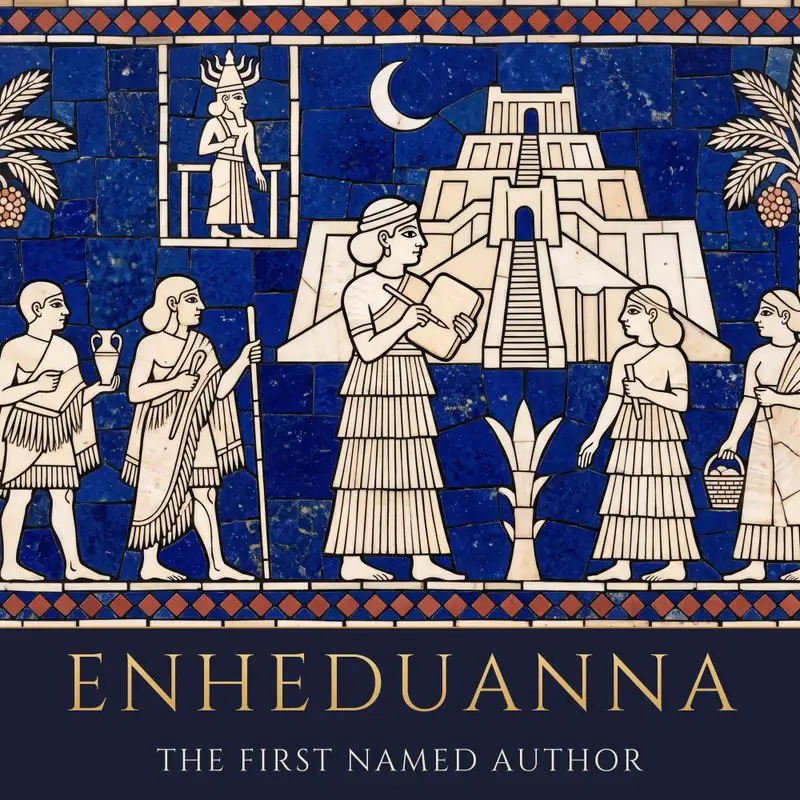
Welcome to The Sleeping Almanac. Tonight is not a myth. Tonight is a person. Last night, if you were here, we made a world out of water and a quarrel and the body of the oldest thing there was, and we ended with a king being slapped in a quiet room until he cried, so that the year could begin. Tonight is quieter than that and closer to you. Tonight is a woman who lived, who had a job and a house and a staff and a bad year, and who wrote things down, and whose name is on them. She is the earliest author on earth whose name we know and whose work we can still read. Not the earliest writing. Writing is older than she is by centuries, and most of it is receipts. She is the earliest person who put their name at the end of something they made and said, in effect, this one is mine. Her name is Enheduanna. Tonight you will hear what her days were like in a moon temple four thousand three hundred years ago, and what she wrote, and the year a man took her house away from her, and what she did about it, which was to write a poem and send it to a goddess. And at the very end I will tell you about a piece of white stone with her picture on it, which somebody, at some point, took a tool to. Stay with it, if you can, to the last chapter, for the stone. There is a room at the edge of the world, and in it there is a lamp. It is the same lamp. Perhaps you were here last night for the making of the world, or on other nights before that, for the gods and the baskets and the flood, or for the long story of what happened to the clay afterward. If so, welcome back, and your place on the reed mat is where you left it. And if this is your first night in the tablet house, be welcome. Nothing tonight will assume you were here before. The lamp is a small clay dish of oil, and it burns the pale gold of old honey. The room smells of river water and dust and barley. Outside, past the doorway, the river is going by in the dark, saying the same soft word over and over against the reeds. But tonight the scribe does not reach for the shelf. He goes to a wooden box in the corner, and lifts the lid, and takes out something that is not clay. It is stone. Pale, almost white, and cool, and heavy for its size, and round, like a plate, or the lid of a jar. He sets it down in the lamplight where you can see it, and turns it a little so the low light catches the carving on its face. This, he says, is not a story. This is a portrait. You do not have to do anything now. Settle onto the mat. Let the lamp be warm on one side of you and the cool night on the other. Close your eyes if they want to close. Tonight there is almost nothing to keep hold of. There is one name that matters and it is hers, and you will have it without trying, and there is a goddess and a moon god and a man who takes her house, and that is the whole cast. Everything else tonight is places, and places do not need to be remembered. A life goes by in order, the way a life does. You do not have to follow every word. You do not have to remember any of it in the morning. If you drift, the story will go on without you. And one thing, whispered like a promise across the stone. Nothing tonight will startle you. There is no battle in this episode, and I want to say that clearly at the start, because there is a rebellion in it and I do not want you bracing for a fight that never comes. Nobody in this story dies. A woman loses her job, and is frightened, and is away from home for a while, and then she goes home. That is the shape of it. The worst thing that happens tonight is that somebody is made to leave a house they loved, and they get it back. Before we begin, one small thing, and then we will not interrupt again. If this story carries you down toward sleep, subscribe now, while your eyes are still open, and the rest of the season will find you as it comes. A like helps other tired travelers find this lamp. And if you would rather carry these nights with you, The Sleeping Almanac is also a free podcast, on Apple Podcasts and on Spotify, waiting wherever you listen. That is all. Now settle back, and we begin.
It is a disk of white calcite, about ten inches across and an inch and a half thick, and it is carved on one face, and it is broken. Let us look at the carving first and come back to the breaking at the end of the night, because the breaking is the last thing I have to give you and it is worth waiting for. There are four figures on it, in a row, and they are doing something specific. At the front, a naked man is pouring a liquid from a jug onto a tall stepped structure. He is a priest, and the structure is an altar, and what he is pouring is a libation, an offering of drink, which is the oldest form of hospitality there is. You give the guest a cup. The guest here is a god. Behind him, larger than he is, and this is deliberate, because in that world importance is drawn as size, stands a woman. She is wearing a flounced robe, layer on layer of tiered fabric down to her ankles, and on her head is a rolled brim cap, a kind of turban, which is not a decoration. It is a uniform. It says what she is. She has one hand raised, and she is watching the priest pour, and she is in charge. Behind her, two attendants, smaller, one carrying something. And above and behind all of them, cut into the stone, a crescent, or the traces of one. The moon. Now turn it over. On the back, cut into the flat side, there is writing, and this is the part that makes the object what it is. The inscription names her. It gives her titles. It says she is the en priestess of the moon god Nanna at Ur, and it says whose daughter she is, and it calls her by her name. Enheduanna. Which is not a birth name at all, and this is the first thing worth knowing about her. It is a title she was given, and it means something like ornament of heaven, or high priestess ornament of the god of heaven. Whoever she was before she came to Ur, that name is gone. What we have is the name of the office, worn by the woman who did the office better than anyone ever had. Now, a disk with a name on it proves that somebody made a disk with a name on it. It is very good evidence and it is not the only evidence, and I want to give you the rest of it now, because in a season where almost everybody is a god it matters that this one is not. There are seals. A seal, in that world, is a small stone cylinder, about the size of the top joint of your thumb, carved all over with a scene and an inscription, cut backwards, so that when you roll it across wet clay it leaves the picture the right way round. Everybody who had authority had one. You wore it on a cord. It was your signature, and rolling it across the clay was how a document became yours. And we have seals belonging to members of her household, and they say so on them. One belonged to a man called Adda, and it says he is the scribe, and it says whose scribe he is. Another names a man who was her hairdresser. Another names her steward. These are not literary objects and nobody was making a point with them. They are the equivalent of an office pass with a job title and a department on it. So the evidence that she existed is not a poem. It is an object with her office on it, and a set of other objects belonging to the people who worked for her, found in the building where she worked, naming her as the person they worked for. She is standing on a piece of stone, in a museum in Philadelphia, tonight, larger than the priest, in her flounced robe, with her hand up, watching a man pour a drink for the moon. And here is the sentence I want you to fall asleep on eventually, though not yet, because we have a whole life to go through first. Everything else in this season is a poem about gods. This is a photograph of an employee. The scribe turns the disk over in his hands and sets it down. Now, he says. How does a person end up on a stone.
Her father was the most successful man of his century, and possibly the most consequential, and almost everything anyone says about his early life is probably a story he told about himself. His name was Sargon, and the name itself is a slogan, because it means the king is legitimate, which is not a thing you are called if nobody has raised the question. The legend, and it is a legend and I will say so, is that his mother was a priestess who could not keep him, and that she set him in a basket of rushes, sealed with pitch, and put him on the river, and that a man drawing water found him and raised him as a gardener. You have heard that story before with somebody else in the basket, and the two are almost certainly related, and which way the borrowing went is argued about, and it is a lovely argument that nobody will ever win. What matters tonight is only that Sargon told it about himself, or let it be told, because he needed an origin and he did not have a royal one. What he had instead was the army. He came up through somebody else's court, and then he was not in somebody else's court any more, and by the end of it he had done a thing nobody had done before. There had always been cities in that country, dozens of them, arguing and trading and occasionally fighting, each with its own god and its own wall and its own king. Sargon put them under one hand. He is generally called the first person to build an empire, and while historians will properly qualify that, the qualification is about definitions and not about the size of what he did. And he had a problem, which is the problem every conqueror has, and it is not military. The cities he had taken were old. Some of them were more than a thousand years old already when he arrived. They had their own gods, their own priesthoods, their own way of doing things, their own language. Sargon and his people spoke Akkadian. The old south spoke Sumerian. He could hold the country with soldiers for as long as he lived, and then it would come apart in a week. And here is a thing about him that I have never got over, and it belongs in a sleep story more than it belongs in a history book. He built a capital. He named it Akkad, and the whole language is named after it, and the whole period is named after it, and for a hundred and fifty years or so it was the richest and most important city in the world, and kings wrote about it, and poems described its harbour and its granaries and the ships from three countries tied up at its quays. Nobody has ever found it. That is not a figure of speech. Every other great city of that world has been dug: Ur, Uruk, Nippur, Eridu, Kish, Lagash, Babylon, Nineveh. Their walls are mapped and their temples are numbered and you can walk in them. Akkad, the capital of the first empire on earth, has never been located. There are candidate mounds and there are arguments and there is a great deal of careful work going on right now, and there is no agreement. The most likely explanation is dull and enormous: it is probably under the modern silt somewhere near where the two rivers come close together, and the rivers have moved since, and it is down there under fields, unopened. Somewhere under a farm in Iraq tonight there is a palace with a throne room in it that nobody has seen for four thousand years. I only tell you so that you have the right feeling about the family this woman came from. They were not ancient to themselves. They were new money, from a city that is now missing. So he did what worked, and it worked for longer than his empire lasted. He put his daughter in the temple. Not as a hostage and not as a spy. As the en priestess of the moon god at Ur, which was one of the most senior religious offices in the whole of the old country, and which was not a decoration either. The en of Nanna at Ur ran a household. She oversaw the rites. She administered land and stores and staff. She was the human counterpart of the god, and in the language of the time she was called his spouse, which meant something formal and institutional rather than anything else, and she held the office for life. And she was the daughter of the northern king, in the oldest office in the southern city, performing the southern rites, in the southern language. It was the most intelligent thing he ever did, and we know it worked because the office he put her in outlasted him by five hundred years, and because kings who came long after and had nothing to do with his family kept putting their own daughters in it, in imitation of him. But that is the politics, and the politics is the least interesting thing about her, and we are done with it now. Because what he cannot possibly have planned, what no father plans, is that the daughter he installed for reasons of state turned out to be able to write.
So here is where she lived, and I want to take our time in it, because it is the most restful room in the season and because she is going to lose it in about four chapters and I would like you to know it well enough to miss it. The city is Ur, in the far south, near the water, in the flat country of canals and date palms and barley. In the middle of it, on a raised terrace, is the moon temple, and the moon god is called Nanna, or Suen, and he is old, older than the city, older than almost anything. And attached to the temple, part of the same complex, is a building called the gipar. The gipar is her house. It is a large square building, thick walled, built around courtyards, and it contains two things at once. It is the residence of the en priestess, with her rooms and her stores and her kitchens and her staff. And it is also the shrine of the goddess Ningal, who is the wife of the moon, so that the priestess of the moon lived inside the house of the moon's wife, which is exactly the kind of arrangement these people found satisfying and which I have always thought is rather beautiful. Thousands of years later a man with a trowel dug that building out of the ground and walked through its rooms, and we know its plan, and we know where the doors were. So. A day. She would have risen before light, because the rites go with the sky and the moon god's business is at night and the turn of the night is when the offerings are made. There is a fire kept somewhere. There is bread. There is beer, which in that country is food rather than an indulgence, thick and slightly sour, drunk through a straw from a jar because of the barley husks in it. There are people everywhere. This is the thing that surprises everyone about ancient temples. They were not quiet. They were the largest employer in the city. There were bakers and brewers and weavers and gardeners and cooks and singers and cleaners and scribes and men who looked after the animals, and all of them ate from the temple's stores, and all of it was written down, because that is what writing was invented for and it is still, in that century, mostly what it is used for. She oversaw it. The offerings, the calendar, the festivals, the accounts. There are seals that belonged to members of her household and they carry names, and the names are ordinary, and I like reading them because they are the only trace we have of the people who were actually in the rooms with her. A man called Adda, who was her scribe. A man called Sagadu, who was her hairdresser, which tells you something about the establishment. Another whose seal calls him her steward. And at the turn of the month, the moon does what it was told to do in last night's poem, and thins to nothing, and is gone for a night or two, and then comes back as a blade of light over the flat country. And when it did, they marked it. The new moon was a festival. So was the seventh day, and the fifteenth when it was full, and the day it disappeared. Her whole calendar was the moon's instruction, followed on the ground. And I should say what the office actually consisted of, because it is easy to imagine something mystical and it was mostly not. She performed the offerings. She presided at the festivals of the month. She managed the estate, which was large, because the temple owned land and the land produced barley and dates and wool and somebody had to account for all of it. She appears in the record as an authority, in the way an abbess or a college head appears in a record, which is to say in documents about property and appointments and stores. There is one part of the job that people ask about and I will deal with it plainly and briefly and then we will move on, because there is a great deal of nonsense written about it. In some cities, in some periods, there were rites in which a priestess and a king enacted a marriage between a goddess and a god. Whether that ever involved anything beyond ritual and formula is not known, and the honest scholarly position is that we do not have the evidence, and that a great deal of confident writing on the subject is confident about something nobody can see. There is no reason to think it has anything to do with this woman's office at Ur, which was the office of the moon god's spouse in a formal and institutional sense, and I mention it only so that you are not left wondering. Now we can go back to the building. Because the building is the thing, and it is real, and you can look at its plan. Thick outer walls, because everything was mud brick and mud brick wants to be thick. A doorway on one side. Inside, courtyards, open to the sky, because that is how you get light and air into a building with no windows worth the name in a country where the sun is an enemy for half the year. Rooms off the courtyards. Storerooms. A kitchen with the fire scars still on it. And on one side of the complex, the shrine of the goddess Ningal, the moon's wife, with its own small court and its own altar. And under the floors, graves. That is not sinister and I do not want it to sound so. They buried the high priestesses in the house. When one died, they laid her in the ground of the gipar and went on using the rooms above her, and the next one came and lived there and was buried there in her turn, and this went on for five hundred years. The women who held that office are all in that floor, one after another, in order, like the tablets on the shelf. And somewhere in that building, in the middle of all that work, there was a person with a stylus and wet clay and a habit.
The first thing she made that we have is not a poem about herself. It is a survey. It is called the Temple Hymns, and it is a collection of forty two short hymns, one for each of forty two temples, in forty two different cities, all across the country, from the far south up into her father's north. Each one is short. Each one names the city, and the temple, and describes the building, and says something about the god who lives in it, and ends with a formula, so that the whole set has a rhythm you can feel even in translation, the way a list of stations on a railway line has a rhythm. And I want you to see what that actually is, because on the surface it is a devotional text and underneath it is something rather astonishing. It is a map. Forty two temples, in order, north and south, the old Sumerian cities and the new Akkadian ones, all of them in one document, all of them treated with the same care, all of them given the same form. Eridu, which they believed was the oldest city in the world. Nippur, the seat of Enlil. Uruk and its great precinct. Ur, her own. Sippar of the sun. Her father's city in the north, and the old southern places his soldiers had marched through. Let me take you down a few of them, in the order she put them, and you can let them go past. The first one is Eridu, in the far south, in the marshes, which they believed was the oldest city in the world and the first place kingship came down. Its temple belongs to the god of the sweet water, and the hymn calls it a house built on the water, standing over the deep, and that is not a metaphor. Eridu sits where the fresh water comes up out of the ground, and the temple is built on top of it, and the whole idea of that god is that he lives underneath in the water that fills the wells. Then Nippur, in the middle of the country, which is not a capital and never was, and which every king in that world had to be recognised at anyway, because it belongs to Enlil, the lord of the air, and his house is called the mountain house, in a country with no mountains. Then Uruk, the great old city, walled, enormous, the one with the precinct of the goddess of the thing that turns over in a night, whose house is called simply the house of heaven. Then Ur, and this one she wrote about her own front door. Then Sippar of the sun, whose temple is called the white house, and the sun god is the god of judgement in that world, so the white house is also the courthouse, and people came to it with disputes and swore oaths there. Then Girsu, which is where she was going to end up living when things went wrong, though she did not know it when she wrote the hymn. And on, and on, temple after temple, city after city, each one four or five or a dozen lines, each one ending in the same closing formula so that you know the shape of the next one before it starts, which is exactly how a person half asleep likes a list to behave. She took a country that had just been forced together by an army and she put it back together as a hymn. Nobody made her do that. It is not an administrative document and there is no evidence anyone commissioned it. And whether every line of it as we have it came from her hand is a real question that I will come back to, because the copies we have are much later. But the collection is hers, and it was known as hers, and it was used for five hundred years afterward in the schools where scribes were trained, which means that generations of children in that country learned to write by copying out a list of temples that a woman had put in order. And at the end of it, after the forty second hymn, there is a line that is unlike anything else in the literature of that world. She signs it. The last lines name her. They say that the compiler of the tablets is Enheduanna, and then they say something that translators render in slightly different ways, but which comes to this: my king, a thing has been made here that no one has made before. Sit with that for a moment. Everything written before this, and there is a great deal of it, going back centuries, is anonymous. Receipts do not have authors. Contracts do not have authors. The old poems and hymns do not have authors, they simply exist, the way a road exists. Nobody had ever thought to put their own name on a piece of writing and claim it, because the idea that a text belonged to the person who arranged it does not seem to have been an idea anybody had. And at the end of a list of temples, in a moon house at Ur, somebody wrote, this is mine, and it is new. That is the sentence that makes her the first author. Not the first writer. Not the first poet, because there were certainly poems before her and singers before that. The first person we know of who stood at the end of a piece of work and put their name on it and said that it had not existed until they made it. The scribe sets his stylus down on the edge of the tablet. She was, he says, about to have a very bad year.
Before the bad year, one more thing she wrote, and it is the longest of them and the most damaged, and it is about the goddess she is going to need. Its name, from its first words, means something like lady of the encompassing heart, and it is a hymn to Inanna, and it is enormous. Two hundred and seventy lines or so, in the pieces we have, and pieces is the right word, because it is broken in many places and we are reading it across gaps. And what it does, over and over, in line after line, is put two opposite things next to each other and say that the goddess is both. She is the one who makes war and the one who makes peace. She turns a man into a woman and a woman into a man. She gives and she takes away in the same movement. She is dressed in fear and she is dressed in delight. To one person she is a friend at the door and to the next she is the thing at the door. To destroy and to build up are hers. To plant and to pull up are hers. Praise and abuse are hers. Deceit and truthfulness are hers. She has the shepherd's crook and she has the thing that takes the flock. To open the door of the house and to close it. To lift up the fallen and to bring down the standing. To be a friend at the door and to be the thing at the door. There is a run of lines that lists the people she is responsible for, and it is one of the strangest and most inclusive passages in the literature of that world, because it does not sort them into good and bad. The old woman, the old man, the singer, the one who mourns, the one who is grieving, the one who is glad, the priest and the priestess and the servant, the strong man and the weak man, and every kind of person who did not fit the ordinary categories of that society, all of them are named as hers, and none of them are named with contempt. It goes on like this, for pages, and it does not resolve, and I do not think it is trying to. Now, I want to be careful here, because this is a goddess who gets flattened in retelling more than any other, and both of the usual flattenings are wrong. She is not a love goddess with a temper. And she is not a war goddess with a soft side. Those are two ways of taking the same person and deciding which half is really her. What the hymn says, and it says it about forty different ways, is that both halves are equally her and that the switching is the point. She is what happens when things change suddenly. A city is at peace and then it is not. A person is loved and then they are not. A crop comes in and then it does not. Everything in that world that could turn over in a night belonged to her, and turning over in a night is exactly what a life in that country did. So when you are the highest priestess in the oldest city and everything is orderly and the calendar runs and the offerings are made on time and the moon does what the moon was told, and then one morning a man arrives with soldiers and it is all gone, you do not pray to the god of the moon about that. The moon is order. The moon is the thing that never varies. You cannot ask the moon for a reversal, because reversal is not what the moon does. You pray to the one whose whole nature is that things turn over. She wrote that hymn, as far as we can tell, before she needed it. Which is either a coincidence or the ordinary fact that a person spends years thinking about the thing they will eventually have to use.
There is one more poem I want to put in front of you, and I have to hand it to you with a label on it, and the label is this: some scholars think this one is hers, and some are not sure, and the honest position tonight is that it is attributed to her and disputed. I will tell it either way, because it is the best short story in her whole world and because if it is not hers it is certainly by somebody who had read her. It is called Inanna and Ebih. Ebih is a mountain. A real one, a range out to the northeast, in the country beyond the rivers, and it stands up out of the plain the way mountains do when you have grown up somewhere completely flat. The poem opens with the goddess speaking about herself, and it is worth hearing because it sets the terms. She says that she is the one who is respected in heaven and on earth, that she fills the sky with her light, that she is a fire and a flood and a storm, and that she will not be denied. It is not modesty and it is not meant to be. In these poems a god announcing what they are is the same act as a king reciting his titles, and nobody in the room found it strange. And in the poem, the goddess looks at it and it does not bow. That is the whole grievance. It does not bow. It stands there, green and forested and full of animals, in its own country, doing well, and it has not lowered itself, and it has not put its nose to the ground, and it has not acknowledged her. So she goes to the sky god, her father's father, and she says she is going to deal with it, and he tells her not to. He says, plainly, that the mountain is terrifying, that its radiance is fearsome, that it is dreadful, and that she should leave it alone. And I like the sky god here, because he is doing what a cautious senior person does, which is to lay out the risk clearly and then decline to help. He does not forbid her. He tells her it is dangerous, and he describes the danger accurately, and he offers no assistance, and he stays where he is. And she says no. And she goes anyway. What follows is short and strange and reads more like weather than like a battle. She raises a storm against it. She strikes at its sides. She sets fire in its woods. And when it is over the mountain is cut down and quiet, and she stands on it and speaks to it, and what she says is not gloating, exactly. It is a list of what it had and what it has now. You had trees, she says, and I have set fire to them. You had rivers, and I have turned them. You would not bow, and now you are lower than I am. And then she builds a shrine on top of it, and puts a throne in it, and sits down. Here is why I wanted you to have this before the next chapter. That is a poem about somebody who would not lower himself to a woman with an office, and about what happened to him. And in about ninety seconds of story time a man is going to arrive at the moon house at Ur and refuse to lower himself to a woman with an office. The poem is not a prophecy. It is older than her trouble, if it is hers at all. But when she sat down in her worst year and chose which god to write to, she chose the one who levelled a mountain for not bowing, and she had that story in her hands, and I do not believe for one second that she had forgotten it.
His name was Lugal Ane, and outside of her poems he is almost nothing. A name in a list. A man who held Ur for a while. What happened, as far as anyone can reconstruct it, is the thing that happens to every empire in its second generation. Sargon died. His sons took over. And all through the old south the cities that had been held down by one man's personal authority discovered that the authority had been personal, and they rose. It was not one rebellion. It was many, in many cities, over years, and the family put them down and they came back and the family put them down again. Her nephew is the one most people have heard of, if they have heard of any of them. His name was Naram Sin, and he was the grandson of Sargon, and he put down a revolt so large that later writers remembered it as the whole world rising at once. And he is remembered for one other thing, which is that he is the first king in that part of the world to write his own name with the sign that marks a god, and to be shown on a monument wearing the horned crown that only gods wore. There is a famous carved slab of him climbing a mountain with stars above his head and his army coming up behind him, and it is in a museum in Paris, and if you have ever seen a picture of Akkadian art you have probably seen that one. It is a war monument and it is doing what war monuments do, and we will leave it on its wall. And a few centuries later somebody wrote a long poem blaming him personally for the fall of the empire, saying he had offended the god at Nippur and brought the mountain people down on everybody, and the poem is a masterpiece and there is very little reason to think it is history. It is what a later age decided must have happened, because empires that end need a reason, and a proud man on a mountain with stars over his head is a very good reason if you are looking for one. That is the family. Grandfather who may or may not have come down a river in a basket. Grandson who put a god sign in front of his own name. And in between, in the moon house at Ur, running the accounts and writing the hymns, the daughter. At Ur, the man who took the city was Lugal Ane. And having taken the city, he needed the temple. This is the part people miss when they imagine ancient rebellions as purely military. He could hold Ur with soldiers. He could not be the legitimate lord of Ur without the moon god's household, and the moon god's household was run by a woman whose surname, in effect, was the name of the family he had just overthrown. So he came to the gipar. The poem does not give us a scene, and I am not going to invent one, and I want to say that out loud because the temptation is enormous and this house does not do it. There is no dialogue. There is no confrontation on a step. What the poem gives us is the aftermath, told by the person it happened to, in the first person, later, from somewhere else. What we can say is what he wanted, because it is obvious from the shape of it. He wanted her to confirm him. To perform the rites in his name. To let the office say that he was legitimate. And she would not. That is the whole of the rebellion in this episode, and it is one sentence long, and it is the most consequential refusal anybody in this season makes. She would not, and so he removed her.
He took the office from her. The poem says he stripped her of the true office, and it is very specific about what that meant in practice, and the specifics are what make it hurt. He put his hand out to her, she says. He took the offering bowl away. He put an end to the rites. And then the line that is the worst one, and it is worst because it is the smallest. He made her leave the gipar. Not the city, first. The building. The house with the courtyards and the kitchens and the stores and the shrine of the moon's wife inside it, where she had lived and worked for years, and where every single thing had a place and she knew where all of them were. She says, and this is her own voice, that she was made to walk out through a window like a swallow. That she was made to fly from the house. Some translations have her carried off in the wind. However you render it, the picture is a person leaving a building not by the door. And then she was gone from Ur altogether, and she went into exile, and the place she went, as far as we can tell, was Girsu, which is another old city off to the east, with its own temple and its own god and no particular reason to care about her. And I want to give you Girsu properly, because I have just named it and walked past it, and it is not a nowhere. It is one of the best documented places in the entire ancient world. That is not an exaggeration. Tens of thousands of administrative tablets have come out of that city and the country around it, from various periods, and they are the reason we know as much as we do about how a Mesopotamian city actually ran. Ration lists. Field measurements. Wool deliveries. The names of ploughmen and the number of days they worked. It is the place where, more than anywhere, the ordinary machinery of that world is visible. It had its own god, a warrior god of the plough and the storm, whose emblem was a great bird with a lion's head, and you will meet that bird properly on a later night of this season. And it had a functioning temple household, with an en of its own, and a calendar, and offerings made at the right hours by the right people, every day, exactly as at Ur. Which is the detail I want you to sit with, because it is the sharpest thing in the whole exile and the poem does not say it. She was not sent to a wilderness. She was sent to another temple city, in full working order, where every morning somebody she did not know went into a building she had no business in and performed, correctly and on time, the same kind of office she had been performing for thirty years and was no longer allowed to perform. She would have heard it. You cannot be in a city like that and not hear it. The drums at the turn of the month. The processions on the festival days. The particular quality of noise a temple makes when the offerings are going in and the staff are all busy and everything is running. All of it going on beautifully, a few streets away, without her. That is what the poem is describing when it says that the day is no good to her and that she does not know what to do with it. She is not lost in a desert. She is a professional, in a town full of her own profession, with no post. And anybody who has ever been out of work in a place where everybody else is working knows the specific sound of that, which is the sound of other people's ordinary Tuesday. Now I want to slow all the way down here, because the middle of this episode is the part of the night where you are most likely to be going under, and because what happens next is not dramatic at all, and I would like you to have it gently. She was, for a period we cannot measure, a woman without a job in a town that was not hers. That is it. That is the disaster. Nobody is chasing her. She is not in a cell. She has, one assumes, money and standing and a name, and somewhere to sleep. What she does not have is the building, and the calendar, and the rites at the turn of the month, and the thing she was. The poem is full of what that felt like and none of it is loud. She says she no longer knows what to do with the day. She says her sweet mouth has turned bitter. She says that the pleasant thing she used to do, the thing that was hers, has been swept away. She says she is like a swallow that has flown, and she says she does not know where the perch is. There is a line where she describes standing in the daylight and it being no good to her, and another where she says she carried the ritual basket and sang the song of joy and now the funeral offering has been set out, as though somebody had died, and the somebody is her office. And in the middle of that, in a borrowed room in a city that was not hers, with no temple to run and no household and no reason to get up early, she did the only thing she had ever been able to do that nobody could take away from her. She got clay.
What she wrote in exile is a hundred and fifty three lines long, and it is called, from its first words, lady of all the divine powers, and it is the most extraordinary document in this entire season, and I am going to walk you through it slowly, because the shape of it is the whole point and the shape is very strange. It begins as a hymn. Not as a complaint. Not as a letter. For the first forty lines or so it is a public, formal, entirely conventional hymn of praise to Inanna, of the kind she had been writing and performing for years, and it is beautiful and it is impersonal and it is exactly what you would expect the high priestess to produce. Lady of all the divine powers, resplendent light, righteous woman clothed in radiance. Beloved of heaven and earth. Great in your greatness. She praises her as the storm. She praises her as the flood that comes down the mountain. She praises the terror of her, the way people scatter before her, the way the land shakes. She spends a long time on how frightening the goddess is, and this is not flattery, or not only flattery, because a person who has been thrown out of her house by a man with soldiers has a very practical interest in the size of the god she is writing to. And then, somewhere around line sixty, without warning, the poem turns. It stops being about the goddess and starts being about her. I am Enheduanna, she writes. That is the line. Four thousand three hundred years ago a woman put her own name inside a poem, in the middle of it, in the first person, as the person the poem is happening to, and as far as anybody knows nobody had ever done that before in the history of writing. I am Enheduanna. I was the high priestess. I carried the ritual basket, I sang the song of joy. Now I am placed in the leper's house. The daylight is hidden from me. The shadow falls over me. My honeyed mouth has become bitter. And then she describes the man, and she describes him without a battle scene and without a curse and in the flattest possible language, which is why it works. That man has taken my crown away from me. He has taken away my office. He has said, this is mine. He set his hand out to me. He put an end to the rites. And then she does something that I find almost unbearable in its ordinariness, and which is the reason I love this poem. She says she asked the moon god first, and he did not answer. She had spent her adult life in the moon's house. She was the moon's own priestess. She was, in the language of the office, his spouse. And she says, in the poem, plainly, that she went to Nanna, and pleaded her case, and there was no answer, and she says the words for it that anybody who has ever prayed and got nothing back would recognise. It is as if he does not care about me. So she turns to the other one. To the goddess of the thing that turns over in a night. The one from the hymn she had already written, the one who is both halves and whose whole nature is reversal, the one who went up a mountain that would not bow. And before the argument there is a passage about the state she is in, and it is the most physical writing in her whole surviving work, and it is not grand at all. She says she cannot stretch out her hand from the pure place where she used to. She says that where there was sweetness there is now no sweetness. She says the good days are turned to a different thing. She talks about her own voice, and this is the part that gets me, because a person whose entire profession was performance says that her mouth, which was for singing, has gone bitter, and that the thing she was known for doing beautifully is now the thing she cannot do. And there is a line in which she says that she is not being spoken well of. That her reputation is being handled by other people, in her absence, and she cannot answer it. Four thousand three hundred years, and that is still the worst part of losing a position, and she got it down first. And she makes her argument, and the argument is not what you would expect either. She does not mostly ask for pity. She tells the goddess that this is a matter of the goddess's own standing. That the world does not yet know her greatness properly. That her power should be spoken of everywhere. She offers, in effect, a trade. Restore me, and I will make you famous. Which is either the most audacious thing anybody says to a god in this literature, or exactly what a temple administrator would say, because it is a proposal, with a benefit stated, from someone who has run a large organisation and knows how requests get approved. And then, near the end, comes the passage I have been saving all night, and I want to give it to you exactly here, at this hour, because it was written for this hour. She describes making the poem. She says that she gave birth to it. That in the night, alone, she brought this thing into being for the goddess, and that what she recited in the middle of the night, a singer should repeat back in the middle of the day. That is a woman describing her own working hours. She wrote it at night. Of course she did. She was a priestess of the moon god for thirty years and her whole professional life ran on the night calendar, and then she lost the office and kept the hours, the way people do, and so the first signed poem in the history of the world was composed in the dark by somebody who could not sleep, and the instruction attached to it is that it should be sung back in daylight by somebody else. You are hearing it in the middle of the night. Somebody, somewhere, is probably reading it in the afternoon. She arranged both. There is one more movement before the end, and it is the one that scholars spend the most time on, because in it she seems to describe the poem working while she is writing it. She says that as she speaks, the goddess grows. That the praise she is putting into the poem is itself the thing that raises her. And so the poem is not only a request for help. It is the payment for the help, delivered in advance, inside the request. She is doing the thing she promised at the same moment she promises it. I do not know how to describe what that is except to say it is the most confident piece of writing I know of from the ancient world. A woman with no office and no house, in a borrowed room in a town she did not choose, wrote a poem whose argument is that the poem itself is so good it constitutes proof that its author should be restored, and then she sent it, and then she was restored. And then the poem ends, and it ends with the thing being granted. The last movement says that the goddess heard her. That her prayer was accepted. That Inanna's heart was cooled, that the day became favourable, that she was clothed in beauty again, and that the light was sweet. The words are careful and formal and there is no scene of triumph, no vengeance, no mountain cut down, no man punished. Just the day becoming favourable. And the light being sweet.
She got the office back. We know this the way we know most things about her, which is sideways, from objects and lists rather than from a story. There are records that place her back at Ur, in the office, afterward. The rebellion at Ur was put down by her family, as the rebellions generally were in that generation, and Lugal Ane goes out of the record entirely, which is the fate of almost everyone who ever held a city for a while. And she went home. I want to give you the walk, because it is the best thing I can give you at this point in the night and because the poem does not describe it, so it is mine to imagine carefully and yours to take or leave. The road into Ur from the east, in the late part of the day, with the flat country going out on both sides, and the canals with their lines of date palms, and the smell of water and mud and animals. The wall, and then the gate. The streets she had known for thirty years, narrow, mud brick, hot on one side and cool on the other. Then the temple terrace, rising up out of the middle of the city, pale in the low sun. And the gipar, with its thick walls and its courtyards, and the shrine of the moon's wife inside it, and the stores, and the kitchens, and the rooms, and every single thing back in the place where she knew it was. The door. Not the window this time. And whatever staff were still there, the scribe called Adda and the steward and the man who did her hair, standing about in the courtyard the way people do when somebody has come back and nobody is quite sure what to say. And then, presumably, the following morning, at the turn of the night, the offerings. Made in the usual way, at the usual hour, in the correct order, by the person whose job it was, which after everything is the most satisfying possible ending, because it is not a triumph. It is a Tuesday. She was the en priestess of Nanna at Ur for the rest of her life. When she died she was buried, as far as we can tell, in the gipar itself, in the ground of the house, along with the other high priestesses who came after her, because they kept that office going for five hundred years and they kept burying them in the same building. And the office went on. That is the part I find steadying, and it is worth having before we go to the last two chapters. Whatever she did in that job, she did it well enough that the job itself became permanent. After her there was another en priestess of Nanna at Ur, and after that one another, and it kept going for something like five hundred years, through the end of her family's empire and the rise and fall of the next one and the one after that. Kings who had no connection to her family at all kept installing their daughters in it, in deliberate imitation, because by then it was simply what a king who wanted to be taken seriously in the south did with a daughter. The last one we know of was the daughter of a Babylonian king called Nabonidus, more than a thousand years after Enheduanna. He is the king who was interested in old things to a degree that annoyed his own priesthood, and when he decided to install his daughter in that office he sent people to dig up the old gipar to find out how it had been done properly. They found the earlier inscriptions. They read them. They rebuilt the building, and put his daughter in it, and wrote down that this was the correct ancient way. A man went digging in the ruins of her house for the right way to do her job, a thousand years later, and left a note saying he had checked. That is the end of the life, and there are two chapters left, and both of them happen after she is dead.
Here is the strangest fact about Enheduanna, and it is the one that took me longest to get used to. We do not have a single line of her poems in her own handwriting. Not one tablet from her lifetime. Nothing from the twenty third century before the year one. Every copy of the Exaltation, of the great hymn, of the temple hymns, every single one of the hundreds of pieces we have, comes from about five hundred years after she died. And they come, almost all of them, from schools. That is the picture, and I want you to have it because it is the warmest thing in the episode and the reason any of this survived. In the old cities, centuries later, in a period when scribes were trained in a formal way in what were essentially classrooms, boys and some girls were taught to write by copying out the standard texts. The way you might have learned handwriting by copying a passage. And among the standard texts, in the curriculum, alongside the old hymns and the proverbs and the lists of trees and birds, were her poems. Picture the room, because we know a fair amount about it. A house in a city, one room of it given over to it, a master and a handful of students. A basket of clay in the corner and water to keep it workable. Round tablets, the size of your palm, with the teacher's line written across the top and the student's copy of it underneath, which is how we can tell which is which. When a tablet was finished with, the clay was soaked and reused, unless somebody happened to throw it in a wall or a floor, which is why we have any of them at all. They learned in stages. First the signs. Then lists, endless lists, of trees and reeds and vessels and animals and stones and professions and place names, which is how you learn several thousand signs. Then proverbs, short and dry and often funny. And then, when a student was good enough, the literature, and the literature was a fixed set of texts that everybody copied, the way every schoolchild in a country ends up having read the same handful of poems. Her poems were in that set. So there are dozens and dozens of copies of the Exaltation of Inanna, in the same hand a child would use, some of them with mistakes, some of them corrected, some of them broken off halfway because whoever it was got tired or was called away or simply stopped. Five hundred years after a woman in a moon house signed a list of temples, children were learning to write by copying out her sentence about being made to leave through a window like a swallow. Now this is also the reason for the honest complication, and I am not going to leave it out. Because the copies are late, we cannot prove that every word we read is a word she wrote. Some scholars think the poems are substantially hers, transmitted carefully, the way texts were transmitted in that world, which was carefully. Others think the schools shaped them over five centuries, and that what we have is Enheduanna as the tradition remembered her. A few go further and treat the whole attribution as a later school's idea about a famous name. There is a useful way of holding all three of those at once, which I did not invent and which comes from the scholars who work on her, and it is that there are several Enheduannas. There is the woman, who certainly lived, whose office is documented, whose disk exists, whose household's seals we can read. There is the author the schools believed in, five centuries later, when they put her name at the head of the curriculum. And there is the figure of the last fifty years, the world's first named author, on posters and in anthologies and on a crater on the planet Mercury, which is a real thing and which is named after her. All three are real. Only the first one had a house.
The scribe reaches over and puts his hand on the white stone. In nineteen twenty seven, a man called Leonard Woolley was digging at Ur, and had been for years, with his wife Katharine, and they went through the moon temple complex and into the gipar, which is how we know its rooms and where its doors were. And in a passage in that building, in the fill, in the rubbish and broken material that had accumulated in it, they found this. Not on a shelf. Not in a case. Not set up anywhere. In pieces, in a passage, among the debris. It had been broken. And Woolley, looking at it, wrote down what he thought had happened to it, and what he thought was that it had not simply fallen. There are marks on it. The face of the carving, the surface with the four figures on it, is damaged in a way that looks to him and to many people since like the work of a tool. Somebody, at some point, with something in their hand, went at it. Deliberately defaced, is the phrase. We do not know who. We do not know when. It could have been in her own century, by somebody who was there when the soldiers came. It could have been generations later, in some other quarrel about some other family. It could have been a person with a reason we would recognise or a person with a reason we would find absurd. Nobody wrote it down. All we have is a broken stone in a passage and the marks on it. And here is the last thing, and it is the reason I asked you at the very beginning to stay awake this long if you could. Among the pieces, they found a flake. One small piece of the carved face, broken off, lying in the fill with the rest. And on that flake, undamaged, was her head. Her face came off in one piece and was not destroyed. Whoever went at that stone with a tool did not manage to take away the part they had presumably most wanted to take away. It broke free and it lay in the ground in the dark of a ruined building for four thousand years with her face on it, and then a man with a trowel picked it up. And they put it back. It is not a perfect restoration, and the people who study it now argue about how much the nineteen twenties repair took liberties, which is a fair argument and a modern one. But the object you can go and stand in front of has a woman on it, larger than the priest, in her flounced robe, with her hand raised, watching a man pour a drink for the moon, and her face is on it, and it is her face, on the piece that came away whole. The lamp is low now. Think of it, wherever you are lying. Somebody built her a stone. Somebody else broke it. The ground kept the piece that mattered. And a man who had never heard of her found it and set it back where it went, and now it is in a case in a museum in Philadelphia, under a light, and people walk past it all day. And in the schools, five hundred years after her death, children copied her sentences to learn how to hold a stylus, which means her words went out through hundreds of hands into the ordinary machinery of a country, and that is the copy that mattered, not the stone. The stone is only her picture. Four thousand three hundred years is a long time for a name to last, and hers lasted because of two completely unremarkable things. She signed her work. And other people, who did not know her and had no reason to care, kept copying it out because it was on the list of things you copied. That is all it takes. Somebody puts their name on something, and then, for a very long time, other people simply do not throw it away. Outside, past the doorway, the river is going by in the dark, saying the same soft word over and over against the reeds. The moon is doing what it was told to do last night, and thinning, and it will be gone in a day or two, and then it will come back over the flat country as a blade of light, the way it did over her house, at the hour she used to be awake. You do not have to keep any of tonight. If you keep one thing let it be the flake with her face on it, lying in the ground in the dark for four thousand years, waiting, without needing anything, until somebody came. Sleep well. Goodnight.