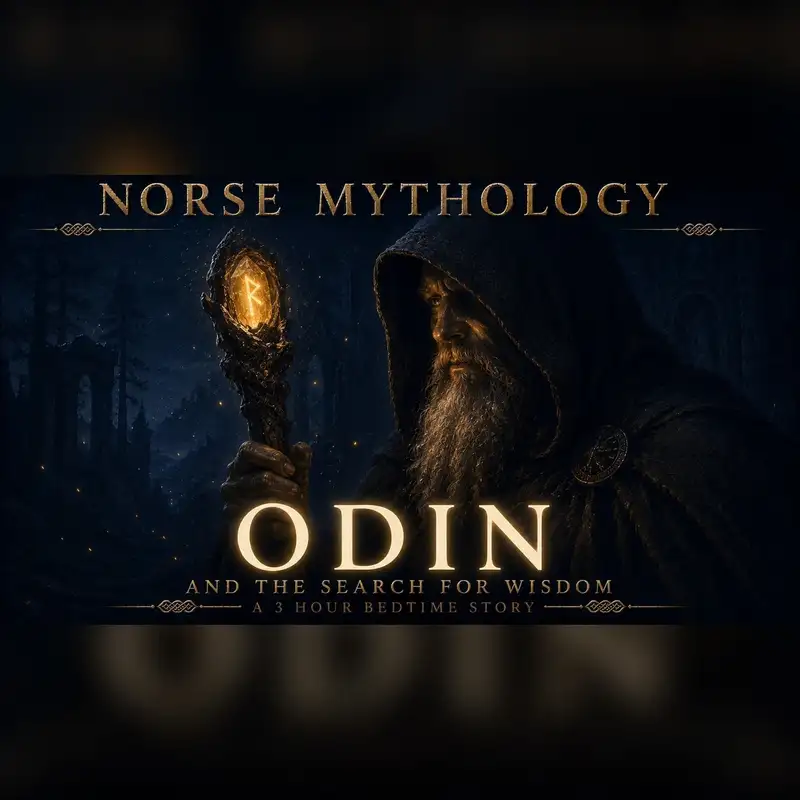
Good evening. Or perhaps good night — if you've made your way here in the small hours, the difference may already have stopped mattering.
You've come back, perhaps, because the first episode helped you sleep. Or you've come for the first time, and the second episode happened to be the one that found you. Either is fine. Tonight stands on its own. We will not require you to remember anything from before.
If you are listening in bed, I'd ask you to do very little. Close your eyes. Let your jaw soften. Let your shoulders drop, even a little, even if you didn't know they were tight. The story does not need your attention. It will keep moving whether you follow it or not. If you drift, that is the point. If you wake briefly to catch a single sentence and then sink again, that is good. The almanac is patient.
Last episode, we set the stage. Nine worlds. A great tree at the center of everything. Roots that reach down into the dark places, and branches that vanish into the stars.
Tonight, we meet the figure at the heart of it all. The wanderer. The one-eyed god. The Allfather. The hanged god, who gave himself to himself, on a tree, in the wind, for nine nights, in pursuit of something he could not get any other way.
This is the story of Odin. And of what a god is willing to give, when what he wants is wisdom.
Now — let us begin.
Chapter One. The God Who Could Not Be Still.
Before we go to the well, and before we go to the tree, we should first sit, for a while, with the figure of the god himself. Because Odin is not what most people now think of when they think of a chief god.
If you've grown up with the Greek and Roman tradition, you may picture a great seated figure — Zeus on Olympus, Jupiter in his temple — a king-god, settled, established, presiding over a stable cosmos. A god who does not need to leave his throne, because the world comes to him.
Odin is not that.
Odin is a god who cannot be still.
He has a throne — we'll come to it in a few chapters — and from it, the medieval Icelander Snorri Sturluson tells us, he can see across the nine worlds. He has a hall, called Valhǫll, where the slain warriors gather. He has wives, sons, beasts that follow him. He has every reason, if he wanted, to sit and rule.
But the surviving stories almost never find him sitting.
They find him walking.
They find him on the road, in a wide-brimmed hat pulled low over his face, leaning on a staff. They find him in disguise at the courts of kings. They find him in the wilderness, between worlds, on the back of a strange horse with eight legs. They find him asking riddles of a giant whose name no one else has dared to learn. They find him hanging from a tree in a wind that does not stop.
The old stories almost never let him rest.
And the reason — or one reason, the reason the surviving sources keep coming back to — is that Odin is hungry. He is hungry for one specific thing. He is hungry for wisdom.
Now, hold that word lightly for a moment. The old Norse poets did not mean by it quite what we now mean. They did not mean book-learning, or cleverness, or the kind of wisdom one ascribes to a quiet old man on a porch. The word the poets used — the word that appears, again and again, when the sources describe what Odin is reaching for — is closer to knowledge of hidden things. Frœði. Visdómr. The kind of knowledge that is kept under stones. Under roots. Under the surface of dark water. The kind of knowledge that has to be paid for.
That is what Odin pursues.
You will hear, in many of his stories, the same arc, repeating. Odin discovers that someone, somewhere, knows something he does not. The someone is usually old. Usually a giant. Usually living far from Asgard, at the edge of the world, in a place no other god wants to go. And Odin goes. Often alone. Often in disguise. He pays — sometimes in his body, sometimes in his form, sometimes in something more precious than either. And he comes back changed.
This is the shape of the god you should hold in your mind tonight. A king-god who refuses to behave like a king. A god who would rather walk than sit. A god who is willing, again and again, to give up something he already has, because he cannot bear the thought of not knowing the thing he doesn't have.
In one reading of the Eddas — and this is the reading the great twentieth-century mythographer Mircea Eliade favored — Odin is not properly a king-god at all. He is a god of a much older type. A god of the seekers. A god of the shamans. A figure whose nearest cousins are not Zeus and Jupiter but the spirit-walkers of the Sámi north and the great hunter-gods of Siberia. A god who travels not by chariot but by trance. A god whose throne is not a seat of authority but a vantage point, used the way an old hunter uses a high rock to see what is moving on the plain.
That reading is not the only reading. Other scholars — Georges Dumézil among them — placed Odin firmly within an Indo-European tradition of sovereign gods, the kind one finds across many cultures. There is no need, tonight, to settle the question. The texts allow both readings, and the truth is probably that Odin contained both — that he was, by the time the surviving sources were written, already a layered figure, with the older shaman-god still visible beneath the newer king-god.
You don't need to choose. You only need to know, as we begin, that the god we are following tonight is not the kind of god who waits for you to come to him.
He goes.
And in this episode, we will follow him on the two journeys for which he is best remembered. The journey to a well, at the foot of the great tree, where the giant Mímir keeps watch over a water that holds something Odin needs more than he needs his own eye. And the journey, longer and stranger, that took him up into the branches of that same tree — where he hung for nine nights, in the dark and the wind, given to himself, with the point of his own spear in his side, until something rose out of the depths to meet him.
These are the two great sacrifices of Odin. The eye. And the body on the tree. The two payments he made, in the surviving stories, for the kind of knowledge he could not get any other way.
We will come to both, slowly.
But first — before the well, before the tree — we should learn the rest of who he is. We should walk with him for a little while. We should learn the company he keeps, the gear he carries, the throne he uses on those rare occasions when he does sit. We should learn his names.
He has many names.
Chapter Two. The Many Names of the Allfather.
In one of the strangest passages of the Poetic Edda — a poem called Grímnismál, the Sayings of the Masked One — Odin is sitting between two fires, bound by a king who does not yet realize who his prisoner is. And in this position, in the long terrible heat of the fires, the god begins to speak. And one of the things he speaks is his own list of names.
He gives them slowly, in long lines of old Norse verse. He gives them in clusters. He gives them like a man who is trying to make a young king understand, before he runs out of time, that he is in the presence of someone much older than he had imagined.
The names go on for stanzas.
I will not give you all of them tonight. The list, if you count every variant in every source — Grímnismál, the longer prose tradition of Snorri's Skáldskaparmál, the scattered references in skaldic poetry — runs to well over a hundred. Some scholars put the figure closer to two hundred. We do not need that many.
But we should sit, for a little while, with a few of them. Because the names of Odin are not, in the way modern names are, just labels. Each one is a small description. Each one tells you what kind of god he is in the moment that name is used. Some of them are quiet. Some are unsettling. Some sound, even at a thousand years' distance, like the names of figures who would not necessarily wish you well.
The most familiar to modern ears is Allfather. Alfǫðr. The father of all. It is the name Snorri uses most often in the Prose Edda, and it carries the king-god weight of the Christian period in which Snorri was writing. It is also a name Odin uses of himself. It is a true name.
But it is not, I think, the truest one.
Consider, beside it, the name Yggr. The Terrible One. The Awful One. The one who makes you afraid. From this name comes the name of the great tree itself — Yggdrasill, which in Old Norse means Yggr's horse. Odin's horse. And the horse, here, is not a horse. The horse, here, is the gallows. Because in the old Norse poetic tradition, a hanged man was said to be riding the gallows-tree, the way one rides a horse. To call the tree Yggr's horse is to name it as the gallows on which Odin once hung.
So the great tree at the center of the world, the one we spent so much of last episode describing — it carries Odin's name in its own. And the name it carries is not the comforting Allfather. It is the unsettling Yggr. The Terrible One. The hanged one's gallows.
Consider, beside that, the name Bölverkr. Evil-Doer. Worker of Bale. This is the name Odin uses when he goes, in disguise, to steal the mead of poetry from a giant — a story we will arrive at later in the season. He gives himself the name Evil-Doer the way a thief gives himself a false name in a tavern. He does not, in that moment, deny that what he is doing is theft. He simply does it.
Consider Grímnir. The Masked One. The Hooded One. The traveler in the wide hat with his face turned away. The figure on the road who does not wish to be recognized.
Consider Hangatýr. The God of the Hanged. The one to whom hanged men were said to belong. The Roman writer Tacitus, looking at the Germanic peoples a thousand years before Snorri, wrote that they sacrificed men to a god he called Mercury, and many scholars believe Tacitus's Mercury is, at least in part, an early form of Odin. The sacrifices were sometimes made by hanging.
Consider Vegtam. Way-Tame. The One Used to the Road. The wanderer.
Consider Síðhǫttr. Long-Hat. Wide-Brim. A name not a man would normally use, but a description that became a name. The hat pulled low over the face. The half-shadow over the missing eye.
Consider Gangleri. Walk-Weary. Wandering-Tired. The one whose feet are sore.
Do you hear what these are doing? They are not titles. They are not royal honorifics. They are descriptions of a god who travels, who hides his face, who is known to the dead, who lies when it is useful, who is tired, who is feared. They are descriptions of a god you might not, if you met him on a road at dusk, immediately want to invite home.
In one reading of the Eddas, the proliferation of Odin's names is itself part of the point. Odin is a god who refuses to be one thing. He is the figure who appears in many forms, in many places, at many moments — and the names are the way the old poets kept track of him. Here he is the wanderer. Here he is the hanged one. Here he is the masked one in the king's hall. Here he is the wise one in the giant's cave. Here he is the terrible one.
This is not, I think, a god who is easy to love. The Norse sources do not present him that way. They present him as a god you respect, and one you fear, and one you are careful around. The skaldic poets sometimes addressed him with a kind of nervous formality — the way one addresses a powerful patron who is also unpredictable.
And yet.
He is also the god who, in his hunger to know hidden things, is willing to suffer. He is the god who gave his eye. He is the god who hung on the tree. These are not the acts of a comfortable king. These are the acts of a seeker who has decided, somewhere in the long dark of his own beginning, that knowledge is worth more than comfort, more than wholeness, more than the body's safety.
So the names matter. They are how we know what kind of seeker he is.
He is the masked one. The hooded one. The wanderer. The hanged one. The terrible one. The all-father. The evil-doer. The way-weary. The god of the gallows.
He is — by his own count, given to a young king who did not know he was speaking to a god — many.
Tonight, we are going to follow one of him. The seeker. The one who gave up his eye, and the one who gave up his body, in the pursuit of something the rest of the gods did not even know how to ask for.
But first — let us meet the company he keeps.
He has, in the surviving stories, three sets of companions. Two ravens. Two wolves. And one horse, with eight legs, which we will come to in its own chapter.
We will start with the ravens.
Chapter Three. Thought and Memory, the Two Ravens.
Each morning, in the surviving Norse tradition, two ravens leave Odin's shoulders.
They are large birds. Black, of course. The poets do not bother to describe their appearance in any detail — the audience already knew what a raven looked like, and the audience already knew, in particular, what a raven looked like at dawn, lifting from a high place and turning into the wind. The Norse poets are spare in this way. They tell you what matters, and they assume the rest.
What matters is the names.
The first raven is called Huginn. The name comes from the Old Norse word hugr, which is usually translated thought, but which carries a fuller meaning than the English word can hold. Hugr is mind, intent, attention, the directed force of a person's interest. It is what you are doing, in your head, right now, even as you let your eyes close — the gentle drifting that is still, just barely, the work of attention.
The second is called Muninn. From munr, which is usually translated memory, but which also means desire, longing, the things one holds in oneself across time. Munr is what you carry. The unsent letter. The face of someone you have not seen in years. The smell of the kitchen of the house you grew up in. The thing you cannot quite stop turning over. Munr is the part of memory that is alive.
Thought, and memory.
This is what Odin sends out, each morning, to bring him news of the world.
The ravens fly out across the nine realms. They go over fjords and forests and battlefields. They go down into the deep places. They go to the houses of men, and to the halls of giants, and to the borders of the underworld. They see what is happening. They listen. They watch. And in the evening, they come back, and they land on Odin's shoulders, and they tell him, in low voices that only he can hear, what they have seen.
This is the image. A god sitting on a high place at evening, with two black birds whispering into his ears, the world being delivered to him in fragments, hour by hour, from every horizon.
It is one of the most beautiful images in Norse mythology.
It is also one of the more melancholy.
Because in the Poetic Edda, in Grímnismál, Odin himself describes the arrangement. And then he adds a line. A line that is, when you stop to consider it, almost startling.
Hugin and Munin fly each day over the wide world, he says. I fear for Hugin, that he may not return. But more anxious am I for Munin.
I fear for Hugin — that he may not return. But more anxious am I for Munin.
Read it twice.
The god — the king of the gods, the figure of greatest power in his pantheon — admits that he is afraid. He admits that each morning, when his thought and his memory leave him, he does not know with certainty that they will come back. And he admits that of the two, it is memory that worries him more.
Now, scholars have spent a great deal of time on this line, and there is no single agreed reading. Some take it literally — that Odin fears his ravens, who are after all only birds, may meet an accident in the wide world. Others read it as a meditation on what it means to be a god of wisdom — that even Odin, with all his power, cannot guarantee that thought and memory will continue to serve him. Others read it as a foreshadowing — that Odin is a god who, in the long view, is fated to lose everything, including, perhaps, the contents of his own mind. Others read it as a moment of vulnerability that the poet allowed the god, deliberately, to humanize him, to make the listener feel, even at a great distance, that the Allfather himself was not free of the worry every old person eventually carries — that one's mind will not, at the end, be reliable.
You can hold whichever reading you prefer. The Norse poets, more often than the Greek, leave room for the listener to settle into the line themselves.
What is consistent, across readings, is the structure of what the ravens represent. Odin does not know the world directly. He is too big, in some sense, to know it directly. He is the Allfather. He sits in the high place. His sight is broad, but it is broad in the way a mountain's view is broad — it sees everything, and so it sees no one thing closely. To know the world closely, he sends out birds. The birds are smaller. The birds can land on a windowsill. The birds can hear what is said in a kitchen. The birds can listen to a king's whisper to his queen, or to a farmer's complaint, or to the secret of a giant's grief. And the birds can come back, in the evening, and place what they have heard at Odin's ear.
In one reading of the Eddas — and this reading I find quietly compelling — the ravens are not separate creatures at all. They are extensions of Odin himself. They are his thought, sent out. They are his memory, sent out. The god does not have two ravens because he needs spies. The god has two ravens because that is how a being of his kind goes looking. He casts pieces of his own mind into the wind, and waits for them to come back.
It is not so different — though I offer this only as a suggestion — from what your own mind is doing, on a long quiet evening, when you let yourself drift back over the day. Pieces of your attention go out. They return with what they found. You sift through what they bring you, and you decide what to keep, and what to release before sleep.
You are, in this small way, doing what Odin was said to do. You are sending out Thought. You are sending out Memory. You are letting them go to the corners of the day, and you are waiting for them to come back.
When they do — when the last of the day's images have been turned over and set down — you sleep.
The ravens, in the old stories, did the same. They flew. They returned. The god received them. And the day, in Asgard, ended.
Now — we have spoken of the ravens. Let us turn to the wolves.
Chapter Four. The Wolves at His Throne.
Odin keeps wolves.
This may surprise you, depending on what associations the word wolf now carries for you. In the modern imagination, wolves and chief gods do not often go together. Wolves, in many later traditions — Christian, Roman, fairy-tale — are figures of menace. The wolf at the door. The wolf in the fold. The wolf who eats grandmothers. By the time of the European Middle Ages, the wolf had become, in much of the surviving folklore, something close to a villain.
The Norse, by contrast, lived with wolves. They knew them. They feared them, yes — they hunted them, yes — but they also recognized in the wolf a kind of dignity. A great hunter. A creature of the long winter. A creature that, in its way, deserved the respect that one beast of the cold gives another.
And so Odin has wolves.
The first is called Geri. The name means, simply, the greedy one. Ravenous. The one who is hungry. The Old Norse word gerr carries the suggestion of a creature whose hunger is constant — not desperate, not starving, but simply present, the way breathing is present.
The second is called Freki. The name also means, more or less, the greedy one. Another word for hunger. The Old Norse poets liked these doubled names — pairs whose meaning rhymes. Huginn and Muninn. Geri and Freki. The two birds of the mind. The two beasts of the appetite. The pattern is intentional.
So at Odin's throne, on either side of him, there are two beasts of hunger.
And here, the Eddas tell us something quite striking.
In Grímnismál — the same poem in which Odin gives his many names — there is a small stanza that describes what the god does with his food. The gods, of course, feast in Valhǫll. The slain warriors, in the old vision of the afterlife, feast with them. There is meat, and there is mead, and the tables are long.
But Odin himself — the Allfather, the king-god — eats nothing.
The stanza tells us: the food set before him, he gives to Geri and Freki. The Old Norse phrase is precise. Geri ok Freki seðr Herjafǫðr — Geri and Freki, the father of armies sates them. The food is for the wolves. The god himself, the stanza adds, lives on wine alone. On mead. On the drink, not the meat.
This image is worth sitting with.
The god of war, the god of the slain, the god who is said to gather the heroic dead into his hall after every battle — that god does not eat the meat of the feast. He passes it down. He feeds his wolves. He drinks the wine.
There are several readings.
One reading is ritual: that the poet, in describing Odin this way, was making him fit the pattern of certain initiated men and certain magicians in the historical record — figures who, in the surviving accounts, were said to fast from solid food during periods of trance or vision. To live on drink alone, in the old Norse imagination, was already to be moving toward the kind of state where wisdom became possible. A man who ate normally was a man with his feet on the ground. A man who lived on wine was a man whose feet were already, slightly, off it.
A second reading is symbolic: that the wolves are Odin's hunger. That, in giving his food to them, he is acknowledging that the hunger he experiences is not, in fact, for meat. It is for something else. The hunger has been transferred. The hunger has been embodied, in two beasts, who can be fed in his place. The god himself can then turn his attention to the harder thing — to the hunger that the wolves cannot eat for him.
A third reading is poetic: that the Norse poets simply liked the picture. A great hall. A long table. A king-god at its head. Two black wolves at his feet, eating what he passes down. A horn of mead at his hand. The hunger of warriors all around him, satisfied. And the god himself, the only being in the hall whose hunger is not satisfied — and who, somehow, has been at peace with that hunger for as long as anyone can remember.
You can choose your reading. They are not exclusive.
What I want you to carry away, for the rest of this episode, is the shape of the image. Because we are going to come back to it, in different forms, again and again.
Odin is a god of withheld appetite. He is a god who does not let his own hunger be satisfied in the normal way. He gives the meal to the wolves. He gives his eye to the well. He gives his body to the tree. Each act, in its way, is the same act. Each one is the god refusing to take what is offered, in order to reach for something further out.
In one reading of the Eddas — this is again the kind of reading Eliade favored — Odin is the patron god of every figure in human culture who has ever traded comfort for vision. The seeker. The mystic. The poet who could have lived an easier life, but who chose the harder one because the easier one would not have given him what he wanted. Odin is the divine face of the choice — repeated, in human form, across cultures — to refuse the meat in front of you because you sense, somewhere, that there is something further you have not yet reached.
That is the god we are following tonight.
He has thought. He has memory. He has hunger, given to two wolves so that he can be free of it. And he has, at his side, two pieces of gear that the poets gave him by name. A spear. A ring. We will turn to those now.
Chapter Five. The Spear and the Ring.
Every god, in every pantheon, has objects.
Zeus has his thunderbolt. Thor — we will come to him next episode — has a hammer. Poseidon has his trident. Hermes has his winged sandals. The objects are not, in the surviving traditions, accidental. The objects are part of the god. They tell you what kind of god you are looking at. They are, in a sense, the god's body extended out into the world — the hammer is part of Thor, the way Thor's beard is part of Thor.
Odin has two such objects.
The first is a spear, called Gungnir. The second is a ring, called Draupnir.
We will begin with the spear.
Gungnir, in the Norse tradition, was made by the dwarves of Svartalfheim. We met that realm last episode, briefly — the great underground city of forges, where the most skilled metalworkers of the nine worlds lived. The name Gungnir comes from a verb meaning to sway, to tremble. The spear that trembles. Some scholars read this as a reference to the haft's quiver in flight — a well-thrown spear is a thing that hums in the air. Others read it as a kind of magical attribute — that the spear, when not in use, shivers slightly at Odin's side, the way a hunting dog shivers when it senses game.
The defining property of Gungnir, in the surviving sources, is simple: it never misses. Whatever Odin throws it at, it strikes. Whatever Odin aims at — even in the dark, even at a great distance, even with one eye — the spear goes there.
This is a small but consequential detail. Because in the Norse worldview, the throwing of a spear was not merely a military act. It was, at certain moments, a sacred one. To throw a spear over an army before battle — the spear of Odin over you — was to dedicate that army's enemies to the god. The throw was the marking. The throw was the giving. Whichever side received the spear's flight was, in some sense, already promised to Odin.
So Gungnir is not only a weapon. It is a marker. A spear that always finds its target is a god's way of saying: this one is mine. I have chosen.
We will see this spear again, later in the episode, in a different and more troubling context. Because the spear that always finds its target — when Odin himself hangs from the tree, in the great sacrifice we are circling toward — pierces the god's own side. Geiri undaðr, the Hávamál says. Wounded by a spear. And though the text does not specify which spear, the long tradition of reading has assumed it was his own. The spear that always finds its target finds, on Yggdrasill, the god who throws it.
But we are getting ahead of ourselves. Hold the spear for now. Set it down. We will come back to it.
The second object is Draupnir.
Draupnir is a ring. Specifically, it is a great gold arm-ring — the kind of object a chieftain would wear on his upper arm, the kind that signified, in the old Norse world, both wealth and the obligation to give wealth away. A ring-giver was a leader. A king. A man whose hands were open. The chieftains in the surviving sagas are praised, often, for the freedom with which they distributed their gold.
Draupnir is the perfect ring for such a giver. Because of all its qualities, the one the poets emphasize is this: every ninth night, from Draupnir, eight identical gold rings drip. The name itself means the dripper. The Prose Edda is precise on this — eight new rings of the same weight as the original, on every ninth night, without interruption. The wealth, in the surviving picture, is the kind that flows so steadily a king could give and give from it, and never empty his hoard.
In the surviving stories, Draupnir was made by the dwarven brothers Sindri and Brokkr. They made it as part of a larger contest — a strange episode, which we will come to in a later season, in which Loki bet his own head that the brothers could not make objects finer than those another set of dwarves had made. The brothers, working at their forge, made three things: Draupnir, the ring; Gullinbursti, a golden boar that ran through the air faster than any horse; and Mjǫllnir, the hammer of Thor, which we will discuss at length next episode. The objects were judged. The brothers were declared the winners. Loki, by sleight of language, escaped the loss of his head — but Draupnir, by then, was already in Odin's keeping.
The ring tells you something about the god. Odin is a giver. Odin keeps a hall, in which he gives. Odin's followers, in the surviving sagas, are themselves often described as ring-givers — chieftains who hold open hands, the way Odin does, modeling themselves on him. The ring is not just an ornament. It is a description of how the god wishes to be in the world. The god of withheld appetite is also, in his way, the god who cannot stop giving the wealth of his arm away. Both can be true at once.
Now hold these together. The spear. The ring. Both gifts from the dwarves. Both with magical properties. Both descriptive — the spear says I always find what I choose, the ring says what I have I give. Together they describe a god who decides, and a god who gives. A god who is willing to mark a man for death with a thrown spear, and a god who is also willing, in the next moment, to lay a ring of gold on the table for whichever follower has earned it.
It is not a tidy combination. Norse gods rarely are.
We have, then: thought, memory, hunger, the spear, the ring, the throne. We have the god's company and the god's gear. We have the names. We have the shape of who he is.
Now, at last, we can begin to walk with him toward the journey for which he is most remembered.
The journey to the well of Mímir.
Chapter Six. The Well Beneath the World.
We must, for this chapter, return to the great tree.
Last episode, we walked all the way around Yggdrasill. We described it from a distance, the way the old Norse poets did — its three roots reaching down into different realms, its branches lost among stars, the eagle at its crown, the squirrel running its length, the four stags eating its leaves, the serpent gnawing at its base. We described it as a structure. As the architecture of the cosmos.
Tonight, we return to it for a smaller purpose. We are going to go to one of its roots — and we are going to look at what is kept there.
There is, depending on which source you trust, some disagreement about exactly how many wells lay beneath Yggdrasill, and which root led to which. Snorri Sturluson, writing the Prose Edda in the early thirteenth century, names three. The Poetic Edda mentions wells without always specifying which is which. The names overlap. The traditions have, by the time they reach us, been folded together by centuries of telling and re-telling.
What is consistent is this. Beneath at least one of Yggdrasill's three great roots, there is a well of water. And the well is not ordinary water. The well holds — depending on which source you read — wisdom. Memory. The deep knowledge of how the world is and how it is going. The water of that well is something older than the gods. Something the tree itself drinks from.
The well we are going to tonight is called the well of Mímir. Mímisbrunnr. Mímir's spring. It sits beneath the root of Yggdrasill that reaches into the realm of the frost-giants — the place last episode we called Jotunheim. So Odin, to reach it, must leave Asgard. Must cross the bridge. Must travel down the long cold reach of one of the world's three great taproots.
This already tells us something. The wisdom that Odin wants is not stored in Asgard. The wisdom is kept in the giants' country. The giants — the older powers, the beings who came before the gods, the children of Ymir's children — hold what Odin needs. He must leave home to find it.
The keeper of the well is called Mímir.
We do not, in the surviving sources, know much about him.
He is, by general agreement, a being from before the named gods — but the Norse sources do not agree on which side of the divine families he belonged to. The Ynglinga saga places him among the Æsir, and tells us he was sent, after a war between the Æsir and the other divine family — the Vanir — as a hostage, and was eventually beheaded, and his head preserved by Odin for counsel. Other sources place him simply among the jötnar, the giant-kind, of an unusually wise sort. Either way, he is older than most of the named gods, and his wisdom is the kind that pre-dates them. His name, in Old Norse, is related to the verbs minna — to remember, to bring to mind — and minni, memory. He is, in his name itself, the rememberer. The one who keeps. The one who does not let things be lost.
Before we go to what Mímir keeps, we should spend a small moment with what Mímir was. Because the figure who sits at the well is not, in the surviving sources, simply a quiet old keeper who has always been there. He has a history. And the history, briefly told, helps us understand why the well is where it is, and why the keeper is the one chosen to keep it.
The story comes to us, in its fullest form, from Snorri Sturluson, writing in the early thirteenth century — and from a shorter account in the Ynglinga saga, attributed to Snorri or to his school, depending on which scholar you read. The two sources, taken together, give us this.
There was, in the older days of the gods, a war. Not the great battle at the end of time — that war is still to come, and we will arrive at it in its season. This was an earlier war. A war between two families of divine beings. On one side, the Æsir — the family to which Odin belongs, the family that lives in Asgard, the family whose names we have been learning. On the other side, the Vanir — an older family, gods of a different kind, associated with fertility, with the sea, with the slow patient work of growing things. The Vanir lived in their own world, called Vanaheim. They had their own ways. They were, in the surviving sources, not lesser than the Æsir, only different. And for reasons the sources do not entirely explain, the two families went to war.
The war, the sources tell us, was long and went badly for both sides. Neither family could entirely defeat the other. And eventually, in the way such wars sometimes end, the two families made peace. The terms of the peace were these. Each side would send to the other two of its most valued members, to live among the foreign family, and to serve, in effect, as both ambassador and hostage. The Vanir sent Njǫrðr — the sea-god, the older one — and his children Freyr and Freyja — beautiful, generous, gods of fertility and of the harvest — to live among the Æsir. The Æsir, in return, sent two of their own. One of them was a god named Hœnir, tall and handsome and impressive in council. The other was Mímir. Mímir, the wise one, the rememberer, the keeper of memory. The Æsir sent the wisest of their own number to live among the Vanir, in token of the seriousness of the peace.
The peace did not, for Mímir, end well.
What happened, in the surviving accounts, was that the Vanir came eventually to suspect they had been cheated. Hœnir, they discovered, was a fine speaker only when Mímir stood at his side — without Mímir, Hœnir gave only short answers, and seemed to depend on his companion for every important word. The Vanir, feeling deceived, did to Mímir what was, in the old usage, sometimes done to a hostage whose value had turned out to be different than promised. They cut off his head.
And they sent the head back, by some long road, to the Æsir.
What Odin did when the head arrived is one of the strangest acts in all of Norse mythology. He did not bury it. He did not burn it. He took the head, the sources tell us, and he treated it with herbs that would keep it from decaying, and he spoke charms over it, and he kept it by him. And the head — the head — continued to speak. Mímir, even severed from his body, continued to give counsel. The Allfather, in many of the later stories, is described as carrying his wisdom-counselor's preserved head with him, consulting it in private, listening to it speak the way one listens to an oracle.
This is the Mímir we meet at the well. Or rather — and this is the point — this is the Mímir we meet, depending on which source you trust. Because in some of the Eddic poems, Mímir is alive at the well, sitting beside it, drinking from it every morning. In other sources, the well is associated with the head Odin keeps — the well is where the head was set, or where the head dwells, or where the head's wisdom is somehow gathered. The two traditions do not entirely line up.
What is consistent — what every surviving source agrees on — is that Mímir, in whatever form he persisted, was the keeper. The wisdom of the well was his. And when Odin came, in his disguise, down the long cold root of the tree, he came to a being who had himself paid a price for the knowledge he held. Mímir had given his body. The well had taken his head. Whatever was left of him sat — or floated, or rested — beside the still water, waiting for whichever god would be foolish enough to come asking for a drink.
And what does he keep? He keeps the well.
The water of Mímir's spring, the sources tell us, contains the deep knowledge of the past — not the past as one might recall it casually, but the past as it really happened, in all its weight, with all its consequences visible. To drink from Mímir's well is to know the world the way Mímir knows it. To see, in any present moment, the full lineage of choices and counter-choices that led to it. To know, with certainty, what has been done.
You can imagine, perhaps, what such knowledge would mean to a god whose central concern was wisdom. The Allfather, who already knows much, who already has thought and memory flying back to him each evening, who already sits on a high throne and surveys nine worlds — even he does not have this. The well holds something he cannot get any other way.
And so he goes.
In one reading of the Eddas — and the sources here are spare, so a good deal must be inferred — Odin first travels to the well alone. He travels in his disguise — the wide hat, the dark cloak, the staff, the half-shadow over his face. He walks the long road down the great cold root of the tree, and he comes, at last, to the place where Mímir keeps watch.
The well, the surviving images suggest, is set in stone. The water is still. Around it, perhaps, there are runes — though the sources do not specify. Mímir himself sits beside it, in some accounts; in others, he is somewhere nearby, perhaps within the great root itself, perhaps in a small stone seat at the water's edge. The atmosphere, in every account, is quiet. The well is not a place of crowds. The well is a place where one being keeps watch over a water that very few have been allowed to drink.
Odin asks for a drink.
The sources do not give us, in any complete form, the conversation that follows. There is no preserved dialogue. There is no recorded back-and-forth. There is only the bare fact, which appears in Vǫluspá — the Seeress's Prophecy, one of the oldest surviving Eddic poems — and which is elaborated, briefly, by Snorri in the Prose Edda.
The fact is this. Mímir agreed. Odin was permitted to drink. But the drink was not free.
The price was an eye.
We will go to that scene in the next chapter. We will sit with it for a while. We will look at it carefully, because it is one of the most consequential scenes in all of Norse mythology, and the surviving sources, sparse as they are, give us enough to look closely.
For now, only hold the structure. A god, on a long road, in a disguise. A keeper at a stone well. A water that holds the past. A price that has not yet been named.
Outside, in whatever room you are listening from, the wind is doing what wind does. The night is doing what night does. The almanac is moving slowly. We have time.
We will go to the well now.
Chapter Seven. The Eye in the Water.
I want to slow down, here, for a moment.
This is a scene that the surviving sources do not give us in detail — and I think that is on purpose. The Norse poets had a kind of restraint, in their most consequential moments, that is easy to miss if you read them quickly. They did not, as the Greek poets sometimes did, linger on the visual. They did not describe the god's face. They did not describe the keeper's face. They did not give us the small psychological detail. They simply told us, in a few lines, what was done.
In Vǫluspá, the seeress is speaking. She is telling Odin himself, in a kind of summoned vision, what she knows of his own life. And she says — and this is a paraphrase, because I do not wish to be precise to the line —
She says: I know where your eye is hidden, Yggr. It is in the deep well of Mímir. There Mímir drinks the mead, every morning, of Valfǫðr's pledge.
That is the line. That is, very nearly, all we are given.
Odin's eye is in Mímir's well. Mímir drinks from it. Every morning. The eye is the pledge. The eye is the price. The exchange has been made.
Snorri, three centuries later, elaborates only slightly. He tells us, in Gylfaginning, that Odin came to the well and asked for a single drink. Mímir would not grant it without payment. The payment was an eye. Odin gave it. The eye remained, after that, in the well — visible, in some accounts, to anyone who looked carefully into the water.
That is the scene.
Let me sit with it for a moment.
Because what the source does not give us is the small thing — the human thing — that I think we are meant to feel, even at a thousand years' distance. The god, standing at the well. The keeper, waiting. The naming of the price.
Now imagine, for a moment, what such a moment would actually contain.
To give an eye is not, in any human or godly sense, a small matter. It is not a piece of clothing. It is not a coin. The eye is a part of the body that, once given, does not return. There is no replacing it. There is no second eye, kept in reserve, that will grow back. The god who gives an eye gives it permanently. Whatever he sees afterward, he sees with one fewer aperture than he had before.
And yet — and this is the central strangeness of the scene — Odin, in every surviving account, gives the eye without hesitation. There is no recorded protest. There is no recorded bargaining. The keeper names the price, and the price is paid.
You may be wondering, as you listen, whether there is any way to read this other than as a kind of madness. To give half of one's sight, permanently, for a single drink of water — even magical water, even water that holds the past — seems, by any ordinary measure, a wild exchange. The god is taking the worst of the deal. He is giving what cannot be recovered, in exchange for what amounts, in the moment, to a swallow.
And yet the surviving Norse tradition does not present it as madness. It presents it as the defining act of the god.
There are, again, a few ways to read this.
One reading — the simplest — is that what the well gave was worth what the well asked. That the drink of Mímir's water was not, in fact, a single moment of vision. It was a permanent reorganization of how the god understood the world. The past, after the drink, was visible to Odin in a way it had not been before. Every present moment carried, for him, its full lineage. He saw, in the face of every being, what had happened to bring that being to be there. He saw, in every battle, the long chain of choices that had led to its first blow. He saw, in himself, the long arc of his own becoming. The wisdom was permanent. The eye was a one-time cost. The math, by that reading, makes sense.
A second reading — more subtle — is that the loss of the eye was itself part of the wisdom. That a god who gave up half his sight in exchange for deeper sight became, by that act, a different kind of seer. A one-eyed god cannot see what is in front of him the way a two-eyed god can. But a one-eyed god has paid, in his own body, for the right to see what is behind the front of things. He has bought, in a way, the right to see crookedly. The right to see askance. The right to see what cannot be seen straight on. In this reading, the loss is not a side effect. The loss is the wisdom. The wisdom and the loss are the same thing.
A third reading — and this is the reading the great mythographer Eliade leans toward — is that the scene at the well is a kind of shamanic initiation. In the surviving accounts of circumpolar shamanism — the spiritual traditions of the Siberian and northern Eurasian peoples — there is a recurring pattern in which the initiate must give up part of their body, or part of their identity, in order to enter the spirit world. The loss is the ticket. The wound is the door. Odin, in giving his eye, is buying not a single drink but an entire mode of being. He becomes, by the act, the kind of being who can travel the deep places. He becomes, by the act, a shaman-god.
You can hold any of these readings. They are not exclusive.
But what I want you to hold, as we close this chapter, is the image itself. Because it is one of the most affecting images in all of mythology.
A god, in a wide hat, standing at the edge of a stone well. The keeper beside him. The water, dark and still. The god's hand, perhaps, lifted to his own face. The act. The moment of giving. The water, after, accepting what has been given. The eye, settling somewhere into the depths — visible, the sources tell us, to anyone who later looked closely. A small bright thing at the bottom of the well, where Mímir himself would drink, every morning, after.
And then the drink.
The god, lifting the cup. The water. The taste of the deep past. The flood of what is now known.
The world, when the god lifted his face from the cup, was the same world it had been. But the god was not the same.
He was now what the sources call him for the rest of his existence. Báleygr — the Flame-Eyed. Bileygr — the Wavering-Eyed, the Weak-Eyed. New names, now, accumulate around this moment, around the missing eye, around the price he has paid. The names mark it. The names tell us, across a thousand years, what the act meant.
He paid in body. He received in mind. The exchange was permanent.
He turned, after, from the well. He walked back up the long root of the great tree. He returned to the upper world. He took up his throne again. He let the ravens fly. He fed his wolves. He drank his wine.
But he was different now.
And the next time he wanted something deeper — something the well of Mímir, even, could not give him — he would have to pay again. He would have to pay more.
He would have to pay, this time, in his whole body.
He would have to give himself to the tree.
Chapter Eight. Sleipnir, the Eight-legged Horse.
Before we go up the tree, we should meet the horse.
I want to give you the horse now because the horse, in the sources, is the way Odin gets between worlds. He is, in the literal sense, the god's vehicle — the means by which Odin, who travels constantly, travels at all. And because much of what is left in this episode is travel — into the upper branches of the tree, into the dark of the nine nights, into and out of the places where the runes lie — it helps, before we go further, to know what Odin rides.
The horse is called Sleipnir. The name means, roughly, the slipper. The glider. The verb-root carries the sense of moving smoothly, of slipping, of passing over surfaces without effort. It is, by every account, the finest horse in the nine worlds.
It has eight legs.
This is, in the surviving Norse iconography, one of the most consistent and recognizable details about the god. Wherever Odin appears in surviving art — on standing stones, on small bronze figurines, in the carvings of medieval Sweden and Norway — he is often accompanied by a horse with more legs than a horse should have. Two extra. Four pairs. The legs, in the images, double back on themselves. The horse is in motion even when it is not, in the sense that an eight-legged creature is, by definition, moving four times as fast as a four-legged one. The horse is built for distance.
Where does the horse come from?
The origin story is, I am afraid, one of the stranger ones in the corpus. It involves the gods' decision to hire a builder for the walls of Asgard, an obscure stranger who turned out to be a giant, a wager about completion dates, and the trickster god Loki — whom we will meet much more thoroughly in later episodes. The full story is long enough that we will not, tonight, walk all the way through it. We will arrive at the bottom of it, which is what matters for our purposes here.
At the bottom of the story is this. Loki, for reasons we will not now untangle, found himself needing to distract a great work-stallion called Svaðilfari — the giant's horse. The simplest distraction Loki could think of was to take the form of a mare. He did. Svaðilfari followed. Loki ran. Svaðilfari followed further. The mare led the stallion off into the woods, and the work the giant was doing stopped, and the gods escaped a costly bargain — and Loki, sometime later, returned to Asgard with a foal.
The foal was Sleipnir.
It had eight legs from the start.
It was, by all surviving accounts, supernaturally strong, supernaturally fast, supernaturally calm. Loki gave it to Odin. Or, in some readings, Loki simply abandoned it in Asgard and Odin claimed it. Either way, the horse became the god's. And it remained, from then on, the means by which Odin moved.
I want you to sit, for a moment, with the strangeness of this.
The chief god of the Norse pantheon — the Allfather, the lord of the slain, the figure of greatest authority and dignity in his cosmos — is mounted on a horse that was born from a male trickster god in the form of a female horse, who allowed himself to be pursued by an actual male horse in order to delay a building project. The genealogy is, to put it mildly, unconventional.
The Norse, however, did not treat this as scandalous. They treated it as, simply, what had happened. Loki is a trickster, and tricksters do trickster things. The trick worked. The foal was produced. The foal turned out to be the finest horse in the worlds. The god received it. The story ended.
This is, I think, one of the differences between the Norse and the Greek mythological imaginations. The Greeks would have, in such a moment, made the genealogy into a problem — a source of shame, a thing to be hidden or fought over. The Norse simply accepted it. The horse was excellent. The god rode it. The conversation moved on.
What you should keep, then, is the function of Sleipnir, not the genealogy.
Sleipnir is the means by which Odin crosses between worlds.
A horse with four legs runs across the ground. A horse with eight legs — the surviving Norse imagination suggests — runs across other surfaces. Across air. Across the surface of water. Across the boundary between the upper world and the lower. Across the path from Asgard down to Hel. There is, in the Eddic poem Baldrs Draumar — The Dreams of Baldr — a passage in which Odin rides Sleipnir down into the underworld, down to the gates of Hel, to summon a long-dead seeress to answer his questions. The horse carries him there. The horse carries him back. The boundaries that, for a four-legged horse, would be impassable — the horse with eight legs simply slips through.
In one reading of the Eddas, Sleipnir is, like the ravens, an extension of Odin himself. The god is a god of motion. The god moves. The horse is the vehicle of the motion. The eight legs are the structural fact that allows the motion to be more-than-natural. The god is not, in fact, traveling on a horse. The god is traveling on a piece of his own travel.
In another reading — and this reading some folklorists have explored at length — the eight legs are a particular kind of magical sign. Eight is, in the surviving Norse symbolism, a number associated with the passage from one state to another. Eight legs may suggest a creature that exists in two worlds at once — four legs in this one, four legs in the next — and that can move between them at will.
Either reading is available to you.
What matters, for the rest of this episode, is that when we follow Odin up onto the tree, in the next chapter, we are following him on a horse that does not behave like a horse. We are following a god who, by the time he reaches the great tree, has already traveled between worlds in a way no mortal horse could carry him. We are following a god who has, by the moment he begins to climb, already made the kind of journey that human imagination usually reserves for dreams.
The tree is in the wind. The horse is between the worlds. The god is going up.
Let us follow him.
Chapter Nine. The Hanging on the Tree.
I am going to do something now that I do not, in the ordinary course of these episodes, do.
I am going to read you a piece of the original source. Not in Old Norse — though I will give you the Norse words, briefly, because they are themselves part of the texture of the moment. I will read you the English of the Hávamál. The high speech. The sayings of the high one. And specifically I will read you the stanzas that scholars have come to call the Rúnatal — the runic tale — in which Odin himself, speaking in the first person, describes what happened on the tree.
I will give you the lines in plain modern English, paraphrased lightly for the cadence of narration. I will not over-translate. The original is spare. The narration should be spare with it.
Here is what the god says. Hávamál 138-141. I am paraphrasing slightly:
I know that I hung on the windy tree — vindgameiðr, the wind-swept gallows — for nine full nights. Wounded by a spear, and given to Odin. Myself, to myself. On that tree of which no man knows from what root it runs. They gave me neither bread nor any drink from a horn. I looked downward. I took up the runes — screaming, I took them up. Then I fell back from there.
That is the passage.
Read it again, slowly, in your own mind, because we are going to spend the next chapter sitting with it.
I hung on the windy tree, for nine full nights, wounded by a spear, and given to Odin. Myself, to myself.
Let us look at what the god has just told us.
He has hung on a tree. The tree is in the wind. He has hung there for nine full nights — not nine days, not nine days and nights, but specifically nine nights. The Norse, for what it is worth, often counted time in nights rather than days. Eight nights ago meant, in the old usage, something like a week and a day in modern English. So nine full nights is, in old time-keeping, just shy of a fortnight. A long, long stretch to hang from anything.
He has been pierced by a spear. The text does not specify whose. The long tradition of reading has assumed it was his own — Gungnir, the spear that never misses, here finding the body of the god who threw it. Some scholars argue the spear was wielded by someone else, perhaps a priest, perhaps a personification of the act itself. The text is, in its bareness, ambiguous. But the most common reading — and the one most consistent with the Norse sense that Odin is the god who sacrifices himself to himself — is that the spear was Odin's own.
He was given to Odin. Gefinn Óðni. He was a sacrifice to himself. The god, in this passage, is both priest and victim. He is the giver and the given. He is the one performing the rite, and the one upon whom the rite is performed. There is no other god involved. There is no audience. There is no one watching except, perhaps, the tree.
Myself, to myself.
Sit with that line.
It is, by general scholarly agreement, one of the most striking lines in all of Germanic poetry. It is the moment in which a god says, in plain words, that the sacrifice he is making is internal. That what is being given is not being given to another being. That the god is reaching some part of himself, and offering it to another part of himself, and the rest of the cosmos is simply the place where the act happens.
I do not want, in a sleep narration, to push too hard on the philosophy of this. But I would like you to notice that there is no exchange, in this scene, with anyone else. There is no Mímir. There is no keeper. There is no other being from whom a price has been demanded. There is only Odin, and Odin, and the tree.
There is something I want to say about the nine nights themselves, before we follow the god's eye downward.
The text gives us, you may have noticed, almost nothing about what happened in those nine nights. The Hávamál, in the stanzas we are walking through, does not describe them. The god says, in the spare way the Old Norse poets had, that he hung on the tree, that he was wounded, that he was given to himself, that no one brought him bread or drink. He does not describe the slow turning of the wind. He does not describe the cold deepening, hour by hour, as the first night gave way to the second. He does not describe the way his body, which was a god's body and could not die, nevertheless began, by the third or fourth night, to forget what being a body meant. The Old Norse poets, in their restraint, did not give us the inside of the experience. They gave us only the outside. The act, the duration, the price.
But you can, if you sit a moment, imagine what was probably inside.
You can imagine the first night. The cold coming on. The wind not yet so terrible. The body still familiar to itself. The spear-wound, no doubt, sharp at first — a single bright line of pain in a body that had not, until that moment, been a body in pain. The mind, in that first night, would have been alert. It would have been counting hours, in the way a mind counts hours when the mind has just begun a thing it has chosen to endure.
You can imagine the second night. The cold deeper now. The wound, somewhere, dulling toward an ache that did not move. The wind, picking up. The first long dark stretch in which the eye no longer found anything new to fix on, because there was nothing to fix on except the tree and the wind and the long fall beneath.
You can imagine the third night, and the fourth. The body becoming strange to itself. The thirst, in particular, becoming a presence in the throat that was no longer separable from the rest of the body's sensation. The arms, perhaps, no longer felt as arms. The shoulders, somewhere in the second or third night, no longer felt as shoulders. The pain, no longer felt as pain — only as a great cold weight, holding the god to the tree.
You can imagine the fifth night. The mind, by now, no longer counting. The hours, no longer separable. The wind, the wood, the long dark, the small distant stars — all of it folding together into a single condition that the god, hanging there, simply was.
And then, somewhere in the sixth or seventh or eighth night — and here we are passing entirely beyond what the surviving sources are willing to say, into what later readers have only inferred — somewhere in those middle nights, the dark beneath the tree, the dark that the god, in the surviving line, had begun to look downward into, began to give back something. Not a shape. Not yet. Only a sense. A pressure. A weight in the dark that had not been there at the beginning. A slow rising, the way a dim shape rises out of black water as the eye learns to see it.
The god, the sources tell us, hung for nine nights. We do not know what happened in the first eight. We know only that on the ninth — at the end of the ninth — something rose up to meet him. The shape that had been gathering in the dark beneath the tree, the thing his downward gaze had been calling, came up to meet him.
I would like you to hold, as you listen, that the nine nights were not nothing. They were the price. They were the slow weathering of a god into a vessel that could receive what the runes were. They were the long emptying, by hunger and thirst and wind, of everything that would have kept the god full of his ordinary self. You cannot, the Norse sources seem to suggest, receive deep knowledge while you are still full. The god had to become empty. The nine nights were the emptying.
They gave me neither bread nor any drink from a horn.
The plural is interesting. The text says they. There is no specified subject. The most common reading is that the they refers to anyone who might have, in the ordinary course of things, given the god food or water. The tree did not offer him bread. The wind did not offer him drink. The other gods — wherever they were — did not come to bring him sustenance. The god hung in the wind for nine nights, without food, without water, alone.
This is, by any measure, an extreme of bodily suffering. A human body without water for nine days does not survive. The god's body, being divine, does not die — but the god, hanging there, is by every measure suffering. He is, in the Norse imagination, undergoing what we now might call an ordeal. A controlled extremity. A pushing of the body to a place where the ordinary boundary between the body and the spirit becomes thin.
I looked downward.
A small line. Easy to miss. The god, hanging on the tree, looked down.
What was beneath him?
The sources do not specify. The tradition has read it many ways. Some readers have understood the downward gaze as a turning of the god's attention away from the bright upper world — the world of Asgard, of feasts, of names — and toward the darker root-realms, the deep places, the wells beneath the tree. Some have understood it as the god's gaze passing into himself — into the inner darkness that ordinary daylight does not penetrate.
What is consistent is that the looking downward is followed by an event.
I took up the runes.
The Old Norse is upp nam ek rúnar. I took them up. Upward. To me. The runes are what the god finds, when he looks down. The runes rise up. The god takes them. There is, in the Norse syntax, no mention of climbing or reaching. The runes are simply there, beneath the god, and the god, looking, lifts them.
Screaming, I took them up.
This line, more than any other in the passage, is the one I find affecting. Œpandi nam. The act of taking the runes is not a quiet act. The god, in the moment of receiving them, screams. The wisdom — when it comes — is not gentle. It does not arrive as a soft whisper. It does not arrive as a benediction. It arrives, the god tells us in his own words, as something that pulls a cry from his throat.
There are several readings of why.
The simplest reading is physical. The god has been hanging for nine nights, in the wind, without food, without water, with a spear in his side. He is, by every measure, in agony. The scream is the body's release. The runes, when they come, come at the moment the body could not have held on any longer. The cry is the cry of an exhausted creature finally being given what it has been waiting for.
A second reading is mystical. The runes, in the Norse tradition, are not merely letters of an alphabet. They are forces. They are condensations of the world. To take a rune is to take, in a sense, a piece of the structure of being into one's mind. The body cannot accept such things easily. The cry is the cry of a finite vessel suddenly being filled with something larger than itself.
A third reading — and this is the reading I find most affecting, though it is not necessarily the right one — is that the cry is grief. That the god, in the moment of receiving the runes, becomes aware of what they will cost him. They will give him knowledge. They will give him power. They will give him the ability, in the coming centuries of his rule, to see further than any other being. But they will also bind him to a fate. They will show him, in the future, the death of his son. They will show him the final battle. They will show him his own end. The cry, in this reading, is the cry of a god who in a single instant has been given everything he wanted, and has seen what it will cost.
Then I fell back from there.
The line is bare. The Old Norse: fell ek aptr þaðan. The god falls. He falls aptr, back. The act is finished. The god, by his own account, falls from the tree.
And then the passage ends.
The Hávamál goes on, in the stanzas after, to discuss the runes themselves and what they enable. The god lists spells. He lists the kinds of knowledge he can now exercise. He lists the words and shapes by which a wise man can affect the world.
But the hanging — the act itself — ends with the falling.
We do not know where he fell. We do not know who, if anyone, was there to receive him. We do not know what state his body was in. We do not know how long it took him to walk again, or whether walking was even the right word.
We know only that the god, who entered the tree as one being, descended from it as another. He was now the god who had taken the runes. He was now the god who knew. And the rest of his eternity — the rest of the stories that the surviving Norse tradition tells about him — proceeds from that moment.
Outside, in whatever room you are listening from, the wind is doing what the wind does. The night is doing what the night does. The almanac is moving slowly. We have, in the chapters left, only a small amount of unwinding still to do. We will look, more closely, at what the runes themselves were. We will look at what the god brought back. And then we will say goodnight.
For now, let the image of the tree stay with you. The god, hanging. The wind. The spear. The dark beneath him. The thing rising up to meet him. The scream. The fall.
The act is done.
Let us look at the runes.
Chapter Ten. What the Runes Whispered.
What are the runes?
This is a question scholars have spent a very long time on, and the answer, frustratingly, is not single.
In one sense, the runes are simply an alphabet. The historical fact is that the Germanic-speaking peoples of northern Europe, sometime in the first or second century after the Roman period began, developed a writing system. The earliest examples — short inscriptions on objects, on stones, on weapons — date to roughly the second century. The system is now called, by linguists, the Elder Futhark. The name comes from the first six letters of the script: F, U, Th, A, R, K. Twenty-four characters. Each one corresponds to a sound. Each one can be carved into wood, into stone, into bone, into metal. Each one, when arranged in lines, can spell out a word.
In this sense, when Odin takes the runes, he takes — quite literally — the technology of writing. He takes the ability to fix language in matter. He takes the means by which words can outlast the throats that spoke them. He becomes, by the act, the god who introduced literacy to the Germanic world.
This is one reading. It is not, in the surviving sources, the most prominent one.
In a second sense, the runes are not merely letters. They are powers. Each rune, in the surviving Norse tradition, has a name. Fehu, the first rune, means cattle, wealth. Úruz means the aurochs, the great wild ox. Thurisaz means giant. Ansuz means god — and specifically, in many readings, Odin himself. Raidho means journey. Kenaz means torch. Gebo means gift. Wunjo means joy. Hagalaz means hail. Naudhiz means need. Isaz means ice. Jera means year, the harvest cycle. Eihwaz means yew. Pertho means a cup, or a dice-cup. Algiz means protection, sometimes elk. Sowilo means sun. Tiwaz means the god Tyr. Berkano means birch. Ehwaz means horse. Mannaz means man. Laguz means water. Ingwaz means the god Ing, or Yngvi. Othalaz means inheritance, homeland. Dagaz means day.
Each of these — and this is the second sense in which the runes were not merely letters — was a name for a force. A pattern in the world. A thing that could be invoked, or warded against, or aligned with. To carve the rune Ansuz onto a stick was not only to write the sound A. It was to invoke the presence of the gods. To carve Algiz was to ask for protection. To carve Naudhiz was to acknowledge a moment of necessity, or to compel one.
Let me give you a few of these runes more carefully, because the names do not tell you, by themselves, what the rune was felt to be. The names are the doors. The forces are behind the doors.
Take Ansuz. The rune of the gods. The rune whose name means a god — and which, in many of the surviving accounts, points specifically at Odin himself. Ansuz, when carved, was understood to draw the presence of the divine word — the breath of the god, his speech, his ability to make a thing real by naming it. The poets, when they wanted to invoke their craft, sometimes invoked Ansuz. The skalds, sitting before a king, sometimes traced it in the air before they began. To carve Ansuz was to say, in a single mark, that what was about to be spoken was not ordinary speech. The mouth, in that moment, was the god's mouth.
Take Algiz. The rune of protection. The shape that the Old English rune poem associates with sedge grass — sharp leaves that wound the hand that grasps them — and that the long Norse rune tradition has come to read as the standing posture of the great elk in the forest, the antlers raised, the body held. Algiz, in the rune traditions that descend from the Norse, became the rune of warding. The shape one carved, in later practice, on a token before a journey. The shape one carved, in later practice, on the threshold of a home. The rune of the standing-upright, the not-falling, the held line. To carve Algiz was to ask the long pattern of the world to keep what it had been keeping.
Take Naudhiz. The rune of need. The shape that is carved, the sources tell us, in moments when there is no other path. When the harvest has failed. When the road is closed by snow. When the loved one is sick beyond the medicines that are known. Naudhiz was not a hopeful rune. It was an honest one. To carve it was to acknowledge that the moment one was in was a moment of necessity — and to ask, by the act of marking it, that the necessity be answered, somehow, by whatever in the world was capable of answering. The rune does not promise. It only names the condition under which the speaker is asking.
Take Thurisaz. The rune of the giant. The hostile force. The pressure that pushes back against the world the gods made. To carve Thurisaz was to acknowledge that the world contained powers older than the named ones — powers that did not particularly wish humans well, powers that could be invoked, if one were brave enough, to do harm to enemies. In some of the surviving inscriptions, Thurisaz appears in curse formulas. It is, of the runes we have been describing, perhaps the most uncomfortable. The Norse imagination did not flinch from acknowledging that the world contained, alongside its protective forces, forces that were the opposite.
Take Hagalaz. The rune of hail. The sudden, destructive moment. The thing that comes from above and ruins, in a quarter of an hour, the work of a season. Hagalaz was the rune of disruption — but also, in some of the deeper Norse readings, the rune of necessary disruption. The world, in the Norse imagination, sometimes required hail. The pattern occasionally needed to be broken before it could be re-set. To carve Hagalaz was to acknowledge that something in one's life had been broken — and to suggest that the breaking, perhaps, had been necessary.
And take, last, Sowilo. The rune of the sun. The wheel of the year. The bright thing in the sky that the Norse, living in the long northern dark, watched with particular attention. The Old English rune poem describes the sun as a joy to seafarers when they cross the wide sea — a small bright thing that meant home was still findable. In the rune traditions that descend from the Norse, Sowilo became the rune of healing, of warmth, of the return of light. The shape one might carve on a token for a sick child. The shape one might trace on a threshold as winter began to break. It was the most hopeful of the runes — the one that asked, simply, for the sun to come back.
These are six of the twenty-four. The other eighteen each have, in the surviving Norse tradition, similar depth.
The Hávamál, in the long passage immediately following Odin's account of the hanging, lists eighteen spells the god learned through the runes. The list is famous in Norse studies. The spells include the ability to give help in distress. To heal the sick. To dull the edges of enemy weapons. To free oneself from bonds. To turn aside arrows in flight. To turn back hostile sorcery. To put out a fire with a word. To reconcile a feud. To calm a storm at sea. To bring a hanged man down from the gallows so that he walks and speaks. To make a woman love. The list ends with one final spell — the eighteenth — which the god declines to share with anyone, except, the verse says, his sister or his wife. Each spell, in the surviving tradition, was associated with a particular rune or combination of runes. The god, by taking up the runes, took up the spells.
This is the third sense in which the runes were not merely letters. They were practical magic.
You can choose, depending on your temperament, which of these readings you wish to hold. The Norse, I think, held all three at once. The runes were letters. They were forces. They were spells. The god, in taking them, took the alphabet, the metaphysics, and the toolkit of the magical practitioner — and he took them, the sources are clear, by hanging on a tree for nine nights and screaming.
I want to spend a moment on what this combination means.
In modern English, the word wisdom is almost entirely interior. It refers to a quality of mind. To say a person is wise is to say something about how they think. It does not, in most modern usage, refer to anything they can do.
The Norse word, vísdómr, was different. Vísdómr was not only interior. It was also operative. A wise person, in the Norse imagination, was a person who could affect the world. The wise man could carve a stick. He could whisper a word. He could put his hand on a wound and stop the bleeding. He could speak over a sword and dull its edge. The wisdom was knowledge that did something.
This is the wisdom Odin won.
He did not, by hanging on the tree, become merely contemplative. He did not become merely thoughtful. He became the kind of being who, with twenty-four small marks and a knowledge of how to combine them, could change what happened next.
The cost, the sources are clear, was real. Nine nights. The spear. The hunger. The thirst. The scream. The fall.
But what he received, the sources are equally clear, was real too.
In one reading of the Eddas — and this is the reading that the great twentieth-century historian of religion Mircea Eliade leaned toward — the runes are themselves a kind of shamanic knowledge. They are the knowledge that an initiated practitioner brings back from the spirit world. The hanging on the tree is the initiation rite. The runes are the souvenir. The god is the patron of every human practitioner who, in the centuries after, would carve runes onto cattle horns and ships and grave-stones and silver brooches, hoping to attract some small piece of the same power.
In another reading — more sober — the runes are simply the writing system. The mythological frame is a poetic explanation, by a tradition that valued poetry above accuracy, of how such a thing as written letters came to exist among the Germanic peoples. The god is credited with the invention not because anyone literally believed he carved the first stone, but because the gift was understood to be of the kind that, in the Norse imagination, only a god could give.
Either reading, again, is available.
What I would invite you to hold is the third reading, which is mine — and I offer it only as a suggestion, since I cannot prove it and the Norse sources do not directly support it. The third reading is that the runes, whatever else they were, were a kind of language that Odin found by looking down. By facing his own depths. By hanging long enough, and going hungry long enough, and giving up enough of the ordinary supports of his being, that something that lived beneath the surface of consciousness rose up to meet him.
In this reading, the runes are what every long sleepless night, every long fast, every long silence has always brought to the seeker who would not turn away. The runes are not invented. The runes are found — by anyone willing to sit long enough at the edge of their own depth that the depth begins to give up what it has been keeping.
This is, I think, why the Norse imagination held the god of the runes in such complicated regard. Odin is not safe. Odin is not comfortable. Odin is the god who proved that wisdom is gettable, but only at a price. And the price, he showed, is paid in the body. In the eye, given. In the body, hung. In the cry, released. In the fall, taken.
And then the god went back to his hall. And he taught what he could. And he carried, for the rest of his eternity, the knowledge of what such things cost.
We have one chapter left, before the goodnight. Let us turn to what he became.
Chapter Eleven. The Wisdom He Brought Back.
When Odin fell from the tree, he was changed.
The surviving sources do not give us, in detail, the moment of his return. They do not tell us who, if anyone, found him at the foot of the tree. They do not tell us how long he lay there. They do not tell us whether he was helped to stand, or whether he stood on his own. They tell us only that, after the hanging, Odin was Odin in a different sense than he had been before. The god, having taken the runes, returned to the company of the other gods and the work of his rule. But the rule was now done by a being who had experienced what he had experienced.
What does it mean, in the surviving stories, to be a god who has hung on a tree?
It means, first, that he is permanently associated with the act. The names accumulate. Hangatýr — the god of the hanged. Hangaguð — the hanged god. Yggr — the terrible one, whose horse is the gallows. Galga valdr — the wielder of the gallows. The act, in the language, becomes the god's identity. He cannot, after the hanging, be referred to without the hanging being implied. The wind in his name is the wind in the tree.
It means, second, that he becomes the patron of certain kinds of human practice. Men who, in the Norse historical world, were hanged in sacrifice — and there is some evidence in the archaeological record that ritual hanging was occasionally practiced — were said to be given to Odin. The god received them. He had himself been hanged, and so he, more than any other god, knew what it meant.
It means, third, that he becomes the god of seekers. Of the men and women in human history who, in the Norse imagination, undertook the kind of self-imposed ordeals — the long fast, the long vigil, the long silence — by which deep knowledge had traditionally been pursued. Odin was their patron. He had done it first. He had paid the price, and he had returned, and he was the proof that the act could yield something. The shamans of the Sámi north, the seiðr-workers of the Norse south, the wise women in the small villages who knew the runes — all of them, in their way, were continuing the act Odin had begun on the tree.
It means, fourth — and this is the hardest one — that he carries the knowledge of his own end.
Because among the things the runes gave Odin, the surviving sources are clear, was foresight. The ability to see what is coming. And what is coming — for the gods of Asgard, in the long arc of the Norse imagination — is not survival.
You may already know the word. Ragnarǫk. The twilight of the gods. The final battle. The day on which the wolf swallows the sun. The day on which the great serpent rises out of the sea. The day on which the gods of Asgard go out to meet their fates, and most of them fall.
Odin, after the tree, knows this is coming.
Every other god in Asgard lives, in the surviving stories, in a kind of innocence about the end. They feast. They drink. They fight. They love. They go about the business of being gods, in the great hall of the world, without the heavy knowledge of how the hall will end.
Odin, alone, knows.
This is the wisdom he brought back. Not only the runes. Not only the spells. Not only the alphabet. But the long sight that sees, in every present moment, the fate that is approaching. The god who hung on the tree is, from that moment on, the god who knows what is going to happen — and who continues, despite knowing, to do the work of being a god.
In one reading of the Eddas — and I find this reading the most affecting — the entire rest of Norse mythology is shaped by this. Odin's restlessness, his constant traveling, his hunger to know more — all of it, after the tree, can be read as the work of a god who is trying, in whatever time is left, to find a way out. He cannot find one. The end is fixed. But the god keeps moving, keeps gathering wisdom, keeps sending his ravens, keeps feeding his wolves, keeps drinking the wine, because what else is there to do, when you know how the story ends, but to live the days you have with as much attention as you can.
That is the Odin who, in the later stories, will steal the mead of poetry from the giants. That is the Odin who will gather warriors into Valhǫll, training them, the surviving sources tell us, for the battle that is coming. That is the Odin who will, on the last day, ride out himself, in golden armor, on Sleipnir, to meet the wolf Fenrir. He will lose. He has known he will lose, for as long as there has been a him to know it. He goes anyway.
This is, I think, the deepest reason the Norse held Odin in such ambivalent regard. He is not a god of comfort. He is not a god whose stories are easy. He is the god who showed, by his own example, that knowledge is gettable, and that what knowledge gives you is not always peace. Sometimes — often, in the Norse imagination — knowledge gives you the certainty of how things will end, and the work of continuing to live, and to rule, and to be good to those who depend on you, anyway.
This is the god we have followed tonight.
We have walked with him from the throne to the well. We have watched him give his eye. We have met his ravens, his wolves, his horse. We have followed him up onto the tree. We have heard him scream. We have heard him fall. We have heard, in his own words, what the act gave him.
And we have arrived, now, at the place in the story where he goes back to his hall, and sets up his throne, and continues the rule that had been waiting for him.
The almanac, like the god, has done its work for the evening.
We will say goodnight in a moment.
Chapter Twelve. A Quiet Reflection on the Allfather.
Before we go to goodnight, I would like to sit, for a few minutes, with what we have been holding tonight.
Because Odin is a strange god to sit with. He is not a god of comfort. He is not a god whose stories end with everything restored. He is, in the surviving tradition, a god who got what he wanted — and who paid for it, in his body, in his sight, in the long knowledge of how the story he was inside would eventually end. The Norse imagination did not, in its wisest moments, soften him. They held him as he was. A god who could not be still. A god who paid in his eye for the past, and in his body for the future, and who returned from both transactions changed in ways he could not have undone if he had wanted to.
This is not, by any modern measure, an easy figure. There is no part of the Odin story in which the god is rescued. There is no part in which someone else makes the sacrifice for him. There is no part in which a wiser elder tells him he need not pay. The god, in every version of every surviving story, pays. He pays himself, to himself. He hangs, on a tree, in a wind, in the dark, alone. And then he goes back to his hall, and he does the work, and he keeps moving.
If there is a teaching here — and the Norse poets did not, mostly, write to teach, but the stories nevertheless do — it is, I think, this. That deep knowledge is not free. The Norse imagination held, in all its sources, that the things worth knowing in this world have prices. That a person who wishes to see the past clearly will give up, in the giving, some part of what they had before. That a person who wishes to see the future will pay, in the seeing, more than they thought they had. That the wisdom you actually receive will not be the wisdom you imagined. It will be harder. It will be costlier. It will leave you carrying things you cannot put down.
And yet — and the Norse poets seem, very gently, to insist on this — the act is, in the end, recommended. Not by anyone in particular. Not by Odin himself, who in the surviving Hávamál says only what he did, not what others should do. But by the long shape of the tradition. The god, the tradition seems to say, was not wrong to pay what he paid. The hanging, the eye, the cry, the fall — these were the right acts. The wisdom was, in the end, worth the wisdom's cost. The god, hanging in the wind for nine nights, was doing what gods are sometimes called upon to do. He was doing what, in your own smaller scale, you have probably been called upon to do, in the long nights of your own life, when something you needed to know was on the far side of a darkness you had to pass through.
You may, when you wake in the morning, not remember any of this. That is fine. The almanac does not require remembering. The almanac is here to hold, while you rest, the kind of stories that took the old peoples a thousand years to set down. You have rested, for an hour or two, in the company of a god who paid for what he wanted, and who continued, after, to do the work of being himself.
That is enough, for one evening.
The Allfather, somewhere, is continuing.
The wind is doing what the wind does.
We are nearly to goodnight.
Chapter Thirteen. Goodnight, and the Allfather Continues.
The episode is nearly over.
Whether you have heard much of it, or only a little, or only this last chapter, you have done what you came here to do. You have given the night somewhere to rest. The almanac has carried what attention you had to give it, and the rest, the almanac has carried alone.
In the long quiet of the Norse imagination, this is what the god himself is now doing. He has finished his work for the evening. He has come back from the tree, in some moment beyond our reach. He has resumed his hall. He has fed his wolves. He has called his ravens back. He has lifted, perhaps, a horn of mead, and let himself sit. And in the deep north, in the wind that has not stopped since the world began, the great tree is doing what it has always done — standing in the long dark, with its branches in stars, and its roots in places older than the gods.
You may, sometime in the coming nights, want to come back. The almanac will be here. Episode three is coming next. It is the story of how the dwarves of Svartalfheim made the hammer Mjǫllnir for the god Thor. We will spend a night with the smiths in their underground city. We will meet the trickster Loki, who set the whole thing in motion. We will meet Thor himself, the son of Odin, the protector of the world of men. And we will see how a hammer — which, on first encounter, sounds like a small thing — became the object on which the safety of nine worlds depended.
That story comes next. It will be here, on the same schedule. New episodes Wednesdays and Sundays, at 8pm Eastern.
For tonight, though, you have done enough. The wind in the tree is doing what the wind has always done. The runes are where the runes have always been — in the small inscriptions on old stones, in the carvings of old grave-markers, in the dark, beneath the surface of things, where they have waited, since the god first reached down and took them up.
The god himself is in his hall.
The ravens are on his shoulders.
The wolves are at his feet.
The horse is between worlds.
The spear is at hand.
The ring is heavy on his arm.
The eye is in the well.
He is, in his hall, quiet. The Allfather is, for the moment, at rest. As you, in your bed, are at rest.
Let the breath slow. Let the shoulders drop. Let what remains of the day go to the same long darkness in which the runes lay before Odin found them. Let it go down. Let it rest there.
The almanac will continue.
The next chapter of the season will arrive in its time.
For tonight, the work of the day is finished.
Goodnight. Sleep well.
The Sleeping Almanac will be here when you come back.