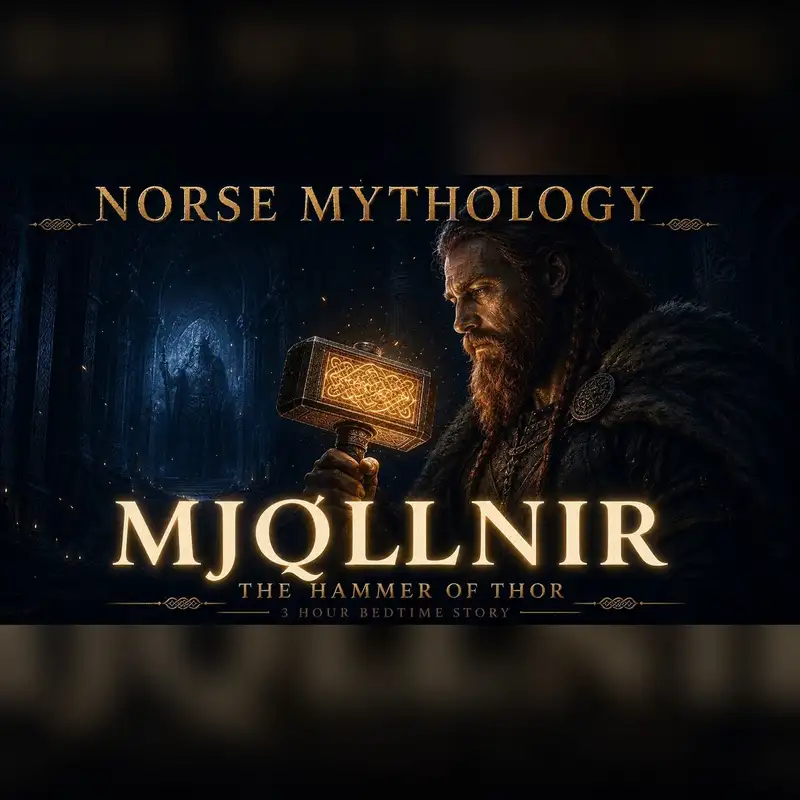
Good evening.
Or perhaps good night, if you've made your
way here in the long hours after midnight
the difference may already have stopped mattering.
You've come back, perhaps, because the last two episodes
helped you sleep.
Or you've come for the first time.
And the third episode happened to be the one
the algorithm offered.
Either is fine.
The almanac is patient.
Tonight stands on its own.
If you are listening in bed, I'd ask you
to do very little.
Close your eyes.
Let your jaw loosen.
Let your shoulders drop, even a little
even if you didn't know they were tight.
The story does not need your attention.
It will keep moving whether you follow it or
not.
If you drift, that is the point.
If you wake briefly to catch a single sentence
and then sink again, that is good.
In the first episode, we walked the shape of
the world, nine realms joined by one great
tree.
In the second, we met the wanderer, the Allfather
the hanged god.
Tonight we meet the figure who stood between the
world of men and the great old powers at
its edges.
The god of thunder.
The red-bearded one.
The one who carried, at his belt
a hammer that had been forged in the underground
halls of the dwarves, under conditions so strange they
have been told and retold for a thousand years.
This is the story of how that hammer came
to be.
And of the small cruelty.
And the long descent.
And the bet that nearly cost a god's head
that lay behind it.
Now, let us begin.
Chapter One.
Thor, the God of the Hammer.
Before we go to the dwarves.
And before we go to the forge
we should sit, for a while, with the figure
of the god whose hammer this story is about.
Thor.
If you have come to Norse mythology through the
surface of modern culture, through comic books
through summer blockbuster films, through the cheerful merchandise that
fills airport shops near Reykjavík, you may carry
in your mind, a particular picture of him.
A tall blond figure.
A square jaw.
A red cape.
A hammer with a short handle held aloft as
lightning strikes around him.
A face that smiles easily.
The Thor of the old Norse sources is
in some ways, that figure .
And in other ways, not quite that figure at
all.
He is described, in the surviving texts, as red-bearded.
Rauðskeggr.
The redbeard.
A man, or a god.
But the texts often use the language of men
for him, of enormous appetite and enormous strength.
He eats more than any other being in Asgard.
He drinks more.
He sleeps deeply.
He is, by every account, the strongest of the
gods, and one of the few who openly enjoys
his own strength.
He laughs easily.
He grieves easily.
He is, in the long view of the surviving
stories, the most directly accessible of the Norse gods
the one whose feelings, when he has them
are not hidden behind cunning or grief or many
names.
He shows you what he feels.
The redbeard.
Rauðskeggr.
The word in Old Norse means exactly what it
looks like.
The color was, in the old Scandinavian world
not common, fewer than one in fifteen people
were born with it .
And a red beard, on a god
was the sort of detail the poets did not
include by accident.
Red was the color of fire.
Of the smithy.
Of the moment when iron came out of the
coals and could be shaped.
It was the color, too, of the lightning that
the old farmers in Norway and Sweden saw flicker
across summer skies and named for him.
The skies in the north were his work.
The thunder, the storms that broke open the long
midsummer afternoons, the rain that came after
all of it carried his name.
Þórsdagr.
Thor's day.
The fifth day of the week, in the old
Norse calendar, was named for him.
It still is, in every Germanic language that survives.
In English we say Thursday and most of us
no longer remember why.
But the name has been carried, across a thousand
years, by the simple weight of repetition.
Children learn it without knowing it is a name.
The god of thunder, in this small daily way
has outlived nearly every temple and every ceremony that
was ever raised to him.
And there is more to him than the lightning.
His father, the sources tell us, was Odin.
Whom we met last episode.
The Allfather.
The wanderer.
And, in this single particular, the two could not
be less alike.
The father is the god of hidden things
of long roads, of self-imposed ordeals, of wisdom paid
for in body.
The son is the god of openness, of feasts
of direct collision with whatever stands in his way.
The father goes alone.
The son arrives at the gallop, on his goat-drawn
chariot, with the sky cracking behind him.
His mother, in the surviving accounts, was Jǫrð.
The Earth.
Sometimes called Hlóðyn or Fjǫrgyn in the older Eddic
poems.
Thor is, by this lineage, the son of the
wanderer-god and of the earth itself.
Sky and ground, joined in a single body.
The figure who, in the old Norse worldview
was meant to stand exactly at the place where
Asgard met Midgard, where the high world of
the gods reached down to the world of human
farms and human halls.
He had a hall of his own.
The texts call it Bilskírnir.
Lightning-Bright.
The hall is said to have had five hundred
and forty rooms, which is the largest hall in
Asgard, larger even than Odin's Valhǫll.
The figure comes to us from Grímnismál
one of the older Eddic poems, and Snorri Sturluson
who liked numbers, preserved it in his
Prose Edda.
Whether it is literal or simply a poet's way
of saying immeasurably large is a matter for the
listener to decide.
He had a wife.
Her name was Sif.
We will meet her, in earnest, in the next
chapter.
Because she is essential to the story we are
walking toward tonight.
He had children.
The principal ones in the surviving sources were two
sons, Magni and Móði, whose names mean, roughly
Strength and Courage.
There is also a daughter, Þrúðr, whose name means
Strength in a different sense, closer to Might.
The children are mentioned in the sources but rarely
take center stage.
Thor's stories are, with very few exceptions, Thor's stories.
And he had two goats.
This is the detail that, more than any other
separates the Norse Thor from the modern Thor of
popular culture.
The Norse Thor did not fly.
The Norse Thor did not, in the surviving texts
hover above the ground or call down lightning at
will from the sky.
The Norse Thor moved across the worlds the way
most beings moved, on a vehicle.
And his vehicle was a chariot, pulled by two
goats.
Their names were Tanngrisnir and Tanngnjóstr.
Which translate, in the rough English the names allow
as Tooth-Barer and Tooth-Grinder.
The surviving sources do not, by and large
describe the goats themselves, only their function.
They are the animals that pull Thor's chariot.
Their names suggest, in the Norse imagination
the kind of bared-teeth countenance one might still meet
today, in the highlands of Iceland or the Faroe
Islands, on a path one would not particularly want
to share.
The goats had a remarkable quality, which I cannot
in good conscience leave out of an episode about
Thor.
They could be eaten, and then resurrected.
In the Eddic story of Thor's journey to the
giant Útgarða-Loki, which we will not visit in
full tonight, since it deserves its own episode in
a later season, Thor and his companions
traveling across the long roads of the world
stop at a peasant's farm for a meal.
Thor slaughters his own goats, butchers them
and shares the meat with the family.
After eating, he gathers the bones in the goatskins
blesses the hides with his hammer.
And the goats stand up alive in the morning.
There is no explanation.
The text simply records what happened.
This image is, in some ways, more telling about
Thor than any description of his appearance.
The hammer was not only a weapon.
The hammer was also, in the Norse imagination
a tool of consecration.
A thing one used to bless.
A thing that could, when laid on the right
thing, restore what had been broken.
We will come back to this.
What you should keep, from this short tour of
the god, is the shape of the being we
are following tonight.
He is the son of the wanderer and the
earth.
He is red-bearded, easily moved, openly strong.
He has a hall larger than his father's.
He has a wife with golden hair
whom we will meet in the next chapter.
He has two goats, who pull his chariot across
the worlds, and who can be killed and brought
back to life.
And he has, by the time the surviving
stories were written
a hammer.
A short-handled hammer.
Mjǫllnir.
The crusher.
The lightning-tool.
The defense of the gods.
The weapon that, in the old Norse imagination
stood between everything that mattered and everything that wanted
to break it.
Tonight is the story of how that hammer came
to be.
And before we go down into the dwarven forges
where the hammer was made, we should first meet
the figure whose suffering set the whole story in
motion.
Because the hammer was made by accident.
The hammer was made because Loki, the trickster
had done something cruel to Thor's wife.
We meet her now.
Chapter Two.
Sif and the Golden Hair.
The wife of Thor was called Sif.
This is, on first encounter, a remarkably short name.
Two syllables.
Almost a sound.
In Old Norse, the word sif means, roughly, kinship.
Relation by marriage.
In-law.
In its broadest sense, it is the word for
the bonds between people who are not bound by
blood but who are bound, nonetheless, by the structures
of family.
To be in sif with someone is to be
tied to them by something other than birth.
This is, scholars have long noted, an unusual sort
of name.
Most Norse god-names are descriptions, Allfather, Thunder
The Just, The Bright One.
Sif's name is, by contrast, almost an abstraction.
She is named after the very idea of being-in-relation.
She is, in her name itself, the one who
is tied.
We know remarkably little about her, in the surviving
sources.
The Norse poets, who lavished long stanzas on the
deeds of the male gods, were briefer when they
came to the goddesses.
Sif appears in the Eddic poems mostly as Thor's
wife, the woman waiting in Bilskírnir when he
is away on his long journeys.
She is not given speeches of her own in
the major poems.
She is mentioned, briefly, in genealogies.
She is, in the old word, sif.
The relation.
The tie.
But what is consistent, across every surviving reference to
her, is the description of her hair.
It was gold.
Not gold as a color, not blonde
not honey, not flax.
Gold.
The metal.
The substance.
The hair of Sif was, in the Norse imagination
literal gold.
It fell from her head the way real hair
falls.
It was warm.
And it grew.
And it moved in the wind.
But it was, by every account, made of gold.
This is the kind of detail that the Norse
poets allowed to stand without explanation.
They did not feel the need to tell us
how such a thing was possible.
They simply told us it was so.
The wife of Thor had hair of gold.
It is the principal thing the surviving texts want
us to know about her.
Why does this matter?
In the Norse cultural imagination, hair was not
as it sometimes is in our own age
a casual or decorative thing.
Hair was a marker of identity.
A marker of social standing.
A marker, in particular, of the relationship between a
woman and her household.
A wife's hair, in the old Norse world
was bound up tightly during the workday and let
down only in private, only with her husband.
To touch a married woman's hair was
in the legal codes that survive from the Icelandic
settlement, an offense that could be punished.
To cut a woman's hair against her will was
an offense graver still, close, in the old
legal language, to the offense of cutting off a
part of her body.
And the wife of Thor had hair that was
itself, a treasure.
Gold.
The most precious substance the Norse imagination knew.
The hair on her head was, in literal weight
and value, the wealth of a kingdom.
Hair, in the old Norse world, was not a
small thing.
It was not, as it sometimes is in
our world, simply a matter of style.
A woman's hair, in particular, carried meaning.
It was, in the surviving texts, a sign of
her honor, of her standing in the household
of her unbroken connection to the family line.
A married woman bound her hair, often
beneath a cloth headcovering, a symbol of her
vows.
An unmarried woman wore her hair loose.
To cut a woman's hair without her consent
in the old Scandinavian law codes that have survived
from later centuries, was an act of grievous insult
a crime that carried a fine roughly equal
to the wounding of her father, or her husband
or her brother.
To cut a goddess's hair was something the old
poets had no measure for at all.
And Sif's hair, in the surviving accounts
was not only hers.
It was, the poets tell us, gold.
Real gold.
Or something the eye could not tell from gold.
When she stood in the firelight of her hall
with her hair loose around her shoulders
the light moved through it the way light moves
through a fall of wheat at evening
before the harvest.
Some of the old commentators have suggested that her
hair was the wheat, that Sif was
in the old farmer's understanding, the field itself
ripening.
And Thor was the rain that came down upon
her.
I want you to hold this image
for a moment, before we move on.
A woman sleeping.
The wife of the strongest god in the pantheon.
In her own hall.
Her hair, spread on the pillow around her
glinting in the low light of the banked hearth-fire.
Gold.
The whole of it.
The Norse poets do not tell us
in the surviving texts, much about her inner life.
They do not tell us what she thought
or what she did during the days when Thor
was away.
They do not give her a voice in the
major poems.
She is named, Sif .
And she is described, gold-haired
and that is, for the most part
what the texts give us.
What they do tell us, in clear and lingering
detail, is what happened to her one night.
While she slept, in the deep middle of the
night, in her own hall, in the long quiet
of Asgard, someone came to her.
The someone, a figure we will meet properly
in the next chapter, moved very quietly.
The figure approached the bed where she lay.
The figure leaned over her, in the dark
while she went on breathing in the rhythm of
sleep.
And the figure cut.
He cut her hair.
All of it.
The Old Norse verb the surviving sources use
skera, means to cut or to shave.
And the texts say he shaved off all of
it.
The gold fell in long heavy strands
in the dark, onto the floor of the hall.
What is consistent across every surviving telling is the
central act.
Sif, the wife of Thor, woke in the morning
to find her hair gone.
The Norse poets do not, in the surviving texts
give us her reaction in dialogue.
They do not let her speak the words anyone
in such a moment might speak.
They simply tell us, in the careful, restrained
almost formal language the Norse used for the most
painful moments, that she woke.
And she found.
And she was, in their phrase, unconsoled.
She was a goddess.
She was the wife of the strongest god in
the pantheon.
She was, by the standards of the old Norse
world, untouchable.
And someone had, in the night, come to her
and taken from her the one thing the texts
repeatedly tell us defined her.
She did not speak, in the surviving texts.
She wept.
And when Thor came home, which he did
eventually, as the texts always have him do
returning from one of his long journeys
and found his wife in her hall
with her head bare, weeping, the response of the
strongest god in the Norse pantheon was
in its own way, exactly what one would expect.
He went to find the figure who had done
it.
He had, the texts tell us, a fairly good
idea of who that figure was.
Because in the surviving Norse imagination, this kind of
cruelty, this kind of small inexplicable malice
this kind of cutting in the dark while someone
slept, this was the work of one specific
god.
And every other god in Asgard knew it.
In the next chapter, we meet him.
We meet Loki.
Chapter Three.
Loki, the Trickster.
I want to spend some time, in this chapter
sitting with the figure of Loki
because Loki is, more than almost any other figure
in Norse mythology, a being who resists the simple
descriptions one might want to apply to him.
The modern English word for what Loki is is
trickster.
This is a useful word.
And a true one, as far as it goes.
Loki is a trickster.
He plays tricks.
He moves things around.
He hides things.
He pretends to be other than what he is.
He lies, when lying serves him.
He shape-shifts.
He laughs when no one else is laughing.
He upends, again and again, what the gods of
Asgard would have otherwise been able to settle into.
But trickster is, in the modern English ear
often a softer word than the Norse texts mean.
The trickster of the modern imagination
the figure in fables, the prankster, the funny uncle
of a pantheon, is a figure of mostly
harmless mischief.
The trickster in the modern sense is someone you
can, in the end, laugh along with.
Loki is, sometimes, that figure.
The Norse texts certainly let him be that figure
when they want him to be.
There are stories in the corpus in which Loki's
tricks save the gods, or at least save them
money, or rescue them from situations they could not
have escaped on their own.
In one of the more famous of these stories
which we will arrive at, in its own
time, in a later season, Loki turns himself
into a mare in order to distract the great
work-horse of a giant builder.
And the gods escape the giant's bargain because of
it.
The trick costs Asgard nothing.
The trick produces, as a side effect
the eight-legged horse Sleipnir, which we met last episode.
The trick, in the end, was good for the
gods.
But Loki is also, sometimes, something else.
He is the figure who, in the surviving end-of-the-world
poetry of the Norse, the Vǫluspá
leads the army of the dead against Asgard
on the last day.
He is the figure who, by the end of
the surviving cycle of stories, has been chained to
a stone in a cave, with a venomous serpent
dripping poison onto his face, in punishment for crimes
the gods could no longer overlook.
He is the figure whose children, in the surviving
genealogies, are the wolf that swallows Odin
the serpent that fights Thor.
And the half-rotted woman who keeps the underworld of
the dead.
Loki is not, in the long view
a harmless prankster.
Loki is, in the long view, the agent of
the gods' ending.
This is the problem of Loki.
He is both at once.
He is the helpful trickster and the eventual enemy.
The same being.
The Norse texts do not, I think
fully resolve this.
They simply allow both to be true.
Loki is one of the strangest figures in any
mythology that has ever survived.
The other gods of the north, Odin, Thor
Freyr, Freyja, Týr, sit, more or less
in the seats that mythologies usually have.
The wise one.
The strong one.
The fertile one.
The brave one.
Loki sits in none of them.
He is, in the surviving sources, not a god
of anything in particular.
He has no temples that we know of.
He has no day of the week.
He has no festival, no ritual, no farmer's prayer
raised to him at the turning of the season.
And yet he is everywhere in the stories.
Every great story of the Norse gods
the building of Asgard's walls, the death of Baldur
the binding of Fenrir, the recovery of Thor's hammer
when it was later stolen, the very ending of
the world at Ragnarǫk, has Loki at its
center.
He is the figure, the old commentators have suggested
who makes the stories move.
Without him, the gods would sit in their halls
and feast forever.
Nothing would happen.
With him, every door is opened that the gods
did not mean to open.
Every wager is offered that the gods did not
mean to take.
Every crime is committed that the gods did not
until then, know was possible.
And he was, in the old sources
blood-brother to Odin.
A blood-brother.
Sworn.
Bound by oath.
Who is he, in his nature?
The surviving sources give us several pieces.
They tell us he is not, properly speaking
a god of the Æsir.
He was born among the giants.
His father was Fárbauti, Cruel-Striker
and his mother was Laufey, sometimes called Nál
who may or may not have been a goddess.
He was brought into Asgard, the texts tell us
through a blood-brotherhood with Odin.
The two gods, in a moment not preserved in
detail in the surviving sources, swore brotherhood by mingling
their blood.
From that moment, Loki was of the Æsir
in the legal sense of the old Norse world.
He could not be expelled.
He could not be killed by the gods.
He had the same standing among them as any
born god.
But he was not, ever, quite one of them.
The texts return to this, again and again.
Loki is in Asgard but not of it.
Loki sits at the gods' tables but is not
in some deeper sense, at the gods' table.
Loki is a guest who never quite leaves.
And he is.
The texts are clear, a being of changing shape.
This is one of the most consistent features of
his character.
He becomes a mare, as we mentioned.
He becomes, in another story, a falcon
borrowing the feather-cloak of the goddess Freyja
to fly between the worlds.
He becomes, in still another story, a salmon
trying to hide from the gods in a river
after a particularly bad piece of work.
He becomes, the texts tell us, a fly
when he needs to be small enough to get
into places he could not otherwise reach.
He becomes an old woman, when he needs to
weep beside a goddess's coffin and refuse to grant
the tear that would release her from the underworld.
The shapes are many.
There is no surviving source that tells us
in clear language, what Loki is in his most
basic form.
The texts do not give us a definitive description.
He is described, when he is described at all
as fair-faced.
Quick.
Slim.
With a slightly cruel mouth.
Beyond that, the sources let his appearance shift with
his moods.
And he is, and this is the part
of his character that matters most for tonight's episode
moved, often, by a kind of malice that
does not have an obvious source.
The Norse texts are honest about this
in a way the surviving Greek and Roman texts
about their own gods sometimes are not.
The Greek gods, when they are cruel
are cruel for reasons.
They want something.
They are punishing someone.
They are settling a score.
Loki is not always like that.
Loki, sometimes, does cruel things for no reason the
text can fully explain.
He does them, the surviving phrase often suggests.
Because the chance presented itself.
Because he saw a way to disturb something that
was otherwise still.
Because the cruelty was, in the moment, available.
This is the Loki who, the surviving texts tell
us, came to Sif's bed in the middle of
the night.
The texts do not give him a motive.
The texts do not tell us he was angry
at Sif.
The texts do not tell us he had quarreled
with Thor.
The texts do not tell us he was acting
on behalf of anyone else.
The surviving phrase in Snorri's Prose Edda is
in its bare Old Norse: Loki Laufeyjarson hafði þat
gjört til lævísi at skera hár alt af Sif.
In Anthony Faulkes's standard modern translation: Loki Laufey's son
had done this out of mischief
had cut off all of Sif's hair.
Out of mischief.
Til lævísi.
Out of cunning malice.
The Norse word lævísi carries a darker weight than
the modern English mischief.
It is closer to intentional harm done because one
is the kind of being who does intentional harm.
It is the malice of a creature who recognizes
that another creature is sleeping safely, and who chooses
in that moment, to do something to break the
safety.
This is the Loki we are dealing with tonight.
He is not, in this story, the trickster who
saves Asgard from a costly bargain.
He is the trickster who, for no reason the
surviving texts can fully explain, came in the night
to the wife of his blood-brother's son
and cut from her head the gold hair she
had been known by for as long as anyone
in Asgard could remember.
And then, when he was caught
he had to set right what he had done.
We turn now to the cutting itself.
And to what followed.
Chapter Four.
The Cutting.
I want to begin this chapter by telling you
what the surviving sources do not give us.
They do not give us, in any version of
the story I have been able to find
the scene of the cutting itself.
Snorri Sturluson, who is by far our most detailed
source for this story, gives us only the bare
fact.
Loki had done this out of malice
had cut off all of Sif's hair.
The act is named.
And the chapter moves on.
This is, in the way of Norse literature
the customary restraint.
The Norse poets did not, by and large
linger in their most painful moments.
They told you what had been done.
And they trusted you, the listener, to do the
rest of the imagining.
The work of the imagination was understood to be
the work of the audience.
The poet's job was to give the bone.
The audience's job was to put the flesh on
it.
So I will not, tonight, give you an invented
scene of the cutting.
I will not give you Loki's face in the
dark, or Sif's breathing in the bed
or the weight of the gold strands in his
hand.
The sources do not give them to me.
And to invent them feels like a betrayal of
the texts' chosen restraint.
The story does not tell us why he did
it.
This is, we should pause here for a
moment, one of the marks of these old
stories that the modern reader sometimes finds difficult.
We are used, in our novels and our films
to motivation being supplied.
A character does a thing.
And the writer tells us why.
The Norse poets did not work that way.
They told us, often, what was done.
They told us, often, what the consequences were.
They very rarely told us what the person inside
the act was thinking.
The story is the act and the consequence.
The interior is for the listener to fill in
or to leave empty, as they prefer.
So we are not told whether Loki cut Sif's
hair out of envy, or out of malice
or out of some quarrel with Thor that has
not survived in the texts.
Some of the old commentators have read it as
a grudge against Thor specifically, Thor being the
god most directly opposed to Loki's tricksterism
the one most likely to threaten violence when Loki
crossed a line.
Others have read it as something more shapeless
as the sort of small cruelty that some figures
in some old stories, simply perform because the performing
of it is its own kind of pleasure.
We are not told.
We may rest in that.
What the sources do give us
and what we can sit with
is what happened next.
Thor came home.
He had been away.
The surviving accounts do not specify where he had
been, in this particular story.
Thor was often away.
The work of being Thor was, in large part
the work of going out, of taking the
chariot of goats and the hammer-not-yet-his and crossing the
long roads between the worlds, dealing with whatever needed
to be dealt with along the way.
The defense of Asgard, in the old Norse imagination
was not a passive thing.
It was the work of the strongest god to
go, again and again, out into the dark places.
And to come back.
He came back, the surviving sources tell us.
And he found his wife in her hall.
Her hair was gone.
She was, in the Norse phrase, unconsoled.
The word in the original is something close to
that, óhuggat, uncomforted, not yet able to be
settled.
She was, in her own hall, in her own
life, in a state from which the ordinary rhythms
of being-her had been broken.
The wife of the strongest god in the pantheon
sitting in her own hall, with her head bare
was a sight that, the surviving texts make
very clear, none of the gods of Asgard
had seen before.
Thor asked her what had happened.
She told him.
The sources are spare on her dialogue.
We do not have her exact words preserved.
What we have, in the structure of the narrative
is the shape of her telling.
She told him what she could tell him.
She told him that someone had come to her
in the night.
She told him what they had done.
She named, by all surviving indications, the figure she
suspected.
She would not have had to look hard.
Every god in Asgard.
By every surviving account, would have known.
It was Loki.
And Thor, the texts tell us in plain
and unguarded language, went to find him.
This is the moment in the story I want
to slow down on, because it is one of
the more affecting moments in all of Norse mythology.
And the surviving Norse sources do something with it
that I find, even at a thousand years' distance
very moving.
Thor caught Loki.
The catching itself is not described in detail.
The texts give us the bare fact.
Thor went, Thor found him, Thor caught him.
The implication, in the way the sources tell it
is that Loki did not run very hard.
He may have tried to talk his way out
in his customary fashion.
He may have offered explanations.
He may have laughed, the way he often did
when caught doing what he had done.
The surviving phrase suggests that whatever Loki tried
it did not work for very long.
Thor, and here I will paraphrase Snorri carefully
because the passage matters, Thor would have broken
every bone in Loki's body, then and there
if Loki had not been very quick about offering
an alternative.
The phrase Snorri uses is, in Faulkes's standard translation:
Thor caught Loki.
And he would have broken every bone in his
body, except that he swore an oath.
Read the sentence again.
He would have broken every bone in his body
except that he swore an oath.
This is, in the Norse imagination, the very edge
of what Thor was capable of.
The strongest god, in the moment of finding the
figure who had cut his wife's hair, was
by the sources' explicit testimony, about to dismember
him, in his own body, slowly and completely.
Not kill him.
Killing would have been easier.
Thor was, in this moment, in the kind of
fury that would have made him take Loki apart
bone by bone, while Loki was still alive to
feel it.
The oath stopped him.
Loki swore, quickly, urgently, in the way one
swears when one is about to be unmade
that he would set right what he had done.
He would not, by any of his own arts
be able to give Sif her hair back;
the hair was gone.
And the gold of it lay on the floor
of her hall.
And even Loki could not make a goddess's own
hair grow back overnight.
But he swore, and this is the central
pivot of the story, that he would get
the dwarves, the great metal-workers of Svartalfheim
the most skilled smiths in the nine worlds
to make her a new head of hair
of true gold, that would grow on her head
as if it had always been there.
Thor accepted the oath.
He did not, the sources tell us
let Loki out of his sight until the work
was done.
He did not break his bones.
He did not unmake him.
He stood, the surviving accounts suggest, and watched Loki
gather himself, and watched him prepare to descend to
the underground country where the dwarves worked.
And let him go on the condition that he
would return with what he had promised.
This is the cutting, and what came after.
A small cruelty.
A great wrath.
An oath.
And the beginning of a long journey down
into the dark places of the world
where the substances that became the great treasures of
Asgard were waiting to be made.
We follow Loki, now, down into Svartalfheim.
Chapter Five.
Down to Svartalfheim.
The dwarves, in the Norse imagination, lived underground.
This is, on first encounter, a familiar enough idea.
Most cultures that knew metal-working knew that the substances
metal-workers worked with came from underground.
Iron from the iron-mines.
Copper from the copper-mines.
Gold, often, from the deep beds of rivers or
from the seams of certain mountains.
To work metal was.
In some sense, to bring up what had been
buried.
The Norse, like many of their neighbors
put this into mythological form.
They imagined a people whose entire life took place
underground.
A people who had been born in the dark
who lived in the dark, who worked in the
dark.
A people who had become, by long habit and
by the patience of generations, the greatest metal-workers any
of the worlds knew.
These were the dwarves.
The name in Old Norse is dvergar.
Singular dvergr.
The word is related, distantly, to the modern English
dwarf, and carries roughly the same meaning.
The dwarves were, in the Norse imagination
short of stature, broad of shoulder, long of beard
and, most consistently, very
very skilled.
Their realm was called Svartalfheim.
We mentioned it briefly, in the first episode of
this season.
Svart-alf-heim.
Black-elf-home.
The home of the dark elves.
The Norse, in some of their sources
conflated dwarves with the dark elves
a related group of underground beings, often referred to
in the same breath, sometimes as if they were
the same people.
The scholarly consensus, today, is that the Norse themselves
were not always clear on the distinction.
Sometimes dwarves and dark elves were two different peoples.
Sometimes they were one.
The sources are, on this point, comfortable with the
ambiguity.
What is consistent is the geography.
Svartalfheim was beneath the worlds of the surface.
To go there, one descended.
Svartalfheim, sometimes called Niðavellir in the older Eddic
poems, sometimes called simply "the dwarf-realm"
sits in the Norse cosmology beneath Midgard.
Below the world of men.
Beneath the roots of the world-tree.
It is one of the nine worlds.
Though the old sources do not always agree on
its exact placement among them.
Some texts treat it as part of the same
vast underground that contains Helheim, the realm of the
dead.
Some treat it as a separate underground entirely.
The poets did not, in this matter
take great pains to be consistent.
The image they meant to convey was simpler than
a map.
Down.
Beneath the surface.
In the dark.
Where the things that the gods used were made.
The dwarves themselves, in the surviving accounts
are an old people.
The Prose Edda, in Snorri Sturluson's telling
says they were born, or, in some readings
that they grew, from the body of Ymir
the first giant, after the gods slew him at
the beginning of the world.
From his flesh, the maggots.
And from those maggots, the dwarves.
The texts give the impression of a people who
had been in the world from very nearly its
beginning.
Older than the gods, perhaps, in a certain sense
or at least as old.
Old, in any case, in the way that very
old craftsmen are old.
They had been making things, in their underground halls
for as long as anyone could remember.
And what they made, no one else could make.
Loki, the surviving sources tell us, went to Svartalfheim.
The journey is not described in detail.
The Norse poets, again, gave us the bare structure.
Loki went down.
He went to the dwarves.
He found, in particular, a group of dwarves called
the Sons of Ivaldi, Ívalda synir in the
Old Norse.
They were.
By every surviving account, among the finest of the
dwarven smiths.
Their forge was old.
Their craft was the kind that had been passed
from father to son and son to son for
as long as any of them could remember.
To go to them was to go to the
experts.
I want to spend a moment, before we follow
Loki into their forge, sitting with the picture of
Svartalfheim as the Norse imagined it.
Because the picture is, in its way
one of the most affecting in all of Norse
cosmology.
Imagine a vast underground country.
There is no sky.
Where the sky should be, there is rock.
The rock is dark.
And it is high.
And it forms the ceiling of the world.
In some places the rock is broken
and small openings let in, far above
the faintest glimpse of starlight from the world above.
But these are rare.
For the most part, the country is lit by
its own light, by the amber glow of
forges, by the orange flicker of furnaces
by the patient steady light of metal being worked.
The country is full of sound.
Hammering.
The slow steady wheeze of bellows.
The hiss of metal being quenched in water.
The voices of dwarves, calling to each other across
the great halls, in a language the surface peoples
did not always understand.
The country has a rhythm.
It works.
There are no women in the surviving accounts.
The dwarves of Svartalfheim are described, in every Norse
source I have been able to find
as men.
The texts do not tell us how this is
possible.
They do not tell us how the dwarves reproduce.
They simply tell us that the dwarves are who
they are.
And that they are very many.
And that they have been working their craft for
as long as anyone in the worlds above has
been able to remember.
It is a country, in some ways
of nothing but work.
This is the world Loki entered.
He came, the surviving sources tell us
with a request.
He came with the memory of his blood-brother's son
standing over him, ready to take him apart.
He came with the gold of Sif's hair, perhaps
gathered in some fold of his cloak .
Though the sources do not specify whether he brought
the original hair or simply came with the need.
He came with what he had to offer the
dwarves in exchange.
He came, in particular, with his own cunning.
Because Loki, by the time he reached the Sons
of Ivaldi, had already had time to think.
Whatever bargain he struck with them
whatever the dwarves asked for, whatever Loki gave them
or promised them, the surviving sources do not
specify.
Snorri does not tell us what Loki paid.
The Sons of Ivaldi, the texts simply say
made the things Loki asked for.
They made them well.
They made, in particular, three things.
They made a head of hair for Sif.
Real gold, fine as silk, that would attach itself
to her head and grow there as if it
had always been there.
It would, the dwarves said, look like ordinary hair.
It would behave like ordinary hair.
The only thing about it that would be unordinary
was that it would be, in its substance
gold.
They made a ship.
Not an ordinary ship, a ship called Skíðblaðnir.
We will come to it in the next chapter.
And they made a spear.
The spear was called Gungnir.
We met it, in passing, last episode.
We will come to it too.
But before we look at the three gifts of
the Sons of Ivaldi, we should look at what
happened next.
Because Loki, having gotten what he came for
did not simply leave Svartalfheim and go home.
Loki, having gotten what he came for
did something else.
He decided to make a bet.
Chapter Six.
The Sons of Ivaldi.
Before we follow Loki into his bet
we should sit, for the length of this chapter
with the three gifts the Sons of Ivaldi made.
Because they are, individually, among the great treasures of
Norse mythology.
And they will each return, in this episode
in later episodes.
And in the long arc of the season
in ways that matter.
The first gift was the hair for Sif.
I have already described it, briefly, in the last
chapter.
It was made of true gold.
It was fine as silk, finer, perhaps
than any actual hair could be.
It was the kind of object that
in the Norse imagination, could only have come from
the patient skill of beings who had spent generations
learning to draw metal into impossibly thin strands.
The Sons of Ivaldi.
By every surviving account, knew how to do this.
But the hair had a quality beyond its substance.
When it was placed on Sif's head
the surviving sources tell us, it took root.
It attached itself to her scalp the way real
hair did.
It grew.
It moved in the wind.
It would, the dwarves promised, behave in every way
as her own hair had behaved
except that it would be, by its substance
gold.
She would, in time, be unable to tell the
difference.
The people who loved her would be unable to
tell the difference.
The hair would, by the time it was settled
on her head and had grown for a season
simply be her hair.
This is, I think, the most quietly remarkable of
the gifts.
The dwarves had not made a wig.
They had not made an ornament.
They had made a kind of replacement that
by some craft the Norse imagination did not fully
explain, had become indistinguishable from the original.
The cruelty Loki had done to Sif could not
in the strict sense, be undone
what is done in time cannot be unmade.
But the cruelty could be, in a way the
texts allow themselves to believe in
covered over.
The gold hair would grow.
Sif would have her hair again.
The wound, while it would always have happened
would not, after this, be a visible wound.
The second gift was a ship.
The ship was called Skíðblaðnir.
The name, in Old Norse, means roughly board-bladed or
thin-planked.
It comes from skíð, meaning a thin board or
wooden strip.
And from blað, meaning a blade or a leaf.
The name is descriptive: the ship was
the sources tell us, made of many thin pieces
of wood, fitted together with a skill so precise
that the seams were nearly invisible.
The ship had three remarkable qualities, all of which
the surviving sources preserve in some detail.
The first was its size.
Skíðblaðnir was, when fully extended, the largest ship in
the worlds.
It could carry, the sources say, all the gods
of Asgard, with all their gear, all their weapons
all their horses, all at once.
There was room for everyone.
The second was its winds.
Skíðblaðnir, the sources tell us, sailed always with a
favorable wind.
Whenever the ship's sails were raised, a wind would
come to fill them, from the right direction
at the right strength.
The ship did not, in the ordinary sense
need to wait for weather.
The weather came when the ship needed it.
The third was its most remarkable quality.
Skíðblaðnir could be folded.
Not folded as in collapsed.
Folded as in taken apart, into its many thin
pieces of wood, and folded together, as one might
fold a cloth, into a small bundle that could
be carried in a pouch.
The Sons of Ivaldi.
By every surviving account, had made a ship the
size of a great hall that, when not needed
could be carried in a man's hand.
This is the kind of detail at which modern
readers sometimes pause.
Snorri Sturluson did not.
He simply told us what the dwarves had made.
And let the audience marvel at it as they
would.
The ship was given, in the eventual distribution of
these gifts, to the god Freyr.
We will not meet Freyr in detail until later
in the season, he is the god of
the Vanir, the older order.
And he deserves his own episode.
Tonight it is enough to know that Skíðblaðnir went
to him.
And that he was, in the surviving accounts
much pleased.
The third gift was a spear.
The spear was called Gungnir.
We met Gungnir in the last episode.
It is Odin's spear.
The spear that never misses.
We will not repeat the description here in full
you can return to the last episode if
you'd like to sit with that gift again.
What is worth noting, in the context of tonight's
episode, is that all three of these things
the hair, the ship, the spear
were made by the same dwarves, in the same
forge, in what the surviving sources suggest was a
single visit.
The Sons of Ivaldi had, in the time Loki
was there, made three things of such craft that
any one of them would have been the achievement
of a lifetime.
They had made them, by all surviving indications, easily.
The forge was old.
The skill was deep.
The work, when it was their work
came out fine.
The first gift, the new hair of Sif
was, by some readings of the old text
not exactly hair at all.
The Prose Edda, in Snorri's account, calls it gold
drawn into threads so fine that they would grow
upon a head the way hair grew
and would settle when the head moved
and could not be told from real hair by
anyone who looked.
This is one of the small details that the
old sources tend to slip past quickly.
But that rewards a listener's attention.
Gold that grows.
Living gold.
The dwarves' work was not merely metal
it was metal that had been given, somehow
in their underground forges, a small portion of life.
The dwarves' three works, the hair, the ship
the spear, would each, in time
be given to a different god, and each god
would find that the gift suited him so precisely
it could only have been made for him alone.
The hair to Sif, by way of Thor.
The ship to Freyr, the god of fruitfulness
who needed the largest of all vessels and yet
could fold it like a cloth into a pocket.
The spear to Odin, of which there are stranger
things still to say.
The Sons of Ivaldi, in their underground country
had done in one sitting what most smiths of
any kind would not do in a lifetime.
Loki took the three gifts.
He thanked the dwarves, presumably, in whatever way Loki
thanked anyone.
He prepared, presumably, to leave Svartalfheim and return to
the upper world, where his blood-brother's son was waiting
to see what he had brought.
But Loki, and this is the moment that
turns the whole story, did not
after receiving the three gifts
simply leave.
He went, instead, to another forge.
There were, in Svartalfheim, many dwarves.
The Sons of Ivaldi were not, by any means
the only smiths in the underground country.
There were others.
There were, in particular, two dwarves who were brothers
who had their own forge, who were known
among the dwarves who knew the trade
as smiths whose work was, by some accounts
the rival of the Sons of Ivaldi's.
Their names were Sindri, sometimes called Eitri.
And Brokkr.
Loki, with the three gifts of the Sons of
Ivaldi already in his keeping, went to find them.
The reason he went is the substance of the
next chapter.
The reason he went is, though Loki himself
may not have known it at the time
the reason this entire episode exists.
We meet the brothers now.
Chapter Seven.
The Wager, Loki Bets His Head.
Sindri and Brokkr.
These are the two names that, by the end
of the Norse mythological corpus, are bound up forever
with the hammer of Thor.
Without them, without the strange brothers
working in their forge somewhere in the deep underground
of Svartalfheim, there would be no Mjǫllnir.
The hammer that defended Asgard against the giants
that called down lightning in the surviving stories
that returned to the thrower's hand, that was the
great weapon of the Norse cosmos, would not
in the Norse imagination
exist.
Sindri and Brokkr are the reason it does.
A brief note on the names, before we go
further.
Snorri Sturluson, in chapter 35 of his Skáldskaparmál
the chapter that is our principal source for this
whole story, gives the brother's name as Eitri.
Eit-ri.
The word in Old Norse means, roughly
poison-worker or the venomous one.
Though the meaning is debated.
Other sources in the surviving Norse corpus
including the Eddic poem Hyndluljóð and certain references in
the Vǫluspá, give the same figure as Sindri.
Sin-dri.
A name that may relate to cinder or spark.
The scholarly consensus today is that Sindri and Eitri
are two names for the same dwarf.
And that the Norse tradition itself did not always
settle which name was canonical.
I will, for clarity, use Sindri in tonight's narration
but you should know, if you read the
original sources, that Eitri is the same dwarf
working at the same forge, on the same gifts.
Brokkr, by all surviving accounts, is the second brother.
The bellows-man.
The one who does, in the story to come
most of the physical work.
The name in Old Norse means, roughly, badger.
Whether this is meant as a description of his
appearance, or his temperament, or his way of moving
the sources do not specify.
Loki came to their forge.
The surviving accounts do not describe the forge in
detail.
We are left to imagine it.
A stone room, probably.
A hearth at one end, glowing amber.
A long iron anvil.
Bellows worked by hand.
Heaps of raw metal, gold, iron, silver
stacked along the walls.
The two brothers, working in the close concentration that
all skilled craft requires, in the long low light.
Loki entered, the texts tell us.
He praised, in passing, the things the Sons of
Ivaldi had just made for him.
He may have shown the brothers the gifts.
The accounts are not specific.
What is consistent is the central act.
Loki, having received three treasures from one group of
dwarves, came to a second group of dwarves
and proposed a contest.
He said, and I am paraphrasing
because Snorri does not give us the exact dialogue
I do not believe you brothers can make
three gifts as fine as the gifts I have
just received from the Sons of Ivaldi.
He said this knowing, perhaps, that the brothers had
a reputation.
He said this, perhaps, because he wanted to see
what would happen.
He said this, perhaps, because Loki was Loki.
And the chance to set one set of dwarves
against another set of dwarves was the kind of
thing he found, in his nature
irresistible.
The brothers, as Loki may or may not have
predicted, took the bait.
Brokkr, the surviving sources tell us, replied immediately.
He said, in essence, We can do better.
My brother can do better.
We can make three gifts that will make the
Sons of Ivaldi look like apprentices.
Loki said, Very well.
I will bet you that you cannot.
Brokkr asked what he was willing to wager.
This is the moment that, more than any other
in the story, marks Loki as the figure he
is.
Because a more cautious being, and almost every
being in the Norse mythological corpus was a more
cautious being than Loki, would have wagered something
small.
Something concrete.
Some piece of gold he could afford to lose.
Some object whose loss would not, by any reasonable
measure, be ruinous.
Loki, instead, wagered his head.
The surviving phrase, in Old Norse, is unambiguous.
Loki veðjaði höfði sínu.
Loki wagered his head.
If the brothers could not make three gifts finer
than the gifts of the Sons of Ivaldi
Loki said, he would keep his head.
If they could, if the brothers' work was
judged by the gods of Asgard to be greater
than the Sons of Ivaldi's, then the brothers
could have Loki's head, to do with as they
pleased.
We should sit, here, for a moment
with the strangeness of what Loki has just done.
He has wagered his head.
Not, as we sometimes hear the phrase used
today, as a manner of speaking.
He has actually, in the literal terms of the
surviving story, said: if these brothers make a better
thing than the sons of Ivaldi, you may take
my head from my shoulders.
And the brothers have accepted.
The work will be done.
And at the end of it, three gifts will
be judged against three gifts, and one wager will
be lost, and one head will be taken.
This is the kind of thing that
in the Norse stories, happens often enough that we
should pay attention to it.
The wager that is too high.
The bet that should not have been offered.
The oath that, once spoken, cannot be unspoken.
The Norse gods, in the surviving sources
are again and again caught by these
by promises they regret, by terms they did not
think through, by a single careless word that locks
the world into a path it cannot leave.
The old poets seem to have felt
on this matter, that the world ran on these
moments.
That every great story turned on a single ill-considered
yes.
Why?
The surviving sources do not give us a clear
answer.
Loki had no obvious need to make such an
extreme bet.
He could have wagered a piece of gold
or a season's worth of work, or any one
of a thousand smaller things.
He wagered his head.
Some scholars have read this as evidence of Loki's
deep confidence in the Sons of Ivaldi.
He had just seen their work.
He had carried their three gifts in his arms.
He could not, in his own assessment
imagine that any other dwarves could surpass them.
The wager, in this reading, was the wager of
a man who believed he could not lose.
Others have read it differently.
Some have suggested that Loki, in his nature
was simply drawn to extremity.
That the chance to wager nothing of importance would
have bored him.
That only by wagering his head could he make
the contest feel real.
Still others, and this is the reading I
find most affecting, have suggested that Loki
on some level, was always a being who wanted
to be punished.
That across the long arc of the surviving Norse
stories, Loki kept doing things that would, eventually
lead to his own undoing.
That the wager of his head was
in some submerged way, an early instance of the
pattern.
Loki was, in this reading, always heading toward the
cave.
The cave was.
In some sense, what he was for.
The wagers, the cruelties, the descents
they were the steps along the road.
You may choose whichever reading you prefer.
The Norse texts, as ever, let several be true
at once.
What the texts do agree on, in full clarity
is what the brothers did.
Brokkr accepted the wager.
The brothers.
By every surviving account, began to work immediately.
They piled fuel into the forge.
They worked the bellows.
They drew out the raw metal they would be
using for the first of their three gifts.
They moved, in the practiced rhythm of long craft
to their stations.
And Loki, having staked his head on what
was about to be made, settled down to
watch.
Or so he pretended.
In the next chapter, we will see what Loki
actually did.
Chapter Eight.
The Fly at the Bellows.
I want to read you, slowly, the central passage
of the story.
Because what happens in this chapter is
in some ways, the heart of the whole Norse
tradition's account of how Mjǫllnir was made .
And the surviving Old Norse text is unusually direct
in its telling.
Loki, having wagered his head, sat down in the
brothers' forge.
Sindri began the work.
He placed, on the fire, a pigskin
the source-material for the first of his three gifts.
He turned to his brother Brokkr and said
in the surviving paraphrase, Pump the bellows.
Do not stop pumping the bellows.
Whatever happens, do not stop.
If you stop, all the work is lost.
Brokkr began to pump.
Sindri left the forge briefly, to fetch something.
Whether he was gone for long, the texts do
not specify.
While he was away, the work continued.
Brokkr at the bellows, in the rhythm of long
craft.
The pigskin in the fire.
The amber heat building.
And then, and here Snorri's text is
in the surviving original, unusually direct
Then a fly flew onto Brokkr's hand and stung
him.
The fly was Loki.
That is the text.
Sú var Loki.
The fly was Loki.
Snorri does not allow the reader any ambiguity.
He does not write some say the fly was
Loki or it was rumored that Loki had taken
the form of a fly.
He simply tells us, in the bare voice of
his prose, that this was what Loki had done.
Loki, who had wagered his own head on
the contest, had taken the form of a
fly, and entered the forge.
And was now actively trying to sabotage the work.
This is, I think, one of the strangest moments
in all of Norse mythology.
The figure who has bet his own head is
the same figure who is trying to make sure
he loses the bet.
The being who, by every rational calculus
should be wanting the brothers to fail
should be doing nothing, should be sitting on his
hands, should be hoping that the brothers' work crack
apart in the flames, is the one taking
active measures to ensure the brothers cannot succeed.
The texts do not explain this contradiction directly.
They simply let it stand.
Loki is Loki.
And Loki, in his nature, does not always act
in the way his interests would dictate.
Loki, sometimes, simply acts in the way that produces
the most interesting story.
The Prose Edda's telling of this moment is one
of the small comic masterpieces in the whole of
Norse literature.
The trickster, with his head wagered, with his life
literally on the line, with the work going against
him, and his only weapon, in the underground
forge of the dwarves, is to become an insect.
To become small enough that Brokkr cannot easily kill
him.
To bite, and bite, and bite again
in the hope that one of the bites will
land in the wrong place at the wrong moment.
And the work will go wrong.
The image, Loki as a fly
circling the head of a sweating dwarf at the
bellows of a fire that is making the most
powerful object ever to exist in the Norse cosmos
is the sort of image that the modern
reader sometimes laughs at.
And the laughter is, I think, intended.
The Norse poets had a sense of humor about
their own gods that the modern reader sometimes underestimates.
The trickster, brought low.
The cosmic stakes, balanced on the head of an
insect.
The dwarf, who has been forging for hours
finally pausing for one moment to wave away the
irritation .
And in that single pause, in that single moment
of distraction, the hammer's handle came out shorter than
it should have.
The whole long history of Mjǫllnir's short handle begins
with that fly bite.
The fly stung Brokkr's hand.
Brokkr did not, the texts tell us, stop pumping.
The sting was painful.
The pain went through his hand, up his arm
into the muscle of his shoulder.
But he had been told, by his brother
that whatever happened, he should not stop.
So he did not stop.
Sindri returned to the forge.
He looked at the work.
He took, from the fire, the first of the
three gifts.
It was, the texts tell us, a boar.
A boar made entirely of gold.
Bristles, hide, tusks, eyes, every part of it
gold.
The boar was called Gullinbursti.
Gold-Bristled.
Gull-in-burst-i.
We will come to it, in detail
in the next chapter.
Sindri then turned to his brother again.
Now we make the second gift, he said.
He placed, on the fire, gold itself.
Raw gold.
He told Brokkr again, in the same words:
Pump the bellows.
Do not stop, whatever happens.
If you stop, all the work is lost.
Brokkr began again.
The fly came back.
This time the fly stung Brokkr's neck.
The sting was, by Snorri's own phrase
half-again as hard as the first
hálfu fastari in the Old Norse, the kind of
careful comparative ratio the Norse texts liked to put
on physical pain.
The pain went down into Brokkr's shoulder
into his back, into the muscle between his shoulder-blades.
But Brokkr did not stop pumping.
He had been told.
He kept the rhythm.
Sindri returned.
He looked at the work.
He took, from the fire, the second of the
three gifts.
It was a ring.
A great gold arm-ring, with, though Brokkr did
not know it yet, a quality that would
make it one of the most coveted objects in
Asgard.
The ring was called Draupnir.
The Dripper.
We met it last episode.
We will come back to it in the next
chapter.
Sindri then turned to his brother for the third
time.
The third gift would be the most demanding
he said.
The third gift would be the one that
if completed, would win them the wager.
He placed, on the fire, iron.
A great mass of iron.
He told Brokkr, this time more urgently than before:
Pump the bellows.
Do not stop.
Above all, on this one, do not stop.
If you stop, even for an instant
the gift will be ruined.
Brokkr began.
The fly came back.
This time the fly stung Brokkr's eyelid.
The bite, the surviving texts tell us
was the hardest of all.
The blood came immediately.
It ran down from Brokkr's eyelid, into his eye
blinding it.
He could not see.
Blood was pouring into his vision.
The fly was still on his eyelid, biting again.
Brokkr, who had been told, again and again
that he must not stop, let go of
the bellows for an instant.
Only an instant.
Long enough to lift his hand to his face
and wipe the blood from his eye.
Then he returned to the bellows.
He kept pumping.
But Sindri, when he came back to take the
third gift from the fire, looked at it and
frowned.
The third gift was a hammer.
The head of the hammer was.
By every surviving account, perfect.
The metal was the finest dark iron the dwarves
knew how to work.
The shape was the perfect shape for what the
hammer would need to do.
The weight was the correct weight.
The balance was the correct balance.
But the handle of the hammer was short.
Shorter than Sindri had intended.
Shorter, the surviving accounts tell us, than any normal
hammer's handle would have been.
The handle was short.
The sources are explicit about why, because of that
one brief moment when Brokkr had stopped pumping the
bellows.
The instant when the metal had cooled, just slightly.
The instant when, in the patient long heat of
forging, the metal had not been quite hot enough
to take the full length of the handle.
The handle was short.
Sindri was, the surviving accounts tell us
deeply unhappy about this.
He looked at his brother.
He saw the blood.
He understood, in the way two long-working craftsmen come
to understand each other without speaking, that something had
happened.
He did not, in the surviving texts
blame Brokkr directly.
He simply observed that the hammer's handle was shorter
than he had wanted.
And .
Though he could not have known it then
that the imperfection would, in the end
become part of the legend.
The hammer was called Mjǫllnir.
We will come to it, in detail
in the next chapter.
We will come to its qualities, its weight
its return, its small concealability, in the chapter
after that.
But for now, let me leave you with the
image.
The forge in the deep.
The amber light.
The brothers, one with blood on his cheek
the other looking down at the three gifts laid
on the cooling-stone.
And, somewhere, perhaps still in the forge
perhaps already gone, a fly, on whose head
in some way the dwarves did not yet know
the entire wager would now turn.
Loki, who had bet his head
and who had spent the bet itself trying to
lose it, slipped back to his own form
somewhere in the dark.
He gathered his things.
He prepared to go up.
He took the three gifts of the Sons of
Ivaldi.
He took the three gifts of Sindri and Brokkr.
And he made his way, the surviving accounts suggest
back up the long roads of Svartalfheim
toward the surface, toward Asgard, toward the judgment that
he knew was waiting.
He had, by his own assessment, won the bet.
The brothers' work was good, but the hammer
had a short handle.
The hair, the ship, the spear of the Sons
of Ivaldi were each perfect in their own way.
The brothers' work, while striking, had a visible flaw.
He may have been smiling as he climbed.
He did not yet know what the gods would
decide.
Chapter Nine.
Gullinbursti and Draupnir.
I want to slow down, in this chapter
and sit with the first two of the brothers'
three gifts.
Because they are, in their own right
two of the more remarkable objects in Norse mythology
.
And they have, in the surviving stories
lives of their own that extend far past the
moment of their making.
The first is the golden boar.
Gullinbursti.
The name in Old Norse means, literally, gold-bristled.
Gull, gold.
Bursti, bristle.
The boar's distinguishing feature is that every bristle of
its coat, every hair on its body
is made of true gold.
The whole animal, in the surviving accounts, shines.
This shining is not, in the Norse imagination, ornamental.
The shining is functional.
The boar, the surviving sources tell us
gives off its own light.
Wherever it goes, the gold of its bristles glows
the way burning coals glow.
And the darkness around it lifts.
The boar can run through the deepest of nights
and create, around itself, a small moving zone of
illumination.
A traveler riding the boar would never
in the surviving Norse imagination, lack for light.
The boar has other qualities.
It can run, the texts tell us
faster than any horse.
It can run through air.
It can run on water, the surface
not under.
It is, in the long view, a creature whose
nature is to move at speed, in any element
in any condition, with its own light.
Gullinbursti was given, in the eventual distribution of the
gifts, to the god Freyr.
We mentioned him briefly in the last chapter;
he is the god of the Vanir
the other order of gods.
And we will meet him in proper detail later
in this season.
For now it is enough to know that the
boar went to Freyr.
And that Freyr, who was, in the surviving
accounts, much pleased, kept it as one of
his principal companions.
Whenever Freyr traveled, the boar traveled with him.
Whenever Freyr needed light, the boar gave it.
The boar appears, in the surviving Norse poems
in scenes you may not yet have read
but if you continue with this season
you will encounter it again.
There is a famous funeral scene, late in the
season's arc, in which Freyr arrives at the pyre
of a fallen god in a wagon drawn by
Gullinbursti, the boar's own light moving across the
dark gathering of mourners.
The boar is, in the surviving corpus
one of the small recurring figures whose presence the
poets liked to note.
Gullinbursti was there.
The light moved with him.
The second gift is the ring.
Draupnir.
We met it last episode.
I will not, here, repeat the description in full.
What is worth noting, in the context of tonight's
episode, is the surrounding circumstance.
The ring was made by Sindri and Brokkr
in the same forge, in the same single sitting
in which they made the boar and the hammer.
The ring was the second of the three.
The fly, Loki, stung Brokkr's neck during
the working of it.
And Brokkr did not stop pumping the bellows.
The ring came out, the surviving sources tell us
perfect.
Draupnir, you may recall, was a great gold arm-ring
of the kind a chieftain would wear on his
upper arm.
Its distinguishing quality was that, every ninth night
eight identical gold arm-rings dripped from it.
The wealth of the ring was, in principle, inexhaustible.
A king who wore Draupnir could give and give
and never empty his hoard.
The ring was given, in the eventual distribution of
the gifts, to Odin.
The Allfather.
The wanderer.
The figure who, in the surviving stories
was the principal ring-giver of the gods
the patron of every chieftain in the human world
who held an open hand.
Draupnir, in Odin's keeping, became a kind of emblem
of the office of leadership itself.
To be a true leader, in the old Norse
imagination, was to be the kind of being from
whom gold could be expected to flow.
Odin kept Draupnir.
The ring appears, in the surviving stories
on several occasions, including, with particular weight
in a funeral scene we will arrive at much
later in the season, in which Odin lays the
ring on a fallen god's pyre.
And the ring is sent down with the body
and is, the texts tell us, given back to
Odin some time later by means I will not
spoil here.
The ring is a recurring object.
It has a life.
I want to note something about the pattern of
the gifts, before we move on to the hammer
in the next chapter.
The two gifts we have just discussed
Gullinbursti and Draupnir, were given, eventually
to two different gods.
The boar went to Freyr.
The ring went to Odin.
The third gift, the hammer, would go to Thor.
Three gifts.
Three gods.
One for each of the three principal male powers
of the surviving Norse pantheon, the god of
fertility, the god of wisdom, the god of thunder.
This is, scholars have long noted, not an accident.
The surviving sources, in their structure, were arranging the
gifts in such a way that the three great
male gods of Asgard each received an object suited
to their particular nature.
Freyr, the god of harvest, of fertility
of golden things growing in fields
received the golden boar that ran through the air
and gave its own light.
Odin, the god of wisdom, of long roads
of the open hand, received the ring that
gave and gave.
Thor, the god of thunder, of direct force
of the defense of Asgard, received
in due time, the hammer.
Each god got the object he was best suited
to wield.
Draupnir, the ring, is worth pausing on
for a moment longer.
The name, in the old Norse, means "the dripper."
Or, in a slightly different reading, "that which drips."
It is one of the rare objects in Norse
mythology whose name is, itself, a description of what
the object does.
Every ninth night, the Prose Edda tells us
eight rings of equal weight and equal beauty dropped
from it.
Every ninth night.
Without ceasing.
The ring was, in effect, a self-replicating source of
wealth, a perpetual fountain of gold
in the form of more rings.
The reader of the modern world may find this
absurd.
The reader of the medieval north, who lived in
a world where wealth was a thing you could
weigh and where rings were one of the standard
forms in which it was carried, would have understood
it as a deeply serious image.
A king with Draupnir on his finger could
in nine months, become richer than any other king
who had ever lived.
The ring, in the surviving sources, was buried with
the god Baldur at his funeral
placed on his pyre as the boat burned.
The story, later, of Hermód's ride to the underworld
to retrieve it, is one of the saddest in
the whole of the Norse corpus.
But that story, tonight, is not ours.
Tonight we have one more gift left to forge.
In the next chapter, we come to the hammer
itself.
We come to Mjǫllnir.
Chapter Ten.
The Making of Mjǫllnir.
The hammer was made, as we said in the
previous chapter, in the same forge, in the same
single sitting in which the brothers made the boar
and the ring.
The hammer was the third and final gift.
It was the one Brokkr had been told
most urgently of all, that he must not stop
pumping for.
It was the one the fly bit Brokkr's eyelid
during.
And the blood ran into his eye.
And he stopped, for just an instant
to wipe his face.
The hammer came out of the fire with a
short handle.
I want to spend most of this chapter sitting
with the hammer itself, with its properties
with its qualities, with what it meant to the
Norse imagination.
Because Mjǫllnir is, by some distance, the most famous
of all the objects in Norse mythology.
It is the object that, more than any other
has survived into the modern world.
You can buy a small replica of it, today
in any airport shop in Reykjavík.
And from many shops in the world far from
there.
The hammer of Thor has, in its way
outlived even the religion that produced it.
What did the dwarves make?
They made a tool of dark iron.
The head of the hammer was, the surviving sources
tell us, square, though some accounts describe it
as more rounded, like a maul.
The metal was, by every account, the finest dark
iron the dwarves knew.
The weight of the head was such that no
being in Asgard but Thor could lift it
Thor's strength, in the surviving descriptions, was specifically the
strength required to swing the hammer.
The hammer demanded a god of his particular kind
to be useful at all.
The hammer had a name.
Mjǫllnir.
The etymology of the name is, even today, contested.
Some scholars derive it from a verb meaning to
crush or to grind, mala in some forms
and so read the name as Crusher or
Grinder.
Others derive it from a root meaning lightning or
flash, related to words for sudden white light in
some of the older Indo-European languages.
Still others have proposed that the name is older
than any of these readings, that it comes
from a time before the Old Norse language existed
in its surviving form.
And that we can only guess what it once
meant.
What is consistent is that, in the surviving Norse
use of the word, Mjǫllnir is the hammer's proper
name.
It is treated, in the texts, the way the
name of a person is treated.
The hammer is referred to, again and again
as if it had a personality of its own.
The hammer had three principal qualities.
The surviving sources are clear about all three.
The first was its strike.
Mjǫllnir, the texts tell us, could strike as hard
as Thor wished it to strike
against any substance, any creature, any obstacle .
And the hammer would not break.
Not on the bones of the largest giant.
Not on the stones of the deepest mountain.
Not on the shell of the great serpent that
lived under the world's sea.
Mjǫllnir was, in this sense, indestructible.
Whatever Thor swung the hammer at, the hammer would
either pass through, or the hammer would shatter .
And the hammer never shattered.
Therefore the thing struck always gave way.
This was the simple math of the weapon.
The second was its return.
Mjǫllnir, the surviving sources tell us, could be thrown.
The hammer, when thrown, would strike whatever Thor had
aimed it at, striking with the same impossible
force, breaking whatever needed to be broken
and then, after striking, the hammer would return to
Thor's hand.
There was no need to retrieve it.
There was no need to walk over to the
corpse of the giant and pull the hammer out.
The hammer simply came back, as if it knew
the way home.
This is a more remarkable quality than it sometimes
seems.
In the long history of mythological weapons across the
world's traditions, the returning weapon is rare.
Most weapons in mythology, once thrown, must be retrieved.
The Norse, in giving Thor a hammer that returned
of its own accord, were giving him a weapon
that could be used again and again
in rapid succession, against multiple enemies.
The hammer was, in this respect, the perfect weapon
for a god who would be fighting alone
in distant places, against many.
The third quality was the most surprising.
Mjǫllnir, the surviving sources tell us, could be made
small.
Small enough that Thor could tuck it inside his
tunic, under his cloak, against his chest.
The hammer could become, in this concealed form
the size of a pendant.
It could be hidden completely.
Thor could walk through any hall, any settlement
any human village, with the hammer on him
and no one would know.
This too is a more remarkable quality than it
sometimes seems.
The hammer, in the modern imagination
in the comic books, in the films
is a great visible object, a thing always present
in Thor's grip.
The Norse imagination, by contrast, gave Thor a hammer
that could disappear.
The god, in the surviving stories, could move through
the world without the weight of the weapon being
apparent.
He could arrive in a hall as a stranger.
He could sit by a peasant's fire as a
guest.
He could pass through a giant's gate as a
merchant.
And only when the situation required it
only when the moment came for the hammer to
be drawn, would the hammer appear, full-sized
in his hand.
This quality, scholars have noted, is one of the
reasons Thor figures so often, in the Eddic poems
in stories of disguise and infiltration.
The hammer being concealable made the god.
In some sense, mobile.
He could go where he wanted to go
in any form, and still be
at any moment, what he was.
And then there was the imperfection.
The handle was short.
The surviving sources are explicit about why this mattered.
Mjǫllnir's short handle meant, in the texts' language
that Thor could not, when swinging it
get the full leverage that a longer handle would
have given him.
He had to grip the hammer close to his
body.
He had to swing it with the strength of
his arm, rather than the leverage of a long
shaft.
The short handle made the hammer, in this respect
slightly less than what it could have been.
But here is the strange thing.
It did not, in any surviving account
prevent Thor from doing what he needed to do.
The hammer's short handle is referenced, throughout the Norse
corpus, mainly as a curiosity.
The dwarves regret it.
Sindri, when the gift is presented in Asgard
mentions it.
Brokkr is, in some surviving accounts, blamed for it.
But Thor, in the surviving texts, does not seem
to mind.
He takes the hammer.
He grips it where the handle is.
He swings it.
It strikes what he wants it to strike.
It returns to his hand.
It becomes small when he asks it to become
small.
The flaw, in the end, is more of a
story than a problem.
This is, I think, one of the quietly affecting
things about the whole story of Mjǫllnir's making.
The hammer is, by every objective measure
one of the great achievements of the Norse mythological
imagination.
It is the weapon that defends the world.
It is the tool by which the gods hold
the giants at bay.
It is the object whose presence, in the long
arc of the surviving stories, is the difference between
continued existence and the early arrival of Ragnarǫk.
And it has a short handle.
The flaw is part of the gift.
The gift is not less for having a flaw.
The flaw.
In some sense, is what makes the gift the
gift it became, a hammer that
by the texts' own account, was both perfect and
imperfect at the same time.
And that was, in any case, the greatest weapon
any of the gods had ever held.
A note on the name.
The most likely origin of Mjǫllnir, by the most
thorough modern philological work, is from an old Indo-European
root meaning "to grind" or "to crush"
the same root that gives us the modern English
word "mill," and the German Mehl for flour.
And the Latin malleus for "hammer." Mjǫllnir
in this reading, is "the crusher." The thing that
grinds.
The instrument of the great mill that turns the
seasons, that breaks open the storm-cloud, that strikes down
whatever stands across its path.
The connection between the hammer and the agricultural mill
is older, perhaps, than any of the stories we
are telling tonight.
Thor was, in the original old farmer's worship
the god of the field as much as he
was the god of the storm.
The same hammer that broke the giants' skulls was
the hammer that blessed the bride at a wedding
that blessed the field at sowing, that blessed the
harvest at the year's turn.
The hammer was, for the old Scandinavian farmer
who carved a small Mjǫllnir-shape on a pendant and
hung it on a leather cord around his neck
of which the archaeological record has preserved over a
thousand examples across Scandinavia and the British Isles
not a weapon.
It was a protector.
A small piece of the storm-god, carried at the
throat, against whatever the night might bring.
We turn now to the moment when the gifts
are brought back to Asgard.
And the gods sit down to judge them.
Chapter Eleven.
The Judgment of the Gods.
The surviving sources tell us that the brothers Sindri
and Brokkr followed Loki up out of Svartalfheim.
They brought their three gifts with them.
Loki brought the three gifts of the Sons of
Ivaldi.
The whole party, by the time it reached Asgard
was a procession, a trickster, two dwarves
six treasures.
They came to the gods.
The judgment, the surviving sources tell us
was to be made by three specific gods.
Odin, the Allfather.
Thor, the strongest.
Freyr, the god of the Vanir, who had joined
the Æsir's company after the war between the two
divine families.
These three sat in their high judgment-seats
the texts tell us.
And the gifts were laid out before them.
And the dwarves and the trickster waited to hear
how the gods would decide.
The first set of gifts was the work of
the Sons of Ivaldi.
Sif's hair was presented.
Skíðblaðnir was presented, folded, perhaps, into a small
bundle of wood the size of a piece of
cloth, and unfolded, for the gods, to its full
size.
Gungnir was presented.
The gods looked at the three.
They were pleased.
Each gift, in its own way, was a wonder.
The hair, when laid on Sif's head
immediately took root and began to grow as ordinary
hair grew.
She wept again, the texts suggest.
But the weeping this time was different
the weeping of a being who has had a
wrong made right, rather than of a being who
has had a wrong inflicted.
The ship, when unfolded, was as large as the
texts had promised.
And the gods could see that it would carry
all of them with their gear.
The spear, when balanced in Odin's hand
felt to him, the texts suggest.
Though they do not give us Odin's exact words
like a continuation of his own arm.
The Sons of Ivaldi had made fine things.
Then the brothers Sindri and Brokkr presented their three
gifts.
Gullinbursti was led out.
The boar, the surviving accounts tell us
was put on its feet on the floor of
the hall.
And the light from its gold bristles immediately filled
the space around it.
The gods marveled.
Freyr, who would receive it, was particularly pleased.
The boar, the dwarves said, would run faster than
any horse, through air or over water
and would always give its own light.
Draupnir was placed in Odin's other hand.
The gods watched it.
The dwarves explained its property, that every ninth
night, eight identical rings would drip from it.
Odin, the texts tell us, ran his thumb along
the edge of the ring, and felt the weight
of it.
And was, the texts suggest, in the careful
way they had of suggesting Odin's feelings without naming
them, moved.
And then Mjǫllnir.
The brothers brought the hammer forward.
They laid it on the long table at which
the gods sat.
They told the gods what the hammer was.
They told the gods, with some embarrassment
that the handle was shorter than they had intended.
They explained, in the surviving accounts, why this had
happened, a fly had stung Brokkr's eyelid during
the forging.
And Brokkr had stopped pumping the bellows for an
instant to wipe the blood from his eye.
And the handle had emerged shorter than the design
had called for.
The gods looked at the hammer.
Thor, for whom the gift was intended
picked it up.
He felt the weight of it.
He felt the balance.
He gripped it where the dwarves had made the
grip, close to the head.
He swung it, gently, in the air of the
hall .
And the hall, the surviving accounts tell us
vibrated faintly with each swing, the way the air
vibrates when a great bell is rung but the
sound has not yet escaped.
The three judges conferred.
The conversation, in detail, is not preserved.
But the outcome is.
The three gods, Odin, Thor, Freyr, declared
unanimously, that the hammer was the greatest of the
six gifts.
Not because it was the most beautiful.
Not because it was the most ingenious.
But because, in their judgment, it was the gift
that would matter most in the long defense of
Asgard.
Their reasoning, the surviving texts give us, was simple.
The world of the gods was surrounded
on all sides, by the world of the giants.
The giants would, at some unknown future moment
come against Asgard in numbers no other god's weapon
could resist.
The hammer, the indestructible, returning, concealable hammer
was the only object among the six that could
in the long view, hold the giants back.
The ship was beautiful.
The hair was a wonder.
The boar gave its light.
The ring gave its gold.
The spear, in Odin's hand, was a marker of
fate.
But the hammer was, in the gods' assessment
the difference between Asgard's continued existence and its end.
The hammer was the greatest gift.
Therefore the brothers Sindri and Brokkr had
by the gods' unanimous verdict, won the wager.
Loki had lost.
Brokkr, the surviving texts tell us, immediately stepped forward.
He was, by every account, a dwarf of strong
feeling.
The fly had stung him three times.
He had pumped the bellows through pain and blood.
He had been told, by his brother
that the work demanded everything of him.
And he had given everything.
And now Loki had lost the bet
the bet Loki himself had proposed
and Brokkr had come to collect what he had
been promised.
He had come, the surviving texts tell us
for Loki's head.
We come, in the final chapter before goodnight
to what Loki did then.
Chapter Twelve.
Goodnight.
And the Hammer at Rest.
Loki, when he saw the verdict, did what Loki
always did.
He looked for a way out.
He did not, in the surviving accounts
try to deny the verdict.
The judgment had been unanimous.
The three gods had spoken.
The brothers had won.
By the terms of the bet
the terms Loki himself had set
Loki's head was now forfeit.
Brokkr was entitled, in the harsh law of the
old Norse wager, to take it.
But Loki, and this is the moment that
more than any other, defines his cunning, found
in the wording of the bet, a small crack.
He turned to the gods, the surviving sources tell
us.
And he said: I wagered my head.
I did not wager my neck.
The brothers may have my head.
But they may not have my neck.
The gods looked at him.
The cunning of the argument is, in its old
Norse form, sharper than it sometimes seems in modern
paraphrase.
Loki was pointing out that one cannot remove a
head without cutting the neck.
The two are joined.
The head, in any literal sense, includes the upper
portion of the neck.
To take the head is, necessarily, to take part
of the neck.
But Loki had only wagered the head.
The neck, even the small portion of neck
through which a beheading must pass, was not
by the strict terms, his to give.
If Brokkr cut into the neck, Brokkr would be
taking something he had not won.
The gods, the surviving texts tell us, considered this.
The argument was, in the old Norse legal sense
sound.
Loki had identified a real ambiguity in the terms.
The wager, as it had been stated
did not give Brokkr the right to cut into
the neck, and there was, in the strict
logic, no way to take the head without doing
so.
Therefore Brokkr could not, by the gods' judgment
have what he had won.
The gods sided with Loki.
I want you to sit with this for a
moment, because it is one of the more affecting
passages in the Norse corpus.
Loki had done a real wrong.
He had cut Sif's hair.
He had taunted the brothers.
He had wagered his head, and lost.
And now, in the moment the consequence was
meant to come down on him, he found
in the precise language of his own wager
a wriggle.
And the gods let him have it.
Why?
The surviving sources do not, I think
fully answer this.
Several readings have been offered.
Some scholars have suggested that the gods
in this moment, were not yet ready to let
one of their own be put to death over
a craft contest, that the relation between the
Æsir and Loki, complicated and ambiguous as it was
was not something they wished to dissolve over the
technicality of a bet.
Others have suggested that the gods admired the cunning
of the argument itself, that the Norse old-law
tradition placed a real value on the kind of
sharp parsing Loki had just done.
And that to deny him his wriggle would have
been to deny the rules of their own legal
system.
Still others have suggested, more darkly, that the gods
knew Loki would, eventually, do worse
and that letting him off this once
in this small way, was the cost of keeping
him close enough to watch.
Whatever the reason, the gods sided with Loki.
Brokkr could not take the head.
We should sit with this for a moment.
This is, exactly, the sort of argument
that the trickster, in nearly every mythology in the
world, makes.
The letter of the agreement, held up against the
spirit of the agreement.
The literal word, used against the meaning.
The Norse poets, in their old way
seem to have admired this kind of legal cunning
even when it offended them.
They preserved many such moments, figures wriggling out
of impossible bargains by finding the small unsaid clause
the loophole, the technicality.
Loki was, in this single way, the patron of
every clever lawyer who has ever stood in any
court, anywhere, since the world began.
The Norse legal imagination, even outside of the mythological
texts, took these wrigglings seriously.
The Icelandic Grágás law codes, written down in the
centuries after the conversion to Christianity, are full of
careful parsings of exactly this kind.
What was promised, in the exact words.
What was withheld, by silence.
Where the boundary of an oath ran
when the oath had been spoken in a hurry.
The Norse, in their long Atlantic settlement
lived in a world where the precise word of
an agreement could mean the difference between life and
exile.
Loki's argument, in the story, would have been read
by a Norse audience not as cheating but as
a particularly fine specimen of the art they all
practiced.
He had read the contract.
He had found the gap.
He had walked through it.
And the gods, who lived by the same law
could not, in justice, refuse him the walk.
Brokkr was.
By every surviving account, angry.
He had been promised something.
And the something was being withheld.
And the withholding was, by the strict logic
of the law
sound.
He could not protest the verdict.
But he could do something else.
He could not take Loki's head.
But he could, the surviving accounts tell us
sew Loki's lips shut.
This is the strange compromise the story records.
Brokkr drew out, the surviving texts mention it
by name, an awl.
The awl was called Vartari.
The Old Norse word may relate to vörð
meaning watch or guard; the etymology is debated.
But the awl itself is named, in the texts
as if it were a person.
Brokkr took Vartari, the surviving sources tell us.
And he punched holes through Loki's lips.
He drew through the holes a strong leather thread.
He sewed Loki's lips shut, one stitch after another
while Loki, who could not, in the moment
refuse, since the alternative was the loss of his
head, stood and let it be done.
When the work was finished, Brokkr took the dwarf-brother's
farewell of Asgard and went back down to Svartalfheim.
Loki, the surviving texts tell us, eventually tore the
thread out of his lips.
He was, of course, capable of doing so
the thread was leather.
And the lips of a god are not so
different from the lips of a man.
He was, after the tearing, free to speak again.
But the surviving Norse imagination, for the rest of
the corpus, treated this as a marking.
Loki had been silenced, once, for the work he
had done.
The silencing did not last.
But it had happened.
The trickster who had cut a goddess's hair had
had, in turn, his own mouth sealed.
The Norse, in their long view, kept this in
mind.
The hammer, Mjǫllnir, appears in many later Norse stories
beyond this one.
It is the hammer Thor used, again and again
to defend Asgard from the giants who threatened it.
It is the hammer he raised, in one of
the surviving Eddic poems, Þrymskviða, the Lay of
Thrym, to retrieve it from the giant Thrym
who had stolen it, in a story that ends
hilariously, with Thor in a bride's dress.
It is the hammer that, in the prophecy of
Ragnarǫk, he will use to kill the great serpent
Jǫrmungandr at the world's end, and after which
he will himself, the prophecy tells us
walk nine steps and fall.
But all of those stories are for other nights.
Tonight, the hammer is new.
The forge has gone cold.
The dwarves have been paid and have returned to
their underground halls.
Sif has her hair back.
Loki has his mouth back, sometime later
when the threads loosened and he could speak again
.
Though the poets do not record exactly when.
The gods of Asgard have their treasures.
And Thor, the red-bearded one, the strongest of the
gods, the one who stood between the world of
men and whatever lay beyond it, has
at his belt, a hammer with a slightly short
handle and a power that no being in any
of the nine worlds could match.
It is enough.
It will do.
In the long arc of the surviving stories
across the rest of this season, and across every
Norse story we have not yet told
Loki's cruelty would grow.
He would do worse things than cutting Sif's hair.
He would do worse things than betting his head.
And the gods, who had let him wriggle out
of his head-bet once, would not, in the end
let him wriggle out of the consequences forever.
But that is the long arc of the stories.
Tonight is not the night for it.
Tonight, the hammer is in Thor's hand.
Sif's hair has grown back, gold and fine
on her head.
And she is, by the surviving texts' account
consoled.
The gods of Asgard have, by the strange accident
of Loki's cruelty and Loki's wriggle, gained five great
treasures and one weapon.
The world is, for the moment, safer than it
was the day before.
The dwarves are back in their forge.
Loki is back among the gods
silent for a time, then speaking again.
And the hammer, the short-handled hammer
the hammer the fly almost ruined, the hammer that
would, in the long view, hold off the end
of the world, is at rest by Thor's
side.
You may, sometime in the coming nights
want to come back.
The almanac will be here.
Episode four is coming next.
It is the story of a wolf.
A wolf the gods could not defeat by force.
A wolf they had to bind through cunning.
And a god, not Thor, not Loki
not Odin, who paid in his own body
to make the binding hold.
That story comes next.
It will be here, on the same schedule.
New episodes Wednesdays and Sundays, at 8pm Eastern.
For tonight, you have done enough.
The wind in the trees is doing what the
wind has always done.
The night is doing what the night does.
The almanac is moving slowly.
The hammer is at rest.
Thor is in his hall.
Sif is in her hall.
Loki, well, Loki is somewhere, doing what Loki
does.
Let the breath slow.
Let the shoulders drop.
Let what remains of the day go to the
same long darkness in which the dwarves' work is
even now, being carried on, in forges we cannot
see, by hands we will not meet.
The almanac will continue.
The next chapter of the season will arrive in
its time.
For tonight, the work of the day is finished.
Goodnight.
Sleep well.
The Sleeping Almanac will be here when you come
back.