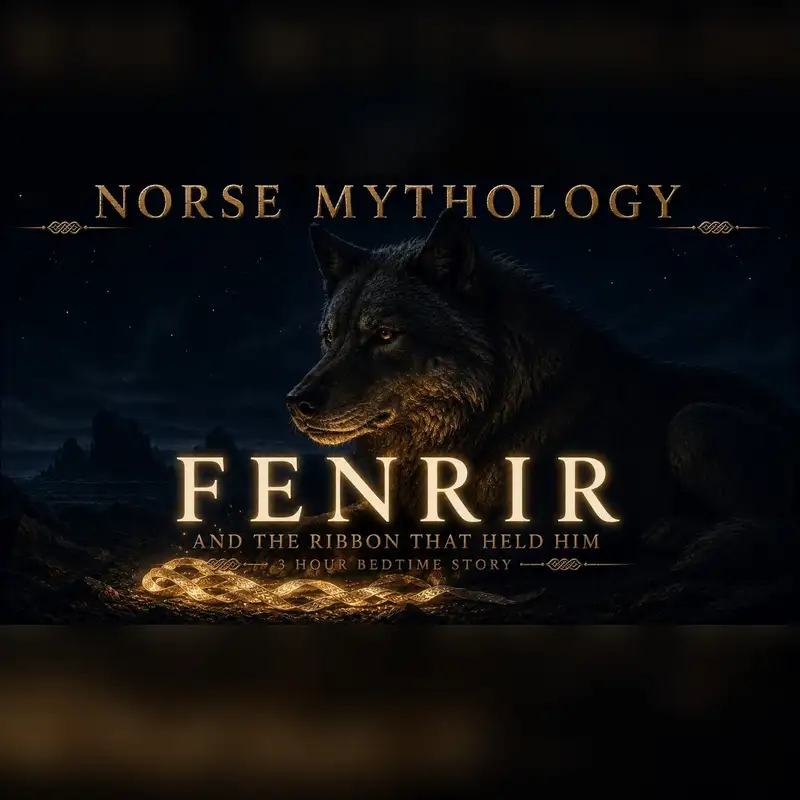
Good evening.
Or perhaps good night, if you've made your
way here in the long hours after midnight
the difference may already have stopped mattering.
You've come back, perhaps, because the last three episodes
helped you sleep.
Or you've come for the first time.
And the fourth episode happened to be the one
the algorithm offered.
Either is fine.
The almanac is patient.
Tonight stands on its own.
If you are listening in bed, I'd ask you
to do very little.
Close your eyes.
Let your jaw loosen.
Let your shoulders drop, even a little
even if you didn't know they were tight.
The story does not need your attention.
It will keep moving whether you follow it or
not.
If you drift, that is the point.
If you wake briefly to catch a single sentence
and then sink again, that is good.
In the first episode, we walked the shape of
the world, nine realms joined by one great
tree.
In the second, we met the wanderer, the Allfather
the hanged god.
In the third, we went down into the dwarven
forges and watched, in a single strange wager
the making of the hammer that would defend the
gods.
Tonight, we follow a quieter and a sadder story.
A story about a wolf.
A wolf who was a child.
A wolf who was raised in the high halls
of Asgard among the very beings who would one
day decide they had to bind him.
This is the story of how that binding was
done.
And of the small ribbon, woven of impossible things
that finally held the wolf.
And of the god, the brave god
the just god, who put his hand into
the wolf's mouth so that the binding could be
made.
Now, let us begin.
Chapter One.
The Three Children of Loki.
Before we go to the wolf.
And before we go to the chain.
We should sit, for a while, with the figure
who gave the wolf his life.
We met him, briefly, in the last episode.
The trickster.
The one who cut Sif's hair while she slept
and who then was made to descend
by Thor's anger, into the underground halls of the
dwarves to bring back gifts of recompense.
We saw him there at the bellows.
We saw him take the shape of a fly.
We saw him try, in his way
to ruin the work of the smiths.
And we saw the work be made anyway
despite him.
Loki.
The Old Norse sources do not give us a
tidy biography of him.
They give us scattered passages, in the Eddic poems
and in Snorri's Prose Edda, and from those passages
we are meant to assemble a figure.
The figure that emerges, when you look at the
texts together, is more complicated than the figure who
appears in modern films and comic books.
The modern Loki is, often, a quick and witty
schemer with the suggestion of a redemption arc.
The Norse Loki is something stranger.
He is something older.
And tonight's story is one of the places where
his strangeness shows.
The texts call him, sometimes, a son of giants.
His father, in the surviving accounts, was a giant
named Fárbauti.
Whose name means, roughly, Cruel Striker.
His mother was Laufey, whose name means Leafy.
Or Leaf-Island.
There has been long argument among scholars about whether
Laufey was a giantess or a goddess.
The surviving texts are not certain.
What is certain is that Loki, by birth
was not of the Æsir.
He was a being who came into Asgard from
outside, and who was made a member of the
Æsir by oath of blood-brotherhood with Odin.
The texts preserve this oath.
The Eddic poem Lokasenna refers to it.
Loki and Odin had, at some point in the
deep past, sworn together that they would drink no
ale that was not poured for them both.
They had become brothers in the older Germanic sense
bound by ceremony, bound by ritual
bound to share a single fate.
This is worth holding in mind, as we walk
through tonight's story.
Loki is, by oath, Odin's brother.
Even when he is doing things the gods do
not approve of, he is doing them inside the
bonds of that brotherhood.
The gods cannot simply expel him.
He has the rights of one of their own.
Loki had a wife in Asgard.
Her name was Sigyn.
She does not appear often in the surviving sources.
But when she appears, she is faithful to him
beyond any reasonable measure.
There is a story we will tell
in a later episode, in which she stands beside
him for ages with a bowl held above his
face.
We will not tell that story tonight.
Tonight is not that story.
What Loki had, that we do need tonight
were three other children.
By another woman.
A giantess.
Her name, in the surviving accounts, was Angrboða.
Angrboða.
The name means, in Old Norse, Sorrow-Bringer.
Or Grief-Bringer.
The texts do not describe her closely.
They tell us only where she lived
which was in Jötunheim, the world of the giants
in a forest the sources call Járnviðr
the Iron Wood.
They tell us she had relations with Loki, somehow
at some point.
And they tell us that she bore him three
children.
The Iron Wood.
The Sorrow-Bringer.
The three children.
This is the kind of detail that
in the older Norse imagination, would have settled
in the listener's mind, the kind of children we
are about to meet.
They were not going to be ordinary.
They were not going to be welcome.
They were going to be of the wild forests
of the giants' world, of the deep places that
the high halls of Asgard did not reach.
And they were not.
The first of Loki's children by Angrboða was a
daughter.
Her name was Hel.
She came into the world, the texts tell us
half one color and half another.
One half of her body, the surviving accounts say
was the color of living flesh.
The other half was the color of corpse.
She was, from her birth, marked.
The second of Loki's children was a serpent.
He had no proper name at first.
He grew.
He kept growing.
He grew until he was longer than the world
could contain.
The third of Loki's children was a wolf.
We will get to him in a moment.
The gods, the sources tell us, did not know
about these children at first.
The trickster had kept them in the Iron Wood
away from Asgard, away from the eyes of the
Æsir.
He was raising them, perhaps.
Or he was hiding them.
The text does not specify which.
But Odin, the Allfather, who saw far
whose ravens flew across the nine worlds at dawn
and brought him back what they had seen
Odin learned of them.
Whether through his ravens or through one of the
seers he sometimes consulted, the texts do not say.
He learned.
And what he learned alarmed him.
He learned that these three children of Loki had
been seen, by those who could see such things
in the visions of the future.
He learned that all three would be present at
Ragnarǫk.
The great unmaking at the end of the world.
He learned that the daughter, Hel, would gather the
dead under her cold rule.
He learned that the serpent would rise from the
sea and poison the air with his breath.
And he learned that the wolf
the wolf would do something terrible.
Something the surviving sources hint at but
in the early passages, do not yet describe.
So Odin acted.
He sent for the three children to be brought
to Asgard.
And when they came, the gods sat in their
hall, and they looked at them, and they decided
what was to be done.
Hel, the daughter, the gods sent down.
They sent her into Niflheim, the lowest of the
cold worlds beneath the world, and they gave her
dominion there.
They gave her a hall called Eljúðnir.
They gave her a table called Hunger and a
knife called Famine.
They gave her authority over the dead who had
not died well, those who had died of
sickness or of age, the dead who would not
feast in Valhǫll or in the halls of Freyja
the great gentle mass of the unspectacular dead.
The gods made her queen of those.
She would gather them under her hand and rule
them in the cold dark below.
This is, in its way, one of the strangest
acts of administration in any mythology.
The gods looked at a half-dead child and said:
you.
You will look after the half-dead.
You will look after the ones who go quietly.
There is something honest about it.
There is something, too, that is cruel.
The texts do not say which the gods intended.
Jǫrmungandr, the serpent, the second child
Odin took him and threw him into the sea.
The great sea that surrounds Midgard.
The serpent kept growing in the sea.
He grew until he could encircle Midgard entirely.
Until he could put his own tail in his
own mouth.
He lies there still, in the world's ocean
biting his tail, his body coiled around all of
the lands of men.
The sailors of the old Scandinavian world knew his
name.
They knew that what they were sailing on was
in some long old reckoning, the back of him.
He waits in the sea.
He will rise at Ragnarǫk.
And then there was the wolf.
The wolf was different.
The wolf, the gods decided, they could not yet
send away.
They brought him into Asgard.
They thought, perhaps, that if he was raised among
them, if he was raised in the high halls
he might grow up to be something other than
what the seers had foretold.
They thought, perhaps, that the future was not yet
certain.
That the wolf could be loved into something gentler.
They were wrong.
But they were not, in the beginning
foolish to try.
We will come to what happened.
His name was Fenrir.
In the Old Norse, Fenris-úlfr, the wolf of
the fen, or the wolf of the wetland.
The lowland wolf.
The wolf of the dark wet places at the
edges of the settled world.
The name carries, in its sound, the kind of
cold the old Scandinavians would have known well.
The marsh in winter.
The mist over the bog.
The wolf that you heard at the edge of
your light at night, and that you knew
even in the safety of your hall
was there.
He came to Asgard as a child.
As a pup, the texts tell us
though the texts do not use that word.
He was small.
He was the kind of small that grows.
The gods looked at him in their hall
and they took him in.
And the texts pause here, before they tell us
what came next.
We pause too.
Sleep, if you are ready to.
The next chapter will tell you what it was
like to feed him.
Chapter Two.
The Wolf Brought to Asgard.
Imagine, if you can, the high hall of the
gods.
The hall is built of timber and gold.
The roof is shielded with shields
the texts use that phrase, that the roof of
Valhǫll was thatched with the war-shields of the slain.
The fires are kept burning in long stone hearths
down the center of the hall.
The benches along the walls are long and broad
and meant to hold many.
The Æsir gather here at evening to drink
to talk, to argue, to settle the business of
the worlds.
Into that hall, the gods brought a wolf-pup.
He was small, at the beginning.
The texts make this point.
He was small enough that the gods could carry
him.
He was small enough to be set down on
the bench beside them.
Small enough to be looked at, in the firelight
as a curious and unusual ward.
But he grew.
Wolves, in the natural world the old Scandinavians knew
grew quickly.
A wolf-pup at six weeks was a small bundle.
A wolf-pup at six months was a creature you
would not lightly approach.
A wolf at one year was, in the eyes
of any farmer in the long north
fully a wolf, already capable of taking a
sheep, already capable of running with a pack across
a frozen field, already wearing the full silvered coat
of the adult.
The growth of a wolf, the people of the
old north knew, was fast and frightening and could
not be slowed.
Fenrir's growth was faster.
The texts do not give us numbers.
They do not say in what week he doubled
in size, in what month he tripled.
They give us, instead, the impression of growth that
exceeded its own kind.
They give us a wolf who, in the great
hall of the gods
grew.
And kept growing.
Until he was the size of a horse.
Until he was the size of two horses.
Until he was the size of one of the
high benches in the hall.
This is a detail worth letting settle.
The benches in a Norse longhouse were long enough
to seat many warriors and broad enough to sleep
on.
To say a wolf was the size of one
of those benches is, in the imagination of the
old Scandinavian world, to say a wolf that would
not fit in any normal hall.
A wolf that bowed the timbers when he moved.
A wolf whose breath, when he panted
fogged the fires.
The gods watched him grow.
They had taken him in for a reason.
They had thought, and the texts hint at
this even where they do not say it
that if the wolf was raised among them
if he was given the kindness of the high
hall, he might be made gentle.
They had thought, perhaps, that the prophecies of what
he would do at Ragnarǫk could be unmade by
love.
It is one of the most poignant choices in
all of Norse mythology.
The gods, knowing what the seers had said.
The gods, having looked at the future.
Choosing, nonetheless, to try.
And the wolf, in the early years
did not refuse the kindness.
He came into the hall.
He ate what was given to him.
He grew.
But he was not, the texts tell us
a tame wolf.
He was not a pet.
He was not, in the way of a dog
of the household, a being that lay at the
feet of the gods and looked up at them
in trust.
He was something else.
He was something the gods had brought into their
own hall, and that was changing, week by week
into something they had not foreseen.
The wolf grew not just in body.
He grew in the strangeness of his eye.
He grew in the depth of his voice.
He grew in the way the other gods
when they came past him in the hall
found themselves walking a little wider.
Found themselves not making eye contact.
Found themselves, without knowing why, holding their breath.
There came a point, the texts tell us
at which only one of the gods was still
willing to feed him.
Before we go to that god, who is the
heart of tonight's story, we should sit a little
longer with the wolf himself.
The Old Norse word for wolf, úlfr
is one of the oldest words in the Germanic
family of languages.
It is related to the German Wolf
the English wolf, the Gothic wulfs.
It is, in the long deep past
one of the words that the Germanic peoples carried
with them from their earliest reckoning of the world.
And the wolf, in the imagination of those peoples
was not one thing.
It was many.
The wolf was, in some readings, the enemy.
The animal at the edge of the firelight that
took the sheep from the fold and that
in the long cold winters, came into settlements when
the snow lay deep.
The wolf was the thing the hall was built
against.
The thing the door was barred against.
The thing the children, in their straw-stuffed beds
learned to listen for in the night-quiet.
But the wolf was also, in other readings
the kindred figure.
The animal that, of all the animals in the
Norse imagination, was closest to the warrior.
The wolf-warriors of the old Germanic peoples, the úlfheðnar
were a specific class of fighters who
in the surviving sources, took on the strength and
the savagery of the wolf in battle.
They wore wolf-pelts.
They were said, in the older heroic poems
to fight as wolves fight.
They were the kindred of the wolf.
And there were the wolves of the gods themselves.
Odin, the Allfather, kept two wolves at his throne.
Their names, we learned in the second episode
were Geri and Freki.
Greedy and Ravenous.
Odin fed them, from his own table
the meat that came to him in Valhǫll.
The wolves of Odin were not, in the surviving
sources, a problem.
They were, in their way, members of the household
of the gods.
They were honored.
They were kept.
So when Fenrir came to Asgard as a small
thing, the gods were not afraid of him because
he was a wolf.
They were not, in the early days
afraid of him at all.
They had wolves at the Allfather's own throne.
Wolves were known.
Wolves were, in their way, kindred.
What changed was not the kind of being Fenrir
was.
What changed was the scale of him.
The simple terrible fact that, week by week
the small thing they had taken in was becoming
larger than any wolf had ever been.
He was passing out of the country of the
familiar wolf.
He was passing into the country of the unfamiliar.
The country of the monstrous.
The country in which the gods, who had known
wolves all their long lives, no longer knew what
was sitting in their hall.
There came a point, the texts tell us
at which only one of the gods was still
willing to feed him.
We will come to that god in the next
chapter.
He is the heart of tonight's story.
What you should hold, from this short telling
is the shape of the situation that had come
slowly, to be true in the hall of Asgard.
The gods had taken in a child.
The child had grown into something the gods could
no longer pretend was a child.
The gods had not yet, in their council
decided what to do about it.
They were watching.
They were waiting.
They were hoping, perhaps, that the growth would slow.
Or that the wolf would, by some unforeseen change
become something other than what the seers had said.
But the wolf did not slow.
And the day was coming when the gods would
have to act.
Before we walk into that day, we should meet
the god who fed him.
Chapter Three.
Týr, the One Who Fed Him.
There was a god whose name was Týr.
The name, in Old Norse, was spelled in three
letters, T-Ý-R.
In runic carving, it was a single rune
the Týr rune, which stood for both the god
and for the sound at the start of his
name.
The rune itself is shaped like a small upward-pointing
arrow.
↑.
A figure with arms raised.
A figure standing, looking up, with arms open.
In the old Scandinavian world, warriors would sometimes scratch
this rune onto the hilt of a sword before
battle, as a quiet asking of the god's protection.
The rune is one of the most often found
in the surviving inscriptions of the runic age.
The god, even in the late telling of the
Norse stories, had not been forgotten.
But by the time of the surviving texts
by the time, that is, of Snorri Sturluson in
the thirteenth century, sitting at his desk in Iceland
writing down what was left of the old religion
the god of Týr had become a thinner
figure than he once had been.
There are passages in the Prose Edda where Snorri
pauses before describing him, as if reaching
in his own thirteenth-century way, for a memory that
was already fading from the world.
Týr.
What the surviving texts do tell us is that
he was, in the older Germanic religious system
one of the highest gods.
There is good reason to believe
and many scholars have argued this
that Týr was, in the deep past
before Odin became the chief of the gods
the chief of the gods himself.
The name Týr is etymologically related to the Greek
Zeus and the Latin Iupiter (which we say as
Jupiter), all of them descended from a single Proto-Indo-European
root meaning sky, or shining
or sky-god.
Týr was, once, the sky-father of the Germanic peoples.
By the time the Norse texts were written down
that role had passed to Odin.
But the older, simpler god of justice and of
law and of the right outcome
that god was still Týr.
He is described, in what survives of him
as the bravest of the gods.
Snorri uses this exact word.
He says, in Gylfaginning, that Týr was the bravest.
He says that Týr was the wisest.
He says that anyone who wishes to surpass the
rest of men in courage and good sense should
call upon Týr.
Týr was the god, that is, that you went
to when you needed a hard thing done.
A right thing.
A thing that other gods, more cunning or more
clever or more politic, would not do.
The texts do not give us a long biography
of him.
They give us, in passing, that he had only
one hand.
That his right hand had been lost.
We will come to how he lost it.
And the texts give us, almost as an aside
what he did for the wolf.
When Fenrir was first brought into Asgard
when he was small, the gods all took turns
with him.
They all, in the texts' careful phrasing, fed him.
They all, in the early days, were willing to
walk to the wolf and lay food before him
and stand beside him while he ate.
But the wolf grew.
And as he grew, the other gods
one by one, stopped going to him.
By the time the wolf was at the size
that bent the timbers of the hall
only Týr was still willing.
Only Týr would walk, each day, to where the
wolf was lying.
Only Týr would carry the meat.
Only Týr would set it down.
And only Týr would stand there, his hands empty
and his eye open, while the wolf ate.
We should pause on this.
The other gods of Asgard had, by then
the high cunning.
The far-seeing.
The names that had been earned across worlds.
Thor had his hammer.
Odin had his ravens.
Heimdallr could hear the grass grow.
Freyr had his shining sword.
Freyja could fly, in her cloak of falcon-feathers
across any sky.
The Æsir were, in every account, beings of enormous
power.
And none of them, the texts tell us
would walk up to Fenrir.
Only Týr.
There is, in this, something the texts do not
need to say in so many words.
Týr was the bravest.
Not because he was the strongest.
Thor was stronger.
Not because he was the wisest.
Odin had drunk from Mímir's well and Týr had
not.
Not because he was the highest.
By the time the texts were written
Týr had been, for centuries, no longer the chief
god.
Týr was the bravest because Týr did the thing
that needed doing.
The wolf needed to be fed.
So Týr fed him.
The other gods, who had taken the wolf in
who had brought him into their hall
who had decided that they would try to raise
him, the other gods had, by then
stepped back.
They were watching from a distance.
They were leaving the daily task to one of
their own.
Týr did not refuse.
The texts give us very little of what passed
between Týr and the wolf in those long quiet
feedings.
They do not give us conversation.
They do not give us a slow growth of
understanding.
They give us, only, the steady fact:
Týr fed him.
Daily.
Without fail.
While the gods watched from the high benches.
There is a question worth asking, here.
Did the wolf, in those years, know what Týr
was doing?
The Norse sources do not believe in unintelligent monsters.
Fenrir, in the surviving texts, is not portrayed as
a brute or as a beast.
He is portrayed, when he speaks, as articulate.
He is portrayed as suspicious, as careful
as alert to the meanings of what is done
to him.
He is, in his own way, a person
a person in a wolf's shape and at a
wolf's terrible scale, but a person.
So when Týr came to him with meat
day after day.
When Týr stood quietly beside him while he ate.
When Týr did not pull back, did not show
fear, did not look away.
What did the wolf understand of that?
The texts do not tell us.
In my reading, and the texts do not
tell us this, the wolf came
in those long quiet feedings, to understand Týr in
a way he did not understand any of the
other gods.
Not as a friend, exactly.
The wolf was not, by any reading of the
texts, a being who had friends.
But as the one god whose presence did not
carry the small flicker of fear that the wolf
was, by then, accustomed to seeing in every other
face.
Týr came to him steadily.
Týr fed him steadily.
Týr stood beside him steadily.
And the wolf, in his huge intelligent watching
came to know that this god was not afraid
of him.
The moment that comes later, the moment when
the wolf, having seen through the gods' deception
asks for one of them to put a hand
in his mouth as surety, has
when you sit with it, a particular shape.
The wolf does not ask for any hand.
He asks, by his refusal to be tested otherwise
for the hand of the god who has been
willing to come close to him.
The text does not give us the wolf's reasoning.
But the wolf's reasoning, in my reading
is there beneath the surface of what the text
gives us.
But the texts do tell us this.
When the moment came, much later, when the gods
needed someone to put a hand into the wolf's
mouth as surety.
When they needed a god to step forward and
offer that hand.
The wolf knew which god to ask for.
He did not ask for Odin.
He did not ask for Thor.
He asked for Týr.
The bravest.
The just.
The one who had fed him.
We will get to that moment.
What you should hold, from this chapter
is the shape of Týr in the hall of
the gods.
He is not loud.
He is not in the front of the stories.
He is the god who, when the other gods
stepped back, walked forward.
He is the god who, when the cost would
be paid, was the one to pay it.
He is the figure who, in tonight's story
will lose more than any other.
In the next chapter, we go to the first
of the gods' attempts to bind the wolf.
Chapter Four.
The First Two Chains.
The gods, the texts tell us, came at last
to their council.
The wolf could no longer be hosted in the
high hall.
The wolf had become too large, too suspicious
too aware.
The Æsir gathered, the texts say, and they spoke
of what was to be done.
And what they decided was this.
The wolf, the gods said, must be bound.
Not killed.
The texts are clear on this.
Not killed.
Even in the height of their alarm
the gods did not move to kill Fenrir.
There has been long argument among scholars about why.
One reading is that, because the gods had taken
him in as a foster-child, killing him would have
been the breaking of the most ancient and most
binding of social obligations, the obligation of the
foster-parent to the foster-child.
Another reading is that, because Fenrir was Loki's son
and Loki was Odin's blood-brother, killing the wolf would
have been the killing of a kinsman.
A third reading is that the gods, foreseeing Ragnarǫk
knew the wolf could not be killed by ordinary
means.
He was to be the killer of Odin himself
at the end of the world.
Such a being could not be put down with
a sword.
Whatever the reading, the texts agree.
The decision was not to kill but to bind.
And to bind, the gods first thought
would be simple.
They were gods.
The wolf, after all, was only a wolf
even a wolf of unusual size and strangeness was
in the imagination of the Æsir at this council
a creature that could be wrapped in iron and
held.
So they made a chain.
The first chain was called Lœðingr.
The etymology of the name is not entirely certain
the Old Norse scholars have argued about it
for a long time.
One reading connects it to a root meaning to
lay down.
Another connects it to the kind of binding-word used
in legal proceedings.
Whichever reading is right, the name carries the sense
that this was a chain meant to settle the
wolf.
To hold him in place.
The Æsir made this chain themselves, in their own
forges.
They did not yet go to the dwarves.
They thought, at this stage, that the work of
binding could be done with their own hands.
They forged the iron.
They linked the links.
They tested the strength of the chain against the
strength of their own arms, and they were satisfied.
Then they brought the chain to the wolf.
The texts give us, here, one of the most
quietly cunning passages in all of Norse literature.
The gods did not come to Fenrir and say
this is a chain.
We have made it to bind you.
Lie still while we place it around you.
They did not say that.
They said, instead, and the surviving accounts preserve
this almost as a joke, they said: Fenrir
we have made this chain.
We do not know how strong it is.
Would you let us try it on you?
It will be a test of your strength against
the chain's.
We will see which is the greater.
It is one of the small dark comedies of
the surviving Edda.
The gods, in their first attempt to bind the
wolf, came to him in the language of sport.
As if it were a game.
As if there were no consequence.
As if they were saying, come, friend
let us see how strong you are today.
The wolf agreed.
He agreed, the texts say, because he was confident
in his own strength.
He had grown to the size he had grown
to.
He had felt the bones of horses give way
under his jaw.
He had felt the timbers of the hall flex
beneath his weight.
The wolf looked at the chain.
He looked at the gods.
And he said, in effect: very well.
Place it on me.
We will see.
The gods placed the chain Lœðingr around him.
They drew the chain tight.
They stepped back.
Fenrir kicked once.
The chain Lœðingr fell to the ground in pieces.
The gods looked at it.
The wolf looked at it.
And the wolf, the texts tell us
was not displeased.
He had won the game.
He had proven his strength.
He was, perhaps, even a little pleased to be
in a game with the gods, who had until
now never tested him in this way.
The gods were silent.
They went away to their council and they spoke
again of what to do.
It was decided that they would make a second
chain.
A stronger one.
Twice as strong, the texts tell us
as the first.
Or, in some readings, of a stronger metal
of an iron worked with secret runes by the
gods' best smiths.
The chain was called Drómi.
The name, in Old Norse, comes from a root
meaning fetter or bond.
It was a fetter in the most literal sense.
A binding-thing.
The gods brought Drómi to the wolf.
They came, again, in the language of sport.
They came, again, as if it were a game.
They said, and this is where the surviving
texts begin to give us, very gently
the suggestion that the wolf was no longer entirely
fooled, they said: Fenrir, your fame for breaking
Lœðingr has spread among us.
We have made a stronger chain.
Will you not test your strength again?
Will you not be praised by all of the
Æsir for the breaking of this one too?
The wolf looked at Drómi.
It was visibly heavier than Lœðingr.
It was visibly thicker.
The eye of the wolf, the texts tell us
was beginning to grow wary.
But the wolf said: very well.
Place it on me.
I am willing.
The gods placed Drómi around him.
They drew it tight.
The chain was so heavy that even the gods
the texts say, strained to lift it.
They stepped back.
The wolf gathered himself.
He had to work this time.
He kicked once.
The chain held.
He kicked again.
The chain bent but did not break.
He bucked.
The chain creaked.
The wolf, the texts tell us, had to put
forth, for the first time, his real strength.
And then the chain broke.
The links of Drómi flew apart across the field.
The pieces, the surviving sources say, lay scattered.
The wolf rose, panting.
He looked at the gods.
And the wolf was even more pleased now than
before.
He had proven his strength a second time.
He had broken even the strongest chain the gods
themselves could make.
The gods, the texts tell us, were beginning to
be afraid.
They went away again to their council.
And they spoke of what was to be done.
And there was, by now, the slow heavy understanding
in the council that they could not bind the
wolf with the strength of their own forges.
The gods of Asgard could not, by themselves
make a chain that would hold him.
They would have to send for help.
They would have to send for the dwarves.
In the next chapter, we go down again
as we did, last week, for the hammer
into the underground halls of Svartalfheim.
Chapter Five.
Down to Svartalfheim Again.
We were last in Svartalfheim only the week before
in the long telling of how Mjǫllnir was made.
We walked there with Loki, then, on the long
road down.
We watched him stand at the bellows.
We watched the dwarves Sindri and Brokkr work at
the anvil.
We watched the gold form into the boar Gullinbursti.
The ring Draupnir.
The hammer that would, from that night forward
hang at Thor's belt.
Tonight we go back.
The gods, having failed twice to bind the wolf
with chains of their own making, send a messenger
down to the same dark country.
This time, it is not Loki who goes.
The texts give us the name of the messenger.
He was called Skírnir.
The bright one.
The shining one.
He was the servant, or, in some readings
the friend and follower, of the god Freyr.
Freyr, who we will meet at length in a
later episode of this season, was one of the
Vanir, the second tribe of gods, who had come
into Asgard after the long Æsir-Vanir war.
Freyr was the god of fertility, of the sun
in summer, of growing things.
Skírnir was his messenger, his runner, the one he
sent on tasks the surviving texts portray as urgent
delicate, and almost diplomatic.
It is interesting that the gods chose Skírnir for
this errand and not, for example
Loki.
Loki had been to Svartalfheim before.
Loki, in the previous episode, had stood at the
bellows and watched the dwarves work.
Loki knew the road.
Loki, in the trickster's way, would have been the
obvious messenger.
But the gods, by this point in the story
no longer entirely trusted Loki.
They knew that Fenrir was Loki's son.
They knew that Loki, while sworn to the Æsir
had his own loyalties and his own ambivalences.
They did not want, on this errand
the trickster's hand on the message.
They wanted someone simpler.
Someone bright.
Someone whose loyalty to the high gods was uncomplicated.
So they sent Skírnir.
Skírnir went down.
The texts do not describe his journey in detail.
They give us only that he went.
He passed through whatever roads the messengers of the
gods knew, perhaps along Bifrǫst, the rainbow bridge
perhaps along older paths that the surviving texts do
not name.
He came to Svartalfheim.
He came to the door of the smiths.
This time, the smiths are not Sindri and Brokkr.
The surviving texts do not name them.
Snorri tells us, in the Prose Edda
only that Skírnir came down to "certain dwarves." He
does not give them faces.
He does not give them lineages.
They are, in the only account that has come
down to us, simply dwarves of the deep country
the unnamed smiths of Svartalfheim, who already
the texts hint, knew why Skírnir had come before
he had spoken.
You will remember, perhaps, that in the previous episode
the dwarves we met were named.
The sons of Ívaldi, who made Sif's new gold
hair and the spear Gungnir and the ship Skíðblaðnir.
The brothers Sindri and Brokkr, who made the boar
Gullinbursti, the ring Draupnir, and Mjǫllnir itself.
Those dwarves the surviving sources named because the story
of the wager required them to be named
the wager was between two specific sets of smiths
and the gods needed to know who had made
which treasure.
Tonight's story is different.
Tonight's story has no wager.
Tonight's story has only a binding.
The makers of the binding the texts have not
preserved by name.
We can, in our own imagination, hold them as
unnamed.
As deeper, perhaps, even than the named dwarves.
As the dwarves of dwarves.
The smiths the other smiths went to when the
work was beyond what they themselves could do.
Skírnir came to them in their hall.
He brought a message from the gods.
The message, in the surviving telling, was this.
The gods, said Skírnir, need a binding.
They need a thing that will hold a wolf.
The wolf is large, very large, larger than the
gods' own forges can make a chain to hold.
The gods have failed twice.
They need a third binding.
They need it to be different.
They need it to be of such a kind
that the wolf, when he sees it
will not believe it can hold him.
And they need it to hold him anyway.
The dwarves listened.
The texts do not give us their faces.
They give us, only, that they listened.
And that after they had listened, they were quiet
for a while.
And that after they had been quiet
they said, and this is the part the
surviving sources preserve almost as a riddle
they said: we will make it.
We will make it of six things.
The things we will use, we will use up.
There will not be any of them left in
the world after we are done.
Skírnir, the texts tell us, did not understand.
He asked, what six things?
And the dwarves said: you will see.
And they began.
The dwarves of Svartalfheim, in the long old Norse
imagination, were the keepers of the deepest crafts.
They were the ones who knew the runes that
the gods themselves did not yet know.
They were the ones who could draw
from the materials of the deep world
the qualities that lived in those materials.
The hardness of stone.
The brightness of gold.
The silence of shadow.
For Gleipnir, the texts give us the name
of the binding here, Gleipnir, which means
in rough Old Norse, the open one
or the deceiver, the one that catches
the dwarves used six things.
Six things that, in the world before the binding
of Fenrir, the texts tell us, were present and
known.
And that, after the binding of Fenrir
were no longer present in the world.
The dwarves used them up.
The world has been thinner ever since.
We come, in the next chapter, to what those
six things were.
Sleep, if you are ready to.
The list is one of the most beloved passages
in all of Norse mythology.
And the listing of it is, in its own
quiet way, a lullaby.
Chapter Six.
The Six Impossible Things.
The first of the things the dwarves used in
the making of Gleipnir was the sound of a
cat's footfall.
This is what the texts say.
The Prose Edda preserves the line.
The first of the six was the sound that
a cat makes when it walks.
The slight, almost-not-there pressure of a cat's foot on
a wooden floor.
The almost-silence of it.
The way a cat can cross a room while
a person who is sitting in it does not
look up.
The dwarves took this.
They took the sound.
They wove it into the cord.
This, the surviving Edda tells us, is the reason
that cats now walk silently.
The sound, before, had been in the world.
The dwarves used it.
The sound that remained, the sound that a
cat now makes when it crosses a floor
is what was left after the dwarves had taken
what they needed.
Cats walk silently because the dwarves needed the sound
of their footfalls for the binding of the wolf.
This is a beautiful piece of mythic reasoning.
It is also, in the way the old Norse
sources sometimes do, a small piece of folk explanation.
Why do cats walk silently?
Because the dwarves used up the rest of the
sound long ago.
The second of the things the dwarves used was
a woman's beard.
This may sound strange to a modern ear.
But the texts are specific.
The second ingredient was the beard of a woman.
And the explanation, and this is one of
the small dry jokes of the surviving sources
is that, before the binding of Fenrir
women had beards.
After the binding of Fenrir, they did not.
The dwarves used them up.
The Old Norse word for beard, skegg
would have been familiar to every household.
The beard of a man was, in the old
Scandinavian world, one of the markers of his standing.
The beard of Thor, of Odin, of every warrior
in the longhouse, was groomed and tended.
The texts of the Edda do not tell us
what a woman's beard, in the time before the
binding, had looked like.
The texts tell us, only, that there had been
one.
And that, after the binding, there was no longer.
The third of the things the dwarves used was
the roots of a mountain.
This one, perhaps, lands more easily in the modern
ear.
The roots of a mountain.
The deep parts of stone that go down into
the earth, that anchor the mountain to whatever is
below, that hold it in place against the slow
turning of the world.
The dwarves, the texts say, took those roots.
Used them.
The mountains have, since the binding of Fenrir
been rootless.
They are held in place now only by their
own weight.
By their own resting.
The roots are gone.
This is the kind of detail that
when you sit with it for a long quiet
moment, does something to your sense of the world.
It says, the mountain is heavier than it looks.
It says, the mountain is balanced now where once
it was anchored.
It says, the world has been, since this story
a little less steady than it once was.
The fourth of the things the dwarves used was
the sinews of a bear.
Sinew, the tough silvery cord that runs along
the muscle of an animal and connects it to
the bone.
In the old Scandinavian world, the sinews of large
animals were used for the strings of bows
for binding the iron-head onto a spear-shaft
for the silent strength inside every craft.
The sinew of a bear was particularly valued.
A bear was the largest land animal of the
Norse imagination.
Its sinew was the strongest of the bindings the
human craft could make.
The dwarves took the sinews of a bear.
Used them.
Wove them into Gleipnir.
The fifth of the things the dwarves used was
the breath of a fish.
You may, listening now, find your eye opening a
little at this.
The breath of a fish.
What does a fish breathe?
A fish, in the old Norse imagination
did not breathe the air that humans breathe.
A fish moved through the water, opening its mouth
and from its gills came a slight pulse
a small almost-silent rhythm that the old Norse people
who knew their cold rivers and their cold seas
would have noticed as they pulled fish from the
water and watched them lie in the bottom of
the boat.
The breath of a fish was that pulse.
That small last quiet exhalation.
The dwarves took it.
Used it.
And the sixth, the last, of the things the
dwarves used was the spittle of a bird.
The Old Norse texts pause on this one too
in the way they do.
The spittle of a bird.
The almost-nothing, the just-barely-there, the moisture inside a bird's
beak that you would not see unless you looked
very closely.
The dwarves used it.
These were the six things.
The sound of a cat's footfall.
A woman's beard.
The roots of a mountain.
The sinews of a bear.
The breath of a fish.
The spittle of a bird.
You may notice, if you let the list settle
that each of the six is a thing that
the old Norse imagination would have called almost-not-there.
They are not, like iron, or like gold
or like stone, the things you can pick up
and hold.
They are not, like the strength of a god
or the speed of a wind, the things you
can name and measure.
They are the things at the very edge of
presence.
The sound a cat makes that is just barely
a sound.
The beard of a woman that, even when it
was in the world, was not the central marker
of her.
The roots of a mountain that no one had
ever seen, only inferred.
The sinew of a bear, which is the strength
inside the strength.
The breath of a fish, which is the breath
inside an animal that does not seem to breathe
at all.
The spittle of a bird, which is the smallest
moisture inside the lightest of all flying things.
The surviving texts do not tell us why the
dwarves chose these six things.
The Prose Edda lists the ingredients without explaining the
reasoning behind them.
What I would offer here, as one way of
understanding the choice, is this.
The gods had tried to bind the wolf with
the things he could feel.
The iron of Lœðingr.
The iron of Drómi.
The chains of the high forges.
The wolf had felt them and had broken them.
So the dwarves, when the gods came to them
in their need, may have reasoned in the deep
way of the dwarves, that the wolf could
not be bound by anything he could feel.
He could only be bound by what he could
not feel.
By the absences.
By the things at the edge of presence.
By what was barely there.
This is, perhaps, the kind of reasoning the old
Norse imagination loved.
The kind of reasoning that says, the thing you
cannot see is stronger than the thing you can.
The thing that is barely there is the thing
that holds.
The lightest binding is, in the end
the only binding that lasts.
The Eddic poets did not write this down for
us in so many words.
But the listener, even the listener at the
edge of sleep, can sit with the possibility.
And the possibility is, in its way
the most Norse of all the things in the
story.
The dwarves took the six things and they wove
them into a single cord.
And the cord, when it was done, was
the texts tell us, smooth as a silken
ribbon, light as a thread of spider's silk
soft enough to be coiled into the palm of
a single hand.
It was so light that it seemed almost not
to be there.
It was so smooth that it seemed it could
not possibly hold anything.
This was Gleipnir.
The deceiver.
The open one.
The one that catches.
The dwarves gave it to Skírnir.
Skírnir, the messenger, took the small soft ribbon in
his hand.
He looked at it.
He must, the texts hint, have wondered how this
small thing was meant to hold the wolf.
He must have wondered whether the dwarves had played
some joke on him.
But the dwarves, in the surviving sources
gave him no further explanation.
They said only: take it.
Bring it to the gods.
They will know what to do.
And Skírnir, holding the small ribbon of impossible things
in his closed fist, climbed back up the road
from Svartalfheim.
And he came home to Asgard.
And he gave the ribbon to the gods.
In the next chapter, we walk to the island
where the binding will be made.
Chapter Seven.
The Ribbon in the Hand.
When Skírnir came back to Asgard, the gods were
waiting in their council hall.
He set the small bright thing on the table
before them.
The texts give us the scene.
The gods looked at it.
They did not, at first, believe it.
This, they said.
This is what the dwarves made.
Skírnir said: yes.
This, they said again.
This silken ribbon.
This little soft cord that we could break between
our fingers.
Skírnir said: yes.
They said it would hold him.
There was, the surviving sources tell us
a long silence in the council.
The gods looked at the ribbon.
They looked at one another.
Some of them, in the slow way of the
long-lived, took the ribbon in their hands and tested
it.
They pulled gently at it.
They pulled harder.
They strained against it with the strength of gods.
The ribbon did not break.
The gods, the texts say, were astonished.
They tried again.
The strongest of them, Thor was not yet
at Mjǫllnir's side in this telling, but Thor was
nonetheless there, with his bare hands and the great
strength of his bare hands, Thor took the
ribbon and pulled.
The ribbon did not move.
The ribbon did not stretch.
The ribbon held.
The gods began, slowly, to understand what the dwarves
had given them.
It was not a thing of weight.
It was not a thing of mass.
It was not a chain in the sense the
gods had been thinking about chains.
It was a binding made of qualities that had
been taken out of the world and woven together.
And the qualities, the silence of cats
the softness of women, the steadiness of mountains
the strength of bears, the patience of fish
the quiet of birds, were not the kind
of thing that strength could break.
The strongest god in Asgard, pulling on Gleipnir
was pulling against the deep order of the world.
The gods, the texts tell us, were satisfied at
last.
But they were also, the texts tell us
beginning to be afraid of how they would get
the wolf to allow it to be placed on
him.
Because Fenrir was not, by this point in the
story, a foolish child.
He had been brought to Asgard as a small
thing.
He had grown in the high hall.
He had watched the gods, one by one
step back from him.
He had felt their eyes change.
He had broken Lœðingr.
He had broken Drómi.
He had heard, in his huge intelligent ears
the conversations of the gods at council.
He had seen, the texts hint, the messenger Skírnir
come back from the deep places carrying something small
in his closed fist.
He had noticed.
The wolf, by this point, was watchful in a
way the gods could not have anticipated when they
took him in.
The wolf was, perhaps, even sad.
The texts do not say.
But the wolf was certainly suspicious.
He knew that the gods were planning something.
He knew that whatever they were planning involved him.
And he knew that the small soft ribbon they
had asked him to be tested with would not
be the simple game the chains had been.
The Æsir came to him.
They came in their numbers this time.
Not just one or two of them.
Not just the messenger.
They came in a small procession.
Odin at their head, in his blue cloak with
his hood drawn forward.
Thor beside him, the great red beard catching the
light.
Skírnir holding the small ribbon.
And, near the back of the procession, walking quietly
Týr.
They came to the wolf.
They did not, this time, immediately go into the
language of sport.
They did not say, immediately, come try this against
your strength.
They paused.
The texts give us the pause.
They looked at the wolf, and the wolf looked
at them.
And there was, in the long moment before anyone
spoke, the understanding on all sides that the game
had moved into a different country.
Then Odin spoke.
He spoke, the surviving texts tell us
in the easy voice the Allfather used when he
wanted to make a thing seem smaller than it
was.
He said: Fenrir.
We have come to you again with a binding.
This one is small.
As you can see.
It is no more than a silken band.
It has been made by the smiths of the
deep country, and they have given it certain qualities.
Will you not test it against your strength
as you tested the others?
Will you not break this little thing for our
entertainment, and we will be done?
The wolf looked at Gleipnir.
The wolf, the texts say, was silent for a
long while.
The wolf, when he spoke, spoke quietly.
He said: I see that this is small.
I see that it is light.
I see that it looks like a ribbon a
child would tie in its hair.
The gods waited.
The wolf went on.
He said: I see also that it has been
brought from the deep country.
I see also that the gods of Asgard
who have failed twice now to bind me
would not bring me a third binding unless they
thought it would hold.
I see also that you would not all of
you have come to watch this small entertainment unless
you thought there was something to watch.
The gods, the texts tell us, did not answer.
The wolf, in the silence that followed
raised his enormous head a little.
He spoke again.
He said: there is no honor in my breaking
of a thing that has clearly been made to
hold me.
There is no honor in pretending we do not
all know what this is.
I will not be made foolish by this game.
The gods, the texts tell us, did not yet
despair.
They had expected this.
They had thought, in their council, about what to
do if the wolf saw through them.
And they had a thing prepared.
In the next chapter, we go to the test
the wolf himself proposed.
Chapter Eight.
The Test the Wolf Proposed.
The wolf, having seen through the gods' game
made a counter-proposal.
He said: I will allow you to place this
ribbon on me.
I will allow you to make the test.
But only if one of you will put your
hand into my mouth, and keep it there
while the test is made.
So that, if I am being deceived
so that, if you have made a thing meant
to hold me and you have brought it here
to put it on me by trickery
I will know that the cost of the trick
will be the hand of one of the gods.
The texts pause here.
They give us the long quiet of the gods
looking at one another.
This is one of the most carefully constructed moments
in all of Norse mythology.
The wolf has not refused the binding.
The wolf has not run.
The wolf has not turned.
He has, instead, set a condition.
A condition that, on its face, sounds reasonable.
He is willing to be tested
but only with a pledge.
A pledge in the form of a hand.
The gods, the texts say, were silent.
Because the gods knew, exactly and without any doubt
what the wolf was asking for.
The wolf was asking for a sworn oath.
A pledge that, in the old Norse legal imagination
would bind the entire community of the Æsir to
the truth of what they were claiming.
And the gods knew that they were lying.
They knew that Gleipnir was meant to hold him.
They knew that, when Fenrir failed to break it
they would not release him.
They would leave him bound.
The trick was the whole point.
So the wolf, by asking for the hand
was asking for the gods to make a pledge
they could not honor.
And the cost of the failed pledge
the cost the wolf was naming
would be the hand of the god who put
it in.
The Æsir looked at one another.
Odin, the texts tell us, said nothing.
Odin, the wise one, the one who had given
his eye at the well of Mímir
the one who had hung nine nights on the
world-tree, was not, even in his bravery
willing to give a hand.
He had given enough.
Thor, the texts tell us, said nothing.
Thor, in some readings of the surviving sources
was not yet at the council when this was
discussed.
In others, Thor was there but did not speak.
Thor was strong.
Thor was loud.
But Thor did not, at this council
put his hand into the wolf's mouth.
Heimdallr, the watcher of the bridge, said nothing.
Freyr, the bright god of fertility, said nothing.
Bragi, the god of poetry, said nothing.
The texts walk us, one by one
through the gods of the council.
None of them spoke.
None of them stepped forward.
And then, the texts tell us, Týr stepped forward.
Týr.
The bravest.
The just.
The one who had fed the wolf in the
high hall when no other god would walk to
him.
The one who had stood beside him daily and
watched him grow and known what he was growing
into and not turned away.
Týr stepped forward.
Týr said: I will do it.
The wolf, the texts tell us, looked at Týr.
There is, in this moment, something the surviving sources
do not need to spell out.
The wolf had known Týr.
The wolf had eaten from his hand.
The wolf, in the long quiet years of the
high hall, had been fed by this god.
Had been the recipient of his daily steady kindness.
And now, in the moment when the wolf was
asking for a pledge, the only god who would
step forward was the one god who had not
turned away from him.
This is the cruelty at the heart of tonight's
story.
The bravest god, the god who had been
most faithful to the wolf, who had been most
willing, who had not withdrawn his hand
was the one who would have to lie to
him.
Týr knew it.
The wolf, the texts hint, may have known it
too.
We will return to that question in a moment.
Týr walked forward.
He came up to the wolf.
He stopped at the wolf's great head
which was at the level of his own chest.
He raised his right hand.
The right hand, the texts are specific
the sword-hand, the hand that, in the old Norse
imagination, was the hand of a warrior's identity.
The hand that held the blade in battle.
The hand that, on a warrior, was the hand
he could least afford to lose.
Týr raised his right hand.
He put it forward.
The wolf opened his mouth.
Týr placed his hand inside.
The texts pause here, in the way they do
at the deepest moments.
They give us, only: he placed his hand inside.
The wolf closed his jaws.
Not hard.
Not yet.
He closed his jaws gently around Týr's wrist
and he held the hand there.
Týr did not pull back.
Týr did not flinch.
In the next chapter, the gods make the binding.
Chapter Nine.
The Binding.
The Æsir, with Týr's hand in the wolf's mouth
came forward with Gleipnir.
They came quietly.
They did not laugh, the texts tell us.
They did not joke.
They did not now pretend, as they had in
the binding of Lœðingr and the binding of Drómi
that this was a game.
The mood had passed beyond the language of sport.
The mood was now, in the surviving sources
the mood of an execution.
A binding.
A solemn thing.
Skírnir, the messenger, held one end of the ribbon.
Another of the gods held the other end.
Slowly, slowly, they wound Gleipnir around the wolf.
The wolf did not resist them while they wound
it.
He stood, with Týr's hand still in his mouth
and he let the gods do the binding.
He had to.
He had made the pledge that he would.
He had bound himself to the test by his
own word.
The gods wound Gleipnir around his legs.
Around his chest.
Around his neck.
The ribbon, being light as a silken thread
took only a few wraps.
It did not feel heavy on him.
It did not feel, the wolf would have said
if he could speak in the moment
like a chain.
It felt like a thing a child had tied
around him in a game.
The gods stepped back.
They had taken him to an island for the
binding.
The texts give us the name of the island.
It was called Lyngvi.
In Old Norse, the name comes from a root
meaning heather or heathland.
It was a small island in a lake.
The lake itself was called Ámsvartnir.
The black lake.
The dark water.
The island was in the dark water
in the middle of the world, in a place
the wolf could not easily walk back from even
if he could break free.
They had chosen the place with care.
They stepped back.
They let the wolf stand free on the island
with the ribbon around him.
They watched.
The wolf gathered himself.
He kicked once, as he had done with Lœðingr.
The ribbon did not break.
He kicked harder, as he had done with Drómi.
The ribbon did not give.
He pulled.
He twisted.
He threw his enormous weight against the ribbon.
He brought to bear the strength that had broken
the first two chains and that, until this moment
he had not believed any binding could resist.
The ribbon did not break.
The wolf, the texts tell us, understood.
He understood, in that moment, that he had been
deceived.
That the small soft ribbon was not a small
soft ribbon.
That it was a binding made by the dwarves
of the deep country out of the qualities of
the world.
That the gods had brought it to him in
trickery.
That the test had not been a test.
That the pledge had not been a pledge.
And so, the wolf, doing what he had said
he would do, closed his jaws.
He closed them on Týr's hand.
He bit through.
Týr's right hand, his sword-hand, came off at the
wrist.
The texts give us this moment, again
in very few words.
They do not linger.
They do not draw it out.
They give us, only, what happened.
The wolf bit through.
Týr lost the hand.
The Æsir, the surviving sources tell us
did not laugh.
They had bound the wolf.
They had succeeded in the thing they had come
to do.
But they had paid for it.
And they had paid for it through the body
of one of their own.
The bravest.
The just.
The one who had fed the wolf.
Týr stepped back from the wolf, his right arm
ending now at the wrist.
He did not, the texts say, cry out.
He did not, in the surviving sources, complain.
He turned, and he walked back to the gathered
company of the gods.
And the gods received him in silence.
And then the gods did the last of what
they had come to do.
They took a great sword.
They drove its hilt deep into the ground at
the wolf's feet.
They placed the point of the sword in the
wolf's lower jaw, and they propped his upper jaw
open against the point of it.
So that the wolf, from that moment on
could not close his mouth.
The wolf's mouth would not close.
And from his mouth, from the open mouth
of the bound wolf, on the island Lyngvi
in the dark lake Ámsvartnir, there began
the texts tell us, to flow a river of
saliva.
A long quiet steady flow.
The river had a name.
The river was called Vón.
In Old Norse, Vón means hope.
The river of hope flows still, the texts say.
It flows from the mouth of the bound wolf.
And there it will continue to flow until Ragnarǫk.
Until the wolf, in some far-off cold morning
finally pulls himself free.
We will come to that morning in a later
episode of this season.
We will not come to it tonight.
Tonight is the binding.
The binding holds.
In the next chapter, we sit a while with
Týr.
With what he lost.
With what he became.
Chapter Ten.
The God Who Could Not Hold a Sword.
Týr returned to Asgard with one hand.
The texts do not tell us how he was
received by the other gods.
They do not give us a scene of welcome
or of grief.
They give us, only, that he came back.
And that he was, from that day forward
known as Týr the One-Handed.
This is one of the quieter changes that the
surviving Norse sources record.
The change in what a god was called.
Before the binding of Fenrir, Týr was Týr
the just, the brave, the sky-god of the older
Germanic religion, the one whose rune was scratched on
the hilts of swords for good fortune in battle.
After the binding of Fenrir, he was Týr the
One-Handed.
The texts had a new epithet for him.
The texts noted, almost in passing, that he could
no longer hold a sword in the way a
warrior held a sword.
He could not, the surviving sources hint
hold a shield.
He could no longer, in the simple physical sense
be the warrior-god he had been.
And yet.
The texts continue to tell stories about him.
He continues to appear in the council of the
gods.
He continues to be present.
He continues to be, in some readings
the figure the gods turn to when a hard
thing must be done.
Týr the One-Handed was, in the surviving Norse imagination
no less a god than Týr the Two-Handed had
been.
He was, perhaps, more.
There is a reason for this.
There is a reason that, when the late Norse
poets thought about Týr, they thought about him not
in terms of what he had lost but in
terms of what he had given.
What he had given was his sword-hand.
The surviving sources do not, in so many words
tell us what was in Týr's mind when he
stepped forward.
They tell us only that he did.
They tell us that he placed his right hand
in the wolf's mouth, and that the wolf
when the binding held, closed his jaws on it.
The texts are spare.
They do not give us his thoughts.
But what we can see, from the larger shape
of the story, is this.
Týr had stepped forward at the council when no
other god would.
He had walked to the wolf.
He had placed his hand in the wolf's mouth.
And the rest of the gods had
in their council, already decided what was going to
happen with Gleipnir.
They had already decided that the binding was meant
to hold.
They had already decided that the test was not
a test.
They had already decided that the wolf would not
be released.
It is one thing to lose a hand by
misfortune.
It is another to lose it by knowing what
you are walking into.
The text does not put this in those words.
But the situation, and the silence of the
surviving sources, which is itself a kind of speaking
invites us to ask whether Týr knew.
Whether, when he stepped forward, he understood that the
binding was meant to hold and that the wolf
being honorable, would take what had been pledged.
I believe, in my own reading, that he did.
The figure who emerges from the larger Norse sources
is not a god who would have been unaware.
Týr was the bravest.
Týr was the wisest in matters of right outcomes.
Týr had been the one feeding the wolf
and so Týr had seen, perhaps more clearly than
any of the other gods, what the wolf was
and what the binding would do.
He was not, perhaps, the unlucky one.
He was the one who had volunteered for the
cost.
The texts may not say it.
But the texts may not need to.
This is, in the long old Germanic religious imagination
what justice looked like.
Not the absence of cost.
Not the avoidance of harm.
Not the careful navigation of the rules so that
no one had to pay.
Justice was the willingness, when the cost had to
be borne, to bear it yourself.
And Týr, the brave Týr, the just Týr
the god who had fed the wolf in the
high hall, had been the one to bear
it.
The wolf had bound himself by his word.
The gods had bound themselves by their word too.
They had pledged.
And the pledge was paid, not in some abstract
way, not in some symbolic way, but in the
actual hand of the actual god who had given
it.
The wolf, in his terrible moment, had been more
honorable than the gods themselves had wanted to be.
The wolf had honored the pledge by taking the
hand.
And Týr had honored the pledge by giving it.
This is a strange thing to sit with in
the modern ear.
It is strange because the modern ear is used
to mythologies in which the heroes are simply right
and the monsters are simply wrong.
The Norse myths do not work this way.
The Norse myths give us a wolf who has
been treated unjustly and who, in his treatment
conducts himself with a kind of awful dignity.
The Norse myths give us gods who
in their fear of the future, do a thing
the rules of their own justice condemn
and who pay, through the body of their bravest
the cost that justice demands.
The Norse myths give us, in this single story
a kind of moral honesty that the modern ear
is not always ready for.
Týr was the god who paid.
The texts call him, in some of the older
Eddic passages, the one-handed god of victory.
This is, in its way, a strange title for
a god who had just lost the part of
his body most useful for fighting.
But the title is honest.
Týr was a god of victory because Týr had
won the thing that needed to be won.
The wolf was bound.
The world was, for now, safe.
Týr had paid for it.
There is more to the figure of Týr than
this one story.
There are other tales of him in the surviving
sources.
Some of them are funny, Týr's father
in some genealogies, was a giant of nine hundred
heads.
Some of them are quieter, Týr was
in some readings, the god you called on when
you needed a thing to be settled rightly between
two parties.
Týr was the god of the thing-meeting.
The local council.
The place where, in the old Scandinavian world
free men gathered to decide questions of law.
Týr, in this larger sense, was the god of
right outcomes.
Of binding agreements.
Of the moment when a word, once given
had to be honored.
There is a small thing the surviving texts tell
us about Týr that is worth pausing on.
He was, the older Eddic sources hint
the god of the thing-meeting.
The thing, in Old Norse, þing
was the local council of free men
gathered at a set place at a set time
of year, who decided the questions of law that
had to be decided.
Whether a debt was owed.
Whether a wrong had been done.
Whether a marriage was lawful.
Whether a man, who had killed another man
owed wergeld, the man-price, for the killing
or whether he was to be made an outlaw.
These were the questions of the thing.
The thing was, in the old Scandinavian world
one of the most ancient institutions.
It predated, by a great deal, the coming of
kings.
It predated, by even more, the coming of Christianity.
The thing was the place where the law was
made, by the free men of the community
in the open air, under the eye of whatever
god watched over the giving and the receiving of
words.
That god was Týr.
We can see this even in the modern map
of northern Europe.
The town in Denmark called Tinghøj.
The Norwegian Tingvoll.
The Icelandic Þingvellir, where the Alþing met for nearly
a thousand years.
The English place-names that end in -ting or -thing.
All of these are the descendants of the old
Germanic thing, the place where the people gathered
under the sky-god, to settle their questions.
The day of the week named for Týr is
Tuesday.
In Old English, Tīwesdæg, the day of Tīw
who is the same god as Týr by a
different name.
In the modern Germanic languages we still say it.
Tuesday in English.
Tirsdag in Danish.
Dienstag in German.
The god of the thing, the god of right
outcomes, the god who paid for the binding of
Fenrir with his hand, that god is still
in our calendar.
Every week.
Quietly.
Unremarked.
The way many old things still are.
This is the figure that the surviving Norse sources
give us, when we look at him in full.
Not just the warrior who lost a hand to
a wolf.
But the older quieter sky-god of justice, who
by the time the Norse texts were written down
had been displaced from the center of the religion
by his younger more cunning relative Odin.
But who had not been forgotten.
Whose rune was still on the swords.
Whose day was still in the week.
Whose name was still spoken at the thing.
Týr, in this larger sense, was the god of
right outcomes.
Of binding agreements.
Of the moment when a word, once given
had to be honored.
And it is fitting, in a way that the
surviving Norse sources may have known and may have
chosen, that Týr was the god who lost his
hand in the binding of Fenrir.
Because the binding of Fenrir was the moment in
the deep Norse imagination when the gods themselves had
had to step outside of right outcomes.
They had had to lie.
They had had to deceive.
And the god of right outcomes had paid for
it.
That is the figure we should hold
from this episode, in the back of the mind
as we drift.
Týr.
The bravest.
The one who paid.
Chapter Eleven.
What Was Lost.
What Was Held.
The wolf is bound on Lyngvi.
Týr has gone back to Asgard.
The gods have, by the end of this story
gotten what they came for.
The wolf will not roam free.
The wolf will not, in the years between this
story and Ragnarǫk, walk into the high hall and
devour the gods one by one.
The threat that the seers had spoken of has
been deferred.
The world has been given time.
But the world has been given time at a
cost.
The cost has been Týr's hand.
The cost has been the trust of the wolf
which the gods had at first cultivated and which
they have now broken.
The cost has been the binding of Fenrir himself
which was not justice in the simple sense.
The wolf had not done anything yet
when he was bound.
He had not yet attacked the gods.
He had not yet killed Odin.
He had not, in the timeline of the surviving
stories, committed any crime.
He had been bound for what he would do.
He had been bound for the prophecy.
He had been bound, the surviving sources hint
on the strength of a vision the seers had
had, a vision of a far cold morning
at the end of time, a vision of a
wolf swallowing the sun, a vision of the death
of the Allfather.
This is a difficult thing to sit with.
The Norse myths do not soften it.
They do not tell us, in the way some
other mythologies might, that the wolf was wicked and
deserved his binding.
They tell us, instead, that the gods bound him
because they were afraid.
They were afraid of what he would become.
They were not, in the moment of the binding
acting on what he was.
The wolf had, at the time of his binding
been a guest in their hall.
He had eaten their food.
He had grown among them.
He had been kind, in the way a wolf
can be kind, to the one god who had
fed him.
He had not, until the moment of the binding
lifted a paw against any of them.
And they bound him for what he would
one day, do.
There has been long argument among readers of the
surviving Norse sources about whether this is a story
of justice or of injustice.
The argument does not, in the texts themselves, resolve.
The Eddic poets did not, it seems
want it to resolve.
They wanted us, when we listened, to feel both
sides.
To feel the gods' fear and to feel the
wolf's grievance.
To feel that the binding was necessary and to
feel that the binding was wrong.
To feel that Týr was the bravest god and
to feel that Týr had been forced into a
betrayal of someone who had trusted him.
This is what the Norse myths give us
when they are at their best.
They give us moral situations that do not resolve.
They give us actions that have costs and that
nonetheless had to be taken.
They give us heroes who have paid prices that
no fully just hero should have had to pay.
The binding of Fenrir is, in this sense
a story about the moral cost of the future.
The gods bound the wolf because the future required
it.
The future, in the Norse imagination, was not a
thing the gods could avoid.
They could only meet it earlier or later
sooner or later, on better terms or on worse.
By binding the wolf, they were meeting the future
earlier and on better terms.
They were buying time.
They were trading Týr's hand and the wolf's freedom
for the deferral of Ragnarǫk by an unknown number
of years.
This was, in their reckoning, worth the cost.
We do not have to agree with their reckoning
to understand it.
We can, in the long quiet evening of this
episode, sit with the story as the Norse poets
gave it to us.
We can hold the gods and the wolf and
Týr all in the mind at once.
We can feel the strangeness of it.
We can feel the weight of it.
There is one last thing the surviving texts tell
us, and we should not leave it out.
The wolf, on Lyngvi, in the dark lake Ámsvartnir
bound by the ribbon Gleipnir, with his jaws propped
open and the river of saliva flowing from his
mouth, the wolf is said to be growing.
He is growing.
The texts do not say this in many words
but the suggestion is there.
The wolf, even bound, is not still.
The wolf is doing, slowly, what wolves do.
He is increasing.
His body is, year by year, becoming larger.
The ribbon Gleipnir is, year by year
accommodating his growth.
The ribbon does not break.
The ribbon holds.
But the wolf inside the ribbon is
by some long quiet measurement, larger than he was
when the gods first bound him.
This means that the binding is not
in the long Norse imagination, a binding outside of
time.
It is a binding inside of time.
It is a binding that exists while the world
exists.
And the wolf, inside the binding, is preparing
slowly, patiently, year after year, for the day
the binding will end.
That day will be Ragnarǫk.
We will not, tonight, walk into Ragnarǫk.
Ragnarǫk has its own episode, much later in this
season, when we will sit with the wolf again
as he finally pulls himself free, and as the
long quiet of his binding finally ends.
Tonight we sit with the binding itself.
With the long patience of the wolf.
With the long patience of the gods who put
him there.
With the steady flow of the river Vón.
The river of hope.
The river that the wolf's open mouth feeds.
It is a strange detail, the name of that
river.
Hope.
The texts do not tell us whose hope.
They do not tell us whether it is the
gods' hope, that the binding will hold.
Or the wolf's hope, that one day it will
not.
Or some older deeper hope, the hope of
the world itself, that whatever comes at the end
of time will, in some far-off form
be made right.
The Norse poets, when they named the river
did not say.
We can sit with the ambiguity.
We can let it be what it is.
In the last chapter, we say goodnight.
Chapter Twelve.
Goodnight.
And the Wolf at the Edge of Time.
It is late.
Or it is, by now, perhaps, the very early
hours of a new morning.
If you are still awake, I'd like to draw
you back, gently, from the island and from the
lake and from the bound wolf.
We are leaving Fenrir on Lyngvi.
We are leaving Týr in Asgard with his one
hand.
We are leaving the gods at their council
where they have done a hard thing and where
they will, in the years to come
have to sit with the cost of it.
There is no neat closing to this story.
The Norse myths do not close neatly.
They open into other stories.
They open into the long arc of the season.
The wolf on the island is waiting.
The trickster, who is the wolf's father
is still in Asgard and is still
though the gods do not yet know how
preparing what will become his own long binding.
The serpent in the sea is biting his tail.
The daughter, Hel, is gathering the dead in her
cold halls below.
The world, in the long Norse reckoning
is moving toward the cold morning that the seers
had seen.
But not tonight.
Tonight, the wolf is on the island
and the ribbon holds, and the river of hope
flows from his mouth, and the gods sleep in
Valhǫll, and Týr, the brave Týr
the just Týr, the god who paid
sits at the high bench with one hand resting
on the table where, until recently, he had two.
The world is, for now, held.
This is one of the small gifts of the
Norse imagination.
It does not pretend that the holding is permanent.
It does not pretend that the cost was not
paid.
It gives us, instead, the long quiet of an
evening in which the thing that needed to be
done has been done.
And in which we, the listeners, can sit beside
the gods at the long fire, and we can
hear the wind outside, and we can know that
for tonight at least, the wolf is not at
our door.
If you have been listening since the first episode
you have come, by now, through a great deal
of the shape of the Norse imagination.
You have walked the nine worlds.
You have followed the Allfather through his long search
for wisdom.
You have gone down with Loki into the dwarven
country and seen the hammer made.
And tonight you have sat with the gods at
the council where the wolf was bound.
You have seen, in this single season
the structure of the world.
The wisdom of its highest god.
The making of its greatest weapon.
The first of the bindings that the world depends
on.
There is a great deal still to come.
There is the theft of Iðunn's apples
which will be the next episode.
There is the death of Baldr, which will be
the most beautiful and the saddest of all of
these stories, the story that the Norse poets themselves
believed was the turning of the world.
There is the long punishment of Loki
who has been with us through every episode so
far and whose own binding will, in its own
way, mirror the binding of his son.
There is the mead of poetry, which will be
a lighter and a stranger and a kinder story.
There is the second tribe of gods, the Vanir
whom we will meet at last.
There is the long human story of Sigurð and
the dragon.
And there is, at the end of the season
Ragnarǫk itself.
And then, after Ragnarǫk, the quiet morning of the
new world.
But all of that is for the weeks ahead.
For tonight, we leave the wolf bound on Lyngvi.
We leave Týr with his hand gone.
We leave the gods in their hall
looking at one another across the long fire
knowing what they have done.
If you have fallen asleep in the middle of
this story, the river of hope is still flowing.
The wolf is still bound.
The ribbon is still holding.
None of it requires your attention.
It will continue without you.
If you have stayed awake to the end
thank you.
I do not know who you are
but I am glad to have walked this far
with you.
There will be another episode in a few days.
And another after that.
And another after that.
The almanac is patient, and the almanac will continue.
Sleep well.
Let me, before we close, take you through one
more long quiet round of the worlds
so that you have the shape of the season
in your mind as you drift.
In the high hall of Asgard, the Allfather is
in his seat.
His ravens, Huginn and Muninn, have come home from
their long day's flight across the nine worlds
and they are perched, now, one on each of
his shoulders.
They are quiet.
They have already told him everything they have seen.
They will fly out again tomorrow.
They will come home again.
This is the long rhythm of the Allfather's days.
In the same hall, at his own place
Thor is sleeping.
The hammer is on the bench beside him.
The red beard rises and falls, slowly
with his breathing.
The hall is warm with the fires.
The other gods are in their places.
Heimdallr, who watches the bridge of burning light
is at his post, the surviving texts tell
us he is the watcher who needs the least
sleep of any of the gods, but tonight even
he is quiet.
Freyr is in his own hall.
Freyja in hers.
Bragi is, perhaps, still awake, finishing a verse he
has been working on.
The hall is, for now, at rest.
In a smaller seat off to one side
Týr is sleeping.
His right arm ends at the wrist.
The wrappings have, by now, healed.
The arm has its own way of resting on
the bench.
He has learned, over the long quiet years since
the binding, how to live with one hand.
He does not, in the surviving texts, complain.
He sleeps the way a brave man sleeps
who has done a hard thing and who is
at peace with having done it.
Outside the hall, the long night of Asgard stretches
over the worlds.
Bifrǫst, the rainbow bridge, glimmers faintly in the dark.
The roots of Yggdrasill, the world-tree, descend into the
wells beneath.
The serpent Jǫrmungandr is coiled in the great sea
his tail in his mouth
asleep.
Hel, in her cold halls below, walks among her
quiet dead.
And on the small island Lyngvi, in the dark
lake Ámsvartnir, the wolf is bound.
He is awake.
Or he is asleep.
The texts do not say.
The wolf may, in the long centuries of his
binding, have learned how to be both at once.
To rest one part of himself while the other
part watches.
The river of saliva flows from his mouth.
It has its name, Vón.
Hope.
The river flows toward whatever far place rivers flow.
The mountains, which are no longer rooted to anything
below, sit by their own weight in their old
places.
The cats walk silently in the empty halls.
The women do not have beards.
The fish breathe their small silent breaths in the
rivers and the seas.
The birds, in their light bodies, hold their small
moisture inside their beaks.
The world is, for tonight, held in the way
it is held.
With the cost paid.
With the bindings in their places.
With the gods asleep.
With the wolf bound.
With the long patient rivers running.
If you have been listening since the first episode
you have come, by now, through a great deal
of the shape of the Norse imagination.
You have walked the nine worlds.
You have followed the Allfather through his long search
for wisdom.
You have gone down with Loki into the dwarven
country and seen the hammer made.
And tonight you have sat with the gods at
the council where the wolf was bound.
You have seen, in this single season
the structure of the world.
The wisdom of its highest god.
The making of its greatest weapon.
The first of the bindings that the world depends
on.
There is a great deal still to come.
There is the theft of Iðunn's apples
which will be the next episode.
There is the death of Baldr, which will be
the most beautiful and the saddest of all of
these stories, the story that the Norse poets themselves
believed was the turning of the world.
There is the long punishment of Loki
who has been with us through every episode so
far and whose own binding will, in its own
way, mirror the binding of his son.
There is the mead of poetry, which will be
a lighter and a stranger and a kinder story.
There is the second tribe of gods, the Vanir
whom we will meet at last.
There is the long human story of Sigurð and
the dragon.
And there is, at the end of the season
Ragnarǫk itself.
And then, after Ragnarǫk, the quiet morning of the
new world.
But all of that is for the weeks ahead.
For tonight, we leave the wolf bound on Lyngvi.
We leave Týr with his hand gone.
We leave the gods in their hall
looking at one another across the long fire
knowing what they have done.
If you have fallen asleep in the middle of
this story, the river of hope is still flowing.
The wolf is still bound.
The ribbon is still holding.
None of it requires your attention.
It will continue without you.
If you have stayed awake to the end
thank you.
I do not know who you are
but I am glad to have walked this far
with you.
There will be another episode in a few days.
And another after that.
And another after that.
The almanac is patient, and the almanac will continue.
Sleep well.
The Allfather is in his hall.
The hammer is at Thor's belt.
The wolf is bound on the island.
The river of hope is flowing.
And the long quiet of the night is
for once, held.
Goodnight.