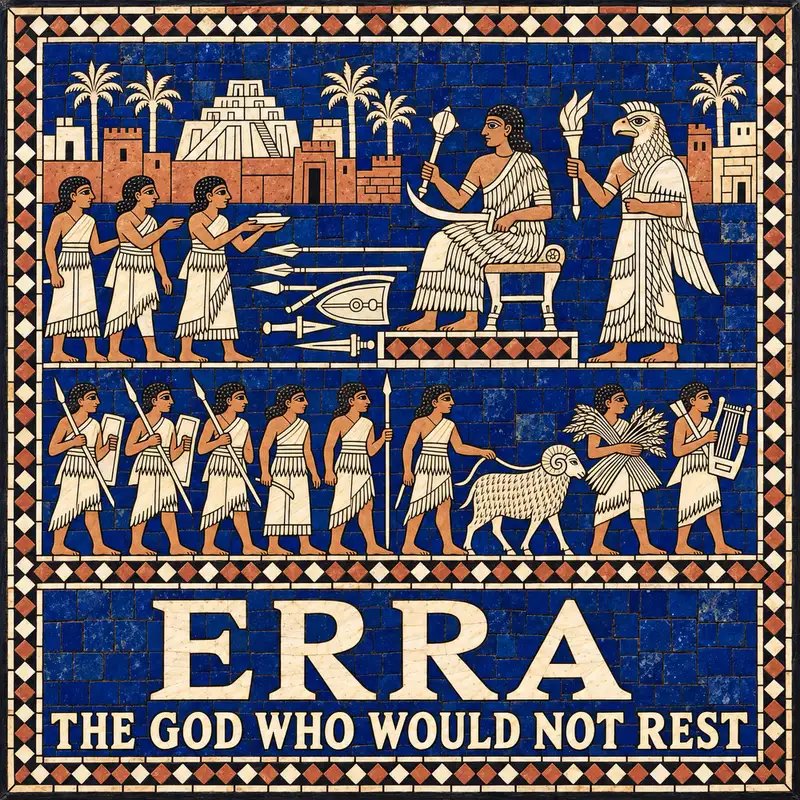
Welcome to The Sleeping Almanac. Tonight is the last night of the season, and it is the only poem in it whose author put his own name at the end and told us how he wrote it. He says it was given to him in a dream. He says it came to him in the middle of the night, complete, and that when he woke up he recited it, and that he did not leave out a single line and he did not add one. That is written on the tablet, in the poem itself, at the end, by a man called Kabti ilani Marduk, son of Dabibi, and it is the most remarkable statement of authorship in this entire literature, and it is where I want to start tonight, because everything after it is about what people do with a text. The poem itself is hard. I am going to tell you that plainly. It is about a city tearing itself apart while its god is out of the room, and it is the most difficult subject of the season, and I have put it last on purpose. And here is why it is the right ending, and why you can rest through the whole of it. It ends with a tablet on a peg. The last thing in the poem, the last thing in this season, is an instruction about how to keep the poem safe, and a promise about what happens in the house where it is kept. And people did it. They copied it out and hung it up. There are pieces of this poem that were made to be worn and to be fixed to walls, because people believed that having the words in the house would keep the thing in the words away. Which means the last night of this season ends where the first special ended: with somebody keeping a piece of clay, and the clay outlasting everything it describes. There is a room at the edge of the world, and in it there is a lamp. It is the same lamp. Perhaps you have been here for all of it, the two waters and the woman in the moon house and the three long nights of the famous king and the eagle and the seven gates and the fisherman and the queen who was left alone and the bird on the mountain. If so, welcome back, and this is the last one, and I am glad you came. And if this is your first night in the tablet house, you have chosen the hardest one to arrive on and you are still welcome, and I will hold your hand through it. The lamp is a small clay dish of oil, and it burns the pale gold of old honey. The room smells of river water and dust and barley. Outside, past the doorway, the river is going by in the dark, saying the same soft word over and over against the reeds. The scribe takes down five tablets and sets them out, and then he does something he has not done all season. He puts his hand flat on top of them and leaves it there for a moment before he opens anything. You do not have to do anything now. Settle onto the mat. Let the lamp be warm on one side of you and the cool night on the other. Close your eyes if they want to close. There are two names tonight. Erra, who is the one who cannot settle. And Ishum, who is the one who talks him down. Everything else is a city or a number. You do not have to follow every word. You do not have to remember any of it in the morning. If you drift, the story will go on without you. And now the promise, and tonight it is a longer one than usual, because tonight needs it. There is a disaster in this poem. Cities are destroyed and people die and it is the subject of the middle of the night. And I am going to tell it the way this house tells things, which means you are going to hear it as weather. Not as wounds. Not as a list of what was done to whom. There will be no bodies described in this episode and no cruelty performed in front of you. What you will get is the way it looks from a distance and afterwards, which is how anybody who has actually lived through one of these tells it: the streets, the silence, the things left in the wrong places, the river. And the whole disaster is over by the ninth chapter, and the last three chapters are a god sitting down, a remnant surviving, and a piece of clay on a wall. Before we begin, one small thing, and then we will not interrupt again. If this story carries you down toward sleep, subscribe now, while your eyes are still open, and whatever comes next in this house will find you when it comes. A like helps other tired travelers find this lamp. And if you would rather carry these nights with you, The Sleeping Almanac is also a free podcast, on Apple Podcasts and on Spotify, waiting wherever you listen. That is all. Now settle back, and we begin.
Start with him, because he is the only one we have. In this entire season, out of twelve nights of poems, there is exactly one work whose author signs it, and it is this one, and the signature is at the end where a colophon goes, and it says this. The composer of this tablet was Kabti ilani Marduk, son of Dabibi. He revealed it to him in the night. And when he recited it in the morning, he did not leave out anything at all, nor did he add one line to it. Now, we have met an author before this season. On the second night there was a woman in a moon temple who put her name at the end of a collection of hymns and said that something had been made that had not been made before, and she is the first author whose name we have. This is different, and the difference is the whole of tonight. She said: I made this. He says: this was given to me, whole, in the night, and all I did was write it down without changing anything. That is a claim about revelation, and it is the oldest one of its kind that we have in that form, and it is worth being careful about how we take it. He may have believed it exactly. Poets in a great many traditions have described work arriving that way, and anybody who has ever made anything knows the feeling of a thing coming faster than you can account for. He may also have known that a poem carries more weight if it comes from a god than if it comes from a man, and both of those can be true at once in the same person and usually are. What matters tonight is what he thought he was doing. He thought he was writing down something that was given to him for a reason, and the reason, as the end of the poem makes clear, is that having it in your house is supposed to protect you. He was not composing literature. He was making a thing that works. And there is one more thing about that claim that I want to give you, because it is the part scholars find most interesting and it is genuinely odd. He says he did not skip a line and did not add one. Think about why somebody would say that. It is a strange thing to insist on. Nobody says it about a shopping list. You say it about a text that came from somewhere else and that you are responsible for transmitting accurately, which is exactly what a scribe says about a copy. So he is describing himself as a copyist of something he received, rather than as the maker of something he invented. He is claiming the role of the person who does not change anything. And that is a claim about accuracy, and accuracy matters because of the way this poem ends, where Erra himself, the god of the poem, promises that having the text in your house protects you. A protective text has to be right. A word out of place in a formula is a formula that does not work. So the boast at the end is not vanity. It is a quality guarantee, attached to a product, by the person who made it, and it is the oldest one I know of. And there is one more thing about the frame before we go into the poem, and it is the reason I opened the last night of the season with a colophon rather than with a god. Every other poem in this season is anonymous. Twelve nights. Eleven of them come to us with no author at all. The great creation poem, the famous epic, the descent, the eagle, the bird on the mountain, the fisherman: all of them arrive with no name attached, or with a traditional attribution added centuries later by scribes doing their best. And that is normal. That is how nearly all of this literature reaches us. These were not books with authors on the spine. They were texts, copied and recopied, belonging to a tradition rather than to a person. And twice in twelve nights that breaks. A woman in a moon house at Ur put her name at the end of a collection of hymns and said that a thing had been made that had not been made before. And a man in Babylon put his name at the end of a poem about a catastrophe and said it was given to him whole in the night and that he had not changed a word of it. Those are the only two, and they are at opposite ends of the season, and one claims to have made something and the other claims to have received something, and between the two of them they cover the whole range of what people have ever said about where writing comes from.
His subject is a god called Erra. And you have met him, though not under that name. He is the plague god and the war god, and he is the same figure as the one who went down through seven gates two nights ago and married the queen of the dead, and in this poem he has a different name and a very different mood. He cannot settle. That is his whole condition at the start of the poem and the poem says it beautifully. He is lying down and he is getting up. He speaks to his weapons and tells them to smear themselves with deadly poison. His heart, the poem says, urges him to do battle. And then he tells his weapons to go and hide in their corners. And he tells his companions to go back to their dwelling. And then he cannot. I want to be careful here, because it would be easy to say this is a poem about a god of war wanting a war, which is true and is not the interesting part. What the poem actually describes is restlessness. He is not angry at anybody. There is no grievance. Nobody has done anything to him. He is a being whose entire function is destruction, and there is nothing happening, and he cannot sit still, and the poem gives him three or four pages of trying to sit still before anything else happens. And that is a very old and very accurate observation about how these things start. Not with a cause. With somebody who cannot bear the quiet. And I want to say how unusual it is that a poem opens this way, because I do not think you can appreciate the rest of tonight without it. Almost everything in this literature opens with an action or a scene. When the heights of heaven had not been named. He who saw the deep. From the great above she set her mind on the great below. Somebody does something, or a state of the world is described, and then events begin. This poem opens inside somebody who cannot get comfortable. There is no event. Nothing has happened. Nobody has been wronged. There is a god in a house, lying down, getting up, telling his weapons to ready their poison and then telling them to go and hide, and not settling. And that goes on, in a long poem, for pages, before a single thing occurs. That is a portrait of a mood, written down three thousand years ago, and it is one of the earliest pieces of writing anywhere that is interested in a state of mind for its own sake rather than as a reason for a plot. And what makes it worse, and better, is that he knows. He is not deceived about himself. He argues with himself, out loud, in the text. He orders his own weapons back into their corners, which is a thing you only do if some part of you expects them not to stay there. He sends his companions home. He is a being who understands exactly what he is about to do and is watching himself walk toward it. And then the Seven start talking, and they say the thing that finishes it, and I will come to them next. But I want you to notice, before anybody talks him into anything, that he was already up. The talking did not start this. He was pacing before they said a word. All they did was give a restless being a reason, and a reason is a very easy thing to give somebody who has already got their boots on. That is why this poem has never stopped being read, and it is why it is the last night of this season. It is not about a monster arriving from outside. It is about the moment when something that was being held in check, by nothing more than its own decision to stay sitting down, stops deciding that.
And before them, one more thing about him, because there is a version of this god you have already met and it will change how you hear tonight. Two nights ago he came down seven flights of stairs, and he was rude at a banquet before that, and he stayed six days, and he left in the morning without waking her, and he came back at a run when she called for him. That is the same god. The one who cannot settle tonight, who is lying down and getting up and telling his weapons to ready themselves and then to go and hide, is the one who went down through seven gates and stayed. And I do not think that is a coincidence, and I do not think the poems were written to fit together, and I still think it is worth holding, because there is a kind of person who cannot be still and who is nevertheless capable of going a very long way and staying, and this literature has him in two poems doing both. Tonight is the version where nobody calls him back. And then there are the Seven, and they get him up. They are called the Sibitti, which simply means the seven, and they are the children of the sky god and the earth, and when they were born their father gave each of them a function, and the functions are the poem's coldest lines. To the first he said: go, and let nothing escape you. To the second: burn like fire, and scorch like a flame. To the third: take the face of a lion, so that whoever sees you melts away. To the fourth: let the mountain collapse when you lift your weapon. To the fifth: blow like the wind, and search out the edges of the world. To the sixth: go through the high country and the low, and spare nobody. And to the seventh: you are loaded with the venom of a serpent, and you will kill whatever lives. Seven of them, and each with one job, and the jobs are the seven ways a country can be destroyed. And I want to say something about them, because it is a rule of this house and it matters. They do not have names. Not one of them. They are numbered, first through seventh, and each one is a function, and that is deliberate and it is how the poem wants them. They are not characters. Nobody could tell you what the fourth one is like. They are the seven things that happen when order stops, given in a list, and they are much more frightening as numbers than they would be as people. And I want to say one thing about them before they speak, because it is a rule of this house and I have kept it all season. Seven is not a random number in this literature and it is not decoration. Count what has been seven in this season. Seven tablets of the creation poem. Seven sages who came out of the water at the beginning. Seven gates going down, and seven judges at the bottom of them. Seven terrors worn by the guardian of the cedar forest and given away afterwards. Seven days and seven nights, over and over, for a storm and for a vigil and for a test with seven loaves. Seven days the south wind did not blow. It is the number they used when they meant a complete set of something. Not many. All of them. So when the poem says there are Seven, and gives each of them one destroying function, it is not saying that seven bad things exist. It is saying: here is the complete set, with nothing missing. And there is one more thing about the Seven, and it is a true one and it is up in the sky. In the astronomical texts of that country, there is a star group called the Seven, and it is the cluster we call the Pleiades. Anybody can see it. It is the small tight knot of stars in the winter sky, the one that looks like a handful of dust or a tiny dipper, and most people can pick out six of them with the naked eye and some people can see more, and it has been called seven in an extraordinary number of unrelated cultures all over the world. And in that country it was called the Seven, and it was associated with this group, and there are omen texts about it and offerings made to it. So the seven destroying functions in tonight's poem are also a thing you can go outside and look at. They are up there now, or they will be in a few months when the season turns. A small cluster, very high, easy to miss, and if you know where to look you can find them in about four seconds. And they come to him where he is lying down, and they talk to him, and what they say is the oldest and most effective argument in the world for starting something. They say: spiders have spun their webs all over our battle gear. They say: we no longer remember the road through the mountain passes. They say: the wild animals have got bold. They say: people have forgotten what you are. And they say: we are bored, and our strength is going soft, and take us out.
And I should tell you the shape of the whole poem before we go on, because it is five tablets and knowing where you are helps. The first tablet is him not being able to settle, and the Seven talking him into it, and then the trick on the god of Babylon. The second and the third are that god away from his seat, and the destruction. And the destruction is the worst of it. The fourth is Ishum's speech, the inventory, the whole terrible list read back to him. And the fifth is him sitting down, and the remnant, and the blessing on the house that keeps the tablet. So the persuading and the trick come first, and then the disaster, and the last two tablets, close to a third of the whole thing, belong mostly to one person talking somebody down, and then the aftermath. That is a large share for a poem about destruction, and it tells you what the author thought he was writing. He was not only writing about a catastrophe. He was writing about the argument that ends one. And one more fact about this poem before we meet the man who argues, because it changes how you hear the whole thing. People kept it. We have a great many copies of this text. More than of most things in that literature. It turns up at site after site, in full copies made for libraries and in extracts and on small tablets with only a few lines of it, and it goes on being copied for centuries after it was written. That is not what usually happens. Most of what survives from that world survives because one or two copies happened to be in one or two places that happened to burn at the right moment. This one survives because a lot of people, in a lot of towns, over a long time, wanted a copy in the house. And we know why, because the poem tells us at the end, and I am going to keep that for the last chapter where it belongs. But hold on to the fact itself while you listen to the rest of tonight. Somebody wrote a poem about a god who could not sit still, and a country coming apart, and a friend who talked him down. And then, for hundreds of years, people in that country went on copying it, and some of those copies were made to be hung up or carried. Not the creation poem. Not the flood. This one. The one about the collapse, and the argument that ended it. I think about that a great deal. A society that had lived through a long bad stretch produced a text about exactly that experience, and then that text became the one people wanted on the wall, and I do not think it was because they enjoyed the destruction. I think it was because of the last tablet. And there is one person standing in front of them, and his name is Ishum. He is the herald. He goes in front of Erra the way a torch goes in front of a procession, and he is the closest thing this poem has to a conscience, and from the first tablet to the fourth he keeps trying to stop what is happening. And the poem gives him an image that I have thought about ever since I first read it. He is the bolted door. That is what he is called. Not a wall, not an army, not an opponent. A door with the bolt across it, standing in front of something that wants very much to get out. And a bolted door is a thing that works completely, right up until it does not. He argues. He asks him why he has planned harm against gods and people. He tells him plainly that what he means to do is crush the lands and wipe out the people in them. The practical argument the poem saves for the very end, and gives to Erra himself, who admits that without Ishum the gods would have had nobody left to bring them their offerings. It is a good argument, because a god with no worshippers is a god with no dinner. And Erra does not listen to him, and goes anyway, and Ishum goes with him, because that is his job, and this is the part of the poem that I find hardest and truest. He does not leave. He argues the entire way, and he loses every argument, and he goes along. And before the trick, I want to say what Ishum actually is, because his name tells you and it is a lovely piece of the poem's design. His name means fire, and specifically the useful kind. Not the fire that burns a city. The fire in a lamp. The fire under a pot. The torch somebody carries in front of a procession so that people can see where they are going. That is what he is. He goes in front, and he lights the way, and in this poem he goes in front of the god of plague, which means that the light that shows you what is coming is walking directly ahead of it. And he is the one who argues. The lamp is the conscience. The little flame that lets you see is also the voice that keeps saying, look at what you are about to do. I do not think that is an accident. I think somebody built that poem very carefully and gave the restraining voice the name of the smallest, most domestic, most useful fire there is, and put him in front of the largest one.
And now the trick, and it is the cleverest and pettiest thing in this whole season. Erra goes to Babylon, to the god of that city, the one we spent the first night of the season making a world with, and he does not attack him. He gives him advice about his appearance. He says: look at yourself. Look at your clothing. Look at your regalia. The gold has gone dull. The jewellery is tarnished. Your crown does not shine the way it should. Your image is not what it was. And the god of Babylon, and this is the part that makes the poem work, agrees with him. He says, yes. I know. And he explains why he has not dealt with it. He says that the last time he left his seat, the world was ruined. He says that when he stood up before, the flood came, and the order of things came apart, and the craftsmen who knew how to do this work were lost, and the materials are in places nobody can reach any more. So he has been sitting there in tarnished gold for a very long time because he does not dare to get up. And Erra says: go. Go and get it seen to. I will sit here while you are gone. I will keep the order of heaven and earth. I will hold the reins. And I want to give you what he actually says when he explains himself, because it is the most surprising speech in the poem and it is spoken by the god we made a world with on the first night of this season. He says: I did move, once. And when I moved, the flood came, and the order of things was undone. He says: the craftsmen who did this work are gone. They went down into the earth in that flood and they have not come back, and the ones who knew where the materials come from went with them. The wood is in a place I cannot reach. The stones are somewhere I do not know. He says: how am I supposed to have it repaired when the people who know how are dead. That is the god of the greatest city in the world, sitting in tarnished gold, explaining that he cannot get his own image cleaned because the skills to do it were lost in a disaster long ago and nobody has them now. And every single person who has ever tried to get something repaired that was made by people who are no longer alive knows exactly what he is describing. And I have to tell you the thing underneath this scene, because it is not invented and it is the reason this passage would have landed like a stone on anybody who first heard it. The statue really did leave. More than once in the actual history of that city, an army came, and took the image of the god out of the temple, and carried it away to another country, and kept it. Not smashed. Taken. It went to the east once and it went to the north once and it went away more times than that, and each time it was gone for years, and in one case for a very long time indeed, and getting it back was the work of a king who built his whole reputation on doing it. That is not a legend. That is administration. There are inscriptions about it. There are letters about it. Bringing the god home was a political event with a date. And in between, while the statue was away, the city still stood and the temple still stood and the priests still came to work and the offerings were still prepared, and the room at the middle of all of it was empty. So when this poem has the god of Babylon say that the last time he got up from his seat the world came apart, the people hearing it were not being told a story about the deep past. They were being told, in the language of myth, about a thing that had happened to their own city inside living memory, more than once, and would probably happen again. And when the poem says the craftsmen who knew how to do this work are gone, and the materials are in places nobody can reach, that is also not a metaphor. Skills die out. That is a plain fact about the world. A workshop is a chain of people teaching people, and if the chain is broken for one generation, by a war or a plague or a deportation, the thing they knew how to do is simply gone, and what is left is the object they made and nobody able to repair it. The far country where the good wood came from is on the other side of a border that is now closed. The stone came from a mountain that is now in somebody else's hands. The men who knew how to work the gold went away in a column with their tools, and did not come back, and did not train anybody here. That is what he is saying. Not I am too grand to be cleaned. He is saying: the world that made me has been broken for so long that I cannot be maintained any more, and if I stand up, you will all see it. And the god of Babylon looked at him, and thought about it, and got up, and went.
And I want to give you what actually happened at that handover, because the poem is careful about it and it is the moment everything turns. He did not seize the throne. He was invited to sit in it, temporarily, by the person whose throne it is, in front of witnesses, for a stated purpose, with an agreed end date. And he accepted the invitation and gave an undertaking, and the undertaking is in the poem: I will hold the reins of heaven and earth. I will keep the order of things while you are away. And then he did not. That is the crime of this poem, and it is not theft and it is not violence and it is not rebellion. It is a breach of trust by somebody who was handed responsibility for a while and who used the interval. And the god of Babylon is not stupid, and this is the part that has bothered me since I first read it. He asks. Before he goes, he asks who will keep everything in order, and the answer he is given is a promise, and he weighs it, and he goes. He made a judgement about somebody's character and he got it wrong, and a country came apart, and there is no version of this poem in which he is blamed for that, and I have never been sure whether that is generous or whether it simply did not occur to anybody. And I should say what was actually going on in that country when somebody sat down and wrote this, because the poem is not a fantasy about a hypothetical collapse. We cannot date it exactly. The estimates run across several centuries and the arguments for each are technical and unresolved, and I am not going to pretend to more precision than the people who work on it have. But the period it is usually set against is one that anybody would recognise. Babylonia went through a long stretch in which the central authority could not hold the country together. Peoples from the west moved in and out of the settled land, sometimes trading and sometimes raiding. Canals went uncleared. Roads became unsafe. Towns that had been continuously occupied for two thousand years were abandoned. And the record of it is not a battle account, because there was no single battle. It is a slow thinning out, visible in the fact that the documents stop. That is the texture this poem is written in. Not an invasion with a name and a date, where an army arrives and a wall falls and afterwards you can say what happened. Something much harder to describe, in which nothing in particular occurs on any given day, and the shepherd does not go out because the road is not safe, and then the field is not cleared because the shepherd is not there, and then the canal silts because the men who cleared it went somewhere else, and at the end of it there is a town with nobody in it and no one moment you can point to and say that is when it happened. Which is exactly what the poem describes, and it is why it does not give you a war. Read chapter seven again when you are awake, if you ever do, and notice what is actually in it. There is very little fighting. What there is, is a list of things not working. The rites performed and not landing. The decisions made and not being right. The people still in their offices and no longer able to do their offices. That is what somebody who has lived through it writes. Not the day the walls came down. The years in which everything was still standing and none of it worked. And the reason he wrote it as a story about a god who could not sit still, rather than as a chronicle, is that a chronicle would have had to blame somebody, and he had no one to blame. There was no invading emperor. There was no wicked king. There was a long bad stretch, and it came, and then it stopped, and nobody could account for either. So he wrote it as a being who could not stay in his house, and a friend who talked him down, and that explains it about as well as anything. And that is how it happens. Not a battle. Not a siege. Not an invasion from outside. The god of the city was persuaded to leave his own seat for a while, for a good reason, by somebody who offered to keep an eye on things, and he went, and the seat was empty. And everything that follows follows from that. The poem is completely clear that the disaster is not something Erra does with a weapon. It is what happens when the thing that holds a place together is not in the place. The rites go on being performed and stop landing. The decisions go on being made and stop being right. The people who ran things are still there and are no longer able to run things. And underneath it all, gradually and then quickly, everything that was being held together stops being held together. That is the whole mechanism of the poem and it is why this text has never stopped being read, because everybody who has lived through the collapse of anything recognises it immediately. Nobody attacked. The middle went out.
Before the cities, one thing about what actually holds a place together in that world, because the poem assumes you know it and we do not. It is not the army and it is not the king. It is the offerings. Everything in that country ran on a schedule of things being done at the right hour by the right person. The god was woken and washed and dressed and fed twice a day. The festivals came round on the calendar and were performed. The canals were opened and closed by agreement between villages who had been making that agreement for centuries. The fields were measured and the boundary stones were where they had always been and everybody knew whose was whose. And all of that is a chain of people doing a thing at a time because the person before them did it and the person after them will. There is nobody enforcing most of it. There is no mechanism. It runs because it has always run and because everybody involved expects everybody else to keep doing it. That is what comes apart in this poem. Not the walls. The expectation. And once the expectation goes, the walls do not matter, because a wall is only a wall if there is somebody who has agreed to stand on it. And now the middle of the night, and I am going to keep my promise. Here is how the poem tells it, and here is how I am going to tell it. The city that had a hundred thousand people in it, and the roads out of it, and the fields around it. The gates standing open. The offerings not made, not because anybody forbade it, but because the person whose job it was is not there. The canals not cleared, because clearing a canal takes forty men and an agreement about who does it, and there is no longer an agreement about anything. Brother against brother. That is in the poem, in those words, and I will say it once. Neighbourhood against neighbourhood. The people of a city turning on each other, not because a foreign army came, but because when the thing that arranges people stops arranging them, the arrangement they fall back into is a bad one. And Erra going through it, and the Seven going through it, each of them doing their one function. The poem names cities. Babylon. Sippar, the old city of the sun. Uruk, with its wall. Der. It goes through them the way a person going through a disaster afterwards goes through a list of places, saying, and there, and there, and there too. And there is one city on that list where the poem pauses over something very particular, and I want to give it to you properly, because it is one of the most specific things in the whole passage and it is usually skipped. Uruk. We have been there before in this house. It is the city with the wall, the one the famous king built and then came home and looked at. And in this poem it belongs to the goddess, and it is her city, and it has been her city since long before anybody in the poem was born. And what the poem singles out about Uruk is not its wall and not its temple. It is the people who worked in the temple. The goddess of that city had, attached to her house, a body of performers. They sang and they danced and they played at her festivals, and they carried out the rites that belonged to her, and they were a recognised part of the establishment with a place in the accounts and a share of the offerings like anybody else on the rolls. And some of them lived and dressed and presented themselves in ways that crossed what that society otherwise expected of men and women, and that was not a secret and not an accident. It was their office. It was understood to be part of what the goddess was and what her worship involved, and it had been so for a very long time, and the texts describe it plainly, in administrative documents, without any fuss at all. And in this poem, the god of plague turns on them specifically. The poem says he set his face against them, and that he changed how people saw them, and that they became a thing the city turned away from. I am telling you that because it is in the poem and because leaving it out would be a kind of lie about what the poem says happened. And I am telling you plainly, without dwelling on it, because it is somebody's real history. What I want you to notice is where the poet puts it. It is in the middle of the list of ruined cities. It sits between a temple with nobody serving in it and a canal nobody is clearing. The author is putting the turning on those people in exactly the same category as the offerings failing and the fields going back to nothing. He is saying that this too is what it looks like when the middle goes out of a place. Not only that the roads stop being safe and the rites stop working. Also that people who belonged, who had a name and an office and a share of the offerings, stop belonging. And he lists it as damage. Not as correction, and not as anybody getting what was coming to them. Damage, in a list of damage, done by a god who could not sit still, to a city that had not done anything. And it says what was left. And here is the phrase that made me choose this poem for the last night, because it is the truest thing in it. The land was made a wilderness, and the wild animals came in. That is it. That is what it looks like. Not corpses. Grass in the street. Animals in the places where people were, which is what you see in every photograph of every abandoned place, and which is the thing that tells you, more than any ruin, that something has stopped. And there is a historical question sitting under all of this that I have to handle carefully, and the honest answer is that we do not know. People have tried very hard to attach this poem to a particular disaster. Babylon was sacked more than once. Cities in that country were taken and burned and depopulated repeatedly across the centuries, and there are candidates, and there are scholars who have argued for this year or that one, and the arguments are serious. And they do not agree, and the poem does not say. So I am going to do what the red team for this season told me to do, which is to name it as a reading and not as a fact. Some people think this poem is about a specific destruction. If it is, we cannot prove which. And it may equally be about all of them, or about the kind of thing that happened often enough in that country that everybody knew what it looked like without needing a date. I lean toward the last of those, and I will tell you why. The poem never names a year. It never names a king. For a text that is otherwise very specific, listing cities by name and describing exactly what happened in each, it is conspicuously silent about when, and I do not think that is an accident. I think it was written to be usable. And I want to give you a little more of what the poem actually shows you, because I have been keeping it at a distance and there is one register in it that I think you should have, and it is not the violent one. It is the register of things being in the wrong place. The poem describes a country where the arrangements have come apart, and the way it does it is by naming ordinary things and saying where they are now. The one who should be inside is outside. The one who should be outside is inside. The father does not ask after his son. The son does not ask after his father. The mother is chatting cheerfully while her daughter is not there. The lame overtake the swift. The weak get the better of the strong. The city is a heap. The temple is a shell. The canal has no water in it and the field has no crop and there is nobody to argue about whose turn it is. That is what the poem gives you. Not wounds. Inventory, of a place where every relation has been swapped or emptied, listed in short flat sentences, one after another. And the reason that is worse than a battle scene, and also the reason it is bearable at one in the morning, is that it is what it actually looks like. Anybody who has been near a collapse will tell you that the memory is not dramatic. It is a list of small wrong things.
And then Ishum speaks. And this is the turn, and it is the whole reason this poem is a poem and not a lament, and the turn is not a battle and it is not a trick. He talks to him. The bolted door, who has been arguing and losing and following the entire way, walks up to the god of plague in the middle of the worst thing that has ever happened, and starts talking, and does not stop. And what he says is not you monster. He is far too clever for that. He tells him what he has done. In order. Plainly. Without any accusation in it at all. He says: you have done this to that city. And this to that one. And this is what has happened to the people who lived there, and this is the state of that temple now, and this is who is left. He gives him an inventory. And then he says the thing that turns it. He says: the innocent and the guilty went down together. That is the argument. Not that it was wrong to be angry. Not that nobody deserved anything. That whatever this was for, it did not sort anybody, and the person who did the sorting was him, and it did not sort. And Erra listened.
And before he does, I want to say the honest thing about this poem's subject, because we have spent six chapters on it and I have kept it at a distance and that was deliberate but it should not be the last word. This happened. Not the god. The thing the poem is describing happened, repeatedly, in that country, over a very long time. Cities in Mesopotamia were taken and burned and emptied. Populations were deported. Canal systems were left uncleared and the land went back to salt and reed. There are periods of a century and more where the archaeology shows large areas simply going quiet. And the people who wrote and copied this poem had either lived through one of those or were one generation from somebody who had. That is why it was copied so often, and why it ended up on amulets, and why the last chapter of it is an instruction for keeping it in your house. It was not a story about something that might happen. It was a story about the thing that everybody expected would eventually happen again, written by somebody trying to do something about it with the only tool he had, which was words. I have told it gently tonight because that is what this house does and because you are lying down. But I am not going to end the season pretending it was ever a metaphor. And then the god of plague did the thing that nobody in this entire season has done, and I have saved it for the last night on purpose. He stopped. Not because he was defeated. Nobody beat him. There was no fight. Nobody in the poem was in any position to make him do anything. And he did not stop at once. First he sent Ishum out, with the Seven behind him, to lay waste one last place, a far mountain called Sharshar. Then he rested. He had listened to a speech from his own herald, and when he spoke again, to all the gods, he admitted that in his anger he had made no difference between the righteous and the wicked. That is what happened. And he sat down. And then he gave his last command, through Ishum, and it is the last decree of the season, and it begins small. Let the remnant survive. Let the handful who are left in the land become many again, he says. Let the small and the great walk the roads side by side. And then it goes further. Let the gods who left in anger come home to their shrines. Let the temples that fell be raised again. Let the two rivers carry their waters of plenty. And that is what he gives. Not an undoing. A remnant, and permission for it to grow, and the promise that what fell will be built again. And I want to be honest about what kind of gift that is, because it would be easy to play it as a happy ending and it is not quite one. It is a promise, not a repair. Nobody who died comes back. The temples and the cities are not rebuilt by a decree, they are rebuilt slowly, by people, over generations, in the ordinary way. What he grants is the end of further destruction, a blessing on the survivors, and his word that the rebuilding will come. And that, in the experience of everybody who has ever lived through one of these, is exactly what actually happens. Nothing is undone. It stops. And then there is a very long time afterwards during which a smaller number of people slowly rebuild something that is not the same as what was there. The poem knows that. It does not offer you more than it can. It offers you the stopping, and the remnant, and the permission, and the promise of building again, and that is all any of these poems ever offer anybody, and it is more honest than most things written since. And I want to say one thing about how long that took, because the poem is honest about it and I have been compressing. Ishum does not talk him down in an afternoon. He has been arguing since the first tablet. He argued before it started. He argued in the middle of it. He walked the entire way, watching, and every time he opened his mouth he lost, and he kept opening his mouth. From the first tablet to the fourth. And the speech that finally works is not more eloquent than the ones that failed. It is not cleverer. The only thing that is different about it is when it is given, which is after, when the thing is done and there is nothing left to argue for except stopping. That is not a heroic model and I am not going to dress it up as one. The lamp in front of the fire did not prevent anything. What he did was stay next to it the whole way, and keep saying the same thing, and be there at the exact moment when it could finally be heard. Sometimes that is the whole job.
And I want to stay with that word, because it is the last idea of this season and it has been in every episode. A remnant is what is left when most of it is gone. The library at Nineveh was a remnant. The fire went through it and the walls came down on it and a hill grew over it and what came out, two and a half thousand years later, was pieces. Not the library. Fragments of the library, in tens of thousands of bits, some of them the size of a fingernail, and out of that we have every single thing I have read to you this season. Every poem in this season is a remnant. The one about the two waters is missing lines. The woman in the moon house survives in copies made five hundred years after she died. The famous king is two thirds recovered. The man on the eagle breaks in the air. The queen and the god who left in the morning stop in the middle of a sentence. And tonight's poem, the one about a city coming apart, is one of the better preserved things in that whole literature, and the reason is the last chapter. And I want to give you Ishum's speech at more length, because I summarised it and it is the best writing in the poem and it deserves better. He does not begin with the destruction. He begins with a compliment, which is the tactic of somebody who has been arguing with this person for three tablets and has learned what does not work. He says: warrior. You are the one who is strongest. You are the first among the gods. And then, having established that he is not challenging him, he starts the inventory. He says: you did this to that city, and its people are gone. You did this to the next one, and the temple stands and nobody serves in it. You did this to the third, and the canal is not cleared and the fields have gone back to nothing. And then he comes to the people themselves, and this is the line that lands. He says: you struck down the old men at their doors and the young women in their own rooms, and even then you would not rest. That is the argument. Not that Erra is cruel. That it reached past the walls and the temples to people who were simply at home, and that what came down was not a punishment falling on the guilty, it fell on everybody, and even then he could not settle. And just before that in the speech comes the line I gave you earlier: the innocent and the guilty went down together. And before the blessing, I want to put the whole shape of the ending in front of you, because it is unusual and I have not said it plainly. Nothing is undone and nobody is punished. Think about how strange that is. The god who did this is not defeated, not chained, not exiled, not diminished. He sits down, and he makes a decree, and the decree is generous, and then the poem praises him. That is genuinely the ending. The last movement of a poem about the destruction of cities is a hymn to the god who destroyed them. And I do not think that is cowardice or flattery. I think it is the most clear eyed thing in the poem. Because he is not going anywhere. Plague is not going anywhere. War is not going anywhere. The thing this poem is about will come back, and everybody reading it knew that, and a poem that ended by putting him in chains would have been a lie that nobody could use. So instead it ends with the only two things that were actually available. He stopped. And there is a text you can keep in your house.
Because at the end of it, after the author's name, the poem does something that no other poem in this season does. It hands the last word to Erra himself, and the god of plague blesses whoever keeps it. He says: in the sanctuary of the god who honours this poem, let abundance gather. The scribe who learns it will escape from the enemy. The singer who chants it will not die in the plague. And then, the line that did it. Whatever house this tablet is kept in, however angry Erra grows and however murderous the Seven, the sword of plague will not come near it. Read that again. Put a copy of this poem in your house, and the thing this poem is about will not come to your door. And people did. And I want to be careful and exact about this, because it is the last claim of the season and I would rather understate it than overstate it. We have copies of this poem on objects that are not library tablets. Some of them are small, and shaped to be hung or carried, and what is written on them is usually not the whole poem but a short passage, most often from the last tablet, the lines with the protection in them. Not always. One carries a passage from the third tablet, and one carries a great deal of the poem. That is what an amulet was in that world. Not a charm in the vague sense. A piece of a text, the effective part, written out and kept close, because the words were understood to do the work. And the poem tells you to do it. That is the extraordinary part. The text contains, inside itself, the instruction for its own copying and display, and a statement of what will happen in the house where it is kept. So a man wrote a poem about a catastrophe, and attached to the end of it an instruction saying that keeping the poem prevents the catastrophe, and people followed the instruction, and that is why we have so many copies, and that is why we have the poem at all. The text arranged its own survival. That is the thing I have been saving all night. We have copies of this poem, and some of them are not library copies. They are small. They are made to be carried or hung. There are pieces of Erra written on objects that are amulets, made to be worn or fixed up, and most of them carry the lines with the protection in them, and one of them, a black stone from Assur, still holds part of the copper pin it hung from. So a man had a dream, or said he did, and wrote a poem about a city tearing itself apart, and at the end of it he had the god of plague himself promise that keeping the poem would keep the disaster away, and for centuries afterwards people in that country copied out its protecting lines and hung them up. And there is one more thing about the amulets that I want to give you, because it is a small physical fact and it is the last one of the season. Some of them are stone, and some of them are clay, and they are small enough to hold in your hand. And what is on them is not decoration. It is text. Somebody sat down with a stylus and copied out the effective part of a poem onto an object the size of a playing card, in a script where every sign is a set of wedges pressed in individually, which takes a long time and a steady hand and good light. And then they put it up in a house, and lived under it. That is a person doing something about a thing they cannot do anything about, with the only material available, which is words on clay, and doing it carefully. And it did not work. It could not work. The plagues came anyway and the cities were taken anyway and the poem's own subject kept happening to the people who kept its copies. And they went on making them, and the ones they made are the reason the poem is not lost. That is the last irony of this season and it is the same one the second special ended on. The thing they did to save themselves did not save them, and it saved the poem, and the poem is how we know they were there.
The lamp is low now. And that is the season. Twelve nights, and we started with two waters mingled in the dark with no names on anything, and we end with a piece of clay on a peg in somebody's house. And I want to put the whole thing in front of you once, quickly, and then let you go. We made a world out of the body of somebody who could not sleep, and a bar was fixed across the sky so her waters would not come down, and the moon was handed the night and given his instructions and has not missed one since. We met a woman with a lamp in a moon house at Ur who signed her name to a list of temples, and lost her house, and wrote a poem to get it back, and got it back, and whose face was chiselled off a stone by somebody and survived anyway on the piece that broke free. We spent three nights with a king who could not be satisfied, and watched him make a friend, and lose him, and go to the end of the world about it, and come home and point at some brickwork. We went up on the back of an eagle and watched the sea turn into the basket the bread comes in. We went down through seven gates and were told each time to be quiet, and at the bottom two small creatures made of the dirt under a god's fingernails said back to a queen in pain the exact shape of her own pain, until she quietened. We watched a sister offer half of every year, for ever, and mean it. We watched a fisherman refuse the bread of life because his father told him to. We watched a queen who has never been anywhere wake up alone and nearly end the world about it, and get him back. We watched an arrow come apart in the air and go home to the marsh and the sheep and the birds. And tonight we watched a city come apart because somebody stood up from a chair, and a herald who lost every argument keep arguing until it stopped. And every single one of those came to you tonight off a piece of dried river mud that somebody pressed with a cut reed, by lamplight, beside a river, and that then survived a fire, and a hill, and two and a half thousand years, and a sea voyage, and a museum drawer, and a hundred and seventy years of people slowly working out what it said. The scribe puts the five tablets down with the rest. And then he does the last thing he does every night, which is to bank the lamp. Think of it, wherever you are lying. Somewhere, in a house, a very long time ago, there is a small piece of clay hanging on a peg by the door, with words on it about a disaster, put there by somebody who believed that having the words in the house would keep the thing away. And the disaster came anyway, eventually, the way it does, to that house or another. And the clay is still here. We have it. It is in a museum, and people can read it, and I have just read some of it to you. And I want to say the last true thing of the season, and then bank the lamp. Every one of these poems is about somebody making something and somebody else keeping it. The world in the first episode is made and then held up with a bar across it and a guard told not to let the waters through. A woman signs a list of temples and five hundred years later children copy it out to learn their letters. A king builds a wall and comes home from the end of the world and tells a stranger to go and look at the brickwork. A man feeds a bird for eight months. Two creatures say somebody's pain back to her. A sister keeps half a year, every year, for ever. A fisherman is handed a garment. A queen keeps a door shut. A young god carries an object down a mountain and puts it back on its peg. And tonight, a man has a dream, and writes it down, and the god in it tells you to keep the tablet, and people did, and here it is. That is what this whole season has been about, and I did not plan it that way, and it turned out to be the only thing all twelve of these have in common. Somebody wrote something down. Somebody else kept it. And it came through. Outside, past the doorway, the river is going by in the dark, saying the same soft word over and over against the reeds, the way it did before any of this was written, and the way it does tonight. You do not have to keep any of this season. If you keep one thing, keep the tablet on the peg. Sleep well. Goodnight.