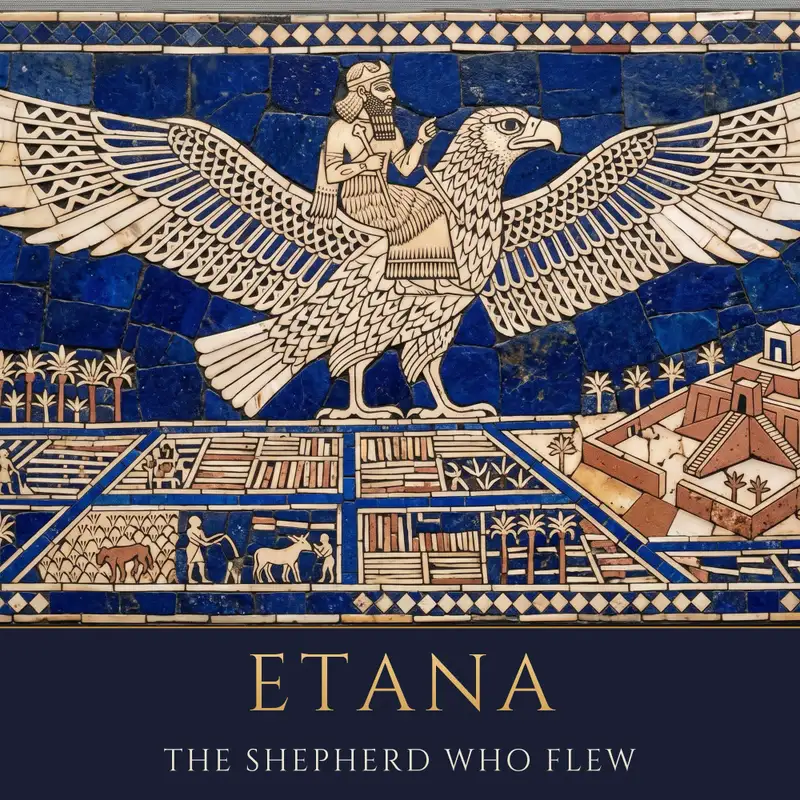
Welcome to The Sleeping Almanac. Tonight is a small story and I think it may be the most restful thing in this whole season. For three nights we have been with the famous one, the king who could not be satisfied, and we left him last night pointing at a wall. Tonight is a different kind of king in a different kind of city, and his problem is not that he wants too much. His problem is that he wants one thing, an ordinary thing, the most ordinary thing there is, and he cannot have it. He wants a child. That is the whole of it. A king in a city called Kish, a long time ago, before almost everything, who had everything a man in that world could want except an heir, and who went looking for a plant that was supposed to help, and who ended up going to get it in a way that nobody before or since has ever tried. He went up on the back of an eagle. And what he saw from up there is the reason I have been looking forward to tonight since we started, because in the middle of this poem there is a passage where a man looks down at the world from higher and higher up, and describes what it looks like as it gets smaller, and it is four thousand years old, and it is the only thing like it in all of ancient literature, and it is going to be the last thing you hear before you go to sleep. There is a room at the edge of the world, and in it there is a lamp. It is the same lamp. Perhaps you have been here for the three long nights of the famous story. If so, welcome back, and you can put it down now. Tonight asks nothing. And if this is your first night in the tablet house, you have picked the easiest one, and everything you need will be given to you as it comes. The lamp is a small clay dish of oil, and it burns the pale gold of old honey. The room smells of river water and dust and barley. Outside, past the doorway, the river is going by in the dark, saying the same soft word over and over against the reeds. The scribe puts the eleven tablets of the long poem back on the shelf, and the twelfth beside them, and then he goes further along the shelf and takes down something much smaller. Three tablets. Not eleven. And two of them are broken. This one, he says, does not end. You do not have to do anything now. Settle onto the mat. Let the lamp be warm on one side of you and the cool night on the other. Close your eyes if they want to close. There is one name tonight, which is Etana, and one word, which is Kish, and Kish is a place. There is also an eagle and a snake and they are not given names, because they do not need any. You do not have to follow every word. You do not have to remember any of it in the morning. If you drift, the story will go on without you. And one thing, whispered like a promise across the clay. Nothing tonight will startle you. There is one cruel act in the middle of it, done by a bird, to some young snakes, and I will tell it once and plainly and briefly and then it is over and it is answered. Nobody in this story is tortured. Nothing is described that you would not want in your head. The worst thing that happens is that somebody breaks a promise, and gets caught, and is punished, and then is forgiven by the person he wronged, which is more than most stories manage. And there is a fall in it, at the end, and I will tell you now, in advance, so that you can rest through the whole flight: nobody is hurt by it. The poem does not describe an impact. It breaks off. That is not me protecting you, it is the actual state of the tablet, and we will talk about it when we get there. Before we begin, one small thing, and then we will not interrupt again. If this story carries you down toward sleep, subscribe now, while your eyes are still open, and the rest of the season will find you as it comes. A like helps other tired travelers find this lamp. And if you would rather carry these nights with you, The Sleeping Almanac is also a free podcast, on Apple Podcasts and on Spotify, waiting wherever you listen. That is all. Now settle back, and we begin.
There is a list. It is one of the strangest documents that world produced and it is called the King List, and what it does is give you the kings of the country in order, one city at a time, with the length of each reign, going back and back and back, past the flood, into numbers that stop making sense. Twenty eight thousand years, it says, for one of them. Thirty six thousand for another. And then, partway down, a line that says the flood swept over, and after the flood, kingship came down again from heaven, and the numbers start behaving. Twelve hundred years. Then nine hundred. Then four hundred. Then a hundred. And by the time you are into the range where we have other evidence, the numbers are ordinary human reign lengths and the names start matching people we can find elsewhere. And I want to stay with those numbers for a moment, because if you were here for the two long specials earlier this year you already have the key to them and you may not have noticed. Before the flood the list gives reigns of twenty eight thousand years, thirty six thousand, forty three thousand. Nobody has ever thought those were literal, including, I suspect, the scribes who copied them. Look at what they are made of. That world counted in sixties. Sixty, and six hundred, and three thousand six hundred, and thirty six thousand, and those were the round numbers, the way ten and a hundred and a thousand are round numbers to us. The unit of three thousand six hundred had its own name and its own single sign, and it turns up everywhere in their arithmetic. So the enormous reigns are not a claim that a man lived for thirty six thousand years. They are round numbers in base sixty, written by people saying, in effect, a very long time, and then a very long time, and then a very long time, the way we would say ages and ages. And after the flood the numbers come down and keep coming down until they are ordinary, and by the time you reach the part of the list where we have other evidence, the reigns are the length of a real reign and the names are people we can sometimes find on other objects. Which means the King List is doing something rather sophisticated. It is saying: back there, before the water, time worked differently and the numbers are not the point. Here, after it, we are counting properly. Etana is on the after side. He is in the first city of the ordinary world. The city after the flood is Kish, and among its kings there is one line that says more than any of the others. Etana, the shepherd, the one who went up to heaven, who consolidated all the lands, ruled. That is it. That is the whole entry. Everything we have tonight is a poem written around one line in an administrative document, and the line is so strange that somebody clearly wanted to know what it meant, and made a story to answer it. He is called the shepherd. That is a title, not a job. Kings in that country were called shepherds all the time and it is a compliment about looking after people rather than a description of livestock. And Kish is real, and it is dug, and I want to tell you what came out of it, because it is a real place under a real sun and people have stood in it with trowels. It is a group of mounds north of where Babylon would later be, and it was excavated in the nineteen twenties and thirties by a joint expedition from Oxford and a museum in Chicago, and they were there for years. They found a city with a very long history. They found temples and palaces and thousands of tablets. And in the early levels they found something that people still argue about, which is a set of burials with vehicles in them. Carts or chariots, with the remains of the animals that pulled them, buried with the dead. They found a flood layer, too, a stratum of clean water laid silt between levels of occupation, which is a real thing that real rivers do and which turns up at several sites in that country at different dates. It is not evidence of one enormous flood covering the world. It is evidence that the rivers there did what rivers do, repeatedly, catastrophically, to people who lived on their banks, which is the far more interesting fact and is almost certainly where the story came from in the first place. So Kish is not a legend. It is a set of mounds with pottery in it and a museum's worth of tablets and a layer of river silt, and a very long time ago somebody was king of it. It is north of Babylon, a group of mounds, and there was a city there very early, and for a while in the deep past to be called king of Kish was the most prestigious thing a ruler in that country could be called, so much so that kings of other cities used the title when they had no connection to Kish at all, the way people use a title that has stopped meaning what it meant. So we have a real city, and a real title, and a name on a list, and a line that says he went up to heaven.
The poem opens with the gods founding a city, laying out its plan, building its walls, digging its river, and then looking around and noticing that there is nobody in charge. They had not yet set up a king, the poem says. The sceptre and the crown and the staff were laid up in heaven before the great gods, and there was no counsellor for the people. And then kingship came down. And I want to give you the opening of the poem properly, because it is one of the more beautiful bits of scene setting in this literature and I skimmed it. The great gods laid out the plan of a city, it says. The lesser gods, the ones who do the work, laid its foundations. They drew the design of it. They marked out where the streets would be. They dug the river that would water it. And then the poem says that the seven gods who decide things barred the gates against trouble, and barred them against the lesser gods too, and set the city up, and looked at it. And it was empty of a king. At that time no tiara had been tied on. No crown. No sceptre laid down in lapis. No shrine had been built. The seven were shutting the gates against the ordinary people. The sceptre and the crown and the cap and the staff were laid up in heaven before the sky god, and there was no counsellor for the people. And then kingship came down from heaven. That last line is a formula and it is the same formula the King List uses, and it is one of the load bearing sentences of that whole civilisation. Kingship is not something a strong man takes. It is an object that is kept in heaven and lowered into a particular city, and it can be taken away again and lowered somewhere else, and the King List is essentially a record of which city was holding it at any given time. And Etana was the one, and he was a good king, and the poem does not spend any time on his wars because he does not appear to have had any worth mentioning, and this is the second thing tonight that is unusual. The first is the eagle. The second is that we are three chapters in and nobody has fought anybody. What we have instead is a man going to a temple every day with the same request. He has no son. That is the problem. In that world it is not a private sadness, though it is that as well. A king with no heir is a city with a succession crisis in waiting, and everybody knows it, and it sits over the whole reign like weather. But the poem does not present it that way. It presents it as a man who wants a child. And he goes to the sun god. Every day, the poem says. He offers a sheep. He burns incense. And he says the same thing over and over. Lord, he says, you have crossed the mountains. You know the way of the land. Give me the plant of birth. Show me the plant of birth. Take away my shame and let me have a son. The plant of birth. That is what he is asking for and it is worth pausing on, because it tells you how they thought about it. Not a miracle. Not a blessing in the abstract. A plant. Something that grows somewhere, that can be found and fetched and used, and that somebody knows the location of. And they had a whole literature of those. We have hundreds of medical tablets from that country. Not magic, or not only magic. Lists of symptoms and lists of treatments, arranged by part of the body, from the head downward, which is how the great medical compendium is organised. If a man's temples hurt him. If a man's eyes are clouded. If a man's stomach is hot. And then the remedies, and the remedies are recipes. Take this plant and that plant and grind them and mix them with beer or with oil or with honey, and give it to him to drink, or bind it on, or let him lie down in it. There are hundreds of plant names in those texts and we cannot identify most of them, which is one of the standing frustrations of the field. We have the recipe and not the ingredient. And there were plants and rituals specifically for childbirth and for conception, and there are incantations to be said over a woman in labour, and some of them are beautiful and some of them are very frightened, and among them the phrase turns up for the plant that helps. So when a king asks the sun god for the plant of birth, he is not asking for a wonder. He is asking a god who sees everything on the earth to tell him which plant, out of the hundreds in the lists, and where it grows. He is asking for the last line of a recipe. That is a very practical kind of hope, and it is the kind that keeps a person going to a temple every morning for years, because a thing that exists can in principle be got. And I want to say what that request actually meant in that world, because we hear a king asking for an heir and we think of a throne, and for them it was something much closer to the ground. A household in that country was a going concern. It had land, or a trade, or a workshop, and it had obligations, and it had a family shrine, and somebody had to keep all of it running after you. And more than that, somebody had to say your name and put out the water, which is the thing we talked about two nights ago: the dead in that world were not tormented, they were hungry, and the remedy was a living person who remembered to set something down for them. So a man with no children was looking at two things at once. A property that would go sideways to a brother or a nephew. And a very long time in the dark with nobody putting anything out. And there were legal remedies, and we have hundreds of them. Adoption contracts are one of the commonest documents from that world. A man adopts a son, sometimes an adult, sometimes an apprentice, sometimes a slave who is freed as part of the arrangement, and the tablet spells out the terms: he will support me while I live, and after I die he will pour the water for me, and in exchange he takes the house. That is what those documents actually say. He will pour the water for me. So Etana has options, and the poem knows he has options, and he does not want them. He wants a child. He goes back to the temple every morning and asks for a plant. And after a long time, the sun god answered him. Go, he said. Cross the mountains. There is a pit. And in the pit there is an eagle, and he is in a bad way, and he will show you the plant.
To understand what is in the pit and why, we have to go back before Etana entirely, to a tree, and this is the oldest part of tonight and probably the oldest thing in it by centuries. In a sanctuary of the storm god there was a poplar. And in the top of the poplar an eagle had built a nest. And down among the roots of the same tree, a serpent had made a den. Two households in one tree. One at the top and one at the bottom. And before I tell you the agreement, one thing about the tree, because it is a detail that gets dropped and it is the reason the whole thing is serious. The poplar was in a sanctuary. It was inside a god's precinct, on holy ground. So the two of them are not making a private arrangement out in the countryside. They are neighbours living on temple land, and everything that happens between them happens in front of a god's house. That is the difference between a squabble and a case. And they made an agreement. They swore it in front of the sun god, which is the way you swore anything in that country, because the sun sees everything on the earth in the course of a day and is therefore the natural witness and the natural judge. Contracts were sworn to him. Oaths were taken in his name. If you wanted a promise to have teeth, you made it in front of the sun. And that is not a poetic idea. It is how the legal system worked, and we have the paperwork. There are thousands of contracts from that country, on clay, for sales and loans and marriages and adoptions and the hire of a boat, and a great many of them include an oath, and the oath is sworn by a god and often by the king as well. Court cases were settled by oath. If the evidence ran out and it came down to one person's word, the court could require them to swear, in the temple, in front of the symbol of the god, and if they swore, that was the end of the matter, because nobody was believed to be willing to lie there. The sun god in particular had that job because of what he does. He crosses the whole sky every day and looks down at all of it. There is nothing on the surface of the earth he has not seen. In the hymns to him he is addressed as the judge, the one who lights up the dark places, the one from whom the criminal cannot hide, and there are lines that say he sees what is done in the depths of the mountains and inside closed houses. So when a bird and a snake in a tree swear an oath in front of the sun, the audience is not hearing a charming detail. They are hearing two parties execute a binding contract in front of the only witness who cannot be fooled, and they know exactly what happens to whoever breaks it, because they have seen it happen to their neighbours. And the promise was this. We will hunt, and whatever either of us catches, we will share, and we will feed each other's young. And for a while they did. The eagle would come back with something from the plain and there would be enough for the serpent's young, and the serpent would take something in the grass and there would be enough for the eaglets, and the poem says they lived like that and the young of both of them grew. It is a good arrangement between two creatures who have no natural reason to trust each other at all, and the poem takes its time with it, and there is a real warmth in the way it describes them eating together at the foot of the tree. And then the eagle's young grew up.
And the eagle had a thought, and the poem gives it to us, and it is the thought of somebody talking themselves into something. He looked at the serpent's young, down among the roots, and he said to himself, I will eat the serpent's children. And one of his own young, the poem says, one of the eaglets, a particularly clever one, spoke up and said, father, do not do it. Do not eat them. The net of the sun god will catch you. Whoever breaks the oath of the sun, the sun will punish. And his father did not listen. He came down and he ate them. And I want to say one thing about why he did it, because the poem is careful about this and it is not simple wickedness. He was hungry, and his own young were hungry, and there was a nest full of food at the bottom of his own tree. That is the whole motive. The poem does not give him malice. It gives him an appetite and an opportunity and a bad idea, and the bad idea is the ordinary one, which is that the arrangement had held for a long time and he had come to think of it as a thing that would go on holding no matter what he did to it. That is how most oaths get broken. Not by villains. By somebody who has stopped believing that the other party can do anything about it. That is the cruel act and it is finished. I told you it would be short and it is, and everything that happens afterward is the answer to it. And the serpent came home, carrying food, the way he had every day, and the nest was empty. And the poem says he cried out. It says he went to the sun god and lay down before him, and he said, I trusted you. I made the oath in front of you. My friend has eaten my children. Look at what has been done to me. Your net is the wide earth and your snare is the distant sky, and the one who breaks the oath cannot escape you. And the sun god answered, and I want you to notice something about him that runs through this whole poem. He does not intervene. Not once, in the whole story, does he do anything himself. He does not strike the eagle down. He does not restore the serpent's young. He does not put the plant of birth into anybody's hand. What he does, every single time, is tell somebody where to go and what to do, and then let them do it. Go to the mountain. There is a dead bull. Get inside it. There is a pit. There is a man coming. He is the judge and the witness and he is the one everybody appeals to, and his entire method is to give accurate directions to people who are able to act, and then stand back. In a season full of gods who flood the world and split the sea and hand out radiances, the sun god of this poem is a magistrate who gives out addresses. And the sun god answered. And what he says is one of the coldest and most satisfying pieces of practical advice in this literature, and it is not a thunderbolt. Go along the road, he says. Cross the mountain. There is a wild bull there, dead. Open it. Get inside it. Wait. And every bird in the sky will come down to eat, and the eagle will come with them, and he does not know what he has coming, and he will go looking for the fattest part, and he will go inside, and when he does, you take him by the wing. Take him by the wing. Tear his wings and his feathers and his talons. Pull him out and throw him into a pit, and let him die there of hunger and thirst.
So the serpent went and found the carcass and got inside it and waited. And I want you to sit in that for a second, because it is one of the strangest images in this literature and nobody ever mentions it. Somewhere out on the plain, in the heat, there is a dead bull, and inside it there is a snake, lying still, waiting for a bird. And the birds came, the way they do. And the eagle came with them, and he circled, and he looked at it, and the poem says he was cautious. He was suspicious of it. He said to his young, come, let us go down and eat. And the clever one spoke up again, the same one who told him not to eat the serpent's children, and said, do not go down. The serpent may be inside that bull. And the eagle, again, did not listen. He went down. He went round the outside of it first, and then he went in among the ribs, looking for the fat, and he found the good part and began to eat. And the serpent took him by the wing. And it was done the way the sun god said. And here is a thing about this fable that I have saved for exactly this point in the night, because it is one of my favourite facts in the whole season. This story travelled. Two and a half thousand years after somebody first wrote it on clay, in a completely different country and a completely different language, there is a fable that goes like this. An eagle and a fox were friends and lived beside each other, the eagle in a tree and the fox at the foot of it, and they agreed to look after each other. And the eagle, when food was short, took the fox's cubs and fed them to its own young. And the fox could not climb the tree, and so called on the gods. And the eagle was punished. That is Aesop. That is a Greek fable, in the collections that every European schoolchild was made to read for two thousand years afterward. Nobody can prove the line of descent, and scholars who work on this are careful about it, and the honest position is that the resemblance is close, that stories of this kind travelled along the same roads that everything else travelled along, and that the Mesopotamian version is very much older. But there it is. A snake at the bottom of a tree in a temple precinct in a country that no longer exists, four thousand years ago, and a fox at the bottom of a tree in a Greek schoolbook, and a small child in a classroom in the eighteenth century reading about a broken promise between neighbours and being told to think about what it means. The same story, still working. The wings and the feathers and the talons. And then he threw him into a pit and left him there. And the eagle called out from the bottom of the pit, and he called every day, and what he called was to the sun god, the same one who had arranged all of it. Have mercy on me, he said. I am dying in a pit. And the sun god answered him, and the answer is the reason this poem is in this season rather than in a book of fables. He said, you are wicked and you have done a terrible thing. What you did is hateful to the gods. You are under a curse and I will not come near you. And then he said: but there is a man coming.
And here they meet, and it is the middle of the poem, and it is two damaged creatures finding each other at the bottom of a hole. And before Etana arrives, I want to give you what had been happening in that hole, because the poem gives it and I passed over it in a sentence and it deserves better. He prayed. Every day, from the bottom of the pit, with his wings torn and no way out, the eagle prayed to the sun god. And the poem gives us the prayers, and they go on, and they change as they go. At first he argues. He points out what he is worth. He says, in effect, look at me, I am the eagle, am I to die in a pit? Then he bargains. He offers what people always offer. Get me out of here and I will do whatever is asked of me for the rest of my life. And then, after long enough, he simply asks. Do not let me die here. And every day the sun passed over the pit, because that is what the sun does, and the eagle could see him go over, and the sun answered him and the answer was no. He said: you are wicked. What you did was an abomination. You broke the oath and I am the one it was sworn in front of, and I will not come near you. That is the answer, and it is repeated, and there is no softening in it. And still the eagle prayed. That is the part I keep coming back to. He knew what the answer was. He had heard it. He went on asking anyway, every day, to the one god who had already told him plainly that he was not coming. And then one day the sun god said: there is a man on his way. He did not lift him out. He did not forgive him. He did not take back a word of what he had said about the oath. What he did, after a long time, was mention to somebody else that there was a bird in a hole. And that is the whole theology of this poem in one movement, and I find it steadying rather than bleak. The god will not come down. He never comes down, not in this story, not once. What he does instead is see everything, and tell the truth about it, and then quietly put two creatures who need each other in the same place at the same time. The eagle prayed for months to a god who would not touch him. And then a man came over the hill. Etana comes over the mountains, the way the sun god told him, and he finds the pit, and he looks down into it. And there is a bird at the bottom of it with no feathers. The poem does not sentimentalise this. The eagle has been in a pit for a long time. He cannot fly, because he has no wings to speak of. He cannot climb out. He has been calling to a god who told him he deserved it. And Etana says, what are you? And the eagle says, I am an eagle, and I am here because of what I did, and if you get me out I will give you anything. And Etana says, I want one thing. Show me the plant of birth. And the eagle says, I do not know where it is. And I want to sit in that, because it is the honest centre of the poem. The god told him to come here. He crossed a mountain. He found the pit exactly where he was told it would be. And the thing at the bottom of the pit, the thing he was sent to, does not have the answer. That is not a trick and the poem does not treat it as one. The sun god did not lie to him. He sent him to the eagle because the eagle is the way to the plant, not because the eagle knows the way to the plant, and those are different things, and nobody explained the difference to him because nobody explains anything to anybody in these stories. So he is standing at the edge of a hole in the ground, having done everything he was told, looking at a featherless bird who cannot help him. And what happens next is the reason I love this poem more than I expected to. He gets him out anyway. That is my favourite exchange in the whole story and almost nobody tells it. He does not have the answer. The god sent him to a bird who does not know. And the eagle says, get me out anyway, and feed me, and let my wings grow back, and then I will take you up to the goddess who has it, and we will get it from her. Which is a completely different proposition, and much larger, and Etana agrees to it.
Before the months, the getting out. The poem does not make it easy or quick. He goes down, or he reaches down, and the tablets are damaged here and the mechanics are not clear, and what is clear is that a man got a large injured bird out of a pit on his own with no equipment. And then he did not leave. And this is the part I love, because it is not an adventure at all. It is eight months of physical therapy. He got him out of the pit. And then, every day, for month after month, he fed him. The poem counts the months, and the counting is the same kind of counting the last three nights have taught you to lean back into. In the first month, and the second, and the third, and the fourth, Etana fed the eagle. He brought him what he had. And in the fifth month the eagle's feathers began to come back. In the sixth month he was stronger. In the seventh month he could move his wings. In the eighth month, the poem says, he could fly a little way, and in the ninth or the tenth, depending on which copy you are reading, he was whole. Eight months of a king walking out to a pit in the plain with food for a bird that ate somebody's children, because the bird said he would help. And in that time they talked, and the poem says the eagle taught him things, and that they became friends, and it uses the same word for friend that the long poem used for the two men we spent three nights with. And when he could fly, the eagle said, now. My friend. Let us go up. And I want to give you one thing about that offer before he accepts it, because the eagle's proposal is stranger than it sounds. He does not offer to fetch the plant. He is a bird. He could go and get it, or look for it, or fly over the country and find where it grows and come back and say. That would be the obvious deal, and it is the deal a fable would make. What he offers instead is to carry the man. And that is a completely different proposition, because it means the man has to go up. Not send somebody. Go, personally, on the back of a large bird, into the sky, past the gates, to ask a goddess for something in person. And the reason, I think, is that the eagle understands the arrangement better than the king does. You cannot send a servant to ask for a child. That is not the kind of request that can be delegated. Whatever this plant is and whatever getting it involves, it is going to require the person who wants it to be there. So the deal he offers is: I cannot get it for you. But I can get you to where it is.
He said, put me on your back. That is how it is done. Not a chariot, not a rope, not a basket. The eagle lay down and the man got on and took hold, and the poem says he set his chest against the eagle's breast and his hands on the feathers of its wings and his arms along its sides. And before they go up, one word about the measure, because the poem counts the ascent in a real unit and it is worth knowing what it is. A league, in that country, is a distance and also a time. It is the distance a person walks in two hours, and their day was divided into twelve of those, and so the same word does duty for both. It is somewhere around seven of our miles. It is the unit you would use to say how far the next town is, and it turns up constantly in ordinary documents, in itineraries and land measurements and the descriptions of journeys. So when the eagle says they have gone up one league, he is saying they have gone as far straight up as a man walks between breakfast and the middle of the morning. That is a real and homely measurement, and it is the one they had, and using it for the sky is exactly the sort of thing this poem does. Nobody had a word for altitude. They had a word for how far you walk before you stop, and they pointed it upward. And the eagle said, hold on. And they went up. And now here is the passage. I want to set it up properly, because it is the whole reason this poem survived and it is unlike anything else that world wrote down. What follows is a description of the earth from above, in stages, as it gets further away, given as a conversation between two friends, and it works by comparing what he can see to ordinary household things. And they went up one league. And the eagle said, my friend, look down at the land. What does it look like? And Etana looked, and said: the land has become a hill, and the wide sea has become like a channel of water. And they went up a second league. And the eagle said, my friend, look down at the land. What does it look like? And Etana looked, and said: the land has become a garden plot, and the wide sea has become like a trough. And they went up a third league. And the eagle said, my friend, look down at the land. What does it look like? And Etana looked, and said: the land has become like a furrow, and the wide sea has become like a bread basket. And I want you to notice what everything is compared to on the way, because the list is the most revealing thing in the poem. The sea becomes a channel of water, which is an irrigation ditch. Then it becomes a trough, which is what animals drink from. Then it becomes a bread basket. The land becomes a hill, then a garden plot, then a furrow. Every single comparison is a farm or a kitchen. Not one of them is grand. There is no attempt at awe and no reaching for a large word. A man goes higher than anybody has ever been and describes what he sees using a ditch, a drinking trough, a bread basket, a vegetable bed and a plough line. Which tells you exactly who this poem was made for, and it was not kings. And it is worth saying plainly that nothing else in the ancient world does this. Other literatures have people carried into the sky. What they do not have is somebody working out, patiently and in order, what the ground would actually look like from up there, and getting it broadly right. The scale shrinks. The sea narrows. The features flatten out into lines. Somebody sat in a mud brick room a very long time ago with no way of ever finding out, and reasoned it through, and wrote down what it would be like.
And before we go higher, one more thing about that country, because it is why the comparisons work. It is flat. Not gently rolling. Flat, in the way that only a river floodplain is flat, for hundreds of miles in every direction, with nothing on the horizon in most places except the palm lines along the canals and the mounds of old cities. Which means that nobody who lived there had ever been high up. There is no hill to climb outside the city and look down from. There is no cliff. The tallest thing anybody in that landscape had ever stood on was a temple platform, and the highest of those gets you perhaps thirty metres, enough to see the fields and the canals laid out and the next town. So the person who wrote this had one single experience to build on, which is the view from the top of a ziggurat, and from up there the country does look like a plan. The fields are rectangles. The canals are lines. The whole irrigated landscape is a diagram, because it was laid out as one. And from that, he extrapolated. If thirty metres makes the fields look like a plan, what does much higher make them look like? And he worked it forward, step by step, and got it right. That is not mysticism. That is somebody standing on the only high place they had, looking down, and thinking carefully about what would happen if they kept going. Stay with that for a moment before we go higher, because there is something in it worth having. Every single comparison is a thing from a kitchen or a farm. A hill. A watering channel. A garden plot. A trough. A furrow. A bread basket. That is a man who has never been off the ground trying to describe the earth from above, and reaching for the only vocabulary he has, which is the vocabulary of the things in his own yard. The sea, which is the largest thing anybody in that country could conceive of, looks like the basket the bread comes in. And the sequence is right. That is the part that gets me. The order of it is correct. As you go up, the land flattens and simplifies and the edges soften, and the large water becomes a shape you could hold, and somebody worked that out with no way of checking it, and got it right, four thousand years before anybody could confirm it. There is a shape carved into the ground in Peru that people say is a picture only visible from above. There are all sorts of stories about ancient people and flight, and almost all of them are nonsense. This is not one of them. This is not a claim that anybody flew. This is a poem, plainly labelled as a poem, in which a man imagines what the world looks like from higher and higher up, and gets the sequence right by thinking about it, and I find that far more impressive than the alternative. And they went up higher still. They passed the gate of the sky god, and the gate of the lord of the air, and the gate of the god of the sweet water. And those three names in that order are not decoration, and I want to give you what they meant, because it is one of the most satisfying pieces of ancient thinking I know and it turns this flight into a diagram. That world divided the sky into three bands. They drew them as three roads or paths running across the heavens, and every star and every planet was assigned to one of them, and there are star lists that do nothing but sort the sky into these three groups, and they were used for centuries. The middle band, the one along the celestial equator where the sun and the moon and the planets run, was the way of the sky god. The northern band was the way of the lord of the air. And the southern band was the way of the god of the sweet water. Three roads in the sky, named after three gods, with the stars distributed between them, worked out by people watching from flat rooftops with no instruments over hundreds of years and written down in lists that we can still read and check. So when the poem says they passed the gate of one and then the gate of another, it is not being vague. It is describing a man going up through the actual, formally defined, professionally catalogued structure of the sky, band by band, in the correct order for somebody rising. The astronomers made the map. The poet put a man on a bird and sent him through it. And the earth kept getting further away. And the eagle said, my friend, look down at the land. What does it look like? And Etana looked. And he said, I cannot see it.
I looked, he says, and I could not find the land. And my eyes cannot get enough of the wide sea. And then he says, my friend, I cannot go up to heaven. Turn back. Take me down. And the poem says they fell. And now I have to be honest with you about the tablets, because this is exactly where they break, and what happens next depends on which copy you are reading and none of them are complete. In one version they come down together, the eagle and the man, falling, for two leagues and then another and then another, and the eagle is holding him, and then the tablet stops. In another there is a dream afterwards. He dreams, and what he dreams is that he goes up again, and the pieces we have of it are tantalising in the exact way that broken tablets always are. There is a gate. There is a house. There is a woman seated on a throne with lions at her feet, and around her there are creatures kneeling, and she says something to him, and the tablet breaks. She is presumably the goddess he went for, and the throne is presumably where the plant is, and the tablet breaks. And then there are lines that read like a second ascent, and they are more confident than the first one, and one fragment has the eagle telling him to hold on and not look down, which is either very good advice from a friend who has watched this go wrong once, or a later scribe having exactly the same thought I just had. And then that breaks too. And in the King List, which is a completely different document written by people keeping records rather than telling stories, the entry says he went up to heaven and consolidated all the lands, and then it names his son, and gives the length of the son's reign, and moves on to the next king. And the son has a name, and I will give it to you because it is the only thing we have of him. He is called Balih in the list, and the list gives him a reign, and then moves on. That is the entire biography of the child a man went up to heaven to get. A name, a number, and the next entry. There is no poem about him. There is no story attached to him at all. He is a line in a document. And I find that oddly moving rather than sad, because it is what actually happens to almost everybody, and because the whole of tonight is a story about a man who wanted exactly that: a name after his own on a list, and a number after it, and somebody to keep the household going and pour the water. He got it. It is on the list. It is the least dramatic possible fulfilment of the most dramatic possible quest, and the poem that tells the quest does not even survive long enough to mention it. So the administrative document says he had a son. And the poem, which is the thing that would tell us how, breaks off in the air. I am not going to invent an ending for you. The house does not do that. What we have is a man who went up and looked down and lost his nerve at the top, and a fall that is not described, and a separate list which says that afterwards there was a boy. You may take that however you like. I take it as a good ending, and I will tell you why in a moment.
Here is the thing that makes this poem different from everything else in this season. We have pictures of it. And the pictures are older than the writing. And I should say what a cylinder seal actually is, because it is the most characteristic object that civilisation made and almost nobody outside the field has held the idea of one properly. It is a stone cylinder, usually between two and four centimetres long, about the thickness of your finger, drilled through the middle so it can be strung. You wore it, on a cord round your neck or pinned at the shoulder. It was yours. It was your signature. And the whole outside of it is carved, in reverse, in intaglio, with a scene, so that when you rolled it across a piece of wet clay it left a continuous picture, and you could roll it as long as you liked and the scene would repeat. They were cut with a bow drill and abrasives, in hard stones, at a size where the figures are a few millimetres tall, and the good ones are among the finest miniature carving anybody has ever done, and they were made in the millions over three thousand years, and they turn up everywhere. And on a number of them, from the deep past, there is a man on the back of a bird, and on a number of them, from the deep past, there is a man on the back of a bird, going up, and below him there are shepherds looking up, and dogs, and sheep. And I have to be careful here, and I would rather be careful than exciting. Not everybody agrees those seals show Etana. There is no writing on them saying so. What there is, is a man on a large bird going up, and below him shepherds looking up and dogs and a flock, and the identification with this story was made by scholars looking at the picture and knowing the poem, which is a reasonable thing to do and is not the same as proof. Some specialists have argued the figures are something else entirely. The debate has been going for the better part of a century and it is a good natured one. So I will put it the way the evidence puts it. There are old seals showing a man carried up by a bird over a flock. There is a poem about a man carried up by a bird who was a shepherd king. Most people who have looked at both think they are the same thing. Nobody can demonstrate it. Those seals are from before any tablet of this poem that we have. Centuries before, in some cases. Which means the story was already in people's heads, already recognisable enough that a carver could put it on an object the size of your thumb and expect anybody who saw it to know what it was, long before anybody wrote it down. That is what those seals are. They are proof that a story existed, in a country, in people's mouths, being told and retold, for a long time before it reached clay. And I want to give you one thing about the flight that I have deliberately held back until now, because it belongs at the end. Look at who is carrying him. He is being flown up to heaven on the back of a creature who ate his neighbour's children, broke a sacred oath, was caught, was mutilated, was thrown in a hole, and was left there by the god he prayed to, and who was only ever going to die at the bottom of that pit. And a man he had never met came over a mountain and pulled him out and fed him for eight months. That is the arrangement that gets him into the sky. Not a virtue. Not a reward. A man who wanted something did an enormous kindness to somebody who did not deserve it and could not repay it in any ordinary way, and the repayment, when it came, was the only thing that creature had, which was the ability to fly. The poem never says any of that out loud. It just puts the two of them in the air together. And there is one more thing about the bird and the snake that I owe you, because scholars have noticed it and it would be dishonest to leave it out. Later on, in the north, in the great library we spent a whole special on, there are copies of this story in which the eagle and the serpent are described in language that reaches toward two other creatures from other poems. There is a storm bird who steals a tablet, who we will meet later this season. There is a horned serpent that turns up in god lists and on gates. And some scholars hear those echoes in these copies and think the later scribes were rhyming this fable with those figures, deliberately, the way an educated writer will let one story lean on another. That is a reading about how the text was copied, and it is a good one. It is not a claim that the eagle in the tree is that other bird, and I am not going to merge them, because they are different stories with different plots and the poems keep them apart. And there is one more small thing, and it is the kind of detail this house exists for. There is a catalogue, made much later by scribes who were keeping track of their own literature, which lists works and who composed them. And beside this poem there is a name. A man called Lu Nanna. That is all we have. A name in a list of authors, attached to a poem about an eagle. We do not know when he lived or what else he wrote or whether he wrote this at all rather than having it attributed to him by somebody centuries afterward, which happened a great deal. But somebody, sitting down to make a list of the country's books, wrote a person's name next to this one, and thought it mattered who made it. And there is one more thing I want to put in front of you before the end, because it is the strangest fact about this poem and I have been saving it. We do not know how it ends and we may find out. That is not true of most of what I have read you this season. The great creation poem is essentially complete. The famous epic is two thirds recovered and the missing third is being filled in slowly. But tonight's poem is in a genuinely broken state, and the pieces we have come from three different periods and three different cities, and the ending is missing from all of them. And tablets are still being joined. That is the thing people outside the field do not realise. This is not a closed subject. There are, at a conservative estimate, tens of thousands of cuneiform fragments in museum drawers that have never been fully read, and there are projects working through them, and the work of matching a fragment in one museum to a fragment in another has been transformed in the last twenty years by photography and by databases. Pieces of poems get joined. New lines turn up. We got twenty lines of the cedar forest that way in twenty fourteen and I told you about it on the third night of this season. So the honest position on tonight is: the tablet breaks in the air, and it might not always. Somewhere, possibly, in a drawer, in a museum, in a box that was catalogued in nineteen twelve by somebody who wrote unidentified literary fragment on the card, there is the rest of it.
The lamp is low now. I said I would tell you why I take it as a good ending, and here it is. He did not get the plant. There is no version of this poem in which anybody finds the plant of birth. The whole quest, the temple, the years of asking, the pit, the eight months of feeding a bird, the flight through three gates of heaven, and the object he went for never appears. The tablets break before it and the fragments do not contain it. And in the King List, he has a son anyway. I do not think that is a gap in the story. I think that may be the story. A man spent years asking for one specific thing in one specific way, and went to enormous and frankly ridiculous lengths to get it, and had an extraordinary experience on the way, and came home without it, and then had the thing he wanted, in the ordinary way, later, and the poem does not even think that part is worth writing down. Which is very close, if you think about it, to what the woman with the beer house told the other king last night. So think of it, wherever you are lying. There is a city of mud brick on a plain, with a wall around it and canals going out from it in lines and fields beyond that, and it is a very long time ago, before almost everything, and its king is not in it. He is above it, on the back of a bird, holding on, looking down. And the land is a hill. And the sea is a channel of water. And higher, and the land is a garden plot, and the sea is a trough. And higher, and the land is a furrow, and the sea is a bread basket. And higher, and it is gone. Every single thing in the world that anybody was worried about that morning, every field and every canal and every wall and every argument and every debt and every unanswered prayer, all of it, from up there, is a garden plot and a bread basket and then nothing at all. He could not bear it, and he asked to come down, and I think that is the most reasonable thing anybody does in this entire season. Think about what he was actually looking at. Not danger. There is nothing dangerous in the sky in this poem. No storm, no hostile god, nothing coming at them. The eagle is strong and the eagle is holding him and the eagle has done nothing but rise steadily since they left the ground. What frightened him was that he could not see home any more. That is all. He looked down for the hill and the channel and the garden plot and the trough and the furrow and the bread basket, and they had gone, and there was nothing underneath him that he recognised, and he said take me back. Every person who has ever gone further than they meant to knows that exact moment. Not the moment of danger. The moment when you look back for the thing you came from and it is not there. And he did the sensible thing, which is what people do, which is to say out loud to whoever is with them, I would like to go home now. And somewhere below him the shepherds are looking up, because they are on the seals, carved by somebody four thousand years ago who wanted you to know that there were people on the ground watching. Outside, past the doorway, the river is going by in the dark, saying the same soft word over and over against the reeds. You do not have to keep any of tonight. If you keep one thing, keep the sea looking like the basket the bread comes in. Sleep well. Goodnight.