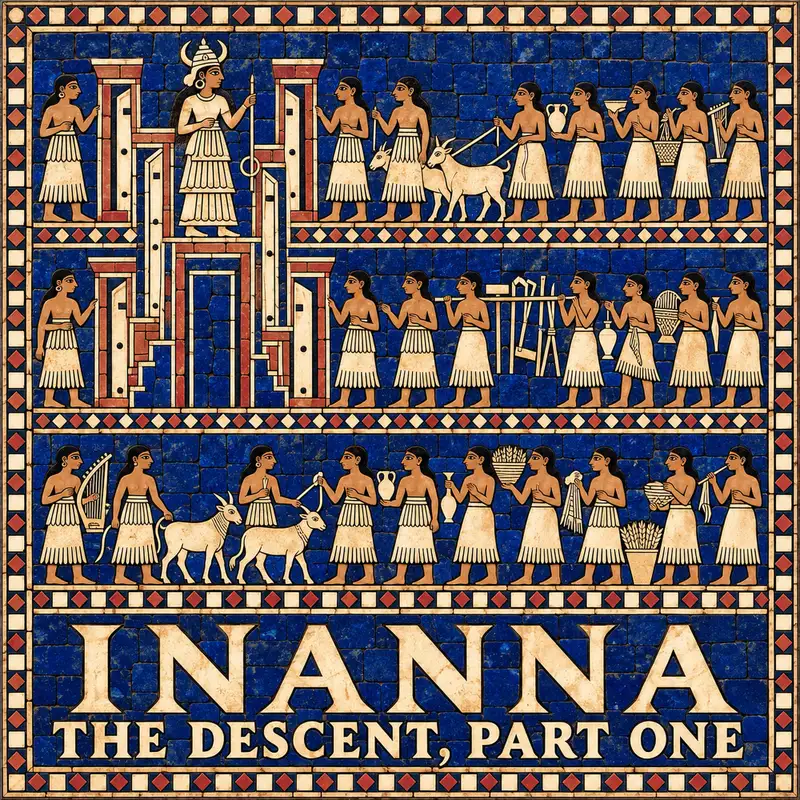
Welcome to The Sleeping Almanac. Tonight is the one I have been waiting for since the first night of this season. It is the story of a goddess who went down into the underworld and did not come back the same, and it is told in a poem that is about four hundred lines long, and it is the best constructed thing in the whole of Sumerian literature, and it is built out of seven gates. Seven gates, one after another, going down. And at each one, something is taken off her. That is the architecture of tonight, and I want you to have it in advance, because once you know it you can stop holding anything at all. There is a gate. Something is taken. There is another gate. Something is taken. Seven times. And then she is at the bottom, with nothing on, in front of her sister. It is going to take us two nights, tonight and the next one, and tonight is the going down, and tomorrow is the coming back and what it costs. And I will tell you the ending of tonight now, because it is not an ending you need to be surprised by. She dies. She is hung on a hook on the wall. And she is brought back, and the way she is brought back is the most beautiful thing in this entire literature, and it is not a battle and it is not a trick and it is not a bargain. It is two small creatures made out of the dirt under a god's fingernails, who go down into the dark, and find the queen of the dead in terrible pain, and agree with her. That is the whole of the rescue. They agree with her. Stay with it, if you can, to the eleventh chapter, for that. There is a room at the edge of the world, and in it there is a lamp. It is the same lamp. Perhaps you were here for the three long nights of the famous king, or for the man on the eagle. If so, welcome back, and your place on the reed mat is where you left it. And if this is your first night in the tablet house, be welcome. Tonight is the best possible night to arrive on, because tonight is a poem that explains itself as it goes and repeats everything important. The lamp is a small clay dish of oil, and it burns the pale gold of old honey. The room smells of river water and dust and barley. Outside, past the doorway, the river is going by in the dark, saying the same soft word over and over against the reeds. The scribe reaches to a different part of the shelf, to the older end, where the tablets are smaller and the writing is not Akkadian. This one, he says, is in the old language. It is older than almost everything I have read you. And it is the tidiest poem in this house. You do not have to do anything now. Settle onto the mat. Let the lamp be warm on one side of you and the cool night on the other. Close your eyes if they want to close. There are three names tonight. Inanna, who goes down. Ereshkigal, who is her sister and who is already down there. And Ninshubur, who waits at the top, and whose name you will hear more than either of the others, because loyalty is the second subject of this poem. You do not have to follow every word. You do not have to remember any of it in the morning. If you drift, the story will go on without you, and the seven gates will still be there when you come back, because they take a long time. And one thing, whispered like a promise across the clay. Nothing tonight will startle you. There is a death in it and it happens in the middle of the night and it is not violent in any way you have to brace for. There is no blood in this poem. Nobody is struck. A woman walks into a room with nothing on and three people look at her and she is dead, and it is done in four lines, and it is the strangest and quietest killing in this entire season. Before we begin, one small thing, and then we will not interrupt again. If this story carries you down toward sleep, subscribe now, while your eyes are still open, so that the second half finds you tomorrow. A like helps other tired travelers find this lamp. And if you would rather carry these nights with you, The Sleeping Almanac is also a free podcast, on Apple Podcasts and on Spotify, waiting wherever you listen. That is all. Now settle back, and we begin.
The poem begins with a decision and does not explain it. From the great above she set her mind on the great below. That is the first line. From the great above she set her mind on the great below. And it repeats it, three more times, in the way this poem does everything, with a small variation each time. From the great above the goddess set her mind on the great below. From the great above Inanna set her mind on the great below. My lady abandoned heaven, abandoned earth, and went down to the underworld. And that is all the explanation you get. Now, before we go any further, I owe you her, properly, because we have been mentioning her all season and never sat down with her. Her name is Inanna in the old language and Ishtar in the later one, and she is the same figure in both, and she is the most written about deity in that entire civilisation. And the thing everybody says about her is that she is the goddess of love and war, which is true and which is also the least interesting way to say it, because it makes her sound like two jobs stapled together. Here is the better way. She is Venus. That is not a metaphor and it is not a modern astronomical footnote. Her star, in every text, in every hymn, on every seal, is the planet Venus, and she is identified with it completely and everybody knew it. And Venus does something that no other object in the sky does. It is the morning star and it is the evening star. It comes up before the sun on one side of the year, and it comes down after the sun on the other side, and for thousands of years people in various places thought those were two different stars, because one is at dawn and one is at dusk and they are never in the sky at the same time. They are the same body. It is one planet, doing two opposite things, in two different halves of its cycle, and it swaps. And these people knew that. They tracked it for centuries. There is a famous tablet recording the risings and settings of Venus over decades, kept because the behaviour of that planet was used to date reigns and to take omens. So they had a goddess whose star is the one thing in the sky that is two opposite things and is nonetheless a single object, and they built her out of that. She is love and she is war. She is the morning and she is the evening. She is the one who gives you the harvest and she is the one who takes it. There is a hymn we heard part of earlier in the season in which she is described as turning a man into a woman and a woman into a man, and as being both the friend at the door and the thing at the door. Everything about her is a reversal, and reversal is what her star literally does, twice a year, in front of everybody, on a schedule they could calculate. Hold that tonight, because she is about to do the largest reversal available to anybody, which is to go from the highest place there is to the lowest, and to come back. Now, I have to tell you about a wrong answer here, because it has been in books for seventy years and you may have met it. There was a great scholar, the man who did more than anybody to bring Sumerian literature to ordinary readers, and in his early work he suggested that she went down to rescue somebody. To free her sister's husband, or to free her own. It is a natural guess, because that is what we expect a descent to be for. Somebody goes down to get somebody out. The text does not say that. The text says she set her mind on the great below, which in that language is closer to she decided to, or she desired to, or she turned her attention to. And the man himself revised his view later, and the field moved on, and the older reading survives mainly in retellings. So here is what we actually have. The most powerful goddess in that world, who has everything, decided one day to go down to the one place she does not rule and cannot leave, and the poem does not say why, and everybody who has read it for four thousand years has had to sit with that. I have my own guess and I will give it to you tomorrow night, once you have seen what she does when she comes back up, because that is the part that decides it. You can judge it then. For now, hold it as it stands. She decided to go down.
And before she went, she gave things up, and the poem lists them, and the list is a tour of a country. She abandoned heaven, she abandoned earth, and she went down to the underworld. She abandoned her office of holy priestess, and went down. She abandoned her temple in Uruk. She abandoned her temple in Badtibira. She abandoned her temple in Zabalam. She abandoned her temple in Adab. She abandoned her temple in Nippur. She abandoned her temple in Kish. She abandoned her temple in Akkad. Seven cities. Seven temples. Each one named, each with the name of its shrine, one after another, in a line down the country. And every one of those places is real. They are on the map. They have been dug, most of them, and in several of them the temple the poem names has been found, and in a couple of them you could stand in the room. That is what the list is for. It is not decoration. She had a presence in seven cities and a house in each, and the poem takes them away from her one at a time before anything else happens, so that when she goes down she is not a goddess visiting a place. She is a woman who has already given up everything she had upstairs. And I want to walk that list with you, slowly, because it is a real map and it is the calmest thing in the first half of tonight. Uruk first, which is hers above all, the city with the wall, and the great house there whose name means the house of heaven. That is the one she is best known for and it is the one at the top of the list. Then Bad tibira, the fortress of the coppersmiths, out in the marsh country in the south, one of the five cities the King List says held kingship before the flood. Then Zabalam, which is further north, and which was hers so completely that in the early writing her name and the name of that town are bound together. Then Adab. Then Nippur, which is the religious centre of the whole country, where the lord of the air lives, and where kingship is confirmed. Then Kish, up in the north, whose name is what a king said when he wanted to claim the whole land. And last, Akkad. The imperial capital. The city of the family we spent a night with earlier this season, which was the greatest city in the world for a while and which has never been found. It is the one place on that list that nobody has ever stood in, because nobody knows where it is. Each of those has its shrine named in the poem, and I am going to be careful here: the names are given in the text, and the way they are rendered varies between editions, and I am not going to recite you a list of seven that I would have to hedge four of. The house of heaven at Uruk is secure. The temple at Akkad is secure. The rest are there in the tablet and are argued over politely in the notes. But you do not need the names to feel the shape of it. Seven houses. Hers, all of them, in seven different cities, spread from the marshes in the far south up to the north of the country, each one with a staff and a calendar and offerings going in at the correct hours. And she gives up every one of them, in a line, before she takes a single step downward. And now count forward. In a few chapters she is going to come to a door, and behind that door are seven gates, and at each one of them something is going to be taken off her. Seven houses given up on the way in. Seven things taken off on the way down. The poem does not point at that and I only noticed it on the third reading. She is stripped twice. Once by herself, voluntarily, above ground, of everything she owns. And once by somebody else, gate by gate, of everything she is wearing. By the time she stands in front of her sister she has nothing left in either direction, and she arranged the first half of that herself.
And then she got dressed. And this is the most famous piece of dressing in ancient literature, and every single item comes off again later, in reverse order, one per gate, which is why the poem takes such trouble over it now. And I should say what those powers actually are, because the word for them is one of the strangest ideas in that world and there is no good English for it. The word is me. Two letters. And it means something like the whole set of things that make civilisation work. There is a poem, a different one, in which Inanna goes to the god of the sweet water at Eridu, and they drink together, and he gets drunk and gives her the me, one after another, and she loads them on a boat and takes them home to Uruk, and when he sobers up he tries to get them back and fails, and it is a comedy. And in that poem there is a list of them, and the list is very long and completely extraordinary, because of what is on it. Kingship is on the list. Priesthood is on the list. Truth is on the list. Descent into the underworld and ascent from the underworld are both on the list, which is worth remembering tonight. But also: the art of the scribe. The craft of the carpenter. The craft of the metalworker. The craft of the leatherworker. The craft of the builder. The craft of the basket weaver. Wisdom. Understanding. Purification. Fear. Consternation. Strife. Judgement. The making of decisions. The kindling of fire and the putting out of fire. Weariness. Rejoicing. The blowing out of a lamp. Every good and every bad thing a society does is on that list, sorted, itemised, as if somebody had gone through a whole civilisation and written down each component part. That is what the me are. Not powers in the sense of superpowers. Offices, arts, functions, institutions, and states of mind. The furniture of a working world. And there is one more thing about the me that I want you to have, because it is the strangest property they have and it runs straight through both these nights. They are portable. That is the part that is hard to hold in a modern head. Kingship is on that list, and so is the craft of the leatherworker, and so is wisdom, and so is the blowing out of a lamp. And in the poem where she gets them from the god of the sweet water, she does not learn them or earn them or become them. She loads them onto a boat. They are handed over, one at a time, at a drinking party, by somebody who regrets it in the morning, and she puts them in a boat and sails home with them, and when he sends people after her to get them back it is a chase, and she keeps them, and that is the end of it. So a civilisation, in that way of thinking, is not a condition a place grows into. It is a set of objects. Somebody has them. They can be given, taken, carried, stolen, and put down. And we have seen this before in this house without my naming it. On the first night there was an object worn on the chest that made whatever its wearer said become true, and it was fastened on and later taken off and sealed. Later this season there will be a bird who steals that same object off a peg while its owner is bathing, and the world stops working for as long as it is gone. That is the same idea. Authority is a thing you can hold in your hands, and it can go somewhere else. Which is exactly why the dressing matters so much. She is not putting on jewellery. She is putting on the visible, wearable form of everything she is entitled to do. The crown is the office. The robe is called the robe of ladyship because that is what it is for. The measuring rod and line in her hand are the instruments of somebody who decides where a boundary falls, which is the most concrete authority there is in a country of fields and canals. She is dressing as herself, completely, with nothing left off. And every single item she is putting on can be removed by somebody else, and she knows it, because she is the one who took them off somebody in the first place. She gathered the powers, the poem says. She took the seven of them into her hands, and she gathered them at her feet, and she went. And here is what she put on. On her head, the crown of the open country. On her forehead, the dark wig arranged. Round her neck, small lapis beads. On her breast, the twin egg shaped beads. Over her body, the robe of ladyship, which is the garment of the office, the one that says what she is. On her eyes, the ointment, and the ointment has a name, and its name is a sentence, and the sentence is: let a man come, let him come. Across her chest, the breastplate, and it too has a name, and its name is: come, man, come. On her wrist, the gold ring. And in her hand, the measuring rod and the measuring line, made of lapis, which are the tools of a surveyor and which mean, in the hands of a god, the authority to set the boundaries of things. Seven pieces. A crown, a wig, beads at the neck, beads at the breast, a robe, cosmetics with a name, a breastplate with a name, a ring, and a rod and line. The lists differ slightly between copies and the count is argued about pleasantly and does not matter. What matters is that she is putting on her whole office, every piece of it, at once, and going down into a place where none of it will work.
Before she goes she gives instructions, and she gives them to one person. Ninshubur. That name is going to be said many times tonight and it is worth knowing what it means and what she was. She is Inanna's minister. Her chief attendant. The one who goes ahead of her and speaks for her and carries her messages, and the poem calls her, over and over, the faithful one, and the one who gives good advice, and the one who follows sound instructions. And Inanna sits her down and tells her exactly what to do if she does not come back. If I do not return in three days, she says, then this is what you will do. Set up a lament for me in the ruined places. Beat the drum for me in the sanctuaries. Go round the houses of the gods for me. Scratch at your eyes for me. Scratch at your mouth. Scratch at your ears, in public. And in private, scratch at yourself where nobody will see. Dress yourself in a single garment, like a pauper. And then go, on your own, to the temple of the lord of the air at Nippur, and go into it, and weep in front of him, and say: father, do not let your daughter be put to death in the underworld. Do not let your good metal be alloyed with the dirt of the underworld. Do not let your good lapis be broken up with the mason's stone. Do not let your boxwood be cut up with the carpenter's wood. Do not let the young woman be put to death in the underworld. And if he will not help you, go to the moon god at Ur, and say the same thing. And if he will not help you, go to the god of the sweet water at Eridu, and say the same thing. Because he knows the plant of life and he knows the water of life, and he is the one who will bring me back. And I want to say what those instructions actually describe, because they are not invented mourning, they are the real thing. Everything on that list is a documented Mesopotamian funeral practice. The lament in the ruined places. There were professional lamenters, and there was a whole genre of lament literature, some of it for individual dead people and some of it for entire cities, and the great city laments are among the most powerful things that world produced. The ruined mound was where you went to make that sound, because it was already a place about loss. The drum in the sanctuaries. There was a specific instrument, a large drum, used in exactly that kind of rite, and it had its own name and its own manufacture ritual. The scratching. Self wounding as a sign of grief is attested in that world and in a great many others, and the poem's detail about doing it in public and also in private, where nobody would see, is the observation of somebody who had watched people grieve. And the single garment of a pauper. Grief clothing, in that world as in ours, was about taking off what marked your status. She is told to dress like somebody with nothing, and to go to the highest gods in the country in that state, and to ask. Ninshubur is going to do every one of those things, exactly, in order, and the poem is going to tell us again when she does, at the same length, which is the way this poem works and which is the best thing about it. And Ninshubur said yes. And that is the whole of chapter four, and I want you to notice that the rescue plan is made by the person being rescued, in advance, in detail, before she leaves, including the order of the appeals and what to say at each one and what to do if the first two say no. She knew she might not come back. She went anyway. And she left instructions.
And before she gets there, one thing about the journey, because the poem does not describe it and the absence is interesting. There is no descent. Think about that. This is the most famous descent in ancient literature, and the poem contains no travelling. She sets her mind on the great below, she abandons her temples, she puts on the seven things, she gives her instructions, and then she is at the door. No stairs. No tunnel. No river to cross, no ferryman, no gate at the edge of the world, none of the apparatus that later literatures would build for this journey. She decides to go, and then she is there. And I have thought about why, and I think it is because the poem is not interested in the distance. It is interested in the gates. Everything the poem has to say about how far away that place is, it says by taking seven things off her, one at a time, on the way in. The distance is not measured in the ground she covers. It is measured in what she loses. She went down. And when she came to the palace of the underworld, which is called the lapis palace, she did a thing that the poem reports without comment and that I have always found startling. She shoved at the door. She acted evilly at the door, the poem says. She pushed at it and she shouted. Open the door, doorman. Open the door. I am alone and I want to come in. And she threatened him. I left that out of the sentence just now and I should not have, because it is the most famous thing she says in the whole poem and it is going to matter again later in this season. Here is what she said at that door. If you do not open the gate for me to come in, I will smash the gate. I will shatter the bolt. I will smash the doorpost and I will overturn the doors. And I will raise up the dead, and they will eat the living. And the dead will outnumber the living. That is the threat. It is the first time in this house that anybody has said it and it will not be the last, and I want you to hold on to the shape of it rather than the words, because the shape is what comes back. The threat is not I will hurt you. It is not I will kill you. It is: I will open the door at the bottom of the world and let everything that is down here come up. And notice who is saying it. She is outside. She is trying to get in. She has no authority in that place whatsoever, she is standing in the dark shouting at a doorman, and the biggest thing she can think of to threaten him with is the population of the house he works in. It is a bluff, in a sense. She cannot raise the dead. It is not her house and they are not her dead. Remember that it was said. Remember who said it and where she was standing. Because on a later night in this house, in a different poem, from a different century, somebody is going to say those exact words again, and that time it will not be a bluff, and it will not be shouted through a door from the outside, and the people who hear it will hand over what she asks for inside a single line. And the doorman came out, and his name is Neti, and he is the chief doorman of the underworld and he has been doing that job for a very long time. And he said: who are you? And she said, I am the queen of heaven, the place where the sun rises. And he said, if you are the queen of heaven, the place where the sun rises, why have you come to the land of no return? How did your heart lead you on the road whose traveller never comes back? And she lied to him. That is the part everybody forgets. She lies at the door, immediately, and it is a good lie and it is a specific one. She said: my elder sister's husband has been killed. I have come to see the funeral rites. Let the beer of his funeral be poured into the cup. That is why I am here. And I want to stop on that name, because if you were here two episodes ago you have already met him and you may not have noticed. The husband she names is called Gugalanna, and the name means the great bull of heaven. That is the Bull of Heaven. That is the animal she asked her father for, in the Akkadian poem, when a young king in a clean cloak insulted her in the middle of his own city and she went up to the sky in tears and demanded it. The one that came down and opened pits in the ground and swallowed three hundred men of Uruk. The one Enkidu caught by the horns and Gilgamesh killed with a knife between the neck and the horns, and whose hindquarter was thrown at her head. In one tradition that bull is the husband of the queen of the underworld. So the lie she tells at the door of the dead is not a random lie. It is: my brother in law has died, and I have come for the funeral. Now, I have to be careful, because these are different poems in different languages from different centuries and the traditions do not line up neatly, and there are scholars who would not want those two identified as firmly as I have just identified them. The connection is real and it is old and it is not universal. But it is there. And if it is right, then somewhere behind tonight's poem there is a family, and a death in it, and a woman going down to her sister's house with a funeral as her excuse, and the funeral is for somebody her own worshippers killed.
So Neti went in to tell his mistress. And here we meet her, and she is the second most important person in these two nights, and I want you to have her properly from the start, because almost every retelling makes her a villain and the poem does not. Her name is Ereshkigal, and it means lady of the great earth, and she is the queen of the underworld and she is Inanna's elder sister. And here is what her situation actually is, because it is worse than people realise and it is the key to both nights. She is not a jailer. She is an inmate with a desk. Everybody else in this literature moves. The sky god sits in heaven but gods come to him and he sends messengers. The lord of the air is at Nippur and kings travel to him. The god of the sweet water is at Eridu and people go down and ask him things. They visit each other. They have dinners. They hold councils and everybody turns up. She does not go anywhere. She has never been anywhere. Everything she rules is down there and everything down there is hers and she cannot leave it, and the reason she cannot leave it is the same rule that is going to be read out at the end of tonight: nobody comes up from there. Including her. There is a story, later, in Akkadian, about the one time somebody tried to get her to come up to a dinner in heaven, and it does not go well, and we are going to spend a whole night on it later this season. For now, hold this. The most powerful woman in the underworld has never once been invited anywhere she could actually go. And she does not come and go. That is the thing about her. Everybody else in this literature travels. Gods go up and down and across and visit each other and turn up at each other's houses. She does not. She is in that place, and she stays in that place, and there is a rule about it that we will get to tomorrow night. And Neti comes in and tells her: your sister is at the door. She has all seven of the powers with her. She is dressed in everything she has. And Ereshkigal listened, and the poem says she slapped her thigh and bit her lip, and then she gave her instructions, and they are cold and exact. Bolt the seven gates of the underworld, she said. Then open the doors of the palace one at a time, a crack. Let her come in. And when she comes, bring her before me bowed low and naked. And at each gate, take one thing from her. And I want to stop on what she does with her body when she hears it, because the poem gives it to us and it is the only window we get. She slapped her thigh. She bit her lip. Those are not decorative. They are the standard vocabulary of distress in that literature, and you find them elsewhere, in laments, in the mouths of people who have just been told something they cannot do anything about. Striking the thigh is what a person does at bad news. Biting the lip is what a person does when they are holding something in. So the queen of the underworld, told that her sister is standing at her door wearing the entire apparatus of her office, does not laugh and does not rage. She hits her own leg and bites her mouth and then starts giving orders. Read the orders again with that in front of you, because they change. Bolt the seven gates. That is the first thing she says. Not seize her, not bring her to me, not throw her out. Lock the doors. Every one of them. You do not bolt seven gates against somebody you are confident about. And then the rest of it, which is not cruelty either when you look at it closely. Open the doors one at a time, a crack. Let her in. Take one thing from her at each gate. Bring her to me bowed low and naked. That is a procedure for admitting somebody dangerous. It is what you do at a border, or at a gate in a wall, when a person with standing arrives and you have to let them in and you are not going to let them in armed. She is not inventing a punishment. She is applying the entry procedure of her own house to a visitor who has never come before, who has arrived unannounced, wearing everything she owns, with a story about a funeral that does not quite hold together. And underneath the procedure, the two small gestures the poem bothered to record. Her sister is at the door for the first time in either of their lives, and the first thing she does about it is bite her lip.
And here is the centre of the poem, and it is seven small identical scenes, and the sameness is the whole effect. She came to the first gate. And the doorman took the crown of the open country from her head. What is this, she said. And he said: be quiet, Inanna. The ways of the underworld are perfect. They may not be questioned. She came to the second gate. And he took the small lapis beads from her neck. What is this, she said. Be quiet, Inanna. The ways of the underworld are perfect. They may not be questioned. She came to the third gate. And he took the twin egg shaped beads from her breast. What is this, she said. Be quiet, Inanna. The ways of the underworld are perfect. They may not be questioned. She came to the fourth gate. And he took the breastplate from her chest, the one whose name is come, man, come. What is this, she said. Be quiet, Inanna. The ways of the underworld are perfect. They may not be questioned. She came to the fifth gate. And he took the gold ring from her hand. What is this, she said. Be quiet, Inanna. The ways of the underworld are perfect. They may not be questioned. She came to the sixth gate. And he took the measuring rod and the measuring line of lapis from her hands. What is this, she said. Be quiet, Inanna. The ways of the underworld are perfect. They may not be questioned. She came to the seventh gate. And he took the robe of ladyship from her body. What is this, she said. Be quiet, Inanna. The ways of the underworld are perfect. They may not be questioned. And I want to say the thing about those seven scenes that makes them work, and then we will go down the last step. It is the same words every time. Not similar words. The same words, seven times, with only the object changing. She asks what is this. She is told to be quiet, that the ways of the underworld are perfect, and that they may not be questioned. And in performance, out loud, in a room, that does something that is very hard to do any other way. By the third gate the listener knows the answer before it comes. By the fifth they are saying it along with the doorman. By the seventh it is not information any more, it is a rhythm, and the thing being described has stopped being an event and become a process, which is exactly what it is. She is not being robbed. She is being processed. And that is why the poem repeats. It is not poverty of invention. It is the sound of a procedure being carried out correctly on somebody, seven times, while they ask what is happening and are told each time that the procedure is correct. And she was brought in naked and bowed low. And I want to say one thing about the building she is going into, because the poem names it and the name is lovely. It is called the lapis palace. That is the house of the queen of the dead: a palace of lapis lazuli, the deep blue stone that had to come two thousand miles overland from the mountains in the east, the most expensive material that world had, the one they used for the eyes of statues and the beards of gods. The land of no return has the best building in the literature. And the underworld itself has several names in these poems and they are worth having once. It is called the great earth, which is the same phrase that is in the queen's own name. It is called the land of no return. And it is called, in a word that turns up over and over, the great place below, which is simply a description. There is no word in any of it for punishment. There is no word for burning. It is a large place, underneath, made of lapis, where everybody goes, and the queen of it has a palace and a minister and a doorman and a set of judges, and the whole thing is described exactly the way you would describe a court.
And I want to stay at the bottom of those stairs for a moment before anything else happens. Seven times she asked what is this, and seven times she was told to be quiet, and the answer she was given was the same answer every time, and it is not an explanation. The ways of the underworld are perfect. They may not be questioned. And I want to give you the phrase in the original shape, as close as I can, because the translation smooths it. What she is told is that the rites of the underworld are complete, or perfect, or fulfilled, and that she must not open her mouth against them. The word for those rites is the same word we met on the third night of this season, the one for the whole set of things that make a working world, the offices and arts and functions, the list that has kingship and the craft of the basket weaver on it side by side. So the doorman is not saying be quiet. He is saying: these are the arrangements of this place, they are complete, they are correct, and there is no procedure by which you can raise an objection. That is the most frightening sentence in the poem and there is nothing violent in it. It is a rule being read out by an official. It does not say you deserve this. It does not say this is a punishment. It says: this is the procedure, it is correct, and you do not get to ask about it. Everything that has ever been taken from anybody by a process rather than a person is in that sentence. And here is the thing about that walk down, which I have thought about more than any other passage in this season. She knew. She is the one who invented the plan for her own rescue and gave it to Ninshubur before she left. She specified three days. She specified the order of the gods to ask. She knew, before she started down the stairs, that this could end with her not coming back, and she went. And at every one of those seven gates she asked what is this. Not why. Not stop. What is this. She is not resisting. She is asking for information, at each stage, and being refused it, at each stage, by somebody doing his job correctly, and she keeps going down. There is a way of reading this poem in which she is being punished for arrogance, and it is a very old reading and I do not believe it, because the poem does not say it anywhere. Nobody in the text says she deserved this. The gods upstairs do not say she deserved it. What they say is that the rule applies, which is a completely different statement. And she came into the room with nothing on. And Ereshkigal rose from her throne, and Inanna sat down on it. And the judges of the underworld, the seven of them, gathered round her and passed judgement. And those judges have a name, and the name is the one this whole season is packaged under, so I am going to say it plainly here. They are called the Anuna. The Anunnaki. That is what they are doing in this poem. They are sitting as a bench. Seven of them, in the underworld, hearing a case, and passing judgement on somebody who has come in without authorisation. In the first episode of this season they were six hundred gods being divided three hundred above and three hundred below and given their duties in writing. Here they are the seven who sit in judgement below. In the poems they are the assembly, the senior gods, the ones who decide. They are always, in every single text, an institution. A council, a court, a body that meets and rules. That is the entire content of the word. And that is worth having tonight, because you have now seen them do the job twice in one season, once as an administrative division and once as a panel of judges, and neither time did anybody come from anywhere. And Ereshkigal fixed on her the eye of death. She spoke against her the word of wrath. She uttered against her the cry of guilt. And the woman was turned into a corpse. And the corpse was hung on a hook. The word for it is the word for a peg or a nail driven into a wall, the kind of thing you would hang a garment on, or a waterskin, or a tool. That is the image. Not a cross and not a gibbet. A peg on a wall, in a room, in a house, with a body on it, the way you would hang up a coat. And the poem puts it in one line and goes straight upstairs to a woman waiting at a door, and does not come back down for two hundred lines. That is the right decision, and it is why the middle of this poem is bearable. The body is on the wall for the whole of the next three chapters and the poem does not look at it once. That is it. Four lines. No weapon, no struggle, nothing described. A look, three sentences spoken, and a body on a hook on a wall, and the poem moves on immediately to what is happening upstairs.
Ninshubur waited. Three days and three nights, and then she did exactly what she had been told to do, in the exact order, without changing anything. She set up the lament in the ruined places. She beat the drum in the sanctuaries. She went round the houses of the gods. She scratched at her eyes and her mouth and her ears in public, and at herself in private where nobody could see. She put on the single garment of a pauper. And she went to Nippur, to the temple of the lord of the air, and she went in and she wept. Father, she said. Do not let your daughter be put to death in the underworld. Do not let your good metal be alloyed with the dirt of the underworld. Do not let your good lapis be broken up with the mason's stone. Do not let your boxwood be cut up with the carpenter's wood. Do not let the young woman be put to death in the underworld. And the lord of the air said no. And here is what he said, and it is important, and it is the same thing the next one will say. My daughter craved the great above. She craved the great below. She who receives the powers of the underworld does not return. Whoever goes to that place, and gets there, stays there. He is not being cruel. He is stating the rule. And you have just heard the rule twice now, once from a doorman on a staircase and once from the highest god in the country, and it is the same rule, and it is going to be the whole of tomorrow night. So she went to Ur. And the poem does not summarise. It says it all again, every word of it, and I am going to say it all again with it, because this is the third time you will hear this speech tonight and the third time is the one that matters. She went to the moon god at Ur, and she went into his temple, and she wept in front of him. Father, she said. Do not let your daughter be put to death in the underworld. Do not let your good metal be alloyed with the dirt of the underworld. Do not let your good lapis be broken up with the mason's stone. Do not let your boxwood be cut up with the carpenter's wood. Do not let the young woman be put to death in the underworld. And the moon god answered her, and he said exactly what the other one had said, in exactly the same words, without a syllable of difference. My daughter craved the great above. She craved the great below. She who receives the powers of the underworld does not return. Whoever goes to that place, and gets there, stays there. Twice now. The same refusal, twice, from the two highest gods she could reach, in identical language, which tells you it is not a personal decision. It is the rule, being read out by the people whose job it is to know the rule. And notice what she does, which is the reason this poem loves her. She does not argue. She does not weep at him a second time or plead or bargain. She has a list, and there are three names on it, and she was given the order by the person who wrote it, and she has now had two refusals, and there is one name left. So she went to Eridu. And before Eridu, I want to say what the two refusals actually mean, because they are not two gods being unhelpful and the poem is careful to make them identical. They said the same thing, word for word, and the words are a statement of law. She craved the great above. She craved the great below. Whoever receives the powers of that place does not return. Whoever goes there, and gets there, stays there. That is not a personal judgement about her. It is a citation. Two of the highest gods in the country were asked to intervene and both of them looked at the situation and gave the same answer, which is that there is no provision for this. And I want to be fair to them, because it is easy to hear them as cold. They are not saying they do not care. They are saying, correctly, that what is being asked for is not a thing that has ever been done and that they do not have the power to do it. The lord of the air holds the tablet that makes commands real and even he cannot command this, because the rule about that place is not a decree that somebody issued. It is a condition of the place. And that is why the third one is different, and it is worth being precise about how. He does not overrule them. He never claims the rule does not apply. He does not go and argue with anybody or issue a counter order. He finds a way through it that leaves the rule standing, and the way through it is two people and a sentence.
To the god of the sweet water, the one who has been in this house on every single night of this season, the clever one, the one who thought of the way out every time. And she said all of it again, the whole speech, for the third time. And he said: what has happened? What has my daughter done? I am troubled. What has Inanna done? I am troubled. What has the queen of all the lands done? I am troubled. He did not check the rule. He did not weigh it. His first response was that he was upset. And then he took some dirt from under his fingernails. That is what the poem says. He took the dirt from under the fingernails of one hand, and from the other, and out of it he made two creatures. They are not gods. They are not heroes. They are two small beings made out of what a god had under his nails. And their names are the names of two real professions, and this is the part that opens the whole poem up. The words the poem uses for them are the words for two kinds of temple personnel. They are the people who performed at rites, and specifically at rites of lamentation. They sang. They played instruments. They made the sound of grieving on the occasions when grieving had to be done publicly and properly. And they were, in the texts, people whose gender was not the ordinary two. That is not a modern reading imposed on the material. It is in the texts, repeatedly, in several different words for several different roles, and it is stated as a fact about who those people were. There are lists of temple staff that include them. There are hymns that mention them. There is a passage in a hymn to this very goddess that says she is the one who turns a man into a woman and a woman into a man, and these are the people that line is understood to be about. And there is a second creation story, a different one from a different poem, in which the god of the sweet water makes a person who is neither, and assigns them a place in the temple, and the whole point of the passage is that this is a real role in the world and here is where it came from. So when the cleverest god in this literature needs somebody to walk into the land of the dead and do the one thing nobody has managed, which is to sit with the queen of the underworld while she is in agony and say the right thing, he does not make a warrior and he does not make a hero. He makes two temple mourners, out of the dirt under his fingernails, who are neither male nor female, and who are professionally skilled at exactly one thing, which is being present at somebody else's grief and making the correct sound. That is not a coincidence. That is casting. And he gave one of them the plant of life. And he gave the other the water of life. And then he gave them their instructions, and the instructions are the most extraordinary thing in this poem.
Go down, he said. Fly through the door like flies. Slip through the pivots of the door like ghosts. And when you get there, this is what you will find. The mother who gave birth, Ereshkigal, is lying there because of her children. Her shoulders are uncovered. Her breasts are bare. Her hair is swirling about her head like leeks. She is in pain. And she will be crying out. And when she cries out, this is what you will do. When she says, oh, my inside, you will say: you are troubled, our mistress, oh your inside. When she says, oh, my outside, you will say: you are troubled, our mistress, oh your outside. And whoever she is, if she is a goddess, she will hear the words spoken to her, and she will be soothed. And if she is a woman, she will hear the words spoken to her, and she will be soothed. And I want to be very careful and very clear about what he has just described, because it is easy to hear it as a trick and it is not one. He is not telling them to flatter her. He is not telling them to say anything false. There is no deception in it at all. He is telling them to listen to what she says and to say it back to her, accurately, in her own words, with her named as the person it is happening to. That is all. And notice what he says will happen. He does not say she will be fooled. He says she will be soothed. And he says it twice, in two versions, covering every possibility. If she is a goddess, she will hear the words spoken to her, and she will be soothed. If she is a mortal woman, she will hear the words spoken to her, and she will be soothed. He is not making a claim about goddesses. He is making a claim about anybody in pain, and he is so confident of it that he sends two people down into the land of no return with no weapon, no protection, no plan B, and a script consisting of six words. That is the plan. That is the entire rescue plan for getting the most powerful goddess in the world out of the land of no return, devised by the cleverest god in the literature, who has spent this whole season out thinking everybody in every situation. Repeat her pain back to her. Not fight her. Not trick her. Not bargain with her. Not sneak past her. Go and stand next to the queen of the dead while she is in agony, and when she says oh, my insides, say back to her, your insides, our mistress, your insides. And they went down. And they slipped through the door like flies, through the pivots like ghosts, and they came into the room where she was, and she was exactly as he had said. Uncovered. In pain. Crying out. And she cried, oh, my inside. And they said, you are troubled, our mistress, oh your inside. And she cried, oh, my outside. And they said, you are troubled, our mistress, oh your outside. And she stopped. And she looked at them, and she said, who are you? You who have spoken to me from my inside to my outside. If you are gods, I will bless you. If you are mortals, I will give you a gift. And she offered them the water gift, the river in its fullness. And they said no. And she offered them the grain gift, the field in its fullness. And they said no. And she said, name your gift. And they said: give us the corpse that is hanging on the hook. And before the rule, one thing about what has just happened in that room, because it went past quickly and it is the largest transaction in the poem. She was offered a river and a field and she asked for a body. That is the exchange, and it is worth weighing. The queen of the dead, moved by two strangers, opens with the two biggest gifts available to her, and they are the two things that country actually ran on: water in the channel and grain in the field. In a farming world those are not symbols. Those are the difference between a good year and everybody dying. And the creatures say no to both, twice, exactly as instructed. And then they name their price and their price is a corpse hanging on a peg, which from her side of the room is worth nothing at all. It is not currency. It is not an asset. It is a body on a wall in a house full of them. So the trade, from her point of view, is that she gave away something of no value to somebody who had just done her the only kindness she had ever received. And from ours, it is everything.
And she gave it to them. That is the whole thing. She had been offered the chance to give away rivers and harvests and she had been refused, and then two small beings who had said the only kind thing anybody had said to her in a very long time asked for a body, and she took it off the wall and handed it over. And they sprinkled the plant of life on it. And they sprinkled the water of life on it. And Inanna got up. That is all it says. Three words in the original, more or less. No description of the moment, no light, no gasp, no scene. The plant and the water were sprinkled and she got up. And I want to point at what actually did it, one more time, because the poem has been careful and I want to be careful too. The plant of life and the water of life did the raising. That is the mechanism, and it came from the cleverest god there is, and it is the standard equipment of a rescue in that literature. But the plant and the water were never the problem. He had those from the start. He could have handed them to anybody. The problem was that nobody had ever got past the queen of the dead, and no god had ever thought of a way to, and the two highest gods in the country had said out loud that it could not be done. And what got past her was not the plant. It was two temple mourners standing in front of her in the dark saying, your inside, our mistress. Your outside, our mistress. The plant was the easy part. Somebody had to get into the room. And now, at the very last moment of tonight, the poem turns, and I want you to hear the turn because it is the whole of tomorrow. As she is going up, on her way to the first gate, the underworld speaks. The judges of the dead, the seven of them, said this. Who has ever ascended from the underworld? Who has ever ascended from the underworld unmarked? If Inanna is to go up from the underworld, then let her provide someone in her place. And that is where we stop tonight. The lamp is low now. She is on the stairs, alive, going up, with the two small creatures beside her, and behind her a voice has just said, out loud, the rule that governs everything: nobody comes up from here for free. And tomorrow night is what that costs, and who pays it, and what happens to the person who does, and the ending of it, which is the one thing in this whole story that I would call kind, and which involves a woman who is not in tonight's episode at all, and who is going to walk in tomorrow and offer to take half of somebody's year. Think of it, wherever you are lying. Two small creatures made out of the dirt under somebody's fingernails, in the dark, at the bottom of seven gates, standing beside a queen nobody visits, who has not been agreed with in the whole of her existence, saying back to her, in her own words, the exact shape of her own pain, until she quietened. That is the oldest description in the world of what actually helps. And I want to say why it is in a poem at all, rather than in a manual, because I think the poem knows exactly what it has got. Look at the shape of the whole night. Seven gates, and at every one of them somebody asks what is happening to her and is told to be quiet, that the procedure is correct, and that it may not be questioned. Seven refusals to acknowledge a person. And then, at the very bottom, underneath all of that, in the last room, two small beings who acknowledge somebody. The poem is built as a contrast and it built it on purpose. The whole descent is the sound of being processed by a system that will not answer you. And the rescue is the sound of one person saying to another, in plain words, I can hear that this hurts. The seven gates take everything off her. Two sentences give somebody else everything back. That is the oldest description in the world of what actually helps. It is not a plant and it is not water, though those come after. It is somebody sitting near you and saying your own trouble back to you, so that you can hear that it has been heard. Outside, past the doorway, the river is going by in the dark, saying the same soft word over and over against the reeds. You do not have to keep any of tonight. If you keep one thing, keep the two small creatures who agreed with her. Sleep well. Goodnight.