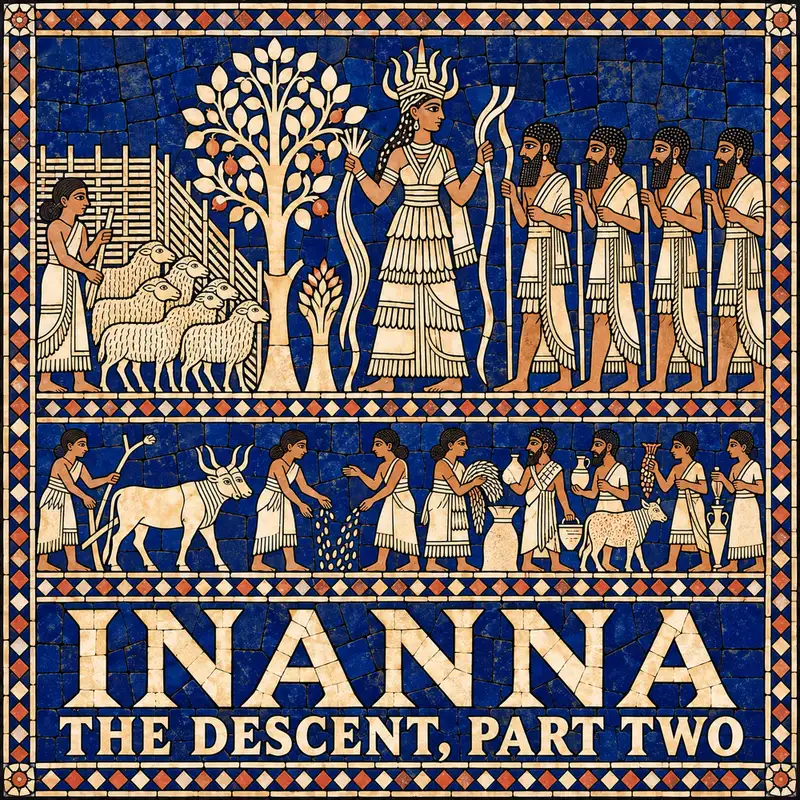
Welcome to The Sleeping Almanac. Tonight is the second half, and it is about a bill coming due. Last night a goddess went down through seven gates and had everything taken off her one piece at a time, and was killed, and was hung on a peg on a wall, and was brought back by two small creatures made out of the dirt under a god's fingernails who did the only thing nobody had ever thought to do down there, which was to sit with the queen of the dead while she was in pain and say her own words back to her. And then, as she was going up the stairs, a voice said: nobody comes up from here for free. If she goes, somebody takes her place. Tonight is who. And I am going to be honest with you at the start, because this is the saddest story in the season and there is no point pretending otherwise. Somebody does go down in the end. It is somebody who did not deserve it and did not see it coming, and there is a chase in the middle of tonight, and he is caught. But here is why I am not worried about telling you this at one in the morning. The ending is kind. The ending of this story is a woman walking into the room where the decision is being made, who has not been mentioned once so far, who has no power and no office and nothing to bargain with, and offering to take half of it herself. And the offer is accepted. And that is how the story ends, and it is why they told it for two thousand years, and it is the reason the seasons turn in that country. Stay with it to the eleventh chapter, for her. There is a room at the edge of the world, and in it there is a lamp. It is the same lamp. Perhaps you were here last night for the seven gates. If so, welcome back. And if this is your first night in the tablet house, you can start here without difficulty. A goddess went down into the land of the dead and got out, and the rule of that place is that nobody gets out for nothing, and somebody has to go in her place, and tonight is the finding of that person. The lamp is a small clay dish of oil, and it burns the pale gold of old honey. The room smells of river water and dust and barley. Outside, past the doorway, the river is going by in the dark, saying the same soft word over and over against the reeds. The scribe has the same tablet as last night, and beside it he has put two others, smaller, and he taps them. These, he says, are different poems. I am going to tell you when we cross from one to the other, because it matters, and because most people who tell you this story do not. You do not have to do anything now. Settle onto the mat. Let the lamp be warm on one side of you and the cool night on the other. Close your eyes if they want to close. There are three new names tonight and you will have them in ten minutes. Dumuzi, who is her husband. Geshtinanna, who is his sister. And the galla, who are the ones doing the taking, and who are not exactly people. You do not have to follow every word. You do not have to remember any of it in the morning. If you drift, the story will go on without you. And one thing, whispered like a promise across the clay. Nothing tonight will startle you. There is a chase in the middle of it, and I am going to tell you now how it ends so that you can lie through the whole of it without tensing. He is caught. It happens quietly. Nobody is hurt in front of you and there is no violence described anywhere in tonight, and the chase itself, which is the longest part of the episode, is mostly a man hiding in a ditch and talking to his sister. Before we begin, one small thing, and then we will not interrupt again. If this story carries you down toward sleep, subscribe now, while your eyes are still open, and the rest of the season will find you as it comes. A like helps other tired travelers find this lamp. And if you would rather carry these nights with you, The Sleeping Almanac is also a free podcast, on Apple Podcasts and on Spotify, waiting wherever you listen. That is all. Now settle back, and we begin.
Here is the rule, said out loud, at the foot of the stairs, by the judges of the dead. Nobody has ever ascended from the underworld unmarked. If Inanna wishes to go up from the underworld, let her provide a substitute for herself. And I want to sit inside that sentence for a moment, because everything tonight comes out of it and because it is not what people usually assume. It is not a punishment. Nobody is angry with her. The judges are not taking revenge and the queen of the underworld, who has just handed over the body off her own wall to two strangers who were kind to her, is not going back on the deal. It is an accounting rule. The underworld, in this literature, is not a prison and it is not a hell. It is a place with a population, and the population is everybody who has died, and the one absolute law of it is that the number does not go down. Things go in. Nothing comes out. That is what the land of no return means, and it is in the name. So if somebody comes out, the books do not balance, and something has to go in to make them balance. And I want to give you the rule properly, because it is the load bearing idea of both these nights and it is nowhere stated as plainly as it deserves. That place is called, among other things, the land of no return. That is not a poetic name. It is a description of a policy, and the policy applies to everybody, including the staff. Her sister cannot come up either. Not because somebody is keeping her down there. Because the place does not have an exit and she is part of the place. So consider what her existence actually consists of. Everybody arrives. Nobody leaves. Every single person she has ever met came in through those seven gates on the worst day of their life, was stripped at each one, and was brought before her bowed low and naked. That is the entirety of her social experience. Nobody has ever come to visit. And upstairs there is a whole society of gods who go to each other's houses and hold banquets and argue in assemblies, and she has a chair in none of it. Hold that, because later this season we will spend a whole night in her house from the inside, and it will matter. And I have to tell you that people in that country did this. Not with a goddess. With each other. The idea underneath tonight, that a thing which is coming for one person can be persuaded to take another instead, was not only a story they told. It was a procedure, written down, with instructions, and it was carried out at every level of that society for well over a thousand years. At the ordinary level it is the figure at the door. Somebody is ill, and the family believes something has come into the house for them, and so a small figure is made, out of clay or dough or reeds, and it is dressed, and it is named, and it is put where the thing will find it first. And the words that go with it say, in effect: here. This one instead. And then the figure is taken out and disposed of, and the person in the bed is left alone. That is a kindness performed with a piece of clay by frightened people at three in the morning, and there are hundreds of texts for it. And at the other end of the society there was a version that used a person. When the omens said that the king was going to die, and the omens in that country were read constantly and taken with complete seriousness, there was a procedure. Another man was put on the throne. He was dressed as the king and addressed as the king and given the queen's place beside him, and he sat there and held the office, and the real king stepped aside and was called, in the letters, the farmer. And the substitute held the kingship for the length of time the omen was thought to cover, which might be a hundred days. And what was coming for the king arrived, and found him on the throne, and took him instead. He did not survive the arrangement. That was the arrangement. We know about this in detail because the scholars who advised on it wrote letters about it to their king, and the letters survive, and they are unbearably matter of fact. They discuss the timing. They discuss whether the omen has been fully discharged. They report that the substitute has gone to his fate, and then they tell the king he may safely return to his throne. So when the judges at the bottom of the stairs say that nobody ascends unmarked and that she must provide a substitute for herself, nobody hearing that poem thought it was a strange rule invented for a story. They thought: yes. That is how it works. That is what you do. And they had a very clear idea of what it costs and who it usually costs it to, which is not the person who is being saved. That is the whole of it. It is not moral. It is arithmetic. And the horror of tonight is entirely a horror of arithmetic, and it is going to be worked out on somebody who has done nothing wrong.
So she came up, and they came with her. The galla. That is what they are called, and there is no good translation, and demon is misleading because these are not tempters and they are not evil spirits. They are more like bailiffs. They are the officers of the underworld, and their function is to fetch. And the poem describes them, and the description is one of the great passages in this literature, and it works by telling you what they do not do. They eat no food. They drink no water. They accept no flour offering. They do not drink the poured libation. They take no gifts. They do not enjoy a wife's embrace. They never kiss a child. They do not know the sweetness of anything. And then, having told you all the things they cannot be reached by, the poem tells you what they do. They take the wife from a man's arms. They take the child from a man's knee. They take the bride out of the house of her father in law. That is what they are. They cannot be bribed because they do not want anything. They cannot be softened because they have never had anything soft. They cannot be delayed by an offering because they do not eat. And they come for people who are in the middle of their lives, with somebody holding on to them. And I want to say where else they turn up, because they are not confined to this poem and knowing that changes how the whole thing feels. They are all over the incantation literature. That world had an enormous body of texts for dealing with things that came for people, and a great many of them are addressed to these. There are rituals to turn them aside. There are substitute figures, made of clay or dough or reed, set out at the door, so that when they come they take the figure instead of the person. Which means that this poem, which looks like a myth about gods, is describing a procedure that people actually performed in their houses. Somebody is ill. The family believes something has come for them. And so they make a substitute, and they put it where the thing will find it, and they say the words, and they hope it takes the figure and goes. That is the ritual. And tonight's poem is the story of the one time it was done at the highest possible level, by a goddess, using a person. There are large and small ones, the poem says. They come up out of the ground on either side of her, and they walk with her, and everywhere she goes they are there, and they are waiting for her to nominate somebody.
And before the first stop, one thing about the shape of what is coming, because knowing it will let you rest through the whole middle of the night. There are four stops and they are the same scene four times. They arrive somewhere. There is a person there. The officers of the dead say: this one, let him go with us and let her go. And she looks at the person and either says no, at length, with reasons, or she does not. Four times. Same structure, same words for the demand, same shape for the answer. And three of the four are refusals, and they get longer and warmer as they go, and then the fourth one is short. That is the whole architecture, and it is the same architecture as last night's seven gates, which was also one scene repeated with one thing changing each time. This poem builds everything out of repetition with a variable, and once you have heard the pattern twice you can let the rest of it go past you knowing exactly where you are. And I want to say who she actually is, because we have had her name for two nights and I have never explained the office she holds. She is a sukkal. That is the word, and you will meet it again later this season, in a different house, when the queen of the dead sends hers up a staircase to fetch a plate of food. It is the position of the one who stands behind, who carries the messages, who goes where they are sent, and who speaks for their master when their master is not there. Every important god in that world has one. It is the most useful job in the pantheon and the least sung. And here is the thing about hers that I did not know until I went looking, and that changed how I read both these nights. Ordinary people prayed to her. There is a kind of scene carved on cylinder seals, and it is one of the commonest images that survives from that whole civilisation, and there are thousands of them. A god is seated. A person is approaching. And between them there is a figure who has the person by the wrist, leading them forward, one hand raised toward the seated god, speaking on their behalf. That figure is the intercessor. That is her role, over and over, in the art of that world, for centuries. Because if you are an ordinary person and you need something from a great god, you do not walk up and ask. That is not how anything worked in that society, not with a king and not with a god. You find somebody who has access, and who is willing to speak for you, and they take you in by the hand. So the position she holds is not only messenger. She is the one who gets you in front of somebody. She is the person who will say your name in a room you cannot enter. Which is exactly what she does in this poem, at enormous personal risk, for three days, going from door to door, being turned away twice, and getting somebody in front of a god who could act. She did her job. That is the whole of it. The job happens to be standing outside great houses asking to be heard on behalf of somebody who cannot speak for themselves, and she did it for three days in a pauper's single garment with dirt on her face. And now she is lying in the dust at the top of the stairs, and the officers of the dead are pointing at her, and the first thing the goddess she saved has to decide is whether to hand her over. And the first place she went was to the person who saved her. Ninshubur was waiting at the edge of the underworld, in the dust, in the single garment of a pauper, exactly as she had been told to be, having done every single thing on the list, in order, for three days and nights. And she threw herself down in the dirt in front of her. And the galla said: this one. Let her go with us. Let Inanna go, and we will take this one. And Inanna said no. And I want to slow down here, because this is where the poem starts doing the thing it does, and the thing it does is a test, applied four times, and the test is not what you would expect. She is not choosing by rank. Two of the people she looks at tonight are lesser gods attached to her own cities, and she refuses to give up either of them, and the fourth is her husband, and she gives him up in a line. She is not choosing by love, or the poem would have kept the husband. There is exactly one criterion and it is applied identically every time. She looks at the person, and at what they are wearing, and at where they are sitting, and she asks one question. Did you grieve for me. That is the whole test. Three people were sitting in the dirt in sackcloth having a terrible three days, and she looked at each of them and said no, not this one. And the fourth was in a clean magnificent robe on a throne in the shade. And listen to what she says, because it is the first of four refusals tonight and the four of them together are the argument of the poem. She said: this is my minister of fair words. This is my escort of true words. She did not forget my instructions. She did not neglect the orders I gave her. She made a lament for me in the ruined places. She beat the drum for me in the sanctuaries. She went round the houses of the gods for me. She scratched at her eyes and her mouth and her ears for me. She dressed herself in a single garment like a pauper. And she went, alone, to the temple of the lord of the air, and then to the moon god at Ur, and then to the god of the sweet water at Eridu, and she brought me back to life. How could I give you her? Let us go on. That is the standard she is applying, and she applies it four times tonight, and it is not rank and it is not affection. It is: did this person grieve for me.
They went on, and they came to a city called Umma, and to its temple, and there was somebody there, and his name was Shara. And I want to say where they are going, because the route is not invented and it is one of the quiet pleasures of this poem. She is touring temples. Every place she stops at tonight is a real city, and the god she finds sitting in the dust at each one is that city's own god, in that city's own temple, doing what the god of that place would actually be doing. The poem is walking a route that its listeners could have walked. Umma was a working city with a long history, in the same stretch of country as its neighbour and rival, and the two of them spent centuries arguing over a border and a canal, and some of the earliest historical documents in the world are the record of that argument. And its god was the one she meets first, and he is a real deity with a real temple and a staff and offerings, and the reason his name means anything at all today is that people there made offerings to him for two thousand years. Bad tibira is older still, and you heard its name last night, in the list of houses she gave up before she went down. It sits in the marsh country in the south, and it was one of the great early centres, and by the time this poem was written it was already ancient. So consider what the shape of the night actually is. A goddess comes up out of the ground with the officers of the dead on either side of her, and she goes from city to city across her own country, from temple to temple, and at each one there is somebody in the dirt in mourning clothes, and the officers say that one, and she says no, and they go on. It is a procession. It has the shape of a festival route, the kind where an image is carried from town to town and stops at each shrine, and everybody in every one of those towns comes out to see it pass. Except that what is being carried along this route is a decision about who has to die. And at every stop, the answer is no. Not him. Not this one. Not here. Three times, in three real towns, on a road people actually walked, she looks at somebody lying in the dust for her and says: not him. Which is why the fourth stop lands the way it does. And I should say why the mourning matters so much here, because to a modern ear the standard sounds harsh. He did not cry enough, therefore he is taken, is how it reads if you are not careful. That is not what is happening. In that world, mourning was not a feeling you either had or did not have. It was a set of actions, publicly performed, on a schedule, by named people, and it was one of the primary obligations you owed somebody. There were professional mourners. There was correct dress. There were the specific acts, the sackcloth, the dust, the drum, the lament in the ruined place, every one of which Ninshubur was given as instructions and every one of which she carried out exactly. Not doing them was not a failure of feeling. It was a failure to perform a duty, in public, that everybody could see you not performing. So when she comes up and finds three people in the dirt and one man on a throne, she is not measuring how sad anybody was. She is looking at who did the job. He is her son in some tellings, and her singer in others, and the poem calls him the one who does her nails and dresses her hair, which is either a courtier's role or a very intimate one and probably both. And he was sitting in the dust, in sackcloth. He threw himself down in front of her. And the galla said: this one. Let him go with us. Let Inanna go. And Inanna said no. She said: this is Shara, who sings for me. Who trims my nails and arranges my hair. How could I give you him? Let us go on.
They went on, and they came to another city, Badtibira, and to its temple, and there was somebody there too, and his name was Lulal. And he was sitting in the dust, in sackcloth. He threw himself down in front of her. And the galla said: this one. Let him go with us. And Inanna said no. She said: this is Lulal, who goes with me at my right hand and my left hand. How could I give you him? Let us go on. Three refusals. Three people found sitting in mourning, in the dirt, in the cheapest clothes they own, for her, and three times she has looked at the officers of the underworld and said no. And now I want you to hear the fourth one, and I want you to hear it with all three of those in your ears, because the poem has spent two hundred lines building this and it is about to spend one line spending it. And there is one more thing I have to say before the tree, and it is the hardest question in these two nights and I have put off answering it. Why did she go down in the first place? I said on the first night that the poem does not say, and that the old guess about her going to rescue somebody is not in the text, and that everybody who reads it has to sit with the silence. And I said I would give you my own guess at the end, so here it is, and it is a guess and I am labelling it as one. I think she went to see her sister. Not to conquer her. Not to take her throne, though the poem does have her sit in it, which is the detail that makes people think she came for the kingdom. To see her. Look at the lie she tells at the door. My sister's husband has died and I have come for the funeral rites. That is a family reason. It is the correct and formal reason for one relative to visit another, and it is the only reason she can think of that would get her in. And look at what happens when she arrives. She does not demand anything. She is stripped at seven gates without resisting and she walks into the room with nothing on and asks nothing of anybody. And look at what her sister does when two strangers are finally kind to her, which is to give away a body off her own wall to the first people in her existence who ever agreed with her about anything. Those are two people who did not know how to be in a room together. That is my reading, and the poem does not confirm it, and you should hold it loosely. But I have never been able to make the other readings fit the funeral lie, and this one fits it exactly.
Before we go to the tree, I want to give you the other poems, the ones about the two of them before any of this, because the bible I work from says that if the dusk needs warmth before the seizure then the love songs are where to find it, and it is right. There is a whole body of poetry about this couple, in Sumerian, and it was sung for centuries, and it is some of the oldest love poetry in the world. In it she is young and he is a shepherd and her brother wants her to marry him and she is not sure, and then she is sure. There is a poem where she goes out to meet him and comes home late and her mother asks where she has been, and she has a lie ready, and the poem gives you the lie: my girlfriend took me to the square, she says, there was music and dancing, and we sang together, and the time went. There is one where she is telling herself to hurry. Where she says she has bathed and put on oil and dressed and put kohl on her eyes and arranged her hair, and where she checks herself over before she goes out. There is one where he comes to the door and she says, wait, let me tell my mother, and she runs in and tells her, and the poem records what a young woman said to her mother about a man, four thousand years ago, and it is not solemn at all. And there are poems about the two of them together that are frank in a way that surprises people who expect ancient literature to be stiff, and which were sung in public at festivals, and which nobody was embarrassed about. That is the couple. And that is who is sitting under the apple tree. They went on. And they came to a place called Kulaba, and there was an apple tree, and under the apple tree there was a throne, and on the throne there was a man. And he was dressed in a magnificent garment. That is the whole of it. That is the entire crime. He was sitting down, in good clothes, in the shade, on a throne. His name is Dumuzi and he is her husband. He had not put on sackcloth. He had not sat in the dust. He had not scratched his face or beaten a drum or gone round the houses of the gods or made any lament at all. She had been dead for three days and nights and he had been on his throne in his best clothes. And there is one more thing here, and it is what makes this the saddest chapter of the season rather than a simple judgement. He is her husband. There is a whole body of poetry in that same language about the two of them, and it is love poetry, and some of it is very beautiful and a good deal of it is frankly explicit, and it was sung at festivals for centuries. Poems where she is getting ready to meet him. Poems where she describes waiting for him. Poems where he comes to the door and she tells her mother a story about where she is going. That is the same couple. The same two names. And everybody hearing this poem knew those other poems the way you would know the songs about a couple before you were told the rest. So the man under the apple tree is not a stranger who let her down. He is the one from the love poems, sitting on a throne in his best clothes, on the third day, and she has just come up seven flights of stairs from being dead. And the poem does not editorialise. It does not say he was heartless or that he was celebrating. It says he was sitting on a magnificent throne dressed in a magnificent garment, and it puts that sentence next to three men in sackcloth in the dirt, and it lets you do the rest. And she looked at him. And the poem says she fastened on him the eye of death. The same phrase, exactly, that was used against her three chapters ago in last night's episode. Her sister rose from the throne, and she sat down on it, and the seven judges gathered, and the judges fastened on her the eye of death. And now she is doing it, to her husband, under an apple tree, and the poem uses the identical words on purpose so that you cannot possibly miss it. She spoke against him the word of wrath. She uttered against him the cry of guilt. Take him, she said.
Before he runs, one more thing about the moment itself, because there is a detail in it that I have never been able to put down. She does it with the same words the judges used on her. Go back three chapters, to the bottom of the seven gates. Ereshkigal rose from her throne. Inanna sat down on it. The seven judges gathered round. And the judges fastened on her the eye of death, spoke against her the word of wrath, uttered against her the cry of guilt. And now: she fastened on him the eye of death, spoke against him the word of wrath, uttered against him the cry of guilt. Word for word. The identical formula, in the identical order, three sentences long. She has been dead for three days. She has come up seven flights of stairs. And the first thing she does at the top, to her own husband, is the exact thing that was done to her at the bottom, in the exact words. The poem does not comment on it. It does not have to. It simply uses the same sentence twice, two hundred lines apart, and lets you find it. That is what the underworld did to her. And that is what she brought back up. And he ran. And here is where I have to stop and tell you that we are leaving one poem and going into another, because this is exactly the place where most retellings blur two texts together and pretend it is one. The poem we have been in, the descent, the one with the seven gates, is nearly finished. It has a few lines left. What happens in the chase, the hiding, the sister, the friend, and the bargain at the end, comes mostly from other poems, related, in the same language, about the same people, and they were separate compositions and everybody who studies this knows they were separate. So I am going to tell them, and I am going to tell you when we cross. But not quite yet. The descent has one more scene before we cross, and it is this one. In the descent itself, this is what happens. He weeps. He lifts his hands to the sky, to the sun god, who is his wife's brother, which makes him a brother in law and which is exactly the family relationship you would use if you were in trouble. And he says: I am the husband of your sister. I brought butter to your mother's house. I brought milk to the house of your sister. That is his case. Not that he is innocent. Not that it is unfair. He says, in effect, I am family and I did the family things. And then he asks for something very specific. Change my hands, he says. Change my feet. Let me get away from the galla. Let them not catch me. Turn my hands into the hands of a snake, and my feet into the feet of a snake. And the sun god heard him, and did it. And I should say why it is the sun he calls, because it is not because the sun happened to be overhead. The sun god in that country is the judge. That is his office, formally, in the hymns and in the law. He crosses the sky every day from one horizon to the other, and the consequence they drew from that is that he sees everything, in every place, with nothing shadowed, which is precisely the qualification you want in somebody who decides cases. He is called the one who illuminates what is hidden. He is called the judge of heaven and earth. And it is not decorative. Law codes were set up under his authority. Oaths were sworn by him. When a case was heard, it could be heard in his temple, and there are documents where the parties go to the gate of his sanctuary to settle a matter. In the prayers of ordinary people in trouble, he is the one you address, and there are a great many of them, and they are some of the most direct writing to survive from that world. A person who has been wronged, or thinks they have, telling the sun about it. So a shepherd standing in a field with the officers of the dead coming along the road does the most natural thing available to anybody in that society who is about to lose everything. He appeals. He lifts his hands to the judge and states his relationship to the court, which is that he married into it, and then he states his good conduct, which is that he brought butter to one house and milk to another. That is a legal filing. It is short and it is badly argued and it is entirely sincere, and the thing to understand is that he is not praying in the way we might mean it. He is going to court, in the only court there is, at the last possible moment, in a field. And the judge finds for him. Not on the merits, because there are no merits, and the sentence is not overturned, and nobody says the arrest was wrong. He is simply given a head start. That is the ruling. Not an acquittal. Not a pardon. The judge of heaven and earth listens to a frightened man in a field and gives him the hands and feet of an animal that can get into a small space, and lets him run. And I want to point at what he actually asked for, because it is not what you would ask for. He does not ask to be hidden. He does not ask for a weapon or an army or for the sentence to be overturned. He asks for his hands and feet to be changed into the hands and feet of an animal that can get into a small space. He asks to be made better at running away. That is the whole prayer, and it is granted, and it works, for a while, and it is the most honest thing anybody asks a god for in this entire season. And he got away.
Now, the other poem, the one called Dumuzi's Dream, starts earlier than this, and it is the most frightened piece of writing in this literature, and I want to give it to you properly. It starts with him already afraid, before anything has happened, out with the flocks. His heart was full of tears, it says. He went out to the plain, and he lay down among the buds, and he had a dream. And he woke from it shaking, and he called for his sister. Her name is Geshtinanna, and she reads dreams. That is what she does. And he tells her his, and it is a list of images, and it is the strangest and most beautiful list of bad omens in the literature. Rushes rising up around me. Reeds growing thick. A single reed trembling for me. A pair of reeds, and one is taken away. Tall trees standing over me in the forest, on their own. Water poured on my sacred hearth, and the hearth going out. My cup taken from its peg and falling. My shepherd's stick gone. An eagle taking a lamb from the sheepfold. A falcon catching a sparrow on the reed fence. My goats dragging their beards of lapis in the dust. My sheep scratching the earth with bent legs. The churn lying on its side, and no milk poured. The cup lying on its side. Dumuzi living no more. The sheepfold given to the winds. And his sister listened to all of it and then told him what it meant, one image at a time, and she did not soften any of it. The rushes are the men who will rise against you. The single trembling reed is your mother, who will shake her head for you. The pair of reeds with one taken away is you and me, and one of us will be taken. The tall trees standing alone are the ones who will come for you. The water on the hearth is the house going quiet. The cup falling from the peg is you falling from the knee of your mother. Your shepherd's stick is gone, and the little galla will take it. The eagle with the lamb is the galla, and it will come and get you out of the fold. And then she said: your churn will lie on its side, and no milk will be poured. Your cup will lie on its side. Dumuzi will be no more, and the sheepfold will be given to the wind. And he said: my sister, go up on the hill. Do not go up like a person. Go up with your heart broken. And watch, and tell me when they come.
And I want to introduce her properly first, because she walks into this story in the eighth chapter and takes it over, and almost nobody knows her name. Geshtinanna. It means something like vine of heaven, and she is a goddess of the vine and of the autumn and of the wine that comes at the end of the year, which matters enormously for how this ends. And she is a scribe. That is her other function and it is in the god lists and in the texts, and it is one of the loveliest job descriptions in this literature. She is described as the one who knows writing, and as a keeper of tablets, and in some texts she is the scribe of the underworld, the one who keeps the register down there. Think about that for a second in the light of what she is about to do. The woman who volunteers to spend half of every year for ever in the land of the dead is, in the wider tradition, the person who does the paperwork of the land of the dead. And she reads dreams. That is how we met her, in the poem where her brother wakes up shaking in a field and calls for her, and she goes through his nightmare image by image and tells him the truth about every single one of them without softening any of it. That is who she is. She reads what is written, whether it is on a tablet or in a dream, and she tells you accurately what it says, and she does not lie to make you feel better. Which makes what she does at the end of tonight even more remarkable, because she of all people would have known exactly what she was signing up for. And they came. And he hid, and she watched, and this is the part of tonight that I find the hardest and the best. They caught her first. They came to her, the galla, and they wanted to know where he was, and the poem says they offered her the water gift, the river in its fullness, and she would not accept it. And they offered her the grain gift, the field in its fullness, and she would not accept it. And then they hurt her. The poem says it in a few words and I am going to say it in the same few words and not dwell on it, because it does not dwell on it either. They tore at her. They did things to her. And she did not tell them. That is Geshtinanna. That is the whole of her character and it is enough. Her brother was hiding in a ditch and the officers of the dead came to her and offered her a river and she refused it and then they hurt her and she refused them again, and she never told them where he was.
And before we get to him, I want to give you the hiding one more time, because there is a version of it in another poem where it goes on longer and it is the most exhausting thing in this literature. He is caught, and he escapes. He prays again and he is changed again and he gets away again, and he runs, and he hides somewhere else, and they find him, and he escapes again. And in the poems it happens three times, or five, depending on the copy, and each round is shorter than the last, and each hiding place is worse than the one before, and by the end he is not running to anywhere, he is just running. And in one telling, at the very end of it, he asks to be taken to his sister's house, and he is, and it is there that they get him. I am not going to dwell on that because it is the bleakest passage in two nights and there is nothing in it to hold on to. I mention it because the poem does, and because it explains something about the chapter we are about to have. By the time they get to the friend, they have been chasing him a long while, and the friend knows it, and everybody in that country knows what is happening because it has been going on in the open. So when the field is offered, it is not offered to somebody who does not understand the situation. They went to his friend. The poem does not give him much of a name and does not need to. He was a friend of Dumuzi. He knew where he was. And they offered him the water gift, the river in its fullness. And he accepted it. And they offered him the grain gift, the field in its fullness. And he accepted it. And he told them where to look. And I want to say something about the friend, because he is the only person in these two nights who does the wrong thing for an ordinary reason and the poem is quietly devastating about him. His sister was offered a river and refused it, and was hurt, and refused it again. He was offered a field and took it. That is the whole comparison and the poem makes it by putting the two scenes next to each other in the same words with the same offers, so that the only variable is the answer. Same demons. Same river. Same field. Same phrasing. One says no twice under pain and one says yes twice without being touched. And the poem does not punish him. He does not appear again, and the only word against him comes from Dumuzi himself, one bitter line: that his sister saved his life, and his friend caused his death. He is a man who was offered a field, which is a livelihood, which is the difference between working for somebody and working for yourself, and who told them where his friend was hiding. And they found him in the ditch, and they took him. That is the chase, and it is over, and it is over quietly, and I told you at the start of the night that it would be. He is taken from a ditch by officers who were told where he was by a man who took a field. And I want to give you the hiding, because the poem gives it properly and it is the part that stays with me. He does not hide in a fortress. There is nowhere in this story that is safe and he knows it, so what he does is what an animal does, which is to keep moving to somewhere slightly less obvious than the last place. He hides in the small ditches. He hides among the plants. He goes to his sister's sheepfold, and the poem says the sheepfold is where he is found the first time, and that when they came into it the churn lay silent and the cup lay broken and the sheep scattered. And there is a moment where his mother comes into it, and she is called Sirtur in some copies and Duttur in others, and she is a shepherd's mother and she has almost no lines and she does not save him either. She is simply there, in a poem about her son being taken, doing what a mother does, which is arriving too late and being told. And there are versions of the story where he escapes and is caught again, and escapes again, and is caught again, and hides in his sister's house and in the sheepfold and among the plants, and each time the flight is a little more tired than the last. And in every version, in the end, they get him.
And before she arrives, I want to be clear about what everybody in this poem has already tried and failed to do, so that you can measure what she does against it. Her mistress tried refusal. Three times, at three stops, she looked at the officers and said no, and each time it worked, and each time it simply moved the problem along the road to the next person. Her brother tried escape. He prayed to a god who granted it, and he was changed, and he ran, and he hid, and he was found. She herself tried silence. She was offered a river and a field and she refused both, and then she was hurt, and she still refused, and it did not save him. Refusal, flight and endurance. Three strategies, tried by three people, all of them failing. And then a woman who has already tried the third one walks in and does the only thing nobody had thought of, which is to accept the rule completely, on its own terms, and find the one arrangement inside it that nobody had noticed was available. And then his sister came. And I want to slow all the way down here, because this is the last movement of two long nights and it deserves to be taken carefully. Consider her position. She has already lost. Her brother has been taken and it is done and there is no ground to stand on, because the rule is the rule and everybody in the poem has now stated it three separate times. Nobody comes up unmarked. A substitute is required. One has been provided. She has nothing to trade. She is not a great goddess with cities and temples. She has no army, no powers to bargain with, no object anybody wants. In the entire poem she has not been shown to own a single thing. She has already been offered the two best things anybody in that world could offer, a river in flood and a field in full grain, and she refused both, so she cannot even claim to have been cooperative. And she has already been hurt, badly, for refusing, which means she knows exactly what these people are willing to do. And she walks in anyway, and she asks. And the only currency she has is her own time, so she offers that, in the largest quantity anybody has ever offered anything in this literature: half of every year, for the rest of forever. She had been on the hill, watching, with her heart broken, because he told her to be. She had been offered a river and refused it. She had been hurt and had not told. And here we cross back into the descent, for its last few lines, and I have to be honest with you, because the clay is broken at exactly this point. Lines are missing. In the lines that survive, she is not even named, and we never see her walk in or hear her ask. Who she is, and how faithful she was, we know from the other poems. So this is the way those broken lines have long been read. When it was finished, and he had been taken, she went to the goddess, and she asked for him. And the poem gives us the decision, and the decision is this. You for half the year, she said, and your sister for half the year. When you are being asked for, you will stay in the underworld. And when your sister is being asked for, she will go in your place. Half the year each. She offered to spend six months of every year, for ever, in the place her brother had been taken to, so that he could spend six months of every year out of it. And it was granted, and that decision is where his story comes to rest, and that is the arrangement that world lived under. And I want to point at who granted it, because it is easy to miss and it changes the ending. It is not the judges. It is not the rule. The rule did not bend, and I want to be clear about that, because it did not. The books still balance. There is still exactly one person in the underworld who was not there before, at every moment, for ever. The arithmetic is untouched. What changed is who. Half the year it is him and half the year it is her, and the total never changes, and the underworld never notices, and the accounts are correct on every single day. She did not break the rule. She found the only move inside it. That is why the poem ends the way it does rather than with a triumph. Nobody won anything. A woman looked at a system that could not be argued with, understood it completely, and found the one arrangement that satisfied it exactly while making it bearable, and then paid for that arrangement herself, for ever, starting immediately. And here I have to hand you the other version, because there is one, in the later language, and it ends differently and I am not going to hide that from you. There is an Akkadian poem called the Descent of Ishtar, and it is much shorter than the Sumerian one, and it is the version most people have actually read because it is the one in the popular anthologies. It is not a translation of tonight's poem. It is a different composition on the same story, and it makes different choices at almost every turn. There is no long journey by the minister to three gods in three cities. The rescue comes differently, and a single figure is sent down rather than two. Ereshkigal in that version is not lying in the dark because of her children. She is described as having the pain of a woman giving birth, and it is one of the strongest images in that text, and it belongs to that text and I am not going to import it into the Sumerian scene because they are two different poems. And at the end of it, the god who was taken is washed, and anointed with oil, and dressed in a red garment, and a flute of lapis is played for him, and the professional mourners perform, and the poem closes on that. Which is a completely different ending. Not a bargain between a brother and a sister. A funeral, done properly, with music. Both are on clay. Both were copied for centuries. When somebody tells you the story of Inanna going down, they are almost always telling you a blend of the two, and I would rather you had them separately and knew which was which. And I want to be careful here about something, because it would be easy to turn this into a lecture and it is not one. Yes, there is a season in it. Dumuzi is a shepherd god and a god of the spring growth and the date palm and the beer, and his sister's name means something like vine of heaven and she belongs to the autumn and to the wine. And there was a month named for him, in high summer, when the land is burnt and everything green is gone, and in that month the women of the cities went out and mourned him by name, and there are poems written for it. And I want to tell you how far that mourning travelled, because it is one of the most remarkable survivals in the history of religion. The month named for him is the fourth month of that calendar, in high summer, when the heat in that country is at its worst and everything green has gone brown. And in that month there was a rite of weeping for him, performed by women, in the cities, publicly. And that rite outlasted the language it started in. It outlasted the cities. It was still being performed, under his name, a thousand and then two thousand years after the poem we are reading tonight was written. There is a line in one of the books of the Hebrew Bible, in the prophet Ezekiel, in which the prophet is shown things happening at the temple in Jerusalem that he is meant to disapprove of, and one of them is that there are women sitting at the north gate, weeping for Tammuz. Tammuz is his name in the later language. That is the same god and the same rite, being performed by women in a city hundreds of miles away and more than a thousand years after the Sumerian poem, and being written down by somebody who did not like it, which is why we have it. And in the calendar of that region the month kept the name. It is still there. In the Hebrew calendar and in the Iraqi and Levantine Arabic calendar there is a summer month called Tammuz, and it is named for a shepherd in a Sumerian poem who was taken because he did not put on sackcloth. The women stopped weeping a very long time ago. The month is still on the calendar. And when the year turned, he came back. That is the shape of it, and everybody who lived in that country lived that shape every year of their lives, and did not need it explained. But the poem does not present it as an explanation of agriculture. It presents it as what happened to a family. A man was taken because he did not grieve properly. His sister, who did grieve, and who was hurt for him and did not tell, went and asked for him, and offered the only thing she had, which was half of every year of her own life. And there is one more thing I want to give you before the last chapter, and it is what happened to the faithful one, because she has been in every chapter of two nights and nobody ever asks. Ninshubur. She waited three days. She did every single thing on the list, in order, exactly. She went to two gods who said no, in identical words, and then to a third who said yes. She is the reason any of this happened. And when her mistress came back up with the officers of the dead beside her, the first person they pointed at was her. And she was spared, and the poem says why, and the reason is that she grieved properly. But that is not the end of her, and this is the part I like. In the wider literature she is everywhere. She has her own hymns. She appears in god lists in her own right, not only as an attendant. She is called the minister of the goddess and she is invoked on her own account, by name, by people asking for things. So the servant who did the paperwork of a rescue, correctly, in order, while everybody more powerful was saying no, ended up with a following of her own. There is a version of the story of these two nights that is about a goddess. And there is a version that is about the person who followed the instructions. And before the last line, I want to say what happens to the two of them afterwards, because there is more of it and it is gentler than tonight has been. The mourning for him became a season, and the season had songs, and the songs are not all grief. There is a body of poetry about his return. About the month ending. About him coming back up, and about what that looked like, and it is written in the same register as the love poems, because to the people who sang it the two things were the same thing: the year turning, and somebody coming back to the door. And his sister goes down as he comes up, and there are poems about that too, and about her, and about what she does down there, which in some tellings is the job she was always suited for, which is to keep the records. So the arrangement they arrived at is not a punishment that repeats for ever. It is a rota. Two people, one post, six months each, handed over twice a year, and a country that watched the handover happen in its own fields and marked it on its calendar. That is what she bought with half of every year of her own life. Not his freedom. A shift pattern. And a shift pattern, if you have ever been the person who could not leave, is not a small thing at all.
The lamp is low now. And here is the last line of the poem, and it is not the one anybody expects. The whole thing has been about Inanna. Her decision, her descent, her seven gates, her death, her rescue, her return, her four refusals, her husband. She is in every chapter of both nights. And the last line of the poem is not about her. Holy Ereshkigal, it says. Sweet is your praise. That is the closing line. The poem ends by praising the queen of the underworld. The sister. The one who never goes anywhere. The one who was lying in the dark in pain with nobody to speak to when two small creatures came in and agreed with her. She gets the last line. And I want to say what that would have sounded like to somebody hearing it in a room four thousand years ago, because it is not a small thing. That formula, holy so and so, sweet is your praise, is a standard closing. It is how a great many of these compositions end. It is the line you say at the end of a hymn, to the god the hymn was for. So the ending is not a wistful gesture toward a minor character. It is the technical, formal, unmistakeable closing of a hymn, and it is addressed to the queen of the dead. Which means that at the last moment the poem turns out to have been at least partly a hymn to her all along. Read the whole thing again with that in your ear and it changes. The seven gates are not only a stripping, they are a description of her house and how it is run. The judges are her court. The rule about substitutes is her law. And the one moment of tenderness in four hundred lines happens in her room, to her, when two strangers say her own pain back to her. She gets the last line. And I have thought about why for a long time, and I think it is this. She is the only one in the whole story who gave something away without being made to. Inanna went down and came back and gave up her husband to do it. The judges applied the rule. The galla did their job. The friend took a field. Ereshkigal was in agony, and two strangers were kind to her, and she gave them the body off her own wall, which was hers, which she was entitled to keep, and which nobody could have taken from her. And the poem noticed, and put her name in the last line. Think of it, wherever you are lying. There is a woman on a hill with her heart broken, watching a road, because her brother asked her to. There is a man in a ditch with the hands of a snake, waiting. There are officers who cannot be bribed coming along a road, and they will arrive, and everybody knows it. And afterwards, when it is done, there is a woman walking into a room where nothing can be undone, and saying: give me half. And somewhere below all of it, in the dark, at the bottom of seven gates, a queen who never leaves is being praised in the last line of the poem, for the one afternoon somebody was kind to her. Outside, past the doorway, the river is going by in the dark, saying the same soft word over and over against the reeds. You do not have to keep any of tonight. If you keep one thing, keep the sister who said, half of every year, for ever, and meant it. Sleep well. Goodnight.