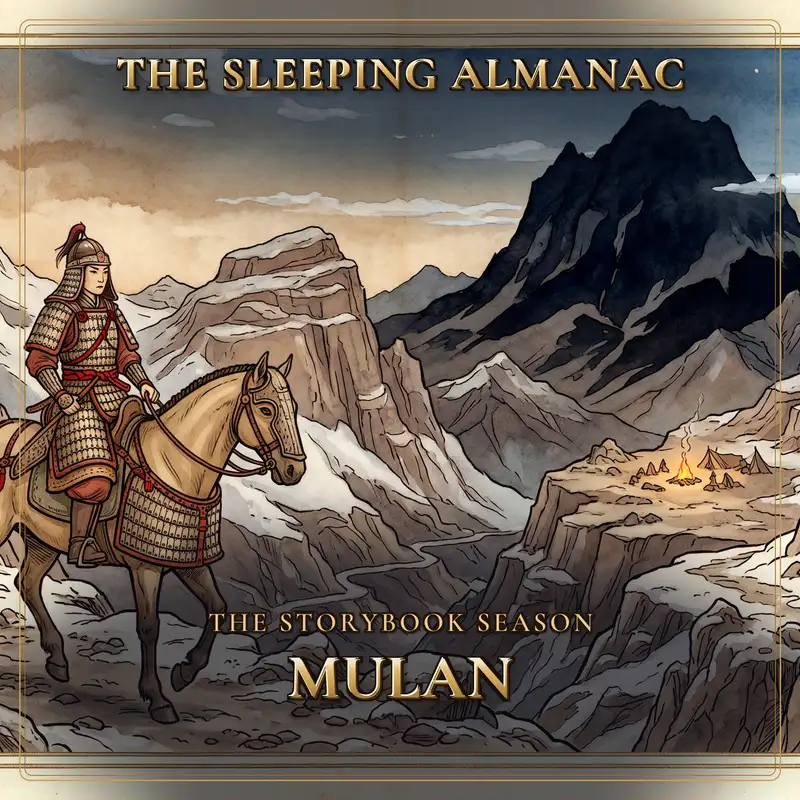
Welcome to The Sleeping Almanac.
Before the lamp is lit, one small thing. If these stories carry you to sleep, subscribe now, while your eyes are still open, and tomorrow night's tale will be waiting for you. A like helps other tired souls find this room. That is all. Let's light the lamp together now.
The lamp is lit again.
The same small flame as last night, in the same quiet room at the edge of the world.
The storyteller is already here. She was here before you arrived. She will stay until you sleep.
There is a chair for you. There is a blanket. The night outside is doing all of its slow, dark work, and none of it is yours to carry until morning.
The storyteller opens the old book, and turns past the tales already told, to a page that waits for tonight.
Tonight, she says softly, we follow the small wooden music of a loom to a house in the north of old China, where a daughter is about to set down her shuttle and buy a horse, in the oldest and kindest of all the soldier songs, the Ballad of Mulan.
And there is no hurry at all as she begins.
Settle in now. Let the chair take your weight, all of it, even the part you have been carrying in your shoulders since morning. Let the blanket be heavy in the good way, the way snow is heavy on a roof that has nothing to do until spring. Close your eyes, if they want to close. This story does not need to be watched. It only needs to be near you, the way lamplight is near you, the way a river is near a sleeping house.
You do not have to follow every word. You do not have to remember any of it in the morning. If you drift, the story will go on without you, quietly, and it will not mind at all. Drifting is not leaving. Drifting is how a listener says thank you.
And you may believe you already know the tale that is coming. Most travelers who find this room believe that. But the tale by lamplight is older than the one you were shown, and smaller, and warmer. It was a song first, short enough to fit on two pages, and people have been singing it for some fifteen hundred years, by rivers, in courtyards, over cradles. There is no dragon in it. There is no magic in it at all, only the ordinary kind that never wears out. A daughter who loved her father. A horse bought in four markets. A secret kept for twelve years among ten thousand men. And at the very end, a joke about two hares, told with a smile, that has not aged a single day. Everything the old song holds is here tonight, and we will add nothing to it but lamplight.
The flame leans, and settles.
We begin.
Chapter One.
The Loom That Faced the Door.
Long ago, and far to the east of here, in the north of old China, there was a house that stood a little apart from its village, with its back against a low hill and its face turned to the road.
It was not a grand house. Its walls were of packed earth, the color of bread crust, and its roof had been mended so many times, tile by tile, that it had taken on the patchwork kindness of a quilt. There was a courtyard with a mulberry tree in one corner and a well in the other, and a few brown hens who patrolled the ground between them with the seriousness of small officials. Beyond the courtyard wall lay the millet fields, going gold. Beyond the fields the river country began. And far beyond that, so far that on most days they were only a blue suggestion along the sky, stood the mountains of the north.
In that house lived a family of five. A father, who had been a soldier once, long ago, and who walked now with an old soldier's ache in his knee when the weather turned. A mother, who ran the house the way a good captain runs a ship, calmly, with lists. An elder sister, grown and gentle, who could fold a dumpling so that it looked like a lotus about to open. A little brother, still small enough to consider the hens his personal cavalry. And between them, the second child, the younger daughter.
Her name was Mulan.
The old song does not tell us what she looked like, and we will not invent a face for her. The song is wiser than that. It tells us instead what she sounded like, which is a better way to know a person. In fact, said the storyteller, the song begins with a sound. Or rather, with the absence of one.
In the main room of that house stood a loom of dark wood, old enough that its beam had been worn silky by three generations of resting hands. It stood facing the door, the way looms did in those houses, so that whoever sat weaving could see the courtyard and the gate and the road beyond, and so the daylight could come in over the work. A weaver sits at a loom for many hours. It is good to face the world while you do it.
And the loom had a voice. Everyone in the family knew it the way you know a voice. Click, and then clack. The shuttle flying through the open threads from one hand to the other, the beater drawn home, the cloth growing by one thin line. Click, and clack, hour after hour, so steady, so woven into the days of that house, that the family only truly heard it on the day it stopped.
On the evening our story begins, it had stopped.
Mulan sat at the loom with the shuttle quiet in her lap. The threads stood open, waiting, patient as a held breath. Through the door she could see the courtyard going blue with dusk, the mulberry tree holding the last of the light in its highest leaves, one hen making a final proud circuit of the well. From the kitchen came the good sounds of the evening meal being made, the fire, the water, the knife on the board. And from the loom came nothing.
No click. No clack. Only, every little while, a sigh.
Her mother heard it, of course. A mother hears the sound a loom is not making more clearly than she hears thunder. She came and stood in the doorway with her hands still dusted with flour, and she looked at her daughter for a while, and then she asked the question the song still asks, word for word, after fifteen hundred years.
Daughter, what are you thinking of? Daughter, what do you long for?
And Mulan answered the way the song answers.
I am thinking of nothing, she said. I am longing for no one.
Which was true, in its way. There was no sweetheart in her thoughts. There was no far city she wished to see. What sat with her in the dusk, beside the quiet shuttle, was heavier than any of that, and she was still deciding how to lift it.
Last night, she said at last, I walked down to the village gate. And I saw what is posted there.
The courtyard went very still, the way a room goes still when a word everyone has been stepping around is finally set down on the table.
Because her mother knew what was posted at the gate. The whole village knew. The whole north knew by then. And in a moment, so will you. But slowly, said the storyteller, turning the page with no hurry at all. Slowly. Nothing in this room ever arrives faster than a walking horse.
Chapter Two.
Twelve Scrolls of Paper.
To understand what was nailed up at the village gate, you must know one small thing about that time and that place, and then the story will carry you the rest of the way.
The north of China, in those years, was ruled by emperors who had come down from the grasslands long before, horsemen who had become builders of cities. And so the old song calls the ruler by two names in the same breath, the Khan and the Son of Heaven, one name from the grass and one from the throne, and it never once stops to explain itself. We will do the same. He was the Khan. He was the Son of Heaven. He was, either way, very far off, and his word traveled in the form of paper.
That autumn, trouble had come down out of the north, as it did in those centuries the way hard winters come, not as a surprise but as a season. Riders had been seen along the passes. The beacon fires had been lit on the old towers, one answering another all down the line of the hills, small orange stars appearing in the dusk where no stars should be. And the Khan had called up a great army.
The calling arrived in the village as a sheaf of notices, brushed in black ink on paper the color of oatmeal, fixed to the boards by the gate where the tax notices and the market days were posted. The army lists were long. They had been copied out into twelve scrolls, and the crier had read them by lantern light, name after name after name, while the village stood in the cold and listened.
And on every one of the twelve scrolls, the song says, stood her father's name.
The song does not explain how a name comes to be written twelve times. It only says it plainly and lets it stand, and perhaps that is what it felt like to a family reading by lantern light, that the name was everywhere, that there was no scroll in the empire without it, that the paper itself would not let him go. Twelve scrolls. Twelve times. His name.
Her father had no grown son. Mulan had no elder brother. That is the very hinge of the song, and it says it just so, in two short lines, like two stones set side by side to cross a stream. The little brother was still of the age when a wooden sword is heavy. The elder sister was needed where she was. And the father, the old soldier, stood at the gate a long time that night, reading his own name in the lantern light, twelve times over, and then walked home, favoring his knee.
At the evening meal he said, at last, what everyone knew he would say. I will report at the muster. I have served before. I remember the way of it.
No one answered him. The fire spoke a little. The mother set down the ladle and did not pick it up again. Because they had all seen him come back from the well that winter, one hand on the wall. They had all heard him on the stairs. He was brave, and he was loved, and he was old, and all three of those things were true at once, which is the kind of arithmetic that keeps families awake at night.
That night, Mulan lay in her own bed, in the quiet of the house, and listened.
She heard the wind come down off the hill and cross the courtyard, stirring the mulberry leaves. She heard the well rope shift on its hook. She heard her father cough once, softly, twice, and go quiet. She heard, in her mind, the crier's voice reading the lists, and behind it, further back, the click and clack of the loom, the sound of her whole life so far, steady as a heart.
And somewhere in the smallest hour of that night, with no trumpet and no vow and no lightning, quietly, the way a scale finally tips when one more grain of rice is added, she decided.
In the morning she rose before the hens, and lit the fire, and set the millet gruel over the fire, and when her father came into the kitchen she filled his bowl and set it before him and said, Father. The lists call for a man of our family name. They do not say which one.
He looked at her a long moment over the bowl.
I will buy a horse in the market, she said. And a saddle, and a bridle, and a whip. And I will ride to the muster in your place, as your son, and no one will know me. I sit a horse as well as anyone in this village. You taught me yourself, before my brother could walk.
Now, here the old song does a very kind thing, said the storyteller, and we will honor it. It does not record the argument. You may be sure there was one. There were tears, and there was the word no, said more than once, said in every voice a father has. But the singers who made this song, fifteen hundred years ago, gave that family their one night of grief to themselves, off the page, behind the shut door, and every singer since has kept it so. The song simply steps from the deciding to the doing, the way you step over a threshold.
And so shall we.
By the second evening it was settled, because it was the only door out of that winter that did not have the old man's name on it. The mother took out her needles and began, without a word, to let out the shoulders of a coat. The sister sat close to Mulan and braided her hair tight, the plain way, the way that fits under a soldier's cap, and said nothing either, but braided very slowly. The little brother, who understood only some of it, promised to guard the hens.
And the loom stood quiet in the dark, facing the door.
And the door, all night, held.
Chapter Three.
The Four Markets.
The market town lay half a day south along the road, where the road met the river's first slow bend, and on market days it doubled itself, the way towns do, every street growing a second street of stalls and awnings and voices.
She went down with the dawn carts, riding among a neighbor's baskets with the family coins knotted into her sash, a daughter going to market, which was every second person on that road, and nothing about her to make anyone look twice. The dew burned off the millet as they went. By the time the town wall showed above the orchards the day was warm and smelled of dust and ripening fruit, and inside the gate the noise arrived all at once, the way water arrives when a sluice is opened. Bread sellers calling their one word over and over. A tinker's small hammer, mending something back into the world. Geese being contradicted. Somewhere a bamboo flute, unhurried, playing a tune the whole north knew and no one could name.
Now the song, said the storyteller, gives Mulan's errand a shape that singers have loved for fifteen hundred years, and once you hear it you will not forget it. It sends her to four markets. In the east market she buys a fine horse. In the west market, a saddle and a saddle blanket. In the south market, a bridle. In the north market, a long whip. Four corners of the compass, one for each piece of the journey, as though she were buckling on the whole wide world one direction at a time. Perhaps the guilds of that town really did keep to their own quarters, the horse dealers in the east and the saddlers in the west. Or perhaps the singers simply knew that a task told in four directions sounds complete, the way a table with four legs stands. Either way, we will walk all four, because the song did, and the song knows what it is doing.
The east market smelled of hay and warm animals. The horse dealers had strung a rope line in the shade of the wall, and along it stood the horses, tails swishing the flies, necks drooping in the morning warmth. There were tall glossy horses that stamped and rolled their eyes to be admired, and the dealers praised those loudest.
Mulan walked the line slowly, twice, saying nothing, the way her father had taught her. You do not listen to the dealer, he had said. You listen to the horse.
Near the end of the line stood a dun horse with a black mane and one white forefoot, neither tall nor small, watching her come with a calm dark eye. When a cart clattered past behind them, the glossy horses shied and the rope jerked all down the line, and the dun horse only turned one ear toward the noise, and then turned it back, and went on watching her, as if to say, yes, carts do that.
She stood at its shoulder. It breathed at her, a great warm smell of hay. She laid her hand flat on its neck, and felt it lean, very slightly, into her hand, the way the lamp flame leans, and settles.
This one, she said.
The dealer began a speech about three finer animals. The horse and Mulan waited together, with the same expression, until he had finished. Then she counted the strings of copper cash into his palm, coin by careful coin, and the dealer, who was not a bad man, looked at her once, and looked at the horse, and let the price be fair.
In the west market she bought the saddle. The saddler's shop smelled of leather and beeswax and lamp oil, that deep brown smell that gets into the wood of such shops and never leaves. Saddles hung on pegs like a flock of patient birds. The saddler showed her the seams, the tree, the girth straps, and she checked each one with her thumbs the way her father had shown her at the kitchen table the night before, his hands remembering thirty years back all on their own. She bought a felt blanket too, gray with a red border, thick enough to keep a horse's back kind through a long day.
There were stirrups on that saddle, two hoops of iron hung on broad leathers, and it is worth a moment to say so, because stirrups were a new thing in the world then, or nearly new, and the north country was where they were newest and best. An older rider had gripped with his knees and hoped. A rider with iron under her feet could stand in a mountain pass, could turn in the saddle, could rest one leg and then the other across a long day, could become, in time, the kind of rider this song is about. The saddler set the leathers to her height and told her she would thank him within the year. She thanked him for twelve.
In the south market she bought the bridle. It was quieter there, an old man in a small shop, reins and headstalls hanging in loops on the wall like written letters. He fitted the bit to her hand, then to the dun horse's mouth, gently, talking to the horse all the while about nothing, the weather, the barley, and the horse listened to him with its calm ears, and Mulan thought, this is how I will talk to you on the nights when neither of us can hear anything kind. He would take no extra coin for the fitting. For the soldier's family, he said, and bowed to her, not knowing the half of what he was bowing to.
And in the north market she bought the long whip.
It was the smallest purchase and the strangest, said the storyteller, and the song gives it its own whole line, so we will too. A soldier's whip, in those days, was hardly ever used for whipping. It was a walking staff when the passes were steep. It was a pointer for showing a far thing to a friend without shouting. It was a way to knock the snow off a tent rope, and to test a river's ice, and to feel taller on a cold night. She chose one of dark rattan, longer than her arm, with a good weight in the hand, and the seller wrapped its grip in new leather while she waited, and the wrapping of it, round and round, slow and neat, was the last quiet errand of the day.
And that was the whole of the errand, and the song keeps it the way a list is kept by someone who loves the things on it. In the east market, a fine horse. In the west market, a saddle and a blanket of felt. In the south market, a bridle. In the north market, a long whip. Say it slowly and it is a compass. Say it more slowly and it is a lullaby. Fifteen hundred years of drowsy children have gone to sleep counting those four markets on four fingers, one direction at a time, and there is no reason in the world, tonight, why you should not be one of them.
She rode home in the late afternoon with the saddle creaking its new leather song under her, the bridle brasses winking in the low sun, the whip across her knees, and the whole west turning the color of ripe apricots ahead of her, and if you had passed her on that road you would have seen nothing to remember. A farm daughter on a dun horse. And you would have passed the beginning of one of the oldest songs in the world, and never known it.
That evening the horse stood in the courtyard, nosing the mulberry leaves, entirely unimpressed by the hens, who reorganized their entire government around it before nightfall. The little brother fed it a heel of bread and named it four different names, all of which the horse declined. The father walked around it once, slowly, his hand trailing on its flank, and said only, a good eye, this one, and stood a while at its head with his forehead near its forehead, saying something too quiet for the yard to hear.
And by lamplight, at the kitchen table, he taught his daughter the things his old hands knew. How to set the saddle so it sits forward of the loin. How to tie the soldier's knots, the one that holds and the one that slips free in the dark. How to bind her hair the plain tight way the soldiers bound theirs, under the cap, so that nothing of it showed. How to answer a sergeant, which is briefly, and how to answer a bragging man, which is not at all.
Keep your feet dry, he said at last. Feed the horse before you feed yourself. Stand your watches honestly. And come home.
That is a whole book of soldiering, said the storyteller, in four lines. Old soldiers speak in pack loads. Everything they say is folded small, to carry far.
Chapter Four.
The Yellow River Nights.
She left at first light, because the song says so, and because first light is when brave things are easiest, before the day is awake enough to argue.
At dawn, says the song, she took leave of her father and her mother. It gives the parting one line, and the line is enough. The mother put into her saddlebag a parcel of steamed bread and dried dates, wrapped in the blue cloth that was usually kept for festivals. The father checked the girth he had already checked, twice, and then once more. The sister smoothed the coat across her shoulders, the coat whose shoulders she had let out herself, needle by needle. The little brother stood very straight by the gate, guarding the hens, as promised, with his wooden sword.
No one wailed. That was their gift to her, and the song understood it. She rode out through the gate and down the road with the dun horse stepping quick and light in the cold, and she did not look back until the house was small, and when she finally did look back, the house was small, and the figures at the gate were small, and the whole valley of her childhood lay in the early light like something woven, gold thread and green, and she fixed it in her memory the way a weaver fixes a pattern, thread by thread, so it could be carried.
All that day she rode south and west, toward the crossing. The road gathered others as it went, the way streams gather, men on horses, men on mules, men walking with their muster papers folded inside their caps, all flowing the same direction. Nobody looked twice at a quiet young rider on a dun horse. An army gathering is a river of strangers. It was the easiest place in the whole empire to be unknown.
And at dusk, exactly as the song says, she came to the bank of the Yellow River, and camped.
Here the storyteller paused, and turned the lamp wick down a little, because this part of the song is the part that has kept it alive for fifteen centuries, and it deserves the dark.
The Yellow River at evening is less like a river than like a moving field. It is wide, and it is the color of its own name, gold and brown, thick with the good silt of half the world, and it does not rush. It proceeds. It has somewhere to be, and it has been going there for longer than there have been names for it, and it will accept no advice. All along the bank that evening were the small fires of the mustered men, each fire with its little kingdom of light, and the great water slid past them all, catching the firelight and folding it under, catching the first stars and folding them under too, patient, enormous, calm.
The riders on that road had heard it long before they saw it. It came to them first as a feeling in the ground, and then as a smell, wet earth and cold stone and something mineral and very old, and then, over the last low rise, as a sound, and the sound was the astonishing part, because it was not loud. A water that wide has no need of loud. It made one broad seamless going sound, a sound with no edges anywhere in it, and the men on the road fell quiet as they came down to it, one by one, the way people fall quiet entering a temple, and the horses pricked their ears at it and then accepted it, and the road ended at the ferry landing, in the smell of wet rope and river mud, and everyone made camp where the day left them.
Mulan picketed the horse where the grass was good. She ate the steamed bread, in the blue festival cloth, slowly. She banked her little fire the way her father banked the kitchen fire. And then she lay with her head on the saddle, in her coat, under the whole deep sky of the north, and listened.
And the song tells us exactly what she heard, and exactly what she did not hear, and it is the saddest and gentlest verse in it, and it goes like this.
She did not hear her father and her mother calling their daughter.
She heard only the Yellow River's water, going by in the dark. Splash upon splash. Murmur upon murmur. The great water, flowing and flowing.
That is all the verse says. It does not say she wept, and so we will not say it either. It only sets those two sounds side by side, the voices that were not there and the water that was, and lets them rock against each other, the way a boat rocks at its mooring, until the listener understands something that cannot be said any plainer. Every person who has ever slept far from home for the first time has lain inside that verse. The room is too quiet, or the night is too loud, and the particular voices that used to call you in to supper are a whole day's ride behind you, and what there is instead is water, or wind, or a strange city humming, some huge old sound that does not know your name.
The old singers even made the sound itself into words, and the words are still in the song, and they are worth hearing once in their own shape. Jian jian, says the river in the old tongue. Splash, splash. Two soft syllables, over and over, the water folding upon the water, and the singers set them exactly where the calling voices should have been, so that anyone who ever sang this song would have to make the river's own sound with their own mouth, softly, twice, and feel a little of what she felt. Try it, and you will find it cannot be said harshly. Jian jian. It is a sound the mouth can only make gently, the way you hush a child.
And here is the mercy in it, said the storyteller, the mercy the song is too wise to explain. The river did not know her name, but it stayed with her all night anyway. It did not stop once. It went on and on in the dark, patient as breathing, the oldest lullaby there is, the sound of something large that is not worried. And somewhere in the middle of listening to it, between one murmur and the next, she stopped hearing the silence where the voices should have been, and heard only the water, and the water carried her off to sleep as surely as it carried the stars downstream.
The dun horse dozed over her, hip cocked, one ear turned to the river.
The little fire kept its warmth folded under the ash.
And at first light she rose, and watered the horse, and crossed the Yellow River on the flat ferry with a dozen silent men and their silent mules, the water pushing broad and gold against the hull, the far bank coming slowly out of the morning haze. And when her horse's feet stepped off onto the northern shore, the song turns a page, and so do we.
She did not know it yet, but it would be twelve years before she crossed that water again.
The river, which had kept her company all night without asking who she was, went on behind her, flowing and flowing.
It is flowing tonight.
Chapter Five.
The Horses of the Black Mountain.
North of the river, the world began to change, the way a voice changes when it is getting to the serious part of the tale.
The fields thinned, then faded. The good yellow earth gave way to grass, and the grass grew tougher and grayer as she rode, until it hissed under the wind like a different language. The villages grew farther apart, and lower to the ground, with walls around them that were not decorations. The wind itself changed. It came from farther away now, and it carried grit in it, and a smell of stone and snow, and it had that particular loneliness of wind that has not passed over a single cooking fire in a hundred miles.
And ahead, all day, the mountains grew.
The one the song names is the Black Mountain. She could see why long before she reached it. Its stone was dark as wet ink, darker where the shadows of the clouds moved over it, and it stood at the edge of the grasslands like the last word of an argument. Below it, in the fold of its foothills, spread the war camp of the Khan.
She came over the last rise at dusk and saw it, and the song saw it with her, and she stopped her horse without meaning to.
It was a city that had not existed the month before. Ten thousand tents in rows, and the rows in squares, and the squares going on into the twilight farther than she could see, each tent glowing faintly from the fire before it, so that the whole valley looked like a field planted with low orange stars. Smoke stood up from it in a hundred soft columns and leaned east together. There was a sound to it, too, a vast quiet mumble, ten thousand men eating and mending and talking low, horses shifting at their lines, somewhere a smith still working, his hammer arriving small and late across the distance, tink, tink, tink.
She sat her horse and looked at it for a long time. Then she rode down into it, and became one of it, and that was that.
At the clerks' tent a tired man with ink on his fingers asked her family name, and she gave it, and he wrote it in a ledger with a worn brush, beautifully, because even tired clerks in that country wrote beautifully, and he asked her nothing else at all. The army needed soldiers the way a field needs rain. It did not interview the rain. She was given a tent number, a mess assignment, a wooden tally, and a direction to walk in, and the great camp swallowed her the way the river had carried her, without once asking who she was.
Her mess was ten men to a fire. That first evening she met them as shapes against the flame, and learned them, over the weeks, the way you learn a new room in the dark, one corner at a time. There was a big quiet man from the wheat country who mended everyone's boots without being asked. There was a boy no older than her little brother would someday be, who talked every night about his mother's noodle soup until the whole mess could taste it. There was an old soldier with a gray braid and seven campaigns behind him, who taught the new ones how to fold a blanket so it kept the ground's cold out, and how to stand a watch without letting the mind wander through the gate of every fear it owns. None of their names come down to us, said the storyteller. The song keeps them the way the night keeps the shapes around a fire. Warm, and close, and nameless.
They took to Mulan because she was steady. She ate what there was, without complaint. She kept her kit clean and her horse cleaner. She spoke little, and never about herself, and an army is the easiest place in the world to speak little, because there is always someone glad to fill the silence with the story of his uncle's mule.
And when the fires burned down, that first night and every night, she lay in her coat with her saddle for a pillow, in the great breathing dark of the camp, and listened.
And the song, which was listening with her, says again what it said by the river, because some verses must be said twice to be true.
She did not hear her father and her mother calling their daughter.
She heard only the horses of the nomads, far off on the slopes of the Yan hills, crying to one another in the night.
That was the sound of that whole country. Not war, not yet, not near. Just horses, wild and strange, a long way off in the dark, calling and answering, calling and answering, the way lonely things do. Some nights the wind brought the sound closer, and some nights it took it away entirely, and the camp of ten thousand men lay under it and slept, each man folded into his own coat, his own distance from home.
The old song gives that far sound its own two syllables as well, sisters to the river's. Jiu jiu, cry the horses on the night hills, thin and high, the way wind sounds in tall grass. First the water, jian jian, then the horses, jiu jiu, one soft sound for each of her two nights on the road, and nothing else of the whole long journey recorded at all. That is how the song measures distance. Not in miles. In the sounds that came to fill the place where the voices of home had been.
And Mulan learned what every soldier learns in the first month, which is the great secret the songs are kind enough to tell us in advance. An army is not made of iron. It is made of homesickness, wearing armor.
She pulled her coat closer, and turned her ear away from the hills, toward the banked fire.
And she slept.
Chapter Six.
Ten Thousand Miles Like Flying.
The years that came next, the song folds into six lines. Six lines for a whole war. And they are six of the finest lines ever made, said the storyteller, so we will unfold them slowly, like a blanket kept in cedar, and shake them out, and see how far they reach.
Ten thousand miles, says the song, she rode on the business of war.
That is the first line, and it is not a boast, it is an itinerary. The army of the Khan did not sit still. It moved the way weather moves, in fronts, along the whole long north of the empire, and Mulan moved with it, season after season. She learned the passes the way she had once known the rooms of her father's house. She crossed them in spring mud and autumn dust and winter iron. She watered her dun horse in rivers whose names she never learned and never forgot, gray rivers, green rivers, rivers so cold the horses drank in sips and shivered.
She crossed the passes and the mountains, says the song, as though she were flying.
Not because it was easy. Because she became good at it. There is a lightness that comes to a person who has done a hard thing many times, a saved motion, a quiet in the hands, and the song gives her that lightness like a medal. Where the new men fought their horses and the road, she let both carry her. On the narrow tracks above the clouds she leaned with the mountain instead of against it. The old soldier with the gray braid saw it within the first year, and said to the fire, one night, without looking up, that one rides like the wind's own daughter, and Mulan looked into the flames and let the remark pass by, wearing, on the inside only, the smallest smile in the whole army of the Khan.
The years in that country did not pass so much as turn, like a great wheel of painted panels, and the two panels she came to know best were spring and winter. Spring was mud and foals and the smell of wet felt drying, the rivers cracking their winter lids with sounds like far doors closing, the first green coming up through the bones of the old grass. And winter was the long held breath, the world gone white and blue and iron, when the whole art of soldiering shrank to the keeping of fires and the keeping of tempers, and she was good at both.
The northern air, says the song, carried the sound of the watchman's iron.
Every camp, every night, all those years, the same sound. The sentries kept the hours with iron clappers, and the cold clear air of that country carried the clang from post to post, around the sleeping tents, regular as a slow heart. It was the sound of being guarded. It was the sound of someone awake so that you could be asleep. Mulan stood that watch herself, hundreds of nights of it, walking the line under stars so many and so hard they looked like frost nailed up, striking the hour on the iron, hearing the next post answer, and the next, fainter and fainter, away down the dark. And some nights, standing there, wrapped to the eyes, she heard in the clapper's rhythm something from very far back, click, and clack, click, and clack, and she stood the whole watch with the loom of her mother's house sounding softly under the war's iron, and it did not make her sad, said the storyteller. It kept her. There is a kind of remembering that is a rope over the river. She held it, and stood her watch, and handed the hours on.
Cold light, says the song, shone on coats of iron.
That was winter in the high camps. The frost got into everything, into the tent seams, into the bread, into the bones of the old wounds, and the moon came up over the ranks of stacked spears and lay along the armor plate by plate, pale as milk, so that the sleeping army glimmered faintly all night, like a river seen from a hill. Cold light on iron coats. The singers put those two things together all those centuries ago, the softest thing in the sky and the hardest thing on earth, and every winter since has proven them right.
The armor of that army was made of small iron plates, hundreds of them to a single coat, each plate laced to its neighbors with cord, so that a coat of iron was really a cloth of iron, and moved when its wearer moved, and clicked to itself very softly on the march, like something patiently counting. By day it was only weight. But on the clear nights of deep winter, when the moon came up over the horse lines, every stacked coat of it in the camp turned silver, plate by plate by plate, and a sentry walking her round walked between low constellations, and it was beautiful, and nobody ever said so, and everybody saw it.
And then the song says its two great quiet lines about the war itself, and they are all it says, and listen to how it says them.
Generals fell in a hundred battles. Strong soldiers came home after ten years.
That is the entire war. Two lines. No blow is described. No field is named. The song had every chance to be loud, and it chose, instead, to be true, because the people who first sang it knew war the way farmers know hail, and they did not need it performed for them. There were battles, and Mulan was in them, and she did her duty, and the duty was hard, and some of the fires in her mess burned with one man fewer after certain days, and the boy who loved his mother's noodle soup grew up all at once one autumn, the way soldiers do. The song holds all of it in those two lines the way a locked chest holds winter clothes, present, and folded, and not to be spread out tonight.
Ten years, the song says there, and twelve in every other verse, for the old singers counted long years the way farmers count sacks, in round handfuls, meaning only that it was long.
And we will follow the song, said the storyteller, because the song has had fifteen hundred years to decide what a sleeping house needs to hear, and it decided.
What it wants us to know is not how the battles went. It is that between the battles, which is where most of a war is lived, there was a soldier called Mulan who kept her mess's fire lit in the rain when no one else could coax it. Who could calm any horse in the lines by standing at its shoulder and talking about the barley. Who was promoted, season by season, not for fury but for steadiness, until the men of a whole banner knew her voice in the dark and were glad of it. Who kept, in the bottom of her saddlebag, folded in a blue festival cloth gone soft as moth wing, a few dried date stones from a parcel eaten twelve years before, and never told anyone why, and never needed to.
The watchman's iron rang the hour, away down the lines.
The next post answered, fainter.
The mountains stood around the sleeping army, holding up the frost.
And the years, said the storyteller, turned the way pages turn.
Chapter Seven.
Twelve Winters, Twelve Springs.
Twelve years is a long time to keep a secret, and the first thing to say about how Mulan kept hers is that she did not keep it the way secrets are kept in lesser stories, with narrow escapes and held breath behind curtains. The song has no such scenes, and it needs none. She kept it the way a careful person keeps anything, a knife sharp, a horse sound, a fire lit. Quietly. Daily. Without drama.
She rose before the camp rose. That was the whole of the trick, if it can even be called one. In the blue hour before the drums, while ten thousand men still lay folded in their coats, she went down to whatever water the camp had pitched beside, a river, a stream, a tank of snowmelt, and washed in the cold and the dark with the horses for company, and was back at her fire, laced and belted, before the first man stirred. Twelve years of first light. She came to know the dawns of the whole north country better than any astronomer in the capital, the green dawns of spring, the white dawns of the snow months, the dawns of late summer that came up dusty rose, like the inside of a shell.
She slept in her coat. Many did, in that cold. She kept her collar high and her cap low, and men remembered her, years after, as a comrade who was sparing with words. The army had a thousand kinds of men in it, loud ones and silent ones, boys who wept for home and grandfathers who joked through blizzards, and a soldier who kept to herself at the wash hour was the least remarkable thing in any camp of the Khan. An army, said the storyteller, is a great crowd of people all politely not asking one another about the thing each one carries. One more unasked question fit in easily.
And the truth is, the men she messed with did not look past her soldiering, because soldiers do not look past soldiering. It is the whole of the language. Was your watch stood honestly. Was your share carried. Did your bow arm hold. Hers, hers, and hers. The big man from the wheat country would have followed her over the edge of the map. The boy who missed his mother's noodles became a man beside her fire, and when his courage failed one black night in the ninth year, it was Mulan who sat with him till morning, saying almost nothing, feeding the fire stick by stick, and he never forgot it, and you will see, at the end, said the storyteller, that none of them forgot any of it.
Twelve times, the plum rains came and went in the south, and the news of them came up with the grain barges. Twelve times, the wild geese went over the camps in their long wavering lines, south in the autumn, north in the spring, and every soldier in the empire looked up at them, because the geese were going over everyone's home, in turn, and could not be asked to carry anything.
When traders came through under license, or a supply column went back down the roads, she sent word home, the way soldiers did, a few characters brushed on a slip by the camp letter writer, paid for with a copper. All is well. The horse is fat. Honor to my father and mother. What came back, months later, smelling of the south, said the same few things in the same few strokes. All is well here also. The millet is in. Your brother is taller. And once, in the sixth year, in her sister's careful hand: the loom is kept in thread for you.
She read that one until the paper went soft.
Letters went both ways along those roads for twelve years, and they were all short, and none of them have survived, and the storyteller will tell you a small true thing about them anyway. The shortness was never poverty of feeling. Paper traveled by grace and by luck, folded inside other men's dispatches, wedged into the corners of grain ledgers, and a soldier learned to fold a whole year into eight brushed characters the way her mother folded a whole winter into one chest. All is well. The horse is fat. Between those two sentences, for anyone who knew how to read them, lay everything else, the frost, the mountains, the ninth year, the missing. Her family knew how to read them. Families always do.
The dun horse grew a beard of winter every year and shed it every spring, and grayed, slowly, at the muzzle, the way the father had grayed at the temples, and stayed sound, because she cared for it the way her father had told her at the kitchen table, feed the horse before you feed yourself, and she never once broke that law, not in twelve years, and every man in her mess knew that about her, that the quiet one's horse ate first, and thought it lucky, and perhaps it was.
And then, in the twelfth year, on an afternoon of high cold sun, the war ended.
It did not end with a great last clash, not where she was. It ended the way a long illness ends, gradually, and then suddenly. The raids thinned. The passes went quiet. Envoys' horses, groomed like mirrors, began to come and go under truce banners. And one morning the criers went down the tent rows shouting that it was over, over, the whole of it over, and the great camp made a sound she never forgot, not a cheer exactly, but ten thousand men letting out one winter of breath apiece, and then, absurdly, everyone began at once to mend things and pack things and boast about kitchens, and the boy of the noodles, now a broad man with frost scars on his cheekbones, sat down by the fire and wept as easily as rain, and no one pretended otherwise, and the big man from the wheat country patted him with a hand like a spade, twice, which for him was a speech.
The army turned south, toward the capital, to be thanked and counted and sent home.
And Mulan rode with it, down out of the mountains she knew like rooms now, past the Black Mountain standing at the door of the grasslands, dark as wet ink, exactly as it had stood twelve years before, not one day older.
She turned in the saddle once, and looked back at it.
Thank you, she did not say. But she thought something of that shape, said the storyteller. Soldiers do, at the last sight of a hard country that did not kill them. It is a kind of bow.
Chapter Eight.
The Hall of Light.
The capital came up out of the southern haze like a made thing the size of weather. Walls within walls, gray and immense, with gate towers whose roofs curled at the corners like the first movement of a wave that had decided, on reflection, to remain architecture. Bells vaster than wells. Streets straight as loom threads, running away to vanishing, strung with market stalls whose awnings made a second sky, and more people in any one of those streets than Mulan had seen in her whole life before the army, all of them apparently late for something wonderful.
The returning soldiers camped outside the walls, and were fed, and were feasted, and then, banner by banner, the ones whose deeds had been recorded were called in, to be received by the ruler himself.
And so it happens, said the storyteller, that our song, which began with a sigh at a loom in a farm kitchen, arrives, for one chapter only, at the very center of the world.
The Son of Heaven sat in the Hall of Light.
That is what the song calls it, and the hall earned the name. It was a room the size of a field, held up on pillars of red lacquer as big around as ancient trees, and the morning came into it through high screens in long diagonal shafts, so that the polished floor was striped gold and shadow, gold and shadow, all the way to the throne, and the air in the beams was full of slow bright dust, like snow that had decided never to land. Officials stood along the pillars in robes the colors of deep water. Somewhere out of sight, a musician touched a stone chime every little while, a single held note, round as a drop of honey, simply so that the silence would not forget itself.
Into that hall, in her plain soldier's best, with her cap on straight and her boots as clean as twelve years of roads would ever allow, walked Mulan.
Her name was read from the rolls of merit. And here the song does something with numbers, said the storyteller, that singers have smiled over for centuries. Twelve scrolls had called her father to the war, if you remember. Now the clerks of the Son of Heaven recorded her deeds in twelve grades of honor, merit stacked on merit, the count of the calling answered exactly by the count of the thanks. Twelve for twelve. The song built that doorframe on purpose, so we would notice her walking back out of it.
Rewards were announced in the high clear voice such halls train men to use. Strings of cash by the hundred thousand. Silks. And then the Khan himself, for the song calls him the Khan here again, in his own hall, leaned forward on the throne and asked her, in front of everyone, the question rulers keep for their best soldiers.
What do you desire? A minister's post? Name it, and it is yours.
And the hall waited, gold and shadow, gold and shadow, chime.
Understand what was being held out to her, said the storyteller, so that you can feel the full weight of the thing she set down. A minister's post in that empire was the summit of the visible world. It meant a mansion in the capital, and servants in ranks, and a seal of office carried before you through the streets, and your name brushed into the histories by men whose whole employment was the brushing of names. Men spent entire lifetimes hoping to be offered the tenth part of it. The hall knew all this, and held its breath accordingly.
And Mulan bowed, and gave the answer that is the hinge of the whole song, and one of the loveliest answers ever given in any hall anywhere.
Mulan has no use, she said, for a minister's post. Lend me a camel with long legs and a steady stride, one that can do its thousand miles, and send me back to my village.
That was all. Of every treasure in the middle of the world, with the floor of the Hall of Light stretching gold and shadow to the throne of the Son of Heaven, and everything on it hers for one word, she asked for transportation.
There was, the tellers say, a silence. And then, from the throne, of all places, something that in a smaller room would have been called a laugh, and has come down through the singers, who keep everything, as the Son of Heaven being pleased.
It was granted. Of course it was granted. Rulers love best the one wish they can grant completely.
And so, a few mornings later, out of the western gate of the capital, past the bells and the awnings and the streets straight as loom threads, there went a soldier of twelve years on a tall pale camel with long legs and a scholar's expression, riding it the way you ride a boat, swaying, unhurried, with a dun horse on a lead rein trotting light and free of every burden but its own gray muzzle.
The guards on the gate towers watched them go north and grow small on the great road.
None of them knew they were watching the best part of a song.
The camel's bell knocked out its slow soft time, mile after mile after mile.
And every mile of it, now, was toward home.
Chapter Nine.
The Road Home.
Going home is a different journey from leaving, even on the same road, said the storyteller. Every mile of it is played in another key.
The great road north unspooled itself backward for her, day by day. The straight streets of the capital became towns, the towns became villages, the villages became fields, and the fields, at last, became the river country, and it all came toward her steadily, at a camel's pace, which is the pace of someone who has stopped needing to hurry and has not yet stopped wanting to.
Word went ahead of her. Word always goes ahead, faster than camels. A returning soldier is news, and news in that country moved from well to well and market to market like water finding its level, and so it happened that in a farm kitchen on the far side of the Yellow River, on an ordinary morning, in the middle of an ordinary chore, an old man and an old woman heard, from a neighbor who had it from a carter who had it from the ferry, that their child was alive, and done with the war, and on the road.
The song then does the thing it has been waiting twelve years to do, said the storyteller. It gathers the whole family, one by one, each to their own preparation. Listen to how the old singers built it. Three verses, three doors, three kinds of love.
The father and the mother, hearing their child is coming, go out beyond the wall of the town to meet her, leaning on each other.
That is the first verse. Leaning on each other. Twelve years had come to live in their knees and their backs, and neither could walk that road alone anymore, and neither would dream of not walking it, and so they walked it together, one slow support, out past the wall, out past the last houses, to stand where the road comes over the rise, in the wind, side by side, four hands on two sticks, watching.
They went out early. Of course they went out early. No one who has waited twelve years waits well through the last hour of it, and so they stood in the wind longer than they needed to, and the town let them, and one by one, quietly, other people discovered errands that needed doing near the wall, until the whole end of the road was lined with unfinished business and turned heads.
The elder sister, hearing her sister is coming, stands at the door and makes herself beautiful.
That is the second verse. She put on her festival dress. She took out the rouge and touched it to her cheeks, and set the good pin in her hair, the one kept wrapped in paper in the bottom of the chest. Not for a festival. For a doorway. Because when the one who went for all of us comes up the path, the first thing she sees at the door of home should be someone standing in it dressed as for the best day of the year. That is a kind of love with no other language, said the storyteller, and the song gives it its whole verse, and does not smile at it, and neither will we.
She did it at the little bronze mirror the two of them had shared as girls, tilting it to catch the window light, and a mirror in those days was polished metal, and gave back a warm and golden version of the world, which is the correct version for such a morning. She practiced nothing. There was nothing to practice. She looked at herself once, steadily, the sister who stayed, whose keeping of the loom and the house and the parents was its own twelve years of service, and found that she could smile, and carried the smile to the door, and stood there holding it like a lamp.
And the little brother, hearing his sister is coming, sharpens the knife, whish, whish, toward the pigs and the sheep.
That is the third verse, and it always gets a smile, and it is allowed to. The little brother was little no longer. He had grown up guarding the hens, and then the gate, and then the whole farm, and he was a young man now with shoulders on him, and his love went straight out the kitchen door and into the practical matter of the feast. The best pig. The fat sheep. A whetstone singing in the yard, whish, whish, a sound that in every village in the world, in every century, has meant exactly one thing. Someone we love is coming, and there is going to be a dinner about it.
And behind him the whole kitchen had broken into its happiest weather. The big steamer stood over the fire, breathing white and steady. The millet was washing, the jujubes were out of their jar, the good dark vinegar was down from its shelf, and the mother moved through all of it giving orders she did not need to give to people who were already doing the things, which is how joy cooks. By noon the smell of the feast to come had drifted over the wall and down the lane, and the neighbors began, casually, one household at a time, to find reasons to walk past the gate.
And up the road, at the camel's patient pace, through the turning gold of the late afternoon, came Mulan.
She saw the town wall small in the distance. She saw the two figures before it, leaning together, and knew them at half a mile the way you know your own name called in a crowd. The camel, sensing something, lengthened its stride. The dun horse lifted its gray muzzle off the wind and made a sound it had not made in twelve years.
And the song, which spent six lines on the whole war, spends none at all on this. It sets them walking toward each other on the road, the old two and the young one, and then it looks away, the way the singers looked away from the family's grief at the beginning, because some rooms are entered only by the people who live in them. We are told no words. There were perhaps not many. There was the wind, and the dust of the road, and four hands and two sticks and one soldier kneeling in the road with her arms full of both her parents at once, all three swaying a little, like one tree.
Let them stand there as long as they like, said the storyteller, turning the lamp a little lower.
The road will wait. The feast will wait.
The whole rest of the song is nothing but welcome.
Chapter Ten.
The Dress by the Window.
The house, when she came through the gate at last, was exactly itself. That is the miracle the song saves for the end, the plainest one it has. The mulberry tree, taller. The well, unchanged, with its same cold smell of deep stone. Hens, patrolling, the granddaughters of the old government, identically serious. The kitchen, breathing its supper smoke. And in the main room, facing the door, in thread, waiting, the loom.
Her comrades were with her in the courtyard. Two of the old mess had ridden the same roads home, the big man of the wheat country whose village lay a day farther east, and the man who as a boy had missed his mother's noodles, and the family, in the way of that family, would not hear of them riding on hungry, and so they stood their horses in the courtyard while the whetstone sang and the sister laughed in the doorway and everything smelled of woodsmoke and welcome.
And Mulan walked into the house, and the song walks her through it room by room, touch by touch, and this passage, said the storyteller, is the tenderest homecoming in all the world's poetry, and it is made entirely of furniture.
I open the door of my east room, says the song, in her own voice now, for the song gives her its own voice at the end. I sit on my bed in the west room.
Door, and bed. She opened her own door. She sat on her own bed. She let each room take her weight again, one at a time, the way you greet elderly relatives, and the house held her the way the chair in the lamp room is holding you now, listener, as though no time had passed at all, as though time were a rumor from another country.
I take off my robe of the wars, says the song. I put on my dress of the old days.
The sister had kept it folded in cedar all those years, and it smelled of cedar and of the south and of before. The wartime coat, twelve winters heavy, she folded and set down, and it was only cloth at last, only cloth on a shelf, and the dress came down over her shoulders as light as the first day of spring lets itself down over a valley.
Facing the window, says the song, I comb out my cloudy hair. Hanging up the mirror, I touch the yellow flower to my forehead.
The window gave onto the courtyard, and the late light came in over the sill the way it had always come. She unbound the soldier's tight plain braid, and her hair came down like weather off a mountain, and she combed it out slowly by the window, and pinned it the way her sister had taught her half a life ago. And on her forehead, between the brows, she set the little golden mark, the yellow flower powder, which was the fashion of that age, the small bright signature young women wore, the way we might wear a favorite ribbon. A dab of gold. The last stitch of the coming home.
She took her time at that window, and the song takes its time with her, and no line in it is in less of a hurry. For twelve years she had dressed in the dark, in cold, in silence, quickly, a soldier's dressing, finished before the drums. Now the combing alone lasted longer than any of those whole mornings put together, and the light moved slowly along the sill while she worked, and out in the courtyard she could hear her sister laughing, and the well rope creaking, and her mother telling somebody to sit down, sit down, you have ridden far enough, and she combed her hair in the middle of all those sounds the way you float in warm water, held up by every one of them.
Then she stood, and crossed the room, and stepped out of the door into the courtyard light, to greet her comrades properly, as herself.
And the two men of her mess, twelve years her brothers, turned around.
And the song says it plain, because plain is strongest, said the storyteller. They were amazed past all speaking. They stood in that courtyard like men in a story, mouths open, and the big man sat down slowly on the edge of the well, and the courtyard hens paused, sensing an event, and the words, when the words finally came, are in the song itself, and have been laughed and marveled over for fifteen hundred years.
Twelve years we marched together. Twelve years, shoulder to shoulder, fire to fire, snow and dust and the whole long north of the world.
And we never knew. We never once knew that Mulan was a girl.
There was no anger in it, said the storyteller. Understand that, and you have the whole ending. There was not one grain of anger anywhere in that courtyard. There was only astonishment of the very best kind, the kind that rearranges a man like a room being opened to the morning, and then, arriving right behind it, enormous, unstoppable, the laughter. The big man laughed until he had to sit down again on the edge of the well, and the laughter went around the courtyard like water finding its level. The other told the story of the ninth year, the black night and the fire fed stick by stick, and told it again, pointing at her, and could not finish it either time, for laughing that was very close to something else.
And the sister stood in the doorway watching all of it with her arms folded and her face shining, and the father came out and stood beside her, and the two men, recovering themselves, bowed to him, one old soldier to another, and one of them began, your son, and stopped, and started again, and said, your daughter was the best of us, and the father's face did the thing that such faces do, which is to remain perfectly still while everything behind it bows.
And the comrade who had been a homesick boy on the Black Mountain looked at her in her dress with the gold mark on her forehead, their best soldier, the steadiest hand of the banner, and he bowed. Deep, and slow, the bow you give to a general.
And Mulan laughed too, and pulled him up out of it by the sleeve, and said the only order she ever gave as herself.
Come and eat. My brother has been sharpening that knife for a week.
Chapter Eleven.
The Two Hares.
The feast was held in the courtyard, under the mulberry tree, because no room in the house could hold that much gladness with the lids on the pots.
The tables were boards on trestles, and the boards disappeared under the food. The little brother's knife had done its work, and the mother's hands had done theirs, and the sister moved down the tables refilling bowls as though bowls being empty were a small injustice she had personally sworn to end. There was warm wine in the good cups that lived, most years, wrapped in straw in the chest. The neighbors came, because in a village a feast is a tide and every door lies in reach of it, and the old men who had known her grandfather sat at the end nearest the fire and agreed with each other about everything, beautifully, for hours.
There was millet steamed to gold, and a whole fleet of the sister's dumplings, each one folded like a lotus about to open, and pork glazed dark and sweet, and mutton falling from the bone with garlic and good vinegar, and warm wine going around and around the table like a slow planet, and the mother, who had made nearly all of it, ate nearly none of it, being too busy watching it be eaten, which is a mother's whole feast, and always has been.
Lanterns were hung in the mulberry tree. Dusk came down slow and violet behind them. The camel folded itself up by the wall like a piece of travel put away, and the dun horse stood loose at the gate of its own yard, gray muzzle deep in good barley, home.
And in the middle of it all sat Mulan, in her old dress, with the gold mark on her forehead and twelve years of the north folded away on a shelf, eating her mother's cooking with her eyes closed for whole moments at a time.
It was the big man from the wheat country who finally asked. Of course it was. He had been turning it over all evening, like a stone in the boot of his mind, and at last, in a lull, with the whole table listening, he set down his cup and said, but how. Twelve years. Marches, camps, watches, the whole war through. Shoulder to shoulder. How did we never see it?
And the table went quiet, and the lanterns swayed once in the tree.
And Mulan smiled, and the song smiled with her, said the storyteller, because here, at the very end, the old singers handed her the last verse to say herself, and it is not an answer at all, and it is the best answer ever given. She reached for the wine, and filled his cup back up, and said this.
The buck hare, she said, tucks up his feet to sit, and dances them when he runs. The doe hare has a soft and dreaming eye. You can tell them apart all day, when they sit still, if it matters so much to you.
But when two hares run side by side, close along the ground, flat out, ears back, flying over the autumn field together, tell me, old friend.
Which is he? Which is she?
And who in the wide world could ever say?
That is where the song ends. On that. Not on the throne room, not on the war, not even on the doorway full of family. On two hares running side by side over open country, and a question with a smile inside it, a question that has no answer and needs none, asked by a soldier at her own table, in her own dress, in the lantern light of home. And the whole table laughed at once, and the laughter went around and around like the warm wine, and was a long time settling. The big man wiped his eyes, and could not stop saying, two hares, two hares, and the old men by the fire made him tell it back to them twice.
Her father laughed too, the old soldier, quietly, in the way of a man hearing a thing he will keep. And the storyteller has always liked to believe, though the song does not say it, that he understood the verse better than anyone at the table. It is not a riddle about hiding, he could have told them. It is a riddle about running. Side by side, over the hard country, all those years. The running was the same running. The service was the same service. The rest was never anyone's business but the field's.
And that verse, said the storyteller, is the reason there is a tonight for this tale at all.
Because the neighbors carried it home, and the carters carried it downriver, and someone, somewhere, in some courtyard smelling of millet and woodsmoke, first sang it instead of saying it. And it walked out of that village on its own two feet, the little song, and up and down the rivers of China, and into the garrison towns and the tea fields and the nurseries, fifty generations of courtyards and boats and bedsides, mothers to children, children to their children, all the dynasties rising and setting around it like moons while it went on its way, small and light and indestructible, carrying, the whole time, in a song still short enough to copy onto two pages, everything you have heard tonight. A loom. Twelve scrolls. Four markets. A river that murmured all night to a homesick soldier. A camel requested from the middle of the world's own treasure hall. A dress by a window. Two hares in the grass.
No dragon ever needed. No magic ever missing.
Just a daughter who went, and did the thing, and came home, and laughed about it at dinner.
In the courtyard the lanterns burned down slow in the mulberry tree. The neighbors went off into the dark in twos and threes, calling their goodnights, and the goodnights got farther and farther apart, and then were done. The comrades slept that night under the family roof, and rode on next morning to courtyards of their own, carrying the verse in their saddlebags to seed the whole east of the country with it.
And in the main room of the house, in the dark, the loom stood facing the door, in thread, patient.
In the morning, it would have its weaver back.
And the house would get back its old music. Click, and clack. Click, and clack.
The sound of everything, at last, in its right place.
Chapter Twelve.
Goodnight. And the Lamp at the Edge of Morning.
The night is deep now, over that whole country.
The feast is long over. The boards are wiped, and the trestles lean against the wall, and the good cups are back in their straw, dreaming of the next great day. The courtyard is swept. The lanterns are out of the mulberry tree, and the tree stands holding stars instead, loosely, the way trees do, losing one now and then between the leaves and never minding.
The hens are in their house, folded down into one warm shape, the whole small government asleep in a row.
The camel sleeps by the wall, folded like a hill practicing to be a smaller hill. Its long legs are done with miles. Its bell hangs on the gatepost, and once in a while the night air moves it, not enough to ring. Just enough to remember.
The dun horse is asleep in its own yard, standing, in that way horses have, trusting its bones. Its muzzle is gray. Its work is over. If it dreams, and horses do, it dreams of good grass by a wide gold river, and of a voice at its shoulder, talking, quietly, about the barley.
The whip hangs on its peg by the door, retired.
The soldier's coat lies folded in the chest now, under cedar, next to a blue festival cloth worn soft as moth wing, with a few date stones inside that no one will ever throw away.
In the west room, the mirror hangs by the window where she left it, and the moon has found it, the way the moon finds every mirror eventually, and the two of them are keeping each other company across all that distance, a little light going back and forth, back and forth, with nothing that needs saying.
The mother sleeps. Her lists are done. Every one of her children is under one roof tonight, and a mother sleeps differently on such nights. The whole house can feel it, the way a ship feels a calm sea.
The father sleeps, the old soldier, and his knee has no weather to warn him of tonight. Somewhere down deep, where the old campaigns live, a sentry's iron rings the hour, and it is a friendly sound now, far off, well guarded, someone else's watch. All is well. Sleep on.
The sister sleeps with the good pin wrapped again in its paper, back in the bottom of the chest, and the little brother, who is not little, sleeps the plain deep sleep of the person who carved for everyone and got the last portion, which is the sweetest sleep there is.
And in her own bed, in her own house, in the middle of her own one life, Mulan is asleep.
She sleeps well. The song would want you to know that, and so does the storyteller. No listening for the camp around her. No boots by the bed, waiting. The north wind comes down off the hill and crosses the courtyard and finds nothing to trouble and no one to wake, and goes on over the millet fields with its hands empty, and that is all the news from the north tonight, and it is the best news there has ever been.
Out past the fields, the great river is flowing.
It murmurs all night, splash upon splash, going by in the dark with its cargo of folded stars, past ten thousand sleeping houses, carrying nothing away from any of them that morning will not return. It kept a soldier company once, on the worst first night of her life, and it has never once stopped making that sound, and it is making it now, somewhere, truly, this very hour, while you lie there with your eyes closed.
Far to the north the mountains stand in the starlight, holding up the frost, keeping the passes, asking nothing.
And the loom faces the door.
And the door is latched, and the house breathes, and the story is all the way home.
The storyteller sits back, here, in the small room at the edge of everything, and lets the book rest open on her knee a while, on the page with the two hares running.
On the shelf at the edge of the lamplight, where the tales keep their things, there is a wooden loom shuttle, worn smooth by a daughter's hands, and a soldier's whip lying quiet beside it, retired. They have been side by side on that shelf all along, all season, since before this night ever began. Perhaps you heard of them once, in this room, and wondered. Now you know. They belong to the same hands. They always did.
The shuttle, and the whip. The going, and the coming home. Two hares, running side by side.
And no one in the world needs to tell them apart.
The lamp is very low now. The flame is the size of an almond, and it leans, and rights itself, and goes on with its small golden work, the oldest work there is, keeping the dark kind.
The room is warm.
The chair holds you.
The night holds the room.
And somewhere far off, and long ago, and even now, a loom is saying its two soft words over and over, click, and clack, click, and clack, slower, and slower, like a heart settling, like rain easing, like a house falling asleep around a story.
You do not have to listen anymore.
It will go on without you.
The storyteller closes the book, but slowly, the way a door is closed on a sleeping house.
The lamp is turned low.
Whatever became of them after, they are safe now, and so are you.
The lantern will be lit again. There are more tales in the old book than there are nights in a year.
Goodnight.