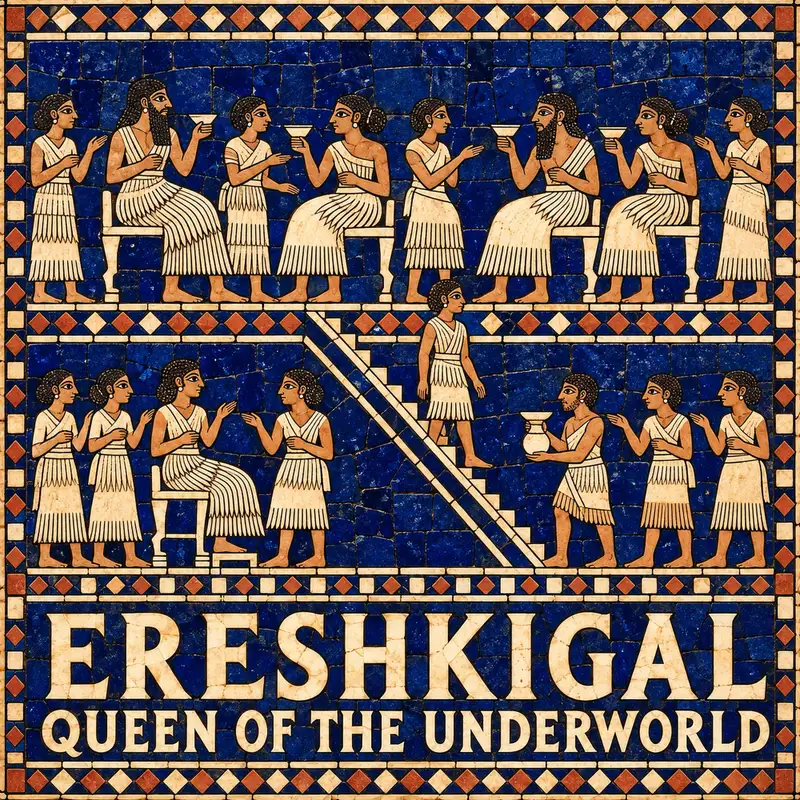
Welcome to The Sleeping Almanac. Tonight we go back down. Three episodes ago a goddess went down through seven gates and was killed and was brought back by two small creatures who were kind to the queen of the dead while she was in pain. And I said at the time that the queen was the second most important person in those two nights, and that she never goes anywhere, and that there was a rule about it that we would come to. Tonight is her story. Tonight is how she got married. And I want to tell you at the start what kind of story this is, because it is not the one you would expect from that description. It is not a romance and it is not an abduction, though it has been called both. It is a story about somebody who has never been invited anywhere, and a party she cannot attend, and a god who is rude to her messenger, and what happens when he is sent down to apologise. And there are two versions of it, from two different centuries, and they are so different in tone that scholars write whole articles about the gap between them. In one he goes down and seizes her. In the other he goes down and stays six days and then runs away in the morning while she is asleep, and she wakes up and finds the bed empty and cannot find him anywhere, and what she does about that is the centre of the night. I am going to tell you both, and I am going to tell you which is which. There is a room at the edge of the world, and in it there is a lamp. It is the same lamp. Perhaps you were here for the seven gates. If so, welcome back, and you already know the house we are going to. And if this is your first night in the tablet house, be welcome, and all you need to know is that there is a place under the ground where everybody goes eventually, and it has a queen, and she is lonely. The lamp is a small clay dish of oil, and it burns the pale gold of old honey. The room smells of river water and dust and barley. Outside, past the doorway, the river is going by in the dark, saying the same soft word over and over against the reeds. The scribe puts two tablets side by side, and they are not the same size, and one of them is much longer than the other. Same story, he says. Different rooms. You do not have to do anything now. Settle onto the mat. Let the lamp be warm on one side of you and the cool night on the other. Close your eyes if they want to close. There are three names tonight. Ereshkigal, whom you have met. Nergal, who is the one who is sent down. And Namtar, who is her minister, and who does all the actual work in this story, and who nobody ever thanks. You do not have to follow every word. You do not have to remember any of it in the morning. If you drift, the story will go on without you. And one thing, whispered like a promise across the clay. Nothing tonight will startle you. Nobody dies. There is a threat made in the middle of the night, one line long, and it is the most alarming sentence in this entire season, and it is not carried out and it was never going to be, and I will tell you so at the time. And there is a marriage in it, and this house tells that the way it tells everything, which is to say with a closed door and a description of the morning after, and nothing at all in between. Before we begin, one small thing, and then we will not interrupt again. If this story carries you down toward sleep, subscribe now, while your eyes are still open, and the rest of the season will find you as it comes. A like helps other tired travelers find this lamp. And if you would rather carry these nights with you, The Sleeping Almanac is also a free podcast, on Apple Podcasts and on Spotify, waiting wherever you listen. That is all. Now settle back, and we begin.
And before the party, I want to put her in front of you properly, because we have met her twice in this house and both times through somebody else's eyes. The first time was in a dying man's dream. A young man in a bed in Uruk described a house of dust where everybody goes, and said that in the middle of it there was a queen seated, with a scribe kneeling in front of her reading from a tablet. That is all we got. A figure on a chair in a room full of dust, being read to. The second time was through her sister, who came down uninvited and lied at the door and was stripped at seven gates and killed and hung on a peg. And in that poem she is the one who gives the order. She slaps her thigh and bites her lip and instructs the doorman, and then the seven judges fasten on her sister the eye of death, and she is, for most of that story, the immovable fact at the bottom of the stairs. And then, near the end of it, two small creatures find her lying in the dark in pain with nobody to talk to, and say her own words back to her, and she softens immediately and gives them what they ask for. That is the last thing we saw her do. Somebody was kind to her once and she handed over a body off her own wall. Tonight is her episode, from the inside, and everything in it follows from that one fact: she is somebody nobody visits. And since we are going to spend the night in her house, let me give you the house properly, because we have only ever had glimpses of it and they were all from people who were frightened. The fullest description in the literature comes from that dream, the one the dying man had in Uruk, and it goes like this. There is a road that goes down, and it goes to a house that people go into and do not come out of. To the road whose road does not come back. To the house whose people are deprived of light. Where dust is their food and clay is their bread. They are clothed like birds, with wings for garments. They sit in the dark and never see the light. That is the description, and it has been quoted for a hundred and fifty years as the bleakest thing in ancient literature, and I want to take it apart a little, gently, before we go down there for the night. First: it is a dream. A frightened, feverish young man dreamed it while he was dying, and the poem is careful to say so. It is not a survey. It is what somebody's fear looked like at three in the morning. Second: it is a house. Not a pit. Not a furnace. Not a place of punishment, and there is no fire in it anywhere, and nothing in that literature says that anybody goes there because they deserved to. Everybody goes. The king goes, and the priest goes, and the person who was kind their whole life goes, and they all get the same dust. It is not just, and it is not unjust. It is simply where the road ends. And third, and this is the part that matters tonight: it has a household. There is a doorkeeper on the gate with a name. There are seven gates with seven bolts and somebody to draw them. There are judges who sit. There is a scribe who kneels in front of the throne and reads out what has been recorded, which means there are records, which means somebody keeps them. There is a minister who goes up and down the stairs. That is not a pit. That is an institution, with staff, and a queen at the top of it, and a great deal of paperwork. And she has been running it since before there was anything to run it for. Her name says what she is. It means, as closely as the words will go over, the lady of the great earth, or the lady of the great place, and the great earth is the earth underneath, which is not a metaphor to them and is simply the lower half of a world that has two of them. So she is the lady of downstairs. She has the larger half by population and the smaller half by everything else. And nobody has ever come to see her. The gods held a banquet. That is how it starts, and it starts up in heaven, and everybody who was anybody was invited, and the poem gives you the guest list the way these poems do. And then somebody remembered her. And they sent a message down, and the message is one of the most awkward pieces of writing in this literature, because it is an invitation that is not an invitation, and everybody in the room knew it when they sent it. Here is what it says. We cannot come down to you. You cannot come up to us. So send your messenger, and let him take your portion. Read it again, because everything tonight is in it. They are having a party. She is not able to come, and they are not able to go to her, and that is not rudeness, that is the structure of the universe. She rules a place nobody leaves, and she is somebody, and the rule applies to her as much as to anybody. She has never been up there. She is never going to be up there. So they are doing the correct and considerate thing, which is to send down a portion. They are saving her some of the dinner. And I have thought about that for a long time and I cannot decide whether it is kind or whether it is the loneliest sentence in the season, and I suspect it is both, which is why it is in a poem. And the more I sit with that message the more I think it is the saddest polite sentence ever written down. We cannot come down to you. You cannot come up to us. Both halves are true and neither is anybody's fault. The gods cannot go down there because going down there is the one journey with no return leg, and it applies to them too, which is the entire plot of an earlier episode this season. And she cannot come up because she is the queen of a place nobody leaves and the rule does not make an exception for the person in charge. So there is a permanent, structural, unfixable separation between her and everybody she is related to, and once a year or however often it is, they have a dinner and send her down a plate. She sent her minister up to collect it.
And before he goes up, one thing about what he is carrying, because it is easy to miss what the errand actually is. He is going up to fetch a plate of food. That is the whole mission. The gods are having a banquet, his mistress cannot attend, they have sent word that a portion is being kept for her, and he is going up the longest staircase in the universe to collect it and bring it back down so that she can eat some of the same dinner they are eating, on her own, in her own house, afterwards. That is not a diplomatic mission. It is a takeaway. And every single god in that room stood up for him. Which tells you they understood what it was. They knew exactly what that errand meant and who it was for and what it cost her to have to send somebody, and they rose, all of them, because the least you can do for a queen who cannot come to dinner is to be on your feet when her servant walks in to collect her portion. His name is Namtar, and he is her vizier, and he is the one who goes up and down and carries messages and does the actual business of that household, and if there is a working person in this story it is him. And I want to give you that staircase, because it is a real piece of the architecture of that universe and it turns up in more than one poem. They imagined the world as a stack. There is the sky above, and there is the earth, and underneath the earth there is the fresh water, and underneath that there is the land of the dead. And the levels are connected. There is a way up and a way down, and in this poem it is a stairway, a long one, described as the long stairway of heaven, and it goes from the gate of the underworld all the way up to the gate of the sky god. And the thing I like about it is who uses it. Not the gods. The gods, in this poem, do not go up and down that staircase. It is used by messengers. It is used by staff. It is the service stair, and the only characters we ever see on it are viziers carrying things between two households that cannot visit each other. And I want to say a word about what a vizier was, because the word we use for it carries the wrong furniture with it. In that world the great households all had one. A temple had one. A palace had one. A god had one. It is the person who stands slightly behind and slightly to the side, who knows where everything is, who says the words their master has given them to say, and who goes and does the thing. They are not advisors, exactly. They are the hands and the voice. When a god sends a message in these poems, a vizier carries it. When something has to be arranged, a vizier arranges it. Most of the actual events in this literature are performed by somebody whose name you would not be able to recall an hour later. And the queen of the dead has one, and his name is Namtar, and he has a second job that makes him one of the more unsettling minor characters in that whole world. His name means something close to fate, in the specific sense of the fate that is allotted to you, and in the medical and magical texts he is the one who is blamed when a person sickens. He is invoked in incantations. He is the thing you ask to be turned away from a house. He is, in that language, roughly what people mean when they say a person was taken. And in this poem, that figure, the one whose name people said over the beds of the sick, spends the entire story going up and down a staircase collecting a plate of food and delivering messages and being sent back out again to look one more time. I find that enormously reassuring and I want to say why. The gods in this literature are not distant. They have jobs. They have staff. They have errands that do not go well and messages that are awkward to deliver. The being who was the fear at the edge of every illness in that world is, in this poem, a man doing his rounds, going up the long stairs one more time because his mistress asked him to. Nothing in the dark is only dark. Everything in there also has a day job. And he went up the long stairway of heaven. And when he came in, the gods stood up. All of them. The short version says they rose, every one, in respect, because he came in the name of the queen of the great earth, and to disrespect her messenger would be to disrespect her. Every single one of them stood up. Except one.
And before we get to him, one thing about the room he was sitting in, because the poem assumes it and it is worth having. The gods of that world hold assemblies. Constantly. It is the single most frequent scene in this entire literature and you have watched it happen half a dozen times this season. They met to decide who would face the sea, and they got drunk first and made a young god king at the table. They met to decide which of two friends would die, and one of them was asleep at the time and dreamed it. They met to decide who would go up the mountain after the bird, and everybody said no in the same words. They met to hear a complaint about a city and its king. That is how that universe is governed. Not by decree from a single throne. By a body that convenes, and argues, and votes, and can be embarrassed. Which is why the failure to stand up matters so much. In an assembly, standing when somebody's representative comes in is not a courtesy. It is the recorded position of the house. He did not abstain quietly. He sat, in a room where everybody else was standing, and everybody saw. And he went back down, and he told her. My lady, he said. The gods stood up for me. All of them. Except one. One god did not rise. He stayed in his seat. That is the short version. In the long one the gods all knelt to the minister, and the one who would not kneel stood. And I want to give you Namtar properly, because he is the most overworked character in this season and nobody has ever put him on a poster. His name means fate, or the decree, and in the wider literature he is the one who carries out the sentence. He is the queen's minister and her enforcer and, in the medical texts, the one whose name you say when somebody is dying of something. And what he actually does in this poem is errands. He goes up the stairs. He collects the food. He comes back down and reports. He is sent up again to make a demand. He comes back down. He is sent up again with a threat to deliver, and he delivers it, in front of the entire assembly of heaven, on behalf of a woman who cannot be there. Then he searches that room for a face he knows, and cannot pick it out, and comes back down with only a description. And he is sent up again. Six trips up and down the longest staircase in the universe, carrying messages between two parties who cannot meet, and at the end of the poem nobody thanks him and he gets no reward and no name in any list, and when the story ends he is presumably still doing it. And she heard that, and the poem says she was furious, and she sent him straight back up with a message, and the message is the plot of the whole night. Bring me that god, she said. Bring me the one who did not stand. Now I want to say something about that, because it is easy to read it as a queen taking offence at a slight, and I do not think that is what the poem is doing. She has never been to their house. She cannot go. The only presence she has up there is the man she sends. He is her whole diplomatic corps, her entire face in that room, the sum total of her participation in the society of the gods. And they all stood up for him except one. Somebody in a room she will never enter did not bother to stand for the only piece of her that will ever be there. So she is not defending her dignity in the abstract. She is defending the only thing she has. And I want to say what it means that they handed him over, because the poem does it in one line and it deserves more. They did not defend him. There is no scene where the assembly debates it. There is no god who stands up and says he is one of us and we do not send our own down there. The demand comes up, and it is a serious demand from a serious quarter, and they look at the situation and they produce him. And what makes it worse, and the poem is quiet about this, is what they are producing him for. Everybody in that room knows what the land of no return is. Everybody in that room has just been reminded, by the invitation, that nobody comes back from it. They are handing a colleague over to a jurisdiction with no appeal and no exit, because he did not stand up at dinner. And the only one who does anything about it is the god of the sweet water, who does not argue either, but who takes him aside on the way out and gives him fourteen diseases and a plan for keeping the doors open. That is the pattern of this whole season, if you want it in one sentence. The assembly agrees to a thing. And then one god goes and quietly arranges for somebody to survive it.
And before the fourteen, one more thing about what he had just been asked to do, because the poem is very clear about it and it is the reason he needs an escort at all. He is going down there alive. That is not a normal thing. Everybody else who goes through those gates goes through them dead, and that is the whole design of the place. There is a procedure for arriving and there is no procedure for leaving, and we spent two whole nights on what happens to somebody who tries. So the gods are sending a living god down into a house from which nothing returns, to answer a summons, in person, and every single one of them knows what the odds are, and that is why they are so quick to hand him over and so careful about how they equip him. They are not sending him to a meeting. They are sending him somewhere they expect him to stay. And the gods heard the demand, and they did what a group of people always does when somebody they have wronged asks for one of them. They gave him up. But before they sent him, the god of the sweet water took him aside, because that is what he does, and he equipped him. He gave him fourteen. Fourteen creatures, and the poem names them, and the names are not names in the way we use names. They are conditions. And here they are, as close as anybody can render them, because the names are difficult and translations differ. Fever. Chills. Lightning. The trembler. The one who burns. The one who seizes. The wind. Sudden fever. Convulsion. The one who strikes. The hot one. The one that comes at noon. The one that comes at night. And the one whose name nobody agrees about. Fourteen of them, and every single one is a symptom. That is the thing to notice, and it is the same thing the poem did with the Seven in the last episode of this season, though we have not got there yet. These are not soldiers. They are conditions. They are the list of things that happen to a body when a plague god goes past, given names and sent along as an escort. So the god of plague is going down into the house of the dead with fourteen diseases walking beside him, and they are going to be posted at the doors, two at a time, to hold them open. And I find that a very strange and very exact piece of imagining. The thing that keeps the way out of the underworld open, for the one person who is going to come back up it, is illness. Fourteen of them, and here is the arrangement, and it is the tidiest piece of tactical planning in the season. There are seven gates, and he is going to have to go through all seven, the same seven the goddess went down through, and at each one he is going to be met and stopped. So he stationed them in pairs. Two at each gate. Fourteen creatures, seven gates, two apiece, and each pair holds its own door open so that the way back up stays open behind him. Which means the whole way down, at every level, there are two of them standing in a doorway, waiting. And I want to give you the gates properly, because we went down through seven of them twice in this season and I never told you they had names. They do. In the poems the doorkeeper is named, and in this one the gates themselves are counted off as he goes, and at each one he is challenged and at each one he answers and is let through, and the fourteen he brought are posted as he goes. And I should be honest about what I can and cannot give you there, because I said properly and I meant it. The keepers are named in the text. The gates are counted. But the names are difficult, and the readings differ between the copies, and half of what you would find printed in one translation is a guess that a different translator did not make. So I am not going to recite you a list of seven names and let you believe they are solid, because two of them are not. What I can give you, and what the poem does give, is the going down itself, one gate at a time, and it is the calmest structure in the whole of this literature, and we have been through it twice already this season, so you know the rhythm of it in your body by now. So take it slowly, because there is no hurry anywhere in this and nothing waiting at the bottom that means him any harm. The first gate. A keeper comes out. A challenge, an answer, and the bolt goes back. And two of the fourteen step into the doorway and stand there, and the door does not close behind him. The second gate. The same. A keeper, a challenge, an answer, the bolt. Two more step in and stand. The third gate, and by now the pattern is doing the work for you, because that is what these lists are for. You are not meant to be counting. You are meant to stop counting. Fourth. A keeper, an answer, a door that stays open. Fifth. The same. Sixth. The same, and by this point the poem is not telling you anything new at all, it is only telling you that it is still going, and that there is still further down to go, and that behind him there is now a line of held doors going all the way back up to the daylight. Seventh. And through it, into the courtyard. And there is one detail in the long version that I love. He does not go down as a supplicant. He goes down with the doors being held open behind him, which means that from the moment he sets foot on the stair, every single person down there can see that he has arranged to be able to leave. Which is not something anybody else who has ever come down those stairs has been able to do. Think about how that would look from the bottom. The whole household of the dead watching a god come down through seven gates with a pair of diseases wedged in each doorway behind him, so that the doors cannot close. He did not arrive. He arrived with the exits propped. And I want you to have the picture of that staircase behind him as he steps in, because it is the exact opposite of the descent we watched three nights ago. The goddess went down through the same seven and every one of them shut behind her and took something off her as it went. The crown, then the beads at her neck, then the beads at her breast, then the breastplate, then the ring, then the measuring rod and line out of her hands, and last of all the robe, and she arrived at the bottom with nothing left and no way back. He arrives with everything he came with, and seven open doors behind him, and a pair of fevers standing in each one. Same stairs. Same gates. Same house. One of them was going to be allowed to leave.
Now, the shorter version, and I want to tell it first because it is shorter and older and cruder and because you should hear it before the good one. The short version was found in Egypt. That is the fact I promised you. In a place on the Nile there was an archive of diplomatic letters, from all over the ancient world, written in the language of Mesopotamia because that was what everybody used for international correspondence at the time, the way people used French later. And among the letters there were school texts, used for teaching that language to Egyptian scribes. And one of them is this story. So the way we have the oldest version of tonight's poem is that somebody in Egypt was learning Akkadian, about three and a half thousand years ago, and their homework survived. And in that version it goes like this. He goes down. He goes through the gates. He comes into the room. And he takes her by the hair and pulls her off the throne and onto the ground to kill her. And she weeps. And she says: do not kill me. Be my husband and I will be your wife. I will put the tablet of wisdom in your hand. I will let you be king over the wide earth. You will be lord and I will be lady. And he heard it, and he took her up, and he kissed her, and he wiped the tears off her face. And he said: what you have asked of me these months, it is granted. And that is the end of the short one. I have never liked it much and I am not going to pretend otherwise. It is a hundred lines long, it is a school exercise, and it resolves a situation that took four chapters to build with an assault and a proposal in eight lines. But it is the oldest telling and it is honest that this is a story about power, and the longer one, which is far better, does not forget that either. And I should say where those longer tablets came from, because the find is a good story in itself. There is a mound in the south of what is now Turkey, near a village, and in the nineteen fifties archaeologists digging there came on a collection of tablets heaped against the outside wall of a building. Not a palace and not a great state library. The working collection of a family of priests. And what was in that collection is extraordinary. Literary works, rituals, incantations, medical texts, and copies of poems that we either did not have at all or only had in pieces. The long version of tonight's story is one of them. So the reason we have the good version of this poem is that a provincial family in the far north kept a working library, and its tablets ended up in a heap against an outside wall, and the clay survived, and two and a half thousand years later somebody dug it up. And there is one more piece of the Egyptian find that I want to give you, because it is one of the great archaeological accidents and it explains a great deal about how anything survives. That city on the Nile was built once, lived in for about fifteen years, and abandoned. The king who built it had made a religious change that his successors reversed, and when he died they went back to the old capital and back to the old gods, and his city was left. Not destroyed. Left. The population moved out, the buildings were quarried for stone here and there, and the desert came in over the rest of it. Which is the single luckiest thing that could have happened to a document. A city that goes on being lived in gets rebuilt. Floors are dug up. Old rubbish is cleared. Archives get thrown out when they stop being current, and clay tablets, once nobody needs them, are exactly the sort of thing that ends up as fill in somebody's wall. A city that is abandoned in one generation and never reoccupied keeps its rubbish exactly where it was dropped. So the correspondence of an entire imperial court, including the school exercises the junior scribes were working through, sat in the sand for three and a half thousand years because a religious experiment failed and nobody wanted to live there afterwards. And that is why we have the older version of tonight's poem: not because anybody preserved it, but because a whole city was left alone.
The long version comes from tablets written some seven centuries later, found in the north, and it is several times the length, and it is a different thing entirely. In this one, before he goes down, he is given a briefing, and the briefing is a list of things not to do. The god of the sweet water sits him down and says: When you go down there, do not do the things people do in a house. When they bring you a chair, do not sit down on it. When the baker brings you bread, do not eat the bread. When the butcher brings you meat, do not eat the meat. When the brewer brings you beer, do not drink the beer. When they bring you water for your feet, do not wash your feet. And when she goes to the bath, and puts on her robe, and lets you look at her body, do not look at her as a man looks at a woman. And I want to stop on that list, because it is not arbitrary and it is not squeamishness. Every single item on it is an act of accepting hospitality. Sitting in the chair. Eating the bread. Eating the meat. Drinking the beer. Washing your feet in the water they bring you. Those are the things a guest does, in that world, in every house, and doing them is how you become a guest, and being a guest binds you to the household. To eat in a house is to be of the house. That is not a Mesopotamian idea particularly. It is very close to a human universal, and it survives in the language we still use. We say somebody has been taken in. We say we broke bread with them. Sharing food is the thing that converts a stranger into a guest, and a guest is somebody the household is now responsible for and who is now, in some measure, obliged back. Every culture that has ever written anything down has rules about this, and the rules are always heavy, because the stakes are high in both directions. To feed somebody is to accept them. To refuse to feed somebody is a serious act. And to eat and then behave as though nothing was owed is close to the worst thing a person can do. That is why the rule exists. In that literature, if you eat the food of the dead you belong to the place. It is not a trap laid by anybody. It is how the boundary works. So he is being told: go into that house, and be in it, and accept nothing from it, and come out. And I want to say one more thing about that list before he goes, because there is an item on it that is not like the others and the poem knows it. Five of the six are about accepting service. A chair, bread, meat, beer, water for your feet. Those are all things somebody hands you, and refusing them is difficult and rude and possible. The sixth one is not like that. The sixth one is: when she goes to the bath, and puts on her robe, and lets you see her, do not look at her the way a man looks at a woman. That is not about accepting something. That is about not feeling something, which is not a thing anybody can be instructed to do. And the clever god who gave the list, who has never in this entire season given anybody advice that did not work, must have known that. He got the first five right and the sixth was never going to hold, and I do not think he expected it to. And he went down. And he did not sit in the chair. And he did not eat the bread. And he did not eat the meat. And he did not drink the beer. And he did not wash his feet. And the thing that makes it beautiful rather than merely clever is that the same rule works in both directions. She is not laying a trap. Nowhere in the poem does she try to make him eat. The bread is brought because bread is brought to a guest, and the chair is set out because a chair is set out for a guest, and the water for his feet arrives because that is what arrives, and none of it is a scheme. It is a house doing what a house does when somebody arrives. She is being a good host. That is all. She has almost certainly never had the opportunity before. And he is standing in the middle of her hospitality refusing every single piece of it, item by item, in silence, because he was told to. Sit down, and he will not sit. Eat, and he will not eat. Drink, and he will not drink. Wash, and he will not wash. Imagine being on the other end of that. Imagine the first visitor you have ever had, going through your house declining everything in it. The poem does not say what she thought about that, and I have wondered about it for as long as I have known this story, and I think it is why the sixth instruction was the one that broke. And then she went to the bath.
And before the door closes, I want to say what he had actually been told about her, and what he found instead, because the gap between those two is the whole poem. He was briefed as though he were being sent into a hazard. Do not sit. Do not eat. Do not drink. Do not wash. Do not look at her. Take fourteen diseases with you and post them at the doors so you can get out. That is how you prepare somebody for a hostile environment. Every instruction assumes that the house will try to keep him and that she is the mechanism by which it will do it. And what he found, when he got there, was a woman who had been alone since the beginning of the world, who had sent her servant upstairs to collect a plate of food from a party she was not able to attend, and who was so unused to being treated as somebody that a single act of ordinary rudeness from a stranger at a banquet was enough to make her demand him in person. Nobody warned him about that. There is no instruction on the list for it. You cannot prepare somebody for the possibility that the frightening thing at the bottom of the stairs is lonely. I am going to tell you what the poem says and then I am going to close the door, because that is what this house does. The poem says that she bathed, and that she put on her robe, and that he looked at her the way a man looks at a woman. And they went to bed. And they were together, and the poem counts the days off, one by one, up to six. That is what it says. It says it plainly, once, without any detail at all, and then it moves on, and I am going to do the same. Six days. And there is something in the counting that I did not notice the first three times I read this poem, and once you see it you cannot stop seeing it. All season the measure of a complete thing has been six days and seven nights. The flood ran six days and seven nights. The king sat by his friend's body for six days and seven nights. The test he failed, with the loaves going stale on the mat beside him, was six days and seven nights. That is the shape of a whole event in this literature. It is the full course. It is how you say in that language that a thing ran all the way to its end. And this one counts up to six, and then the clay is damaged. The very next line is broken. The editors restore a seventh day in it, so the count may well have run on to seven, but the number itself is lost. For a long time I read that as the one place all season where the count falls short, broken by a man leaving early. I cannot tell you that now. The gap is in the clay, and a gap in the clay is not a choice anybody made. Six days and seven nights is a phrase you can feel arriving, and here the seventh may well have come, on a line we no longer have. What the clay gives us for certain is six. So let the six be six. There is a house under the ground with a courtyard in it, and a bath, and a bed. The door at the top of the stairs is shut and there is nothing on the other side of it that anybody in there is thinking about. No party. No stairway. No message waiting to be carried anywhere. Two people who have both been alone for a very long time, in a room, for six days, and nothing in the poem about what was said, because the poem does not tell you and neither will I. That is the calmest stretch of this entire season, and it is calm precisely because nothing is happening in it that anybody wrote down. Six days of a door being closed. And I want to say the thing about those six days that the poem does not say and that is sitting underneath all of it. She has never had this. That is what the whole first half of the episode has been telling you. She has never been to a party. She has never been up the stairs. Nobody stands for her except by proxy and one of them did not even do that. And now there is somebody in her house who came down through seven gates to get there, and it is six days. And on the seventh morning he was gone.
And before he goes, I want to say why he went, because everybody who reads it wants to know, and the poem's own answer is nearly lost. It survives in a single broken line, something about his being away from heaven, and the rest of that line is gone. In what is left, he does not say he was afraid, or that he regretted it. He gets up and he goes, and he tells a lie on the way out. So we are left with the situation, and the situation is this. He was sent down to that house as a defendant, under strict instructions to accept nothing from it, because accepting anything from that house is how you belong to it. And he accepted the largest thing in it. Which means that when he woke on the seventh morning, he was not a visitor who had overstayed. He was somebody who had done the one thing he was told would bind him to the land of the dead, six times over, and who had a staircase behind him with the doors still propped open by fourteen diseases, and who knew that the propping would not last for ever. I think he ran because he understood exactly what he had done and could not face the size of it before breakfast. And then he thought about it for a while and came back, which is the only thing in the poem that redeems the morning. He got up, and spoke to her about going, in lines that are partly lost, and left her sleeping. And at the gate he gave the doorkeeper a message that he said came from her: the visitor from heaven is to leave before daybreak. It was not true. And then he went up the long stairway, and out. And she woke up. And the poem gives us her waking, and it is the reason this version is worth several times the length of the other one. She got up, and bathed, and gave her orders for the day: the visitor from heaven was to eat her bread and drink her beer. And Namtar told her that he had gone before daybreak. And she understood. And I want to give this the room it deserves, because it is the whole reason I put this episode in the season and it is one of the great small scenes in ancient literature. Think about what she is working out, on her throne. She has spent her entire existence in a house nobody visits. The one time a message came from upstairs it was a note explaining that they could not come and neither could she. Her only contact with the rest of the world is a servant who goes up and down a staircase carrying things. And then somebody came down. Not a corpse. Not a delivery. A person, who came down through seven gates on purpose, and stayed. And now she has bathed, and ordered his bread and his beer, and her own minister is telling her he went before daybreak, and she is doing the arithmetic that anybody does in that situation, which is: he planned this. He left in the dark, while I slept, so that he would be a long way off before I worked it out. That is the moment. That is the whole episode. And what she does about it is the reason the poem is several times longer in this version, because in the short one she is a queen who is overpowered and offers a throne, and in this one she is a person who wakes up alone and reacts. And then she cried out like a woman in labour, and the poem says she fell from the throne to the ground, and wept where she fell. And she called for Namtar, who has been doing the work in this story from the first chapter, and she sent him up. And I want to say what those six days actually cost, on both sides, because the poem is not sentimental about it and neither will I be. For her, it is the only week of her existence in which somebody was there. For him, it is a week during which he broke every instruction he was given by the god who was trying to keep him alive, in a house he was told not to accept anything from, with the queen of the dead, while fourteen diseases held the doors open behind him. And at the end of it he did what a great many people do after a week like that, which is to leave quietly before anybody wakes up, and to tell a lie at the gate on the way out. That is not a heroic exit. The poem is not presenting it as one. It is a man getting his sandals and going.
Go up, she said. Go up the long stairway of heaven. Go into the room where they are all sitting. And find him and bring him down. And Namtar went up. And here is where the poem does something extremely clever and slightly funny. He cannot find him. Because the god of the sweet water, who equipped him on the way down, has done one more thing. He has changed him. In some readings he has made him bald, in some he has altered his appearance, and the effect is that Namtar goes into the assembly of the gods, looks along the row, and cannot pick him out. So he goes down and reports that the god is not there. There is only one odd god among them, he says, bald and squinting and lame, sitting with the rest. And she sends him up again. The message he carried up the first time, out loud, to the whole assembly, I have kept for the next chapter, because it is the most alarming sentence in this season, and I told you it was coming and that it was not going to happen. And I want to say what she does in between, because the poem gives it and it is the part that hurts. She sends him up a second time. That is the detail. She hears that description, a bald god, squinting, lame, and she knows at once who it is. Nobody has told her. She simply knows him. Which is a thing people do. She is not stupid. She is the queen of a place where everybody eventually arrives and she has been running it since before there were cities. She even names the trick. The god of the sweet water, she says, has sprinkled him with water to change him. So she sends her servant straight back up the stairs with the plainest order in the poem: go and seize that god, and bring him to me. That is the most human thing anybody does in this entire season, and it is done by the queen of the dead, and the poem does not comment on it at all. And I want to stay with the minister for a moment, because this is the worst day of his working life and nobody in either poem notices. Think about what he is actually being asked to do. He is the one who went up the stairs at the start of all this to fetch a plate of food, and had an entire room of gods honour him, all but one. He is the one who had to go home and report that. He is the one who was sent back up to complain about it. He is the one who was standing there when the offender came down, and he is the one who showed him in. And now he is being sent up that staircase again, in the morning, to walk into the assembly of every god there is, in front of all of them, and ask for the return of the man who spent six days in his mistress's house and left before she woke up. There is no dignified way to run that errand. And he runs it anyway, twice, because that is what he does, and the poem gives him no interior life whatsoever and no line of complaint, and he is on that staircase more than any other character in the story. I have been calling him the working person in this poem and I will say it once more plainly. Every single thing that actually moves in this story is moved by him. The plate of food is carried by him. The insult is witnessed by him. The complaint is delivered by him. The search is run by him, twice. The threat is spoken by him, out loud, in a room full of gods who all know he is only the messenger. He is the reason there is a story at all, and he is never thanked, and I think he should be mentioned at least once in a house where somebody is listening. Namtar. That is his name. Say it before you drift, if you like. And the other thing to see in this chapter is what the gods do, which is nothing. They do not hand him over the first time. They let a servant walk the length of the universe, look along a row of faces, fail to find the one he is looking for, and go home with nothing but a description. And they know. Every one of them knows exactly where the man is sitting, because he is sitting among them, and somebody has arranged for him not to be recognisable. That is not cruelty. It is worse than that in a way, it is convenience. The easiest thing for a room full of gods to do is nothing, and so they do nothing, and a minister goes up and down a staircase twice for no reason. Not even a threat makes them point him out.
Here is the message. Give me the god who came down to me. If you do not send him back, I will raise up the dead. I will bring them up, and they will eat the living. And I will make the dead outnumber the living. That is the line, and every single thing that has ever been made out of that idea since, every risen dead thing in every story you have ever been told, is downstream of a sentence like that one, written on clay, a very long time ago. And I want to be clear about why it works, and it is not because it is frightening in the way a monster is frightening. It works because she can do it. Nobody in the poem doubts it. Nobody says she is bluffing. She is the queen of that place and the population of it is everybody who has ever died and the only thing keeping them down there is her keeping them down there, and she has just told the gods that if they do not return one person she will open the door. And the balance of the whole universe in that literature depends on her not doing it. Which means she has, sitting in her lap the entire time, from the first line of the poem, the power to end everything, and she has never used it, and the only thing that ever made her reach for it was somebody slipping away while she slept. And you may have heard words like these before, in this house, three nights ago, and if you did, I owe you a correction. I want to be exact about it, because it is the best thing in the season and I have been waiting for it since the seven gates. They are not in the old Sumerian poem we followed down the seven gates. There, the sister pushes at the door and shouts, but all she asks is to be let in. The threat belongs to the Akkadian telling of the same descent, where she is called Ishtar, and there, at the gate, she swears she will break the door and the bolt, and bring up the dead to eat the living, until the dead outnumber the living. Same words. Same door. Different woman on it. And the difference between the two is the whole of tonight. When Ishtar said it, she was outside, in the dark, with no standing in that place at all, trying to get in. She could not do a single thing she was threatening. She did not own those dead. It was the biggest sentence she could think of to shout at a doorkeeper, and she was let in, and stripped at every gate, one thing at a time, until she came to the bottom with nothing. That is what happens in that poem to somebody who says those words from the outside. And now the same sentence is said by the one person in existence who is not bluffing, and it is not shouted at a doorman, it is sent upstairs in the mouth of a servant, into a room she has never been allowed to enter, and the response is not to bolt anything. And there is one more turn on it, and it is the one I find hard. The sister said it to get in. She is saying it to get somebody back. And I want to be exact about what she is threatening, because people hear it as a horror story and it is not one, it is a constitutional argument. She is not proposing to unleash monsters. She is proposing to stop doing her job. Her whole function, the thing she is for, the reason that place exists and has a queen, is that the dead stay where they are put. That is the service she provides to the entire universe. Everything above her depends on her keeping the door shut, and she has kept it shut for as long as there has been a door. And what she says is: give him back, or I will open it. And the poem does not have anybody argue with her. There is no scene where somebody says she would never, or that she could not, or that it would be wrong. The gods hear the message and nobody refuses her. They tell her minister to come in and look for him, because the threat is completely credible and because everybody in that universe knows that the only thing standing between the living and everybody who has ever died is one woman's willingness to keep doing a job nobody has ever thanked her for. And still the looking does not find him. In the end, in lines that are badly broken, he seems to give himself away. And there is a moment in between that I have not given you, and it belongs here because it is the only time in the poem that he explains himself. Before he goes back down, he goes to the god of the sweet water, the one who briefed him in the first place, and he says, in effect: I have to go back. And the god does not stop him. That is worth noticing. This is the god whose entire method in twelve episodes of this season has been to find the way out. He told him not to sit and not to eat and not to drink and not to wash his feet, and the whole point of those instructions was to keep him from belonging to that house. And when the man comes back and says he is going anyway, the god who spent the first half of the poem trying to prevent exactly this outcome helps him get ready.
And he went down again. And this time he did not creep. The poem says he came down at speed, through the gates, and that he went through the courtyard, and that he came in, and that he laughed. And then he took her by the hair and pulled her off the throne. Now, that is the same act as the short version, and it lands completely differently, and I want to say why. In the short version that is an assault by a stranger who had been sent down to his death, because she had asked for him so that she could kill him. In the long version it comes after days together. He slipped away before daybreak while she slept, and she woke and made ready for him and was told he had gone, and cried out, and fell from her throne and wept, and then threatened to end the world to get him back, and he came back, laughing, and pulled her off her chair. It is not the same gesture at all. It is the gesture of somebody who has come back. And then, the poem says, they took hold of each other, and they went to bed, and it counts the days again, one by one, up to six, and a seventh in a line the editors have had to restore. And then the tablet breaks. That is where it ends, in the middle, and we do not have the last of it, and what we have of the very end is fragmentary lines that seem to be about the arrangement afterward, and the arrangement is that he stays. That is how the god of plague and war becomes the king of the underworld. He goes down as a defendant and he comes back as a husband. And there is one more thing about him that belongs here, at the end, because it is the bridge to the last night of this season. The god who goes down in tonight's poem, who is rude at a banquet and is sent to apologise and stays six days and comes back and becomes king of the underworld, is the same figure as the god in the final episode of this season. Same deity. Different name and completely different poem. Tonight he is a young god in a story about wanting somebody. In the last episode he is the god of plague and war, sitting in a room, unable to keep still, being talked into destroying cities by seven numbered functions, with a herald in front of him arguing all the way. And the reason I mention it here rather than there is that it changes both. The god who cannot settle in the last episode of this season is the same one who came down seven flights of stairs and stayed, and who left in the morning, and who came back at a run when he was called. Whatever else he is, he is somebody who comes back. And there is one more thing I owe you, which is who he was to the people who actually worshipped him, because tonight he has been a character in a story and he was also somebody with a temple and a city and a festival. His city is called Kutha, north of Babylon, and his temple there had a name that means something like the house of the warrior of the underworld, and it was one of the significant sanctuaries of that country for a very long time. And what he was, in ordinary religious life, is the god you dealt with about the things that kill people suddenly. Plague. Fever. War. The sudden death, as opposed to the slow one. In the god lists he is set beside the fever demons and the plague spirits, and in the medical texts his name turns up in the diagnoses. Which means that the marriage in tonight's poem is not a romance somebody invented. It is a theological explanation. It answers a real question that people in that country would actually have asked, which is: why is the god of sudden death also a king in the land of the dead? And the answer the poem gives is: because he went down there once, and he was rude, and then he stayed. That is a very strange way to explain a pantheon, and it is much better than the tidy version would have been. And there is one more thing I want to say about the difference between the two versions, because I have been treating it as a matter of length and it is not. The short one is about a problem being solved. There is an offence, and a summons, and a confrontation, and an offer, and it is accepted, and the situation is resolved. It is shaped like a negotiation, and it ends with terms. Nothing in it is about wanting anything. He does not want her and she does not want him. She wants to live and he wants a throne and they arrive at an arrangement. The long one is about somebody not being able to stay away. And the difference is not that one is romantic and the other is not. It is that centuries apart, two writers looked at the same situation, a god of death and a queen of the dead ending up together, and one of them thought the interesting question was how the deal was struck, and the other thought the interesting question was why he came back. That is a real change in what people wanted from a story, and you can watch it happen across the gap, and I do not think you get many chances to see that this clearly in a literature this old.
The lamp is low now. So there are two of them, and they do not agree, and I want to leave you with both rather than with a blend, because a blend would be a poem nobody wrote. And before I set them side by side, it is worth saying where each of the two actually came from, because the places are almost as good as the poems. The short one turned up in Egypt. It is on a tablet from the same archive as the Adapa fragment, from that abandoned city on the Nile where a pharaoh's foreign correspondence sat in the sand for three thousand years. So the short telling of this story survives because somebody in Egypt was learning the international language of the day and this was on the syllabus, exactly as with the fisherman. Two of the strangest stories in this literature reached us as homework. The long one comes from further north and much later, from tablets found at more than one site, including a provincial town where a family of priests kept a working library, the kind of collection that gets copied out by students and annotated in the margins. So the two versions are separated by something like seven centuries, several hundred miles, and an entire change in what the story was thought to be for. And that is the part I want to leave with you. Because the usual way a story changes over the centuries is that it gets shorter, and harder, and more like a summary of itself. Details fall off. The middle gets compressed. What survives is the plot. This one went the other way. The old short version is the efficient one. He goes down, he takes her, she saves herself by offering him the throne, and it is over in a fraction of the space. It is a story about power changing hands, and it is told the way you would tell somebody how a thing came to be arranged the way it is now. And some seven centuries later the telling we have is several times longer, and every single one of the added parts is about feeling. The list of things he must not accept. The bath. The six days. The empty bed in the morning. The false message at the gate. The servant sent up the stairs twice. The threat, which in the short version does not exist at all. Somebody, in a room, a very long time ago, took a brisk little story about a god acquiring a queen, and decided that the interesting question was not how he got there but what it was like for her. That is seven centuries of people telling each other the same thing and slowly working out what it was actually about. And they did it with clay and a reed, in a language nobody has spoken in two thousand years, in a town whose name we are not entirely sure of. The short one, from a schoolroom in Egypt three and a half thousand years ago, says: he went down and took her by the hair and she saved her life by offering him a throne. The long one, from the north, some seven centuries later, says: he went down under strict instructions to accept nothing, and he accepted her, and then he slipped away before daybreak, and she nearly ended the world, and he came back. Same characters. Same gates. Same ending, in the sense that he stays. And I think the difference between them is one of the most interesting things in this whole season, because it is centuries of somebody thinking about the same story and deciding it needed to be about wanting rather than about winning. So think of it, wherever you are lying. There is a house at the bottom of seven gates, and it has a courtyard and a bath and a bed and a throne in it, and it has a queen who has never in her existence been anywhere else. There is a party going on upstairs that she has never once attended, and somebody has been sent down with her portion of the food, because they are not unkind, they simply cannot come. There is a minister going up and down the stairs, doing all the work, saying the messages he is given, and nobody in either poem ever thanks him. And there is one morning, in the long version, in the middle of the story, where she wakes and bathes and orders his bread and his beer, and her minister tells her he went before daybreak. And of everything in this entire season, of all the floods and the battles and the seven gates and the eleven monsters and the wall of Uruk, that is the moment I think about most. The queen of the dead, who could raise every corpse there has ever been, ordering bread and beer for somebody who has already gone. She got him back, though. That is the ending, and it is on the tablet, and it is worth going to sleep on. Outside, past the doorway, the river is going by in the dark, saying the same soft word over and over against the reeds. You do not have to keep any of tonight. If you keep one thing, keep the portion of the dinner they sent down, because they could not come. Sleep well. Goodnight.