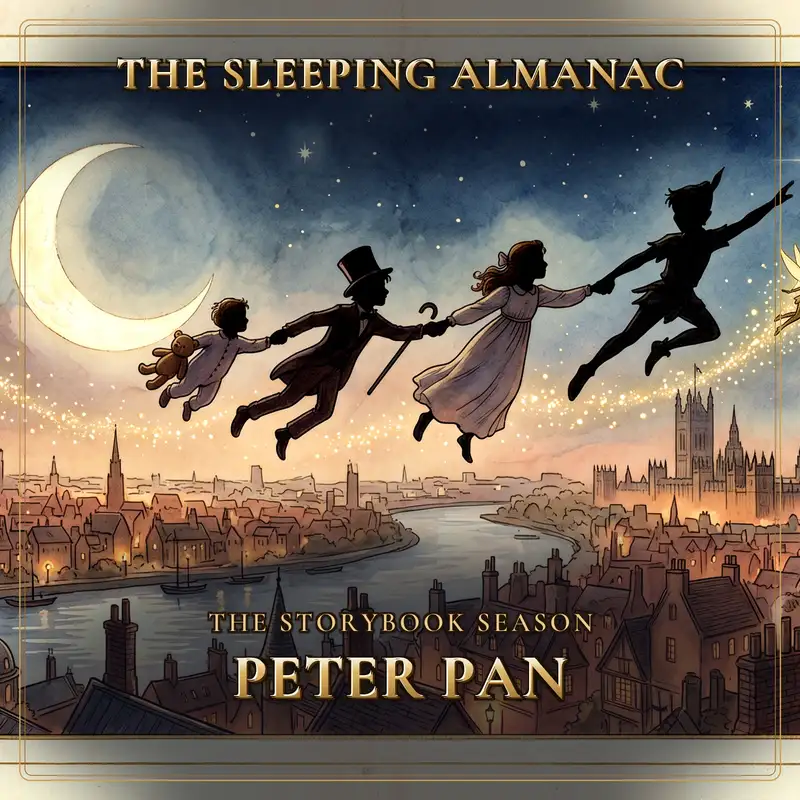
Welcome to The Sleeping Almanac.
Before the lamp is lit, one small thing. If these stories carry you to sleep, subscribe now, while your eyes are still open, and tomorrow night's tale will be waiting for you. A like helps other tired souls find this room. That is all. Let's light the lamp together now.
The lamp is lit again.
The same small flame as last night, in the same quiet room at the edge of the world.
The storyteller is already here. She was here before you arrived. She will stay until you sleep.
There is a chair for you. There is a blanket. The night outside is doing all of its slow, dark work, and none of it is yours to carry until morning.
The storyteller opens the old book, and turns past the tales already told, to a page that waits for tonight.
Tonight, she says softly, we leave a nursery window open in London for the boy called Peter Pan, who is coming back for his shadow, and who knows the way to an island that lies past the second star to the right, and straight on till morning.
And there is no hurry at all as she begins.
Settle in now. Let the chair take your weight, and the blanket take your warmth, and the night take everything else. You do not have to watch this story. You do not have to follow every word, and you do not have to remember any of it in the morning. It only needs to be near you, the way lamplight is near you, the way rain on a window is near you when you are already half asleep.
If you drift, the story will go on without you, quietly, and it will not mind at all. Drifting is not leaving. Drifting is how a listener says thank you.
And you should know, before we fly, that nothing in this room will ever startle you. There are pirates in this tale, but they are the politest pirates who ever sailed, and their captain is a gentleman before he is anything else, and the only crocodile in it ticks as gently as a clock on a mantel. Every storm in this story blows itself out long before the end, and every bed in it is filled by morning. You can trust this room. That is what it was built for.
Chapter One.
The Nursery at Number Fourteen.
All children grow up, except one.
That is how the old book begins, and the storyteller reads it just as it is written, because there is no better beginning on all the shelves of the world. You will meet that one soon. But every tale needs a doorway, and the doorway of this tale is a nursery, at the top of a tall house, at number fourteen, on a quiet street in London, long ago, when the streets were lit with gas lamps and the lamplighter came round at dusk with his long pole, leaving little moons burning all down the pavement behind him.
In that house lived the Darling family.
There was Mr. Darling, who went to an office in the city and knew about stocks and shares, or at least spoke of them in the voice of a man who knows, which in the city amounts to the same thing. He was gruff in the mornings and gentle in the evenings, and he wanted, more than he ever managed to say, for his family to be happy.
The old book pauses to tell how he won her, and the storyteller likes the telling. Mrs. Darling, when she was a girl, had many admirers, and one day they all discovered at the same hour that they loved her, and they all ran to her house to propose, all except Mr. Darling, who took a cab and nipped in first, and so he got her. He got all of her there was to get, except the innermost box of her mind, and the kiss in the corner of her mouth, and in time he stopped hoping about the box, and the kiss he spoke of, when he spoke of it at all, the way a man speaks of the far side of the moon. Present. Certain. Not his.
They were not rich, the Darlings. When Wendy came there was a long anxious evening of arithmetic over her, for a new baby is a joy, but a joy that must be fed and shod and eventually schooled, and Mr. Darling sat on the edge of the bed with a pencil and paper, adding up whether they could keep her, while Mrs. Darling held the small new person and watched his face, holding being an argument too, and the best one. He added it one way and the sum came out wrong. He added it another way, remembering to carry the one, and Mrs. Darling suggested small economies from the pillow, and at the very bottom of the page, with a little to spare if he cut down on his coffee, Wendy just came through. There was the same trembling arithmetic for John, and Michael was a nearer thing still, but both of them squeaked through as well, and there they all were. And some evenings, years later, Mr. Darling would do the sums again for no reason at all, just for the pleasure of getting the same answer.
There was Mrs. Darling, the loveliest lady in that part of London, with a romantic mind and a sweet mocking mouth. Her mind was like the tiny boxes that come from the puzzling East, one inside another inside another, so that however many you opened, there was always one more. And in the right corner of her mouth there was a kiss. Not a kiss she gave. A kiss she kept. It sat there plainly, and yet nobody could ever get it. Wendy tried. Mr. Darling tried for years and gave up honorably. It was not for them, and the old book keeps that small mystery folded away until the very last page, where it is opened.
And there were the three children. Wendy came first, the kind of child who knows where everything in a house belongs, including the people. Then John, who wore spectacles when he read and liked things to be fair. Then Michael, the littlest, still young enough that sleep sometimes came for him at the table, in the middle of pudding, like a tide coming in.
And there was Nana.
Nana was the children's nurse, and Nana was a dog. A prim Newfoundland, large and solemn and brown, and a treasure. She bathed the children and never got soap in their eyes. She walked them to school in good order, nudging them back into line with her nose, and on rainy days she carried an umbrella in her mouth. She knew a cough that mattered from a cough that wanted attention, and no nursery in London was kept so sweetly. Some of the neighbors talked, of course, about a family that kept a dog for a nurse, and Mr. Darling heard the talk and let it worry at him, the way a stone worries at a shoe. Remember that small stone. It has a part to play.
Nana's kennel stood in the nursery itself, so that she was never farther from the children than a mother's hearing, and she slept with one ear out of the blankets by lifelong habit. She had a genius for knowing which coughs are to be given no patience and which need a stocking wound around your throat, warmed first at the fender, and she believed to her last day in old fashioned remedies, like rhubarb leaf, and made low sounds of contempt over all this newer talk of germs. To watch her walk the children to school, the old book says, was a lesson in composure. She went sedately by their side when they were behaving, and if a child strayed toward the gutter she put it back in line with her nose, unhurried, the way a librarian straightens a book.
The household had one other member, and the storyteller gives her a sentence so that she is not lost. Liza was the servant, the whole staff of the house in one very small person, so proud of her long skirt and her cap that no one could imagine her without them, who considered the nursery a little beneath her dignity and secretly loved it, and who goes in and out of this tale mostly carrying things, and carries them well.
Now, it was the nightly custom of Mrs. Darling, after her children were asleep, to sit by the fire in the nursery and tidy their minds.
This is a thing all good mothers do, says the old book, though the children never know it. When you wake in the morning and find your naughtiness folded small and put away at the bottom of your mind, and your prettier thoughts laid out fresh on top, ready to wear, that is your mother's doing, done by lamplight while you slept.
A child's mind, tidied by lamplight, looks a little like a map. There are zigzag lines on it, very like your temperature chart on a fever card, and those are probably roads in the island. For the Neverland is always more or less an island, with astonishing splashes of color here and there, and coral reefs, and one small quick boat with a rakish look to her, and gnomes who are mostly tailors, and caves through which a river runs, and princes with six elder brothers, and a hut fast going to decay, and one very small old lady with a hooked nose. On these magic shores, children at play are forever beaching their little boats. We have all been there. Some of us can still hear the sound of the surf, on the right kind of night, though we shall land no more.
And in among the island things lie the plainer furnishings of a child's mind, the first day at school, the round pond, needlework, chocolate pudding day, three pence for pulling out your own tooth, say ninety nine, all of it folded together, island and mainland in the same small drawer, which is why the drawer never quite shuts, and why no mother has ever finished the tidying entirely, and why no mother has ever wanted to.
Of all the delectable islands, the old book says, the Neverland is the snuggest and most compact. Not large and sprawly, with tedious distances between one adventure and the next, but nicely crammed. When you play at it by day, with the chairs and the table cloth, it is not in the least alarming. But in the two minutes before you go to sleep, it becomes very nearly real. That is why there are night lights.
And one night, tidying, Mrs. Darling found something she did not recognize.
The name Peter was written all through her children's minds, in letters bolder than any others. She did not know any Peter. Yet the name had a cocksure look to it, standing there among the thoughts of school and puddings and one lost penny, like a boy standing on a garden wall.
She asked Wendy in the morning, and Wendy said, with mild surprise that it needed asking, why, Peter Pan, mother. He comes to the nursery at night, and sits at the foot of the bed and plays his pipes. He comes in by the window.
Nonsense, said Mrs. Darling. Nobody can come in by the window. The nursery was three floors up, with nothing below but a small tired garden.
But Wendy only pointed, in her tidy way, to the floor by the window, and there they were. Leaves. Small dry skeleton leaves, of no tree that grew in that square. And holding those strange leaves, she felt something turn over in the deepest of her nested boxes, because when she was a girl, she too had known of a boy called Peter Pan, who lived with the fairies and never grew up. She had believed in him then. Now that she was married and sensible, she doubted very much whether there was any such person.
There was. There is. And a few nights later, she saw him.
She had fallen asleep in her chair by the nursery fire, with her sewing in her lap, while the children slept and the night lights burned low. And while she slept, the window blew open, and a boy dropped lightly onto the floor. He was dressed in skeleton leaves and the juices that run in trees, he had all his first teeth still, every pearl of them, and beside him floated a light no bigger than your fist, darting about the room like a living spark.
Mrs. Darling woke, and saw him, and somehow knew at once that he was Peter Pan.
Then everything happened in a soft rush. Nana, coming in from her evening off, growled and sprang. The boy went out through the window in one motion, the way a swallow leaves an eave, and when Mrs. Darling looked down into the street there was nothing there, only the dark and the gas lamps and, far up, something like a shooting star going the wrong way.
And Nana stood at the window with something in her mouth.
It was the boy's shadow.
The window had snapped shut as he went, too quick for all of him, and the shadow had come clean away. Nana laid it on the floor, and it lay there, quite flat, quite dark, not sorry for itself at all.
Mrs. Darling looked at it a long while. It seemed rather ordinary, she thought, for the shadow of a legend. Then she rolled it up carefully, the way you roll a ribbon you mean to keep, and put it away in a drawer of the nursery dresser, until a proper opportunity should come for returning it.
She thought, once or twice, of showing the shadow to Mr. Darling, but she knew exactly what he would say. It comes of having a dog for a nurse, he would say, and then he would be worried in the wrong direction for a week. So she folded the knowing away with the shadow, in among the sensible contents of the drawer, handkerchiefs and hair ribbons and spare buttons, one impossible thing filed among the ordinary, and the dresser stood a little straighter for it, the way furniture does when it has been trusted.
Which is where a shadow ought to wait, in a quiet drawer, in a quiet house.
And which is why, of course, the boy was always going to come back.
Chapter Two.
The Boy Who Came for His Shadow.
The night it all began was a Friday. Mr. and Mrs. Darling were invited to dinner at number twenty seven, a few doors down the street, close enough that Mrs. Darling could stand at the gate and still see the light of the nursery window, which is a thing mothers measure without knowing they do it.
But before the dinner there was an upset, and the storyteller tells it gently, because it shames a good man, and good men shamed are to be handled like sprained wrists.
Before there was any medicine, there was a tie. Mr. Darling stood in the middle of the nursery in his fine evening clothes with a white tie in his hand, and the tie would not knot. Around the bed post it knotted beautifully. Around the bed post it tied like a ribbon on a present. Around his neck it turned to a wet rope, and after the twelfth attempt he came to Mrs. Darling half dressed, holding the thing out before him, and announced, in the voice of a man reporting a shipwreck, that unless this tie was around his neck they were not going out to dinner, and if they did not go out to dinner he could never show his face at the office again, and if he never went to the office again, he and Mrs. Darling would starve, and their children would be flung into the streets.
Mrs. Darling did not point out that this was a great deal of weather to hang on one strip of silk. She was not that kind of wife. She said, let me try, dear, which was exactly what he had come for, and with her cool hands she tied it in a moment, easily, while the children stood around in their nightclothes watching their fates being decided. Some men would have minded that she could do so easily the thing that had beaten them twelve times. Mr. Darling was far too fine a man for that. He thanked her carelessly, and forgot the abyss in an instant, and in another instant he was dancing around the nursery with Michael on his back.
The storyteller lets that romp run a moment longer than the old book does, because the family has earned it, and because of what is coming. It ended, as romps in that nursery often ended, with Nana joining in and Mr. Darling colliding with her, and a fresh coat of her hairs across his new trousers. And they were not only new. They were the first trousers he had ever owned with braid on them, and he had to bite his lip to keep the tears back. Mrs. Darling brushed him clean, but he began to talk again, low and injured, about a dog for a nurse, and the small stone in his shoe turned over.
And then came the medicine. Michael had to take his, a spoonful of something dreadful, and Michael was making the stand that small boys have made against spoons since spoons began. Won't, he said, from behind the entire fortress of his bed. Won't. And Mr. Darling, meaning to help, told him to be a man, and boasted that he himself took medicine far nastier without a murmur, and would take it this minute, to show how it was done, if he had not lost the bottle.
He had not so much lost the bottle as hidden it, for it was truly vile stuff, but Wendy, who lived to be useful, was out of the room before he could finish the sentence, and back in a breath with the bottle held high like a trophy. And so there stood Mr. Darling with his own glass poured, and the nastiness of it, he said faintly, was the kind that got worse with keeping. Wendy, brimming with fairness, proposed that father and Michael take theirs at the very same moment, on a count, and counted. Michael, on the count, swallowed his like a soldier. Mr. Darling discovered that his courage had stepped quietly out of the room, and put his glass behind his back.
Michael came up from his spoon betrayed, and the word went around the nursery, in the terrible level voice of children keeping score, that father had not taken his. So Mr. Darling did a silly thing, the kind fathers do when their children are watching and their pride is pinching. He made a joke of it, and declared it a splendid trick, and tipped his medicine into Nana's bowl.
Nana lapped at her bowl, trusting it, and stopped, and gave Mr. Darling a look. Not an angry look. Dogs of her quality do not do angry. It was quiet disappointment, which is a hundred times heavier, and she walked with great dignity into her kennel.
And Mr. Darling, feeling small, got bigger and louder instead of saying sorry. He declared that a nursery was no place for a dog, and he took Nana out into the yard, and chained her up for the night. He was sorry the whole time he was doing it, the old book is clear on this, sorry in his very fingers as he fastened the chain. But he did it. And Nana did not struggle. She only let the sad sound she was too polite to make sit low in her throat, because she knew what no one else in the house knew.
She knew tonight was the night.
Upstairs, Mrs. Darling tucked the children in and lit their night lights, three small flames standing guard by three beds. Michael asked, from inside his blankets, nothing can hurt us after the night lights are lit, can it. And Mrs. Darling said no, nothing. They are the eyes a mother leaves behind her to guard her children.
She went from bed to bed, singing a little, and kissed them, Wendy first, then John, then Michael, who held her hand as long as he could hold it. And then she went down the stairs and out into the street with Mr. Darling, toward the lit windows of number twenty seven, under a sky that was watching everything.
Because the stars were watching. The stars, says the old book, are beautiful, but they may not take part in anything. They can only look on. Not one of them has ever been inside a nursery at bedtime, and they wish they could, more than anything in the wheeling sky. So they crowd close over houses where children sleep, and on this night the whole broad heaven of them lay over one street in London, waiting, and the smallest star in the Milky Way could hardly hold still in its place.
The children slept. And then, one by one, in the space of a single breath, the night lights yawned, all three of them, and went out.
And there was another light in the room now, a thousand times brighter.
It was a fairy, no longer than your hand, darting into every drawer and wardrobe in search of a shadow. Her name was Tinker Bell, called Tink, because she mended the pots and kettles of the fairies, as a tinker does, and her voice was not a voice at all but the ringing of a little bell. She poked into the big jug on the washstand and liked it there, and for a moment the whole jug glowed like a lamp made of milk.
Then the window blew open, as it had before, blown by the breath of the small stars, and Peter dropped in.
In the drawer, he said to himself, and Tink rang yes, and he had the drawer open and the shadow out in a moment, so pleased that he shut Tinker Bell in the drawer without noticing, which tells you nearly everything about Peter that you will need for the rest of the night.
He sat on the floor and set his shadow against his feet, expecting it to join on, the way a thing ought to. It did not. He fetched soap from the bathroom and tried to stick the two of them together with that, which is not how shadows work, but nobody had ever taught him how anything works, and he had gotten remarkably far even so. The soap failed. The shadow lay flat. And Peter Pan, who was not afraid of anything under the moon, sat down on the nursery floor and cried.
His crying woke Wendy.
She sat up in bed, and she was not frightened, only interested and polite, for a boy crying on the carpet was new to her nursery.
Boy, she said, why are you crying.
Peter got up, and bowed to her beautifully. He had been to many fairy ceremonies, and his manners were finer than anything in London. Wendy, very pleased, bowed to him back from the bed.
What is your name, he asked.
Wendy Moira Angela Darling, she said, giving him the whole of it, because the whole of it was hers. What is yours.
Peter Pan.
Is that all.
Yes, he said, and for the first time it seemed to him a short sort of name, but she let it be. Where do you live, she asked.
Second to the right, he said, and then straight on till morning.
What a funny address.
Peter had a sinking feeling that perhaps it was, but he said, with dignity, no it isn't.
I mean, said Wendy kindly, remembering that she was the hostess, is that what they put on the letters.
Don't get any letters, said Peter.
But your mother gets letters.
Don't have a mother, said Peter. And he said it lightly, the way you would say you did not have an umbrella, but Wendy felt at once that here was a tragedy standing in her nursery, and she was out of bed in a moment.
She found out soon enough why he was crying, and she said, in her mother's own voice, how exactly like a boy, to try to stick it on with soap. It must be sewn on, she said. I shall sew it on for you, my little man, she said, though he was as tall as she was. And she got her needle and thread, and sewed his shadow to his feet, stitch by small stitch, while he shut his eyes and bore it, and Tinker Bell rang furiously from inside the dresser drawer, where nobody was listening yet.
When it was done, the shadow followed him everywhere he went, a little wrinkled at the edges, but his.
And did Peter thank Wendy, who had done the sewing.
He did not. He jumped about the nursery crowing like a rooster at sunrise, which was the sound he made when he was pleased with himself, and he cried, oh, the cleverness of me. There never was a boy so full of himself, and the old book loves him anyway, and so does the storyteller, because his boastfulness was not the kind that steals from anyone. He simply could not tell where he ended and the wonderful world began.
Wendy, however, could tell exactly, and she got back into bed and pulled the blanket over her face.
And Peter, discovering that his audience had closed, sat on the end of the bed and did the wisest thing he knew, which was flattery, and the terrible thing about Peter's flattery was that it was all true. Wendy, he said, one girl is more use than twenty boys.
Wendy came out from under the blanket by inches.
They talked then, sitting side by side on the edge of the bed, the sleeping brothers breathing around them, and everything that matters in this tale was decided in that hour, quietly, the way the big doors of a life always swing, on small hinges, without a sound.
Wendy, being a Darling, and hospitable to the bone, said that she would give him a kiss if he liked. And Peter, who did not know what a kiss was, held out his hand for it, politely, the way you hold out your hand for a parcel.
You must not laugh at him, and Wendy did not. She was the kind of person who, on discovering that a boy does not know what a kiss is, does not tell him so. She looked once around the nursery, and slid her thimble off her finger, and laid it in his open hand. There, she said. A kiss.
Peter examined it gravely and found it good, and said, fair being fair, that he would give her a kiss in return, and he picked from his garment of skeleton leaves an acorn button, and presented it. And Wendy, who understood more in a minute than most people understand in a year, said it was lovely, and threaded it onto the chain she wore around her neck, where it hung, small and brown and perfectly ordinary, just over her heart. Remember it hanging there. Of everything given and taken in this nursery tonight, that plain little button will turn out to be the treasure, though no one in the room can know it yet, except the storyteller, who has read ahead.
She asked him how old he was, which was a natural question, and it was the only one all night that made him shift his feet. I don't know, he said, but I am quite young. And that was the truth, and it was also the entire sum of his information on the subject.
He told her about himself. He had run away the day he was born, he said, because he had heard his father and mother talking about what he was to be when he became a man, and he did not want to be a man, not ever. So he ran away to Kensington Gardens and lived a long time among the fairies.
Wendy asked about the fairies, and what she learned she never forgot. When the first baby laughed for the first time, said Peter, its laugh broke into a thousand pieces, and they all went skipping about, and that was the beginning of fairies. There ought to be one fairy for every boy and girl, but children know such a lot now, and they stop believing so soon, and every time a child says I do not believe in fairies, somewhere a small light goes quietly out.
And talking of fairies reminded Peter of something, and he looked about the room. Tink, he said. I cannot think where she has gone. He listened, and Wendy listened with him, and from inside the dresser there came a sound like small gold coins being shaken in a purse, furious ones. And Peter said, in honest wonder at himself, I do believe I shut her in the drawer.
He let poor Tink out, and she flew about the nursery ringing at the top of her bells, doing a fury the size of a teacup. Of course I am very sorry, said Peter mildly, following her with his eyes, but how could I know you were in the drawer. And Wendy, craning and delighted, cried, oh Peter, if only she would stand still and let me see her. They hardly ever stand still, he said. But for one moment Wendy saw her, a spark come to rest on the mantel clock, wings like cobweb, gowned most beautifully in a skeleton leaf cut low and square, and Wendy said she was exquisite, which was exactly the wrong thing to say aloud near a fairy in a temper, and exactly the right thing to be true.
Tink says she is my fairy, said Peter amiably. And then, because he was a truthful boy whenever he remembered to be one, he admitted that Tink was saying something else as well, something not at all polite, and he did not translate it, and neither will the storyteller. Fairies, remember, are so small that they have room for only one feeling at a time. Tinker Bell's one feeling had found its object that night, and the object was standing in the middle of the nursery in a white nightgown, being kind.
And Wendy asked, at last, the question the whole night had been leaning toward. But Peter, why did you come to our window.
To listen to the stories, he said.
He had no stories of his own, none of the lost boys did. But Wendy's mother, on the evenings when the window was open, told stories in the nursery, and Peter would sit outside on the sill in the dark and listen. That was what he came for, the treasure this house held without knowing it.
He had heard nearly the whole of one about a glass slipper. Cinderella, said Wendy, and Peter said, that is the one, and he had gone away before the ending, and it had troubled him for a season. Wendy told him. She and the prince, she said, lived happily ever after.
And Peter was so glad he stood straight up off the bed and made for the window.
Where are you going, cried Wendy.
To tell the others.
And then he turned, and looked at her, and the look had all of the night sky in it. Wendy, he said, come with me.
Come where.
To the island. To tell them stories. None of us knows any, he said. You could tell them stories every night, and tuck them in, you could tuck us in, Wendy, nobody has ever tucked us in. And you could darn our clothes, and make pockets for us. None of us has any pockets.
It was cunningly said, and he knew it, and the old book scolds him for it and forgives him in the same sentence. And Wendy stood in the middle of her own warm nursery, in her nightgown, and felt the window open behind her like the first page of a book.
There are mermaids, said Peter.
Mermaids, said Wendy, very slowly.
And that, as any storyteller will tell you, was that. She ran to the beds and shook her brothers. John, she said, Michael. Wake up. There is a boy here, and he is going to teach us to fly.
Chapter Three.
Second Star to the Right.
You cannot fly simply by being told to. John tried it first, from the end of his bed, with his eyes shut and his arms out, and arrived at the carpet in the usual way.
You just think lovely wonderful thoughts, Peter explained, and they lift you up in the air.
They thought their lovely thoughts. Toffee. Christmas. The seaside. Nothing lifted anywhere. And Peter, who had been teasing them a little, because he could no more resist showing off than a kettle can resist singing, at last told them the truth of it. No one can fly without fairy dust.
Tinker Bell was still ringing in her teacup of a temper, lighting the ceiling in flashes, and Peter, in the offhand way he did everything, took the fairy dust that was on his hands from handling her, and blew a little on each of the children, like a boy blowing the seeds off a dandelion.
Now, he said, wriggle your shoulders this way, and let go.
Michael let go first. He was the littlest, and the littlest have the shortest distance to fall and the least sense that falling is what usually happens. He rose off his bed and hung in the air above it, round and astonished in his sleeping suit, and he said, I flewed.
Then John let go, and met the ceiling somewhat, and his spectacles stayed on, which he mentioned. Then Wendy rose the way a note of music rises. They went round and round the nursery, over the beds, past the mantel, bumping softly and laughing low so as not to wake the house, three children in nightclothes swimming through the air of their own room as though it were a warm sea.
Peter watched them a while, greatly superior, flying with his hands in the places where pockets would have been if anyone had ever made him pockets.
And in the yard below, Nana pulled her chain tight and barked the truest barks of her honest life. Down the street at number twenty seven, Mrs. Darling heard, and knew the sound was not a nothing sound, and she and Mr. Darling rose from dinner and hurried out into the street without their coats, and above them the stars leaned close.
The stars did what they could, which was very little, for stars, as you know, may only watch. But the old book records that they blew the window wide for what came next, and that the smallest star in the Milky Way, who had waited the whole night for a part in the play, called out something high and urgent as the mother and father ran, a warning in star language, thrown down through the dark to a nursery that could not understand it. The stars have never been quite sure, since, whether they were helping the children or the parents that night. Neither has the storyteller. Perhaps, in the way of the best help, it was both.
In the nursery, Tinker Bell was ringing that the pirates would like Wendy, or something equally unhelpful, and Peter cried, come on, and went out through the window as easily as a word leaves a mouth.
Second to the right, he called back, and straight on till morning.
And out they went after him. Wendy first, then John, then Michael, each pausing one heartbeat on the sill, which is all the time such choices take when you are young. Out over the small garden, up past the roof of their own house, which none of them had ever seen before, solid and patient with its chimneys smoking gently, minding the family inside.
Mr. and Mrs. Darling and Nana, freed from her chain and faster than either, reached the nursery one minute later. The beds were warm. The window was open. The room smelled of night air, with the smallest possible sparkle of fairy dust still settling.
And if your heart has gone down the stairs with the mother and the father, let the storyteller lift it back up, for that is her work. The window they left by stays open in this story, open every night, until they come home through it. The old book promises it. So does this room.
And the children flew over London.
Oh, that flight. The old book hurries past it, but the storyteller never does. Below them the city lay asleep in its rings and rows of gas lamps, thousands of small flames all burning at once, streets of light laid out like necklaces on dark velvet. They flew over the rooftops, over forests of chimney pots still breathing their last warm smoke, over church steeples that stood up through the dark like patient gray grandfathers, each with its own sleeping bell.
They saw the river, going through the city the way silver braid goes through a dark sleeve, with the bridges crossing it in strings of lamps. They saw the great clock tower by the river, its lit face like a second moon, and as they passed it struck one single stroke, a round gold sound that rolled away over the roofs, and Michael said, hush, to it, and it said nothing further.
In a thousand nurseries under a thousand roofs, night lights burned beside sleeping children, and not one of those children knew what was passing over their houses, though a few of them smiled suddenly in their sleep, and their mothers, sitting up sewing, wondered why.
They passed over a great dark park, and Peter dropped low, for this had been Kensington Gardens, his first kingdom, where he had lived among the fairies before ever there was an island. He skimmed the round pond and touched the black water with one bare toe, for old times' sake, and a ring spread out across the whole pond, slow and silver, and the ducks murmured in their sleep and let it pass under them.
Then the houses grew fewer and the dark grew wider, and the river spread its arms and became the sea.
The sea at night, from above, is the biggest quiet there is. The children grew quiet along with it. Below them the gulls slept riding on the swells, in their hundreds, letting the whole ocean rock them. The moon laid a road of light along the water, and they flew above the road of light, four small travelers and one small spark, out and out.
They ate as they went, in the friendly manner of birds. Peter would swoop along a flock going somewhere on business of its own, and take bread from their beaks, or whatever a bird will part with midair, and the birds chased him for it, laughing in bird, and gave up, and circled back to be robbed again, for it was the best game going in that sky, and everyone in it knew the rules. Wendy was not sure it was a proper way of getting one's bread, but she was a guest in this sky, and she had noticed that the birds minded it far less than she did.
And once, the old book admits, Peter came swooping back to them with the look of a boy who could not quite place their faces. It lasted only a moment, no longer than it takes a lamp to steady after a door has opened, and then he knew them again, and was calling Wendy by name and showing off before she could be frightened. But the storyteller sets it down, small and honest, because it tells you what living without yesterdays is like, and why a boy with no stories in him flew all the way to London to sit outside a window where stories were kept.
John, who liked things to be fair, asked once how they would know when they had arrived, since nobody had a map. You will feel it, said Peter, which is no answer at all in geography and a perfectly complete one in the Neverland. And on they flew.
And ahead of them, low over the edge of the world, one star stood apart from all the others. The second to the right. It was brighter than its neighbors, and it flickered, not coldly, the way stars flicker in winter, but warmly, like a lamp put in a window on purpose, for someone expected.
Peter pointed at it with both hands.
There, he said. Straight on till morning.
Chapter Four.
The Island That Woke.
The way was long. They flew, and slept, and flew again, and there is no counting the nights and days of it, for in those airs the sun and the moon keep looser hours than they keep over London.
The children learned the knack of sleeping on the wind. You lean back on a slant of moving air, the way you lean back in a boat, and the wind carries you along its own road while you dream. At first, falling asleep, they would begin to drop, and Peter would dart down laughing and catch them and set them back on the airstream, and he was always in time, always, and the storyteller checked twice. After a while they could sleep as gulls sleep, rocking on the air, and they took their meals as birds take theirs, on the wing and without plates.
And then one evening, all at once, the island was there.
The strange thing, the thing the children never forgot, was that they did not find it. It found them. The Neverland came out of the dusk looking for them, and a million golden arrows pointed it out, all the arrows of the setting sun, which knew the way and was glad to show them.
And they knew it at once.
That is the sweetness of the Neverland, and the reason no map of it hangs in any schoolroom. Every child has already been there. It is the island of the games you played before you can remember playing, and so, coming to it, you do not arrive, you return. John saw the lagoon first, flaming below them in the last of the sun, and cried out that he remembered it. Michael saw a cave he knew. And what Wendy saw first was the smoke of small cooking fires rising through the trees, and she thought, with her practical heart already rolling up its sleeves, somebody down there has no one to mind the supper.
The island lay in the darkening sea like a sleeping animal, all coves and hills and deep woods, with the surf white around its reefs, and one lagoon already holding the first stars. There were flamingoes over the shallows, flying home pink through the gray dusk. And riding at anchor in a bay of black glass there was a ship, a brig with dark sails furled, and even furled, even at rest, you could tell the ship thought very well of itself.
Now the storyteller must tell you who lived on the island, and she does it while the children are still high and safe in the air.
There were the lost boys. They were boys who had fallen out of their prams while their nurses were looking the other way, and if they are not claimed in seven days, they are sent far away to the Neverland, where Peter Pan is their captain. There were six of them just then, living for the evenings and the games and the someday hope of a mother, and they wore the skins of bears, round furry boys padding through the ferns. There was Tootles, the humblest, who had somehow always just missed the adventures and stayed sweet about it, which is the rarest kind of bravery. There was Nibs, who was cheerful, and Curly, who owned up to everything whether he had done it or not, to save time. There was Slightly, who had been found in a pinafore with the words Slightly Soiled written on it, and had taken the first word for his name. And there were the Twins, who cannot be described, because we should certainly be describing the wrong one.
There were the island's own people, who had been there longest of all, a brave and handsome people who moved through the woods without stirring a leaf. They knew the island the way you know your own hallway in the dark, every root and stone of it by heart, and it was said their sentries could tell, from one snapped twig, the difference between a bear, a boy, and a pirate, and were seldom much troubled by any of the three. They fished the lagoon from slim canoes that made no more sound than a leaf makes landing on water, and their cooking fires smelled of cedar, and in the evenings there was singing in their lodges, low songs, older than the island, and the island liked to listen.
Their princess was Tiger Lily, daughter of the chief, and she was calm the way deep water is calm, and afraid of exactly nothing. She had refused every suitor on the island so far, kindly and completely, preferring her own good company, her canoe, and her knife, and her people were proud of her the way you are proud of a fine winter, respectfully, and from a small distance.
There were the beasts, lions and bears and one enormous crocodile, of whom more presently, and you may unclench about all of them now, for not one lays a paw or a tooth on anyone in this telling.
And there were fairies, whole neighborhoods of them, for the Neverland is thick with fairies the way an orchard is thick with bees. They kept their own roads through the wood, marked in lights too small for anyone's eyes but theirs, and they held revels on the nights between the moons, and any hollow log on that island might be a ballroom if you passed it at the right hour, with a whole orchestra inside it no louder than rain beginning.
And there were the pirates.
They belonged to the dark ship in the bay, the brig called the Jolly Roger, and a more villainous crew never flew the black flag, and yet, seen from a safe chair with a blanket, there was something of the pantomime about the whole boatload. There was Smee, the boatswain, an Irishman in spectacles, who did the mending aboard, and who was kind in a helpless sort of way, entirely by accident, and never knew it. There was Gentleman Starkey, once an usher in a school, dainty even in his villainy, who owned a tall hat of good silk that he minded more than his own head.
There was Cecco, the handsome Italian, who had, the tellers say, a song for every port he could no longer go back to, and sang them all beautifully on quiet watches. There was Bill Jukes, every inch of him tattooed, and there were a great many inches, so that off duty he was less a man than a gallery, and the younger pirates would ask him to roll up a sleeve the way you ask for a picture book. There was Cookson, said to be the brother of a far worse man, though nobody on board ever managed to prove it. And there was Noodler, whose hands were fixed on backwards, poor fellow, a thing he minded less than you are minding it now, for he had long ago learned to do everything in reverse and had become, by that road, the tidiest man aboard. Rough men, every one, with histories the old book only clears its throat about, and yet aboard that ship of an evening they mended nets, and argued recipes, and minded each other's watches, and were, among themselves, very nearly domestic. The storyteller does not excuse them. She only notes that villainy, seen at its own dinner table, is mostly elbows.
And there was the captain.
James Hook. The storyteller says the name the way you set down a heavy, handsome book. He was the only man the sea cook ever feared, and the sea cook was feared by everyone else, so you may work out the arithmetic of Captain Hook yourself. He was tall and dark, with long curls that hung like black candles about a face made for old coins, and eyes the deep blue of certain small spring flowers, and in the whole of him there was not one careless thread. He dressed with the elegance of an older, grander age, as though a portrait of a king had stepped down from its frame and taken up seafaring. In his cabin he kept a harpsichord, and played it beautifully in the evenings, slow old airs, with the doors open to the bay. He had a holder of his own design for two cigars at once, which he considered no more than a gentleman's due. His voice was low and cultivated even at his worst, and he thought a very great deal, more than he thought of anything else, about good form, about doing things the fine way, the way that would not have disgraced the famous school of his boyhood. The old book says he was most dangerous when he was most polite. It also says, and tonight we lean on this side of him, that he kept faith with his own strange code from first page to last, and went out of the story on its terms, like a gentleman.
For his right hand he had an iron hook, and that requires a history.
Long before our children came to the island, in a fight the old book mentions and this room declines to describe, Peter Pan cut off Hook's right hand, and it fell to a crocodile, who found it so much to her liking that she has followed Hook from sea to sea ever since, hopeful about the rest of him. And she would have had him long ago but for one lucky chance. The crocodile had at some time swallowed a clock, and the clock went on ticking inside her, so that she could be heard coming, tick tick tick, a soft dry patient sound, and whenever Hook heard it he simply went and stood somewhere else. That tick was the only thing in the world he feared. Some men are afraid of the dark, and some of the sea, and James Hook was afraid of a clock, which is to say, of time, which is only the fear of growing up wearing a different coat. Keep that in a corner of your mind, near sleep. It is why he and Peter could never have let each other alone.
Now. While Peter is away from the island, the old book says, everything on it goes quietly. The fairies take an hour longer in the mornings, the beasts attend to their young, and the whole island dozes like a schoolroom in summer.
But Peter was coming back.
And below the children, as they dropped down the last mile of evening air, the Neverland stirred and woke. Fires were lit. Drums spoke softly, hill to hill. The lost boys came out of hiding to look for Peter, and the pirates came out to look for the lost boys, and the island's people came out to keep an eye on the pirates, and the beasts came out to keep an eye on everyone, and all of them went round and round the island in the dark, each following the one in front, none of them ever quite catching up, like the hands of one great slow clock, and about as dangerous, most nights, as a clock is.
The island had missed its boy.
And Wendy, John, and Michael Darling came down through the warm dark toward the treetops of it, holding hands.
Chapter Five.
The Little House.
Now the storyteller must tell of a small wrong done in the dark, and she tells it the way it must be told at bedtime, with the mending already in her other hand.
Tinker Bell was jealous. She was a fairy, and fairies are so small that they only have room inside them for one feeling at a time, and all that evening the feeling in Tink had been jealousy of Wendy, filling her from wing to wing. So Tink flew ahead of the children, down to the island, in her brightest and most beautiful glow, and she told the lost boys a fib. The worst fib of her small shining life. Peter, she rang, wants you to shoot the Wendy bird.
The boys did not stop to wonder. When Peter wanted a thing, they did it. And Tootles, poor sweet Tootles, who so wanted to do something splendid at last, fitted an arrow to his bow, and shot at the white figure drifting down through the dark.
And here the storyteller lays her hand flat on the page, so that nothing on it can move, and tells you the ending of this part before she tells you the middle. Wendy is not hurt. Sleep on that. Now see how it happened.
Around Wendy's neck, on a chain, hung the acorn button Peter had given her in the nursery, his kiss, as he called it. The arrow struck the button squarely, and glanced away into the ferns, and Wendy, more startled than anything, fluttered down out of the air like a big white leaf and came to rest in the strange sleep of the very surprised.
The boys gathered round her in the dark, and took their bearskin caps off, and were afraid in the way you are afraid when you may have broken the best thing that was ever sent to you. Tootles saw his arrow lying by her, and understood, and stood forward and said, it was I, in a voice that had grown up several years in one minute.
And then Peter dropped down among them, crowing, crying, great news, boys, I have brought you at last a mother. And then he saw.
The old book gives this moment its full weight, and then it does a wonderful thing. Wendy stirred. She lifted her hand, the one nearest the acorn button. She was, as the storyteller promised you, only resting.
The boys, all talking at once with relief, wanted to carry her down to
the home under the ground. But Peter said no. You must not touch her. It would not be sufficiently respectful. And Slightly said, that is exactly what I was thinking. And then Peter had the idea of the whole night, the idea the island is still proud of. Let us build a house around her.
And that is what they did.
They built a house around Wendy where she lay sleeping in the ferns, and it went up as fast as belief itself. They ran for everything they had, branches and moss and boughs still sweet with sap, and they measured everything against Wendy herself, so that the house came out exactly Wendy sized. John and Michael, arriving last and half asleep on their feet, were put to work before they could finish yawning, and Michael was so tired that they leaned him gently against a tree in the manner of a spare plank until he was needed.
And as they built they sang, softly, so as not to wake her, a building song they made up as they went, asking the sleeping lady what kind of house she wished for, for it seemed only right that the house should be hers from the first nail. And the wonderful thing, the thing the island talked about for a season, is that Wendy answered. Without waking, from the deep middle of her sleep, she sang back to them, in a small drowsy voice, that she wished for a pretty house, the littlest ever seen, with funny little red walls, and a roof of mossy green.
The boys looked at one another as though a queen had spoken. By the purest luck the boughs they had brought were red with sap, and the ground of that hollow was moss to the ankles, and so the house that rose around her was red walled and green roofed to the last inch of it, her own house, ordered from inside a dream and delivered before she opened her eyes. And Wendy, still sleeping, sang one verse more, asking for roses peeping in at the windows, and babies peeping out.
Roses, whispered Tootles, we can manage roses. Babies, the boys felt, were more of an undertaking, and they exchanged the looks of builders who have just read the difficult page of the plans. But you shall hear how even that verse came true, in its own way, for the house filled up with boys by nightfall, and boys peeping out of windows were near enough to babies for anyone.
The house wanted a chimney. John's hat was taken from his head, the good black hat of a London boy, and set on the roof with the crown knocked out, and the house was so pleased with it that smoke began to rise from it at once, curling up soft and gray into the dark, exactly as though supper were already on inside.
Roses, said one of the boys, houses have roses. So roses were planted up the walls, make believe roses, and they climbed faster than any real roses ever dared, and bloomed on the instant, because make believe things on that island grow best of all, being watered from the deepest well there is.
Then they knocked, very politely, on the little door.
And Wendy opened it. She had woken inside a house that had grown around her like a shell around a pearl, and instead of being frightened, she was charmed to the soles of her feet, because it is not every girl who wakes up already home. And the boys swept off their caps and went down on their knees in the ferns, Tootles lowest of all, and said, O Wendy lady, be our mother.
Ought I, said Wendy, shining and doubtful. It is frightfully fascinating, but you see I am only a little girl. I have no real experience.
That doesn't matter, said Peter, as if he were the one person present who understood the whole subject. What we need is just a nice motherly person.
Oh dear, said Wendy. Very well. I will do my best.
And her best began that very minute. She had the whole flock of them inside, for it was that kind of house, and before she let one boy sleep she told them Cinderella, the whole of it, through to the ending, with the slipper fitting and the happily ever after in its proper place, and the boys received that ending the way dry gardens receive rain. Then she tucked them where they lay, in rows, furry and warm.
As for Tinker Bell, Peter was stern with her, and banished her from his company for a whole week, which in fairy time is close to a year. She rang very small and very far away for some days. And then she was herself again, bright and vain and quick, which is the way of fairies, and if we are honest by lamplight, the way of most of us. The island keeps no long accounts. Neither does this room.
And outside the little house, all that first night, Peter Pan walked up and down before the door with his sword drawn, keeping watch, while the roses that were not real breathed exactly as though they were.
Very late, a file of fairies came home through the wood from a revel, their small lanterns swaying, and their road home ran, as it had run for a hundred years, straight past the new front door. They found a boy with a sword standing in the middle of it. They were fairies, so they did not go around. They went between his feet and under the hem of his shadow, one by one, a procession of lights the size of sparks, and the last of them, who was young and full of the evening, flew up as she passed and tweaked his nose, and was gone before the tweak arrived. Peter took it as a compliment. It was one.
And the moon came around to that side of the island, and looked down at the one small house standing where no house had been that morning, with its red walls and its mossy roof and its hat for a chimney, smoking peacefully, and a sentry at the door already half asleep on his feet, and the moon, who has seen every house ever built, is said to have looked at this one a little longer than usual.
Chapter Six. The Home Under the Ground.
The days that followed settled into the shape that days take when a house has a mother in it, and the house in question was like no other house in this world or near it, for it lay entirely under the ground.
You entered it through trees. Seven hollow trees stood about that part of the wood, looking exactly as innocent as all the others, and each boy had his own, fitted to him the way a good coat is fitted. The fitting was a serious business, and Peter conducted it as carefully as a tailor. He measured you for your tree the day you arrived, and if you were bumpy in awkward places, or the tree was, something was done about it, either to you or to the tree. A change of clothing was generally enough for the one, and a little judicious whittling saw to the other, and after that you fitted, and going up and down became as easy as breathing, which in fact is what it was, for you rose in your tree by drawing breath and letting it carry you. Wendy and John and Michael were measured their first week, and three trees were found for them and made true, and Wendy privately considered the whole arrangement the most sensible thing about the island, a house where the front doors grew, and needed no polishing. You drew in your breath at the top, and down you went, sliding inside the trunk at exactly the speed of yourself, and arrived in the one great room below with your hair only slightly surprised. Michael's tree was the smallest, and nothing in his whole life so far had ever pleased him more.
The room below was the whole of the house, as a ship's cabin is the whole of a ship, and everything in it had learned to be two or three things at once. The floor was good brown earth, swept firm, and if you wished to go fishing of a morning you dug for worms right there in the parlor, which no house above ground has ever offered its children.
In the very middle of the room a tree tried to grow, a stubborn optimistic tree called the Never tree, and the household had long ago come to an arrangement with it. Each morning they sawed the new trunk level with the floor. By teatime it had always grown to the height of a table, whereupon they laid a great flat door on top of it, and that was the supper table. And when supper was cleared they sawed the trunk away again, so that there was room for games. One tree, patient as bread, becoming a table for them every single evening of its life.
The bed was let down at half past six, and it filled nearly half the house, and all the boys slept in it together, packed like sardines in a tin, with a strict rule against turning over until one gave the signal, when all turned together. Michael should have been in it too, but Wendy wanted a baby in the house, and Michael was the littlest, and so Michael hung from the ceiling in a basket, and swung a little all night in the warm dark, like a small moon in a small sky.
And in the wall, behind a tiny curtain, was Tinker Bell's own apartment, a private recess no bigger than a bird cage, and the grandest room, inch for inch, on the whole island. She had a couch, and quilts that changed with the fruit blossom seasons, and a looking glass before which a great deal of important work was done, and a chandelier kept for looks alone, since Tink lit her rooms herself. When her curtain was drawn and her light was on inside, the wall glowed in one small square, like the window of a dollhouse at dusk, and the boys fell asleep facing it as often as not.
Meals were sometimes real and sometimes make believe, and the law of the house was that you never knew which it would be until you were seated. Peter could eat a make believe meal so heartily that you could see him growing rounder as he ate, and to him the two kinds were exactly the same, and on the hungry evenings the boys found this hard, but they kept the rule, because it was his. And make believe pudding never once gave any boy a stomach ache, which is more than real pudding can claim.
In the evenings, when the meal was cleared and the tree sawed away, Wendy sat by the fire with her workbasket, and darned. Heels with holes in them, and knees worn through, every knee in the household worn through always, and she would exclaim over them exactly as her own mother had exclaimed, oh dear, children are more trouble than they are worth, and she said it glowing, the way it has always been said. She made them pockets, too, all the pockets a boy could wish, a whole tribe of boys sitting in a row while their bearskin coats were given pockets at last, with nothing yet to put in them but their own warm hands, which is enough, at first, for anyone.
Wendy's days were full in the way a kettle is full, busy to the brim and singing about it. There was the cooking, real or make believe as the evening decreed, the great pot swinging over the fire and needing opinions. There was the washing, and the airing of the one enormous bed, which had to be stood on its end by day, and the sweeping of a floor that grew its own dust in the friendly way of earth floors. Truly, she would say, with the mending stacked to her chin and every boy in the house needing something at once, spinsters are to be envied. And she said it glowing, and not one boy in the room believed her, and she did not mean one word of it, and everyone was satisfied, for that is one of the oldest songs a home knows, and it is always sung glowing.
Peter, in this household, was the father, and he played the part with tremendous conviction, sitting at the head of the table, calling the boys his sons, asking Wendy grandly whether the young rascals had been good while he was out hunting. But once, by the fire, when the boys were asleep, a small anxiety came over him, rare as rain in that room, and he asked her, in a voice not grand at all, Wendy, it is only make believe, isn't it, that I am their father. Oh yes, said Wendy primly, going on with her stitching. Peter let out his breath. You see, he said, it would make me seem so old, to be their real father. And Wendy said that it was quite all right, and that they were his make believe sons and her make believe sons, and the fire cracked companionably, and if her needle rested on one stitch a moment longer than a stitch requires, the old book is too much of a gentleman to say so, and this room is too sleepy.
And one more thing Wendy did, quietly, with the corner of her mind where a mother keeps the calendar. She had begun to notice that John remembered their father and mother now the way you remember people met once at a party, politely, and in pieces, and that Michael was coming to believe, in his warm swinging basket, that Wendy herself had always been his mother. It gave her a small cold feeling, like a draft under a well made door, and she met it the way she met everything, with organization. She set examination papers. Ordinary questions, written out fair. What was the color of mother's eyes. Which was taller, father or mother. Describe mother's party dress. Describe the kennel, and its inmate. If you could not answer, you were to make a cross, and it must be honestly told that Michael's papers were a good many crosses. But the questions did their work even unanswered, for they kept the old house standing in nine small heads, its door handles polished, its stair carpet held down with brass rods, and its window, you remember which window, always open.
And then, with the fire low and the basket shut, came the stories. That was the hour the whole island seemed to lean in toward one small glowing room under its floor. But the story the boys loved best of all the stories Wendy knew is a story this tale is saving, and it will be told in its right place, a few nights deeper in.
Sleep now came for the household in its fixed and pleasant order. The bed let down. The sardines arranged. The basket swaying. Tink's window bright, then dim. And the last thing every night was the night light the tellers say Wendy contrived out of a glow worm in a walnut shell, who considered himself, with some justice, the most important person on the island, and the fire settling, and above them all the great dark island turning peacefully under the stars, with the sea going round it, and, very far off, too far to trouble anyone, the small dry ticking of a clock that swam.
Chapter Seven.
The Mermaids' Lagoon.
The old book says that if you shut your eyes, and you are one of the lucky ones, you may see for a moment a pool of lovely pale colors floating in the darkness. Then if you squeeze your eyes tighter, the pool begins to take shape, and the colors grow so vivid that another squeeze would set them on fire. And just before that fire, the old book says, you see the lagoon. That is the nearest you ever get to it on the mainland, one heavenly moment. If there could be two moments, you might see the surf, and hear the mermaids singing.
The children had whole summer days of it.
The mermaids lived there in shining shoals, and by day they sunned themselves on Marooners' Rock, out in the middle of the lagoon, combing out their long hair in a lazy, showy manner. They were not kind to Wendy. They were not kind to anyone. If she came near the water they splashed her with their tails, and the boys considered this simply the weather of the lagoon. But oh, they were beautiful, and their games were the most beautiful things the children ever saw there. When it rained on the lagoon and the sun shone at once, the water filled with bubbles of a hundred colors, born in the rainbow, and the mermaids played at ball with them, striking them gaily from tail to tail across the water, keeping them in the air of the rainbow until they burst. Wendy watched a whole game once, lying on the rock with her chin in her hands, and it was the loveliest hour of her island life, and nothing happened in it at all, which she noticed was no accident.
The rock where they lazed had a name, Marooners' Rock, and an old dark history from the rough days of the sea, for sailors were once left upon it by their shipmates to wait for the tide, and that is all this room will say of that, except that the rock had long since retired from such work, and spent its days now warming children, the way some old soldiers end their days minding gardens.
And in the deepest part of the lagoon, the tellers say, there hangs a bell of pearl. At dusk someone rings it, no one has ever seen who, and that is bedtime under the sea. The mermaids go down through the darkening water to their bedchambers then, each trailing her own pale light, and the lagoon empties from the top downward, the way a tall house goes dark from the upstairs first, and the last thing you hear over the water is the bell's last note rounding itself off, and then the surf has the night shift to itself.
One drowsy afternoon they were all on Marooners' Rock after their midday meal, sleeping in the sun in a warm heap, while Wendy sat minding them with her sewing.
And the lagoon changed. A shiver crossed it. The sun stepped behind a veil, and the water went the color of pewter, and out of the dimness came a small boat, rowing softly.
In it were two pirates, Smee and Gentleman Starkey, and with them, sitting upright with her hands bound behind her, was Tiger Lily, the princess of the island's own people. She had been caught boarding their ship with a knife in her teeth, which was exactly like her, and the pirates meant to leave her on the rock for the tide to settle the matter. The sea people know what that means, and it is not kind, and that is the whole of what this room will say about it. Tiger Lily herself said less. She sat in the boat with her chin level, calm as deep water, for she was the daughter of chiefs, and the tide, her face said plainly, was welcome to try.
But Peter had woken, and was watching from the water, only his eyes above it.
And Peter could do a thing no other boy could do. He could take any voice on the island and wear it like a coat. So out of the darkness over the lagoon there came, low and cultivated and unmistakable, the voice of Captain Hook.
Set her free, said the voice.
The pirates sat up straight. Set her free, captain, said Smee, doubting his own ears.
Cut her bonds and let her go, said the voice, or it will be the worse for you.
At once, do you hear, said the voice, and it was so exactly Hook, down to the last polished inch of it, that Smee and Starkey did as they were told, fumbling in their haste. And Tiger Lily was over the side in a breath, sliding through the water like a seal through moonlight, gone, home, free. And under the surface of the lagoon Peter Pan was so pleased with himself that he nearly sank from the effort of not crowing.
He could never leave well alone. That was his flaw and his glory, and the old book will not have him without both. For the real Hook was abroad on the lagoon that night.
He came swimming out to the boat through the gray water, and his men helped him aboard, and the news he brought them was, by his lights, heavy. The boys have found a mother, he said, in the voice another captain would use for reporting reefs. Smee pushed his spectacles up his nose. Captain, he asked, what is a mother. For Smee had come motherless through the whole of his villainous life, and he asked it the way you ask the meaning of a foreign word, hoping it is something to eat.
And the lagoon itself answered him. Across the dim water there came drifting a great nest, riding the small waves as calmly as a ferry boat, and sitting in it was a bird, wings folded, eggs warm beneath her. Her nest had fallen out of its tree into the lagoon in some storm now long over, and rather than leave her eggs, she had simply settled deeper and learned to sail. There is a lesson in mothers for you, said Hook, watching her go by. The nest falls into the sea, but will the bird desert her eggs. No. And something crossed his face as he said it, some weather from very long ago, a window of his own perhaps, but it passed, the way weather does.
Mark that bird, drowsily, with the corner of one closing eye. She has business with this story yet.
And it was Smee, kind helpless Smee, who then had the idea. Captain, he said, brightening under his spectacles, could we not seize these boys' mother, and make her our mother. And Hook called it a princely scheme, and there in the mist the boat sat planning a kidnapping the way other households plan a picnic. Let them plan. You hold the ending already. Every bed in this tale is filled by morning, and the promise keeps.
It was then that they looked to the rock, and found it bare. Tiger Lily was gone. Starkey explained, with the confidence of a man about to lose it, that they had freed her, captain, on your own orders, called across the water not ten minutes since. I gave no such order, said Hook, very quietly, which was the most alarming volume he owned. And the little boat grew cold, for if the order had not come from the captain, then the lagoon had spoken in the captain's voice, and pirates are the most superstitious men afloat.
So Hook did the brave thing, for whatever else is said of him tonight, no one ever called him a coward. He lifted his face into the mist and addressed the dark water directly. Spirit that haunts this lagoon tonight, he called, have you a voice. And the voice that answered was his own, note for polished note. I have, it said.
And there followed, across that darkening water, the strangest game of questions ever played over the sea. Have you another name, called Hook. Ay ay, said the voice. Vegetable, called Hook. No, said the voice. Mineral. No. Animal. Yes. Man. No, said the voice, and the no had scorn in it. Boy. Yes. Ordinary boy. No. Wonderful boy. Yes, said the voice, and the old book catches Wendy listening from the water just there, and reports that her own heart answered with it, in the same breath.
Hook was running out of alphabet. Are you in England, he tried. No. Are you here. Yes, said the voice, from everywhere at once and nowhere twice.
And Hook, beaten at his own dark guessing game, on his own lagoon, in his own voice, said the only thing left to a man of his education. Who are you, stranger, speak. And the voice that answered could not resist its moment.
I am Peter Pan.
What happened then on Marooners' Rock, the old book tells with a good deal of splashing, and this room will tell with almost none. There was a scramble in the dark, wet and brisk and confused, boys and pirates all through the water, and it ended as such scrambles on that island always ended, with the pirates rowing off in a temper and everyone else swimming home laughing through the dusk.
Everyone but two. Peter had been knocked about in the scramble and had wrenched himself, and could neither swim well nor fly just yet, and Wendy had stayed by him. They were alone on the rock, and the rock was growing smaller, for the tide was coming in. Slow and patient, without malice, the way tides do.
And here the storyteller turns the page ahead one finger's width, because sleep must never wait on worry. On the next page, both of them are home and warm. Now watch how the lagoon managed it.
A kite came first. Michael's kite, sailing over the water with its long tail hanging down, and Peter caught the tail as it passed. It had lifted Michael off his feet once, and so it could carry one, and only one. Peter tied it about Wendy, and there was no argument, though she tried to make one, and the kite bore her up and away over the lagoon, over the reef, home, and set her down as gently as a mother sets down a sleeping child.
And Peter stood alone on the small rock in the wide water.
The moon came out. The water shone all around him, rising by inches, and the mermaids were going down to their bedchambers under the sea, and he heard, far off and sweet, the bell that rings there at dusk. He stood very straight. Something drummed inside his chest, and he let it drum, and he said to himself, in that bright curious way of his, that whatever came next would be an awfully big adventure.
But the lagoon, as it happened, had kinder plans. And they were already sailing toward him.
Chapter Eight.
The Never Bird.
What came across the moonlit water was a nest.
It was a great nest, riding the lagoon like a little round boat, and sitting in it was the Never bird. You marked her earlier, with one drowsy eye, when she sailed past a boatload of pirates and taught them, without meaning to, what a mother is. Now she comes into her own chapter, as patient things generally do. She was a large soft brown bird, and her nest had fallen from its tree into the lagoon some while before with her two eggs still in it, and rather than grieve, she had simply settled deeper and sailed on, sitting her eggs afloat, which tells you what kind of bird she was.
And she had seen the boy on the shrinking rock, and she had made up her mind.
She paddled toward him against the wind, working hard, and when she was near she called out to tell him what she had come for. Take the nest, she called. Get into the nest. And Peter called back, what do you want, and could not understand her, and she could not understand him, for birds and boys do not share a language, even on that island. So they grew louder, and then they grew cross, and they shouted the friendliest offers at each other in the most quarrelsome voices, both meaning purely well the entire time.
At last the Never bird gave up words altogether, and paddled her nest right up against the rock, and rose out of it, and hovered, with her wings wide, leaving her two great white eggs sitting in the nest before him.
And Peter understood at last, and understanding, he did the thing that made the bird his friend for life. He would not tip her eggs into the sea, not to save himself.
There was a stave standing on the rock, driven there by pirates in some older story, and hanging on it was the tall silk hat of Gentleman Starkey, left behind in the evening's scramble. Peter lifted the eggs, warm as fresh bread, and set them in the hat, and set the hat on the lagoon. It floated beautifully. It floated like a hat that had waited all its respectable life for this.
And so they exchanged ships, the boy and the bird. She settled onto the hat, over her eggs, and drifted one way. He climbed into the nest, and set the stave up in it for a mast, and hung up his shirt for a sail, and sailed the other. They called to each other across the widening water, no longer cross, in two languages neither could understand, and understood each other completely.
The wind took him home slowly, and he beached the nest where the boys were waiting, and everyone was in bed before the moon was high, and if Wendy had a look for him about staying out on rocks past bedtime, she had also kept his supper warm, and both were mother's justice, and he took the two together.
And the tellers this storyteller trusts say the hat suited the Never bird so well that Never birds have nested in hats whenever they could get them, from that day to this, which is why a hat left out overnight on that island is never quite empty in the morning.
As for Gentleman Starkey, when word reached him that his good silk hat was cruising the lagoon under new management, with a bird at the helm and a family in the hold, he had feelings, and the island gave him room to have them. He was seen more than once on the shore at evening, watching his hat go by with her head under her wing, and what he felt as he watched, the old book does not say. The storyteller suspects it was the closest thing to fatherhood the man ever brushed against, and that it improved him slightly, and forever.
The island settled. The lagoon smoothed itself over, holding the moon. And far out in the bay, on the dark and handsome ship, lamps burned in the stern windows, and Captain Hook sat late at his harpsichord, playing an old slow air from his school days, quite beautifully, to nobody. Smee sat on the deck outside the door at his sewing machine, and the storyteller must pause on that machine, because you did not expect it, and neither did the sea. It was a real sewing machine, the most domestic object ever carried aboard a pirate brig, come aboard in circumstances nobody could remember, and Smee treadled away at it by lantern light, hemming sailcloth and patching shirts, his spectacles down his nose, perfectly happy. It whirred under the rigging like a big tame insect, and the pirates in their hammocks below fell asleep to the sound of it, every man of them, and would have gone to the bottom of the sea before admitting so. The ship rocked. The music rose and fell over the whirring. Even villainy has its evenings off.
Somewhere across the water, mild as a mantel clock, something ticked.
And here is a strange thing to say about the most feared sound on that island, but it is true from where you are lying. Heard from a safe chair, with a whole lagoon between, it is not a frightening sound at all. It is only time, going about its rounds, wearing a crocodile. Everything on the island could hear it and know exactly where time had gotten to tonight, which is more than can be said for time anywhere else in the world. Tick, said the dark, unhurried. Tick. The mermaids slept under it, far below their bell. The Never bird rocked to it, at anchor on her hat. Because a clock in the dark, when you are warm and the door is locked and someone loves you, has only ever meant one thing. Somebody wound it. Somebody meant the morning to arrive.
And the music in the captain's cabin paused, and moved its chair a little farther from the window, and went on.
Chapter Nine.
Wendy's Story.
And now the story the boys loved best, the one this tale has been saving.
They begged for it every night, and some nights Wendy said yes. The boys packed themselves into the great bed early, just to be in place, Michael's basket was swung around to face her, and even Peter, who pretended stories were for the others, sat where he could hear.
There was once a gentleman, Wendy began.
I had rather he was a lady, said Curly. I wish he was a white rat, said Nibs. Quiet, said the bed.
There was once a gentleman, said Wendy, and a lady, and their names were Mr. and Mrs. Darling, and they lived at number fourteen.
I knew them, said the first twin, purely to be in the story somehow, and the other boys hushed him jealously, and Nibs said that he had known them too, which was met with the scorn it deserved.
They had three children, Wendy went on, serenely, sailing over the top of it all, for a storyteller learns to move through interruptions the way a swan moves through reeds. And they had a faithful nurse called Nana. And one night the three children flew away to the Neverland, where the lost boys are.
The boys loved this part, for they felt they knew the very island, and Tootles whispered that he did believe it was their island, and was so pleased by the coincidence that he had to hold his own feet.
And oh, said Wendy, think of the empty beds. Think of the mother and the father.
And the boys wallowed in the empty beds. That is the exact word the storyteller wants. Wallowed. Being sad about the empty beds was the most delicious part of the whole story, sorrow at no cost, grief with supper already eaten, and on nights when Wendy tried to hurry past the empty beds the boys asked for them by name. Sadness in a warm bed, the old book knows, is one of childhood's finest entertainments, and no child was ever harmed by it, and several have been improved.
But think now of the window, said Wendy. For the mother always, always left the window open for her children to fly back by. And now, dear boys, let us take a peep into the future. And the whole bed leaned forward, for peeping into the future is the best part of any story, and can only be done in stories.
Years have rolled by, said Wendy, in the story voice that makes years roll softly, like marbles across a carpet. And who is this elegant lady of uncertain age, stepping down from the train in London town. Can it be, cried Nibs, who knew perfectly well. It is, said Wendy. It is Wendy, grown quite tall, and her two grown brothers beside her. And see, dear brothers, says the grown Wendy in the story, pointing up through the dusk. See the window, still standing open.
And in they flew, grown as they were, for the window had never once been shut in all those years, and the mother and the father were waiting, and there was never a gladder house in London, and they all lived happily ever after.
That is where the story ended, every time, and every time the bed sighed with satisfaction.
But on this night, out of the shadows by the fire, came a small flat voice.
You are wrong about mothers, said Peter.
And he told them the only story he had, and it was short. Long ago, he said, he had thought as they did, that his mother would always keep the window open. So he had stayed away for moons and moons, and then flown home. And the window was barred, and there was another little boy sleeping in his bed.
Perhaps it was the wrong window. Perhaps it was a dream, or a night when a latch had slipped. The old book lets it stand as a mystery, and this room will not press on it, for some pages are tender to the touch. But Wendy looked at Peter's face, and then at Michael, who could no longer say for certain what Nana looked like, and she knew, the way mothers know, that it was time.
John and Michael were sitting up in the bed by then, for it had occurred to both of them, in the same breath, and seriously, for the first time, that windows are shut by hands, and Wendy gathered them in before the thought could finish.
John. Michael. We are going home. Tonight.
And the lost boys stood in a row in their bear skins, stricken, until Wendy held out her arms and said the thing that changed six lives in one sentence. Come with us. All of you. I feel almost sure my father and mother will adopt you.
The bed nearly came off its legs for joy. Only Peter stood apart, and took up his pipes, and said, airily, that he hoped they would have a pleasant journey, for he was not coming. No one, he said, was going to catch him and make him a man. He wanted always to be a little boy and to have fun. And he played a careless tune while everything he wanted in the world packed to leave, because that was Peter, and the old book loves him too much to pretend otherwise.
The packing was the quickest packing in the history of leaving home, for the lost boys owned nothing, which is the saddest kind of traveling light, and also the fastest. They put on their best leaves, and stood ready in a row before Wendy had finished saying the word ready. Tinker Bell, sulking magnificently at the honor, was appointed to guide them across the sea.
The farewells were said, and Wendy set out Peter's medicine on the ledge, one cup, and made him promise to take it at bedtime, every night, and he promised, in the lordly way that meant the promise was already half asleep in him. And she looked around the little room one long last time, at the great bed and the swinging basket, at the Never tree sawed level for the evening, at the small square of wall that glowed where a fairy kept her rooms, the way a woman looks around a room she has finished loving. Which is to say, thoroughly. And taking nothing.
Above their heads, in the dark of the wood, the pirates were waiting. Hook had not forgotten the idea born on the lagoon. But hold this as you drift. No one in this tale is hurt tonight. Every bed in it will be filled by morning. The old book keeps that promise, and so does this room.
Chapter Ten.
The Gentleman and the Clock.
It was done with terrible politeness.
For Hook had won the night above without a single stroke this room need describe, by tapping the great drum of the island's people himself, slow and steady, the signal of a victory that had not happened, so that the children came up their trees smiling, straight into the politest ambush in the history of the sea.
As the children came up out of their trees, one by one into the night wood, the pirates were simply there, courteous as ushers, and there was no battle and no shouting, only a quiet escorting away through the dark toward the ship. Michael was asleep on a pirate's shoulder before they reached the beach, which tells you the temperature of the thing. Aboard the Jolly Roger they were made fast, but gently, and Smee tucked a fold of sailcloth over the small ones, muttering that it was nothing personal.
Hook himself stayed behind. He found Slightly's tree, which had been whittled roomy, and went down it toward the home under the ground, and at the foot of the shaft a little door stopped him, a door made for boys, with its catch set too low for a gentleman's hand, so that all he could do was look over it at Peter asleep on the great bed, and all he could reach of that whole room was the small ledge beside the door, where the cup of medicine sat.
It was the cup Wendy had left.
And here the gentleman failed himself. From his coat he took a small dark bottle, and let fall into the cup five drops of something bitter that had no business near a boy's bedside, and climbed away up the tree, pleased and not pleased with what he had done, for even as he did it he suspected it was bad form, and the suspicion followed him all the way back to his ship like a gull.
And late that night, aboard his quiet ship, Hook paced his own quarterdeck, and the old book, in the middle of all his triumph, opens one window into him and lets us look. He was not happy. The night was fine, the prize was won, the ship rode easy at her anchor, and he walked up and down gnawed by the one thought that no victory had ever fed. No little children loved him. He had good form, and a beautiful coat, and a cabin full of old music, and not one soul on the wide sea who would be glad at the sound of his boots on a stair. Behind him Smee's sewing machine stood sheeted by the mast, off duty, like the small ghost of a gentler trade. You may spare the captain a little pity here, at the edge of sleep, where pity costs nothing and weighs less. The storyteller does. It changes nothing that happens. It changes the flavor of the dark, which at this hour is the more important work.
Tinker Bell woke Peter with her bells all ringing at once, and told him everything. Wendy. The boys. The ship. Peter seized his sword, and then, because he had promised Wendy, reached first for his medicine.
And Tink, who had seen what she had seen from the shadows, got between his lips and the cup, and drank it to the last drop, and hold the promise you were given, for this small dark minute ends well.
Her light began to go out. She settled on the pillow like a falling spark, and her bells came slow and small, and she told him, faintly, that she thought she could get well again if children believed in fairies.
There were no children in the room. But there were children everywhere, asleep and dreaming of the Neverland, which is nearer to any nursery than the next street is. And Peter called out to every dreaming child in every bed in the world. If you believe, he cried, clap your hands.
And the clapping came. It came from everywhere at once, like rain beginning on a broad roof, small hands in London and in every city under the stars, clapping in their sleep for a fairy they had never met. And Tink's light steadied. And grew. And then she was up and darting about the room, brighter than ever and twice as pleased with herself, and one minute later the two of them were out into the night, headed for the bay.
Peter crossed the dark water quietly. And here the old book tells a strange, fine detail. The ticking had stopped on the island that night. The clock inside the crocodile had run down at last, worn out, as every clock is in the end, having ticked its whole long spring empty in the patient service of one appetite, and for the first night in years the island lay in unmeasured time. So Peter, passing, took up the ticking himself, softly, tick tick tick, so that the beasts of the lagoon would let him by, and it carried him right up the side of the ship, for aboard the Jolly Roger every pirate froze at the sound of it, and looked to their captain, and their captain closed his eyes.
And the old book swears to one more thing, the finest of the whole night. Somewhere on that dark crossing, Peter forgot that he was making the sound at all, and ticked on without knowing it, and the storyteller likes to think that for those few minutes he was the nearest anyone has ever come to being time itself out for a swim.
What happened on that deck the old book tells with a great deal of clashing, and this room will tell with almost none, for the ending is the same either way, and it is the ending that matters at bedtime. The boys were cut free. The pirates, finding the night full of a boy they could not lay hands on, went over the side in ones and twos and swam for the shore, and, the tellers say, most of them gave up the trade for quieter work. Gentleman Starkey waded ashore and was taken in by the island's own people, who considered him carefully and set him to minding their smallest children, which the old book calls a comedown for a pirate, and the storyteller calls a promotion. Smee got away in the dinghy with his spectacles and his sewing, and spent the rest of his days telling anyone who would listen that he was the only man James Hook had ever feared, and nobody believed him, and he did not mind.
Which left, at the last, in the lantern light by the wheel, the boy and the gentleman.
They said the old formal words to each other, the way dancers bow before a dance, and what followed was brief, and Hook, who had lived his whole dark life by good form, saw in the middle of it the thing that finished him more surely than any blade. The boy had good form and did not know he had it, which is the best form of all.
So Hook ended it his own way. He stepped up onto the bulwark with the dark sea below, and he looked at Peter, and he invited the worst of him, and got it. Peter, being a boy to the very last inch, kicked instead of bowing. And James Hook went over the side of his own ship almost content, calling bad form as he went, having been right about boys at the very end, and a gentleman would rather be right than rescued.
The sea took him quietly. The old book says the crocodile was waiting, and the old book turns that page quickly, and so shall we. What is certain is this. The ticking never came back to the island. The lagoon keeps no grudges. Neither will we.
And when the sun came up, the Jolly Roger had a new crew, none of them taller than a doorknob. Wendy tucked the boys into the pirates' own bunks. Peter stood at the wheel in a coat of Hook's, far too big, with the cuffs turned back six times, and set the course they all knew by heart. They sailed her through one whole shining sea day, and when the wind knew the way, they rose off the deck together and flew the last of it, for home.
Chapter Eleven.
The Window Left Open.
All this while, London had been keeping faith.
At number fourteen, nothing had been moved. The three beds stood aired and turned down, every night, three small harbors waiting for three small ships. And the window was open. It was open in June and it was open in the rain, and when the wind came cold Mrs. Darling put on a shawl rather than close it, for it was not a window anymore. It was a promise, kept nightly.
Mr. Darling had taken the whole blame onto himself, in his own strange, faithful way. It was I who chained Nana up, he said, and Nana was wiser than I. And so, until his children came back, he had gone to live in the kennel. He was carried to the office in it every morning in a cab, and carried home at six, and if the neighbors talked now, he no longer minded, for he had stopped being able to hear any voice but three. And the city noticed, as cities do. It laughed first, being a city. Then the story of why the little gentleman rode in a kennel went around, the way true stories go around, quietly, over counters and garden walls, and the laughing stopped, and here and there along his daily route the hats began to come off as his cab went by. And Mr. Darling rode to his office through the raised hats of strangers, bowing gently from inside the kennel, and it is the opinion of the old book, and of this room, that there went more true dignity down those streets in that kennel than in most carriages. And Nana, who had been right all along, never once said so, which is the mark of the very best nurses.
On this last evening, Mrs. Darling sat at the piano in the nursery, playing softly to the open window, and fell asleep there, and dreamed of her children.
And Peter and Tinker Bell reached the window first.
Peter had flown ahead with a plan, and it was not a kind one. Bar the window, he told Tink, and when Wendy comes she will think her mother has forgotten her, and she will have to come back to the island with me. And then he looked in, and saw the dreaming lady at the piano, and the two tears that were on her face. She was fond of Wendy, he saw. He was fond of Wendy too. She could not have them both, and it was a hard arithmetic, and he stood on the sill a long time doing it.
Oh, all right, he said at last, to nobody, and swallowed hard, and opened the window wide. Come on, Tink, he cried. We don't want any silly mothers. And away he flew, which is how the greatest kindnesses of certain people always look exactly like flouncing.
So the window was open when the children came.
They gathered on the sill in a row, three travelers at the end of the longest journey ever made in nightclothes, and looked in at the lamplit room and the sleeping lady at the piano. John was for creeping up and putting their hands over their mother's eyes. Michael was for announcing themselves from the sill like a brass band. Wendy heard both plans out, in the way of chairwomen everywhere, and chose her own. Let us all slip into our beds, she said, and be there when she wakes, just as if we had never been away.
So they slipped in over the sill, Wendy, then John, then Michael. And Michael paused a moment in the middle of the room, and asked, in a very small voice, which is my bed. And Wendy showed him, and that was the last question of the whole long journey home, and the right person answered it. And there were their own beds, and they did the sweetest thing that was ever done in that nursery. They simply got in. They pulled their own blankets to their own chins, and waited, warm, for morning to notice them.
It was their mother who noticed first. She woke at the piano and saw the three beds filled, and she had dreamed it so many times that she said, softly, it is the dream again. And then Wendy said, mother. And John said it. And Michael said it. And Mrs. Darling knew, and opened her arms, and all three were in them at once, and Mr. Darling came up the stairs three at a time with Nana ahead of him, and there could not have been a lovelier sight.
And the only one who saw it was a small boy at the window.
He had more joys than any child could ever count, and he was looking in at the one joy he had decided, long ago, to do without. He did not knock. He watched a while, sitting on the sill, and then he played one very quiet tune, and only Nana lifted her head at it, and by the time she looked, the sill held nothing but night air.
The lost boys were brought up from the street, where they had been standing in a row rehearsing their manners, and Mrs. Darling counted six of them with her heart before her head could object, and Mr. Darling began doing sums aloud about bedrooms, which was his way of saying yes, and the house grew by six boys in a single evening, and never regretted it once.
And Peter came back, briefly, to settle accounts with the future. Mrs. Darling offered to adopt him too. School, she said gently, and then an office, and a grown life. Keep back, lady, said Peter. No one is going to catch me and make me a man. I want always to be a little boy and to have fun. And Mrs. Darling looked at him, and understood him better than he knew, and made the bargain his own size instead. Wendy would go to him once a year, each spring, for a week, to the little house, to do his spring cleaning. The fairies had carried the little house up into the treetops by then, and they lit it at night, and it was agreed.
And Peter took one thing with him when he went. You remember the kiss that Mrs. Darling kept in the right corner of her mouth, the one that Wendy could never get, nor Mr. Darling either, the kiss that was for nobody. Peter took it quite easily, as he flew past. It had been for him all along. The old book says she seemed satisfied, and the storyteller believes it, for some kisses are kept for years precisely so they can fly away.
Chapter Twelve.
Goodnight. And the Lamp at the Edge of Morning.
The night is deep now, even at the edge of everything.
In London the gas lamps burn low along the quiet street, and number fourteen is asleep, all of it, at last, every bed full and every heart accounted for. The nursery holds three children and the spare rooms hold six boys, washed and astonished, sleeping in real sheets for the first time in their lives, and finding them, on the whole, an improvement on bear skins.
Nana lies by the nursery fender, in her rightful place, one ear folded back. The kennel stands empty in the hall, retired with honors. Mr. Darling sleeps the sleep of a man whose house is full. Mrs. Darling sleeps with the corner of her mouth at rest, for the kiss that waited there so long has gone where it was always going, and keeping is over, and that is a kind of rest no one had thought to wish her.
The night lights burn beside the beds, three small flames, the eyes a mother leaves behind her. They have nothing to guard against tonight. They burn anyway. That is their work, and they are proud of it, the way small flames are.
And the window is open.
Not from carelessness. It will be open tomorrow night as well, and every night after, a hand's width of London dark kept on purpose at the edge of the room, because once a year a boy comes for a week's worth of spring cleaning, and because a house that has learned to leave a window open never quite unlearns it. The curtain moves a little. The night comes in, in its small allowed amount, and behaves itself.
And far away, past the second star to the right and straight on till morning, the island is going to sleep as well.
The lagoon lies smooth as the inside of a shell, holding the moon. The mermaids are in their bedchambers under the sea, and the last bell down there rang long ago. Out on the dark water the Never bird rides at anchor on a tall silk hat, her head under her wing, her eggs warm beneath her, the whole small household of her rising and falling with the breathing of the sea.
The little house sits high in the treetops now, where the fairies carried it. Its make believe roses are blooming in the dark, which is when make believe roses do their best work. Its one window glows, fairy lit, a lamp the size of a walnut, and it will glow like that until spring, when a girl comes to sweep its one room and scold its one chair and set everything one week right.
In the wood, the hollow trees stand empty, keeping the shapes of the boys who slid down them, the way boots keep the shape of walking. Underground, the great room is dark and tidy. The Never tree grows quietly in the middle of it, an inch by morning, two by teatime, patient as bread, becoming a table for nobody, and it does not mind. Trees are the best of all things at waiting. It will be a table again someday. Perhaps for the children of children. The old book only smiles about this, and turns.
The ship rides at anchor in the bay, empty and forgiven, rocking on the tide like a cradle that has run out of things to hold. The beasts are denned. The drums are quiet. The island's own people sleep in their lodges, and Tiger Lily sleeps the sleep of princesses, calm as deep water. No ticking anywhere. Only surf, and wind in the high leaves, and the small ringing, somewhere, of one fairy putting out her chandelier.
And on the highest branch of the tallest tree, a boy is sitting in the moonlight with his pipes in his lap, wide awake, the only wide awake thing on the whole round island, and perfectly content to be, for someone must mind the stars, and he knows all of them by name, and the second one to the right is burning steady, low over the sea, like a lamp put in a window on purpose.
He plays a little. The tune has no beginning and needs no end.
The island rocks. The sea minds it. The stars mind the sea.
And the old book has one more page. A quiet one, at the very back, in smaller writing, and the storyteller turns to it now, because it is the page this story likes to sleep on.
Peter came back for Wendy the next spring, exactly as agreed, and they cleaned the little house in the treetops together, and it was all as it had been. He came the spring after that as well. He never knew he had been away a year. To Peter, all time was about the length of an afternoon. Other people did his counting for him, or nobody did.
And once, when Wendy spoke of Tinker Bell, he could not remember her. There are lots of fairies, he said, comfortably. Wendy was shocked, until she understood, and this room will help you understand too. Fairies live short bright lives, the way dew does, gone by eight in the morning and never once sorry, and Peter's forgetting was not coldness. It was the way of a boy with no yesterdays, for whom the whole world is always just beginning. There are worse ways for a world to be.
Then there came a spring when he forgot to come at all. And another when he came, and had forgotten so much that Wendy did the remembering for both of them. Which is, if you think about it, what she had always done. Which is what mothers are for.
And the years went by after that the way pages turn under a drowsy thumb, several at a time, softly. Wendy grew up. You need not be sorry about it. She was one of the kind that likes to grow up, and she grew up gladly, of her own free will, a day quicker than other girls. And in time she had a daughter, and the daughter's name was Jane, and Jane slept in that same nursery, in the bed nearest the window, and asked questions about Peter Pan at all the right places in the story. And the window, of course, stayed open.
And one spring night, when Jane was small, the window blew wide, and a boy dropped onto the floor, exactly the same, all his first teeth still, dressed in skeleton leaves, expecting Wendy to fly away with him for the cleaning. And Wendy could not come. She had forgotten how to fly, the way grown people forget, gently, without ever noticing the day it happens. She could only sit by the fire, grown and warm in the firelight, while the boy on the carpet cried without understanding.
And Jane sat up in her bed, and said, boy, why are you crying.
Which is where you came in, a whole night ago, if you remember. The same words, at the same window. The old book smiles as it writes them down the second time, because it knew from the first page that this tale was round, a tale shaped like the turning of years, like a lamp relit each evening, like a window opening, and opening, and opening.
So Jane flew with him to the Neverland that spring, with her mother's blessing folded warm around her, and swept the little house, and came home safe, as promised, for the window promise held in that family now the way other families hold to a name or a nose. And when Jane grew up, in her turn, she had a daughter called Margaret, and every spring, except the springs when he forgets, Peter comes for Margaret, and Margaret tells him stories about himself, and he listens, the old book says, more eagerly to those than to any other stories in the world. And when Margaret grows up, she will have a daughter too. And so it will go on, spring after spring, window after window, so long as children are gay and innocent and heartless, which is the old book's own last word on the matter, and a gentler word than it looks, for it belongs to children, whose hearts are not missing, only brand new, and still learning what to carry.
But all of that lies many springs away from tonight, stacked and waiting, the way clean linen waits in a cupboard.
Tonight, there is only this.
And in London the nursery fire settles, softly, coal by coal, and Nana sighs in her sleep, and the three beds and the six spare beds rise and fall, rise and fall, slow as tides, and the night lights burn on, and the window stays open, and nothing comes in but the dark, in its small allowed amount, behaving itself, all night, at the edge of morning.
The storyteller closes the book, but slowly, the way a door is closed on a sleeping house.
The lamp is turned low.
Whatever became of them after, they are safe now, and so are you.
The lantern will be lit again. There are more tales in the old book than there are nights in a year.
Goodnight.