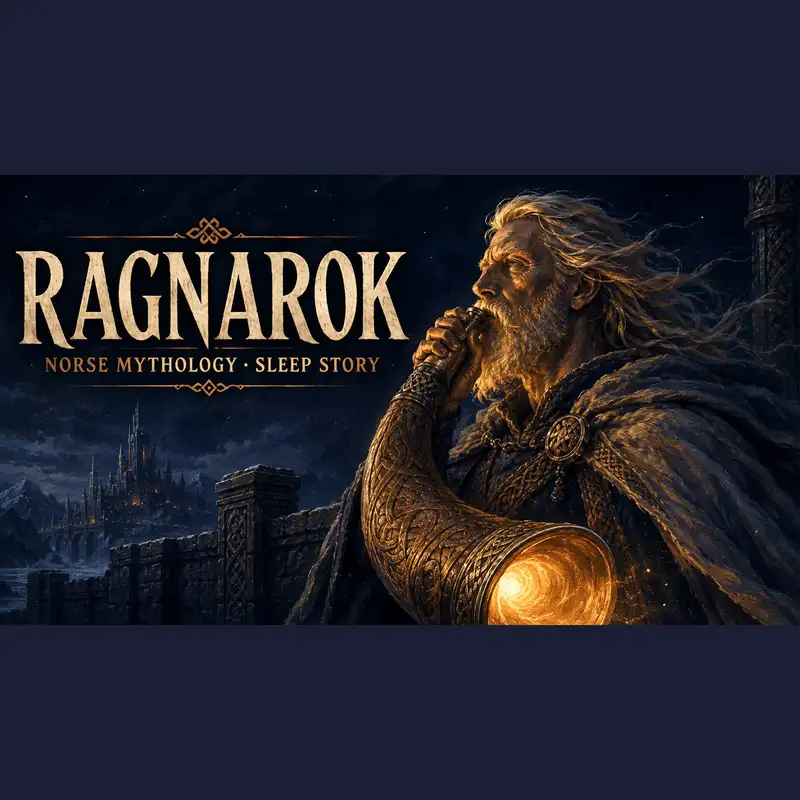
Welcome to The Sleeping Almanac.
Tonight: the story the old north put at the end of every other story. The story the gods had been hearing prophesied for a thousand winters. The story they could not avoid and did not, in the end, try to avoid.
A long cold winter that will not end. A wolf that slips its chain. A great serpent that lifts itself up out of the deep sea. A ship made of the fingernails of the dead. A horn lifted in the dark to call the gods to a field they had always known they would die on.
We will tell the story tonight from the Vǫluspá, the Seeress's Prophecy, the first poem of the Codex Regius. And from Gylfaginning, the part of Snorri Sturluson's Prose Edda that gathers all the old north's endings into one quiet long telling.
The Hávamál has a stanza for this kind of story. Cattle die, kinsmen die, you yourself shall die. But one thing I know that never dies: the judgement of a dead man's life.
Tonight, by the time the story is done, the gods will have died, the earth will have drowned, and a small green field will have risen again. And the Hávamál's quiet promise about what does not die will still hold.
Settle in. Let your shoulders drop. We begin in a winter that will not end.
Chapter One. The Fimbulvetr.
The Vǫluspá tells us that the long winter came first.
It does not, the poem implies, give the long winter any particular dramatic introduction. The seeress moves into it the way a winter moves into a country. The wind shifted. The light got thinner. The first snow came earlier than it should have. And then it did not stop.
The old north called the long winter the Fimbulvetr. The word means, the scholars say, the great winter, the terrible winter, the winter beyond winters. The poem tells us, with the dry exactness it uses for the worst things, that the Fimbulvetr lasted three years. Three winters in a row, with no summer between them. Three winters with no green grass and no warm wind and no return of the long days. Three winters that came on top of each other the way a man piles three woollen cloaks on top of each other, each heavier than the one beneath.
The first winter was harder than any winter that had been remembered. The rivers froze deeper than the rivers had ever frozen. The seas froze along the coasts. The deep snow came earlier in the autumn and stayed later into the spring. The cattle grew thin. The hay was used up before the spring was anywhere near. The old people, who had seen many winters, said this was not a usual winter. The young people, who had not seen many winters, learned what a hard winter actually looked like.
Picture a farmer at the door of his cold byre in the middle of the morning, the small visible breath of the man hanging in the air, looking at his cattle and counting ribs he should not have been able to count yet. Picture a woman at a hearth, looking at a basket of dried fish she had counted twice already, counting it a third time, finding that the count had not changed. Picture a child at a small window, looking out at the snow that had come in the night, asking, in the careful way of children who have begun to understand that something is wrong, whether the spring would come.
The first winter ended. The old north would have said this was the test. The first winter had been bad. The first winter had been the kind of winter the bards would sing about. But the snow had gone, in the end. The green had come back, in the end. The old people, who had seen many things, said, we have come through the worst of it. The young people, who wanted to believe their elders, agreed.
But the second winter, the Vǫluspá tells us, came down without any spring in between.
The first cold wind of autumn came in the middle of what should have been the middle of summer. The leaves browned and fell. The cattle, which had not yet grown back the weight they lost in the first winter, were now thinner than they had been at the end of the first winter. The hay barns had no more in them than they had had at the worst of the first spring. And the snow came again. And the rivers froze again. And the deep cold settled into the country again. This time, no one said anything about coming through the worst of it.
The second winter was harder than the first. The country, which had not had a summer in between to recover, did not have anything to give to the second winter. The forests, which had not put out new leaves, had nothing to lose. The fields, which had not been mown, had nothing to be cut. The cattle, which had not been fattened, had nothing to give back. The Fimbulvetr was a winter that ate its own future.
The second winter ended. There was no spring. The third winter began.
The Vǫluspá says, with the small dry brevity it uses for the worst things, that during the Fimbulvetr the wolves swallowed the sun and the moon.
Two wolves had been chasing the sun and the moon since the world began. The wolf chasing the sun was called Sköll. The wolf chasing the moon was called Hati. They had been running since the days were first counted. They had been getting closer for a thousand winters. The slow narrowing of the long chase. One step behind at the start of the world. Nine tenths of a step behind by the end. The wolves had been patient. The wolves had been certain. The wolves had been getting closer.
And in the third year of the Fimbulvetr, the seeress says, they caught their long quarry, and they swallowed the sun and the moon, and the sky went dark.
This was when everyone knew.
This was when the old people, who had been saying it was a bad winter, stopped saying it was a bad winter. This was when the young people, who had been hoping their elders were right, stopped hoping. This was when even the children stopped asking when the spring would come. The dark hung over the world in the middle of what should have been a noonday in the third year. The cold settled into bones that had been cold for two and a half years already. The wolves howled, somewhere out beyond the edge of every fence, somewhere closer than they should have been. The small hearth-fires in every long winter hall burned a little lower, because the wood had been used up, because the careful stores had thinned, because the dark outside was now a dark that did not even have the small reliable light of the moon to push back against.
The Vǫluspá says, in the small careful way it says the worst things, that this was the time when the brothers began to kill the brothers.
Chapter Two. Brother Will Kill Brother.
The Vǫluspá says, in one of the most famous stanzas of any old north poem, that the moral collapse came next.
Brothers will fight, the seeress says, and slay each other. Cousins will break the bonds of kinship. It will be a hard time in the world. A time of much fornication. An axe-age, a sword-age. Shields will be cleft. A wind-age, a wolf-age, before the world goes down. No man will spare another.
We have to pause on what these stanzas meant.
The old north was a kin-bound culture. The deepest bond a being could have, in the old north, was the bond between brothers, the bond between cousins, the bond between father and son, the bond between the long lines of kindred that ran out into every long winter hall and every cold mountain country. To say that the brothers would kill the brothers was to say, in the deepest language of the old north, that the social fabric had unraveled. The thing that held the cold north together had stopped holding.
The first killings, the seeress implies, came over the small things. Over a sheep that died and a brother who blamed another brother for it. Over a stored barrel of grain that was eaten by one cousin without sharing with another cousin. Over the borrowed sword that was never returned, the broken oath that was never repaired, the harsh word in the cold hall that was never taken back. These small things, in a country where the cold had gone on for three years and the wolves were howling at the edge of every fence, became the things that the kindred killed each other over.
Picture the first careful moment. Two brothers in a small hall in some long valley of the cold north. The fire was low. The hay was nearly out. The cattle in the byre were down to two. One brother had taken, perhaps without asking, the last small piece of dried fish from the basket. The other brother, when he came to the basket and found it empty, said something sharp. The first brother said something sharper back. The second brother stood up. The first brother stood up. And the careful hand that had been holding a careful knife at the table did, in a careful moment that neither brother had quite planned, what it should not have done.
This was, in some small steading, the first moment.
Then the same moment happened in other steadings. The same small fights, the same small refusals to forgive, the same standings up at the table, the same hands holding knives. The Vǫluspá says, with the same dry brevity, that no man spared another.
The seeress did not mean that every single man in the world killed his brother. She meant something subtler and worse. She meant that, in the third year of the Fimbulvetr, when a man in the cold north decided to do a small ordinary wickedness against his kindred, no one stopped him. The neighbours did not intervene. The elders did not speak up. The law-speakers did not come to the door. The small bonds that had held the cold north together for ten thousand winters had thinned. And then, in the long dark of the third year, they had broken.
Picture the long quiet morning after the first killing. The brother who was still alive sat at the cold table for a long time. The brother who was dead lay where he had fallen. The cattle in the byre did not say anything. The neighbours, in the next steading, would have heard. The neighbours did not come. The brother who was still alive eventually got up and went out. And the day went on as if nothing had happened. As if the long quiet thing the cold north had relied on for ten thousand winters had not, in that careful morning, been broken.
The poem says that this was the wolf-age.
The wolf, in the old north, was the symbol of the broken bond. The wolf was the one who lived outside the kindred, outside the hall, outside the law. The wolf was what a man became, in the old language, when he had broken his kindred so badly that he could not come back to the hall. The wolf was the warning the grandmothers told their grandchildren around the long winter fires. Do not become the wolf. Do not become the one who lives outside the long warm hall, outside the careful bond, outside the promise the kindred owe each other.
The wolf-age was the age when every being in the cold north had stepped, by their own small choices, outside the bond that had held them. Every refusal to forgive, every choosing of the self over the kindred, every picking up of the knife at the table, was a small step into the wolf-age.
And it was, the poem implies, in this wolf-age that the actual wolf began to stir.
Chapter Three. The Wolf Slips the Chain.
The Vǫluspá and Gylfaginning both tell us, in their different ways, that Fenrir slipped the chain.
We told the story of how Fenrir was bound, in an earlier episode of The Sleeping Almanac. We told the story of the three chains. The gods had first tried a great iron chain called Loeding, which the wolf broke with one tightening of its shoulders. The second chain was called Drómi, twice as strong as Loeding, which the wolf broke with two tightenings. The gods, who had run out of ordinary chains, sent down to the dwarves in the deep mountains and asked for a chain that could not be broken.
The dwarves made a soft ribbon called Gleipnir. It was woven from six impossible things. The sound of a cat's footfall. The beard of a woman. The roots of a mountain. The sinews of a bear. The breath of a fish. The spittle of a bird. The six things were impossible because the world did not have any of them. Cats made no sound when they walked. Women had no beards. Mountains had no roots that anyone had ever seen. Bears had no sinews you could pull out. Fish did not breathe. Birds did not spit. The dwarves took the six things that did not exist in the world, and they spun them into a ribbon.
The ribbon was soft. The ribbon was thin. The ribbon was no thicker than a careful thread of silk. And it was the one chain the wolf could not break.
Týr put his hand into the wolf's mouth as a pledge of the gods' good faith, and the wolf bit it off when the chain held. The gods bound the wolf to a great rock called Gioll, which they sank into the deep earth, with another rock called Þviti for an anchor. They jammed a great sword between the wolf's jaws, with the hilt against the lower jaw and the point against the upper jaw, so that the wolf could not close its mouth, so that the great spittle of the wolf's hunger ran out forever and made a river that the old north called Vón, the river of expectation.
The wolf had been straining at that chain for a thousand winters.
It had not stopped straining for one day. It had been pulling, very slowly, very steadily, against the soft ribbon and the great rock and the deep earth. It had been growing, the way old gods and old serpents and old wolves grow, slowly and steadily and without ever being seen to grow. It had been waiting, the way a being waits when it has been wronged.
A wolf does not think the way a man thinks. The wolf did not count the days or mark the years. The wolf knew, in the deep wolf way, that it was waiting. The wolf knew the careful old chain was thinning, very slowly, in some small place that only the wolf could feel against its leg. The wolf knew the long time was passing. The wolf knew the long time was, by some measure that only the wolf knew, almost done.
The Vǫluspá says, with the dry economy it uses for the worst hinges, that the wolf slipped the chain.
The poem does not tell us how. It does not say that the chain was cut by a sword or undone by a key. It says only that the wolf, in the third year of the Fimbulvetr, in the wolf-age when no man spared another, slipped the chain that had been holding it. Perhaps the chain had stretched. Perhaps the rock had begun to give. Perhaps the deep earth had thinned around the anchor. Perhaps the soft ribbon called Gleipnir had finally, in some small place, given way.
The wolf did not roar. The wolf did not howl. The wolf did not do any of the loud things a small wolf in a small story might be expected to do at this moment. The wolf lifted its head, slowly, the way an old being lifts its head when an old expectation has at last been met. The wolf rose, slowly. The wolf shook off the last small pieces of Gleipnir that still clung to its forelegs. It shook off the pieces of Gioll the great rock that had broken when the chain at last gave. It shook off the deep earth that had still been clinging to its hide.
The wolf walked up through the long cold dark place where it had been chained. The deep earth opened, very slowly, around its great shoulders, the way deep earth opens around the great roots of an old tree being lifted by an old storm. The wolf walked up. The wolf walked through the deep stone. The wolf walked through the deep cold dark. The wolf walked, very slowly, very steadily, the way a wolf walks when a wolf has been waiting for a thousand winters and is no longer in any hurry, up toward the surface of the world.
And then the wolf walked out.
It walked out into the broken country of the Fimbulvetr. It walked into the dark that had come down when the wolves Sköll and Hati had swallowed the sun and the moon. It walked into the cold that had been settling for three years. It walked into the wolf-age when the brothers were killing the brothers. The wolf walked the way an old debt walks when an old debt has at last come due.
The Vǫluspá says it with one of its most famous lines. Fenrir is loose.
The door was open.
Chapter Four. The Serpent Stirs.
The Vǫluspá tells us, a few stanzas later, that the great serpent Jǫrmungandr lifted itself up out of the deep sea.
We have told this story too, in an earlier episode of The Sleeping Almanac. We told the story of Þórr fishing with Hymir. Þórr had gone, in disguise, to the great hall of the giant Hymir. Hymir had taken Þórr out fishing in the deep sea. Þórr had baited his hook with the head of a great ox. The line had gone down into the deep. The great pull had come. Þórr's feet had gone through the bottom of the boat as he braced against the pull. Þórr had brought the serpent up out of the deep enough that he could see its small careful eyes looking up at him through the dark water. Hymir had lost his nerve and cut the line. The serpent had gone back down. And Þórr had been waiting, in the long quiet thousand winters since, for the serpent to come up again.
The serpent had not been still in the deep. It had been growing.
It was, by the third year of the Fimbulvetr, so long that it lay coiled around the whole of the world, holding its own tail in its own mouth, the way a long snake will sometimes lie when it has nowhere else to go. The serpent was the slow long boundary of the world itself. It was the dark line at the bottom of every careful old map. It was what the small fishermen knew was somewhere under their small boats. It had been there, in the deep sea, the bottom of every story, the dark below every story, the long quiet thing the gods knew was there but did not, for a thousand winters, do anything about.
The serpent, in some old north sense the seeress does not name, had been thinking about Þórr. A serpent does not think the way a man thinks. It does not count the days. But the serpent knew the careful old god with the careful old hammer had come within an arm's reach of pulling it up out of the deep once. And the serpent knew, in some deep serpent way, that the old god was coming again.
The Vǫluspá says, with the same dry economy, that the serpent rose.
The poem does not say how. It does not describe the great waves that would have come up across the cold north shores, the way the small fishermen on the cold coasts would have watched the water go strange and high. It says only that the serpent, in the third year of the Fimbulvetr, lifted itself up out of the deep, uncoiled from around the world, and came up onto the land.
The serpent was so large that its movement was almost too slow to see. It did not lash and writhe the way a small angry snake lashes and writhes. It uncoiled the way a long slow tide uncoils, the way a cold heavy current turns in the deep. The water of every coast on the cold north went strange. The fish swam in confused circles. The seabirds rose in great wheeling clouds without knowing why they were rising. The small fishermen pulled their boats up onto the shore and went home, the way small fishermen will sometimes do when the sea has gone wrong without their being able to say why.
The fishermen had been pulling up less and less. They had been catching almost nothing. They had been pulling up nets that had things in them they did not recognise. Deep things from the deep sea. The long thin pale fish that lived a long way down. The small blind crabs of the cold deep. They had been pulling up, in the last days of the Fimbulvetr, things they did not want to look at. And on the morning when the sea went wrong, they did not need to be told that the morning had gone wrong. The old men with the long careful wisdom of the cold north coast pulled their boats up, in silence, the way men sometimes do when they know without having to say.
And then, the Vǫluspá says, the serpent came onto the land.
It came up out of the sea on the eastern coast. It crawled up out of the cold black water and onto the cold black stones of the shore. It was so large that it was hard to see it as a serpent. It looked, from any distance, like a long ridge that had not been there yesterday. It looked like a long dark river of scales, lying along the eastern shore, breathing.
The Vǫluspá says, with the same dry care, that the serpent's breath was poison.
The serpent breathed, and the breath went up into the sky, and the sky went the colour of old bronze. The breath rolled out across the cold country in slow heavy waves of poison fog. The grass that the breath touched died. The trees that the breath touched died. The small creatures that the breath caught died where they stood. The cattle in the steadings of the eastern shore lay down and did not get up. The old men who had pulled up their boats went into their halls and closed the doors and sat at their hearths in silence, knowing.
And the great serpent crawled, very slowly, up the eastern coast toward the long road inland.
The wolf was loose. The serpent was up. The third sign had not yet come, but it was coming.
Chapter Five. The Ship of Nails.
The Vǫluspá says, in the deepest stanzas of its prophecy, that the ship called Naglfar sailed.
The old north remembered that Naglfar was a ship that had been built, very slowly, out of the fingernails and toenails of the dead. Every being who had died without having their nails properly cut, the old north said, had contributed a small piece of Naglfar. Every careless mourner who had not, in the careful old way, trimmed the nails of the dead before laying the dead in the ground, had given a small piece of nail to a great dark hull that was being built, very slowly, somewhere across the cold sea.
This was a small everyday warning. A reminder. The old north's way of telling its children that what you did with the small things mattered. That every act of carelessness toward the dead, every forgetting to do the right thing by a kinsman who had gone, was being added to a great long thing that was being built somewhere out beyond the horizon. The grandmothers in the long halls told the grandchildren, in a careful voice, to be sure they did the cutting properly when the time came. The grandchildren nodded.
Over ten thousand winters, the small carelessness of the cold north had built a great dark ship.
It was the longest ship that had ever been imagined.
It had no decks. It had no clear wood. It was nothing but a long dark hull of overlapping nails, fingernails packed against fingernails, toenails packed against toenails, the keratin of ten thousand uncut dead set together by some long careful hand into the shape of a vessel. The mast was a single great bone, taken from some old creature the poem does not name. The sail was the woven shrouds of the unburied. The rope was the long careful hair of the long careful dead, taken in handfuls from the cold graves and braided together over ten thousand winters into the long quiet ropes of the long dark ship.
The ship was kept in a long quiet harbour somewhere across the cold sea.
Snorri, in Gylfaginning, says that the captain of Naglfar was the giant Hrym. Hrym was an old enemy of the gods, a frost-giant who had been waiting in the deep east for the third year of the Fimbulvetr the way every other thing in this story had been waiting. The Vǫluspá itself shows Hrym at the prow, holding a shield, leading the army of the giants in from the east.
The dead, in Snorri's telling, sailed a separate ship, out of Hel, with Loki at the helm.
Hel, the daughter of Loki, the lady of the dead, had been waiting in her cold country for ten thousand winters. She had been counting the dead, sorting the dead, gathering the dead into long quiet ranks. Hel was half blue and half white. One side of her face was the face of a living woman. The other side was the face of a long dead one. She had been given, in the deep old beginning, the cold country of the dead to rule. She had been ruling it, in the careful old way, for ten thousand winters. She had not, in any of those winters, been impatient. She had been counting. She had been sorting. She had been waiting.
The Vǫluspá says that, in the third year of the Fimbulvetr, the signal came.
The poem does not say how. It says only that Hel, in her cold country, knew the time had come. And Hel walked down to the harbour where her ship was waiting, and Hel walked aboard. And the long quiet ranks of the dead walked aboard behind her. The cold-north dead who had been waiting in Hel's country — who had not died in battle and so had not gone to Valhalla, who had not died at sea and so had not gone to Rán, who had died small careful old deaths and gone to Hel — walked, in long order, down to the harbour and aboard the ship.
And the helmsman of that ship, the Vǫluspá says, was Loki.
We told the story of Loki's binding, in an earlier episode of The Sleeping Almanac. Loki had been bound, after the death of Baldr, with the entrails of his own son turned to iron, in a cold cave under a stone, with a serpent dripping venom onto his face, and his wife Sigyn standing beside him with a bowl to catch the venom. Loki had been bound, like the wolf, for a thousand winters. And Loki, like the wolf, had been waiting.
The Vǫluspá implies that Loki also slipped his chain. The poem does not dwell on how. Perhaps the entrails of the son, which had been iron, had at last given way. Perhaps Sigyn, who had been holding the bowl for a thousand winters, had at last, in the long dark of the Fimbulvetr, looked away for one careful moment, and the venom had splashed Loki's face, and Loki had shaken with the shaking he had been doing for a thousand winters, and the shaking had at last been enough to break the careful old binding.
When the long signal came, Loki rose from the long dark cave under the stone, and walked through the broken country of the Fimbulvetr, and came down to the harbour where the ship from Hel was waiting. And Loki, with the clever face he had always had, the face the old north had loved and feared in equal measure for ten thousand winters, took the helm.
And the ship set sail across the cold sea, with the dead at the oars and the lady of the dead at the mast and the clever god at the helm.
Hrym and the giants sailed Naglfar from the east. Loki and the host of Hel sailed from the north. Both ships, the Vǫluspá implies, were aimed at the same shore.
Chapter Six. The Horn.
The Vǫluspá and Gylfaginning both tell us, in their own careful ways, that Heimdallr blew the horn.
We have told the story of Heimdallr in earlier episodes of The Sleeping Almanac. Heimdallr was the watcher of the rainbow bridge, the white god, the foreseeing one, the one who needed less sleep than a bird, the one who could hear the grass growing in the field and the wool growing on the sheep's back. Heimdallr stood, year after year, on the parapet at the gate of Asgard, looking out at the long road from the east, and listening.
He had been listening for the wolf for a thousand winters. He had been listening for the serpent. He had been listening for the long slow approach of the ship of nails across the cold sea. His hearing was the most careful hearing in any of the nine worlds. He could hear a single thread of wool growing on a sheep on a hill in a country a thousand leagues away. He could hear the breath of a sleeping child in a cradle in a steading in a valley a hundred days' ride from the gate of Asgard.
On the day in the third year of the Fimbulvetr when all three sounds came at once — the breath of the wolf newly freed from the chain, the slow crawl of the serpent up the eastern shore, the slap of the oars of Naglfar across the cold sea — Heimdallr lifted his great horn called Gjallarhorn, and Heimdallr blew it.
Heimdallr had always been calm. He was the steady one. He was the patient one. He was the one who would do the careful work of watching for the careful thousand winters that the careful work required. On the morning of the long signal, he lifted the horn with the same careful calm he had always had.
He lifted Gjallarhorn. He put the great curve of horn to his white lips. He drew a breath that was as careful and steady as every other breath he had ever drawn. And he blew.
The sound went out across the worlds.
The Gjallarhorn was the loudest horn in any of the nine worlds. It was made of a great curl of horn from a great cold creature no one in the old north could quite name. It could be heard at the bottom of the deepest sea and at the top of the tallest mountain and in the deepest cave under the deepest stone. It was the horn you blew at the end of the world.
When Heimdallr blew it, every being in every world heard it.
The gods in Asgard heard it. Þórr, who had been waiting for the serpent for a thousand winters, heard it and lifted his head from whatever he had been doing in his hall at Bilskírnir, and Þórr knew. Óðinn, who had been preparing for the wolf for a thousand winters, heard it and put down whatever he had been doing in his great hall at Valaskjálf, and Óðinn knew. Freyja, who had been gathering the einherjar, the slain warriors who would fight beside the gods at the last battle, heard it and went to the doors of Vingólf and called the einherjar out. Frigg, in her quiet hall called Fensalir, heard it and folded her hands in her lap and looked at the empty chair where Baldr had once sat, and the long quiet patience she had been holding for a thousand winters since Baldr's death came finally to its end. Sif and Iðunn and Skaði and all the goddesses of the cold country heard it and rose.
The einherjar in Valhalla heard it. The great roar that came from Óðinn's long hall when the eight hundred doors opened and the eight hundred warriors per door came out — eight hundred times eight hundred warriors, the einherjar who had been training for this battle for ten thousand winters — was, in the old north's imagination, the loudest sound any place had ever made. The doors opened. The warriors poured out. The long ranks rolled out across the long open field of Vígríðr.
The dwarves in the deep mountains heard it. They stood at the doors of their cold stone halls and groaned. They had been making the weapons of the gods for ten thousand winters. They had made Mjǫllnir. They had made Gungnir. They had made Gleipnir. They heard the horn and knew the long careful work was about to be tested. They had always known, in some deep dwarf way, that the long careful work would eventually be tested. They had hoped, perhaps, that the testing would come a little later than it did. They did not complain. They stood at the doors and listened.
The light-elves in Álfheimr heard it. The dead in Hel heard it, though they were already aboard the ship. The frost giants in Jǫtunheimr heard it and put on their armour.
And the ash of Yggdrasill heard it and shook.
The Vǫluspá says the great tree shook from root to crown. The squirrel called Ratatoskr, who ran up and down the trunk carrying insults between the eagle in the top branches and the serpent at the roots, stopped, the old north imagined, for the first time in ten thousand winters. The eagle at the top of the tree opened its wings without yet flying. The serpent at the roots lifted its head. The four stags who ate the leaves — Dáinn and Dvalinn and Duneyrr and Duraþrór — lifted their heads. The three Norns at the well of Urðr, who had been weaving the careful threads of every being's life for ten thousand winters, looked at each other and at the great tree. The whole long axis of the worlds hung still for a single careful moment after the horn had sounded.
And then the gods began to arm.
Chapter Seven. The Gods Arm.
The Vǫluspá and Gylfaginning both tell us, with the dry economy they use for the most important moments, that the gods of Asgard armed themselves and went to the field.
The field was called Vígríðr. The name meant the plain of battle, the long open ground where the last battle would be fought. Snorri says Vígríðr was a hundred leagues long on each side, a country with no hills or trees or rivers, a country built to be the country where the last battle would be fought. The gods had known about Vígríðr for ten thousand winters. They had not visited it in any of those winters. They had not wanted to look at the place where they were going to die.
But, in the third year of the Fimbulvetr, the gods rode out to Vígríðr.
Óðinn rode first. He was on his eight-legged horse Sleipnir, the grey stallion that ran across earth and sea and sky and the deep places between. Sleipnir was the strangest horse anyone had ever imagined. He had eight legs because he had been born, in the old story, of Loki in the shape of a mare and a great stallion called Svaðilfari. He could run faster than any horse with four legs. He could run across water as if water were grass. He could run up into the sky. He was the horse the all-father rode when the all-father needed to be everywhere at once.
Óðinn wore the helmet he had carried for ten thousand winters, the great helmet of grey iron with the two ravens stamped on the crown. He carried Gungnir, the spear that had been made by the dwarves and that had never missed its mark. He was dressed for war. His long grey beard, which had grown for ten thousand winters, was tucked into the collar of his cloak. His one eye, the one he had not given up at the well of Mímir, looked steadily out from under the helmet. He was calm. He had been preparing for this for ten thousand winters. He knew, in the deepest sense, what was coming. He rode out to it anyway.
Þórr rode beside him. He was in the chariot pulled by Tanngrísnir and Tanngnjóstr, the two great goats whose names meant the gnasher and the toothgrinder. The chariot was a wagon of dark wood with the two great goats in the traces. Þórr could kill and eat the goats at any hall, and he could then bring them back to life with Mjǫllnir, by a careful waving of the hammer over the careful gathered bones. The goats were the cold north's way of telling its children that the god of the thunder always had something to eat. Þórr wore the belt of strength, Megingjǫrð, which doubled his already great strength. He wore the iron gloves, Járngreipr, which let him grip the haft of Mjǫllnir. And he carried Mjǫllnir, the hammer that had been forged in the deep mountains by the dwarves Brokkr and Sindri, the hammer we have told the story of in an earlier episode of The Sleeping Almanac.
Frey rode beside them. Frey, the lord of the sun and the rain and the fruitful summer, was on his great boar called Gullinbursti, the golden-bristled one. Gullinbursti was a great creature with bristles of pure gold, which gave off a small light of their own, so that Frey on Gullinbursti could ride into the deepest darkest night and still see his way by the light of the boar he was riding. Frey was missing his sword. He had given it away in the wooing of the giantess Gerðr, the story Skírnismál tells. He had given the sword that fights by itself to his servant Skírnir, and the sword had not, in any of the long thousand winters since, come back. And now, in the third year of the Fimbulvetr, on the long ride out to Vígríðr, Frey had no sword. He rode out anyway.
Týr rode beside them. Týr, who had lost his hand to the wolf in the binding, rode out one-handed to the last battle. He carried a sword in the only hand he had. He was the calmest of all the gods on the long ride out. He had already done, a thousand winters earlier, the thing the situation had asked of him. He had put his hand into the mouth of the wolf when no other god would. He had paid the price. He was, in some quiet sense, already at peace with what was coming.
Heimdallr rode beside them. He had the great horn at his belt now, lowered after the long sounding. He carried his own sword, the one called Hǫfuð, the head. He was looking at the small dark figure of Loki at the helm of his ship far across the field, and he was very calm. Heimdallr and Loki had been waiting to meet each other for the whole of the ten thousand winters. They had been, in some traditions, brothers. They had been, in some traditions, enemies for a thousand winters. They were going, today, to settle it.
The einherjar came up behind the gods, eight hundred doors of Valhalla open, eight hundred warriors per door, the long ranks of the slain rolling out across the long open field of Vígríðr. The Valkyries rode at the head of them, the long-haired women of the cold north, the choosers of the slain, the ones who had been bringing the dead to Valhalla for ten thousand winters. The Valkyries were now riding the slain out to their final battle. They rode great pale horses. The long pale braids fell down their armoured shoulders. The careful spears were lowered. They had been training the dead for ten thousand winters. They were now leading them out.
The army of the giants came up from the east with Hrym at the prow of Naglfar. The host of Hel came up from the north, off Loki's ship, the long ranks of the dead walking in slow formation across the long open field. Surtr, the giant of fire from the deep south, the lord of Muspell, the one who had been waiting in the south with his sword of fire for ten thousand winters, came up from the south. Surtr was a giant of pure flame, his body a long shape of burning, his sword a long line of fire so hot the cold air of the Fimbulvetr around him hissed and steamed and pulled back. The wolf came up from the east beside the giants. The serpent crawled up from the deep sea beside the wolf. Loki, with the clever face he had always had, stood at the head of the army of Hel.
The Vǫluspá says, with the same dry brevity it uses for the most important hinges, that the two armies met on the field of Vígríðr.
And the gods did what they had been preparing to do for ten thousand winters.
Chapter Eight. Óðinn and the Wolf.
The Vǫluspá says, with the brevity it uses for the worst things, that Óðinn went to meet the wolf.
Óðinn, on his grey eight-legged stallion Sleipnir, the spear Gungnir lowered, the helmet on his head, rode out to meet the wolf alone. The wolf had grown so large in its thousand winters in the chain that its open mouth, when it opened, reached from the floor of the world to the roof of the world. The wolf was the size of mountains. Its two great eyes were the size of the great cold lakes of the deep north country. When it breathed in, it pulled the cold air of the cold north toward it from a hundred leagues away.
Óðinn rode at the wolf anyway.
This was the moment the whole of the old north had been waiting for. Óðinn, the all-father, the king of the gods, the long-watcher, the wisdom-seeker, the one who had sacrificed his eye at the well of Mímir and his life on the tree of Yggdrasill, the one who had spent ten thousand winters preparing for this exact wolf, lowered his spear and rode at the wolf.
Sleipnir's eight hooves on the cold ground of Vígríðr, the pace of a horse going into a charge. The pull on the reins. The lowering of the long shaft of Gungnir to the level. The steady look from the one eye under the grey iron helmet. The wolf, in the same suspended moment, lifting its great head and seeing the small grey figure on the small grey horse coming at it across the long open field. The wolf opening, very slowly, the great mouth.
And the wolf swallowed Óðinn.
The Vǫluspá says it, with the same dry brevity. The wolf swallowed Óðinn. The all-father went into the great mouth of the great wolf, and the wolf closed its mouth, and Óðinn was gone.
We have to sit on what this means.
The old north did not soften what the seeress was saying. The all-father did not defeat the wolf. The all-father did not drive his spear into the wolf's throat and bring the wolf down. The all-father, the king of all the gods, the one who had been preparing for ten thousand winters, was eaten. The wolf, who had been waiting for the same ten thousand winters, won.
This was, in the deepest sense, the lesson of the whole poem. The gods were not immortal. The gods could die. The gods were going to die. The seeress was telling the whole cold north that the gods knew this, and prepared for it, and rode out to it anyway. The gods did not refuse the battle because the battle was lost. They rode out into the lost battle because the lost battle was the battle that had been given to them.
And the wolf, the Vǫluspá says, was killed in turn.
The wolf was killed by Víðarr, the silent son of Óðinn. Víðarr was the god of the small dark wood, a quiet steady young man who did not say much. He was, in Snorri's reckoning, the second strongest of all the gods after Þórr. He had been waiting, in his small dark wood, for the same ten thousand winters that everyone else had been waiting. He had not, in any of those winters, said much about it. He had not complained. He had been quietly preparing.
In the moment the wolf swallowed his father, Víðarr walked up to the wolf.
He was wearing a single great shoe. The shoe was a famous shoe in the old north. It had been made, Snorri tells us, out of every scrap of leather that every cobbler in every country had ever cut off the heel and the toe of every shoe they had ever made and thrown away. Every careless cobbler who had ever, in any of ten thousand winters, thrown a scrap of leather into the corner of a workshop, had been making, without knowing it, the great shoe of Víðarr. Every grandmother who had told her grandchildren to save their scraps of leather had been preparing the shoe.
This was the second small everyday warning in the poem. The first had been the cutting of the nails of the dead, the small act of carelessness that built the long dark ship. The second was the saving of the scraps of leather, the small act of carefulness that built the great shoe. Both of them were small everyday acts. Both of them, over ten thousand winters, had been building two great long things — a ship for the enemies and a shoe for the avenger.
Víðarr put the great shoe into the wolf's lower jaw. He braced his foot. He took the wolf's upper jaw in his hands. And he, with the steady strength he had always had, tore the wolf's mouth open from top to bottom and killed the wolf.
The wolf, which had just swallowed the all-father, lifting its great head in the moment after. The steady figure of Víðarr walking up to the wolf the way Víðarr always walked. Víðarr saying nothing. Víðarr putting the great shoe in. Víðarr taking the great upper jaw. Víðarr pulling, with the steady strength of a being who had been waiting ten thousand winters for this moment. The great jaw giving way. The wolf dying.
The wolf died. The wolf had won. The wolf had eaten Óðinn. And then, the moment after, the wolf was gone.
This was the quiet justice of the old north. The wolf got what it had been waiting for. And then the wolf was killed in turn. And the long careful chain of cause and effect rolled forward.
Chapter Nine. Þórr and the Serpent.
The Vǫluspá says that, at the same moment Óðinn was meeting the wolf, Þórr was meeting the serpent.
The two great single combats of the last battle happened at the same time. On one side of the field of Vígríðr, the all-father was riding at the great wolf. On the other side, the great red-bearded god of the thunder, the strongest of all the gods, the keeper of Mjǫllnir, was meeting the great serpent who had been waiting for him since the day Hymir cut the line.
Þórr was ready.
He had been ready for ten thousand winters. He had thought about the serpent more often than any other god in any of the worlds had thought about anything. He had wanted, with the clean wanting Þórr always had, to finish what had been started in the boat with Hymir. He had wanted the serpent for a thousand winters. In the long evenings in his hall at Bilskírnir, when he sat at the long table with Sif and the servants, his mind drifted back to the moment in the boat. The line going down. The pull. The careful eyes of the serpent looking up at him through the dark water. The line being cut. The serpent going back down. And Þórr knew, in some deep way, that he would meet the serpent again.
Today, he was meeting it.
The two of them met on the field of Vígríðr.
The serpent came up across the field on its great length of dark scales, the poison breath rolling out in slow heavy waves around it. Þórr came at the serpent from the other side, in the chariot of the two goats, Mjǫllnir lifted. The poem does not tell us what they said to each other. They had said everything they needed to say in the boat with Hymir a thousand winters earlier.
Þórr standing in the chariot. Tanngrísnir and Tanngnjóstr pulling the chariot at a long careful pace toward the great long ridge of dark scales that was the serpent. Þórr's red beard standing out in the small cold wind of Vígríðr. The iron gloves Járngreipr on Þórr's hands. The belt Megingjǫrð doubling his already great strength. Mjǫllnir lifted, the great forge-marked head of the hammer dark against the cold sky.
The serpent's great head, in the same suspended moment, lifting on the long dark neck. The serpent's small careful eyes finding Þórr. The recognition between the two of them — the recognition of two beings who had at last met again after a thousand winters.
Þórr struck the serpent with Mjǫllnir.
The Vǫluspá says it, with the same dry brevity. Þórr struck the serpent. The hammer came down. The great forge-marked head of the dwarves' hammer, the hammer the old north remembered as the one that always returned to the hand that threw it, the hammer that had been forged in the deep mountains by Brokkr and Sindri, came down on the head of the great serpent. And the serpent, who had been growing in the deep sea for a thousand winters, who had wrapped its great length around the whole of the world, who had been breathing its poison breath across the cold north for the last long days of the Fimbulvetr, died.
The great long dark length of the serpent, which had been the slow long boundary of the world itself, going still. The great scales going darker. The careful light of the day — what light there was, in the long dark of the Fimbulvetr with the sun and moon already swallowed — catching, perhaps, on the great forge-marked head of Mjǫllnir as Þórr lifted it back. The careful satisfaction of a long thing at last done.
But Þórr did not walk away.
The serpent's death-breath, in the moment of its dying, rolled out one last time. The serpent breathed the great poison breath one last time, into Þórr's face, into Þórr's mouth, into Þórr's lungs. And Þórr, who had killed the serpent, who had finished the work he had been waiting to finish for a thousand winters, took the serpent's last poison breath into his own body.
Þórr took nine steps back from the dead serpent. The old north remembered the exact number. Nine steps. The number was the number of completion, the number of cycles, the number that came back to every careful story.
The first step. Þórr backing away from the great length of the dead serpent, Mjǫllnir still in his hand. The second step. The third step. The fourth step, Þórr feeling, perhaps, the cold of the poison beginning to work in his chest. The fifth step. The sixth step, the iron-gloved hand still holding Mjǫllnir but a little lower than it had been at the fifth step. The seventh step. The eighth step, Þórr's face going pale in the slow way a face goes pale. The ninth step.
And then Þórr, who had killed the serpent, who had finished his work, fell down dead from the poison.
This was the deep lesson again. Þórr killed the thing he had been waiting to kill. And the thing he killed killed him in turn. The cycle came back. The serpent and the thunder went down together.
The Vǫluspá says, with the same dry brevity, that other gods died on the field of Vígríðr at the same time.
Frey met Surtr, the giant of fire. Frey, who had given away his sword in the wooing of Gerðr, fought Surtr with whatever he had — with his fists, perhaps, or with an antler from his great boar Gullinbursti, or with nothing more than the clean light of a god who had loved a giantess once and had not regretted it. The poem does not tell us what the fight looked like. It says only that Frey met Surtr, and that Frey died. Surtr lived on, for one more thing he had to do.
Týr met Garmr, the great hound at the gates of Hel. Týr, the one-handed god, fought Garmr with the only hand he had. The Vǫluspá says, with the same brevity, that they killed each other. The one-handed god and the great hound, both of them creatures of the broken hand and the bitten hand, both of them with a careful old history of biting and being bitten. They killed each other. The ledger between them closed.
Heimdallr met Loki.
This was the meeting everyone had been waiting for. Heimdallr, the watcher of the rainbow bridge, the white god, the foreseeing one. Loki, the clever god, the trickster, the one who had been bound for the death of Baldr. The two of them had been, in some traditions, brothers. The two of them had been, in some traditions, enemies for a thousand winters. The two of them had been opposites — the watcher and the breaker, the careful one and the careless one, the one who kept the rainbow bridge and the one who set the bridge on fire.
They met on the field of Vígríðr. The Vǫluspá says, with the same dry brevity, that they killed each other.
By now, everything was going down.
Chapter Ten. The World Burns and Drowns.
The Vǫluspá says, in some of its most famous stanzas, that after the gods had killed and been killed, the world itself ended.
Surtr, the giant of fire from the deep south, was still alive. Surtr had killed Frey. Surtr had one more thing to do. Surtr lifted his great sword of fire, the sword that had been burning since the days when the world was first made, and Surtr brought the sword down across the whole of the cold north country.
The Vǫluspá says, in one of its most famous lines, that fire flickered up against the sky.
The cold north began to burn. The trees that the serpent's poison had not killed caught fire from Surtr's sword. The grass that had survived the Fimbulvetr caught fire. The halls of the long winter steadings caught fire. The wooden bridges over the cold rivers caught fire. The walls of Asgard, which the old story said had been built by a giant who lost a bet, caught fire. The roof of Valhalla caught fire. The roots of Yggdrasill, the great ash tree that held the worlds together, began to catch fire.
The great ash of Yggdrasill, which had stood since the days the world was made, which had held the nine worlds on its branches, began to burn from the roots. The roots, which went down into the well of Urðr and into the deep cold spring of Hvergelmir and into the deep dark place where the serpent Níðhǫggr lay coiled, began to catch fire. The fire climbed slowly up the great trunk. The fire reached the lower branches, where the four stags ate the leaves. The four stags ran, in four directions, out of the great tree. The fire reached the top branches, where the eagle nested. The eagle took off with a great beat of its great wings, and flew out into the burning sky.
The Vǫluspá says, with the same dry brevity, that the fire reached the heavens.
The whole of the cold north sky glowed orange and red and the colour of old bronze. The smoke rose so high that the stars were lost. The sun was already gone, swallowed by the wolf Sköll in the first sign of the Fimbulvetr. The moon was already gone, swallowed by the wolf Hati. And now the small fires of the cold north hearths, which had been the last warm lights in the long dark of the Fimbulvetr, were lost too in the great fire of Surtr. The great fire of the burning world. The great long flame that had been waiting in the deep south, in the cold country of the fire-giant, for ten thousand winters. The great fire that was now eating the whole of the cold north at the end.
And then, the Vǫluspá says, the earth sank into the sea.
The poem does not tell us exactly how. It says only that the great fire and the great death of the gods had broken the careful balance of the long axis of the worlds, and the earth, which had been held up between the deep below and the high above by the ash of Yggdrasill, no longer had anything to hold it up. The earth slid into the cold sea. The mountains went down first. The long fjords filled in and were lost. The long forests went under. The great halls of the gods, which had already been burning, went under burning. The whole of the cold north country went down into the cold sea, and the cold sea closed over it.
The great walls of Asgard, already on fire, beginning to lean. The great roof of Valhalla, which had been the roof under which the einherjar had feasted for ten thousand winters, beginning to slip. The great bridge Bifrǫst, the rainbow bridge that Heimdallr had watched for ten thousand winters, breaking, the colours of the rainbow scattering, the bridge falling into the cold sea. The whole long careful architecture of the nine worlds, which had stood since the world was made, going down into the cold dark.
The Vǫluspá says, in one of its most famous stanzas, that the stars went out.
The stars had been the fixed lights in the cold sky. They had been there since the days when the world was first made. They had watched every old north winter from the same long calm careful distance. And now, in the third year of the Fimbulvetr, after the gods had died and the earth had drowned, the stars, one by one, went out.
The seeress's stanza was one of the most beautiful in the whole poem. She said it simply. The stars went out of the heavens. The light that had been there for ten thousand winters was, one by one, the seeress said, not there.
The Vǫluspá says, with the same dry brevity that has been carrying us through the whole prophecy, that the world was dark.
There was a long quiet moment. The long calm of a world that has died. The cold sea was still. The sky was empty. The stars were gone. The sun was gone. The moon was gone. The gods were gone. The wolf was dead. The serpent was dead. The fire of Surtr had at last burned itself out. There was nothing left.
The cold sea moved very slowly. The deep dark was complete. There was no wind, because there was no shore for any wind to come from. There was no sound, because there was no being to make any sound, and no other being to hear any sound that was made. There was, in the deepest sense, nothing.
And then, the Vǫluspá says, in the stanzas that turn the whole poem, something began to come back.
Chapter Eleven. The Green Earth.
The Vǫluspá says, with a stanza the old north loved as much as any other stanza in any other poem, that the green earth came up out of the sea.
The seeress, who has been telling the whole prophecy in her dry careful brevity, lets the line breathe a little here. She has been waiting for this stanza for the whole of the rest of the poem. She lets the words come out slowly. The earth, the seeress says, rises up out of the sea, a second time, green.
The poem does not tell us how. The seeress says only that the earth came back. The seeress says only that, after the long dark moment when there had been nothing, the earth rose, and the earth was green.
The sea slowly grew quiet. The dark slowly thinned. A small light came back into the eastern sky. Not the sun — for the sun had been swallowed by the wolf — but the daughter of the sun, whom Vafþrúðnismál tells us the sun had borne before the wolf came. The daughter of the sun rose, slowly, into the cleared eastern sky. And the light that the daughter of the sun gave was the same warm calm light her mother had given.
The sky, which had been the long quiet dark for what could not be measured, lightening, very slowly, in the east. The first hint of grey. The first hint of pale. The first thin line of gold. The daughter of the sun coming up, slowly, with the same steadiness her mother had had. The first light falling on the long quiet sea.
And under the new light, the earth rose.
The earth rose slowly out of the cold sea. The water rolled off the slopes. The grass, which had not been there before, the grass which had no business being there, was there. The grass was green. The grass was deep and soft and the colour of the deepest summer that had ever come to the cold north. The trees, which had also no business being there, were there, and they were green, and they were the deep green of summer.
The grass was the kind of grass that had not been seen in the cold north for three years of the Fimbulvetr. The grass was thick. The grass was soft. The grass came up to the knees in places. The grass was full of small flowers — the small white star-flowers of the cold north spring, the yellow flowers the old north had loved, the purple flowers that came up in the meadows after the long snow. The earth's quiet way of saying that the earth was, in the deepest sense, back.
The Vǫluspá says, with care, that the new earth was without sowing.
The new earth had not been sown. No farmer had ploughed it. No seed had been put into it. The grain that grew on it grew because the grain wanted to grow there. The trees that stood on it stood because the trees wanted to be there. The deep summer that lay on it lay there because the deep summer wanted to lie there. The old north would have called this, in their language, the gift.
And, the Vǫluspá says, there were beings on the new earth.
The poem says that two human beings had survived the burning and the drowning. They had hidden, in the wood of Yggdrasill itself — Vafþrúðnismál calls it Hoddmímis holt, the wood of Hoddmímir, which Snorri identifies with Yggdrasill. They had found a hollow in the great old trunk, no bigger than two beings could fit into, the grain of the great old wood around them, the dark, the quiet. They had not, the poem implies, said much. They had only waited.
Their names were Líf and Lífþrasir. Life and the one who longs for life.
They came out when the earth was green again. They walked out onto the grass. They ate the morning dew. And from them, the new humanity came. Every grandchild of every grandparent in every long line of every country that came after was descended, the old north said, from Líf and Lífþrasir. Every baby in every cradle had, in the deep careful sense, two old grandparents who had walked out of the great trunk of Yggdrasill and eaten the morning dew.
And there were gods on the new earth too.
The Vǫluspá says that some of the gods came back. Víðarr was there, the silent son of Óðinn, who had killed the wolf. Váli was there, the avenger of Baldr, who had been born for the purpose of killing Hǫðr and had done so. Móði and Magni, the sons of Þórr, were there, and they had inherited Mjǫllnir, their father's hammer. The two sons of the thunder had been small enough not to ride out to the field of Vígríðr, and so had survived. The hammer had come to them.
And, the Vǫluspá says in the stanza the old north loved most of all the stanzas in the poem, Baldr came back.
Baldr, the beautiful god, the one we have told the story of in an earlier episode of The Sleeping Almanac, the one who had been killed by his blind brother Hǫðr with a sprig of mistletoe, the one who had been in Hel for the whole of the long quiet thousand winters before Ragnarǫk, came back. Hǫðr came back too. The two brothers walked out onto the green grass together. The killing was finished. The long grief Frigg had carried for a thousand winters had, in the deepest sense, ended.
The gods, the Vǫluspá says, sat down together on the new earth, in a place called Iðavǫllr, which had been a meadow in old Asgard, and they found in the grass — the seeress lets this image breathe too — the golden chess pieces that the old gods had been playing with in the days before the world began.
The old gods had been playing chess. The pieces had been lost in the long burning. And in the new green grass, the new gods, the survivors, found the pieces, and they would now, the seeress implies, play the same game on the new earth.
The new green grass, deep and soft, full of small flowers. Víðarr and Váli and Móði and Magni and Baldr and Hǫðr sitting in the grass in a careful circle. The small golden chess pieces of the old gods scattered in the grass between them. One piece — perhaps a king, perhaps a queen — picked up by Baldr in his careful hand, turned over, looked at, set back in its place. The game beginning again.
The Hávamál line we anchored at the start of this episode comes back here.
Cattle die, kinsmen die, you yourself shall die. But one thing I know that never dies. What never dies is the judgement of a dead man's life. What never dies is the long careful weight of how a being lived. The gods died. The wolf died. The serpent died. The earth burned and drowned. And what came back was a green earth where the careful work of the dead gods still mattered. Where the gold pieces of the old game were still in the grass.
The dead gods are remembered. The judgement of their lives, in the old language, never died.
Chapter Twelve. Goodnight. And the Wolf at the Edge of Time.
We are at the end of the story, and the end of the season.
We have spent eleven episodes of The Sleeping Almanac in the old north together. We have spent them in the hall of Yggdrasill, in the search of Óðinn for wisdom, in the forging of Mjǫllnir in the deep mountains, in the binding of Fenrir with the soft ribbon called Gleipnir, in the long quiet hall of Ægir where the gods drank with the sea-king, in the death of Baldr by the mistletoe, in the long binding of Loki in the cave under the stone, in the open sea where Thor went fishing for the serpent, in the cold hall of Þrymr where the bride who was Thor sat with eyes burning at the bottom of the veil, in the deep mountain where Bǫlverkr drank the three vessels of the mead of poetry, and in the cold mountain country where Skaði learned what kind of home she actually wanted.
And tonight, we have spent the last episode at Ragnarǫk.
The story we have told tonight is, in the old north's deepest careful way, the story that all the other stories were always pointing toward. Every chapter of every earlier episode of The Sleeping Almanac has ended in this same Chapter Twelve. Goodnight. And the Wolf at the Edge of Time. Every closing has folded the small individual story back into the great long story that ends here. The wolf at the edge of time was, in every earlier episode, the wolf we told the long full story of tonight.
And the wolf came. The wolf was Fenrir, slipping the chain in the third year of the Fimbulvetr. The wolf came onto the field of Vígríðr. The wolf swallowed Óðinn. The wolf was killed by Víðarr. The wolf is done.
And so are the gods.
The old north did not regret the death of the gods. The old north loved the gods. The old north sang about the gods for a thousand winters. The old north put the gods at the centre of every long winter hall and every cold mountain story and every quiet evening by every small fire. And the old north also knew, from the very beginning, that the gods were going to die.
The old north knew this and did not flinch. The old north knew this and made the stories anyway. The old north put the wolf at the edge of every time and let the gods come into the long warm halls and tell the long stories anyway, knowing that the wolf was coming, knowing that the long stories were going to end, knowing that the cold winter was going to come and the green grass was going to grow over the long winter and the cycle was going to come around again.
The Hávamál, in the same deep way, gave us the line for this. Cattle die, kinsmen die, you yourself shall die. But one thing I know that never dies. The judgement of a dead man's life. The careful weight of a being's small choices. The long quiet remembering that the old north did, around the long winter fires, of the gods who had once lived and who had once made these careful choices.
You, lying in your bed in the warm dark of your own evening, are part of that long quiet remembering.
You are the small continuation of what the old north imagined. The grass that came back after the long drowning is the grass that grew, eventually, into the place where you are lying. The two human beings who walked out of the wood of Yggdrasill are the long careful ancestors that made the line that led to your own quiet night. The careful old gods who sat on the new earth and found the golden chess pieces in the grass are the careful old gods who sit, in your own long quiet evening, in the small careful old stories you have just heard.
The wolf at the edge of time is also at the edge of your time. The long dark of the Fimbulvetr is also at the edge of your night. The cold winter that does not end is, in the deepest sense, the same cold winter that is somewhere always at the edge of every long quiet evening. The gods were not immortal. The gods knew this. The gods rode out anyway.
This was the deep careful old lesson. Ride out anyway.
Go to sleep tonight knowing that the wolf is there, somewhere at the edge of your time. Go to sleep knowing that the long careful old gods rode out at it anyway. Go to sleep knowing that, after the long burning and the long drowning, the green earth came up out of the sea a second time. Go to sleep knowing that Líf and Lífþrasir walked out of the wood of Yggdrasill onto the new green grass. Go to sleep knowing that the chess pieces are still, in the deep careful way, lying in the new grass.
Go to sleep knowing that Baldr came back.
The Hávamál's line will hold. Cattle die, kinsmen die, you yourself shall die. But one thing I know that never dies. The judgement of a dead man's life.
Sleep well.
Goodnight. And the wolf at the edge of time.