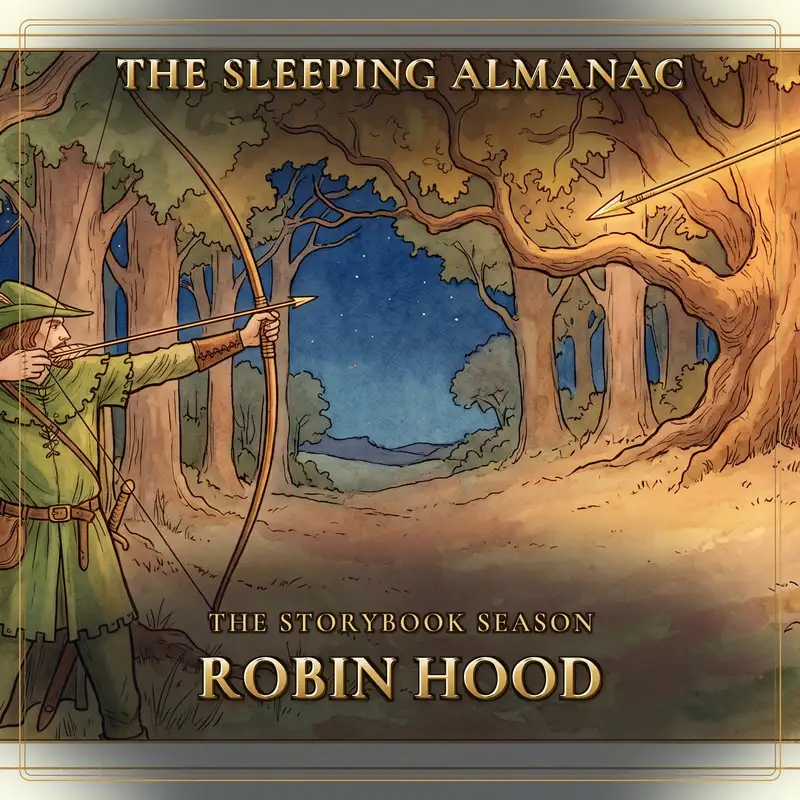
Welcome to The Sleeping Almanac.
Before the lamp is lit, one small thing. If these stories carry you to sleep, subscribe now, while your eyes are still open, and tomorrow night's tale will be waiting for you. A like helps other tired souls find this room. That is all. Let's light the lamp together now.
The lamp is lit again.
The same small flame as last night, in the same quiet room at the edge of the world.
The storyteller is already here. She was here before you arrived. She will stay until you sleep.
There is a chair for you. There is a blanket. The night outside is doing all of its slow, dark work, and none of it is yours to carry until morning.
The storyteller opens the old book, and turns past the tales already told, to a page that waits for tonight.
Tonight, she says softly, we go into
the greenwood, into Sherwood in the deep leaf of summer, where the light comes down green as pond water, where the deer step like rumors between the oaks, and where a man called Robin Hood keeps the merriest table in England.
And there is no hurry at all as she begins.
You do not need to do anything now. The forest in this story asks nothing of its guests. Settle in. Let the chair hold you the way moss holds a fallen branch, completely, and without any opinion about it. Let the blanket be heavy in the good way, the way shade is heavy under a great tree at noon.
Close your eyes, if they want to close. This tale does not need to be watched. It only needs to be near you, the way a campfire is near you, the way rain in the leaves is near you when the shelter is dry and you are already half asleep.
You do not have to follow every word. You do not have to remember any of it in the morning. If you drift, the story will go on without you, quietly, in among the trees, and it will not mind at all. Drifting is not leaving. Drifting is how a listener says thank you.
Chapter One. The Greenwood.
Long ago, in the green middle of England, there was a forest that was older than the kingdom around it.
Its name was Sherwood.
It was so large, in those days, that a bird crossing it would want to rest twice. Roads went in at the edges and thought better of it, dwindling to lanes, and then to paths, and then to deer trails, and then to nothing at all, just leaf mould and shade and the patient gray columns of the oaks. Whole villages sat along its hem like buttons on a green coat. And in its deep places the forest kept its own weather, cooler than the fields in summer, softer than the hills in winter, with slow winds moving high in the canopy like tides that had wandered inland long ago and decided to stay.
People said you could tell the hour in Sherwood without ever seeing the sun. Morning was birdsong and cold silver light and every spiderweb strung with beads of water. Midday was the drowsy hum of a warm clearing, bracken ticking as it stretched, a woodpecker somewhere keeping careless time. And evening was the color of everything deepening at once, green going to gold, gold going to shadow, while the wood pigeons called their five soft notes over and over, like someone humming a tune they had loved for years and mostly remembered.
The deer of that forest belonged to the king. That was the law. Every stag and hind and dappled fawn from one edge of the shire to the other was the king's own property, watched over by the king's foresters, and the penalty for an arrow loosed at the king's venison was heavy enough that most folk kept their bows at home and their eyes on the road.
Most folk.
For in the deep of Sherwood, in those days, there lived a man that the whole of England told stories about at supper.
His name was Robin Hood.
The oldest songs about him begin by asking the listener to draw near and listen, gentlemen and yeomen all, so draw near, and listen. He was not a lord in disguise. The old rhymes are quite clear about this, and rather proud of it. He was a yeoman, which meant a free man of the middle sort, with no castle, no title, and no land to speak of. What he had was a longbow taller than a doorway, a coat of Lincoln green, a horn that could call seven score men out of what looked like empty forest, and the best company of friends that ever sat down to dinner under one tree.
And here is the wonder of him, the thing worth keeping your eyes open a few minutes longer to hear. He was an outlaw, the most famous outlaw who ever drew breath, and the thing he was famous for, above everything else, was his manners.
The old songs list his rules the way you would list the virtues of a saint. He never harmed any company that had a woman in it, not once, not ever. He never took so much as a penny from a ploughman, or from any honest yeoman walking behind his oxen, or from a good knight fallen on hard times. Of all things in heaven he loved Our Lady best, and for love of her he was gentle with everyone who was gentle with the world. But a fat abbot riding through the forest with silver in his saddlebags and a hungry parish left behind him, or a proud official grown rich on other men's harvests, ah, said the songs, those gentlemen would be invited to dinner.
Invited. That was the way of it. That was the joke the whole forest was in on.
For Robin Hood robbed no one on the road, not exactly. He fed them first. A wealthy traveler stopped beneath the trees would be led, wondering, along paths no map had ever caught, to a clearing in the heart of the wood. And in that clearing stood an oak.
It was the greatest oak in England. Its trunk was as wide as a cottage. Its lowest branches were as thick as ordinary trees, and they reached out level over the grass as though the tree had spread its arms one summer, a thousand summers ago, and had never yet seen a reason to draw them back. Under that roof of leaves stood long tables of split logs, and fire pits ringed with river stones, and there the guest would be seated in the place of honor and served such a dinner as kings rarely see. Venison, of course, the king's own, roasted brown and glistening. Bread still warm from the ashes. Trout from the cold streams. Ale, and good wine, and blackberries in their season, and the pale sweet honey of wild bees.
And when the meal was done, and the guest sat back amazed, Robin Hood would smile, and ask, most politely, what such a dinner might be worth, and whether he might see the gentleman's purse, only to be sure the arithmetic was honest.
An honest man who told the truth about his purse went on his way with every coin he had come with, and sometimes more, and a story to tell for the rest of his life. A rich man who lied about his purse paid for his dinner. He paid, as a rule, everything above what he needed to get home safely. And it went out to the poor of the villages along the forest's hem, quietly, all through the year. A sack of flour on a doorstep. A purse on a widow's windowsill. Seed corn for a farmer whose ox had died in the plough.
The sheriff of Nottingham called this robbery, and he was not entirely wrong.
The villagers called it something else, and they were not wrong either.
One rule more, the strangest rule and the best one. Robin Hood would not sit down to his own dinner until a guest had been found to share it. He liked the news of the road. He liked strangers the way some men like books, because you never know what is inside one until it is open. Many an evening the whole company waited, the venison turning, the ale poured, while three men in green stood out by the great road, watching the distance for anyone interesting.
Which is exactly where this story begins. On a bright morning at the end of spring, by a narrow bridge over a quick stream, on the day Robin Hood himself went out walking, and met a man who would not step aside.
Chapter Two.
The Stranger on the Bridge.
The stream ran along the western edge of the forest, cold and quick and talkative, and the bridge that crossed it was a single plank of oak, worn gray by years of boots, wide enough for one man, or for one man's pride.
Robin came down to the bridge from the forest side, walking easily, his bow unstrung across his back, thinking of nothing in particular, which is the best thing to think of on a fine morning. And from the meadow side, at exactly the same moment, came a stranger.
He was the tallest man Robin had ever seen. The old song swears he stood seven feet, and the old song saw him, so we will take its word. His shoulders filled the morning like a barn door. He carried a quarterstaff of oak, taller than himself, worn smooth at the middle where his hands lived, and he swung it as he walked the way a smaller man swings a hazel switch.
Both of them stepped onto the bridge at once. The plank creaked twice, once for each opinion.
Give way, friend, said Robin, pleasantly.
Give way yourself, said the stranger, just as pleasantly. The bridge was mine at my end before it was yours at your end.
I stood on it first, said Robin.
I weigh more, said the stranger. So more of it is mine.
They looked at each other across ten feet of gray plank, and the stream went on underneath them, minding everyone's business at once, the way streams do.
Now Robin had his bow, and for a moment his hand thought about it before he did. But he was, before everything, a courteous man. It would be a poor tale to tell, he said, half to himself, that Robin Hood stood with a yew bow and a full quiver against a man armed with a stick. Stay there, friend. Grant me the time to cut a staff, and then we shall discover whose bridge this is by an older arithmetic.
The stranger leaned on his staff like a man leaning on a gatepost and smiled for the first time. Take all the time you need, he said. I have nowhere to be, and this is turning into a better morning than I had planned.
So Robin stepped back into the trees and cut himself a staff of ground oak, six feet of it, and peeled the twigs away, and swung it twice to learn its weight. Then the two of them met at the middle of the bridge, over the deepest part of the stream, and the morning got better still.
Do not worry. Nobody in this story is ever hurt worse than his dignity, and dignity grows back thicker every time.
What followed was less like a battle than like weather. The staves knocked and clattered in the bright air, quick as a woodpecker, hollow as a church door, and the two men rocked and swayed on the plank like two herons disputing a perch, feet shuffling, eyes merry, each waiting for the little lean, the little error. The stranger struck Robin across the ribs, a blow that rang him like a shaken rug, and Robin answered with a crack across the crown that made the tall man blink and mind his manners. The stream chuckled along underneath. A blackbird stopped to watch, decided it was only men, and went back to more serious things.
And then the stranger feinted low, swung high, caught Robin fair on the shoulder, and swept him, neat as a leaf off a step, into the stream.
The water was cold and green and about four feet deep, which is exactly deep enough for a lesson and not an inch deeper. The tall man leaned over the rail, peering down into the eddies, suddenly worried he had drowned the merriest voice he had met in a year.
Good fellow, he called, where are you now?
Faith, called Robin, from flat on his back in the middle of the stream, with his toes pointed downstream and his hair streaming like waterweed, I am in the flood, and traveling with the tide.
And he began to laugh. He lay in the cold water and laughed at the sky, and the stranger stood on the bridge he had won and laughed down at him, and if you had stood in the meadow that morning you would have heard nothing in all the world but a stream and two grown men laughing.
Robin waded to the bank, poured a boot out, and set his horn to his lips. He blew three notes, sweet and clear, and the empty forest turned out not to be empty at all. Men in Lincoln green came out of the ferns and down from the banks, a dozen, two dozen, more, appearing the way stars appear, one at a time and then suddenly everywhere.
Good master, said the first of them, a steady man called Will Stutely, you are wet through to the bone.
Nothing of the kind, said Robin. I have been inspecting the underside of the bridge, and I am pleased to report it sound. And this gentleman, he said, nodding up at the stranger, who had watched the ferns produce a small army with his staff still ready and his chin still level, this gentleman is the finest hand with a quarterstaff in the north country, and he has just now paid my ferry fare.
Some of the men, out of loyalty, were of a mind to duck the tall man on principle. Robin would not hear of it. He won the bridge fairly, he said, and a man who fights fairly and laughs afterward is not a man you duck. He is a man you feed.
They asked the stranger his name. John Little, he said, of Holderness, a free man of no particular fortune, out to seek a better one.
Then your fortune is found, said Robin, if you want it. Draw a bow with us, eat at our table, wear the green. The rich pay for their dinners and the poor eat free, and no man of mine is ever asked to do a shameful thing. What do you say?
John Little looked at the wet man who had fought him laughing, and at the quiet trees full of friendly eyes, and later he would say it was the easiest question anyone ever asked him.
That night there was a feast under the great oak, which surprised nobody, and at that feast the company held a christening, which surprised only the guest of honor. Will Stutely stood up as godfather, solemn as an owl, a cup of ale in his hand, and declared that the infant before them had come to the forest unnamed and could not lawfully remain so. This child was called John Little, he announced, and that will never do. The words are the wrong way round, as anyone can see. From this night forward, we turn them about, and he shall be Little John.
Seven feet of infant, said Will Stutely, gravely. The largest baby ever christened in England. May he grow.
And the clearing roared, and the ale went round, and the name stuck for seven hundred years.
From that day, Little John was the first of all Robin's friends, his other hand, his level head, his shadow that walked on its own. Where the master went, the big man was seldom far, and between the two of them there was a trust so plain and worn and comfortable that the songs never once bothered to explain it.
The bridge is gone now, plank and post. The stream is still there.
It still remembers, if you ask it quietly.
Chapter Three.
The Miller's Son and the Man in Scarlet.
A camp of seven score men sounds like a loud place, and by day, in fair weather, it could be. But mostly what it sounds like, if you stand at the edge of the clearing with your eyes closed, is work being done by people who like their work.
Listen. There is the long soft hiss of a blade on a whetstone, patient as a cat washing. There is the tap and scrape of arrows being made, for a company of archers eats arrows the way horses eat hay, and somewhere under the oak, always, someone sat fletching, laying the gray goose feathers true, and the best arrows in that camp, in later years, were fletched with feathers of peacock, which is a detail the old songs mention with such pride that we will mention it too. There is the creak of a bow drawn and the small polite thump of a target agreeing to be hit. There is bread being slapped into shape. There is a man singing the first half of a song and forgetting the rest, and three others supplying the rest, wrongly.
In all that good noise, this chapter finds two men worth knowing by name.
The first was called Much, and he was a miller's son. He had grown up in the dusty thunder of his father's mill on the forest's edge, lifting sacks of flour from the moment he could walk, and it had built him like a doorframe, not tall, but square, and quietly certain of where he stood. They said Much could carry a full sack under each arm and still open a gate with his foot, politely. He spoke little. He noticed everything. He kept the stores of the camp, the flour and the salt and the barrels, all counted in his steady head, and no man in the greenwood ever went hungry on Much's watch, because Much knew exactly what hungry felt like and had decided, somewhere back in his boyhood, to be its enemy for life.
And there was a fine white dust about him, always, or so the company swore. Years out of the mill, and still, if Much sat by the fire of an evening, the light found something floury in him. Some men never quite leave the place that made them. It is not a fault. It is a kind of loyalty.
The second man arrived, as the best people do, in the middle of an otherwise ordinary afternoon.
He came walking up the forest road in silk. Scarlet silk, red as rosehips, red as a robin's breast in January, with silk stockings to match, and he walked through the mud and the bramble shade like a man crossing a ballroom floor. The watch brought word, and Robin came out to the road himself, and stood marveling.
A gentleman so fine, said Robin, must surely be carrying a fine purse to match.
That, said the young man, pleasantly, is between me and my tailor.
It would be a kindness, said Robin, to let us weigh it for you. The road through Sherwood is long, and gold is heavy, and we are famous hereabouts for lightening burdens.
I have heard that you are, said the young man, and he smiled, and put his hand not to his purse but to the good yew bow on his back.
Now, the old songs love what happened next, and tell it at length, how the fine young man in scarlet would not be lightened of anything, and how he and Robin tried one another, bout after bout, all courtesy and no malice, and how the young man proved so quick and so strong and so unreasonably cheerful about all of it that Robin stepped back at last, laughing, and asked his name outright.
And the young man told him. He was the son of Robin's own sister, a nephew come looking for his uncle the famous outlaw, and he swore ever after that he had walked the last five miles in his best clothes on purpose, so as to be robbed by his own family in a manner worth writing home about.
They say the laughter could be heard at the far edge of the clearing, where the horses were, and that the horses looked up.
So the company gained a nephew, and because of the silk, and because it was that kind of camp, the name arrived before the introductions were finished. Will Scarlet, they called him, and Will Scarlet he stayed. He kept the fine manners and the finer clothes, brushed the forest off his shoulders every evening like a cat keeping its whiteness in a coal yard, and fought, when he had to, like a summer storm, briefly, brilliantly, and with everyone left standing afterward somehow feeling the day had gone well.
Much the miller's son and Will Scarlet, the quiet one and the bright one, the sack of flour and the bolt of silk. Between them and Little John and the rest, the great oak gathered a family the way an old coat gathers warmth, slowly, year by year, until you cannot imagine the coat without it.
They practiced at the butts each day, splitting peeled willow wands at distances you would not believe if I told you in feet. They hunted the king's deer, which we must admit, and the king will have something to say about it later in this very tale, so let it rest for now. They baked and they brewed. They mended and they argued and they made up. They swam in the cold pools in summer and sat close as loaves in an oven around the winter fires.
And every evening, before the master of the greenwood would touch his own dinner, the old strange rule woke up and stretched.
Go out to the great road, Robin would say, as the smell of the roast began its work on seven score patient men. Go up to the crossing by the Sayles, and look along the way, and bring me a guest. A baron, an abbot, a knight, a merchant grown too comfortable. Someone with news. Someone with a story under his cloak. I will not dine alone in front of all this plenty. It sours the taste.
And so, on an evening at the turn of autumn, when the beeches had begun to drop gold into the road and the light came long and low through the trunks, Little John, and Much the miller's son, and Will Scarlet took their bows and went up to the crossing, and stood in the shadows watching the empty way.
And along that road, at the pace of a tired heart, came a knight.
Chapter Four.
The Knight at Dinner.
You could see, even from a distance, even in poor light, that something was wrong with him.
A knight on horseback is usually a proud sight, all height and jingle. This one drooped. His cloak was thin and had been mended by someone who loved him but could not sew. One foot rode in its stirrup, the other swung loose and forgotten. His hood had slipped down over his eyes and he had not troubled to push it back, so that horse and man drifted up the road together like a boat with no hand on the tiller, and the horse, who clearly felt responsible for the whole enterprise, picked the smooth places to walk.
The three in green stepped into the road, and bent their knees courteously, for that was the custom of the house.
Welcome, gentle knight, said Little John, in his best voice, which rumbled like a cart on a wooden bridge. My master waits dinner on you, and has waited, fasting, these three hours.
The knight pushed back his hood, slowly, like a man coming up from deep water. Who is your master, he asked, though he did not sound as if any answer could frighten him. There was no fear left in him to spend.
Robin Hood, said Little John.
And the knight, to their surprise, smiled, though it was the smallest coin of a smile, worn thin from little use. I have heard he keeps a good table, he said. I had meant to dine tonight in Blyth or Doncaster, on water and regret. Your master's plan is better. Lead on.
So they brought him to the clearing, through the last of the long light, and Robin came forward and greeted him, and hood was doffed to hood, knee bent to knee, for the songs are particular that between Robin Hood and this knight it was courtesy from the first look, both ways, like two men who recognize something in each other before either can name it.
There was water brought in a basin, and towels of good linen, for the greenwood kept that gentle custom as faithfully as any castle. Then they set him in the seat of honor, and they fed him.
Bread and wine. Venison in its juices. Swan and pheasant, says the old song, and river fish, and ale like brown silk. And the knight ate at first like a man remembering how, and then like a man who had not truly dined in a season, and the company, who missed nothing, made their talk louder and easier around him so that he could eat unwatched. Much refilled whatever emptied. Will Scarlet told a story against himself involving silk stockings and a bramble patch. By the time the fire was built up against the dark, the knight sat back, and there was color in his face, and he said, quietly, that such a dinner had not stood before him in three weeks, and that if he ever again had a home worth the name, Robin Hood should be feasted in it until neither of them could rise.
If he ever again had a home. The words fell out of him and lay there.
Now, said Robin, gently, for he had heard the words land, thank the cook, and pay the reckoning. It is our small custom here. A yeoman pays nothing, but you are a knight, and dinner for a knight, with swan, comes dear. What is in your purse, sir, truly?
Ten shillings, said the knight, and my truth with it. Look if you will.
Robin nodded to Little John, and Little John spread the knight's thin cloak on the grass, and opened the little purse, and counted. Ten shillings. Not a penny over, not a penny hid.
And Robin Hood filled the knight's cup with his own hand and said, a man who tells the truth about an empty purse eats free under this tree, tonight and always. But sir, how does a belted knight come to ten shillings and a mended cloak? Were you careless, or a gambler, or unkind, and are you paying a fair price for it? Or is it the other kind of story?
It is the other kind, said the knight.
And with the fire warm on his face and the company quiet around him, he told it.
His name was Sir Richard at the Lee. He had a small castle and good lands, and a wife he loved, and one son, a tall boy, quick and kind and better with a lance at twenty than most men at forty. And at a tournament, in fair play, the boy's skill had outrun everyone's luck. A knight was struck true, and did not rise. No malice in it, no crooked stroke, the marshals themselves said so. But a man was gone, and the law, when it is done weeping, reaches for its scales. To keep his son from ruin, Sir Richard had needed gold, a great weight of gold, at once.
We will let him say the next part as the old song says it, plainly, for plainness was all he had left.
I borrowed
four hundred pounds, he said, from the abbot of Saint Mary's Abbey, in York. My lands stand pledged for it. The day of payment is tomorrow noon. If the money is not counted onto the abbot's table by then, the lands are the abbey's forever, and my family's name goes out like a candle, and I go overseas to end my days where no one knew me when I was whole.
And your friends, asked Robin, though he knew the answer. Everyone knows the answer.
My friends, said Sir Richard, were bees. Thick in the summer of my fortune. Gone at the first frost. When I rode past their gates this week, gates I had feasted inside, the porters were very sorry, and the lords were very much away.
The fire snapped softly. Overhead the great oak moved its thousand hands.
What surety could you give, said Robin at last, if a man were to lend you four hundred pounds tonight?
Sir Richard laughed, one note, like something breaking cleanly. None, he said. I have nothing left to pledge. No surety in the world, unless it be God in heaven, and Our Lady, who has never yet failed me, however near the edge I have walked.
And at that name, every man around the fire saw the master of the greenwood go still, and then begin, slowly, to smile.
Of all the sureties in England, said Robin Hood, standing up into the firelight, you have named the only one I would take before gold in the hand. Our Lady stands good for you, sir knight. Then the money is as good as counted. Little John. Go to the treasury, and count out four hundred pounds.
Chapter Five. Four Hundred Pounds.
The treasury of the greenwood was a dry hollow under the roots at the north side of the great oak, lined with stone, dark as the inside of a pocket, and Little John went to it with a rushlight and a sack and the particular expression of a man who intends to be generous with someone else's arithmetic.
Will Scarlet went with him to hold the light.
Little John counted the gold onto his spread cloak by twenties, and his counting, that night, had a certain music to it, for some of his twenties held more coins than other men's. When at last he announced that there lay four hundred pounds exactly, Will Scarlet looked at the heap, and looked at Little John, and said, solemnly, that it was the largest four hundred pounds he had ever seen.
Nor was that the end. For Little John observed that a knight could not ride to York in a threadbare cloak, it would shame the greenwood's hospitality, and the master agreed. So bolts of cloth were brought out, green and scarlet and good gray, and Little John measured the knight's new clothes using his own longbow as a yardstick, and three feet of gift traveled with every yard of measure. Much went off without a word and came back with new boots.
And when Sir Richard at the Lee protested, which he did, at every single item, Robin Hood talked over him, cheerfully, about the weather.
Last of all they brought him a horse. A gray courser, strong and calm, with a new saddle, for the knight's own tired beast had earned a long holiday in the forest pastures. And Robin said, it were a shame for a knight to ride to such an appointment unattended. Little John will go with you and serve as your yeoman until this business is done.
So in the gray of the morning, Sir Richard at the Lee rode north for York on a good horse, in good clothes, with four hundred generous pounds in his saddlebags and seven feet of borrowed yeoman at his stirrup, and hope sitting on him strangely, like a hawk returned to a wrist that had thought itself done with hawks.
Now turn the page, says the storyteller, and see the other end of this bargain.
In the great abbey of Saint Mary's at York, that same morning, the lord abbot sat at a long table doing sums of his own, and doing them out loud, with relish. This day twelve month, he told the hall, a knight borrowed of this house four hundred pounds, against all his lands. Unless he stands in this room by noon paying gold onto this table, the lands are ours, every field and fishpond, forever. And the sun, gentlemen, is already high, and the roads from the south, I am told, are quite empty.
The high justice of England himself sat at that table, retained in the abbey's coin, and it is recorded that only the prior spoke up for the absent man, and was told, in the language of the cloister, to mind his soup.
At which point there came a knocking at the gate.
Sir Richard at the Lee came up that long hall in his old thin cloak. This was his own idea, and Little John, walking behind with the saddlebags, had approved it as connoisseurs approve. The knight came poor, hood in hand, and knelt, and asked the lord abbot, humbly, for one thing only. More time.
Not a day, said the abbot. The sun and the deed agree, sir. Pay, or the land is Saint Mary's.
The knight, still kneeling, asked if any man at that table would speak for him, be his friend, hold the lands in trust against a later payment. The justice studied the grain of the table. The officers found things in their cups to look at. The abbot smiled the smile of a man watching fruit fall into his lap from a tree he did not plant.
Then Sir Richard at the Lee rose off his knees, and he was somehow taller than he had been, and he said, in a voice the old song took care to remember, that a lord who could watch a true man kneel and beg, and feel nothing but the weight of the coming gold, might keep his courtesy, for the gold itself was ready.
And Little John came up the hall and turned the saddlebags out onto the abbot's table.
Four hundred pounds, said the knight, counted and true, and had you offered me one kind word, my lord, you would have had my thanks along with it, and the thanks of my house would have been worth more to you, over the long years, than the money. Count it. And give me my deeds.
There are silences and silences, and the song lingers on this one. The abbot sat looking at more gold than he had expected ever to see refused him, which is to say, at gold that was merely gold now, and not fields, not fishponds, not forever. The deeds were fetched. The knight took them, and bowed to the exact depth courtesy required and not the width of a hair further, and walked back down the long hall with his heart floating somewhere up among the roof beams.
At the gate he put on his new clothes.
He rode home through the autumn gold with Little John beside him, and they sang, says the song, the pair of them, tunelessly and at length, the whole way into Wyresdale. And at the gate of his own small castle his lady stood waiting, who had watched the road every day for a month, and he swung down and told her, laughing and half crying, wife, be merry, and pray for Robin Hood, for our house stands, and our son is safe, and there is one man in England under whose tree the age of courtesy is not dead.
A year to the day afterward, Sir Richard at the Lee set out for Sherwood with four hundred pounds saved honestly, to repay his debt, and with a hundred new bows and a hundred sheaves of peacock arrows besides. He arrived at the great oak late, and full of apologies, having stopped on the road to see a poor yeoman righted, who was being cheated of his prize at a country wrestling match. Robin heard that excuse and declared it the only excuse in England better than the errand.
But here is the strangeness, and the joke, and the grace of it. Robin would not take the knight's money.
For it happened that not long before, on that same great road, the company had invited to dinner a certain monk, the high cellarer of Saint Mary's Abbey itself, no less, riding south in state. And when Robin asked that monk, most politely, what was in his coffers, the monk had answered, twenty marks, hardly worth the counting. And Little John had counted. And in the coffers of the cellarer of Saint Mary's lay eight hundred pounds in silver and gold.
Robin Hood had laughed until he had to sit down on a root. Then he stood, and swept off his hood to the baffled monk, and thanked him, for his honesty was poor but his errand was blessed. For do you not see, said Robin to the company, Our Lady stood surety for the knight's four hundred pounds. And here, by the hand of her own abbey's cellarer, she has sent repayment, doubled. She is the best guarantor in heaven or England, and none of you shall ever say otherwise under my tree.
So when Sir Richard came with his honest four hundred, Robin held up a hand. The debt is paid, he said. Paid twice over, by a lady, and it would be poor manners to collect it a third time. Keep your gold, sir. And take the second four hundred home with you besides, for your courtesy, and buy your good horse a brighter bridle, and let your lady never watch an empty road again.
And the hundred bows and the hundred sheaves of peacock arrows he did accept, and they hung in the great oak like an armory grown on branches, and the knight and the outlaw parted friends for life, which, in this story, is exactly what they remained.
Chapter Six.
The Friar at the River.
It was midsummer when the greenwood heard about the friar.
The talk began, as most greenwood talk began, at dinner. Someone claimed there was no man in three counties who could stand against Little John with a staff, and Little John modestly agreed, and Will Scarlet, examining an apple, remarked that he had heard otherwise.
He had heard, he said, of a friar down in Fountain Dale, where the river bends among the willows south of the forest. A curtal friar, one of the wandering sort, broad as a church door and strong as any two honest men, who lived by the water, said his prayers loudly, brewed the best ale in the shire, and had never in his life stepped out of anyone's way.
Robin set down his cup. Anyone can hear the weather turn in a story. Never, he asked, out of anyone's way?
Never once, said Will Scarlet, and bit his apple.
Well, said Robin Hood. It would be a discourtesy not to visit.
So the next morning he went south alone through the sleeping heat, down where the oaks gave way to willows, and he found the river running wide and easy over gravel, and on the far bank, in the deep shade, a friar in a gray robe, sitting like a boulder that had taken orders, with a brown dog asleep against his knee, eating bread and cheese with the concentration of a man at his true vocation.
Robin looked at the water, which was too deep for dry boots, and at the friar, who was very large, and he felt the morning improving around him exactly as the bridge morning had improved, years before. Some men collect smooth stones. Robin Hood collected mornings like this.
Good friar, he called across, in his most gilded voice, I have urgent business on your side of the water, and I dare not wet these clothes. Carry me over, in charity, and heaven will remember it.
The friar looked up from his cheese. He considered the request, and the requester, for a long, mild moment. Then he stood, tucked his robe into his belt, waded across, presented his broad back without one word, and carried Robin Hood over the river like a sack of fair value, setting him down on the far gravel gentle as an egg.
Robin was opening his mouth to be gracious about it when the friar spoke.
Now, said the friar, my business is urgent too, and it lies on the side I have just left, and heaven, as you say, remembers charity. Carry me back.
And such was the mildness of his voice, and such was the size of his shoulders, that Robin Hood, the terror of abbots, the uncatchable, found himself bending his back on a gravel bank while a friar the weight of a cathedral bell climbed aboard. The song says Robin carried him. The song also says the water reached Robin's knees, then his belt, then his chin was making calculations, and that the friar rode as serene as a bishop in a barge, remarking pleasantly on the fineness of the day.
Robin staggered out on the first bank and set him down. And then, because he could not help himself, he tried it a third time. Friar, he gasped, charity is a ladder, and turnabout is holy. Carry me over once more, and we part in love.
Gladly, said the friar.
And he took Robin Hood up on his back, and waded out sure as a ford horse, to the exact middle of the river, where the water ran deepest and the current pulled sweetest. And there he stopped.
Now, my fine fellow, said the friar, in a voice full of sunshine, here is my sermon for the day. It is short. Choose, whether you will sink or swim.
And he let go.
The river received Robin Hood with enthusiasm. The friar waded to the bank, sat down by his bread and cheese, and watched the famous outlaw come up streaming like a water spaniel, and the two of them looked at each other across the bright water, and it was the bridge all over again, and they both knew it, and the laughing started in the middle of the river and finished, much later, in the shade, with the friar's ale jug open between them.
They tried each other further, of course, the whole long golden afternoon, in every friendly way two strong men can, and the tally came out even, and evener with each cup. And at the end of it Robin put the question he had waded a river to ask. Come north, he said. Come to the greenwood. Seven score good men, and venison every day, and all the wrongheaded wealth of the north country passing our table in need of a blessing.
The friar considered. Is the ale good, he asked.
The best in three shires, said Robin, though I have just now drunk its better.
And who says the grace at this table of yours?
Nobody, said Robin, who says it properly.
The friar stood up and brushed the crumbs from his robe like a man concluding a negotiation. Then you have need of me, he said, and that is theology.
So the curtal friar came to Sherwood, and the greenwood, which named everybody, came to call him Friar Tuck. His dogs came with him, a jostling, devoted crowd of them, who took up posts around the cook fires with a professional air. He built himself a bower of boughs a little apart, said his offices loudly at dawn to the great annoyance and secret comfort of the camp, brewed, baptized the occasional baby brought shyly in from the villages, and said grace each evening over the venison, at length, with one eye open, blessing the meat and forgiving it for being so delicious.
The company had been a family for years.
Now it had a church. The roof was oak leaves. The bells were birds.
Chapter Seven.
The Golden Arrow.
Now all this while, down in Nottingham, in a castle of good gray stone, lived the sheriff.
The old songs never give him a name, and so neither will we. He was the sheriff, as winter is winter. He was proud, and careful of his dignity, and fond of accounts, and the account he could not close, the ledger line that itched him at night, was Robin Hood. Rents and rich purses went missing into that forest. Fat abbots came out of it lighter and furious. And the man responsible dined openly on the king's own deer, and the villagers, when questioned, had never heard of him, and could not say who, then, had left flour on their doorsteps, perhaps it was the fairies.
You may dislike the sheriff a comfortable amount, but do not fear him. He is not that kind of sheriff, and this is not that kind of story. Think of him as a man trying to catch a river with a ledger.
That spring, however, the sheriff had an idea, and he was so pleased with it that he was kind to his clerks for a week.
He proclaimed a grand contest of archery, open to every bowman in the north country, to be held on a holiday at the butts by Nottingham's gates. And the prize was this. An arrow of pure gold at the head and feathers, with a shaft of white silver, made by the town's best goldsmith, worth a farm. Word of it went out by every road and market, as the sheriff intended.
For the sheriff had reasoned thus. The finest archer in England is the man I want. The finest archer in England cannot bear that anyone else be called the finest archer in England. Therefore hang a golden arrow in the sun, and pride will bring him to me, walking on his own two legs, saving my men the forest.
Under the great oak, the proclamation was read aloud to a very thoughtful dinner.
It is a trap, said Little John, comfortably, helping himself to more.
It is a beautiful trap, said Will Scarlet. Gold head, silver shaft. The man has taste.
It is bait on a hook, said Friar Tuck, and the fish that bites is a proud fish. Bless this fish.
Robin Hood said nothing for a while. In the firelight the company watched him not saying it, and began, quietly, to grin at one another, because they knew their master. He could no more stay away from that contest than the tide can stay out of a harbor. The only question worth debating was the manner of the thing, and so the greenwood spent a happy evening debating it.
It was Little John, the level head, who laid out the way of it. We go, he said, but not as ourselves. Not one thread of Lincoln green crosses that field. We scatter through the crowd and shoot as strangers, one in white, one in yellow, one in blue, and the master in a sorry old coat of red, patched, with the hood pulled forward. Six of us shoot. The rest stand easy in the crowd. We win the arrow, we admire it, and we are gone before the ale tents empty.
And that is exactly what they did.
The holiday came in high blue weather. Nottingham on a fair day was a sight worth the walk, the whole town turned inside out, banners on the walls, the streets smelling of roast pork and trodden grass and gingerbread, pipers competing on corners, jugglers dropping things dramatically on purpose, children underfoot everywhere like happy weather. Somewhere a fiddler tuned his strings, gave it up as a bad job, and played anyway, and nobody minded, for it was that kind of morning. Out by the gates the butts stood freshly painted, the crowd banked up on either side deep as a hedgerow, and in a stand with a striped awning sat the sheriff himself, in his best chain of office, watching the field like a heron watching a pond.
And through the gates, in ones and twos, unhurried, in white and yellow and blue and russet and one sorry patched coat of faded red, came certain strangers, carrying bows.
Chapter Eight.
The Splitting of the Wand.
All morning the field thundered gently with the sound of arrows going where they were sent.
Every archer in the north had come. Farm lads with their fathers' bows. Foresters in the king's livery. Soldiers, millers, a tanner from Leeds who shot beautifully and blushed whenever the crowd cheered. Round by round the targets moved farther, and round by round the field thinned, the way a fire burns down to its truest coals.
By noon there were twenty archers. By early afternoon there were ten.
And by the slant light of the day's turning there were three, and one of them was a lean man in a patched red coat with his hood forward, who had said perhaps nine words all day, and whose arrows had a habit the crowd had begun to murmur about. Other men's arrows landed in the white. His seemed to land where the others' would have wanted to, in the middle of the middle, as if the arrow itself simply preferred it there.
For the last trial, the marshals did the old cruel thing. They took away the broad targets and set up a peeled willow wand, slim as a finger, at a hundred paces, pale against the brown earth.
The first archer's shaft kissed the wand in passing and the crowd sighed like a wave.
The second archer's shaft passed a hand's width wide, which at that distance is shooting to tell your grandchildren about, and the crowd cheered him home.
Then the man in the faded red coat stepped to the mark. He stood still a moment, feeling the small wind on his cheek the way you would feel for rain. The crowd hushed itself, rank by rank, back to the ale tents. Somewhere a dog barked once and was shushed by two hundred people.
He drew, in one slow breath, and loosed.
They said afterward you could hear it, over the whole silent field, the sound the willow wand made. A little green click. The wand stood split to the earth, in two thin white halves, with the arrow trembling between them.
The crowd made a noise like the sea getting to its feet.
And so it came about that the sheriff of Nottingham, in front of all the shire, with trumpets, handed the golden arrow to Robin Hood, at arm's length, smiling his official smile into the shadow of that hood, and knew him not at all.
You shoot, said the sheriff graciously, better than any man I ever watched. A fellow of your hand should leave off wandering and enter service. Come serve me, and wear my livery, and draw my pay.
Thank you, master, said the man in red, in a voice like any voice, but I have a master already, the best in England, and I could never leave him. He keeps, you see, a very good table.
And he bowed, and took his arrow, and the crowd swallowed him the way the forest swallows a path.
That night under the great oak the golden arrow went from hand to hand around the fire while the story went round the other way, twice as fast and growing. But Robin Hood, at the head of the table, turned his cup and was quiet, until Little John, who could read him across a dark field in rain, asked him what the matter was.
The matter, said Robin, is a discourtesy. The sheriff of Nottingham gave the prize to a stranger in a red coat. That stranger has a name, and the sheriff, our own good sheriff, of all men, does not know that he crowned it today. It is wrong for a man to be so far behind on the news.
The clearing grew very still with delight.
You would not, said Friar Tuck, hopefully.
A letter, said Robin Hood, standing up with the firelight all over his grin. A courteous letter. And Little John shall carry it, by air.
So a letter was written that evening, in a fair round hand, with every flourish courtesy allows. It thanked the lord sheriff for a splendid contest, praised the goldsmith's work in the warmest terms, assured his lordship that the arrow had found a worthy home in a tall oak of his acquaintance, and remained his lordship's most obliged and faithful neighbor, Robin Hood.
Do not be startled. Nothing in this story ever comes through a window unkindly.
And three nights later, as the sheriff sat at supper in his hall with the windows open to the warm dark, something came through the casement with a sound like a swan's wingbeat and stood, quivering gently, in the tabletop, precisely between the roast and the salt.
It was an arrow, fletched gray goose, and the letter was tied below the head with a green ribbon.
The household held its breath in the doorways while the sheriff read. His face passed through several counties. And it is recorded, by the kinder chroniclers, that after the shouting was over, and the guards had searched the empty garden, and the household had been sent to bed, the sheriff of Nottingham sat alone a long while, looking at the arrow standing in his good oak table, at the impossible dark it had flown out of, at the neatness of the shot between roast and salt.
And that he said, at last, quietly, to no one at all, that it was the second finest shot he had seen that week.
Then he went to bed. Even sheriffs must sleep, and it is not for us to grudge him.
In the greenwood the golden arrow was hung high on a bough of the great oak, where it swung small and bright among the leaves for years, catching the last of every sunset, catching the first of every fire. The company left it there. Nobody spent it. Some things are not for spending.
It was the light it gave, they said. A tree that has caught the sun once likes to be reminded.
Chapter Nine.
The King Comes to the Greenwood.
Now all of this, as news will, went traveling.
It left the shire on market carts and pack saddles, changing its clothes a little at every fireside, the way stories do, and by and by it came to London, and climbed the longest stairs in England, and was told, over supper, to the king.
Edward, the old song calls him. Edward our comely king. And the song says that when he heard of Robin Hood, and of the golden arrow, and of his own deer of Sherwood running thin, because there was a man in the greenwood who regarded them, sire, as his pantry, the king set down his cup and was quiet a long moment, and no one at the table could tell from his face whether a storm was coming or a holiday.
So the king came north. He came to Nottingham with a household that filled the castle to the eaves, and he stayed, the song says, half a year, and in all that half year, of Robin Hood he caught exactly nothing. It is a rare thing for a king to be refused, and rarer still for the refusal to be so polite, and the king began to want, more than the capture, a look at this fellow.
At last an old forester of the shire, gray as a January morning, came to him privately and told him the truth of it. Sire, you may hunt this man for seven years with seven armies and never once wet your boots. He cannot be caught by anyone he does not wish to meet. But he can be met. Dress as a rich abbot. Take five of your quietest knights and put them in monks' gray, and ride down the forest road, unhurried, as men with full saddlebags ride, and you will dine with him before the sun is down. And sire, whatever passes under those trees, you have my word you will take no harm. That is the strangeness of him. That has always been the strangeness of him.
And so, on a morning of high white clouds, there rode down the great road into Sherwood a lord abbot on a tall horse, broad in the shoulders for a churchman, with five gray monks behind him who sat their saddles like cavalry.
They had not gone a mile beneath the trees when the road, which had been empty, was not.
A man stood in the leaf light with a longbow in his hand, bareheaded, and men in green stood easy behind him, a few, and then more than a few, and the abbot gave up counting somewhere past thirty.
The man in front took the abbot's bridle, and bent his knee, courteous as a chamberlain.
Sir abbot, he said, welcome to the greenwood. We are yeomen of this forest. We live under these trees on the king's deer, for we have no other larder, and you have abbeys and churches and rents in plenty, and gold going spare. Grant us some of your spending, for holy charity, and you shall have such a dinner for it as no abbey ever laid.
And the abbot said, gravely, that he had lain a fortnight at Nottingham with the king, and had spent a great deal in that expensive company, and that forty pounds was every coin he had left in the world.
Little John spread his cloak on the road, and counted. Forty pounds. Not a penny over, not a penny hid.
So Robin took twenty pounds for his men, and set the other twenty back in the abbot's saddlebag with his own hand, and said, sir, a man who tells the truth on this road keeps the half at least, and dines free besides.
Then the abbot said the thing he had ridden into the forest to say. I carry with me a greeting, he said, from Edward the king. He bids you and your men to Nottingham, in his own name. And from inside his robe he brought out the king's seal, the great wax and ribbon of England, and held it out in the green light.
Robin Hood went down on his knee in the road. Both knees. His hood was off before either knee had landed.
I love no man in all this world, he said, so well as I do my king. Sir abbot, for the love of the seal you carry, you are the most welcome man to walk this road in seven years. Tonight you dine with me.
And he set his horn to his lips and blew, and the forest, which had been a forest, became seven score men in
Lincoln green, kneeling in the bracken with their hoods off.
And the song tells us what the abbot said then, very low, inside his own chest, where no one could hear it. Here is a wonder, and a seemly sight. His men come quicker to his horn than my men come to my crown.
Then they dined.
They dined under the great oak, in the place of honor, on venison, which the abbot ate with an expression the company entirely misread, and good white bread, and the fat wild swans of the river, and Friar Tuck said a grace over the king's own deer that lasted, the song swears, until the meat was nearly cold, while a gray monk with a soldier's shoulders laughed into his sleeve.
And the tall abbot ate the king's venison, at the king's expense, in the company of the man who had taken it, and found, to his private and everlasting astonishment, that he could not remember a better dinner in his life.
Chapter Ten. Lincoln Green.
After dinner, as the light went long and gold between the trunks, there was sport.
Hazel wands were set up down the clearing, at a distance the abbot privately considered unreasonable, and on each wand was hung a garland of roses, and the game was the old greenwood game. Every man shoots through the garland. And whoever misses loses his arrow to the winner, and takes for his tuition one friendly buffet, flat handed, from the master of the field.
You may set your heart at ease. Nobody here is ever hurt worse than his dignity.
So they shot, in the slant light. Little John shot, and Will Scarlet shot, and Much the miller's son shot, and mostly the arrows went through the garlands clean, and now and then a man missed, and paid his forfeit, and the clearing laughed. And Robin shot best of all, twice splitting the wand itself, which was his old habit.
But the third time, at the last, whether the light had shifted, or the wind had breathed, or whether, as Friar Tuck maintained ever after, heaven itself had a hand on the arrow, Robin Hood missed the garland. By three fingers' width. The whole clearing saw it, and drew one delighted breath, and held it.
Little John was solemn as a church. Master, he said, a bargain is a bargain, and the whole field is witness. Your arrow is lost, and there is a payment owing.
Then I will take my pay, said Robin, laughing, from a better hand than any of yours. Sir abbot, I delivered you your dinner, deliver me my buffet. I yield it to the church.
It falls not into my order, said the abbot, gravely, to smite a good yeoman.
Smite boldly, said Robin Hood, planting his feet. I give you full leave.
So the abbot rolled back his sleeve. And the clearing noticed the arm that came out of that churchman's sleeve exactly one instant too late. The buffet, when it came, was flat handed and fair and entirely within the rules, and it sat the most famous outlaw in England down on the grass of his own clearing, neat as a leaf off a step.
By my faith, said Robin Hood, from the ground, working his jaw thoughtfully, there is pith in your arm, sir abbot. There is a strong yeoman spoiled in you.
And then he looked up.
He looked up at the tall man standing over him, the light full on his face at last, and the look lasted longer than any look needs to, and something came into Robin's face that no man under the oak had ever seen there.
For at the long table, Sir Richard at the Lee had already risen to his feet, white as a wand, and now he came forward and went down on his knee in the grass. And when the company saw the knight kneel, and then saw their own master pull the hood from his head and come up off the ground not to his feet but to his knees, the whole clearing understood at once, the way a field understands wind, and seven score men went down in the bracken without a word.
My lord the king of England, said Robin Hood. Now I know you well. Mercy, my lord, for me and for my men. For we meant your majesty nothing but forty pounds of inconvenience, and we have fed you the best dinner in your own deer's power to provide.
And Edward the king looked down at him, at this fellow who could split a willow wand at a hundred paces, who could not be caught by half a year of crown and cavalry, and who had been brought to both knees in a heartbeat by a circle of old wax with a ribbon on it.
Mercy I grant, said the king, to you and your men, on this one condition. That you quit this greenwood, and come south, and dwell at my court, and serve me. I have a use for a man whose men love him faster than mine love me.
Then this is the gladdest day the greenwood ever grew, said Robin, and welcome, my lord, twice welcome, once as abbot and once as England.
And then the king said the thing that turned the whole day to holiday for good.
Have you, he asked, any of that green cloth to sell me?
They clothed him under the great oak, Edward the king, in Lincoln green, and his five knights after him, and when the whole company rode out of Sherwood for Nottingham in the morning there was not one thread among them all that was not green, king and outlaw and knight and miller's son together, and they shot at wayside marks the whole road in, and the king lost as often as any man, and paid his forfeits laughing, for winning was his daily bread and had long ago lost its taste.
Now the good folk of Nottingham, seeing from their walls a hundred riders all in green coming up the road, drew the one conclusion the past ten years had taught them to draw, and the gates were half barred and the bells half rung and the streets emptying fast, when the tallest rider put back his hood and showed the town the face of the king.
Then the bells rang the other way, which every town knows how to do, and quickly.
There was a feast in the castle that night. And it is recorded that the sheriff of Nottingham dined at the high table, two seats from a lean man in new green whom he had once handed a golden arrow at arm's length. And if the sheriff knew him, he was wise enough at last to say nothing, and if he did not, then he passed a most pleasant evening, and either way we may leave him there kindly, with his cup full, in the candlelight, at peace.
And in the morning the king's pardon was cried in the marketplace, to Robin Hood and to all his company, by name where names were known and by trade where they were not.
And that cry, said the storyteller, turning the page slowly, was heard in a good many villages along a certain forest's hem, and in every one of them, somebody smiled at their supper and said nothing, and put a little extra flour by, out of old habit, for whoever might need it.
Chapter Eleven.
The Turning of the Year.
So Robin Hood went south, and dwelt at the king's court.
He was given rooms, and a fee, and new clothes with fur at the collar, and the court found him marvelous, for a season, the way courts do. And the song says that in twelve months and something more, his fee had run through his open fingers to knights and squires and porters and anyone with a good story and a thin coat, and he had kept nothing, which surprised him not at all, and the court very much.
But a fee can be spent again. It was not the money.
It was this. At court, the morning came through windows. The birds were in cages, and sang beautifully, and wrongly, at the wrong hours. Dinner arrived without being hunted, and tasted like it. And of all the seven score men of the greenwood, in the end only Little John and Will Scarlet had stayed at his master's side, the others drifting home north by twos and threes, not from any failing of love, but because a forest was where their hands made sense.
Robin grew quiet. Quieter by the month. He stood at ceremonies with his face doing its duty and his heart somewhere up among old branches.
And one bright morning he chanced upon some young men of the court at the archery butts, laughing at one another's misses, and he stood and watched them a long while. And the smell of the cut grass, and the flat thump of the arrows, and the particular sound young men make when nothing yet has ever really gone wrong for them, undid him completely, there in the sunshine, in his good clothes.
He went to the king that same day.
My lord, he said, I once built a small chapel in the greenwood, a poor thing of wood and thatch, and it is the dearest roof to me in England after yours. I have not knelt in it these many months, and I cannot sleep for thinking of it. Grant me leave to walk north, barefoot, as a pilgrim goes, and see it once again.
And Edward the king looked at him a long moment, the way he had looked down at him once in a clearing, and what was in the king's face the song calls sadness, and lets it be. He had studied this man well enough by now to know exactly what he was being asked, underneath the pilgrim's words, and exactly how it would end.
Seven nights, said the king, quietly. I give you seven nights, and no more. And he watched him go from the highest window.
Robin Hood came into Sherwood on a morning in May, in the young leaf, with the dew still down.
The song keeps this part simple, and so will we. He came in under the eaves of the forest, and stood still, and heard the notes of the small birds threaded through the green dusk of the wood, and he said, aloud, to nobody, it seems long since I was here. And also it seemed to him that he had never left, and both were true, for that is exactly the shape of coming home.
He shot a hart, for old custom. And then he set his horn to his lips, and blew the three notes, sweet and clear, the notes the whole north country could have sung in its sleep.
And Sherwood answered.
Out of the ferns and down from the banks, out of the green shade by ones and twos and then by scores, seven score men came through the bracken with their hoods coming off as they ran, and they knelt around him in the old rings, laughing and not one of them pretending otherwise. And the word went along the forest paths and out to the villages on the hem faster than any horse could have carried it. He is home. He is home. He is home.
And home he stayed. The old song, closing, says that Robin Hood dwelt in the green forest after that for two and twenty years, and in the arithmetic of songs, two and twenty years means always.
So let the years turn now, the way the song lets them turn, like a slow wheel, well greased with quiet.
Spring in the greenwood was the birches first, a green mist along the streams before the oaks would commit to anything, and the pools loud with snowmelt, and the fawns arriving on their borrowed legs, safe now by the king's own word.
Summer was the deep leaf. Light coming down green as pond water. The cold pools and the swimming, and the bees working the lime trees until whole aisles of the forest hummed like a held note, and the smell of roasting over everything, and always, at evening, a guest at the merriest table in England.
And one summer among those summers, the greenwood held a wedding. A young minstrel called Allan a Dale had come to the fires with a broken harp string and a worse heart, for his true love Ellen was promised that very week to a rich old knight she had never chosen, and the banns were bought and the church was ready and everything was arranged except her opinion. Robin Hood heard the tale out, and asked what Allan could pay for the righting of it, and the answer was five shillings and a ring, and the ring, Allan explained, was spoken for. The master of the greenwood declared it the best fee ever offered under his tree. So the company went to church. The old knight arrived to find the aisle lined with quiet men in Lincoln green, and the bride arrived to find Allan waiting at the door, and Friar Tuck, at length, with one eye open, and enjoying himself immensely, married the two people in that church who actually wished to be married. The old knight rode home unwed and unharmed, which everyone agreed was the correct order of injuries. And Ellen came into the greenwood a bride, and there was dancing on the grass until the owls complained, and from that summer on the camp had music at evening, which is the one furnishing no great hall should ever be without.
Autumn was the beeches dropping gold into the roads, and Much the miller's son counting barrels and sacks against the cold with his steady lips moving, and apples in the ashes, and smoke standing up straight from the fires.
And winter was close and kind. Snow on the shoulders of the great oak. The fires banked deep, and the company sitting close as loaves in an oven, and Friar Tuck's grace grown shorter in the cold and warmer for it, and the stories going round and round the fire, the bridge, the river, the wedding, the golden arrow, the buffet that sat a king's outlaw down in his own clearing, every story polished a little rounder every winter, the way the stream polishes its stones. In after years the singers would give Robin a sweetheart, Maid Marian, queen of the May games. The oldest songs are shy about her, but the firesides of England never were, and there is room under a tree that size for both to be true.
Year by year. Ring by ring, the way the oak counted.
And that is where this telling leaves them, for a night telling knows where to stop. We do not follow them out. We leave them under the tree, at the fire, at the full table, forever, in the two and twenty years that mean always, with the snow coming down soft outside the circle of the firelight, and nothing coming up the road but friends.
Chapter Twelve.
Goodnight. And the Lamp at the Edge of Morning.
It is night in Sherwood now. Deep night, the kind the forest keeps for itself.
The fires under the great oak have been banked down to their embers, and the embers breathe under their blankets of ash, slow and even, keeping tomorrow's warmth like a secret. The long tables stand empty in the dark, wiped and quiet. High in the branches, where it has hung for years, the golden arrow holds the last red of the firelight in its feathers, a small warm star among the leaves, and sways a little, and settles.
The company is asleep.
Little John sleeps like a hill, vast and calm, one arm across his eyes. Will Scarlet sleeps with his fine coat folded square beside him, brushed even in his dreams. Much the miller's son sleeps with his stores all counted and his mind at rest, and a fine white dust of moonlight on him that would not surprise anyone. Friar Tuck sleeps in his bower of boughs, having said his last office to an audience of owls, and his dogs are curled against him in a warm devoted heap, twitching gently after dream rabbits.
Robin Hood sleeps under the tree that knows him best.
Out in the moon meadows, the deer have come from the shade to graze the silver grass. They are safe tonight. They step without hurry, lifting their heads now and then to listen, finding only owl sound and leaf sound, and lowering them again. The whole herd drifts across the clearing slower than clouds.
By the old crossing at the forest's western edge, the stream is still talking. The plank bridge is long gone, and the stream does not mind. It goes on telling the same story to its stones all night, the one about the morning two grown men filled the whole meadow with laughing, and the stones have heard it a thousand times, and let it be told again.
Down in Nottingham, the town sleeps behind its walls. The market square is bare and blue with moonlight. The bells hang quiet in their towers, resting their voices. In the castle of good gray stone the sheriff is asleep, and his ledgers are closed on their shelf, and whatever he dreams of, it holds no arrows, and we are glad for him.
Away north, in a small castle in Wyresdale, Sir Richard at the Lee sleeps beside his lady, and the deeds of his lands sleep in their chest, and his tall son sleeps down the hall, and the road outside the gate lies empty all night long with no one watching it. That is what a happy ending looks like from a window. An empty road, and no one watching it.
And over it all, the forest.
The high canopy moves in the night wind, slow as a tide, the sound the greenwood has made every night since before the kingdom had a name. The oaks hold up the stars. The owls go over on their soft wings, asking their one round question. An acorn lets go, somewhere in the dark, and lands in the moss, and begins, very slowly, in no hurry at all, to become a great oak with room under it for seven score friends.
The greenwood does not sleep, exactly. It keeps watch the way the very old and the very kind keep watch. With its eyes half closed. Over everyone.
And far away, at the quiet edge of everything, in a small room, a lamp is burning low.
The storyteller turns the last page of tonight's tale. Pressed flat there, faint as a watermark, is an oak leaf, still green, which no autumn has ever been able to touch. If you held it to your ear, in a very quiet room, on the very edge of sleep, you might hear it. A horn, far off among the trees. Three notes, sweet and clear. Friends coming through the ferns.
You do not need to hold it to your ear. You are already hearing it.
The flame is the size of an almond now. It leans a little, and rights itself, and goes on with its small golden work, which is the oldest work there is. Keeping the dark kind.
The words of the story have stopped being words. They are just warmth with a rhythm in it now.
Like a heartbeat through a wall.
Like rain in the leaves, far off, when the shelter is dry.
Like someone humming in another room, who will still be there in the morning.
The storyteller closes the book, but slowly, the way a door is closed on a sleeping house.
The lamp is turned low.
Whatever became of them after, they are safe now, and so are you.
The lantern will be lit again. There are more tales in the old book than there are nights in a year.
Goodnight.