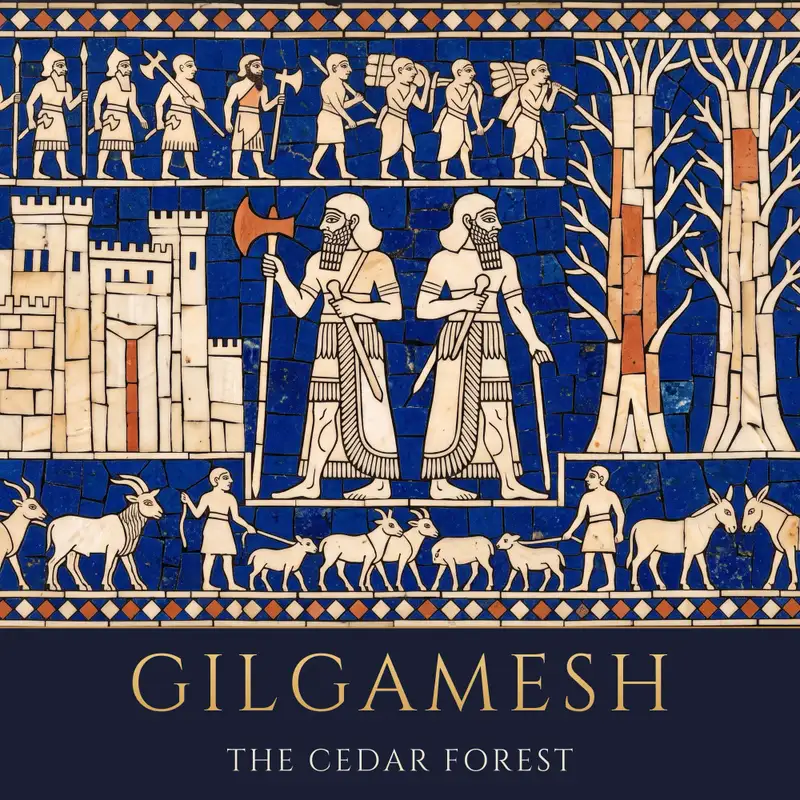
Welcome to The Sleeping Almanac. Tonight we come to the famous one. For two nights we have been in the deep background of this world, the making of it and the first person to sign her name to anything in it. Tonight we start the story that everybody has heard of and almost nobody has actually read, and we are going to take three whole nights over it, because it is three thousand lines long and it deserves them. Tonight is the first third. A king who is too much for his own city. A wild man made out of clay and thrown into the grass, who lives with the gazelles and drinks at their waterhole. A trapper who finds him and is frightened. A woman who is sent out to meet him, and who does the thing that turns him from an animal into a person, which is not what you might assume and is much stranger and much kinder. A wrestling match in a doorway that turns into the most famous friendship in literature. And then a long walk north into a forest that nobody was supposed to enter, to kill the thing that lived in it. And I will tell you now, so that you are not braced for it, that the killing happens in the tenth chapter and that the last two chapters of tonight are quiet. We begin on a wall, and in three nights time, at the very end of the third episode, we will end on the same wall. Hold nothing. It will come back to you. There is a room at the edge of the world, and in it there is a lamp. It is the same lamp. Perhaps you were here for the making of the world out of water, or for the woman in the moon house, or on older nights for the gods and the baskets and the flood. If so, welcome back, and your place on the reed mat is where you left it. And if this is your first night in the tablet house, be welcome. This is a good night to arrive on, because tonight is a beginning. The lamp is a small clay dish of oil, and it burns the pale gold of old honey. The room smells of river water and dust and barley. Outside, past the doorway, the river is going by in the dark, saying the same soft word over and over against the reeds. The scribe takes down a tablet, and then another, and then another, and keeps going until there are eleven of them stacked at his elbow, and then he puts a twelfth beside the stack rather than on it, slightly apart, which he does deliberately and which we will not talk about for two more nights. This one, he says, is the long one. You do not have to do anything now. Settle onto the mat. Let the lamp be warm on one side of you and the cool night on the other. Close your eyes if they want to close. There are three names tonight and they are the only three you need. Gilgamesh, who is the king. Enkidu, who is the wild man. And Humbaba, who is in the forest. Everything else can go past you. You do not have to follow every word. You do not have to remember any of it in the morning. If you drift, the story will go on without you. And one thing, whispered like a promise across the clay. There is a killing in this story and I am not going to hide it from you. But it is one killing, of one enormous creature, at the end of a long walk, and it is over in a page, and it is followed by two chapters of men floating timber down a river in the sunshine, which is where we are going to leave you. Nothing tonight will startle you. The frightening thing about this poem does not arrive until tomorrow night, and it is not a monster. Before we begin, one small thing, and then we will not interrupt again. If this story carries you down toward sleep, subscribe now, while your eyes are still open, so that the second and third nights find you without your having to look. A like helps other tired travelers find this lamp. And if you would rather carry these nights with you, The Sleeping Almanac is also a free podcast, on Apple Podcasts and on Spotify, waiting wherever you listen. That is all. Now settle back, and we begin.
The poem does not begin with the king. It begins with a building, and it begins by talking to you. Go up, it says. Go up on the wall of Uruk and walk along it. Survey the foundation platform, examine the brickwork. Is it not baked brick, of the very best? Did not the seven sages themselves lay its foundations? That is the opening of the oldest long poem in the world, and it is a walking tour. Somebody is standing next to you at the bottom of a wall, telling you to climb up and go along the top and look at the brickwork, and asking you, with obvious pride, to admit that it is good brickwork. Not to admire the king. Not to fear the gods. To go up and look at the bricks. And you can still do this. That is the part that undoes me. The wall of Uruk is in the ground in southern Iraq and it has been dug and measured, and it runs for something in the region of six miles around, and there are the remains of hundreds of towers along it, and where the mud brick has weathered you can see the courses. People go up on it. And it credits the foundations to the seven sages. They come up all through this literature and they are worth having once, tonight, because they will be back later in the season. The seven sages are figures from before the flood, half fish or fish clothed depending on the picture, who came up out of the water at the beginning and taught people the things people did not work out for themselves. Building. Writing. Law. The crafts. There are statues of them buried under the floors of houses, deliberately, as protection, and there are lists of them with names, and each one is attached to a king of the old time. So the poem's claim about the wall is not that a king built it. It is that the wall goes back past kings, to the people who taught the first people how to do anything, and that what you are climbing on is that old. And underneath the boast there is a fact. Uruk is one of the first cities on earth. Not a big village. A city, with a population that ran into the tens of thousands at a time when almost nowhere else on the planet had anything of the kind. Writing appears there. The earliest tablets anybody has found come out of that ground, and they are accounts of grain and beer and workers, and they are older than every story in this season by a long way. The poem tells you the size of the city, and it does it in the flattest possible way, like a man reading out a deed. One square mile is city. One square mile is date grove. One square mile is clay pit. And half a square mile is the temple precinct. Three and a half square miles, it says, is the measure of Uruk. That is a survey. Somebody paced that out, or read it off a document, and put it into a poem, and it survived four thousand years, and it is roughly correct. And then it tells you about the box. There is, the poem says, a copper box at the wall, and in it a tablet of lapis lazuli, and on the tablet is written everything this man went through. Open the box. Undo the fastening. Take out the tablet and read it aloud. So the poem tells you that the poem you are hearing was found in a box in the wall of a real city, written down by the man it happened to. That is not true, and it is the oldest version of that particular lie in the world, and every book that has ever pretended to be a found manuscript is doing what this poem did first. But the wall is real. The wall is six miles of it, still there. Remember the wall. In three nights we come back to it, and a man who has lost everything will point at the brickwork and it will be the ending.
His name was Gilgamesh, and he was king in Uruk, and there is a reasonable chance he existed. I want to put that carefully. There is a king list, made much later, that has him in it, in the right sort of place, in the first dynasty of Uruk, and there are a few other early mentions. He is not attested the way a king with his own inscriptions is attested. But he sits in the record roughly where a real early king would sit, and a good number of specialists think there was probably a man, and that the man became this. The poem says he was two thirds god and one third human, which is not a fraction that works, and everybody who has ever read it has noticed, and nobody has ever satisfactorily explained it, and I find that comforting. The oldest long poem in the world opens with arithmetic that does not add up. His mother is a goddess, called Ninsun, which means wild cow, and she is going to be important tonight because she is one of the few people in this literature who is unambiguously good at her job and completely unbothered by anybody. And he is magnificent. The poem spends a long time on this. Perfect in strength. Tall. Beautiful. He opened the passes in the mountains. He dug wells. He crossed the sea. He restored the temples. He built that wall. And he is a disaster to live near. The city complains, and the complaint is the engine of everything that follows, and it is worth hearing exactly. The young men of Uruk, they say, he does not leave alone. And the daughters, they say, he does not leave alone. Now, the tablets are damaged here, and there is an old reading of this passage that says the king was claiming a right over brides on their wedding nights, and you will find that in a great many retellings. The honest position is that the text does not clearly say it, that the reading depends on restorations of broken lines, and that specialists argue about it and have for decades. What the text definitely says is that he wore the city out. That nobody was left in peace. That the sons were kept from their fathers and the young women from their mothers, and that the people of Uruk went up to the gods and complained about their own king. And that is a good enough problem. A city built by a man who is too strong for it, who has done everything worth doing and has nothing left to do, and who is now simply loose in the streets with all that energy and no war on. And I want to put one other thing beside that, because if we only tell you this version you will get him wrong. There is a separate, older, Sumerian poem in which the same king behaves completely differently. In it, a rival city sends messengers demanding submission, and Gilgamesh goes first to the assembly of the elders of Uruk, who tell him to give in, and then he goes to the assembly of the young men, who tell him to fight, and he takes the second answer and the city holds. Two assemblies. A ruler who asks both of them. That poem is not about a man who is too much for his city. It is about a constitutional question, and it is one of the reasons people argue about how early something like a citizens' assembly existed in that country. So the tyrant of the first tablet is one telling. There are others, older, in a different language, where he is a careful king. The long poem chose the difficult version because a poem needs a problem, and I would rather you knew there were choices being made than think we have a photograph. So the gods hear the complaint, and they do what gods in this world always do, which is not to remove the problem. They make him a friend.
They went to the goddess who makes people. Her name here is Aruru, and she is one of the birth goddesses, and she is the one who made the human race in the first place. And they said, you made him. Now make his equal. Make somebody who can match him, so that they can contend with each other, and Uruk can have some peace. And she washed her hands. I love that detail more than almost any other in the poem, and it is one line and easy to miss. Before she made a living creature she washed her hands, the way you would before handling dough. She washed her hands, and she pinched off some clay, and she threw it down in the wild country. And a word about that clay, because we have been here before in this house and the two are not the same. In the older story, the one with the baskets and the strike, the whole human race is made out of clay mixed with the blood of a god, once, at the beginning, to carry the work. Two nights ago, in the Babylonian poem, people are made out of the blood of the commander of the losing army, once, so that the gods can rest. This is neither of those. This is one man, made on request, as a match for another man, by a goddess who washed her hands first. It is not the creation of humanity. It is a commission. Same material. Completely different job. The tablets are perfectly comfortable having all three of these in the same library and so are we. And there, in the open, out beyond the fields, Enkidu came into being. He is covered in hair. The whole of him, shaggy, all over his body. The hair of his head grows long, like a woman's, thick as the barley goddess's. He knows nothing of people or of settled country. He wears no clothes, because there is nobody to have taught him about clothes. He eats grass with the gazelles. He crowds in at the waterhole with the animals and drinks alongside them. He is not lonely and he is not a savage and the poem is entirely without contempt for him. He is simply an animal, and a well fed and contented one, and he is enormous. And I want to give you what he was actually like before anybody got to him, because the description is one of the most carefully made things in the poem and it is not what people remember. He wears no clothes. He knows no people and he knows no land. He does not know bread and he does not know beer. And he lives with the animals, and this is the part that matters. He does not hunt them. He eats grass with the gazelles. He jostles at the watering hole with the wild beasts, and the poem says the herd is glad of the water and so is he. He is not a wild man in the sense of a savage. He is a wild man in the sense of a creature who belongs to a herd, and is happy in it, and has never been anything else. And what he does that brings him to anybody's notice is not violence. It is that he fills in the trapper's pits and pulls up the traps and lets the animals out. That is his crime. He keeps undoing the hunting. Which means the poem introduces its second hero as somebody who is preventing people from making a living, out of straightforward sympathy for the things being caught, without any idea that he is doing anything at all. And then it puts him next to the king. Look at what these two actually are, side by side, because the poem has built them as a matched pair on purpose and every detail lines up against its opposite. One is inside the greatest wall in the world. The other has never seen a wall. One is two thirds god. The other is made of clay and thrown into the open country. One is described as a bull rampaging through his own city, taking whatever he wants from people who cannot refuse him. The other is described as a creature drinking peacefully with a herd, taking nothing, and going out of his way to spare animals he could have eaten. The poem is not making a hero and a monster. It is making two halves of a person, and then spending the rest of the night putting them together and watching what the combination does. And then the traps start disappearing. There is a trapper working that country, setting pits and snares for the animals, and he comes out one morning and his pits are filled in and his snares are pulled up and the animals are drinking calmly at the waterhole. And he sees, standing among them, a man. The poem is very good about the trapper. It says his face froze, the way a man's face does. It says he went home and could not speak of it properly, and that he was rigid with fear, and that his heart was pounding. And it says he went to his father. And his father, who is an old man in a hut at the edge of the wild country, gives him a piece of advice that changes the history of literature. Go to Uruk, he says. Go to the king. Tell him what you have seen. And ask him for a woman.
Her name is Shamhat, and she works at the temple of the goddess of the thing that turns over in a night, and what her profession was exactly is one of the longest running arguments in this field, and I am going to give you the honest version rather than either of the confident ones. There was a class of women attached to temples in that world, with titles, and duties, and standing. Some of those duties involved rites and music and celebration. Whether and how they involved anything else is argued about endlessly, and the words for them are translated in a dozen ways depending on which decade and which scholar you are reading. She has been called a prostitute and a priestess and a courtesan and a temple servant, and every one of those carries a load of assumptions from the translator's own century. What the poem tells us is what she does, and what she does is the thing that matters. She walks out into the wild country with the trapper. Three days walk, out past the fields, to the waterhole. And they sit down and they wait. For two days nothing. And on the third day the animals come down to drink, and among them is the man. And she does what she was brought to do, and the poem says it plainly and without any leering at all, and takes about four lines over it. She was not ashamed, it says. She took him in. For six days and seven nights, Enkidu was with her. And then the important part. When he stood up and went back to the animals, they ran from him. The gazelles saw him and scattered. The wild creatures of the open country backed away from him. He tried to go after them and his legs would not do what they had done. His body was heavy. His knees were slow. He was not the same thing any more. And he came back and sat down at her feet, and the poem says that he had lost his strength, and that he had gained understanding, and that he was wise, and broad in his thinking. Now, that exchange is the whole of it, and I want to be careful with it, because it can be told two ways and one of them is much better and also more accurate. The bad way is to say he lost his innocence. That is a Genesis reading laid over a poem that is older and that does not have the same idea in it at all. What the poem actually says is that he became able to think, and that the price of it was that he could no longer run with the animals. Not because he had done something wrong. Because he had changed species. You cannot be a person and also be a gazelle. The herd knew before he did. And what does she do with him, this woman who came out to the waterhole for six days with a trapper? She talks to him. She sits with him and tells him about the city. And this is the longest speech any woman gets in the poem and it is worth having properly, because everything after it happens because she said it well. Come with me, she says, to Uruk of the walls, to the holy temple, where the people are dressed in fine clothes, where every day is a festival, where the young men are handsome and the young women are lovely, where there is music and drums and the perfume of cedar. And then she says the thing that lands. There is a man there, she says. His name is Gilgamesh. He is powerful and beautiful and there is nobody like him, and he does not sleep at night, and the city is worn out with him. You are his equal. You were made his equal. Go and see him, and he will see you, and you will know each other. She is not seducing him into the city. She is recruiting him. She has understood, in six days at a waterhole, exactly what he is for, and she goes and gets him, and she is right about all of it. And I will tell you now, because tomorrow night is heavy and I would rather it did not surprise you there: the poem does not forget her. In the second episode a dying man will curse her by name for having brought him out of the wild country, at length, bitterly, and then the sun god will answer him and list everything she gave him, and he will take the curse back and bless her instead. She is the only person in this poem who is cursed and blessed by the same man in the same conversation. And then she takes off her clothing and she divides it in two and she puts half of it on him. That is how Enkidu gets dressed. She tears her own dress in half and gives him one half and wears the other half herself and takes him by the hand like a child and walks him to the shepherds' camp.
I want to spend a whole chapter here, because this is the gentlest passage in the entire epic and hardly anybody ever tells it. The shepherds put food in front of him and he does not know what it is. They set out bread, and he stares at it. He has never seen bread. He does not know that it is food. He had, the poem says, only ever sucked the milk of wild animals. He squints at it and turns it over and does not eat it. And they set out beer, and he does not know what to do with that either. And somebody, one of the shepherds, tells him. Eat the bread, Enkidu, they say. It is what people live on. Drink the beer. It is the custom of the land. And I want to stop on the beer for a moment, because we hear the word and think of an indulgence and in that country it was nothing of the kind. Beer there was made from barley bread, broken up and fermented, and it was thick, closer to a gruel than to anything you would order now, and it was drunk through a straw made of reed or metal because of the husks floating in it. There are pictures of people sitting round a single large jar with several straws going into it, which is how you drank in company. It was food. It was a large part of how an ordinary person got their calories. Workers were paid in it, by the day, measured out in fixed rations along with barley and oil, and those ration lists are among the earliest documents anybody wrote. And there is a hymn to the goddess of beer, whose name is Ninkasi, and the hymn is a recipe. It goes through the process, step by step, the soaking and the baking and the mashing and the vat, in praise language, so that a person singing a hymn to a goddess is also being told how to make beer, which means the oldest brewing instructions we have are a song. So when the shepherds put a jar in front of him, they are not offering him a drink. They are offering him dinner, and the answer to the question of what people in that country ate. So he ate the bread, until he was full. And he drank the beer. Seven jugs of it. And then, the poem says, he became expansive and he sang. He was joyful. His face lit up. He washed his hairy body with water, and he rubbed himself with oil, and he put on clothes, and the poem says, and this is the line, that he became like a man. Seven jugs of beer and a wash and a change of clothes. That is the initiation. That is the whole ceremony of becoming human in the oldest story we have. Somebody hands you bread and explains what it is for, somebody pours you a drink, you get cheerful, you have a wash, you put on a shirt. And then he takes a weapon and goes out at night to guard the flocks against the lions and the wolves he used to live beside, and the shepherds sleep, and the poem says they slept soundly, because there was a man watching. And it is worth saying what that meant in practice, because the poem is specific and the picture is wonderful. He had spent his whole life on the other side of that arrangement. He knew where the lions lay up in the day. He knew what a wolf does at the edge of a flock and how long it waits. He had drunk at the waterhole beside every animal that was now coming for the sheep, and he knew all of them by sight and by sound and probably by smell. So he sat out at night with a weapon, in the dark, listening, and the poem says he caught wolves and drove off lions, and that the herders lay down and slept. He was, within a week, the best thing that had happened to that camp. And then a stranger comes through, going to Uruk for a wedding, and Enkidu asks him what the city is like. And the man tells him about the king, and about what the king does, and Enkidu's face goes white with anger, and he says, take me there.
Meanwhile, in the city, the king has been dreaming. He has had two dreams and he does not understand either of them, and he takes them to his mother, because his mother is a goddess and this is what she is for. In the first dream, he says, the stars of the sky were above me, and something fell out of the sky like a lump of rock, and it landed in front of me. And I tried to lift it and it was too heavy. And the whole city gathered around it. And I loved it. The poem uses the words the way you would about a person. He says he was drawn to it as to a wife. He says he bent over it, and lifted it with great effort, and brought it to his mother, and laid it at her feet. And Ninsun, wild cow Ninsun, listens to the whole thing and then explains it to him without a moment of confusion. That, she says, is a friend. There is coming to you a strong companion, one who rescues a friend. He is the mightiest in the land. And you will love him as you love a wife, and you will bend over him, and I will make him your equal. And then he has a second dream, about an axe lying in the street, and the city gathered round it, and again he loved it, and again she says the same thing. It is a man. It is your friend. You will love him. Now, I want to say something about this, because it is the thing people most often ask about this poem and it deserves a plain answer. The language in these dreams is love language. It is the language you would use about a spouse, and the poem uses it deliberately and repeatedly, and the scholarship on whether that means what a modern reader would take it to mean is large, serious, and unresolved. What is not in dispute is that this is the central relationship in the poem, that it is described in the most intimate terms the language had, and that everything that happens for the next two nights happens because of it. The poem itself does not seem to feel any need to categorise it. I am not going to do it for them. So he is expecting a friend when Enkidu walks into town. And Enkidu walks into town and the people come out and look at him, and they say he is the same build as the king, shorter perhaps, but broader, and the city fills up with a kind of excitement, and somebody says, a rival has come. There is a wedding happening, and the king is going to it, and the door of the house is open. And Enkidu goes and stands in the doorway and puts his foot across it, and will not let him in. And they fight. They fight in the doorway and then out into the street. The poem says they grappled like bulls, that they shattered the doorpost, that the wall shook. It is a proper fight and it is not one sided and it goes on. And then the king gets his knee bent to the ground and puts his foot back down and stops. And it breaks. Whatever it was between them breaks, right there, in the street, with the wedding guests watching. Gilgamesh turns away, and his fury goes out of him, and Enkidu speaks first, and what he says is not a taunt. He says, your mother bore you as one apart. Your head is raised above other men. Enlil has given you the kingship over the people. And they kissed each other, the poem says, and they became friends. There are older tablets of this scene, from centuries before the long version, and two of the best known sit in museums in America and are called after them, one at Pennsylvania and one at Yale. They tell the same events in a different tone, warmer and rougher and less grand, and in one of them, after the fight, Enkidu stands there and weeps because he has understood that he has come into a settled life and will not go back, and Gilgamesh has to comfort him. One sentence of that is all I want to give you, because two versions is a texture and three is a lecture. Some older tellings are gentler. The scene is the same and the men are softer in it. The scribe stops for a moment. That, he says, is the whole problem of the first two tablets solved in one afternoon by two men who wanted a fight. The city is at peace. The king has somebody to talk to. The wild man has a house. Everybody in Uruk got what they asked for. He turns the tablet. And if it ended there, he says, nobody would have copied it for two thousand years.
What happens next is that Enkidu becomes unhappy, and it is one of the most human turns in the whole poem. He has a house now. He has a friend. He eats bread and drinks beer and sleeps under a roof. And after a while he goes soft, and he sits down, and he weeps, and Gilgamesh asks him what is wrong, and Enkidu says, my arms have gone slack. My strength has become weak. Idleness has come over me. The wild man got a comfortable life and it made him miserable. And Gilgamesh, who has been looking for something to do since the first tablet, has an idea. There is, he says, a forest. It is far away, in the mountains to the north or the west depending on which version you are reading, and it is full of cedar, which is the most valuable timber in the world to a country that has no trees worth the name. Cedar is what temple doors are made of. Cedar is what roofs are made of. Cedar smells extraordinary and lasts for centuries and does not grow anywhere within a month's walk of Uruk. And it is guarded. The guardian's name is Humbaba, and he was appointed by Enlil himself to keep that forest, and he is a terror by design. Enlil put him there so that people would not cut the cedars. He has a voice like a flood. His mouth is fire. His breath is death. And he has seven of something that the poems call radiances or auras or terrors, which are put on and taken off like garments, and which are the reason nobody has ever got near him. Let us go, says Gilgamesh, and kill him, and cut the cedar, and make a name that lasts. And here is the thing I want you to notice about this poem, and it is the reason it is not a hero story in the way we usually mean. Everybody tells him not to. Enkidu tells him not to first, and Enkidu is the one person who has actually been there. When I lived in the wild country, he says, I knew that forest. I have seen where he goes. Humbaba's roar is the flood, his mouth is fire, his breath is death. Why do you want to do this? It is a battle that cannot be won. Then the elders of Uruk tell him not to. The council of the old men of the city, who have watched him grow up, tell him he is young, that his heart is carrying him away, that he does not know what he is proposing, and that the road is long and the thing at the end of it is not something a person defeats. And when he will not be talked out of it, they change tack, and this is the part I like. Having failed to stop him, the old men give him instructions. Do not rely on your own strength alone, they say. Let Enkidu go in front of you, because he knows the road and he has walked the forest. Let him lead. He who goes in front saves his companion. And when you make camp, dig a well, so that the water in your waterskin is always fresh. And pour a libation to the sun god, and remember your father. That is what the council of a city says to a young man who will not be stopped. Take somebody who knows the way. Let him go first. Dig a well every night. Keep your water fresh. Say your prayers. Think of your father. And then his mother tells him not to, or as near to it as a goddess will come. Ninsun goes up onto the roof of her temple. She washes. She puts on a clean robe and the ornaments of her office and her crown. She sets out an offering and lights incense, and she raises her arms to the sun god, and what she says to him is a complaint. Why, she says, did you give my son a restless heart and then let him go? She does not stop him. That is not the kind of goddess she is. She asks the sun to watch the road, and she asks the winds to be with him, and then she does something that I think is the best thing anybody does in the first half of this poem. She comes down, and she sends for Enkidu, and she puts a token round his neck, and she adopts him. She makes the wild man her son. Formally, in front of the priestesses, so that the man made out of clay and thrown into the grass, who had no mother and no people and no name until a woman gave him half her dress, now has a family and a temple and a place he belongs to. And she says to him, Enkidu is not of my body, but I have taken him as mine. And then she tells him to look after her son.
They went out through the gate, and the young men of Uruk cheered them, and the elders gave them advice all the way to the wall, and then they were on the road, and the road is long. Fifty leagues in a day, the poem says. A journey of a month and a half they made in three days. And at the end of each day they stopped, and they dug a well, and they poured out water, and they made an offering of flour, and then Gilgamesh climbed the mountain and went to sleep on purpose to have a dream, because in this world that is a technique. And I want to give you the ritual, because it is the same every night and repetition at this hour is the whole point. They stop before dark. They dig a well, so there is fresh water. They pour some of it out on the ground as an offering. They put out flour. Then Gilgamesh goes up the slope, alone, and draws a circle of flour around himself, and lies down inside it with his back against the hill. He would put his chin on his knees, the poem says. And sleep came over him. Chin on the knees. A very large man, on a mountainside, curled up inside a ring of flour, with his chin on his knees, waiting for a dream. It is the least heroic posture in the poem and it is repeated four nights running. And I want to stop on the circle of flour, because it is not a decorative detail and I did not know what it was the first several times I read this. It is a real ritual object. That world had a large and well organised profession of people whose job was to deal with things that came at you from outside the ordinary run of life. Illness, bad dreams, a house that felt wrong, a persistent run of misfortune. And one of the standard tools of that profession was a line of flour, poured on the ground, drawn around a person or a bed or a doorway, to mark out a space that the thing could not cross. There is a word for it. It appears in the ritual texts constantly. Draw the circle. Pour the flour. And then the patient sits inside it, or lies down inside it, and the work is done from there. So the picture in this chapter is not a warrior improvising a bit of camp craft. It is a man performing a domestic protective rite that ordinary people in that country performed in their own houses, on a mountainside, alone, before deliberately going to sleep in a place he is frightened of. He is doing what your grandmother would have done. And that is what makes the posture land the way it does. He digs the well, and pours out the water, and sets out the flour, and goes up the hill by himself, and draws the circle around himself the way an exorcist would draw it around a sick child, and then he sits down inside it and puts his chin on his knees. The strongest man in the world, on a mountain, inside a ring of flour, with his knees up. And the reason he is doing it at all is the other half of the practice, which is that going to sleep in order to receive a dream was a technique, and a respectable one. There were people whose job was to interpret dreams. There were texts listing what dreams meant, long catalogues of them, this image signifies that outcome. And there were rituals for asking, deliberately, for a dream to be sent, and for what to do with a bad one when it came. So he is not sleeping badly and having nightmares. He is going up the hill on purpose, four nights running, to request information, in the correct manner, inside a protected circle, and every time he gets it, and every time it terrifies him, and every time his friend sits with him in the dark and tells him it means the opposite. That is the ritual, and it is repeated four nights, and it is the most restful passage in the whole poem. And every night he woke in the middle of it, and every night the dream was terrible, and every night Enkidu explained it to him and made it good. The first night he dreams the mountain fell on them. And Enkidu says, the mountain you saw is Humbaba. We will kill him and throw his body down and it will lie like the mountain. The second night he dreams of a bull that seizes him, and the ground splits, and dust darkens the sky, and then a man gives him water from a skin. And Enkidu says, the bull is not an enemy. The one who gave you water was the sun god. The third night, thunder and lightning and fire falling and the ground turning to ash. And Enkidu says, it is good. Now I want you to see what is happening on that road, because it is not really about dreams. Every night, a frightened man wakes up in the dark on a mountain and tells his friend the worst thing his mind has produced. And every night his friend, who is more frightened than he is, and who said out loud before they left that this could not be won, listens to the whole thing and then tells him calmly that it means they are going to be fine. Enkidu lies to him for three nights running, gently, at altitude, so that he can sleep. That is what the dream chapters are. And on the last morning they came down out of the passes, and there was the forest.
Here is where I have to tell you about a tablet that we have only had since twenty fourteen. For most of the time that people have been reading this poem, the arrival at the cedar forest was short. A few lines. They stood and stared at the mountain of cedar, they looked at the height of it, they marvelled, and then the story moved on to the killing. And then a museum in Sulaymaniyah, in the Kurdistan region of Iraq, bought a tablet. I am going to be plain about that, because it matters. It was not excavated. It was bought, from a dealer, along with a group of other tablets, in the years after the invasion and the looting, when enormous numbers of objects came out of the ground illegally and went onto a market. The museum was buying them to get them back into the country rather than out of it, which is a defensible policy and also means that we do not know what hole in what ground this thing came out of, and we never will. A scholar was working through what the museum had acquired, tablet by tablet, and came to this one, and recognised the shape of the lines, and got a colleague, and the two of them published it in twenty fourteen. I want to be honest about how that feels, because it is two things at once and both are true. It is one of the great finds of the last hundred years in this field, and it exists in our hands because somebody dug a hole illegally in a country that was falling apart and sold what came out. Every specialist who works on this material lives with that, and the museums that bought objects back to keep them in the country have made an argument about the least bad option available, and reasonable people disagree about it. What nobody can do is pretend the tablet came out of a clean trench, because it did not. So we say where it came from, and then we read what is on it. And what is on it is about twenty lines of Tablet Five that nobody alive had ever seen. And what those twenty lines contain is the forest. Not the height of the trees. The noise. The monkeys. There are monkeys in the cedar forest. They are chorusing, the tablet says. There is a whole troop of them up in the canopy making a racket, and the poem describes it as a kind of music, and it says that Humbaba listens to them, and that the sound of them is like the musicians who play for a king. And the cicadas. There is a shrill of cicadas going all through it, constant, the way cicadas are. And birds calling to each other. And doves moaning. And something answering something else across the valley. And the resin. The cedar bleeds its resin and it runs down the trunks, and the tablet says the ground was soaked with it, and the smell of it must have been enormous, because cedar resin is one of the strongest smells there is and this is a whole forest of it in the heat. Do you understand what that changes? For three thousand years the cedar forest was a location. It was where the monster lived. And then somebody bought a broken tablet from a dealer, and now the cedar forest is a place with monkeys shouting in the treetops and insects screaming and birds and the smell of hot resin, and Humbaba, the terror, the thing with a voice like a flood, sits in the middle of it listening to the monkeys as though they were his orchestra. He is not a beast in a cave. He is a king in a country, and it is a loud, green, extremely alive country, and he is at home in it. And the same tablet has one more thing in it, and it is the one that hurts. Enkidu knew him. When Enkidu lived out in the wild country, before the trapper and the woman and the bread and the beer, he had been in that forest and he had known Humbaba, and the tablet has him saying so. They were, in some sense, familiar to each other. So the man who told his friend it could not be won, and who then walked six hundred miles to do it anyway, and who lied about his dreams for three nights to keep him calm, is about to help kill somebody he used to know. And now the two of them are standing at the edge of the trees, and they can hear the monkeys, and neither of them says anything for a while.
They cut a cedar. That is what starts it. Not a challenge, not a horn, not a shout. They take an axe to one tree, and the sound of it goes through the forest, and Humbaba hears it and comes. And when he comes, he is wearing his radiances, and this is the part of the story that I find most interesting and that gets left out of every retelling. The seven terrors are not weapons and he does not fight with them. They are worn. They are something like an atmosphere, a blaze that surrounds him, and there are seven of them and they can be put on one at a time and taken off one at a time, and while he is wearing all seven of them nobody can come near him. The word for them is used elsewhere in this literature for the radiance of gods and of kings and of certain objects. It is what makes a thing unapproachable. And there is one detail about them that I have always liked. Each one has a name, and the names are not grand. They are the names of the weather in a country where the weather can kill you. And when he takes them off, he takes them off one at a time, and while he is doing it he is speaking, and what he is saying is a challenge and a boast and a description of what he intends, and it goes on, and the two men stand there and let him finish. And the sun god, who Ninsun asked to watch the road, sends the winds. Thirteen of them, in the Akkadian version. The great wind, the north wind, the whirlwind, the storm, the ice wind, the tempest, the sandstorm, and more, and they come all at once, from every direction, and they pin him. And in the older Sumerian version of this story, which is a different poem and which I am flagging as a different poem, it is done differently and I think more cleverly. There, Gilgamesh talks to him. He offers him a gift, and asks for a radiance in exchange, and Humbaba takes the gift and gives one up. And then another gift, and another radiance. He offers him his elder sister to be his wife and his younger sister to be his servant. He offers him flour, and water skins, and shoes for his feet, and each time he asks for one more, and each time Humbaba hands one over, because each time the offer sounds like the beginning of a friendship. And when all seven are gone, Gilgamesh takes hold of him. That is the oldest confidence trick in the world and it is being run on a monster, and the reason the poem can do it is that Humbaba is not stupid. He is lonely. He has been standing in a forest by himself for as long as anybody can remember, guarding trees for a god who put him there, and a young man comes to the edge of it and offers him a family. He gives away everything that makes him unapproachable, one piece at a time, to somebody who says he wants to be close to him. However it is done, it ends the same way. The radiance comes off. The winds hold him. And he is on the ground with a man standing over him. And he begs. He appeals to Gilgamesh directly. He says he will serve him. He says he will cut the trees for him himself, and build him a house out of them. He says, in the Sumerian version, that he never had a mother or a father, that the mountain bore him. And Gilgamesh hesitates. That is on the tablet. The king wavers. He is about to let him go. And Enkidu says no. Enkidu, who did not want to come, who said it could not be won, who knew him in the old days, is the one who says finish it, because if you let him go you will never get home and Enlil will hear of it and everything we have done will come apart. So they killed him. The poem does it in a few lines and I will do it in fewer. They struck him, and it was done, and the forest went quiet for a distance of two leagues around, and the mountains shook, and the cedars, the poem says, cried out. There is one more line, in some versions, and I will give it to you and then close the chapter. As he goes down, Humbaba curses them. He says, may the two of them not grow old together. May Enkidu not find peace. Note that he does not curse the king. He curses the friendship, and he is specific about which of the two he means, and he is the only character in the poem who says out loud what is going to happen. And that is the killing, and it is finished, and nothing else in tonight's episode will ask anything of you. And before Nippur, one thing about the journey back, because the poem skips it and the geography is worth having. They went there on foot, and it is not a short walk. Whatever mountain range the cedar forest is meant to be, and the poem is not consistent about it and the older Sumerian version and the later Akkadian one point in different directions, it is a very long way from a city in the far south of Iraq to any mountain with cedars on it. Hundreds of miles. Weeks. And they did it twice. Out and back. The poem gives you fifty leagues a day and a journey of a month and a half done in three days, which is the standard way this literature says a long way, quickly, and which nobody was meant to take as a measurement. What it actually was, if you strip the poetry off, is two men walking to another country and back, with a head, and then building a raft.
They took the head to Nippur. They cut cedars, a great many of them, and they made a raft, and they took the head of the guardian with them, and they went to the city in the middle of the country where Enlil lives, and they laid it in front of him. And Enlil was furious. Not pleased. Not impressed. Furious, and the poem does not soften it. Why did you do this, he says. Why did you burn the forest? Why did you kill the guardian? He should have eaten the bread you eat and drunk the water you drink. That is the line. He should have sat and eaten with you. And then Enlil does the strangest and most beautiful thing in the whole of tonight, and almost nobody knows about it, because it survives best in the older Sumerian poem rather than in the famous version. He takes the seven radiances, and he gives them away. He gives the first one to the fields. He gives the second to the rivers. He gives the third to the reeds. He gives the fourth to the lions. He gives the fifth to the palace. He gives the sixth to the forest. And the seventh he gives to the goddess of the great prison. And in the Sumerian telling he does it while he is still angry, which is the part that makes it make sense. He is not rewarding anybody. He is refusing to let the thing simply be gone. Somebody destroyed a piece of the world's furniture, and rather than replace it or restore it, the lord of the air takes what made it frightening and scatters it through everything that people have to live alongside anyway. And before he gives them away, I owe you an explanation of what they are, because the word has been in this house all season and I have been translating it and never defining it. The radiance. It is a real term with a real meaning and it is one of the central ideas of that whole civilisation. It is not light in the ordinary sense. It is the visible, terrible, unbearable brightness that something powerful gives off, and the point of it is that you cannot look at it and you cannot stand in front of it. Gods wear it. It is a standard part of the description of a god. Kings wear it, and being covered in it is one of the things a god grants a king when he makes him king. Temples have it. Weapons have it. And monsters have it, which is why the guardian of the forest has seven. And it can be taken off, and given, and lost. That is the part that matters, because it means it is treated as an object rather than a quality. A god can put it on somebody. A god can strip it off. When a king was defeated, the texts sometimes say his radiance was taken away, and they mean it as a description of what happened, not as a metaphor for morale. So the seven that the guardian wears are not seven feelings. They are seven detachable pieces of terror, worn like armour, and the whole of the confrontation in the forest is about getting them off him one at a time, which is what the winds are for. Which is why what happens next is so surprising. There is a version of this story in which the hero takes the radiances. He kills the guardian and he puts them on and he is now the frightening thing, and that would be the ordinary shape of it, and there is a Sumerian poem where he does hand them over and the question of who ends up wearing them is live. And in this telling, nobody wears them. The lord of the air takes seven pieces of pure terror, the awful shining that made a creature unapproachable, and he does not keep them and he does not destroy them and he does not give them to the men who did the killing. He puts them in the fields, and the rivers, and the reeds, and the lions, and the palace, and the forest. Which means that from that day, according to this poem, a certain amount of the terrible is simply in the ordinary furniture of the world. In the river you cross. In the reeds by your house. In the field you work in. Not concentrated any more, not standing in one place in a forest with a face on it, but distributed, in small quantities, through everything. And I have thought about that for a long time and I do not think it is a punishment or a consolation. I think it is an explanation. Somebody was trying to say why an ordinary field, in ordinary daylight, can occasionally feel like that. Think about what that is. The terror that kept people out of a forest is broken up and distributed, in pieces, across the ordinary world. Into the crops. Into the water. Into the reed beds along every canal in the country. Into the animals. Into the buildings people live in. The thing they killed did not go anywhere. It was handed out. So that afterward, when you stand in a field at evening, or come up on a river in the dark, or hear something move in the reeds, and feel that small lift at the back of the neck that has no reason attached to it, the poem has an explanation ready for you, and the explanation is that a piece of the guardian was put there on purpose after he died, by the lord of the air, so that the world would not be entirely safe and entirely dull. They wanted a monster killed. What they got was a monster divided into the scenery.
The lamp is low now. Here is the last picture of the night, and it is the quietest thing in the poem, and it is what they actually did next. They cut the cedars, and they made them into timber, and they built an enormous door. A door for the temple at Nippur, for Enlil's own house, made of cedar from the forest that Enlil had told them to leave alone, which is either an apology or a provocation and the poem does not say which. Seventy two cubits high, it says, and twenty four wide, and a cubit thick, and its pivot and its fittings all of one piece. And then they put it in the river, and floated it home. That is the image. Two men on a raft of cedar logs going down the Euphrates in the sun, several hundred miles, at the speed of the current, with a door lashed to the deck. And I can tell you what happened to that door, because the poem tells us, though not tonight and not tomorrow. It is standing in Enlil's temple at Nippur, and tomorrow night, a man who is dying is going to turn his face to the wall and speak to that door, out loud, and blame it, and it is one of the strangest small moments in the whole epic. Keep the door somewhere at the back of your mind. It comes back sooner than you think. There is nothing to do on a raft. That is the whole point of it. You cannot make it go faster. You steer occasionally. The country goes past on both sides, flat and green and then flat and yellow, with the date palms in lines along the banks and the villages coming and going and people looking up from the fields at two men and a very large door. And here is the thing underneath the whole story, which I have saved for the raft because it is a restful fact rather than an exciting one. Cedar was real, and getting it was a real problem, and it is one of the things that country genuinely spent centuries doing. There are no cedars in southern Iraq. There is barely a tree worth cutting. The building materials there are mud, reed and date palm, and date palm makes a poor beam. So every substantial roof, every temple door, every important building, needed timber from somewhere else, and somewhere else was hundreds of miles away in the mountains, in the country we now call Lebanon and the ranges north of it. And they went and got it, for thousands of years. There are royal inscriptions, ordinary administrative ones, not poems, in which a ruler records with obvious satisfaction that he brought cedar down from the mountain, and gives the dimensions of the beams, and says what he made with them. One ruler of a southern city describes bringing cedar in rafts down the river and lists the lengths. So the plot of the most famous poem in the world is a logistics problem. A country with no trees needs timber. The timber is far away and the road is dangerous and there is something in the mountains that stops people taking it. Two men go and get some. Everything mythical in this story is sitting on top of a completely ordinary and very old commercial fact, and the fact is that somebody had to go and fetch the wood. And it would have smelled of cedar the entire way. That resin the tablet talks about, soaking the ground of the forest, is in every log under them, in the heat, for weeks. The most famous friendship in literature spent the best part of a season lying on a raft in the sunshine, smelling of cedar, with nothing to do. I do not think either of them was ever happier than that, and I am fairly sure they did not know it at the time, and I am telling you now because tomorrow night is the other kind of night, and I would rather you fell asleep on the river. Think of it, wherever you are lying. The forest is behind them and still enormous, because they took a handful of trees out of a mountain of them, and the monkeys are still up in the canopy making their noise, and the cicadas have not stopped, and the resin is still running down the trunks in the heat, and nobody is guarding any of it now. The radiances are out in the world, in the fields and the rivers and the reeds. The head is in Nippur. And the two of them are lying on their backs on a raft of cedar in the middle of a wide brown river, going home, not talking, in the sun. Outside, past the doorway, the river is going by in the dark, saying the same soft word over and over against the reeds. You do not have to keep any of tonight. If you keep one thing, keep the raft. Sleep well. Goodnight.