Welcome to The Sleeping Almanac. Tonight is the hard one, and I am going to tell you that at the start rather than let you find it. Last night two men walked six hundred miles, killed the guardian of a forest, and floated home on a raft of cedar in the sunshine with nothing to do. Tonight one of them dies. I want to be plain with you about how this house handles that, because you are lying down and you did not come here to be upset. The death in this story is not violent. Nobody is killed. There is no accident. A man becomes ill, and lies in a bed for twelve days, and his friend sits with him, and then he dies, and then his friend cannot accept it for a week and finally does. That is the whole of it, and it is the oldest description of that experience anybody wrote down, and it is four thousand years old, and it is still, line for line, exactly right. We will tell it the way this house tells everything. Plainly, in a low voice, once, and then set down. It is finished by the tenth chapter and the last two chapters of the night are a washing and a quiet city. Before that there is a goddess who makes an offer and is refused, and a bull that comes down out of the sky, and one of the great insults in literature, thrown by a man who is about to pay for it. Stay with it if you can. And if you cannot, if tonight is the wrong night for this one, then let it go past you, because that is allowed here and always has been. There is a room at the edge of the world, and in it there is a lamp. It is the same lamp. Perhaps you were here last night on the raft. If so, welcome back, and your place on the reed mat is where you left it. And if this is your first night in the tablet house, be welcome, and you have missed less than you think. Two men are friends. They went and did something enormous together. That is everything you need. The lamp is a small clay dish of oil, and it burns the pale gold of old honey. The room smells of river water and dust and barley. Outside, past the doorway, the river is going by in the dark, saying the same soft word over and over against the reeds. The scribe takes the stack of tablets and moves the first five to one side, and puts his hand flat on the sixth. You do not have to do anything now. Settle onto the mat. Let the lamp be warm on one side of you and the cool night on the other. Close your eyes if they want to close. It is the same three names as last night, and you already have them. You do not have to follow every word. You do not have to remember any of it in the morning. If you drift, the story will go on without you, and tonight, more than any other night in this season, drifting is not a loss. This is a poem about a man who could not let go of something, and there is no version of tonight where sleeping through part of it is a failure. And one thing, whispered like a promise across the clay. Nothing tonight will startle you. There is a bull in it and it does not go well for the bull, and there is a bad dream in the middle of the night, and I will tell you before it starts that the dream is about a house, and that the house is not frightening once you have seen it properly, and that the poem itself takes the fear out of it before it lets you go. And I will tell you the very last thing now, so you can rest on it the whole way through. This story does not end tonight. Tomorrow night the same man walks out of the city to look for a way not to die, and he does not find it, and he comes home anyway, and the ending is kind. Whatever happens in the next two hours, there is a third night and it is the gentlest of the three. Before we begin, one small thing, and then we will not interrupt again. If this story carries you down toward sleep, subscribe now, while your eyes are still open, so that the last night finds you. A like helps other tired travelers find this lamp. And if you would rather carry these nights with you, The Sleeping Almanac is also a free podcast, on Apple Podcasts and on Spotify, waiting wherever you listen. That is all. Now settle back, and we begin.
The sixth tablet begins with a man washing his hair. He washed his matted hair, the poem says. He cleaned his gear. He shook out his locks over his back. He threw off his soiled clothes and put on clean ones, wrapped a cloak about him and tied on a sash. They have come home. The timber is delivered. The thing that could not be done has been done, and the road dust is being scrubbed off in a courtyard in Uruk, and somebody has laid out a clean cloak. And I want to hold this for a moment, because it is the last ordinary morning in this poem and nobody in it knows that. They have been away for months. The city has had them back for long enough that the parade is over and the story has been told in every house. The timber went to Nippur and the door is standing in it. Enkidu has a room somewhere in the palace and a place at the table and a name that people in the street know. The thing they went to do is done and it worked, and there is nothing on the calendar. This is the part of a life that nobody writes down, and the poem gives it four lines and then it is gone: a man in a courtyard with wet hair, in the sun, being handed a clean cloak. And then he put on his crown. That is the sentence that starts everything that follows. A young man, freshly washed, in clean clothes, putting on a crown, in the sunlight, in the middle of his own city, at the height of his life. And I want to give you the city he was standing in, because this is the last time we see it working and tomorrow it will be a place he is walking away from. It is the middle of the day. The wall is out there, six miles of it with its towers, and inside it the streets are narrow and the walls are mud brick and every surface that faces the sun is too hot to touch and every surface in shadow is cool. There is a smell of dust and animals and baking and the river. In the temple precinct the offerings are going on at the hours they always go on at. In the workshops somebody is beating copper. Down by the canal the boats are tied up and being unloaded, reed bundles and barley and fish and wool coming in, and dates and cloth going out. Out past the gate the fields go to the horizon in strips with the irrigation ditches between them and men standing in them up to their ankles opening and closing the water with their feet. A hundred thousand ordinary things happening at once, the way they do in a city on a warm afternoon, and none of them are in the poem, and all of them are underneath it. And in the middle of that, a young man in a courtyard with wet hair, putting on a crown. And Ishtar looked up. Now, we have met her before in this house, and we will spend two whole nights with her later in the season, so tonight I will only say what you need for the next hour. She is the goddess of the thing that turns over in a night. She is the one whose whole nature is reversal, who is both halves of everything and neither of them for long. In the Sumerian she is Inanna. Here in the Akkadian she is Ishtar. Same figure, different language, and I will use the name the tablet uses. She looked down and saw a beautiful man in a clean cloak, and she wanted him. And I have to tell you what that meant for a king of that city in particular, because without it the next chapter reads as a man turning down a proposal, and it is a great deal more than that. The kings of the south were married to her. Not personally, and not all of them, and the details are argued about, and I will give you the argument in a moment. But the idea itself is well attested and it ran for centuries. There was a rite in which the king of a city and the goddess were joined, and the hymns that go with it are explicit and joyful and were sung in public. The king takes the part of her husband, the shepherd. She receives him. And out of that union, in the language of the hymns, comes the good year: the flocks increasing, the grain heavy, the canals full, the storehouses filling up. There is a body of poetry about this that is some of the most frankly happy writing to survive from the ancient world, and a good deal of it is put in her mouth. Now the argument, briefly and honestly. Whether this was ever physically enacted, by a living king with a living priestess, or whether it was performed with images, or sung rather than done, is genuinely disputed, and the scholars who work on it disagree, and anybody who tells you flatly which it was is going beyond the evidence. What is not disputed is that the relationship existed as an idea and mattered enormously: that being the one she chose was part of what made a king of that country a king. So hold that, and now look at the courtyard. A young man is standing in the middle of Uruk, which is her city, in which the great temple is her house, having just done the most celebrated thing anybody in that city has ever done, freshly washed, putting on a crown. And the goddess of that city looks down and offers to marry him. That is not a private matter and it is not only a compliment. It is the offer, made directly and in person, of exactly the thing that legitimates a king of Uruk. She is proposing the arrangement his whole office is built on. Which is why what he does next is not a man being rude to a woman. It is the king of her city, standing in her city, in front of everybody, refusing the thing that makes him the king of her city.
Come, Gilgamesh, she says. Be my husband. Grant me your fruit. And then she makes him an offer, and I want to read it out, because it is one of the great seductions in literature and because it is entirely material and there is not one word of feeling in it. You shall be my husband and I shall be your wife. I will have a chariot harnessed for you, of lapis lazuli and gold, with wheels of gold and horns of amber. Storm demons shall draw it, mighty mules. You shall enter our house in the fragrance of cedar. When you enter our house, the threshold and the dais shall kiss your feet. Kings and lords and princes shall bow down before you. Everything the hills and the lands produce shall be brought to you as tribute. Your goats shall bear triplets and your ewes twins. Your donkey shall outrun the mule. Your ox shall have no rival at the yoke. Listen to what she is actually offering. A vehicle. A house that smells expensive. Rank. Tribute. And then, at the end, and at length, livestock. Better breeding rates in your goats. Twins from your ewes. A faster donkey. A stronger ox. And I want to unpack two items on it, because they are the ones a listener from that world would have heard loudest. A chariot of lapis lazuli and gold. Lapis is a deep blue stone and there is none of it anywhere near that country. All of it, every single piece in every object in every museum, came overland from the mountains of what is now Afghanistan, across two thousand miles, hand to hand, for thousands of years. It is the most expensive material they had, and it is the material they used for the eyes of statues and the beards of gods, and she is offering him a vehicle made of it. And storm demons to pull it. Not horses. She is offering him weather in harness. And then, after the lapis and the gold and the storm demons and the kings bowing at his threshold, she gets to the part she clearly thinks will close the deal, and it is livestock fertility. Your goats will have triplets. Your ewes will have twins. That is not an anticlimax. That is the offer. Everything before it is decoration and that is the actual product, because in a country living one harvest from disaster the thing you want from a god is not a chariot. It is that the animals keep having young. That is not a love song. That is a prospectus. She is offering him a life in which everything increases, which in a farming country is the single most desirable thing there is, and she is offering it as a transaction and she is completely open about that. Now before he answers I want to put one fact beside her offer, because it changes the shape of the scene. She has done this before, and it is on the calendar. In the cities of that country there was a rite in which a king and a priestess enacted a marriage between the goddess and her consort, and there are poems written for it, love poems, some of them very beautiful, in which she chooses him and brings him into her house. Whatever that rite actually consisted of, and I said last week that we do not know and I meant it, the important thing tonight is that it existed, and that everybody listening knew it existed, and that being chosen by her was a real institutional thing that happened to real kings. So this is not a goddess making an unusual pass at a stranger. This is the arrangement, being offered in the ordinary way, to the king of her own city, in front of everybody. And here is the other half of that offer, which is the part he does not mention and which the audience would have supplied for themselves. Her house is in that city. Not a temple in the abstract. A precinct, at the centre of Uruk, one of the biggest structures anybody had built by then, with courtyards and storerooms and a staff running into the hundreds, and it is the reason the city is the size it is. She is not an outside force arriving with a proposition. She is the landlord. So when she stands in front of him and offers him a chariot and a house and tribute and better livestock, she is offering him a partnership in the institution his city is built around, and she is offering it to a man who has just come back from a famous journey and washed his hair and put on a crown. There is a version of this scene where he says yes and it is the shortest poem in the world and nobody remembers his name. And he says no. And the way he says no is one of the reasons people have been arguing about this poem for a hundred and fifty years, because he does not say no politely.
What would I have to give you, he asks, if I took you as a wife? And then he answers his own question, and he does it with a list. And the metaphors are worth going through slowly, one at a time, because they are all household objects and they are all objects that have failed, and a person listening in that country would have owned every single one of them. A brazier, he says, that goes out in the cold. The one thing in the house that is supposed to be warm, on the night you need it. A door that does not keep out the wind. Not a door that will not open. A door that is there, and shut, and useless. A palace that crushes the men inside it. The building that is supposed to be the safest place there is, coming down on the people it was built for. A waterskin that soaks the man carrying it. You are three days into a journey and the one thing keeping you alive is running down your back into the sand. A shoe that bites its owner's foot. Everyone has had that shoe. Limestone that crumbles in the wall. A battering ram that breaks in the enemy's country. Pitch that stains the hands of the man carrying it. Every one of those is a thing that exists to do a job and does the opposite of it. He is not calling her wicked. He is calling her unreliable, which in a country where the wrong year kills you is a far worse accusation, and she knows it, which is why the rest of tonight happens. And then he stops arguing in metaphors and starts naming names. Which of your lovers, he says, did you love for ever? Tammuz, he says. The husband of your youth. For him you ordained wailing, year after year. That is real, and every listener in that world knew it, because in every city there was a season when the women went out and mourned that god by name, and the mourning was on the calendar. He is telling her that her first husband has an annual funeral. And I am going to stop on that one, because it is the first item on the list and because it is the only one of them that we are coming back to. Later in this season, two whole nights of it, you will hear how that happened. You will hear what she was doing when it was decided, and where she had been, and what it cost her, and who was standing in front of her when she chose. And you will find that the wailing he is throwing in her face here, the annual mourning that every listener in that world could hear in their own street at the right season, is the end of one of the saddest stories anybody ever wrote. He is using it as an insult. It is not an insult. It is a receipt for something that nearly destroyed her. He does not know that. He is twenty something and furious and showing off in a courtyard. But you will know it, later this season, and when you get there I will remind you that a man in a clean cloak once used it as a debating point. The bird with the bright colours, he says. You loved him, and then you struck him and broke his wing, and now he stands in the woods crying my wing, my wing. The lion, perfect in strength. You loved him, and you dug seven pits and seven more for him. That one is worth a moment because of how it is phrased. It does not say she killed him. It says she dug pits, seven and seven of them, which is fourteen holes in the ground for one animal, and the picture is not of an execution, it is of a hunt organised at enormous scale, by somebody who wanted very much to catch a particular lion and was prepared to dig for a week. That is the pattern under the whole list, if you want it. She does not lose interest. She turns her whole attention onto the next thing with exactly the force she turned it onto the last one, and the force is the problem. The horse, magnificent in battle. You loved him, and you decreed for him the whip and the spur and the lash. You decreed that he should gallop seven leagues, and that he should drink muddied water, and for his mother you decreed weeping. The herdsman who kept the flocks, who heaped up ash cakes for you every day and slaughtered kids for you. You struck him and turned him into a wolf, so that his own herd boys drive him off, and his own dogs bite his thighs. And I want to give the shepherd his own paragraph, because his is the most horrible of them and it is horrible in a specific way. He did everything right. That is the point of him. The poem says he heaped up ash cakes for her every day and slaughtered kids for her, which is a description of a man performing his devotions properly and consistently for a long time. He is not a rival or a rebel or somebody who refused her. He is a good worshipper. And she turned him into a wolf. And then, and this is the detail that makes it land, his own herd boys drove him off. The boys who worked for him, who knew him, who had probably been fed by him, chased him away from his own flock. And his own dogs bit his legs. The animals he had spent his life protecting, and the young men he had trained, and the dogs he had raised, all turned on him at once, and none of them did anything wrong, because what they were looking at was a wolf. And then the last one, and this is the one with the most story in it. Your father's gardener, he says. His name was Ishullanu, and he brought you baskets of dates, every day, and made your table shine. And you looked at him and went to him and said, my Ishullanu, let us taste your strength, put out your hand. And Ishullanu said no. He said, what do you want of me? Has my mother not baked? Have I not eaten? He said, in effect, I am fed, I am fine, I do not need this. And she turned him into a small creature, a frog or a mole depending on which translation you read, and put him in the middle of his own garden where he could not go up and he could not go down. And you, says Gilgamesh, would love me and then treat me as you treated them. Now. I want to be careful here, because this passage is usually presented in one of two ways and both of them are simpler than the poem. It is not a straightforward case of a hero seeing through a wicked goddess. He is being deliberately cruel, at length, in public, to somebody who has just proposed to him, and the poem gives him no lines of regret about it, and everything that happens for the rest of tonight is set in motion by it. And it is also not simply arrogance. Every single item on that list is true. Those stories existed. The audience knew them. He is not making up slanders, he is reciting the record, and the record is what it is. What he is actually doing, and I think this is the honest reading, is refusing to become a story. Every one of those lovers ended up as something else, a bird, a wolf, a mole, a season of mourning. He has just come back from making a name that will last. And she is offering him a place in a list. The scribe turns the tablet. She went up to heaven, he says, in tears.
She went to her father, who is the sky, and she wept, and she told him what had been said to her. And her father said, well. Did you not provoke him? That is Anu's answer, and I have never been able to decide whether it is the most reasonable line in the poem or the worst thing a parent has ever said, and I suspect it is both, which is why it has survived. And she demanded the Bull of Heaven. Give me the Bull, she says. Let me strike him down in his own city. And Anu said no, at first, and gave a practical reason. If I give you the Bull of Heaven, he says, there will be seven years of empty husks in Uruk. Seven years of nothing to eat. And she said, I have seen to it. I have piled up grain for the people. I have grown grass for the animals. I have stored against the seven years. And before we go on I want to tell you what he was actually bargaining about, because seven years of empty husks is not a poetic phrase. That country lived on barley, and barley lived on irrigation, and irrigation lived on the rivers behaving. When the rivers ran low, or ran in the wrong place, or came down too hard in the spring and took the canal banks out, the crop failed, and there was no other crop. There were no reserves in an ordinary household beyond what was in the jar. A bad year meant selling things. Two bad years meant selling people, and that is not a figure of speech either, because debt slavery was a legal institution and the documents survive. Seven years is not a bad patch. Seven years is the end of a city. And there is a reading of this whole chapter that I find persuasive and that I will give you as a reading and not as a fact. The Bull of Heaven, in the sky, is the constellation we still call the Bull, which is Taurus, and it comes up in the sky at a particular season. And what the Bull does when it arrives in the poem is open pits in the ground and dry things up, and the price of it is seven years of husks. So one way to read this chapter, and it is not the only way, is that a goddess brought down the drought. Not a monster. The weather. And he gave her the Bull. I want you to notice what has just happened, because it is easy to lose in the drama and it is the reason this scene is in the poem at all. She did the paperwork. She was refused, in public, insultingly. She went to her father and asked for the most destructive thing available. He told her the cost, and the cost was seven years of famine for a city of tens of thousands of people. And she went away and arranged the grain and the fodder in advance so that the cost would not fall, and then she came back and asked again. That is not a tantrum. That is a goddess of a city, who is furious, who is also responsible for that city, taking the trouble to make sure her revenge does not starve her own people. She is not a good character in this chapter. She is a competent one, and the poem knows the difference, and almost nobody retelling it does.
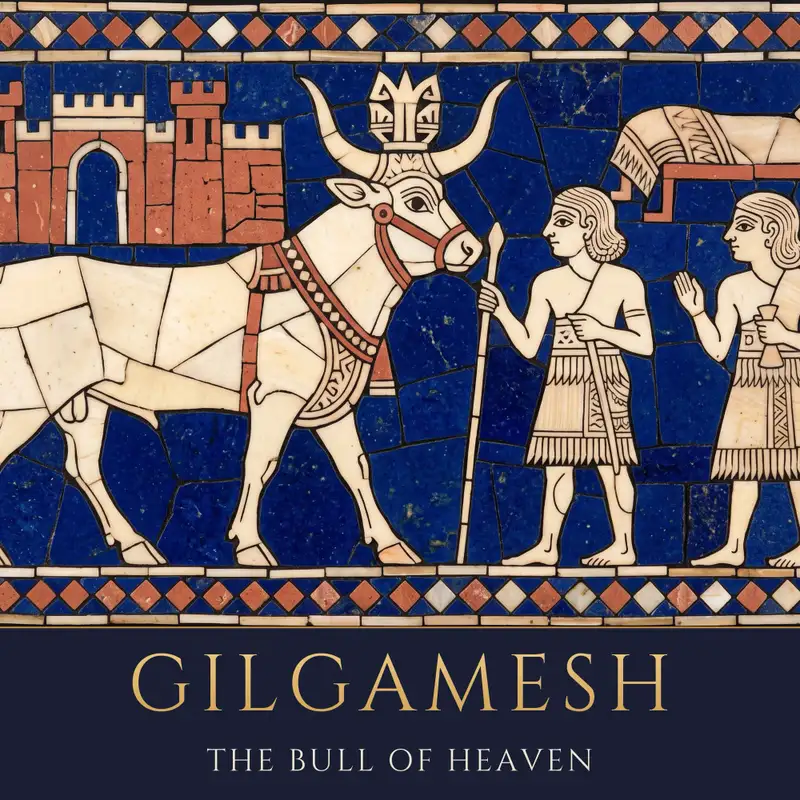
The Bull came down. It came down out of the sky at Uruk, and the poem describes what it did in a way that has nothing to do with a fight and everything to do with an earthquake. And I want you to hear the shape of what follows, because it is built out of three of the same sentence and the numbers go up, which is exactly the kind of thing that carries a tired listener along without asking anything of them. It snorted, and a pit opened in the ground, and a hundred men of Uruk fell into it. It snorted a second time, and a second pit opened, and two hundred men fell in. It snorted a third time, and a pit opened in front of Enkidu, and he fell in up to his waist. Three snorts. One hundred, two hundred, three hundred. And the third pit opens under the one person in the city who is not going to fall all the way in. And I should say what those pits are, because the poem is not being fanciful. In a country of irrigated fields and canal banks, the ground opening and swallowing people is not a metaphor for anything. Banks collapse. Ground undercut by water gives way. Somebody who lived there and heard this would have pictured something they had seen. And then he climbed out and took it by the horns. The rest is short. Enkidu got hold of it, by the horns and then the tail, and held it, and turned it, and Gilgamesh came in past its head like a butcher, the poem says, like a man who knows exactly where to put the knife, and he put it in between the neck and the horns, and it was over. And they took the heart out and offered it to the sun god, and then they sat down together, the two of them, and rested. I like that line more than any of the fighting. They killed the thing, and they gave the heart to the god who had told them to go to the forest, and then the two of them sat down on the ground next to it and rested, the way you would after moving furniture. That is the whole of the Bull of Heaven, and it is the last time in this poem that either of them is happy. And then Ishtar came up on the wall of Uruk. She stood on the great wall, the one from the first chapter of last night, the one you were told to go up on and admire the brickwork, and she looked down at what was left of the Bull, and she began to lament, and she said, woe to Gilgamesh, who slandered me and killed the Bull of Heaven. And Enkidu heard her.
He tore off the Bull's hindquarter, and he threw it at her. Up at the wall, into the middle of the women standing around her, and it landed in front of her, and he shouted, if I could get hold of you I would do the same to you. I would drape its guts on your arms. That is the moment. That is the exact moment this poem turns, and everything from here to the end of tomorrow night is the consequence of a man throwing a piece of meat at a goddess because she was crying about a bull. And here is what I want you to hold on to, because it is the saddest thing in the episode and nobody ever says it. He did it for his friend. Gilgamesh insulted her. Gilgamesh made the list. Gilgamesh is the one who said no and said it with a catalogue. Enkidu, who was made out of clay two weeks ago in narrative time, who learned what bread was from a shepherd, who has been a person for about a year, sees somebody standing on a wall attacking his friend, and does the only thing he can think of, which is to make it worse. And she did something in response that almost every retelling leaves out, and it is the most dignified thing in the chapter. She gathered the women. The poem says she assembled the temple women and the courtesans and the priestesses, and they set up a lament, over the hindquarter of the Bull, which was lying there in the dust where he had thrown it. They held a funeral for a piece of meat, in public, in front of everybody, and they did it properly. That is not a joke and the poem does not treat it as one. She has been insulted twice in one day, once with a list of everything that ever went wrong in her life and once with an animal part thrown at her head, and what she does is gather her people and hold a formal mourning, out loud, where the city can hear it. And then they went through the city in the parade. They washed their hands in the river. They rode through the streets of Uruk and the people came out to look at them. Gilgamesh called to the singing girls, who is the finest among men? Who is the most glorious of males? Gilgamesh is the finest. Enkidu is the most glorious. And then he did the thing with the horns, and it is a small strange domestic detail that I have always liked. The poem measures them. It says each horn held thirty minas of lapis, and that the pair together would hold six measures of oil, which is a great deal of oil, and it gives you the thickness of them at the base. Somebody measured the horns. And then, having measured them, he did not put them in the temple. He dedicated them to his father, who is a dead king, and then he took them home and hung them on the wall of his own bedroom. Two enormous horns from the thing that came down out of the sky, on the bedroom wall, over the bed. And they are there through everything that happens for the rest of tonight. They are there while a man is dying in the next room. They are there through the six days and seven nights. Nobody in the poem ever mentions them again. And they poured out oil for the god of the city. And then they held a celebration in the palace, and everybody drank, and afterwards the young men lay down to sleep on the couches of the night. And Enkidu lay down, and Enkidu had a dream.
He dreamed the gods were sitting together. Anu, and Enlil, and Ea, and the sun god, in a room, in conference, and they were talking about the two of them. Because they have killed the Bull of Heaven, said Anu, and because they have killed Humbaba, one of them must die. Let it be the one who stripped the mountain of its cedar. And I should say who is in that room, because there are four of them and each one is there for a reason. Anu is the sky, the oldest and the highest, the one whose name simply is the sky, and he is the one who gave the Bull away in the first place because his daughter asked him for it. He speaks first, and what he says is that a death is owed. He is the one who set the whole thing running and he is the one who calls for the settlement. Enlil is the lord of the air, the one who appointed the guardian of the cedar forest and put him there and expected him to stay there. Of the four he has the strongest grievance, because both of the things these men did were done to his property. Ea is the clever one, the one who has been in this house before on other nights, the one who put the first god to sleep and built his house on top of him and thought of the way out every time there has been a way out. He is in the room. The poem records that he is in the room. And he does not speak. I have thought about that a great deal. The god whose entire character in this literature is that he finds the loophole, sitting in the meeting where his own great grandson's friend is condemned, saying nothing that anybody wrote down. And the fourth is the sun, who told them to go in the first place, and he is the only one who argues. And Enlil said, let Enkidu die. Gilgamesh shall not die. And the sun god spoke up for him. He said, was it not at my word that they killed the Bull and Humbaba? I told them to go. Should Enkidu now die innocent? And Enlil turned on him and said, you talk to them like one of their companions. You go down among them every day. And that is the end of the argument. I want to sit with this for a moment because it is the coldest scene in the poem and it does not get told. There is no punishment here in any sense we would recognise. There is no weighing. Nobody asks what either of them intended. Two men did two things, both of which were done with the encouragement of one of the gods in the room, and the room decides that a death is owed, and then chooses which of the two of them will supply it, and chooses the one who is not a king, and the one who was made out of clay for the purpose of being a companion, and who has, in the whole of his short life, done exactly one thing that was his own idea, which was to throw a piece of meat at a goddess in defence of his friend. And the god who sent them speaks up for him and is told to be quiet. And there is one more thing about that scene that I only noticed after reading it many times, and it has stayed with me. Enkidu is asleep when it happens. He is not in the room. He is lying on a couch in a palace after a party, full of beer, and he is dreaming, and what he dreams is a meeting he was not invited to in which four people decide he should die. And the poem gives no indication whatever that the dream is inaccurate. That is a strange and modern kind of horror and it is sitting in the middle of the oldest epic we have. Not a monster. Not a battle. A committee, in another room, while you are asleep. Enkidu woke up and told Gilgamesh the dream, and then he said, my friend, why are the great gods in council? And then he became ill.
Here is where the door comes back, and I told you it would. He is lying down and he is angry and he is frightened, and he starts cursing things, and the first thing he curses is a piece of carpentry. He turns his face toward the cedar door, the one they cut in the forest and floated down the river in the sun and set up in the temple at Nippur, and he speaks to it as though it could hear him. O door, he says. O door of the forest. You have no sense. You have no understanding. For twenty leagues I sought out the finest timber for you. I saw the cedar and I carried it. There is no wood like you. Your height is seventy two cubits, your width twenty four. Your pivot and your fittings I made. I set you up in Nippur. If I had known, door, that this would be my reward, I would have taken an axe to you. I would have made you into a raft. That is a dying man shouting at a door. And it is the same door. That is the part I want to make sure you have. Last night, at the very end, two men floated a raft of cedar logs down the river in the sun with a door lashed to the deck, and I told you to keep it somewhere at the back of your mind, and this is why. The last good day of his life produced an object, and the object is still standing in a temple two hundred miles away, in perfect condition, doing exactly what it was made to do, and he is in a bed and he is not. There is nothing wrong with the door. That is the whole problem with it. And it is one of the truest things in the poem, because nobody in that state is reasonable, and the object he chooses to blame is not the goddess and not the gods and not his friend. It is the one thing he made with his own hands that is still standing somewhere, doing fine, while he is not. And then he cursed the trapper who found him at the waterhole. May his catch be small. May his profit be cut. May the beasts escape his snares. And the curse on the trapper is longer than I gave it and it is oddly specific, and the specificity is the interesting part. He does not wish him dead. He wishes him unemployed. May your profits be cut. May your income be halved. May the game escape your nets. May whatever you catch get away in front of you. A man dying in a bed, working through the people who changed his life, curses the first one by wishing him a bad season. It is such a small, real, human size of anger. He does not have the imagination for anything worse in that moment, because nobody does, and the poem knows it, and lets him be petty for four lines before it lets him be terrible for twenty. And then he cursed the woman.
He cursed Shamhat by name, and it goes on for a long time, and it is ugly, and I am going to summarise it rather than perform it, because there is nothing in it worth having and the poem itself does not think there is either. He wishes her ruin. He wishes her homeless. He wishes her the worst life he can imagine, in detail, at length, from a bed, because she is the one who brought him out of the wild country and into a world where this could happen to him. And the sun god heard it from heaven. And the sun god spoke, and this is the answer, and it is one of the few times in this literature where a god corrects somebody and is entirely right. Enkidu, he says. Why are you cursing the woman? She gave you bread to eat that was fit for a god. She gave you ale to drink that was fit for a king. She clothed you in a great garment. And she gave you Gilgamesh for your companion. And now he, your friend and your brother, will lay you out on a great bed. He will lay you on a bed of honour. He will settle you in a restful place, the seat at his left hand, so that the rulers of the underworld will kiss your feet. He will have the people of Uruk weep for you, and he will make himself filthy with grief and put on a lion skin and go into the wild country. And I want to point at one line in that speech, because it is doing something the poem does not draw attention to. The sun god tells him what is going to happen at his funeral. He tells him that his friend will lay him out on a bed of honour, that the city will weep, that the rulers of the underworld will kiss his feet, and that Gilgamesh will make himself filthy with grief and put on a lion skin and go out into the wild country. He is being told, in advance, by a god, that he is going to be mourned properly. That is the whole content of the consolation. Nobody offers him more time. Nobody offers him a reprieve or an afterlife worth having, and in about a page he is going to describe the afterlife and it is dust. What he is offered is the certainty that somebody will mind. And it works. That is the part I cannot get over. It works, immediately, and he stops cursing and starts blessing. And Enkidu heard it, and his anger went quiet. And he took it back. And I want to give you the blessing properly rather than in summary, because he had cursed her for a long time and the poem gives the blessing the same length, and that balance is deliberate and it is the whole moral architecture of the chapter. May governors and princes love you, he said. May the man who is a league away slap his thigh at the sight of you. May the man who is two leagues away shake out his hair for you. May no soldier be slow to loosen his belt for you. May he give you obsidian and lapis and gold. May his gift to you be earrings of filigree. May his storehouse be filled for you and his granary heaped. May you be brought into the presence of the gods. May the wife of a man, the mother of seven, be left for your sake. That last one is a hard line and I am not going to soften it, because it is a curse on somebody else inside a blessing, and the poem does not notice, and that is what people were like. But look at the shape of what he wishes her. Money, standing, jewellery, a full storehouse, and to be received respectfully in the temple. He is a dying man wishing a woman a secure old age, in the only terms he has, using the only currency he knows about, and it is the last kind thing he does. He called out again, and he said, let me bless her instead, and he did. May governors and princes love you. May the young man undo his belt for you. May you be given gold and lapis. May the mother of seven be abandoned for your sake. I do not want to over explain that, but I do want to say one thing about it. He is dying. He has been told by a god, out loud, exactly what she gave him: bread, beer, clothes, and a friend. Those are the four things from the shepherds' camp, the whole of his humanity, listed back to him as an inventory. And he understands that he would not undo any of it. That is the moment he accepts his own life, and it happens about a day before he loses it, and it is the reason the rest of this is bearable.
He had one more dream and then he told it, and it is the oldest description of the afterlife in any literature, and I am going to give it to you carefully, because the poem gives it carefully. He said, there was a man standing there whose face was dark, whose face was like a bird's, with wings. And he took hold of me and he led me down. Down the road, he says, from which there is no coming back. Down to the house where those who go in do not come out. Down to the house whose people are deprived of light. Where dust is their food and clay is their bread. They are clothed like birds, he says, with wings for garments. And they sit in the dark, and they do not see light. Now hold on, because the next part is the part that matters. And in that house, he says, I saw the crowns. Kings, in a heap, who had ruled the land in the old days. The ones who wore the crowns are all in there, and now they serve the food and pour the water. I saw priests. I saw the ecstatics and the singers. I saw the ones who anointed the great gods. And I want to go through what he saw, in order, because it is a list and it is a good one. He saw the kings, he says, the ones who had ruled the land in the old days, all of them together, and the crowns they wore are set aside now, and the ones who wore the crowns are serving the meat and pouring the water. He saw the ones who had been anointed. He saw the priests. He saw the ones who spoke for the gods and the ones who went into a trance for them and the ones who sang. He saw the old gods of the earth, sitting there, who had been replaced by newer ones and had gone down and stayed. And in the middle of it, seated, was the queen of the netherworld, and kneeling in front of her was her scribe, holding a tablet, reading aloud. The scribe has a name, and I will not ask you to keep it, but she is a woman and her job is to keep the register of the dead, and she reads it out to the queen, and that is the last image in the whole vision: not a judge, not a punishment, a clerk with a list, reading the names of everybody who came in. That is the afterlife in this world, and I want you to see it properly, because it is not a punishment. There is no fire in it. There is nobody being tormented. There is no judgement scene, no scales, no accusation, and no sorting of anybody into anywhere. It is dark and it is dusty and everyone is there, and the kings are doing the serving now, and there is a bureaucrat with a tablet keeping the record, because of course there is, because these are people who could not imagine an institution of any size without somebody writing it down. It is a very large, very old, very quiet room, and everyone you ever heard of is in it, wearing feathers, sitting in the dust. And I will tell you now, because it will make two later nights easier, that you are going to come back to this room. The queen he saw sitting in the middle of it, with the scribe kneeling in front of her reading from a tablet, has a name, and later in this season we are going to spend two entire nights in her house, from the inside, going down through it a gate at a time. And when we get there you will already know what it looks like, because a dying man described it to his friend tonight, from a bed in Uruk, before anybody took you down the stairs. The dust, the feathers, the dark, the kings doing the serving, the clerk with the tablet. Same house. Different door. That is not a comfortable idea and I am not going to pretend it is a lovely one. But it is not cruel. Nobody in that house is being hurt. And every single person in that story, the kings and the priests and the singers and the man in the bed telling it, ends up in the same room, which is the one thing that world was absolutely certain of. And then there were twelve days, and the poem counts them, and I am going to count them with you slowly because this is the last thing before the end and because counting is a good thing to do at this hour. On the first day he was ill and he lay down. On the second day his friend sat with him. On the third and the fourth and the fifth the poem does not tell us anything, and the not telling is the truest part of it, because there is nothing to tell. That is what those days are. Somebody is in a bed and somebody else is in a chair and the light goes across the wall and comes back the next morning. The poem says his sickness grew heavy. It says he was in his bed. It says the days went by. On the tenth day the poem says his sickness grew worse. On the eleventh and the twelfth day he called out. Twelve days. That is the whole of it. There is no crisis, no turn for the better, no last stand and nothing dramatic in any of it. A strong man who could hold a bull by the horns lay in a bed for twelve days and got weaker, and his friend, who had killed the guardian of a forest, sat next to him and could not do one single thing about it. He was ill for twelve days. The poem says it exactly like that. He lay in his bed and the days went past and they are counted, and on the twelfth day he called Gilgamesh over. And he said, my friend, a god has taken against me. I am not dying the way a man dies in a fight. I would have been glad to fall in the field. I am dying in a bed. And then he said one more thing, and it is the last thing he says in three thousand lines, and it is not a farewell. He said, my friend, the great goddess has cursed me, and I will not die like a man who fell in battle. I was afraid of the fight and so I die dishonoured. My friend, the one who falls in battle is fortunate. I am not. He is ashamed. That is what he goes out on. A man who wrestled a king in a doorway, who walked six hundred miles and helped kill the guardian of the cedar forest, who caught the Bull of Heaven by the horns while it was opening pits in the ground and men were falling into them, dies apologising for dying in a bed. There is no reply to that in the poem. Nobody tells him he is wrong. The scene simply ends. And then he died.
The eleventh chapter is what happened afterward, and it is why this poem is four thousand years old and still the best thing anybody has written about this. He would not let them take him. And I want to be careful and slow here, because this is the part of the poem that everybody who has lost somebody recognises immediately, and it is the part that the poem is best at, and I am not going to rush it. The first thing he did was touch him. He touched his heart, the poem says, to see whether it was beating, and it was not. That is the first act. Not a cry, not a collapse. A hand on a chest, checking, because until you have checked you do not have to know. And then he covered his face. The poem says he veiled his friend like a bride, which is one of the strangest and most tender comparisons in the literature, and translators have argued about it for a century. Whatever else it means, the physical action is clear and it is the one everybody does. He put something over his face, because a face that is not doing anything is the hardest part. And then he began to move. He circled him like an eagle, the poem says. He paced back and forth in front of him like a lioness whose cubs have been taken. He tore his hair out. He tore off his fine clothes and threw them down as though they were unclean things. Read those in order, because the order is the whole point. Circling. Pacing. Pulling at himself. Getting rid of his own clothes. That is not grief as a feeling. That is grief as a physical condition, described from the outside by somebody who had clearly watched it happen, and every single one of those actions is something a person actually does, and none of them help, and he does all of them. And then he called on everything to weep. That is the whole of it. He touched his friend's heart and there was nothing. He covered his face, the poem says, the way you cover the face of a bride, and then he circled the body like an eagle, and he paced, and he tore out his hair, and he tore off his fine clothes and threw them down as though they were unclean. And he called on everything to weep. This is a long passage and it is a list, and it is the gentlest thing in the chapter, and I am going to let it run, because a list of everything in the world being asked to mourn one man is exactly the right shape for this hour. May the roads weep for him, he said, the roads we walked together. May the forest weep for him, the cedar we went for. May the bear weep, and the hyena, and the panther, and the leopard, and the stag and the ibex, and all the wild animals of the open country. May the pure river weep, along whose banks we used to walk. May the elders of Uruk weep. May the young men weep. May the ploughman weep at his plough, who used to praise your name. May the shepherd weep, and the herdsman, who used to bring you butter and beer. May the woman of the alehouse weep, who used to put beer in your hand. May the field weep for you as if it were your mother. May the cypress and the cedar weep for you, which we went through together in our anger. May the bear and the hyena and the panther and the tiger and the stag and the leopard, the lion, the wild bull, the deer and the ibex, all the creatures of the open country, weep for you. May the holy river weep for you, along whose banks we used to walk. May the pure Euphrates weep for you, from which we used to draw water for the skin. May the young men of the wide city weep for you, who watched us fight the Bull and win. May the farmer weep for you, who used to sing your name over his furrow. May the one who anointed your back with oil weep for you. May the one who put the beer in your cup weep for you. May the harlot weep for you, who rubbed you with sweet oil. May the elders of the walled city weep for you, who put their hands to your neck in blessing. Notice the shape of that. It begins with the road and the forest, which are places, and it goes through the animals, which he had known before he was a person, and then it comes into the city and gets narrower and narrower and more and more particular, until at the end it is not a country weeping, it is the individual named human beings who did small physical kindnesses for him. The one who put oil on his back. The one who filled his cup. A man who has lost somebody starts with the whole world and finishes with the person who used to hand him a drink. Anybody who has done this knows the order it happens in and it is that one. And then he said the thing that is quoted more than any other line in this poem, and it is quoted because it is exactly true. My friend, my younger brother, who chased the wild ass of the hills and the panther of the open country. We conquered everything. We went up the mountain. We seized the Bull and killed it. We brought down Humbaba in the cedar forest. Now what is this sleep that has taken hold of you? You have gone dark, and you cannot hear me. And then he did the thing the sun god had promised he would do, and which nobody has mentioned since. He made himself filthy. He put off everything he owned that marked him as a king. He let his hair go. And he put on the skin of a lion and went out of the city, and this is the state he will be in for the whole of tomorrow night, walking across the world in an animal skin looking for a man who did not die. The king of Uruk, who washed his hair and put on a crown in the first chapter of tonight, ends the same episode dressed as the thing Enkidu used to hunt. And he sat with him for six days and seven nights, and he would not give him up for burial. And on the seventh day he saw what happens to a body, and he understood, finally, that his friend was not going to wake up. And he gave him up. That is the resolution, and it is done, and the last chapter of tonight is quiet.
He did everything. He called the country. That is the phrase the poem uses, and it means he sent word out and had people come in, and the list of who came is a list of trades. The coppersmiths. The goldsmiths. The stoneworkers. The jewellers. The ones who worked lapis and the ones who worked carnelian and the ones who cast metal and the ones who cut and polished. Every skilled maker in the country, called to one room, to make one object. And what I find steadying about that, at this hour, is that it is the most practical possible response to something nobody can do anything about. He cannot bring him back and he knows it. So he commissions work. He finds the best people at each trade and he gives them a job and a material and a deadline, and for a while there are forty people in a workshop doing something careful with their hands because of somebody who died, and the poem thinks that is worth several lines. The body of it lapis, the poem says. The chest of gold. And I want to say what a statue like that actually was, because it is not a monument in a square. In that world, an image of a person, made properly and set up in the right place, was how the dead were kept in the ordinary business of the living. You put the figure somewhere it would be seen. You put food in front of it. You said the name out loud, because a name said out loud was the thing that kept somebody from going completely out of the world. The worst thing that could happen to you after death, in that literature, was not punishment. It was that nobody said your name and nobody put out the water. There are texts about ghosts, and the ghosts in them are not angry, they are hungry and thirsty and forgotten, and the remedy is always the same: somebody remembers to put something down for them. So the statue of lapis and gold is not a tribute. It is an arrangement. It is a man building a thing that will make it possible to go on feeding his friend, by name, indefinitely, in a room, every day, for as long as anybody keeps it up. And then he laid out the offerings, and the poem lists them, and the list is long, and I will give you a piece of it because it is the most careful writing in the whole tablet. He brought out a great table of elmwood. He filled a carnelian bowl with honey. He filled a lapis bowl with butter. He set out a flask and adorned it and displayed it to the sun. For the queen of the netherworld he set out a knife, its handle of lapis. For her scribe he set out a stool. And then he went through the gods of the underworld one at a time, and I am going to let this run, because it is the last long list of the night and it is the most soothing thing in the tablet. For the queen of the netherworld he set out a knife with a lapis handle, and he displayed it to the sun, and he said, may she be pleased with this, and may she walk beside my friend, and not let him be uneasy in his heart. For her scribe, who kneels in front of her with the tablet, he set out a stool. For the god who guards the gate, he set out a thing that was his. For the one who keeps the record of the dead. For the shepherd of the underworld. For the god of the river that has to be crossed. For the ones whose names are only in these lists and who have no stories at all, one after another, each with an object, each displayed to the sun, each with the same request attached. May you be pleased with this. May you walk at my friend's side. May he not be uneasy in his heart. That is the whole of the last tablet. A man going down a list of everyone who works in the place his friend has gone to, and giving each of them something good, and asking every single one of them, in the same words, to be kind to somebody who has just arrived and does not know anybody there. It is a man ringing round. That is what the whole of the last tablet is. A man going through a list of gods, one at a time, and giving each of them a good object, and asking each of them to be kind to somebody who has just arrived and does not know anybody. And there is a separate poem, older, in Sumerian, and I am flagging it as separate because it is not part of the long epic and it is not tonight's tablet. It is called the death of Gilgamesh, and it is about the other funeral, his own, and it contains one image that people never forget once they have heard it. In that poem they turn a river aside. They divert the water from its bed, and in the dry riverbed they build the tomb, and they lay him in it with his household, and then they let the river back, and it runs over the top of him, and nobody can ever find it or dig it up. That is a different poem about a different burial and I will not pretend it belongs to tonight. But I mention it because in nineteen ninety a team surveying an old dried up channel of the Euphrates in Iraq found a structure in the riverbed, and the newspapers had a wonderful few weeks, and the archaeologists were considerably more careful, and it remains exactly what it was: an interesting feature in a dry channel near where the poem says it should be. The lamp is low now. And then Uruk without him. The city goes on. It has to. The Bull's horns are still hanging on the bedroom wall, holding their oil. The wall is still six miles round with its towers. The temple is still there and the offerings are still made at the right hours by the right people, because that is what a city is, a set of things that keep happening whether anybody feels like it or not. And that is the thing about a city, and it is either the coldest fact in the poem or the kindest one and I have never settled it. Nothing stops. The bread is baked at the same hour. The boats come in. The water is opened into the fields at the right time because if it is not the barley dies, and the barley does not know anything has happened. The offerings are made at dawn by the person whose job it is. The gate is opened and closed. If you have ever lost somebody you know both of the ways that feels. It is unbearable that the world does not stop. And it is also the only reason you get through the week, because the world not stopping is what carries you, hour by hour, from the morning to the evening, whether you agree to it or not. And a man is walking around inside it who has not slept properly in a week, who has put a statue of gold and lapis somewhere he can see it, and who has just understood something that everybody in this story except him has known the whole time, which is that this happens to everyone, and it is going to happen to him. That is the whole of tomorrow night, and tomorrow night is the kind one, and I will tell you the shape of it now so that you can go to sleep on it rather than on this. He is going to leave the city and go out into the wild country and look for the one man who did not die. And I will tell you the shape of the whole of it now, so that it is waiting for you rather than sprung on you. He walks east until he comes to a mountain with a gate in it, and the gate is kept by two creatures who are half scorpion, and they tell him that what is on the other side is twelve hours of complete darkness with no light in it at all, and that nobody has ever gone through, and he goes through anyway, and the poem counts the hours, one after another, in the dark, and it is the strangest passage in the whole epic and it is going to be the most restful thing you have heard in a month. And he comes out the other side into a garden where the trees have fruit made of carnelian and lapis, and there is a woman there with a tavern at the edge of the sea, and she says the wisest thing anybody says in this literature, and he does not listen to her. And then a boatman, and a crossing, and an old man on an island who tells him about a flood, and a plant at the bottom of the sea, and a snake. And then home. He is going to walk through a mountain in the dark. He is going to meet a woman with a tavern at the edge of the world who gives him the best advice anybody gives anybody in this literature. He is going to hear the story of the flood from the man it happened to. He is going to be offered a plant that undoes old age, and he is going to lose it, in a way that is so ordinary and so annoying that you will laugh. And then he is going to come home, and stand in front of that wall, and say something about the brickwork, and it is going to be the ending. He does not find what he goes for. He comes back anyway, and the coming back is the point, and it is the last thing this poem has to say and it takes it three thousand lines to say it. But that is tomorrow. Tonight he is in a city that is going on around him, in the dark, with a gold and lapis statue of somebody in the next room, having finally, on the seventh day, let them take the body away. Outside, past the doorway, the river is going by in the dark, saying the same soft word over and over against the reeds. Think of it, wherever you are lying. The statue is in a room somewhere in the palace, lapis and gold, being looked at. The horns are on the bedroom wall, holding their oil, and nobody has taken them down. The door is standing in the temple at Nippur, two hundred miles away, in perfect condition, and it will still be standing there in a hundred years and it does not know anything. And out in the country the ploughman is at his plough and the shepherd is with the flock and the woman of the alehouse is filling somebody's cup, and every one of them has been asked, by name, in a poem, to weep for a man they may never have met, and four thousand years later they are still being asked, every time anybody reads it out. That is the only thing anybody has ever been able to do about this. Make a list of the people who were kind to somebody, and read it out, and keep reading it out. You do not have to keep any of tonight. If you keep one thing, keep the woman of the alehouse, who was asked to weep, and who used to put a beer in his hand. Sleep well. Goodnight.