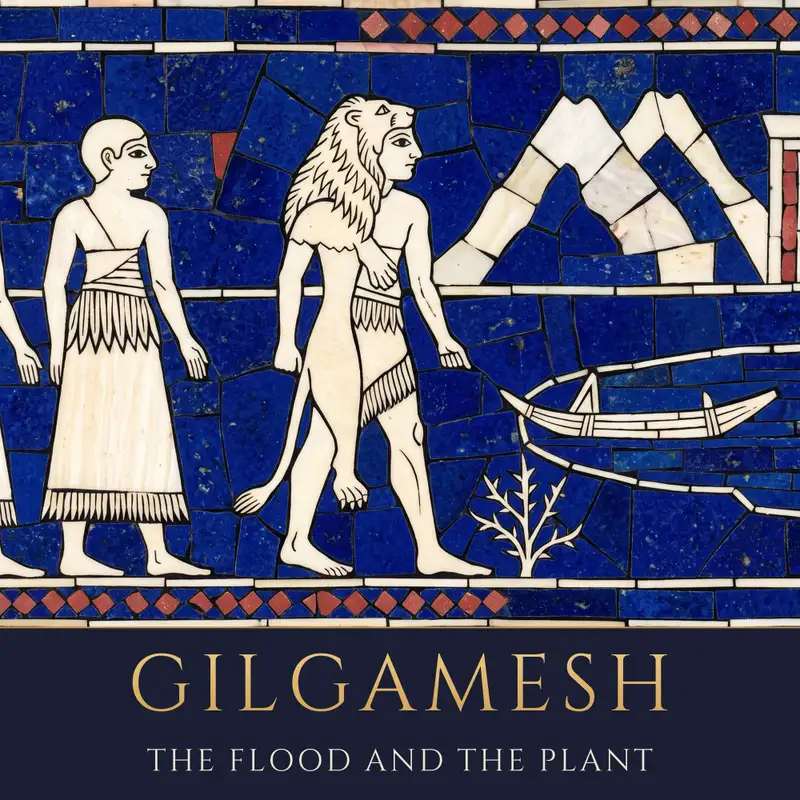
Welcome to The Sleeping Almanac. Tonight is the kind one, and it is the last of the three, and it is the one I have been looking forward to since we started. Last night a man died in a bed and his friend sat with him for six days and seven nights and would not let him go, and then on the seventh day he understood, and he let them take the body, and he had a statue made of lapis and gold, and then he walked out of his own city in a lion skin and did not tell anybody where he was going. Tonight is where he went. And I will tell you the whole shape of it now, because there is nothing to protect you from tonight and knowing the ending will not spoil anything. He is looking for a way not to die. He does not find one. He comes home anyway. And on the way he walks through a mountain in the dark for twelve hours, and comes out into a garden where the trees are made of gemstones, and meets a woman who keeps a tavern at the edge of the sea and who tells him the truest thing anybody says in this entire literature. He crosses an ocean you are not allowed to touch. He hears the story of the flood from the only man it did not kill. He is given a plant that undoes old age and he loses it to a snake, in a way so ordinary and so annoying that people have been laughing about it for four thousand years. And then he comes home and stands in front of a wall. Which is where we started, two nights ago, if you were here. And if you were not, it will not matter, because the wall explains itself. There is a room at the edge of the world, and in it there is a lamp. It is the same lamp. Perhaps you were here last night, in which case I am glad you came back, because last night was heavy and tonight is not. And if this is your first night in the tablet house, be welcome, and you have missed nothing that will stop you. A king lost the person he loved most. He has gone out to see whether that has to happen. That is all you need. The lamp is a small clay dish of oil, and it burns the pale gold of old honey. The room smells of river water and dust and barley. Outside, past the doorway, the river is going by in the dark, saying the same soft word over and over against the reeds. The scribe takes the last three tablets of the stack, and sets the twelfth one aside again, apart, the way he has done for three nights, and this time he says something about it. This one, he says, we will come to at the end, and I will tell you what it is and why it is not really part of the story, and then we will read it anyway, because it is beautiful and because leaving things out is not what this house does. You do not have to do anything now. Settle onto the mat. Let the lamp be warm on one side of you and the cool night on the other. Close your eyes if they want to close. There are two new names tonight and neither of them is difficult. A woman who keeps a tavern, and a very old man on an island. Everything else you already have. You do not have to follow every word. You do not have to remember any of it in the morning. If you drift, the story will go on without you. And one thing, whispered like a promise across the clay. There is nothing frightening in tonight. Nobody dies. There is a flood in it, told once, at a distance of four thousand years, by an old man sitting down, and it is over in a chapter, and everything on either side of it is a man walking, or floating, or sitting in a garden, or asleep. In fact I will tell you the single most restful thing about tonight in advance. The longest passage in this episode is a man walking through complete darkness for twelve hours, and the poem counts the hours one at a time, and almost nothing happens in any of them. It is the closest thing to a lullaby in the whole of ancient literature and I have been saving it for you. Before we begin, one small thing, and then we will not interrupt again. If this story carries you down toward sleep, subscribe now, while your eyes are still open, and the rest of the season will find you as it comes. A like helps other tired travelers find this lamp. And if you would rather carry these nights with you, The Sleeping Almanac is also a free podcast, on Apple Podcasts and on Spotify, waiting wherever you listen. That is all. Now settle back, and we begin.
He went out into the open country and he wept. That is how the ninth tablet begins. Not with a decision, not with a speech. A man walking away from a city, crying, in an animal skin. For my friend Enkidu, he says, I weep bitterly, and I roam the wild country. And then he says the thing that is actually driving him, and it is not what people usually say it is. He does not say, I miss him. He says that too, but that is not the sentence that turns him around and sends him east. The sentence is this. Shall I not be like him? Shall I too not lie down, and never rise again, for ever and ever? He has understood something and he has understood it too late and it is now the only thing in his head. Not that his friend is gone. That he is next. And he is afraid. The poem says so, flatly, and it is one of the best things about it. The strongest man in the world, two thirds god, who wrestled a king in a doorway and killed the guardian of a forest and caught the Bull of Heaven by the horns, is frightened of dying and says so out loud and goes to do something about it. And what he does about it is set off on foot to find one particular person. There was a man, long ago, before all of this, who survived the flood. And the gods gave him life without end, and put him somewhere far away, at the mouth of the rivers, and he is still there, and he is the only person who has ever been given the thing Gilgamesh now wants. So he is going to go and ask him how. And I want to give you the state he is in, because the poem does and most retellings tidy it up. He is not travelling. He is roaming. The word the poem uses is the word you would use for an animal ranging over country, and it is the same word it used for Enkidu in the first episode, before the trapper, when he was out with the gazelles. The king of Uruk has gone back to being the thing his friend used to be, and the poem does that on purpose and never mentions it. He does not wash. He does not change his clothes, because he is not wearing clothes, he is wearing skins. He sleeps in the open. He eats what he kills. And he is afraid at night. There is a passage where he lies down in a mountain pass and wakes because there are lions around him in the moonlight, and he is frightened, and he lifts his axe and goes at them, and the poem says he scattered them and killed them and took their pelts. That is not a hunting scene. That is somebody who cannot sleep, in the dark, in the open, dealing with the thing that woke him, badly, and then lying back down. He kills lions in the passes on the way and wears their skins. He does not sleep properly. The poem says his cheeks are hollow and his face is drawn and his heart is sick, and that he looks like a man who has come a long way. And then he comes to a mountain.
Its name is Mashu, which means twins, and it has two peaks. And the poem describes it in a way that I want you to hear properly, because it is one of the great images in this literature and it is done in two lines. The tops of it reach up to the vault of heaven. The bottoms of it reach down to the underworld. That is a mountain that goes all the way through. It touches the roof of the sky at the top and the floor of the dead at the bottom, and it stands between them, and the sun goes into it in the evening and comes out of it in the morning, and there is a gate. And the gate is kept. The ones who keep it are called scorpion people, and there is a man and a woman, and the poem says that their terror is awesome, that a look from them is death, and that their radiance is terrifying and covers the mountains. And the mountain has a name that people have argued about for a long time, and I will give you the argument in one breath because it is a pleasant one. Some think Mashu is a real range, out east or north, and there are candidates. Others think it is not a place on any map, that it is the mountain at the edge, the one the sun goes into, and that looking for it is like looking for the horizon. The poem does not care. It has two peaks, the sun uses it, and there is a gate. And there are pictures of them. That is what I love about this. They are a real thing in the art of that world, a human head and torso on a scorpion's body with the tail up over the back, standing at doorways, and they are on seals and on carved slabs and on the bases of thrones, and every single time they appear they are doing the same job, which is standing on either side of something and guarding it. So he comes up to the gate, and they see him, and he shields his face for a moment. And then he takes his hand down and goes toward them. And the male one says to his wife, this one who has come to us, his body is the flesh of the gods. And the woman answers, two thirds of him is god and one third is human. And here is where it becomes one of my favourite scenes in the poem, because they do not fight him. They ask him questions. They ask why he has come such a long way and by such a difficult road. And he tells them. He says he is looking for the old man who was given life, because he wants to ask him about death and about living. And the scorpion man listens to all of it and then explains the situation to him, kindly and completely, like somebody at a desk. Nobody, he says, has ever done this. There is no passage. The road into that mountain is twelve double hours long. The darkness is thick and there is no light in it. Not at the start, not in the middle, not at the end. From sunrise to sunset there is darkness. And Gilgamesh says, I am going anyway. And the scorpion man opens the gate. That is what happens. That is the whole encounter. He does not have to defeat them. He does not trick them. Two beings whose glance is described as death listen to a man explain what he wants, tell him honestly how hard it is, and then open the gate for him and tell him to be careful. The gate of the sun, the poem says, was opened for him. And he went in.
Here it is. I am going to read you this the way the poem does it, which is one hour at a time, in the same words, twelve times, and I want you to understand before I start that this is not a passage where you are supposed to be paying attention. The poem repeats itself here more than anywhere else in three thousand lines. Somebody sat in a room four thousand years ago and heard the same sentence twelve times in a row on purpose. It is the deepest and slowest thing in the epic and it exists to make a very long walk feel very long. So let it happen. Let it go past you. There will be nothing to miss. At one double hour of distance, the darkness was dense, and there was no light. He could not see what was ahead of him and he could not see what was behind him. At two double hours of distance, the darkness was dense, and there was no light. He could not see what was ahead of him and he could not see what was behind him. At three double hours of distance, the darkness was dense, and there was no light. He could not see what was ahead of him and he could not see what was behind him. At four double hours of distance, the darkness was dense, and there was no light. He could not see what was ahead of him and he could not see what was behind him. Nothing has changed. Nothing is going to change for a while. That is not a failure of the story, that is the story. Somebody is walking under a mountain and the hours are the same as each other, and the poem is going to say so, in the same words, until you feel it in your legs. At five double hours of distance, the darkness was dense, and there was no light. He could not see what was ahead of him and he could not see what was behind him. At six double hours of distance, the darkness was dense, and there was no light. He could not see what was ahead of him and he could not see what was behind him. Halfway. Nobody has ever done this and there is no way to know how far along you are, and he has been walking in complete darkness for six hours, and there is nothing to look at and nothing to hear and nothing to steer by. At seven double hours, the darkness was dense, and there was no light. He could not see ahead of him and he could not see behind him. At eight double hours, he cried out. The darkness was dense, and there was no light, and he could not see what was ahead of him or what was behind him. At nine double hours, the north wind licked at his face. There. Did you feel that? Eight hours of nothing at all, in the same words, in the dark, and then a small cold wind on the side of his face, and it is the most welcome sentence in the whole epic, and it is a change in the weather. At ten double hours of distance, the way out was near. He could feel it. That is the poem's phrase, more or less. Not saw. Felt. There is a quality of air near an opening that anybody who has been underground knows about, and the tablet has it. At eleven double hours, at a distance of two double hours, the light began. At twelve double hours, it was bright. And he came out ahead of the sun. That is the passage. That is twelve hours of walking in the dark under a mountain, told in the fewest possible different words, and if you were drifting through the middle of it, that is exactly what it is for. Nothing was missed. The whole point of the eighth hour crying out is that you are as tired of the dark as he is. And what is on the other side is a garden.
He came out of the mountain and there was a garden, and everything in it was made of jewels. The poem lists them, and the list is short and strange and no two translations agree about all of it, and I am going to give you the version I like because I do not think precision helps here. Carnelian, it says, bearing its fruit. A vine hanging with grapes, and the grapes are lapis lazuli. Foliage of lapis. Thorns and thistles of some clear stone. Cedars of agate. Coral, and pearl, and one tree hung with what the poem calls the fruit of the sea. Trees made of stone, bearing stone fruit, in the light, at the far end of the mountain, in a place where nobody has ever been. And I want to tell you what those two stones actually were to the people hearing this, because if you do not know that, the garden is only pretty, and it is not only pretty. It is the most extravagant thing in the poem. Neither of them comes from that country. There is no lapis lazuli in Mesopotamia. There is none anywhere near it. In the ancient world essentially all of it came from one place, a set of mines high in the mountains of what is now northeastern Afghanistan, and from there it travelled, hand to hand, over passes and across deserts and down the rivers, something like fifteen hundred miles, to end up in a workshop in a flat country that has no stone in it at all. And carnelian is the same story in the other direction. The finest of it came from the far side of the Gulf, out of the great cities of the Indus valley, and it arrived by sea, through the islands, in ships, along a trade route that operated for centuries and is documented on both ends. So these are not gems in the way we might think of gems. They are the two most travelled objects in that world. They are the things that came from the absolute edge of the known map, from places most people had only heard named, at enormous cost, over years, through more hands than anybody could count. And what did they do with them when they arrived? They put them in the ground with their dead. In the great cemetery at Ur, in the graves of that period, there are headdresses of gold and lapis and carnelian, and beads by the thousand, and inlays, and a lyre with a bull's head on it. The most far travelled material available to them, and they buried it. Now go back to the garden. A man has walked to the end of the world, in the dark, through a mountain, looking for a way not to die. And he comes out the other side, and what is growing there, on the trees, is exactly the two substances his own people put in their graves. Carnelian is bearing fruit. Lapis is hanging in leaves. The poem does not comment. It simply describes the garden, item by item, the way an inventory does, and moves him through it. But everybody in that room knew what those stones cost and where they ended up. And the man walking under them is out here because he has understood, three weeks too late, that he is going to be buried too. And I want to stay in the garden for a moment, because it is the only place in this poem that is purely beautiful and it goes past in a dozen lines. Think about what a garden of stone fruit would actually be. Nothing in it grows. Nothing in it can be eaten. It is a garden that gives nothing and costs nothing and asks nothing, standing at the far end of a mountain, in the light, where nobody comes. And the materials are the materials of the temple. Carnelian and lapis and agate are what you make the eyes of a statue out of, and the beard of a god, and the jewellery of a queen. Every stone in that garden is a stone somebody in Uruk would have recognised instantly as belonging on an object of enormous value. So it is not an alien landscape. It is a garden made out of the most precious things his own city knew about, growing on trees, unattended, at the end of the world, in the sun. He does not touch any of it. The poem does not say he tried to pick anything. He walks through and goes on, because he is not looking for treasure and it does not occur to him that a tree made of lapis is worth stopping for. The sun god sees him there. And this is another one of those moments I keep pointing at, where the poem is quietly kinder than it needs to be. The sun looks down at the man standing in the jewel garden in his lion skin and speaks to him, and what he says is not a warning or a rebuke. It is closer to what you would say to somebody who is doing something hopeless. The life you seek, he says, you will not find. And Gilgamesh answers him, and the answer is one long complaint and it is completely reasonable. After I have walked all this way, after roaming the wild country, am I now to lay my head down in the earth and sleep for ever? Let me look at the sun and see the light. I have had enough of the dark. The sun god does not have an answer to that. Nobody does. So he goes on, out of the garden, down toward the water.
At the edge of the sea there is a house, and in the house there is a woman, and her name is Siduri, and she makes and serves beer. That is her job. She is what the poem calls an alewife, which was a real profession run by real women in that country. There were laws about them in the law codes, and I am going to tell you two of them because they are real and they are marvellous. There is a famous set of laws, carved on a tall black stone that stands in a museum in Paris, made for a Babylonian king, and among the sections about oxen and boundary walls and surgeons there are sections about the woman who sells beer. One says that if she takes payment in silver rather than in barley, or if she gives short measure, she is to be punished. So there was a fixed exchange rate and somebody was checking it. And another says that if outlaws gather in her house and she does not seize them and take them to the palace, she is to be put to death. Think about what that tells you. The law assumed that if there was trouble anywhere in a town, it would be in the beer house, and that the woman running it would know exactly who was in the room, and it made her responsible for it. They were not just serving drinks. They were the closest thing that world had to a place where you found out what was going on, and the state knew it, and legislated for it. They kept houses where you could get a drink, and they extended credit, and they knew everybody, and if you wanted to know what was happening in a town you asked the woman who ran the beer house. And this one is at the end of the world, on the shore, with the sea in front of her, and she has a jar and a mash tub and a set of vats and, the poem is very clear about this, a door with a bolt on it. And she is standing outside and she sees something coming. She sees a man wearing skins with the body of a god and the face of somebody who has come a very long way, and she does what any woman running a bar by herself at the edge of nowhere would do. She goes inside and bolts the door and goes up on the roof. I love her so much. Four thousand years of literature and one of the very few completely sensible characters in it is a publican who saw a large stranger in a lion skin coming up the beach and locked up. And I want to be fair to him too, because from the beach it looks different. He has been walking for a length of time the poem does not measure. He has come out of twelve hours of darkness and through a garden nobody has seen. He has not spoken to a human being since the scorpion people, and before that since he left his own city, and he has been talking to himself and to the dead the whole way. And he comes over a rise and there is a house with smoke coming out of it and a woman standing outside, and it is the first ordinary thing he has seen in months, and she takes one look at him and locks the door. Both of them are entirely right and neither of them is being unreasonable, and that is why it is a good scene. And he shouts at her from outside. He says, what did you see that made you bolt the door? I will break the door. I will smash the bolt. And she calls down from the roof, perfectly calmly, and asks him who he is. And he tells her. He gives her the whole thing. He says who he is, and what he did, the Bull and the forest and the guardian, and then he tells her about his friend, and the poem gives him the same lines he has been saying since the first chapter of tonight. My friend whom I loved has turned to clay. Shall I not lie down like him, and never rise again? And then he says, I am afraid of death. And I want to point out what changed her mind, because it is not the threat. He threatened to break the door and she did not open it. What he did next was tell her who he was, and then tell her about his friend, and then say out loud, to a stranger, from the wrong side of a bolted door, that he was afraid. And then she came down. She did not open the door for the king of Uruk. She opened it for somebody who said he was frightened. And she comes down and opens the door.
Now. I have to explain something about this passage, because it is the most famous thing in the poem and the situation with the text is genuinely interesting. In the standard version, the one on the eleven tablets, what she says to him is short. She says the life you seek you will not find. She says that when the gods created humankind, they set death aside for humankind and kept life for themselves. And then she points him toward the boatman. But there is an older tablet, from centuries before, an Old Babylonian one, and on it she says a great deal more, and what she says on it is the single most quoted passage from any Mesopotamian text, and it is the reason people love this poem, and I am going to give it to you and I am going to be honest with you that it is not on the eleven tablet version. Some older tellings have her say this. Gilgamesh, where are you wandering? The life that you are looking for, you will never find. When the gods created humankind, they kept everlasting life for themselves and gave death to us. So. Let your belly be full. Enjoy yourself, day and night. Make every day a festival. Dance and play, day and night. Let your clothes be clean. Let your head be washed. Bathe in water. Look at the child who is holding your hand. Let your wife be happy in your arms. For this, she says, is what people are for. That is it. That is the oldest surviving statement of that particular idea in any literature on earth, and it was written down by somebody in a mud brick country four thousand years ago and put in the mouth of a woman running a bar. And I want you to notice, because almost nobody does, that it is not a grand philosophy. Look at the list again. A full stomach. Clean clothes. A wash. Something to celebrate. Somebody small holding your hand. Somebody you love, glad you are there. Every single item on it is a domestic thing that costs nothing and that you can have tonight. And I want to say what has happened to that passage since, because it is one of the most travelled pieces of writing in the world. It has been read as the oldest expression of a particular idea about living for the day. It has been quoted in books about grief. It gets put on posters. It turns up in a great many wedding readings by people who have no idea it is spoken by a barmaid to a man in a lion skin at the end of the world. And there is a resemblance that people notice and argue about, between what she says and a passage in one of the books of the Bible, in the one about vanity and the sun and everything being a chasing after wind, which also tells you to eat your bread and drink your wine and enjoy life with the one you love. Whether there is any connection between them, direct or through the air of a shared world, is a real scholarly question and the answers range from probably to certainly not. I am not going to settle it and I do not need to. What matters tonight is that a very old idea about how to live with the fact of dying appears first, as far as we can tell, in the mouth of a woman running a bar at the edge of the sea, telling a man to go home. She is not telling him that life is short so seize it. She is telling him to go home and have dinner. And he does not listen to her. That is the part that makes this the best chapter in the poem. She gives him the answer, in full, in plain language, at the exact halfway point of the story, and it is the correct answer, and he thanks her and asks for directions to the ferry. He is going to spend the rest of the episode finding out that she was right.
There is a boatman, and his name is Urshanabi, and he works for the old man on the island, and he is sitting in the wood with some things. The poem calls them the stone ones, and nobody is entirely certain what they were. They are objects, or figures, made of stone, and they have something to do with how the boat crosses, and they may be a crew or a charm or a set of fittings, and the honest answer is that specialists disagree and the text does not explain because everybody listening knew. And Gilgamesh, who has just come out of a mountain and a jewel garden and a conversation with a woman who told him to go home, arrives in a state and smashes them. He breaks the stone ones before anybody has explained anything to him. And Urshanabi looks at what he has done and says, in effect, well. Now you have made this harder. Because the stone ones were how they got across, and now there is another way and it is worse. They must cross the Waters of Death, and the rule about the Waters of Death is one line long and it is the most frightening rule in the poem because it is so specific. Your hand must not touch it. Not a monster in it. Not a current. If any part of your hand touches that water, that is the end. So they cannot row. And here is the solution, and it is my favourite piece of problem solving in ancient literature. Go into the forest, says the boatman, and cut three hundred punting poles, each sixty cubits long. Trim them. Cap them. And then, when we are out on the water, you will take one pole and push us forward with it, and then you will let it go and take the next one. Never touch the water. Use each pole once, and drop it, and take a new one. Three hundred poles. Three hundred pushes. One at a time. And I want you to feel the arithmetic of it, because the poem gives you the number and then moves on and the number is the whole point. Three hundred poles, each sixty cubits long. That is a pole about ninety feet long, which is an absurd length, and there are three hundred of them, and they have to be cut and trimmed and capped before anybody gets in the boat. So before the crossing there is a day, or several days, of two men in a forest with axes, felling and trimming and stacking, in silence, making three hundred identical objects that will each be used exactly once. And that is how they cross. A man standing on a boat in a dead flat sea, taking a pole, pushing, dropping it in the water, picking up the next one, pushing, dropping it, three hundred times, for however long that takes, in silence. And when the poles run out, and they do run out, he takes off the skin he has been wearing and holds it up on his arms as a sail, and the wind takes them the rest of the way in.
His name is Uta napishti, and it means something like he found life, and he is sitting on the shore when they come in, and he has been there a very long time. And he watches the boat coming and he says to himself, why are the stone ones smashed, and who is that on board who is not my boatman. And Gilgamesh comes ashore and stands in front of him, and the old man looks at him, and asks the question everybody in this poem asks him. Why are your cheeks hollow? Why is your face sunken? Why is there sorrow in your heart? Why do you look like someone who has been on the road a long time, with cold and heat beating on your face? And Gilgamesh tells him the whole thing again. The friend, the clay, the fear, the road. And then he says, I have come to see you, whom they call the far away one. I have come to ask about life and death. And before the lecture there is a passage I skipped over and I want to give it to you, because it is the clearest statement in the poem of how that world understood the arrangement. He says, nobody sees death. Nobody sees the face of it. Nobody hears its voice. But it cuts people down. And then he says, we build a house and we think it will stand for ever. We seal a contract and we think it will hold for ever. Brothers divide an inheritance and think the settlement is permanent. There is enmity in the land and people think it will always be there. The river rises in flood and people think the flood is the way things are. And every one of those is a thing that ends. And then, and this is the part that is doing the real work, he says that the great gods and the mother goddess who fixes destinies sat down together, and they established death and life, and they did not disclose the day of death. They fixed both. Not death alone. Death and life, together, in the same session, by the same committee, and the only thing they withheld was the date. That is not a curse and it is not a punishment for anything. It is an administrative decision, taken once, at the beginning, by the same people who assigned the rivers their courses and gave the moon his instructions. And the old man does not tell him a secret. That is the thing about this scene that people are never ready for. There is no technique. There is no ordeal to pass. He has walked to the end of the world and the man he came to see gives him a lecture, and the lecture is very good and very sad and completely useless to him. Do we build a house for ever, he says. Do we seal a contract for ever. Do brothers divide an inheritance for ever. Does the river always rise in flood. The dragonfly, he says, drifts on the water, and its face looks at the sun, and then suddenly there is nothing there at all. Nobody sees the face of death. Nobody hears the voice of death. But death cuts down humankind. We build houses. We make agreements. Brothers argue over property. The rivers rise. And the sleeping and the dead, he says, are just alike. And Gilgamesh looks at him and says, all right. But you are standing there. You are exactly like me. There is nothing different about you. I came here to fight you for it and I find you lying on your back doing nothing. So tell me how you did it. And the old man says, I will tell you a secret. I will tell you a hidden thing of the gods. And Gilgamesh, who has not understood yet, keeps pushing. He says, I looked at you and I expected to find somebody different. I was going to fight you for it. And I find you lying on your back. Tell me how you joined the assembly of the gods, he says. Tell me how you found life without end. And the old man says, all right. And then he tells him about the flood.
I told you at the start of tonight that the flood is one chapter, and this is it, and it is being told by a very old man sitting on a beach who was there, and that is the only reason it is in this poem at all. There was a city, he says, called Shuruppak, on the bank of the Euphrates. It was already old. And the gods, who were in it, decided to bring a flood. He does not say why. The standard version does not give a reason, and that is worth noticing, because the older poem we told in this house in the seed special does give one, and it is noise. In that poem the world got loud and one god could not sleep and that is how it started. Here it is simply decided. And one of them told. The clever one, the one who has been in this house on every night of this season, the one who put the first god to sleep and built his house on top of him, went to a reed fence, and spoke through it, and pretended he was speaking to the fence rather than to the man on the other side of it, and said, reed fence, reed fence, wall, wall. Listen. Tear down your house and build a boat. Give up possessions and save your life. Take the seed of all living things on board. And the man asked, what do I tell the city? And the god told him what to say, and what he told him to say is a lie, and it is the coldest thing in the chapter. Tell them, he said, that you have to leave because the lord of the air is angry with you, and that when you go, the gods will rain abundance down on them. So they built it. And the whole city helped. The carpenters and the reed workers and the children carrying pitch, and he killed oxen and sheep every day and gave them beer and wine as though it were a festival, and they worked, and they thought they were building something that would bring them rain. And before the dimensions, one thing about that lie, because it is the most uncomfortable moment in the chapter and the poem does not flinch from it. The city helped him build it. All of them. The carpenters and the reed workers and the pitch carriers and the children, and he fed them and gave them beer and wine and it was like a festival, and every single one of them drowned. He does not say that. He does not have to. He lists the work and the food and the good spirits of it, and then a page later everybody is clay, and the poem lets you do the subtraction yourself, which is far worse than being told. He gives the dimensions. He says the deck was an acre, that the sides were a hundred and twenty cubits, that he divided it into seven levels and each level into nine compartments, that he drove in water plugs and stowed the punting poles. Then he loaded it. Silver and gold. His family. The craftsmen. And the animals of the field, and the beasts, and the seed of all living things. And he handed the boat over to the boatman and went in and shut the door. And it came at dawn. A black cloud on the horizon. The storm gods went ahead of it over the mountains and the valleys, and the dykes broke, and the light turned to darkness, and the land was shattered like a pot. For one whole day the storm blew. And then the south wind came, and the flood went over the mountains. And here is the line that makes this chapter what it is. The gods were frightened of it. They fled. They went up to the highest heaven and cowered there like dogs, crouched against the outer wall. And the goddess cried out like a woman in labour, and she said, how could I have spoken like that in the assembly of the gods? How could I have ordered a war to destroy my people, when it is I who gave birth to them, and now they fill the sea like fish. And the gods sat and wept with her, and their lips were parched. Six days and seven nights the wind blew and the flood flattened the land. And the poem counts those days the way it counted the hours in the mountain, and the counting is the same kind of counting, and if you noticed that then you have noticed the architecture of the whole episode. One day and one night the south wind blew and the flood went over the land. A second day. A third and a fourth. A fifth, a sixth. Six days and seven nights, the wind and the flood levelling everything. And on the seventh day the storm stopped. The sea grew calm. The wind died. The flood ended. And he opened a hatch, he says, and the light fell on my face. And he looked out, and everything was flat, and everything was silent, and all of the people had turned back into clay. And he sat down and he wept, and the tears ran down his face. That is the line I would keep if I could only keep one from the whole flood. Not the storm. Not the gods cowering like dogs against the wall of heaven. A man opening a hatch after seven days in the dark, getting the light on his face, looking out at a completely flat and completely silent world, and sitting down on the deck and crying. He does not celebrate. He does not give thanks yet. He sits down, and he cries, and the poem gives it one line and then goes on. And then the boat came to rest on a mountain, and it held, and it did not move. And the mountain has a name in this poem and it is not the one most people expect. It is called Nimush, and it is somewhere in the mountains to the east, and it is not the mountain that other traditions later settled on. Same shape of story, different peak, and the poem is perfectly clear about which one it means. And on the seventh day after that he let out a dove, and it went and came back, because there was nowhere to land. And he let out a swallow, and it went and came back. And he let out a raven, and the raven saw that the water had gone down, and it fed, and it circled, and it did not come back. And he opened everything to the four winds and made an offering, and poured out incense on the mountain, and the gods smelled it and came round it, and the poem says they gathered over the sacrifice like flies. And afterward there was an argument among them, and the lord of the air was furious that anybody had survived, and the clever one answered him and said, you should have punished the wrongdoer for his wrongdoing, and not sent a flood on everybody, and there were better ways, a lion, a famine, a plague, and next time do that instead. And then the lord of the air came aboard the boat and took the old man and his wife by the hand, and made them kneel, and touched their foreheads, and blessed them, and said, until now this man was human. From now on he and his wife shall be like us. And they shall live far away, at the mouth of the rivers. And that, says the old man on the beach, is how I got what you came here for. It was given to me once, by a council of gods, after a flood, as a settlement, and there is not going to be another council and there is not going to be another flood. There is no way for you to get it.
But there is a test, and the old man offers it, and it is the funniest and saddest thing in the poem. You want life without end, he says. Very well. Let us start with something simpler. Do not sleep for six days and seven nights. And I want you to see the trap in it, which he does not. The old man has just spent a chapter explaining that he got what he has by an accident of history that cannot repeat, and that there is no method, and Gilgamesh has heard none of it. So the old man stops arguing and sets a demonstration instead. He does not test him against death. He tests him against sleep, which is the small daily version of it, the one everybody loses to every single night without minding, and which this poem has already told you twice is the same thing. The sleeping and the dead are just alike. He said that a page ago and nobody was listening. And Gilgamesh sits down to stay awake. And the poem says that no sooner had he sat down than sleep came over him like a fog. Immediately. Not on the third night. Not after a heroic struggle. He sits down to prove he can defeat death and he is asleep before the sentence ends, because he has walked across the world in a lion skin and crossed an ocean by punting three hundred times and he has not slept properly since his friend died. And the old man looks at his wife and says, look at this strong man who wanted eternal life. Sleep is blowing over him like a fog. And his wife says, touch him, wake him up, let him go home the way he came. And the old man says no. He will lie. Bake a loaf for him and set it by his head, every day, and mark the wall. So she baked. And I want to slow this down because it is the gentlest test in literature and nobody ever notices what it actually is. She is not trying to catch him out. She is his wife, and she has lived at the mouth of the rivers with an immortal husband for an unimaginable length of time, and a young man has just arrived off a boat in a state, and her husband has set him an impossible task, and the young man has fallen asleep instantly. And her response is to bake. Every day, for seven days, she makes a loaf of bread and puts it beside the head of a sleeping stranger, so that when he wakes up and says he was not asleep, there will be something kind on the floor next to him that proves it without anybody having to argue. She could have woken him. She suggested it. Her husband said no. So she did the only useful thing available, which was to keep a record, in bread, of how long somebody had been asleep. And this is the detail I want you to have, because it is the most domestic proof anybody has ever offered of anything. The first loaf went hard as a stone. The second went like leather. The third was soggy. The fourth had gone white on the crust. The fifth had turned grey with mould. The sixth was still fresh. And the seventh was still on the coals when they woke him. And they woke him, and he said, immediately, I only just dozed off. You touched me and woke me. And the old man said, count your loaves. And he looked, and there they were in a row beside his head, one hard as stone, one like leather, one soggy, one white, one grey, one fresh, and one still baking, and he had to do the arithmetic himself, and there is no arguing with bread. And he understood, and he said, what do I do now? Wherever I set my foot, death is there. That is the moment the poem has been walking toward since the first tablet. Not a defeat by an enemy. Not a failed ordeal. He was beaten by being tired, in front of the only person who ever got what he wanted, and the evidence was seven loaves of bread in a row, going from stone hard to still baking, and he counted them himself. There is no arguing with bread. That is the whole of it. He can argue with gods and he has, twice. He can argue with a scorpion man at a gate and he did. He cannot argue with the fourth loaf.
They put him out. He is washed, and his skins are taken off him and thrown into the sea, and he is given clean clothes that the poem says will not show their age until he gets home. And the boatman, who is banished for having brought him, goes with him. And as they are pushing off, the old man's wife speaks up. She says, he came all this way. He wore himself out getting here. What are you going to give him to take home? And that is why he gets the plant. Not because he earned it. Because a woman on a beach thought a man should not go home with nothing. And the old man tells him about it. There is a plant, he says, that grows at the bottom of the sea. It has thorns like a rose and it will prick your hands. If you get hold of it, you will be young again. And the method is real, and it is the last piece of ordinary craft in the poem. That coast had pearl divers, and they worked exactly like this: a stone tied to the feet to take you straight down without wasting air on swimming, cut it loose at the bottom, take what you came for, and let the water bring you up. People were doing that in the gulf for thousands of years and were still doing it within living memory. So the great supernatural quest of the oldest epic ends with a man using the standard commercial diving technique of his own coastline. So he tied stones to his feet, the way the pearl divers did, and the stones took him down into the deep water, and he saw it, and he took it, and it cut his hands, and he cut the stones loose and the sea threw him back up onto the shore. And he had it. And he did not eat it. That is the part everybody forgets. He had it in his hand, on the beach, and he did not eat it. He said, I will take this back to Uruk. I will give it to the old men there. I will let an old man eat it and see what happens. And then I will eat it myself and go back to being young. He was going to test it on the elderly of his city first. And I have come round to liking him for that, though it took me years. It is not cowardice and it is not selfishness, or not only. He has spent this entire episode being told by everybody he meets that there is no way round death, and he has not believed any of them, and now he has a plant in his hand that is supposed to undo old age and he has no idea whether it works. So he does the sensible thing. He is going to take it home and give it to the old men of Uruk, who would like to be young again more than he would, and watch. The first recorded plan for a clinical trial is in the eleventh tablet of Gilgamesh and it does not go ahead because of a snake. And then, on the way home, after a day of walking, he found a pool of cool water, and he went down into it to bathe, and he left the plant on the bank. And a snake smelled it. The poem says it caught the fragrance of the plant. It came up silently and it took the plant and it went back down, and as it went it shed its skin. And Gilgamesh sat down on the bank and wept. That is the whole loss. Not a battle. Not a theft by an enemy. He put it down for ten minutes to have a wash after a long walk, and a snake found it, and that is why snakes shed their skins and get to be new and we do not. He said, for whom have my arms laboured? For whom has my heart's blood been spent? I gained nothing for myself. I have done a good deed for a snake. I have done a good deed for a snake. That is the last complaint in three thousand lines and it is the most human sentence in the poem, and if you have ever lost something stupidly after working very hard for it, you have said a version of it.
They walked the rest of the way home. And when they came in sight of the city, the man who had crossed the waters of death and been to the end of the world and lost everything he went for turned to the boatman, who had never been to Uruk in his life, and said this. Urshanabi. Go up on the wall of Uruk and walk along it. Survey the foundation platform. Examine the brickwork. Is it not baked brick, of the very best? Did not the seven sages themselves lay its foundations? One square mile is city. One square mile is date grove. One square mile is clay pit. And half a square mile is the temple precinct. Three and a half square miles is the measure of Uruk. And that is the end of the poem. Nothing else. No death scene for him, no summing up, no last words to anybody. The last thing in eleven tablets and three thousand lines is a man pointing at some brickwork and giving the dimensions of a city. The poem stops the way a person stops talking when they have said the thing they meant. Those are the same words that opened it, two nights ago, in the first chapter of the first episode. The wall we started on. The brickwork we were told to go up and admire before we had met anybody. And now we know who is saying it, and when, and what he has just come back from. That is why they are there. He went out to find a way not to die and he did not find one. He came back with nothing in his hands, having lost even the consolation prize to a snake. And the first thing he does when he sees his city is point at a wall he built and tell a stranger to go and look at the brickwork. Not, I am going to live for ever. Not, I have understood the meaning of life. Look at the wall. Look at the bricks. Three and a half square miles. Good work, that. That is the answer. That is the whole answer, and it takes three thousand lines to arrive at it and it is four words long. Look at the wall. And the woman with the tavern told him the same thing a thousand lines earlier and he did not listen, and I want to put the two of them next to each other because they are the same answer in two registers. She said, eat your dinner, wash, hold the hand of the child, and let your wife be glad you are there. He said, look at the brickwork. Both of them are saying: the thing that lasts is the thing you actually did and the people who were actually there. Now, the twelfth tablet. The scribe picks up the one he has kept apart for three nights and holds it. This one, he says, is not part of it. And I will tell you exactly what it is, because the honest version is more interesting than pretending. The eleven tablets you have just heard are a single poem with a beginning and an ending, and the ending is the wall. The twelfth tablet is a translation, into Akkadian, of the second half of a completely different and older Sumerian poem, and somebody attached it to the end of the collection at some point, and it does not follow on. Enkidu is alive in it. The poem contradicts itself the moment it starts. So it is not the ending. It was stapled on. And it goes like this. Gilgamesh drops two objects, a ball and a stick of some kind, and they fall down into the underworld. And Enkidu says he will go and get them. And Gilgamesh tells him how to behave down there so he can come back, and the instructions are wonderful and they are all about not being noticed. Do not put on clean clothes. Do not anoint yourself with oil. Do not carry a weapon. Do not raise your voice. Do not kiss the wife you love and do not strike the child you dislike, because the outcry of the dead will seize you. And Enkidu goes down and does every single one of those things wrong, and he is held. And then his shade comes up, through a hole in the ground, and the two of them embrace, and Gilgamesh asks him what it is like down there. And what follows is a list, and it is the last thing in the collection, and it is a strange, gentle, oddly practical list. Did you see the man with one son? I saw him. He weeps bitterly at the peg driven into his wall. The man with two sons? He sits on two bricks and eats bread. Three sons, four sons, five, six, seven, and each one is a little better off than the last, and the man with seven sons sits among the lesser gods and listens to music. Did you see the man with no heir? He eats bread like a broken brick. Did you see the palace eunuch? He stands in a corner like a useless stick. Did you see the woman who never gave birth? She is thrown aside like a broken pot, and no man takes pleasure in her. Did you see the young man who never undressed his wife? I saw him. You put a rope in his hand and he weeps over the rope. Did you see the young woman who never lay with a husband? I saw her. You put a reed mat in her hand and she weeps over the mat. Those are hard lines and I am giving them to you flat, because that is how the tablet gives them, and because the values in them are four thousand years old and are not ours and I am not going to pretend otherwise. What the list is doing is measuring everybody by the same one thing. Did you see the stillborn children? I saw them. They play at a table of gold and silver, with honey and butter. That one is different from all the others and it is the only tender line in the list, and nobody has ever satisfactorily explained why it is there, and I like it enormously. Did you see the one who fell in battle? I saw him. His father and mother hold up his head and his wife weeps over him. Did you see the one whose body was left in the open with nobody to bury him? I saw him. His ghost does not rest. He eats scraps. Did you see the one with nobody to make offerings for him? I saw him. He eats what is scraped from the pot and thrown in the street. And that is the twelfth tablet. Not a moral. A survey, of who has a good time down there and who does not, and the answer, every single time, is the number of people left up here who remember you. It does not belong to the poem. But it is saying the same thing the wall says and the same thing the woman with the beer said, which is that the only thing that carries over is other people, and I think whoever attached it knew exactly what they were doing. And one last thing about the three nights, and then we are done. You have now heard the whole of it. Not a retelling of the famous bits. The wall, the wild man, the woman who talked him into the city, the bread and the beer, the doorway, the road, the forest with the monkeys in it, the killing, the raft of cedar in the sun. The bath and the crown and the offer and the list and the bull and the haunch. The council in the room while he was asleep, the door he shouted at, the twelve days, the six days and seven nights, the statue, the offerings, the list of gods to be kind to a new arrival. And then the lion skin, the mountain, twelve hours of dark, a garden made of stone, a woman with a bolt on her door who told him to go home and eat his dinner, three hundred poles, an old man on a beach, a flood, seven loaves, a plant, a snake, and a wall. That is three thousand lines and about four thousand years and it comes out at look at the brickwork. The lamp is low now. Think of it, wherever you are lying. The wall is still there. That is not a figure of speech. It is in the ground in southern Iraq, six miles of it, with the stubs of its towers, and people have walked on it and measured it and photographed it, and you could go. And the last thing that a man who had been to the end of the world and back wanted anybody to do was to go up on it and look at how well it was made. Not at what he found. At what he built. And there is one more thing about him and it is the last true fact of the three nights and I have kept it for here. He got what he wanted, in the end, and nobody in the poem tells him. Not eternal life. But afterwards, for two thousand years, in that country, Gilgamesh was a god. Not a big one. A specific one, with a specific job. He became one of the judges of the dead, down in the house of dust that his friend described from a bed in Uruk, and people wrote his name on tablets and buried them, and in the incantations for the restless dead it is Gilgamesh who is asked to settle the case. There are little offerings recorded to him. There are prayers that begin by naming him as the one who gives judgement below. So the man who walked to the end of the world because he could not bear that everybody goes down into the dark ended up working there. Not as a prisoner. As the person you ask for when there is a problem. Nobody planned that. It is just what happened to him over the following two thousand years, in the ordinary religious practice of ordinary people, and he never knew, and I find it one of the most satisfying facts in the whole of this literature. He wanted not to go down there. He went down there, like everybody. And then they gave him a desk. Outside, past the doorway, the river is going by in the dark, saying the same soft word over and over against the reeds. You do not have to keep any of tonight. If you keep one thing, keep the woman at the beer house, who told him to go home and have his dinner, and who was right. Sleep well. Goodnight.