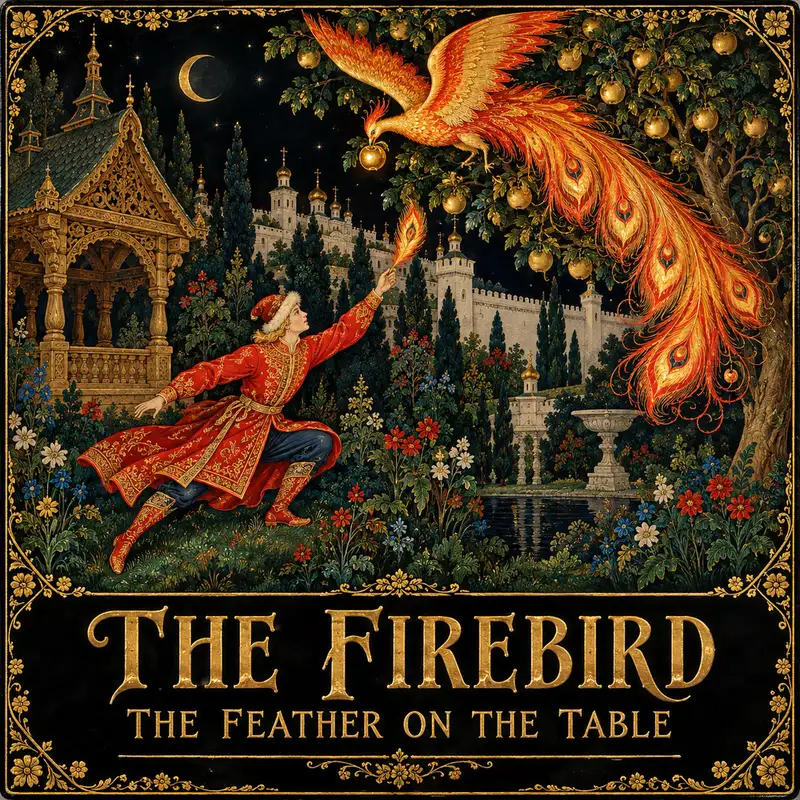
Welcome to The Sleeping Almanac. Tonight there is a feather on a table in a dark room, and the room is not dark. It is a single feather, as long as a man's forearm, and it is lying where a young man put it down, and it is giving off light. Not glowing, the way a coal glows. Lighting the room, the way a lamp does, so that the tsar sitting at the table can see his son's face and his son can see his, and neither of them is holding anything, and there is no fire, and the light is coming off a feather. That is the first thing in tonight's story that is not ordinary, and it is the thing the whole story is named for, and I have given it to you first because I want you to have it as a light, not as a picture. Everybody has seen the picture: the bird, gold and red, with the tail like flame. Almost nobody remembers that the bird is hardly in the story. It is caught in one paragraph and carried in a cage for the rest of the night and never says a word. What is in the story is the feather, and a wolf. If you would rather listen with the screen off, this whole season is on the podcast, free, same night. And if this carries you down toward sleep, subscribe now, while your eyes are still open, and the next night will be waiting for you when you need it. This is the fifth of twelve nights, and the season is Slavic, and the story tonight is the one that, if you asked a hundred people to name a Russian fairy tale, most of them would name, and could not tell you. The Firebird. And what I am going to do is tell it, whole, from beginning to end, the way it was printed in the collection you have heard about every night this season, and I am going to do it slowly, because it is a long story with a great many things in it and every one of them is exact, and because the middle of it, the part with the wolf, is one of the best things ever told in that country, and it is the part that gets cut. Here is what I can promise you. One story, in order, nothing skipped. A garden, an apple tree, a bird that steals, a feather, a stone at a crossroads with writing on it, a horse eaten, a wolf who serves, two gardens broken into at night, a golden cage, a golden bridle, a princess, a wolf who wears her face, a parting, a murder in a field told once and plainly, a raven, and a wedding feast that a dead man walks into. Every one of those is coming, and I will tell you when I am stepping out of the story to say where a thing comes from. Near the end I will tell you what the bird's name means, and where the story went, which is Paris, in nineteen ten, in a theatre, with an orchestra, and I will tell that plainly too. And I will tell you where the story came from, which is not where you think, and which the man who printed it admitted, and I will give you the lullaby, the one every child in that country is put to sleep with, because there is a grey wolf in it and he is this wolf's little brother, and because it is a night for sleeping and I would be a poor host not to. And here is what I cannot promise. I cannot tell you what the Firebird is. It is a bird that glows and steals apples and nothing else is ever said about it, and the people who try to make it the sun or the dawn are guessing, and I will not. I cannot tell you why the wolf serves Ivan, because the wolf gives one reason and it is a strange one, and I will give it to you as he does and let it stand. And I cannot tell you that Ivan deserves any of it. He is warned twice not to touch a thing and he touches it twice, and he is warned by the writing at the crossroads that his horse will die and rides that road anyway, and he is told to keep watch and he sleeps, and the wolf saves him every time, and the story loves him anyway, and I think you will too, and I think that is the point. So. A tsar, a garden, a tree with golden apples on it, and one apple gone every morning. Let us go and stand under the tree.
In a certain kingdom, in a certain land, there lived a tsar, and his name was Vyslav Andronovich, and he had three sons. Dmitry, Vasily, and Ivan. And he had a garden, a fine one, walled, and in the garden, among the other trees, one tree that bore golden apples. Golden apples. I am going to give you those exactly as the story does, which is without explanation. They are apples and they are gold. Whether that means they were gold in colour or gold in metal the story does not say, and I think the tellers saw something that was both, a fruit you could bite and could not, and it does not matter, because what matters is that the tsar minded. I am going to say he counted them. The Russian says only that the bird plucked a great many and that he grieved over the tree; the English tellers, from the eighteen nineties on, and above all the one printed in nineteen twelve that most of the world read, have him finding one apple gone each morning, and I am keeping the counting, because it is the truest thing anybody ever added to this story. Golden apples are in other stories from that country, and I will give you one, because it tells you what a tsar's garden was for. There is a tale of a tsar gone blind with age who sends his sons for the apples of youth and the water of life, from a garden at the end of the world guarded by a woman on a horse, and the apples make him young. Apples that do something. A tree that is not an ornament but a store of the one thing a king cannot buy. Vyslav's tree is never said to do anything; it is simply gold, and he counts it. But everybody in the room knew what a golden apple tree in a tsar's garden might be for, and knew why a man would count. Every night she came, and every morning there were fewer. Somebody was coming into the walled garden at night and taking an apple from the tree. And the story does not have him set a guard. That is worth a moment: a tsar with a whole household of armed men, and the first people he sends into the garden at night are his own three sons, because the thing in the tree is not a thief with a sack, it is a bird on fire, and a bird on fire is a thing you send a son for. The story tells you what she is before it tells you about the sons, and it tells you that the tsar already knew. That is how the story gives it. The Firebird. Feathers of gold, and eyes like crystal, the story says, and that is the whole of her description, and she came into the garden every night and sat in the tree and plucked the golden apples and flew away, and nobody had yet tried to catch her. And the tsar, who was, the story says, very grieved about his apples, called his three sons and said: whichever of you catches this bird alive and brings her to me shall have half my kingdom now and the whole of it when I die. Three sons. A task. And the oldest goes first, because he is the oldest. Dmitry goes into the garden at dusk and sits down under the apple tree to keep watch, and he watches, and the garden gets dark, and he falls asleep. And in the morning the tsar asks him: well, did you see the thief? And Dmitry says: no, father, nobody came, the bird did not come tonight. And the tsar goes and counts, and an apple is gone. Vasily goes the second night, and the same. Sits down. Watches. Sleeps. In the morning: nobody came, father. And the tsar counts, and an apple is gone. And on the third night Ivan goes. I want to give you Ivan's night properly, because it is the first thing he does in the story and it is the thing that makes him what he is, and because the tellers gave it more than a line. He goes into the garden at dusk, and he sits down under the tree, and he does not lie down. That is the first thing. He sits, with his back against the trunk. And he watches, and the garden gets dark, and the first hour goes by, and he is awake, and the second hour, and he is awake, and the story says that toward the middle of the night the garden lit up. As if many fires had been lit in it, the story says. And it was the bird. She came down through the dark and sat in the tree, on a branch, and the light came off her, gold, onto the leaves and the wall and the grass, and she reached for an apple. And Ivan stood up under the branch, very quietly, and took hold of her tail. And she pulled, and he held, and she pulled harder, and she was a bird and he was a young man with his feet on the ground, and she got away, and went up over the wall in a streak of light and was gone. But he was left holding one feather from her tail. One feather. And he carries it back to the house, in the dark, and it lights the way, and in the morning, the story says, as soon as the tsar is awake, he goes in to him and puts it in his hand. The room I gave you at the door is not in the story as a scene. It is in it as a measure, the story's own: if you carried this feather into a dark room, it says, this is what would happen, and I built the room round that sentence and put the father and the son in it, and I am telling you now that I did, so that you can keep the room and know whose it is. The story says that the tsar was overjoyed, and that he put the feather in his own chamber to keep, and that from then on the Firebird did not come to the garden any more. And here is the thing about the feather, and the story is precise about it, and I want you to have it exactly. The feather was so wonderful and so bright that if you brought it into a dark room, the room was lit as if by a great many candles. Not a glow. Candles. A great many of them. A single feather from the tail of a bird, on a table, and the room is as bright as a hall lit for a feast. Hold that feather. It is the only piece of the bird that Ivan ever gets by himself, and it is the thing the tsar has at the end of the story, when the bird is in a cage and the story has forgotten about her, and it is the thing I am going to leave you with in the morning. The tsar has the feather. And now, being a tsar, he wants the bird.
The tsar called his sons again. And he said: my dear sons, you have seen the feather. Now go, with my blessing, and find the bird, and bring her to me alive, and the one who does shall have what I promised. And Dmitry and Vasily went, on their own account, the story says, together, and the story loses interest in them for a long time, and so will I. And Ivan asked his father for his blessing too, and got it, and went to the stable and chose a horse, a good one, the story says, and I want you to hold the horse for a chapter, because it is going to be paid for. A tsar's son choosing a horse from his father's stable was choosing the thing he would ride for the rest of the story, and every listener knew that a horse chosen in the first chapter is a horse that something happens to. He chose it, and saddled it, and rode out, and rode, the story says, he did not know where. And that is worth stopping on. He does not know where the bird lives. Nobody has told him. He simply rides away from the garden in some direction and keeps going, and after a while, in an open field, he comes to a stone. A post, the printed text says, a pillar standing up in the open field at a place where the road splits into three, and on the post, writing. Three lines, one for each road. The sung tales put a stone at that parting of the roads, and most of the pictures and most of the English tellings since have made it a stone, and I am going to call it the stone too, because that is the thing you will know it by, but you should have the book's own word once: a post. I am going to give you the three lines in my words, and I want you to hear them the way Ivan did, standing in a field with a horse, reading. Whoever goes straight on will be cold and hungry. Whoever goes to the right will live, but his horse will die. Whoever goes to the left will die himself, but his horse will live. And Ivan reads them, and thinks, and turns his horse to the right. Cold and hungry. I want to say a word for the road nobody takes, because it is the one that tells you where the story was told. Cold and hungry is not a fairy tale fate. It is what happened to a man who went the wrong way in that country in winter, and every listener had been cold and hungry, and some of them had buried somebody who had been colder. The stone offers Ivan three things, and two of them are wonders, a horse that dies and a rider that dies, and the third is simply the weather, and the story puts it first, and Ivan does not even consider it. Notice what he has chosen. Not the road where he lives and the horse lives, because there is no such road. He has three choices: be cold and hungry, lose the horse, or lose himself. And he takes the middle one. He keeps his own life and gives up the horse's, and the story says, plainly, that he thought about it, and chose, and rode on. Now I want to step out for a moment and tell you about the stone, because it is one of the oldest things in the story and you will meet it again. There is a stone in the spells and songs of that country that is older than any story. It has a name, Alatyr, and it is white, and it burns, and it lies at the centre of the world, or on an island in the sea, and the charms that women said over a sick child or a wound begin, very often, by putting the speaker at that stone: on the sea, on the ocean, on the island, on the white burning stone. From that stone the world can be seen and named and told what to do. I do not say Ivan's stone is that one. I say that the people who told this story had a stone in their mouths every time they said a charm, and that a stone in a field with the roads written on it did not seem strange to them, because a stone was where you went to read the world. A stone at a crossroads with the fates of the three roads written on it is in the sung tales of that country, the long ones about the heroes, over and over. The hero comes to the stone, and reads, and chooses, and usually he chooses the road that says he will die on it, because he is a hero and that is what heroes do with a stone like that. The greatest of those heroes, whose night is coming later in this season, reads a stone like this one and takes all three roads in turn, and that is his story and I will not touch it. Ivan is not a hero of that kind. He is a tsar's third son in a story told by a stove, and he reads the stone, and he chooses the road where he lives, and the story does not think less of him for it. I think that is one of the reasons the story has lasted. He is the one who makes the choice you would make. He rides to the right. A day, and another day, and a third. And on the third day, out of the forest beside the road, comes a wolf. A big grey wolf, the story says, and it comes straight at them, and it says, and I am giving you this in my words because the story gives the wolf words: Ivan Tsarevich, you read the stone. You knew what it said. Why did you come this way? Tsarevich. The wolf gives him his title, and I have been using it, and it means simply the tsar's son, the way a king's son is a prince, and it is the name of half the heroes in that collection, Ivan Tsarevich, because a tsar with three sons was the commonest beginning there was and the youngest was always Ivan. It is not a name. It is a place in a family. And before Ivan can answer, the wolf has the horse. It tears the horse in two, the story says, and it is over in a line, and the wolf goes back into the forest, and Ivan is standing in the road on the third day with his saddlebags and no horse. That is the stone's promise kept. He was told, and he chose, and the horse is dead, and he weeps for it, the story says, bitterly, and then he does the only thing there is to do, which is walk. He walks all that day. And by evening he is worn out, and hungry, and sits down, and the wolf comes out of the forest again.
The wolf comes up to him and stands there. And it says, in my words: I am sorry for you, Ivan Tsarevich. You are worn out with walking. I am sorry too that I ate your good horse. Well. Get on my back and tell me where you want to go, and why. And Ivan gets on. I want to stop here, before they go, because this is the most important moment in the story and it goes by in two lines, and because I said at the door that the wolf gives one reason for what he does and it is a strange one, and here it is. He is sorry. That is all. Not a debt, not a spell, not a bargain. The wolf ate the horse, because that was what the stone said would happen and the wolf is the thing that makes the stone true, and then the wolf looked at the young man walking down the road with no horse, and was sorry for him, and came back. Every helper in these stories has a reason. The doll was fed. The animals were spared. The old woman was scolded into her manners. This wolf ate the horse and felt bad about it. I do not know of another helper in the whole collection who is moved by nothing but pity for the trouble he caused, and I think it is why the wolf is the best of them. And Ivan tells him. My father sent me for the Firebird. And the wolf says: I know where she is. Hold on. And they go. And here is the wolf's running. The printed text gives it in four words: he ran faster than a horse. The tellers who came after could not leave it at that, and it is their picture everybody knows, the one I am going to give you once and then let stand for every ride tonight: the grey wolf ran so that the ground went by under him like water, and the forests went past on either side like a fence going by, and the lakes and rivers went under his feet as if he were stepping over puddles, and when a mountain came he went over it, and when a valley came he was across it, and his tail swept the track behind him. Four words in the book. All of that in the room. I want to give you the real wolf too, for a moment, because the people who told this story lived with the real one. A wolf, in that country, in the eighteen hundreds, was not a picture in a book. It was the thing that took the sheep in winter and, in a bad winter, when the snow was deep and the forest empty, came into the villages at night and took a dog off its chain or a child from a yard. Every village had a story. Every winter there were tracks. Men rode in sleighs with a gun across their knees for it, and there is a whole literature of that country of the wolf pack behind the sleigh. And at the same time, in the same villages, the wolf was the dog of the forest spirit, and of a saint. The saint was George, who in that country has two days, one in spring and one at the end of autumn, and on the autumn one, when the first snow is down, the wolves were said to be given their food for the winter by him, and to gather, and the roads were theirs that night, and nobody went out. Wolves were his dogs. He let them off the chain in the autumn, people said, and called them in at the spring day, and what they took in between was his to give. A man who met one and spoke to it politely might be let by. Both things at once. The thing that ate the horse and the thing you could talk to. The tellers put both into one grey wolf and did not explain it, and they were right. And there is one more grey wolf in that country that every person in it has met, and met before they could talk, and I want to give him to you because this is a night for sleeping and he is the wolf of sleep. There is a lullaby, the lullaby, the one every mother and grandmother in that country sings, and it is very short, and it goes, in my words: hush, hush, little one, do not lie down at the edge of the bed, or the little grey wolf will come, and take you by the side, and carry you off into the forest, under the willow bush. That is the whole of it. A threat, sung softly, to a baby, about a small grey wolf who comes for children who sleep too near the edge. And the babies sleep. They have slept to it for as long as anybody has been singing, and the little grey wolf under the willow bush is the first wolf any child in that country knows, and he is not frightening, he is the sound of being put to bed. Tonight's wolf is his older brother. He eats a horse and carries a prince and I do not think, in that country, that anybody ever heard the words grey wolf without also hearing, somewhere underneath, the lullaby. Now the first garden. The wolf carries Ivan to a stone wall in the night, and stops, and says: Ivan Tsarevich, climb over this wall. Behind it is a garden, and in the garden the Firebird sits in a golden cage. Take the bird, and come back over the wall. But do not touch the cage. If you take the cage you will not get out of there; they will have you at once. Do not touch the cage. That is the first warning, and I want you to hear it the way the room heard it, because everybody in the room knew what a warning in a story was for. Ivan climbs the wall. The garden is dark and quiet, and there, where the wolf said, a cage of gold, and in the cage, the bird, with the light coming off her low, the way a banked fire glows, and the story does not say what the cage hung from or stood on, and I will not either. And he opens the cage door, and takes her out, and puts her inside his coat, and turns to go. And he looks at the cage. The story says that he was tempted by it. It was a beautiful cage, gold, and the bird would be the better for having her own cage to travel in, and he thought, how am I to carry her without a cage? And he reached out and took it. And the whole garden went off like thunder. Strings, the story says. The cage was tied to strings, and when the cage moved the strings moved, and a noise went through that garden that the story calls a knocking and a thunder, and the guards woke, and came running into the garden and took Ivan Tsarevich, with the bird under his coat and the cage in his hands, and brought him straight before their tsar. The English telling of nineteen twelve, the one most of the world read, made the noise bells, and if you have heard this story with bells in it, that is where they came from.
The tsar of that garden was called Dolmat, and I want you to see him, because the story gives him a temper and a bargain, and both are going to matter. He is angry. A young man has climbed his wall in the night and been caught with his bird under his coat and his cage in his hands, and he says, in my words: are you not ashamed? Who are you, and whose son, and what is your name? And Ivan tells him. Vyslav's son, Ivan Tsarevich, and your bird has been coming to my father's garden every night and has nearly ruined his tree. And Dolmat says: a tsar's son, and you come over my wall like a thief in the night. If you had come to my door and asked me for the bird I would have given her to you with honour, and now I shall send to every kingdom and tell them what you did. If you had come to my door and asked. I want to stop on that, because both tsars say it, and it is the moral of the first half of the story, and it is not the moral you would expect. Neither tsar is angry that Ivan wanted the bird or the horse. They are angry that he did not ask. In that country, in that world, a tsar's son who rode up to a gate and asked for a thing with honour would very likely have been given it, because that is what honour between houses was for, and a tsar's son who climbed the wall at night was a thief, whatever his father was. Ivan, on the wolf's advice, does it the wolf's way, over the wall, and the wolf's way works for the wolf, who is a wolf, and fails for Ivan, who is not, because he cannot leave the gold alone. The tsars are telling him, twice, that there was a door. And then the bargain. But, he says, if you will do me a service, I will give you the bird, and forgive you, and keep quiet. Go beyond three times nine lands, to the thirtieth kingdom, and there is a tsar there called Afron, and he has a horse with a golden mane. Bring me that horse, and the Firebird is yours. And Ivan, the story says, went out of Dolmat's palace very sad, and told the grey wolf. And the wolf said: I told you not to touch the cage. That is all he says about it. One line. Not a reproach, not a lecture. I told you. And then: well, get on, and hold on. And they go. I want to give you the second garden as the story gives it, because it is the first one again, and the story knows it is the first one again, and tells it that way on purpose. The wolf runs, and comes at night to a stone wall, and stops, and says: Ivan Tsarevich, climb over the wall. The guards are asleep. Go to the stable, and take the horse with the golden mane. But on the wall of the stable there hangs a golden bridle. Do not touch the bridle. Do not touch the bridle. And every listener in the room, hearing that, knew exactly what was about to happen, and the teller knew they knew, and went on. Ivan climbs the wall. He goes into the stable. The horse is there, in the dark, and he can see it by its mane, which is gold, and gives a little light. And he takes the horse by its forelock, and leads it toward the door. And on the wall, on a peg, hangs a bridle, gold, and he stops. The story says only that he was charmed by it, and I think the thought was the one he had at the cage: how can I lead a horse like this with no bridle? And he took it down off the peg. And the noise went through the stables, thunder and clatter, strings again, tied to the bridle, and the grooms woke, and the guards came, and Ivan was taken, with the horse and the bridle, and brought before Tsar Afron in the morning. Now here is the thing I want you to notice, because it is the music of this chapter and the reason it is told twice. Afron says exactly what Dolmat said. The same speech, nearly to the word. Are you not ashamed, whose son are you, if you had come to my door I would have given you the horse with honour, now I shall tell every kingdom. And then the same bargain. Do me a service, and I will forgive you and give you the horse. Go beyond three times nine lands, to the thirtieth kingdom, where there is a princess called Elena the Beautiful, and bring her to me, because I have loved her a long time and cannot win her. Bring me Elena and the horse is yours. Two gardens, two walls, two warnings, two golden things that should not have been touched, two sets of strings, two tsars with the same speech and the same bargain. The story is not being lazy. It is building a rhythm, the way the three storms built one on the fourth night and the three riders did on the first, and the rhythm is: Ivan cannot be trusted with a golden thing, and every tsar in the world has something he wants and will trade for it, and each errand is further than the last. A bird, then a horse, then a woman. Each in the thirtieth kingdom. Each behind a wall. And Ivan goes out very sad, and tells the wolf, and the wolf says: I told you not to touch the bridle. And then, and this is where the story turns, the wolf says: this time I will do it myself.
They come to the third kingdom, and it is not a wall this time. It is a garden with a golden fence round it, the story says, and in the garden, walking, in the evening, with her women, is Elena the Beautiful. The wolf stops at the fence, and tells Ivan: go back along the road, to the open field under the green oak, and wait for me there. A green oak in an open field. The story says it as if there were only one, and in a sense there was: the oak in that country was the tree you met under, the one tree in an open field that everybody could name from a distance, and the one the old songs put oaths and meetings under, and on the second night of this season you heard of one on an island where boats stopped and men made offerings. When the wolf says wait under the green oak, he is naming the one place in an open country where a man could stand and be found again. Every listener knew the tree. And Ivan goes and waits. Here is what the story says, and it says it quickly, and I am going to say it quickly. The wolf waited there, outside the golden railings, and in the evening the princess came walking with her women and her nurses, the old women who had raised her and who went everywhere a princess went in that country, a step behind, watching, the way they did in real palaces and in every story about one, and as she passed, the wolf went over the railings, and took her, and went back over, and ran. The women screamed and the guards came running, and it was no use, because the wolf runs the way I told you the wolf runs, and by the time the guards were at the fence the wolf was a mile off with Elena the Beautiful across his back. He comes to the oak in the field where Ivan is waiting. And he says: Ivan Tsarevich, get on. And Ivan gets on behind Elena, and the wolf runs. And the story does the thing here that makes this the story it is, and it does it in one sentence, and I want to give you the sentence slowly. On the way to Afron's kingdom, the story says, Ivan fell in love with Elena the Beautiful, and she with him. On the back of a wolf. Running across a country at the speed of a river, with the forests going by like a fence, two people who have never met, one of them stolen from her own garden an hour ago, and by the time they reach the place where he is supposed to hand her over to another man, they are in love, and she with him. The story does not describe it. It says it happened, on the way, and I believe it, because there is nowhere in the world two people are more alone together than on the back of a running wolf. Elena the Beautiful. Her name is the name of half the princesses in that collection, the way Ivan is the name of half the princes, and it is, I think, the oldest beautiful woman's name in the world, the one from Troy, come north through the church calendar and worn smooth. The Beautiful is her title, as it was the girl's on the first night, and it means what it meant then: not a description, a rank. She is the one who is wanted. Three kingdoms have wanted her by the end of tonight, and she chooses, on a wolf's back, in an hour, and never changes her mind. So they come to Afron's kingdom, and stop, and Ivan gets down, and he is weeping. The story says so. He is standing outside the walls of a tsar's palace with the princess he was sent to fetch and he is weeping, because he has to give her up to get the horse. And the wolf says: what are you crying about? And Ivan says: how can I not? I love her, and she loves me, and I have to give her to Afron. And the wolf says, and this is the line I have been waiting all night to give you: I have served you a great deal, Ivan Tsarevich. I will serve you in this too. Listen. I will turn myself into Elena the Beautiful. You take me to Afron, and give me to him, and take the horse, and get on it, and ride away, and hide the real Elena, and think of me. And the moment you think of me, I will come. And the wolf struck the ground, and stood up, and was Elena the Beautiful. I want you to see that, because it is the strangest picture in the story and the tellers gave it without a blink. A grey wolf, in a field outside a city wall, in the evening, with the real princess standing a few yards off watching, strikes the ground with its paw and stands up as her. Her face. Her dress. Her hands. And the real Elena is looking at herself, and Ivan is looking at two of them, and the wolf, in her shape, says: take me in. And Ivan takes the wolf, in Elena's shape, into the palace, and gives her to Afron, and Afron is overjoyed, the story says, and gives Ivan the horse with the golden mane, and the golden bridle too, and Ivan gets on, and rides out of the gate, and the real Elena is waiting where he hid her, and he takes her up behind him, and they ride for Dolmat's kingdom. And Afron, in the palace, has his bride. I am going to give you the four days, because the story does, and because it is the funniest thing in the whole collection and I do not think it is often told. The wolf, the story says, lives at Afron's for a day, and two, and three, in Elena's place, in her shape, waited on and looked at and, one supposes, talked to, and the story does not say a word about what that was like, and on the fourth day the false Elena goes to Afron and asks leave to walk in the open field, to shake off her grief, and Afron says: for you I will do anything, and sends her out with her nurses and all the ladies of the court. And Ivan, far away on the road, riding with the real Elena behind him and the golden horse under him, talking with her, had all but forgotten the wolf, the story says, and then remembers, and thinks: where is my grey wolf now? And in the field, in the middle of the nurses and the ladies, the bride is a wolf, and is gone. The story says the wolf came from nowhere and stood in front of Ivan on the road. It does not say what the nurses did in the field, and I will leave them there.
And that is all the story says about it. Ivan got off the horse and onto the wolf, and Elena rode the horse, and they went on together, toward Dolmat's kingdom, where the Firebird is, and where Ivan owes a horse. And on the road, near Dolmat's city, Ivan turns to the wolf himself this time, the story says, and asks: can you not turn yourself into the horse with the golden mane, instead of this one, because I do not want to part with it. And the wolf does the thing again, and I am going to give it to you once more because the story does and because the second time is different: the first time the wolf offered, and this time Ivan asks, which is the first time in the story he has understood what he has been riding. The wolf says nothing. He strikes the ground, and is a horse with a golden mane, and Ivan leaves the real horse in the field with Elena, and rides the wolf into Dolmat's palace, and gives him to Dolmat, and takes the Firebird in her golden cage, and walks out of the gate with the cage, and gets back to Elena and the horse, and they ride. And Dolmat, in the palace, has a horse, and he is so pleased with it that the next day he rides out on it into the open field to try it, and puts it to the gallop, and the horse throws him, the story says, and is a wolf before it lands, and runs, and Dolmat is left sitting where his horse was, and I will leave him there too, next to Afron's nurses. Look at what the wolf has just done, and at the order of it, because the story built it carefully and hardly anybody notices. Ivan touched two golden things he was told not to touch, the cage and the bridle, and each one cost him an errand. And the wolf has now paid each errand by becoming the thing the errand was for: the woman for the horse, the horse for the bird. Two wrongs, two shapes, in reverse order, and at the end of it Ivan holds the cage and the bridle both, the two things he should never have picked up, and the wolf has been a bride and a mount to get them for him. The story does not point this out. It simply does it, and the pattern is there for whoever is awake. So the wolf catches them up again, and now Ivan has all of it. The Firebird in her cage, the horse with the golden mane, and Elena the Beautiful, and a grey wolf running beside them, and every tsar he has cheated is standing in a field somewhere behind them looking at where his prize was. I want to stop here, in the middle of the ride, and say something about the wolf, because the story has now shown you the whole of what he is and I do not think it gets said. He ate the horse. He carried Ivan to three gardens. He warned him twice and was ignored twice and said I told you and carried him on. And then, when Ivan could not bear to give up what he had been sent for, the wolf gave himself up instead. Twice. He became the woman and was a bride for three days and never a wife. He became the horse and was ridden. He let himself be handed over, in place of the thing Ivan loved, and trusted Ivan to remember him, and was remembered, and came back. A wolf that can become a person, in that country, was not only a story. There was a word for it, a man who put on a wolf's skin, and there were people in every district who were said to be able to do it, and on the second night of this season you heard, in one line, of a prince in an old poem who ran as a wolf by night and crossed the sun's path before dawn, and he was a real prince, in a real chronicle, and the poem meant it. So a grey wolf who strikes the ground and stands up as a princess was, to the room, a thing turned the other way round. Men became wolves. Here a wolf becomes a woman, and then a horse, and then a wolf again, and the room did not laugh, because the room had heard of the other direction all its life. There are people who read these stories and want to know what the wolf stands for. I do not think he stands for anything. I think he is a wolf who was sorry, and who found, in the course of being sorry, that he could be a great many things and that none of them were as good as running, and who was, for one young man, for a while, the whole of the help there was in the world. That is enough. Nobody in the room where this was told wanted more, and the wolf is about to leave, and I want you to have him whole before he goes.
They ride, and they come to the place. The story is exact about it. They come to the place on the road where the grey wolf tore Ivan's horse in two, on the third day, when Ivan had chosen the right hand road at the stone. And the wolf stops. He says: Ivan Tsarevich. This is where I ate your horse. I have served you in faith and truth ever since. Get down from me now. I am no longer your servant. And Ivan gets down. That is the whole of the parting, and the story does not make more of it, and I want to. Because the wolf has chosen the place. He could have left Ivan at his father's gate. He could have left him at the border of the kingdom. He went back to the exact spot on the road where he had done the harm, the place where the horse died, and he stopped there, and he said: this is where it started, and this is where it ends, and I am not your servant any more, and he said it in that field so that the beginning and the end would be in the same place. That is not a thing a wolf does. That is a thing a person does who has been keeping an account. I am no longer your servant. The words he uses are the words of the oath of service, in faith and truth, the phrase a man swore to a master in that country for his keep, and it is a strange word for a wolf, and the story uses it on purpose. He had been in service. He had entered it in the road on the third day out of pity, with no wages and no term, and he leaves it at the same spot, and the leaving is his to do, because nobody put him in it. That is the last thing to know about him. He served because he chose to, and stopped when the account was square, and no tsar in the story could say as much. And Ivan weeps, the story says, bitterly, and gets down, and the wolf turns and goes into the forest, and does not look back. He weeps a great deal, Ivan, and I want to say a word about that, because a listener now might think less of him for it and the room did not. He wept for the horse. He wept outside Afron's walls. He wept on the road to Dolmat's. He weeps now. The men in these stories weep, and the men in the sung tales weep, heroes with swords, openly, at partings and at graves and at the sight of a field of the slain, and nobody in that country thought it was weakness. It was what you did when a thing was worth it. Ivan weeps for a wolf, in a road, in front of nobody, and the story records it the way it records the golden mane, as a fact about the scene, and goes on. Three days. The story counts it. Three days from the post to the place where the horse died, and it does not count the ride from the garden to the post at all, and now the wolf has brought him back to that place, and the whole of the middle of the story, three kingdoms and a princess and a horse, sits inside a ride the story never measures, as if none of it had happened on any map. That is how these stories keep their geography: the far places are far, the thirtieth kingdom is past the end of the world, and the road home is whatever length the teller needs. Ivan is left in the road, at the place where his horse died, with a horse with a golden mane, a bird in a golden cage, and a princess, and no wolf. And here I have to tell you that the story is not over, and that what happens next is the reason the wolf was in it at all, and that it is hard. Ivan and Elena ride on. They ride, the story says, until they were near his father's kingdom, and it was a hot day, and they were tired, and they stopped, in a field, under a tree, to rest. And they tied the horse, and set the cage down, and lay down in the grass, and slept. I want you to see them there, because the story does, before it does what it does. A young man and a young woman asleep in a field in the afternoon under a tree, with a horse cropping the grass beside them and a bird in a golden cage on the ground, asleep too, and the light coming off her low, the way it does. They are twenty versts from home, the story says, which is about thirteen miles, an afternoon's ride, and they have stopped anyway. They have everything. And there is nobody watching, because the wolf has gone into the forest, and it was the wolf who kept watch. I told you at the door that Ivan was told to keep watch and slept. That was the garden, at the start, with the apple tree, and he did not sleep, he was the one who stayed awake. This is the other time. This is the field, at the end, and he sleeps, and this time there is no tree to lean against and no bird to catch, and there are two riders coming along the road.
Dmitry and Vasily. The older two. The ones who slept under the apple tree and said nobody came. I told you the story lost interest in them, and it did, for a long time; they rode off together at the start to find the bird and the story has not mentioned them since. Now they come back, and the story says how: they had gone about the world and found nothing, no bird, no horse, no princess, and they were riding home to their father empty handed, and their road went through the field where Ivan was asleep. And they see him. Their youngest brother, asleep under a tree, with Elena the Beautiful asleep beside him, and a horse with a golden mane tied to the tree, and a golden cage with the Firebird in it on the grass. I am going to tell you what they did once, plainly, the way I told the burning on the first night and the barrel on the fourth, because the story tells it plainly and because there is no way to tell it that makes it better. They looked at each other. And Dmitry drew his sword, the story says, and killed him, asleep, in the grass, and cut him into pieces, and Vasily stood by, and they left him there. And then they woke Elena, and asked her who she was, and she told them, and she told them more than that. If you were good knights, she said, in my words, you would have ridden out with him into the open field and beaten him awake. You killed a sleeping man, and a sleeping man is as good as dead. What praise do you expect for that? And Dmitry put the point of his sword to her heart and said: you will say at home that we took you, and the bird, and the horse, and if you say anything else, we will do to you what we did to him. And she swore it, the story says, by everything holy. Then the two of them cast lots for her and for the horse, as if she were the horse, and Elena fell to Vasily and the horse to Dmitry, and Dmitry took the bird as well. And after that she said nothing, because she had sworn and because she was afraid, and they rode home to their father. Twenty versts, the story's distance, an afternoon, on the golden horse and their own, with the cage tied on behind and the bird in it glowing and nobody saying anything, a princess between two men who had just done what they had done, and I want you to hold the silence of that ride, because she had spoken once, in the field, and been answered with a sword, and silence is the last thing she is asked for before she is asked for the opposite. That is all. I have told it once and I will not go back to it. Two things, and then we leave the field. The first is that the story does not explain them, and neither will I. But I will tell you what the room knew about them before they drew their swords, which is that they were the older two, and in that country's stories the older two are always the ones who fail. There is a whole tradition of it. The youngest son, the third one, the one the family thinks least of, is the one who stays awake under the tree and chooses the right road and comes home with everything, and there is even a kind of youngest son the tellers called the fool, Ivan the Fool, who lies on the stove all day and is laughed at and wins the kingdom, and he is a cousin of tonight's Ivan, and every listener had him in mind. The older two are not wicked because they are wicked. They are the older two. That is the shape, and the tellers used it because it was true in enough houses to be worth telling. They are not wicked in the first chapter; they are lazy, they fall asleep under a tree and lie about it. And then they come along a road and see their brother with everything they failed to get, and the story says they drew their swords. There is nothing in between. The tellers did not think there needed to be, and I think they were right, because the people who told this story had brothers, and had seen what a field with everything in it could do to a man who had nothing, and did not need it explained. There is another story in that country, and in most countries, about a brother killed by his brothers in a field, and in that one the field tells. A reed grows on the spot, or a willow, and a shepherd cuts it and makes a pipe, and the pipe, when he plays it, sings the murder in the dead boy's voice, and the pipe is carried to the father's table and sings it there. The tellers knew that story as well as this one, and this one does not use it. Nothing grows in Ivan's field. Nothing sings. He lies there, and the field keeps quiet, and the only thing that tells is a woman who was told not to. The second is the silence they force on Elena. Say nothing, or we will do to you what we did to him. Hold that. Because the story is going to come to a wedding feast, and at the wedding feast somebody is going to speak, and the whole weight of the ending is going to rest on who, and it will not be Ivan. They ride home. The tsar, their father, is overjoyed. His sons have come back with the Firebird, and a horse with a golden mane, and a princess, and the story does not say what he gave them for it, only that Elena, who had fallen to Vasily by lot in the field, was to be Vasily's wife, and a day was set for the wedding, and the whole court makes ready, and the Firebird sits in her cage in the palace, and the feather that Ivan brought is still in the tsar's chamber, on the table, giving light, and nobody looks at it. And in the field, under the tree, Ivan Tsarevich lies where he was left, and the days go by.
Thirty days. The story says it. He lay in the field for thirty days, in pieces, under the tree, in the summer, and I am not going to tell you what thirty days does to a body in a field in summer, because the story does not, and because you know. And on the thirtieth day the grey wolf came by. That is all the story says about how he came. He came by. Not sent for, not called, not remembered. The wolf had gone into the forest at the place where he ate the horse and said I am not your servant, and thirty days later, on a road near the tsar's kingdom, he came by, and found what was under the tree. And he knew, the story says, by the smell. He knew it was Ivan. And he grieved. Now the raven. The wolf wanted to bring him back to life, the story says, and did not know how. And then he did, because the way to the two waters came to him on wings. And as the wolf stood there, a raven came down out of the sky, with its two young, and they lit on the body, and the raven meant to eat. And the wolf sprang, and caught one of the young ravens, and held it down, and was going to tear it in two. And the old raven came down, and stood off a little way, and said, in my words: grey wolf, do not touch my child. It has done you no harm. And the wolf said: listen, raven. I will not touch your child, and I will let it go unharmed, if you will do me one service. Fly beyond three times nine lands, to the thirtieth kingdom, and bring me the dead water and the living water. And the raven said: I will do that, only do not harm my child. And it flew. I want to stop here for one moment, and I told you at the door I would say when I was calling something back from another night, and this is that. The two waters. You heard them on the fourth night, what each one does and in what order, poured on a young man on a beach by three birds, and I am not going to give them to you again. They are the same two waters, from the same thirtieth kingdom, and they work the same way. Hold what you know. Here it is a raven. Other tales give other birds the work, and on the fourth night the two waters came by more than one beak. I will not turn this raven into a rule that excludes the falcon. What matters here is the bargain: the wolf holds a young bird, and its parent flies for the waters. It is the battlefield bird again in the association I hear, and I said on the fourth night that I do not think that is an accident, and I will not say it twice. The raven is gone, the story says, three days. And the wolf sits by the body under the tree with the young raven held under his paw, and waits. And on the third day the raven comes back with two small flasks, one of the dead water and one of the living water, and gives them to the wolf. And the wolf, to be sure, the story says, first tears the young raven in two. And sprinkles it with the dead water, and the pieces join. And sprinkles it with the living water, and it shakes itself and flies away with its mother. I have given you that because the story does, and because I think it tells you something about the wolf that I want you to have. He is not sure the raven has not cheated him. So he tests the water on the raven's own child, and the child is torn and joined and lives, and only then does he turn to Ivan. He is careful. He has been careful the whole story, warning and testing and going back over his tracks, and this is the last careful thing he does, and it is done on a bird. And then he sprinkles Ivan with the dead water, and the pieces knit. And he sprinkles him with the living water, and Ivan Tsarevich sits up under the tree and says, as they always say: how long I have slept. How long I have slept. You heard on the fourth night that this is the line they always say when they are raised, and the room waited for it here the way you wait for the last note of a song. Not where am I, not what happened. How long I have slept. As if death were a nap in a field on a hot afternoon, which, for Ivan, is exactly what it was, and the wolf's answer is the answer you give a man who has overslept. And the wolf says: you would have slept for ever, Ivan Tsarevich, if it were not for me. Your brothers killed you and took everything. Now get on my back, and quickly, because your brother Vasily is marrying Elena the Beautiful today.
Ivan gets on the wolf, and the wolf runs, one last time, the way I told you he runs, and brings him to the gate of his father's city, and stops there, and Ivan gets down, and the wolf says nothing, and Ivan goes in on foot. And the wolf is gone. That is the last of him in the story. He carried Ivan to the gate and let him down and the story never mentions him again, not at the feast, not at the wedding, not at the end. He came by on the thirtieth day, and did what needed doing, and took him to the gate, and went, and I think, if you have been awake for the whole of tonight, you would not have him do anything else. Ivan walks through the city. He is in the clothes he was killed in, and he has been dead for a month, and nobody stops him, because nobody is looking; the whole city is at the wedding. And he comes to the palace, and goes up, and in through the door of the hall, where the feast is laid, and his father is at the head of the table, and Vasily is beside him, back from the church with her that same day, the story says, and beside Vasily, Elena the Beautiful, in her wedding dress, with her eyes on the table. The wedding feast in these stories is always the same feast, and I will give it to you once, because it is where the story ends and the room would have seen it. Long tables in the hall, the tsar at the head, the bride and groom beside him, the boyars down the sides in their fur collars, and food carried in on platters by the men of the household: roast swan, in the songs, and geese, and pies, and mead in ladles from a barrel, and the feast running for days. Into that, through the door at the far end, walks a man everyone at the table thinks is dead. And the bride is about to stand up. Hold the length of that table, because she has to walk it. And she looks up. And she sees him. And she gets up from the table, the story says, and she goes to him, across the hall, in front of everyone, and kisses him, the story says, on the mouth, in front of the whole table, and she says: this is my true bridegroom. This is Ivan Tsarevich, who won me. Not that one, who sits beside me, and knows why I said nothing. And then she tells it. All of it. The wolf, and the gardens, and the ride, and the field, and the swords, and the thirty days. She had been told to say nothing or they would do to her what they did to him, and he is standing in the door alive, and so she says everything, and I told you in the field that the weight of the ending would rest on who spoke, and it is her. Half the kingdom. Remember the promise under the apple tree: half now, all of it later, to the son who brought the bird. The story does not say whether the tsar had paid it yet, and I think he had not, because a tsar who had already given away half his kingdom would have found it harder to do what he is about to do. But the promise was made in front of all three of them, and the two who claimed it are at this table, and the man who caught the bird by the tail is standing in the door in torn clothes, and the promise now has to be paid across the table to a son everybody thought was dead, in public, at a wedding. The tsar gets up. And the story says that he was very angry, and that it was Elena he asked, not Ivan, and that when she had finished the tsar ordered his two older sons put in the dungeon, and that Ivan Tsarevich married Elena the Beautiful, and the story goes from the dungeon to the wedding in one breath, as if it were the same day at the same table, and they lived, the story says, in such love and harmony that neither of them could be a minute without the other. There are said to be tellings of this story, from other places, in which the ending is softer, and the tsar forgives the two older sons, or Ivan does, and they are sent away instead of under the floor, and I give you that because the collection is honest about its variants and so should I be. The one I have told you is the printed one, the one that went round the country in the pedlars' packs, and in it the brothers go down into the dark. That is the end. And I want to give you two things about it before we step out, because they are easy to miss. The first is that nobody dies. The brothers are put in the dungeon, which in that country was a real thing with a real name, the dark place, a cell without a window under the palace, and a man could be forgotten in one for a lifetime, and the story does not say the brothers were ever let out, and I do not think they were. That is all. In a story where a wolf tears a horse in two and two men cut their brother to pieces in a field, the ending has the villains locked up and nothing more, and the tsar, who has just found out what his two older sons are, keeps them alive under his own house. I think the tellers meant that. It is a story about a family, and a family does not scatter its own on the wind, whatever they have done. It puts them somewhere and goes on. The second is the feather. Nobody mentions it. It is in the tsar's chamber on the table where Ivan put it down at the start of the story, still giving light, and the bird it came from is in a cage in the same palace, and the story has forgotten both of them, because the story was never about them. It was about a young man who chose the road where he lived and lost his horse, and a wolf who was sorry, and I am going to give you the feather back myself, at the end, because somebody should.
I am stepping all the way out now, the way I do near the end, and I am going to tell you three true things about the bird, and then we will go back for the feather. The first is the name. In the language of the story she is the Zhar ptitsa, and ptitsa is bird. Zhar has senses of heat and hot air, and also glowing coals without flame. That second sense is the glow I hear beside the feather, though the word does not prove that a magical bird can never flame or flicker. Firebird is an established English name; Wheeler chose Glowing Bird and Magnus Bird of Light. The different names turn the same strange light a little in the hand. I picture the warmth of banked coals and the steady brightness of a lamp, but the tale's measure is simpler: a feather can make a dark room seem full of candles. I will keep that measure without making the word a record of precisely when every household put its bread in an oven or what its people saw every night. The bird's name makes me hear heat. The feather's action gives us light. The second is that she is hardly in the story, and I said that at the door and I want to make it exact now. She eats an apple. She loses a feather. She is taken out of a cage and put back in one. She is carried, in the cage, across two kingdoms on the back of a wolf and then across a third on a horse and then set on the grass in a field before the brothers take her home and leave the man who carried her lying in pieces. I leave her in the palace in my wedding picture, though the text does not place her cage in the hall. She never speaks. She never does anything except glow. The wolf talks, and the raven talks, and the princess who was told to say nothing speaks at last. The golden horse, like the bird, has no speech in this telling. The Firebird is the one thing in the tale that is only a light. There are two other birds in that country's pictures that she is kin to, and I will give them to you because you will see them on the same cheap printed sheets I told you about on the third night. They are birds with women's faces. One is called Sirin and one is called Alkonost, and they sit in the branches of a tree of paradise, with crowns on their heads and feathers to the ground, and the prints say that whoever hears them sing forgets everything and follows the sound. They are birds of paradise, from the church's pictures by way of the fairground, and they were pasted on the walls of huts beside the old woman on her pig. The Firebird is not them. She has no face and does not sing. But she comes from the same country of pictures, the bright bird from the far garden that a man sees once, and she is, I think, what the tellers made when they wanted a paradise bird that a boy could grab by the tail. And I think that is why she is the title. Not because she matters to the plot. Because she is the thing that does not change. The wolf changes shape twice. Ivan dies and comes back. The brothers turn. The tsar's mind is changed at his own table. And the whole time, in a cage, on a table, in a field, there is a bird giving off the same light, and in the tsar's chamber a feather doing the same, and the light is the one fixed point the story has, and the tellers named it for that. And here is a thing about tonight's story that the man who printed it admitted himself, and I want you to have it, because I have been saying all season that these stories came from the stove, and this one came from a bookstall. His note on the tale says that he took it from a printed chapbook. Not from a teller. The story of Ivan Tsarevich and the Firebird and the grey wolf was already in print in the seventeen eighties, in one of the cheap little books of tales sold at fairs alongside the pictures I told you about on the third night, with the tsar's name in it, Vyslav Andronovich, which is not a name any village would have used, and the two kingdoms with their tsars' names, Dolmat and Afron, which are not village names either. Somebody in a city, I think, seventy years before the collection, took a story that was being told in the villages and wrote it up with tsars' names and a post with writing on it, and printed it, and it sold, and it went back out to the villages in the pedlars' packs, and by the eighteen fifties it was the version everybody knew, and the man in Moscow, who was honest, printed it and said where he got it. So the story you have heard tonight is the villages' story with a city's polish on it, and the wolf, I am glad to say, survived the polish untouched. The feather is in another tale too, in the same collection, and I will give you that one briefly, because it is the feather doing the same work in a different house. An archer, a king's huntsman, riding through a forest on a horse that can talk, finds a feather of the Firebird lying in the road, glowing, and the horse says: leave it, if you take it you will know trouble. And he takes it, because it is beautiful, and brings it to his king. And the king says: if you can bring me a feather you can bring me the bird. And the archer weeps, and the horse says: I told you, but never mind, this is not the trouble, the trouble is ahead. And it goes on from there, the bird caught in a field of scattered wheat, and then the king wanting a princess from the end of the world, and then her wedding dress from the bottom of the sea, and at last a cauldron of boiling water that the archer is told to bathe in and comes out of young and handsome, and the king, seeing that, gets into it himself, and does not come out. That is the other feather. Picked up off a road against a horse's advice, and it costs the archer everything and gives him everything, and the horse says I told you, the way the wolf does, and carries him anyway. And from that second tale the feather went into another book, a famous one, fifty years after the chapbook. A young man of nineteen, in the eighteen thirties, wrote a long poem for children about a peasant boy and a little humpbacked horse, and in the poem the boy finds a feather of the Firebird in a field at night, glowing, and picks it up against the horse's advice, and it lights his stable, and the tsar hears of it and demands the bird itself, and the whole of the boy's trouble starts from the feather. Every child in that country knows that poem. It is the same feather, doing the same thing, lighting a dark room and making a tsar want more, and the poet took it out of the old tales, that second one most of all, and did not pretend otherwise. The third is where she went, and it is Paris, and I will tell it plainly. In the year nineteen ten, a Russian impresario who had brought a company of dancers to Paris the year before and astonished the city wanted a new ballet for the second season, a Russian one, out of the old stories, and he commissioned a young composer nobody had heard of to write the music. The composer was twenty seven when he took the job, and eight days before the first night he turned twenty eight. He had never written a ballet. He wrote it in the winter and spring, and it was called The Firebird, and it was performed at the Opera in Paris in June of that year, and the young composer's name, which you know, was Stravinsky, and it was the night he became famous. The story of the ballet is not the story I have told you tonight. The people who made it put pieces of several tales together, and what they built was this: a prince in a garden at night, a bird who glows, a feather, thirteen princesses under a spell, and an old sorcerer who cannot die and whose death is kept in an egg, and if you were with us on the fourth night you know exactly who that is, and I will say only that he is in the ballet, and that the feather is what calls the bird back, and the bird is what undoes him. The bird, in the ballet, is danced by a woman, in a costume of red and gold with a headdress of feathers, and the dancer who first did it was one of the great ones, and when, long afterward, she coached a younger dancer in the part, she is remembered as telling her it was the most tiring ballet she would ever dance, because the bird never stops moving. That is the Firebird most of the world knows. An orchestra, a stage in Paris, a woman in red and gold, a dance in which a bird fights a sorcerer, and a finale with the whole orchestra going that you have heard whether you know it or not. And it is a fine thing, and it is not the story. The story is a wolf, and a stone at a crossroads, and a young man who cannot leave a golden thing alone, and a bird who does nothing at all but shine. I give you the ballet so that you can put it down, the way I gave you the pictures of the old woman on the third night. It is the reason you have heard of her. It is not what she is.
Back to the palace, because the wedding is over, and it is late, and there is a thing on a table that nobody has looked at in a long time. The hall is empty. The feast is cleared. Ivan and Elena have gone up, and the tsar has gone to his chamber, and the two older brothers are in the dark under the floor, and the city is asleep. And in the tsar's chamber, on the table, where a young man handed it over on the morning after the third watch, there is a feather. It is still lit. That is the thing. A feather from the tail of a bird, lying flat on a table in a dark room, and the room is not dark, because the feather is giving off light, gold, steady, without a flicker, the way it has every night since it was put there, whether anybody was in the room to see it or not. The tsar has lived beside it for the whole of the story. He has lived beside it through the months his sons were away, and the thirty days his youngest son was dead in a field, and the day he nearly married his princess to the wrong one, and it has never gone out and never grown less, and he has stopped noticing it, the way you stop noticing a lamp. And in a room down the passage, in a golden cage, the bird herself, asleep, with the light coming off her low, the way a banked fire glows, and nobody watching her either. And out in the walled garden, in the dark, the apple tree. It has all its apples. Nobody has counted them since the night the feather came into the house, because nobody needed to, and the gold of them is dull in the dark the way gold is when nothing is lighting it, and there is no light in the tree tonight and there will not be again, because the thing that lit it is in a cage indoors, and the story, which began with a man counting, ends with nobody counting anything. That is where the light is, at the end of this story. Not in the wolf, who is in the forest. Not in the wedding, which is over. In a feather on a table and a bird in a cage, in two rooms in a palace at night, giving off a glow that nobody is looking at, that lit a room for a father and a son at the door tonight and has lit it every night of the story since. And in the forest, somewhere, the wolf. Not asleep; wolves are not, at night. Moving through the trees at the pace he keeps when nobody is on his back, which is slower, because there is no hurry, past the place on the road where a horse died and a young man got down and wept, which is grass now, and on, into the country that is his, where there are no walls to climb and no golden things and nobody who needs telling twice. I do not know what the bird is. I said that at the door. But I know what the feather is, because the story told me, in its own measure: it is a thing that makes a dark room as bright as a hall lit for a feast, and it does it without being asked, and it goes on doing it after everybody has stopped needing it. That is the feather. And the story, which was about a wolf and a stone and a field, was named for it anyway, and I think the tellers knew what they were doing. And the two older brothers, under the floor, in the dark, with no feather. That is the one room in the palace tonight with no light in it at all, and the story put them there, and I will not take them out. So here is where I leave you. A walled garden with an apple tree in it and no apples missing. A stone in a field with three lines on it and grass growing up round the base. A place on a road where a horse died and a wolf said goodbye. A field under a tree where a man lay thirty days and got up. A forest, somewhere, with a grey wolf in it who is nobody's servant. And a palace, asleep, with a feather on a table in one room and a bird in a cage in another, both of them lit, both of them quiet, keeping the light on for nobody, all night. And if you have stayed awake for the whole of it, you are the only one in the palace still looking at the feather, and I think the story would be glad of you. Goodnight.