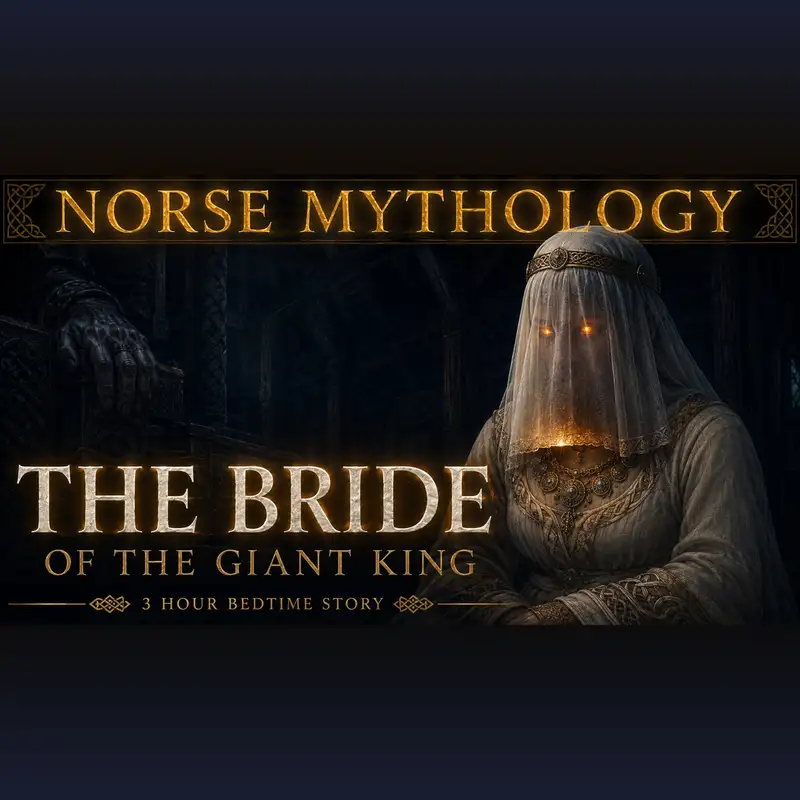
Welcome to The Sleeping Almanac.
Tonight, the strangest thing the gods of
Asgard ever did.
The day they dressed Thor, the strongest god in the worlds, the storm god, the wielder of the great hammer Mjölnir
they dressed him as a bride.
They put a veil on his face, a gown on his shoulders, the bride's keys at his belt, and the great gold necklace of Freyja
the goddess of love, at his throat, and they rode him east in his own goat chariot to a giant's wedding feast in the cold country across the world where the hammer that had been stolen from him eight nights before was waiting on a pillow.
We will tell the story tonight from the Thrymskvida, the Lay of Thrymr, the last and strangest of the great Thor poems preserved in the Codex Regius.
There is a verse in the Havamal, the wisdom poem of the Old North, that says, "Praise the day at evening.
Praise the woman after she is buried.
Praise the weapon when it has been tried."
Tonight, by the time the story is done,
Mjölnir will be tried.
Settle in.
Let your shoulders drop.
We begin on the morning the hammer
disappeared.
Chapter one.
The empty pillow.
Thor woke at dawn.
The Thrymskvidha does not tell us exactly what dawn it was or what season of the year.
We can imagine from the small details the poem gives us that it was an early summer dawn
that the long gray light of the eastern sky was already pale, that the goats in the yard outside Thor's hall were already stirring
that the small birds of Asgard were beginning their first careful calls in the trees of Idavoll.
We can imagine that Thor's wife, Sif, the one with hair of gold, was still asleep beside him.
We can imagine the slow, steady rhythm of
her breathing in the early light.
We can imagine that the hall around them
was very still.
Thor opened his eyes.
He reached the way he always reached on waking to his right side, to the place on the floor beside his bed where he kept Mjolnir
the hammer that the dwarves Eitri and Brokkr had forged for him in the great forging contest of long ago
the hammer that had cracked the heads of giants, the hammer that had broken the rocks of the world rim
the hammer that had been at his side every night since the day it had been given to him.
His hand closed on nothing.
The floor was empty.
There was no haft.
There was no head.
There was no leather thong.
There was no oil cloth wrapped around the
great iron weight.
There was only the dust of the floor and
the cold morning air against his palm.
Thor sat up.
He sat up very slowly.
The Thrymskvidha gives us this moment with
its rare gift for the quiet detail.
The poem tells us that Thor, who had killed more giants than any other being in the worlds
Thor the strongest of the gods, Thor who had pulled the world serpent up out of the deep
Thor in this moment did not roar, did not
curse, did not strike out.
The poem says only that he sat up and that he looked at the floor and that his beard shook.
His beard shook.
That is the line the Thrymskvidha gives
us.
In the old language, the line is, "Skegg nam að hrista, skör nam að dæja." His beard began to shake.
His hair began to tremble.
Not because he was afraid.
Thor did not get afraid.
The trembling the old North understood was the small physical sign of the anger that was beginning very slowly in the center of Thor's chest
like a small fire being lit somewhere deep
that would burn slowly outward and that
if it was not contained, would burn the
whole world.
Thor's beard shook.
He stood up.
He did not wake Sif.
He moved very quietly, the poem tells us,
around the bed, looking on every side.
He looked under the bed.
He looked behind the wall hangings.
He looked in the corners of the room.
He looked in the small chests of his
clothes.
He looked in the high rafters above the
bed.
He looked everywhere a hammer might have been mislaid by a tired man at the end of a long day.
He did this very thoroughly, very slowly, very carefully, even though he knew, and the poem implies that he knew
that Mjollnir was not in the room.
Mjollnir, the poem implies, was not in the
hall at all.
Mjollnir, the poem implies, was not in
Asgard.
Mjollnir was somewhere else.
Thor finished his search.
He stood for a long moment in the center of his own bedroom in the dim gray early morning light with the chest still open behind him and the wall hanging still pulled aside
and he looked at the place beside the bed
where his hammer had always been.
The dust on the floor was undisturbed.
That was the strange thing.
That was the thing the Thrymskvidha does
not say but implies.
The dust on the floor was undisturbed.
There was no scuff mark of a thief's foot.
There was no print of a hand.
There was no track of a sliding object.
The hammer had not been pulled away.
The hammer had not been dragged.
The hammer had not been picked up by hands
that had crossed the room from any door.
The hammer had simply, sometime in the
night, ceased to be where it had been.
That was a kind of theft, Thor understood, that very few beings in the worlds could perform.
That was the theft of a being who could reach into a god's bedroom from somewhere else and take a hammer out of its place and leave the dust undisturbed.
Thor knew, in that moment, that he had a
problem.
He went to find Loki.
He did not wake Sif.
He did not call for his servants.
He did not yet, the poem implies, tell
anyone in his own hall what had happened.
He walked out the door of his bedroom, down the long hall of his house, across the small dawn courtyard outside his hall
where the goats were beginning to bleat for their morning feed, and across the long open road that led between the gods' halls in Asgard
and he went directly to the door of the only being in the worlds who would know what to do
Loki.
Loki, who had been there at the forging of
the hammer.
Loki, who had been there at every clever
thing the gods had ever done.
Loki, who, when a thing was lost, was the only being in Asgard who would think to ask the right questions about who might have taken it.
Loki, who in his own way, even though Loki was the one who would eventually be the cause of the ending of all things
Loki was also, in the long old North, the one being who could be relied on to find a thing that had gone missing.
Thor arrived at Loki's door.
He did not knock.
He pushed the door open and walked into
Loki's hall.
Loki was already awake.
Loki, the poem implies with the small smile of a poet who knows his characters, Loki was already awake because Loki was always already awake.
Loki slept lightly.
Loki kept odd hours.
Loki, in the dawn, was usually already sitting somewhere with a cup of something warm in his hands
watching the morning come on.
He had eyes the color of cold water.
He had a thin face.
He had a small smile that did not quite
reach his eyes.
Loki looked up when Thor came in.
He saw Thor's beard still shaking.
He set down his cup very carefully, and he
stood up.
He said, "What has happened?" Thor said, "My hammer is gone." The Thrymskvidha gives us
in this moment, one of its small jewels.
Loki, who could be many things and who was many things and who would in the end be the betrayer of all things
Loki, in this single moment, was Thor's
friend.
The poem records no laughter, no quick
remark, no quip.
The poem records only that Loki, hearing what Thor had to say, understood immediately.
Loki said, "Come with me." And the two of them, the god of thunder with his beard still trembling and the trickster of Asgard with his cold eyes very calm and very focused
the two of them walked out of Loki's hall together and across the dawn road and toward the hall of Freyja.
Because Loki, the poem implies, had already begun to work the problem, and Loki, the poem implies
knew exactly what the first move had to
be.
Chapter two, The Borrowed Wings.
Freyja was awake.
The poem does not tell us how she knew the
two gods were coming.
We can imagine, in the way the old North imagined these things, that Freyja, who was the goddess of love and of fertility and of war and of magic
who was a Vanir goddess older than the Aesir, who saw a great many things that other gods did not see
that Freyja had simply, on some morning instinct, felt that two of her colleagues were on their way to her door.
She was at the threshold of her hall when
they arrived.
The Thrymskvidha describes her in a single image, and the image is the small precious detail of this part of the poem.
She is, the poem says, wearing the great necklace, Brisingamen, the necklace of fire, a necklace whose origin the Thrymskvidha does not tell us
though later tellings in other later poems would give the necklace a long strange story of its own.
The Thrymskvidha tells us only that the necklace was Freyja's, that she wore it every day
that it was the most beautiful object in
any of the worlds.
Around her throat, the four small dwarf stones of it catching the dawn light, her hair fell loose.
Her gown was the color of wheat grain just
before harvest.
She looked at Thor.
She looked at Loki.
She said, What is wrong?
Loki spoke.
Thor, the poem implies, was not yet
capable of words.
Thor was still in the small slow burning
rage of a god who had lost his hammer.
Loki spoke for him.
Loki said, Freyja, lend us your feather
cloak.
The poem moves quickly here, and we will move with it, but let us first explain the cloak
because the cloak is the thing this whole
chapter turns on.
Freyja owned a great feather cloak.
The poem calls it a fjedurhamar, a feather skin, but the meaning is more specific than that.
The cloak was a falcon skin, a magical garment that, when a being wrapped it around themselves
allowed that being to take the form of a
falcon and to fly.
Freyja used it for her own purposes.
She lent it occasionally to other gods.
It was one of the great treasures of
Asgard.
It was not a thing she gave lightly.
Freyja looked at Loki.
She said, "Why?" Loki said, "Thor's hammer
is gone." Freyja's face changed.
The poem does not describe the change in
detail.
The poem says only in a single fine line
that the old Norse poets loved.
Freyja, hearing what Loki had said,
understood at once.
She understood what it meant for Mjollnir
to be gone.
She understood that some giant somewhere had reached into Asgard in the night and pulled the hammer out of the place where it lived.
She understood that without Mjollnir, the
gods were vulnerable.
She understood that without Mjollnir, the
giants might come.
She said, "Take it." She turned.
She went into her hall.
She came back out a moment later with a
cloak folded over her arms.
The cloak was the color of a wild falcon's back, brown and white and gray, with the long banded feathers of the wing folded carefully one over the other.
She held it out to Loki.
She said, "Bring my cloak back to me and bring Thor's hammer back to him." Loki took the cloak.
Loki bowed to Freyja, very quickly and very formally, in the way the Old North's tricksters bowed when they wanted to acknowledge that someone had done them a service.
Loki turned to Thor.
Loki said, "Wait here." The Thrymskvidha gives this moment one of its precious small touches.
Loki, the poem implies, did not waste any
further words.
Loki, the poem implies, knew that every moment was a moment in which Mjolnir was somewhere it should not have been.
Loki turned and walked out of Freyja's hall and went to the open space of Idavollr
the great plain at the center of Asgard.
And he stood there in the morning light with the feather cloak in his hands, and he looked east.
He looked east because east was where the
Jotnar lived.
He looked east because if Mjolnir had been taken, the being who had taken it would have hidden it in the country of the Jotnar.
He looked east because he was about to fly
there.
Loki, the poem tells us, swung the feather
cloak around his shoulders.
The cloak, the way the cloak worked, the way the Old North imagined these things, closed itself around him.
The feathers settled against his
shoulders.
The hood came up and over his head.
And then, in a way the poem does not bother to describe because the listener would have known
Loki was no longer Loki.
Loki was a falcon, a small gray and brown falcon with cold eyes and a sharp beak, standing on the long grass of Idavollr in the early morning light
looking east.
The falcon opened its wings.
The falcon launched into the sky.
The Thrymskvidha describes this, and this is one of the small lovely lines of the poem.
In three quick brush strokes, whir of wings, wind through feathers, the shape of a falcon rising over the high walls of Asgard and turning east
the morning light catching on the back of the wings as he climbed, the small distant shape of him crossing the rainbow bridge of Bifrost and then crossing beyond it into the long country between Asgard and Jotunheimr.
Thor, on the ground in front of Freyja's
hall, watched him go.
Thor said nothing.
Freyja stood beside him.
She said quietly, "He will find it." Thor said, "I hope so." And the two of them stood in the dawn in the long shadow of Freyja's hall with the great necklace of Brisingamen catching the morning light
and they waited for Loki to come back.
Chapter three: The Hall of Thrymmer.
Loki flew east.
The Thrymskvidda does not tell us how long
the flight took.
We can imagine from the way the poem hints at distance that it took most of a morning.
The world between Asgard and Jotunheimr is
a long world.
The lands roll under a falcon's wings for
hour after hour.
The forests of the middle country pass
below.
The rivers cross the falcon's path like
long silver threads.
The small farms of Midgard, the country of men, pass below in their slow patchwork of green and brown.
The high mountains of the eastern border
rise.
The falcon climbs over the mountains.
The falcon crosses the great cold passes
of the high country.
And then somewhere on the far side, the falcon comes down out of the high air into the country of the Jotnar
Jotunheimr.
The country was, the poem implies in the way the old North always implied, vast, cold, stony
vast pine forest stretching in every direction, high cliffs of dark stone, cold rivers running between cold rocks
halls of the Jotnar standing alone in clearings with thin lines of smoke rising from the smoke holes of their roofs
cattle of the Jotnar grazing in the long meadows, herds larger than any herd in Midgard.
The country went on for as far as the
falcon's eyes could see.
Loki, in falcon shape, began to look.
He looked for a hall that was bigger than
the others.
He looked for a hall that had recently
been visited by something important.
He looked for a hall where the wood smoke smelled different, where the cooking fire smelled of feasting
where the hangings outside were the bright hangings of a hall preparing for a celebration.
He looked in the way the old North's tricksters looked for the small signs of a being who had just done something that he was very proud of
and he found it.
The Thrymskvida does not give us a detailed description of Thrymmer's hall, but the poem implies
in a few small details, that the hall was large, that it was new, that it stood on a flat shelf of rock above a wide pasture in which a great many cattle grazed.
The roof was thatched with new straw.
The doors were thrown open.
The hall was already preparing for some event, some celebration, some announcement, something the giant who lived there was very pleased about.
Loki, in falcon shape, came down through the cold air of the eastern country and landed on the long stone wall in front of Thrymmer's hall.
He sat on the wall in falcon shape.
He turned his head, the way a falcon does, with the quick, small movement that takes in the whole landscape in three turns of the neck.
He looked at the hall.
He looked at the pasture.
He looked at the cattle.
And then, looking back at the hall, he saw
the figure he had come to find.
Thrymmer was sitting on a high stone seat
outside his hall.
The Thrymskvida gives us, here, one of the
small precious images of the poem.
Thrymmer, the king of the Jotnar of the eastern country, the lord of the Thirsas, the one whom the poem calls Thirsa Draughten.
Thrymmer was sitting on his stone seat in the morning sun, calm, satisfied, the way a man sits when he has just done a thing that he believes is going to bring him a very great prize.
He was weaving collars for his hunting
dogs.
The poem records this in a single quick
line.
He was weaving gold collars for his dogs.
He was trimming the manes of his horses.
The horses, the poem says, were large and dark, with black coats that gleamed in the morning sun.
Thrymmer was sitting on his stone seat in the bright morning, with the collars across his lap
and the great hunting dogs of his hall lying at his feet, and the horses of his hall grazing in the pasture
and he was waiting.
He was waiting, the poem implies, with the patience of a being who knew what he was waiting for.
Loki, in falcon shape, watched him.
Thrymmer, after a moment, looked up.
He saw the small falcon on the wall.
He recognized it.
The Thrymskvida gives us, here, the small detail that Thrymmer, even though he was a giant of the eastern country
even though he had probably never met Loki face to face, Thrymmer immediately recognized the falcon as one of the messengers of Asgard.
He had heard of Freyja's cloak.
He had heard of the gods who borrowed it.
He understood, the way creatures of the old North understood these things, that the falcon on his wall was not a wild falcon.
Thrymmer said, in the open air, without standing up, "Well, Loki of the Aesir, what brings you to my hall?" The Thrymskvidha gives this line to Thrymmer exactly.
He addresses Loki by name.
He calls him Loki of the Aesir.
He speaks calmly, as if he has been
expecting the visit for some time.
Loki, on the wall, took the feather cloak
off.
He became Loki again, standing on the top of the long stone wall in the morning light of Jotunheimr
thin, pale, cold-eyed, wearing his traveling cloak underneath the falcon skin, which he now folded over his arm.
Loki said, "Thrymmer, lord of the thursas, I have come for a thing that we believe is in your possession." Thrymmer did not
the poem records, look surprised.
Thrymmer did not pretend ignorance.
Thrymmer did not, in the long Norse way,
even try to bluff.
Thrymmer simply, with the calm of a man who has been waiting for this question, raised his head a little.
Thrymmer said, "What thing?" Loki said,
"Thor's hammer." A small silence.
Thrymmer smiled.
It was not a friendly smile.
It was the smile of a being who has been waiting for a long time to be asked exactly this question and who has been preparing his answer for as long as he has been waiting.
Thrymmer did not stand up.
Thrymmer did not call for any of his
giants.
Thrymmer did not, the poem implies, even
raise his voice.
Thrymmer said, "I have hidden Mjollnir
eight leagues underground.
No being will ever find it.
No being will ever lift it.
No being will ever take it from where I have put it." Loki said, "What do you want for it?"
The Thrymskvidha records the exchange in three short stanzas, and the exchange is the heart of this chapter.
Loki, in the old way, did not argue.
Loki, in the old way, did not threaten.
Loki simply asked the only question a
being like Thrymmer would understand.
What is your price?
Thrymmer leaned forward a little on his
stone seat.
His smile grew wider.
He said, Bring me Freya as my bride in
eight nights' time.
And on the morning of the wedding, when she comes to my hall, when she takes the marriage vows with me
when she is mine, on that morning, and not a moment before, I will give back Thor's hammer.
Chapter four, The Demand.
Loki did not, the poem records, respond
immediately.
Loki, on the stone wall, with the feather cloak folded over his arm, looked at Thrymmer for a long moment without speaking.
The poem does not tell us what Loki was thinking in that long moment, but we can imagine.
We can imagine that Loki, the trickster who lived by the small, careful calculation of how impossible things could be made possible
Loki was already turning the demand over
in his mind.
Freyja as bride in eight nights, the wedding to be performed in Thrymr's hall, the hammer to be returned only after the marriage was complete.
It was, Loki understood, an impossible
demand.
Freyja would not, Loki knew with great certainty, agree to it, and even if Freyja agreed
even if somehow the gods of Asgard pressured her into the agreement, once the wedding was performed
once she was Thrymr's bride, the gods would have given the giants a much greater prize than just the hammer.
They would have given them Freyja herself.
Freyja, the goddess of love.
Freyja, the goddess of fertility.
Freyja, the older Vanir goddess whose
magic was older than the Aesir.
The giants, having Freyja as their queen, would be able to bring such terrible weather
such terrible failures of crops, such terrible barrenness of beasts on the lands of the gods that Asgard might fall within a generation.
It was, Loki understood, a demand designed
to be impossible.
Thrymr was not, Loki understood, asking for Freyja because he thought he could have her.
Thrymr was asking for Freyja because he knew the gods could not give her, and the gods could not get their hammer back
and Thrymr would have what he had always wanted, which was Mjollnir hidden eight leagues underground in his own land
and the gods of Asgard without their greatest weapon, and the long, slow tilting of the worlds toward a future in which the giants might at last be greater than the gods.
Loki understood all of this.
Loki, in his cold-eyed way, did not show
that he understood any of it.
Loki said, " I will bring your demand to the gods." Thrymr said, "Do." Loki bowed in the small way the old Norse tricksters bowed when they wanted to acknowledge a transaction that was not yet complete.
He put the falcon cloak back around his
shoulders.
He became, again, the falcon.
He launched into the cold morning air of Jotunheimr, and he turned and he flew back west toward Asgard with the demand of Thrym
the lord of the Thirsas, the king of the eastern country, wrapped in his mind like a small dark stone.
He flew fast.
The flight back to Asgard was, the poem
implies, faster than the flight out.
Loki had something to tell, and Loki, the poem implies, had already begun to think, even in the air
even with the wind in his feathers, about how the impossible demand of Thrym might be turned in some small impossible way into a possible demand A demand that might
with the right cleverness, be answered without giving Thrymmer the prize he was really asking for.
Loki, the poem implies, was already in
flight, beginning to work the problem.
By the time he came down out of the western sky onto the long grass of Idavollr in the late afternoon light
Loki had, though the poem does not say so
out loud, Loki had a plan.
It was a very strange plan.
It was a plan that required the cooperation of the strongest god in Asgard.
It was a plan that required Thor to do a thing that Thor would not, in his ordinary life, ever have considered doing.
Loki landed.
He pulled the falcon cloak off.
He became Loki again.
Thor was still standing in front of Freyja's hall, exactly where Loki had left him.
Freyja was beside him, with the great necklace, Brisingamen, still around her neck, with the dawn long since passed and the late afternoon light now slanting across the open space of Idavollr.
Thor turned.
Thor said, "What did you find?" Loki said, "I found Thrymmer, the king of the Thursas.
He has Mjollnir." Thor said, "Where?" Loki said, "Eight leagues underground, in his own land.
He will not give it back unless we pay him for it." Thor said, "What does he want?" Loki
the poem records, paused for a moment.
The poem does not tell us why he paused.
We can imagine that Loki, with his cold-eyed practical mind, wanted to deliver the news in such a way that the news did not immediately cause Thor to take a sword and start swinging it.
We can imagine that Loki was choosing his
words.
Loki said, "He wants Freyja as his bride." The poem records Freyja's reaction in one of its most famous lines.
The poem says simply that Freyja snorted.
Chapter five, The Refusal.
She snorted.
That is the line the Thrymskvidha gives us, and the line is one of the small great moments of the poem.
Freyja, hearing what Loki had just said, did not, the poem implies, speak first, did not curse
did not raise her voice, did not, in any human sense, react in the way that the old North would have expected a furious goddess to react.
Freya simply, in the moment of hearing the demand, drew in a long, deep breath and pushed it out through her nostrils: a snort.
It is the kind of sound a horse makes when a thing it cannot accept has just been put in front of it.
It is the kind of sound that does not contain any words because the words have not yet been arranged
because the anger is still in the body and
has not yet reached the throat.
It is the small first physical sign of a goddess realizing what has just been said to her.
The Thrymskvidha gives this snort in the original Old Norse in a single word: fnasaði.
She fnasaði.
She snorted with anger.
And the snort, the poem records, was so violent, was so full of the deep, cold, ancient anger of an old Vanir goddess who had just been told what her colleagues at the door wanted to bargain her away for
that the great hall of Freya shook on its
foundations.
The great walls of the hall trembled.
The Brísingamen, the great necklace of fire that lived around her throat, the necklace forged by four dwarves in a cave under a mountain in some ancient time before the gods were named
the Brísingamen broke.
Or rather, the poem says, "The Brísingamen burst from her neck, the clasp of it sprang open
the chain of it leapt up from her throat, the four small dwarf stones of it scattered for one quick moment into the air of her hall
" stukk af halsi men.
The necklace leapt from her neck.
The Brísingamen fell.
It fell onto the long wooden floor of Freyja's hall, where it lay in a small, bright pile of light
like a small fallen star.
Freyja did not pick it up.
Freyja, the poem records, was looking at
Loki.
The Thrymskvida gives us this look in a
single careful line.
Freyja looked at Loki, and Loki, Loki who had stared down jotnar, Loki who had walked across the long roads of the worlds with the most dangerous of beings as his companions
Loki who would in the end be the cause of the ending of all things, Loki, in this moment
took a small step back.
The poem does not record what Loki said in
that moment.
The poem records only Freyja's response.
Freyja said, "Do you think I am a goddess so full of love for men that I would marry a jotun to get a hammer back?" The poem renders this in two short stanzas.
The first contains Freyja's question.
The second contains a single line that the old North loved, that the old North repeated
that the old North preserved for hundreds
of years in this single poem.
Mik veist verða vergarnasta ef ek ek með
þeri jotunheima?
You would have me be the most husband mad of all the women in the worlds if I went with you to Jotunheimr.
It is one of the great lines of the Old
North.
The line is a refusal.
The line is also, in the small, dry old
way of the Eddic poems, a joke.
Freyja was not, the poem implies, going to
marry Thrymmer.
Freyja was not, the poem implies, going to
even consider marrying Thrymmer.
The idea was so monstrous that Freyja had no other response except to point out, very dryly
that the gods would have to think very
poorly of her to imagine that she would.
The gods, the poem implies, took the
point.
Thor, in the doorway of Freyja's hall, did
not speak.
Loki, who had taken a small step back, did
not speak either.
The Brisingamen lay on the floor.
Freyja, after a long moment, knelt down
very slowly and picked up the necklace.
She held it in her hands for a moment, looking at the small dwarf stones of it in the long fading afternoon light.
The clasp of the necklace had not broken.
The necklace had simply leapt off her
throat in the moment of her anger.
She fastened it back around her own neck, very carefully, very deliberately, with the small
careful movements of a woman who is restoring order to a thing that has been disordered.
She stood up.
She looked at Thor.
She looked at Loki.
She said, Find another way.
And she turned, and she went back into her
hall, and she closed the door behind her.
The Thrymskvida gives us this gesture, the closing of the door, without any further explanation.
The door closed.
Freyja was inside her hall.
The two gods were outside.
The question of how to recover Mjolnir
was, now, entirely the gods' problem.
Freyja had refused.
The refusal was final.
The gods would have to find another way.
Thor, in the late afternoon light, looked
at Loki.
Thor said, We should call a council.
Loki, the poem implies, agreed.
Loki nodded.
Loki, who already, the poem implies, had a plan, but who was not yet ready to share that plan with anyone
least of all with Thor.
Loki nodded, and the two of them turned, and they walked together across the long open space of Idavollr toward the great hall of council that stood at the center of Asgard
where the gods met when the gods had a
problem they could not solve alone.
They called the council.
Chapter six: The Council of the Gods.
The gods came.
The Thrymskvidda does not give us a long list of who was at the council, but we can imagine from the way the poem implies the gathering that everyone came.
Odin, the Allfather.
Frigg, his wife, with her quiet eyes.
Tyr, the one-handed god.
Heimdallr, the watcher of the rainbow
bridge, with his great horn at his side.
Freyr, brother of Freyja, the lord of
fertility.
Idun, keeper of the apples of youth, with
her hair the color of wheat.
Sif, Thor's wife, with her golden hair.
Baldr.
Yes, the Thrymskvidda takes place before the death of Baldr, and so Baldr was at this council
the bright son of Odin, whose loss would one day begin the great tilting of the world toward Ragnarok.
Baldr was there, the poem implies, sitting
at the long table with the others.
The gods sat in a circle.
Thor stood at the center.
He told them, in the small, careful way that even Thor knew how to use when the situation called for it
what had happened.
The hammer.
The empty floor by the bed.
The visit to Freyja.
The borrowing of the cloak.
Loki's flight east.
Thrymmer's demand.
Then he said, "Freyja will not go." The gods, the poem records, all turned to look at Freyja
who was at the council.
Freyja, with the Brísingamen back around
her neck, looked at the gods.
Freyja, the poem implies, did not need to
say anything.
The gods knew.
The gods understood.
The gods, the poem implies, would not have asked her to go, even if Thor had not already said she would not.
There was a long silence.
The gods of Asgard, the Thrymskvidda
implies, did not have a ready answer.
The problem was, on its face, impossible.
The hammer was gone.
The giants would not return it without
Freyja.
Freyja would not be given.
The hammer would not, by any path any of
them could see, be coming back.
And then, in the small, clear voice of the watcher of the rainbow bridge, Heimdallr spoke.
The Thrymskvidha gives us Heimdallr's speech with all the dignity the old North could give to a difficult suggestion.
The Havamal, the old wisdom poem of the North, the long sequence of plain quiet sayings that Odin himself was said to have spoken
preserved in the Codex Regius alongside the Thrymskvidha itself, has a line for moments like this one.
It is better, the Havamal says, to give a
friend a wise word than to give him bread.
The bread will be gone by morning.
The word may save his life.
Heimdallr was the kind of friend who gave
the word.
Heimdallr, the white god, the foreseeing one, the one whose hearing was so sharp that he could hear the grass growing on the ground and the wool growing on a sheep's back
the one whose eyes could see a hundred leagues in any direction, the one whose horn would one day announce the beginning of Ragnarok Heimdallr stood up at the council.
He looked at the gods.
He looked, finally, at Thor.
Heimdallr said, "There is a way." The gods
turned to him.
Heimdallr said, "We dress Thor as the
bride." A small silence.
The poem records this silence with one of
its few overt notes of comedy.
The gods did not, the poem implies,
immediately respond.
The gods, the poem implies, were taking in
what Heimdallr had said.
They were turning it over.
They were looking at Thor, at the great red bearded god, at the broad shoulders, at the strong arms
at the everything about him that was not,
in any conceivable way, a bride.
They were trying to imagine what Heimdallr
had just suggested.
Heimdallr, sensing the silence, continued.
He said, "We put the bride's gown on him.
We put the bride's veil on him.
We put the Brisingamen around his neck.
He travels east in the goat chariot to
Thrymmer's hall.
He goes through the wedding feast.
At the moment when the hammer is brought out, at the moment when, by the customs of the jotnar
Mjollnir is laid on the bride's knees as the blessing of the marriage, at that moment
Thor seizes his hammer back and ends the
wedding."
The gods, the poem implies, began, slowly,
to understand.
It was a plan.
It was a strange plan.
It was a plan that turned on a single piece of the old Norse marriage customs that the gods all knew.
When a giant married, the great hammer of the giant, the symbol of his power and his protection
was brought out at the wedding feast and
laid on the bride's knees.
It was the blessing of the marriage.
It was the moment that consecrated the
union.
It was the moment that, by the old laws of
the jotnar, made the wedding final.
If Mjollnir was brought out to bless this wedding, and the wedding was for Thor's hammer
and Thrymmer had no other hammer of his own that could match it, then Mjollnir would be brought out to bless the wedding
and Mjollnir, brought to be laid on the bride's knees, would be brought directly into reach of the bride who was not a bride.
The gods, the poem implies, began to nod.
Loki, sitting beside the council, smiled
his small cold smile.
Loki said, "Yes." Thor, the poem records,
did not smile.
The Thrymskvidha gives us Thor's response
in one of its small great lines.
Thor said, "They will call me unmanly." The poem records this objection with all the seriousness the old North could give to a question of honor.
Thor, for whom honor was not an abstract concept, for whom honor was the small everyday thing of being a god who was known and feared and respected
Thor could not, the poem implies, imagine
himself putting on a bride's gown.
The gown would not, in the old North,
simply be a costume.
The gown would be a public act of becoming
the thing the gown represented.
The gods of Asgard would see him in it.
The giants of Jotunheimr would see him in
it.
The skalds of the long winters afterward
would tell stories about him in it.
The men of Midgard, in their long cold halls, would, for many generations to come, laugh in their cups about the time the strongest god of Asgard had put on a bride's gown.
Thor could not, in that moment, accept it.
The poem records this objection in a
single famous line.
Thor said, "Argr." Argr is one of the
great words of the old North.
It means, and the meaning is not translatable in any single English word, it means unmanly
but it means more than that.
It means a man who has given up his
manhood.
It means a man who has accepted the role
of the woman.
It means, in the old Norse warrior honor culture, the single most insulting word that could be said of a man.
To be argur was to be unworthy of the
company of men.
To be argur was to be exiled from the
warrior's hall.
To be argur was, in some old laws, to be
killable without consequence.
Thor was saying that he could not, by going through with this plan, do that to himself.
The gods, the poem records, looked at one
another.
Loki, and this is one of the small moments where the poem lets us see Loki's intelligence at its sharpest.
Loki stood up.
Loki said, "Shut up, Thor." The Thrymskvida records this with exactly that bluntness.
"Thegi thu Thor," the poem says.
Shut up, Thor.
Loki was the only being in Asgard who could say a thing like that to Thor and survive.
He said it.
The gods, the poem implies, did not
flinch.
They knew Loki was speaking for all of
them.
Loki said, "Think." Loki said, "If you do not go to Thrymmer's hall, if you do not do this thing
the Jotnar will rule Asgard within the
year.
They will come here.
They will sit on our seats.
They will take our halls.
They will be the masters of this place where you and I and all of these other gods have lived for as long as any of us can remember.
They will end us.
Mjolnir is the thing that has kept the
Jotnar out of Asgard.
Without Mjolnir, the Jotnar come in.
You know this.
You have always known this.
The choice is not between wearing a bride's gown and not wearing a bride's gown.
The choice is between wearing a bride's gown for one day and watching everything we have ever cared about being ground under the feet of the Jotnar for the rest of time." Thor
the poem records, looked at Loki for a
long moment.
Then he looked at Freya.
Then he looked at Sif, his wife, who was sitting at the council with her hair the color of gold falling down her back.
Sif, the poem implies, did not say
anything.
She did not need to.
The two of them, Thor and Sif, had been married long enough to know each other in the small
quiet way that long married beings know
each other.
Thor was asking her with one look across the council whether she could bear what was about to happen
whether she could sit in her hall in Asgard for the next eight nights knowing that her husband was on his way east in a bride's gown to be married to another being
whether she could bear the long, quiet humiliation of knowing that her husband had agreed to put on the veil of another woman
and not just any other woman, but the most beautiful goddess in Asgard, the goddess of love herself
whose necklace would for the long ride east be lying against her husband's collarbones.
Sif, the poem implies, considered all of this for one long quiet moment, and then she gave him the only answer that mattered.
She nodded once slowly. with the small, calm steadiness of a woman who had known, since the morning her husband had walked into her hall to tell her his hammer was gone
that some price would have to be paid, and who had decided, long before the council had even been called
that whatever the price was, she would, in
her own way, help him pay it.
Sif, the old North remembered, had reason to be cautious about the cleverness of Loki.
It had been Loki, in some older story, who had once crept into her bedroom in the night and cut off her hair while she slept.
Sif knew what the cleverness of Loki could
cost.
She knew that the plans of Loki, even when they worked, were not the kind of plans that came without consequence.
She knew that the gown she was now allowing her husband to wear was, in some small way, going to cost her too.
She nodded anyway.
That was, the poem implies, what marriage
in the old North could be at its best.
Two beings who had been together long enough to know what the other was asking and who could
when the cost was high and the moment came, give each other the small, calm answer that made the next hard thing possible.
It was permission, the wife's permission, the permission of the gods of Asgard in the form of one calm look from his own wife to do the thing he was being asked to do.
Thor, the poem records, said one word.
He said, "Very well." And the gods, the poem implies with one of its rare moments of collective relief
the gods exhaled.
The plan had been accepted.
Thor would go.
The wedding would be performed.
The hammer would be brought out.
Mjolnir would, by the old laws of the Jotnar, be laid on the bride's knees for the blessing of the marriage.
And after that, after that, the poem implies, the old laws of the Jotnar would no longer matter.
After that, the old laws of any of the
worlds would no longer matter.
After that, there would be only Thor and
Mjolnir and a hall full of giants.
Chapter seven, The Bridal Veil.
The gods went to work.
The Thrymskvidha gives this chapter in a few quick stanzas, and the chapter is the small precious comedy of the poem.
The gods of Asgard, with their council ended, went together with Thor into the great hall of Freyja where the dresses of Asgard's women were kept
and they began to dress Thor as a bride.
It did not go quickly.
The gown was, the poem implies, the first
problem.
The bride's gown of a goddess like Freyja was a fine close fitted thing, long falling to the floor with embroidered patterns at the hem and the sleeves.
It was not made for the shoulders of Thor.
The shoulders of Thor were the shoulders
of the strongest god in Asgard.
The gown, when they tried to fasten it
across his chest, would not close.
The scalds in the long winter halls would tell for centuries afterward the story of how the gods of Asgard had to let out the seams of Freyja's wedding gown to fit it around Thor's shoulders and how the women of Freyja's household stood around with needles and thread very calmly
very seriously doing the work that needed
to be done.
The gown was finally fastened.
Then the necklace.
Freyja, the poem implies, took the Brisingamen off her own neck and placed it around Thor's.
The four small dwarf stones of the necklace in the late afternoon light of Freyja's hall lay against Thor's collarbones.
Freyja did this.
The poem implies without any expression the gods were gonna use her necklace to deceive a giant.
Her necklace would, by the end of the day,
be in the hall of Thrymmer.
Her necklace would be the one piece of her that would, in some small way, be present at the wedding she was not attending.
She fastened the clasp.
She stepped back.
Then the keys.
The bride of a Norse household carried
around her belt a set of keys.
The keys were the symbol of the bride's coming authority over the household, the keys to the food store
the keys to the chest, the keys to the great storehouse where the household kept the things that mattered.
Thor, as the bride, would need to wear
these keys.
The gods, the poem implies, found a set of bride's keys somewhere in Freyja's hall, and they fastened them to Thor's belt.
The keys hung against his hip.
The keys clinked very softly every time he
moved.
Then the rings.
The bride of a Norse household wore rings, gold rings on her fingers, a great brooch at her shoulder.
The gods of Asgard found these things and
put them on Thor.
Then the veil.
The veil was the last and the most
important of all the bride's garments.
The veil was the white linen cloth that
covered the bride's head and face.
The veil hid the bride from the eyes of the wedding guest until the moment at the end of the wedding feast when the husband raised the veil and saw for the first time the face of the woman he had married.
The veil was the great symbol of the
bride.
The veil was the thing that, by the customs of the Old North, made the wedding a wedding.
Freyja, the poem implies, brought out a
veil of fine white linen.
She held it for a moment in her hands.
Thor, and we can imagine this even though the poem does not say it, Thor stood very still.
He had been standing very still for some
time now.
He had been standing very still while the seamstresses had let out the seams of the gown.
He had been standing very still while the Brisingamen had been fastened around his throat.
He had been standing very still while the keys had been hung at his belt and the rings had been placed on his fingers.
He had not, in any of those small
unmakings of himself, said anything.
He had simply stood.
He had let the gods of Asgard do to him
what they needed to do.
He had, the poem implies, with all the dignity the Old North could find for him, he had held his breath somewhere deep in his chest
and he had let the bride be made out of
him.
The veil was the last piece.
Once the veil came down, the unmaking
would be complete.
Once the veil came down, the gods of Asgard would look at him and see not Thor, but Freyja.
Once the veil came down, the long ride east would begin, and the long humiliation and the long careful pretending in the giant's hall.
Freyja set the veil on Thor's head.
She pulled it down over his face.
Thor, behind the veil, did not move.
He could see, the poem implies, and this small detail is one the old North would have understood.
Thor could see the gods of Asgard through
the veil.
The veil was a thin linen.
Light came through it.
The shapes of the gods who had dressed him were visible on the other side of the white cloth
but the gods of Asgard could no longer
easily see his face.
The veil hid him.
The veil was, for the first time since he had taken Mjollnir off his belt the previous evening
a barrier between Thor and the world.
The poem records this moment in its small
dignified way in a single line.
Thor was now dressed.
He was, by every outward sign, the bride.
Freyja's gown, Freyja's necklace, the bride's keys, the bride's rings, the bride's veil.
He was, in every visible way, ready to be married to the king of the Jotnar of the eastern country.
Loki watching smiled his small cold smile.
Loki said, 'She will need a handmaiden.' The Thrymskvida gives this moment to Loki in one of its small lovely lines.
Loki, who had been the architect of the whole impossible plan, Loki was not content to send Thor east alone.
Thor, in a bride's veil, would, at the very first awkward word, give the whole thing away.
Thor did not have the gift of words.
Thor did not have the gift of social
grace.
Thor was the god of thunder, not the god of polite conversation at a wedding feast in a giant's hall.
Thor would need a bridesmaid, a handmaiden who could speak for him, who could explain his strangenesses
who could deflect questions, who could, when the giant's eyes lingered too long on the bride
give the kind of clever, quick answer that
would turn the questioning aside.
Loki, the poem implies, knew exactly who
that handmaiden should be.
Loki said, "I will be the handmaiden." The
gods, the poem records, did not object.
The gods understood.
The plan would not work without Loki.
Loki, in a handmaiden's gown, with his cold eyes and his quick tongue and his small smile
was exactly the being who could keep Thor from being recognized at the wedding feast of Thrymmer.
The gods dressed Loki.
The poem records this in a single quick
image.
They put a handmaiden's gown on him, a simple linen dress more modest than the bride's
a cap on his head, a small bundle of belongings, the way a handmaiden traveling with her bride would have carried
slung over his shoulder.
Loki, in handmaiden's clothes, looked, the poem implies, convincingly like a handmaiden.
Loki had always been able to take any
shape he chose.
The handmaiden's gown was not, for Loki, a
hard costume.
Thor, behind the veil, said one word.
He said, "Loki." Loki said yes.
Thor said, "Do not let me kill you on the road east." Loki, the poem implies, did not promise anything.
Loki only smiled his small, cold smile.
The gods, the poem records, walked the two of them, the bride and the bridesmaid, out into the open air of Idavollr
where Thor's chariot of goats was waiting and where the long road east lay open under the late afternoon sky.
Chapter eight, The Road East.
They climbed into the chariot.
Thor's chariot, the Thrymskvidha gives us in a single quick image, was drawn by two great goats.
The poem does not name them in this stanza, but the old North would have known their names.
They were Tanngrisnir, the gap toothed,
and Tanngnjóstr, the tooth gnasher.
Two great goats with horns curving above their heads, with shaggy coats the color of late autumn grass
with hooves shod in brass.
They drew the chariot of Thor across the
worlds when he traveled.
They drew it now.
Thor, in his bride's veil, sat down in the
chariot.
Loki, in his handmaiden's gown, sat down
beside him.
The gods of Asgard, standing on the long
grass of Idavollr, watched them go.
Sif was there.
Freyja was there.
Odin was there.
Heimdallr, with his great horn, was there.
None of them, the poem implies, spoke.
There was nothing to say.
The bride and the bridesmaid were on their
way.
The gods could only watch and hope and wait for the chariot to come back with a hammer in it.
Thor took up the reins of the goat
chariot.
He shouted, the poem implies, in his great voice, the voice that was the same whether he wore a bride's veil or not.
he shouted at the goats.
The goats started forward.
The chariot lurched.
The wheels began to turn.
The chariot picked up speed.
And here the Thrymskvidha gives us one of
its small great lines.
The poem says in two careful stanzas that the chariot went east at such speed and Thor drove the goats with such fury at having to make this journey at all that the road behind them caught fire.
The rock split.
The mountain shook.
The earth burned with flame.
Bjorg brustu, brann jord loga.
It is one of the famous lines of the Old
Norse corpus.
The mountain shattered.
The earth burned with flame.
The poem is, in this single line, giving us a window into the cosmic temper of Thor in this moment.
Thor was not happy Thor was driving his chariot east at the speed of his own fury at the situation he had been placed in.
The road behind him, in the wake of the chariot's wheels, was a long line of cracked rock and burning grass.
The mountains on either side of his path
were trembling.
Loki, in his handmaiden's gown, hung onto
the side of the chariot.
The Thrymskvidha does not record what Loki
said in that moment.
We can imagine that Loki, with his cold-eyed pragmatism, was thinking that they needed to slow down
that arriving at Thrymmer's hall with the visible signs of cosmic disturbance trailing behind them would not
perhaps, help with the disguise.
We can imagine Loki turning his head and the wind catching at a small handmaiden's cap and Loki saying something quiet and sharp to Thor through the noise of the wheels.
We can imagine Thor behind his veil, breathing in, breathing out, pulling the reins a little, slowing the goats.
The fire behind them died down.
The chariot, by the time it crossed the long border into Jotunheimr, was no longer trailing cosmic disturbance behind it.
It was just a chariot, a bride and her handmaiden, two great goats pulling them across the cold country.
The journey was, by then, a quieter
journey.
The country grew rougher.
The forest grew darker.
The cattle of the Jotnar grazed in the
high pastures on either side of the road.
The smoke of the Jotnar's halls rose in long, thin lines from the small clearings between the trees.
They drove east.
They drove east through the late afternoon and into the long blue evening of Jotunheimr.
The Havamal opens with a verse for the
kind of crossing the chariot was making.
At every doorway, the old poem says,
"Before you go in, look around carefully.
You never know what enemy is already sitting on the bench within." The bench within Thrymmer's hall that evening was lined with enemies.
And as the evening grew, the great hall of
Thrymmer came into sight on the horizon.
The new straw of its roof, the doors thrown open, the cooking fires already burning.
The hall, the poem implies, was already at
full preparation for the wedding.
Thrymmer, the king of the Jotnar, was
waiting.
The Thrymskvidha gives us the next moment
in one of its small great touches.
Thrymmer When he saw the chariot coming up the long road from the west, Thrym stood up from his stone seat outside the hall.
Thrym called to his giants.
Thrym's voice carried across the pasture
and through the open doors of the hall.
Thrym said, "Stand up, Jotnar.
She is coming.
Freyja, the daughter of the Vanir, is coming to my hall to be my bride, to bring me the great prize my hammer theft has won." The Thrymskvida records his speech with all the small awful pride of a giant who is about to be very badly fooled.
Thrym says in the next stanza that he has many gold-horned cattle, many black oxen, many things in his hall
many treasures, many fine gems and rings, and that all of these things would mean nothing to him until tonight when at last he would have Freyja.
The poem records this with a small dry
irony.
The poem knows that Thrym has just said the last thing he will ever say with any of his old confidence.
The chariot rolled to a stop in front of
the hall.
The bride climbed down.
The handmaiden climbed down.
The goat stood breathing hard in the cold
blue evening light.
The bride, with her veil down over her
face, was led by Thrym's hand.
Thrym, the poem implies, took her hand at the door of the hall, and the bride's hand was even through the gown
even through the long sleeve, even through the embroidered cuff, a hand of strange and unusual size and weight.
Thrym led her in.
The wedding feast began.
Chapter nine.
The wedding feast.
The hall was full.
The Thrymskvida gives us the wedding feast in three stanzas, and the three stanzas are the comic heart of the poem.
The hall of Thrymr was filled with giants, cousins, brothers, sons, lords of the eastern country
lesser jotnar of the surrounding
mountains.
The long tables of the hall were laid with
food.
The great hearth at the center of the hall
was burning.
The cooking fires in the side passages were sending up smoke through the open vents in the roof.
The hall was loud with the voices of the giants, with the slow, heavy laughter of giants pleased about a wedding that was a triumph
with the small, bright clinking of bronze
cups being filled with mead.
The hall was warm.
It was the warmth of a great cold country hall on a winter evening, the warmth of stone walls that had soaked up the heat of the cooking fires for hours
the warmth of bodies and the bodies of
jotnar.
The old North knew were large bodies, hot bodies, bodies that gave off heat the way smaller bodies could not.
The warmth of the rough wool clothes that the wedding guests were wearing, the long fur cloaks over the shoulders of the men
the heavy gowns of the women, the small steam that rose from the cups of hot spiced wine that were now being passed down the long tables.
The hall was warm in a way that the poem implies the bride was feeling under her veil.
The hall smelled, the poem implies, of
many things at once.
It smelled of roasting beef.
It smelled of charred fat.
It smelled of the long, sweet smoke of pine wood burning in the great hearth, of the small
sharp smoke of resinous branches being tossed in for fragrance, of the warm, yeasty smell of bread baking in the side ovens.
It smelled of mead, which is to say it smelled of honey, of fermented honey, of the warm
spiced honey wine that the jotnar of the eastern country were famous for and that they were now bringing out in great oak barrels and pouring into the bronze cups of every guest in the hall.
The hall sounded like a feast, the slow, heavy laughter of giants, the clinking of cups
the scrape of long knives on the wooden cutting boards as the carving women cut the roasted meats into portions.
The small quick footsteps of the serving children, who were the half grown jotnar of Thrymmer's household
weaving in and out among the tables with
platters held high.
The voices in the rafters of the great hall, rising and falling, gathering into the long low roar that any large feast in any large hall makes when the company has settled in and the mead has begun to do its work.
And underneath all of it, very quietly, very steadily, the slow careful breathing of the bride.
Thrymmer sat at the high seat at the head
of the hall.
Thor, the bride, with the veil down over his face, with Freyja's necklace at his throat
with the keys clinking at his belt, sat at
Thrymmer's right hand.
Loki, the handmaiden, sat at Thor's right
hand, ready to speak for him.
The food came.
The Thrymskvida gives us the menu of the
wedding feast in a single careful stanza.
Roasted ox, eight salmon, all the delicate small dishes that were customarily made for the women of the feast.
Small breads, small honey cakes, small soft fruits, small cheeses, the kind of fine careful foods that a bride was expected to eat slowly
in small portions, behind her veil.
The bride, the poem records, did not eat
slowly.
The bride ate the whole ox.
The bride ate all eight of the salmon.
The bride ate every one of the small delicate dishes that had been prepared for the women.
And then, the poem records, the bride
called for mead.
Three barrels of mead.
The bride drank.
The Thrymskvida says, three barrels of
mead in a single sitting.
Thrymr, sitting in his high seat at the
head of the hall, watched all of this.
Thrymr's face, the poem implies, slowly
changed.
The poem gives us, in one of its famous
lines, Thrymr's reaction.
Thrymr leaned over to where Loki was
sitting at the bride's right hand.
Thrymr spoke very softly.
Thrymr said, I never saw a bride bite more
sharply.
I never saw a maiden eat more food.
I never saw a young woman drink more mead.
It is one of the small comic gems of the
Old North.
Thrymr, the king of the Jotnar, the lord of the Thirsas, the giant who has hidden Mjolnir eight leagues underground
Thrymr is now leaning across the high table and quietly asking the handmaiden whether his bride is
perhaps, unusual.
Loki, the poem records, was ready.
Loki had, the poem implies, been preparing for exactly this question on the long ride east.
Loki turned to Thrymr.
Loki, in his handmaiden's voice, which the poem implies was a soft, careful voice, the kind of voice a respectful handmaiden of an old high-rank goddess would use to address the giant who was about to become her mistress's husband.
Loki gave Thrymr the answer.
Loki said, Freya has not eaten in eight
nights.
So eager was she to come to your hall, lord of the Thirsas, so impatient was she to be your bride
that she has not slept and has not eaten for the eight nights since the demand was sent.
Now, finally, in your hall, she is eating
and drinking, because at last she is here.
The poem gives us Thrymr's response in the
smallest possible touch.
Thrymr smiled.
It was a smile of vanity.
It was a smile of a being who, on hearing the explanation, found that he was very willing to believe the explanation
because the explanation flattered him.
Freya had been so eager for him, so hungry for the wedding, that she had not slept or eaten for eight nights.
Of course.
Of course she had.
He, Thrymr, was the giant she had been
waiting for.
He, Thrymr, was the king worthy of such
hunger.
Thrymr was satisfied.
The feast continued.
The bride, behind her veil, kept eating.
Chapter ten.
The eye beneath the veil.
The feast went on for some time.
The Thrymskvidda does not give us the length, but the poem implies that the meal stretched on through the long evening of Jotunheimr
with the cooking fires burning down, with the small fine wedding foods being brought out by the women of Thrymmer's household
with the mead going around in the great bronze cups, with the slow heavy laughter of the giants growing slower and more affectionate as the wedding feast did the thing wedding feasts always do
which is bring the company into the warmth
of a long shared meal.
And at some point in the evening, the poem implies, Thrymmer leaned over toward the bride.
Thrymmer wanted to kiss her.
The Thrymskvidda gives us the moment with
all the small comic dread it can muster.
Thrymmer, the king of the Jotnar, the bridegroom, the man who had won the prize he had been waiting for
Thrymmer leaned across the high table toward the bride who sat beside him with her veil still down over her face.
He wanted, the poem implies, to lift the
veil and see the face of his bride.
He reached out.
He lifted the veil just a little, just enough to see in the warm hall light the eyes of the woman he was about to be married to.
Thor, the poem implies, could not move.
The poem does not tell us this, but we can
imagine it.
Thor, sitting at the high seat at the head of the hall with the great square iron head of Mjolnir still nowhere in his hands
with his hand still trapped under the embroidered sleeve of a bride's gown, with the giant's face four inches from his own face and the giant's mouth coming closer with the slow
heavy intention of a kiss.
Thor could not move, could not strike, could not stand up, could not in any of the small old ways the god of thunder had ever solved a problem
solve this problem.
Mjolnir was somewhere in the hall on a cloth in the hands of giants being brought out in slow procession.
Mjolnir was not yet in his lap.
Mjolnir was not yet in his hand.
Thor was, for one second of the long evening, the most vulnerable he had ever been in his life.
Thor was a bride.
Thor was unarmed.
Thor was being kissed at by a giant.
He held the eye contact.
He had to.
Looking away would have been the giveaway.
Closing his eyes would have been the
giveaway.
Any flinch, any small involuntary turn of the head, any small reflexive setting of the jaw would have been the giveaway.
Thor held the eye contact with the man he had ridden east to kill, with the man whose face was now closer to his own face than any face had ever been outside his own bed
and he held it, and he held his breath, and he held the small, slow burning fury of a god who had been brought to this point by the strangest series of small impossible decisions any god had ever been brought to.
And the burning, the poem implies, was
visible.
The fury came up through Thor's eyes the way it had come up through his beard on the morning he had found his hammer gone.
He could not contain it.
He had been containing it all day.
He had been containing it through the
dressing.
He had been containing it through the ride
east.
He had been containing it through the
feast.
The fury had been gathering in his chest, in his shoulders, in the muscles of his arms under the long embroidered sleeves.
And now, in the small space between his face and Thrymmer's, with no way to release it
the fury did the only thing it could do.
It came out through his eyes.
His eyes burned.
His eyes burned the way coals at the bottom of a forge fire burn when the bellows have been working them for a long time.
His eyes burned the way the iron of Mjolnir had burned in the great forging contest of the dwarves Eitri and Brokkr long ago
when the small pale flame at the bottom of the forge had been worked, breath after breath
into the bright white fury that the hammer
head had been pulled out of.
His eyes burned.
Thrymmer saw them.
He recoiled.
The Thrymskvida gives this recoil in one
of its great lines.
Thrymmer leapt back.
Thrymmer almost overturned his own high
seat.
Thrymmer, the king of the Thyrses, was, for the first time in this whole poem, afraid.
The poem records, in Thrymmer's own voice,
what he had seen.
Thrymmer said, Why are Freya's eyes so
terrible?
Why do they burn like fire?
Why are they not the eyes of a maiden?
The poem records this in one of its small,
dignified stanzas.
Thrymmer's eyes had met in the small space under the lifted edge of the veil, the eyes of Thor.
And Thor's eyes behind the veil were not
the eyes of Freya.
They were the eyes of the God who had spent the entire journey east burning with the fury of having to wear a bride's gown.
They were the eyes of a being who had just eaten an entire ox and drunk three barrels of mead and was
in the way only Thor could be, very awake.
They were the eyes that in the corners of the warm hall light glowed like the small coals at the bottom of a forge fire.
Thrymmer saw them, and Thrymmer, the giant who had been ready to laugh off any eccentricity of his bride.
Thrymmer, in this moment, almost saw
through the disguise.
Loki, the poem records, was ready again.
The poem does not tell us what Loki was feeling in that second, but we can imagine.
We can imagine that Loki, who had been the architect of the whole plan, who had ridden east with Thor
knowing that this exact moment would come, who had been rehearsing his lines for the long ride out
Loki, in this second, was feeling for the first time the full cold weight of what the plan had been asking him to carry.
If the next sentence out of his mouth did not work, both of them would die in this hall.
There were a hundred giants in this room.
There were weapons on every wall.
Mjollnir was not in Thor's hand.
The plan, the careful, impossible plan, was in this small space between Thrymmer's leaning in face and the bride's burning eyes
and it lived or died on whether Loki could say one true sounding sentence in the voice of a soft
careful handmaiden.
Loki's heart, the poem implies, came up
into his throat.
Loki's voice, the poem implies, stayed
very even.
Loki, in his handmaiden's voice, and the poem implies that this is the moment when all of Loki's clever
cold thinking on the long road east was being repaid in a single critical exchange.
Loki leaned in toward Thrymmer.
Loki said, Lord of the Thursas, do not be
afraid.
Freyja's eyes burn because for the same reason that she has eaten and drunk so much tonight
she has not slept for eight nights.
The eight nights between the demand and the wedding, she has lain awake in her hall, so eager was she for you.
Her eyes burn because they have not been
closed.
They will be calm again, Lord of the
Thursas, after she has rested in your bed.
The Thrymskvida records Thrymmer's reaction to the second explanation with the same small comic touch.
Thrymmer who had almost seen through the
disguise.
Thrymmer, on hearing Loki's explanation,
again chose to believe it.
He chose to believe it because the
explanation, again, flattered him.
Freyja's eyes burned with the hunger of
love.
Freyja's eyes had not slept because she
could not stop thinking of him.
Thrymmer, in this moment, settled back
onto his high seat.
He smiled again.
It was the small, dangerous smile of a
giant who has chosen vanity over caution.
It was the smile of a giant who was, the poem implies, about to die, but Thrymmer did not yet know that.
Thrymmer, restored to his confidence by the explanation, Thrymmer now decided that it was time.
The feast had gone on long enough.
The mead had been drunk.
The food had been eaten.
The hour had come for the moment that, by the old laws of the Jotnar, would make the wedding final.
Thrymmer stood up at the high seat.
Thrymmer raised his voice across the hall.
The Thrymskvida gives us his speech in one of the great anticipated moments of the entire poem.
Thrymmer said, "Bring out the hammer."
Chapter Eleven: The Hammer on the Knee.
A small silence fell across the hall.
The Thrymskvida gives us the silence in a
single quick line.
The giants of Thrymmer's hall, hearing the king's command, stopped their conversations.
The clinking of cups stopped.
The laughter stopped.
The hall was, for one moment, completely still because the giants knew what was about to happen.
The bringing out of the hammer at a giant wedding was the great consecrating moment of the marriage.
The hammer of the bridegroom, the symbol of his power and of the protection he would now extend over his bride
was carried out by the bridegroom's men.
It was laid on the bride's knees.
The bride, by accepting the hammer on her knees, accepted the protection of her husband.
The husband, by laying the hammer on her
knees, gave that protection.
It was the moment that, by the old laws of the Jotnar, the laws older than any of the laws of the gods
made the wedding final.
Thrymmer's giants brought out the hammer.
The Thrymskvidda does not give us the details of the procession, but the poem implies that the hammer was carried by several giants.
Mjollnir was a heavy weapon, and even in the hall of Thrymmer, the bringing out of it was a procession.
They carried it on a cloth.
They carried it slowly, with the great
care that the moment required.
The hammer, the poem implies, was the great hammer, Mjollnir of Thor, with its short, heavy haft and its great square iron head
with the small marks on the head where the dwarves Eitri and Brokkr had finished it in the deep places of the worlds.
It was, after eight long nights, no longer
eight leagues underground.
It was, after eight long nights, finally
back in the same room as Thor.
The giants approached the high table.
They carried the hammer to where the bride
was sitting beside Thrymmer.
They, by the old custom of the Jotnar,
laid Mjollnir on the bride's knees.
The Thrymskvidda gives us, here, the line that the Old North preserved more carefully than almost any other line in the entire poem.
The line is, Hlo hlórida hugr í brjósti.
It means, the heart of Thor laughed in his
breast.
Thor, who had been silent through the whole feast, who had eaten an ox and ate salmon and drunk three barrels of mead
who had stared out at Thrymmer through the
veil with eyes that almost gave him away
who had been carried east in a bride's
gown against every instinct of his honor.
Thor, in this single quiet moment, when the haft of his own hammer touched the cloth of the gown across his own knees
when his hand, hidden under the embroidered sleeve of the bride's gown, closed around the haft that he had not held in eight nights.
Thor's heart laughed in his breast.
It is one of the small great lines of the
entire Old Norse corpus.
The heart of Thor laughed, not aloud, not so that any of the giants in the hall heard it.
The poem is careful about this.
The laughter was internal.
The laughter was the small recognition, deep in Thor's chest, that the long humiliating journey
the gown, the keys, the necklace, the veil, the eight salmon, the three barrels of mead, the careful explanations of Loki
all of it, all of it had brought him here to this moment with his hand around the haft of Mjollnir in the hall of Thrymmer with the giants of the eastern country gathered around him in their long wedding feast clothes
weapons at their sides, but not in their
hands.
The slow, heavy laughter of a feast still
echoing in the rafters of the hall.
The laughter was also, the poem implies,
something else.
The laughter was the moment in which a being who had spent the whole day being someone he was not
being a bride, being a quiet woman, being a thing the gown had made him, felt himself in one small private second become himself again.
The hand under the embroidered sleeve was
his own hand.
The hand was the hand that had held this
hammer ten thousand times.
The hand knew the haft.
The haft knew the hand.
The wood of the haft had over the long
years taken the shape of his grip.
The grip now slid back into the place the
haft had been waiting for it to slide.
The hammer remembered him.
He remembered the hammer under the veil, behind the gown, with the Brisingamen at his throat and the bride's keys at his belt and the small bright rings of the bride still on his fingers.
Thor, for one small space of one held breath with his hand on his own hammer for the first time in eight nights
Thor was again Thor.
The bride was not the bride.
The bride was the god of thunder, and the god of thunder, the poem implies, was about to be the god of thunder again.
Thor was Thor again.
Mjollnir was Mjollnir again.
The plan, the careful impossible plan of
Loki, had worked.
There is a verse in the Havamal that says,
"Praise the day at evening.
Praise the woman after she is buried.
Praise the weapon when it has been tried." Mjolnir, that night, was about to be tried.
The Thrymskvidha gives us the next moment
in three quick stanzas.
Thor seized the hammer from his own lap.
He stood up at the high table.
The veil fell back.
The bride's gown fell open.
The keys jangled at his belt.
The Brisingamen swung at his throat.
Freyja's gold and Thor's beard and the great square iron head of Mjolnir all caught the firelight at the same moment
and Thrymr, beside him at the high seat,
finally, too late, saw who his bride was.
Thrymr stood up.
Thrymr opened his mouth to call to his
giants.
Thor brought Mjolnir down.
The Thrymskvidha records the moment with the brief dignity of a poem that knows it does not need to elaborate.
The hammer fell.
Thrymr, the king of the thursas, fell.
The hall, for a single moment, was full of the small sound of the king of the jotnar of the eastern country striking the floor of his own hall.
Then the giants began to rise, and Thor, the great red-bearded god, with the gown still half on
with the necklace still around his neck, with his hammer in his hand, Thor moved through the hall of Thrymmer the way Thor always moved through halls of giants.
The poem does not give us the details.
The poem says only that Thor, in this hall, killed every giant who stood up to come against him.
The hall, by the time it was over, was
silent.
The wedding feast, by the time it was
over, was no longer a wedding feast.
Thrymmer's hall was a hall of fallen
giants and a god with a hammer.
The Thrymskvidha gives us one final small detail, and the detail is one of the strangest in the poem.
At the end of the slaughter, when the hall was silent, an old jotun woman came forward.
She had been Thrymmer's sister.
She had, the poem implies, been at the wedding for the giving of the bride gift, which in the old North was the gift of rings from the bridegroom's family to the bride.
She had been about to give Freyja, as she imagined Freyja, the rings that were her right by custom.
Now, with her brother dead and the hall full of fallen giants and the bride who was not a bride standing in the middle of it all with her hammer in her hand
she asked anyway.
She asked for the rings.
The Thrymskvidha records with a small dry note that Thor gave her instead what he had given her brother.
The hall went quiet.
Thor lowered the hammer.
He looked around the hall at the long fallen tables, at the small fire still burning in the wall sconces
at the great half-eaten ox at the center of the high table, at the empty mead barrels on the floor
and he understood that the wedding was
over.
The mission was done.
Mjolnir was in his hand.
Loki, in his handmaiden's gown, stood very
still in the corner of the hall.
Loki, who had been the architect of the whole plan, who had been at Thor's side through the whole long impossible day
who had spoken for Thor at the feast and saved him from Thrymmer's eyes and explained away the burning eyes and the great appetite
Loki in this moment did the one thing he was always good at, which was knowing when not to draw attention to himself.
Loki said, "Are we going home?" Thor said, "Yes." And the two of them, the god of thunder with his hammer in his hand and his gown still half on
and the trickster of Asgard with his handmaiden's cap askew on his head and his small cold smile playing at the corner of his mouth
the two of them walked out of the hall of Thrymmer in the deep blue light of the Jotunheimer night
and they climbed back into the chariot of goats, and they turned the chariot west, and they went home.
The Thrymskvidha gives us one final stanza
for the ride back.
The chariot, with Thor no longer in the cosmic rage of the outward journey, with Mjolnir back in his hand and the matter resolved
drove west across the long country between Jotunheimer and Asgard at the ordinary speed of a chariot.
The road behind them did not catch fire.
The mountains did not split.
The earth did not burn.
The two great goats pulled the chariot steadily across the cold country through the night and into the first gray light of the dawn over Asgard.
Thor came home.
Thor, still in the gown, the poem implies because the poem does not record any pause to change clothes.
Thor came home to the gods of Asgard with Mjolnir at his side in the first light of morning.
The gods of Asgard, who had waited the
night, came out to meet him.
The Thrymskvidha ends the story here with
one last small line.
The gods received Thor.
The hammer was back.
The matter was closed.
Freyja's necklace was returned to her.
Freyja's gown was returned to her
household.
The bride's veil was folded carefully
away.
Loki's handmaiden's gown was folded away
too.
The chariot of goats was put back in its
stable.
The poem ends, as Eddic poems often end, with a small, simple note that the story is now over.
Tonight, dear listener, the story will end
in a slightly different way.
Tonight, we will sit for a moment in the closing of the story before we let you go to sleep.
Chapter Twelve: Goodnight and the Wolf at
the Edge of Time.
The story we told you tonight is one of
the strangest in the Old North.
A god lost a hammer.
The hammer was hidden eight leagues
underground by a king of the giants.
The king of the giants demanded, as the price of the hammer's return, the goddess of love as his bride.
The goddess refused.
The gods of Asgard, having no other path, dressed the god of thunder in a bride's gown and a bride's veil and sent him east to the giant's hall.
The giant, in the small, awful pride of a being who has been waiting too long for his prize
failed to recognize that the bride was not
the bride he had asked for.
The hammer was brought out.
The hammer was laid on the bride's knees.
The bride, in that small moment, became
again the god whose hammer it was.
And the wedding ended in the way the
wedding could only have ended.
That is all.
There is no great tragedy in this story.
There is no death of a son of the gods.
There is no binding of a great old enemy.
There is no first meeting of two beings fated to kill each other at the end of all things.
There is only the small precious comedy of a god in a bride's gown and the small precious moment in which his heart laughed inside his breast when his hand finally closed around the haft of his own hammer.
But the Old North loved this story.
The Old North loved this story the way the Old North loved any story in which the gods of Asgard
by some clever, impossible turn, recovered
what they had lost.
The Thrymskvidha was one of the most
beloved poems in the entire Eddic corpus.
It survived in the Codex Regius.
It was probably composed, the scholars believe, in the late tenth century or the early eleventh
when the old religion of Iceland was just
beginning to give way to the new religion.
It was a poem from the late days of the
Old North's understanding of itself.
And it was, in some quiet way, exactly the kind of poem the Old North's listeners needed.
The hammer had been lost.
The hammer had been recovered.
The world had, by a strange, impossible
path, been put right again.
Thor was Thor again.
Mjolnir was Mjolnir again.
And the giants, the Old North believed, would not, for one more generation at least, be the masters of Asgard.
But the giants were still there.
The Thrymskvida does not say so in its closing stanza, but the Old North's listeners would have understood.
Thrymr was one giant.
Thrymr had hidden the hammer eight leagues
underground.
Thrymr had been answered, but the giants of the eastern country were still there in their long
cold halls, waiting.
The giants would, in the next generation,
try again.
The giants would try again and again and again through all the long stretching ages of the Old North's cosmos until at last
at the end of all things, they would try one final time, and that final time would be the time when the gods of Asgard would not
by any clever, impossible plan, be able to
send them home.
That final time would be Ragnarok.
The giants would come across the long road
from the east.
They would cross the rainbow bridge.
They would walk into Asgard.
The hammer would still be in Thor's hand.
The hammer would, on that day, no longer
be enough to send them back.
The serpent we met two nights ago in the deep, cold sea would rise from the encircling water.
Loki, who tonight, in the small dignified comedy of the wedding feast, was Thor's clever
loyal companion.
Loki would by then have become the great
betrayer.
Loki would lead the giants.
Loki would ride at the head of the army.
But Ragnarok is not yet.
Ragnarok is, the old North believed, still
many generations away.
Tonight the giants are at home in the cold
east.
The hammer is back at Thor's side.
Freyja is back in her hall with her
necklace at her throat.
Loki is back in his small cold cunning, smiling his small smile with no sign yet that the smile would in some far future turn into something terrible.
Tonight is the small precious time before
the ending.
This is, in some quiet way, what the Thrymskvidha was telling itself in the long winter halls of the late tenth century.
The hammer is gone.
The hammer is recovered.
The world goes on.
The giants are out there.
The giants will try again.
But for tonight, the giants are at home.
For tonight, the hammer is here.
For tonight, the gods of Asgard sit in Idavollr in the morning light, and Thor is taking off the bride's gown at last
and Loki is taking off the handmaiden's cap, and Freyja is fastening the Brisingamen back around her own throat
and the long quiet day after the strange
impossible night is beginning.
That is what tonight's story is, a small, precious recovery, a hammer back in its place
a few thousand more years of the world.
We will tell you next time of a god who went into the country of the giants for a different reason
not to recover something stolen, but to seek something he wanted, of a hall of riddles
of a contest of strength, of a great horn that no being could drain, of a cat that no being could lift
of an old crone called Elli, whose name in the old language meant simply old age, and against whom even Thor could not stand.
We will tell you of the visit to
Utgardaloki on Wednesday.
But for now, for now, the bride is no
longer the bride.
The hammer is back in its place beside
Thor's bed.
The chariot of goats is stabled.
The Brisingamen catches the morning light
at Freyja's throat.
Loki is sitting again at his own table with his warm cup in his hands, watching the dawn come on
the small cold smile playing at the corner
of his mouth.
Sif is in the kitchen of her hall with her
gold hair shining in the morning light
making breakfast for her husband who has come home Thor is sitting on the edge of his bed
taking off the last of the bride's gown and reaching down to the place beside the bed where Mjolnir now is again.
The world has another few thousand years.
The wolf at the edge of time waits.
The great ship Naglfar is still being
built.
Ragnarok is still far away.
Tonight there is only the cold morning of Asgard and a hammer back in its place and a god in his own bed and a small smile somewhere across town that has not yet turned into the smile that ends everything.
Good night, dear listener.
Wherever you are tonight, whatever bed you are in, whatever quiet room, whatever soft pillow you have laid your head on
let the picture of the god and the hammer
be the last picture you carry into sleep.
Not the slaughter at the end of the
wedding feast.
Not the falling of Thrimur.
The hand.
The hand of the god, hidden under the embroidered sleeve of the bride's gown, closing around the haft of his own hammer for the first time in eight long nights.
The small private laughter of his heart
inside his breast.
The recognition.
The recovery.
Let the wolf at the edge of time wait.
Let the great ship Naglfar wait in the
cold east.
Let Ragnarok wait.
Tonight there is only the morning and the
hammer and the good night.
And tonight there is only your bed and your breath and the room around you growing dark.
Sleep.
The Sleeping Almanac will be here on Wednesday with another story from the Old North.
New episodes every Wednesday and Sunday at
eight o'clock in the evening.
If the story carried you down into sleep, if the picture of the god and the hammer was the last thing you saw before the dark came
leave a quiet small note in the comments.
We read every one.
We tell each other in the morning who
slept.
Sleep deeply.
Sleep without dreams.
And wake into a quieter world.
Good night, dear listener.
From the long Old North.
From the bride who was not a bride.
From the hammer back in its place.
From the almanac that is keeping the slow
count.
Good night.