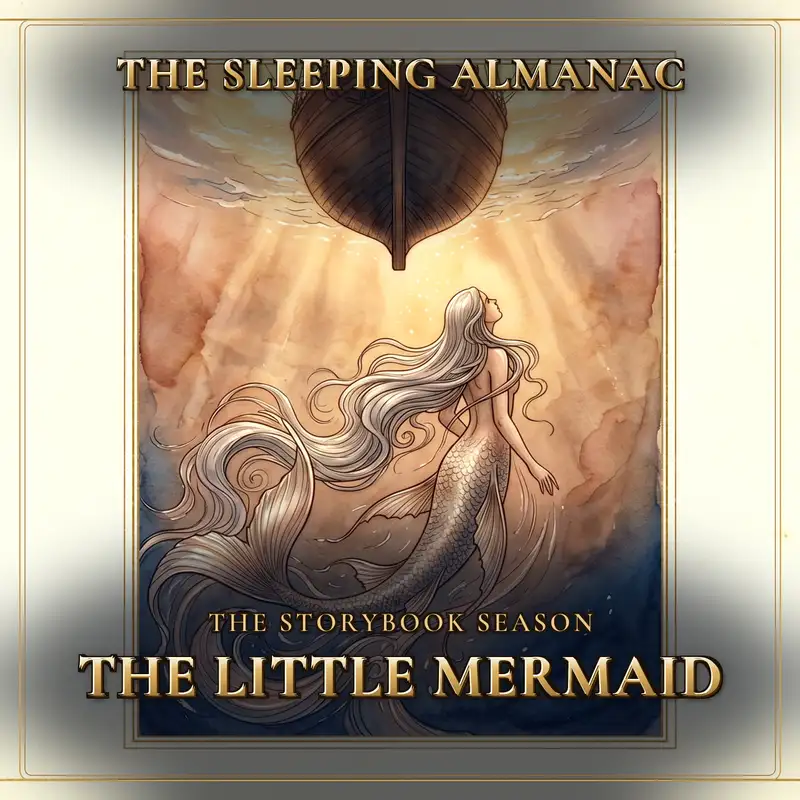
Welcome to The Sleeping Almanac.
Before the lamp is lit, one small thing. If these stories carry you to sleep, subscribe now, while your eyes are still open, and tomorrow night's tale will be waiting for you. A like helps other tired souls find this room. That is all. Let's light the lamp together now.
The lamp is lit again.
The same small flame as last night, in the same quiet room at the edge of the world.
The storyteller is already here. She was here before you arrived. She will stay until you sleep.
There is a chair for you. There is a blanket. The night outside is doing all of its slow, dark work, and none of it is yours to carry until morning.
The storyteller opens the old book, and turns past the tales already told, to a page that waits for tonight.
Tonight, she says softly, we go down beneath the waves, far out where the water is blue as the petals of the loveliest cornflower and clear as the clearest glass, down and down to a palace of amber and coral, for tonight is the tale of the little mermaid.
And there is no hurry at all as she begins.
Settle in, now. Let the chair take your weight, all of it, even the weight you did not know you were still holding. Let the blanket be heavy in the good way, the way snow is heavy on a roof that has nothing to do until spring. The day is over. It cannot be improved and it does not need to be. You do not have to watch this story. You do not have to remember any of it in the morning.
You may believe you know this tale. You know a version of it, the way you know a postcard of the sea. Tonight you are given the sea itself, the old tale, the true one, written down by a gentle and lonely man in Denmark almost two hundred years ago, and it is deeper and stranger and kinder than the one you remember. No one in it has a name. Not the mermaid, not the prince, not the witch. That is not a lack. That is how you know a tale is truly old. Names wear off things that have been loved for a long time, the way gilt wears off the edges of a book. And the ending, whispered here before we even begin, so that no part of you needs to brace for it anywhere along the way: the ending is not sad. It rises. You will see.
If you drift, drift. This story is mostly water, and water has never once minded being slept beside. We begin.
Chapter One.
Far Out, Where the Water Is Blue.
Far out at sea, the water is as blue as the petals of the loveliest cornflower, and as clear as the clearest glass.
That is how the old book begins this tale, and no one in almost two hundred years has found a better way, so the storyteller reads it exactly as it is written. And then she reads it again, more slowly, because it is a sentence like a view, the kind you walk past and then turn around and walk back to.
Far out. Farther than the fishing boats trouble to go. Farther than the gulls bother to follow them. Out where the last smudge of land has slipped below the edge of the world behind you, and the sea stops being a place you visit and becomes, simply, the place. The water out there is the exact blue of a cornflower petal held up to the light, and it is clear, the old book insists on this, clear as the clearest glass.
And it is deep. Deeper than any anchor rope has ever reached, deeper than any anchor. The old book measures it the only way a person of the land could understand. Many church steeples, it says, would have to be piled one upon another, spire upon tower upon spire, to reach from the bottom of that water up to the surface. Picture that a moment, drowsily, without effort. A tower of towers, standing in the dark blue, its lowest door resting on the clean sand and its highest weathervane still far below the keels of the ships. That is how deep. That is where this story lives.
It would be wrong to think that nothing is down there but bare gray sand. That is the first thing the old book wants corrected, right at the start.
Down there, the most wonderful trees and plants are growing. Their stalks and leaves are so fine and so supple that the least stirring of the water sets them swaying, as if they were breathing, as if they were alive, which, in their own way, they are. Fish large and small slip in and out among the branches, exactly the way birds slip among the trees up here in the world of air. A whole forest, swaying without any wind. A whole sky with no clouds in it at all, only fish, going about their silver errands.
And the light down there is not darkness. This surprises everyone. In very calm weather, the old book says, you can see the sun from the bottom of the sea. It looks like a purple flower, with all the light of the world streaming out of its cup. Day comes down softened, strained through fathom after fathom of blue, until it lies along the sea floor the way light lies through the windows of some vast quiet chapel, and everything it touches is gentled by it. Even time moves differently in light like that. Slower. Rounder. The way it is moving for you now.
In the deepest place of all stands the sea king's palace.
Its walls are of coral, grown rather than built, patient centuries of it, branching rose and white and every shade the sea knows between. Its long pointed windows are of the clearest amber, so that all day the light inside is honey colored, and everything in those halls, faces, hair, the drifting hems of garments, is warmed by it, the way lamplight warms a winter room. And the roof, the roof is made of mussel shells, thousands upon thousands of them, which open and close as the water breathes over them. In every open shell lies a shining pearl, any single one of which would be the chief glory of a queen's crown up in the world of air. The whole roof glimmers, opening, closing, opening. A roof that is also a treasury. A roof that is also, in its slow way, asleep.
The sea king who lived in that palace had been a widower for many years. His old mother kept house for him. She was a wise woman, and proud of her noble birth, and on her tail she wore twelve oysters, while the other great folk of the sea were allowed only six. But she deserved every honor she gave herself, the old book says, and chiefly for this reason, that she was endlessly fond of the little sea princesses, her granddaughters.
There were six of them. They were beautiful children, and the youngest was the most beautiful of them all. Her skin was as clear and delicate as a rose petal. Her eyes were as blue as the deepest sea. But like all the rest, like every one of her people, she had no feet. Her body ended in a fish's tail.
Remember her. She is small now, and quiet, the quietest of the six. All this deep blue country, the amber windows and the pearl roof and the swaying forests and the purple flower of the sun, all of it is her home. And of everyone in her family, she is the one who will love it most, and she is the one who will leave it.
But that is far off yet, years and years off, and nothing hurries down there. Tonight she is a child in the deepest, safest place in the whole world, and the water rocks the roof of shells above her, open, closed, open, and every shell holds its pearl, and every pearl holds a little of the light.
Chapter Two.
Six Small Gardens.
Outside the palace there was a great garden, and it was like no garden you have ever walked in, though it kept all the old kind habits of gardens everywhere.
The trees there were fiery red and deep blue. Their fruit shone like gold, and their blossoms like small flames, and their branches and leaves were never still, because water is a wind that never stops blowing, only slower. The ground was the finest sand, but blue, like the flame of burning sulfur, the old book says, a soft strange blue over everything, and over everything too lay a wonderful shimmer of light, so that on the clearest days you might think yourself standing high up in the air with only sky above you and sky below, instead of at the bottom of the sea.
Now, in that great garden, each of the six princesses had her own little plot, where she might dig and plant exactly as she pleased. Six little gardens inside the great one. Six small kingdoms of an armspan each.
One princess shaped her flower bed like a whale, because she thought whales were the grandest things that crossed her sky, and so they are. Another thought it prettier to shape hers like a little mermaid, a portrait of herself in flowers, and she did not mind at all who smiled at it. You could have walked the row of those gardens and named each sister without being told.
But the youngest made her garden round, perfectly round, like the sun. And she would have no flowers in it but flowers that glowed red like the sun. Round and red and warm at the edge of all that blue.
She was a strange child, the old book says, and it says it tenderly. Quiet, and thoughtful. Where her sisters decked their gardens with the wonderful things they had gotten from wrecked ships, and the sea in those years was generous with wrecks, chests and coins, carved chairs, ships' bells, all the sunken furniture of the upper world, the youngest would have nothing in her garden but her red flowers, and one thing more.
A statue.
It was the statue of a handsome boy, hewn out of white shining marble, and it had come down through the water when a ship was lost, turning slowly, and had settled on the blue sand, and she had claimed it. No one in the deep knew who he was. He was young, and his face was kind, and he looked always slightly upward, the way statues do, as if listening for something above the roof of the water.
Beside the statue she planted a rose red weeping willow. It grew splendidly, as everything grew in that garden, and it hung its fresh branches over the marble boy, down toward the blue sand, and its shadow lay upon the sand in violet, and moved as the branches moved, so that the treetop above and the roots below seemed to be playing together, gently, at kissing one another. The old book says exactly that, and the storyteller reads it exactly that way, because no one has ever described the bottom of the sea more beautifully than the man who wrote this tale, who lived his whole life beside the sea and never once saw the bottom of it, and gave it this instead.
The little mermaid tended her round red garden. She combed the sand of it. She turned her flowers toward whatever brightness came down. And when her work was done she would sit beside the marble boy under the rose red tree, with her tail curled beneath her, and look up.
Far, far above, the water ended. She knew that, the way you know the sky ends somewhere and the stars begin. Up there, the fish called the birds swam among trees that stood in air. Up there the sun was not a purple flower but a fire of gold too bright to look at. Up there were the ships, and in the ships were people, the two legged people of the dry world, who lived their whole short lives on top of the water and never once came down to see the roof of pearls.
Nothing was wrong with her world. Understand that, the storyteller says, looking up from the book a moment. Nothing drove her away. Nothing was ever unkind to her down there. It is only that some hearts are born with their windows facing another country. No one chooses it. No one is to blame for it. She was made with her face turned upward, that is all, the way her garden was shaped like the sun, which is not a thing that lives in the sea at all.
And in the long amber afternoons the little mermaid sat with the marble boy and the red flowers, and was quiet, and nobody minded, because every family keeps a chair by the window for its dreamer.
Her greatest pleasure in all the world, the old book says, was to hear about the world of human beings up above.
And for that, there was her grandmother.
Chapter Three.
Stories of the World Above.
The old queen mother of the sea knew more about the upper world than anyone in the palace, because she was old, and because in her long life she had risen many times to the surface and looked her fill, and because she was one of those grandmothers, they exist in every country, wet or dry, who keep everything they have ever seen arranged in stories, the way other people keep linen in a chest, folded, scented, ready.
In the evenings the six princesses would gather in her rooms, where the amber windows let in the last of the honey light, and the old lady would settle her twelve oysters comfortably and begin.
Ships, she told them about. Not the undersides, which the princesses knew, the long dark keels sliding over the garden, but the tops of ships, the part the sea never sees from below. White sails stacked up into the wind like towers of laundry. Ropes in patterns finer than any coral. And little people walking about on top, calling to one another in their air voices, which are rougher than sea voices, the grandmother said, but warm, like everything up there.
She told them about towns. At night, she said, a town on a shore looks like a hundred stars that have fallen in a heap and gone on burning, quite content. There is noise in a town, and rumbling, and bells in high towers that swing and sing. There is a smell of smoke and bread. The lights double themselves in the harbor water, which is the only piece of the sea that ever gets to live in a town, and is very proud of it.
She told them about the forests, which are green, a green the deep sea does not own, and about the little birds that sing in them. And here the old book keeps one of its most charming secrets, and the storyteller hands it to you now, softly, like something passed across a table at dusk. The grandmother called the birds fishes. The little fishes of the trees, she said, that swim in the air from branch to branch, and sing. She said it that way on purpose, because her granddaughters had never seen a bird, and a new thing can only be carried into a mind on the back of a known thing. Every teacher who has ever lived has done this. Every grandmother most of all.
The flowers of the land, she told them, have a gift the flowers of the sea are missing. They pour out scent. You can close your eyes in a garden of the dry world, she said, and still be in the garden. The roses go on telling you where they are, kindly, in the dark. A flower you could hear with your breath. The princesses thought about that a long time.
And the sun, up there, is not a flower. It is gold fire, and at evening it lays a road of gold across the water, straight toward whoever is watching. That is the way of every world, she said. The wonders are wasted on the residents.
When you have completed your fifteenth year, she told them, for this was the law of the sea king's house, you shall have leave to rise up out of the water, and to sit on the rocks in the moonlight and watch the great ships sailing by, and you shall see forests and towns.
Fifteen. The eldest sister would reach it first, of course. But they were each a year apart, one stair step of a sister after another, and so the youngest, the quiet one, had the longest of all to wait. Five whole years. And if you have ever been the youngest of anything, you know the particular length of a year that stands between you and the thing your heart is set on. It is the longest measure of time there is. Ask any child in any world.
But each sister promised the others to come back after her first day above and tell everything she had seen, and everything she had thought most beautiful. For their grandmother's stories, rich as they were, could never be enough. There is no story so good that it can stand in for the sky.
Many an evening the youngest stood at her open window of amber, looking up through the dark blue water, where the fish waved their fins and the currents turned over slowly in their sleep. She could see the moon and the stars from down there. They shone pale, and looked much larger through the water than they look to us, and when something like a black cloud slid slowly across them she knew it was either a whale swimming over her, or else a ship, full of human beings.
And the people on that ship never imagined, not one of them, that a lovely little mermaid stood far below in the dark, stretching her white hands up toward the keel.
They sailed on, and slept in their swaying beds, and never knew they were loved from below.
That is how this tale begins its real journey, the storyteller says, turning the page. With a child at a window, and five years to wait, and a whole roof of water between her and the singing fishes of the trees.
Chapter Four.
Five Sisters, Five Evenings.
The year came when the eldest princess turned fifteen, and rose.
She went up through the water in the evening, as the law allowed, and the whole palace waited below, and the youngest waited hardest of all. And when the eldest came home, in the first blue of the deep sea morning, she had a hundred things to tell.
But the loveliest of all, she said, was this. To lie on a sandbank in the moonlight, in the quiet sea, and look at the great town on the coast. The lights twinkled there like a hundred stars come down to keep house together. There was music, and the noise and rattle of carriages, and voices, so many voices, all woven together into one warm sound. And above everything stood the towers with their spires, and the church bells rang, and because she could not go into the town and be part of it, it was the town she longed after most of all. That is the way of first evenings. We long hardest for the room we cannot enter.
The youngest listened to every word. And after that, when she stood of an evening at her open window looking up through the dark blue water, she thought of the great town, and it seemed to her that she could hear the church bells ringing, faintly, all the way down where she was. It was not true, of course. It was only her heart, practicing.
The next year, the second sister had leave to rise. She came up out of the water just as the sun was setting, and it was the sunset she never stopped talking about. The whole sky, she said, was gold. And the clouds, she could not say enough about the clouds. They sailed over her head, crimson and violet, great slow ships of color bound for nowhere. And swifter than the clouds there flew across the water a flock of wild swans, in one long white line, like a veil trailed over the sea, away toward where the sun stood burning. She swam toward it, toward the sun, wanting to reach it before it went. But it sank, and the rose color went out of the sky and off the face of the water, gently, the way a light goes when nobody blows it out, and the first stars opened, and she came home.
The third sister was the boldest of them all, and the next year, when her evening came, she did the boldest thing. She swam up a broad river that ran into the sea. Fresh water, running the wrong way, full of the taste of land. She saw green hills covered with vines, and castles and farms looking out through the woods, and she heard how all the birds sang, the little fishes of the trees, singing till the whole warm air rippled with it. The sun was hot on her head. She had never been warm on top before.
In a little cove she came upon a crowd of human children, splashing about in the water, quite naked and shining, and she wanted to play with them. But they fled from her in fright, as though she were something to be afraid of, which she found very strange, and a little sad, and then a small black animal came down to the water and made a sound at her that no sea creature has ever made. It was a dog. She had never seen a dog. It barked so terribly that she turned for the open sea then and there. But she never could forget the green hills, and the singing in the trees, and the beautiful children who could swim, although they had no fish tails at all.
The fourth sister was not so daring, and her way of being wise was to stay far out in the wildest part of the open ocean, and it was she who came home saying that the open ocean was precisely the loveliest place. You could see for miles and miles all around you, she said, and the sky above stood over everything like an enormous bell of glass. She had seen ships, but so far off that they looked like resting gulls. The dolphins had turned somersaults for her, because dolphins cannot resist an audience, and the great whales had risen and spouted water from their nostrils, so that it looked, she said, as if a hundred fountains were playing in a ring around her, under the great glass bell of the sky, with nobody there to see it but her and the sun.
The fifth sister's birthday fell in the winter, and so she saw, on her first evening, what none of the others had seen on theirs. The sea was green, she said, a deep cold green, and everywhere on it floated great mountains of ice. Each one, she said, gleamed like a pearl, and yet was larger than the church towers that human beings build. They showed themselves in the strangest shapes, castles and swans and sleeping animals, and they glittered. She had sat down on the broadest of them and let the sea wind play with her long hair, and every ship that passed took one look at the mountain of ice with a maiden sitting on it and steered wide away, which suited her perfectly.
Late that evening there was weather far off, and the dark waves lifted the great ice mountains high so that they glittered against the sky. But she sat quietly on her floating mountain and watched the storm walk its own road away across the sea, the way storms do, busy and self important and gone by morning. To her people, you see, weather was a show put on above the roof. Nothing in this tale is ever quite what it is to us. Hold that thought gently. You will want it later.
So it went, sister after sister, year after year. And here the old book notices something true about all of us, and says it kindly. Each sister, the first time she rose, was enchanted by the new and beautiful things she saw. But when they were grown girls, and might go up whenever they pleased, the newness wore through, and they grew indifferent to it, and after a month of evenings they said that down below was loveliest after all, and it was so pleasant, they said, to be at home.
Many an evening hour, all the same, the five sisters would take one another by the arms and rise together in a row to the surface, just to sing. They had beautiful voices, lovelier than any human voice, and when a storm was blowing up, and ships were laboring, the sisters would swim before the ships and sing to the sailors, songs about how beautiful it was at the bottom of the sea, and how the sailors need not fear to come down. But the sailors could never understand the words. They thought the singing was the wind. And so the beauty of the deep stayed unseen by them, and the deep kept its kindness and its sorrow together, the way the deep keeps everything.
And when the five sisters rose up like that, arm in arm, singing, the youngest stayed below, all alone, looking up after them.
She would have wept, watching them go. But a mermaid has no tears, and so she suffers all the more. The old book says it in one short line, and the storyteller will not add another. But the waiting had an end, and the end of it is the very next thing that happens.
Chapter Five.
The Night She Rose.
Now I am fifteen, she said. Now I too may rise up out of the sea.
Her grandmother, the old dowager queen, dressed her for it with her own hands, for this was a great occasion, the coming of age of the last of the six. She set on the little mermaid's head a wreath of white lilies, and every petal of every flower was half of a pearl. And she had eight great oysters fasten themselves onto the princess's tail, to show her high rank.
But they pinch so, said the little mermaid.
Yes, said the grandmother. Pride must put up with a little pinching.
The old book means us to smile there, and we do. The little mermaid would gladly have shaken off all that grandeur and laid aside the heavy wreath. Her own red flowers from her own round garden would have suited her better. But she did not dare, because grandmothers are a weather of their own, and so she wore her pearls and her pinching oysters, and said farewell.
Up she went, past the roof of shells, past the swaying forests where the fish turned to watch her go, up through water that turned from deep blue to green gold, growing warmer and brighter, light and clear as a rising bubble, until at last she put her head up out of the sea.
The sun had just gone down as she lifted her head above the waves. That was the first thing she ever saw of the upper world with her own eyes, the after light of a sunset. The clouds still shone like roses and gold, and up in the pale pink sky the evening star stood, clear and beautiful, the first lamp of the night lit early. The air was mild and fresh on her face. The sea lay dead calm, without one ripple beyond her own.
And near her on that calm sea lay a great ship, with three tall masts.
Only a single sail was set, for not a breath of wind stirred, and the sailors sat idle in the rigging and on the yards, easy as the singing fishes in the branches of a wood. There was music aboard, and singing, and as the evening darkened, hundreds of colored lanterns were lit along the rails and up among the ropes, so many and so bright that it looked as if the flags of all the nations of the world were waving in the air. It was the loveliest thing she had ever seen, and she had grown up under a roof of pearls.
The little mermaid swam close, right up to the cabin window, and every time the low swell lifted her she could see in through the clear panes. There were many finely dressed people within, but the handsomest of them all was a young prince with large coal black eyes.
He was sixteen years old, or not much more. It was his birthday. That was the reason for all the splendor, the music and the lanterns and the singing. And when the young prince came out on the deck, where the sailors were dancing, more than a hundred rockets went up into the sky all at once, and broke, and turned the night as bright as day.
The little mermaid was so frightened that she dove straight down under the water. It was her first fireworks, after all, and even the bravest of us was frightened by our first. But she soon put her head up again, and then, oh, then it looked to her as if all the stars of heaven were falling down to her, gently, in showers of gold and green and rose, and great fiery suns wheeled and spun, and fish of fire swam in the blue air, and all of it doubled itself in the clear still sea below, so that the whole world, above and beneath, was light. She had never imagined that human beings, the short lived people of the dry world, kept festivals like this, and burned little suns for joy, just because someone they loved had been alive for sixteen years.
On the ship itself it was so bright that you could see every rope, and every face, and how much more the face she watched. The young prince stood among the light laughing, shaking hands with his people, smiling, while the music went out over the lovely night sea.
It grew late. But the little mermaid could not turn her eyes away from the ship, or from the beautiful prince. The colored lanterns were put out, one by one. No more rockets rose. The music fell quiet, and the sea began, very softly at first, to move.
The little mermaid stayed. She rocked on the swell by the cabin window, waiting for nothing, wanting nothing, only looking, the way you look at a lit house across a field at night and feel, without one reason, that you belong to it.
And far off, under the edge of the sky, the weather that the sailors had read in the falling glass was quietly getting to its feet.
Chapter Six.
The Storm, and the Shore.
The sea got up in the night.
The storyteller tells this part the way the old sailors told weather, plainly, with respect, without one word of fright. The swell grew longer, then taller. The wind found the ship and leaned on it. The sailors took in the last sail, and the great ship flew along over the wild sea, and the waves rose up like dark mountains that wanted to look over the masts, and the ship dove down their far sides like a swan and rose again on the lifted, towering water.
To the little mermaid, remember, this was pleasure. Storms were a show put on above the roof of her world. She thought it a fine swift ride, this night. The sailors thought otherwise. And in time the ship itself thought otherwise. Its thick planks groaned under the heavy blows, and the mainmast snapped in the middle like a reed, and the ship lay over on her side, and the water came in.
Then, and only then, the little mermaid understood that the people of the ship were in danger. She herself had to mind the beams and broken planks that drove about on the water. For one moment it was so pitch dark that she could see nothing at all. Then the lightning opened the sky for a breath, and everything stood out clear, and she could see everyone on the drowning ship, each soul striving for its own life.
But it was the young prince she looked for. And just as the ship parted and went down, she saw him sink into the deep sea.
For one heartbeat, one only, she was glad. That is in the old book, and the storyteller keeps it, because it is the truest heartbeat in the tale. He is coming down to me, she thought. Down to my country, to the amber windows and the gardens. And then she remembered what her grandmother had taught them all. Human beings cannot live in the water. They are not made for the deep. He could only come down to her father's palace dead.
No, she said, to the whole dark sea. And she dove.
Down among the driving beams and planks she went, quite forgetting that they could have crushed her, deep down and high up again through the running waves, until she found him. His arms and legs had no more swimming in them. His beautiful eyes were closed. He would have died there, in the great moving dark, if the little mermaid had not come.
She held his head above the water. That was all. That was everything. And then she let the waves carry the two of them wherever the waves went, all the rest of that night, the storm walking itself out above them hour by hour, the sea slowly, slowly remembering how to be calm.
When morning came, the weather had passed as though it had never been. The sun rose red and shining out of the water, and its light brought something like life back into the prince's cheeks, though his eyes stayed shut. The little mermaid kissed his high fair forehead and stroked back his wet hair, and it seemed to her that he looked like the marble boy in her little garden at the bottom of the sea. She kissed his brow again, and wished, on the whole width of the morning, that he might live.
And then she saw before her the dry land.
High blue mountains stood far off with white snow shining on their tops, like a row of swans asleep on the sky. Down by the coast were beautiful green woods, and in front of the woods stood a building, a church or a convent, she could not say which, only that it was holy and quiet. Lemon trees and orange trees grew in its garden, and before its gate stood tall palm trees. The sea had made a little bay there, still as glass and very deep, that ran in to a cliff where fine white sand had gathered.
There she swam with the beautiful prince, and laid him on the sand, taking care that his head rested high, in the warmth of the sun.
The bells began to ring in the great white building, and a company of young girls came out through the garden. So the little mermaid swam a little way out, behind some high stones that stood up from the water, and covered her hair and her shoulders with sea foam, so that no one could see her small face, and watched to see who would come to the poor prince.
It was not long before a young girl came upon him. She seemed frightened, but only for a moment, and then she fetched the others, and the little mermaid watched as the prince came back to himself, and smiled at everyone around him.
But he did not send a smile out to sea. He did not know she was there. He did not know it was she who had carried him through the whole of the night. And when he was led away, up toward the white building among the lemon trees, the little mermaid felt a sorrow she had no name for, because it was her first, and she dove down under the water and came home to her father's palace, quiet, quieter than she had ever been, and she had always been the quiet one.
Her sisters asked what she had seen on her first evening above. Nothing, she said. Nothing they could make her tell.
Many an evening and many a morning after that, she rose again to the place where she had left him. She watched the fruits of the garden ripen and be gathered. She watched the snow melt off the high mountains. But the prince she never saw, and so she always turned home, each time a little sadder, down to her round garden. She let the garden go a little wild that year, the old book says. The flowers grew over the paths and wove their long stems in among the branches of the trees, until the whole place was a sweet gloom. And she sat in it, and grew inward, as quiet things do when they carry something alone.
At last it could not be carried alone any longer, and she told one of her sisters. And so, in the way of sisters in every world, all the rest of them knew it within the day, but no one beyond them, except a few other mermaids, who told no one, except their own dearest friends. And it was one of those friends who knew who the prince was. She too had seen the birthday festival on the ship, and she knew where his kingdom lay, and where his palace stood.
Come, little sister, said the princesses. And arm in arm, in one long row, they rose out of the sea together where the prince's palace stood, and showed it to her.
It was built of a pale shining stone, with great flights of marble steps, and one of those flights went straight down into the sea. Splendid gilded domes lifted above the roof, and between the pillars that ran around the whole building stood marble statues that looked almost alive. Through the clear glass of the high windows you could see into the noblest halls, hung with costly silk curtains and tapestries, and every wall covered with great paintings that were a pleasure just to glimpse. In the midst of the largest hall a great fountain played, its jets springing high toward the glass dome of the ceiling, through which the sun shone down on the water and on the beautiful plants that grew in the wide basin.
Now she knew where he lived. And now the nights of this tale change their shape, and become, for a long while, a very gentle habit.
Chapter Seven.
Three Hundred Years.
Evening after evening, while the amber windows went dim behind her, the little mermaid rose through the dark miles of water to the prince's palace.
She swam nearer to the land than any of her sisters had ever dared. She went right up the narrow canal beneath the fine marble balcony that threw its long shadow across the water, and there she sat, and watched the young prince, who believed himself all alone in the bright moonlight.
She saw him many an evening, sailing with music in his splendid boat where the flags waved. She peeped out from among the green rushes, and if the wind caught her long silver veil of hair, whoever saw it took it for a swan spreading its wings, and thought no more.
She heard the fishermen, many a night as they lay out with their torches on the water, speaking so much good of the young prince, and it made her glad, down to the bottom of her quiet heart, that she had saved his life when he drifted half dead on the waves. And she thought of how his head had rested on her, and how heartily she had kissed his brow. And he knew nothing of it at all, and could not even dream of her.
More and more she came to love human beings. More and more she wished she could rise and walk about among them. Their world, it seemed to her, was far larger than her own. They could fly over the sea in ships, and climb the high mountains above the clouds, and the lands they owned rolled on, in woods and fields, farther than her eyes could follow. There was so much she wanted to know, and her sisters could not answer the half of it. So she asked her old grandmother, who knew the upper world well.
If human beings are not drowned, the little mermaid asked, can they live forever? Do they not die, as we die down here in the sea?
Yes, said the old lady. They must die too. And their lifetime is even shorter than ours. We can live to be three hundred years old. But when we cease to be, we become only foam on the water, and we do not have so much as a grave down here among our dear ones. We have no immortal soul. We never live again. We are like the green rushes. Once they are cut, they cannot grow green anymore. But human beings have a soul that lives forever, that lives on after the body has become earth. It rises up through the clear air, up to all the shining stars. As we rise out of the water to see the lands of the earth, so they rise up to beautiful places unknown, which we shall never see.
Why did we not get an immortal soul? said the little mermaid, sorrowfully. I would give all the hundreds of years I have to live, to be a human being only for one day, and afterward to have a share in the heavenly world.
You must not go thinking about that, said the grandmother. We are far happier and far better off than the human beings up there.
Then I am to die, said the little mermaid, and float as foam upon the sea, and never hear the music of the waves again, or see the beautiful flowers, or the red sun. Is there nothing at all I can do to win an eternal soul?
No, said the old lady. Only if a human being loved you so dearly that you were more to him than father and mother. If he clung to you with all his thought and all his love, and let the priest lay his right hand in yours with a promise of faithfulness here and in all eternity, then his soul would flow over into your body, and you too would have a share in the happiness of humankind. He would give you a soul and yet keep his own. But that can never happen. The very thing that is thought so beautiful here in the sea, your fish's tail, they think ugly up on the earth. They know no better. Up there, to be counted lovely, you must have two clumsy props, which they call legs.
Then the little mermaid sighed, and looked sadly at her fish's tail.
Let us be glad, said the old lady. Let us leap and dance through the three hundred years we have to live. It is surely long enough. After that, one can rest in one's foam all the more contentedly. Tonight there is to be a court ball.
And what a ball it was. Nothing like it is ever seen on the earth. The walls and the ceiling of the great dancing hall were of thick clear glass. Several hundred enormous shells, rose red and grass green, stood in rows on either side, each holding a blue burning flame, and the flames lit the whole hall and shone out through the glass walls, so that the sea outside was lit far and wide. You could see the countless fish, great and small, come swimming to the glass, some with scales gleaming purple and red, some like shining silver and gold. Through the middle of the hall flowed a broad living stream, and on it the mermen and mermaids danced to their own singing.
No people of the land have voices so lovely. And the little mermaid sang most beautifully of them all. The whole court clapped their hands for her, and for a moment there was joy in her heart, full joy, because she knew that she had the loveliest voice of anyone on the earth or in the sea.
Hold on to that, the storyteller says softly, marking the place with one finger. The loveliest voice of anyone, anywhere. Remember it was true.
But soon the little mermaid was thinking again of the world above her. She could not forget the beautiful prince, nor her own sorrow at not having, as he had, an immortal soul. So she crept out of her father's palace, while everything within was song and gladness, and sat in her own little garden, in the sweet gloom of the overgrown flowers, beside the marble boy.
And down through the water came the sound of horns, far off and high above, where the evening was.
Now he is sailing up there, she thought. He whom I love more than father and mother. He to whom my heart clings. He in whose hand I would lay the whole happiness of my life. I would dare anything to win him, and an immortal soul.
While my sisters are dancing in my father's palace, she thought, I will go to the sea witch. I have always been so terribly afraid of her. But perhaps she can advise me, and help me.
And the little mermaid went out of her garden, toward the roaring whirlpools behind which the witch lived, holding her one small thought before her the whole way, the way a person carries a candle down an unlit stair.
Chapter Eight.
The House Beyond the Whirlpools.
The way to the sea witch did not pass through the gardens.
The little mermaid had never been that road before. No flowers grew along it, and no sea grass. Only the bare gray sand stretched away toward the whirlpools, where the water turned and turned upon itself like great rumbling mill wheels, drawing everything it caught down into the deep. Between those churning wheels the little mermaid had to pass, and beyond them the road ran through hot bubbling mud, which the witch called her peat bog. And behind all that stood her house, in the middle of the strangest forest in the sea.
The trees and bushes of that forest were polyps, half animal and half plant. They looked like snakes with a hundred heads growing out of the ground. All their branches were long slimy arms, with fingers like supple worms, and joint by joint they moved, from the root to the outermost tip, and whatever they seized in the sea, they wound themselves fast around, and never let go.
The little mermaid stopped at the edge of that wood, and her heart beat with fear. She nearly turned back. But then she thought of the prince, and of the human soul, and her courage came to her.
She bound her long flowing hair close about her head, so that the polyps might not seize her by it. She laid both her hands together over her breast, to make herself small. And then she darted, the way a fish darts through the water, in among the terrible trees, which stretched their reaching arms and fingers after her and closed on nothing but her wake.
She saw, as she went, that every one of them held something it had caught, held fast in a hundred small arms like hoops of iron. The old book tells what some of those things were, oars and chests and the white keepsakes of wrecks, and the storyteller turns that page gently, without reading all of it aloud. The little mermaid looked ahead and only ahead, and passed through quickly, and came out safe on the other side. That is all this room needs of that wood, tonight or ever.
Beyond it lay an open place in the forest, where great fat water snakes rolled about at their ease. In the middle of the clearing stood a house, built of pale smooth bones that the sea had gathered, over long years, from all its wrecks, and there sat the sea witch, letting a toad eat out of her mouth exactly the way a person lets a canary eat sugar. The ugly water snakes she called her little chickens, and let them wander over her as they pleased. She was, in short, the strangest hostess in this whole season of tales. But remember the promise of this room. Nothing here will startle you. Not even her. She keeps to her own chapter, and it is nearly over already.
I know well enough what you want, said the sea witch, before the little mermaid had said a word. And very foolish it is of you. But you shall have your way, for it will bring you sorrow, my pretty princess. You want to be rid of your fish tail, and to have two stumps to walk about on instead, as human beings do, so that the young prince may fall in love with you, and you may win him, and an immortal soul besides.
And the witch laughed, long and low, so that the toad and the snakes tumbled off her onto the ground.
You come just in time, she said. Tomorrow, once the sun is up, I could not have helped you for another year. I shall make you a drink. Before the sun rises, you must swim to the land, sit down on the shore, and drink it. Then your tail will part in two, and shrink into what humans call pretty legs. But it will hurt. It will be as if a sharp sword went through you. All who see you will say you are the loveliest human child they ever saw. You will keep your floating walk, and no dancer will move as lightly as you. But every step you take will feel as though you trod on a sharp knife. If you will bear all this, I will help you.
Yes, said the little mermaid, in a voice that trembled. And she thought of the prince, and of winning an immortal soul.
But consider, said the witch. Once you have a human shape, you can never be a mermaid again. Never again come down through the water to your sisters, or to your father's palace. And if you do not win the prince's love, so wholly that for your sake he forgets father and mother, and clings to you with his every thought, and lets the priest join your hands as man and wife, then you will win no immortal soul. On the first morning after he marries another, your heart will break, and you will be foam on the water.
I will bear it, said the little mermaid, and she was pale as a pearl.
But you must pay me as well, said the witch, and it is no small thing I ask. You have the loveliest voice of all who live at the bottom of the sea, and no doubt you think to charm him with it. That voice you shall give to me. The best thing you possess, for my precious drink. For I must put my own blood into it, that the draught may be sharp as a sword with two edges.
But if you take my voice, said the little mermaid, what will be left to me?
Your lovely form, said the witch. Your floating walk. And your speaking eyes. With those, a human heart can be won well enough. Come. Is your courage gone already?
It was not gone. The price was paid. The old book tells it in a single quick line, and the storyteller does the same, quietly, and then it is done and behind us: a mermaid carries her voice in her tongue, and so the witch took that, one small quick moment and then over forever, and from that hour the little mermaid could neither sing nor speak. It cost what true wishes always cost in the old tales, everything of one particular kind. She paid it with her eyes open.
Then the witch set her cauldron on to boil the magic drink. Cleanliness is a virtue, she said, and scoured the pot with the snakes, tied into a knot. She pricked her own breast and let her dark blood drip in, and the steam rose up in shapes so strange that no one has ever found names for them. Every moment the witch laid something new into the cauldron. And when the drink was ready at last, it was as clear as the clearest water.
There it is, said the witch, and gave it to her.
And the little mermaid went back the way she had come, through the wood, over the bog, between the roaring wheels of the whirlpools. The polyps, when they saw what shone in her hand like a glittering star, drew their arms and fingers in and shrank away from her, every one, and she passed through untouched.
She could see her father's palace. The lamps were all out in the great ballroom. Everyone within was asleep by now. She did not dare go in and look at them, now that she was voiceless and leaving them forever. It was as if her heart would break with sorrow. She stole into the garden instead, and took one flower from each of her sisters' little flower beds, five flowers, one for each sister, and blew a thousand kisses from her hand toward the palace, and rose up through the dark blue sea.
Chapter Nine.
Two White Feet.
The sun was not yet up when she came to the prince's palace and drew herself onto the lowest of the noble marble steps, the flight that went down into the sea.
The moon was still shining, clear and bright. The great building slept above her, all its windows dark, its statues keeping their patient watch between the pillars. The little mermaid sat on the cool marble with the sea holding her tail for the last time, and she drank the sharp burning draught down.
It was as the witch had said, like a sword passing through her, and she fainted, and lay as if dead on the steps while the sky grew pale.
When the sun came up over the sea, she woke, and before her stood the beautiful young prince. He fixed his coal black eyes on her, so that she cast down her own, and then she saw that her fish's tail was gone, and that she had the prettiest small white feet any girl could have. She had no clothing, so she wrapped herself in her long thick hair, and looked up at him.
He asked who she was, and how she had come there. And she could only look back at him, gently and sorrowfully, with her deep blue eyes. For speak she could not.
He took her hand and led her up toward the palace. And every step she took was as the witch had foretold, as if she were treading on the points of needles and the blades of knives. She bore it gladly. The little mermaid never said one word of it in her whole life, and the storyteller will follow her example. Hand in hand with the prince she went up the marble steps, light as a rising bubble, and he and everyone who saw her marveled at her graceful floating walk.
They dressed her in costly robes of silk and muslin. She was the loveliest person in all the palace. But she was mute. She could neither sing nor say. Beautiful slave girls, dressed in silk and gold, came out and sang before the prince and his royal parents, and one of them sang more sweetly than all the rest, and the prince smiled at her and clapped his hands. Then the little mermaid was sad inside, for she knew that she herself had sung far, far more sweetly, once. And she thought, oh, if he only knew that I gave my voice away forever, in order to be near him.
Then the slave girls danced, graceful and gliding, to the noblest music. And the little mermaid raised her beautiful white arms, and rose up on the tips of her toes, and floated across the floor, and danced as no one had ever danced. With every movement her loveliness showed clearer, and her eyes said more, and said it deeper into the heart, than all the singing of the slaves.
Everyone was enchanted, and most of all the prince, who called her his little foundling. And she danced again, and again. The prince said that she should stay with him always, and she was given leave to sleep outside his door, on a velvet cushion.
He had a page's suit made for her, so that she might ride out with him on horseback. They rode together through the sweet smelling woods, where the green boughs brushed their shoulders and the little birds sang among the fresh leaves, and she heard at last, with her own ears, the singing fishes of the trees, and knew that her grandmother's stories had all been true, and told gently at that. She climbed with the prince up the high mountains, and when they had climbed far enough they saw the clouds sailing along below them, like flocks of birds on their way to other lands.
And at night, in the prince's palace, when the others slept, she would go down the broad marble steps, and stand on the lowest one, and cool her feet, still warm from all the day's dancing, in the cold sea water. And then she thought of them, down there in the deep.
One night her sisters came up, arm in arm. They sang so sorrowfully as they swam upon the water that she beckoned to them, and they knew her, and came, and told her how she had grieved them all. After that they visited her every night. And once, far out, she saw her old grandmother, who had not been up to the surface of the sea for many years, and the sea king himself, with his crown upon his head. They stretched their hands toward her across the water. But they did not dare come near the land, as the sisters did. They only looked, the two old crowned heads in the dark water, and she looked back, and that was their whole conversation, and it said everything such conversations ever say.
Day by day the prince grew fonder of her. He loved her the way one loves a dear, good child. But to make her his queen, that thought never came into his head at all.
And on his marriage, remember, everything hung. The witch had said it plainly. If he wedded another, then on the morning after, the little mermaid would be foam on the sea.
Do you not love me best of them all? the little mermaid's eyes seemed to ask, when he took her in his arms and kissed her fair forehead.
Yes, you are dearest to me, said the prince, for you have the best heart of them all. You are the most devoted to me, and you are like a young girl I once saw, and shall surely never find again. I was on a ship that was wrecked. The waves carried me ashore near a holy temple, where many young girls serve. The youngest of them found me on the shore, and saved my life. I saw her only twice. She is the only one in this world I could truly love. But you are like her. You almost push her picture out of my heart. She belongs to the holy temple, and so my good fortune has sent you to me instead. We will never part.
Ah, thought the little mermaid, he does not know that it was I who saved his life. I carried him over the sea, to the wood where the temple stands. I lay behind the stones in the foam and watched until the girl came, and the girl he loves is only the second half of a morning that began with me.
And she sighed, deeply, for weep she could not.
The girl belongs to the holy temple, she told herself. She will never come out into the world. They will never meet again. But I am with him. I see him every day. I will care for him, and love him, and lay my whole life down at his feet like a path.
And for a while, a good long while, the tale rests there, and lets her be happy, and so will we. Evenings of music. Mornings on horseback under the singing trees. The sea on the lowest step at night, cool around her ankles, carrying up its old blue smell of home.
Chapter Ten.
The Bride From the Temple.
The palace heard it first as sound, a hammering down in the yards, day upon day, where a splendid ship was being fitted out. Then came the word itself, going quietly from room to room. The prince was to marry, and his bride would be the lovely daughter of the neighboring king.
The prince told his little foundling how it stood. My parents desire me to see this princess, he said. But they cannot force me to bring her home as my bride. I cannot love her. She will not be like the beautiful girl of the temple, whom you are like. If I ever had to choose a bride, I would sooner choose you, my silent foundling with the speaking eyes.
And he kissed her rosy mouth, and played with her long hair, and laid his head against her heart, and her heart dreamed of human happiness, and of an immortal soul.
You are not afraid of the sea, my quiet child, he said, when they stood together on the splendid ship. And he told her of storms and of calms, of the strange fishes of the deep, and of what the divers had seen down there. And she smiled at his telling, for she knew the bottom of the sea better than anyone who has ever stood on a deck.
In the moonlit night, when everyone slept but the steersman at his wheel, she sat at the ship's rail and looked down through the clear water. She thought she could make out her father's palace, far below, and her old grandmother standing on its highest tower, her silver crown on her head, gazing up through the moving currents at the ship's keel. Then her sisters came up out of the water, and looked at her full of sorrow, wringing their white hands. She beckoned to them, and smiled, and wanted to tell them that all was well with her, that she was happy. But a ship's boy came along the deck just then, and the sisters dove, and the boy believed the white he had seen was foam upon the water.
Next morning the ship came into the harbor of the neighboring king's city. All the church bells rang. Trumpets sounded from the high towers, and the soldiers stood drawn up with waving banners and shining steel. Every day held a festival. But the princess herself had not yet arrived. She was being brought up far away in a holy temple, they said, learning all the royal virtues. The little mermaid stood eager to see her.
And when she came, the little mermaid had to confess that she had never seen a lovelier being. Her skin was clear and delicate, and behind her long dark lashes smiled a pair of true, dark blue eyes.
It is you, said the prince. You. Who saved me, when I lay like one dead on the shore. And he caught his blushing bride in his arms. Oh, I am too happy, he said to the little mermaid. The best I ever dared hope has come true. And you will rejoice at my happiness, for you love me best of them all.
And the little mermaid kissed his hand. And it seemed to her that her heart was breaking already, quietly, ahead of time.
Here the storyteller lays her hand flat on the page a moment, and looks up. Remember the promise. No ending in this room is a fall. What is coming is not what you fear. Rest, and watch what the tale does.
The wedding was held that same day. The bells rang, and on every altar the sweet oil burned in silver lamps, and the bride and bridegroom joined hands and received the blessing. The little mermaid, dressed in silk and gold, held the bride's train. But her ears did not hear the festive music, and her eyes did not follow the holy ceremony. She was thinking of her last night in the world, and of everything she had given, and everything she had lost.
That same evening, bride and bridegroom went aboard the ship. The flags flew. A royal tent of gold and purple had been raised amidships, with the softest cushions, and there the wedded pair would sleep in the cool, calm night. The sails filled, and the ship slid lightly over the clear sea.
When it grew dark, colored lanterns were lit, and the sailors danced upon the deck. The little mermaid thought of the first night she had ever risen from the sea, when she had watched this same splendor from the water. And she gave herself to the dance one last time. She floated, the way a swallow floats at evening. She had never danced so wonderfully, and everyone marveled. Her feet ached, and she scarcely noticed, for she was saying goodbye. To him. To the lamps. To the sea wind. To all of it, in the only language she had left.
Past midnight the ship grew quiet. Only the steersman stood at his wheel. The little mermaid laid her white arms on the rail and turned her face to the east, where the sun would rise, and where, with its first ray, as she well knew, her life would end.
Then she saw her sisters rise up out of the sea. They were pale as she was. Their long beautiful hair no longer streamed on the wind. It had been cut off, every one of them.
We have given our hair to the witch, they said, to buy her help, so that you need not die tonight. She has given us a knife. See it. What the witch asked, the storyteller says once, in the smallest voice this room owns, and then it is said forever. Before sunrise the knife was for the prince, and if it was used, the little mermaid's tail would come back to her, and she could sink home with her sisters, and live out her three hundred years. Hurry, they said. One of you must die before the sun is up. Our old grandmother mourns so, her white hair has fallen away as ours fell to the witch's scissors. Come back to us. Do you see the red streak in the sky? In a few minutes the sun will rise. Hurry.
And they gave a strange, deep sigh, and sank beneath the waves.
The little mermaid drew back the purple curtain of the tent, and saw the lovely bride asleep with her head on the prince's breast. She bent down, and kissed his fair brow. She looked at the sky, where the light of morning was gathering brightness. She looked at the sharp knife. She looked again at the prince, who murmured his bride's name in his dreams. She alone was in his thoughts, that other she, and the knife trembled in the little mermaid's hand.
And then she flung it, far out over the waves.
The water shone where it fell, one moment of red gold, as if a drop of the sunrise had gone down early to wait. And the little mermaid looked once more at the prince, with eyes already half of another world, and let herself go from the ship's side, down into the sea, and felt her body loosen, and become foam.
And now the sun came up out of the sea.
Its light fell, warm and mild, across the cold foam on the water. And the little mermaid felt nothing of death.
Chapter Eleven.
The Daughters of the Air.
She saw the bright sun. And above her, in the air, there floated hundreds of beautiful transparent beings.
She could see, straight through them, the white sails of the ship and the rose colored clouds of morning. Their voices were pure melody, but so fine and so light that no human ear could hear them, just as no human eye could see them. They had no wings. They floated by their own lightness, the way scent floats, the way warmth floats. And the little mermaid saw that she had a body like theirs now, and that it was lifting, all by itself, higher and higher out of the foam.
To whom am I coming? she said. And her voice, her voice, sounded like the voices of the others, a music so gentle that no instrument of the earth could play it. It had come back to her finer than it ever was.
To the daughters of the air, they answered. A mermaid has no immortal soul, and can never win one, unless she gains the love of a human being. Her eternal life must be given her by another. The daughters of the air have no everlasting soul either. But they can make one for themselves, by good deeds, gently done, over long years. We fly to the hot countries, where the air lies heavy on the people, and we fan coolness over them. We spread the scent of flowers through the air, and carry refreshment and healing wherever we go. When we have striven for three hundred years to do what good we can, then we receive an immortal soul, and share in the eternal happiness of humankind. And you, poor little mermaid, you have striven with your whole heart for the same thing we strive for. You have suffered, and endured, and been lifted into the world of the spirits of the air. And now, by your own good deeds, you may make yourself an immortal soul, three hundred years from tonight.
And the little mermaid lifted her clear bright arms up toward the sun, and for the first time in her whole life, she felt tears.
They did not hurt. Nothing hurt anymore. Not her feet, which would never again touch any floor. Not her heart. A mermaid cannot weep, her people always said, and now she had everything her old world could not give. Lightness. Morning. Time. Her voice. And tears when she needed them, which is its own quiet mercy.
On the ship below there was life and noise again. She saw the prince, and his beautiful bride beside him, searching the water for her. They gazed at the drifting foam so sorrowfully, as if they knew what she had done. Unseen, she kissed the bride's forehead. She smiled at the prince, one long smile with no sadness left in it. And then she rose with the other children of the air, up onto the rose colored cloud that went sailing through the sky.
In three hundred years, said one of her new sisters, we shall float like this into the kingdom of heaven.
And we may come there even sooner, whispered another. Unseen, we float into the houses of human beings, wherever there are children. And for every day we find a good child, a child who makes its parents glad and deserves their love, our time is made shorter. The child never knows when we fly through the room. And when we smile over it, with joy, a whole year is taken from our three hundred.
Think of that, says the storyteller, closing her eyes a moment. All the sleeping children of the world, breathing slowly, each one shortening some invisible sister's road to heaven just by being loved and worth the loving. You were such a child once. Some daughter of the air is nearer home tonight because of you, and never told you, and never will.
And the little mermaid learned the new work quickly, because it was the work she had been doing all along, under another name. Carrying what was heavy. Cooling what was fevered. Loving without being seen. She flew with her sisters to the hot lands, and fanned the sleepers there, and spread the smell of orange blossoms through open windows, and wherever she passed, the air behind her was kinder than the air before.
Sometimes she crossed the sea she had come from, and always slowed there. Once, they say, she passed low over a sandbank where five mermaids lay in the moonlight, their short hair growing long again, singing, and she sang one soft note down into their song, and they all looked up, and saw nothing, and smiled anyway.
Chapter Twelve.
Goodnight. And the Lamp at the Edge of Morning.
The night is deep now, even at the edge of everything.
Far out at sea, the water is still as blue as the loveliest cornflower, and as clear as the clearest glass, and it is resting. The whole broad surface of it lifts and settles, lifts and settles, like something breathing under a quilt of stars.
Down below, at the bottom of everything, the sea king's palace stands in the dark blue country, and the palace is asleep. The amber windows are dim and warm. The roof of mussel shells has closed for the night, every shell shut softly on its pearl, the whole treasury tucked in. In the great glass hall the blue flames are out, and the fish that pressed their faces to the walls have drifted home into the swaying forests, fin by fin, the way lamps go out along a street.
The gardens are asleep. The whale of flowers is asleep, and the mermaid of flowers beside it. And the round little garden that was shaped like the sun is kept blooming still. The sisters tend it now, in turns, one evening each. The red flowers ring the marble boy, who looks upward through all the fathoms, patient as ever. He was always looking toward where she went. Of everyone in the deep, he alone was never surprised.
The old grandmother sleeps in her rooms, her twelve oysters set neatly by. She tells a new story now, on the long evenings, the finest in all her keeping. It is about a granddaughter who wanted the sky, and got it. She tells it slowly. No one hurries her.
On the far shore, the prince's palace is dark and quiet. The fountain in the great hall plays on alone under the glass dome, softer at night, a sound like rain remembered rather than falling. The prince sleeps, and his bride sleeps, and they are kind to each other all their days, and once a year, on a certain summer morning, they scatter flowers on the water, for someone they loved without ever learning her name. The sea takes the flowers gently. The sea knows exactly whose they are.
And the marble steps still walk down into the water, and all night the small waves come up the lowest step and back, up and back, the way a hand rests on the shoulder of a sleeping child. Nothing in this tale was lost, you see. It only moved higher.
Because above it all, in the mild high air where the last clouds are, the daughters of the air are going about the great slow night of the world. Over the hot lands, fanning. Over the gardens, carrying scent. Over the roofs of every town that looks like a hundred fallen stars. Over your roof. One of them, the youngest, with the loveliest voice in any world, pauses longest where the windows are dark and someone inside is almost asleep.
She is there now, for all anyone can say. The room you are lying in is full of air, after all. Every room is. We live at the bottom of a sea of it, and lightness swims above us all night long, unseen, humming, wishing us well.
Listen. The night is doing its slow, dark work. The waves lift and settle. The pearls sleep in their shells. The flame of the lamp leans, and rights itself, small and gold at the edge of morning.
The storyteller closes the book, but slowly, the way a door is closed on a sleeping house.
The lamp is turned low.
Whatever became of them after, they are safe now, and so are you.
The lantern will be lit again. There are more tales in the old book than there are nights in a year.
Goodnight.