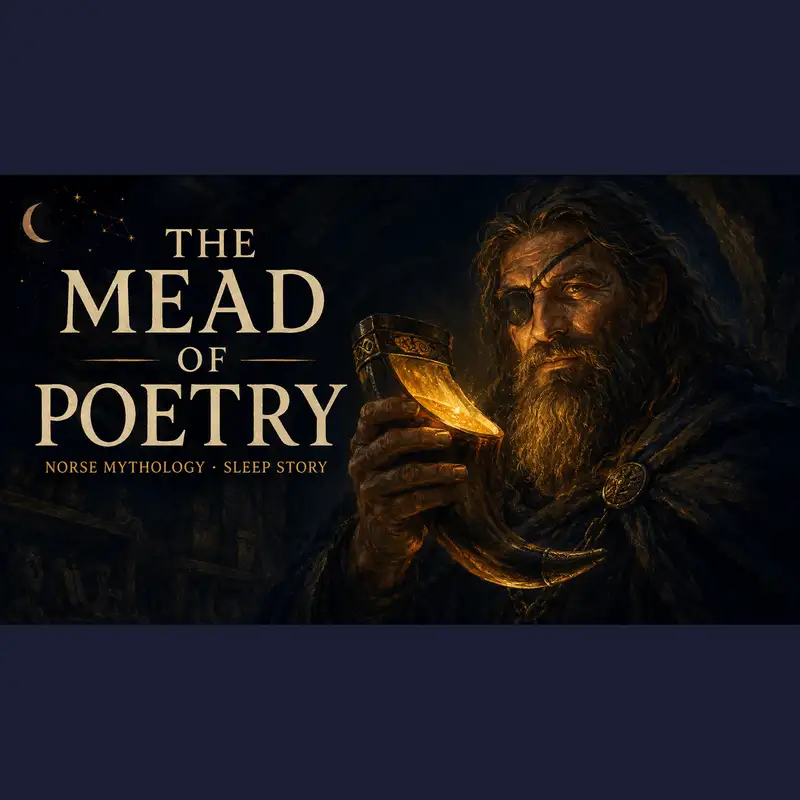
Welcome to The Sleeping Almanac.
Tonight: the night Óðinn — the all-father, the king of Asgard, the wisdom-seeker —
became a snake and slid through a crack in a mountain to steal the poetry of the worlds.
A drill in the stone.
A snake on its belly.
A giant's daughter on a golden throne.
Three sips of a precious mead.
And a god flying home, in the shape of a great eagle, with all of poetry held inside his throat.
We will tell the story tonight from the Hávamál — the wisdom-poem of the old north —
and from Snorri Sturluson's Skáldskaparmál, the second part of the Prose Edda.
The Hávamál preserves the heist in Óðinn's own voice.
Six brief stanzas.
The only moment in the entire Norse corpus where the All-Father speaks first-person about something he stole.
The Hávamál says: I sought the old giant.
Now I am back.
Talking got me very little there.
With many words I won my wishes in the hall of Suttungr.
Rati's mouth made me an opening, gnawed through the stone.
The paths of the giants ran over and under.
I risked my head on it.
Gunnlǫð gave me, from her golden throne, a drink of the precious mead.
Tonight, by the time the story is done, we will be in the hall of Suttungr.
Settle in.
Let your shoulders drop.
We begin on the day a god of wisdom was born from a jar of spit.
Chapter One.
The Spit in the Jar.
There was, in the old north, a war.
The Skáldskaparmál does not tell us when, exactly.
The Vǫluspá tells us only that it was the first war in the worlds —
the war that came before the world we know.
We can imagine, from the small details the poem gives us, that it was very long ago,
in the days when the gods were still figuring out what kind of beings they were going to be.
There were, the old north remembered, two tribes of gods.
The Æsir — the gods of the sky and the storm and the spear and the gallows — lived in Asgard.
Their father was Óðinn.
Their lord of thunder was Þórr.
Their watcher at the rainbow bridge was Heimdallr.
The Æsir were the gods we have been telling stories about all season.
The Vanir — the gods of the field and the sea and the long slow growing of things — lived in Vanaheimr.
Their father was Njǫrðr.
Their lord of harvest was Freyr.
Their lady of love was Freyja.
The Vanir were the older gods, the quieter gods, the gods who remembered the world before the world.
The two tribes, in the long old days, did not get along.
The Skáldskaparmál does not tell us, in detail, why the war began.
The poem implies — and the Vǫluspá implies — that it had something to do with a woman.
A Vanir witch named Gullveig.
The Æsir tried to burn her.
She would not burn.
They burned her three times, the poem says, and three times she rose from the fire whole.
After the third burning, the Æsir gave up on burning her, and the Vanir came to her defence,
and the war began.
It was, the old north remembered, a long war.
It went on for years.
Maybe for ages.
The Æsir threw their spears across the field.
The Vanir threw down the walls of Asgard.
Both sides used every weapon they had.
Both sides tried every trick.
And by the end of it, neither side could win.
So the war ended the way the old north's worst wars always ended.
It ended with talk.
The Skáldskaparmál tells us that the two tribes came together in the centre of the worlds,
in a place where they could meet without either side having the advantage, and they sat down across from each other,
and they made peace.
But the peace, the old north understood, had to be sealed.
In the old laws of the north, when two parties made peace after a long war,
they had to mark the moment in some way that could not be taken back.
They had to do a thing that no one in either tribe could later undo.
They had to bind themselves to the truce.
And the way they did it, in this case, the Skáldskaparmál tells us with the small dry tone of a man writing down something very strange, was this.
They spat.
All of the gods, the Skáldskaparmál says, came forward, one by one — Óðinn first,
then Freyr, then Njǫrðr, then Freyja, then Heimdallr, then every one of the Æsir and every one of the Vanir,
all the gods who had been at the war and were now at the peace —
and each of them, in turn, leaned forward over a great jar that had been set on a stone in the centre of the council,
and each of them spat into it.
The Skáldskaparmál tells us this with the smallest possible explanation.
Snorri Sturluson, writing in Iceland two hundred years after the old poems were first preserved,
does not pause to tell us why.
He simply says: they spat into a jar, and that is how the peace was sealed.
We can imagine, from what the old north understood about marks of binding, that the spit of every god in the worlds,
mixed together in one vessel, was a thing that no one in either tribe could ever later separate.
The peace, by the time the last god had spat into the jar, was inside the jar.
The peace, in some old-north sense, had become a physical thing.
A thing that the gods, between them, had made together.
The jar was full.
The Skáldskaparmál tells us that the gods looked at the jar after the spitting was done,
and they understood that what was inside it was too important to be poured out.
The spit of all the gods in the worlds, mixed together — the marker of the first peace —
was a substance, the gods understood, that had to be kept.
But they did not, the poem implies, quite know what to do with it.
And then, the Skáldskaparmál says, with the small tone of a poet preparing us for a wonder,
one of the gods had an idea.
We do not know which one.
The poem does not name the god.
We can imagine — the way the old north often imagined Óðinn at the moment of any clever idea —
that it was Óðinn.
We can imagine the All-Father looking at the jar of mixed spit, and tilting his one good eye,
and saying, with the slow careful voice of a god who has just thought of something he has never thought of before: we could make it into a being.
A being made of the wisdom of all the gods.
A being who could carry, inside his body, the peace itself.
The Skáldskaparmál tells us that this is what the gods did.
They took the spit from the jar.
They shaped it, the way a potter shapes clay.
They breathed life into it.
And the being who stood up, when the spit had become flesh and the flesh had taken its first breath, was a man.
His name was Kvasir.
The Skáldskaparmál tells us his name with a small reverence.
Kvasir — the wisest being in the worlds.
Kvasir — born of the spit of every god in every tribe.
Kvasir — the living embodiment of the peace between the Æsir and the Vanir.
Kvasir, the poem implies, was so wise that no question, asked of him by any being in any of the worlds,
could ever stump him.
He stood up.
He looked at the gods around him.
He understood, the poem implies, in the first moment of his existence, what he was,
and why he had been made, and what he was for.
And he opened his mouth, and he spoke for the first time, and the first thing he ever said,
the poem implies, was a thing of such wisdom that the gods themselves —
even Óðinn, even the All-Father — were quiet for a long moment afterward.
Kvasir, the Skáldskaparmál tells us, then asked permission to leave.
He did not, the poem implies, want to live in Asgard.
He did not want to live in Vanaheimr.
He wanted, instead, to walk through the worlds — through the lands of men and the lands of dwarves and the lands of giants and the lands of small beings the old north did not have names for — and to teach.
To answer questions.
To bring the wisdom of the gods to the beings who had never had a god to ask.
The gods, the poem implies, agreed.
And Kvasir walked out of the council of the gods, and he walked away from Asgard,
and he walked into the world.
Chapter Two.
The Wisest Being in the Worlds.
Kvasir walked.
The Skáldskaparmál does not tell us how long.
The poem moves quickly through this part of the story, the way poems do when they are setting up something terrible by establishing first something good.
Kvasir walked through the worlds.
He stopped wherever beings stopped him.
He answered any question that any being asked.
He never, the poem tells us, did not have an answer.
We can imagine — and the old north, telling this story around their winter fires,
would have imagined — what it was like to meet Kvasir on the road.
You would have been, perhaps, a farmer.
Or a fisherman.
Or a small craftsman in a village in the long northern country.
You would have been going about your work in the way you always did,
and you would have looked up from your field or your nets or your bench,
and you would have seen a quiet stranger walking down the road.
He would not have looked, the old north imagined, like anything special.
Kvasir, the poem implies, did not glow.
He did not radiate.
He did not announce himself.
He was simply a quiet man in a traveller's cloak, walking with the slow steady pace of a being who had nowhere in particular to be by any particular time,
and who was happy, while he walked, to stop and talk.
You might have called out to him.
You might have asked him, the way the old north's farmers asked travelling strangers,
whether the weather to the east was good.
Or whether there were giants on the road north.
Or whether he had seen any news of the king's army.
And Kvasir, the Skáldskaparmál implies, would have answered.
And his answer would have been, you would have understood, with a small slow chill of recognition,
the truest answer to that question that anyone had ever given you.
Not just true.
True in a way you had not known was possible.
As if the question itself had been, before he spoke, much smaller than you had realised,
and his answer had revealed how large it really was.
You might, then, have asked him a second question.
You might have asked him, the old north imagined, the kind of question you had been carrying around in the back of your chest for years.
The question about whether your wife still loved you.
Or whether your son was lost.
Or whether the small dark feeling you had been having, in the mornings, was a sickness or an omen.
And Kvasir, the poem implies, would have answered that question too.
And his answer to that one would have changed your life.
Because that, the Skáldskaparmál implies, was what Kvasir did.
He walked through the worlds, and he stopped wherever beings stopped him, and he answered.
He answered the small questions and he answered the large questions and he answered the questions no one had quite known how to ask.
And when he had answered, he walked on.
He did not stay.
He did not collect a following.
He did not build a hall and gather students around him.
He simply walked, and answered, and walked on.
He was, the old north remembered, the wisest being who had ever lived.
And the wisest being who had ever lived, the old north also remembered, with the small dry note of a tradition that knew exactly how the world worked,
did not survive very long.
Because — the Skáldskaparmál tells us, with the small heaviness of a poet who knows what is coming —
Kvasir's walking eventually took him to a particular hall, on a particular evening, in a particular country at the edge of the worlds.
And the beings who opened the door of that hall, when Kvasir knocked, were not beings who were going to ask him questions.
They were beings who were going to kill him.
Chapter Three.
The Dwarves at the Door.
Their names were Fjalar and Galar.
The Skáldskaparmál tells us their names without ceremony.
Two dwarves.
Brothers.
The kind of dwarves the old north remembered with the small uneasy tone of a tradition that knew dwarves were not,
despite their small size, safe.
Dwarves, in the old north, were craftsmen.
They forged the great hammer of Þórr.
They forged the spear of Óðinn.
They forged the ring of Andvari that would bring down kingdoms.
But dwarves, the old north also remembered, kept their own counsel.
Dwarves had reasons no one else understood.
Dwarves, when they wanted something, would do things to get it that no other being in the worlds would have done.
Fjalar and Galar, the Skáldskaparmál tells us, lived in a small dark hall in a dark country far from the gods.
They had heard, the poem implies, of the wisest being in the worlds.
They had heard, perhaps, the stories of farmers and fishermen and small craftsmen who had been changed by a meeting with the quiet stranger on the road.
They had heard, perhaps, that the stranger never refused a guest.
They had heard, perhaps, that the stranger would come to any hall to which he was invited,
and that he would stay for one evening, and that he would answer any question put to him,
and that he would then walk on.
And they decided, the Skáldskaparmál implies with the small dry tone of a poet who knows exactly what kind of beings these were, to invite him.
They sent a message.
We can imagine, from how such things were done in the old north, that they sent a small runner,
or a passing trader, or a bird trained for such errands.
The message went out into the world.
It said: Fjalar and Galar, the dwarf-brothers of the deep country, invite the wise Kvasir to their hall.
They have heard of his answers.
They would like, very much, to hear one for themselves.
Will he come?
Kvasir, the Skáldskaparmál tells us, came.
He did not, the poem implies, suspect anything.
Kvasir had been invited to many halls.
Kings had invited him.
Witches had invited him.
Hermits in mountain caves had invited him.
Kvasir had gone to all of them, and he had answered their questions, and he had walked on.
He had no reason, when the message from Fjalar and Galar reached him, to think this invitation was different.
He walked, the poem implies, for many days.
The country where Fjalar and Galar lived was a long way from the road where the message had reached him.
The journey took Kvasir through forests that grew thicker as he walked east.
The trees, the old north imagined, grew older.
The light, between the trees, grew dimmer.
The roads, the old north imagined, grew less travelled.
And by the time Kvasir arrived at the hall of Fjalar and Galar, he had been walking,
alone, through deep country for a very long time, and he was — for the first time in his existence as a wise being in the world — tired.
He knocked on the door.
The door, the Skáldskaparmál tells us, was opened by Fjalar.
We can imagine, from how the old north imagined dwarves, what Fjalar looked like.
Short.
Bearded.
Eyes the colour of cold metal.
A small smile that did not, quite, reach the rest of his face.
He stood in the doorway, and he looked up at the tall wise stranger,
and he said the words the old north remembered the dwarves saying: welcome, friend.
Come in.
We have been waiting.
Kvasir came in.
The hall, the Skáldskaparmál implies, was warm.
There was a fire in the hearth.
There was food on the table.
There was, near the fire, a second dwarf — Galar, the brother — already seated at one of the benches,
with a cup in his hand.
Galar looked up when Kvasir came in.
Galar smiled the same small smile his brother had smiled at the door.
Galar gestured, with the cup, to a seat at the table.
Kvasir sat.
And the Skáldskaparmál tells us what happened then with the smallest possible number of words.
The two dwarves, the poem says, killed him.
That is the line the poem gives us.
They killed him.
The Skáldskaparmál does not tell us how.
The Skáldskaparmál does not tell us what was said.
The Skáldskaparmál does not tell us what Kvasir, in his last moments, understood about what was happening to him.
The poem moves through this moment with the dry brevity of a tradition that knew there was no way to make the killing of the wisest being in the worlds bearable to tell at any length,
and so chose to tell it as quickly as possible.
They killed him.
And then, the Skáldskaparmál tells us, they did something stranger.
They drained his blood.
They took, the poem implies, two great vessels — vessels they had prepared, in advance, for exactly this purpose.
They drained Kvasir's blood into the vessels.
They drained, the poem implies, every drop.
The wisdom of all the gods, in the form of the blood of the being the gods had made of their spit,
ran out of Kvasir and into the dwarves' vessels, and Fjalar and Galar collected it carefully,
and they set the vessels aside.
Then, the Skáldskaparmál says, they brought out a third vessel.
A vessel of honey.
They mixed Kvasir's blood with the honey.
They stirred the mixture, the way a brewer stirs the first stages of mead.
They poured the mixture, when it had settled, into three smaller vessels — one large vessel called Óðrœrir,
and two smaller vessels called Boðn and Són.
And what they had made, the Skáldskaparmál tells us, was the most precious substance that had ever existed in any of the worlds.
It was a mead.
A mead, the poem says, of such a kind that any being who drank even a single sip of it would,
from that moment forward, be a poet and a scholar.
The wisdom of Kvasir — the wisdom of every god in every tribe, distilled through Kvasir's body,
mixed now with honey and stored in three small vessels in a dwarf's hall in the deep country — could be drunk.
It could be carried in a cup.
It could be tasted on a tongue.
And anyone who tasted it would never, after that, be the same.
The dwarves, the Skáldskaparmál tells us, drank none of it themselves.
They were dwarves.
The mead, the old north understood, was not made for dwarves.
The mead, the dwarves understood, was a thing to be kept.
A thing to be hidden.
A thing, perhaps, to be sold, one day, at the highest possible price to the highest possible buyer.
They set the three vessels on a high shelf in the back of their hall.
And the Skáldskaparmál tells us, with the small dry note of a poet who knows exactly what kind of beings these dwarves were,
that they began, almost immediately, to look for the next being they could kill.
Chapter Four.
The Drowning of Gilling.
Some time later — the Skáldskaparmál does not tell us how long — a giant came to the dwarves' hall.
His name was Gilling.
The Skáldskaparmál tells us his name without much ceremony.
Gilling — a giant of the eastern country, a being of the jǫtnar tribe,
the kind of being who, in the long old north, lived in the cold mountains and the deep forests where the gods rarely went.
Gilling had a wife.
The Skáldskaparmál does not give us her name.
Gilling and his wife, the poem implies, had come to the dwarves' country on some business of their own.
Perhaps trade.
Perhaps a journey.
The poem does not tell us.
The poem tells us only that they came to the dwarves' hall, and that they accepted the dwarves' hospitality,
and that they sat down at the dwarves' table to eat.
Fjalar and Galar, the Skáldskaparmál implies, did not like having giants in their hall.
We can imagine, from how the old north remembered dwarves, that they were uneasy.
Giants were larger than dwarves.
Giants were stronger than dwarves.
A giant in a small dwarf-hall was, in the long view, a being who could break the hall if he wanted to.
The dwarves, the poem implies, watched their guest carefully.
They smiled the small smiles they were good at.
They served the food.
They poured the drink.
And they thought, the poem implies, about what they were going to do about Gilling before he could do anything about them.
After the meal, the Skáldskaparmál tells us, Fjalar invited Gilling to go out in a small boat.
The country around the dwarves' hall, the poem implies, was a country of lakes.
There were small boats at the shore.
Fjalar suggested, with the small careful courtesy of a host showing his guest the local sights,
that they could row out on the lake and see the country from the water.
Gilling, who did not know what kind of host he had, agreed.
They took a small boat out onto the lake.
Gilling, the Skáldskaparmál tells us, was at the prow.
Fjalar was at the oars.
They rowed out, the poem implies, into the deeper water in the middle of the lake.
And then Fjalar, the Skáldskaparmál tells us, with no particular ceremony, drove the boat against a hidden rock.
The boat, the poem tells us, capsized.
Gilling, who was a giant of the mountains and not of the sea, could not swim.
He drowned.
The Skáldskaparmál tells us this with the dry brevity it has used for everything else in this story.
Gilling drowned.
Fjalar swam to shore.
Fjalar walked back to the hall, where his brother Galar was waiting, and where Gilling's wife —
who did not yet know what had happened — was also waiting.
When Gilling's wife saw Fjalar come back alone, she understood, the Skáldskaparmál implies, immediately what had happened.
She began to wail.
The Skáldskaparmál tells us that she wailed, in the door of the dwarves' hall,
in a voice so loud and so full of grief that the dwarves could not bear to hear it.
The dwarves, the poem tells us, conferred.
The dwarves, the poem tells us, agreed that something would have to be done about the wailing.
Galar went to the door.
He called Gilling's wife outside.
He said, the poem implies, with the small false-soothing voice of a being lying to ease another being's grief,
that he could take her to see the place on the lake where Gilling had drowned.
He would help her, he said, find her husband's body.
She came outside.
Galar, the Skáldskaparmál tells us, was waiting for her with a heavy millstone in his hands.
As she stepped through the door, Galar dropped the millstone from above.
It struck her on the head.
The Skáldskaparmál tells us, with the brevity it has used for every killing in this story,
that she fell to the ground, and that she was dead.
And the two dwarves, the poem implies, dragged her body away from their hall,
and they went back inside, and they returned to the slow careful work of guarding the three vessels of mead.
They had killed, by this point, three beings.
Kvasir.
Gilling.
Gilling's wife.
And they thought, the Skáldskaparmál implies, that the killings were over.
They were wrong.
Because Gilling, it turned out, had a son.
His name was Suttungr.
Chapter Five.
The Brother's Revenge.
Some time later, the Skáldskaparmál tells us, Suttungr came looking for his parents.
We can imagine, from how the old north's giants kept track of each other across the great cold country,
that he did not find them quickly.
Giants travelled slowly.
Giants kept long counsel.
Suttungr would have waited, perhaps for a long time, for word of his father and mother to come back from their journey.
He would have waited at his own hall, the Skáldskaparmál implies, in the deep eastern mountains,
and he would have grown, with each passing month, more and more uneasy.
When the word finally came, the old north imagined, it came from a passing trader.
The trader, perhaps, had stopped at the dwarves' hall on his way through the lake country.
The dwarves had been hospitable.
The dwarves had fed him.
The dwarves, in the small careless way of beings who had committed a murder and were now quite confident they had got away with it,
had said something — a wrong word, perhaps, or a small slip — about the strange visitors they had recently entertained.
The trader, the old north imagined, had been clever enough to notice.
The trader had said nothing in the hall.
The trader had ridden on.
And when the trader, in his next country, met one of Suttungr's kin, he told them what he had heard.
Suttungr came at once.
The Skáldskaparmál tells us his arrival at the dwarves' hall with the small heavy economy it has used for everything in this story.
Suttungr came.
He stood in the door of the dwarves' hall.
He was, the poem implies, a giant of great size — taller than the door of the hall,
taller perhaps than the hall itself — and the dwarves, the moment they saw him in their doorway,
understood that everything they had thought they had got away with was, in this single moment,
no longer something they had got away with.
Suttungr asked them where his father was.
The Skáldskaparmál does not give us the dwarves' answer in detail.
The poem implies that they tried, at first, to lie.
They tried, perhaps, to say that Gilling had come, and that Gilling had left,
and that they did not know where Gilling had gone.
We can imagine, from how dwarves lied in the old north, that they were good at it.
They had small smiles.
They had careful voices.
They had practised, in their long lives of dealings with beings stronger than they were,
the art of saying nothing while seeming to say everything.
Suttungr, the Skáldskaparmál implies, did not believe them.
The Skáldskaparmál tells us, then, what Suttungr did.
He took both dwarves by the shoulders.
He carried them, one in each great hand, out of their hall and away from their country,
and he carried them, the poem implies, for some distance — across forests and across rivers and out to the western edge of the cold country where the cold sea met the cold rocks.
And he set them down, the poem says, on a single small rock that stood out from the shore.
A rock that was, when the tide was low, dry.
A rock that was, when the tide came in, completely underwater.
He set them on the rock.
He stepped back, the Skáldskaparmál implies, to the dry shore.
And the dwarves, standing on their small rock with the tide coming in around their ankles,
understood, very quickly, what the giant intended to do to them.
Suttungr was going to wait.
Suttungr was going to stand on the shore, and watch, while the tide came in around the rock,
and the rock disappeared under the water, and the dwarves drowned the way Gilling had drowned,
on a small piece of stone in cold water, with no one to help them.
The dwarves, the Skáldskaparmál tells us, began to bargain.
We can imagine, from how dwarves bargained in the old north when their lives were on the line,
what it was like.
They were quick.
They were inventive.
They were, even with the cold sea-water rising around their feet, calm in the small careful way of beings who had spent their whole lives weighing offers and counter-offers.
They called out to Suttungr.
They told him they had something.
They told him they had something the giant would want.
They told him, the poem implies, with the quick desperate brightness of beings who had only one card to play, about the mead.
The mead, they said, was theirs to give.
The mead, they said, was the most precious substance that had ever existed in any of the worlds.
The mead had been made — they did not, perhaps, explain how — from the blood of the wisest being that had ever lived.
The mead, they said, could turn any drinker, in a single sip, into a poet and a scholar.
The mead, they said, was on a high shelf in their hall.
The mead was in three vessels.
The mead, they said, would be Suttungr's, in compensation for his father's death, if he would let them off the rock.
Suttungr, the Skáldskaparmál tells us, considered.
He was a giant.
He was, the old north remembered, calculating in the slow heavy way of giants.
He looked down at the two small beings on the small rock with the cold water rising.
He listened to their offer.
He understood that they had killed his father.
He understood that they would deserve, by every old-north measure of justice, to drown.
And he understood, with the slow practical sense of a being who had thought a great deal about what was and was not worth doing,
that the mead they were describing might, in fact, be a thing more valuable than the small revenge of watching two murderers drown.
He agreed.
The Skáldskaparmál tells us, with the small dry note of a poet who has watched many such bargains,
that Suttungr waded out to the rock, and he picked up both dwarves, and he carried them back to the dry shore.
He set them down.
He looked at them.
He said, the poem implies, that if they did not now produce the mead they had promised,
he would carry them back to the rock and stand on the shore and watch until they were dead.
The dwarves, the poem implies, understood.
The dwarves agreed.
The dwarves led Suttungr back across the forests and across the rivers and back to their hall.
The mead, the Skáldskaparmál tells us, was on the high shelf where they had left it.
Suttungr took down the three vessels.
He took them, the poem implies, very carefully.
The vessels were not large.
He could carry all three of them, one cradled in the crook of his arm and the others held between his fingers.
He looked at the dwarves.
He told them, the Skáldskaparmál implies, that if he ever saw either of them again,
he would remember what they owed him.
And then he turned, the poem says, and he carried the three vessels out of the dwarves' hall,
and he walked east, with the mead.
Chapter Six.
The Mead in the Mountain.
Suttungr's hall, the Skáldskaparmál tells us, was in a mountain.
The mountain was called Hnitbjǫrg.
The name, in the old language, meant the clashing rocks, or the heavy rocks, depending on which scholar you ask.
Hnitbjǫrg was a great peak in the deep eastern country of the jǫtnar —
a mountain so large that whole communities of giants lived inside it, in halls cut into the rock,
in chambers carved out of the deep stone, in corridors that ran for miles inside the mountain's body.
Suttungr's hall, the Skáldskaparmál implies, was the largest of these chambers.
It was at the heart of the mountain.
It was the place Suttungr, when he was not travelling, considered his home.
He brought the mead there.
The journey home, the Skáldskaparmál implies, took some time.
Suttungr walked east.
He walked through the long countries between the lake-country of the dwarves and the deep mountains of his own people.
He walked carefully, the poem implies, with the slow steady pace of a being who was carrying something he did not want to drop.
The three small vessels, in his great hands, were the most precious substance in any of the worlds.
He did not, the poem implies, set them down.
He did not even, when he stopped to sleep on his journey, let them out of his sight.
When he reached Hnitbjǫrg, he carried the mead deep inside.
The Skáldskaparmál tells us that he chose, for the hiding-place, a chamber far from the main hall.
We can imagine, from how the old north imagined the inside of mountains, what the chamber was like.
Cold.
Dark.
A small space cut from the rock, far enough from the surface that the warmth of the giants' cooking-fires did not reach it.
A space with one entrance, and the entrance closed by a heavy stone door.
A space, the old north imagined, that no being in the worlds could find unless they had been told exactly where to look.
Suttungr set the three vessels on a stone shelf in the chamber.
He stepped back.
He looked at them.
He understood, the Skáldskaparmál implies, what he now had.
He had the wisdom of all the gods, distilled through Kvasir's body, brewed by the dwarves into a drinkable form,
and stored in three small vessels on a shelf in a chamber in the deep heart of his mountain.
He had, the old north would have said, the most valuable thing any being in the worlds had ever owned.
And he understood, the Skáldskaparmál implies, that he could not, by himself, guard it forever.
He had to sleep.
He had to leave, sometimes, on the business of giants.
He had to be, at certain hours, somewhere other than the chamber where the mead was.
And in those hours, the poem implies, the mead would be unguarded.
He needed a guardian.
The Skáldskaparmál tells us, then, the small detail of this story that makes the whole story possible.
Suttungr, the poem says, had a daughter.
Her name was Gunnlǫð.
She was — the poem does not give us many details, and we will be careful not to invent too many —
a young giantess, the only child of Suttungr, and she lived with her father inside Hnitbjǫrg.
Suttungr called her.
We can imagine the moment.
Suttungr standing in the small dark chamber with the three vessels of mead on the shelf behind him.
Gunnlǫð arriving at the door, the poem implies, with the small quiet care of a young being summoned by her large dangerous father.
She would have looked at him.
She would have waited to be told what he wanted.
Suttungr told her.
He told her, the Skáldskaparmál implies, what was in the chamber.
He told her — perhaps in some detail, perhaps not — what the mead was,
and how it had come to him, and what it could do for any being who drank it.
He told her, the poem implies, what he wanted her to do.
He wanted her, he said, to sit in the chamber.
To live in the chamber.
To keep watch in the chamber, day and night, for as long as the mead was there.
To let no being into the chamber except him, and to let no drop of the mead leave the chamber until he,
Suttungr, came back and asked for it.
She was, the Skáldskaparmál implies, his only daughter, and he was, the poem implies,
her only living parent, and she had nowhere else, in the long old north, to be.
She agreed.
The Skáldskaparmál tells us that Suttungr installed her in the chamber.
He brought, the poem implies, the few things she would need — a bed,
a chest of clothes, a small lamp, perhaps a few books or a small loom for the long quiet hours of the watch.
He sat her on a low stone seat near the shelf where the vessels stood,
and the seat, the poem tells us, was covered in gold cloth, so that she would have,
in the long cold hours of guarding the mead, at least one small piece of brightness near her.
The seat, the Skáldskaparmál implies, became her throne.
And Gunnlǫð, the daughter of Suttungr, took up her watch.
She would sit on the gold-covered seat in the small dark chamber in the deep heart of Hnitbjǫrg,
the Skáldskaparmál implies, for what was, by the time the story arrives at her,
a very long time.
She would watch the three vessels on the shelf.
She would tend the small lamp.
She would, perhaps, sing to herself, or weave at a small loom, or read by the lamp's light.
She would wait.
She would not, the poem implies, see any being other than her father for what we can imagine was months at a stretch, perhaps years.
She would be, by the time another being finally came through the chamber's door,
the loneliest young being in any of the worlds.
That, the Skáldskaparmál implies, is what was waiting in the deep heart of Hnitbjǫrg.
A young giantess on a gold-covered seat.
A small lamp.
Three vessels of the most precious mead in any of the worlds.
And — somewhere far away, in Asgard, the Skáldskaparmál tells us — a god who had heard,
by now, what Suttungr had done.
A god who was, by the time we leave Hnitbjǫrg and turn west, already preparing to come for it.
Chapter Seven.
Bǫlverkr at the Farm.
Óðinn, the Skáldskaparmál tells us, decided to steal the mead.
The poem does not tell us, in detail, why.
We can imagine the reasons.
The mead was the wisdom of the gods, distilled through Kvasir.
The mead, the poem implies, was a thing that belonged, in some old-north sense, to the gods themselves.
Óðinn was the god of wisdom.
Óðinn had, years before this story, given his right eye to drink from the well of Mímir.
Óðinn had, years before, hung himself on the world-tree for nine nights to win the runes.
Óðinn, of every being in the worlds, was the being who understood, most clearly,
what the mead was, and what it could do, and what it would mean if it stayed forever in a giant's mountain in the eastern country,
where no being who could properly use it would ever drink it.
He decided to go and get it.
He did not, the Skáldskaparmál tells us, go as Óðinn.
We have told this story before, in earlier episodes of The Sleeping Almanac.
Óðinn, when he travelled in the worlds outside Asgard, did not travel as the king of the gods.
He travelled, the Hávamál tells us, in disguise.
He wore the long grey cloak of a wanderer.
He pulled the wide-brimmed hat down low over his face.
He hid the eye-patch that would have given him away.
He gave himself a different name, often, in the lands he passed through.
He became, for the journey, somebody else.
For this journey, the Skáldskaparmál tells us, he became Bǫlverkr.
The name, in the old language, meant the evil-doer.
Or, more precisely: the doer of bad work.
We can imagine, from how the old north chose its names, what Óðinn was telling himself with this choice.
He was going to a giant's farm.
He was going to play a part.
He was going to do, in the playing of that part, things that no good being would do.
He gave himself, before he went, the name that owned the thing he was about to be.
He walked east.
The Skáldskaparmál does not tell us how long.
The poem moves quickly.
Bǫlverkr walked east, away from Asgard, into the long cold country between the gods' country and the giants'.
He walked for what we can imagine was many days.
And eventually, the poem implies, he came to a farm on the edge of the giants' country,
in a long valley with fields of summer hay.
The farm, the Skáldskaparmál tells us, belonged to a giant called Baugi.
And Baugi, the poem tells us, was the brother of Suttungr.
Bǫlverkr arrived at the edge of the hayfield.
It was, the Skáldskaparmál implies, late in the summer.
The hay was tall.
The hay needed cutting.
In Baugi's hayfield, the poem tells us, nine slaves were at work.
They moved across the field in a long slow line, the poem implies, each with a scythe in his hands,
swinging in the slow steady rhythm of beings who had been at the same work all summer and would be at it for several more days.
The scythes flashed in the sunlight.
The hay fell in long rows behind them.
The slaves, the poem implies, did not look up when Bǫlverkr came to the edge of the field.
Bǫlverkr watched them for a moment.
He saw, the Skáldskaparmál implies, with the quick wise eye of the All-Father in disguise, what he was looking at.
He saw that the slaves were tired.
He saw that the scythes were dull.
He saw that the work, in the long heat of the late summer, was going slowly,
and that the slaves had become careless, and that the field would not be finished before the weather turned.
He saw, the poem implies, what he could do with this.
He walked into the field.
He greeted the slaves, the Skáldskaparmál implies, in the calm courteous way of a stranger introducing himself to working men.
He told them he was a traveller.
He told them he had been watching their work.
He told them, the poem implies, that he was sorry to interrupt, but that he had noticed something he could perhaps help with.
He showed them his whetstone.
The Skáldskaparmál tells us that Bǫlverkr carried, in a small pouch at his belt, a whetstone of unusual quality.
We can imagine — the poem does not specify, but we can imagine, from how the old north thought about such objects —
that the whetstone was something Óðinn had made, or won, or been given long ago,
and that it was a whetstone that could put an edge on any blade more sharply than any whetstone ever made.
Bǫlverkr offered, in the calm courteous voice of a stranger doing a kindness, to sharpen the slaves' scythes.
The slaves agreed.
They came forward, one at a time, the Skáldskaparmál implies, with their dulled scythes in their hands.
Bǫlverkr took each scythe.
He drew the whetstone, with slow careful strokes, along the curved iron blade.
And the blade, when he was done with it, was, the poem implies, sharper than it had ever been in its life.
The slaves, when they took their scythes back, looked at the new edges with the small slow wonder of working men suddenly given a tool they had not known was possible.
They went back to the work.
And the work, the Skáldskaparmál tells us, suddenly went very quickly.
The new edges cut the hay in clean fast strokes.
The slaves moved through the field with a new lightness, the poem implies, the way working men move when their tools are finally right.
The long rows of hay fell behind them.
The field, which had been many days from finished, became, in a single afternoon's work, almost done.
The slaves stopped, at the end of the afternoon, to rest.
They sat in the shade at the edge of the field.
They looked at the whetstone in Bǫlverkr's hand.
They began, the Skáldskaparmál implies, to talk.
They asked Bǫlverkr, perhaps politely at first, where he had got the whetstone.
They asked, perhaps less politely as the afternoon went on, whether the whetstone was for sale.
They asked, the poem implies, whether the whetstone could be borrowed.
They asked, the poem implies, whether each of them, in turn, might have the use of the whetstone,
just for a few moments, just for the small private purpose of sharpening his own tools at home in the evenings.
Bǫlverkr, the Skáldskaparmál tells us, smiled.
He said, in the calm courteous voice he had been using all afternoon, that the whetstone was not for sale.
He said that the whetstone was not for loan.
He said, the poem implies, with the small slow note of a god who was setting a trap,
that he would tell them what he was willing to do.
He would, he said, throw the whetstone up in the air.
Whichever of the nine of them caught it, the poem implies he said, could have it.
As a gift.
The slaves, the Skáldskaparmál tells us, jumped up.
We can imagine the moment with the dry quiet exactness of the old north.
Nine men in a hayfield at the end of a long afternoon.
Tired.
Hopeful.
Each one wanting, very much, the whetstone that would make his work easy for the rest of his life.
Each one looking at the other eight and understanding, in the same small slow second,
that only one of them was going to catch it.
Bǫlverkr threw the whetstone up in the air.
The Skáldskaparmál tells us what happened then with the dry brevity it has used for everything in this story.
The slaves, the poem says, reached up.
They reached at the same moment.
They reached with their scythes still in their hands.
And in the small space of a single moment, with nine men reaching up at the same moment with nine very sharp blades in their hands,
all nine of them, the poem says, cut each other's throats.
They fell, the Skáldskaparmál implies, where they stood.
The whetstone, the poem does not bother to tell us, was caught by nobody.
It fell to the ground somewhere among them.
Bǫlverkr, the poem implies, did not even bother to pick it up.
He stood, in the shade at the edge of the field, and he looked at the nine bodies of the slaves of Baugi the giant,
and he did not say anything.
Then he went, the Skáldskaparmál tells us, to the door of Baugi's hall.
Chapter Eight.
The Summer of Nine Men's Work.
Baugi was at home.
The Skáldskaparmál tells us that he opened the door himself, in the small quiet way of a giant who had not been expecting visitors.
He looked down at the stranger on his step.
He asked the stranger, perhaps with some impatience, what he wanted.
Bǫlverkr told him, the poem implies, that he had bad news.
He told Baugi, in the calm careful voice of a stranger being honest, that he had been passing the giant's hayfield earlier in the afternoon.
He told Baugi that he had seen, with great regret, an accident.
He told Baugi, the poem implies, that the nine slaves who had been mowing Baugi's hay had got into a small disagreement over a tool,
and that they had, in the heat of the disagreement, cut each other's throats with their own scythes,
and that all nine of them were now lying in the field, dead.
Baugi, the Skáldskaparmál implies, was furious.
He was a giant.
He had, the poem implies, owned those nine slaves for many years.
They had been, in his calculation, valuable.
And they were now, the poem implies, lying in his hayfield with their work half-finished,
and the harvest was coming, and he had no other slaves, and the whole of his summer's labour was,
by the end of this single afternoon, on the edge of being lost.
He told Bǫlverkr, the poem implies, exactly what he thought.
Bǫlverkr listened, the Skáldskaparmál implies, with the small patient courtesy of a stranger who had nowhere in particular to be.
He let the giant finish.
And then, when the giant had run out of words, Bǫlverkr told him, in the calm voice he had been using all day,
that he had a proposal.
He told Baugi, the Skáldskaparmál implies, that he was a strong worker.
He told Baugi that he was, in fact, as strong as nine ordinary men.
He told Baugi that he was willing, if Baugi wanted him to, to do the work of all nine slaves for the rest of the summer.
He would mow the hay.
He would bring in the harvest.
He would, by the end of the season, leave Baugi's farm in better shape than it had been in before the accident.
And in exchange, Bǫlverkr said, with the small slow voice of a being naming his price,
he wanted only one thing.
He wanted, he said, a single sip of his brother Suttungr's mead.
The Skáldskaparmál tells us that Baugi was startled.
He had not, the poem implies, expected this stranger to know about the mead.
Few beings in the worlds, by this point in the story, knew about the mead.
Suttungr had been careful.
The mead was deep in Hnitbjǫrg.
The mead was guarded by Gunnlǫð.
The mead, in the long view of the giants, was supposed to be a thing that nobody outside Suttungr's hall even knew existed.
Baugi looked at the stranger.
He saw, the Skáldskaparmál implies, what we have been told all along he saw.
He saw a tall man in a long grey traveller's cloak.
He saw a wide-brimmed hat pulled low.
He saw the small careful smile of a being who had said exactly what he meant to say.
He did not, the poem implies, see Óðinn.
He saw only Bǫlverkr.
Baugi, the Skáldskaparmál tells us, agreed.
He agreed with a reservation.
He said, in the slow careful voice of a giant being honest about what he could and could not promise,
that he could not, by himself, give Bǫlverkr a sip of the mead.
The mead, he said, belonged to his brother.
The mead was in his brother's mountain.
The mead was guarded by his brother's daughter.
He, Baugi, had no control over the mead.
But if Bǫlverkr did the work, Baugi said, Baugi would go with him to Suttungr at the end of the summer,
and Baugi would speak on Bǫlverkr's behalf, and Baugi would do everything he could to persuade his brother to grant Bǫlverkr the sip.
Bǫlverkr, the poem implies, agreed.
He moved, the Skáldskaparmál tells us, into Baugi's farm.
He worked, the poem tells us, all summer.
We can imagine the work, the way the old north imagined the long hot work of a Norse summer.
The hay.
The cutting.
The hauling.
The stacking.
The repair of fences.
The cleaning of tools.
The feeding of cattle.
The herding of sheep.
The thousand small tasks that a giant's farm required, on every day of every week of the long northern summer,
and that had been done, until this summer, by nine men.
Now they were done by one.
Bǫlverkr, the Skáldskaparmál implies, did the work of nine men.
He did it well.
He did it quickly.
He did it, the poem implies, with the small steady patience of a god who knew he was paying a very long down-payment on a single sip of a mead worth more than every hayfield in the worlds.
Baugi, the Skáldskaparmál implies, watched him.
Baugi began, as the summer went on, to understand that he had got a very strange bargain.
The stranger he had taken on for the cost of one sip of his brother's mead was,
by the end of the season, going to leave Baugi's farm richer than Baugi could remember it ever being.
Baugi, the poem implies, began to feel, with the small uneasy sense of a being who had paid less than the true price for a thing,
that he owed Bǫlverkr something more than he had bargained for.
By the end of the summer, the work was done.
The harvest was in.
The fields were cleared.
The fences were repaired.
The tools were stored.
The animals were settled.
Baugi's farm, the Skáldskaparmál implies, had not been in this kind of shape in many years.
Bǫlverkr came to Baugi at the end of the season.
He reminded him, the Skáldskaparmál implies, of their bargain.
He said, in the calm voice he had been using all summer, that the time had come to go and ask Suttungr for the sip of mead.
Baugi, the poem tells us, agreed.
The two of them, the Skáldskaparmál tells us, walked east.
They walked, the poem implies, for several days.
They came to the foot of Hnitbjǫrg.
They climbed the long slow road that ran up the side of the mountain.
They came to the entrance of Suttungr's hall.
They were greeted, the poem implies, by Suttungr's servants, and they were brought into the hall,
and they were given seats at the long table, and they were given food and drink and the small careful hospitality that even a giant's hall offered to a guest who had been brought in by the master's brother.
Suttungr, the Skáldskaparmál tells us, came to meet them.
He sat down at the head of the table.
He listened, the poem implies, while his brother Baugi explained why they had come.
Baugi told the story, the poem implies, carefully.
He told Suttungr about the accident in the hayfield.
He told Suttungr about the stranger who had arrived just after.
He told Suttungr about the bargain.
He told Suttungr about the summer's work.
He told Suttungr that the stranger had earned, by every measure of the old north's justice of work and pay,
a single sip of the mead.
Suttungr, the Skáldskaparmál tells us, refused.
He refused, the poem implies, immediately.
He refused without much explanation.
He said that the mead was his.
He said that the mead had been bought at the price of his father's life.
He said that he had no intention, no matter what bargain his brother had made on a farm at the edge of the country,
of giving any drop of it to any being who was not himself.
He said, the poem implies, that the conversation was over.
Bǫlverkr, the Skáldskaparmál tells us, looked at Baugi.
Baugi, the poem implies, looked away.
And the two of them, the poem says, left Suttungr's hall, and they walked back down the long slow road that ran down the side of Hnitbjǫrg,
and they came to the foot of the mountain in the long blue evening of the late summer, and they stopped.
Bǫlverkr, the Skáldskaparmál tells us, turned to Baugi.
He said, in the calm voice he had been using all season, that there was another way.
Chapter Nine.
The Drill in the Stone.
The Skáldskaparmál tells us, then, the strangest small moment in this story.
Bǫlverkr proposed, in the long blue evening at the foot of Hnitbjǫrg, that they drill into the mountain.
He proposed it, the poem implies, with the calm matter-of-fact voice of a being suggesting a small technical solution to a small technical problem.
He said that he knew of a drill — a drill called Rati —
that could bore through any rock, however hard, however thick.
He said, the poem implies, that he had brought the drill with him, in case it was needed.
He said that the way into Suttungr's chamber, if the front door was closed to them,
was through the rock itself.
Baugi, the Skáldskaparmál implies, was reluctant.
We can imagine, from how the poem moves through this moment, that he understood what he was being asked.
He was being asked to help a stranger break into his brother's mountain.
He was being asked to take part, however small the part, in a theft of his brother's most precious property.
Baugi was a giant.
Giants did not, in the long old north, betray each other lightly.
But Baugi, the Skáldskaparmál implies, had made a bargain.
He had taken from Bǫlverkr a summer's work.
He had eaten the bread his brother had refused to share.
He felt, the poem implies, that he owed something.
And the something he owed, he understood, was at least the small help of holding the drill while Bǫlverkr did the work.
He agreed.
The Skáldskaparmál tells us that Bǫlverkr produced the drill.
He drew it, the poem implies, from somewhere inside his long grey cloak.
The drill was called Rati.
The name, in the old language, meant the borer, or the gnawer.
The drill was small, and it was sharp, and it was, the poem implies,
of a kind no being in the worlds had seen before or has seen since.
It was a drill that could go through stone the way a tooth goes through soft wood.
Baugi took the drill.
The two of them, the Skáldskaparmál tells us, climbed the lower slope of Hnitbjǫrg to a place where the rock-face was clean and steady.
Bǫlverkr placed his hand against the rock.
He listened.
He felt, the poem implies, for the direction of the hollow chamber inside.
And he showed Baugi, with a small careful gesture, where to start.
Baugi began to drill.
The Skáldskaparmál tells us that the drill went into the stone the way a knife goes into hard cheese.
Slowly, but steadily.
The rock-dust fell from the hole in a small fine stream.
The hole, the poem implies, grew deeper.
Baugi worked, the poem tells us, for some time.
The evening grew dark around them.
The lower slope of Hnitbjǫrg cooled.
The hole grew deeper still.
After some time, the Skáldskaparmál tells us, Baugi stopped.
He turned to Bǫlverkr.
He said, in the small careful voice of a being making a report, that the drill had gone through.
He said that the rock, at the bottom of the hole, was now open into the chamber on the other side.
He said that the way was clear.
Bǫlverkr looked at him.
He took, the Skáldskaparmál implies, the small slow measure of the giant in the dark beside him.
And then he did, the poem says, what the Hávamál preserves in stanza one hundred and six.
He put his mouth to the hole.
He blew, the poem says, into it.
A small stream of rock-chips, the Skáldskaparmál tells us, blew back out of the hole into Bǫlverkr's face.
The drill, Bǫlverkr understood, had not gone through.
The drill had gone almost through.
The drill had stopped, perhaps an inch or two before the breakthrough, in the small careful way of a tool held by a being who did not,
in his heart, quite want to finish the job.
The rock-chips, when Bǫlverkr blew into the hole, were chips that should have fallen into the chamber on the other side and been gone forever.
They had come back out the way they came in.
Bǫlverkr, the Skáldskaparmál tells us, said nothing about this.
He simply, the poem implies, told Baugi to keep drilling.
Baugi, the Skáldskaparmál implies, understood that he had been caught.
He took the drill back up.
He set it to the hole.
He turned, the poem says, for some more time.
And eventually, when the breakthrough finally came, Bǫlverkr blew into the hole a second time,
and this time, the poem says, no chips came back.
The hole, this time, was clear.
The chamber on the other side, Bǫlverkr knew, was now open to him.
Chapter Ten.
The Snake in the Mountain.
What happened next, the Skáldskaparmál tells us, took a single quick moment.
Bǫlverkr stepped back from the hole.
He said nothing, the poem implies, to Baugi.
He simply, the Skáldskaparmál says, transformed.
We have been telling this story all season, and we have, by now, heard about the transformations of Loki —
the falcon-cloak, the salmon, the horse who became the mother of Sleipnir.
Óðinn, the Hávamál implies, could do the same.
Óðinn, the wisdom-seeker, the rune-winner, the wanderer of the worlds — Óðinn, in this single moment,
on the dark slope of Hnitbjǫrg at the end of the summer, with a small hole in the rock at his side and a giant standing uneasily beside him in the dark, became a snake.
The Skáldskaparmál tells us that the transformation was quick.
Bǫlverkr's tall form, the poem implies, shrank.
His long grey cloak fell to the ground.
His wide-brimmed hat fell with it.
And on the rock at Baugi's feet, the poem says, there was now a long thin grey snake.
The snake, the Skáldskaparmál implies, slid forward.
Baugi, the poem says, understood, in the same small slow second, what was happening.
Baugi understood that Bǫlverkr, in the form of the snake, was about to slide into the hole and disappear into the chamber on the other side and steal his brother's mead.
Baugi understood, the poem implies, that this was the moment when, if he wanted to be loyal to his brother,
he could end the theft before it began.
Baugi raised the drill.
The Skáldskaparmál tells us, with the small quick economy it has used for everything in this story, what happened then.
Baugi drove the drill down at the snake, the poem says, with the intent of pinning it to the rock.
The drill came down.
The snake, by the time the drill struck the rock, was already in the hole.
The drill came down on empty stone.
The snake's tail, the poem implies, was just disappearing into the hole at the moment the drill struck.
Baugi missed by a hand's breadth.
The snake was gone.
The Skáldskaparmál tells us that Baugi stood, for a long moment, on the dark slope of Hnitbjǫrg,
with the drill in his hand and an empty hole in front of him and nothing more he could do.
The poem does not tell us what Baugi did next.
The poem implies that he turned, in the dark, and walked away.
Inside the mountain, the Skáldskaparmál tells us, the snake came out the other end of the hole.
It came out, the poem implies, in a small dark passage.
The passage led, in the deep heart of Hnitbjǫrg, toward the chamber where Suttungr had hidden the mead.
The snake, the poem implies, slid along the passage with the slow careful certainty of a being who knew exactly where it was going.
It moved, the poem implies, for some distance.
And eventually, when it came to the heavy stone door at the end of the passage,
it slid underneath the door and into the chamber.
In the chamber, the Skáldskaparmál tells us, the snake stopped.
It looked, the poem implies, at the small dark space.
It saw the three vessels on the shelf.
It saw the low stone seat covered in gold cloth.
It saw, on the seat, the young giantess who had been watching the mead for what we can imagine was,
by this point, a very long time.
It saw Gunnlǫð.
And the snake, the Skáldskaparmál tells us, transformed.
Bǫlverkr stood up, in the small dark chamber, in the same long grey traveller's cloak he had been wearing all summer at Baugi's farm.
He looked, the poem implies, at the young giantess on the gold-covered seat.
He took off his wide-brimmed hat.
And he greeted her, the poem implies, in the calm careful voice he had been using all season —
the voice of a stranger who had come a long way and had no particular hurry,
and who was, very much, looking forward to having a conversation.
Chapter Eleven.
The Three Nights.
The Skáldskaparmál tells us that Bǫlverkr stayed with Gunnlǫð for three nights.
The poem does not give us, in detail, what was said in those three nights.
The poem implies — and the Hávamál, in the small first-person stanzas Óðinn preserved of this story,
also implies — that he spoke to her.
He spoke, the poem implies, in the careful voice of a being who had come a long way for one purpose,
and who knew exactly what he had to do to accomplish it, and who was doing it with the slow steady patience of a god who had practised,
in his long life of wandering and disguise, the art of being whatever a being in front of him needed him to be.
He told her, the Hávamál implies, that he was in love with her.
He told her, perhaps, that he had heard of her in the world outside the mountain.
He told her, perhaps, that he had come to find her.
He told her that he understood — with the small slow tone of a being who saw what no one else had seen —
what it had been like for her, in the deep dark chamber, alone, for what we can imagine was years on end,
with no being for company but her dangerous father, and no work to do but to watch three vessels on a shelf.
He told her, perhaps, that he wanted to take her away from the mountain.
That he wanted, perhaps, to make her his wife.
That he wanted, the Hávamál's first-person admission preserves, things he was not, in his heart, ever going to give her.
She believed him.
The Skáldskaparmál implies — and the Hávamál, in stanza one hundred and ten, comes back to admit —
that Gunnlǫð gave Bǫlverkr what he asked for with her whole heart.
The Hávamál's own line, in the wisdom-poem the All-Father himself was said to have spoken, calls her wholehearted.
The Hávamál says: she gave me, on her golden throne, a drink of the precious mead.
A poor reward I gave her back, for her true heart, for her wholehearted love.
That is the line the Hávamál preserves.
That is the small honest moment, in the entire Norse corpus, where Óðinn admits what he did.
On the third night, the Skáldskaparmál tells us, Gunnlǫð got up from her gold-covered seat.
She went to the shelf where the three vessels stood.
She brought them down, one at a time.
She set them on a small table beside the seat.
And she told Bǫlverkr, the poem implies, that he could have one drink from each.
Bǫlverkr drank from the first vessel.
The Skáldskaparmál tells us, with the small dry economy it has used for everything in this story,
that the first sip emptied the vessel.
The whole vessel, the poem says, went down in one swallow.
Bǫlverkr set the vessel down.
He took up the second.
He drank from it.
The second vessel, the poem says, also went down in one swallow.
He took up the third.
He drank from it.
The third vessel, the poem says, was likewise drained, in a single sip, to the bottom.
Three sips.
Three vessels.
All of the mead.
Gunnlǫð, the Skáldskaparmál implies, did not, at first, understand what had happened.
She had agreed to give him a drink from each vessel.
She had not understood that a drink, to a god of his thirst, meant the whole thing.
Bǫlverkr stood up.
He looked at her, the Skáldskaparmál implies, for one long moment.
The poem does not tell us what he said.
The Hávamál's later admission implies that he said, perhaps, less than he should have.
He said goodbye, perhaps.
He said, perhaps, nothing at all.
He simply stood up, with the three vessels' worth of the mead of poetry held now in his mouth and his throat and his chest,
and he walked, the poem implies, toward the door of the chamber.
And then, the Skáldskaparmál tells us, he transformed.
The grey cloak fell.
The wide-brimmed hat fell.
The tall form of the traveller, the poem implies, contracted and shifted and changed shape.
And what stood in the chamber, in the small dark space where Bǫlverkr had been standing a moment before,
was not a man.
It was a great eagle.
The eagle, the Skáldskaparmál implies, was large.
Its wings, the poem implies, almost touched the walls of the chamber.
Its eyes were the colour of the cold winter sky.
Its beak was open, and inside the open beak, the poem implies, the mead of poetry was held —
all of it, in three swallows, in the throat of the eagle.
The eagle, the Skáldskaparmál tells us, beat its wings once.
It went, the poem says, up.
It rose through the small passage that the snake had come down.
It came out of the hole at the side of Hnitbjǫrg in the long dark hour just before dawn.
It rose into the cold sky over the eastern country.
It turned west.
And it flew, the poem says, for Asgard.
In the chamber, Gunnlǫð, the Skáldskaparmál implies, sat alone on her gold-covered seat with three empty vessels on the table beside her and the long slow understanding,
the poem implies, of what had just happened beginning to come over her.
And in another part of the mountain, the Skáldskaparmál tells us, Suttungr heard.
He heard, the poem implies, his daughter's voice.
He came to the chamber.
He saw the three empty vessels.
He saw his daughter's face.
He understood, the poem implies, in the same single second that Gunnlǫð did, what had been done to her,
and to him, and to the mead.
Suttungr ran.
He ran, the Skáldskaparmál implies, out of the mountain.
He came to the open air.
And he, like Bǫlverkr a moment before him, transformed.
Suttungr — the giant who had killed two dwarves on a sea-rock for his father's revenge,
the giant who had carried the mead deep into the mountain, the giant who had set his daughter to guard it —
Suttungr, the poem says, became an eagle.
A second eagle, of a different colour, of perhaps a greater size, of a fury the first eagle did not have.
He went, the poem says, up.
He turned west.
And the chase, the Skáldskaparmál tells us, began.
The two eagles, the poem implies, were not far apart.
Bǫlverkr had a small head start.
But Suttungr was, the poem implies, faster.
Suttungr was on his own ground.
Suttungr knew the wind.
Suttungr was furious.
The distance between them, as they flew west, began, the poem implies, to close.
In Asgard, the Skáldskaparmál tells us, the gods saw them coming.
They had been waiting, the poem implies, for this.
Óðinn had told them, before he left, what he was going to try to do,
and what they should watch for, and what they should do when he came back.
The gods saw the first eagle.
They saw the second.
They understood, the poem implies, immediately what was happening.
They set out, the Skáldskaparmál tells us, the great vessels in the centre of Iðavǫllr.
They set out three great vats, the poem implies, large enough to hold all the mead Óðinn had drunk into himself.
They stood, the gods, in a long careful line around the vats.
They waited.
The first eagle, the Skáldskaparmál says, came over the walls of Asgard.
It came, the poem implies, just ahead of the second.
It came at full speed.
It came, the poem implies, with the mead still in its throat and the breath of the second eagle,
by this point, close on its tail-feathers.
It crossed the wall.
It crossed the long open ground of Iðavǫllr.
And as it came down toward the vats, the Skáldskaparmál says, it opened its beak.
The mead, the poem says, came out.
It came out in three long careful streams.
The first stream went into the first vat.
The second stream went into the second vat.
The third stream went into the third vat.
The vats, the poem implies, filled.
The mead — all the mead, all of Kvasir's blood, all of the wisdom of every god in every tribe,
the substance the dwarves had brewed and Suttungr had hidden — was, in that single moment,
back in the hands of the gods.
But, the Skáldskaparmál tells us, with the small dry tone of the poet who knows the world is not perfect,
not all of the mead went into the vats.
A small portion — a small careless flick of the mead — fell, the poem implies,
behind the eagle as it landed.
The Skáldskaparmál tells this part briefly, in a single sentence with the small dry note of comedy the old north loved.
Some of the mead, the poem says, fell where it was not supposed to fall.
Some of the mead fell behind the god.
That small portion, the Skáldskaparmál says, became the share of the bad poets.
The old north had a name for it.
The skáldfífla hlutr.
The bad poets' portion.
It was the explanation, the old north told itself, with the small dry humour the old north was good at,
for why most of the poetry made by most of the poets in most of the worlds was,
well, not very good.
Some poets, the old north said, drank from the vats.
Most poets, the old north said with a small wink, drank only from the small careless puddle the god had let fall behind himself.
The second eagle, the Skáldskaparmál tells us, came over the wall of Asgard a moment too late.
Suttungr, the poem implies, was met by the gods.
The Skáldskaparmál does not give us the killing in detail.
The poem says only that when the second eagle came down at the wall of Asgard,
the gods met him there, and that Suttungr did not, when the morning came, fly back east.
Suttungr was dead.
The mead was in Asgard.
And Óðinn, the Skáldskaparmál tells us, with the small slow note of a poet ending a story he has been telling for a long time,
took the mead, and he gave it to the gods.
He gave it to those who needed it most.
He gave it, the old north said, to skalds.
He gave it to poets.
He gave it, in small careful portions over the long years of the worlds,
to any being who asked for it the right way.
And the mead, the poem implies, became the wisdom of poetry itself — the small inexplicable thing that allowed certain beings,
when they put words together, to put them together in a way that made other beings stop and listen,
and remember, and understand things they had not understood before.
That, the Skáldskaparmál tells us, is the story of where poetry comes from.
But the Hávamál, the wisdom-poem of the old north, preserves one more line that the Skáldskaparmál does not.
The Hávamál preserves a line about Gunnlǫð.
The Hávamál, in stanza one hundred and ten, says — in Óðinn's own voice —
that the oath ring that Óðinn had taken at the door of Suttungr's hall,
the oath ring he had sworn upon when he had told Gunnlǫð he loved her, was broken.
The Hávamál says: how can his truth be trusted?
He left Suttungr cheated of his draught, and he left Gunnlǫð weeping.
That is the line, the small honest line, the wisdom-poem itself preserves.
The mead of poetry, the old north understood, was not won cleanly.
It was won by a god who took a name that meant the evil-doer,
who killed nine men with a thrown whetstone, who lied to a young giantess in a dark chamber,
who broke his oath, and who left, behind him in the mountain, a being whose true heart he had used and discarded.
The wisdom of the worlds, the Hávamál implies, comes to us through a story we do not,
when we look at it carefully, very much like.
The poetry we are using, even now, in this story we are telling, is poetry that has Gunnlǫð weeping somewhere behind it.
That, the old north remembered, was the price.
That, the old north remembered, was what wisdom cost, even for the All-Father.
Chapter Twelve.
Goodnight.
And the Wolf at the Edge of Time.
The story we told you tonight, dear listener, is one of the strangest in the old north.
It is a heist story.
It is a love story, of a particular dark kind.
It is a creation story for the thing called poetry, which is the thing we have been using,
all season, to tell you these stories at all.
And it is, the old north understood, a story with a small heavy moral weight at its centre.
The wisdom of the gods, the story tells us, did not come to the worlds by clean means.
It came by theft.
It came by lies.
It came by the broken oath of the wisest god, made to a young giantess who had spent her life alone in a mountain,
and who had, on the third night, finally let someone in.
The Hávamál, the wisdom-poem the All-Father himself was said to have spoken, does not, in its later stanzas, pretend otherwise.
The Hávamál admits, in the small honest voice the old north loved, that the All-Father had done a thing that even the All-Father,
looking back, was not proud of.
The Hávamál preserves Gunnlǫð weeping.
The Hávamál preserves the broken oath ring.
The Hávamál preserves the small line about a poor reward for a true heart,
and it does not, in any of the long stanzas around that line, try to make the line into something better than it is.
That is, perhaps, what makes the Hávamál the wisdom-poem.
A wisdom-poem, the old north understood, is not a poem that tells you the world is good.
A wisdom-poem is a poem that tells you the world is what it is,
and that the beings who have wisdom in it are the beings who have looked clearly at what it is,
and who have not, even when they could have, looked away.
Óðinn, the old north understood, was the god who had looked clearly.
He had looked at the well of Mímir, and he had given his eye to drink from it.
He had looked at the world-tree, and he had hung himself on it for nine nights to win the runes.
He had looked at the mountain of Suttungr, and he had become a snake and a lover and a thief and an eagle to bring the mead back to the gods.
And he had looked, in the long quiet years afterward, at what he had done to a young giantess in a dark chamber,
and he had not, when he composed the Hávamál, looked away from that either.
That is, perhaps, why poetry exists.
The old north understood, in the small careful way it understood things, that poetry is the thing that makes it possible to say the hard truths about what a being has done,
and what a being has been, and what the cost of any good thing in any world has always been.
Poetry is the form, the old north understood, that the wisdom of looking-clearly takes when it has to be spoken aloud.
Poetry is what allows even a god, even the All-Father, even the king of the gods,
to say the line about Gunnlǫð weeping and to keep it in the wisdom-poem for the next thousand years.
That is the story we have been telling you tonight.
The mead of poetry is in Asgard.
The vats are full.
The skalds, in the long years of the old north, came one by one to Óðinn,
and they asked for the mead the right way, and they were given it,
and they went out into the worlds and made the small inexplicable thing that allowed other beings to stop and listen.
The bad poets' portion, the small careless flick of mead that fell behind the eagle in Iðavǫllr,
is still, the old north said with a small dry smile, available to anyone who wants it.
The old north pointed out, in the long evenings around the winter fires, that most of the poetry in most of the worlds tasted a little bit of the puddle.
That is, the old north said, why most of the poetry is not very good.
But the mead in the vats, the old north said, was something else.
The mead in the vats, the old north said, was what made it possible for any of us to tell a story about what was done to Gunnlǫð in a dark chamber,
and to say it clearly, and to mean it.
Goodnight, dear listener, wherever you are tonight.
Whatever bed you are in.
Whatever quiet room.
Whatever soft pillow you have laid your head against to hear this story.
Let the snake slide back into its hole.
Let the eagle land in the vats.
Let Suttungr fall by the wall of Asgard.
Let Gunnlǫð, in the chamber of Hnitbjǫrg, finally lay down her head on the gold-covered seat and sleep the long sleep that the gods,
in the end, did not deny her either.
Let the wolf at the edge of time wait.
Let the great ship Naglfar wait in the cold east.
Let Ragnarǫk wait.
Tonight there is only the long calm of the worlds at peace, and the mead of poetry in the vats of Asgard,
and the small quiet truth that even the wisest god in any of the worlds had to do a thing he was not proud of,
in order to bring the wisdom home.
Goodnight.
And the Wolf at the Edge of Time.
The Sleeping Almanac will be here on Sunday with another story from the old north.
New episodes every Wednesday and Sunday at eight in the evening, Eastern time.
If the story tonight carried you down into sleep, dear listener, a like is a small kindness to a small channel.
I read every comment in the morning.
Goodnight.