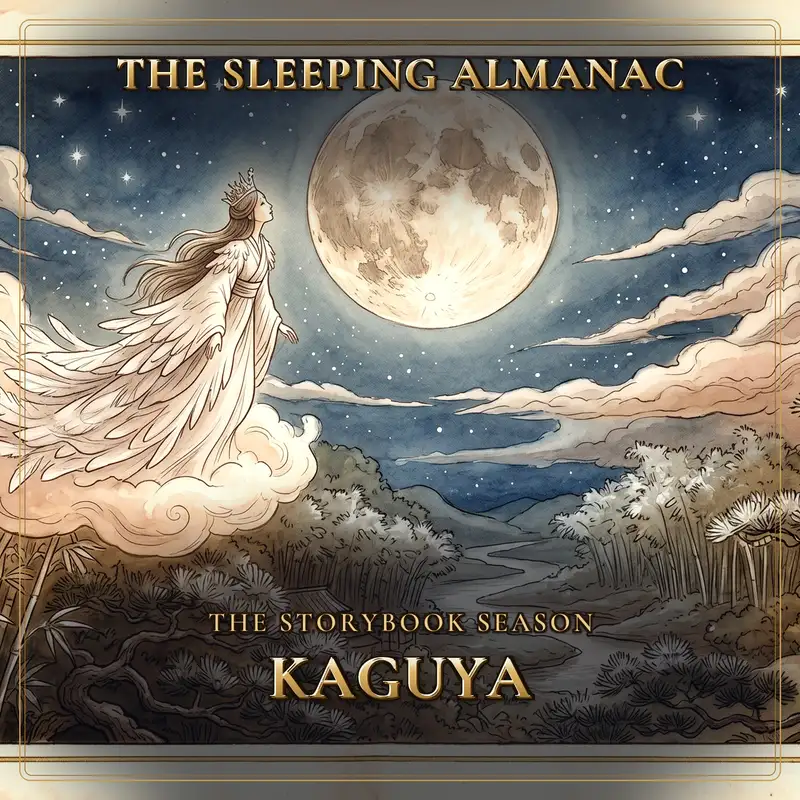
Welcome to The Sleeping Almanac.
Before the lamp is lit, one small thing. If these stories carry you to sleep, subscribe now, while your eyes are still open, and tomorrow night's tale will be waiting for you. A like helps other tired souls find this room. That is all. Let's light the lamp together now.
The lamp is lit again.
The same small flame as last night, in the same quiet room at the edge of the world.
The storyteller is already here. She was here before you arrived. She will stay until you sleep.
There is a chair for you. There is a blanket. The night outside is doing all of its slow, dark work, and none of it is yours to carry until morning.
The storyteller opens the old book, and turns past the tales already told, to a page that waits for tonight.
Tonight, she says softly, an old man walks into a bamboo grove at dusk and finds one green stalk glowing from within, like the moon shining through paper, and inside it, small enough to sleep in the palm of his hand, a princess whose true home is the moon itself.
And there is no hurry at all as she begins.
But notice, before her voice carries you off, what your eyes may already have caught. The page she has turned to is the last page in the old book. This is the twelfth tale, the final night of the Storybook Season, and the book has been saving it all this while, the way the month saves the full moon for its middle, the way a grandmother saves the best story for the night before the journey home.
There is nothing in that to be sad about. In this room, an ending is only another kind of tucking in.
So settle in. Let the chair hold you. Let the blanket be heavy in the good way, the way moonlight is heavy on a garden that has nothing left to do until morning.
Close your eyes, if they want to close. You do not have to watch. You do not have to follow. You do not have to remember any of it in the morning.
If you drift, the story will go on without you, quietly, and it will not mind at all. Drifting is not leaving. Drifting is how a listener says thank you.
And one kindness more, on this night of all nights. This is a tale about going home. There is a parting in it, told the old way, the true way, and it is gentler than you may have heard, gentler than almost any parting in any storybook. No one in this tale is lost. Someone is returned. The moon in this tale is not a cold stone. It is a lantern with a family inside it, and it has been waiting a thousand years for you to hear this told properly, in a warm room, with your eyes closed, going soft toward sleep.
The flame leans, and settles.
We begin.
Chapter One.
The Grove of Green Light.
Long ago, and far from here, on the islands at the eastern edge of the world, there was a bamboo grove that the moon loved.
All groves are good places, but a bamboo grove is a particular kind of good place. It is not like a forest of oaks, which stands still and thinks. Bamboo moves. All day the tall green stalks lean and return, lean and return, in winds too small for anyone else to feel, and the sound they make is the most patient sound in the world, a hush and a knock and a creak, like a house settling, like rain deciding not to fall after all, like a thousand green flutes that have all agreed to hold the same soft note, which is the note between evening and night.
By day the grove was full of green light. Sunlight came down through the high leaves the way light comes down through deep water, softened, slowed, made kind. By night it was full of silver. The moon loved that grove, as we have said, and the grove loved the moon back, and lifted its thin leaves to be counted, and the moon counted them, every one, every night, and never once lost her place.
At the edge of that grove, in a house with a roof of thatch and walls of wood gone gray and soft as dove feathers, there lived an old man and an old woman.
The old man's name was Sanuki no Miyatsuko, and he was a bamboo cutter. That was his whole trade and his whole fortune. Every morning, in every weather, he took his knife and his baskets and went in among the tall green stalks, and cut what the grove could spare, and carried it home, and made things of it. He made baskets. He made cages for crickets, whose songs the fine folk of the capital liked to keep beside their pillows in autumn. He made blinds to hang in doorways, and dippers for wells, and fences, and flutes. There is almost nothing a patient man cannot make from bamboo, and he had been patient for seventy years.
He and his wife had food for every day and a fire for every night, and they were as happy as two people can be who carry one quiet sorrow between them. They had no child. This is told plainly, the way the old book tells it, and then it is let be, because the tale does not dwell there, and neither will we. It is enough to know that the house was tidy, and the garden was tended, and that sometimes, in the evenings, the house was a little too quiet, and the two of them had grown old listening to that particular quiet, and had learned to be gentle with it, and with each other.
Now, one evening in the early spring of the year, the old man was in the grove later than usual.
The light was going. Not gone, but going, the way it goes in a bamboo grove, from green to gray to a blue like the inside of a mussel shell. He had his bundle on his back and his knife at his belt, and he was picking his way home along the path he had walked ten thousand times, when he saw, off among the stalks, a light.
He stopped.
His first thought was fireflies, but it was too early in the year for fireflies, and the light did not wander. His second thought was fox fire, because he was a sensible man who knew that groves at dusk are famous for mischief, and he stood still a long moment, ready to be respectful to whatever it turned out to be. Country people in that age were wise in this. When you meet a strange light in the woods, you do not run at it, and you do not run away. You take off your hat, if you have one, and you say good evening, and you see what happens.
The light did not move. It sat where it was, low to the ground, steady as a lamp in a window.
So the old man went toward it, slowly, between the dark stalks, saying good evening as he came, and what he found was this.
One single stalk of bamboo, in among all the thousands, was shining from inside.
Not burning. Shining. The green of it had gone bright and soft all at once, lit from within the way a paper lantern is lit, so that one whole joint of the stalk glowed the way the moon glows when thin clouds cross her, and the light that came out of it lay on the leaves all around like spilled milk.
The old man stood before it a long time.
He was not afraid. He said so afterward, always, and his wife always believed him, and you may as well believe him too. There was nothing in that light that knew how to be frightening. It was the kind of light one candle makes when it is the only candle in a temple. It was the kind of light that is doing something very quietly for somebody, and does not mind being seen at it.
The old man took his knife, and he cut the shining stalk, with the same two clean strokes he had used all his life.
And inside, in the hollow of the joint, sitting in the light as if the light were a small room, was a girl.
She was perhaps the length of his thumb. No taller. She was dressed, tiny as she was, in robes finer than anything the old man had ever glimpsed through the gates of great houses, layer upon layer of silk in the colors of dawn, each layer smaller than a moth's wing. Her hair was black and long and fell around her like brushed ink. And she herself was the light. It came from her steadily, gently, the way warmth comes from a sleeping child, and she looked up at the enormous old face peering down at her, and she was not afraid either.
The old man let out his breath, very slowly.
Well, he said at last, and his voice was as soft as he could make it, which after seventy years of talking to bamboo was very soft indeed. Well. You were found in my grove, in my bamboo, which I have tended all my life. So I think you must be meant to be my child.
And that was all the philosophy anyone needed, in that age, at that hour, in that grove. Some things simply arrive, and the only wise answer is to make room.
He put out his hand, brown and creased and hard as a tree root, and the shining girl stepped onto his palm and sat down in it, composedly, arranging her small silks around her, as if a palm were a perfectly usual place to sit, as if she had been waiting in that green stalk, all this while, for exactly this hand.
And the old man carried her home through the darkening grove, walking with the great slow care of a man carrying a full cup, and the bamboo leaned and returned above him all the way, hush, and knock, and creak, and the first stars came out to watch, and the light of her spilled out between his fingers and went ahead of them both along the path, so that for the first time in all his years the old man walked home at night with no need of the moon.
At the door of the little house, his wife stood waiting with a lamp.
She had been about to worry. She never got the chance to finish. The old man opened his two hands in front of her, the way you open a book, and in the hollow of them sat the light of the whole world.
The old woman looked for a long moment.
Then she said, softly, the same thing all grandmothers say when a baby is put into their arms, no matter the baby, no matter the country, no matter the age of the world. She said, oh. And then she said, come in, come in out of the cold, the both of you.
And so the Moon Princess came to live in the house of the bamboo cutter. Though it would be a long while yet before anyone under that roof said the word moon.
Chapter Two.
The Smallest Princess in the World.
They made her bed, that first night, in a round woven basket, lined with the softest cloth in the house, and set it where the lamplight could keep it company. In the morning the old woman woke first, and lay a while being quite certain she had dreamed the whole of it, and then she saw, across the room, the basket glowing gently in the gray before dawn, like a coal under ash, and she woke her husband with her elbow, and the two of them lay in their old bed watching their basket shine, holding hands, which they had not thought to do in some years.
Raising her was like raising no child before or since. She did not cry. She was never ill. She ate almost nothing, a single grain of rice held in both her arms like a festival cake, a drop of broth offered on the tip of a chopstick, and yet she was never hungry, and never pale, for how could she be pale, being made of light. When she slept, the basket glowed. When she woke, the whole room knew it at once, the way a garden knows the moment the sun clears the hill.
And she grew.
That was the wonder inside the wonder. She grew the way the moon grows, not slowly, the way children do, one shoe size a season, but visibly, week upon week, the way the moon fills from a paring to a bowl to a lantern. In three months, no more, the girl who had sat in the old man's palm stood before him as tall as any young woman in the land, and taller in her bearing, and the old couple, who had missed a whole childhood and somehow not missed it at all, could only look at her and marvel, the way you marvel at the first warm day of the year, without one question in you that wants answering.
She was, the old book says plainly, the most beautiful person in the world. But the old book is careful, and we will be careful too, about what that means. It was not only the face. It was the light. It never left her. In the day you saw it the way you see a lamp lit at noon, only just, a warmth at the edges of her. But at dusk the corners of the house filled quietly with a pale gold shining wherever she sat, so that the old woman gave up trimming lamps in whatever room her daughter was in, and the dark of that house was never anything but gentle again.
And there was this, which the old book swears to, and which the old man swore to all his days. When he was tired, and came home aching in every joint a bamboo cutter can ache in, one look at her and the aches set themselves down like baskets at the door. When he was cross, he could not stay cross in the room with her. Sorrow and anger simply would not keep in that house, the way milk will not sour in a cold spring. Whatever she was made of, it was the opposite of heaviness.
Now, from the day he found her, the old man's luck turned like a tide.
He went on cutting bamboo, because a man does not stop being himself just because a marvel has moved in. But now, again and again, when his knife opened a stalk, he found the joints filled with gold. Not every stalk, and never with any warning. Just often enough that the rice jars filled, and then the storehouse, and then the strongbox he had to buy, and then the second one. He would come home and set the gold on the mat and look at it in a puzzled, mild way, like a man whose hens have started laying eggs of silver, and his wife would say, well, and he would say, well, and that was the whole of their conversation about wealth, because neither of them had ever wanted anything but enough, and now there was more than enough, and the only thing they could think to do with more than enough was to build a fitting house around their daughter.
So they built it. A real house, in the manner of the great families of that age, with deep eaves and floors of smooth wood that held the shine of the garden, with a wide veranda for moon viewing, and lattice shutters that swung up on autumn days to let the whole gold afternoon in. There were blinds of split bamboo so fine they poured like cloth, and the old man wove some of them himself, because there are things a craftsman will not leave to other craftsmen. There were curtained rooms deep inside for a young lady of rank, as the custom was in those days, where she would sit behind silk in the proper way when strangers came. There was a garden with a pond, and a pine leaning over the pond, and a stone lantern by the water whose little flame, the servants said, always looked a bit embarrassed, like a candle asked to sing beside a bell.
And when the house was built, the old man did the thing that made her truly theirs, in the eyes of that country and that age. He sent for a namer.
The namer was called Imbe no Akita, of Mimurodo, a man learned in names, for in that age a name was not a label but a garment, cut to fit, meant to be worn a whole life. Akita came, and was shown into the fine new house, and the blinds were raised a hand's breadth, and he looked once at the light sitting quietly behind the silk, and it is said he was silent for the better part of an hour, which for a professional talker is a kind of bow.
Then he gave her the name. Nayotake no Kaguya hime. The Shining Princess of the Supple Bamboo. Kaguya, they called her, ever after. The light and the bending green, both held in one name, the grove and the glow together, so that she would carry the place she was found wherever she went, the way we all do, whether our names admit it or not.
And then, because a naming in that age was a festival, the old man threw open his new gates and held a feast of three days, and invited everyone, and meant it. Fine folk came, and farmers came, and the priest came, and the neighbors who remembered the old man when his whole fortune was a knife and a knack. There was music, flutes and drums and the great arched harp, and there was rice wine, and there were lanterns strung along the eaves, though people said, laughing, that the house needed lanterns the way the sea needs salt. For three days the smell of good cooking hung over the grove, and the bamboo leaned and returned above the road, hush, and knock, and creak, watching everything, saying nothing.
On the third night, when the last guests had wandered home singing, the old man stood in his garden with his cup, and looked up at the moon over the pine, and, being full of rice wine and gladness, thanked it. For the fine night, he meant. For the feast gone well. For everything.
He did not know what he was thanking. The moon, who did, said nothing, and only laid her light down over the house and the pond and the sleeping grove, evenly, gently, the way a mother pulls one blanket over two children.
But light is the one guest that cannot be kept indoors. Through the finest blinds it goes, between the boards of the best shutters, out under the deep eaves and over the wall. On dark nights the new house at the edge of the grove shone, softly, like the moon behind a cloud, and travelers on the road below would stop, and look up at it, and ask at the next village whose house that was. And the village would tell them. The bamboo cutter's house, they would say. Where the shining princess lives.
And the travelers carried it on, as travelers do. Down the road, over the pass, into the wine houses and the way stations, all the long miles to the capital itself. There is a princess at the edge of the eastern grove, they said, made of light, or nearly, the most beautiful person in the world, they say, and no one has properly seen her, they say, which of course only made the story better, and the story went everywhere, gathering shine as it rolled, the way stories do.
And that, said the storyteller, turning the page with one finger, is where the trouble began. Because a tale like that always, always, finds its way at last to the ears of young men with time on their hands.
Chapter Three.
The Five Suitors.
Men came from everywhere.
They came on horseback and they came in carriages drawn by slow oxen, and the grandest of them came with runners going ahead to announce them, which in the deep country by a bamboo grove is a little like sending a herald to announce you to a duck pond. They gathered outside the old man's fence, in their best silks, in their court hats, and they walked up and down, and cleared their throats musically, and recited poems at the house in general, on the theory that somewhere behind those blinds somebody was swooning. The old book says that some of them, the truly lovestruck, took to walking around and around the fence in the dark, and peering hopefully at the gaps in the hedge, and the servants of the house took to calling this pastime night crawling, and took no notice of it otherwise, and the people of that land took the word for this hopeful creeping and made it their everyday word for courtship, so that every suitor since has been named for the fools at that fence, and no one else took any notice either, least of all Kaguya, who could not be seen from the fence, nor from anywhere, being a well brought up young lady of that age, living deep in the house behind her curtains, exactly as the custom was.
You could not so much as hear her sleeve move, says the old book, no matter how long you loitered. And still they loitered.
But loitering is hungry work, and unrewarded devotion is a crop that mostly fails. The summer heats came, and thinned the crowd. The autumn rains came, and thinned it further. Then the snows, which are the great test of romance conducted outdoors, and by the time the plum trees bloomed again the road along the fence was quiet, and the hedge had grown back over the peeping holes, and nearly every fine young man in the land had discovered urgent business elsewhere, and attended to it.
Nearly every one. Five remained.
Five of them, and the old book gives their names and their offices with a straight face, and we will do the same, because they were, after all, five of the greatest gentlemen of the land, even if they were about to spend the next three years proving that greatness comes in more varieties than one.
There was Prince Ishitsukuri, a man of high birth and deep comfort, who loved fine things and warm rooms, and whose talent, above all talents, was for arranging that the difficult parts of life be handled somewhere out of his sight.
There was Prince Kuramochi, clever as a kingfisher, rich as a harvest, a man with a workshop where his heart should have been, who never in his life met a locked door without first checking whether it could be painted to look open.
There was the Minister of the Right, Abe no Miushi, whose storehouses were famous and whose heart was trusting, a man who sincerely believed, all his days, that anything under heaven could be bought if one only wrote a large enough number, and who is owed some tenderness from us, because the world needs its trusting men, and is always a little hard on them.
There was the Grand Counselor, Otomo no Miyuki, a man of loud voice and grand gestures, at his very best on a veranda, describing storms he had never been out in.
And there was the Middle Counselor, Isonokami no Marotari, the youngest of the five in spirit if not in years, earnest as a schoolboy, quick to hope, the kind of man who trips over the doorsill on his way to do you a kindness.
These five did not give up. Rain or frost, festival or famine, they came and stood their hopeful watch by the fence, until at last the old man, who had a soft heart and no practice at all in the ways of great families, felt the situation had outgrown him, and went in through the curtains to speak with his daughter.
He sat down across the silk from her glow. He addressed her, as he always did, half as a father and half as a worshipper, which the old book notes and which she gently teased him for.
My treasure, he said. I am past seventy. I was old when the grove gave you to me, and I am older now, and no man knows his hour. In this world, a man takes a wife and a woman takes a husband, and their gate grows wide, and their house goes on. It is the way of things. These five lords have waited at our fence through three winters. They are men of the highest rank in the land. Choose one of them, and let your old father see you settled, and I will have nothing left to wish for.
And Kaguya was quiet a while, and when she answered, her voice was so mild that it took the old man a moment to notice she had not agreed to anything.
Why should I marry, she said, when I am so happy here with you.
The old man made the sound fathers make, which is not an argument but wishes it were.
Besides, she said, and here the light of her wavered, just once, like a lamp when a door far away in the house is opened, I am not certain I am the kind of thing that marries. I am not certain what I am. And if I wed a man because his rank is high, without knowing whether his heart is deep, I think I would be sorry, and I think he would be sorrier.
But she saw her father's face, and she loved him, and so she folded her hands and offered him the smallest coin that would still spend.
Do this, she said. Tell the five lords I will marry the one whose devotion is true. And since I cannot see into hearts any more than they can see into this house, let each of them bring me one thing, one thing only, that I will name. Whichever of them brings me what I ask for, faithfully and truly, that man I will call the deepest of heart, and that man I will serve as a wife serves.
That seems very fair, said the old man, brightening. That seems more than fair.
It is completely fair, said Kaguya, in the voice of a person being completely fair, which any parent can tell you is a voice with weather behind it.
That evening, at dusk, the five lords were called to the house, and gathered on the veranda in their court silks, each one certain the summons was for him alone, each one discovering the other four with the expression of a man finding strangers in his bath. The old man came out to them, cleared his throat, apologized in six directions at once, and delivered the terms. A murmur of delight. One thing only. How hard could one thing be.
Then, from deep in the house, from behind the curtains, where the lamps had not been lit because they were never needed, Kaguya named the things.
For Prince Ishitsukuri, the stone begging bowl that the Buddha himself once carried, which rests in far India, and shines with its own light.
For Prince Kuramochi, a branch from the jeweled tree that grows on Mount Horai, in the eastern sea, a tree with roots of silver and a trunk of gold, whose fruits are pearls of white jade.
For the Minister of the Right, Abe no Miushi, the robe made from the fur of the fire rat of China, which fire cannot burn, and which comes out of the flames brighter than it went in.
For the Grand Counselor, Otomo no Miyuki, the jewel of five colors that shines in the neck of the dragon of the deep sea.
And for the Middle Counselor, Isonokami no Marotari, the small shell of safe and easy birth, which the swallows keep hidden in their nests.
There was a silence on that veranda, says the old book, of a very high quality.
Somewhere in the garden the pond made a small sound, a fish rising, or possibly the pond laughing. The five lords looked at the curtains, and looked at the old man, and looked, at last, carefully, at nothing at all, each privately performing the same arithmetic, the distance to India, the depth of the sea, the temperature of dragons. And then, because they were courtiers, and courtiers can smile while swallowing a whole winter, they thanked the house for its kindness, and bowed beautifully, and went home in five different directions to five sleepless nights.
The moon rose over the grove that evening, near to full, and looked down at five great houses burning their lamps late, five fine minds pacing five polished floors, scheming, sighing, unrolling maps, and rolling them up again.
And in the house by the grove, in the room that needed no lamp, Kaguya slept the sleep of the completely fair.
Chapter Four.
The Stone Bowl of the Buddha.
Prince Ishitsukuri, who had drawn the Buddha's own begging bowl, began, to his credit, with honest despair.
India. He said the word to himself several times, in the privacy of his fine warm study, with the brazier glowing and the winter rain on the roof. India was, by every account he could gather, very far away. One traveled for months over seas that disliked boats, and then for further months over mountains that disliked everything, and at the end of it, supposing one arrived, there was no signpost saying bowl. A thing like that, if it existed at all, would be the treasure of some temple ringed with ten thousand monks, none of whom, presumably, were fools.
And here the prince had his idea, which arrived, as his ideas always did, wearing the costume of wisdom.
For who in this land, he reasoned, warming his hands, has ever seen the Buddha's bowl. No one. Who knows what it looks like. No one. A bowl is a bowl. The virtue of the errand, surely, is in the devotion, and devotion is a thing of the heart, and the heart, thought the prince, growing more comfortable by the moment, the heart does not actually require the body to go to India.
So he let it be known, with much ceremony, that he was departing for India that very spring. There were farewells. There may have been a banner. And then Prince Ishitsukuri traveled, by unhurried stages, to a quiet mountain temple in Yamato, some three days from home, where he took lodgings, and where he stayed, in considerable comfort, for three years.
We should be fair to him. The old book is, in its dry way. He waited three whole years, which shows a certain workmanlike respect for the distance to India. He inquired after the local cooking. He became, the tellers suspect, genuinely fond of mountain air. And when the three years had turned, he went into one of the lesser halls of that temple, where an image of the holy one sat in the dust of long neglect, and there before it stood a stone bowl, a plain old begging bowl, black as a kettle with the soot of a hundred years of lamp smoke.
Perfect, said the prince, from the bottom of his heart, such as it was.
He had the bowl cleaned of the worst of it, though soot that old goes all the way in, and he wrapped it in brocade, and set it in a carrying case of carved wood, and tied to the case a spray of artificial flowers, silk ones, very fine, because presentation, he had found, covers a multitude of journeys. And he composed a poem to go with it, all seas crossed and bones wearied and tears shed into the westward waves, a really excellent poem, the work of a man with three years of mountain leisure and no shame to spend them on.
Then he presented himself at the house by the grove, travel dust artfully applied, and handed in the bowl.
Now Kaguya knew one thing about the true bowl, the thing everyone knew, the thing the prince had somehow talked himself around. The Buddha's bowl shines. It carries its own soft light, as holy things do, a glow like a firefly's at the very least, like moonrise at best.
She had the blinds raised a hand's breadth. She looked at the offering on its silk cushion.
The bowl sat there, black as a midwinter midnight, and shone precisely as much as a stone shines, which is to say, it lay in the light of the room and kept all of it.
Not by the glimmer of a firefly, said Kaguya, gently, to the curtains, to the room, to history. There is not in this bowl so much as the light of a dewdrop on a blade of grass. And she wrote a poem saying so, kindly but completely, and sent the bowl back out to the veranda.
And here the prince did the strange small thing that fixed him in the memory of that country forever. He took his rejected bowl, and he dropped it outside the gate, in the ditch, the way a man drops a thing he is suddenly embarrassed to be holding. And then, unburdened, he turned back to the house and tried again in verse, hoping, roughly, that the bowl might be overlooked and the devotion still scored. Perhaps, he suggested, its light had failed out of deference to the greater light of the lady. It was, as recoveries go, nimble.
From behind the curtains came no answer at all, which is the completest answer there is.
And the people of that country, who heard the whole story by way of the servants, as people always do, coined a saying from it that outlived everyone concerned. Of a man who has failed and pleads on regardless, glowing with hope, empty of merit, they said, ah, he has dropped his bowl and kept on asking, and in their language the words for dropping the bowl and dropping one's shame ring so close together that the saying winked at itself, and everyone caught the wink. To lose the bowl was to lose the shame. The prince had mislaid both in a single ditch.
He went home, in the end, to his warm rooms and his excellent brazier, and the old book lets him go without malice, and so shall we. He was not a wicked man. He was only a man who wanted the moon without the journey, and the world is not short of them, and at least he wrote his own poems.
One task asked. One task failed. Four lamps still burning late in four great houses.
And in the house by the grove, the old man fretted, and Kaguya sat serenely behind her curtains, exactly as serene as a person who has asked for the unfindable and is watching it not be found.
Chapter Five.
The Jeweled Branch of Horai.
Prince Kuramochi was of another cut entirely. Where Ishitsukuri dreamed of comfort, Kuramochi dreamed of method. He heard his task, the branch of silver roots and golden trunk and fruits of white jade, from the mountain of Horai that stands in the eastern sea and can be found by no one who seeks it, and he did not despair at all. He went home, called for his steward, and began, that very night, to organize.
His plan had the beauty of a spider's web, and about the same warmth.
First, publicly, he announced his departure. He would sail for Horai, he declared, though it cost him his life. To the court he gave out that he was traveling south to take the hot springs, a modest cover story, for a modest man, he implied, did not trumpet a holy quest. Then he went down to the harbor with an entourage sized for an emperor's progress, boarded his ship in front of everyone who mattered, and sailed grandly out of the bay while the assembled world waved.
Three days later, by night, the ship slipped quietly back to a lonely stretch of coast, and the prince came ashore in the dark, hooded, delighted with himself.
He had prepared, in the mountains, in a place with no road to it, a hidden house. Around the house he had built a fence within a fence within a fence, and inside it a forge and a workshop, and into this snuggery he had gathered, in deepest secrecy, six of the finest metalsmiths and jewelwrights in all the land, six masters of the kind whose work you know at one glance and whose faces you never learn. He shut himself in with them. And there, for a thousand days, three years shy a season, while the world believed him on the deep sea, Prince Kuramochi and his six smiths built the branch of Mount Horai.
And here is the uncomfortable wonder at the middle of this chapter, which the old book does not soften, and neither will we. The branch was magnificent.
The roots were silver, brushed and darkened like roots that had gripped real soil. The trunk was gold, not polished gaudy but burnished soft, with the faint long lines of true bark drawn in by a graver's patient hand. And the fruits were moons of white jade, hung so cunningly on golden stems that they trembled when a door was closed across the room, exactly as real fruit trembles, and seemed always about to be ripe. Kaguya had named the tree leaf for leaf, and leaf for leaf the six smiths matched her asking, and when at last they laid down their tools, they looked at the thing they had made, and were silent, and one of them, the oldest, is said to have wiped his eyes, because a man may spend his whole life mastering a craft and only once be asked to do the impossible with it.
The prince, meanwhile, practiced his suffering.
This must be understood about Kuramochi. He was not lazy in his lying. He composed his false voyage the way a poet composes an epic, with drafts. He grew his beard to the correct length of despair. He studied thirst. He rehearsed a stagger. When at last he came up the road to the bamboo cutter's gate, salt stained and hollow eyed, bearing the shrouded branch before him on a lacquered stand, entire villages turned out to pity him, and the old man wept at the sight, and hurried him in, and sent word within doors that the impossible had arrived, and Kaguya, behind her curtains, felt her heart go very still, the way a garden goes still before hail.
For the branch was carried in, and unveiled, and it was right. She had asked for a thing that was not in the world, and here it stood, shining on its stand, correct to the last jade plum. She looked at it a long time.
And the prince, invited to rest, settling himself on the best cushion with the sigh of a man home from the edge of the map, told his voyage.
The old book gives him his full performance, and it is one of the treasures of the tale, the lie lovingly preserved alongside the truth like a counterfeit coin kept in the temple treasury for the fineness of its minting. He told them of five hundred days of open sea. Of storms that stood the ship on its beam, of a calm that lasted till the water went bad in the casks, of hunger, of strange islands where things with the faces of women sang. He told them of the morning Horai rose from the waves ahead, impossibly tall, robed in cloud, and of the shining woman he met there on the mountainside, dipping water with a silver bowl, who told him the mountain's name. He told them of flowers whose smell reached the ship before the land did, of streams running over pebbles of amber, of the tree, the very tree, blazing on its slope like sunrise made solid, and of how he took only this one branch, only one, out of reverence, and turned for home, and wept, he said, to leave a place no man sees twice.
He told it, says the old book, without one seam showing. The old man wept freely. The servants listening at the doors wept. It was, by every account, the best story anyone in that house had ever heard, and Kaguya, behind her silk, listening to a man describe with perfect beauty a place she half remembered and he had wholly invented, did not weep, and said nothing, and her light, for those who could read it, burned very low and very steady, like a lamp being patient.
The wedding preparations began that same hour. The old man could hardly be restrained. And they were still laying out the cups, the old book says, when there came a commotion at the gate.
Six men stood there. Working men, in working clothes, road worn and resolute, and their leader carried, held before him in both hands like a petition to a magistrate, a written account.
They were, the account respectfully declared, six craftsmen of the capital and its provinces, masters of metal and stone. For a thousand days, in a hidden house in the mountains, they had labored night and day at the order of the great Prince Kuramochi, setting aside all other work, seeing neither family nor festival, to build a certain branch. A branch with roots of silver, a trunk of gold, and fruits of white jade. The work was long since delivered. The payment, to date, was nothing. And hearing that the branch had found its way to this honorable house, they had walked all this way to present, with a thousand apologies, the bill.
There are silences and silences, said the storyteller. The silence on the veranda when the tasks were first named, that was a courtiers' silence, smooth as lacquer. This one had texture.
Kaguya read the craftsmen's account twice, with, the tellers insist, the blinds trembling faintly, in the way blinds will when someone behind them is being very quiet about her delight. The relief came off her like spring. She had the magnificent branch carried out and returned to the prince with one small poem, which observed, in the mildest possible way, that she had asked for a branch of Horai, and had been given instead the finest work six honest men ever did, and that of the two, the honest work was worth more, and was not hers to keep either.
And she paid the craftsmen. Paid them richly, from her father's bamboo gold, every day of the thousand days, and sent them home rejoicing. What Prince Kuramochi said to those six men as they passed him at the gate, the old book does record, and this room, at this hour, declines to repeat it. It was not gracious. Even so, their work was paid and their names were made, and he went home poor in the only coin that had ever interested him, and finding the capital suddenly airless, he vanished into the deep mountains, alone, for years, to be embarrassed among the pines, where embarrassment is at least private, and the pines, to their credit, never mentioned it.
The old book adds one small mercy, and it is worth carrying to sleep. The branch itself was not destroyed. A thing that beautiful never quite is. It passed from hand to hand, and out of the tale, and somewhere, the tellers like to think, it stands to this day in some quiet alcove, wearing a century of careful dusting, being at last what it always was. Not a lie. Just a masterpiece with a bad start in life.
Two tasks asked. Two tasks failed. And in the house by the grove, the old man had stopped planning weddings, and begun, in the evenings, simply sitting with his daughter, the two of them watching the pond hold the moon, which is, when everything else has been tried, the oldest occupation in the world.
Chapter Six.
The Robe of the Fire Rat.
The Minister of the Right, Abe no Miushi, was the richest of the five, and the least complicated. He heard his task, the robe of the fire rat of China, fur that fire cannot burn, and he reasoned as follows. The robe was in China. Ships went to China. Money went on ships. Where was the difficulty.
There was in the harbor at that time a trading master from over the sea, a merchant of great affairs named Wang Kei, whose ships went out with the autumn wind and came home with the spring one, and whose word, in matters of cargo, was accounted good. To Wang Kei the minister wrote a letter of beautiful frankness. There is said to be, in your great country, the fur of a certain rat that lives in fire. I require a robe of it. Buy it, whatever it costs, and this gold is for the buying, and there will be more gold when it is in my hands, and I am, with every confidence, your friend Abe.
And then the minister waited, which was the part of any plan he did best, because waiting, when one is very rich, is simply living.
A full turn of seasons went by. The ships went out. The ships came home. And with the spring wind came a letter from Wang Kei, and the letter, being a merchant's letter, was a small masterpiece of its kind. The robe had not been easy, it said. The robe had, in fact, been nearly impossible. The fire rat was not found in China proper, and his agents had traveled, at great cost, into the far west of the world, to a mountain temple in India, where at last, by prayer, by persistence, and by an outlay he blushed to name, the thing itself had been secured. He begged only to be reimbursed the difference, a further fifty ounces of gold, payable on delivery, and if the honorable minister found the sum excessive, he should say so plainly, and Wang Kei would keep the robe.
Send it at once, wrote the minister, by return messenger, with the gold. You are the most honest of men.
The robe came up from the harbor in a jeweled casket, and when the minister lifted the lid, even he, who owned beautiful things the way a beach owns sand, sat back on his heels. The fur was a deep blue, the blue of the last sky before night, and every hair of it was tipped with gold, so that when it moved in the light the whole robe rippled like a field of dusk with the sun still caught in it. It was, all agreed, too beautiful to be anything but true. This has never once in the history of the world been sound reasoning, and it has never once stopped anyone.
The minister did not even wait for a lucky day. He rode to the bamboo cutter's house with the casket before him on the saddle, and was received, and the robe was carried in, and even through the curtains he heard the small intake of breath, and his heart soared.
It is very beautiful, said Kaguya, and her voice was kind, because what she had to say next was not less kind, but it was harder. It is so beautiful that I hope it is true. And there is one way to know. The fur of the fire rat comes out of the flames brighter than it went in. Let us give it to the fire, and if the fire gives it back, I will put it on that same hour, and be your household's from that day.
Of course, said the minister. Naturally. Burn it. He said this, the old book notes, with the full serenity of a man who has paid so much for a thing that the universe would surely not embarrass him.
A fire was made in the garden, of good charcoal, well fanned. The evening was still. The household gathered on the veranda, and the blinds were raised a hand's breadth, and the robe of the fire rat was laid, with great ceremony, upon the coals.
It burned.
Not slowly, not reluctantly, not with any hesitation that could be generously interpreted. It burned the way any winter coat burns, promptly, thoroughly, and with a certain enthusiasm, crackling politely, sending up one long ribbon of blue gray smoke into the evening air, and leaving on the coals, in a few breaths, nothing at all but a fine white ash that stirred, and lifted, and went off over the garden wall like a sigh going home.
There was a silence, and in the middle of the silence sat the minister, watching the smoke of a year of his life and a great deal of his gold rise gently over the pines.
To his lasting credit, he did not shout. He did not curse Wang Kei, though a letter went west in due course that must have been warm to carry. He looked at the fire a long while, and then he laughed, one short honest laugh at the size of his own hope, and he stood, and bowed to the curtains, and said, the fire has spoken, and it says I am unmarried, and he went home with an empty casket and, the tellers like to think, a lighter heart than either prince before him, because he alone had actually believed, and there is a health in believing that outlives the disappointment of it.
Kaguya sent his poem back after him with gentleness. She had wanted, the tellers say, to like the robe.
And the people of that country, hearing how the splendid thing had gone up in one bright breath, made from the minister's own name a little word for it. When a plan looked glorious and perished at its first test, they said it had gone abenashi, gone the way of Abe, which is to say, gloriously, and completely, and up in smoke, and they were still saying it long after anyone remembered the man, which is one of the stranger kinds of immortality, but is immortality all the same.
Three tasks asked. Three tasks failed. And far away in the deep sea, something very large and very old turned over in its sleep, not knowing it had just become the fourth.
Chapter Seven.
The Jewel in the Dragon's Neck.
The Grand Counselor, Otomo no Miyuki, differed from the first three lords in one great point. It never once occurred to him to cheat. This was not entirely virtue. It was also that his imagination, a modest and well fed creature, had never needed to invent anything, because its owner had always been able to command instead.
So he commanded. He gathered his household men, his retainers and archers and stewards, every man who ate his rice, and he stood before them on the veranda in his grandest manner and informed them that somewhere in the deep sea was a dragon, and in the neck of the dragon a jewel that shone with five colors, and that they, his loyal men, would now go and fetch it, and that none of them was to show his face at home again until the jewel was in his hand.
The retainers looked at the sea, which could be smelled from the veranda when the wind was right. The sea declined to comment.
To speed them on, the counselor emptied his storehouses. Silk for traveling money, rice for provisions, gold for whatever gold does in an emergency involving dragons. The men bowed low, accepted everything, expressed with feeling their determination to die rather than fail, and departed in a body.
And then, being sensible men whose families loved them, they scattered like sparrows from a clapped hand. Some went home by back roads. Some went to relatives in distant provinces they had been meaning to visit for years. One or two, the old book suggests, simply found agreeable villages and settled down in them on the counselor's silk, and if any man of them went within a mile of a dragon, the record is silent about it.
The counselor waited. Waited, and had the great house made ready for his bride, lacquer and silver, new blinds, new mats, everything rare and fine, while his wives, and he had wives already, the old book mentions this with its driest face, watched the redecorating with expressions history has kindly not preserved.
A year of this. No jewel. No men.
At last the counselor did the one grand thing he truly had in him, the thing this chapter loves him for. He went himself. He had a ship fitted out, and he stumped aboard, and he pointed it at the horizon and went dragon hunting, personally, an old courtier on a wide gray sea, and for a few bright days he stood in the bows with his sleeves streaming and felt, we may be sure, magnificent.
The sea let him have those days. Then it introduced him to the weather.
The storm that came up out of the southeast was, the sailors agreed afterward, of the honest worst kind. Thunder that walked from one edge of the sky to the other. Waves like moving hills, dark as plums. The ship went up things it should not have been able to climb and down things it is better not to remember, and the counselor, clinging to whatever declined to move, discovered saltwater in parts of his dignity that dignity does not have names for.
And the helmsman, hauling at his oar, shouted the thing sailors have always shouted at passengers who bring their ambitions on board. This is your doing, my lord. You have been bellowing for a year about killing a dragon and taking his jewel. The dragon has heard you. The sea belongs to him. Pray, my lord. Apologize to the dragon, or we are all fish food together.
And the Grand Counselor Otomo no Miyuki, to whom no one had suggested an apology in forty years, apologized to the dragon.
He did it, once he got started, with real range. He stood as well as he could, gripping the rail, drenched to his court rank, and he assured the storm at the top of his lungs that he now perceived the dragon to be a great lord, a venerable lord, a lord in every way senior to himself, that the jewel was the dragon's own personal property and always had been, that he, Otomo, had spoken as a fool speaks, and that if the dragon would overlook the whole regrettable year, he, Otomo, swore never again to trouble so much as a pond newt. A thousand pardons. He counted several of them out loud.
Whether it was the apology, or simply that storms end, the old book does not commit itself. But the wind eased, and the thunder took its walk elsewhere, and after three ragged days a very humble ship ran gently aground on the beach at Akashi, and its passenger was carried ashore and laid under a pine to recover, which he did slowly, in stages, like a man being reassembled.
He was not injured, unless one counts the whole man. But the wind and the salt and the sun had swollen his eyes most pitiably, and when his people came hurrying down from the capital and found him propped beneath his pine, they observed, and the old book preserves the observation forever, that his lordship's eyes looked exactly like two plums. It is the most famous pair of plums in the literature of that island, and the counselor bore them home on a litter, with compresses.
From his sickbed he issued two final commands on the subject of dragons. The first was that his scattered retainers, who came creeping back by ones and twos when the news reached them, were not to be punished, but thanked, and he thanked them, feelingly, for their wisdom in never going anywhere near the beast, since it would certainly have killed the lot of them. The second was that the bride house, all that lacquer and silver, be given over to storage.
Marriage, he announced to the ceiling, and dragons, are both weathers, and a wise man enjoys weather from the veranda.
And the people of the capital, who had followed the whole affair the way people follow anything wonderful that is happening to someone else, laughed for a season, but gently, the way a village laughs at a storm once it has safely passed. Because he had gone himself. Say what you like about the plums. Of the five great suitors, only two ever truly went out their own front gates toward the impossible, and the counselor, wet, swollen, apologizing to the horizon, was the first of them.
The second was already studying swallows.
Chapter Eight.
The Swallow's Shell.
The Middle Counselor, Isonokami no Marotari, had drawn, on the face of it, the easiest task of the five. No India, no Horai, no China, no dragon. Swallows. The little shell of safe and easy birth that swallows were said to keep in their nests, a charm the size of a fingernail. Swallows nested every summer under the eaves of the palace kitchens, an easy stroll from his own gate. He was, his household agreed, practically married already.
The difficulty, as anyone who has ever tried to take anything from a swallow could have told him, is that swallows are not stupid.
He began with scale, in the manner of the age. He learned that the best colony nested along the ridge of the great kitchen hall of the palace, where the smoke kept the hawks away, and he sent twenty men to build scaffolds up to the eaves, and set them watching the nests in shifts, day and night, with instructions to reach in the moment a shell appeared.
The swallows took one look at twenty men on scaffolds and stopped coming home entirely. The nests stood empty. Even the sparrows left, on principle.
The counselor was in despair, and here the tale sends him, as tales in that age liked to send great men, wisdom in the shape of a servant. An old man of the kitchen stores, one Kuratsumaro, bent as a ladle and twice as useful, begged leave to speak, and spoke sense. Take down the scaffolds, he said. Send home the twenty men. A swallow keeps her secret for the space of one heartbeat, at the moment of laying, and no forest of watchers will ever see it. Let one man wait below with a basket on a rope and pulley, rigged to the ridge beam. When the mother bird raises her tail and turns herself seven times, that is the moment. Haul the basket up swift and quiet, and let the man feel in the nest with his hand, and the gods send he finds it.
It was excellent advice, and the counselor followed every word of it but one. When the night came, and the fires were banked, and the kitchen hall stood empty and warm and dark, and the basket waited at the foot of the rope, he looked at the man appointed to ride in it, and he could not bear it. This was his task. His shell. His one thing, asked of him by the only voice that had ever asked him for anything. He put the man aside, kindly, and climbed into the basket himself.
We should hold this picture a moment, said the storyteller, because it is the best thing any of the five ever did. A counselor of the middle rank, in his silks, folded into a storage basket in a dark kitchen, at midnight, waiting on the domestic arrangements of a bird. Love has been called many things by many poets. It is also this.
The basket went up. The great hall breathed around him, warm ash and old smoke and rice. Above, in the dark under the ridge, a rustle. A small feathered turning, once, twice, seven times. Now, whispered the counselor, and hauled at the dark, and his hand found the nest, and in the nest something flat, and hard, and rounded to his fingers.
I have it, he cried, in a voice that woke the geese three courtyards away. I have it, pull me down.
And whether the men below pulled too hard for joy, or the rope was old, or the night simply preferred the story this way, down indeed he came, basket, counselor, treasure and all, not gently, landing upon one of the great bronze rice cauldrons, which rang beneath him like a temple bell announcing the failure of a plan, and rolling from there to the floor, where his men found him flat on his back among the embers of his expedition, eyes shut with pain, both hands cupped over his prize like a lid over a lamp.
He would not open them until he had been carried home and propped up, splinted and bandaged, on his own pillows, with lamps brought near. Then, slowly, in front of his whole anxious household, the Middle Counselor Isonokami no Marotari uncurled his fingers from around the small hard thing he had carried down through fire and bell and ruin.
It was a dropping. An old, dried dropping, of the kind swallows leave a great many of, polished smooth by the nest and the years, and shaped, the tellers admit, quite remarkably like a shell.
He looked at it a long time, there on his pillow mountain, with his back complaining and his household not laughing so loudly that he could prove it. And at last he said, softly, the words that his country never let go of, because in the old language of that island, the words no shell and no reward sound exactly the same. All this, he said, and no shell in it. And the sentence folded over on itself and meant, all this, and nothing to show, and both meanings were true, and everyone in the room heard both, and ever since, in that country, when a great effort ends in a small nothing, they say those words, and the counselor is in them still, flat on his back, holding history's most disappointing pebble.
Word of the whole night ran through the capital by morning, as such words do, and it came, in time, behind the curtains of the house by the grove. And here the tale turns a small quiet corner that matters more than it looks. Kaguya, hearing it, did not smile.
She had set five impossible tasks to five vain men, and four vanities had duly come to nothing, and cost her nothing. But this was different. This one had climbed into the basket himself. She sent him a poem, the first thing she had ever freely sent to any of the five, a few kind lines asking whether it was true he had fallen, and hoping, in the oldest words the language had for it, that he was mending.
They brought it to him where he lay. His injuries, the truth is, were mending badly. He was old for such a fall, and the shame, some said, weighed more than the basket had. But he read her poem, and the household saw a little light come back into his face, the way the moon comes back from behind cloud, and he asked for brush and ink, and in a hand that wandered but did not once stop, he wrote back that a fall was a small price for such kindness, and that he counted it, on balance, a bargain.
He sent his poem. He kept hers. And holding it, the old book says, with his household around him, he closed his eyes, easy at last, at the end of a long, kind, clumsy, honorable life, and the old book draws a soft cover over him there, and says no more, and neither will we, except this. Of the five who asked for the moon's daughter, he came nearest. Not because of the basket. Because when the impossible was asked of him, he was the only one of the five who never once thought of sending someone else.
So the five tasks ended, and no one had won her, and no one ever would.
The fence by the road grew quiet. The hedge filled in. In the house, the old man packed away, without a word, certain wedding things he had been keeping hopeful for three years. And Kaguya sat behind her curtains in her own soft light, out of reach of princes and ministers and counselors, and the only suitor left in all the world with any standing at all was the one whose light she sat in every full moon night, looking up, and up, and saying nothing.
But before the moon could claim her, one more mortal had to try. And he was not a man who waited at fences, because he had never in his life needed to.
He was the Emperor.
Chapter Nine.
The Emperor's Letters.
The Emperor of that land heard about Kaguya the way emperors hear about everything, last of all, and from three directions at once.
He heard about the light in the house by the grove, and the five great lords, and the bowl and the branch and the robe and the plums and the basket, the whole of it, and where another man might have laughed, he found that he had stopped, in the middle of a corridor, and was looking out at the moon over the palace roofs, thinking. A woman had refused the five highest men in his realm without once being unkind. A woman no one could see had become the most visible person in the country. He was young, and he was wise for his age, though not yet as wise as he was about to become, and he decided he would like to know what sort of person shone.
So he sent a lady of his court, Nakatomi no Fusako by name, with instructions to go to the house, and see the princess, and report.
Fusako went. Fusako was received with every courtesy. Fusako sat in the fine outer room, near the curtains, and stated her errand, an imperial errand, a command, in the way of a woman who had never once in her career not been obeyed.
From behind the silk, the soft voice was very sorry. It was not possible. Not out of pride, said the voice, and truly not out of unkindness, but she was not fit to be looked at on the Emperor's behalf, being not quite what a person should be, and she could not.
You are refusing the Emperor, said Fusako, to the curtains, with the room going cold around the words.
I am refusing everyone, said the voice, gently, and it must be said the refusal had had practice.
And Fusako, who could command everything but light, went back to the palace with an empty report and a full imagination, and told the Emperor the truth, that she had seen nothing, and that nothing had been, somehow, the most impressive thing in her whole long service.
The Emperor then tried the door that always opened. He summoned the old man, and offered him what the old man's world could not refuse, court rank, a cap, a standing among the great. Only bring your daughter to the palace, he said, and the thing is done.
The old man went home walking on air, and came back walking on earth. She will not, he reported, wretched. And she says, and he twisted his cap in his hands, she says that if she is forced, she will only fade. Like breath from a mirror, she says. And your servant believes her, because his daughter does not say things twice, and she said this twice.
A ruler learns to hear the true no under all the polite ones. This, the Emperor understood, was a true no. So he did the thing this chapter has been waiting for him to do, the thing that made him worth a chapter in her story at all. He arranged an accident.
A royal hunt was proclaimed, with hawks and horses and horns, and its path, by the purest chance, ran along the road by a certain bamboo grove, and at a certain gate, quite suddenly, the Emperor dismounted and walked in, unannounced, as a hunter may, asking after water.
And so he saw her. No curtains warned, no blinds were ready. He came around the veranda and there was a light in the inner room like moonrise indoors, and in the middle of the light, caught halfway to rising, a woman looked up at him, and for the rest of his life he never told anyone what her face was, only that afterward all other faces seemed to be copies of something he had now seen the original of.
She moved to slip away. He caught, very gently, the edge of her sleeve.
And where he held her, she began to go faint. Not fleeing, not fainting. Fading, the way the moon fades when cloud crosses it, her edge going soft, the silk in his hand growing thin as lamplight, and she looked at him without anger and said, I am not of this country. I am not a thing that can be kept. If you take me, you will find your hands full of shining, and then full of nothing at all.
The Emperor was many things, and one of them, buried under the robes and the rank, was genuinely intelligent. He opened his hand.
She came back, the way the moon comes back, all at once and without reproach.
Forgive me, he said. And then, because intelligence, once started, is hard to stop, he said the wisest thing any man says in this whole tale. I see now what you are, he said. You are not to be won. Very well. Then I will not try to win you. But a letter is not a hand on a sleeve. May a letter come to this house, sometimes, from a man who is glad you exist under the same moon he is under.
And from behind her light, for the first time in the whole old book, Kaguya laughed, just a little, like a bell heard over water.
A letter, she said, would be received.
He rode home, and the hunt never did catch anything, and no one dared mention it. And that evening the first letter went out to the house by the grove, and in the morning an answer came back, and that was the beginning of the true courtship of this tale, the one that asked for nothing and therefore could be given everything.
For three years the letters went back and forth. Poems, mostly, in the way of that age, short as breaths and deep as wells. His plum blossoms against her late frost. Her first cuckoo against his long rains. Small jokes that took two weeks to finish. The moon, always and endlessly the moon, until the palace paper keepers must have wondered how one heavenly body could need so much ink. He never again came to the house. She never once came to court. The court ladies noticed that the Emperor's evening letters went always in one direction, like geese in autumn, and they said what court ladies say, and it changed nothing.
And this, said the storyteller, was the nearest thing to marriage the old book allows her, and the tellers have never agreed on whether it was less than one or more. A friendship at the exact right distance. The moon and the sea, writing to each other every night, moving each other from far away, touching nothing, missing nothing.
Three years of that. Three good years. And then, in the spring of the third year, the servants of the house by the grove began to notice something about their lady, and what they noticed is the last turning of this tale, and it turns, as it was always going to, upward.
Chapter Ten.
The Fifteenth Night of the Eighth Month.
It began with the moon, as it had to.
That spring, on the bright nights, Kaguya took to sitting out on the veranda, alone, watching the moon rise over the grove. The old servants held that it was unlucky to stare into the moon's face, and said so, kindly, and she smiled at them, kindly, and went on doing it. There was nothing anyone could name amiss. Only that as the moon filled, each month, her quiet deepened, and on the nights when it stood full over the pines, they saw, more than once, that her face was wet.
Through the summer it grew. And on the full moon night of the seventh month, the old man found her weeping openly, with her arms around her knees like any village girl, and he sat down beside her, old bones and all, and asked, and this time she told him.
I am not of this world, she said. There, at last, it is said. My home is the Moon Capital, the shining city, and its people are my people. I was sent down to this country for a time, for reasons that were not mine to choose, and the time is ending. On the fifteenth night of the eighth month, at the full of the moon, they will come for me. I have always known. Forgive me. I was small, and then I was happy, and there was never a good evening to say it.
She took her father's hands, both of them, small light around old wood.
Understand me, she said. I do not weep at going home. I weep because this has become home too, and no heart is made to be two homes at once. When I think of leaving you and mother, the sky itself feels like falling.
What the old couple said that night, the old book keeps behind its hand, and so will we. Grief in a small house is not for visitors. But by morning the old man had passed through weeping and out the far side into something splendid and hopeless, and announced to the household that the moon, if it wanted his daughter, could come down and discuss the matter with him personally. He was one basket maker, past seventy, and he was proposing to contest the sky. There is no braver sentence in the whole old book, and none more useless, and every parent who has ever heard this tale has understood him completely.
Word went to the palace, because by now what touched that house touched the Emperor. And the Emperor, who could not save her either, did what power does when it loves and cannot help. He sent everything he had. On the fifteenth day of the eighth month, a captain of the guard came down the road with two thousand men, and by evening the house by the grove was dressed in soldiers, archers on the roof ridge, spearmen shoulder to shoulder along the walls, the garden bristling, the gates barred, more armed men around one bamboo cutter's house than most wars got in that century.
Inside, in the innermost room, a storeroom with walls of good thick plaster, the old woman sat holding Kaguya in her arms, and would not be moved. The old man stood guard at its one door. Two thousand and two, then, all told.
Kaguya, held tight in the middle of the army, was gentle with them all.
You cannot fight them, she said. I say it not to wound you, but so that no one is hurt for me. The people of the moon do not come as an enemy comes. Walls do not stop moonlight. Locks do not know it is there. When they call me, I will go, not because I choose against you, but the way the tide goes, because it is made of the sea. Sit with me instead. We have tonight, until the hour comes. Sit with me, and let me look at you.
And so the last evening of the Moon Princess on the earth was spent in a storeroom, by lamplight no one needed, an old woman holding her, an old man at the door pretending to guard it and really only staying near, and outside, on the roof, two thousand soldiers under a rising moon, joking in low voices to keep their courage fed, while the full moon of the eighth month came up over the grove enormous and pale gold, the harvest moon, the one that stands lower and looks nearer than any moon of the year.
Midnight came, and went. The men on the roof began to hope.
And then, at the hour of the Rat, the deepest step of the night, the sky above the house began to lighten.
Not like dawn. Dawn comes from an edge. This came from directly above, softly, evenly, the darkness turning pale the way water turns when milk is poured into it, until the garden below was bright as ten full moons together, bright past noon, and yet with no glare in it anywhere, a brightness the eye drank without flinching. And down through the middle of that brightness, slow as a leaf, came a white cloud, and on the cloud stood people.
They shone. They were dressed as kings and queens are dressed in the oldest dreams, and their faces were calm the way deep water is calm, and among them rode a high canopied car of light. The cloud came down until it stood above the garden no higher than a man's head, and stopped there, resting on the air.
And now the two thousand proved what they were worth, which was nothing, and it was not their fault. The captain called the order. Every man on that roof was brave. But their arms, as they drew, went soft, the strength running out of them like water from a tipped jar, and the arrows wandered off sideways with no conviction at all, and fell in the vegetable rows. The fiercest fighters in the Emperor's service found they could not so much as glare. A heaviness had come over every armed man, mild and complete, the very heaviness that is settling over you now, the weight of the hour before sleep, and one by one the bows were lowered, because there is no drill for shooting at something that only makes you drowsy and kind.
The doors of the house opened themselves. Softly, in order, outer to inner, every latch letting go, every screen sliding wide, the lattices swinging up on their own to let the light walk through. The storeroom's one door opened last. The old woman felt her arms unclose, with no force in the world touching them, and Kaguya stood, and kissed her mother's hair, and walked out through the bowing doors into the garden of light, shining her own answer back at the sky.
From the cloud, one who seemed a king among them looked down, and spoke to the old man, and his voice was not unkind. It was worse, the old man said after. It was patient.
Miyatsuko, he said. For a small good deed, done long ago, you were lent a great joy. She was sent down for a fault, a little fault, committed in a high place, and her exile is long since paid, and the gold you found in your bamboo was her keep, sent down each month with the light. You have raised her well, and it is written in your favor forever. But the loan is ended. Give her back.
She is ill, said the old man, lying magnificently, his cap crooked, his old knees shaking. That one is not the Kaguya you mean. Yours is, is another Kaguya. This one is very ill, and cannot travel, and,
And the king of the moon looked at him, the way the moon looks at a cloud that is trying to hide it, and waited, and the old man's brave nonsense fell quietly to pieces, and he wept instead, which was the truth.
Kaguya asked for a moment, and it was granted. Even the moon, it turns out, will wait for letters.
She wrote two. The first was for the old couple, and she knelt and put it into their hands herself. Had I been born of this country, it said, I would never have left you, not for any sky. Keep my robe, my everyday one, the silk that was daughter and not princess, and on the nights when the moon is bright, look up, for I will be looking down, and the same light will be on both our faces, and that is not nothing. That is very far from nothing. Do not grieve longer than you must. Being your child was the good part of the whole long life of me.
The second letter was for the Emperor. She wrote it standing, while the shining people waited, and one of them, restless, murmured that the hour was passing, and she answered, without looking up, that she was saying goodbye to a whole world, and the hour could carry that much. With the letter she sent a gift, taken from the hands of the moon people themselves, a small sealed jar, white as the inside of a shell. In it was the medicine of the moon, the elixir of life, one draught of which holds off death forever. Take these to him, she said to the captain of the guard, and tell him, and here she folded into the letter one poem, the last one, and the old book has kept it a thousand years. Now that the moment is come, it said, and the robe of feathers waits for me, I find that it is you I think of, with tenderness, after all.
Then they brought the robe.
It came out of a box of light, the robe of feathers, hagoromo, white beyond white, soft beyond soft, the garment of her own country. And you must know what it does, for the ending to land in your chest the right way. The robe of feathers takes away the ache. That is its nature. No one wearing it can carry a heavy heart, for it is woven of whatever the moon is made of, distance and calm and unbroken light, and the moment it settles on your shoulders, sorrow lets go of you, not torn away, just set down, the way you set down a bag at your own front door.
Kaguya looked at her mother, and her father, a long time, gathering their faces the way you gather things for a journey.
Then she let the robe be laid upon her.
And all of it, the weight of the parting, the tearing of the two homes, the whole unbearable arithmetic, lifted off her in one long breath, and what stood in the garden then still loved them, you could see it, but loved them the way the moon loves, from a height, wholly, calmly, without one shadow of pain, and her face was the face of someone hearing, from far away, the sounds of the house where she was born.
She stepped up into the car of light, among the hundred shining people.
And the cloud rose. Slowly, the way a lantern rises when a child lets go of the string, up past the roof and its harmless drowsy archers, up past the tops of the pines, up and up, the brightness folding itself smaller and smaller, until it was a star among the stars, and then a spark, and then the sky closed softly over it like water over a lifted hand, and the full moon stood alone over the grove, and the night came back, the ordinary, kind, dark night, with all its crickets ringing.
No one who stood in that garden was ever afraid of the dark again. And no one who stood there ever again called the moon empty.
Chapter Eleven.
The Smoke of the Mountain.
What is left, after such a night, is the part of the tale that belongs to us, the ones who stay.
The old couple were, at first, like fields in winter. That must be said honestly, and the old book says it honestly, and then, like the good farmers of grief that old people are, they came slowly back. They had her letter, which the old woman kept in a box of paulownia wood and knew by heart anyway. They had the robe, her everyday silk, which held, the old man swore, a faint warmth always, like a stone that remembers the sun. And they had the veranda, and the pond, and the pine.
On the bright nights, the two of them would sit out together, wrapped warm, and look up, the way she had told them to. And the old woman said, once, that it felt like waving to a daughter married far away. Very far away, she said, and very well, into a great family, who would keep her shining. And after she had said that, it is told, the two of them could watch the moon rise without weeping, and some months later they could watch it rise smiling, because grief, tended gently, grows down into something with roots, and the name of the thing with roots is remembering.
The old man went on cutting bamboo. Of course he did. It was who he was. There was no more gold in the stalks, the keep having ended with the keeping, and he found he did not mind. He had never minded about the gold. And the tellers, who have carried this tale a thousand years, add here the one thing the old couple themselves would never have said aloud. Of all the houses of the earth, of all the emperors' palaces and the princes' mansions with their triple fences, when the moon had one child to lend, it looked down the whole shining world and chose the house of a man who was kind to bamboo. They were not people something terrible had happened to. They were the two most trusted people in the history of the ground.
And the Emperor.
The captain of the guard came back to the palace at dawn, empty of victories, and laid before him the letter, and the small white jar.
The Emperor read the letter twice. Then he sat for a long time with the jar of the elixir in his two hands, the little jar that unmakes death, the draught emperors in old tales burn kingdoms to find, his now, freely given, hers.
Then he asked his ministers a single question. Which mountain of this land stands nearest to heaven.
And they conferred, and answered him. In the province of Suruga, they said, there stands a mountain taller than every other, so tall its head keeps snow in high summer, and stands closest of all things in the realm to the road of the moon.
The Emperor nodded. He wrote his answer to her then, the poem the old book keeps beside hers, and it says, in the small space such poems are given, that a man who will never again see her has no use for a life that does not end. What should I do with forever, it asks, alone in it.
And he called a trusted man, a captain named Tsuki no Iwakasa, and if you listen to that name you can hear the word for moon inside it, which the tale notices and quietly enjoys, and he gave into his hands the letter and the jar. Take soldiers, he said, many soldiers, and climb the mountain in Suruga to its very summit, and there, as close to her country as this country goes, burn them together, the letter and the elixir both, and let the smoke carry up what I could not.
And it was done. Iwakasa went, with such a great company of warriors that the mountainsides were bright with them, and they climbed past the forests, past the last grass, up into the snow and the thin blue air, to the summit stones where the sky begins. And there they made a small fire at the top of the world, and in it the Emperor's letter, and the elixir of life, burned together, and the smoke of them rose, straight and thin and silver, up from the peak toward the moon, and it did not stop.
It has never stopped, says the old book. And the people, watching that thread of smoke stand up from the summit year upon year, gave the mountain its name from that day. Some say it is named for the warriors, the great host of them on its slopes, and some say it is named for the burning itself, fushi, the word for deathless, for the deathlessness that was given back unused. The mountain of Fuji. And when travelers on the Suruga road saw its smoke against the evening, for a thousand years, they would tell their children, that is the Emperor's letter, still going up, and the children would watch it rise and privately conclude, as children rightly do, that it must be very long, or very good, to take so many years in the sending.
So the tale sets everything down at last, each thing in its right keeping.
The moon keeps her. She is home, in the shining city, among her own calm people, wearing no ache, and on bright nights the light that falls on your window sill has come through the country where she lives.
The mountain keeps the smoke, the unswallowed forever, the love letter that is still, this very night, on its way.
And a house by a bamboo grove keeps two old people, asleep by now, her letter in its wooden box, her robe folded soft beside it, the memory of having been chosen laid over them both like a quilt.
Nobody in this story lost anything, in the end, except the five suitors, who lost only what they never had, and the world, which lost one light upward, and gained, in exchange, the mountain, and the tale, and the excellent plums.
Chapter Twelve.
Goodnight. And the Lamp at the Edge of Morning.
The night is deep now, even at the edge of everything.
Far away and long ago, the bamboo grove stands in the dark, leaning and returning, hush, and knock, and creak. No stalk of it glows tonight. The grove gave its one lantern back to the sky, and shines now only the ordinary way, silver at the leaf edges, which was always enough. Deer pass through it. The wind takes its slow roll through the leaves, a sound like the sea agreeing with itself, and the path the old man walked ten thousand times lies quiet from one end to the other, remembering feet.
Over the bay, over the pines, the mountain stands in the moonlight with its head in the stars, sending up its one silver thread. Fishermen on the dark water see the smoke and the moon in the same lifted glance, and say nothing, because some sights close the mouth and open something else.
And the moon herself stands over the whole of it, full and calm, the great lamp of this tale and of this season, and of every sleeper who was ever carried to bed.
Look at her a moment, from under your warm blanket, before the lamp goes low.
Most nights she is silver, a pearl, a bowl of milk. Some nights she is gold at the rising, huge over the hills, the harvest lantern. And once in a long while, on a night worth staying up for, the earth itself leans gently between its lamp and its moon, and the shadow of the whole world crosses that bright face, and the moon goes the soft color of embers, of amber, of a lantern behind silk. People have always gathered to watch that, in every age, on rooftops and hillsides, wrapped in blankets, quiet. And there is nothing in it to fear, and there never was. It is only the earth, saying goodnight, standing for one hour exactly between its light and its children, the way a mother pauses in a doorway. The silver always comes back. It always has. If you are ever awake to see the moon turn amber, think of Kaguya, going home, and the smoke of a mountain rising to meet her, and watch how gently the light returns.
The storyteller looks up from the last page, here, at the whole room.
Behind her, at the edge of the lamplight, stands the shelf. You have heard about the shelf. All season it has stood there, holding its small waiting things, and tonight, for the first time, nothing on it is waiting.
The old brass lamp with the dent in its side has been rubbed and has retired. The glass slipper has been danced in, twice, and fits exactly the one person it always fit. The silver shoes have walked their road of yellow brick and carried their girl home from it. The little pot of paint from the London nursery is closed tight, the thimble beside it given and received. The coral comb has been drawn one last time through copper hair, deep under a kind sea. The spindle sleeps, its hundred years all spent, wound down to an ordinary spindle at last. The yew bow has loosed its arrow into the greenwood and the greenwood keeps it. The loom shuttle from the house by the Yellow River rests by the whip that rode twelve years to war and told no one. The mirror splinters lie counted in their velvet bag, every last one home, none out doing mischief, the bag gone quiet. The bottle of tears has dried to a shimmer. The watch has agreed, at long last, that even teatime ends.
And the stalk of green bamboo, sealed at every joint, that the shelf kept for last because the shelf is sentimental, is dark now. Dark, and warm to the touch, like a lamp after morning, like a stage after the bows. Its light was never lost. Its light was only a story, and the story has been told, and told light does not go out. It goes in. Into the listener. Into you. Twelve tales, twelve nights of lamplight, and every one of them is in you now, keeping their warmth where warmth keeps best, in a sleeping person, in the dark, at the edge of morning.
The old book lies heavier than it did in August. Told tales weigh a little more, the way slept in beds do. The lamp leans, and rights itself, and goes on with its small golden work, minding its one acre of the dark, and the room is the same quiet room it has been all season, at the edge of everything, which means close to everywhere, and closest of all, tonight, to you.
There is nothing left to wait for. That is not an empty feeling. That is the fullest feeling there is. It is the feeling of the house after the guests have been walked to the gate, of the field after harvest, of the page after the last word, when the ink is dry and the pen is down and the whole long labor folds its hands.
The moon is on the window sill. The blanket is doing its slow warm work. Somewhere very far away, a thread of smoke is climbing toward a shining city, in no hurry, sure of its road.
And when the storyteller reaches the end of this last page, she will close the old book all the way, front board to back, for the first time since the lamp was first lit, twelve tales asleep inside it like twelve sleepers under one roof, and she will rest her hand on the cover a moment, the way you rest a hand on the shoulder of an old friend who has done a long thing well, and the old book will settle, and sigh, and sleep.
The storyteller closes the book, but slowly, the way a door is closed on a sleeping house.
The lamp is turned low.
Whatever became of them after, they are safe now, and so are you.
The lantern will be lit again. There are more tales in the old book than there are nights in a year.
Goodnight.