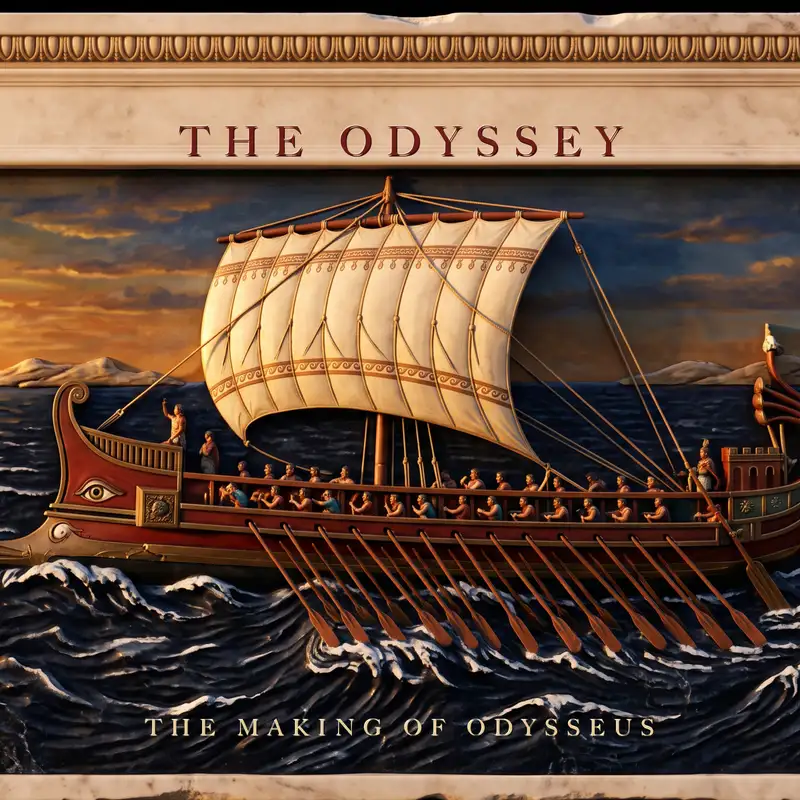
Welcome to The Sleeping Almanac.
Tonight, a story you have never quite been told. You know the man it is about, or you believe you do. Before he was the most famous traveler in all the world, before the one eyed giant and the witch on her island and the long, long way home, he was a boy on a small goat island, and he was given a name that meant trouble. Tonight is the story of how that boy became that man. How he came by the name. How he outwitted a whole hall full of kings and won the wife he would one day spend twenty years trying to get back home to. And how, at the very end, it was his own cleverness, one brilliant idea he had as a young man, that reached back around and carried him off to sea against his will. Stay with it, if you can, all the way down to the last chapter, and you will know the wanderer far better than the whole famous voyage could ever show you. For the voyage tells you only what a man did. It is the home he was made in that tells you who he was.
There is a beach at the edge of the world, and on it there is a fire.
It is a small fire, built of driftwood that the sea gave back, and it burns the pale gold of old honey. Beyond it the water is dark, the deep wine dark of the sea at night, and it breathes the way the sea breathes, in and out against the sand, patient, in no hurry, asking nothing of you. The stars are out. They are the same stars that sailors have steered by for three thousand years, and they do not know that any time has passed at all.
By the fire sits an old singer. You cannot see his eyes, and it would not matter if you could, for he has not needed them for a long time. He knows this beach by the sound of it. He knows you are here by the quiet you brought with you. His hands rest on his knees, and when he speaks his voice is low and worn smooth, like a step that many feet have crossed.
The air smells of salt, and of the driftwood smoke, and of something green and far off that the night wind carries down from the hills behind the beach and lays across the fire like a hand. Somewhere out past the light a wave turns over and folds itself onto the sand, and then another, slow, evenly spaced, the way a clock would keep time if a clock were kind. There is no other sound. There is nowhere else to be. The whole wide dark has narrowed down to this one warm circle, and you are inside it, and it is enough.
There is a place for you by the fire. There is sand still warm from the day, and a cloak folded for your head, and a whole night with nothing in it that you must carry.
Tonight, the singer says, I will not sing you the famous story.
You know the famous one already, or you think you do. The long way home. The one eyed giant, the witch on her island, the song that kills, the wife who waited. That story is coming. But no one, he says, can truly know a wanderer until they know the home he was torn away from, and the boy he was before the world learned his name. So tonight I will sing you the story before the story. The making of the man himself.
You do not have to do anything now.
Settle into the sand. Let the fire be warm on one side of you and the cool night on the other, the way the whole world feels when you are almost asleep and perfectly safe. Close your eyes if they want to close. This story does not need to be watched. It only needs to be near you, the way the fire is near you, the way the sea is near you, saying the same soft word over and over against the shore.
Let your shoulders come down from wherever the day left them. Let your hands lie open. There is nothing here that wants anything from you, not the fire, not the sea, not the old man who tends them both. The tide will come in a little while we talk, and go out again, and it will not ask your leave, and it will not need your help, and that is the whole gift of it. You are a guest here, and a guest at a good fire has only one task, which is to be warm, and to let the night do the rest.
You do not have to follow every word. You do not have to remember any of it in the morning. If you drift, the singer will go on without you, and he will not mind. Out here, drifting is only another way of listening.
And one thing, whispered like a promise across the fire. Nothing in this story will ever startle you. Whatever storms are coming for this man, and storms are coming, they are far off yet, and they will stay far off all night. Tonight there is only an island, and a boy, and the people who loved him. You can trust this fire. That is what it was lit for.
The old singer turns a piece of driftwood in the coals. It settles. A few sparks go up and join the stars and are gone.
Before the singer begins, one small thing, and then we will not interrupt again. If this story carries you down toward sleep, subscribe now, while your eyes are still open, and the next tale will be waiting for you when you need it. A like helps other tired travelers find this fire on the beach. That is all. Now settle back, and let him begin.
Chapter One. The Island That Made Him.
Long ago, and far across the water from here, there was an island so small that a strong man could walk its length in a morning, and so loved by the people born on it that not one of them ever truly wished to live anywhere else.
It was a rough little kingdom. It had no wide golden plains, no rivers worth the name, no towers to speak of. What it had was stone, and sea, and light. Grey stone that warmed all day and gave the warmth back at night. Sea on every side, close enough that you could hear it from any bed on the island, so that the children born there learned the sound of waves before they learned words, and carried it under everything they ever heard after. And light, the clean hard light of a place surrounded by water, that made the olive leaves flash silver when the wind turned them and laid a road of fire across the sea every evening as the sun went down.
The island was called Ithaca.
Picture it the way you would come upon it from the water, which is the only way anyone ever came upon it at all. First a grey shape low on the sea, no bigger than a cloud that had settled and decided to stay. Then, as you drew nearer, the shape breaking into hills, steep and close, folded against one another, with the pale scars of goat paths running along their sides. Then the smell of it reaching you before the shore did, the dry warm smell of thyme and sage baking on the slopes all day, and under it the green bitter smell of the olives, and under that the salt. And then the harbor opening quietly in the rock to take you in, small and safe and deep, and the little houses climbing the hill above it, and the smoke standing up from them, and you would know, whoever you were, that people lived here who were glad to be exactly where they were.
On its hillsides the olive trees grew in their slow crooked way, some of them older than any story anyone could tell about them, their trunks twisted like men leaning into a wind that had stopped blowing centuries ago. In the spring the slopes went pale with the small four petaled flowers of the olives, and the bees came, and the whole hillside hummed like a plucked string. In the autumn the fruit came heavy and green and then black, and the whole island turned out to gather it, spreading cloths beneath the branches and beating the boughs gently with long poles, and the oil they pressed from it was the color of new grass and the pride of every household. Goats moved among the trees, sure footed on the stone, and their bells made a small careless music that drifted up and down the slopes all day, so that a person lying awake at night, hearing a single bell far off, would know without rising exactly which fold of which hill it came from. Below, in the little harbor, fishing boats leaned against each other at their moorings and knocked together softly when the swell came in, wood on wood, a sound like a house settling for the night.
There was weather on Ithaca, but it was mostly kind. And always, in every season, there was the sea saying its one word against the shore, so close and so constant that after a while a person stopped hearing it the way you stop hearing your own breath, and only noticed it again in the rare dead calm when for an hour it went quiet, and then the silence felt strange, and everyone waited, without quite knowing they were waiting, for the sound to come back.
And on this island there was a king, though you would not always have known him for one.
His name was Laertes, and he was a king in the old way, which is to say he was a farmer who happened to wear a crown, and who was happiest when the crown was somewhere else and there was earth under his hands. You might have come upon him on a hillside on any afternoon and taken him for one of his own gardeners, for he loved the ground of his island with a patient love, and he trusted his hands more than his title. He kept an orchard on the slope below the house, and he had planted much of it himself when he was young, walking the rows and counting the trees aloud the way another man might count gold. There were pear trees there, and apple, and fig, and long ordered rows of vines that gave a little wine each year, enough, and never too much. He knew each tree the way he knew each of his people, by its own small history. When autumn came he could tell you which pear would ripen first and which would make you wait, and he was almost never wrong, and being right about pears was a satisfaction to him far deeper than being right about men.
He had a way of working that the whole household knew and no one ever remarked on, because it was as much a part of the place as the weather. He rose before the others, in the grey, and went down to the orchard with a mattock over his shoulder, and he worked the ground around the roots of his trees while the dew was still on the leaves, and he talked to them quietly as he worked, not in any way that would have embarrassed a man to be caught at, but low, under his breath, the way you speak to an animal you are gentling. He believed, though he would never have said it in those words, that a thing tended with attention gave more back than a thing merely owned. He had made a whole small kingdom out of that belief, and it had served him, and it would turn out to be the deepest thing he ever taught his son, deeper than any lesson given in words, because the boy grew up watching it done.
It was a small kingdom in the way that a large family is small, which is to say that everyone in it knew everyone else, and their parents, and their parents before them. The men went out in the little boats before light and came home with the sun high. The women worked the wool and the gardens. The swineherds took the pigs up into the oak woods for the acorns, and the goatherds took the goats along the high stony places where only goats can go, and in the evening the smoke of a hundred small suppers went up straight into the windless air, so that the whole island smelled of woodfire and the sea at once. There was not much money on Ithaca, and not much need of any. A man counted himself rich there if his olives bore and his goats were fat and his neighbors thought well of him, and by that measure a good many of them were rich, and knew it, and were content. This was the world the child was born into. Small, and hard, and bright, and full of people who would remember him.
In the house above the orchard lived his wife, and her name was Anticleia.
She had come to Ithaca from the mainland, from a family that was talked about in careful voices, though we will come to that in its own time, and she had brought with her a warmth that the grey stone house had never quite known before she walked into it. She was the kind of woman a whole household arranges itself around without being told to, the way a room arranges itself around a fire. The servants brought their small troubles to her before they brought them to anyone else. Laertes, who was shy in the way that steady men are often shy, had loved her from the first hour, and went on loving her quietly for the rest of his life, and this too was a thing the island knew and was glad of, for a house that is at peace at its center keeps a whole small kingdom calm around it.
She had her own quiet arts, the way Laertes had his. She kept the household stores, and she knew to the last measure what the house held against the winter, the oil in its jars, the grain, the salted fish, the wool waiting to be spun. She had a way with the sick, and the women of the island came to her when a child would not thrive or a fever would not break, and she sat with them through the long nights and asked nothing for it. And she could weave. She sat at the great loom in the main room of the house with the light coming in over her shoulder, and the shuttle went back and forth, back and forth, and the cloth grew under her hands a finger's width at a time, and the sound of it, that soft steady knock of the loom, was one of the first sounds the child would ever have known, before he had words to put to it, a sound like patience itself made audible. It would matter, that sound. It would come round again at the very end, in another woman's hands. But that is far off, and the room is warm, and the loom is knocking softly, and there is no hurry at all.
For a long while they had no child. And then, in a season much like any other, they had one.
He came in the ordinary way that the most extraordinary people always seem to come, which is to say helplessly, and red faced, and roaring, and small enough to hold in two hands. The women of the house washed him and wrapped him and laid him in his mother's arms, and Laertes stood in the doorway not trusting himself to come closer, the way new fathers stand, as though the room had suddenly been made of glass. Outside, the goats went on with their bells. The sea went on saying its one word against the shore. And no one in that house, bending over the new small face in the lamplight, could have told you that they were looking at the man the whole world would one day argue about, the cleverest and most troublesome traveler who ever put out to sea and took ten years, and then ten years more, to find his way home. To the people in that room he was only warm, and new, and theirs.
But he had to be given a name. And in the old world a name was not a small thing, chosen lightly over a cradle. A name was a kind of prophecy. It was a door held open onto the life a child would walk into. And there was one person, and only one, whom this family would trust to choose it.
He lived on a mountain, far to the north, across the water and up among the oak forests where the snow stayed late. And word was sent to him that he had a grandson now, and that the naming waited on him.
Chapter Two. The Grandfather on the Mountain.
There are men the world tells stories about while they are still alive, and Anticleia's father was one of them.
His name was Autolycus, and he lived high on the great mountain called Parnassus, in a house among the oaks where the clouds came down and sat in the valleys like flocks. He was old already by the time his grandson was born, old and lean and bright eyed, with a way of listening to you that made you feel he had already heard the end of whatever you were about to say. And he was famous, up and down that whole country, for two things, and both of them were gifts, and both of them had come to him from a god.
For it was whispered, and Autolycus never once troubled to deny it, that his own father had been Hermes. Hermes of the golden sandals, the quickest of all the gods, the one who carries messages between the worlds, who guides the newly dead down the last road, who watches over travelers and traders and the crossing of borders, and who watches, too, with a certain fondness, over thieves. And Hermes, the story went, had given his mortal son two talents to carry through the world. The first was the gift of taking what he liked and never being caught at it. The second was the gift of the oath. He could swear a solemn oath, hand raised, voice steady, and he could bend that oath in the swearing so cleverly that it stayed true to the letter while it slipped its meaning entirely, and the man he had sworn it to would go away satisfied, and only much later begin to wonder. It was not the same as simply lying. Any fool can lie, and be caught, and be shamed. What Autolycus could do was finer and stranger than lying. He could say a thing that was perfectly true, every word of it, and arrange those true words so that the man hearing them built a false house inside his own head and moved into it gladly, and never once could point to the brick that was crooked, because not one brick was crooked. It was honesty turned into a lockpick.
And of those two gifts, the theft and the oath, it was the second that would matter most to the child sleeping in the cradle, though no one could have guessed it that night. For this boy would grow up to be, among a great many other things, the finest maker of oaths and bargains the world had yet seen, a man who could bind whole kingdoms together with a single clever promise. Where did that come from, that gift? The island gave him his patience, and his fairness, and his love of home. The mountain gave him this, the quick mind that loved a knot, and the tongue that could tie one or untie one as it pleased. He would need all of it, every scrap, before the end. But he did not know that yet. He was asleep, and being named, and the fire was warm.
He was, in short, the finest and slipperiest trickster in all that land, and the wonderful thing about him, the thing that kept people fond of him despite it all, was how plainly he enjoyed it. He could lift an ox from under its yoke in the grey before dawn and change the look of it so its own owner would not know it, and if you accused him he would lay his hand upon his grey head and swear by every god on the mountain that he had never in his life seen such a beast, and swear it so beautifully that the man who had lost the ox would go home doubting his own memory. There was no cruelty in him. It was a kind of art with him, the way another man carves wood or works metal, and he practiced it for the pure pleasure of the practice, the pleasure of a mind that loves a locked door only because it loves the moment the key turns.
This was the man who came down off his mountain and across the water to name the child.
They welcomed him into the house, and there was a feast, and afterward, in the warm lamplight, the old nurse of the household lifted the baby from his cradle. Her name was Eurycleia, and she had been in that family since she was a girl, and she will matter far more to this story than she or anyone else could have guessed that night. She carried the child across the room and set him down upon the old man's knees, and she said, Autolycus, you have named many children in your long life. Find now a name for your daughter's son. He is a child much prayed for, and the naming is yours by right.
And Autolycus looked down at his grandson for a long moment, and the baby looked back up at him the way babies do, with that enormous unbothered calm, as though it were the old man being examined and not the child. And the old trickster smiled, because he saw something there. He would not have been able to say what. But he saw it. Perhaps it was only the steadiness of the small gaze, the way the child did not flinch from him or cry, the way it seemed to be taking his measure with the same patient interest that he was taking its own. Whatever it was, it pleased him, and it decided him.
I have gone through this wide world, he said at last, giving trouble to a great many people, men and women both, and taking a great deal of trouble back from them in my turn. Anger given and anger received, over all the generous earth. So let the boy be named for that. Let his name carry the edge that my own life has carried.
And so he named him Odysseus, which is a name that means, near enough, the man of trouble. The one who will deal out grief, and be dealt grief in return. It was not a soft name to hang around the neck of a sleeping baby. But there was a kind of love folded up inside its hard shape, the love of an old rogue passing on to a new small life the one true thing he had to give, which was not gold, but the promise of a quick mind and an interesting road. He was not wishing hardship on the child. He was doing something older and stranger than that. He was recognizing the child, claiming him, saying to the whole listening room, this one is mine, this one is of my blood and my kind, and the world had better make room for him, because he is going to take some.
And here is a small strange truth about names in the old world, which is that they had a way of coming true. This one would come true twice over, in both of its edges, for the man who carried it would indeed deal out a great deal of trouble in his life, to giants and witches and kings and even to gods, and he would take a very great deal of trouble back in return, tossed about on the sea for years by a power that came to hate him. The old rogue on the mountain, naming a baby after his own long quarrel with the world, had seen further than he knew. But all of that was still folded up small and sleeping, like the child himself, and no one in that warm room that night felt anything at all but the gladness of a family gathered close around a new small life with a very big name.
And before he left, Autolycus said to them, when the boy is grown, send him up to me on Parnassus, and I will fill his hands with gifts.
They did not think much about that promise at the time. It was only a kind grandfather being kind. But it was made, that night, and it would be kept, years later, and the keeping of it would leave a mark on the boy that he would carry to the end of his days. But that is a hunt for another chapter, and the boy is still asleep in his cradle, and there is no hurry at all.
Chapter Three. The Whisper of Another Father.
Every clever man collects a rumor the way the hull of a ship collects barnacles, quietly, below the waterline, without ever being asked.
And there was a rumor that gathered around this boy, and it is worth telling you tonight, gently, and setting down again just as gently, because it is part of the strange weather that hung over him all his life. It was this. That Laertes, the good and gardening king, was not his true father at all. That his real father was another man entirely, a man from far away, and the cleverest and most cunning mortal who had ever lived.
Now you must hold this the way you hold a story a stranger tells you at a fire, lightly, with your eyes half closed, believing it and not believing it at the same time, which is the only sensible way to hold a rumor. Because that is all this ever was. But here is how it went.
You remember that the boy's grandfather, Autolycus, was the finest thief in the world. Well, there was one man who was said to be his match, and more than his match, and his name was Sisyphus, a king of a city on the narrow neck of land where two seas almost meet. Sisyphus was clever the way winter is cold, all the way through, to the bone. He was so clever that when Death himself came for him, Sisyphus talked Death into a pair of handcuffs, just to see how they worked, and then walked away and left him chained, so that for a while no one on earth could die at all. That is the kind of man he was. Twice he slipped out of the land of the dead by sheer wit, and only the gods themselves, in the end, could find a punishment clever enough to hold him.
You may know how the gods answered him at the last. They gave him a stone. Down in the shadowed country of the dead they set him to roll a great boulder up a long hill, and every time he neared the top, every single time, just as the thing was almost done, the boulder would twist out of his hands and roll all the way back down to the bottom, and he would have to go down after it and begin again, forever, world without end. It is a hard picture, and I give it to you only because it belongs to the man. But set it down now. It is only the rumor inside a rumor, and it is far away, on a dark hill, and it does not need to follow you here.
And the tale went that these two great tricksters, Autolycus and Sisyphus, once crossed paths over a matter of cattle. Autolycus had been stealing Sisyphus's fine herds, a few at a time, and doing it in his usual way, changing the color and the markings so that not one beast could be known again. And Sisyphus, who was nobody's fool, quietly carved a secret mark into the underside of every one of his animals' hooves before they were taken, so that wherever they walked they signed his name in the dust. And by following those signatures, Sisyphus came at last to Autolycus's own gate and proved the theft, and caught the great thief fairly, which almost no one ever did. There is a kind of justice in that, if you listen for it, one trickster undone not by force but by a trick even quieter than his own, and the singers who told it always told it with a certain relish, because they loved, as Odysseus would love, the moment when the cleverer mind wins.
And here the whisper turns soft and slips into the house. For some singers said that Sisyphus, having bested the master thief, went one step further to settle the score, and that before Anticleia was ever married to Laertes, it was Sisyphus who fathered her child. And so, the whisper concluded, the cleverness in the boy was too deep and too old to have come from a quiet goat island. It had come down through the two slyest bloodlines the world had ever bred.
That is the rumor. And now, having told it, the old singer sets it down.
For the truest of the old books, the one this fire trusts, says something simpler and kinder. It says that Laertes was his father. Laertes, who planted pear trees, who counted his vines aloud, who stood in a doorway afraid to touch a newborn. Laertes raised him, and taught him, and loved him without reservation for as long as he lived, and that, the singer says, is the truer kind of fatherhood in any case, the kind that is chosen every ordinary morning rather than settled once in the dark.
People tell such tales about clever men, he says, because it comforts them. They cannot quite believe that a mind so quick could grow from an ordinary loving home, from a mother's warmth and a father's patience and a small island that made a child pay attention. So they reach for a hidden god, a secret king, a stolen night. But the truth is often plainer, and better. Whoever first struck the spark in this boy, and we will never know for certain, it was Ithaca that tended it, and Laertes and Anticleia who fed it, and the sea outside every window that taught it to wait. And that is enough. Let the rumor drift off now, out over the dark water, the way rumors do, and let it go.
Chapter Four. The Boar in the Thicket.
The boy grew, as boys do when no one is watching too closely, and one grey morning years later he climbed the great mountain of Parnassus to claim the gifts his grandfather had promised him in his cradle.
He was not a little child anymore. He was a young man now, broad in the shoulder for his height, quick on his feet, with that same unbothered calm in his eyes that had looked up out of the cradle at the old trickster. He had crossed the water and come up through the oak forests on foot, climbing all a long day into the higher country where the air thinned and sharpened and the trees stood further apart, until he came at last to the house among the oaks with the clouds sitting in the valleys below it. Autolycus welcomed him with a great feast, and his uncles were there, the many sons of Autolycus, loud and generous men who lived by the hunt, and they ate and drank late into the night and were glad of the boy, and glad of each other.
It was a good night, that last ordinary night before the hunt, and I want you to have it before we go up into the thicket, because it is the warm part. There was roast meat, and dark wine mixed with cold mountain water, and the fire threw its light up onto the smoke blackened beams while the wind went by outside. There were dogs asleep under the benches, twitching after dream rabbits, and the smell of the roasting and the pine smoke and the wet wool of men who had come in out of the mountain cold. The old man sat at the head of it all, thinner now than he had been, but with the same bright eye, and he looked down the long table at this grandson of his, this young man wearing his own name, and something in him was quietly, deeply satisfied. The old man told stories, for of course he did, the old thefts, the old escapes, polished smooth by a hundred tellings, and the boy had heard some of them before and did not mind hearing them again, because a good story told by the man it happened to is a different thing each time. The uncles argued cheerfully about which of them was the finest tracker, which is the kind of argument hunting men never tire of and never once settle. And the boy sat there among them, half a stranger and half their own blood, and was made much of, and was happy, and slept that night under his grandfather's roof on the mountain without a single dream to trouble him. Hold onto that. The hunt comes next, and the hunt is quick, and then it is over, and he is safe again by another fire, and mended.
And at the first grey edge of dawn, before the sun had cleared the eastern ridges, they rose to go hunting, the whole company of them, with their spears and their long line of eager hounds, up into the wooded folds of the mountain where the boar lived. The dew was heavy and cold on the ferns, and it soaked them to the knee, and their breath smoked in the grey air, and the dogs went ahead casting for the scent, noses down, sterns high, quivering with the joy of it. They climbed as the light came up, out of the oaks and into the steeper country, and the boy climbed among them with his heart lifting, the way a young heart lifts on a cold bright morning with something to be done.
Now high on those slopes there was a thicket, and I want you to see it, because it is the one place in this whole gentle story where the boy meets something with tusks. It was a place so dense and so overgrown that neither the wet wind nor the wet rain could reach the ground beneath it, and the sun's rays never once, in all the year, pierced down through the tangle to touch the earth. It was dark in there, and dry, and thick with fallen leaves gone soft as fur, and in the very heart of it, bedded down in the warm dark, lay a great boar.
The hounds smelled him and gave tongue, and the hunters came on with a shout, and the boy went in among the first of them, his spear held ready, eager the way the young are eager, wanting to be the one. And the boar, hearing the men and the dogs coming, rose up out of his warm bed with his bristles standing along his spine and fire in his eyes, and he did not run. He turned and he came at them.
He came at the boy first.
And the boy was quick, and he drove in with his spear to take the beast, and the beast was quicker still by a hair, and in the tangle and the rush of it the boar's tusk caught him high on the thigh, above the knee, and left a long gash there, though the tusk, glancing, missed the bone. And the boy, even as it happened, even in that first bright shock of it, did not lose his head. He set his shoulder and drove his own spear home into the boar's shoulder, and the great beast went down, and lay still, and it was over almost before it had begun.
Now here is the gentle part, and I tell it gently on purpose. His uncles did not panic, and neither must you. They gathered around him at once, these big kind men who had bound a hundred hunting wounds, and they knelt in the leaves and dressed the gash with careful hands, and they staunched the dark flow of it. And one of them, for they were kin to Autolycus and kin to Hermes through him, knew an old song, a healing charm, low and murmured, the kind of song that has no tune you could carry away, only a rise and a fall like breathing, and he sang it over the wound while the others held the boy, and under that old song the bleeding quieted and stopped. It is a strange and lovely thing, that detail, that in this family the gift of the tongue reached even into this, that words could be turned to a kinder use and talk the blood back into a wound and bid it be still. The same family gift, only bent now toward mending instead of mischief. That words could close a thing as well as open it.
Then they carried him home to the house on the mountain, and they cleaned him, and they fed him, and they made much of him, and by the time the moon had turned he was whole again and walking, and soon after that he went home to Ithaca with his grandfather's gifts and a story to tell.
But he did not go home unmarked. He carried a scar now, a long pale seam high on his thigh where the tusk had opened him and the old song had closed him. And it healed clean and it stayed with him, quiet, most of the time hidden, the way such marks are.
Remember it. Not because it will trouble your sleep, for it will not. Remember it the way you remember a name whispered once. Because a great many years from now, in a hall far from this mountain, an old woman kneeling to wash a tired beggar's feet will run her hands along that leg in the firelight, and her fingers will find that long seam, and her breath will catch, for she will know that scar. She bathed the boy who took it. But that is the very last chapter of the very last story, and this is only the first, and the wound is healed, and the boy is home, and there is nothing here tonight but an old song stopping the hurt.
Chapter Five. The Boy Who Grew Clever.
When he came home to Ithaca, the young man did a thing so simple that no one thought to remark on it, and it made him who he was. He learned his island. All of it. By heart.
He walked it until there was not a cove or a cliff or a goat track on it that he could not have found in the dark, and often he did find them in the dark, on purpose, to be sure he could. He learned the harbor, and the deep cool cave near its head where the sea nymphs were honored, with its two ways in, one for men and one, they said, for the gods. He learned which coves the fish came into and at what turn of the year. He learned the springs, every one, and which never failed even in the driest summer. He learned the paths a person would take and, more useful by far, the paths a person would not think to take, the goat ways along the cliffs, the short cuts through the folds of the hills. He learned the way the light fell on the far side of the island in the evening, and the way sound carried across the water on a still night, so that a voice in one bay could be heard, faintly, in the next.
And this is worth pausing on, because it is the whole seed of the man. Other young men learned to fight, or to sail, or to drink and boast, and he learned those things too, well enough. But the thing he could not stop doing, the thing that was as natural to him as breathing, was to notice. He would sit on a headland for an hour watching the way a current ran and eddied around a spur of rock, not because anyone had asked him to, but because his mind wanted to understand it, and a mind like that is never quite idle and never quite bored, because the whole world is a puzzle box left open on the table, and there is always one more drawer to try.
He loved the cave best of all, the cool one near the head of the harbor, where fresh water dripped from the stone and the wild bees had built their combs high up in the dark, and where, the people said, the sea nymphs kept their looms and wove cloth the deep purple of the sea on frames of stone. It had two mouths, that cave, one opening to the north wind that ordinary people came and went by, and one opening to the south that was said to belong to the gods, that no mortal ever walked through. He would go there sometimes and sit in the green quiet and listen to the water find its slow way down through the rock, and he did not know, could not possibly have known, that of all the places on his whole island this was the one the story would carry him back to at the very last, a changed and weathered man, set down asleep on his own shore after everything. But that is the far end of the road, and we are at the near end, in the good light. Tonight he is only a young man who loves a cave, and has all the time in the world to sit in it.
He was not the biggest of the young men of Ithaca. He was not the strongest, though he was strong. What he had, and what people slowly came to notice he had, was a mind that could not stop turning a thing over until it understood how it worked, whether that thing was a knot, or a boat, or a quarrel, or a man. He listened more than he spoke, which is rare in the young, and rarer still in the clever, and when he did speak, people found that he had usually seen a little further into the matter than they had. And he had a gift, along with all the rest, for working with his hands, the true inheritance from his father, so that he could mend a boat or hang a door or lay a wall as well as any craftsman on the island, and took a plain quiet pleasure in it that never left him. A clever man who is also a maker is a rarer thing than either alone, and it made him, even young, a person others were easy around, because he was never too proud to take up a tool.
And so, without anyone deciding it, they began to bring their troubles to him. When two families fell out over a boundary stone that may or may not have been moved in the night, it was the young man they sent for, because he would walk the ground himself, and hear both sides all the way to the end without interrupting, and then propose some fair and slightly clever arrangement that let both families keep their pride along with their share, so that the quarrel did not just end but dissolved, as though it had never quite been there. When a herd strayed and two men each swore the strayed beasts were his, the young man could untangle it. He had a gift for finding the answer that cost no one their dignity, and on a small island, where everyone must go on seeing everyone else at the well every single morning for the rest of their lives, that gift is worth more than gold, and the people of Ithaca knew it, and were quietly proud that it was theirs.
And because he could see the shape of a quarrel, he could see, just as clearly, the shape of an agreement, and so, young as he was, they began to send him out whenever Ithaca had dealings with other islands and other kings, over trade, or grazing rights, or the old tangled question of who owed what to whom after a bad season. He was good at it. He could sit across from a hard man and find the very words that let that man say yes without ever feeling he had lost. He learned that the right story, told at the right moment, could do what no threat could do, and he folded that away with everything else he was learning, and it would turn out, in the end, to be the most useful thing he ever carried, more useful than the great bow, more useful even than the sword. The wide world would one day call him a great many things, and not all of them were kind. But the first thing anyone ever called him, quietly, on his own small island, was fair. And of all the names he gathered in his life, that was the one he stayed proudest of.
There was one more thing he brought back into that house in those years, and it hung on the wall, and it is worth a moment because it will hang there all through the story we are not telling tonight.
It was a bow. A great bow, an old and famous one, and it had come to him through friendship. On a journey to the mainland, sent as a young man to recover some sheep that raiders had lifted from the island, he had met another young man named Iphitos, and the two of them had liked each other on sight, the way you sometimes do, all at once and for life. And they had exchanged gifts to seal it, as friends did in the old world, so that their two households would be joined by hospitality forever. Odysseus gave Iphitos a sharp sword and a strong spear. And Iphitos gave Odysseus this bow, which had belonged to his own father, a bow so heavy in the draw that few men living could bend it enough to loop the string.
He loved that bow. But here is the telling thing about him, even then. He did not carry it off to show it about, and later, when the ships sailed to war, he did not take it with him either. He left it at home, on the wall, in the dark, because it was too dear to him and too much his own to risk out in the wide world among strangers. He kept it as you keep the memory of a friend, safe, and near, and at rest. And there it stayed, a strong thing hanging quiet on the wall, waiting for a hand it knew. It is a small thing to know about a man, that of everything he owned, the one possession he would not risk was the gift a friend had given him. But it tells you nearly everything. He valued the making of a bond above the showing of a prize. And there the bow hung, and waited, and it was patient, the way he was patient, the way the island had taught them both to be. But that too is a story for a night that is not this one.
Chapter Six. The Hall of Many Suitors.
There came a season when every great young man in all the land was traveling the same road, toward the same city, for the same reason, and Odysseus of Ithaca traveled it with them.
The city was Sparta, inland and strong, ringed by its dry hills, and the reason was a woman. Her name was Helen, and she was said to be the most beautiful woman in the world, and for once the saying was not an exaggeration but a plain and slightly dangerous fact. She was the daughter of the house of Sparta, and word had gone out that she was of an age to marry, and so from every kingdom, from every island and headland and river valley, the young kings and princes had come to ask for her, and the great hall of Sparta was crowded as it had never been crowded before.
Picture the road to it in that season, if you like, before we ever reach the hall. It was thick with the coming and going of the great. Fine chariots throwing up the dust, strings of pack mules loaded with gifts, servants and horses and armed men, all of them converging inland from the sea toward the one city where the prize was, and the closer you came, the grander the company grew, and the more each lord eyed the baggage of the next, doing his sums, weighing his chances. And in among all that shine came a young man from a goat island with not very much baggage at all, and a quiet way of watching everything, and no particular expectation of winning anything, which as it happened made him the freest man on the whole road, though not one of the others would have envied him for it.
You have been in a room like that, or near enough. A room where everyone is competing for the same thing and pretending not to, all shining, all watchful, the wine going round, the gifts stacked higher by the hour, cattle and gold and bronze and fine woven cloth, each man's offering meant to outshine the last. They were the best men of their generation, gathered under one roof, and the air fairly hummed with all that ambition politely held in check. It was loud with the particular loudness of men who are showing off without seeming to, the too easy laughter, the boasts folded cleverly inside stories so that they did not sound like boasts, the way every man's eyes moved around the room even while he was speaking, counting the others, ranking them, measuring himself against them. And Odysseus, who could read a room the way his father could read an orchard, read this one at a glance and understood exactly where he stood in it, which was nowhere, and was strangely at peace about it.
They were names you would know, some of them, if the singer named them all, and one day their names would be sung in a far greater and sadder song than this gentle one. There was the mighty one, huge as a tower, who carried a shield like a moving wall. There was another, smaller and quicker, a runner, light on his feet. There was a hard eyed young king who feared almost nothing under the sky, and a lord from a rich golden city, and the wronged man's own brother, and on and on it went, the best blood of a whole generation crowded shoulder to shoulder in one bright hall, and every one of them certain, in the private unspoken way that the young and the strong are always certain, that the prize would surely fall to him. Not one of them guessed that most of them would meet again, years on, on a wide plain before a burning city, called there by a promise that some of them were about to make in that very room. But that is the sadder song, and it is not tonight's. Tonight they are only young, and hopeful, and loud, and gloriously alive, and the wine is good, and no one has lost anything yet.
And in among them moved the young man from the goat island, and he did what he always did. He watched. He listened. He did his quiet arithmetic.
And his arithmetic told him three things, one after another, cool and clear. The first was that he could not win her. He had no great wealth to pile on the table. His kingdom was a handful of rocks in the sea, rich in olives and goats and not much else, and against the treasuries of the mainland kings he had nothing to offer that would tip the scale. And he did not fret about it, or resent it, which is a rare thing in a young man in a room full of rivals. He simply saw the truth of his position, set it down where he could see it, and went on to the next question.
The second thing his arithmetic told him was subtler, and it was that he did not, when he was honest, even want to win her. For he looked at all that dazzling beauty, and being the kind of man he was, he saw around it and behind it, and he sensed the trouble folded up inside it, the way a knife can be folded up inside a soft cloth. He could not have named the trouble. It had not happened yet. But some cold clear part of him did not envy the man who would carry that particular prize home. There was too much wanting in that room, too many strong men wanting the same single thing too badly, and he knew, the way he knew the weather was turning before the sky showed it, that so much wanting gathered in one place does not simply disperse when the choosing is done. It has to go somewhere. It has to break somewhere. He would not have said any of this aloud. But he felt it, and it cooled whatever small warmth the beauty of Helen might otherwise have lit in him, and he was glad, later, all his life, that it had.
And the third thing his arithmetic told him was the only one that mattered, and it had nothing to do with Helen at all. Because there was another young woman in that house, quieter, standing a little apart from the shine of it, and Odysseus had noticed her almost at once and gone on noticing her ever since. Her name was Penelope, and she was Helen's cousin, the daughter of a man called Icarius, and she was not the most beautiful woman in the world, and she did not need to be. She had steady eyes that took the measure of a room the same careful way his own did. She had a stillness to her, a self possession, a look of someone keeping her own counsel and content to keep it. He watched her, over those crowded evenings, watching the room the way he watched it, and he saw that she was not dazzled by the shine any more than he was, that she stood a little back from all that heat and noise with a faint private amusement he recognized because it was his own. She was, he understood with a certainty that surprised him, the one person in that whole glittering crowd he could imagine sitting across a table from for fifty years and never once running out of things worth being silent about together.
He wanted Penelope.
And that, of course, was its own problem, and a harder one than winning Helen would have been, because a man cannot simply cross a crowded hall and take the quiet cousin he prefers. There were customs. There was her father. There was the whole tangled question of Helen still unsettled and unsafe, hanging over the gathering like a storm that has not decided where to break. And Odysseus, standing at the edge of the firelight with a cup he was not really drinking from, began, in the way that was his and his alone, to think.
Chapter Seven. The Oath He Invented.
The old king of Sparta had a problem, and it was keeping him awake, and it was this. He did not dare to choose.
His name was Tyndareus, and Helen was his to give, and he had come to see that whichever of these proud young men he handed her to, he would in the same moment insult all the others. And these were not men who took insult lightly. They were kings, each with his own ships and his own spears and his own hot pride, and they were all gathered in one place, armed, and half in love, which is the most flammable condition known to the world. Tyndareus looked at his crowded hall and saw not a wedding but a war waiting for a spark. So he did nothing. He delayed. He let the feasting go on and made no choice, because every choice he could see led to bloodshed, and a man who cannot find a safe road often simply stops walking.
Odysseus watched the old king hesitate, and he understood exactly what he was seeing, and he saw, at the same time, his own way through.
So he went to Tyndareus quietly, apart from the others, and he said, in effect, I can solve your trouble for you. I can show you how to give Helen to any man you like and be certain that not one of the others will lift a hand in anger over it. I can make your problem simply vanish. And I ask only one thing in return. You have a brother, Icarius, and Icarius has a daughter named Penelope. Speak to your brother for me. Help me win her. Do that, and I will hand you the answer you cannot find.
And Tyndareus, who was tired, and afraid, and shrewd enough to know a good bargain when it was laid in front of him, agreed. He did not even have to think long. He had been staring at his impossible problem for weeks, and here was a young man from nowhere offering to lift it clean off his shoulders in exchange for a word to a brother about a daughter no one else had thought to ask for. It was the easiest yes the old king had ever said.
Here was the answer Odysseus gave him, and I want you to hear how neat it is, because its neatness is the whole point, and the whole seed of everything that comes after. He said, before you choose, gather all the suitors together, every one of them, and have each man swear a great and binding oath. Let them swear not to fight over your choice, but something far cleverer than that. Let them all swear that whoever wins Helen, they will every one of them defend that man's marriage, all their lives, and that if anyone in the whole world should ever do him wrong concerning her, should ever try to take her from him, then all of them together, every king in this hall, will rise up as one and go to that wronged man's aid, wherever he is, whatever it costs.
Do you see what he had done? He had turned all that dangerous rivalry inside out and made it into a shield. Each man, swearing the oath, was protecting his own hopes, for any of them might be the one chosen. And once the choice was made, that same oath bound every disappointed suitor to defend the winner rather than resent him. The losers became the winner's sworn army. It was a beautiful piece of work, clean and quiet and complete, and the suitors, seeing the sense of it, swore it gladly, every one, standing over the offering with their hands raised, binding themselves and all their strength to a promise they thought would only ever keep the peace.
And notice the deepest turn of it, the part that makes it not merely clever but a kind of masterpiece, because it is the same trick his grandfather knew, only grown up and turned to peace instead of theft. He did not ask any man to give anything up. He did not stand in that hot proud room and beg them to be reasonable, which would have failed, because you cannot argue men out of wanting. Instead he found the one promise that each man would want to make for his own sake, and let their own self interest do all the binding for him. The very wanting that had made the room dangerous became, with one turn of the key, the thing that made it safe. That is the whole of his gift in a single act. Not to fight the current, but to find the one small channel that turns the whole flood where you want it to go.
They say that to make the oath as solemn as an oath can be made, a horse was offered in sacrifice, as the most binding oaths required, and the suitors swore their great vow over the offering, so that the earth itself would witness what was said and hold every man to it. And when the swearing was done, the offering was buried in one place, and a mound of earth was raised over it, and for long years afterward you could still be led to that spot and told, there, that is where the kings all swore. A grim little hill to come out of so neat and bloodless a plan. But no one was thinking of that just then. They brushed the dust from their knees and went back in to the feasting, well pleased with themselves, and well pleased with the clever young man who had shown them the way.
Then Tyndareus, safe now, gave Helen to a good and wealthy king named Menelaus, and no one raised a hand, exactly as Odysseus had promised. And Tyndareus, grateful, went to his brother Icarius and spoke for the young man from Ithaca, as the bargain required.
So it all came out as Odysseus had planned. He had untied the knot no one else could untie. He had won the help he needed to win the woman he wanted. It was, everyone agreed, the cleverest thing done in Sparta that whole season.
And here the old singer pauses, and turns a piece of driftwood in the coals, and says only this, softly, so as not to weigh too heavily on a sleepy hour. He could not have known. Or perhaps, being who he was, some small cold corner of him did half know, and chose not to look. Because the oath he invented that night to keep the peace was the very same oath that would one day, years on, reach across the sea and take hold of every one of those kings, and take hold of Odysseus himself, and pull them all to a war none of them yet dreamed of. The cleverest men build the neatest cages. And every now and then, without ever meaning to, they build one exactly their own size. But that is far off yet, far off across the water, and it can stay there. Tonight there is a wedding to come, and a veil, and a bed made of a living tree, and all of it is good.
Chapter Eight. Penelope's Veil.
So the young man from Ithaca had earned his way to Penelope's hand.
Some of the old tellers say he earned it in the plainest way there is, by winning a race. That her father Icarius, unable to simply choose among the men who wanted her, set them all to run a footrace there in Sparta, with Penelope herself as the prize, and that Odysseus, who was quick on his feet as well as quick in his mind, ran and won her fairly. Whether it happened exactly so, no one can now say for certain, and it does not greatly matter to us tonight. Hold it the way we held the other tale, lightly, as one of the things some singers say. What matters is that by the oath, and by the race, and by whatever else, the thing was settled at last, and Penelope was his to take home to his island, if she would come.
But there was one more heart to be won before he could bring her home, and it did not belong to Penelope. It belonged to her father.
Icarius loved his daughter. He loved her the way a good father loves a clear eyed, self possessed child who has never given him a single day's worry, which is to say he loved her and did not want to let her go, and could not quite picture the house without her in it. She had been the quiet steady center of his household for as long as she had been grown, the one he could rely on, the one whose good sense he had leaned on without ever quite telling her so, and now here was a stranger from a rocky island at the far edge of the sea come to carry her off to the other end of the world, and the old man's heart simply would not consent to it. And when the time came for Odysseus to take his bride and carry her across the water to that little rocky kingdom so far away, Icarius could not bear it. He begged them to stay. He offered them a home in Sparta, land, everything, if only they would not sail off to the edge of the world. He pleaded with Odysseus, and when that failed, he pleaded with his daughter.
And when at last the day came, and Odysseus set Penelope in the chariot to carry her away, the old man could not hold himself back. He came running after the chariot down the road, on foot, an old king making a spectacle of himself in front of everyone and past all caring, calling out to his daughter to stay, to stay, please, only to stay. There is something in that picture that goes straight to the soft part of anyone who has ever loved someone they had to let go, the dignified old man forgetting his dignity entirely, running in the dust behind a chariot, not because he thought it would work, but because his love simply would not let him stand still and watch her go. It was not a wise thing to do. It was only a true one.
And Odysseus, to his lasting credit, did a generous thing. He did not whip up the horses and carry her off. He stopped. He turned to Penelope, there in the road, with her weeping father on one side and her new husband on the other and the whole matter of her life balanced between them, and he told her plainly that the choice was hers, and hers alone. Come with me to Ithaca, he said, and be my wife. Or stay here in Sparta with your father, who loves you, and I will not force you, and I will not blame you. Choose. I will abide by it either way. And think what it cost him to say it, this man who had schemed so carefully to win her. He had it in his hand. He had only to snap the reins and it was done. And instead he gave the choice back to her, freely, and stood there in the dust and waited on her word, because he had understood, somewhere deep and early, that a thing given freely is the only thing you truly get to keep.
And Penelope said nothing at all.
She did not argue. She did not weep, or not so anyone could see. She did not make a speech about her heart. She simply reached up and drew her veil across her face, quietly, and let it fall, and hid herself behind it. And that was her whole answer.
For everyone standing in that road understood at once what the drawn veil meant. It meant she had chosen her husband, and it meant she was too modest, too tender of her father's grief, to say so out loud in front of him, to stand there and announce that she was choosing the young stranger over the old man who had raised her. So she said it without a single word. She let a fall of cloth speak for her, and it spoke more clearly than any speech could have, and Icarius, watching it, understood, and stopped running, and stood still in the road, and let her go. There was a whole tenderness folded into that small gesture, a way of choosing that wounded no one, that gave her father the mercy of not having to hear the words even as it gave him the truth of them. She had found, without a moment's calculation, the one answer that told him everything and spared him the worst of it. She was, in her own silent way, every bit as clever as the man she was choosing. She simply spent her cleverness on kindness.
They say the old king, when he had gathered himself, set up a statue on that very spot, on the road where his daughter drew her veil, and that he called it after Modesty, the quiet virtue, the one that keeps its counsel and spares the feelings of others even in the moment of leaving. And there the statue stood for a very long time, marking the place where a woman made the largest choice of her life and made it in silence.
Hold onto that veil for a moment before you drift, because it tells you who she was, and who she would go on being through all the long years to come. She was a woman of quiet, coded, deliberate choices. A woman who could say the deepest thing without a word, who kept her own counsel and revealed it only when and how she chose. The man who had won her was the cleverest in the world, quick with a hundred words and a hundred plans. And he had chosen, out of all the shining hall, the one person who could answer a whole crowded road with the simple falling of a veil. They were, it turned out, exactly matched. Not matched the way two loud things are matched, striking sparks. Matched the way a lock is matched to its one key, quietly, exactly, so that the two of them together could do what neither could do alone. And they did not yet know the half of how much they would need to be.
Chapter Nine. The Bed of Living Olive.
He brought her home to Ithaca, and now the story comes to its warmest room, and its deepest secret, and it is a good and quiet secret, the kind you would want a marriage to be built on. It was a bed.
When he built the house he would share with her, or rather the great chamber at the heart of it, Odysseus did a strange and beautiful thing, and he did it with his own hands, for he was Laertes's son after all and trusted his hands the way his father did. There was, growing in the courtyard, a young olive tree, its trunk already thick and strong as a pillar, rooted deep and fast in the earth of the island. And instead of cutting it down to clear the ground, he built the room around it. He raised the walls of the bedchamber with the living tree standing inside them. He roofed it over. He fitted the doors. And only then did he turn to the tree itself. He trimmed away its spreading branches, and he cut the long trunk off clean above the roots, and he smoothed it, and squared it true with his tools, and bored it, and worked it, patient hour after patient hour, until that rooted trunk had become the bedpost, one solid corner of their marriage bed, still joined at its foot to the deep earth of Ithaca, still a living thing, planted, immovable, holding up the bed where they would sleep. Around that fixed green corner he built the rest, and inlaid it with silver and gold and pale ivory, and stretched the ox hide straps across it, and it was finished, and it was theirs.
Think of him at that work, for it is worth seeing. The cleverest man in the world, the one who could talk a king out of his daughter and a whole hall of rivals into peace, down on his knees in the wood shavings with a bow drill and a plane, taking a whole day over a joint that no one but he and his wife would ever see, because he wanted it true. He worked the way his father worked in the orchard, slowly, attentively, talking to the wood under his breath perhaps, the way the old man talked to his vines. He did not hurry it. There would have been men on the island who could have knocked him together a bed in an afternoon, and it would have held their weight and served the purpose. He wanted something else. He wanted to make, with his own hands, out of a living tree, an object that could hold a marriage the way the marriage was meant to hold, which is to say without moving, without wavering, rooted past the reach of any storm. And when it was done, and the last strap was stretched and the last inlay set, he must have stood back from it in the lamplight and known that it was good, in the plain deep way a maker knows a thing is good, and that no one would ever quite understand what it was except the one woman it was made for.
Now think what that bed was. The most restless mind the world had ever made had built its marriage around a tree that could not walk. It could not be moved. It could not be carried out, because one leg of it was a tree that went down into the bones of the island itself. And no one knew this. No one in the whole world knew the secret of that bed except the two of them, and one old and trusted servant woman who kept the doors of that chamber and had been let into its secret.
Set that beside her veil, and you begin to see the shape of what these two had made together. Here were two people who both understood, without ever having to explain it to each other, that the deepest things are the quiet ones, the ones that do not announce themselves. She had a way of saying the largest thing in silence. He had a way of building the largest thing where no one would see it. They were, both of them, keepers of quiet true things. And the singer will not spend the rest of that secret tonight. He only wanted you to see it built, and to know it is there, holding, in the dark heart of the house, all through everything that comes after.
And the good years came, then, the fullest years of his life, and I want to lay them out for you gently, one on top of another, the way you would fold warm clothes. Old Laertes stepped back from the crown at last and went happily down to his orchard, to his pears and his vines, to be a gardener with nothing left to prove, and Odysseus became king in full, and he was a good one, fair and clever and slow to anger, the young man who had settled quarrels grown into the king who kept a whole small country content. Anticleia his mother was alive still, and glad, glad to see her son a king and her husband happy in the dirt among his trees and a new young wife at the loom where she herself had sat. Eurycleia the old nurse ran the household, as she had run it since before Odysseus was born, and she watched over the young queen with the same fierce quiet care she had given the boy. And into all this quiet good fortune a child was born to Odysseus and Penelope, a son, and they named him Telemachus, and there is nothing in the world softer than a clever, careful man made suddenly and completely foolish with love for a small new person who cannot yet hold up his own head.
You could see it change him, that child, the way a first child changes a man who has always trusted his own mind above all things. Here at last was a thing his cleverness could do nothing about and would not have wanted to. He would carry the baby out into the early light and show him the goats, and name them for him, though the child could not yet hold a name. He would sit by the cradle longer than he meant to, watching the small chest rise and fall, caught by it, the way the sea had never yet caught him and the war had not yet caught him, held fast by something no bigger than a loaf of bread. The old nurse, who had seen him born, watched him become a father and said nothing, but she knew what she was looking at. She was looking at a man who had, at last, been given the one thing his name had never promised him, which was peace, and who had the wit to know its worth while he held it.
They were good years, and good years are the hardest of all to tell a story about, because nothing in them goes wrong, and story loves things going wrong. So let it just be a handful of small pictures, the way you remember a happy stretch of your own life, not as events but as light in certain rooms. The king walking down through the olives in the early morning to see how the harvest was coming on, the dew still on the nets they spread beneath the trees. The queen at her great loom, the shuttle going back and forth, back and forth, a sound like slow breathing that filled the whole house, the very sound his own mother's loom had made over his cradle, so that the child now falling asleep to it was the third small life on that island to be sung to sleep by the same soft knock of wood on wood. Old Laertes down on his knees in the orchard, talking quietly to his vines, with the boy who would one day be told all their names watching from a little way off. The baby learning to stand, and falling, and standing again, with that furious solemn concentration that babies bring to it. Suppers in the smoky hall, and songs after, and the doors left open to the warm night, and the sound of the sea coming in through them, close and constant, saying its one word to a house that had everything it wanted.
And in the middle of an evening like that, Odysseus did nothing clever at all. He wanted nothing, schemed nothing, solved nothing, only sat and let it be, and was, for that hour, as happy as a man is ever given to be on this earth. There were a thousand evenings like that. He did not count them while he had them. Almost no one ever does.
Year upon year upon quiet year, the kind of ordinary happiness that most people never notice they are living inside of until it has already become the past. He noticed. That may have been the best of all his gifts, better than the quick tongue, better than the untying of knots. He knew, while it was still happening, that it was good. There was a part of him that stood a little apart even from his own happiness and watched it and marked it and was grateful for it, and that part would turn out to be the part that survived everything, because it had learned the whole shape of what it loved by heart, in the good light, before anything came to threaten it.
So there it all was, gathered in one place, everything a man could ask the world for. A wife who matched him thought for thought. A son in the cradle. A father in the orchard, a mother by the fire, a bed that could not be moved, an island that knew him, a bow at rest on the wall, and peace on all the water as far as the eye could reach. Those years were so good, the singer says, that the people of Ithaca looked out at the sea only to love it. It did not occur to them to fear it. Why would it? The sea had only ever brought them fish, and rain, and the light of evening laid across the water like a road. They had forgotten, in their happiness, that a road runs two ways, and that anything that can carry you out can also carry something in.
Chapter Ten. The Furrow of Salt.
One morning there were sails on the far horizon that had no business being there, and everyone who saw them knew, without being told, that the good years were over.
Far away, in another country, the thing that had been folded up inside Helen's beauty all those years ago had finally come undone. A prince from across the sea, from the great city of Troy, had come as a guest into the house of Menelaus, the good king who had won her, and had carried Helen away over the water, back to Troy with him. And Menelaus, wronged exactly as the old oath had foreseen, called that oath in. All those kings who had sworn, so long ago in the crowded Spartan hall, to defend Helen's husband if ever he were wronged, all of them were bound now, bound by their own raised hands and their own long ago words, to gather their ships and their men and sail against Troy to bring her back.
And so the summons came at last to Ithaca, carried by men who had crossed the sea to fetch him, and they wanted Odysseus above all the others. They wanted him not only because he had sworn the oath like everyone else, though he had. They wanted him because a war against a city like Troy would need a mind like his more than it needed any ten strong arms. Everyone knew it. The cleverest man in the world could not be left behind.
But Odysseus did not want to go. Why would he? He had, as we have said, everything, and a man who has everything has everything to lose. And there was more. For it had been foretold to him, by those who could read such things, that if he sailed to this war he would be gone twenty long years, and that he would come home at the very end of them alone, having lost every companion, stripped of all he sailed with, arriving as a stranger and a beggar in his own kingdom. Twenty years. Say the number to yourself slowly and feel the weight of it. The baby who could not yet hold up his head would be a grown man before his father saw the island again. The wife at the loom would have woven twenty years of cloth. Set against the warm weight of a sleeping son and a wife who could answer a road with a veil, twenty years is not a price a wise man pays if there is any way at all around it.
So he tried to find a way around it. And here is the one strange thing he did in all this gentle story, and I will tell it to you softly, because it is a little sad, but it is not frightening, and no harm comes of it, and I want you to stay easy while I tell it.
He pretended to be mad.
When the men came for him, they found the cleverest king in the world behaving like a man whose wits had left him entirely. He had yoked together two beasts that no farmer would ever pair, an ox and a donkey, mismatched, pulling all wrong against each other. He had put on his head the plain felt cap of a simple peasant. And he was down on the shore, at the very edge of the sea, driving that ill matched team up and down the sand, plowing the beach, turning long useless furrows in the ground where nothing could ever grow, and into those furrows, instead of good seed, he was casting handfuls of salt. A king sowing salt in the sand. It was the picture of a broken mind, and it was meant to be, for a madman cannot be held to an oath, and cannot be asked to lead a war, and would be left at home with his ruin and his family, which was all in the world he wanted. And there was something almost tender in the cleverness of it, if you look, because even in his madness he was still himself, still the maker of neat plans, choosing the one performance that might set him free. It was a lie told with an ox and a donkey and a fistful of salt, and it very nearly worked.
But one of the men who had come for him, a man named Palamedes, was clever too, nearly as clever as Odysseus himself, and he was not fooled, or at the least he would not let himself be fooled without a test. And so he did a quiet, knowing thing. He went and he took the baby, little Telemachus, and he carried him down to the shore, and he laid the child gently down in the sand, right there in the path of the plow, in the next furrow the oncoming blade would open.
And Odysseus came on, driving his mismatched team, playing the madman, and the plow came down the beach toward the place where his son lay sleeping in the sand.
And he turned the plow aside.
Of course he did. He lifted the blade and swung the whole team wide around the child, gently, carefully, the way any father's hands would move before his mind had even finished the thought, and the baby was never touched, and the baby was never truly in danger at all, because the danger was never the plow. The danger was only ever to the disguise. It was his love that was on trial there in the sand, and his love answered before he could stop it, instantly, plainly, in front of everyone. A madman would have plowed straight on. A madman would not have known his own son, would not have cared, would not have swerved. Odysseus swerved. And in swerving, he showed them all that his mind was perfectly whole, and that he had known exactly what he was doing every moment, and that the plowing and the salt and the peasant's cap had all been a story he was telling with his body to keep himself home.
He was caught. He had been outwitted at his own game, beaten cleanly, and part of him, the craftsman in him, the part that could not help admiring a neat piece of work even when it was done against him, understood that and set it down without much anger. He straightened up in the sand. He took the felt cap off his head. He let the reins fall slack. And he understood, standing there with the sea at his back and his family behind him, that the clever oath he himself had invented in Sparta so many years before had come, at the very last, for him, and that there was no turning that plow aside. The cage he had built in that far off hall to keep other men at peace had been, all along, exactly his own size, and now here it was, come across all those years and all that water, to fit itself around him.
He had to go. And so he would.
But he would go, he decided, as himself. Not as a madman dragged from his own beach. Not tricked, not raving, not carried off in chains of his own making. He would go as Odysseus, king of Ithaca, with his eyes wide open and his mind his own, and he would do the terrible thing that had to be done in the way a man does a thing he has chosen, which is the only way to keep your dignity when the choosing has been taken from you. He walked down the beach to where his son lay in the furrow. He bent, and he lifted the baby up out of the sand, and he brushed the loose salt gently from the small warm back, and he held him against his shoulder for a while, and the sea came in and smoothed away the useless furrows behind them as though they had never been. And that was that. The war was certain now. But it was still far off, across all that water, and there was a little time yet before the ships must sail, and the rest of this night is only the leaving, and the leaving will be slow, and gentle, and kind.
Chapter Eleven. The Last Quiet Days.
So he had a little time. Not much. But enough for what he meant to do with it, which was to say goodbye to an island so slowly that it would not feel like goodbye at all.
He did not spend those last days in grand farewells. That was not his way, and it was not Penelope's, and it was not the way of that quiet house. He spent them memorizing. On purpose. He had decided, somewhere in himself, that if he might not see this place again for twenty years, then he would carry all of it with him, every stone of it, folded up small and safe inside where no sea could reach it. And so he went about, in those last soft days, gathering his home into his memory the way you fill a lamp against a long dark. It was the same thing he had done as a boy, when he learned every cove and cliff of the island by heart, only now he was not learning it to master it. He was learning it to keep it. He walked the same ground with a different hunger, taking it in not as a map but as a memory, storing up the exact feel of the place against all the years he would have to live on the memory alone.
He walked the paths he had learned as a boy, the goat tracks along the cliffs, the short ways through the folds of the hills. He went down to the harbor and stood a while and listened to the boats knock together at their moorings, wood on wood, that sound like a house settling for the night. He went up to the cave near the harbor head, cool and dim, and stood in its quiet, and listened to the water find its slow way down through the stone the way he had listened to it as a young man with all the time in the world, and he did not know, though the singer knows, that this same cool cave was where the story would set him down at the very end, asleep on his own shore, home at last after everything. He walked among the old olive trees on the hillside, and put his hand on their twisted trunks, the ones older than any story, and let the wind turn the leaves silver over his head one more time. He stood where he could see the whole curve of the harbor and the hills folded down around it, and he made himself look at it slowly, on purpose, the way you look at a face you are trying to keep. And he noticed things he had stopped noticing years before, the smell of the thyme crushed underfoot on the high paths, the exact place where the goat track turned and the whole sea opened out below, the sound of his own household waking in the early light, a door, a voice, water poured, a child's cry answered. He had lived inside those sounds his whole life without hearing them. Now he heard every one, and stored it, and it was almost unbearably sweet to him, the way ordinary things become when you know their number is nearly up.
He sat with his father in the orchard. Laertes was old now, and stooped, and happy among his pears and his vines, and the two of them did not say very much, because there was not very much that could be said, and both of them knew it, and the not saying was itself the saying. They walked the rows. The old man told him, as he had told him a hundred times, which pear would ripen first. Odysseus listened as though he had never heard it, and fixed the sound of that old voice in his memory beside everything else. He looked at his father's hands, the same hands that had planted half that orchard, spotted now and slower but still gentle among the leaves, and he thought, without letting the thought fully rise, that these were hands he might not see again, and he looked at them the longer for it, and helped the old man tie up a vine, and said nothing, because there was nothing to say that the doing did not say better.
He carried Telemachus on his shoulders up the hill in the evening, the small hands gripping his hair, and he showed the baby the island as though the baby could understand it, the harbor, the boats, the far headland, the road of light the sun laid across the water going down. Here, he said, without saying it. All of this. Remember it for me if I cannot get back to remember it myself. He knew the child was too young to keep any of it, that these evenings would leave no memory in the small head at all, that the boy would grow up with a father who was only a story other people told him. And he carried him up the hill anyway, every evening he had left, and named the headlands for him anyway, because the giving was for himself as much as the boy, a way of joining his son to the island so that even if the man never came back, some thread of him would have been wound, on these few evenings, around this small warm life that would carry the island on after him.
He watched Penelope at her loom in the lamplight, the shuttle going back and forth, and he did not interrupt her, because watching was enough. He knew that sound would go with him, that of everything on the island it might be the sound he carried furthest and clearest, the soft knock of the loom that had been the first sound of his own life and the daily music of his marriage, and he stood in the doorway and let it fill him. And when they did speak of it, they spoke of it plainly and bravely and only once. He told her that if the years grew very long, and if word ever came that he would not return, she must live her own life, and not spend it all waiting at a window for a ship that might never come. He said it gently, the hardest and most generous thing a leaving man can say, and she heard it, and did not answer it, because some things are answered better by the years than by words. And he did not press her for an answer, because he already knew, as surely as he knew anything, that she would wait, that a woman who could choose a husband with the fall of a veil would choose him again every single day he was gone. He had married the one woman in the world whose silence he could trust like a spoken oath, and that was one weight, at least, he would not have to carry across the sea.
And to his old friend Mentor, a steady man he trusted with his whole heart, he gave the care of the house and the watching over of the boy, so that there would be one good and constant presence in the halls while he was gone. He walked him through it all without ceremony, the running of the household, the tending of the lands, the raising of the child, the way you hand over something precious to the one pair of hands you know will not drop it, and Mentor took it the same way, quietly, completely, and the two of them understood each other, and it was done.
There was a young dog in those last days, too, hardly more than a puppy, that he had bred himself and named Argos, and he took the time to begin its training, though he must have known he would not be there to finish it. He showed it the small simple things, to come, to wait, to follow a scent, and the puppy did what puppies do, got most of it wrong and adored him anyway, and trotted at his heel about the yard on legs still too big for it. He made nothing of it. But he made time for it. A man leaving for twenty years, with a fleet to gather and a war waiting on the far side of the sea, and he knelt down in the dust of his own yard and taught a puppy to sit. That was the kind of goodbye he believed in. Not the grand kind. The small kind, the kind you do with your hands, given to the ordinary living things that would still be here, going on, while he was away. He could not have known, kneeling there with the clumsy young dog, how long the small creature's own faithfulness would outlast the training, how it would wait, and wait, and go on waiting past all reason for the hand it had learned to love in these few days in the dust of the yard. But the singer knows. And the singer will only say that of all the small things he did in those last days, that was among the truest, and leave it there, gently, because it is a tender thing and this is a tender hour.
That was all. There was no great scene. There was only a man doing small ordinary things for the last time and letting each small ordinary thing be enough. One more evening meal with the people he loved, the fire lit, the doors open to the warm night, the talk easy and unhurried, no one saying the thing that everyone was thinking. One more ordinary night under his own roof, in the bed that could not be moved, beside the wife who had chosen him with a veil, the rooted olive holding up the corner of it the way it had held it up through all the good years and would go on holding it up through all the years of waiting to come. One more waking to the sound of goat bells drifting up the slope and the sea saying its one soft word against the shore. He mended a gate he would not be there to use, because it needed mending, and because a man leaves a place in good order if he loves it. He taught a servant a small task, so it would be done right in his absence. And the island took all of this in the way islands do, without comment, without alarm, going on with its bells and its knocking boats and its silver leaves, holding him one more day, and then one more, and then, at last, one more, until there were no more to hold.
Chapter Twelve. Goodnight. And the Sail at the Edge of Morning.
And then it was morning. The last one. The one that had been coming quietly across all the good years, and had arrived at last, the way the last of everything arrives, on an ordinary day that does not look any different from the others until you know.
The ship was ready in the harbor, dark on the pale water. The men of Ithaca who would sail with him were aboard or gathering, quiet, the way people are quiet at a leaving. The sail was furled and waiting. The oars lay ready in their places. There was a little mist on the sea, the kind the early sun burns off within the hour, and everything was very still, and very soft, and very early. The light was only just coming up behind the eastern hills, grey going to pale gold, and the water lay flat and pearl colored and barely breathing, and the whole island seemed to be holding itself very quiet, the way a house is quiet around someone who is sleeping, or someone who is leaving, which in that grey hour felt almost like the same thing.
He said his goodbyes down at the water, and they were quiet ones, because that was the family he came from and the wife he had chosen. He held his son. He held Penelope, and neither of them said the large things, because the large things had already been said, once, plainly, and did not need saying again. He put his hand for a moment on the shoulder of his old father, who had come down from the orchard to the shore, and the two of them looked at each other, and that was all, and it was enough. And then he went down to the boat, and stepped aboard, and took his place, and the men bent to the oars, and the ship drew away from the land.
He stood at the stern as they pulled out of the harbor, and he looked back. He let himself have this. One long look. The grey stone warming in the first light. The olive trees going silver on the hillside as the wind turned them. The thin blue thread of smoke standing up from the house, his house, where the fire had been lit against the morning chill in a hearth he would not sit beside again for twenty years. The small figures on the shore, growing smaller, his wife and his son and his old father and the people of his household, all of them standing where the land met the water, watching the ship carry him off. The whole loved shape of the island, harbor and hill and headland, laid out before him in the clean morning light, and he took it in slowly, all of it, and pressed it down into that safe folded place inside him where he had been storing it up, and he held it there, and he did not look away until the last of it had sunk down behind the curve of the sea.
They say a man's true home is the one place he can see clearly with his eyes closed, and by that measure he carried Ithaca with him every single mile of the long road that followed, all the twenty years of it, through every strange harbor and every dark and dangerous water, because he had stood there at the stern and learned it by heart on purpose, the way he had learned it as a boy. Whatever the sea would do to him after, and it would do a great deal, it could never quite take the island away from him, because he had already set it down somewhere the sea could not reach. That was the last and best of all his clever acts, though it looked like nothing at all, like a man simply standing and looking back. He had carried his home inside him where nothing could get at it, and it would be the thing that brought him back in the end, the fixed point, the rooted tree, the corner of the bed that could not be moved.
And then there was only the water ahead, wide and bright and opening, and the whole unknown world beyond it.
And here, the old singer at the fire lifts his head, and stops.
For what happened out on that water, he says, is the famous story, the one you already half know. The giant with the single eye. The witch who turned men into swine. The rocks that sang men to their deaths. The years and the years and the long, long road home to the bed that could not be moved and the wife who never stopped weaving. That is a great story, and a true one, and it will be sung. But it will not be sung tonight. Tonight we only needed to know the man who was leaving. The boy on the goat island who was given a name that meant trouble. The grandson of the trickster on the mountain. The one who took the boar's tusk and kept the scar. The young man who could untie any knot. The husband who was chosen with a veil and who built a bed around a living tree. Tonight we only needed to meet him, so that when the great voyage comes, we will know whose heart it is that is trying so hard to get home.
And now we do. So we can let him go. Out onto the bright water, small and getting smaller, carrying his whole island folded up inside him, sailing off the edge of the morning and into a story for another night.
The old singer lets that settle. He turns the last piece of driftwood in the coals, and it falls in, and a few more sparks go up to join the stars and are gone.
The fire is low now. It has done its work. It is banked down to a soft red glow that will keep till dawn, warm enough, no more, and the beach is dim and kind around it, and the sea has come up a little closer while we talked, the tide sliding in the way it does, patient, unhurried, saying the same soft word over and over against the sand, the way it said it three thousand years ago, the way it will say it long after all of us have gone down into our own good sleep.
You do not have to carry any of it. Not the names, not the island, not the long road ahead of him. Let it all stay here by the fire with the old singer, safe, where he keeps such things. He will hold the whole story for you through the night, and it will still be here, unharmed, whenever you should want it again.
Somewhere out on the dark water, a single sail waits at the edge of morning for a wind that has not yet come. It is in no hurry. Neither are you. There is nothing left tonight that you must do, and nowhere you must be, and no shore you have to reach. There is only the warm sand, and the low fire, and the tide coming gently in, and the old stars keeping their watch, and your own slow breathing, easy now, and easier, going out with the waves and coming back.
Rest now. The fire is banked. The sea is close. The story is kept. And the sail will still be there in the morning.
Sleep well, traveler.
Goodnight.