Welcome to The Sleeping Almanac.
Tonight, the last night of a long road home, and the gentlest of them. A man twenty years gone walks up through his own autumn hills to a small farm, where an old man in patched clothes digs around a young tree and does not know his son is alive. You will hear how a father once counted trees over a boy's head the way another man counts gold, and how those trees, forty years on, become the proof of a whole life. You will hear the island's last anger rise and march, and be stopped not by a sword but by a single word out of the sky, and a long journey end, all the way end, in peace, at a table with three generations at it. Stay to the last chapter, and watch a story you half know be quietly set down.
There is a beach at the edge of the world, and on it there is a fire. It is the same fire. Perhaps you have sat at it many nights, and heard the whole long road home told out over the water. If so, welcome back, for the last of it. Your place in the sand is where you left it. And if this is your first night at this fire, be welcome too. The singer never begins a story that will leave a newcomer behind, least of all tonight, when everything comes home.
By the fire sits the old singer, his voice low and worn smooth. Last night, he says, I brought the wanderer home into his own hall, and the house was made clean, and a wary wife tested her stranger with a bed that could not be moved, and knew him. Tonight there is one reunion left, and one peace. Tonight I bring him up to his father, in the orchard, and then I let the whole story rest.
You do not have to do anything now. Settle into the sand. Close your eyes if they want to close. This story does not need to be watched, only kept near you, the way the sea is near you, saying its one soft word against the shore.
And hear the fire's promise, for tonight is nearly all peace. There is one hard note, and only one. When the wasters of the hall were answered, they left fathers and brothers behind, and grief in a town looks for somewhere to go, and one last time some men take the old road up with weapons in their hands. The fire will tell that truth plainly, in a low voice. It will cost one life, and then it will be stopped, not by more blood but by a goddess's cry and a bolt out of a clear sky, and the weapons will fall like leaves. Nothing tonight will startle you. This is the night the long story lies down and sleeps.
Before the singer begins, one small thing, and then we will not interrupt again. If this last night carries you toward sleep, subscribe now, while your eyes are still open, so the fire will be easy to find again whenever you want the whole road home. A like helps other tired travelers find this beach. That is all. Now settle back, and let him begin.
We begin.
Chapter One. The Morning After Twenty Years.
He woke in a bed that could not be moved, in a house that had finally stopped holding its breath.
You must understand what an ordinary thing that was, and how far he had come to be allowed it. For twenty years a man had slept on foreign sand and foreign decks, in a witch's warm house and a goddess's cedar cave, on a raft in the open swell with the stars on his left hand, in the ash by strangers' fires and on fleeces in the porch of his own hall while the wrong men snored below. And now he woke, on an ordinary morning, in the bed he had built with his own hands around the trunk of a living olive tree, rooted in the bones of the island, in the room he had raised over that root, beside the one woman in all the world who had known the secret of it and kept it. The loom stood quiet in the next room. The grey light came in the way it had always come in, over the eastern hills, soft and slow and pearl. Somewhere below the house a goat bell shifted, once, and was still. It was the most unremarkable waking a man ever had, and it was the whole prize of the poem, and he lay still inside it a long while, letting it be true.
Beside him Penelope slept, or seemed to, in the good deep way the goddess had given her at last, after the years of thin and watchful sleep. He did not wake her yet. He lay and listened to the house be a house, and not a battlefield, and not a siege, and not a widow's long patience wearing thin at the edges. Just a house, at morning, on a small island, with the sea close on every side. And he did the thing he had always done in the good quiet hours, which was to take a slow private inventory of everything that was his and where it lay. But this morning, for the first time in twenty years, the inventory did not have to be carried anywhere. He was not learning the island by heart so that he could hold it against the loss of it. He was simply lying inside it, the way you lie inside your own life when nothing has been taken from you.
And it was all still there. He lay and named it over, not against loss now but for pure gladness, the way you touch familiar things in the dark just to feel them whole. The bed beneath him, rooted to the island. The wife beside him, breathing slow. The son grown, and asleep under this same roof. The old father up among his pears, though the father did not yet know. The bow at rest on the wall of the hall below. The scar quiet under his own hand, the mark of the mountain, proof that a boy can be hurt, and mended, and go on whole. The cave near the harbor head with its two mouths, one for people and one for the gods, where they had set him down asleep the night he came home. The spring under the poplars. The goat tracks along the cliffs. Every cove and headland of the island, no longer folded up small and carried against the loss of it, but simply outside the door, in the morning light, where he could walk to any of it whenever he liked, for the rest of his life. It was a strange and enormous thing to believe. He lay still, and practiced believing it.
There is a thing the singer wants you to hold, gently, at the start of this last night, because the whole night turns on it. When this man was young, and knew he was leaving, he had walked every cove and cliff and goat track of his island on purpose, in the daylight and in the dark, and pressed it all down into the one safe folded place inside him where no water could reach, so that he could carry Ithaca away with him and never quite lose it. That was the last and best of all his clever acts, and it worked. It brought him home. But a thing carried is not the same as a thing lived in. All those years the island was a picture he kept behind his eyes, dear and exact and closed. This morning it was around him again, open on every side, the real stone warming, the real sea breathing, the real light coming up gold over the real hills. He had spent his youth memorizing the island so that he could bear to leave it. Now he had only to walk out into it, and stay. And of the two, the singer will tell you, the second is by far the harder thing to believe, and it takes a while, even for the cleverest man alive, to believe it.
When she woke, he told her, plainly and without fear, for the sting had gone out of it in the night, what the day would bring. Word of what had been done in the hall would run through the town before noon, the way such word always runs, and there would be grief in the houses of the men who had wasted his substance, and some trouble might come of that grief. She should keep to her upper rooms with her women for a little while, and see no one, and let him manage what came. She did not argue. She had spent twenty years managing what came, alone, with no one to hand it to, and there was a rest for her, too, in being told, once, by the one voice she had waited for, that this part he would carry. Then he rose, and put on his gear, and woke his son, and the two loyal herdsmen who had held the doors with him, the swineherd and the cowherd, and told them to take up their arms as well, not for a fight he expected, but because a wise man walking into a morning like this one goes ready. And the four of them stepped out of the house into the cool of the early day, four men, where twenty years before one man had stepped out alone.
And he named, to himself, the day's one errand, and it was the tenderest errand left in the whole story. For there was one person on the island who had loved him longest and did not yet know he was alive. Not his wife, who knew now. Not his son, who had wept on his neck two days ago in a swineherd's hut. Not the old nurse, who had found his scar with her own two hands. One old man, up on the high ground, among the pear trees, grieving a son he thought the sea had swallowed, digging in the dirt to keep from weeping, and not knowing, this whole bright morning, that the weeping was already over. He could not rest, the wanderer found, could not sit down in his own recovered house and be still, until that last old grief was answered. So he set his face toward the high farm. He was going up to find his father.
Chapter Two. The Walk Up Through the Autumn Island.
They went up out of the town in the last of the morning mist, and the grey eyed goddess folded the daylight around them as they went, so that no one in the waking streets saw four armed men climb the hill, the way you would draw a soft cloth over a thing you did not want disturbed too soon.
That was her way all through these last days, and the fire will have much more to say of it before the night is out, but say this much now. She did not clear his road with thunder. She cleared it with quiet. She thinned a crowd from a doorway, turned a curious head aside, laid a little early sleep on a house, drew a mist across a hillside at the useful hour. The great powers of the old world, when they loved you, mostly loved you like that, in small mercies you never saw, so that a thing you thought you had managed by luck had in truth been managed for you by a hand you could not see. And the four men walked up through the folds of the hills unremarked, and the town went on waking below them, and did not know that its king was passing overhead through the mist like a rumor of himself.
He knew every step of that road. He had learned it as a boy, the goat tracks along the cliffs, the short ways through the folds of the hills, the exact place where the path turned and the whole sea opened out below. He had walked it one last time before he sailed, slowly, on purpose, storing it up. And here he was walking it again, in the other direction, in from the harbor and up toward the high ground, and every stone of it was where he had left it, patient as the island itself. The spring still ran under the poplars where it had always run. The old olive on the ridge still leaned into the wind that had stopped blowing centuries ago. The path still turned where it turned, and the sea still opened out below when it did, wide and bright and morning colored, the sea that had taken twenty years from him and given them, in the end, grudgingly, back.
And the island was turning toward autumn, up on those high slopes. The figs were long gathered. The vine leaves were beginning, here and there, to go gold at the edges, and a few had let go and lay on the terraces, and the light had that thin clear slant to it that the year takes on when the heat has broken and the harvest is mostly in. And here, once only, at this one place in the whole long telling, the singer will let the two autumns touch, the one in the story and the one out here beyond the fire, where the leaves on the hills behind this beach have gone gold too, and are letting go, and lying down, the way they do every year when a thing is finishing kindly. It is the same season, in the story and at the fire, the season of the harvest home, and of the last of the light being sweet, and of the year lying down to rest with its work done. Hold that lightly. It is only the singer telling you that the world outside your window and the world inside this story are, for one morning, in the same gentle weather.
And there, near the top, was the farm, and the singer will show it to you, because Laertes made it himself, and it is worth seeing. It was a good, well ordered steading that the old man had won for himself long ago, in his strong years, by hard work, a house of his own up on the high ground with the sheds ranged round it where the field hands ate and sat and slept, and one old serving woman, brought long ago from far off Sicily, who cared for the old king faithfully out here at the edge of his own kingdom, where he had come to live apart with his grief. The terraces climbed the hillside in their old ordered steps, the vines in their fifty rows, the fig trees, the pears, the little beds of green things, every one of them tended, because tending was the only medicine the old man had. It was not a palace. It had stopped, years ago, wanting to be. It was a farm, and a good one, kept in order by a broken heart that could not stop being careful.
He stopped there, at the edge of it, and did another of his small clever kindnesses. He sent the other three ahead, his son and the two herdsmen, in through the gate and into the farmhouse, and told them to go and kill the best pig they could find and set about the morning meal, so that there would be a feast ready when the time came for a feast. He did not tell them the whole of why. He told them enough. And they went in, glad of the task, and the smoke of the cook fire began to rise from the farmhouse into the still autumn air. And the wanderer turned aside from the buildings, and went alone, down through the gate and into the orchard, because the last reunion of the whole story was a thing he meant to come to on foot, and by himself, and slowly, the way you approach a thing you are almost afraid to find.
Chapter Three. The Gardener King.
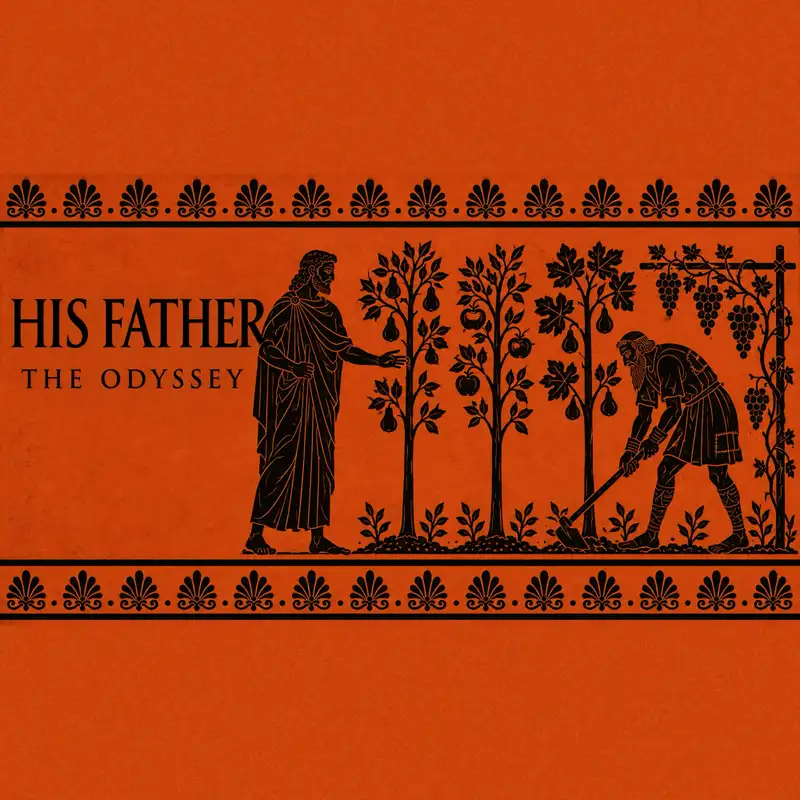
He found the old man alone at the foot of a young tree, on his knees in the dark turned earth, banking it up around the roots with his two hands, in gloves, tending a sapling and a grief with the same slow care.
He was alone because his people were away at their work. Old Dolius, the servant who ran the high farm, had taken his sons off along the terraces to gather stones for the low walls that hold a hillside vineyard in place, and so there was no one about, and the old king was left to his digging and his sorrow with only the trees for company, which was, most days, exactly how he wanted it. Let the singer show him to you exactly, because the picture matters, and because it is not the picture you might dread. He wore a tunic that had been patched and patched again, poor and filthy and long past mending, the tunic of a man who has stopped caring how he looks because the one he used to dress for is gone. He had oxhide leggings bound about his shins against the brambles, and thick gloves on his hands against the thorns, and a cap of goatskin pulled down over his grey head. He was stooped, and old, and worn, and he was digging, on his knees, in the dirt of his own orchard, alone, in the middle of a bright morning, an old king in the clothes of the poorest laborer on his own land. And a lesser story, and a lesser singer, would ask you to pity him here, and would pile the pity on, the fallen majesty, the king brought low, the ruin of a great house sitting in the mud. The fire will not do that, and the fire asks you not to do it either. Look again.
For this fire has known this old man from the very first night, when it sang you the island that made the wanderer. And it remembers who Laertes always was. He was a king in the old way, which is to say a farmer who happened to wear a crown, and who was happiest when the crown was somewhere else and there was earth under his hands. He had planted much of this orchard himself when he was young, walking the rows and counting the trees aloud the way another man might count gold. He knew each tree by its own small history, which pear would ripen first and which would make you wait, and he took a satisfaction in being right about pears that went far deeper than being right about men. He rose before everyone, in the grey, and went down to the trees with a mattock over his shoulder, and worked the ground about their roots while the dew was still on them, and talked to them under his breath, low, the way you speak to an animal you are gentling. That was not a thing the war took from him. That was not a fall. That was the truest part of him, and it was the deepest thing he ever taught his son, deeper than any lesson given in words, and it was there in the boy's own hands ever after, in the way that boy built a bed, and joined a raft, and tended a whole kingdom of quarreling men as patiently as an orchard.
So do not see a broken king in the dirt. See a gardener, doing the thing that was always most himself, in the one language that had never once failed him. The grief was real. The patched tunic was real, and the goatskin cap pulled down, and the neglect of a man who had let the years go hard on him because the waiting had gone on so long. But the gardening was not the wound. The gardening was the medicine he had been giving himself, morning after morning, all these years. A man who has lost nearly everything can still put his hands in the earth and coax one more tree toward bearing, and there is a mercy in that no palace ever held, and Laertes had been living on that mercy, alone, up here on the high ground, for a very long time.
And you could see the medicine at work in the orchard around him, for it was in beautiful order, every row of it. The vines climbed their props in their fifty patient ranks. The fig trees were pruned, and the pears were pruned, and the little beds of green things were dug and weeded and watered by hand, and the low stone walls that held the terraces against the slipping of the hillside were kept up and mended, stone fitted true to stone. A man may let himself go to rags and still keep faith with living things, and Laertes had. The trees did not know he was a king, and did not care. They knew only that a pair of old hands came to them every morning and asked nothing of them but that they go on growing, and gave them, in return, everything those hands had left to give. And so they grew, and the orchard was the one bright and cared for thing on that whole high farm, better kept by far than the man who kept it, which is a true thing about grief, and about gardens, and the fire sets it down and goes on.
And down at the edge of the orchard, under a pear tree, in good clean clothes, stood the son he had wept for, watching him, and unable for a moment to move. It is Homer's own moment, and it is one of the most human in all the poem, and the fire keeps it whole. The wanderer stood there and his eyes filled, and his heart was wrung, and everything in him wanted to run across the turned earth and throw his arms around the old man's neck and cry out that the waiting was over, that the sea had given him back, that he was here, here, twenty years late but here. Everything in him wanted that. But he was who he was, and he had one habit that twenty years had only deepened, the habit of testing a thing before he trusted it, of coming at even his own joy sideways, carefully, to be sure of it. And so he did not run. He stood under the pear tree, and mastered himself, and decided, this one last time, to come to his father the long way round, with a story, the way he had come to everyone all his life. It was the last disguise he would ever put on. And like all his disguises, it would last exactly as long as it needed to, and not one heartbeat longer.
Chapter Four. The Test He Could Not Finish.
So the stranger came up the orchard rows, and praised the trees to the one man on the island who had planted them.
He came on as a traveler, mild and courteous, and he began where a kind stranger might begin, with admiration, because it was true. Old man, he said, you are no poor hand at a garden. There is not a plant in this whole orchard that is not well cared for, not a fig or a vine or a pear or an olive or a bed of green stuff in the whole enclosure that does not show a tending hand. The keeping was faultless, and he said so, and meant it, and the old man on his knees looked up at the well spoken stranger in his good clothes and did not know him. Twenty years and a hard road and a beggar's weathering and a father's grief had done between them what they do. Laertes looked into the face of his own son and saw a courteous foreigner who had wandered up his hill.
And then the wanderer did the thing that this fire, telling it, can hardly forgive him for, and forgives him for entirely, because you would have done it too. He teased. Gently, and with a hook in it. He said the orchard was well kept, and then he said, but you yourself, old man, are not so well kept as your trees. Look at you. The tunic patched and filthy, the work of the poorest slave, and yet you carry yourself like no slave. There is something of a king about you under the dirt. Tell me, whose orchard is this, and whose man are you, and, since I am a stranger far from home, tell me truly, is this really the island they call Ithaca. For I met a man of this country once, long ago and far from here, who said he was the son of Laertes, and I took him into my house, and treated him as a guest should be treated, and gave him fine parting gifts, seven talents of wrought gold, and a mixing bowl all of silver, and cloaks and rugs and tunics, and we parted with fair omens for his safe return home. And the stranger gave himself a name, and a father, and a far city that no map at this fire needs to hold, the last false name he would ever wear, and asked, with all the old easy skill, whether that guest of his had ever reached his home. It was a story of exactly the right shape, aimed with exactly the old skill, a story built to make an old father lift his head and answer.
And it did. But not the way a game wants to be answered. For the old man heard the name of his son spoken by a stranger, the son he had given up to the sea, and heard that this traveler had once housed him and sped him with rich gifts, and the gifts were the wrong thing to hear about, because they meant the boy had been alive, and abroad, and had passed through the world and out of it and never come home to the father who would have counted every hour. And the old man's eyes filled, and he could not speak for a moment, and then he told the stranger, in a low broken voice, yes, this was Ithaca, and yes, that man had been his son, his own son, gone now these twenty years, lost somewhere on the wide sea with no mother or father or wife to close his eyes or mourn him rightly. And here the old man reached down with both his gloved hands into the dirt he had been tending, and took up the dark dry earth, and poured it over his own grey head, over the goatskin cap, again and again, mourning, the way the very old mourn, past caring who sees.
And the game was over. It ended not because it failed but because it worked too well, because it reached the thing it was aiming at, and the thing it was aiming at was more grief than any man should watch and go on playing. The wanderer's heart broke in him. Homer says his very nostrils stung with the sudden rush of it, the sharp physical grief that comes up the back of the face before the tears do, and the singer keeps that, because it is so true and so small and so human. There was no test left in him. There was no cleverness left, no craft, no long way round. There was only a son watching his old father pour dirt on his own head for grief of him while he stood there whole and alive and close enough to touch. And he crossed the last of the ground between them in a rush, and he caught the old man up out of the dirt, and he kissed him, and he said the simplest sentence of the whole long season.
Father, he said. Stop. I am he. I am the man you are grieving, and I am not lost, and I am not on the wide sea, and I am not dead. I am here. In the twentieth year, I have come home to my own country. Stop your weeping now. Put the earth down. It is over. I am here.
Chapter Five. The Proof of the Orchard.
The old man did not fall on his neck at once. He drew back, and looked, and asked for a sign, because he was that boy's father, and the caution ran in the blood.
The singer loves this, and wants you to love it, because it is the family's own deepest trait shown one last time, in the oldest member of it. All season you have watched them be careful. You watched the wife sit wary by her own fire and test her stranger with a bed rather than fling herself on a hope. You watched the son hold back. You watched the nurse keep the secret. The whole house was built of people who had learned, the hard way, over twenty years of false hopes and clever men and beggars with good stories, not to believe a joy until they had turned it over in their hands and found it solid. And here is the old father, at the very end, doing the same. A stranger has just called himself my son, he thinks. My son is dead. Men have come before with tales. If this is a cruelty, or a mistake, or a wandering beggar who has learned the right names, then I will have buried my boy twice. Prove it. Show me something no liar could carry. If you are truly my son come home, he said aloud, then give me some sure sign, that I may believe.
And the wanderer, who understood that caution better than any man alive because it was his own, did not take offense, and did not weep at being doubted. He gave the proof. He gave two proofs, and the fire will give them both, in the order Homer gives them, and the second of them is the deepest planted seed in this whole two year telling, the thing this entire finale was built to arrive at.
The first proof was on his own body. Look, he said, with your own eyes, and he drew back his good clothing and showed the old man the long pale seam above his knee, the scar. The mark of the boar on the mountain, taken when he was a boy hunting with his grandfather's people, the white wound that a young man carries out of his youth and keeps for life. His father had known that scar when it was a fresh red hurt on a frightened boy just home from Parnassus. And the singer notes, once, quietly, for the long listener, that this is the third and last time on these final nights that the old scar does its patient work. An old nurse found it in the firelight with her own hands, and knew him, and nearly dropped the basin. Two loyal herdsmen were shown it in a farmyard and knew their king. And now a father sees it above his son's knee in an autumn orchard, and it is the same mark, the same proof, the same body come home. A wound a boy took, and kept, and was known by, at the very end, by everyone who ever loved him. But the scar was only the first proof, and the old man's eyes were still swimming, and so the wanderer gave the second, and it was not on his body. It was all around them, growing in the ground.
And here you must slow down with the singer, and let the rocking of it carry you, because this is a counting, and you may float on it and hold none of it. He turned, and looked out over the orchard rows, and he began to count his father's trees, but not the way a stranger counts them. He counted them as they had been given. Come, he said, and I will tell you the trees. I will tell you the very trees of this orchard that you gave me, once, long ago, when I was only a little boy following you down these rows, and I begged you for them, one by one, and you named them to me, and gave them to me for my own. You gave me thirteen pear trees. And ten apple trees. And forty fig trees. And you named to me fifty rows of vines, one after another, each one ripening in its own season, so that there would be grapes on this hillside at every stage of the year, some just setting and some swelling and some going soft and dark and ready, whenever a man walked out among them. Thirteen pears. Ten apples. Forty figs. Fifty rows of vines, each in its own season. That is what you gave me, father. No stranger could know it. Only the boy who walked these rows at your heel, and the man that boy became, who carried the whole count of them across the wide world and never once let it go.
And the fire, telling it, folds the whole two years closed on that count, because this is where it always meant to end. On the very first night, before there was a war or a wooden horse or a witch or a giant or a single sail on the water, the fire sang you an old king who counted his trees aloud the way another man might count gold. It seemed, that first night, a small and tender thing, a way of showing you a gentle father in a gentle place. It was a seed. And it lay in the ground through the whole war, and the whole long wandering, through the giant's cave and the winds tied in the bag and the meadow of the singers and the seven years on the goddess's island, waiting, the way a planted thing waits. And here, at the very last, it comes up out of the ground and bears, and the harvest of it is a father knowing his son. The trees his father counted turn out to be the truest proof of who he is, because a life is not finally proved by scars and wars and famous deeds at all. It is proved by the small particular things that were given to you in love, and that you carried, and that only you could name.
And the old man's knees gave way beneath him. The count of the trees went into him, and his heart went out from under him all at once, and he swayed, and the strength ran out of his old legs, and his son caught him, and held him up against his own shoulder, and gathered the old grey head in against him, and stood there in the turned earth holding his father while the old man came back to himself slowly, one long moment gathered in against the living warmth of the son he had grieved as dead. And when the breath came back into him, and the strength, the old man wound his arms around his son and held on, and the two of them stood a long time in the orchard, in the autumn light, saying nothing, because there was nothing to say that the holding did not say better. It was the last of the great reunions of the whole story, and it was the quietest, and it happened, exactly as it should have, among the trees.
And when the old man could speak, he said a thing that was pure joy and pure worry in the very same breath, the way the very old often speak. Father Zeus, he said, looking up, you gods do still rule on high, if truly those proud men have paid for their reckless wrongs. And then, almost in the next breath, the worry came, because a man who has grieved a long time does not trust a joy to stand up on its own. But now I am afraid, he said, terribly afraid, that the men of Ithaca will come up against us for this, and send the word round through all the towns of the islands. And his son, who had already thought of exactly that, and set a plan against it, told him gently not to be afraid, and to let that trouble be his own to carry, and helped him to his feet. Hold the old man's fear a moment, and carry it up the hill with them, for it is the true seed of the one hard thing still to come, and see how even at the very height of his joy this careful family was already, quietly, watching the road.
Chapter Six. The Bath and the Table.
A little later the old king stepped out of his own bath looking taller than he had gone into it, and stood in the doorway in clean clothes, astonished at himself.
They had gone up to the farmhouse together, the son's arm about the father, and the old Sicilian woman and the others had drawn a bath, and washed the old man, and rubbed him with good oil, and put a fair cloak about his shoulders, the first time in longer than anyone could remember that Laertes had let himself be tended rather than tending. And as he bathed, the grey eyed goddess, who was near all that morning, worked one of her smallest and kindest miracles, the sort she liked best, the sort that mends a heart by mending a body. She filled out his old limbs. She made him taller to look at, and sturdier, and put back into his frame some of the largeness the years had taken, so that when he came out of the bath he came out looking, for a moment, the way his son remembered him from long ago, the way a boy remembers his father when the boy is small and the father is the biggest and surest thing in the world. And Laertes looked down at his own arms, and marveled, and said that surely a god had had a hand in this, for he felt like the man he used to be, like the king he had been in his strong years. And his son looked at him, and his eyes stung again, and said only that he wished he could have stood beside him in the hall two days ago, the two of them together. It was as near as either of them came, all that day, to speaking of the twenty years. They did not need more. The bath, and the clean cloak, and the old man standing straight in a doorway, said the rest.
And then the others came in from the fields. Old Dolius came up from his labor with his sons behind him, called in by the old woman, and they came in tired and wondering, not knowing why they had been sent for, and they stopped in the doorway and stared, because there at the table sat a man they had given up for dead. And when Dolius understood, when it went into the old servant that this was truly Odysseus, home, alive, sitting at his father's table, he came across the room with both his hands out, and caught the wanderer's hand, and kissed it at the wrist, and could hardly speak for the gladness of it, and asked, when he could speak, whether wise Penelope knew her husband was home, or whether they should send a runner to her with the news, and was told, gently, that she knew, that she had known before any of them, and there was no need. And the sons of Dolius crowded in after their father, and there was a long glad greeting, hands gripped and shoulders held, the whole small household of the high farm turned in a single moment from grief to feast. And they all sat down together, at the plain farm table, to the meal the herdsmen had made, and it was only a farm meal, a good pig and barley bread and the wine of that very hillside, but it was set out and eaten as the greatest feast in the world, because of who was at the table.
And the two herdsmen were at that table too, the swineherd and the cowherd who had held the doors, honored now and glad, and the wanderer had not forgotten what they were owed, nor what a good man owes the small faithful people who keep his house while he is gone. The swineherd had lent a cold beggar his own spare cloak on a wet night not two days past, not knowing he was clothing his king. That cloak, and much more than a cloak, came back to him now, with a whole kingdom's thanks. For the fire has said all season that the guest law is the deep law of that old world, the law that a stranger and a beggar come from the gods and must be fed, and it had been broken in a giant's cave, and broken again in this very hall by the men who wasted it, and kept, most truly of all, by the poorest men on the island, who had almost nothing and gave it anyway. And now the keeping was repaid, at a farm table, in the open, where everyone could see that faith is not forgotten in that house.
And the fire wants you to see who was at that table, and to sit a while with it, because it is the whole answer to the whole war. There was old Laertes, the grandfather, the gardener king, straight again in his clean cloak. There was Odysseus, the father, home from twenty years of everything the world could throw at a man. And there was Telemachus, the son, who had been a baby in a cradle when his father sailed and was a grown man now with new iron in him, come safe through his own long searching. Grandfather, father, son. Three generations of one patient family, at one table, at the same time, for the first time in the entire reach of this story. It had never once happened before. When the boy was born, the war was already calling. When the war ended, the wandering began. For the whole span of these tellings there had never been a single hour when all three of them stood in one room. And here it was, at last, on a farm on a hillside, over a plain meal, with the autumn light coming in the door and the loyal old servants glad around them. Every ship that sailed, every year at the walls, every strange shore and every lost companion and every night of the wife's long waiting, all of it, had been trying, all along, to arrange this one table. This is what the road was for. Not glory, not plunder, not even the answering of the men who ate the house. This. Three generations of one family, safe, together, eating bread in the light. The fire lingers here on purpose, because a tired listener should be allowed a good long rest at a full and peaceful table, and because the singer wants you to know, before the night's one hard note, that the thing the whole story was for has already been won, and cannot now be lost.
Chapter Seven. The Anger in the Town.
Down in the town, that same morning, a rumor went from house to house like smoke going under a door, and where it passed, it left grief, and the grief began to look for somewhere to go.
The fire told you at the very start of the night that this was coming, and named it honestly, so that it would not startle you now. Here it is, and the fire keeps its promise, and tells it plainly and in a low voice, and it is not danger walking toward you. It is sorrow, in motion. For when the wasters of the hall were answered, they did not vanish out of the world. They had been the sons of the island, many of them, the young lords of Ithaca and the isles near it, and now they were dead, and by that same morning the word of it had reached the houses they came from, and in those houses there were fathers, and brothers, and mothers, who had not eaten anyone's substance or wooed anyone's wife, and who knew only that their boys had gone down to the great hall and had not come home, and would not, ever. And grief like that is a heavy thing with nowhere to sit, and it stood up in the town, and it wanted, the way grief wants, to do something, to move, to make someone answer for the size of the hole that had opened.
The word had gone out the way such word goes, faster than any runner, mouth to mouth down the lanes and up the stairs, and by mid morning there was not a house on that side of the island that had not heard some shape of it, that the strangers were dead, that the young lords were dead, that the beggar in the great hall had been no beggar at all. And in the houses where the news landed hardest there was that terrible first silence that falls on a family before the weeping starts, when the thing has been said and not yet believed. It is the oldest sound in any war, that silence, and it was the same in the halls of Troy three thousand years ago as it was in these small stone houses now, and the fire does not hurry past it, because to hurry past it would be to pretend the wasters had no mothers, and they had. Their sons had done wrong, and had earned their end, and were also somebody's boys, and both of those things are true, and the fire holds both, and grieves the second even while it grants the first.
So they gathered, the people of the island, in the old assembly place, the way that world gathered when a thing had to be decided together. And a man stood up among them who was the sharp point of all that grief, an old man named Eupeithes, and he was the father of the very first of the suitors to fall, the worst of them, the one who had thrown the stool and led the wasting, and the fire will tell you plainly that his son had earned his end. But you will not hear this fire call Eupeithes a villain, because he was not one. He was a father whose boy was dead. He stood up in the assembly with the tears running down into his beard, and he could not hold the grief, and he told them the killer had led the best men of the islands off to the war years ago and lost every one of them, ships and all, and had now come home and killed the flower of their sons on top of it, and would slip away over the sea to Pylos or to Elis before they could lift a hand, and that they would carry the shame of it forever, a thing for men in far years to sing about with scorn, unless they rose now and took vengeance. Better to die, he said, than to live on disgraced. It was not wisdom. It was not even quite sanity. It was grief, given a voice, asking the only thing grief knows how to ask when it cannot have the one thing it truly wants, which is the boy, alive, coming up the road again. He wanted his son back. He could not have his son back. So he asked for war instead, because war at least is something a man can do with his hands while his heart is breaking.
But the island had wiser voices in it too, and the fire is glad to keep them, because they are the first two workmen of the peace that is coming. There came to the assembly the herald Medon, and the singer of the house, the two men who had been in the hall and had been spared, spared for their decency and for their song, and Medon stood up and told the people what he had seen with his own eyes. This was not done, he said, against the will of heaven. I myself saw a god standing beside Odysseus in that hall, in the very likeness of Mentor, now at his shoulder heartening him, now sweeping down the hall driving the suitors before him, and they fell in heaps. There was a power there greater than any man. And then an old seer of the island, Halitherses, who had lived long and read the birds and had warned the young men years before to leave the queen's house alone, rose among them and said the hardest true thing anyone said that day. This came upon your sons, he told them, through their own wrongdoing, and through yours. You would not listen to me, and you would not restrain them when there was still time, when a word from their own fathers might have called them home from the wasting of a good man's house. Do not now go up the hill and lay a second grief on top of the first. Let it lie. Go home.
And here Homer keeps a thing that the fire treasures, and calls the island's own deep sanity. For the people heard both voices, the grief and the wisdom, and they divided. And a great many of them, hearing the old seer, and knowing in their hearts that he was right, simply stood up and went home. They put down the anger, and turned, and walked back to their own houses, and had no more part in it. That is a thing worth staying awake one more minute to hear, because it does not happen in every story. Half a town, in the middle of its rage, chose peace, quietly, with its feet, and went home to grieve honestly instead of marching to grieve with weapons. But the rest, the ones whose grief was louder than their wisdom, the ones who could not yet let the boys be gone, took up their armor, and gathered behind Eupeithes, and started up the old road toward the high farm. And so this is the whole of the night's hard note, and you have it now, and it is not a threat creeping up on a sleeping house. It is a column of the island's own grieving people, walking up a hill behind a broken old father, carrying weapons they will not, in the end, be allowed to use. The fire's promise stands. This morning ends in a sworn peace, and there is one cost between here and there, and the fire will tell it truly, and then it will be over for good.
Chapter Eight. The Voice That Ended It.
Up at the farm, they saw the armed men coming along the road below, and before the singer tells you what happened on that road, he must tell you a thing the household had half known for twenty years, and never quite said aloud.
You remember Mentor. On the very night the wanderer sailed for the war, all those years ago, he had put his whole kingdom into the hands of one steady friend, a man named Mentor, the calmest and truest man on the island, and had given him the household, and the lands, and the watching over of the child, the way you hand a precious thing to the one pair of hands you are sure will not drop it. And through all the years since, whenever the young prince had needed counsel, whenever a steady word had come at exactly the right hour to hold a frightened boy together or stiffen a wavering assembly or send a son off bravely to look for his father, it had come, so often, in Mentor's shape, in Mentor's steady voice. And here, at the end, the fire will tell you the thing the family had felt in their bones and never proved. More than once, when Mentor's steady shape spoke wisdom at exactly the right hour, it was not Mentor at all. It was the grey eyed goddess herself, wearing the shape of the steadiest man on the island, standing in a doorway or at a shoulder, saying the thing that needed saying in a voice the house would trust. The household had half known it for years, the way you half know the kind thing that has been quietly holding your life together. The fire is only saying it aloud now, gently, at the end, the way you finally thank someone once the danger is past. She had been Mentor when they needed Mentor. And she was near now, in that same shape, coming up to the farm.
And far off and above, in the high clear air, the two who watch such mornings had already settled how this one would go. The grey eyed goddess had asked her father, the father of gods and men, what he meant to do, whether he would let this grief run on into more war, or make a peace between them. And he had answered her kindly, for it had been his own will from the start. Let there be a covenant, he said. Let the man be king over them again in peace. Let us make the town forget the killing of its sons and its brothers. Let them love one another again as before, and let there be wealth and peace among them in plenty. That was decided in the high air before ever the armed men reached the farm, so that all that happened on the road below happened inside a peace already promised. And old Laertes, down at the farm, seeing his son and his grandson take up their arms with the loyal men beside them, felt his own old blood rise, and prayed, glad past speaking, glad to see his son and his son's son standing shoulder to shoulder and vying with each other in courage, an old gardener given, on the last morning, one more thing to be proud of.
They had armed, the little household, when they saw the column coming along the road, and the fire will name them, because it is a tender muster and worth the naming. There was the wanderer, and his son beside him, and the two faithful herdsmen. And there was old Dolius, the servant of the farm, and his six sons, taking up spears in their working hands. And there was Laertes himself, the gardener king, and old Dolius beside him, two grey heads putting on bronze, warriors though their hair had long gone white, because the day asked it of them. It was not an army. It was a family and its faithful people, standing in the orchard gate, and above them the goddess in Mentor's shape, and over them all the peace already promised in the high clear air. That is who met the grief on the road.
And now the fire tells the one cost of the whole long story, plainly, in a low voice, and sets it down, and does not paint it. The two crowds met on the road. And old Laertes, the gardener king, with the goddess's strength breathed into his old arm, cast the one spear thrown that morning, and it flew true, and it struck Eupeithes, the grief maddened father who had led the march, and he fell, and he died there on the road. That is the whole of it. The poem says so, and the fire says so, in one grave sentence, and stages nothing more. There is no battle here for you to watch. There is no second man down, no melee, no long clash of arms, no triumph. The old man is given no boast over the body, because his glory this last morning was never a spear at all. His glory was an orchard, and a son come home, and a table with three generations at it. He threw one spear, because the moment asked it of him, and a grieving father on the other side went down, and it was the last death in the whole two years of telling, one old man killed by another old man, both of them fathers, both of them mad with what the war and the wandering had done to their sons. And then, before it could become anything worse, before the grief on that road could answer itself with more grief, the thing was stopped.
It was stopped by a voice. The grey eyed goddess lifted up her own full voice over the road, and cried out so that every man on both sides heard it in his chest, Hold. Hold back your hands, men of Ithaca. Stop this grievous war. Part now, without more blood. And the sky itself spoke once behind her, a single bright bolt of the father of the gods laid down flaming across the road like a bar drawn between the two crowds, not to burn anyone, only to be seen, the whole weight of heaven come down for one instant to say the same word the goddess said. Enough. And at that voice, and that flash, the terror of the divine went through every armed man on that hillside, and the weapons fell. They fell from every hand at once, spears and swords dropping into the grass, the way leaves let go of a tree all together in a sudden gust of autumn wind, with a soft scatter and then stillness. And the anger went out of the morning the way the tide goes off a flat, all at once and quietly, running back and leaving the sand bare and calm, and it took the fight out of the grief as it went, and let the grieving be only grieving again, which is the most that can be asked of any hard morning. The armed men turned, pale and shaking, and fled back down toward the town. And the wanderer, whose whole long life had taught him to press an advantage the moment it opened, felt the old fierceness rise in him one last time, and started after them with a great cry. But the goddess checked him, there on the road, in the very voice he had trusted his whole life. Hold, she said. Cease the strife of leveling war, before the father of gods and men is angry with you. And he heard her, and he stopped, and he obeyed, and he was glad in his heart to obey, for he was tired of war down to the marrow of him, and the laying of it down was a kind of coming home too. No one was pursued. No one else was harmed. The men went down to mourn their dead in the honest way, and it was over. The tension of the whole night, such as it was, was spent on that road, and resolved on that road, and everything from here to the last word of the season is peace.
Chapter Nine. The Oaths of Peace.
Then, on that same road, in the same shape the household had always trusted, the goddess set the two halves of the island swearing peace to each other, for all the years that were to come.
It was done the old way, the way that world sealed a thing so that it would hold, with oaths, and with heaven for a witness. The killing was set behind them. The debt of the hall, and the debt of the road, were declared closed, both at once, paid and finished, not to be reopened by any son or any brother in any year to come. The king would be king again, and the people would be his people, and the memory of the slain would be let go, not forgotten, for you do not forget your dead, but let go of as a cause for any more blood. And the goddess in Mentor's steady shape stood between them and bound it, and the men of Ithaca swore it, and the island, which had been a house divided against itself, a hall full of wasters below and a queen weeping above and a king in rags at his own door, became, in that one morning, one household again, whole, at peace with itself, under one roof, the way it had been long ago before the sail with no business appeared on the water.
And here the old singer at the fire closes the season's whole ledger, quietly, in a single balance, and asks you to hear how neatly the books come out, for it is a beautiful thing, and a true one. Think back, all the way back, to the very beginning of everything, before the war, before the wandering. There was a bright hall once, full of proud young kings, all of them wanting one woman, all of them armed, all of them a spark away from turning that hall into a slaughter. And a clever young man, unregarded, the youngest sort of trickster, had stood up in that hall and invented an oath, a neat and brilliant oath, to hold all those armed men to a peace. Let every man swear, he had said, to defend the marriage of whichever one of them wins her. And they swore it, gladly, and it held the peace in that hall perfectly. And then it reached out across the years and dragged the whole world to war, because the same oath that kept the peace among them became the chain that hauled every one of them to Troy when the woman was taken. One oath, invented to end a quarrel, became the engine of the largest grief the old world ever knew. That was the first oath. And now, at the very end, on a road on the same man's home island, a goddess stood in a trusted shape and gave the world its answer, and it was another oath, an oath sworn to end a war instead of to feed one, an oath that stopped grief rather than gathering it. The first oath dragged the world into ten years of blood and twenty years of wandering. The last oath ended a morning's grief in a single hour and sent everyone home. The clever young man's oath opened the whole long story. The goddess's oath closes it. The first, and the last. And between them, everything. The books balance. The account is settled. There is nothing owed now, by anyone, to anyone, and the island is at rest.
Chapter Ten. The Days After.
And so the long dusk of the whole season begins, and the fire will spend it the gentlest way it knows, which is to count small things, one after another, the quiet restorations of a house learning to be a house again, and you may float on the counting and hold none of it.
The bow, first. The great bow of Iphitos that had hung quiet on the wall through the whole war, too dear a gift to risk among strangers, the bow that no waster in the hall could bend, the bow that came down at last into the hands it had waited twenty years for and sang one clear note like a swallow and ended everything. That bow went back up onto its peg on the wall. And this time it hung there not as a thing left behind, not as a promise kept in reserve, not as a weapon waiting for a terrible day, but simply as an old bow at rest in a peaceful house, its whole work done, forever. It would gather the good dust of quiet years. No hand would need it again. It hangs there still, in the story, at rest, truly and finally, and there is a deep sweetness in a strong thing at last allowed to be still.
And the gate. There had been a gate the young king mended with his own hands before he sailed, one of the hundred small right things a man does around a place he loves, and it had held, all those years, the way a well made thing holds. And now he mended it again, not because it needed much, but for gladness, for the pure pleasure of putting his hands to the small work of his own home in peace, tightening what the years had loosened, the way his father had always tended the trees, because a thing tended with attention gives more back than a thing merely owned. And the hearth in the great hall was swept and relit, and the smoke of it went up straight and blue into the still air, the way the suppers' smoke had gone up when he was a boy. And the goats came back down the high slopes with their small careless bells, that music that drifts up and down the hills all day, so that a person lying awake at night, hearing a single bell far off, knows without rising which fold of which hill it comes from. And the fishing boats leaned together at their moorings in the little harbor and knocked softly, wood on wood, when the swell came in, a sound like a house settling for the night. And the old nurse who had carried him the day he was named went about the storerooms with her keys again, content, and the household stores were counted and found good against the winter, oil in its jars, grain, the wool waiting to be spun. And the men went out in the little boats again before light, and came home with the sun high, and no one on the shore watched the sea now with anything but love, the way the island had loved it before it learned that a road runs two ways. And the smoke of a hundred small suppers went up straight into the windless evening, so that the whole island smelled of woodfire and the sea at once, exactly as it had in the good years, before ever a sail with no business appeared on the water.
And the loom in the house took up its soft steady knock again, back and forth, back and forth, the first sound the wanderer had ever known in his life, the sound of his own mother's weaving over his cradle. Only now the loom wove for no one's defense. There was no shroud to grow by day and unpick by lamplight to hold off a hall of suitors. There was only wool, and winter coming, and a woman weaving warm cloth for the people she loved, at her own pace, in her own house, with her husband under the same roof. The loom that had been the shield of the house for three long years was allowed, at last, to be only a loom. And there was a boy learning the names of the trees. Out in the orchard, in the good autumn light, the old grandfather walked the rows again, slow and glad, and at his heel walked a younger boy of the household, learning which pear would ripen first and which would make you wait, learning the fifty rows of the vines and the season each one came ripe in, learning the whole count the way the wanderer himself had learned it once, at this same old man's heel, in this same orchard, a lifetime ago. Three generations of one family had already sat at one table. Now a fourth small thread ran forward into the years, a boy taking up the count of the trees, so that when the old man was gone the names would not be lost, and the orchard would go on being known, tree by tree, by someone who loved it. That, the fire will tell you, is the truest kind of going on the old world believed in, not a name shouted in a song, but a boy who knows your trees. And near the gate of the yard, where the sun fell warm, the household kept a small mound green, and tended it, and no one who tended it was sad for long, for it was the resting place of an old dog who had waited longer than any creature on the island, and had waited well, and had seen his master home with his own dim eyes before he laid his grey head down, and had earned, past all reason, his rest. They kept his mound green out of gratitude, not grief. He had finished his waiting. So had they all.
Chapter Eleven. The Story That Was Promised.
There is one more thing the fire will lay out for you before it lets the night go, and it will lay it out the way you lay out bedding, smooth and soft and unhurried, for a long sleep. It is the far future, promised long ago, and it is gentle all the way to its end.
You heard it first on a strange dim shore, on the night the wanderer went down to speak with those who were past all harm, and an old seer with a golden staff told him the whole shape of the road, and, at the very end of it, laid down a promise for the far years. Someday, years from now, when all of this is old and quiet, the wanderer will take up an oar, a plain sea oar, and carry it on his shoulder up away from the water, inland, over the hills, on and on, until he comes at last to a people so far from any sea that they salt no food, and know no ships, and have never seen a painted prow. And there a stranger on the road will look at the thing on his shoulder and, not knowing what it is, will call it a winnowing fan, a farmer's tool for tossing grain into the wind. And on that day, when a man who has never seen the sea gives the sea's own oar a farmer's name, the wanderer will know he has come far enough. And he will plant the oar there, upright in the inland earth, and make his peace with the god of the sea at last, far from the sea, and turn for home, squared with the water forever. That journey is promised, and it is gentle, and it is far away, and the fire only lays it before you the way you lay a folded blanket at the foot of a bed, something waiting, soft, for later. It is not tonight's story. No oar walks inland tonight. It is only a promise, resting.
And at the very end of everything, the same old seer promised the same man the gentlest thing of all, and the fire has kept it lit all season, and lays it down now, last. Death will come to him, when it comes, off the sea, or gently away from it, so softly that it is hardly a death at all, in a sleek and easy old age, with his people prosperous and happy all around him. Not in battle. Not in a storm. Not alone on a far shore with no one to close his eyes. At home, old, and full of years, and surrounded by the ones he loves, going down into the dark the way a good day goes down into a good night, gently, with nothing left undone. Even his ending, when it comes at last, is promised kind. And it is far off, and it is not tonight's story, and it never will be at this fire, because this season ends where the old song ends, and the old song ends here, at peace, in a house made whole, with the hard road behind him and only good years ahead. The fire will not follow him past the peace. There is no need. The peace is the ending. The peace was always the ending.
And one promise more, and then the singer will fold the story closed. Long ago, in a dark meadow among the pale flowers, the wanderer met the ghost of a great king who had come home from the same war to a homecoming that went all wrong, and that king, out of his own broken house, had blessed the wanderer's wife, and said her heart was true, not like his own queen's, and the fire told you then that a gift was hidden in that grief. Here is the rest of the gift. The gods themselves, that king's ghost said, will make a song for faithful Penelope, a graceful song, so that her name and her long faithfulness will never die, but will be sung as long as there are people to sing, in every land, forever. And the fire will tell you a small secret about that promised song, now, at the end, softly. That song, traveler, is partly the very one you have been sleeping inside all season. Every night you came back to this beach and let the road home be sung over you, you were inside the keeping of a promise made to a faithful woman by a dead king in a dark meadow, that her name would not be let go. It has not been let go. It is being kept, right now, at this fire, by you being here to hear it.
And singers tell that the man himself was the first to sing this story, in a sea king's hall. And that a blind man on a rocky island sang it after him. And that every singer since has only been keeping the same fire lit. The singer will not tell you which he is. At this hour, traveler, every singer is the same singer.
Chapter Twelve. Goodnight. And the Sail at the Edge of Morning.
And so, for the first time in the whole long season, the old singer at the fire lets the fire burn down.
Every other night he banked it. Every other night, at the farewell, he raked the coals together and covered them warm to keep till dawn, because there was more road to sing, and a fire you mean to light again you do not let die. But there is no more road. The story is over. The man is home, and his father knows him, and the island is one house again, and the last oath is sworn, and the trees are counted, and the bow is at rest on its peg, and the loom weaves for winter, and a boy is learning the names of the vines. It is all told. It is all kept. And so tonight, at the very end, the fire is allowed to do the thing it has waited all season to be allowed to do. It is allowed to burn all the way down. The driftwood settles into embers, and the embers into a soft red glow, and the glow into warm grey ash, slowly, with no hurry at all, the way everything moves out here at the end of the night.
The tide has come all the way up while we talked. It stands higher on the sand tonight than it has stood any night of the season, high and quiet and kind, as near as it will ever come, and it makes its small sounds against the shore, patient, unhurried, saying the one soft word it says to every coast in the world at once. You do not have to carry any of it. Not the trees, not the scar, not the oath, not the oar, not the long road home. Let it all stay here by the fire with the old singer, safe, where he keeps such things. He will hold the whole story for you through the night, every island of it, whole, and it will still be here, unharmed, whenever you should want it again.
And the stars are going pale. Look, out over the water. The dark is thinning at the far edge of the sea, grey going to pearl, pearl going to the first faint gold, and it is not the false grey of a night that only pretends to end. It is the true dawn, the first true dawn of the whole season, coming up at last over the wine dark water because the story it was waiting for is finished.
And there, far out on the brightening sea, is the sail. You have known it was there all season. A single sail, out at the edge of morning, waiting for a wind that had not yet come. It has waited since the very first night, patient, in no hurry. And now the wind comes. It comes soft and fair off the land, the way the right wind always comes at the right hour, and it reaches the sail, and the sail fills, and steadies, and the little craft leans, and begins, at last, to move, out over the bright water, small, and unhurried, going, the way everything goes when its waiting is finally done. No one calls it back. No one needs to. It goes the way a good day goes, and a good story goes, and a good life goes, gently, in fair weather, with its work behind it and the open water ahead.
You do not have to watch it go. You do not have to do anything at all.
The fire is warm ash now. The tide is full and kind. The dawn is coming up gold, and the sail is small on the water, and going, and the beach will be here, and the sea will still know the whole way, whenever you should want it again.
The story is kept. All of it. Whole.
Sleep well, traveler.
Goodnight.