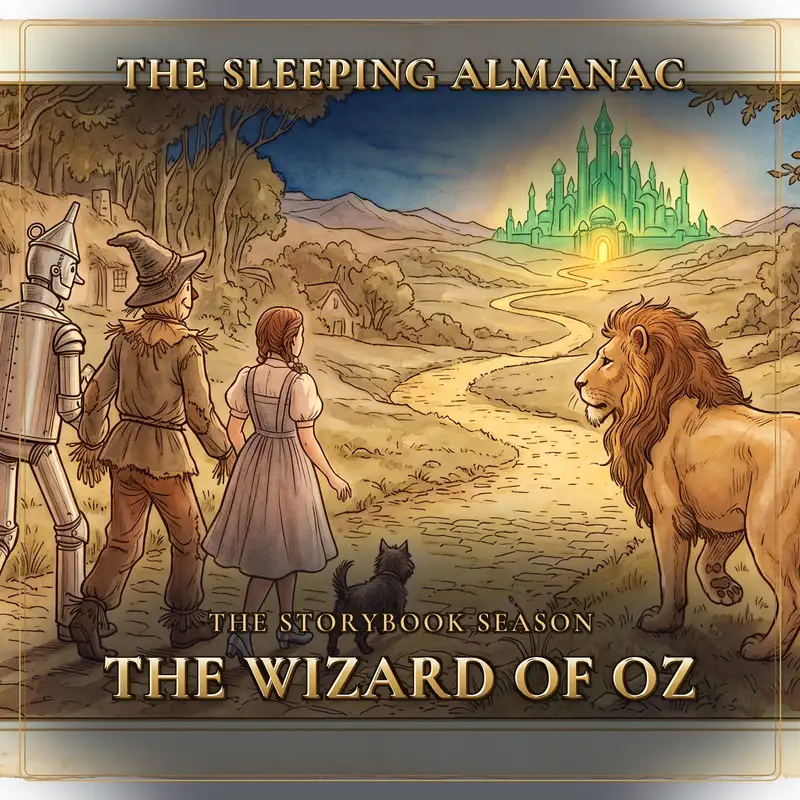
Welcome to The Sleeping Almanac.
Before the lamp is lit, one small thing. If these stories carry you to sleep, subscribe now, while your eyes are still open, and tomorrow night's tale will be waiting for you. A like helps other tired souls find this room. That is all. Let's light the lamp together now.
The lamp is lit again.
The same small flame as last night, in the same quiet room at the edge of the world.
The storyteller is already here. She was here before you arrived. She will stay until you sleep.
There is a chair for you. There is a blanket. The night outside is doing all of its slow, dark work, and none of it is yours to carry until morning.
The storyteller opens the old book, and turns past the tales already told, to a page that waits for tonight.
Tonight, she says softly, a small gray house sails through the sky on the back of a storm, and a girl in silver shoes follows a road of yellow brick to a city as green as deep summer water.
And there is no hurry at all as she begins.
Settle in now. Let the chair hold you. Let the blanket be heavy in the good way, the way snow is heavy on a roof that has nothing to do until spring.
Close your eyes, if they want to close. This story does not need to be watched. It only needs to be near you, the way lamplight is near you, the way rain on a window is near you when you are already half asleep.
You may know some of this tale already. You may be certain you know it. But the story you are about to hear is the old one, the first one, the one set down on paper more than a hundred years ago, before anyone put it on a stage or a screen. By lamplight, some things are different. The shoes, for one, are not the color you remember, and the story will show you why. The old way is the deep way, and the deep way is the way down to sleep.
You do not have to follow every word. You do not have to remember any of it in the morning. If you drift, the story will go on without you, quietly, and it will not mind at all. Drifting is not leaving. Drifting is how a listener says thank you.
The flame leans, and settles.
We begin.
Chapter One.
The House on the Gray Prairie.
Long ago, and half a world from here, in the very middle of a country called Kansas, there stood a small wooden house alone on the great prairie.
If you stood in the doorway of that house and looked in any direction you liked, you would see the same thing. Grass. Flat gray grass, running out and out to the edge of the sky, so far and so level that the world seemed to be a plate and the house a crumb in the middle of it. No tree broke the line of it. No hill lifted it. The sun had baked the plowed land into a gray mass with little cracks running through it, and even the grass was not green there, for the sun had burned the tops of the long blades until they were the same gray as everything else.
The house was small, because the lumber to build it had come from many miles away by wagon, and a wagon can only carry so much. There was one room in it, and in the room a rusty looking stove, a cupboard for the dishes, a table, three or four chairs, and the beds. And in the floor of that one room there was a small trap door, and under the trap door a ladder, and under the ladder a little dark hole dug into the earth, called a cyclone cellar, where the family could go if one of the great prairie winds rose up. Remember the little door in the floor. It matters, in a while, though not in the way you might guess.
In that house lived a farmer named Uncle Henry, and his wife, Aunt Em, and a little girl named Dorothy.
Dorothy was an orphan, and the old book does not dwell on that, and neither will we. It is enough to say that when she came to live with her aunt and her uncle, she brought the only two things the gray country could not fade. She brought her laugh, and she brought her dog.
The dog was called Toto. He was a little black dog with long silky hair and small black eyes that twinkled merrily on either side of his funny, wee nose. Toto played all day long, and Dorothy played with him, and loved him dearly. When the gray of the prairie pressed too close, it was Toto who saved her from growing gray herself. He was not gray. He was black as a stove lid and quick as a cricket, and wherever he went, a little of the world's color seemed to follow him around.
Aunt Em had been a pretty young wife once, they said, but the sun and the wind had taken the sparkle from her eyes and the red from her cheeks and lips, and she had grown thin and gaunt, and she never smiled now. When Dorothy first came to her and laughed, Aunt Em would press her hand upon her heart, so startling was a child's laughter in that quiet place, and she would look at the little girl with wonder that she could find anything to laugh at.
Uncle Henry never laughed either. He worked hard from morning till night and did not know what joy was. He was gray also, from his long beard to his rough boots, and he looked stern and solemn, and rarely spoke.
But do not feel too sorry for that house. It was a poor house in a gray country, but it held three people and a dog who belonged to one another, and that is more than many a palace can say. And on the evening our story truly begins, everything in it was where it should be. The dishes were washed. The stove was banked. The wind was just beginning to talk to itself away off at the edge of the world.
Uncle Henry sat upon the doorstep and looked anxiously at the sky, which was even grayer than usual. Dorothy stood in the door with Toto in her arms, and looked at the sky too. From the far north they heard a low wail of the wind, and they could see where the long grass bowed in waves before the coming storm. Then there came a sharp whistling in the air from the south, and as they turned their eyes that way, they saw ripples in the grass coming from that direction also.
Two winds, one from the north and one from the south, were walking toward each other across the whole width of the prairie, and the house stood exactly where they were going to meet.
Uncle Henry stood up.
There is a cyclone coming, Em, he called to his wife. I will go look after the stock. And he ran toward the sheds where the cows and horses were kept.
Aunt Em dropped her work and came to the door. One glance told her of the danger close at hand.
Quick, Dorothy, she screamed. Run for the cellar.
Toto, who did not care for loud weather, jumped out of Dorothy's arms and hid under the bed, and the girl started to get him. Aunt Em, badly frightened, threw open the trap door in the floor and climbed down the ladder into the small dark hole. Dorothy caught Toto at last and started to follow her aunt. And when she was halfway across the room there came a great shriek from the wind, and the house shook so hard that she lost her footing and sat down suddenly upon the floor.
Then a strange thing happened.
The house whirled around two or three times, slowly, like a leaf trying to make up its mind, and rose slowly through the air. Dorothy felt as if she were going up in a balloon.
The north wind and the south wind had met exactly where the house stood, and made it the exact center of the cyclone. Now, in the middle of a cyclone the air is generally still. It is the great pressure of the wind on every side of the house that raised it up, higher and higher, until it was at the very top of the cyclone, and there it remained, and was carried miles and miles away, as easily as you could carry a feather.
It was very dark, and the wind howled horribly around her, but Dorothy found she was riding quite easily. After the first few whirls around, and one other time when the house tipped badly, she felt as if she were being rocked gently, like a baby in a cradle.
Toto did not like it. He ran about the room, now here, now there, barking loudly. But Dorothy sat quite still on the floor and waited to see what would happen. Once Toto got too near the open trap door, and fell in, and at first the little girl thought she had lost him. But soon she saw one of his ears sticking up through the hole, for the strong pressure of the air was keeping him up so that he could not fall. She crept to the hole, caught Toto by the ear, and dragged him into the room again, and afterward closed the trap door so that no more accidents could happen.
Hour after hour passed away, and slowly Dorothy got over her fright. She felt lonely, and the wind shrieked so loudly all about her that she nearly became deaf. But by and by, as nothing dreadful happened, she stopped worrying, and resolved to wait calmly and see what the future would bring.
At last she crawled over the swaying floor to her bed, and lay down upon it, and Toto followed and lay down beside her.
And in spite of the swaying of the house and the wailing of the wind, Dorothy soon closed her eyes.
Think of that, for a moment, as you lie in your own still bed, which is going nowhere at all tonight. A little girl in a flying house, a whole mile above the earth, with the storm singing its enormous gray song on every side of her. And she slept. Children can do that. It is one of their great talents, and it is a talent worth borrowing tonight.
The house sailed on through the dark, over the whole width of the sleeping country, carrying a bed, a stove, a cupboard of dishes, a small dog, and a sleeping girl.
And while she slept, the storm grew tired, the way all storms do.
The house began, very gently, to come down.
Chapter Two.
The Silver Shoes and the Kiss.
Dorothy was awakened by a shock, so sudden and severe that if she had not been lying on the soft bed she might have been hurt. As it was, the jar made her catch her breath and wonder what had happened, and Toto put his cold little nose into her face and whined dismally. Dorothy sat up and noticed that the house was not moving. Nor was it dark, for bright sunshine came in at the window, flooding the little room. She sprang from her bed and, with Toto at her heels, ran and opened the door.
And then she gave a cry of amazement and looked about her, and her eyes grew bigger and bigger at the wonderful sights she saw.
The cyclone had set the house down, very gently for a cyclone, in the midst of a country of marvelous beauty. There were lovely patches of greensward all about, with stately trees bearing rich and luscious fruits. Banks of gorgeous flowers were on every hand, and birds with rare and brilliant plumage sang and fluttered in the trees and bushes. A little way off was a small brook, rushing and sparkling along between green banks, and murmuring in a voice very grateful to a little girl who had lived so long on the dry, gray prairies.
Think of stepping out of a gray world into that. She stood in the doorway a long moment, only looking. After a life of gray grass and gray sky, here was green in a hundred shades, and blue, and gold, and the deep red of fruit hanging low enough to touch. Even the air smelled different. It smelled like water and blossoms and warm bark, and she breathed it in slowly, the way you might breathe now, once, before we go on.
While she stood looking eagerly at the strange and beautiful sights, she noticed coming toward her a group of the queerest people she had ever seen. There were three men and one woman, and all were oddly dressed. The men were about as tall as Dorothy herself, though they were, so far as looks go, many years older. They wore round hats that rose to a small point a foot above their heads, with little bells around the brims that tinkled sweetly as they moved. Their hats were blue, their clothing was blue, and they wore well polished boots with a deep roll of blue at the tops.
But the woman was different. Her hat was white, and she wore a white gown that hung in pleats from her shoulders. Over it were sprinkled little stars that glistened in the sun like diamonds. Her face was covered with wrinkles, her hair was nearly white, and she walked rather stiffly, but her eyes were kind and bright.
When these people drew near the house where Dorothy was standing in the doorway, they paused and whispered among themselves, as if afraid to come farther. But the little old woman walked up to Dorothy, made a low bow, and said, in a sweet voice, You are welcome, most noble Sorceress, to the land of the Munchkins. We are so grateful to you for having freed our people from the Witch of the East, and for setting them free from bondage.
Dorothy listened to this speech with wonder. What could the little woman possibly mean by calling her a sorceress, and by saying she had freed anybody from anything? Dorothy was an innocent, harmless little girl, who had been carried by a cyclone many miles from home, and she had never freed anyone in all her life.
You are very kind, said Dorothy, but there must be some mistake. I have not freed anyone.
Your house did, anyway, replied the little old woman, with a laugh, and that is the same thing. See, she continued, pointing to the corner of the house.
Dorothy looked, and gave a little cry of fright. There, just under the corner of the great beam the house rested on, two feet were sticking out, shod in silver shoes with pointed toes.
Oh dear, oh dear, cried Dorothy, clasping her hands together in dismay. The house must have fallen on her. Whatever shall we do?
There is nothing to be done, said the little woman calmly.
Now, if this were a different kind of book, and a different kind of room, this might be an alarming moment. But listen to how the old story itself treats it, because the old story hardly pauses at all. The one the house came down upon was the Wicked Witch of the East, and she had been wicked for so many years, and so dry and dusty inside from all that wickedness, that there was very little of her left to trouble about. Indeed, even as Dorothy watched, the feet in the silver shoes disappeared entirely, and nothing remained but the shoes themselves, sitting empty in the sunlight.
She was so old, explained the Witch of the North, that she dried up quickly in the sun. That is the end of her. But the silver shoes are yours, and you shall have them to wear. She reached down, picked up the shoes, and after shaking the dust out of them handed them to Dorothy.
The Witch of the East was proud of those silver shoes, said one of the Munchkins, and there is some charm connected with them. But what it is we never knew.
And here is where you must let go of something you may have carried into this room. If a small voice in you says the shoes should be red, thank the voice, and let it drift off to its own sleep. In the old book, on the old page under the storyteller's lamp, the shoes are silver, and always were. Silver like frost on a fence rail. Silver like the underside of a poplar leaf when the wind turns it over. They will matter later, so let them shine quietly in your mind, and hold their color.
Dorothy carried the shoes into the house and placed them on the table. Then she came out again and asked the little old woman a question that had been gathering in her all this while.
Are you a Munchkin? she asked.
No, but I am their friend. I am the Witch of the North.
Oh gracious, cried Dorothy. Are you a real witch?
Yes indeed, answered the little woman. But I am a good witch, and the people love me. There were only four witches in all the Land of Oz, and two of them, those who live in the North and the South, are good witches. Those who dwelt in the East and the West were, indeed, wicked witches. But now that your house has settled the matter of the East, there is but one wicked witch in all the Land of Oz, the one who lives in the West, and she is far away from here.
But Aunt Em has told me that the witches were all dead, years and years ago, said Dorothy.
Aunt Em lives in a civilized country, said the Witch of the North, and in civilized countries there are no witches left. But the Land of Oz has never been civilized, for we are cut off from all the rest of the world by a great desert. Therefore we still have witches and wizards among us. The greatest of the wizards is Oz himself, and he lives in the City of Emeralds.
Dorothy was going to ask another question, but just then the Munchkins gave a shout and pointed to the corner of the house where the witch had lain, and there was nothing there at all now, not even the dust, for the sun had finished its patient work, and the field grass was already leaning back into the space as if nothing had ever pressed it down.
Dorothy thought for a moment, and then she said the thing that had been under all her other thoughts, the way a stone is under moss.
I want to get back to my aunt and uncle, she said earnestly, for I am sure they will worry about me. Can you help me find my way?
The Munchkins and the Witch looked at one another, and then at Dorothy, and shook their heads. There was the great desert on every side, they told her, and none had ever crossed it. It seemed, for a moment, that she would have to live with them always.
Then the Witch of the North did a curious and wonderful thing. She took off her cap and balanced the point on the end of her nose, while she counted one, two, three, in a solemn voice. At once the cap changed to a slate, on which was written in big white chalk marks, LET DOROTHY GO TO THE CITY OF EMERALDS.
Is your name Dorothy, my dear? asked the little old woman.
Yes, answered the child.
Then you must go to the City of Emeralds. Perhaps Oz will help you.
Where is this city?
It is exactly in the center of the country, and is ruled by Oz, the Great Wizard I told you of. It is a long walk, through a country that is sometimes pleasant and sometimes dark and terrible. However, I will use all the magic arts I know of to keep you from harm.
Won't you go with me? pleaded Dorothy, for the little old woman had begun to feel like the only fixed thing in a spinning world.
No, I cannot do that, she replied. But I will give you my kiss, and no one will dare injure a person who has been kissed by the Witch of the North.
She came close to Dorothy and kissed her gently on the forehead. And where her lips touched the girl they left a round, shining mark, soft as lamplight, though Dorothy did not know this until later. Carry that mark with you through the whole of this story. Whatever shadows lean over the road ahead, remember that the kiss goes where she goes, the way a night light goes on shining whether or not you open your eyes to check.
The road to the City of Emeralds is paved with yellow brick, said the Witch, so you cannot miss it. When you get to Oz, do not be afraid of him. Tell your story, and ask him to help you. Goodbye, my dear.
The three Munchkins bowed low to her and wished her a pleasant journey, after which they walked away through the trees, their little bells tinkling fainter and fainter until the sound folded into birdsong. The Witch gave Dorothy a friendly little nod, whirled around on her left heel three times, and straightway disappeared, much to the surprise of little Toto, who barked after her loudly enough, once she was gone, since he had been much too sensible to bark while she was standing there.
But Dorothy, knowing her to be a witch, had expected her to disappear in just that way, and was not surprised in the least. She stood in the sweet green morning with the silver shoes waiting on the table behind her, and the yellow road waiting somewhere beyond the trees, and for the first time since the wind took the house, she felt that the world, though very strange, was not unkind.
Chapter Three.
The Road of Yellow Brick.
When Dorothy was left alone she began to feel hungry, and hunger, in any world, is a homely and reassuring thing to feel. So she went to the cupboard and cut herself some bread, and spread it with butter, and gave some to Toto, and then she took a pail down to the little brook and filled it with clear, sparkling water, and drank, and washed her face, and felt very much better.
There was work to do before a journey, and she did it the way sensible people do, one small task at a time. She had only one other dress, but it happened to be clean, and it hung on a peg beside her bed. It was gingham, with checks of white and blue, and though the blue was somewhat faded from many washings, it was still a pretty frock. She put it on, and tied her pink sunbonnet under her chin, and took a little basket and filled it with bread from the cupboard, laying a white cloth over the top.
Then she looked down at her feet and noticed how old and worn her shoes were. They would surely never do for a long journey. And there on the table sat the silver shoes, quiet as two spoonfuls of moonlight, exactly where she had left them.
She took off her old leather shoes and tried on the silver ones, and they fitted her as well as if they had been made for her. Perhaps they had been, in the way that some things in old stories are simply waiting for the right person to arrive.
At last she picked up her basket, and called to Toto, and shut the door of the little house carefully behind her, and put the key in the pocket of her dress. There were several roads near by, but it did not take her long to find the one paved with yellow brick, and within a short time she was walking briskly toward the Emerald City, her silver shoes tinkling merrily on the hard yellow roadbed.
The sun shone bright and the birds sang sweetly, and Dorothy did not feel nearly so bad as you might think a little girl would who had been suddenly whisked away from her own country and set down in the midst of a strange land. But then, she had slept well, and eaten, and the road was warm underfoot, and those three things together will carry a traveler a long way.
She was surprised, as she walked along, to see how pretty the country was about her. There were neat fences at the sides of the road, painted a dainty blue color, and beyond them were fields of grain and vegetables in abundance. Evidently the Munchkins were good farmers and able to raise large crops. Once in a while she would pass a house, and the houses of this country were odd looking dwellings, for each was round, with a big dome for a roof, and all of them were painted blue, for in this country of the East blue was the favorite color.
The people came to their doors to look at her as she passed, and bowed low, every one of them, for it was known through all the land that her house had been the undoing of the Wicked Witch of the East and had set them free. Dorothy did not feel she had done anything to deserve the bowing, since it was really the house that had done it, and the storm that had carried the house. But she nodded back politely, because politeness costs nothing and is always the right size.
Toward evening, when she was tired with her long walk, she came to a house rather larger than the rest, where many men and women were dancing and singing on the green lawn, and a big table near by was loaded with good things to eat. This was the home of one of the richest Munchkins in the land, whose name was Boq, and his friends were gathered with him to celebrate their freedom, and they welcomed Dorothy kindly to supper and to pass the night.
Dorothy ate a hearty supper, waited upon by Boq himself, and Toto was slipped so many good things under the table that he grew quite round. When she had eaten, Boq looked at her thoughtfully.
You must be a great sorceress, he said.
Why? asked Dorothy.
Because you wear silver shoes and have destroyed a wicked witch. Besides, you have white in your frock, and only witches and sorceresses wear white.
My dress is blue and white checked, said Dorothy, smoothing out the wrinkles in it.
It is kind of you to wear that, said Boq. Blue is the color of the Munchkins, and white is the witch color, so we know you are a friendly witch.
Dorothy did not know what to say to this, for all the people seemed to think her a witch, and she knew very well she was only an ordinary little girl who had come by the chance of a cyclone into a strange land. So she said nothing, which is often the wisest speech of all.
That night she slept in a pretty room with a soft bed and sheets of blue cloth, and Toto curled up on the blue rug beside her.
In the morning she asked Boq how far it was to the Emerald City.
I do not know, he answered gravely, for I have never been there. It is better for people to keep away from Oz, unless they have business with him. But it is a long way to the Emerald City, and it will take you many days. The country here is rich and pleasant, but you must pass through rough and difficult places before you come to the end of your journey.
This troubled Dorothy a little, but she knew that only the Great Oz could help her get to Kansas again, so she bravely resolved not to turn back.
She bade her friends goodbye and set off again along the road of yellow brick. When she had gone several miles she thought she would stop to rest, and so climbed to the top of the fence beside the road and sat down. There was a great cornfield beyond the fence, and not far away she saw a Scarecrow, set up among the tall stalks of corn to keep the birds from the ripe grain.
Dorothy leaned her chin upon her hand and gazed thoughtfully at the Scarecrow. Its head was a small sack stuffed with straw, with eyes, a nose, and a mouth painted on it to represent a face, and the painted face was a cheerful one. An old pointed blue hat, that had belonged to some Munchkin, sat on its head, and the rest of it was a blue suit of clothes, worn and faded, which had also been stuffed with straw. On its feet were some old boots with blue tops, such as every man wore in this country. A stout pole held the figure up above the cornstalks, and it sat there comfortably enough, the way a child sits upon a gate.
While Dorothy was looking earnestly into the queer painted face of the Scarecrow, she was surprised to see one of the eyes slowly wink at her. She thought she must have been mistaken at first, for none of the scarecrows in Kansas ever wink. But presently the figure nodded its head to her in a friendly way. Then she climbed down from the fence and walked up to it, while Toto ran around the pole and barked.
Good day, said the Scarecrow, in a rather husky voice.
Did you speak? asked Dorothy, in wonder.
Certainly, answered the Scarecrow. How do you do?
I am pretty well, thank you, replied Dorothy politely. How do you do?
I am not feeling well, said the Scarecrow, with a smile, for it is very tedious being perched up here night and day to scare away crows.
Can you not get down? asked Dorothy.
No, for the pole holds me up. If you will please lift me down, I shall be greatly obliged to you.
So Dorothy reached up both arms and lifted the Scarecrow off the pole, and set him gently on the ground, and it was easily done, for, being stuffed with straw, he was quite light.
Thank you very much, said the Scarecrow, when he had been set down on his own two boots. I feel like a new man.
Dorothy was puzzled at this, for it sounded queer to hear a stuffed man speak, and to see him bow and walk along beside her. But in the land she now traveled, the queer thing and the kindly thing were often the same thing, and she was learning to greet them both the same way.
Who are you? asked the Scarecrow, when he had stretched himself and yawned. And where are you going?
My name is Dorothy, said the girl, and I am going to the Emerald City, to ask the Great Oz to send me back to Kansas.
Where is the Emerald City? he inquired. And who is Oz?
Why, do you not know? she returned, in surprise.
No, indeed. I do not know anything. You see, I am stuffed, so I have no brains at all, he answered sadly.
Oh, said Dorothy, I am awfully sorry for you.
Do you think, he asked, if I go to the Emerald City with you, that Oz would give me some brains?
I cannot tell, she returned, but you may come with me, if you like. If Oz will not give you any brains, you will be no worse off than you are now.
That is true, said the Scarecrow. You see, he went on confidentially, I do not mind my legs and arms and body being stuffed, because I cannot be hurt. If anyone treads on my toes or sticks a pin into me, it does not matter, for I cannot feel it. But I do not want people to call me a fool, and if my head stays stuffed with straw instead of with brains, as yours is, how am I ever to know anything?
I understand how you feel, said the little girl, who was truly sorry for him. If you will come with me, I will ask Oz to do all he can for you.
Thank you, he answered gratefully.
And that was his whole trouble, and the whole of it, a small sorrow, as sorrows go, and by the end of this story it will be smaller still.
They walked back to the road, and Dorothy helped him over the fence, and they started along the path of yellow brick together. Toto did not like this addition to the party at first. He smelled around the stuffed man as if he suspected there might be a nest of rats in the straw, and he growled once, in a small unconvincing way, and then gave it up and trotted ahead as before.
The Scarecrow never grew tired, and he never needed to eat or to sleep, so he was a very easy traveling companion. As they walked, Dorothy told him all about Kansas, and how gray everything was there, and how the cyclone had carried her to this queer Land of Oz.
The Scarecrow listened carefully, and said, I cannot understand why you should wish to leave this beautiful country and go back to the dry, gray place you call Kansas.
That is because you have no brains yet, answered the girl. No matter how dreary and gray our homes are, we people of flesh and blood would rather live there than in any other country, be it ever so beautiful. Home is home, and there is nothing else quite like it, anywhere.
The Scarecrow sighed.
Of course I cannot understand it, he said. If your heads were stuffed with straw, like mine, you would probably all live in the beautiful places, and then Kansas would have no people at all. It is fortunate for Kansas that you have brains.
And on they went, through the fields and the long yellow afternoon, the little girl, the little dog, and the man of straw, who was already thinking as hard as a man can think who has nothing yet to think with.
Chapter Four.
The Man of Tin.
Toward evening the road began to change under their feet. The yellow bricks, which had lain smooth as a tabletop all through the Munchkin farmlands, grew rough and uneven here, and the walking was harder. The farms were fewer, and the houses fewer, and the little blue fences had given up somewhere behind them. The country was growing lonelier, mile by mile, the way a song grows quieter, verse by verse, when the singer is beginning to think of bed.
The Scarecrow, having no brains yet to tell him where the holes in the road were, stumbled often, and sometimes went down all his length upon the bricks. It never hurt him in the least. Dorothy would pick him up and set him on his feet again, and he would laugh with her at his own mishap, and walk on as cheerfully as before. There is a kind of traveler who is improved by every fall, and he was exactly that kind.
By and by the trees began to gather at the sides of the road, first in twos and threes, then in crowds, until the party walked in a green dusk with the branches meeting overhead. It was the beginning of a great forest, and the light that came down through the leaves was dim and soft, like light through water. Toto trotted close to Dorothy's heels now, and even the Scarecrow walked a little nearer than before, though he would have told you, quite truthfully, that he was not afraid, only sociable.
If we do not soon come to some place to spend the night, said Dorothy, I shall be very tired. In fact, I am very tired now.
Straw does not tire, said the Scarecrow, but I have noticed that flesh does, and I am sorry for it. When we see a house, I shall mention it at once.
He was as good as his word. A little while later he stopped, and pointed off among the trees, and there stood a small cottage, built of logs and branches, quiet and empty, with its door standing open as if it had been expecting somebody for years. Dorothy went in and found, in one corner, a bed of dried leaves. She lay down at once, with Toto beside her, and being very tired from the long day's walking, she fell fast asleep almost before she had finished lying down.
The Scarecrow, who was never tired and never sleepy, stood patiently in another corner all night long, waiting for morning. Think of him there, if you like, as you lie in your own corner of the night. The most patient of sentries, a man of straw in the dark of a strange wood, perfectly content, listening to a girl and a dog breathe slowly in the leaves, and thinking his long, soft, strawish thoughts until the birds began.
When Dorothy awoke, the sun was slanting green and gold through the trees, and Toto was already out the door, chasing birds he had no plan for catching. She breakfasted on bread from her basket, and drank from a little spring of clear water they found near the cottage, and shared with Toto, and they made ready to walk on.
They had not gone far when Dorothy stopped, quite suddenly, and put her hand up.
What was that? she asked.
From somewhere among the trees close by there had come a deep groan. It was not a frightening sound. It was a patient one, if a groan can be patient, the sound of someone who has been uncomfortable for a very long while and has nearly given up mentioning it.
They turned toward it, and walked a little way through the trees, and there Dorothy stopped again, with a little cry of surprise.
One of the big trees had been partly cut, and standing beside it, with an axe lifted in his two hands, was a man made entirely of tin. His head and arms and legs were jointed upon his body, but he stood perfectly motionless, as if he could not stir at all, and the morning sun lay along his tin shoulders in one long bright line.
Did you groan? asked Dorothy.
Yes, said the tin man. I did. I have been groaning for more than a year, and no one has ever heard me before, or come to help me.
What can I do for you? she inquired softly, for she was moved by the sad patience in his voice.
Get an oil can and oil my joints, he answered. They are rusted so badly that I cannot move them at all. If I am well oiled I shall soon be all right again. You will find an oil can on a shelf in my cottage.
Dorothy ran back to the cottage at once and found the oil can, small and dented and faithful, exactly where he said it would be. Then she returned and asked, anxiously, Where are your joints?
Oil my neck first, said the Tin Woodman, for that was what he was, a woodman made of tin.
So she oiled it, and as it was quite badly rusted, the Scarecrow took hold of the tin head and moved it gently from side to side until it worked freely of itself, and the Tin Woodman sighed, a long, easy, grateful sigh, the sigh of a man setting down a load he has carried for a year.
Now oil the joints in my arms, he said. And Dorothy oiled them, one by one, and the Scarecrow bent them carefully, one by one, until they were quite free of rust and moved as smoothly as new. There is hardly a kindlier sound in any story than the small squeak of a stiff joint letting go, and there were many such sounds in the forest that morning, each one a little lower and a little softer than the last.
The Tin Woodman gave a sigh of satisfaction and lowered his axe at last, leaning it against the tree.
This is a great comfort, he said. I have been holding that axe in the air ever since I rusted, and I am glad to be able to put it down at last. Now, if you will oil the joints of my legs, I shall be all right once more.
So they oiled his legs, knee and ankle, one by one, until he could move them freely. And he thanked them again and again for his release, for he seemed a very polite creature, and very grateful. I might have stood there always if you had not come along, he said. So you have certainly saved my life. How did you happen to be here?
We are on our way to the Emerald City, to see the Great Oz, answered Dorothy. And we stopped at your cottage to pass the night.
Why do you wish to see Oz? he asked.
I want him to send me back to Kansas, and the Scarecrow wants him to put a few brains into his head, said she.
The Tin Woodman appeared to think deeply for a moment. Then he said, Do you suppose Oz could give me a heart?
Why, I guess so, Dorothy answered. It would be as easy as to give the Scarecrow brains.
That is true, the Tin Woodman said. So, if you will allow me to join your party, I will also go to the Emerald City and ask Oz to help me.
And as they walked back toward the road of yellow brick together, he told them, simply and without sorrow, how he came to be made of tin. He had been a woodman of flesh and blood once, he said, and he had loved a Munchkin girl, and meant to marry her. But the old woman the girl kept house for did not wish to lose her, and paid the Wicked Witch of the East two sheep and a cow to stop the marriage. And that witch, the very same one whose two feet you saw at the corner of a fallen house, laid an enchantment on his axe. And the axe slipped in its work, again and again, and each time the kindly tinsmith of the village replaced a little more of the woodman with bright tin, until at last he was tin altogether, a marvel of the tinsmith's patience, jointed and polished and shining, and stronger than he had ever been before.
But the tinsmith, for all his patience, had not thought to give him a heart. And so the love had gone quiet in him, the way a house goes quiet when the fire is banked, and it was the one thing in all the world he missed.
I will be very careful in the rain from now on, he added, in a practical tone, for it was the rain that rusted me. Dorothy, hearing this, put the oil can into her basket beside the bread, where it rode for the rest of the story, and you may keep half an ear on it, for a day will come when it is wanted.
And so the party was four, counting the dog. They walked on through the forest, and the Tin Woodman swung along so easily on his new oiled joints that there was a soft ringing at every stride, like a very small bell ringing very far away.
Chapter Five.
The Cowardly Lion.
As they walked, the Scarecrow and the Tin Woodman fell into a gentle argument, the gentlest argument in all the old book, and one worth hearing slowly.
I shall ask Oz for brains, said the Scarecrow, for a head stuffed with straw cannot know anything, and knowing is the whole of it.
I shall ask for a heart, said the Tin Woodman, for brains do not make one happy, and happiness is the best thing in the world.
Each was quite sure the other had chosen wrongly, and each was far too polite to say so more than four or five times. Dorothy walked between them and said nothing, for she was thinking that what she wanted most was neither brains nor a heart but Kansas, which is a way of wanting both at once, and Toto wanted his supper, which settles the question in yet a fourth direction. The old book does not say who was right. Old books are wise that way. They let a question walk along with the travelers, mile after mile, like one more companion who never gets tired.
The forest was thick and dark in this part of the country, and the road of yellow brick ran through it like a seam of lamplight. Now and then there came a deep rumbling from somewhere far off among the trees, a big, furred, distant sound, and Toto would walk a little closer to Dorothy's ankles, and the Tin Woodman would say, in a comfortable voice, that it was probably nothing, in the particular tone people use when they are not entirely sure it is nothing.
And then, just as they came to a bend in the road, there was a great crashing in the underbrush, and out into the middle of the yellow bricks bounded an enormous Lion.
He was as big as a small horse, with a great shaggy mane, and he meant, it must be said, to be terrifying. With one blow of his paw he sent the Scarecrow spinning over and over to the edge of the road, where he lay in a heap of straw, entirely unhurt and mostly surprised. Then the Lion struck at the Tin Woodman with his sharp claws, and this went even worse for the Lion, for the claws could make no mark at all upon the bright tin, and the Tin Woodman simply fell over in the road with a clatter and lay there looking up at him.
Little Toto, now that he had an enemy to face, ran barking toward the Lion, and the great beast opened his mouth as if to snap at the little dog.
And Dorothy, fearing Toto would be hurt, and heedless of any danger to herself, rushed forward and slapped the Lion upon his nose as hard as she could, crying out, Don't you dare bite Toto! You ought to be ashamed of yourself, a great big beast like you, to bite a poor little dog!
I didn't bite him, said the Lion.
No, but you tried to, she retorted, helping the Tin Woodman to his feet. You are nothing but a big coward.
I know it, said the Lion, and he hung his great head, and two large tears gathered in his eyes. I have always known it. But how can I help it?
And there in the middle of the road, while Dorothy patted the straw back into the Scarecrow, the enormous Lion made his confession. All the other animals in the forest expected him to be brave, he said, for the Lion is everywhere thought to be the King of Beasts. And so, whenever he met any other creature, he roared as loudly as he could, and the creature always ran away, and no one ever learned the truth of it. But inside, behind the roar and the mane and the great padded paws, his heart went like a rabbit's whenever there was danger. He had only to meet a strange dog, or hear a sudden noise, and everything in him wished to run and hide.
It is my great sorrow, said the Lion. It makes my life very unhappy. Whenever there is danger, my heart begins to beat fast.
Perhaps you have heart disease, said the Tin Woodman, with some interest, for hearts were his subject.
It may be, said the Lion sadly.
If you have, said the Tin Woodman, you ought to be glad, for it proves you have a heart. For my part, I have no heart at all, so I could not even have heart disease.
The Lion thought about this, and found it was no comfort whatever, but he was too polite to say so, and that, if you are keeping count, was the second politeness of that kind in a single morning, which tells you what sort of company this story keeps.
So it was agreed that the Lion should come with them to the Emerald City, to ask the Great Oz for courage, and the party was five, counting the dog. Toto did not approve at first, for he remembered how nearly he had been snapped at. But by that evening he and the Lion had grown to be good friends, and they remained so for the rest of the story, which is the way of dogs, who keep no accounts.
During the rest of that day there was no other adventure, except one very small one, which mattered more than its size. The Tin Woodman stepped by accident upon a beetle crossing the road, and the poor little thing was hurt, and the Tin Woodman was so sorry that he wept, for he was always careful never to be cruel or unkind to anything. The tears ran slowly down his face and over the hinges of his jaw, and there they rusted, and when Dorothy asked him a question he could not open his mouth at all. Then the oil can came out of the basket for the first time, and the Scarecrow oiled the hinges of his jaw until he could speak as well as ever. This will serve me a lesson, said the Tin Woodman, to look where I step. And ever after he walked with his eyes on the road, and stepped over every ant, and Dorothy dried the last of his tears with her apron so that no more of him would rust.
The forest went on and on. Once they came to a great ditch that crossed the road and divided the wood as far as they could see on either side. It was too wide to jump and too steep to climb, and it seemed the journey must end there. But the Lion, after measuring it with his eye, said he thought he could leap it with one of them on his back at a time, and so it was done, in four soft flights, the Lion sailing over the gulf like a great cat crossing from one rooftop to another, first with the Scarecrow, then with Dorothy and Toto, then with the Tin Woodman, and each landing as gentle as the last.
Farther on there was a second ditch, wider still, too wide even for the Lion. And here the Scarecrow, whose head was already doing better work than he gave it credit for, had a thought. There stood a tall tree close to the edge. If the Tin Woodman can chop it down, said the Scarecrow, so that it falls across the gulf, we can walk over it quite easily. That is a first rate idea, said the Lion. One would almost suspect you had brains in your head instead of straw.
The Tin Woodman set to work at once, and he was a fine workman, and before long the tree fell neatly across the ditch, making a bridge of it, and they started over one behind another.
Now, in that part of the forest there lived certain beasts called Kalidahs, with bodies like bears and heads like tigers, and it happened that two of them saw the travelers on the bridge and came bounding after, thinking of supper. Dorothy heard them and looked back, and the Lion turned on the bridge and gave a roar so great and so loud that the whole forest listened, and even the Kalidahs stopped short and looked at him in surprise.
But they were bigger than lions, the Kalidahs, and there were two of them, and after a moment they came on again. So the Tin Woodman, waiting until his friends were all safely across, chopped away the near end of the tree, and the bridge, with the Kalidahs upon it, tipped and slid gently down into the gulf, and the Kalidahs went with it, down into the deep green shadows at the bottom, which is where Kalidahs live anyway when they are at home. The old book spends no more worry on them, and neither shall we. Let us say that they landed among soft ferns at the bottom of their own country, far below the road, and by suppertime they had forgotten the whole affair, for the memory of a Kalidah is short, and its ferns are comfortable.
The forest thinned after that, and toward afternoon the trees opened, and the travelers came to a broad river with a swift current, and on the far bank they could see the road of yellow brick beginning again, running on through a lovely country of green meadows and bright flowers. Getting over the water was the last puzzle of the day, and the Scarecrow solved this one too. The Tin Woodman built them a raft of logs, pinned together with wooden pins, and in the morning, after a night's rest under a fine tree, they pushed off from the bank, all five of them and the basket, poling their way across.
The river had one small trick left in it. In the middle, where the water ran deep and quick, the current took hold of the raft and carried it downstream, and the Scarecrow, pushing hard on his long pole, pushed it so deep into the mud at the bottom that it stuck fast, and before he could let go, the raft swept on without him, and there he was, left clinging to a pole in the middle of the river, like a heron who has forgotten what he came for.
The others were carried some way down the water before the Lion slipped in and swam, towing the raft to shore with his great strong tail held out for the Tin Woodman to grip. And as for the Scarecrow, he was not on his pole for long. A great Stork, flying by on her way home from feeding her young, took pity on him, and finding him light as a bundle of laundry, carried him in her beak across the water and set him down on the bank among his friends, who were very glad to have him back, straw and all.
He thanked the Stork so warmly, and so many times, that she blushed under her feathers, if storks can blush, and flew off saying it was nothing at all. And the party walked on along the riverbank in the late gold light, listening to the water, looking for the road, all together again, which is the best way for any story to end its day.
Chapter Six.
The Field of Scarlet Poppies.
The country they walked through now was the loveliest they had seen. The green banks were dotted with flowers, yellow and white and blue and purple, and the air was sweet with them. And as they walked on, looking for the place where the road of yellow brick came down to the river, the flowers grew thicker and thicker, until the other colors fell away one by one, and there was only red, and the travelers found themselves at the edge of a great meadow of scarlet poppies, stretching away as far as the eye could carry, like a red sea lying perfectly still.
Aren't they beautiful, said Dorothy, breathing in the spicy scent of the big bright flowers.
I suppose so, answered the Scarecrow, who could not smell them. When I have brains, I shall probably like them better.
If I only had a heart, said the Tin Woodman, I should love them.
I always did like flowers, said the Lion. They seem so helpless and frail. But there are none in the forest so bright as these.
Now it is well known, and the old book says it plainly, that when there are many of these flowers together, their odor is so powerful that anyone who breathes it falls asleep. It is not a trap, exactly, and it is not unkind. It is simply the flowers' own old magic, older than witches, older than wizards, the same slow red magic that has been putting tired creatures to sleep since the world began. The scent of the great scarlet blossoms lay over the whole meadow like a warm quilt over a bed, and the road of yellow brick ran straight through the middle of it, and there was nothing to do but walk on.
And here I will tell you something, listener, that the travelers did not know. You are allowed to breathe this part of the story as deeply as you like. The poppies can do you no harm from here. From here, in your bed, at the edge of the lamplight, their old magic arrives thinned and gentled, just enough of it, carried to you the way the smell of a garden is carried into a house at dusk. If your eyes grow heavy in this chapter, that is the story working exactly as it should.
They walked, and the scent of the flowers rose all about them.
Dorothy's eyes grew heavy first. Her feet still went on, one silver shoe and then the other, but her thoughts began to lie down long before she did. She felt she must sit among the poppies, only for a minute, only to rest her eyes.
But the Tin Woodman would not let her.
We must hurry and get back to the road of yellow brick before dark, he said, and the Scarecrow agreed, and so they kept walking, one on either side of her, until Dorothy could stand no more. Her eyes closed in spite of herself, and she forgot where she was, and sank down softly among the poppies, fast asleep, with Toto already asleep beside her, his chin on her arm, his supper forgotten for the first time in his life.
What shall we do? asked the Tin Woodman.
If we leave her here she will sleep on and on, said the Lion, with a great yawn, for the flower smell was reaching him too, heavy and sweet. And he could barely keep his own eyes open even as he said it.
The Scarecrow and the Tin Woodman, though, were not made of flesh at all, and the flowers had no doors into them. They could stand in the middle of that red sea all year and only admire it.
Run fast, they told the Lion, get out of this sleepy flower bed while your legs still listen to you. We will bring the little girl with us, but if you should fall asleep you are too big to be carried.
So the Lion aroused himself and bounded forward as fast as he could go, great soft leaps through the red, and in a moment he was out of sight.
The Scarecrow and the Tin Woodman made a chair of their hands, the way children do, and set Dorothy upon it with Toto in her lap, and carried the sleeping girl through the flowers, and she never stirred. They walked on and on, and it seemed the great carpet of red would never end. They followed the bend of the river, and at last they came upon their friend the Lion, lying fast asleep among the poppies, so close to the edge of the field that the sweet grass of ordinary country began just beyond his outstretched paws. He had run until running turned to walking, and walking turned to lying down, and there sleep had taken him mid stride, the way it takes children on long car rides, all at once and without any argument.
We can do nothing for him, said the Tin Woodman, sadly, for he is much too heavy to lift. We must leave him here, sleeping.
They carried Dorothy up a little farther, out of the reach of the scent, and laid her gently on the soft grass beside the river, with Toto tucked in the bend of her arm, and waited for the fresh breeze to wake her.
And while they waited, there took place one of those small kindnesses on which the whole of this story turns, quiet as a hinge.
A great yellow wildcat came bounding through the grass, hunting, ears flat, and running ahead of it, small and gray and breathless, came a little field mouse. The Tin Woodman, who had no heart, and therefore, as he said himself, was very careful never to be cruel or unkind to anything, stepped directly into the wildcat's path and raised his shining axe, and made himself as tall and as bright and as terrible as a polished stove, and the wildcat looked up at this gleaming apparition, thought the matter over with great speed, decided that supper elsewhere would suit it far better, and bounded away into the wood without another glance. It was not hurt in the least. It was only educated.
The little field mouse came up to the Tin Woodman and said, in a small voice that squeaked with dignity, Oh, thank you. Thank you ever so much for saving my life.
Don't speak of it, I beg of you, replied the Tin Woodman. I have no heart, you know, so I am careful to help all those who may need a friend, even if it happens to be only a mouse.
Only a mouse, cried the little creature. Why, I am a Queen. I am the Queen of all the Field Mice.
And so she was. In a moment the grass all around was alive with mice, dozens of them, then hundreds, come running to see that their Queen was safe, and when she told them what the Tin Woodman had done, they all cried out that they would grant him any favor he could name.
It was the Scarecrow, whose head was having another of its good days, who named it. There is a Lion asleep in the poppy bed, he said. Bring us as much rope and as many mice as there are in the meadows, and we shall save him.
You would have smiled to see it, and you may smile now, with your eyes closed. The Tin Woodman built a low truck of wood, with four wheels cut from thick branches, and the mice came by the thousand, each with a piece of string in its mouth, and they were harnessed to the truck like ten thousand tiny gray horses. Even the Queen took a place at the front. And when the Scarecrow and the Tin Woodman had rolled the great sleeping Lion aboard, the mice all pulled together, and the truck creaked, and moved, and rolled slowly up out of the red field and onto the green grass, carrying the King of Beasts to safety in a wagon drawn by mice.
Dorothy, who had woken by then in the sweet river air, thanked the little creatures with all her heart. And the Queen of the Mice, before she left, said this. If ever you need us again, come out into the field and call, and we shall hear you and come. Then all the mice ran off through the grass to their thousand small suppers, and the Queen went last, with her tail held high.
The Lion slept on a long while yet, for the poppy scent was slow to leave so large a sleeper. The others sat about him in the grass and rested, and ate a little from the basket, and watched the river carry the evening light away, fold by fold. And when at last the Lion yawned himself awake, he was very glad to find himself in the sweet ordinary air again.
I ran as fast as I could, he said, sitting up and rubbing his eyes with a paw, but the flowers were too strong for me. How did you get me out?
And they told him about the field mice, and how they had generously saved him from sleeping forever in the poppy bed, and the Cowardly Lion laughed his first laugh of the whole story, warm and deep as a summer well, and said, I have always thought myself very big and terrible. Yet little things like flowers came near to ending me, and small animals like mice have saved my life. How strange it all is.
How strange, and how comfortable, said the Scarecrow, and nobody argued, and the stars came out over the five of them one at a time, in no hurry whatever, the way they are coming out now, somewhere above your own roof.
Chapter Seven.
The Emerald City and the Green Spectacles.
The travelers slept that night on the soft grass near the river, under a fine spreading tree, and when they woke the sun was up and the world smelled of clean water and warm clover. They found the road of yellow brick again before the dew was off it, and set out walking toward the place where the sky itself had begun, very faintly, to turn green.
For there was a glow ahead of them, low on the horizon, the color of light through bottle glass, and everyone agreed it could only be the Emerald City. As they walked, the glow grew, and the country changed to meet it. The fences beside the road were painted green now, and the little round houses were green, and the farmers they passed wore green clothes and tall green hats. Everything was as green here as everything had been blue in the country of the East, as if the land kept its colors sorted the way a careful child keeps crayons.
That evening they stopped at a green farmhouse, and the farmer and his wife gave them supper and beds, and the travelers asked their hosts about the Great Oz, since they were now so near him.
But the farmer only shook his head slowly. Oz never lets anyone come into his presence, he said. I have been to the Emerald City many times, but I have never seen the Great Oz, nor do I know of any living person who has seen him.
What does he look like, then? asked Dorothy.
That is hard to tell, said the farmer thoughtfully. You see, Oz is a great wizard, and can take on any form he wishes. Some say he looks like a bird, and some say he looks like an elephant, and some say he looks like a cat. To some he appears as a beautiful lady, and to others as a brownie, or a great head, or a shape of light. But who the real Oz is, when he is in his own form, no living person can tell.
The travelers thought about this in their beds that night, and if it puzzled them, it did not worry them much, for a warm bed argues against worry better than any philosopher.
The next day they walked on, and the green glow filled more and more of the sky, and in the afternoon they came at last to the end of the road of yellow brick. It stopped before a great wall, high and thick and green as a summer pond, that ran away out of sight on either hand, circling the whole of the city. In front of them, exactly where the road ended, was a big gate, all studded with emeralds that glittered so in the sun that even the painted eyes of the Scarecrow were dazzled by their brilliancy.
There was a bell beside the gate, and Dorothy pushed the button, and heard a silvery tinkle sound within. Then the big gate swung slowly open, and they all passed through and found themselves in a high arched room, the walls of which glistened with countless emeralds.
Before them stood a little man about the same size as the Munchkins. He was clothed all in green, from his head to his feet, and even his skin was of a greenish tint, and at his side was a large green box. This was the Guardian of the Gates, and a more courteous doorkeeper never kept a door in any story. He bowed to them, and asked, in a friendly way, What do you wish in the Emerald City?
We came here to see the Great Oz, said Dorothy.
The little man sat down to think this over, and it was plain the answer surprised him. It has been many years, he said, since anyone has asked to see Oz. He is powerful, and he is good, but those who come to him on idle errands find the visit goes hard, so few come at all. Are you sure your errand is a true one?
It is, said Dorothy simply. We each have one wish, and none of them is idle.
Then the Guardian of the Gates nodded, as if that settled the matter properly, and stood up, and said, Since it is so, I must take you to his Palace. But first you must put on the spectacles.
Why? asked Dorothy.
Because if you did not wear spectacles, the brightness and glory of the Emerald City would dazzle you, he explained. Even those who live in the City must wear spectacles night and day. They are all locked on, for Oz so ordered it when the City was first built, and I have the only key that will unlock them.
He opened the big green box, and in it were spectacles of every size and shape imaginable, and all of them had green glass in them. The Guardian of the Gates found a pair that fitted Dorothy just right and set them gently on her nose and over her ears, where two golden bands met behind her head and were locked together by a little key that hung on a chain at his belt. Then he fitted the Scarecrow, and the Tin Woodman, and the Lion, whose spectacles had to be the largest in the box, and even little Toto, who did not care for them at first but was persuaded, and all were locked on with the same small golden click, which is one of the most satisfying sounds there is, the sound of a thing done properly.
Then the Guardian of the Gates put on his own glasses and told them he was ready to show them to the Palace. Taking a big golden key from a peg on the wall, he opened another gate, an inner one, and they all followed him through it into the streets of the Emerald City.
Even with their eyes protected by the green spectacles, Dorothy and her friends were at first dazzled by the brilliancy of the wonderful City. The streets were lined with beautiful houses, all built of green marble and studded everywhere with sparkling emeralds. They walked over a pavement of the same green marble, and where the blocks were joined together were rows of emeralds, set closely, glittering in the brightness of the sun. The window panes were of green glass. Even the sky above the City had a green tint, and the rays of the sun were green.
There were many people walking about, men and women and children, and all of them were dressed in green clothes, and all of them had greenish skins, and all of them wore spectacles locked over their eyes, just as the travelers did. They looked at Dorothy and her strangely assorted company with wondering eyes, and the children all hid behind their mothers when they saw the Lion, but no one spoke to them, and no one was unkind. Many shops stood in the street, and Dorothy saw that everything in them was green. Green candy and green popcorn were offered for sale, and green shoes, green hats, and green clothes of all sorts. At one place a man was selling green lemonade, and when the children bought it, Dorothy could see that they paid for it with green pennies.
There seemed to be no horses nor animals of any kind. The men carried things around in little green carts, which they pushed before them. Everyone seemed happy and contented and prosperous, and nobody seemed in a hurry, which told Dorothy more about the City than the emeralds did.
Now, you may already be wondering something, listener, behind your own closed eyes. You may be wondering whether that city was truly as green as all that, or whether it was the spectacles. It is a fair question, and it is exactly the right question, and the story will answer it in its own good time. For now, do as the travelers did. Wear the green gladly, and walk on.
The Guardian of the Gates led them through the streets until they came to a big building, exactly in the middle of the City, which was the Palace of Oz, the Great Wizard. There was a soldier before the door, dressed in a green uniform and wearing a long green beard.
Here are strangers, said the Guardian of the Gates to him, and they demand to see the Great Oz.
Step inside, answered the soldier, and I will carry your message to him. And it must be said that his voice, for all the length and grandness of his beard, was as mild as milk.
So they passed through the Palace gates and were led into a big room with a green carpet and lovely green furniture set with emeralds. The soldier made them all wipe their feet upon a green mat before entering this room, which pleased Dorothy, for it was exactly what Aunt Em would have made them do, and it made the grand Palace feel suddenly like a place where sensible people lived.
When they were seated, the soldier said politely, Make yourselves comfortable while I go to the door of the Throne Room and tell Oz you are here.
They had to wait a long time before the soldier returned. When at last he came back, Dorothy asked, Have you seen Oz?
Oh, no, returned the soldier. I have never seen him. But I spoke to him as he sat behind his screen, and gave him your message. He says he will grant you an audience, if you so desire. But each one of you must enter his presence alone, and he will admit but one each day.
Therefore, since each of you must wait several days, said the soldier, I will have you shown to rooms in the Palace where you may rest in comfort after your journey.
A young girl in a pretty green silk gown led Dorothy through seven passages and up three flights of stairs to a room at the front of the Palace. It was the sweetest little room in the world, with a soft comfortable bed that had sheets of green silk and a green velvet counterpane. There was a tiny fountain in the middle of the room, that shot a spray of green perfume into the air. In a wardrobe were many green dresses, made of silk and satin and velvet, and all of them fitted Dorothy exactly.
Make yourself perfectly at home, said the green girl, and if you wish for anything ring the bell.
The others were led to rooms of their own, each as comfortable as the last, though it must be admitted the comfort was somewhat wasted on them. The Scarecrow, who could not sleep, stood patiently just inside his door all night, watching a little spider that was spinning in the corner, and thinking his slow soft thoughts. The Tin Woodman lay down on his bed from force of habit, remembering the days when he was made of flesh, and passed the night moving his joints gently up and down to make sure they kept in good working order. The Lion would have preferred a bed of dried leaves in the forest, but he had too much sense to let this worry him. He sprang upon the bed and rolled himself up like a cat and purred himself asleep in a minute, and his purring rumbled down through three floors of the Palace, and the people sleeping below found, though they could not have said why, that it was a very comfortable sound to sleep above.
And Dorothy, washed and fed and tucked into green silk, lay listening to the little fountain until her thoughts turned green and soft as the city, and she slept, with Toto curled beside her, and the silver shoes standing together by the bed, toes pointed at the door, patient as ever.
Chapter Eight.
The Four Faces of Oz.
The next morning, after breakfast, the green maiden came to fetch Dorothy, and dressed her in one of the prettiest gowns in the wardrobe, a soft green brocade that whispered when she walked. Dorothy tied a green ribbon around Toto's neck, and together they set out for the Throne Room of the Great Oz, down long halls where the lamps burned green and the carpets were deep as moss.
First they came to a great hall where many ladies and gentlemen of the court stood about in rich costumes, talking quietly to one another. These fine people came every morning to wait outside the Throne Room, though not one of them had ever been permitted to see Oz, and by now their waiting had stopped being impatient and become a pleasant habit, the way some people sit on a porch every evening whether or not anything passes on the road.
Then a bell rang, soft as a spoon against a cup, and the soldier with the green whiskers said, That is the signal. You must go into the Throne Room alone.
He opened a little door, and Dorothy walked through it with Toto at her heels, and found herself in a wonderful place. It was a big round room with a high arched roof, and the walls and ceiling and floor were covered with large emeralds set closely together. In the center of the roof was a great light, as bright as the sun, which made the emeralds sparkle in a marvelous manner.
But what interested Dorothy most was the big throne of green marble that stood in the middle of the room. It was shaped like a chair and sparkled with gems, as did everything else. In the center of the chair was an enormous Head, without a body to support it or any arms or legs whatever. There was no hair upon this head, but it had eyes and a nose and a mouth, and it was much bigger than the head of the biggest giant.
Now if you had been told, before bed, that a girl would stand before a giant floating head, you might expect this to be the frightening part. It was not. That is the strange, kind truth of it. The Head was a marvel, not a menace, the way the moon is a marvel when it rises orange and enormous over a field and you cannot look away. Its eyes turned slowly to look at Dorothy, the way great slow things move, and its voice, when it came, filled the round room the way an organ note fills a church, round and deep and even.
I am Oz, the Great and Terrible, said the voice. Who are you, and why do you seek me?
It was not so awful a voice as she had expected from so great a Head, and so Dorothy took courage and answered, I am Dorothy, the Small and Meek. I have come to you for help.
The eyes looked at her thoughtfully for a full minute. Then the voice said, Where did you get the silver shoes?
I got them from the Wicked Witch of the East, when my house fell on her and ended her spell, said Dorothy.
Where did you get the mark upon your forehead? continued the voice.
That is where the Good Witch of the North kissed me when she bade me goodbye and sent me to you, said the girl.
Again the eyes looked at her sharply, and they saw she was telling the truth. Then Oz asked, What do you wish me to do?
Send me back to Kansas, where my Aunt Em and Uncle Henry are, she answered earnestly. I don't like your country, although it is so beautiful. And I am sure Aunt Em will be dreadfully worried over my being away so long.
The eyes winked three times, and then they turned up to the ceiling and down to the floor and rolled around so queerly that they seemed to see every part of the room. And at last they looked at Dorothy again.
Why should I do this for you? asked Oz.
Because you are strong and I am weak, because you are a Great Wizard and I am only a little girl, said Dorothy.
But you were strong enough to end the power of the Wicked Witch of the East, said Oz.
That just happened, returned Dorothy simply. I could not help it.
Then, said the Head, I will give you my answer. You have no right to expect me to send you back to Kansas unless you do something for me in return. In this country everyone must pay for everything he gets. If you wish me to use my magic power to send you home again, you must do something for me first. Help me and I will help you.
What must I do? asked Dorothy.
There is one unkind power left in all this land, said Oz, and the voice was slow and grave, but not cruel. In the yellow country of the West there lives a Wicked Witch, the last of her kind, and the people there, who are called the Winkies, are her servants and cannot be free while her power lasts. When you can tell me she is gone, and her spell over the West is ended forever, then I will send you back to Kansas. But not before.
Dorothy began to weep, she was so disappointed, for she was small and meek, and ending the power of witches did not seem the sort of errand that belonged to her. But the great eyes only winked again and looked at her steadily, as much as to say that Oz had made up his mind, and that he believed, more than she did, that she could do it. So she went sorrowfully back to her friends, and told them what Oz had said, and the Lion sighed, and the Scarecrow patted her hand with his soft stuffed fingers, and there was nothing to be done that day but rest, so they rested.
The next morning the soldier with the green whiskers came for the Scarecrow, and led him to the great Throne Room. But when the Scarecrow entered, he did not find a Head at all. Sitting in the emerald throne was a most lovely Lady, dressed in green silk gauze, with a crown of jewels upon her flowing green hair, and growing from her shoulders were wings, gorgeous in color and so light that they fluttered if the merest breath of air reached them. She was, the Scarecrow thought, the most beautiful thing a person with painted eyes had ever been lucky enough to look at.
I am Oz, the Great and Terrible, said the lovely Lady, in a voice like water poured slowly. Who are you, and why do you seek me?
The Scarecrow, who had expected the great Head Dorothy told him of, was astonished, but he bowed as well as a stuffed man can bow, and asked for his brains. And the Lady smiled upon him kindly and gave him the very same answer. Help me, and I will help you. End the power of the Wicked Witch of the West, and the finest brains in all of Oz shall be yours.
The next day the soldier came for the Tin Woodman, and when the Tin Woodman entered the great room, the throne held neither a Head nor a Lady, but a Beast. Now, let the word rest easy on you, for this Beast is nothing to carry into sleep. It was a great round gentle enormity, nearly as big as an elephant, with a thick woolly hide and more eyes than it needed and more legs than it used, and it sat as still as a hill sits. It looked at the Tin Woodman the way oxen look over a fence, with a patience so large it has no room for anger in it. The Tin Woodman, who had faced it braced for terror, found that what he mostly wanted to do was pat it.
I am Oz, the Great and Terrible, said the Beast, in a voice like a great door swinging on a slow hinge. Who are you, and why do you seek me?
The Tin Woodman asked for his heart, and the Beast gave him the same answer the Lady had given, and the same the Head had given. Help me, and I will help you.
On the fourth morning the soldier came for the Lion, who walked into the Throne Room with his tail swinging low, and found no Head, no Lady, no Beast, but a Ball of Fire hovering above the emerald throne, so bright he could hardly look at it. Yet it did not roar or leap the way fire does when it is hungry. It burned round and steady, like the heart of a lamp turned high, and the warmth that came off it was the warmth of a hearth, not a wildfire. The Lion lay down before it, because that is what one does in front of a warm fire, whatever its size.
I am Oz, the Great and Terrible, said the Ball of Fire, in a voice that crackled softly like burning applewood. Who are you, and why do you seek me?
The Lion asked for his courage, and the Ball of Fire told him what it had told the others. Help me, and I will help you.
So the four friends sat together that evening in Dorothy's little green room and compared their four wonders, the Head and the Lady and the Beast and the Fire, and could not agree at all on what Oz truly was, which is exactly how Oz preferred it. And in the morning they made up their minds together, as friends do, that since there was no other way home, and no other way to brains, or a heart, or courage, they would go west. The soldier with the green whiskers told them there was no road to the country of the West. No one ever wishes to go that way, he said. How, then, are we to find her? asked Dorothy. That will be easy, replied the man, for when she knows you are in her country she will find you. Keep to the west, where the sun sets, and you cannot fail to find her.
At the gate of the City the Guardian of the Gates unlocked their spectacles with his little key and put them carefully back into the great green box, and the world went back to its own colors, which felt, after so much green, like taking off a heavy coat. He wished them well, and pressed the button, and the emerald gate swung open, and the four friends and the little dog walked out into the plain morning light, and turned their faces toward the West.
Chapter Nine.
The Golden Cap.
There was no road at all in the country of the West, only rolling fields of soft grass, dotted here and there with daisies and buttercups, and the travelers walked through it as through a sea that only came up to their ankles. The sun shone bright on their backs in the morning and bright in their faces in the afternoon, for they were walking into the sunset now, day after day, and every evening the sky ahead of them put on its yellow and amber and rose as if to show them they were headed the right way.
Now the Wicked Witch of the West had but one eye, yet that one eye was as powerful as a telescope and could see everywhere. From the door of her yellow castle she happened one day to look out and saw, far away, four small figures and a dog asleep in a field inside her borders, and she was angry to find strangers in her country, for she was the sort of person to whom every visitor is a trespasser. And here, listener, the old story spends several pages on the creatures she sent to drive them away, and if you were wide awake at noon I would tell you all of it. But it is night, so let it be enough to say this. She sent wolves, and the Tin Woodman stood in front of his friends while they slept, and in the morning the wolves were no more trouble. She sent crows, and the Scarecrow stood tall in the field and spread his arms, and the crows found that a stuffed man who wants his friends left alone is a match for any number of crows. She sent her black bees, and the Scarecrow's own straw was spread gently over Dorothy and the Lion and Toto so that the bees found nothing to sting but tin, and bees cannot sting tin, and when the trouble had passed, the straw was gathered up and stuffed back into the Scarecrow's clothes, and he was as good as ever. She even sent her Winkie soldiers, who did not want to come at all, and the Lion gave one great roar, and the Winkies, who were not brave and had never wished to fight anyone, ran back home as fast as their yellow boots would take them, and privately, in their hearts, they were glad to go.
Then the Wicked Witch, having spent all her wolves and crows and bees, went to her cupboard and took out a Golden Cap, with a circle of diamonds and rubies running round it. Now this Golden Cap held a charm. Whoever owned it could call three times upon the Winged Monkeys, who would obey any order they were given, and no person could command them more than three times. Twice already the Witch had used the charm in years gone by. Once, long ago, to make the Winkies her servants and set herself over their yellow country. And once to drive the Great Oz himself out of the land of the West, which is a thing worth remembering later in this story. This was the last calling she would ever have.
She stood on one foot and said, Ep pe, pep pe, kak ke. She stood on the other foot and said, Hil lo, hol lo, hel lo. Then she stood on both feet and cried out, Ziz zy, zuz zy, zik.
Now the charm began to work. The sky darkened the way it does before a summer shower, and there came a low rushing sound, like wind through a wood, and the sun broke through again as a great band of Winged Monkeys came flying toward the castle, filling the air with their wide leathery wings and their chattering and laughing. For here is a thing worth carrying into your dreams, listener. In the land of Oz there are monkeys with wings, whole flocks of them, and they travel the sky the way starlings travel it here, in wheeling crowds that fold and unfold, and to be carried by them, as you will hear, is not a terrible thing at all. It is the closest thing that country has to a ride through the clouds.
The King of the Winged Monkeys flew close to the Witch and asked what her third command would be, and the last she would ever give. Go to the strangers in my land, she said, and bring the girl and the dog and the Lion to me, and see that the others trouble me no more. And the Monkeys rose up in a great rustling cloud and flew away eastward over the yellow fields, and the Witch put the emptied Cap back in her cupboard, not knowing, because unkind people never do know these things, that she had just spent the last magic she would ever have.
The Monkeys found the travelers walking through the yellow fields, and what happened then was quick and strange, but listen to how the story itself tells it, because the story is kinder than you fear. Some of the Monkeys took the Tin Woodman and carried him far away and set him down in a rocky valley, where he lay too dented and bent to move, which sounds sorrowful until you remember that a tin man feels no pain at all, and can be mended by any good tinsmith as completely as a kettle can, and knows it, and so he simply lay looking at the sky and waiting, with the patience of metal, which is very great. Others took the Scarecrow, and drew the straw out of his clothes, and left his hat and boots and clothes in the top of a tall tree, which sounds even more sorrowful until you remember that a scarecrow is not his straw. He is something else, a voice and a way of thinking, and straw can be put back, and his own slow soft thoughts went on the whole time quite comfortably, high in the tree, watching the birds.
The Lion they wound about with many coils of rope until he could not scratch or bite, and lifted him up, a flying lion in a hammock of ropes, and carried him through the sky to the Witch's castle, where he was set down in a yard with a high iron fence around it. And Dorothy, with Toto in her arms, was lifted last and most gently of all, for the King of the Winged Monkeys had seen the mark of the good kiss upon her forehead, and the Winged Monkeys dare not harm, and would not wish to harm, anyone so protected. They carried her carefully, the way you would carry a bowl filled to the brim, and Dorothy, once she understood she was not to be hurt, found the ride through the evening air so smooth and so wide and so wonderful that she was almost sorry when it ended. The fields slid by far below, all gold in the late light, and the wind of the wings was steady, and Toto put his nose over her arm into the rushing air the way dogs do in wagons.
They set her down softly before the door of the yellow castle, and flew away in a long chattering ribbon across the sky, and the Wicked Witch came out to meet her. When the Witch looked down at Dorothy's feet and saw the silver shoes, she began to tremble, for she knew what a powerful charm belonged to them. At first she was tempted to run away. But she happened to look into the child's eyes and saw how simple the soul was behind them, and that the little girl did not know of the wonderful power the silver shoes gave her. So the Witch decided she was safe, and she said to Dorothy, harshly but with fear hiding under the harshness the way a mouse hides under a floor, Come with me, and see that you mind everything I tell you.
So Dorothy went to work in the castle of the Witch, and this part of the story passes like the plain parts of any week. She carried wood and swept floors and washed pots in the great yellow kitchen, and kept the fire fed, and the Winkies, who were servants there too, were kind to her in small quiet ways when the Witch was not looking, a warmer roll, a fuller bowl, a kind word by the wood pile. The Lion in his yard would not admit he was tamed, and roared very grandly whenever the Witch came near, so she did not come near, and every night, when the castle slept, Dorothy carried him food from the cupboard, and they sat together by the iron fence and talked of how they might get away, and found no plan, but found the talking itself a comfort, which is half of what plans are for.
And all this while the Witch thought only of the silver shoes. She wanted them for her own, for her power over her yellow country was old and thinning, and the shoes were worth more than everything else she had. But Dorothy wore them day in and day out, and took them off only at night and when she took her bath, and the Witch was far too afraid of the dark to enter Dorothy's room at night. And here you may smile into your pillow, listener, for it is true and it is written in the old book plainly. That witch, who had frightened a whole country, was afraid of the dark, the same dark you are lying in so comfortably now. And her dread of water was greater still. She never touched it. She would not so much as walk out into a rain. Remember the water, listener. The story is almost ready to use it.
At last the Witch thought of a trick. She placed a bar of iron in the middle of the kitchen floor, and by her arts made it invisible, so that Dorothy, walking across the room with her arms full of kindling, caught her foot on nothing at all and tumbled, and one of the silver shoes came off, and before she could reach it the Witch had snatched it up and put it on her own skinny foot.
Give me back my shoe, said Dorothy, getting up.
I will not, retorted the Witch, for it is my shoe now, and not yours. And she laughed at the girl, a dry little laugh like a gate creaking, and told her that one day she would take the other one as well.
Now Dorothy was so angry, in the plain honest way that children are angry at unfairness, that she picked up the bucket of water that stood near the door, the one she used for scrubbing, and dashed it over the Witch, wetting her from head to foot.
And the Wicked Witch of the West, who had never in all her long unkind life let water touch her, went soft at the edges and sank down and away, quietly and completely, like a spoonful of brown sugar in warm rain, until there was nothing left on the clean kitchen floor but the silver shoe, and a puddle, and the quiet.
That was all. That is truly all, listener, for that is how the old book tells it. No thunder came, and nothing burned, and nobody was hurt, least of all Dorothy, who stood a moment in the still kitchen, and then picked up the shoe, and wiped it dry, and put it on. And the silence that filled the yellow castle then was not an empty silence but a resting one, the silence of a house after a long argument has finally ended, the silence of a kettle taken off the boil. The spell over the West was done. The errand, which had seemed too large for a small meek girl, had come down in the end to a tripped foot, a lost temper, and a bucket of wash water, which is often the way with large errands.
Dorothy went out to the yard and unlocked the gate, and told the Lion the news, and then she and the Lion together called the Winkies and told them that they were free.
There was great rejoicing among the yellow people that day, but it was rejoicing of the gentlest kind, for the Winkies are a soft spoken folk. They did not shout. They lit lamps in every window of the castle, so that the whole yellow country could see the good news shining. They set the long tables and brought out the best of everything, and there was singing, but low singing, the kind that is half humming, and neighbors sat close together, and children fell asleep in laps before the meal was half done, and nobody moved them. And ever after, the Winkies kept that day as a holiday, and it was always the quietest and happiest day of their year.
Then Dorothy asked the Winkies if they would help rescue her friends, and the Winkies said they would do anything in the world for her, so she chose a band of the cleverest, and they went out together. They walked that day and part of the next until they came to the rocky valley where the Tin Woodman lay, all battered and bent, his axe rusted beside him. The Winkies lifted him tenderly in their arms and carried him back to the yellow castle, where the most skillful tinsmiths in all the West, and there are no better tinsmiths anywhere, worked for three days and four nights, hammering and twisting and bending and soldering and polishing, until the Tin Woodman was straight and whole again, and shone like new, and if here and there a patch showed on him, he did not mind at all, for a mended thing is a loved thing, and he had never in his life been so fussed over.
Then they went to the tall tree where the Scarecrow's clothes hung, and the Tin Woodman, whose axe the Winkie smiths had made bright and keen again with a handle of gold, chopped down the tree so gently that the clothes floated to the grass, and the Winkies stuffed them with clean fresh straw, and there stood the Scarecrow, as good as ever, thanking everybody twice around, and privately pleased, you could tell, with the excellent quality of the new straw.
And when they were all gathered in the castle once more, resting and mending and eating and being glad, Dorothy went to the cupboard to fetch fruit for supper, and found there, sitting quietly on a shelf, the Golden Cap. She tried it on, just because it was pretty, and it fitted her exactly, and though she knew nothing yet of its charm, she kept it, and wore it, and the story smiled to itself, for the story knew what the Cap was for.
Chapter Ten.
The Man Behind the Screen.
When the friends were rested and mended and ready to travel, the Winkies begged the Tin Woodman to stay and rule over them, for they had grown to love him dearly, and there is something about a man who has been mended by a whole village that makes the village feel he belongs to them. He promised that one day, when Dorothy was safely home, he would come back to the yellow country, and the Winkies gave each of the travelers a gift, and to Toto a golden collar, and stood in their doorways to watch them go, waving in their quiet way until the travelers were small in the distance.
Now the way back to the Emerald City was long, and there was no road, and it was Dorothy who found the shorter path, though she did not know she carried it on her own head. For when the friends had walked for days through fields of buttercups and had begun to lose their way, Dorothy remembered the charm written inside the Golden Cap, and stood on one foot, and on the other foot, and on both feet, and said the strange soft words, and the sky filled with the rushing of wide wings, and the Winged Monkeys came down around them like a flock of great gentle birds.
The King of the Monkeys bowed to Dorothy, for the Cap was hers now and the charm with it, and when she asked to be carried to the Emerald City, the Monkeys took each traveler up as carefully as parcels marked glass, and rose into the air, and flew east. And as they flew, the King told Dorothy the story of his people, how they had once, long ago, been a careless laughing folk who dropped a fine young man named Quelala into a river on his wedding day, silks and velvet and all, and so played one joke too many on his bride, the powerful princess Gayelette, and how they were bound ever after to obey the owner of her Golden Cap, three commands to each owner, until the Cap should someday set them free. It was a good story for a journey through the sky, told in an easy voice over the steady wash of wings, and Dorothy listened with the wind in her hair and the whole green and gold country unrolling below her like a quilt on a wide bed, rivers stitched in silver thread, forests embroidered in dark green, and far ahead, growing slowly, the soft emerald glow of the City.
The Monkeys set them down before the great gate, bowed to Dorothy once more, and flew away in a long merry ribbon.
The Guardian of the Gates was amazed to see them, for no one had believed they could ever return from the country of the Wicked Witch. He locked the green spectacles gently over their eyes once more, and led them in, and word ran ahead of them through the green streets faster than they could walk. The people crowded to see them, and murmured to one another, and bowed, for the news that the Witch's power was ended forever had come east faster than any traveler, the way good news does.
Yet when they came to the Palace and asked to see Oz, there was a long pause. The soldier with the green whiskers carried their message to the door of the Throne Room, and came back, and carried it again the next morning, and the Wizard made no answer at all. They waited one day, and then another, and then a third, and the waiting grew tiresome even in the sweetest little rooms in the world, until at last the Scarecrow, whose thoughts were slow but arrived somewhere useful more often than quick ones do, asked the soldier to remind Oz of the Winged Monkeys, and to mention that the friends were owed a promise and had been patient. And very promptly after that, word came back that they might all four come to the Throne Room together in the morning.
So in the morning they walked together down the long green hall, the girl, the straw man, the tin man, and the lion, with the little dog trotting ahead, and the door of the great round room swung open, and they went in, and stopped.
The throne was empty. The room was empty. There was no Head, no Lady, no Beast, no Ball of Fire. There was only the green light falling from the great lamp in the roof, and the emeralds glittering quietly on every wall, and a silence with something faintly embarrassed in it.
Then a Voice spoke, seeming to come from somewhere near the top of the great dome, and it said, solemnly, I am Oz, the Great and Terrible. Why do you seek me?
They looked again in every part of the room, and seeing no one, Dorothy asked, Where are you?
I am everywhere, answered the Voice, but to the eyes of common mortals I am invisible. I will now seat myself upon my throne, that you may converse with me. Indeed, the Voice seemed just then to come straight from the throne itself, so they walked toward it and stood in a row, and Dorothy told him they had come to claim their promises. The Witch's power was ended. The West was free.
Is she truly gone? asked the Voice, and Dorothy thought the Voice trembled a little.
Truly, said Dorothy. A bucket of wash water ended her, and nobody was hurt, and the Winkies keep the day as a holiday now.
Dear me, said the Voice, how sudden. Well, come to me tomorrow, for I must have time to think it over.
But the friends had waited long enough, and the Lion, thinking it might be well to frighten the Wizard just a little, gave a large deep roar, only one, and not his fiercest. But it was enough to make Toto jump sideways in alarm, and as the little dog jumped, he tipped over a tall green screen that stood in a corner of the room. The screen fell with a soft flat clap, and behind it, where nobody had thought to look, they saw a little old man with a bald head and a wrinkled face, who seemed to be as much surprised as they were, caught in the middle of the room with no throne, no thunder, and nowhere at all to hide.
The Tin Woodman raised his axe, not to use it, only to look official, and cried, Who are you?
I am Oz, the Great and Terrible, said the little old man, in a voice that shook a little, but please don't strike me, please don't, and I'll do anything you want me to.
Our friends looked at him in surprise and dismay. I thought Oz was a great Head, said Dorothy. And I thought Oz was a lovely Lady, said the Scarecrow. And I thought Oz was a terrible Beast, said the Tin Woodman. And I thought Oz was a Ball of Fire, exclaimed the Lion.
No, you are all wrong, said the little man meekly. I have been making believe.
Making believe! cried Dorothy. Are you not a Great Wizard?
Hush, my dear, he said, don't speak so loud, or you will be overheard, and I should be ruined. I'm supposed to be a Great Wizard.
And aren't you? she asked.
Not a bit of it, my dear. I'm just a common man.
You're more than that, said the Scarecrow, in a grieved tone. You're a humbug.
Exactly so, declared the little man, rubbing his hands together as if it relieved him, I am a humbug.
And it did relieve him. You could see it happen, the way you can see a man set down a heavy case he has carried a long way. For the little old man had been pretending for so many years, all alone in his great palace, with nobody in the whole world he dared tell the truth to, that being found out felt, once the first fright had passed, almost exactly like being rescued. He looked at the four faces around him, and none of them meant him any harm, and something in his wrinkled face smoothed out, and he asked them, quite humbly, if they would sit down, for there were chairs enough, and he had a story to tell, and it had been years since he had anyone to tell it to.
And you, listener, may settle deeper into your own pillow here, for there is no safer moment in any story than this one, the moment when the fearsome thing turns out to be a small kind thing that was only lonely, and everyone sits down together, and the truth comes out at last in a quiet room.
I was born in Omaha, said the little man, which made Dorothy sit up, for Omaha is not so very far from Kansas. When I grew up I became a ventriloquist, a man who can throw his voice, so that it seems to come from a bird on a branch or a box on a shelf, and later I went up in a balloon for a circus, to draw a crowd on fair days. And one day the ropes of my balloon got twisted, and I could not come down again, and the wind carried me for a day and a night over strange country, and set me down at last, gently enough, in the middle of this beautiful land.
The people here saw me come down out of the clouds, and thought I must be a great wizard, and I let them think so, he admitted, because they were not afraid of me, and they promised to do anything I wished. So to amuse them, and to keep the good people busy, I ordered them to build this City and my Palace, and they built them gladly and well. And because the country was so green and lovely, I called it the Emerald City, and to make the name fit even better, I put green spectacles on all the people, so that everything they saw was green.
But isn't everything here green? asked Dorothy.
No more than in any other city, replied Oz, but my people have worn green glasses on their eyes so long that most of them think it really is an Emerald City. It is a beautiful place all the same, he added, and that part needed no pretending.
Then he showed them, because there was no reason left to hide anything, how his wonders had been made, and this was the best part of the evening, for a good trick explained by a friendly man is a finer entertainment than any real magic. The great Head was made of many thicknesses of paper, with a face painted carefully upon it, and he had stood behind his screen and pulled fine threads to make the eyes move and the mouth open, and thrown his voice into it so that the Head seemed to speak. The lovely Lady was the little man himself, in a mask and a gown of green silk, with the beautiful wings pinned on. The Beast was a bundle of skins sewn cleverly together over a frame. And the Ball of Fire was a ball of cotton hung from the ceiling on a wire, burning bright with a little oil, warm and round and steady, just as the Lion remembered it.
The four friends looked at the paper head and the folded gown and the sewn skins laid out before them, and you might think they were angry, but mostly they were delighted, the way you are delighted when a magician shows you, at last, where the coin went. Only the Scarecrow shook his head slowly and said again, softly, and almost with admiration, You are certainly a humbug.
I am, said the little man, but do not tell the others. And how can I ever repay you, when I have no magic at all?
You promised us things, said Dorothy, not unkindly, but firmly, for promises were promises in Kansas.
The little man was quiet a moment. Then he said, I have been a make believe wizard for many years, and if there is one thing such a man learns, it is what people are really asking for when they ask. Come back tomorrow, one at a time, and I think, humbug though I am, I may be able to keep three of my four promises after all.
So the next morning the Scarecrow went in first, and Oz unfastened the Scarecrow's head, and emptied out the old straw, and filled it instead with a measure of bran, mixed all through with a great many pins and needles, and fastened it on again, and told him that from this day he had fine new brains, and would be sharp indeed. And the Scarecrow came out to his friends glowing with pride and happiness, and thought so hard all morning that you could almost hear it, and whatever a wise doctor might say about bran and pins, this much was plainly true. The Scarecrow believed in his brains now, and belief was the only part that had ever been missing.
Then the Tin Woodman went in, and Oz cut a small square hole, very neatly, in the left side of his tin breast, and placed inside it a pretty heart made of silk and stuffed with sawdust, and soldered the patch back so smoothly that it hardly showed. Is it a kind heart? asked the Tin Woodman anxiously. Oh, a very kind heart, said Oz, and it was, for the kindness, like the brains, had been living in its owner all along, waiting only for permission.
Then the Lion went in, and Oz took from his cupboard a square green bottle, and poured its contents into a green gold dish, and the Lion drank it down, and felt it go warm all through him, and Oz told him he was now full to the brim of courage. And the Lion walked out with his head high and his tail swinging like a bell rope, and never trembled again at anything the whole rest of his days, or if he did, he no longer minded the trembling, which is what courage actually is.
But when Dorothy came in, the little man could only sit down and sigh, for there was no bottle and no stuffing that could carry a girl across the wide desert to Kansas. And yet he wanted to keep this promise most of all. So he thought for three days, and on the third day he called her in, and said, I came to this country in a balloon, and I begin to think the only way out of it is the same way. We will make a balloon, you and I, and I will go with you, for I am tired of being a humbug shut up in a palace, and Omaha and Kansas are nearly neighbors.
So for days the Palace was filled with the pleasant sound of scissors and needles. Great strips of green silk were cut and sewn together, and Dorothy sewed her share, and the silk was painted over with a thin coat of glue to hold the air in, and at last there was a proper balloon, more than twenty feet across, with a big clothes basket tied beneath it by many ropes. Oz had it carried out before the Palace, and the people gathered in their thousands, for word had gone out that the Great Wizard was going to visit a brother wizard who lived in the sky, and the people of the Emerald City would not have missed it for anything.
The balloon was held over a fire so that the hot air filled the silk, and it swelled and rose and tugged at its ropes like a large patient animal that would rather be walking. Oz climbed into the basket and spoke to the people, and told them that while he was away the Scarecrow, with his fine new brains, would rule the City in his place, and the people were well pleased, for they liked the Scarecrow.
Come, Dorothy, cried the Wizard, hurry up, or the balloon will fly away.
But Toto, at just that moment, had trotted off into the crowd after a kitten, as dogs will at the worst of all possible moments, and Dorothy would not leave without him. By the time she had caught him up in her arms and run back, the ropes had grown too eager. They cracked one after another, softly, like knuckles, and the balloon rose into the air without her.
Come back, she called. I want to go too.
I can't come back, my dear, called Oz from the basket, leaning over the edge and growing smaller as he spoke. Goodbye!
Goodbye, shouted everyone, and every eye turned upward, and every green hat came off, and the balloon drifted up and up into the evening, growing smaller and rounder and quieter, until it was only a gentle dot against the first stars, and then it was gone. And that was the last any of them ever saw of Oz, the Wonderful Wizard, though he may very well have reached Omaha, and be living there quietly to this day, an ordinary little old man in an ordinary street, which was, after all, everything he had wanted.
The people of the Emerald City remembered him fondly ever after, and said to one another, Oz was always our friend. When he was here he built for us this beautiful Emerald City, and now he is gone he has left the Wise Scarecrow to rule over us. And that night the City slept peacefully under its green lamps, and only Dorothy lay awake a little while, wondering how she would ever get home now, with the wizard flown and the desert as wide as ever. But even she slept at last, for the Palace was warm and the bed was soft, and tomorrow, as Aunt Em used to say, always knows things that tonight does not.
Chapter Eleven.
The China Country and Glinda the Good.
It was the soldier with the green whiskers who thought of the answer, in the end. Glinda, he said. The Good Witch of the South. She is the most powerful of all the witches, and the kindest, and her castle stands on the southern edge of the land. If anyone can tell you how to cross the desert, it is Glinda.
So the friends decided to go south together, all of them, for the Scarecrow said the City could rule itself a while longer, and the Tin Woodman polished his axe, and the Lion stretched, and Toto wagged, and in the morning they set out through the southern gate, and the people of the Emerald City waved them away from the walls.
The country to the south was green and full of flowers, and the first day of walking was as easy as walking in a story should be. They passed fields and fences and little brooks, and slept that night on the grass with nothing over them but the stars, and the stars were enough.
On the second day they came to a thick wood, and the trees at the edge of it were unwilling at first to let them pass, bending their branches down against the travelers. But the Tin Woodman spoke to the first tree politely and firmly, and showed it his bright axe, and after that the whole wood let them through, cool and pleasant all the way to its southern side.
And there the travelers found something none of them had ever heard of, in all their travels. Standing across the country from east to west, farther than they could see in either direction, was a high wall, smooth and white and shining, like the side of an enormous dish, made, when they touched it, of china. Real china, the kind teacups are made of, cool and glassy under the hand.
They made a ladder, for there was wood about, and the Tin Woodman was clever with his hands, and one by one they climbed to the top of the white wall and looked over, and what they saw below them, listener, is worth opening your inner eyes for, however sleepy the outer ones have become.
Spread out beneath the wall was a country with a floor as smooth and shining and white as the bottom of a big platter. Scattered around were many houses made entirely of china and painted in the brightest colors, houses no taller than Dorothy's waist. There were little china barns with china fences around them, and china cows and china sheep and china horses and china pigs standing about in groups, no bigger than kittens. And the people, the milkmaids and shepherdesses in their bodices of rose and gold, the princesses in silver and blue, the shepherds in striped knee breeches with golden buckles on their shoes, were every one of them made of china, glazed and gleaming, and none of them taller than Dorothy's knee. It was, in the plainest words, a whole country from the top shelf of a grandmother's cabinet, alive and going about its morning.
The friends climbed carefully down inside, and set their feet on the smooth white floor as gently as they could, for in such a country the first law, and the kindest, is simply this. Walk carefully. Everything here can break, so nothing here must be hurried. And is that not, listener, a fine law for this hour of the night. Walk carefully. Nothing must be hurried. Say it once inside yourself, and let your shoulders come down from wherever they have been hanging.
They crossed the china country slowly and with great care, stepping around the little farms and over the little fences, and mostly all went well. Once a china cow, startled by Toto, kicked over her own china milking stool, and the little china milkmaid scolded them crossly, for in that country even a chipped elbow must go to the mender's shop, and the friends were very sorry, and walked more carefully than ever after that.
Further on, Dorothy met a beautifully dressed young princess, all white and gold and rose, who ran from them at first, and when Dorothy called out to her not to be afraid, the china princess stopped at a safe distance and explained, in a voice like the ringing of a tiny bell, that if she ran and fell she might break herself. And we can be mended here, she said, but one is never quite so pretty after mending, you know. Dorothy said she thought the princess would be lovely even with a mended arm, which pleased the princess, but did not persuade her to come nearer. There was also a funny little clown there called the Joker, all patched and cracked from head to heel, for he was always trying somersaults, and he seemed perfectly content with every crack, and stood on his head to prove it, and the princess sighed at him the way one sighs at a brother.
Dorothy asked the princess whether she might carry her back to Kansas and stand her on Aunt Em's mantel shelf, for she had never in her life seen anything so pretty. But the princess shook her little glazed head. Here in our own country we can talk and move about as we please, she said, but whenever any of us are taken away, our joints at once stiffen, and we can only stand straight and look pretty. Of course that is all that is expected of us when we are on mantel shelves and cabinets and drawing room tables, but our lives are much pleasanter here in our own country. And Dorothy said she would not make the princess unhappy for all the world, and wished her goodbye, and walked on. But she thought about it a long while afterward, and so may you, listener, the next time you see a china shepherdess standing very straight and quiet on somebody's shelf. Perhaps she is only being polite. Perhaps at home, in her own far country, she runs.
At the far side of the china country the travelers climbed the second white wall, helped one another down the other side, and found themselves at the edge of an old forest, deeper and older than any they had passed, where the trees wore long beards of moss and the light came down in green coins through the leaves. It was a quiet forest, and a kind one, and that night the animals of the wood gathered around the Lion, the way animals will gather around one of their own who has traveled, and they told him their troubles, for the forest had lately had a trouble in it, one of those large clumsy troubles that wander into even the best woods, and there was no king among them to set it right. And the Lion, with the courage sitting warm in him where Oz had poured it, set the trouble right, and it does not visit that forest anymore, and the bedtime telling needs not one word more about it than that. The animals bowed their heads to him and asked him to be their king, and he promised that as soon as Dorothy was safely on her way home, he would come back to them, and rule the quiet forest gently, which, in time, is exactly what he did.
Beyond the quiet forest the road south ran up against a steep hill, all covered with great pieces of rock, and this hill belonged to a curious people called the Hammerheads. They were short and round and stout, with no arms at all, and heads that were flat on top and set on thick wrinkled necks that could stretch out long and snap back again, like a jack shutting into its box. Whenever anyone tried to climb their hill, up would pop a Hammerhead, and out would shoot that head, quick as a shrug, and bump the climber gently but firmly back down the slope to the bottom, where the grass, it must be said, was thick and soft, as if the hill itself did not really wish anyone hurt, only turned away. The Hammerheads never explained themselves and never came down. It was simply their hill, and no one was to cross it, and there are people like that in every country, and the wise traveler does not argue with them, but goes another way.
And Dorothy had another way, sitting all this time upon her own head. She took off the Golden Cap and said the soft strange words, standing on one foot and the other foot and both feet, and down out of the southern sky came the Winged Monkeys, cheerful as ever, and gathered the whole party up, and lifted them over the grumbling hill so high that the Hammerheads could only crane their long necks and watch them pass, like hens watching a hawk that has no interest in them whatever.
This was the second command of the three, and the Monkeys flew them over the hill and over a bright patchwork of fields and set them down softly in the country of the South, the country of the Quadlings, where everything that had been blue in the East and yellow in the West was a warm ripe red, red barns and red fences and little red houses, and the fields were full of grain standing ready, and the people were short and fat and looked as if they had never once been hungry or worried in their lives. The King of the Monkeys bowed low to Dorothy, and she thanked him, and the Monkeys rose and flew away north, and she watched them go with a fondness she could not quite explain, though the story can. It is a fine thing to be carried, when you have walked a very long way.
The travelers walked through the red country the rest of that day, and were given supper and good beds by a Quadling farmer's wife, and in the morning they came to Glinda's castle, which stood on the southern edge of everything, white and beautiful, with the desert beyond it stretching away like a sea of sand. Three young girls in handsome red uniforms met them at the gate, and when Dorothy gave her name and her errand, they were led in without any waiting at all, for Glinda, unlike certain wizards we could name, had never in her life hidden from anyone.
Glinda sat on a throne of rubies, and she was both beautiful and young to their eyes. Her hair was a rich red and fell in flowing ringlets over her shoulders, her dress was pure white, and her eyes were blue, and they rested on the little girl with a kindness that had no hurry in it anywhere. What can I do for you, my child? she asked.
So Dorothy told her the whole story, the cyclone and the Munchkins, the road of yellow brick and the friends she had gathered along it, the four faces of Oz and the errand west, the bucket of water, the balloon that had flown away without her. My greatest wish now, she added, is to get back to Kansas, for Aunt Em will surely think something dreadful has happened to me, and that will make her put on mourning, and unless the crops are better this year than they were last, I am sure Uncle Henry cannot afford it. And it is by such plain small worries, listener, that you may always know a good heart.
Glinda leaned forward and kissed the sweet upturned face of the little girl. Bless your dear heart, she said, I am sure I can tell you a way to get back to Kansas. Then she added, But if I do, you must give me the Golden Cap.
Willingly, exclaimed Dorothy, for indeed it is of no use to me now, and when you have it you may command the Winged Monkeys three times. And she gave the Cap over gladly, and Glinda smiled at what she meant to do with it.
For Glinda used the commands of the Cap the way such things are meant to be used, all in gifts. With the first, she said, I shall command the Winged Monkeys to carry the Scarecrow back to the Emerald City, that he may rule his people there, for a city that has a wise ruler who was once stuffed by a farmer will never grow too proud. With the second, they shall carry the Tin Woodman safely to the country of the West, where the Winkies wait to make him their ruler, and where the tinsmiths who love him can keep him polished all his days. And with the third, they shall carry the Lion to the old forest, where the beasts have already named him king. And when the third command is spent, said Glinda, I shall give the Golden Cap to the King of the Winged Monkeys himself, so that no one may ever command his people again, and they shall keep their own sky, and be forever free. And somewhere far to the north, that very evening, a whole flock of monkeys turned somersaults in the air for no reason the farmers below could see.
But you have told us nothing yet for Dorothy, said the Scarecrow anxiously.
The silver shoes, said Glinda, gently, as if it were the simplest lesson in the oldest book, will carry you over the desert. If you had known their power you could have gone back to your Aunt Em the very first day you came to this country.
But then I should not have had my wonderful brains, cried the Scarecrow. Nor I my lovely heart, said the Tin Woodman. Nor I my courage, said the Lion. And Dorothy said she was glad of it too, glad of every mile of the yellow road, and that now that each of them had what he most desired, she thought she should like to go back to Kansas. The silver shoes, said Glinda, have wonderful powers. And one of the most curious things about them is that they can carry you to any place in the world in three steps, and each step will be made in the wink of an eye. All you have to do is knock the heels together three times and command the shoes to carry you wherever you wish to go.
Then Dorothy hugged them, each in turn, and it was the kind of goodbye that is allowed to take as long as it needs. She hugged the soft stuffed body of the Scarecrow, and kissed the Tin Woodman, who cried a little in spite of the danger to his joints, so that Dorothy dried his tears with her apron one last time, and she wrapped her arms deep in the warm mane of the Lion, and Toto licked everyone impartially. And nobody said anything for a while, because the best friends never need to, and the ruby room was quiet, and the quiet was full.
Chapter Twelve.
Goodnight. And the Lamp at the Edge of Morning.
Dorothy took Toto up solemnly in her arms, and having said one last goodbye, she clapped the heels of her shoes together three times, saying, Take me home to Aunt Em.
Instantly she was whirling through the air, so swiftly that all she could see or feel was the wind whistling past her ears, soft and enormous, like the inside of a seashell. The silver shoes took but three steps, and each step was gentler than the last, and if you are wondering whether she was afraid, she was not, for the shoes had been hers a long while now, and they had never once been unkind.
She rolled over upon the grass several times before she stopped, and sat up, and looked about her.
Good gracious, she cried.
For she was sitting on the broad Kansas prairie, in the deep gold light of late afternoon, and just before her was the new farmhouse Uncle Henry had built after the cyclone carried away the old one, with a new porch, and a rain barrel at the corner, and washing on the line. Uncle Henry was milking the cows in the barnyard, and the sound of the milk in the pail came across the yard, steady and small. Toto jumped out of her arms and ran toward the barn, barking joyously with his whole body.
Dorothy stood up and found she was in her stocking feet. For the silver shoes had fallen off in her flight through the air, and were lost forever in the desert, where perhaps they are lying to this day, filling slowly with the quietest sand in the world, and it does not matter at all, for they had done the only errand that was ever truly asked of them.
Aunt Em had just come out of the house to water the cabbages, and she looked up, and saw the girl running toward her.
My darling child, she cried, folding her in her arms and covering her face with kisses. Where in the world did you come from?
From the Land of Oz, said Dorothy gravely. And here is Toto too. And oh, Aunt Em, I'm so glad to be at home again.
And that is the whole of the ending, exactly as the old book gives it, and notice, listener, what the old book knew. It does not end with the Wizard, or the witches, or the wonderful City. It ends with a woman who thought she had lost a child, holding that child in a cabbage patch in the plain gold light, saying her name. That is what all the roads of yellow brick are for, in every story there is. They lead the long way round to the back door of home.
That evening there was supper in the new farmhouse. There was bread, and there was butter, and there was milk still warm from the pail. Dorothy told a little of where she had been, and Aunt Em said, mercy, and Uncle Henry said nothing, but he put another slice of bread on Dorothy's plate, which in Kansas is a long speech.
Afterward the dishes were washed, and the lamp was lit in the kitchen window, and the prairie outside went from gold to gray. But look at the gray now, listener. It is not the tired gray from the beginning of our story. It is the gray of a clean slate, of rain that is coming when the fields want it, of a dove's wing. Dorothy stood at the window a moment and looked at it, and found she loved it, every flat quiet mile of it, all the way to where it met the first stars.
Then she went up to bed, in a room that smelled of new wood, with Toto already a warm circle at the foot of the quilt. Below her the house ticked and settled. Outside, the wind came over a thousand miles of grass with nothing to knock over and nothing to carry away, and it made the one sound it makes, the oldest hushing sound there is.
And she slept. No cyclone in it. No witches anywhere in the world outside the window, so far as Kansas knows. Only the deep prairie dark, and the small lamp burning low downstairs, the way a lamp burns at the edge of morning, keeping watch over a sleeping house until the sun takes over the job.
And far away, at the edge of the world, in the quiet room where all of this was told, a girl in silver shoes has walked all the way home, and the page has come to its end.
The storyteller closes the book, but slowly, the way a door is closed on a sleeping house.
The lamp is turned low.
Whatever became of them after, they are safe now, and so are you.
The lantern will be lit again. There are more tales in the old book than there are nights in a year.
Goodnight.