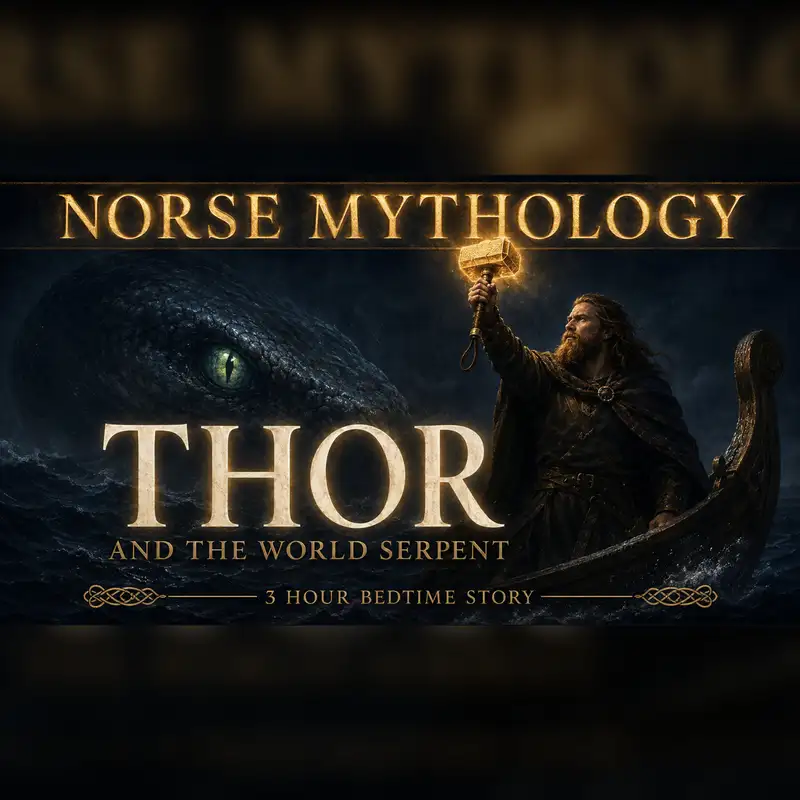
Welcome to The Sleeping Almanac.
Tonight we tell the story of the god who
went fishing for his oldest enemy and
almost killed him.
Of a small wooden boat on the cold sea at
the very edge of the world.
Of a hook baited with the head of an ox.
Of two figures rowing out into water no
boat had ever gone into before.
Of one of those figures, very large, very
tall, sitting in the back with his eyes
on the horizon, knowing what he was about
to do. Of the line that pulled.
Of the head that rose. Of the eye that
opened, and looked back at him.
And of the moment, between the rising of
the head and the falling of the hammer,
when the god in the boat and the great
serpent in the water looked at each other
across the open sea, and each of them
understood that they had been waiting for
this meeting since the world began.
We will tell this story tonight from the
Poetic Edda, where it lives most fully in
a poem called the Hymiskviða, the Lay of
Hymir, which gives us the long version:
the council of the gods, the journey east,
the giant's grandmother with her nine
hundred heads, the giant's mother with her
gold-decked arms, the eight cauldrons
that fell from a single look, the meal of
three oxen, the cutting of the line, the
breaking of the goblet, the chase home.
We will draw also on the forty-eighth
chapter of Snorri Sturluson's Gylfaginning,
which preserves the central scene more
compactly, and which gives us the moment we
will return to tonight as the heart of the
story, the moment when Þórr and the
Serpent looked at each other.
And we will draw on a much older skaldic
poem called the Húsdrápa, composed by the
poet Úlfr Uggason in the late tenth
century for the wedding hall of Óláfr the
Peacock in Iceland, which preserves an
independent and older confirmation that this
story was known to the old north long
before Snorri wrote it down.
Where the surviving sources are silent
about what was said or thought or felt in
any given moment, we will tell you we are
imagining, and we will tell you so
clearly. The story is more than old enough
to bear the imagining.
Tonight we go east. To a giant's hall at
the very edge of the world. To a boat.
To a hook.
To the moment the line pulled, and the god
in the boat braced, and the great
serpent rose out of the sea. Settle in.
Let your shoulders drop.
We begin in the hall of the sea-giant
Ægir, where the gods are gathered, and where
the question that begins this whole story
is being asked.
Chapter One. The Cauldron That Was Not
There.
The hall of Ægir stood at the edge of the
world.
We have stood in this hall before, dear
listener.
We stood in it not long ago, in the story
of Loki's binding, when the gods had
gathered for a feast that turned cruel.
Tonight's story is older.
Tonight's story takes place before that
night.
Tonight's story is from the time when the
gods still came gladly to Ægir's hall,
when the ale was good and the company was
kind and the world had not yet begun its
long slow tilt toward the end.
Ægir was a jǫtunn — but not the kind of
jǫtunn the gods made war on.
He was a sea-giant.
His wife was Rán, who held a net at the
bottom of the sea for the drowned.
His daughters were the waves themselves,
nine of them, each with her own name, each
with her own way of moving across the
water.
Ægir was, of all the giants of the old
north, the one closest to the gods.
He hosted them. He brewed for them.
He kept a hall at the edge of the world
where the gods came to drink and to be glad.
But on this night — the night where our
story begins — Ægir had a problem.
The Æsir had come to him in number. Not
just Óðinn and Þórr. Not just a few.
All of them.
Every god of Asgard had crossed the long
road from the high city and come down to
the sea-cliff hall, and they had come
hungry, and they had come thirsty, and they
had come expecting ale.
And Ægir, looking at the size of his
company, and looking at the size of his
brewing-cauldron, knew that he could not
brew enough.
He stood among them in his great hall,
with his white hair and his sea-grey eyes,
and he said: my friends. I cannot brew for
you all. My cauldron is not large enough.
There is no cauldron in all of Asgard
large enough to brew ale for this company.
Find me a cauldron, and I will brew. Until
then, we drink what little I have.
The gods looked at one another.
Þórr — who had been silent, who was always
silent until the work needed doing —
Þórr said: I will find one. Óðinn looked
at his son.
Óðinn said: where will you find a cauldron
larger than any cauldron in Asgard?
And here a voice spoke up that had not
spoken yet. The voice of Týr.
The one-handed god.
The one who had given his right hand to
the wolf Fenrir when no other god would put
a hand into the wolf's mouth, the one who
knew what it was to keep a promise even
when the promise cost you something you
could not get back.
Týr stood up at the long table and said: I
know where such a cauldron is.
The gods turned toward him. Týr said: my
father has one.
A small silence fell across the hall.
Because Týr's father, in this telling, was
not the All-father Óðinn.
Týr's father, in this telling, was Hymir.
A giant.
A jǫtunn of the eastern marches, who lived
far across the cold lands where the gods
did not go.
The relation is given to us in the
Hymiskviða, the poem that preserves this story,
and it is a strange relation — Týr, the
one-handed god of the gods' war-oath,
somehow also being the son of a jǫtunn who
lived in the cold east.
The Eddas elsewhere call Týr a son of
Óðinn.
The Eddas are not always consistent on
these matters.
Tonight, in this poem, in this story,
Týr's father is Hymir.
And Hymir, says Týr — my father — has a
cauldron at the bottom of his hall that is
a full mile deep. He calls it his
brewing-vat.
It is the largest cauldron in any of the
worlds.
If we can bring it back to Ægir, the
brewing problem is solved.
The gods looked at one another again. Þórr
looked at Týr. Þórr said: then we go.
And that was the beginning of the journey.
Two figures — the strongest god of Asgard
and the one-handed god whose father was a
giant — leaving Ægir's hall at the edge of
the world and turning east.
East, into the cold lands where the jǫtnar
lived.
East, toward a hall on the very edge of
the world where the ice never melted and
the seas were full of things older than
the gods. The hall they were going to.
The hall of Hymir.
Chapter Two. The Journey East. Þórr and
Týr left at dawn.
They did not take Þórr's chariot of goats.
The Hymiskviða does not tell us why.
We can imagine, from what the poem hints,
that this was a journey that required
quiet and not noise — that the chariot of
Þórr, drawn by two great goats with
brass-shod hooves, was a thing too loud
for the country they were entering.
Or perhaps Þórr simply wanted, this once,
to walk. The Eddas do not tell us.
We are told only that the two gods set out
on foot, that they crossed the long
plain east of Ægir's hall, and that they
began the slow climb up into the cold high
country where the jǫtnar lived. The land
changed as they walked.
The Æsir country was green.
There were oak and ash, there were rivers,
there were small farms scattered across
the rolling country with little
smoke-trails rising from the hearths.
The gods passed these and the small
farmers, who looked up and bowed, and the gods
nodded back, and they kept walking. Then
the green began to thin.
The trees grew shorter. The rivers grew
narrower.
The grass turned silver and brittle. The
wind picked up.
The two gods, walking shoulder to
shoulder, leaned forward against it.
Þórr's red beard whipped behind him. Týr's
cloak filled like a sail.
Then the snow began. Not the gentle snow
of a winter night.
The hard sideways snow of the eastern
wilderness.
The snow that does not fall — that is
hurled across the country by a wind that has
been coming for a thousand years and is
not stopping. Þórr lowered his head.
Týr lowered his. They kept walking. The
land grew rocks. Then more rocks.
Then nothing but rocks. The grass was
gone. The trees were gone.
There were only the long grey ridges of
jǫtunn country, the dark cliffs of stone
that rose around them on every side, the
high passes where the wind came through
like a knife. They climbed for a long
time.
The Hymiskviða does not tell us how long.
The poem moves quickly through this part
of the story.
It tells us that the two gods crossed the
wide country, and that they climbed the
high passes, and that at last they came
down out of a high notch in the stones and
saw, far below them, a great hall standing
alone on a flat shelf of stone above a
cold sea. The hall. It was vast. Larger
than any hall in Asgard.
Larger than any hall the two gods had ever
stood in.
Its roof-beams were great whole trees laid
across each other.
Its walls were stone — undressed boulders
fitted together by a hand large enough to
lift them like pebbles. Smoke rose from a
hole in its roof.
Around it, in a wide ring of trampled
snow, the cattle of the giant grazed —
enormous oxen, each one larger than any ox
in any farm in Midgard, their breath
rising in white clouds in the cold air.
And the sea below the hall — that was
Hymir's sea.
The cold edge-of-the-world sea where no
boat from Asgard had ever rowed.
The sea that, somewhere out in its deep,
held the Serpent.
Þórr stood at the top of the notch and
looked down at the hall and the cattle and
the sea. Týr stood beside him. Týr said:
that is my father's hall.
Þórr said: are you ready? Týr said: yes.
And the two gods began their long climb
down toward Hymir's hall.
Chapter Three. The Grandmother and the
Mother.
They entered the hall through its great
open door.
The Hymiskviða gives us, here, one of the
strangest images in all the surviving
Norse poetry.
It tells us that the first person Þórr and
Týr saw inside Hymir's hall was not
Hymir. It was Hymir's mother. Týr's
grandmother.
And she was — the poem says — a thing of
nine hundred heads. Nine hundred.
The poem does not explain. The poem does
not elaborate.
The poem says only that there she was,
sitting at the back of the hall, an old
jǫtunn woman with nine hundred heads, each
of them awful, each of them ancient,
each of them turned toward the door as the
two gods walked in.
Some of the heads were sleeping. Some were
watching.
Some were looking past Þórr and Týr at
nothing at all.
The poem leaves her there as the bare
strange fact of her existence — a creature so
old and so monstrous that the human mind
cannot quite hold her, but who is, all the
same, Týr's own grandmother. Whom Týr has
known. Whom Týr has visited.
Þórr stopped at the threshold. Týr walked
in, and bowed.
The grandmother of nine hundred heads said
nothing.
And then, from another part of the hall, a
different woman stepped forward.
This was Týr's mother.
The Hymiskviða describes her in a single
line, and the line is the small jewel of
this part of the poem. She is, the poem
says, gold-decked.
Her arms are bright with gold rings. Her
hair is bright. Her gown is fair.
Her eyes — the poem does not say, but the
poem does not need to say — are kind.
She looked at Týr. She had not seen him in
a long time. She crossed the hall to him.
She did not throw her arms around him. The
poem does not give us that.
The poem gives us only that she came to
him, and stood close to him, and looked at
him for a long moment without speaking,
and then said: my son.
Why have you come here. And Týr answered
her honestly.
He said: we have come to ask your husband
for the cauldron. We need it.
The gods need it. Ægir cannot brew without
it. His mother lowered her head.
She said: your father will not be pleased
to find Æsir in his hall.
Hide behind the great pillar at the back
of the room.
I will speak to him when he comes home.
If he is in a good mood, he will give it
to you.
If he is not — if he is not, I will do
what I can. The two gods understood.
Þórr — the strongest god in Asgard, the
god who had killed more jǫtnar than any
other being in the worlds, the god whose
hammer had cracked the world-rocks and
whose anger had shaken the seas — Þórr
crouched down behind a stone pillar at the
back of his enemy's hall, on his enemy's
orders, on his enemy's wife's orders,
because the strangest thing about meeting
a giant in his own hall is that you do
not, even if you are Þórr, simply burst in
shouting. You wait.
You let the mother of the house speak
first. Týr crouched beside him. They waited.
The grandmother of nine hundred heads
watched them from the back of the hall.
She did not, the poem implies, give them
away.
Whether she would have, had Hymir asked
her, the poem does not say.
Chapter Four. The Return of Hymir. He came
home at twilight.
The Hymiskviða gives this scene one of the
most evocative descriptions in the
entire poem. We hear Hymir before we see
him.
We hear his footsteps on the long stone
path that comes down from the high country.
We hear the rattle of frozen branches
being dragged behind him.
We hear his breathing — the slow heavy
breathing of a giant who has walked all day
across the cold east and is now at last
coming home.
The door of the great hall darkened. He
filled the doorway entirely.
He had to bend to come through.
When he stood up inside the hall, his head
almost touched the roof-beams, even
though the roof-beams were laid across the
hall on poles thick as old oaks.
He was older than Þórr. He was older than
Týr.
He was older than any jǫtunn the gods had
met before. His hair was white.
His beard was white.
And from his beard, the poem says — and
this is the image that the old north loved
enough to repeat — from his beard the ice
fell in cracking pieces as he stepped
into the warmth of the hall. He had been
hunting in the high country.
His beard was so frozen that, as the
warmth of the fire began to touch it, the ice
cracked off in shards and fell to the
stone floor of the hall.
Hymir stood in the middle of the great
chamber and shook off the cold.
He did not, yet, see his guests. Týr's
mother went to him. She kissed him.
She said: husband. There are guests in the
hall. Hymir turned his head.
He looked toward the back of the hall,
toward the great pillar where Þórr and Týr
were crouched.
And then — the poem tells us — and then a
thing happened that the old north
considered, in its memory of giants, one
of the small great miracles of Hymir.
Hymir's gaze fell on the corner of the
room.
His eyes — old, cold, accustomed to the
high country — his eyes simply rested on
the back wall for a moment.
And from the rafters above the pillar
where Þórr and Týr were crouched, eight
cauldrons fell. Cauldrons that had been
hanging there for years.
Cauldrons used for brewing, for boiling,
for storing.
Each one had been fixed to its peg with
iron rings. The iron rings broke.
The cauldrons fell. One after another.
Eight of them.
They struck the stone floor and they
shattered.
The sound was like ice cracking in a deep
winter wood. Hymir had not even glared.
He had merely looked. And the cauldrons
had fallen.
Only one cauldron, the poem tells us,
remained on its peg. The largest one.
The one Týr had spoken of. The one a mile
deep. That cauldron did not fall.
That cauldron, the poem tells us, was made
of metal too good to break.
But the other eight broke. The hall heard
them.
Hymir's wife — Týr's mother — said:
husband. Be kind.
They are our son and his friend. They have
come a long way. Hymir said nothing.
He walked to the back of the hall. He
looked down at the two crouched figures.
He looked at Týr, his own son.
He looked at Þórr, the red-bearded god of
Asgard whose hammer had killed more of
Hymir's kin than the giant could count. He
looked for a long moment.
Then he said: very well. He turned to his
wife. He said: slaughter three oxen.
And he went to sit at the head of his long
stone table, and to wait for his dinner.
The gods rose from behind the pillar.
The grandmother of nine hundred heads
watched them rise.
Chapter Five. The Three Oxen. Hymir's wife
brought out the meat.
It was a great deal of meat.
Three whole oxen, slaughtered that
afternoon by Hymir's herdsman, roasted slowly
through the long blue hours of the eastern
dusk on a spit so long it took three
poles to hold it. The smell filled the
hall.
The smell of roasting beef, of fat
dripping into the fire, of charred bones and
rendered tallow.
It is the smell every hall in the long
winter country of the old north must have
smelled like, on a good night, when the
hunt had been kind.
It is the smell of survival in cold
places.
The two gods, sitting at the long stone
table in their enemy's hall, would have
known this smell in their own halls of
Asgard, and would have known it in every
farmhouse and feast-hall of Midgard, and
would have known what the smell meant —
that the night was going to be all right.
That whatever the day had cost, the night
would feed you.
That you would sleep on a full belly.
Hymir's wife — Týr's mother — carved.
The Hymiskviða tells us — without any
flourish, just as a small flat fact — that
Þórr ate two of the three oxen at this
meal. Two. Of the three.
The third ox, the one not eaten by Þórr,
was shared between Hymir, Týr, and Týr's
mother.
The fourth person at the table — Þórr —
ate twice as much by himself as everyone
else combined. This is, in the old north,
one of the standard jokes about Þórr.
He was the largest of the gods. He needed
enormous amounts of food.
The Eddas tell us elsewhere that he could
empty a giant's mead-horn in three
draughts — that he could eat an entire ox
and ask for another.
That his appetite was, in some way, part
of his identity.
Þórr was the god of the labouring people.
Þórr was the god of those who worked the
fields and rowed the boats and needed to
eat enough to keep going.
So the poet of the Hymiskviða, telling us
that Þórr ate two oxen at this meal, was
telling the old north something it already
knew: that Þórr in a strange hall was
Þórr being most himself, eating everything
in front of him with a clean conscience.
But Hymir — sitting at the head of his
long table, watching this happen — was not
amused. Hymir was a hunter. He had been
out all day. He had walked the long miles.
He had brought back the cold game. He had
earned his evening meal.
And now, in his own hall, this red-bearded
son of Óðinn was eating two of his three
best oxen in a single sitting. When the
meal was done, Hymir stood up.
He said, slowly, looking at Þórr:
tomorrow, we will not eat what is in my pantry.
Tomorrow we will eat what the sea gives
us.
If we are hungry, we will fish for our
dinner.
If the sea gives us nothing — we will go
to bed hungry. Is this understood.
Þórr said: yes. Hymir said: good.
And he turned and went to his bed at the
back of the hall.
Týr and Þórr stayed at the table. Týr's
mother began to gather the bones.
She did not look at her son. She did not
look at Þórr.
She gathered the bones in silence, one by
one, and dropped them into a great
basket, and carried them away to the back
of the hall where the dogs of the giant
lived. The dogs ate the bones one by one.
Their teeth — the Hymiskviða notes,
without explaining — were as long as a child's
arm.
The cracking of the bones in their jaws
was, for a while, the only sound in the
hall. The fire crackled now and then. The
wind, outside, moved against the shutters.
The dogs ate. The bones broke. The marrow
came out. The dogs swallowed it.
The pile of bones, slowly, became a pile
of nothing.
The grandmother of nine hundred heads, at
the back of the hall, did not eat.
She did not move. She did not speak. Some
of her heads slept. Some of them watched.
The Hymiskviða does not tell us, in any of
its surviving versions, what the
grandmother ate, or whether she ate at
all.
The poem leaves her there as a presence
the listener accepts and does not question.
She was the oldest jǫtunn-being in the
hall.
She had been there before Hymir was a
child.
She would, in some way the Eddas do not
explain, still be there long after he was
gone. Some beings, the old north knew, did
not require what other beings required.
The hall went quiet. The fire died down.
Þórr leaned back from the table.
Týr looked at his friend. Týr said: my
father said we are fishing tomorrow.
Þórr said: yes. Týr said: do you know what
he will be hoping to catch.
Þórr looked at him. Þórr said: I have a
guess. Týr said: and if he catches it.
Þórr said: he will not be the one to pull
it in.
The two gods sat in the quiet of Hymir's
hall.
Outside, the cold sea was breathing
against the rocks below the hall.
Somewhere out in that sea, in water so
deep that no light had ever touched its
bottom, the Serpent was sleeping.
The Serpent had been there since the first
day of the world, when Óðinn had thrown
it into the encircling sea. The Serpent
had grown with the world.
The Serpent had wrapped itself around all
the lands of Midgard, biting its own tail
at the eastern horizon, holding the world
together with its own body.
The Serpent was Þórr's old enemy.
The Serpent was the thing Þórr was fated,
at the end of all things, to fight and
kill and be killed by. The Serpent did not
know, that night, what was coming.
The Serpent slept. Þórr did not sleep.
Þórr sat at Hymir's table, in the dying
firelight, and looked out the open door at
the dark sea. And he listened to the sound
of the waves. And he waited for morning.
Chapter Six. The Bait. He went out at
dawn.
The Hymiskviða gives us, here, one of the
simple striking images of the poem.
Þórr — before Hymir had risen, before Týr
had risen, before even Týr's mother had
begun her morning work — Þórr was already
up and outside the hall, walking the long
ridge above the cold sea. He was thinking
about bait.
For the great fish of the deep, Þórr knew,
you do not bait your hook with a worm.
You do not bait it with a small fish.
You bait it with something that the great
fish of the deep will want — something
big enough, something rich enough in blood
and meat, that it will rise up out of
its deep place to take. Þórr looked around
at the country.
He saw the cattle of Hymir grazing in the
high pasture. The cattle were enormous.
Each one as big as a small house. Their
hides were dark and shaggy.
Their breath rose in white clouds in the
cold morning air.
They moved slowly across the snow, pulling
at the brittle grass underneath.
Þórr's eye fell on one of them. The
largest. The black ox at the head of the herd.
Its horns were nearly as tall as Þórr
himself. Its eyes were dark and patient.
The Hymiskviða gives this ox a name —
Himinhrjóðr, the heaven-tearer, the
heaven-render.
The name had come, the old north said,
from some ancient story about the ox having
torn at the sky itself with its horns in
some quarrel of the giants.
The name had stayed with this particular
line of cattle since.
Þórr walked into the pasture. The other
cattle moved away from him.
The black ox Himinhrjóðr — perhaps because
of his name, perhaps because of his
nature — did not move.
He looked at the small red-bearded figure
walking toward him across the snow.
He lowered his head, slightly. He did not
run. Þórr came to him.
He put one hand on the ox's neck.
And then — quietly, without ceremony —
Þórr broke the ox's neck.
The Hymiskviða does not give us drama
here.
The poem says only that Þórr took the ox
down. The ox did not fight him.
The ox did not have time to. Þórr was
Þórr. The ox was an ox. The thing was done.
Then Þórr, with both hands, tore the ox's
head from its body.
He carried the head back toward the hall.
A whole ox-head.
Black-furred, enormous, the horns curving
up above Þórr's shoulders as he walked.
Blood ran down his arms.
His red beard, in the morning light, was
the same colour as the blood.
He carried the head as easily as a man
might carry a heavy basket. He did not hurry.
He walked steadily back across the long
snow-field toward Hymir's hall.
Hymir was just stepping out the door as
Þórr arrived.
The giant stopped in his tracks. He looked
at Þórr.
He looked at the head of his finest ox,
dangling from Þórr's hand, the eyes still
slightly open, the tongue lolling. The
giant said nothing.
The poem records no words from him.
The poem says only that Hymir's face —
old, cold, accustomed to giant-country anger
— Hymir's face went very still.
The way a man's face goes still when he
has seen, in a moment, more than he had
bargained for in the day ahead of him.
Þórr lifted the head a little.
Þórr said: bait. Hymir looked at him.
Hymir said, finally: get in the boat.
And the two of them walked down to the
cold sea, where Hymir's small fishing-boat
was pulled up on the black rocks. Týr came
down behind them.
The poem does not tell us whether Týr came
on the boat or stayed on the shore.
Most of the surviving versions imply he
stayed. The boat, after all, was small.
Two passengers — a god and a giant — was
already a great deal of weight.
Three would have been more than the small
craft could bear.
Þórr put the ox-head in the bottom of the
boat. He picked up the oars.
Hymir sat in the back, where the fishing
was done.
He had two long lines, two great iron
hooks.
He had — somewhere out in the deep beyond
the rocks — a place he liked to fish, a
shallow bank where the flat-fish came up
at certain tides. He pointed to it.
Þórr pulled at the oars. The boat shot
away from the shore.
Týr stood on the black rocks and watched
them go.
The cold wind blew his cloak straight out
behind him.
The grey sea heaved under the small dark
shape of the boat. Þórr rowed.
Hymir sat in the back. The boat got
smaller. The wind got colder.
Týr stood there for a long time, watching
them, until the boat was a black speck on
the water, and then until even the speck
was gone, and then he stood for a while
longer just looking at the place where the
speck had been.
He did not know — none of them knew, that
morning — what they were going to find
out there.
None of them knew, as the boat pulled out
of sight, that this was the moment the
world began its slow tilt toward Ragnarǫk.
They knew only that a god and a giant had
gone out fishing, and that the cold sea
had taken them, and that the small boat
was now somewhere out in water no one in
this country knew. Týr turned, eventually,
and walked back up to Hymir's hall.
He sat at the long stone table, with his
grandmother of nine hundred heads watching
him from the back of the room, and his
mother working at the hearth, and the cold
wind rattling the door, and he waited for
his friend to come back.
Chapter Seven. The Rowing Out. Þórr rowed.
The Hymiskviða gives this part of the
story in the way the old north's poets did
their best work — quietly, with a small
accumulation of detail, letting the
listener feel the weight of what was
happening rather than telling them.
Hymir, in the back of the boat, was the
giant who had fished these waters since the
world was young. He knew every bank. He
knew every depth.
He knew where the flat-fish came up at
certain tides, where the cod gathered in the
cool channels, where the herring ran in
their long silver schools.
He pointed past Þórr's shoulder, toward a
place perhaps a half-mile from the shore,
where the cliffs of the giant-country
formed a low ledge under the water.
He said: there. The flat-fish come there.
We will fish there.
Þórr did not stop rowing. Þórr passed the
half-mile mark. The cliffs slipped behind.
The water under the boat got darker.
The bottom — which a fisherman could
often, in shallower water, see as a green
shimmer below the keel — disappeared. The
bottom was now too far down to see.
Hymir said: we have gone far enough. Þórr
kept rowing.
The shore behind them grew smaller.
The cliffs of Hymir's country became a
thin grey line on the horizon.
The sea around the boat became a great
empty grey-blue plate of water, with no land
visible in any direction except behind
them, and even behind them, the land was
thinning out. Hymir said: god of Asgard.
We have gone too far. Þórr did not answer.
Þórr rowed. The strokes of his oars were
not human strokes.
The poem does not pretend they were. Þórr
was the strongest of the gods.
When he pulled at the oars, the small boat
did not move the way a small boat
usually moves on a calm sea. The small
boat shot forward.
The water rolled away from the bow in two
long curls.
The wake stretched behind them in a
straight white line as long as a king's hall.
With every stroke of Þórr's oars the boat
leapt forward another length of itself,
and another, and another, and the shore
behind them disappeared into the haze, and
the great grey plate of the sea opened
around them.
The water under the boat changed.
Near the shore, when they had pushed off,
the water had been green-grey, with the
green of the kelp-beds visible far below.
Then it had darkened.
Then it had become the colour of slate.
Then, as they kept going, it had darkened
again — to the colour of wet iron, to the
colour of old armour, to the colour of
stone left out in winter rain.
And now, somewhere out under them, the
water was a colour the old north did not
have a name for. A blue so dark it was
almost black.
A blue that the eye could not look at for
very long without feeling that something
was being held below it, very still, and
very large.
The sea-birds that had followed them out
from the shore — the gulls, the
kittiwakes, the small white birds of the
coast — had thinned out.
Then they had stopped.
The last gull turned back somewhere over
the half-mile mark and beat its way back
toward the safe shallows. There were no
birds out here.
There were no birds, because there were no
small fish here for the birds to eat.
There were no small fish here, because no
small fish came this far out.
Only the great things of the deep came out
this far.
And the great things of the deep did not
need air.
They did not need to come to the surface.
They could stay down, far down, in the
long blue dark, and that is where they
stayed. Þórr rowed. Hymir watched the
water.
The Hymiskviða does not give us the
giant's thoughts here, but the poem implies
them by the way his hands moved.
Hymir, sitting in the stern, had his hands
clasped together in his lap.
He kept tightening his grip on one with
the other.
The old joint of his right thumb cracked.
The cracking was the only sound in the
boat besides the small clean noise of Þórr's
oars going in and out of the water and the
long slow breathing of the sea.
Hymir said: stop. Þórr stopped. He let the
oars rest on the gunwales.
The boat drifted in the long slow swell.
The two of them — the god in the bow, the
giant in the stern, the small dark wooden
shape of the boat between them — sat in
the middle of a sea no one in the worlds
had ever seen this far out. The water
around them was the colour of old iron.
The sky above them was the colour of a wet
stone. There was no horizon.
There was no land.
There was only the long grey breathing of
the cold sea, and the small wooden boat,
and the two figures in it, and the
silence.
Hymir said, very quietly: this is the
Serpent's water. Þórr said: I know.
Hymir said: turn the boat. Now. Þórr did
not turn the boat.
Þórr looked over the side, down into the
dark. He could not see the bottom.
The bottom was a hundred fathoms below
them, maybe a thousand, maybe more.
There was no measuring it. The light only
went down so far.
After the light stopped, there was only
the cold and the dark and whatever lived in
it. Þórr said: bait the hooks. Hymir,
after a long moment, did.
Chapter Eight. The Whales. The giant
fished first.
Hymir, in the stern, baited his two great
hooks with whatever giants use for bait —
the poem does not tell us exactly, but the
implication is something not unlike what
a giant would always carry on a fishing
trip: long strips of dried fish, perhaps,
or whole small fish kept in a salt-barrel
for just this purpose.
He cast the lines over the side. The hooks
sank away into the dark.
For a long time, there was nothing. The
boat drifted. Hymir watched the lines.
The poem does not give us his thoughts.
The poem gives us only that he sat in the
stern, his old white beard catching the
salt-mist, his eyes fixed on the two lines
as they hung down into the water, and
that he waited. Then a tug. Then another.
Hymir's hands tightened on the lines.
He began to pull.
The poem tells us — and this is one of the
small jewels of the Hymiskviða, one of
the moments the old north loved — that
Hymir pulled up, in quick succession, two
whales. Two of them. From a single trip
out to sea. From two casts of his line.
Whales.
Not the kind of whale the men of Midgard
could ever have caught from a small boat —
these were not the great singing
leviathans of the deep ocean, the kind the men of
Norway hunted in their long autumn hunts.
These were smaller whales — porpoises,
perhaps, or pilot whales, the kind that
sometimes came close to a fishing boat on
a calm sea. But two of them. Two.
From a single sitting.
Hymir hauled them, one after another, into
the bottom of the boat.
The bottom of the boat became a sliding
pile of grey-blue flesh and dark eyes and
small fins. The whales' breath had
stopped.
Their bodies were warm against the cold
wooden boards.
Hymir looked at Þórr, finally, with
something like satisfaction in his old eyes.
He said: this is fishing. We can go home
now. Þórr looked at the two whales.
Þórr looked at the giant. Þórr said: no.
He picked up the ox-head — Himinhrjóðr's
great black head, with the horns still
curving up, the eyes now sunk and grey —
and he threaded it onto his own great iron
hook. The hook was thicker around than a
child's wrist.
The ox-head, on the hook, looked very
small.
He took up the line — a line as thick as a
ship's rope, twisted from the hair of
many cows — and he stood up in the bow of
the small boat, with the boat rocking
under him, and he swung the baited ox-head
once in the air, and twice in the air,
and then he let it go. The ox-head sailed
out into the grey distance.
It struck the water with a sound like a
stone falling into a deep well.
The line ran out. It ran out for a long
time.
The line was almost a quarter of a mile
long.
The whole thing went out of the boat, over
the gunwale, down into the dark.
It paid out at speed. The wooden cleats it
ran past whistled with the friction.
The line went on running for so long that
even Hymir, in the stern, sat up and
watched it with attention. Then it
stopped. The hook had reached the deep.
The ox-head was sitting on the dark
sea-bed somewhere far, far below them, at a
depth no human-made line had ever reached.
It was lying on whatever it was lying on.
The sand of the deep. The mud of the deep.
Or — perhaps — the back of the thing the
deep belonged to.
Þórr held the line in his right hand. He
sat down in the bow. He waited.
Chapter Nine. The Pull. Nothing happened.
For a long time. The boat rocked.
The grey sea breathed. The cold wind
pulled at Þórr's beard.
Hymir, in the stern, watched the god in
the bow.
The god in the bow watched the line.
The line led down out of the boat, into
the water, into the dark.
There was no movement on it. Þórr did not
move.
The Hymiskviða is quiet about how long
this took.
The poem gives us, here, a single pause.
The poem says only: he waited.
The skaldic art knew that waiting was a
thing you did not need to belabor.
The listener felt the wait without being
told to.
But we, dear listener, can imagine it.
We can imagine Þórr sitting very still in
the bow of the small boat, with the line
in his right hand and the oars resting on
the gunwales.
We can imagine the long swell of the sea
raising the boat and lowering the boat,
raising it and lowering it, slowly, in a
rhythm older than the world.
We can imagine the small sound of the
water against the planks — the soft slap,
slap, slap of the cold sea against the
small wooden craft.
We can imagine the cold air, moving slowly
past their faces, carrying the smell of
salt and of distance.
We can imagine Hymir, in the stern,
breathing through his nose, his hands still
clasped, his old eyes watching the line
where it disappeared into the dark.
And we can imagine that somewhere far
below the boat — somewhere a long, long way
down, in water cold enough to slow even
the blood of a thing as ancient as the
Serpent — there was, in that moment, a
stirring.
A small movement of an old enormous body
that had been still for a long time.
A turning of an ancient head.
A noticing of something on the dark floor
of the deep that had not been there
before. A small dark shape. Round. Black.
With a piece of iron through it.
The Serpent did not, the old north
imagined, recognize the bait at first.
The Serpent did not know what an ox-head
was.
The Serpent did not understand the
difference between an offering and a trick.
The Serpent knew only that something had
appeared on the floor of its deep place,
something with the smell of meat and the
warmth of blood-and-bone in it, and that
it was small, and that it could be tasted.
The Serpent moved.
In the dark of the deep sea, the great
body of Jǫrmungandr began, slowly, to gather
itself. The vast coils that wrapped the
world began to shift.
The Serpent that bit its own tail at the
eastern horizon let go of its tail, for
one moment, for the first time in many
ages, and turned its head toward the small
dark shape that had appeared on the sand.
The Serpent opened its mouth.
And then — without warning, without
preamble — the line moved. Not a small tug.
Not the gentle pulse of a small fish
nosing a hook.
The line moved as if it had been seized.
As if some thing far below them had taken
the bait into its mouth and turned and
begun to swim. The line, in Þórr's right
hand, jumped. Then it ran.
The remaining slack jumped out of the boat
in a single instant, snapping taut over
the gunwale. The cleats whistled again.
The boat lurched forward — not a small
lurch, the lurch of a small craft being
pulled by a thing larger than it. Hymir,
in the stern, said: gods.
Þórr did not say anything.
Þórr braced his feet against the bottom of
the small boat.
He set his hand on the line. He began to
pull.
This is the moment the old north
remembered.
This is the moment the picture-stones at
Altuna and at Ardre and on the Gosforth
Cross all preserved, in different ways,
with the same image — the god of the gods,
in a small boat, his feet braced, hauling
on a line, with the great head of the
Serpent rising in the dark water below
him. Þórr pulled. The line came up.
The thing on the other end of the line
resisted. It was not a small resistance.
It was the resistance of the entire weight
of the sea.
Þórr's arms — which had lifted hammers,
which had broken mountains, which had
thrown jǫtnar into the sky — Þórr's arms
strained against the line.
The cords of his neck stood out. His face
went dark with the effort.
He was not, the poem implies, struggling
because he was weak.
He was struggling because the thing on the
other end of the line was — for the
first time in his life — a thing that did
not want to come up.
A thing that was pulling back.
A thing that, if it had wanted to, could
have pulled Þórr straight out of the boat
and down into the sea. But Þórr was Þórr.
He braced harder.
And as he braced, the Hymiskviða tells us
— and the Húsdrápa tells us, in its
older, more dignified way — and Snorri in
Gylfaginning ch. 48 tells us, in the same
language — Þórr's feet went through the
bottom of the boat. Through the planks.
Through the wooden floor of the small
craft.
The pressure of Þórr's bracing pushed his
feet down so hard that the cedar planks
of the bottom of the boat split, and
Þórr's feet went through, and his bare feet,
in their leather sandals, were now planted
not on the boat's bottom but on the very
sea-bed below the boat. The cold sea was
rushing up around his ankles.
The small boat was — and the poem does not
bother to say it, because the listener
of the old north would have understood —
the small boat was now held above the
water only by Þórr's own braced legs and
the careful balance of his weight.
He was, in effect, standing on the floor
of the sea.
He was, in effect, pulling on a line.
Hymir, in the stern, watched this with
eyes that the poet of the Hymiskviða
specifically described — using the old
Norse word for the fear of a man who has
seen something he should never have seen.
Þórr pulled the line. The line came up.
And then, in the great grey plate of the
sea around the boat, the water began to
lift. Not in a wave. In a slow upward
swell.
As if something enormous, far below, were
rising toward the surface — pushing the
whole weight of the sea upward as it rose.
The water lifted. And then it broke.
Chapter Ten. The Eye. This is the heart of
the story.
This is the moment the old north loved
most about Þórr — more than the killing of
any other jǫtunn, more than the recovery
of Mjǫllnir from the giant Þrymr, more
than any of his other adventures.
This is the moment the Húsdrápa preserved
as worthy of being carved into the wooden
panels of a wedding-hall in Iceland in the
late tenth century, long before any of
these tales were written down.
This is the moment Snorri Sturluson, two
hundred years later, put at the centre of
his Prose Edda chapter on Þórr's labours.
This is the moment that exists, in its
long silence, in the picture-stones of
Sweden and Gotland and the Isle of Man.
This is the moment the old north could not
let go of. The Serpent rose.
Out of the sea, in front of Þórr's small
boat, the great head of Jǫrmungandr lifted
itself above the water. It was vast.
The old north was very careful, in its
descriptions, about not giving us a number.
The Serpent's head was — bigger than the
boat. Bigger than Hymir's hall.
Bigger, perhaps, than any single thing the
gods had ever stood before.
Its scales were the colour of cold steel.
Its eyes were old — older than the world,
older than the gods.
They had been open since Óðinn had thrown
the Serpent into the sea on the first day
of creation, and they had been open every
day since.
The mouth of the Serpent had closed on
Þórr's hook.
The ox-head of Himinhrjóðr was caught
inside the corner of that mouth, the iron
hook hooked through the inside of the
Serpent's lip. The Serpent was caught.
Þórr — standing in the boat with his feet
through the bottom and his legs braced
against the sea-floor and his hands
holding the line — Þórr looked up at the great
head. The Serpent looked down at him.
We do not know, the old north said, what
the Serpent saw in that first moment.
The Serpent had never, before this, looked
at a god.
The Serpent had been at the bottom of the
deep since Óðinn had thrown it there.
It had grown there, slowly, generation by
generation.
It had wrapped itself around the lands of
Midgard, biting its own tail.
It had felt the world above it — the
stamping of horses, the building of halls, the
rising and falling of small wars. But it
had not seen these things.
The Serpent had not, until this moment,
opened its eye and looked at a god.
Now it did.
The eye was — the old north said, in many
different ways across many different
sources — green. Cold green.
The green of ice that has been under the
sea for a long time.
The green of the deep aurora that hangs
above the northern country in winter.
The green of certain old stones that have
been polished by the long working of
water. The pupil of the eye was vertical.
Like a snake's pupil.
Long and dark and very still.
And in that pupil — for the small moment
they were holding each other — Þórr saw,
perhaps, the long dark of every place the
Serpent had ever been.
The cold lightless trench at the bottom of
the encircling sea.
The great slow turnings of the Serpent's
body around the lands of men.
The long old waiting of an enormous mind
that had nothing to do but wait.
Þórr saw, perhaps, his own future.
The day at the end of the world when this
eye would be the last thing he would ever
see. And the Serpent saw, perhaps, what
Þórr was. A small red-bearded god in a boat.
A hammer in his hand.
The thing that was, in the very far
distance, going to kill it.
The moment, in the actual time of the
world, did not last long. The eye opens.
The eye closes. The water rolls. The boat
rocks.
The line trembles in the god's hand.
By any honest measurement of time, the
looking lasted only as long as it takes a
person to draw one slow breath. Perhaps
two. Perhaps three.
The Hymiskviða does not measure it. The
Gylfaginning does not measure it.
The Húsdrápa does not measure it.
The picture-stones at Altuna and Ardre and
the Gosforth Cross do not measure it
either — they freeze it, the way a piece
of carved stone is meant to freeze a thing.
But the moment, in the way the old north
measured the things that mattered, was
longer than that.
The moment, in the way the old north
measured these things, was long enough to
contain a kind of recognition that does
not happen in human time.
The Serpent had been alive since the first
morning.
The Serpent had been at the bottom of the
encircling sea for as long as there had
been a sea.
And in all of that time — in the long deep
dark of the bottom of the world — the
Serpent had never, until this moment,
looked into the face of the being who was
going to kill it. Now it had.
And Þórr — who had killed many giants, who
had broken many of the great old enemies
of the gods, who had taken Mjǫllnir in his
hand more times than even he could
remember — Þórr had never, until this
moment, looked into the face of the being who
was going to kill him. Now he had.
Each of them, for the small space of three
breaths, knew the face of the other.
The Serpent learned what Þórr looked like
at close range — the red beard, the
strong square jaw, the dark eyes set deep
under the heavy brow.
The shape of the man who would, at the end
of the world, swing the hammer that
would end the Serpent's life. The Serpent
looked at this man as if to memorize him.
As if the Serpent, sinking back into its
deep place after this was done, would
carry the image of Þórr down with it, and
would keep it for the long thousand years
between this looking and the next looking,
and would hold it ready for the day the
two of them would meet again. And Þórr
looked at the Serpent the same way.
He looked at the great cold green eye.
He looked at the scales the colour of old
armour.
He looked at the long terrible body that
he could see, in pieces, where the
Serpent's coils broke the surface of the
water in different places around the boat.
He looked at the thing that was — in the
very far distance of the cosmos, at the
end of all of time — going to spit its
venom across half the sky and kill him.
He looked at it without fear. The old
north was very careful to insist on this.
The old north did not give us a Þórr who
was afraid in this moment.
The Hymiskviða does not give us a Þórr who
flinched.
The Gylfaginning does not give us a Þórr
who hesitated.
The picture-stones do not show a Þórr who
looks worried.
The old north gave us a Þórr who looked at
the Serpent the way a man looks at a
thing he has been waiting to meet for a
long time. With curiosity. With patience.
With the small steadiness of a being who
knew what was coming and was, in some
quiet way, glad to have seen it once
before the end.
The old north was very careful, here, with
what it said.
The poem does not tell us what the Serpent
was thinking.
The poem does not tell us what Þórr was
thinking.
The poem tells us only that the two of
them looked at each other.
For one long moment, in the middle of the
grey sea, at the edge of the world, the
great green eye of the Serpent and the
small dark eyes of the god rested on each
other. They had been waiting for this
meeting since the first day of the world.
They had known, both of them, that it was
coming.
They had known it in the way the very old
things know what is going to happen — not
as a thought, not as a plan, but as a
certainty in the bones.
They were, the two of them, fated to fight
each other at the end of all things.
They had been fated to it since they were
both made. The Vǫluspá knew this.
The skalds knew this. The picture-stones
knew this.
But the end of all things was not yet.
The end of all things was, the old north
believed, still many slow generations away.
Naglfar, the ship made of the fingernails
of dead men, was still being built
quietly by the slow work of the unkempt
dead. The world was still turning.
The cloth of fate, woven by the three
sisters at the foot of Yggdrasil, was still
being woven. It was not yet time.
But it was, the Serpent and the god both
understood — looking at each other across
the cold grey water — it was, in some way,
time enough to know each other's faces.
To see, once, the shape of what was
coming.
To learn the eye that, at the end of all
things, would be the last eye each of them
would see. Þórr did not strike yet. The
Serpent did not pull yet.
The two of them — the god and the worm —
held each other in their gaze for the
small space of time that, in the old
north's memory, was the only space of time in
all the long histories of the gods when
these two old enemies actually saw each
other clearly.
Then Þórr — slowly, carefully,
deliberately — reached for the hammer at his belt.
He drew Mjǫllnir. He raised it. He brought
it back.
He was about to bring it down on the head
of the Serpent and end, three thousand
years before it was supposed to end, the
slow countdown of the world toward
Ragnarǫk.
And in the stern of the boat — the part of
this story the old north loved most, the
part that gave Hymir his place in the long
memory of the north — in the stern of
the boat, Hymir the giant, who had brought
the god out here, who had watched all of
this happen, who had spent his whole long
life on the cold sea and knew what the
Serpent was — Hymir reached for the small
knife at his belt. And cut the line.
Chapter Eleven. The Cut. The line went
slack. Þórr's hammer was already coming down.
The Hymiskviða gives us this part of the
story in a strange, almost stuttering
rhythm — as if the poet himself, in the
long act of telling, could not quite decide
what to put first. The hammer falling. The
line going slack.
The Serpent falling away. The god's roar.
What the poem agrees on, in every
surviving version, is this: The line was cut.
The Serpent, freed from the hook, began to
fall away from the surface of the sea,
back into the deep. Slowly, at first. The
great head sinking. The neck following.
The vast body, somewhere far down,
beginning to gather itself for the descent.
Þórr's hammer reached the place where the
Serpent's head had been.
In Hymiskviða stanza twenty-three, the
poet says: the hammer struck.
The hammer caught the Serpent on the side
of the head as it sank.
The blow was so strong that the rocks of
the eastern shore — far, far behind them,
miles back at the edge of Hymir's country
— the rocks were said to have cracked.
In Gylfaginning chapter forty-eight,
Snorri Sturluson is more careful.
Snorri says: many men say Þórr struck the
head off the Serpent there in the deep.
But it is more true to tell, Snorri says,
that the Serpent lives still, and lies in
the encircling sea.
The two versions do not, in the long view,
contradict each other.
The Hymiskviða tells us what Þórr's hammer
did to a thing that the Serpent could
put on as a face and then take off, the
way the old north imagined the great
immortal beings could do.
The Gylfaginning tells us what the Serpent
really was, underneath. Þórr struck.
Þórr struck hard enough to crack the rocks
of the coast.
But the Serpent — because the Serpent was
the Serpent — fell back into its deep
place and went on living, the way the
Serpent had lived since before the gods were
named. The hook was lost. The bait was
lost. The line was lost.
The Serpent was gone.
Þórr stood in the boat with his feet
through the bottom and his hammer in his hand
and the foam of the broken sea still
spraying around him, and he turned, slowly,
and looked at Hymir.
Hymir was sitting in the stern of the boat
with the small knife still in his hand.
The two of them looked at each other.
Þórr — the Hymiskviða tells us, very
quietly — Þórr did not say anything.
Þórr reached across the small boat with
his left hand, and he took Hymir by the
front of his frozen white beard, and he
lifted Hymir off the bench, and he held the
giant in the air for one moment over the
side of the boat — and then he opened his
hand. Hymir went into the cold sea. He
came up sputtering. He swam.
He swam for the shore, the long miles of
the shore, with his great white beard
streaming behind him in the cold water,
with his old eyes squinting against the
salt, with his ancient giant's body
labouring against the cold of the sea he had
fished all his life. Þórr, in the boat,
sat down. He took the oars again.
He looked once more at the place where the
Serpent had been.
The water there was still rolling — the
great swell of the Serpent's descent was
still settling itself.
The two whales Hymir had caught, slid into
the bottom of the boat, were rolling
among Þórr's feet.
The boat, despite the holes in its bottom,
was somehow staying afloat.
The poem does not explain why. The old
north did not always explain. Þórr rowed.
He rowed back to Hymir's country.
He overtook Hymir in the water — the giant
swimming, the god in the boat — and he
passed him without looking down. He pulled
the small boat up onto the black rocks.
He stepped out.
He picked up the two whales — each one as
long as Þórr was tall — and he carried
them, one under each arm, up the long path
toward Hymir's hall. Týr was at the door.
Týr looked at his friend. Týr said: what
happened. Þórr said: I had him.
Your father cut the line. Týr said: oh.
Týr said: did you kill him.
Þórr said: not all of him.
The two of them stood together at the door
of the giant's hall, with the two dead
whales at Þórr's feet, and the cold wind
blowing past them, and the small distant
shape of Hymir still swimming for shore
far out on the grey sea behind them.
The cauldron, the poem reminds us — almost
as an afterthought, almost embarrassed
at having to remember it — the cauldron
was still inside.
The thing they had come for. The thing
this whole journey had been about.
The mile-deep brewing-vat that Ægir needed
to make ale for the gods.
Þórr and Týr went inside the hall.
The grandmother of nine hundred heads was
still watching from the back.
Týr's mother was at the hearth. She looked
up at her son. She looked at Þórr.
She looked at the white salt drying in
Þórr's beard.
She had heard, the poem implies, what had
happened on the water.
She had heard the crack of the eastern
shore. She had felt the boat coming back.
She said, very quietly: he will be angry
when he gets home.
Þórr said: we will be gone by then.
He walked to the great pillar at the back
of the hall, where the largest cauldron
in the worlds had hung since before the
giant himself was a child. He lifted it.
He set it on his head — upside-down, the
way men of the old north carried great
vessels — and the rim of it came down over
his shoulders and rested there, and the
depth of it went up into the air above him
like a great metal tower. He turned.
He walked to the door of the hall. Týr
walked beside him.
Týr's mother watched them go.
The grandmother of nine hundred heads, in
the back of the hall, watched them too.
None of her nine hundred faces moved.
The poem does not tell us whether she
might, at the end, have wished her grandson
well. The poem does not tell us much about
her at all.
It only tells us that she watched them go,
and that they did not look back, and
that the great hall of Hymir was the last
thing they saw of the eastern country
before the snow closed in behind them and
they were on the long road home.
Hymir, the Hymiskviða tells us, came home
to a hall with no cauldron and no Þórr
and no Týr.
He stood in his empty hall for a long
moment, the cold sea-water still dripping
from his white beard, his old eyes moving
from the broken hook on the pillar to the
empty space where the largest cauldron in
the worlds had hung since before he was a
child, to the still-warm hearth where his
wife had cooked the three oxen the night
before. He understood, slowly, what had
happened.
He understood what the eating of the two
oxen had been.
He understood what the rowing out had
been.
He understood that the red-bearded god of
Asgard had not, in any of the moments of
this whole long visit, been there for
fishing. Hymir went to the door of his hall.
He called.
The Hymiskviða tells us he raised a small
army of his giant-kin — the cousins and
brothers and grown sons of the eastern
country, the jǫtnar who lived in the high
cold valleys around Hymir's hall — and he
led them in pursuit.
They came down out of the mountains in a
long ragged line.
Each one carried whatever weapon he had to
hand. Some of them carried iron clubs.
Some of them carried axes.
Some of them carried only their own
enormous hands, which for a giant of the
eastern country are weapon enough.
Þórr, on the long road west with the
cauldron on his head and Týr at his side,
heard them coming. He set down the
cauldron. He turned. He took up Mjǫllnir.
The Hymiskviða does this part of the story
briefly — not, perhaps, because the
killings did not matter to the poet, but
because the poet knew the listener had
already had the central scene. The hammer
falling on the Serpent.
The eye looking up at the god. The line
being cut. Those were the moments.
The rest was the long walk home with a
borrowed cauldron and, after the walk had
been briefly interrupted, a hammer red
with new blood. The pursuit was a coda.
The killings were a postscript.
They happened — Þórr killed every one of
the giants who came against him on that
road — but they happened the way the
closing of a feast happens, when the wine has
been poured and the great speeches have
been given and what is left is simply the
small clearing of the table.
When it was over, Þórr lifted the cauldron
back onto his head and Týr walked beside
him and the two of them went on west. They
walked through the long grey afternoon.
They walked through the cold evening. They
walked through the night.
They came at last to Ægir's hall in the
dim before dawn, with the cauldron still on
Þórr's head, with the snow of the eastern
country still in their cloaks, with the
salt of the cold sea still drying in
Þórr's beard.
Þórr set the cauldron down at the door of
the hall. Ægir came out to meet them.
The sea-giant — calm, old, white-haired,
glad — looked at the great vessel his hall
would now be able to brew in, and he
looked at the two gods who had brought it to
him, and he understood, without their
having to tell him, that the journey had not
been only a journey for a cauldron. He
looked at Þórr.
He looked at the small distance that was
now in Þórr's eyes that had not been there
when Þórr had left.
He understood that Þórr had been somewhere
a god does not often go.
That Þórr had seen something that not many
beings in the worlds had seen.
Ægir said: come in. You will tell me what
you saw. And Ægir brewed.
And the gods drank.
And the story of the fishing trip, the
Hymiskviða tells us, became one of the
stories the gods of Asgard told each other
in their cups for a very long time
afterward. The great head rising. The eye
looking up at the god. The line being cut.
The small mercy of an old giant in the
back of a boat, who at the last moment lost
his nerve and saved the world from ending
three thousand years too early.
Chapter Twelve. Goodnight. And the Wolf at
the Edge of Time.
The story we told you tonight is one of
the simplest in the old north.
A god went fishing. A giant went with him.
A serpent rose to the bait.
The line was cut. The serpent fell back
into the sea. That is all.
There is no death in the central scene.
There is no marriage. There is no betrayal.
There is no transformation.
There is only a boat, and a hook, and the
great head of an old enemy rising in
front of the god who would, at the end of
all things, be the one to kill him.
But the old north loved this story.
The old north loved it more than it loved
most of the other Þórr stories.
It carved it into wedding-halls. It
painted it on picture-stones.
It told it in long winter halls and short
summer nights, in Iceland and Norway and
Sweden and the Isle of Man.
The poet of the Hymiskviða gave it
thirty-nine careful stanzas.
Snorri Sturluson gave it a full chapter.
The Húsdrápa, the older skaldic poem,
lingered over it.
The old north loved this story because of
what almost happened.
Because, for one moment, in the boat on
the grey sea, the god of the gods had the
Serpent on the line. Had Mjǫllnir in his
hand.
Had the bracing of his own feet against
the sea-floor. Could have struck.
Could have ended, three thousand years
before it was supposed to end, the slow
countdown of the world toward Ragnarǫk.
And was prevented. By a giant.
By an old giant, sitting in the back of a
boat, who had brought the god out here in
the first place and watched the whole
thing happen and at the very last moment lost
his nerve. Hymir was not, in the end, a
great villain.
Hymir was a hunter at the edge of the
world, who had spent his life respecting the
Serpent's water and not going into it, and
who, when the red-bearded god of Asgard
had finally pulled the Serpent up out of
its deep place, had done what any creature
near the bottom of the food-chain of the
worlds will do when faced with a thing
that big — he had cut the line. The
Serpent went back into its deep place.
The Serpent is still there.
The Vǫluspá tells us, in its long Ragnarǫk
vision, what will happen the day the
Serpent comes out for the last time.
The Vǫluspá tells us that on the day
Ragnarǫk begins — on the day Loki tears
himself free of the cave and the great
ship Naglfar comes loose and the wolf
Fenrir's bonds break — on that day, the
Serpent will rise out of the encircling sea.
The Serpent will come on shore.
The Serpent will go to meet Þórr at the
field where the world will be decided.
The Serpent will spit its venom across
half the sky. Þórr will kill it.
Þórr will take nine steps. And then Þórr
will fall.
That is how the meeting between the two of
them ends. Not in the boat tonight.
In a field, at the end of the world, three
thousand years from where we are sitting.
Tonight is only the first meeting. Tonight
is only the introduction.
The looking-into-each-other's-eyes. The
learning of the face.
Tonight is the practice for the day that
will be the last day.
This is, in some quiet way, what the old
north was telling itself when it carved
this story into the picture-stones at
Altuna and Ardre and the Gosforth Cross.
The old north was saying: the great
endings of the world do not arrive all at once.
They are practiced. They are rehearsed.
They are met halfway, in a small boat on a
grey sea, by the same two beings who
will meet for real at the end. The world
ends slowly.
The world has many small almost-endings
before the real one.
The Serpent has risen before. The hammer
has been raised before.
The line has been cut before, by an old
giant in the back of a boat who lost his
nerve at the last moment. The carvers of
the picture-stones knew this.
The picture-stone at Altuna, in Sweden,
shows Þórr in a small boat with his feet
through the bottom and his hammer raised,
the great Serpent rising out of the water
below him. The carver placed Þórr and the
Serpent at the centre of the stone.
Everything else on the stone — the small
surrounding decorations, the runes, the
borders — radiates out from this central
image.
The carver knew, in the eleventh century
when he made the stone, that this was the
moment to put at the centre. Not the
killing. Not the binding. Not the death.
The almost. The looking. The recognition.
The picture-stones at Ardre, on the
Swedish island of Gotland, do the same.
So does the Gosforth Cross, in northern
England, carved by Norse settlers in the
tenth century.
So does a stone fragment at Hørdum, in
Denmark, that shows Þórr's foot going
through the boat's planking with a kind of
awkward energy that only an artist who
knew the story could have managed.
Across thousands of miles, across two
centuries, the old Norse carvers and the old
Norse listeners kept returning to this
single image. The boat. The line. The eye.
The hammer raised but not yet falling. It
was the image of the moment before.
And we, the listeners of the old north —
and we, dear listener, tonight — sit
between the almost-endings and the real
one.
We do not know how many more times the
Serpent will rise before the last time.
We know only that, every time it has risen
so far, something has happened to send
it back. A line cut. A giant's hand on a
knife.
A small mercy in the middle of a great
fated story. That is what tonight's story is.
A small mercy. A line cut. A few thousand
more years of the world.
We will tell you, next time, of the great
hammer Mjǫllnir, and of the day it was
stolen from Þórr by a king of the giants
named Þrymr, and of the strange thing the
gods of Asgard had to do to get it back.
Of a wedding. Of a veil.
Of a god who had to put on a bride's gown
and ride east in a borrowed wagon to a
hall where his hammer was waiting on a
pillow.
We will tell you that story on Wednesday.
But for now.
For now, the boat is back on the black
rocks. The cauldron is on its way to Ægir.
The Serpent is in its deep place, asleep
again, with the old bait still in the
corner of its mouth and the cold water
closing back over its head.
Hymir is wringing out his beard on the
shore. Týr is at his father's door.
Þórr is walking the long road west with
the cauldron on his head and a small
private smile under his red beard. The
world has another few thousand years.
The wolf at the edge of time waits. The
great ship Naglfar is still being built.
Ragnarǫk is still far away.
Tonight there is only the cold sea, and
the small boat, and the moment two old
enemies looked at each other across the
open water and recognized, for the first
time, the face of the one they were
waiting for. Goodnight, dear listener.
Wherever you are tonight. Whatever bed you
are in. Whatever quiet room.
Whatever soft pillow you have laid your
head on.
Let the picture of the god and the serpent
be the last picture you carry into sleep.
Not the violence of the hammer. Not the
cutting of the line. The looking.
The seeing. The recognition.
The small space of stillness, in the
middle of a grey sea at the edge of the world,
when two beings who had been waiting for
each other since the first morning finally
met.
And both of them, perhaps, were a little
glad to have seen each other once before
the end. Let the wolf at the edge of time
wait.
Let the great ship Naglfar wait in the
cold east. Let Ragnarǫk wait.
Tonight there is only the boat, and the
line, and the sea, and the goodnight.
And tonight there is only your bed, and
your breath, and the room around you
growing dark. Sleep.
The Sleeping Almanac will be here on
Wednesday with another story from the old
north. New episodes every Wednesday and
Sunday at eight o'clock in the evening.
If the story carried you down into sleep,
if the picture of the god and the serpent
was the last thing you saw before the dark
came, leave a quiet small note in the
comments. We read every one. We tell each
other, in the morning, who slept.
Sleep deeply. Sleep without dreams. And
wake into a quieter world.
Goodnight, dear listener. From the long
old north. From the boat on the cold sea.
From the almanac that is keeping the slow
count. Goodnight.