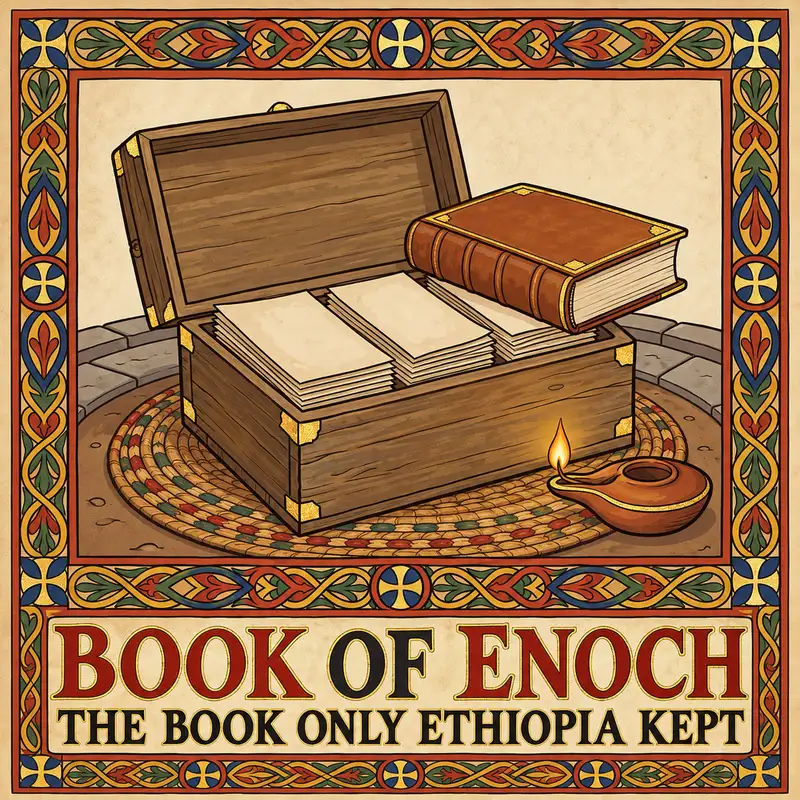
Welcome to The Sleeping Almanac. Tonight, the middle of the season, and the middle of a book, and the middle of a box. I have been telling you for five nights about the copyist on the hill, and the book he is copying, and the last gathering he has been filling by lamplight since the fourth night. I have told you what is in that gathering, the child who lit the room, and I have told you what is on the shelf behind him, the heavy book with the years counted. What I have not told you is what is already in the box. Because the box is nearly full, and most of what is in it he copied months ago, in the dry season, and a great part of it is a thing that exists, on this earth, in his language and in no other. Thirty five chapters of the Book of Enoch, from the thirty seventh to the seventy first, not found among the identified cave fragments or surviving Greek witnesses, and preserved in the Ge'ez manuscript tradition. The Book of Parables. The book only Ethiopia kept. I told you on the second of the special nights, when we sat at the long tables in the room with the windows shut, with the fragments on glass, that this section was absent from the caves, and that an absence is only an absence. I am going to keep to that. But I am going to open it tonight, all of it, because it is the one part of the season's first book that belongs to the Ethiopian manuscript tradition, and because it is, I think, the strangest and most beautiful thing in that whole strange and beautiful book. A figure with a head white like wool. Beside him, one who looks like a man. Four voices around a throne, and the fourth voice keeping the accusers out. Wisdom coming down to look for a house and going home again. Six mountains of metal that melt like wax. Two monsters parted on one day, one for the sea and one for the desert. Angels flying north with measuring cords. The oath that holds the sea behind the sand. And at the end of it, a name given to the man who has been watching all of this, that later readers in another religion would recognise, and argue about, for two thousand years. And then, because it is the copyist's night, the rest of what is in his box that the surviving cave fragments do not preserve in full. Two dreams Enoch had before he took a wife, one as a boy, of the sky falling, and one that runs the whole history of the world as a story about cattle and sheep, with a white bull at the start and a white bull at the end. And ten weeks, into which the whole of time is folded, that end with a new heaven and many weeks without number. I want to say one thing at the door, and once. The man beside the white haired one is called, in this book, the Son of Man. Christian readers, later, hearing that name, thought of someone. I will tell you that they did, and when, and I will not tell you they were right or wrong, because this is a Jewish book, written before or around the time of Jesus, without naming Jesus, and it says what it says, and later readers made of it what they made. That is the rule for the whole season. It is the rule tonight. We are on the hill. The round church, the rain, the lamp. He has the board across his knees and the last gathering on it, but tonight, before he writes, he has lifted the lid of the box, and he is looking at the leaves that are already done. There is a place for you here, on the bench by the wall, in the dry. If this story carries you down toward sleep, subscribe now, while your eyes are still open, and the next night will be waiting for you when you need it. Nothing else is expected of you. You do not have to do anything now.
Let me tell you what is in the box, and then let me tell you why it matters, and then we will read. The copyist is copying Mashafa Henok, the Book of Enoch, from an old copy to a new one, on parchment, in Ge'ez, in gatherings of leaves that will be sewn together at the end. The old book on his shelf is one book from its first leaf to its last. He does not think of it as sections. But it is. It is five books that were written at different times by different hands and later gathered into one, and the five are these, and you know most of them. The Book of the Watchers, chapters one to thirty six, which is the descent and the judgment and the journeys, and which the season began with. The Book of Parables, thirty seven to seventy one, which is tonight. The Book of the Luminaries, seventy two to eighty two, the sky book, the calendar. The Dream Visions, eighty three to ninety, which are also tonight. And the last book, the Epistle, ninety one to a hundred and eight, which holds the Apocalypse of Weeks, also tonight, and the birth of Noah, which was the third night. Now here is the thing, and it is the whole of the first layer. Of those five books, four were found in the caves. In Aramaic, the language they were written in, in pieces, on the floor of the fourth cave, sorted on glass over decades by the man with the fastest hands in the world. The Watchers, in pieces. The Luminaries, in pieces that point to a longer form of the book than the Ge'ez preserves. The Dream Visions, in pieces. The Epistle, in pieces. And the Book of Parables, not one word. Not a scrap. Not a letter. Thirty five chapters in the middle of the book, and the desert, which kept pieces of everything else, had none of it. And the Greek, which is the second language the book survived in, in the grave at Akhmim and in the Chester Beatty papyrus and in the quotations of the chroniclers, has none of it either. And the Latin scrap has none of it. So the Book of Parables survives in Ge'ez, within the Ethiopian manuscript tradition. Those manuscripts have travelled to libraries elsewhere too, but the copyist's copy is here, on his shelf and in his box. What do you do with that. There are two things people have done with it, and I will give you both, and then set them down. The first is to say that the Parables were not part of the book when the caves were filled. That they were written later, by somebody else, and added to the book afterwards, in Greek or in Ge'ez, and that the reason they are absent from the desert is that they did not exist yet. Some scholars have thought that, and some have thought it was written by Christians, because of the name I told you about at the door. The second is to say that the caves were one library, with one taste, and that they did not keep the Parables for the same reason they did not keep a great many things, and that the Parables are as Jewish and as old as the rest, or nearly. Most scholars now think the second. The book's ideas are Jewish, many scholars find a Semitic language beneath the Ge'ez, it never mentions anything a Christian would have mentioned, and it is dated, by most, to somewhere in the hundred years on either side of the year we count from. Before Jesus, or around him, or just after, in a text that does not name Jesus. That is the honest range and I will not narrow it. And an absence is only an absence. The caves are a library, not the world. The desert kept what it was given. And the hill kept what it was given, which was all five books, in one, and never asked which of them the desert had. That is the whole of the first layer, and it is the reason this night is the copyist's. He is the only reader in this story who has never had to wonder whether the middle of his book is real. It is in the box. He copied it in the dry season. He remembers the leaves. One more thing about the object, and then the book. The copyist's Enoch came into Europe by the road I told you about in the special, the traveller and the manuscripts and the Oxford translation fifty years later, and I will not tell that again. But I want you to know what the first European readers made of the middle of it, because it is the beginning of the third layer. They read the Parables, in Ge'ez, in the eighteen twenties, and they found the Son of Man sitting on a throne of glory, and the kings and the mighty, and the name named before the sun was made, and they were astonished, and the argument about what this book was, and when it was written, and whether the name in it looked forward or only looked up, began then and has not finished. It is the only argument in the whole Book of Enoch that is really about the middle, and the middle is among the pages preserved in Ethiopia. So the argument, whatever it decides, is an argument about a thing that Ethiopia kept, and that nobody else could have had the argument without.
The book begins by saying what it is, and it says it the way the old books do, with a genealogy. The second vision which he saw, it says, the vision of wisdom, which Enoch the son of Jared, the son of Mahalalel, the son of Cainan, the son of Enos, the son of Seth, the son of Adam, saw. Seven names, back to the first man, and the seventh from Adam is the one speaking. And then he speaks. Hear, ye men of old time, and see, ye that come after, the words of the Holy One which I will speak before the Lord of Spirits. The Lord of Spirits. You will hear that name all night, and you have not heard it before, because the Watchers book does not use it. It is this book's name for God, and it is one of the ways you can tell that a different hand wrote it. The Lord of Spirits, over and over, as if the writer could not say it enough. And Enoch says, till the present day such wisdom has never been given by the Lord of Spirits as I have received. Now three parables were imparted to me, and I lifted up my voice and recounted them to those that dwell on the earth. Three parables. That is the shape of the book. A parable, in this book, is not a little story with a lesson. It is a vision, a long one, of what is hidden, told as a likeness, because what is hidden cannot be told any other way. And the first parable begins, not with a picture, but with a question. When the congregation of the righteous shall appear, the book says, and sinners shall be judged for their sins and driven from the face of the earth, and when the Righteous One shall appear before the eyes of the righteous, where then will be the dwelling of the sinners, and where the resting place of those who have denied the Lord of Spirits. It had been good for them if they had not been born. That is the book's whole weather, in one breath. A day is coming. On that day the righteous will be seen, and the ones who have denied the Lord of Spirits will have nowhere to be. And then the book says who it means, and it is not who you might think. Not the Watchers. Not the giants. Then shall the kings and the mighty perish, the book says, and be given into the hands of the righteous and holy. The kings and the mighty. You will hear that phrase as often as the Lord of Spirits, and it is the other way you can tell a different hand wrote this. The Watchers book was angry at angels. This book is angry at kings. Whoever wrote it had been ruled by somebody, and had not liked it, and had looked up. And then the whirlwind. And in those days, Enoch says, a whirlwind carried me off from the earth, and set me down at the end of the heavens. And there I saw another vision, the dwelling places of the holy, and the resting places of the righteous. Here mine eyes saw their dwellings with His righteous angels, and their resting places with the holy. And they petitioned and interceded and prayed for the children of men, and righteousness flowed before them as water, and mercy like dew upon the earth. That is the first picture, and I want you to keep it, because the book will come back to it at the end. A place at the end of the heavens where the righteous rest, with the angels, and the thing they do there is pray for the people below. Here, in this scene, they pray for the people below. Righteousness like water and mercy like dew. And Enoch says, there I wished to dwell, and my spirit longed for that dwelling place, and there heretofore hath been my portion, for so has it been established concerning me before the Lord of Spirits. He is looking at his own future home, and he knows it. And then the ones who do not sleep. Those who sleep not bless Thee, Enoch says, they stand before Thy glory and bless, praise, and extol, saying, Holy, holy, holy, is the Lord of Spirits, He filleth the earth with spirits. And here my eyes saw all those who sleep not, they stand before Him and bless. Holy, holy, holy. You know that from Isaiah, and from every liturgy since, and here it is, in the Parables, in the mouths of the ones who never sleep, whose whole work is to stand and say it. And Enoch says, and my face was changed, for I could no longer behold. And Enoch says one thing more about the place before he leaves it, and I give it to you because it is the book's own idea of what praise is for. He knows before the world was created, Enoch says of the Lord of Spirits, what is for ever and what will be from generation unto generation. Those who sleep not bless Thee. The blessing is not information. He already knows. The ones who do not sleep stand and say it anyway, because that is what standing before him is, and because somebody has to, always, in every hour, so that there is never an hour in which it is not being said. That is where the first parable pauses, and it is where I want to pause too, on the ones who sleep not, because you are going to. Somebody has to stay awake and say the three words, and it is not you, and it never was. That is the arrangement. They stand. You lie down.
And after that, Enoch says, I saw thousands of thousands and ten thousand times ten thousand, I saw a multitude beyond number and reckoning, who stood before the Lord of Spirits. You have heard that number before, on the first of the special nights, in the house of fire and ice. It is the same number. This book borrowed it. And on the four sides of the Lord of Spirits, Enoch says, I saw four presences, different from those that sleep not, and I learnt their names, for the angel that went with me made known to me their names, and showed me all the hidden things. Four presences. Four voices. And Enoch listens to what each of them is saying, and this is the passage I brought you here for, because it is the gentlest thing in the whole book about how the world is looked after. The first voice, he says, blesses the Lord of Spirits for ever and ever. And the second voice I heard blessing the Elect One and the elect ones who hang upon the Lord of Spirits. And the third voice I heard pray and intercede for those who dwell on the earth and supplicate in the name of the Lord of Spirits. And I heard the fourth voice fending off the Satans and forbidding them to come before the Lord of Spirits to accuse them who dwell on the earth. Four voices, four jobs. One blesses. One blesses the chosen. One prays for the people. And one stands at the door and keeps the accusers out. Fending off the Satans, the book says, and it means what the Jubilees book meant last time we were here, the ones whose whole work is to stand in the court and say, look what they have done. The fourth voice will not let them in. That is its only work. And Enoch asks who they are, and the angel of peace who went with him tells him. This first is Michael, the merciful and long suffering. And the second, who is set over all the diseases and all the wounds of the children of men, is Raphael. And the third, who is set over all the powers, is Gabriel. And the fourth, who is set over the repentance unto hope of those who inherit eternal life, is named Phanuel. Phanuel. You have not heard that name before, and there is no angel by that name anywhere in the Bible, though a woman in Luke's gospel has a father called Phanuel. In the Watchers book the four are Michael, Raphael, Gabriel and Uriel, and Uriel is the one who shows Enoch the sky. Here the fourth is Phanuel, and he is not the angel of the stars. He is the angel of repentance, the one who stands over the hope of the people who turn back, and the one who keeps the accusers out. The book has changed one of the four, and the one it chose is the one whose job is to make sure that when you turn back, nobody in the court is allowed to say what you were. And then the secrets, which I will only touch, because the sky book has had its night. Enoch is shown the chambers of the winds, and the chamber of the hail, and the mist and the clouds, and the chambers of the sun and moon, and how they keep faith with each other, in accordance with the oath by which they are bound together. Hold that word. Oath. It comes back near the end, and it is the strangest thing in the book. And Enoch says, for no angel hinders and no power is able to hinder, for He appoints a judge for them all and He judges them all before Him. And then, in the middle of the secrets, a little poem, three verses, that is in no other book on earth, and that people who love this book love above every other part of it. It is about Wisdom, as a woman, looking for somewhere to live. Wisdom found no place where she might dwell, the book says. Then a dwelling place was assigned her in the heavens. Wisdom went forth to make her dwelling among the children of men, and found no dwelling place. Wisdom returned to her place, and took her seat among the angels. And unrighteousness went forth from her chambers. Whom she sought not she found, and dwelt with them, as rain in a desert and dew on a thirsty land. Read that again slowly, because it is sad and it is not bitter. Wisdom came down to look for a house among us and nobody had a room, and she went home and sat with the angels. And unrighteousness came down and did not even have to look. She found people she was not looking for, and moved in, and was welcomed like rain. That is the writer's whole view of his own time, in six lines, and he does not shout it. He says it the way you would say the weather. And then he goes on to the lightnings, and the stars weighed in a balance according to their light, and the angel tells him that the stars are the names of the holy who dwell on the earth. Every righteous person is a star, weighed, and called by name. That is the end of the first parable. It began with a question about where the sinners would rest, and it ends with the stars being the names of the good.
The second parable begins, and it begins with a picture that is older than the book and will outlast it, and I am going to give it to you as the book gives it, which is quietly, in one sentence, as if it were nothing. And there I saw One who had a head of days, Enoch says, and His head was white like wool, and with Him was another being whose countenance had the appearance of a man, and his face was full of graciousness, like one of the holy angels. That is all. A head of days. An old one, so old that his age is what he is made of, and his hair white like wool. And beside him, someone who looks like a man. You know where that comes from, if you know Daniel, because Daniel saw an Ancient of Days with hair like pure wool, and one like a son of man coming on the clouds to him, and this book has read Daniel and taken the picture and done something with it that Daniel did not do. It has asked who the one like a man is. And I asked the angel who went with me, Enoch says, concerning that Son of Man, who he was, and whence he was, and why he went with the Head of Days. And the angel answers. This is the Son of Man who hath righteousness, with whom dwelleth righteousness, and who revealeth all the treasures of that which is hidden, because the Lord of Spirits hath chosen him, and whose lot hath the pre eminence before the Lord of Spirits in uprightness for ever. And this Son of Man whom thou hast seen shall raise up the kings and the mighty from their seats, and the strong from their thrones, and shall loosen the reins of the strong, and break the teeth of the sinners. There it is. The one beside the white haired one has a name, and the name is the Son of Man, and his work is the kings and the mighty. He puts them down. Because they do not extol and praise Him, the book says, nor humbly acknowledge whence the kingdom was bestowed upon them. And it goes on, and it is the hardest passage in the parable, and I will give you one line of it and then let it go. Darkness shall be their dwelling, and worms shall be their bed. That is what the book thinks of kings. Set it down. And then the book does the thing that made the argument. In the forty eighth chapter, in the place of the fountain of righteousness, it says, and at that hour that Son of Man was named in the presence of the Lord of Spirits, and his name before the Head of Days. Yea, before the sun and the signs were created, before the stars of the heaven were made, his name was named before the Lord of Spirits. Named before the sun. That is the sentence. And then, he shall be a staff to the righteous whereon to stay themselves and not fall, and he shall be the light of the Gentiles, and the hope of those who are troubled of heart. And for this reason hath he been chosen and hidden before Him, before the creation of the world and for evermore. A figure who looks like a man, chosen and hidden before the world was made, whose name was named before the stars, who will be a staff to the righteous and a light to the nations and the hope of the troubled of heart, and who will sit, the book says a little later, on the throne of glory and judge. Now you can hear why the argument began in the eighteen twenties and has not stopped. If you are a Christian, you have heard that before, in the Gospels, in the letters, and it may be strange to hear a Jewish book saying it too. If you are a scholar, you look at the language and the ideas and the caves and you say, this is a Jewish book, and the Gospels were written inside the same Jewish world, and the picture was in the air, and the Gospels breathed it. If you are the copyist, you have never once thought about it, because in his church the Book of Enoch and the Gospels have stood on the same shelf for as long as there has been a shelf, and a thing said in both of them is not a problem to be solved. It is a thing said twice. I am going to give you the honest version and then let you sleep on it. The Parables are a Jewish book. The Son of Man in them is a heavenly figure, chosen and hidden, who will judge the kings and gather the righteous, and he is not named as any person on earth, and nobody in the book has met him. The Gospels use the same title, and some of the same pictures, the throne of glory, the coming, the gathering, and scholars have argued for two hundred years about whether the people who wrote the Gospels had read this book, or only breathed the same air, and the honest answer is that nobody knows, and that it does not matter as much as either side wants it to. What matters, for tonight, is that the picture exists. A white haired one and a man beside him, and the man is the hope of the troubled of heart. Whoever wrote that, in whatever year, wanted somebody to be waiting for the people who were troubled of heart. That is not a claim about history. It is a wish, made carefully, in Ge'ez, on the hill.
And the book goes on into the second parable, and it becomes a book of pictures, one after another, each one strange, each one set down and left, and I am going to walk you through them the way the whirlwind walked Enoch, and not stay long at any. The earth gives back. And in those days, the book says, shall the earth also give back that which has been entrusted to it, and Sheol also shall give back that which it has received, and hell shall give back that which it owes. And the Elect One shall in those days sit on My throne, and his mouth shall pour forth all the secrets of wisdom and counsel. And in those days shall the mountains leap like rams, and the hills also shall skip like lambs satisfied with milk, and the faces of all the angels in heaven shall be lighted up with joy. The dead given back like a thing that was lent. The hills skipping like lambs that have had their milk. The angels' faces lit up. That is the book's picture of the end, and it is not a fire. It is a return. Then the mountains. And after those days, Enoch says, in that place where I had seen all the visions of that which is hidden, for I had been carried off in a whirlwind and they had borne me towards the west, there mine eyes saw all the secret things of heaven that shall be, a mountain of iron, and a mountain of copper, and a mountain of silver, and a mountain of gold, and a mountain of soft metal, and a mountain of lead. Six mountains, each of a metal. And Enoch asks what they are, and the angel says, all these things which thou hast seen shall serve the dominion of His Anointed that he may be potent and mighty on the earth. And then, this. These mountains which thine eyes have seen, the mountain of iron, and the mountain of copper, and the mountain of silver, and the mountain of gold, and the mountain of soft metal, and the mountain of lead, all these shall be in the presence of the Elect One as wax before the fire, and like the water which streams down from above upon those mountains, and they shall become powerless before his feet. And it shall come to pass in those days that none shall be saved, either by gold or by silver, and none be able to escape. And there shall be no iron for war, nor shall one clothe oneself with a breastplate. Bronze shall be of no service, and tin shall not be esteemed, and lead shall not be desired. Six mountains of metal melting like wax. It is the Watchers' crafts again, if you remember the first special, the metals that Azazel taught, the sword and the breastplate and the ornaments. This book takes the whole of that teaching and makes it into six mountains, and then melts them. No iron for war. No breastplate. No gold to buy your way out. It is the gentlest picture of disarmament ever written, and it is written as geography. The mountains just go soft. Then the valleys, and I will be quick, because the rule is one image and away. A deep valley with open mouths, where the kings of the earth bring their gifts, and it never fills. A valley of fire, and iron chains of immeasurable weight being made, and Enoch asks for whom, and the angel says, for the hosts of Azazel, and Michael and Gabriel and Raphael and Phanuel shall take hold of them on that great day. That is the judgment of the first night, retold in a sentence, from a distance, by a different hand. And away. And then, in the middle of the second parable, a thing that the old edition treats as a fragment of a lost Book of Noah, woven into the Parables, and it is about the flood, and it is very short, and it has in it the one line in the whole Book of Enoch that I would keep if I could keep only one. And after that, the book says, the Head of Days repented and said, in vain have I destroyed all who dwell on the earth. And He sware by His great name, henceforth I will not do so to all who dwell on the earth, and I will set a sign in the heaven, and this shall be a pledge of good faith between Me and them for ever, so long as heaven is above the earth. In vain have I destroyed all who dwell on the earth. Genesis has the bow in the cloud and the promise. This book has the regret. The Head of Days, the white haired one, looking at what the flood did and saying, that was for nothing. And then the sign. I do not know who wrote that sentence. Nobody does. But the copyist has copied it, in the dry season, and it is in the box, and it is the reason, I think, that this book sits so easily on his shelf beside the Gospels, because it is a book in which God can say he was sorry.
The third parable begins with a blessing, and then it turns into a book of weather, and I am going to give you the weather slowly, because it is the best sleep text in the Book of Enoch and it comes at the right time. Blessed are ye, ye righteous and elect, Enoch says, for glorious shall be your lot. And the righteous shall be in the light of the sun, and the elect in the light of eternal life. The days of their life shall be unending, and the days of the holy without number. And there shall be a light that never endeth. That is the whole of the third parable's promise, said at the door. Then comes the strange part. In the year five hundred, the book says, in the seventh month, on the fourteenth day of the month, in the life of Enoch. And here the scholars stop and say that it should say Noah, because what follows is Noah's, another piece of the lost book sewn in, and I will tell it as the book tells it, with the seam showing. In that parable I saw how a mighty quaking made the heaven of heavens to quake, and the host of the Most High, and the angels, a thousand thousands and ten thousand times ten thousand, were disquieted with a great disquiet. And the Head of Days sat on the throne of His glory, and the angels and the righteous stood around Him. And a great trembling seized me, and fear took hold of me, and my loins gave way, and I fell upon my face. And Michael sent another angel from among the holy ones and he raised me up, and when he had raised me up my spirit returned. And then the monsters. And on that day, the book says, were two monsters parted, a female monster named Leviathan, to dwell in the abysses of the ocean over the fountains of the waters. But the male is named Behemoth, who occupied with his breast a waste wilderness, on the east of the garden where the elect and righteous dwell, where my grandfather was taken up, the seventh from Adam, the first man whom the Lord of Spirits created. Leviathan and Behemoth. You know them from Job, where God shows them to a man who has asked too many questions. Here they are parted, on one day, one for the sea and one for the dry land, and Enoch, or Noah, asks to be shown their might, and the angel says something to him that I want you to hear, because it is the only time in this book anyone is told no. Thou son of man, the angel says, herein thou dost seek to know what is hidden. And that is all. The monsters are not explained. They are placed, one in the deep and one in the desert east of the garden, and left there, and the book moves on to what it will explain, which is everything else. And what it explains is the weather, and this is the part. The other angel told me, the book says, what is first and last in the heaven in the height, and beneath the earth in the depth, and at the ends of the heaven, and on the foundation of the heaven. And the chambers of the winds, and how the winds are divided, and how they are weighed. And the thunders according to the places where they fall. For the thunder has places of rest which are assigned to it while it is waiting for its peal. Listen to that. The thunder has a place where it waits. And the thunder and lightning are inseparable, the book says, and although not one and undivided, they both go together through the spirit and separate not. For when the lightning lightens, the thunder utters its voice, and the spirit enforces a pause during the peal, and divides equally between them. Somebody, a very long time ago, lay awake in a storm and counted the pause between the flash and the sound, and decided that a spirit was holding the thunder back for a moment, on purpose, so that the two would not come at once. That is the whole of natural philosophy in this book. Not how. Who. And the spirit of the sea is masculine and strong, the book says, and according to the might of his strength he draws it back with a rein. And the spirit of the hoar frost is his own angel, and the spirit of the hail is a good angel. And the spirit of the snow has forsaken his chambers on account of his strength, and that which ascends from it is like smoke, and its name is frost. And the spirit of the mist is not united with them in their chambers, but it has a special chamber, for its course is glorious both in light and in darkness, and in winter and in summer, and in its chamber is an angel. And the spirit of the dew has its dwelling at the ends of the heaven, and is connected with the chambers of the rain. And when the spirit of the rain goes forth from its chamber, the angels come and open the chamber and lead it out, and when it is diffused over the whole earth it unites with the water on the earth. For the waters are for those who dwell on the earth, for they are nourishment for the earth from the Most High who is in heaven, therefore there is a measure for the rain, and the angels take it in charge. There is a measure for the rain, and the angels take it in charge. That is what is falling on the roof of the church tonight. Measured. Led out of its chamber by somebody whose job that is. The hail is a good angel. The mist has a room of its own because it works in the dark as well as the light. The dew lives at the edge of the sky next door to the rain. I have read a great many books about weather and none of them is kinder than this one, and I want you to fall asleep tonight inside it, with the rain measured, and the thunder waiting in its place of rest, and not coming.
Two more pictures from the third parable, and then the name, and then we go to the dreams. The first is the measuring. And I saw in those days, Enoch says, how long cords were given to those angels, and they took to themselves wings and flew, and they went towards the north. And I asked the angel, saying unto him, why have those angels taken these cords and gone off. And he said unto me, they have gone to measure. And the angel who went with me said unto me, these shall bring the measures of the righteous, and the ropes of the righteous to the righteous, that they may stay themselves on the name of the Lord of Spirits for ever and ever. And these measures shall reveal all the secrets of the depths of the earth, and those who have been destroyed by the desert, and those who have been devoured by the beasts, and those who have been devoured by the fish of the sea, that they may return and stay themselves on the day of the Elect One. For none shall be destroyed before the Lord of Spirits, and none can be destroyed. Angels with cords, flying north, to measure. To measure what. A place, the book says later, for the elect and righteous, the dwelling Enoch saw in the first parable and longed for. But also, and this is the part, to find everyone. The ones the desert took. The ones the beasts took. The ones the fish took, who have no grave and no name and nobody to say where they went. The cords find them. None shall be destroyed, and none can be destroyed. Whoever wrote this had lost somebody to the sea, or the desert, I am nearly sure of it, and wrote an angel with a rope to go and get them. The second picture is the oath, and it is the strangest thing in the book, and I have been holding it since the third chapter. Near the end of the third parable there is a list of the Watchers again, the twenty one leaders, with names that are not quite the names of the first book, and a few of them are given new crafts. One taught writing with ink and paper, and the book says, and thereby many sinned from eternity to eternity and until this day, for men were not created for such a purpose, to give confirmation to their good faith with pen and ink. A book, on the hill, being copied with pen and ink, that says pen and ink were a fallen angel's idea. The copyist has copied that sentence. I do not know what he thought. I think he thought nothing. It is on the page. And then the oath. There is a chief of the oath, the book says, whose name I will not give you, because the book says it once and never needs it again, and neither do we, and he asked Michael to show him the hidden name, that he might enunciate it in the oath, and this is the power of this oath, for it is powerful and strong. And the heaven was suspended before the world was created, and for ever. And through it the earth was founded upon the water. And through that oath the sea was created, and as its foundation He set for it the sand against the time of its anger, and it dare not pass beyond it from the creation of the world unto eternity. And through that oath are the depths made fast, and abide and stir not from their place from eternity to eternity. And through that oath the sun and moon complete their course, and deviate not from their ordinance from eternity to eternity. And through that oath the stars complete their course, and He calls them by their names, and they answer Him from eternity to eternity. An oath that holds the sea behind a line of sand. That keeps the sun on its path and the deeps in their place and the stars answering to their names. The book does not say what the words of the oath are. It says there is one, and that everything that stays where it is stays because of it, and that the sea, which is angry, dare not cross the sand because of a promise made before the world. That is the physics of this book. Not law. Oath. The sea keeps its word. And the third parable closes, and I will give you the close because it is the turn of the whole book. And there was great joy amongst them, and they blessed and glorified and extolled, because the name of that Son of Man had been revealed unto them. And he sat on the throne of his glory, and the sum of judgment was given unto the Son of Man. And from henceforth there shall be nothing corruptible, for that Son of Man has appeared, and has seated himself on the throne of his glory, and all evil shall pass away before his face. And before it closes, one more thing, because it is for you and not for the kings. The book gives the kings and the mighty a last speech, when they see the Son of Man on his throne, and it is the only time in the book they are allowed to be sorry, and it is too late, and they know it. Would that we had rest to glorify and give thanks, they say, and confess our faith before His glory. And now we long for a little rest but find it not. We follow hard upon and obtain it not. That longing for rest comes after the book has accused the mighty of oppression and wrongful gain. The rest they seek is a respite from judgment, too late to undo what they did. And against that the book sets the righteous, and gives them, of all things, clothes. And the righteous and elect shall have risen from the earth, it says, and ceased to be of downcast countenance. And they shall have been clothed with garments of glory, and these shall be the garments of life from the Lord of Spirits, and your garments shall not grow old, nor your glory pass away. Garments that do not grow old. A book written by somebody who had watched cloth wear thin, and mended it, and wanted, for the good, one thing that would not need mending. And with that Son of Man shall they eat, it says, and lie down and rise up for ever and ever. Eat, and lie down, and rise up. That is the whole of the promised life in this book. A table, a bed, a morning. Nothing else was wanted. This is the Third Parable of Enoch.
And then two more chapters, after the three parables are finished, that the book calls Enoch's translation, his being taken up, and they are the chapters the whole argument is about, and I am going to read them to you nearly whole, and then tell you what happened in them, because something does. And it came to pass after this, the book says, that his name during his lifetime was raised aloft to that Son of Man and to the Lord of Spirits from amongst those who dwell on the earth. And he was raised aloft on the chariots of the spirit and his name vanished among them. And from that day I was no longer numbered amongst them, and he set me between the two winds, between the North and the West, where the angels took the cords to measure for me the place for the elect and righteous. And there I saw the first fathers and the righteous who from the beginning dwell in that place. So Enoch is taken up, and put in the place the cords measured, with the first fathers. And then the last chapter, the seventy first, which is a second ascent, higher. And it came to pass after this that my spirit was translated and it ascended into the heavens. And I saw the holy sons of God. They were stepping on flames of fire. Their garments were white, and their faces shone like snow. And I saw two streams of fire, and the light of that fire shone like hyacinth, and I fell on my face before the Lord of Spirits. And the angel Michael seized me by my right hand, and lifted me up and led me forth into all the secrets. And he translated my spirit into the heaven of heavens, and I saw there as it were a structure built of crystals, and between those crystals tongues of living fire. And my spirit saw the girdle which girt that house of fire, and on its four sides were streams full of living fire, and they girt that house. And round about were Seraphin, Cherubin, and Ophannin, and these are they who sleep not and guard the throne of His glory. And I saw angels who could not be counted, a thousand thousands, and ten thousand times ten thousand, encircling that house. And Michael, and Raphael, and Gabriel, and Phanuel, and the holy angels who are above the heavens, go in and out of that house. You have been in that house before. On the first special night, the house of fire and ice, the greater house, the throne. This is the same house, built again by the second hand, of crystal and living fire, with the four going in and out of it. And then, out of it, this. And they came forth from that house, and Michael and Gabriel, Raphael and Phanuel, and many holy angels without number. And with them the Head of Days, His head white and pure as wool, and His raiment indescribable. And I fell on my face, and my whole body became relaxed, and my spirit was transfigured, and I cried with a loud voice, with the spirit of power, and blessed and glorified and extolled. And these blessings which went forth out of my mouth were well pleasing before that Head of Days. And then the angel speaks to Enoch, and here is the sentence, and here is the argument. In the old translation I am reading from, the one made in Oxford before the first war, the angel says, This is the Son of Man who is born unto righteousness, and righteousness abides over him, and the righteousness of the Head of Days forsakes him not. This is. As if the angel were pointing at someone else, the way he pointed in the forty sixth chapter. The printed English makes the angel point away from Enoch. Many later translators instead keep the address to Enoch himself. Thou art. Thou art the Son of Man who is born unto righteousness. Even then, readers differ over whether the words name the heavenly judge or call Enoch a son of man, a human being transformed by what he has seen. Thou art. On one influential reading, Enoch, who has been shown the Son of Man and asked who he was, discovers at the end that he is that figure. The watcher becomes the one he watched. Other readers hear a different address, one that honours Enoch without making him the heavenly judge. The words are there, and the interpretation is the question. And he said unto me, the book goes on, he proclaims unto thee peace in the name of the world to come, for from hence has proceeded peace since the creation of the world, and so shall it be unto thee for ever and for ever and ever. And all shall walk in his ways since righteousness never forsaketh him. With him will be their dwelling places, and with him their heritage, and they shall not be separated from him for ever and ever and ever. And so there shall be length of days with that Son of Man, and the righteous shall have peace and an upright way in the name of the Lord of Spirits for ever and ever. That is where the Parables end. On peace, said three times, and length of days, and an address to the man who has been watching. One reading makes Enoch himself the heavenly Son of Man. That is a striking way to hear the ending, but it is not the only one. Traditional Ethiopian commentators have distinguished Enoch from the heavenly judge, whom they identify with Christ. They can hear Enoch called a son of man without making him that judge. The same preserved words can carry an argument among readers, and we should not make the copyist settle it for us. He has copied thou art, in his own hand. The book belongs among his church's scriptures. How that church reads a difficult line deserves the same care as the words it kept. Set it down, the whole of the Parables, thou art and all. It is the book only Ethiopia kept, and you have heard it now, all three parables and the ascent, which the surviving cave, Greek and Latin witnesses do not preserve for us. Now the dreams, which are older, and which are about animals.
The Dream Visions are the fourth book of the five, and they are older than the Parables, and the caves had them, in pieces, in Aramaic, so they are not the hill's alone. But they are the copyist's, in the box, in full, and they belong tonight because they are the other thing Enoch saw before he was taken, and because the second of them is the strangest way anyone ever told the history of the world. There are two dreams, and Enoch tells them to his son. And now, my son Methuselah, he says, I will show thee all my visions which I have seen, recounting them before thee. Two visions I saw before I took a wife, and the one was quite unlike the other, the first when I was learning to write, the second before I took thy mother. When I was learning to write. He was a boy. And the first dream is a boy's dream, and it is short, and it is the end of the world. I had laid me down in the house of my grandfather Mahalalel, Enoch says, when I saw in a vision how the heaven collapsed and was borne off and fell to the earth. And when it fell to the earth I saw how the earth was swallowed up in a great abyss, and mountains were suspended on mountains, and hills sank down on hills, and high trees were rent from their stems, and hurled down and sunk in the abyss. And thereupon a word fell into my mouth, and I lifted up my voice to cry aloud, and said, the earth is destroyed. And my grandfather Mahalalel waked me as I lay near him, and said unto me, why dost thou cry so, my son, and why dost thou make such lamentation. A boy waking up shouting that the earth is destroyed, and his grandfather beside him. And the grandfather does not say, it was only a dream. He says, a terrible thing hast thou seen, my son, and of grave moment is thy dream vision as to the secrets of all the sin of the earth, it must sink into the abyss and be destroyed with a great destruction. And now, my son, arise and make petition to the Lord of glory, since thou art a believer, that a remnant may remain on the earth. So the boy gets up and prays. And I want you to have the morning after, because the book gives it, and it is the loveliest thing in the Dream Visions. And when I had gone forth below, Enoch says, and seen the heaven, and the sun rising in the east, and the moon setting in the west, and a few stars, and the whole earth, and everything as He had known it in the beginning, then I blessed the Lord of judgment and extolled Him because He had made the sun to go forth from the windows of the east. A boy who dreamed the sky fell, going out at dawn and seeing that it had not, and the sun coming up through its gate. That is the first dream, and that is the whole of it, and I would sleep on that alone. The second dream is the long one, and it begins like this. Before I took thy mother Edna, Enoch says, I saw in a vision on my bed, and behold a bull came forth from the earth, and that bull was white. And after it came forth a heifer, and along with this came forth two bulls, one of them black and the other red. And that black bull gored the red one and pursued him over the earth, and thereupon I could no longer see that red bull. You know who they are. You are meant to. The white bull is Adam, and the heifer is Eve, and the black bull is Cain and the red one is Abel, and he is gone. The whole of Genesis and the whole of the Bible after it, told as animals, with no names, so that you have to know the story to know who is who, and if you know it, you will not miss a step. And that cow, that first one, went from the presence of that first bull in order to seek that red one, but found him not, and lamented with a great lamentation over him and sought him. Eve looking for Abel. Genesis does not have that. This does. And then the star. And again I saw with mine eyes as I slept, Enoch says, and I saw the heaven above, and behold a star fell from heaven, and it arose and ate and pastured amongst those oxen. And again I saw in the vision, and looked towards the heaven, and behold I saw many stars descend and cast themselves down from heaven to that first star, and they became bulls amongst those cattle and pastured with them. And they all became pregnant and bare elephants, camels, and asses. And all the oxen feared them and were affrighted at them, and began to bite with their teeth and to devour, and to gore with their horns. That is the Watchers, from the first night of this season and the first of the specials, told again, by an older hand than the Parables, in nine lines, as stars that fell and became bulls, and their children as elephants and camels and asses, beasts too big for the pasture, that ate the cattle. The book does not say Watchers. It does not say Shemihazah. It says a star fell, and then many, and the herd was afraid. And then, and behold there came forth from heaven beings who were like white men, and four went forth from that place and three with them. Seven who look like men, dressed in white. The four are the four you know. And the three took Enoch by the hand and raised him up to a lofty place, and showed him a tower raised high above the earth, and all the hills were lower, and one said unto him, remain here till thou seest everything that befalls those elephants, camels, and asses, and the stars and the oxen, and all of them. And from the tower he watches the four do their work. One seized that first star which had fallen from the heaven, and bound it hand and foot and cast it into an abyss. One drew a sword and gave it to the elephants and camels and asses, and they began to smite each other. One gathered all the great stars and bound them all hand and foot and cast them in an abyss of the earth. And one went to that white bull and instructed him in a secret, without his being terrified, and he was born a bull and became a man, and built for himself a great vessel and dwelt thereon. Noah, a bull who became a man, because he was told a secret and was not afraid. And the roof of the sky opened seven torrents, and the water rose, and the vessel floated, and everything else sank, and the water ran down into the chasms, and the vessel settled, and the darkness retired and light appeared. That is the flood, in a dream, from a tower, with the animals gone under. The season has had the flood more than once now, and this is the shortest telling, and the kindest, because from that height you cannot hear anything.
And out of the vessel come three bulls, white and red and black, and from them the beasts of the field, lions and wolves and dogs and boars and foxes and every bird, and among them, the book says, was born a white bull, and from him a wild ass and a white bull, and from that one a black wild boar and a white sheep. And that sheep begat twelve sheep. So the people become sheep. Abraham is the white bull, Ishmael the wild ass, Isaac the white bull, Esau the boar, Jacob the sheep, and his twelve. And from here the dream is the history of Israel told as a flock among wild beasts, and I am going to give it to you fast and gently, because it is a long story you already know and the dream's whole art is that you know it. The twelve sheep gave one of them to the asses, and the asses gave him to the wolves, and that sheep grew up among the wolves, and the Lord brought the eleven to live with it among the wolves. Joseph, sold, and Egypt. And the wolves oppressed them, and cast their young into a river, and the sheep cried, and a sheep that had been saved from the wolves fled to the wild asses. And the Lord of the sheep descended at the voice of the sheep from a lofty abode, and came to them. Moses, the lamb who ran, and the Lord of the sheep coming down. And the sea was divided, and the water stood on this side and on that, and the wolves followed into the midst of that sea, and the sea gathered itself together and became as it had been created. And the sheep went into a wilderness where there was no water and no grass, and began to open their eyes and to see. Open their eyes. That is the dream's whole measure of a people. When they see, they are well. When they are blinded, everything goes wrong. And the sheep that led them, the book says, ascended to the summit of that lofty rock, and the Lord of the sheep sent it to them, and the sheep began to be blinded, and that sheep came down from the rock and found the greatest part of them blinded and fallen away. And that sheep became a man and built a house for the Lord of the sheep. And then it fell asleep, and the sheep sought it and cried over it with a great crying, and crossed a stream of water, and came to a goodly place, and a pleasant and glorious land. Moses dies. Joshua crosses. The land. And the dogs and the foxes and the wild boars began to devour those sheep, till the Lord of the sheep raised up a ram from their midst, and the ram butted on either side, and then forsook its glory and began to butt the sheep, and the Lord of the sheep sent the lamb to another lamb and raised it to being a ram. Saul, and David. And that house became great and broad, and a tower lofty and great was built on the house for the Lord of the sheep, and the Lord of the sheep stood on that tower and they offered a full table before Him. The temple. A tower on a house, with a table. And then the part the dream was written for, and I will slow down for it. The sheep went many ways, and forsook that their house, and the Lord of the sheep sent some from amongst the sheep to the sheep, and the sheep began to slay them. The prophets. And one of them was saved and was not slain, and it sped away, and the Lord brought it up to me, and caused it to dwell there. That is Elijah, taken up, to where Enoch is, because Enoch is telling this. And He gave them over into the hands of the lions and tigers, and wolves and hyenas, and I saw that He forsook that their house and their tower. And the lions burnt that tower and demolished that house. And I became exceedingly sorrowful over that tower. Babylon. The temple burned. Enoch, in a dream, weeping for it. And then the shepherds. And He called seventy shepherds, the book says, and cast those sheep to them that they might pasture them, and He spake to the shepherds, let each individual of you pasture the sheep henceforward, and everything that I shall command you that do ye. And I will deliver them over unto you duly numbered, and tell you which of them are to be destroyed, and them destroy ye. And He called another and spake unto him, observe and mark everything that the shepherds will do to those sheep, for they will destroy more of them than I have commanded them. And every excess and the destruction which will be wrought through the shepherds, record. Record against every individual shepherd all the destruction he effects. And read out before me by number. Seventy shepherds, and one who writes it down. The shepherds, most readers think, are the angels set over the nations who were given Israel to rule from the exile on, Babylon and Persia and Greece and the rest, seventy of them in turn, each allowed to destroy a set number of sheep and each destroying more, and the one who writes is an angel with a book, keeping the count, day by day, of every sheep killed beyond the number. And I saw that one who wrote, Enoch says, how he wrote down every one that was destroyed by those shepherds, day by day, and carried up and laid down and showed actually the whole book to the Lord of the sheep. And the book was read before the Lord of the sheep, and He took the book from his hand and read it and sealed it and laid it down. An angel keeping a written account of every death that was not commanded, and carrying it up, and reading it aloud, and the Lord of the sheep sealing it and setting it down. That is the dream's whole answer to the exile, and to everything after it. Not that it was deserved. That it was counted. Somebody wrote down every excess, and the book is sealed, and it is kept. And the sheep came home, three of them, and began to build up all that had fallen down of that house, and reared up that tower, and began again to place a table before the tower, but all the bread on it was polluted and not pure. The second temple, and the dream does not like it. And the shepherds went on, twelve of them, and then twenty three, and twenty three more, and twelve at the last, seventy in all, and the birds came, eagles and vultures and kites and ravens, and took from the sheep until there were few of them left. And then lambs. But behold lambs were borne by those white sheep, the book says, and they began to open their eyes and to see, and to cry to the sheep. And I saw till horns grew upon those lambs, and I saw till there sprouted a great horn of one of those sheep, and their eyes were opened. And the ravens fought and battled with it and sought to lay low its horn, but they had no power over it. Lambs with their eyes open, and one with a great horn that the ravens could not break. Most scholars read that as the writer's own time, the rising in the second century before Christ, and the great horn as its leader, and the reason they read it so is that this is where the dream stops being history and becomes hope, which is where a dream always stops being history. Because the next thing is a throne set up in the pleasant land, and the sealed books opened, and the stars judged first, and then the seventy shepherds, and then the old house folded up, all its pillars and beams and ornaments folded up with it and carried off, and a new house brought, greater and loftier, and all the sheep within it. And the sheep were all white, and their wool was abundant and clean. And all the beasts and the birds fell down and did homage to the sheep. And the sword that had been given to the sheep was brought back into the house, and sealed. And then the last thing. And I saw that a white bull was born, Enoch says, with large horns, and all the beasts of the field and all the birds of the air feared him and made petition to him all the time. And I saw till all their generations were transformed, and they all became white bulls. A white bull at the start, which was Adam. Sheep for the whole of history. And at the end, a white bull again, and everyone becomes one. The dream ends where it began, with the first animal, and everybody is it. And I slept in their midst, Enoch says, and I awoke and saw everything. And then, because he is young, still, in the dream, then I wept with a great weeping and my tears stayed not till I could no longer endure it. On that night I remembered the first dream, and because of it I wept and was troubled. The one who as a boy dreamed the sky fell, grown now and dreaming the whole of time as cattle, and waking, and crying, and remembering the first one. That is the end of the Dream Visions, and the caves had it in pieces, and the copyist has it whole.
One more thing from the box, and it is short, and then the readers, and then the hill. At the head of the fifth book, the Epistle, Enoch calls his children together, and gives them a thing he calls the books. And Enoch began to recount from the books and said, I was born the seventh in the first week, while judgment and righteousness still endured. And after me there shall arise in the second week great wickedness, and deceit shall have sprung up, and in it there shall be the first end, and in it a man shall be saved. And after that in the third week at its close a man shall be elected as the plant of righteous judgment, and his posterity shall become the plant of righteousness for evermore. And after that in the fourth week, at its close, visions of the holy and righteous shall be seen, and a law for all generations and an enclosure shall be made for them. And after that in the fifth week, at its close, the house of glory and dominion shall be built for ever. And after that in the sixth week all who live in it shall be blinded, and the hearts of all of them shall godlessly forsake wisdom, and in it a man shall ascend, and at its close the house of dominion shall be burnt with fire, and the whole race of the chosen root shall be dispersed. And after that in the seventh week shall an apostate generation arise, and many shall be its deeds, and all its deeds shall be apostate. And at its close shall be elected the elect righteous of the eternal plant of righteousness, to receive sevenfold instruction concerning all His creation. Seven weeks, and the whole of time in them. Enoch in the first. The flood in the second, and a man saved. Abraham in the third, the plant. Moses in the fourth, the law and the enclosure, which is the tabernacle. The temple in the fifth. Elijah taken up in the sixth, and the temple burned at its end. And the seventh, which is the writer's own, an apostate generation, and at its close, the chosen. And you will have noticed that the chosen are given a plant to be, the plant of righteousness, which is the same plant the first night of the season found in the Watchers book, on the page after the judgment, where the olives gave ten presses of oil. It is the one image every part of this book agrees on. The good are a plant, and it will grow. And then three weeks more, which the book has in a different place, because in the Ge'ez these verses stand earlier in the book, before the first seven weeks, and scholars have restored the order with help from an Aramaic fragment. And after that there shall be another, the eighth week, that of righteousness, and a sword shall be given to it, and at its close they shall acquire houses through their righteousness, and a house shall be built for the Great King in glory for evermore. And after that, in the ninth week, the righteous judgment shall be revealed to the whole world, and all the works of the godless shall vanish from all the earth, and the world shall be written down for destruction. And after this, in the tenth week in the seventh part, there shall be the great eternal judgment, in which He will execute vengeance amongst the angels. And the first heaven shall depart and pass away, and a new heaven shall appear, and all the powers of the heavens shall give sevenfold light. And after that there will be many weeks without number for ever, and all shall be in goodness and righteousness, and sin shall no more be mentioned for ever. Many weeks without number. Ten weeks, and the whole of history from Enoch to the end, and then the counting stops, and the weeks go on, and nobody counts them, because there is nothing left to count toward. The Jubilees book, last time we were here, counted every year of the world to make sure the sum came out. This book counts ten weeks and then says, and after that, without number. And sin shall no more be mentioned. Not punished. Not remembered. Not mentioned. The last word of the Apocalypse of Weeks is that nobody will bring it up. Now the readers, and I will be brief, because the last night of the season is theirs, and because tonight's third layer is really one reader, and you have been sitting beside him all night. Who read the Parables. Jews, first, whoever wrote them, in the years around the turn of the era, probably in a Semitic tongue, and then, most scholars think, somebody put them into Greek on the way to Ge'ez, and the Greek is gone. Christians read them, early, and some of them heard the Son of Man on his throne of glory and thought of their own, and quoted the book, and the letter of Jude, which the first special read you, quotes the first chapter of Enoch, not the Parables, and I will not tell that again. Then the Greek churches let the whole book go, and the surviving Latin is only a small fragment, and it did not enter the rabbinic scriptural collection. We do not have a single recorded verdict that explains that whole history. The preservation of Enoch in Ethiopia includes more than one community, and I need to leave room for both. And then Europe found the whole book again, on the road I have told you, and read the middle, and has been arguing about it since, and the argument is a good one and I have given you its shape and I am not going to settle it, because an authentic book is not the same as a true event, and the Parables are authentic, and what they are evidence of is what somebody hoped, in Ge'ez, on parchment, in a church, about a man beside a white haired one who would be a staff to the righteous and the hope of the troubled of heart. That hope is real. Who the man was is the argument. The hope is the book.
The hill. The rain, measured, led out of its chamber. The lamp. The copyist has the lid of the box open, and it is late, and he has not written a word tonight, which is not like him, and he knows it, and he does not mind. The last gathering is on the board on his knees, more than half filled, with last night's column and a bit still the newest ink on it, and he has not touched it. He has been looking at the leaves that are done. The Book of Enoch is scripture in the Ethiopian Orthodox Tewahedo Church today. It is also among the sacred books preserved by the Beta Israel community. The copyist in this room belongs to one of those traditions. He does not separate the middle of the book from the leaves around it; that is how I have pictured him tonight. He lifts a gathering out. Not the last one. One from the middle of the stack, sewn to nothing yet, its leaves held together only by being folded, and he opens it on his knees on top of the last gathering, and it is the seventy first chapter. He knows it by where it falls in the stack, the way you know a page of a book you have read a hundred times by its weight in your hand. The house of crystal and living fire. The four going in and out. The Head of Days, in red, the name in red, his own red, from the dry season, a little browner now than when he made it. And near the bottom of the second leaf, in his own hand, thou art. He does not read it. He knows it. He looks at the letters the way he looks at rain, as a thing that is there and is right. And then he does what he does with the old book when he closes it. He turns the gathering back to its first leaf, so that it will lie right in the stack, and sets it back in the box, in its place, between the one before it and the one after, and the stack takes it without a sound, and he lowers the lid. And I want to tell you what he has, because it is what the whole night was. He has the middle of a book kept in his church. He does not think of it as kept. He thinks of it as there. He has thirty five chapters missing from the surviving desert fragments and ancient Greek witnesses, and he copied them in the dry season, in a hand that was steadier than it is now, and they are in the box, done, and nothing in the world can make them not done. The argument about the man beside the white haired one is happening in rooms he will never see, in languages he does not read, and it is a good argument, and it depends on the manuscripts that those copyists kept. In the picture I have given you, he has the whole book before him. He has never once thought that was remarkable. And what he has, tonight, in these leaves kept through the Ethiopian manuscript tradition, is the weather. The rain measured and the angels taking it in charge. The thunder in its place of rest. The hail a good angel. The mist with a room of its own. The dew living at the edge of the sky. An oath that holds the sea behind the sand. Somebody wrote all of that, in a tongue nobody's mother speaks now, and it went into Greek and out of Greek and into Ge'ez and onto this hill, and it is falling on the roof. He stands. He puts the board with the last gathering on it flat on the floor, where he will find it in the morning, and he looks at the box with its lid down, and at the old book on the shelf, and at the lamp, and lets the lamp burn. Let the room be as it is. Let the rain go on. It was never asking anything of you. It was only there, the way it was there for the copyist, and for his teacher, and for every one of them, back and back, and the way the ones who sleep not are there, standing, saying the three words, so that you do not have to. In the morning somebody will open the door, and the light will come in across the floor, and the box will be where he left it, with the lid down, and the middle of the book inside it, done, and the last gathering on the floor waiting for the next column, and the sun will come up through its gate in the east, the way it did for a boy who dreamed the sky had fallen and went out and found it had not. But that is the morning, and the morning can wait. Sleep well. Goodnight.