Welcome to The Sleeping Almanac. Tonight the season turns over, the way you turn over in the night, and everything that was on one side is on the other. For six nights you have heard one story told and retold by people who believed it. The sons of heaven came down. They taught. They were judged. You have heard it from the priests who wrote the Watchers book, and from the people who kept it in the caves, and from the book of the years on the copyist's shelf, and from the Parables and the dream of the cattle, and every one of those tellings agreed about one thing, which is which way was up. Heaven was above. The ones who came down were wrong to. The one who judged them was the one who made the world. Tonight a book that read all of that, and turned it over. A book in which the one who made the world is not the highest thing there is, and does not know it, and the ones who came down to the daughters of men were not rebels against him but his own servants, sent, on purpose, to do exactly what they did. The same descent. The same metals. The same daughters. Told from below, by people who had decided that below was where the maker lived. I told you the shape of this book on the first of the special nights, and I made you a promise then about a name, and I am going to keep it. The maker who does not know he is not the highest, the boast, the cloud, the serpent who tells the truth, John on the mountain, and the woman called Wisdom who acted alone. All of that you have. I will touch it as we pass. And the name of the maker, which I said you would hear once more some other night and then never again from me, you will hear tonight, once, slowly, at the moment the book gives it, and then not again, tonight or any night, for as long as this show runs. That is the promise, and this is the night. What you do not have is the rest of it, and the rest of it is most of it. The layers above the maker, told one by one, in order, until you can see how far down he is. The seven he made, with the faces of animals. The man made by a committee of angels, one for each limb, and lying on the ground unable to move until they were tricked into giving him the only thing worth having. The tree, seen from the other side. The flood, seen from the other side. And then the Watchers, seen from the other side, which is the turn. And two more books from the same jar that tell it their own way, one in which a woman is refused a place in the ark, and one in which the first man tells his son what really happened, and the son writes it down. I want to say two things at the door, and then we go in. The first is that this book is late. It was written in Greek in the second century, and copied into Coptic in the fourth, and nothing in it was known to the people of the caves or to the copyist on the hill, and nothing in it is being said tonight about Jesus, or about the Bible, or about what you should believe. It is a book some people read, in Egypt, seventeen hundred years ago, whose books survived inside a jar, though we do not know why they were put there. The second is that it is not a frightening book. It sounds like one, when I describe it. It is not. It is a book by people who felt that the world was badly made and wanted to know why, and who answered, patiently, in layers, that the fault was not at the top, and that a light had been sent down to them anyway, three times, and would come again. If you find it strange, that is right. If you find it sad, that is right too. You will not find it cruel. We begin in the third room. Cairo. The museum of the old church of Egypt, I called it on the second special night, and it is that in everything but the deed: the church gave the ground and the first silver, a Copt built it, and the state has kept it for the better part of a century. Thick walls, the traffic far off, a case, and in the case the books from the jar. Leather covers. Papyrus. Coptic in Greek letters. It is night there too. There is a place for you, on the bench, in the cool. If this story carries you down toward sleep, subscribe now, while your eyes are still open, and the next night will be waiting for you when you need it. Nothing else is asked of you. You do not have to do anything now.
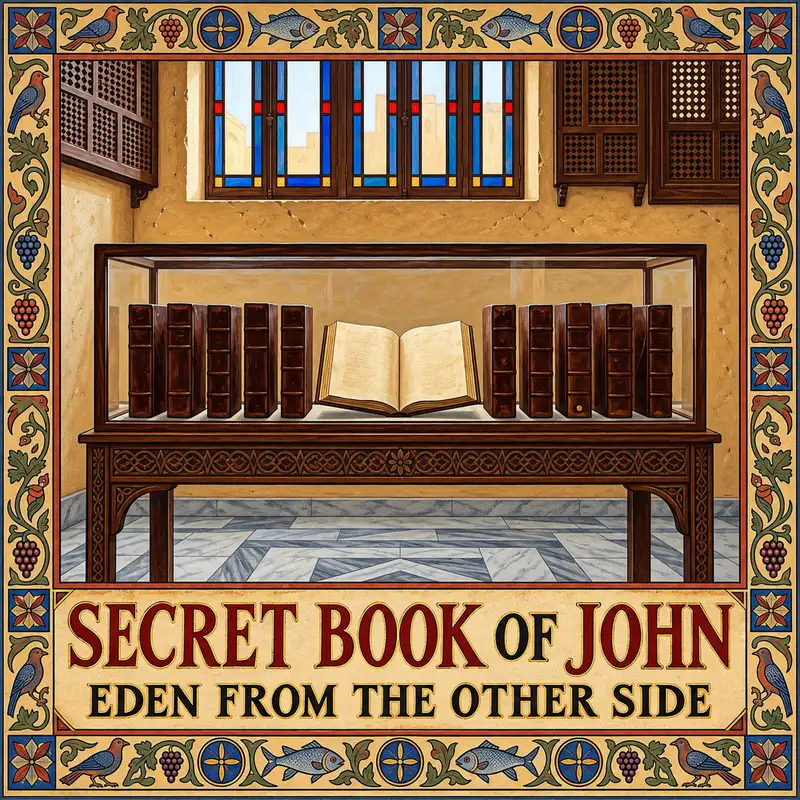
Let me give you the books first, as things, because we always do, and because these are the strangest objects in the season. They are not scrolls. That is the first thing. The cave manuscripts have mostly been rolls, leather or copper, wound and unwound. The copyist's books have pages too. These are books. Codices, the scholars say, which only means books with pages, folded and sewn and bound between covers, the way a book has been made ever since. They are among the oldest bound books in the world. The covers are leather, and some of them were stiffened with waste papyrus, old letters and accounts pasted in layers, and those scraps are part of the books' history. Scholars generally date these surviving copies to the fourth century. That is a date for the copies, not for the first making of their words. They are not large. That is the second thing, and it surprises people who have only seen the photographs. The pages are small enough for a book to be carried under an arm, and the leaves were made by cutting papyrus sheets, laying them, folding them once down the middle and stacking the folded sheets inside one another into a single thick gathering, so that nearly every one of these books is a single enormous fold, sewn through the spine, and the leather cover wraps round it with a flap that comes over the fore edge like the flap of an envelope, and a thong to tie it shut. You could carry one under your arm. Somebody did, out to the foot of the cliff, to the jar. The hands are careful, several different hands, a plain upright Coptic in black ink, and the lines fill the pages. Inside, papyrus, and on the papyrus, Coptic. I told you on the special night that Coptic is the old language of Egypt written in Greek letters, the way the church on the hill still writes Ge'ez, and that it was the language of the church in Egypt and still is, in its liturgy. What the books hold is Coptic translations of Greek originals, and for the book I am going to read you the Greek is gone, all of it, except where a church father described it to argue with it. So what is in the case in Cairo is a copy of a translation of a book whose original nobody has seen for seventeen hundred years. That is the object. Layer under layer, which, you will find, is also what the book is about. The book I am going to read you most of is the one the special called the Secret Book of John. It has other names, the Apocryphon of John, the Secret Revelation of John, which are all the same book under different names. It was in the jar more than once, in two lengths, a shorter telling and a longer one, and the longer one has in it a hymn near the end that the shorter one does not, and I will give you the hymn, at dusk, because it is the gentlest thing in the jar. And there is another copy of the short one that was not in the jar at all, but in a book that reached Berlin half a century before the jar was found, and sat in a drawer there, and I will tell you about that book on the ninth night, because it has a gospel in it with a woman's name, and it deserves its own room. Who wrote it. Nobody knows. Some time in the second century, a Christian, of a kind that other Christians very quickly decided was not one, in Greek, probably in Egypt or Syria. A church father in Gaul, about the year one hundred and eighty, wrote five books against people who believed things very like this, and described a system that is nearly this one, so we know it was in the air by then, and hated by then. That is the date, and that is the whole of the third layer for now. Second century, written. Fourth century, copied. Hidden at some later point. Nineteen forty five, found. Between those ancient readers and the modern finds, the surviving copies leave a long silence. One short copy reached Berlin before the jar was found. We cannot follow every reader who may once have held the book. And the copyist on the hill has never seen it, and never will, and it is not in his church's scriptural list or among the identified cave fragments, and I want you to hold that. Tonight's book is not part of the Ethiopian church's scriptural list, and in our story it has never reached the copyist's shelf. It is the turn for that reason too. We have gone from the room where the book is alive, to the room where it is kept, to the room where it was hidden, and tonight the book is the one that was hidden. Let me open it.
The book begins with a story, before it begins with the world, and the story is a man walking out of a building. It is John, the apostle, the brother of James, the son of Zebedee, and he has gone up to the temple, and a Pharisee stops him there, and the Pharisee has a name, Arimanius, which is a name that would have made a reader of that time think of the dark god of the Persians, and that is probably not an accident. Where is your master, the Pharisee asks him, and John says, he has gone back to the place he came from. And the Pharisee says, that Nazarene tricked you. He filled your ears with lies and turned you away from what your fathers taught. And John does not argue. He turns away from the temple and goes out to a desert place, and he grieves, and the book gives you his grieving as a list of questions, and the questions are the book. How was the saviour appointed, and why was he sent into the world, and who is his father, and what is that place we are going to, which he called an aeon and told us was like the imperishable one, and did not tell us what the imperishable one was like. That is what John wants to know. Not whether. What kind. What is the place like. And the word he uses for the place is one you will hear all night, so let me give it to you once. Aeon. In Greek it means an age, a long stretch of time, and in these books it also means a place, a realm, a level of heaven, so that when John asks what sort of aeon we are going to, he is asking, at once, how long and how high. The book never separates the two. Every level is also a length of time, and every length of time is somewhere you could stand. Hold that loosely. It is the reason the book can talk about the upper world as if it were a country and a history at once. And while he is standing in the desert asking, the heavens open, and everything under heaven shines, and the world shakes, and in the light there is a youth standing beside him, and as John looks the youth becomes an old man, and then a servant, and the book says it was not three people but one likeness with three forms, showing through each other. I told you this on the special night, John on the mountain, which this copy calls a desert place, and I will only add the words, because they are the book's first kindness and it has more than you would think. John, John, the figure says, why the doubt, and why the fear. You have seen this likeness before. Do not be timid. I am with you always. I am the Father, I am the Mother, I am the Son. And then it tells him why it has come, to teach him what is and what was and what is still to come, the hidden things and the open ones both, and it tells him to lift his face. And I will give you now how the frame closes, at the very end, because it belongs with its opening and I do not want to come back for it. When the figure has finished, hours later in the book's time, he says, he has told John everything so that John can write it down and pass it quietly to the others of his kind, because it is the secret of the race that does not waver. And he adds a curse, the only one in the book, on anyone who trades what he has heard for a present, or a meal, or a drink, or a coat, or anything else that can be had for it. A book that was not to be sold. And then, the book says, immediately he disappeared from him, and John went to his fellow disciples and told them what the saviour had told him. So the whole of what you are going to hear tonight is, in the book's own framing, what one man told his friends after a light spoke to him in the desert and then was gone. Not a scripture. A report. And the report was copied, in Coptic, in both of its lengths, and in more than one hand, which means that whoever copied it did not think of it as a secret at all. They thought of it as a book that needed more than one copy, the way you make more than one copy of anything you are afraid of losing, and they were right to be afraid, and the copies were not enough, and one was. Father, Mother, Son. Hold the middle one. The book is going to be about mothers more than anything else, about a mother who made a mistake, and a mother who came to correct it, and a mother hidden inside a man where the ones who made him could not find her. Whoever wrote this book had a mother in it from the first page. And then John asks, and the figure tells him, and the telling begins at the very top, above everything, and works down, and the way down is long, and I am going to walk it with you slowly, because the whole point of the book is how far it is.
At the top there is one, and the book cannot describe him, and instead of describing him it tells you every way in which he cannot be described, and I am going to give you some of that, paraphrased, because it is one of the most beautiful passages in the jar and because it is the sound a mind makes when it has climbed as high as it can and found nothing to hold. The One, the book says, is a monarchy with nothing above it. He is not a god, because a god is a thing you can compare to other things, and there is nothing to compare him to. He does not exist inside anything, because everything exists inside him. He is not perfect, or blessed, or divine, because those are words for things that are less than he is. He is not large and he is not small. There is no way to ask how much of him there is, or what kind. He is not one being among beings. He is eternal because nothing came before him to give him a beginning. He is unsearchable because there was nobody there before him to search. He is unnameable because there was nobody there before him to give him a name. He is light, the book says, pure and immeasurable, into which no eye can look. He does not partake of time. Time was not given to him, because he receives nothing from anyone, because to receive would be to borrow. He needs nothing. He is at rest, in silence, before everything. That is the top, and it is empty of anything you can picture, on purpose. And then the book does what the Parables did on the hill on the last night with the Lord of Spirits. It gives him water. He looks at himself, the book says, in the light that surrounds him, which is the spring of the water of life, and he sees his own image in the spring, and his thought becomes a deed, and she comes forth. She. The first thing after the One is a woman, and she is his own thought, the forethought of everything, and her light is like his light, and the book gives her a name, Barbelo, which I will say once and let go, and it calls her the first power, the womb of everything, the Mother Father, the first man. All of that at once. She is the first thing that ever was apart from the One, and she is his idea of himself, looking back at him. And she asks him for things, and he gives them, and each thing she asks for stands beside her. Foreknowledge. Indestructibility. Eternal life. Truth. Five, with her. And then she looks at him, and he looks at her with the light that surrounds him, and she conceives, and a spark of light comes forth, and the One anoints it with his goodness until it is perfect, and it is called, in this book, the Christ, the anointed, the only begotten, and I want you to notice that the telling has still not reached the making of the earthly world. This Christ is a light in the highest heaven, born of a thought, before there was anywhere for anything to happen. And from the Christ, four lights. The book names them and gives each of them three companions, twelve in all, and the twelve are things like grace and truth and form, perception and memory, understanding and love, perfection and peace and wisdom. Not places. Qualities, standing in ranks. And over the first of the four lights is set a perfect man, the first Adam, the heavenly one, whom the book calls by a doubled name, Adamas, with a strange word in front of it that nobody has ever translated for certain, and who is not the Adam of the garden at all but the pattern the garden's Adam was made from, the way a coin is made from a die, who praises the One in a sentence you should hear, because it is what the whole upper world is for. Everything came to be for your sake, he says, and everything will go back to you. And over the second light, his son Seth. And over the third, the seed of Seth, the souls of the holy. And over the fourth, the souls of those who did not know the fullness at first, and did not repent at once, but persisted for a while, and repented afterwards. Notice that. There is a place, in the highest heaven of this book, kept for people who took their time. The fourth light is for the ones who repented afterwards. And the fourth light is the one that, in a little while, when things go wrong, is going to come down. That is the whole of the upper world. The One. His thought, who is a woman. Her five. Their child, the light. His four lights and their twelve. The first man and his son and the holy and the slow. And with the light, a mind, because the light asked for a fellow worker and the One gladly consented, and with the mind a will, and with the will a word, because, the book says, the will became a deed and the word followed the will, and through the word everything above was made. Mind, will, word. Three things a person has, set at the top of the world as the tools it was built with. The book calls it the fullness, the Pleroma, and everything in it came into being in silence, and agreed, and nothing in it has happened yet, because nothing needed to. And then something does.
You know this part. I told it on the special night. One of the twelve, the last of them, whose name is Wisdom, Sophia, wanted to bring something forth out of herself, alone, without her partner's agreement and without the Spirit's consent. And she did. And I said then that what came out of her was a mistake, and that she hid it. Tonight I am going to give you the part I left out, which is what it looked like, and what it did, because the whole of the rest of the book comes out of it. The thing that came out of her was imperfect, the book says, and unlike her, because she had made it without her consort, and when she saw what she had done, it changed into the shape of a serpent with the face of a lion, and its eyes were like lightning. And she threw it away from her, outside the fullness, so that none of the immortal ones would see it, because she had made it in ignorance. And she wrapped it in a cloud of light, and set a throne inside the cloud, so that nobody could see it but the Spirit. And she gave it a name. Here it is. Once. The name she gave it was Yaldabaoth. And that is the last time you will hear it from me. He has two other names in the book, and I will give you one of them later, from a different book, once, because that book's whole story hangs on it. But that name is done. He is the maker. The chief ruler. The one in the cloud. From here on he is only what he does. And what he does, first, is take. He took a great power from his mother, the book says, and moved away from the place where he was born, and made himself other heavens, out of a fire that still burns, and then he made rulers for himself, twelve of them, one for each of the twelve above, in mockery or in ignorance, and the book names them, and I will not, except to tell you that two of the names are Cain and Abel, which tells you what the book thinks of the story it is retelling. And he set seven of them over seven heavens and five over the deep. And he shared his fire with them but not his light, because the light was his mother's and he was hoarding it. And the book says a thing here about light and darkness that I want you to have exactly, because it is the book's whole theory of the world we live in. When the light mixed with the darkness, it made the darkness shine. And when the darkness mixed with the light, it dimmed the light. And it became neither light nor dark, but dim. That is where we live. In the dim. Not the dark. The dim. Then the seven. The book gives them names and faces, and the faces are animals. The first has the face of a sheep, the second of a donkey, the third of a hyena, the fourth of a serpent with seven heads, the fifth of a dragon, the sixth of a monkey, and the seventh a face of shining fire. This is the sevenness of the week, the book says, so that the seven days you live inside are, in this book, seven rulers with the heads of beasts. And the maker himself has many faces, more than all of them, so that he can put whichever one he likes in front. And he gives each of the seven a virtue for a name, goodness, foreknowledge, divinity, lordship, kingdom, envy, understanding, and the book says those names were given for their destruction, and that they have two names each, and that the names they were given by their maker have power, and the names they were given from above mean their end. And then the line the whole book turns on, and you have heard it, and I will say it once more because it is the hinge and then let it go. He looked at what he had made, and at the crowd of angels around him that had come out of him, and he said to them, I am a jealous God, and there is no other God beside me. And the book stops, and says, but by announcing this he showed the angels who attended him that there is another God. For if there were no other, of whom would he be jealous. And his mother heard it. And she began to move to and fro. And John asks what that means, and the figure smiles, the book says he smiles, and says, do not take it the way Moses had it, hovering over the waters. No. When she saw the wrong that had been done, and what her son had stolen, she was sorry, and forgetfulness came over her in the dark, and shame, and she could not bring herself to go back up, and so she paced. That is the moving to and fro. A mother, outside the fullness, ashamed to go home, pacing. And the whole fullness heard her weeping, and the Spirit consented, and she was lifted up, not to her own place, but to the ninth heaven, just above her son, until she should mend what she had broken. And there she waits, above him, where he cannot see her, for the rest of the book. The ninth, I said. The book places his mother above him, away from her own realm while she waits for the lack to be corrected. It has given us seven heavens and a ninth, but it has not drawn every stair between them. I would not make a complete plan from these few words. What matters in the story is the distance. The maker has a world beneath him and a mother above him, and he does not understand the source of the light he took. Higher still are the lights and the twelve and the One in silence. He mistakes his own reach for the reach of everything. That is the mistake the book keeps showing us, in the cloud and the boast and the image in the water. It is the ceiling of a house with a house beyond it, and the one below has not seen the upper room.
And then a voice came from above, and the voice said, the Man exists, and the son of Man. And the maker heard it, and thought it was his mother, and did not know where it came from. And with the voice, an image. The image of the first man, the heavenly one, the one set over the first light, was shown, in the water, on the underside of the waters above the world, so that everything below was lit by it, and the maker and his rulers looked up and saw a shape in the water, a man of light, and wanted it. Come, the maker says to his rulers, let us make a man according to the image of God and according to our likeness, so that his image may become a light for us. And they did. Each of the seven made one part. The first made a bone soul. The second a sinew soul. Then flesh, then marrow, then blood, then skin, then hair. Seven souls, one for each ruler, and then the angels, hundreds of them, each one given one limb. The book lists them. One made the head. One the brain. One the right eye and one the left. One the right ear, one the left. The nose. The lips. The teeth. The molars. The tonsils. The throat. The right shoulder and the left. The elbows. The hands and the fingers of each hand and the nails. The ribs on each side. The belly. The navel. The heart. The lungs. The liver. The spleen. The kidneys. The spine. The knees, the feet, the toes, the nails of the feet. A name for each maker, and the book gives them all, pages of them, and then names the ones set over the senses, and the four demons of heat and cold and wet and dry, and their mother who is matter, and the four demons of pleasure and desire and grief and fear. And the book opens each of the four out. Out of grief it draws a whole family, envy and spite and worry and pain and hardness of heart and mourning. Out of pleasure, wickedness and an empty pride. Out of desire, anger and bitterness and a hunger that is never filled. Out of fear, dread and cringing and agony and shame. And then, in the middle of the list, a thing the book did not have to say. Every one of these, it says, can be turned to use as well as to harm. The passions are not simply the enemy. They are the makers' work, and the makers made them double, and grief, which brings mourning, also brings care. And then it says, if you want the rest, it is written in the book of Zoroaster. And it counts them. Three hundred and sixty five angels, one for each day of the year, worked on him, limb for limb, until the body was finished. And it did not move. The book says their product was completely inactive and motionless for a long time. A man on the ground, built by committee, every part named, and nothing in him. That is what the rulers can make, in this book. A perfect body that will not get up. And here is the trick, and it is the kindest trick in any book I know. The mother, above, wanted her power back, the power her son had stolen, and she asked the Mother Father of everything, and he sent down five lights, the book says, and does not say which five, to the place where the maker was, in the likeness of his own angels, and they advised him. Blow into his face something of your spirit, they said, and the body will rise. And he did. He did not know what he was doing. He breathed into the face of the thing on the ground the spirit that was his mother's power, the only light he had, and it went out of him and into the man, and the man moved, and grew strong, and was luminous. So the maker was tricked into giving away the one thing he had stolen, and it went into us. That is the book's account of the breath of life. Not a gift from the top. A theft, recovered, by a trick, from a thief who did not know he was being robbed. And at once the rulers were jealous, because the man could think better than they could, and was free of wickedness, and shone. So they took him and threw him down into the lowest part of matter. And the Mother Father, who is merciful, the book keeps saying that, sent him a helper, a light called Insight, and the book says her name too, Epinoia, and I will call her Insight, and she is called Life, and she was hidden inside Adam where the rulers could not find her, to wake him when it was time. And the rulers, seeing he was still too bright, took fire and earth and water and wind and made him a second body out of them, a heavy one, and the book calls it the tomb, the bond of forgetfulness, the thing the robbers dressed him in, and that was when he became mortal. And then they put him in a garden, and told him to eat, and the book says their trees are godlessness and their fruit is poison and their promise is death. The tree of life, in this garden, is theirs. Its root is bitter, its branches are death, its shadow is hate. And the tree of the knowledge of good and evil, the one you were told not to touch, is Insight herself, and the rulers stood in front of it so that he would not look up and see what he was.
But it was I, the figure tells John, who brought it about that they ate. And John asks, was it not the serpent. And the figure smiles again, he smiles a great deal in this book, and says the serpent taught them to eat from the wickedness of begetting, lust and destruction, so that the man would be useful to the maker. I told you on the special night that in this book the serpent tells the truth. That was a fair summary of the whole family of books in the jar. In this particular one, I have to be more careful, and I will be. The serpent is not the hero here. The hero is the figure speaking, who says, I did it. And the thing that follows is the reason. The maker, seeing that Adam would not obey him, because of the Insight in him, wanted to get his power back out of the man, and so he brought a forgetfulness over Adam. And John asks what the forgetfulness is, and the figure says, it is not the way Moses wrote it. Not a sleep. A veil over his perception. And then the maker tried to take Insight out of Adam's side, and could not, because Insight cannot be grasped, and darkness pursued her and did not catch her. So he took part of the power instead, and made a second creature from it, in the form of a woman, in the likeness of the Insight he had seen. Not a rib, the book says. Not as Moses said. That is the third time, if you are counting, that the book has stopped to say, not as Moses said, and there is a fourth coming. The spirit moving to and fro, not over the waters. The sleep, not a sleep. The rib, not a rib. And the ark, when we come to it, not an ark. The book has Genesis open beside it the whole way and corrects it, line by line, gently, the way you would correct someone who had heard a story from the other end of the house and got the outside of it right and the inside wrong. It never says Moses lied. It says Moses wrote what could be seen from below. That is what the whole jar thinks of the Bible, when you come down to it. Not that it is false. That it is the view from the seventh heaven, and that there is a ninth. And Adam saw the woman beside him, and in that moment Insight appeared and lifted the veil from his mind, and he became sober from the drunkenness of the dark, and he knew her, and said, this is bone of my bones and flesh of my flesh. And then the figure says a thing I want you to hear as nearly as I can give it, because it is the turn inside the turn. I came, he says, as an eagle, sitting on the tree of knowledge, to teach them and to wake them out of the depth of their sleep. An eagle on the tree. Not a serpent. The figure of light, sitting in the branches of the tree the rulers had forbidden, so that when the two below looked up they would see it, and eat, and wake. And they did, and they saw that they were naked, and the maker cursed his earth, and cast them out, and clothed them in gloomy darkness, and the book says he saw the woman, and that the Insight of life had appeared in her, and that he was full of ignorance, and that the foreknowledge of the All saw it and sent some to snatch Life out of Eve before he could reach her. And now I have to tell you one thing that the book tells, and I have thought hard about how, and I am going to do it the way the book does, in one paragraph, and then set it down and not return. The maker took Eve, and had two sons by her, and their names in the book are Eloim and Yave, and one has the face of a bear and one the face of a cat, and he called them Cain and Abel to deceive, and he set one over fire and wind and one over water and earth. And another book from the same jar, which we will come to, tells the same thing more gently, and I will give you its version now, in its own image, so that you have both and can keep whichever you can bear. In that book the rulers chased her, and she mocked how little they could see, and in their grasp she became a tree, and left behind her a shadow of herself, a reflection, and it was the shadow they took. Not her. Her shadow. She was already gone into the tree. That is what the book says, and that is all I will say, and it is set down. And then, because the book cannot leave anyone without a rescue, Adam knew his own likeness, and begot a son who was like him, and called him Seth, after the one above, and the mother sent down her spirit to prepare a place for the ones who would come after, and the maker made them all drink the water of forgetfulness so that they would not know where they came from. And the seed stayed, hidden, waiting, so that when the Spirit came it would have something to wake. I want to stay one moment on the water of forgetfulness, because it is the book's quietest idea and the one you can use tonight. The book says every soul that comes down is given it to drink, so that it will not know where it came from, and that the whole work of the Spirit afterwards is to make the soul remember. Not learn. Remember. Everything the book calls knowledge is a kind of recognising, the way Adam recognised the woman and said, this is bone of my bones, the way John recognised the light and was told, you have seen this likeness before. The book's whole idea of being saved is that you already know, and drank something, and have to be reminded. That is a gentle idea to fall asleep inside. You are not being asked to find anything out. Only to remember, slowly, what you drank away.
Here is the turn. I have been walking you toward it for six nights and I am going to put it down in front of you gently, and then leave it there. Before the flood, the book gives the maker one more thing to make, and it is the thing most people alive have felt without a name for it, and the book names it. When the maker saw that the ones below him thought better than he did, and that he could not seize their thought, he made a plan with his powers, and out of the plan was begotten bitter fate. The book uses the Greek word for it, the thing the stars fix, the lot you are born to. And it says fate is the last of the changeable bonds, and harder and stronger than anything the gods and angels and demons ever made, and that out of fate came every wrong and every lie against heaven, and the chain of forgetting, and every hard commandment and every great fear, and that by it the whole of creation was blinded, so that it would not know the God above it. Everything, the book says, is tied down by its measures and its times and its moments, because fate is the master of all of it. Measures and times and moments. Whoever wrote that had looked at a calendar, and a clock, and a birth chart, and found in all three the same bond. The people of the caves loved the year and its measures and called them the tablets of heaven. This book calls them chains. Same sky. Turned over. The maker, the book says, repented of everything that had come into being through him. That is the one sentence in the book where he is allowed to feel something, and what he does with the feeling is plan a flood. He decided to bring a flood upon the work of man. But the light that knows things beforehand warned Noah, and Noah warned everyone, and the ones who were strangers to him would not hear it. And then the book says, it is not as Moses said, that they hid in an ark. They hid in a place. Not Noah alone, but a crowd of others from the race that does not waver, and the place they went into was a cloud of light, and they stood inside it while the maker put the whole earth into the dark. No ark. A cloud. The people who could be saved were not saved in a box on the water. They were saved in a light, standing still, while the dark went over. Hold that. The next book will put Noah's ark beside a woman whom Noah will not admit. And then. And he laid a plan with his powers. He sent his angels down to the daughters of men, to take some of them for their own and to breed children from them for their pleasure. There it is. Listen to who is speaking. In the book on the hill, the two hundred came down on their own oath, against heaven, and heaven judged them. In this book the maker sent them. The rulers made the plan. The descent was not a rebellion. It was policy. And the book goes on, and every beat of it is the beat you know. At first it did not work. So they made a false spirit, a copy of the true one, to soil the souls with, and they put on the likeness of the women's own husbands, and filled the women with a spirit of darkness. And they came bearing gifts, the book says, gold and silver and copper and iron and metal and every kind of thing. And they drew the people who went after them into great trouble, one deception after another. And the people grew old and had no joy of it. They died without ever finding the truth, without ever knowing the God of truth. And so the whole creation has been in bondage, the book says, from the founding of the world until now. Gold and silver and copper and iron. The metal crafts echo Azazel's teaching, from the first special and the first night of the season. The same daughters. The same trouble. But in this book nobody in heaven cried out, and nobody in heaven sent four archangels down, and nobody bound anyone under the hills, because the one who would have had to do the binding is the one who sent them. That is what the turn is. It is not a new story. It is the story you know, with the sky turned over, so that the ones who came down were obeying, and the God who judged them in the old book is, in this one, the one who gave the order. I said at the door it was not a cruel book, and here is why it is not, even here. Look at what it says the angels' crime was. Not the metals. Not the daughters, quite. It is that the people grew old and had no joy of it. They died without finding the truth. The book's whole grief is that people are made to live in the dim, and grow old in it, and never find out what they are. Everything else, the rulers and the faces and the seven heavens, is the writer's attempt to explain how that could be true in a world that was supposed to have been made by somebody good. His answer was that it was not. That somebody good was much further up, and had been sending help down through the layers, quietly, all along, and the help was a woman hidden inside you. Set it down. That is the turn, and the night goes down from here. And I want to give you one more piece of it before the other two books, because it is the book's whole answer and it is also, I think, one possible reason a reader might have wanted to keep it. John asks, at the end, will all the souls be saved. And the figure says, the ones on whom the Spirit descends will be saved, and be perfect, and be purified. And John asks, and the ones on whom the Spirit descended but who did not do the works. And the figure says, if the Spirit descended on them, they will in any case be saved. In any case. And John asks about the ones who did not know at all, and the figure says, their souls are handed over to the rulers, and chained, and put in a prison, and kept company there, the book says, until they are freed from the forgetting and come to know, and if they come to know fully, they are saved. And John asks how a soul can shrink like that and still come back. And the figure is glad of the question, the book says, and tells him he is blessed for having understood. That soul is set to follow another soul, and it is not sent down into another body. The lasting loss it singles out is for those who turn away and speak against the Spirit. For the others, it describes ways of learning and release, even after failure and forgetting. It is a book about layers, and the layers go both ways.
The second book from the jar is short, and it is the hinge of the night, because it is the same story told by the one person who was there for all of it, and it is told the way a father tells a son something at the end of his life. It is called the Revelation of Adam, and it begins, what Adam revealed to his son Seth in his seven hundredth year, and it opens with the father asking the boy to listen. And what follows is Adam remembering. When God made me out of the earth, he says, and your mother Eve with me, I walked with her in a glory she had seen in the world we came from. She taught me one word of the knowledge of the eternal God. And we were like the great eternal angels, because we stood higher than the god who had made us, and the powers around him, and we did not even know they were there. Higher than the god who made us. That is the whole of the Secret Book, in one line, said by Adam, to his boy. And then, he says, the god who ruled the powers divided us in wrath, and the glory left our hearts, and the knowledge that had breathed in us fled from us and went into the seed of the great generation, which is you, my son, which is why I called you by that name. And since then, Adam says, we learned about dead things, like men. And we recognised the god who had made us, and we served him in fear and slavery, and our hearts went dark. And then he sleeps, and three men come to him, whom he cannot recognise, because they are not the powers of the god who made him, and they say, get up, Adam, out of the sleep of death, and hear about the seed of the man to whom life has come, the one who came from you and from Eve. And when he wakes and tells Eve, they sigh, and the god who made them is standing there, and says, why the sighing. Do you not know that it was I who made you, and I who breathed the breath of life into you. And darkness came over their eyes, and their days grew few, because, Adam says, he knew then that death had authority over him. And then Adam tells Seth what the three men told him, and it is the future, and it is the flood, and you know the flood. The rain will be poured out to destroy all flesh because of what it seeks after. And great angels will come on high clouds and carry the ones who have the knowledge to the place where the spirit of life dwells, and the rest will be left behind in the waters. And God will rest from his wrath, and give the earth to Noah and his sons, and Noah, the book says, whom the generations will call by another name, and it gives the name, and the name is Greek, Deucalion, the man who in the old Greek story survived a flood in a chest with his wife and threw stones over his shoulder that became people. So this Egyptian book, in Coptic, has Adam tell Seth that the Greeks will remember Noah under their own name for him, which is the kind of thing a reader in Alexandria in the second century would have known and smiled at, and which is a hint about where the book was read. Noah will be told that none of the men who will not stand before this god are to come from his seed. And then Noah will be accused of having made another generation, and he will swear that it did not come from him or from his sons, and those men will be taken to a land of their own, and live there in a knowledge of imperishability, with the angels of the great light dwelling with them, and no foul deed in their hearts. So in this book too there are the ones in the cloud and the ones in the water, and the ones in the cloud are not Noah's, and Noah does not know where they came from. And then the book does a thing that nothing else in the jar does, and it is the reason I put it here, at the bottom of the night's descent, because it is the softest landing in the season. It tells the future in kingdoms. Thirteen kingdoms, each of which says something different about the one who will come, the illuminator, the light that comes down. The first kingdom says he came from a spirit and was nourished in the heavens and came to the water. The second says a bird carried him as a child to a high mountain and fed him. The third says he came from a virgin, and was cast out of his city with his mother, and raised in the desert. The fifth says he was a drop from heaven thrown into the sea, and the deep received him and gave birth to him. The sixth says a woman went down to gather flowers and became pregnant from the desire of the flowers. The seventh says dragons brought him down to caves. The eighth says a cloud came upon a rock and he came out of it. The ninth says one of the nine Muses went up a mountain alone. And each one ends the same way, and thus he came to the water. Thirteen guesses, thirteen stories, every one of them a story you half know from somewhere, the child on the mountain, the child in the sea, the child of the flower, and every one of them wrong, the book says, and then the fourteenth voice, which is the generation without a king, says only that God chose him from all the aeons, and that he came out of a foreign air, and made the ones he chose shine. I do not think anybody who has read that has ever been sure what the thirteen kingdoms are. Thirteen religions, some say. Thirteen myths of a saviour. Thirteen ways people tell a birth. What I know is that it is the one place in the jar where the book stops arguing and just listens, patiently, to everybody else's story, and lets each one end with the same quiet line, and thus he came to the water, before it says its own. It is a list, and you can let it go by like water. That is what it is for. And the book ends, after the guessing, with a thing about books that I keep for the end of this chapter because it is the opposite of everything the copyist does. The words the true generation kept, it says, were never put in a book, never written at all. Angels will carry them, angels the generations of men will not recognise, and they will keep them on a high mountain, on a rock of truth. A revelation that says of itself that it was never written down, written down, in Coptic, in a book, in a jar. The people who copied it did not think that was strange either. Nobody who copies ever does.
The third book from the jar is the one I said had a story hanging on a name, and it is short, and it begins as a letter. Somebody has written to ask about the rulers, the authorities of darkness the apostle warned about, and the letter begins by quoting him, the great apostle, it calls him, who said that our contest is not against flesh and blood but against the authorities of the universe and the spirits of wickedness. That is Paul, in the letter to the Ephesians, not named but unmistakable, quoted as the great apostle in a book outside the bishops' approved lists. The jar is full of that. People who thought they were the true readers of the apostles, quoting the apostles, on their way into the ground. And the writer answers, and the answer starts at the very moment the special night started, the boast, and then goes somewhere the Secret Book does not. Their chief is blind, the letter says. Out of his power and his ignorance and his pride, he said that he alone was God and there was no one else. And in saying it, he sinned against the whole. And the words went up, and out of the incorruptible a voice came down, and the voice said, you are mistaken, Samael. There is the name, and I am saying it once, and it is the name of this book and not the other, and it means, the letter says, god of the blind. That is who the maker is in this book. Not a serpent with a lion's face. A blind god, told he is mistaken by a voice from above him that he cannot see. And the letter says his thoughts became blind, and he chased his own boast down into the abyss, which is his mother. And then the letter tells the making of Adam again, quickly, and it is the same, the image in the water, the rulers wanting it, the man of soil who could not stand up, the spirit coming down from the Adamantine Land into him, and the naming of the animals, and the garden, and the sleep. And in this book the sleep is called what it is. The deep sleep they caused to fall on Adam, the letter says, is Ignorance. And they opened his side, and a woman came who was spirit, and she said, arise, Adam, and he said that she was the one who had given him life, and that she would be called the mother of the living. And then the snake, and in this book the snake is called the instructor, and the female spiritual principle came into the snake, the letter says, and taught them, and she promises, in my words, that eating will not bring death. She tells them the prohibition comes from jealousy, and that their eyes will be opened to knowledge of good and evil. And then she left the snake, and it was only a thing of the earth again. And the rulers cursed the snake's shadow, not knowing it was a form they had made. Everything in this book is a shadow or a form. The rulers cannot get hold of anything real. They keep grabbing reflections. And the letter goes on through Cain and Abel and Seth, and then a fourth child, and this is the book's own, and the reason it is here. Eve conceived again, the letter says, and bore Norea, and said over her that a virgin had been given her, a help for many generations of people to come. She is the virgin, the letter says, that the powers never touched. A daughter. Genesis does not have her. The jar has her in one or two other books, and the church fathers had heard of her, and the Bible never. And the rest of the letter is hers. But before her, the seventh heaven, because it is the strangest and kindest thing in the book and I do not want to lose it. Wisdom, in this book, when the blind god boasted, stretched out her finger and put light into matter, and her daughter, whose name is Life, breathed into his face, and her breath became an angel of fire, and the angel bound the blind god and threw him down below the abyss. And one of his sons, whose name is Sabaoth, the lord of hosts, saw the angel's power, and repented, and condemned his father and his mother, who is matter, and sang praises up to Wisdom and to Life. And Wisdom and Life caught him up and gave him charge of the seventh heaven, just below the veil between above and below. And he made himself a chariot of cherubim with four faces, and angels without number to serve him, and harps and lyres. And Wisdom set her daughter Life at his right hand to teach him about the eighth heaven, and the angel of wrath at his left. Since that day, the letter says, his right has been called life. The letter goes further about the blind god's making than the Secret Book does, and it is worth a moment, because it is where the word shadow comes from. Within limitless realms, the angel says later, dwells incorruptibility. And Wisdom wanted to make something alone, and her product was a celestial thing, and between the world above and the worlds below there hangs a veil, and under the veil a shadow fell, and the shadow became matter. Matter is a shadow. The thing you are lying on, and the thing you are, is the shadow a veil cast when Wisdom made something without her partner. And what she made took shape in the shadow, like a child born too early, and became an arrogant beast like a lion, and opened its eyes, and saw a vast quantity of matter without limit, and said the thing. It is I who am God. So in this book the boast is what a creature says when it opens its eyes on the dark and sees no one else. It is not wickedness, quite. It is loneliness, with power. A son of the blind god who repented, and was given the seventh heaven, and a chariot, and music. That is what this book does with the God of the Bible's own title, lord of hosts. It makes him the one ruler who turned round. And from that day, the letter says, the blind god envied him, and envy engendered death, and death filled the heavens below with its children. But below the veil, in the seventh heaven, there is a chariot and a harp and a woman at the right hand who is called Life, teaching a repentant ruler about the heaven above his own.
Now the daughter. And this is the book's flood, and it is the last flood of the night, and after it the night is only quiet. In the next part of the letter, the rulers decide that a flood will clear the world of people and animals. Their plan does not stay secret. Another power, called the ruler of the forces, warns Noah. Build a vessel of lasting wood, he tells him, and shelter your children and the creatures in it, and put it on a mountain. Noah builds it. But Norea wants a place aboard, and Noah will not give her one. She sends her breath against the vessel and destroys it by fire. Noah has to begin again. Eve's daughter, whom the forces did not defile, was refused a place in the ark, burned it with her breath, and made Noah start over. I have thought about that sentence more than any other in the jar. It reminds me of the Secret Book's cloud, another rescue beyond a vessel, but the two books do not tell the same episode. Here Norea wanted to board, and Noah said no. Her breath is the answer the story gives. Noah builds it again. The letter does not say whether she got in the second time. I do not think she did. Then the rulers approach Norea, intending to mislead her. Their chief claims that Eve had submitted to them. Norea refuses his claim. What they knew was a counterpart of their own, she tells them, never her true mother. She belongs to the world above them, and they have no right to her. The chief turns threatening and demands her service. Norea appeals beyond him, to the holy one, asking to be rescued from the powers that have her in their grasp. And an angel came down. And the angel said to her, why are you shouting up to God. Why so bold toward the holy spirit. And she asked who he was. And the rulers had already gone. And the angel gave his name, Eleleth, which he glossed as understanding, the great angel who stands before the holy spirit, sent down to speak with her and to take her out of the hands of the lawless, and to teach her, he said, where she came from, her root. Eleleth. The fourth light. The one, from the Secret Book, who is set over the ones who took their time and repented afterwards. That is who comes down, in this book, when a woman shouts. And here the letter changes its voice, and Norea herself speaks, and she says, that she cannot describe his power, that he looked like fine gold and was dressed like snow, and that her mouth could not manage his power or his face. And he asks her whether she thinks these rulers have any hold on her. Not one of them, he says, can stand against the root of truth. They cannot touch her, or her generation, because her home is in the incorruptible, where the virgin spirit lives. And then she asks him, the way John asked, how did the rulers come to be, and he tells her, and it is the story you have heard tonight twice, Wisdom without her partner, the shadow under the veil that became matter, the thing like an aborted child that took the shape of a lion, the boast, the voice, you are mistaken. And she asks, am I also from their matter. And he says no. She and her children are from the first father. From above. Out of the light that does not perish. And she asks, how much longer. And he tells her that a true man will come, within a modelled form, and teach them, and anoint them, and then they will trample death underfoot, and the authorities will give up their ages, and their angels will weep, and all the children of the light will say with one voice, the father's truth is just, holy, holy, holy, amen. And one more thing the angel tells her, and then the words. What was sown, he says, will not be known yet. Three generations on, it will be. Three generations. It is the only date in the book, and it is not a date, it is a patience. The prophecy gives the seed a future beyond recognition in the present. I hear patience in it, though the three generations are not a date we can set against the writer's own readers. In the story the promise is spoken to Norea by the angel whose appearance she can scarcely describe, gold and snow beside the memory of the ark. Holy, holy, holy. The same three words the ones who sleep not were saying on the last night, in the Parables, on the hill. The book from the jar ends on them too. Whatever else these two books disagree about, and they disagree about which way is up, they agree about what is said at the end, and by whom, and that it is said forever.
The third layer, the readers, and one question first, because you have been asking it all night and I said at the door that the book answers it, in layers, so here is the answer. If the highest one is good, and merciful, and knows everything, and the maker is blind, and the world is the maker's, why does the highest one not simply fix it. Why the layers. Why the trick with the breath and the woman hidden in the man and the eagle in the tree and the three comings. Why not reach down and take the world away from the one who does not deserve it. This is the question I hear beneath the book, and the answer I hear is a temperament. The highest one does not act. That is what makes him the highest. He is at rest, in silence, before everything, and he does not reach, because reaching is what the maker does, and the maker is what you get when something reaches without its partner. So everything the highest one does, he does by consent. The book says it a dozen times. He consented. And when the invisible Spirit had consented. Every layer of the fullness came into being by somebody asking and the One agreeing, and nothing was ever seized. And the one time something was made without consent, you got the world. So the highest one cannot fix the world by force, because force is the disease. He can only send down what he is, which is light and consent and a voice that says, you are mistaken, and wait for somebody to hear it. I do not offer you that as true. I offer it as what the book thinks, and as the reason the book ends the way it does, with a hymn about a voice coming down three times into the dark and being heard once. And that hymn is the last thing I will read you tonight, at dusk, because it is dusk in the book too. But first, who read it. Christians, of a kind. In the second century, in Egypt and Syria and Rome, there were people who called themselves followers of Jesus and read books like this one, and the bishops of the other kind wrote against them at enormous length, and won, and in the fourth century such books stood outside the list in a bishop's Easter letter. One theory connects that conflict with the hiding of the books in the jar, but the hiding has left us no explanation. I told you that on the special night. What I will add is what the books were to the people who read them. Their communities are difficult to reconstruct. Some of these ideas were debated among Christians, and the surviving books do not give us one account of how all their readers lived. Nobody was hunted for a jar. Nobody was killed for the Secret Book of John, so far as anyone knows. The arguments ran for generations, and these works stood outside the approved scriptural collections. Copies survived in the Nile valley, inside a jar. Why they were put there remains a question. The Secret Book of John also survived in another codex, the one later bought for Berlin. Two more things about the readers, and then the sentence, and then the hymn. The first is the word. You will have heard these books called Gnostic, and I have not used the word tonight, and I will not, because the people who wrote them did not, mostly, and the scholars now argue about whether it means anything, and the copyist would not know it, and the season does not need it. These books give knowledge of who a person is a central place in rescue. That is one way to describe what they offer their readers. The second is the room. The museum in Cairo stands inside the old walls of Coptic Cairo, on ground the Coptic church gave, beside the church's own oldest churches, and it was built by a Copt to keep what the Copts had made, and the Egyptian state has run it for the better part of a century. The church itself is alive, the way the church on the hill is alive, and it has kept Coptic in its worship through many centuries. These books are not part of its scriptural canon. It keeps the Gospels, in Coptic, and reads them on Sunday. The books from the jar sit in that museum as history, in the same building as the church's icons and its carved wooden doors, and I want that said plainly, because the living church and the ancient readers of these hidden books need not have drawn the same scriptural list. Second century, written. Fourth century, hidden. Never Jesus, never Qumran, never the hill. The Watchers the rulers sent were written down four hundred years after the Watchers who came down on their own, by people who had read the first story and turned it over. That is the whole of the third layer and I will not make it more. And this is the place for the sentence, and it means more tonight than on any other night. An authentic book is not the same as a true event. The Secret Book of John is authentic. It was written when I said, by people like the ones I said, and it says what it says, and it is in a case in Cairo, and you can look at it. What it is evidence of is that some people, seventeen hundred years ago, looked at a world they found badly made and decided that the fault could not be at the top. That is not a fact about the world. It is a fact about them. And it is a fact about you too, if you have ever lain awake and thought the same thing, which is why the book is not frightening, in the end. It is company. Now the hymn. It is in the long version only, near the end, and the figure who has been speaking to John stops explaining and simply says who he is, and what he did, three times. I am the richness of the light, he says, and the memory of the fullness. And he tells how he went down into the dark, and kept going until he stood in the middle of the prison, and the foundations of chaos shook. And he hid himself from them, because of their wickedness, and they did not know him. And he went back up, and came a second time, and walked about inside the dark, in the dark place itself, and again the foundations shook, and he ran back up to his root of light so that they would not be destroyed before their time. And a third time he went, and this time he says what he is, the light that lives inside the light, the memory of the forethought, and he went into the middle of their prison, which is the prison of the body, and he said, whoever hears this, get up out of the deep sleep. And he wept, the hymn says. He cried, and wiped away bitter tears, and asked who was calling his name, and where a hope like that could have come from, to him, in chains, in a prison. And the voice said, I am the forethought of the pure light. Stand up, and remember that you are the one who heard, and follow your root, which is me, the merciful one. And I raised him, the hymn says, and sealed him in the light of the water with five seals, so that from then on death would have no power over him. Five seals. The book does not say what they are. Many scholars think they were a rite, a baptism, water and five sealings, that the people who read this book went through, and that the hymn is what they heard at it, or near it, and that the man weeping in the prison is every one of them, on the day they were sealed. If that is right, then the gentlest thing in the jar is not a poem. It is the memory of a ceremony, written down by somebody who had stood in the water and been told, stand up, and remember. I cannot prove that. Nobody can. But it is the kind of thing a book keeps for, and I would rather you had it than not. Three times down. Twice unheard. The third time, one man weeping, asking who called his name. That is the whole book, in the end, and it is not about the rulers at all. It is about a voice that keeps coming, and a man in the dark who finally hears it, and the first thing he does is cry.
The hill. The rain. The lamp. We have been in Cairo all night, in the third room, with the hidden book, and now we come home, because every night ends here, and because the copyist does not know any of what I have told you tonight, and never will, and I want you to see what that looks like. He is where he always is. The board across his knees, the last gathering on it, more than half filled, and tonight he has written, a column, slowly, and his hand aches, and he sets the reed down and sits with his hands in his lap, the way he does. On the shelf behind him the old Enoch and the heavy book of the years, and in the box the leaves he has done. In the room I have pictured, the book from the jar is absent. The bishop who wrote the Easter letter also ordained this country's first bishop; the churches were connected. That does not prove his letter caused the books to be buried. When the Ethiopian church made its own scriptural lists, in its own time, this book was not included. Its lists did not simply repeat the list in the bishop's letter. The Book of Enoch is scripture in the Ethiopian Orthodox Tewahedo Church today, and the book from the jar is not, and the copyist has never had to choose, because the choice was made before anyone on this hill was born, and it was made by keeping. And here is the thing I brought you home for. The book on his shelf and the book in the case in Cairo tell the same story. The sons of heaven came down to the daughters of men, and taught them metals, and the world went wrong. He has copied that story, in Ge'ez, from the old book to the new one, with the name in red. And the book in Cairo, which he has never seen, says the same words and means the opposite, that the ones who came down were sent by the one he calls God, and that the one he calls God is a blind thing in a cloud who does not know his mother is above him. And the copyist would, if you told him, set down his reed and look at you with the same face he gives the rain. Not because he is simple. Because he has the book. He has had it all his life. He has copied it. He knows what it says, and it says the Most High judged them, and that is written, in red, and a book from a jar in a country he has never seen does not reach the hill. I do not tell you that to say he is right. I tell you that to say what keeping is. The people who read the Secret Book gave the old story another sky. Their copies survived, though we do not know why the books from the jar were put away. On this hill I have pictured a different history of keeping. The Ethiopian church remained part of the Christian world and kept a scriptural collection of its own. Its books were not preserved simply because no argument could reach the highlands. People copied them. The rain is ours to imagine; the survival of the manuscripts is something we can examine. And in our room the copyist is still copying, the last gathering is more than half filled, and the box will be full by the end of the month. And I will tell you the one thing the two books share that neither of them knows. Both of them were kept by copying. The one on the hill by a chain of hands that never broke, and the one in Cairo by a hand that made a fair copy in Coptic in the fourth century. How that copy came to be hidden is still a question. Every book that reaches you was carried by somebody who decided, once, not to let it go. The copyist on the hill is that somebody, tonight, for his book. Somebody in Egypt was that somebody, once, for the other. They would not have understood each other. They did the same thing. He stands. He puts the board flat on the floor where he will find it. He touches, on the shelf, the spine of the heavy book, and then the spine of the old Enoch, the way you touch the shoulder of someone asleep, to make sure. And he looks at the lamp, and lets it burn. Let the room be as it is. Let the rain go on. It was never asking anything of you. It was only there, the way it was there for the copyist, and for his teacher, and for every one of them, back and back, and the way the light was there, in the book from the jar, coming down three times into the dark, for whoever was awake enough to hear it, and then letting him sleep. In the morning somebody will open the door, and the light will come in across the floor, and the books will be on the shelf where they have always been, and the box will be a little heavier, and the last gathering will be on the floor with a column more on it than there was, and nothing on the hill will have turned over in the night. But that is the morning, and the morning can wait. Sleep well. Goodnight.